
大领主El Grande
一句话概览
大领主 是一款已收录于村了吗规则库的桌游,支持 2–5 人,原名 El Grande。
本页内容:一句话概览 · 游戏概述 · 1. 游戏组件 · 2. 游戏设置 · 3. 游戏流程 · 4. 城堡(Castillo) · 5. 国王与国王所在地区 · 6. 行动牌叠层详解 · 7. 计分规则 · 8. 游戏结束 · 关键规则与常见问题 · 常见问题
大领主 规则速览
以下规则速览由本站整理,与官方规则书表述不同,仅供快速上手参考。
游戏概述
15世纪西班牙,玩家扮演贵族势力,通过在各地区部署骑士(Caballero)争夺多数控制权,获取胜利点数。每3回合进行一次区域计分,终局得分最高者获胜,被尊为"大领主"(El Grande)。
核心机制: 多数争夺、手牌管理、隐秘信息、区域控制
1. 游戏组件
| 组件 | 说明 |
|---|---|
| 游戏板 | 1块,标有西班牙各地区及计分轨道 |
| 骑士(Caballero) | 每位玩家若干,分为省区(Province)、宫廷(Court)、场上地区三个去向 |
| 大贵族(Grande) | 每位玩家1个,标记故乡地区 |
| 权力牌(Power Card) | 每位玩家一组,数值用于决定回合顺序与补给量 |
| 行动牌(Action Card) | 5叠,每叠若干张,提供放置骑士与特殊行动 |
| 国王棋子 | 1个,标识国王所在地区 |
| 秘密转盘(Secret Disc) | 每位玩家1个,用于秘密选择地区 |
| 计分标记 | 每位玩家1个,用于在计分轨道上移动 |
| 移动计分板 | 2块,可覆盖地区原有计分板以改变分值 |
| 起始玩家标记 | 1个 |
2. 游戏设置
- 将游戏板放在桌面中央
- 每位玩家拿取1个大贵族放在自己的故乡地区(各玩家颜色对应)
- 每位玩家的骑士分为省区、宫廷两组:大部分放在省区,少量放在宫廷
- 每位玩家获得一组权力牌和1个秘密转盘
- 5叠行动牌分别洗匀,面朝下放在游戏板旁
- 移动计分板放在游戏板旁备用
- 随机决定起始玩家,将起始玩家标记交给该玩家
3. 游戏流程
游戏共进行 9回合,每3回合(第3、6、9回合结束后)进行一次大计分。也可选择6回合短局,每2回合计分一次。
每个回合按以下阶段顺序执行:
3.1 翻开行动牌
翻开每叠行动牌堆顶的1张牌,共5张,展示给所有玩家。
3.2 打出权力牌
从起始玩家开始,顺时针每人打出1张权力牌面朝上放在自己面前。同一回合内不得打出其他玩家已打出的相同数值的权力牌。
权力牌决定两件事:
- 回合顺序: 数值最高的玩家先行动,依次排列
- 补给量: 牌中央的骑士图标数量表示本回合可从省区取入宫廷的骑士数。数值越高的牌,补给量越少
3.3 玩家轮流行动
按权力牌决定的顺序,每位玩家依次执行一次行动,包含以下两步:
步骤一:从省区取骑士到宫廷
从省区取出等于权力牌所示数量的骑士放入宫廷。若省区不足,可从场上地区(不可从城堡)补足;也可选择少取。
步骤二:执行行动牌
从已翻开的5张行动牌中选择1张,取走并执行。必须先完成一个动作(放置骑士或执行特殊行动),再完成另一个,不可交替进行。
- 放置骑士: 从宫廷取出行动牌所示数量的骑士,放在与国王所在地区相邻的地区,或放入城堡。不可放在国王所在地区本身。
- 特殊行动: 可选择执行或放弃。若执行,必须尽可能完整地完成(部分牌允许部分执行)。
已使用的行动牌面朝下放回对应牌堆底部,本轮其他玩家不可再使用。
3.4 回合结束
- 剩余未被选走的行动牌面朝下放回对应牌堆底部
- 权力牌数值最小的玩家获得起始玩家标记
- 所有玩家将本回合打出的权力牌面朝下放入个人弃牌堆(已弃权力牌不可再使用)
- 回合标记下移一格
3.5 大计分(第3、6、9回合后)
详见下方"计分规则"。
4. 城堡(Castillo)
城堡不是地区。规则或卡牌提到"地区"时,均不包含城堡。
- 放置骑士时,可选择将部分或全部骑士放入城堡
- 不可从城堡移出骑士(但可从地区移入城堡)
- 放入城堡时必须公开告知对手数量;任何玩家不可查看城堡内部
- 大计分时,城堡先单独计分,然后玩家将城堡内的骑士秘密移至自选地区(不可移至国王所在地区)
5. 国王与国王所在地区
国王所在的地区称为国王所在地区,有三条铁律:
- 国王所在地区是禁忌! 禁止向其中放入或移出任何骑士、大贵族或计分板,无任何例外
- 放置骑士时只能放在与国王所在地区相邻的地区(或城堡中)
- 国王所在地区计分时,骑士最多的玩家(无并列)额外获得 2点 国王奖励
6. 行动牌叠层详解
第1叠:放置1名骑士
所有第1叠卡牌允许放置最多1名骑士。特殊行动主要涉及移动骑士:
- 移动可涉及自己和/或其他玩家的骑士
- 可从多个地区取走骑士,也可移至多个地区
- 不可从城堡或宫廷中取走骑士
- 可移动少于卡牌所示数量
- 不受"国王相邻地区"限制,可移至任何地区(国王所在地区除外)或城堡
具体卡牌类型:
- 阴谋(Intrigue): 移动3-5名骑士(自选/对手/混合),部分限定只移动自己或对手的骑士
- 部分阴谋牌允许额外放置2名骑士到任意地区
第2叠:放置2名骑士
特殊行动包括:
- 否决(Veto)×2: 本轮或下轮可阻止1位对手执行特殊行动。对手宣布行动后即可否决,已执行的部分需撤回
- 愤怒的国王(Angry King)×1: 每位对手将3名骑士从任意来源(宫廷和/或地区)归还省区
- 权威衰退(Decay of Authority)×1: 每位对手将宫廷中所有骑士归还省区
- 驱逐(特定牌)×1: 每位对手秘密选择1个有骑士的地区,将该地区所有骑士归还省区
- 削弱(特定牌)×1: 每位对手秘密选择1个至少有2名骑士的地区,归还2名骑士
- 回收(特定牌)×1: 从每位对手的地区各移除1名骑士归还省区
第3叠:放置3名骑士
特殊行动为特别计分,规则与大计分相同(含国王奖励和故乡奖励),但城堡不参与(除非卡牌特别指定)。具体类型:
- 计分所有4分地区(加利西亚、加泰罗尼亚、塞维利亚)
- 计分所有5分地区(巴斯克、阿拉贡、瓦伦西亚)
- 计分所有6-7分地区(旧卡斯蒂利亚、新卡斯蒂利亚、格拉纳达)
- 计分骑士最多的地区
- 计分骑士最少的地区(无骑士的地区不计)
- 计分城堡
- 自选1个地区计分
- 计分所有地区(仅计第一名,并列则该地区不计分)
第4叠:放置4名骑士
特殊行动包括:
- 移动计分板×3: 放置或移动2块移动计分板之一,覆盖某地区原有计分板。该地区按移动计分板的分值计分。不可放在国王所在地区,每地区最多1块
- 牌力回收(Power of the Cards)×2: 将1张已使用的权力牌(本轮打出的或弃牌堆中的)收回手牌
- 宫廷补充(The Court)×1: 从省区额外取2名骑士到宫廷
- 移动大贵族(Grande)×2: 将大贵族移至其他地区。不可移入或移出国王所在地区,不可放入城堡
第5叠:放置5名骑士
仅有国王牌(King's Card)。特殊行动:
- 特别计分×1: 所有玩家(含自己)秘密选择1个地区,然后同时揭晓。恰好被1人选择的地区立即计分;无人选或多人选的地区不计分
- 驱逐(Eviction)×1: 选择1个地区,每位对手秘密选择1个目标地区。所有对手将被选地区的全部骑士移至各自目标地区(选中国王所在地区的改为回宫廷)
- 皇家顾问(Royal Advisor)×1: 将国王移至相邻地区(可在放置骑士前后执行)
7. 计分规则
大计分流程
每3回合后(第3、6、9回合),按以下顺序执行:
- 选择秘密地区: 每位玩家用秘密转盘选择1个地区(用于稍后接收城堡骑士)。不可选国王所在地区
- 城堡计分: 揭开城堡,按人数排名计分:
- 4人游戏:第1名5分,第2名3分,第3名1分
- 3人游戏:仅前两名计分
- 2人游戏:仅第一名计分
- 并列时均按下一档计分 - 城堡骑士转移: 公开秘密转盘,将各自在城堡中的骑士移至所选地区。若选中国王所在地区,则骑士改回宫廷
- 逐区计分: 按计分键顺序依次计分每个地区
地区计分规则
- 各地区计分板标明第1/2/3名的分值
- 大贵族不计入多数统计,仅用于标识故乡
- 并列时均按下一档计分
- 无骑士的玩家不参与该地区计分
特殊奖励
- 国王奖励: 国王所在地区计分时,骑士最多的玩家(无并列)额外+2分
- 故乡奖励: 玩家故乡地区计分时,该玩家骑士最多(无并列)额外+2分
- 两个奖励可同时获得
移动计分板
移动计分板覆盖地区后,该地区按移动计分板的分值计分(取代原分值)。
8. 游戏结束
第3次大计分完成后,游戏结束。得分最高者获胜,被尊为"大领主"。若最高分并列,共享胜利。
关键规则与常见问题
易错规则
- 国王所在地区是绝对禁忌——不可放入、移出任何骑士、大贵族或计分板,无例外
- 城堡不是地区——规则中"地区"均不含城堡
- 不可从城堡移出骑士——只能从地区移入城堡
- 权力牌数值越高,补给量越少——高数值牌的骑士图标更少
- 同一回合不可打出相同数值的权力牌
- 行动牌使用后不可再被其他玩家使用——面朝下放回牌堆底部
- 放置骑士与特殊行动必须交替完整执行,不可穿插进行
- 并列时按下一档计分——例如并列第一则均按第二名计分
- 大贵族不计入多数统计
- 已弃权力牌不可再使用(除非通过"牌力回收"行动取回)
常见问题
-
Q:省区骑士不够怎么办?
A:可从场上地区(不可从城堡)补足,也可选择少取。 -
Q:可以不执行特殊行动吗?
A:可以,特殊行动是可选的。但若选择执行,必须尽可能完整地完成。 -
Q:移动骑士时可以移入国王所在地区吗?
A:不可以,国王所在地区是禁忌,任何情况下都不可改变其内容。 -
Q:6回合短局怎么玩?
A:跳过第1、4、7回合的回合标记位置,每2回合计分一次。 -
Q:否决卡什么时候可以使用?
A:在打出的当轮或下一轮,对手宣布或正在执行特殊行动时可以否决。 -
Q:故乡奖励和国王奖励可以同时获得吗?
A:可以,若玩家的故乡恰好是国王所在地区,且该玩家骑士最多(无并列),可同时获得两个+2奖励。
常见问题(FAQ)
以下 1 条问答中 0 条来自站内玩家的真实提问,其余 1 条为本站整理的常见疑问;答复内容保持原样。
大领主支持几个人玩?
2–5 人。
去哪查完整规则
想核对具体规则细节、卡牌效果或某个回合的结算方式,可以在村了吗里选中这款游戏后直接提问。
同类桌游
- 卡坦岛德式
- 工业革命:伯明翰德式
- 勃艮第城堡:特别典藏版德式
- 方舟动物园德式
- 重塑宇宙德式
- 埃多拉的德鲁伊德式
- 1817 (2020)德式
- 甜蜜国度德式
- 卡里普索德式
- 铁路环游德式
规则原文(Markdown)
本站收录这款游戏的规则原文 2 个文件,此处内联渲染 2 个,可直接展开阅读或下载。
b8-el-grande-big-box-rulebook.md37.2 KB


HISTORICAL BACKGROUND
Spain in the 15th century: 12 kingdoms, 1 county, 1 principality, and the Basque provinces. Five tribes spread: Spaniards, Basques, Galicians, Catalans, and Moors.
The nobility, especially the “Grandes” (or “grand ones”) ot high nobility, held significant influence. However, the middle nobility, the “Caballeros," were themselves in possession of extensive privileges. All the regions of Spain were eager to develop their independence. The “Castillos” (or castles) also played an important role.
Note on pronunciation: In Spanish, “Il” is pronounced with a “y” sound;
Castillo = "ka-STEE-yo"; Caballero = “ka-ba-YEH-ro.
Please find the included overview sheet to help you set up the game,
GAME OBJECTIVE
Players strategically place their Caballeros in regions to obtain points for majorities. At the end of the game, the player with the most points wins.

GAME SEQUENCE
The game is played over 9 rounds, in which players place Caballeros from their Court into the regions on the board.
Every 3 rounds (after the 3rd, 6th, and 9th rounds), scoring occurs. The players with the most Caballeros in each region scores points, marked by moving their scoring marker forward on the scoring track.
Note; You may choose to play a shorter 6-round game. ln a 6-round game, scoring occurs every 2 rounds. Skip rounds 1, 4, and 7 on the round track.
In each round, the following phases occur in the following order:

-
Reveal Action cards
-
Play Power cards
-
Each player takes their turn
3,1 Take Caballeros from the Province into your Court
3.2 Execute an Action card
-
End of round
-
Scoring phase (only after rounds 3, 6, and 9)
1. REVEAL ACTION CARDS
Reveal the top Action card of each of the 5 Action card stacks.

Example; The top card of each Action card stack has been revealed.
Each player will perform one of these actions in the present round. Players may now take a moment to make themselves familiar with the available Action cards
2. PLAY POWER CARDS
Beginning with the player who has the start player marker, each player, in clockwise order, plays a Power card from their hand, faceup in front of themselves. A player may not play a Power card bearing the value of a Power card that was already played in the same round.
Example; Ramon has the start player marker. He begins the round by playing a 7. Benita is the next player clockwise. She may play anything but a 7. She plays a 3. Gabrl is next and may play anything but a 7 or a 3. He plays a 2. Rřc@vāla is last and chooses to play an &.

The playing of Power cards determines two things, both of which come into effect in step 3.
1, Turn order
In step 3, the player who played the highest Power card takes the first turn. Then, the player with the second highest Power card plays, etc. Note; Taking an earlier turn allows a player a better selection of Action cards.
Example; The turn order for this round is Ricarda (8), Ramon (7), Benita (3), Gabriel (2).

2. Supply
In step 3, the number of Caballero因 symbols in the center of your Power card indicates how many Caballeros you may take from the Province into your Court. Note; The higher the number of the Power card, the lower the supply.
Note; Caballeros must be in your Court before you can send them to the regions of Spain. Example; Rřc@v@la will receive 2 Caballeros from the Province to place in her Court; Ramon, 3; Benita and Gabriel, 5 each.
3. ÉACH PLAYER TAKES THEIR TURN
The player who played the highest Power card begins. Once this player has completed his turn, the next player in Power card turn order plays, etc. Each player takes only one turn in each round. Each player performs the following steps during his turn;
3,1 Take Caballeros from the Province into one's Court
To begin your turn, take a number of Caballeros from the Province into your Court equal to the number of Cabalero symbols on your Power card.
Important; 1f there are not enough Caballeros in the Province, you may choose to take Caballeros from regions on the board (not from the Castillo).
lmportant; You may choose to take fewer Caballeros than the Power card indicates.
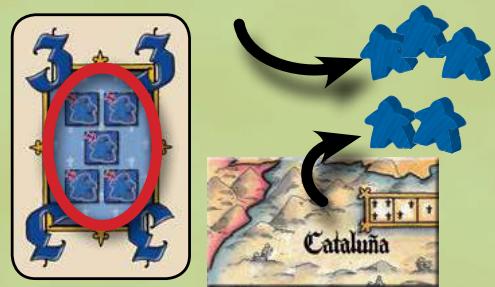
Example; Benita may take up to 5 Caballeros into her Court, however she has only 3 Caballeros remaining in the Province. She takes those 3’ into her Court and 2 more from regions on the board.
If Benita did not wish to remove any of her Caballeros from the board, she could have chosen to only take the 3 Caballeros from the Province.
3.2 Execute an Action card
Now you choose one of the revealed Action cards. Take the card and execute the following two actions:
The Special Action
You may execute the special action on the card. In doing so, you must perform the complete action, whenever possible. Using the card to the right as an example, you must score all 5-point regions, even if this would cause an opponent to score more points than

you. Some cards, however, indicate that you are allowed to partially execute the action, for example, the Intrigue card: “You may place 4 Caballeros."
You may also choose to not perform the special action at all.
Place Caballeros
The number of Caballeros shown on the Action card indicates how many Caballeros图you place on the boãrd.
• You may only use Caballeros from your Court. lf there are not enough Caballeros in your Court to place the number you are allowed, then those placements are forfeited.
• You may only place Caballeros in regions neighboring the King's region (NOT the King's region itself.)
• You may also choose to place Caballeros in the Castillo.
You may choose the order in which you execute the special action and place caballeros. However, you must complete them one at a time. You may not, for example, place some of your Caballeros, execute the Special action, then place the rest of your Caballeros (or vice versa).

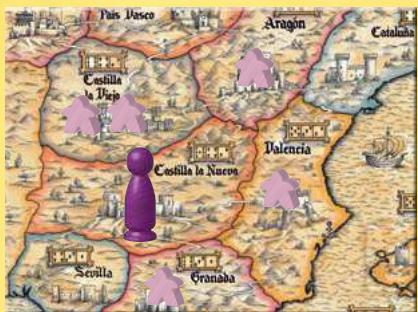
the special action first. She moves the King to “Castilla la Nueva," which becomes the new King's region. Rc@vāla then places 5 Caballeros from her Court onto the board. She may place these Caballeros in any region neighboring the King's region, which are (at this time): “Aragón," “Castilla la
Vieja," “Granada," “Sevilla," and “Valencia." She may also choose to place Caballeros in the Castillo.

She decides to place Caballeros on the board first. The action card allows her to place 3 Caballeros from her Court. The King's region is “Galicia," meaning that Benita may place her Caballeros in “Castilla la Vieja," “País Vasco," or the Castillo. She places 2 Caballeros in “País Vasco” and one in the Castillo.
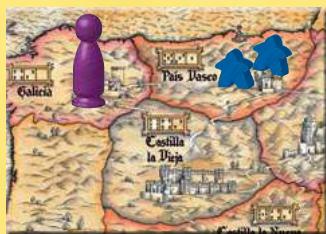
Then, Benita executes the special action and scores all 5-point regions.
These are “Aragón," “País Vasco," and “Valencia." She must score all 5-point regions, even those where an opponent scores more points than her. The Castillo is not scored by this card (see below).
For a complete explanation of scoring, see page 6.
After you are finished using the Action card, place this Action card facedown underneath the corresponding stack. This card will not be available for the other players.
Then, the next player in Power card turn order takes their turn, as explained above.
Some important concepts and special features;
THE CASTILLO
• The Castillo is not a region. When the rules or cards mention a “region” or “regions,” the Castillo is excluded.
• Whenever you place Caballeros on the board, you may choose to place some or all of them in the Castillo. It does not matter which region is the King's region.
• Whenever you move Caballeros, you may not move them from the Castillo. You may, however, choose to move Caballeros from a region into the Castillo. (“Moving” is possible through several Action cards and is described on page 9.)

• Whenever you place Caballeros in the Castillo, you must tell your opponents how Te C many Caballeros you are adding to the Castillo. No player may look inside the Castillo or move Caballeros out of the Castillo.
Note: lt is therefore useful to memorize the number of Caballeros each player has placed in the Castillo.
• During each general scoring (after rounds 3, 6, and 9), as well as during special Castillo scoring (page 11) - and only then - the Castillo is lifted. After a special Castillo scoring, the Caballeros found in the Castillo remain there. After general scoring, Caballeros are moved to specific regions (see Scoring on page 6).
THE KING, THE KING'S REGION+ AND THE NEIGHBORING REGIONS
The region the King occupies is called the King's region. There are 3 rules that govern the King's region:
- The King's region is taboo! (This is one of the most important rules of the game!)
Nothing in the King's region may ever be changed! No Caballeros, Grandes, or sčoreboards may be placed in or removed from the King's region.
There are no exceptions!
2. Caballeros placed on the board
Caballeros may only be placed in the regions neighboring the King's region (or placed in the Castillo).
Never in the King's region itself!
3. King's Bonus
During general scoring or a special scoring affecting the King's region, the player who has the most Caballeros
“Castilla la Nueva' is the King's region. Neighboring regions are all those regions directly adjacent to the King's region.

in the King's region scores an additional 2 points. If there is a tie for the most Caballeros in a region, this bonus is not awarded!
4. END OF ROUND
After all players have completed their turns, perform the following to prepare for the next round: 1. Place any remaining Action cards facedown underneath the corresponding stack.

Example; ln a 4-player game, 1 Action card is left unused. This card is placed underneath its stack. The top card of each stack is now hidden.
-
The player with the lowest Power card takes the start player marker.
-
All players discard their Power card to their personal facedown Power card discard pile. Discarded Power cards can not be used again.
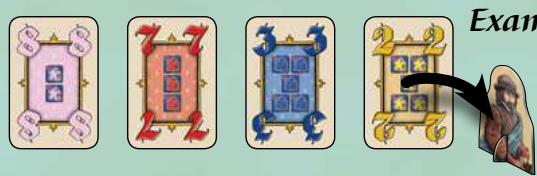
Example; Gabriel played the lowest Power card. He takes the start player marker. ln the next round, he will be the first player to play a Power card. The other players will follow in clockwise order.
Note; In each round, you will have one fewer Power card to choose from. Make sure to leave yourself a variety of Power cards for future rounds. (lncidentally, it is guaranteed that you will always have a Power card that you are able to play.)
- Move the round marker 1 space down.
If the round marker is moved to the next number, a new round begins, as described above.
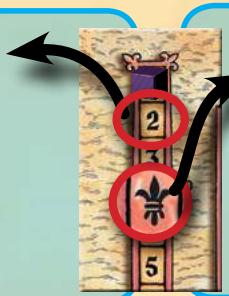
lf the round marker is moved to a fleur-,de-lis, general scoring occurs (see below). This will happen after the 3rd, 6th, and 9th rounds. Once general scoring is complete, move the round marker 1 space down and begin the following round.
5. SCORING
If the round marker is moved to a fleur-de-lis, a general scoring occurs.
In each general scoring, perform the following steps:
-
Choose a secret region.
-
Score the Castillo.

Fleur-de-lis (indicates general scoring)
-
Move the Caballeros from the Castillo to the players' chosen regions.
-
Score the individual regions.
The scoring key on the right, next to the round track, serves as an overview.
Scoring key with symbols describing the specific order for general scoring
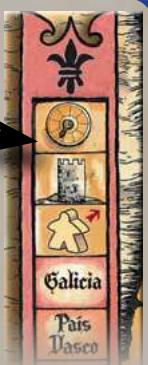

1. CHOOSE A SECRET REGION
The region you choose indicates where your Caballeros will be moved during step 3, “Move the Caballeros from the Castillo." You must now choose the region your Caballeros will be moved to after the Castillo has been scored. To do so, move the arrow on the secret disc to the region you have chosen.
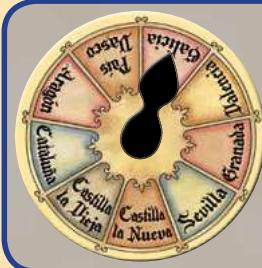
“Galicia” has been chosen on the secret disc.
lmportant; These Caballeros may not be moved to multiple regions. You must clearly choose one region.
Remember that the King's region is taboo (Caballeros may not be moved there).

2. SCORE THE CASTILLO
After all players have chosen a secret region, the Castillo is scored. Lift the Castillo and determine which players had the most Caballeros in the Castillo. The player with the most Caballeros scores 5 points. The player with the second most scores 3 points. The player with the third most scores 1 point. lf there is a tie, all tied players score points according to the next lowest position. A player who has no Caballeros in the Castillo scores no points.
The Castillo is emptied. Players score points for majorities according to the scoreboard below.
Note; ln a 2-player game, only the player with the most Caballeros in the Castillo will score points. ln a 3-player game, only the players with the most and second most Caballeros in the Castillo will score points.
Players track their points by moving their scoring markers forward on the score track.

Example with 4 players; Ramon and Benita each have 2 Caballeros in the Castillo. Gabriel has 1 and Ricarda has none. 3
The scoreboard for the Castillo indicates that first place N scores 5 points, second scores 3, and third scores 1. Ramon and Benita are tied for first place. Because of this, they score points for second place instead, 3 points each Gabriel is in third place and scores 1 point.


Ramon and Benita each move their score markers 3 spaces forward on the score track. Gabriel moves his 1 space forward.
All players reveal their secret disc. Each player moves their Caballeros from the Castillo to the region they chose on their secret disc.
lmportant; Any player who chose the King's region moves their Caballeros from the Castillo back into their Court.

Example; Ramon moves both of his Caballeros from the Castillo to “Granada.'
Return the Castillo to its normal position on the board.


4、 SCORE THE INDIVIDUAL REGIONS
Each region is scored in the order depicted on the scoring key. As with the Castillo, points are awarded to those players who have the most Caballeros in each region. The scoreboard in each region indicates how many points are awarded to those players with the most (second most, third most) Caballeros in the region.
lmportant; The Grandes only serve to identify each player's home region, and are not counted when determining majority.
Note; ln a 2-player game, only first place points are awarded.
The regions are scored in the order they appear on the scoring key, from top to bottom.
Only the player with the most Caballeros in a region will score points.
ln a 3-player game, only first and second place points are awarded. Only the players with the most and second most Caballeros in a region will score points.
As with the Castillo, tied players score points according to the next lowest position. Players with no Caballeros in a region do not participate in the scoring of that region.
Example with 4 players;

“Galicia” is the first region to be scored. Gabriel is in first place with 3 Caballeros, and scores 4 points. Benita is in second place with 2 Caballeros, and scores 2 points. Ramon is in third place with 1 Caballero. Ulnfortunately, no points are awarded for third place in “Galicia.


The next region is “País Vasco." Benita, Ramon, and Ricarda each have 3 Caballeros, and Gabriel has 2 Caballeros. As Benita, Ramon, and Ricarla are tied for first place, they each score points for the next lowest position, second place: 3 points. Gabriel scores 1 point for third place.
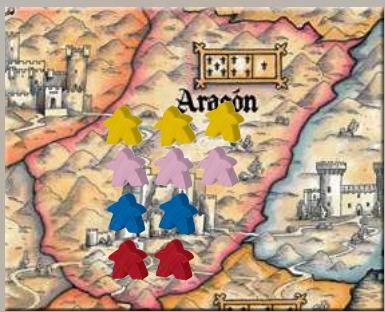
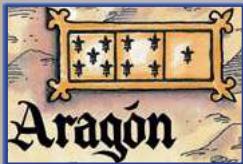
Then follows “Aragón." Gabriel and Ricarda each have 3 Caballeros. Benita and Ramon each have 2-Caballeros. Gabriel and Ricarda are tied for first place, meaning they each score points for the next lowest position, second place: 4 points. Benita and Ramon are tied for third place, and score points for the next lowest position. Unfortunately, no points are awarded for fourth place.
KING'S BONUS
Whenever the King's region is scored (whether during general or special scoring), the player with the most Caballeros (no ties!) scores an additional 2 points.
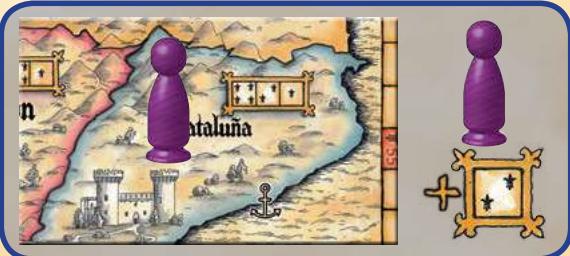

Example; “Cataluña” is the King's region. Gabriel has 2 Caballeros. Ramon has 1 Caballero. Therefore Gabriel is alone in first place, and scores 4 points according to the region's scoreboard, plus an additional 2

points for being first place in the King's region. Ramon scores 2 points for second place. No other players are present, so third place points are not awarded.
HOME REGION BONUS
The home region bonus is similar to the King's region bonus. lf a player has the most Caballeros in his home region (no ties!) when it is scored (whether during general or special scoring), he scores an additional 2 points.
Remember; Do not count The Grande when determining majority.
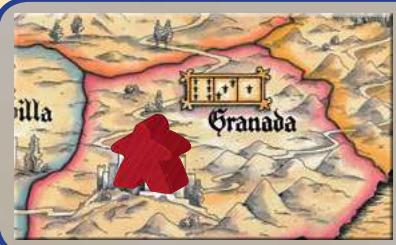
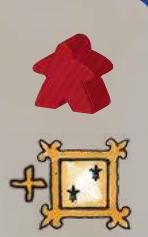
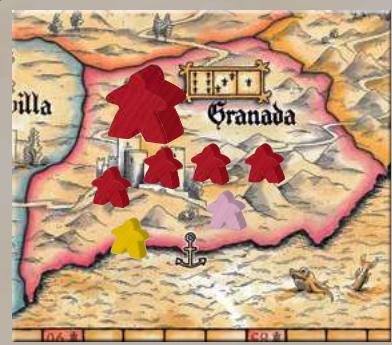
Example; “Granada” is Ramon's home region (his Grande is there). He has 4 Caballeros there. Gabriel and Ricarda each have only 1 Caballero. Ramon scores 4 points for first place, and an additional 2 points for being first

place in his home region. Gabriel and Ricardla are tied for second place, and each score points for the next lowest position, third place: 1 point.
Note; It is possible for a player to receive the King's bonus and his home bonus in the same region.
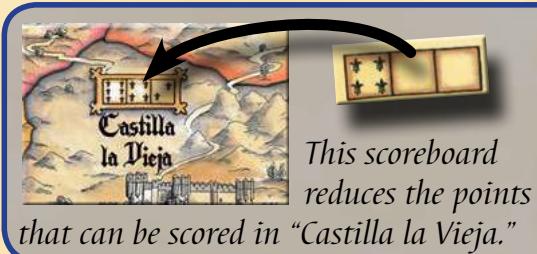
MOBILE SCOREBOARD
The two mobile scoreboards can be placed and moved with certain Action cards, causing regions to either appreciate or depreciate in value. Each region may only host one mobile scoreboard at a time.
Once all regions have been scored, move the round marker 1 space down, and begin the new round.
GAME END
The game ends after the third general scoring. The player with the most points wins, and is dubbed “El Grande." lf there is a tie for most points, these players rejoice in a shared victory!

ACTION CARDS - STACK 1
All stack 1 cards;
You may place up to 1 Caballero from your Court into a region neighboring the King's region or into the Častillo.
Before or after doing so, you may execute or forfeit the special action printed on the Action card.
The cards in this stack allow players to move their own / foreign Caballeros.
Any card indicating that you may “move” Caballeros must be executed according to the following rules:
• • You may move your own and/or foreign Caballeros (exceptions are listed below).
• • You may move Caballeros from and to one or multiple regions, for example take 2 Caballeros from one region, and 1 from another (exceptions are listed below).
• • You may not take Caballeros from the Castillo or a player's Court.
• • You may move fewer Caballeros than the number printed on the card.
• • You are not restricted to those regions neighboring the King's region. You may move Caballeros to any region (except the King's region) or into the Castillo.
• • The King's region is taboo! You may never move a Caballero from or to the King's region (there are no exceptions).
The stack 1 cards are as follows:
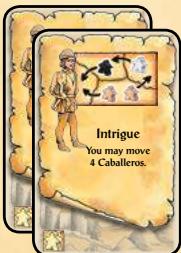
Intrigue (1x)
You may move 3 Caballeros.
lntrigue (1x) You may move 4 Caballeros.

Intrigue (1x)
You may move 4 of your Caballeros. You may only move your own Caballeros, not those belonging to other players.
Intrigue (1x)

You may move 3 foreign Caballeros. You may only move Caballeros belonging to other players, not your own.

Intrigue (2x)
You may move 2 of your Caballeros and 2 foreign Caballeros.
You may move up to 2 of your own Caballeros and up to 2 Caballeros belonging to other players. You may not
move more than 2 of your own Caballeros, or more than 2 Caballeros belonging to other players.

Intrigue (2x)
Choose a region. You may move 5 Caballeros from this region to other regions.
You may only move Caballeros from one region. However, you may move leros to any number of regions.

You may move all your Caballeros away from one region.
Intrigue (1x)
You may only move your own
Caballeros from one region. However, you may move these Caballeros to any number of regions. You may also choose
to leave some Caballeros in the chosen region.
Intrigue (1x)
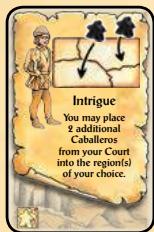
You may place 2 additional Caballeros from your Court into the region(s) of your choice.
With this card, you may place up to 3 Caballeros from your Court into
regions or the Castillo: 1 into a region neighboring the King's region, and 2 into the region(s) of your choice (including regions neighboring the King's).

Intrigue (1x)
You may move all your Caballeros away from one region.
OR
You may place up to 2 Caballeros from your Court into the region(s) of your choice.
You must choose which of the actions you wish to execute. The actions on this card are identical to those of the 2 above cards.

ACTION CARDS - STACK
All stack 2 cards;
You may place up to 2 Caballeros from your Court into a region or regions neighboring the King's region or into the Castillo.
Before or after doing so, you may execute or forfeit the special action printed on the Action card. Some cards allow you to remove Caballeros from the board: the King's region is taboo! The stack 2 cards are as follows: cards are as follows:
Veto (2x)

You may prevent one special action in this round or the next round. All players must announce their special actions before they execute thém.
When you choose the Veto card, place it faceup in front of you. Once during this round or the next round, you may entirely or partly prevent another player from executing his special action. You may prevent a special action before or during its execution. The player affected by the Veto must immediately terminate the execution of their special action.
Example; Your opponent may move 4 Caballeros. He has already moved 2 of them. You disapprove of where they have moved the 3rd Caballero, and choose to veto the action. Your opponent must undo the placement of the 3rd Caballero and immediately end his special action. He may not move the 4th Caballero, as the action has been vetoed.
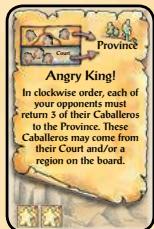
In clockwise order, each of your opponents must return 3 of their Caballeros to the Province. These Caballeros may come from their Court and/or a region on the board. Each player chooses for themselves
After you have used your veto, place the Veto card facedown under stačk 2. lf you do not use your veto by the end of the following round, you must place the Veto card facedown under stack 2 without effect.
Angry King! (1x)

which 3 of their Caballeros to return to the Province.
Each of your opponents chooses a region (where they have at least one Caballero) with their secret disc. Each of your opponents must return all their Caballeros from their chosen region to the Province. (1x) Each of your opponents (not you)

Decay of Authority (1x) Each of your opponents must return all Caballeros in their Court to the Province. This only affects your opponents.
simultaneously chooses a region where they have at least 1 Caballero on their secret disc. Each of your opponents then reveals their secret disc and returns all of their own Caballeros in their chosen region to the Province.

Each of your opponents chooses a region (where they have at least 2 Caballeros) with their secret disc. Each of your opponents must return 2 of their Caballeros from their chosen region to the Province. (1x) Each of your opponents (not you)

simultaneously chooses a region where they have at least 2 Caballeros on their secret disc. Each of your opponents then reveals their secret disc and returns 2 of their own Caballeros in the chosen region to the Province.
Decay of Authority (1x) Each of your opponents must return 3 Caballeros in their Court to the Province. This only affects your opponents.
Special Scoring (3x)

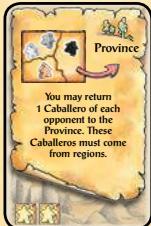
You may return 1 Caballero of each opponent to the Province. These Caballeros must come from regions. (1x) You choose 1 Caballero o each opponent (not yourself) and place them in the Province.
Choose a region to be scored immediately.
You choose a region on the board and score that region during your turn. You may score the region before or after you have placed your Caballeros. You may choose to score the King's region, but may not choose the Castillo (as it is not a region). The region is scored in the same way as it would be during a general scoring, i.e., players score points for first, second, and third places, and the King's region and home region bonuses can be awarded.
ACTION CARDS - STACK 3
All stack 3 cards;
You may place up to 3 Caballeros from your Court into a region or regions neighboring the King's region or into the Castillo.
Before or after doing so, you may execute or forfeit the special action printed on the Action card.
The cards in this stack allow you to execute a special scoring during your turn.
These cards must be executed according to the following rules:
• • You may execute the special scoring before or after you have placed your Caballeros.
• • Special scoring is executed according to the same rules as general scoring, i.e., players score points for first, second, ānd third places, and the King's region and home region bonuses can be awarded.
• The Castillo is not a region. lt is not scored when the card specifies region or regions. (Exception: the special scoring card that specifically scores the Castillo.)
• • lf multiple regions are scored by a single card, the active player chooses the order in which they are to be scored.
The stack 3 cards are as follows:

Special Scoring (2x)
All 4-point regions are scored immediately.
During your turn, all regions awarding 4 points for first place are scored. (These are: Galicia, Cataluña, and Sevilla).

lmportant; The mobile scoreboards can change which regions are to be scored: if this mobile scoreboard is placed in a region, then it is a 4-point region, and will be scored (the Castillo is not a region, and will not be scored, even if this mobile scoreboard is there).lf this mobile scoreboard is in Galicia, Cataluña, or Sevilla, then it is not a 4-point region, and will not be scored. The mobile scoreboards are placed and moved by cards in stack 4 (see next page).
All regions are scored immediately. Only first place scores points. ln case of a tie, no points are scored.
During your turn, all regions (not the Castillo) are scored. Follow the scoring
Special Scoring (2x)
Special Scoring (1x)

key as you would during a general scoring, however only first place points are awarded. lf there is a tie for first place, no points are awarded for that region.

All regions with the most Caballeros are scored immediately.
All 5-point regions are scored immediately.
During your turn, all regions awarding 5 points for first place are scored. (Thèse are: País Vasco, Aragón, and Valencia, but not the Castillo). The clarifications listed for the scoring of 4-point regions apply here as well.
During your turn, the region containing the most Caballeros is scored. lf there are several regions tied for the most
Special Scoring (1x)
Caballeros, each of these regions is scored. The Castillo may not be considered.
Special Scoring (1x)


Nueva, and Granada). The clarifications listed for the scoring of 4-point regions apply here as well.
During your turn, all regions awarding 6 or 7 points for first place are scored. (These are: Castilla la Vieja, Castilla la
All 6- and 7-point regions are scored immediately.
All regions with the least Caballeros are scored immediately. Regions containing no Caballeros do not count.
Special Scoring (1x)
During your turn, the region containing the least Caballeros is scored. If there are
Special Scoring (2x)
several regions tied for the least Caballeros, each of these regions is scored. The Castillo and regions containing no Caballeros may not be considered.
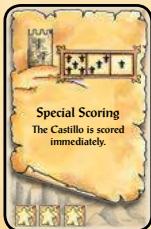
The Castillo is scored immediately. During your turn, the Castillo is scored. After scoring is complete, add the revealed Caballeros to the Castillo so that they are hidden again.
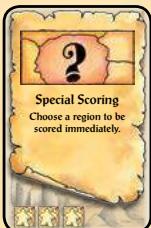
Special Scoring (1x)
Choose a region to be scored
immediately.
During your turn, you choose a region to be scored.

ACTION CARDS - STACK 4
All stack 4 cards;
You may place up to 4 Caballeros from your Court into a region or regions neighboring the King's region or into the Castillo.
Before or after doing so, you may execute or forfeit the special action printed on the Action card. The stack 4 cards are as follows:
Mobile Scoreboard (3x)

You may place a new mobile scoreboard OR move an existing one. You may place or move one of the two mobile scoreboards to cover a region's scoreboard. These mobile scoreboards begin the game next to the board. If the scoreboard you wish to place is already on the board, you may take it from that region and move it to a different region. As long as a mobile scoreboard exists in a region, points for scoring that region are awarded according to the mobile scoreboard (instead of the points that would normally be awarded there). You may choose which of the two mobile scoreboards you wish to place or move. A mobile scoreboard may be placed at the Castillo (it replaces both of the Castillo's scoreboards). No region may have more than one mobile scoreboard. A mobile scoreboard may not be placed in or moved from the King's region.
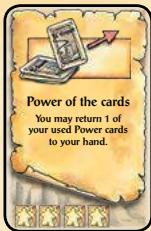
Power of the Cards (2x)
You may return 1 of your used Power cards to your hand. You may return the Power card that you played this round or any Power card in your discard pile to your hand.

The Court (1x)
You may take 2 Caballeros from the Province into your Court. This card improves your Supply for the turn, and must be executed according to the same rules (see page 3).

Grande (2x)
You may move your Grande. You may not move your Grande in or out of the King's region. You may not place your Grande in the Castillo.
ACTION CARDS - STACK 5
Stack 5 consists of only the King's Card. You may place up to 5 Caballeros from your Court into a region or regions neighboring the King's region or into the Castillo. Before or after doing so, you may execute or forfeit the special action printed on the Action card.
Special Scoring (1x)
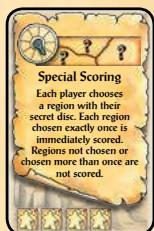
Each player chooses a region with their secret disc. Each region chosen exactly once is immediately scored. Regions not chosen or chosen more than once are not scored.
You may execute the special scoring before or after you have placed your Caballeros. First, all players (including you) choose a region with their secret disc, and then reveal their choices simultaneously All regions chosen exactly once are scored immediately. Regions not chosen or chosen more than once are not scored. These regions are scored in the order of the active player's choice, according to regular scoring rules, i.e., players score points for first, second, and third places, and the King's region and home region bonuses can be awarded.

Eviction (1x)
Choose a region. Each of your opponents chooses a region on their secret disc. Each of your opponents moves all their Caballeros from this
region to their chosen region.
First, you choose the region from which your opponents (not you) must move their Caballeros. Then each of your opponents chooses a region on their secret disc to which to move these Caballeros. Finally, they simultaneously reveal their secret discs and move their Caballeros to their chosen region. Any player who chose the King's region instead returns the Caballeros to their Court.

Royal Advisor (1x)
You may move the King to an adjacent region.
You may move the King before or after you have placed your Caballeros.

King's Card (1x)
You may move the King to any region. You may move the King before or after you have placed your Caballeros. You may not place the King in the Castillo.
下载 Markdownrules_en_el-grande-k-nig-intrigant_370.md19.6 KB
El Grande: König & Intrigant
逐页 VLM 转写(qwen3-vl-plus),保留原文结构,未翻译。
El Grande
König & Intrigant
Wolfgang Kramer és Richard Ulrich játéka
„Király és Cselszövő” az El Grande egyik variációja, amit csak az El Grande alapcsomaggal együtt tudunk játszani. Az El Grande szabályait helyettesíteni kell ezekkel a szabályokkal, ha szükséges.
Játékelemek
El Grande erő- és akciókártyáit ki kell cserélni a ’Király és a Cselszövő’ kártyákkal, ennek megfelelően az ezekre vonatkozó szabályok is kicserélődnek.
Ez a kártyaszett a következő elemeket tartalmazza:
[图: 18 akciókártya, 5 különböző színben]
18 akciókártya,
5 különböző színben
[图: 5 Caballero kártya]
5 Caballero kártya
[图: 1 Királykártya]
1 Királykártya
[图: 1 Cselszövőkártya]
1 Cselszövőkártya
[图: 1 áttekintőkártya a Caballero kártyák elosztásához – táblázat: „Spielerzahl” oszlopban 2, 3, 4, 5; „Caballero-karten” sorokban: 2→9, 3→1,3,5, 4→1,2,4,5, 5→1,2,3,4,5]
1 áttekintőkártya a
Caballero kártyák elosztásához
[图: 2 üres kártya]
2 üres kártya
Fordította: Dunda&Móni&Évi
1
Lehelyezés/kiinduló pozíció
A játék elején minden játékos kap 18 akciókártyát a saját színében. Mivel csak 13 kártyát használunk a játék folyamán, ezért 5 kártyát titokban kiválaszt, és félretesz minden játékos. Ezek a kártyák nem vesznek majd részt a játékban. A Caballero kártyákat a játékosok száma szerint kell kiválasztani –lásd Cabellero kártyák leírása –és a Király és a Cselszövő kártyával együtt a játéktábla mellé kell helyezni.
A kezdés olyan, mint az El Grandeben, majd miután ez megtörtént, a korongjukat használva, a játékosok kiválasztanak egy tetszőleges régiót és lehelyeznek rá egy Caballerot a Tartományból. /Azaz összesen így 3 Caballero kerül a táblára játékosonként./
A Kártyák
[图: Akciókártya: bal felső sarokban „130 130”, két portré, alatta „Aragon” című kártya, „x2” jelzés, és német szöveg: „Wählen Sie eine beliebige Regionenkarte aus und legen Sie diese verdeckt vor sich ab. Bei der nächsten allgemeinen Wertung wird diese Region doppelt gewertet.”]
Akciókártyák
A nagy szám a kártya tetején a kártya értékét jelenti. Ez meghatározza a játék menetét/sorrendjét.
A Caballero fejek száma azt mutatja meg, hogy maximum hány Caballerot mozgathat át a játékos a tartományból a saját udvarba.
A kártya ezen kívül tartalmazza egy speciális akció leírását.
Caballero kártyák
[图: Caballero-karte: címsor „Caballero-karte”, középen keretes német szöveg: „Bringen Sie 3 Caballeros von Ihrem Hof nach Spanien. Setzen Sie diese in Nachbarregionen zum König und/oder ins Castillo.”, alatta három portré]
Mutatják a maximum Caballero számot, amit a játékos feltehet a kör során a saját udvarból
Játékszabályok
A játék 9 /esetleg 6/ köre az alábbi fázisokból áll, amiket sorba kell követni.
-
Jelzőkő előremozdítása egy hellyel. (ez mutatja, hányadik körét játsszuk a játéknak)
-
Játékosok kijátsszák az akciókártyáikat
Az első körben a legfiatalabb játékos kezd, a többiben az a játékos kezd, aki a megelőző körben a legalacsonyabb értékű kártyát játszotta ki. Ezután az óramutató járásával megegyezően kell játszani. Mint a normál El Grandeben itt sem játszhat ki játékos olyan értékű kártyát, amit valaki már az adott körben kijátszott.
Fordította: Dunda&Móni&Évi
2
A Király-, a Cselszövő- és a Caballero kártyák kiosztása
Az a játékos, akinél a legmagasabb értékű akciókártya van kijátszva, kapja a Királyt és a legmagasabb értékű Caballero lapot. A második legnagyobb értékű akciókártya viszi a második legnagyobb értékű Caballero kártyát és így tovább. Az a játékos, akinek a legalacsonyabb értékű az akciókártyája megkapja az utolsó Caballero lapot, valamint a Cselszövőkártyát is.Játékosok lejátsszák a saját körüket
A Királykártya tulajdonosa kezd, majd őt követi a második legnagyobb értékű Caballero lap, és így tovább. A kör egy vagy több akciót tartalmaz a következők szerint:
- Az akciókártyán szereplő Caballerok áthelyezése a Tartományból a saját Udvarba.
- Speciális akció kijátszása az akciókártya alapján.
- A Caballero kártyán jelzett számú Caballero behelyezése a játékterületre.
[图: Kónigs-karte és Intriganten-karte képe, két kártya illusztrációval és német felirattal]
A legmagasabb értékű akciókártya tulajdonosa lesz mindig az aktuális Király. Neki nem szabad kijátszania az Akciókártyán lévő speciális akciót, helyette Királylapon lévő akciót kell véghez vinnie, ami a következő: bármelyik választott régióba áthelyezhető a király.
Az a játékos, akinél a legalacsonyabb értékű akciókártya van, lesz a Cselszövő. Szintén nem szabad kijátszania az akciókártyán lévő speciális akciót, helyette a Cselszövő akcióját kell kijátszania, ami a következő: vagy egy idegen Caballerot elmozgat egy területről, vagy az adott területről az összes saját Caballerot áthelyezheti egy másik, tetszőlegesen választott területre, kivéve a királyéba.
Az összes többi játékosnak ki kell játszania a speciális akciót, kivéve, ha a következő szavakkal kezdődnek: you may/sie können –lehet vagy you are allowed/you can/ sie dürfen – lehet, megteheted, tehát ha lehetőséget kínál fel a cselekvésre, de nem teszi kötelezővé. Ebben az esetben eldöntheti a játékos, hogy ki akarja e játszani a speciális akciót vagy nem.
Minden játékos, a Király és a Cselszövő is, annyi Caballerot kap a Tartományból a saját Udvarba, amennyi az akciókártyájukon szerepel.
A kör végén minden kijátszott Akciókártyát el kell távolítani végérvényesen a játékból.
A Király-, Cselszövő- és Caballero kártyákat visszahelyezzük a tábla mellé, és kezdődhet a következő kör.
Szabályok 2 vagy 3 játékos esetén
Az a játékos, aki a Király- vagy a Cselszövőkártyát kapta eldöntheti, hogy a Király/Cselszövő akcióját játssza ki vagy a saját akciókártyáját.
Fordította: Dunda&Móni&Évi
3
Kártyák leírása
Néhány kártya ebben az új verzióban nem azonos a régiekkel, ezekhez kell némi magyarázat.
[图: 10-es kártya, "Intrigant" felirattal, két 1-es és egy 2-es értékjelöléssel]
Mivel a 10-es kártya a legalacsonyabb a játékban, automatikusan az a játékos lesz a Cselszövő, aki ezt kijátszza.
[图: 20-as kártya, "Setzen Sie Ihre Caballeros in beliebige Regionen." felirattal, két 2-es és egy 3-as értékjelöléssel]
A lehelyezhető Caballerokat nem muszáj a királlyal szomszédos régiókba tenni, oda rakhatók le, ahova akarjuk, kivéve a király területe.
[图: 130-as kártya, "Wählen Sie eine beliebige Regionenkarte aus und legen Sie diese verdeckt vor sich ab. Bei der nächsten allgemeinen Wertung wird diese Region doppelt gewertet." felirattal, két 2-es értékjelöléssel]
A Régió kártyákból titkosan kell választani egyet (a választott kártyát a játékos képpel lefele maga elé teszi). A választott terület duplán lesz értékelve a következő teljes értékeléskor (a 3. vagy a 6. vagy a 9. kör végén). Értékelés után a kártya visszakerül a többi közé.
[图: 170-as kártya, "Sonderwertung: Dukaten Sie auf Ihren Mitregenten, welche Regionen gewertet werden sollen. Dann stellt jeder Spieler eine Region auf die Scheibe ein. Alle nach dem gewählten Regionen werden gewertet." felirattal, egy 2-es értékjelöléssel]
Minden megegyezés/megállapodás/szerződés lehetséges, de nem kötelező. Különleges értékelés: a játékos beszélje meg a többi játékossal, melyik régió(k) értékelődjenek, ez után minden játékos választ a korongjával titkosan egy területet. Minden régió, amit egynél többen választottak, ki fog értékelődni.
[图: 180-as kártya, "Sein Wunsch ist es, König zu sein." felirattal, két 2-es értékjelöléssel]
Mivel a 180-as kártya a legmagasabb a játékban, automatikusan az a játékos lesz a király, aki ezt kijátszza.
Néhány tisztázás az El Grande szabályokkal kapcsolatban:
Ha a játékosnak elfogy az összes Caballeroja a Tartományból, akkor a játéktáblán lévő régiókból visszavehet az Udvarba (kivéve kastélyból és a királyi területről) és felhasználhatja őket a játékhoz.
Ha valaki eléri a győzelmi pontot, akkor kezdjen egy újabb körbe számlálón.
A játékhoz tartozik 2 üres kártya: azért adták, hogy ha valakinek van új ötlete speciális akcióra, akkor erre írja le és vigye be a játékba. Akár el is küldheti a jó ötleteket a készítőknek. Három havonta értékelik ezeket a kártyákat, és a legjobb kap egy játék kollekciót.
Fordította: Dunda&Móni&Évi
4
Kártyák:
Ez már így az eredeti szabályban nem szerepel, de azért összeszedtem az összes kártyát, ami a játékban van, mert szerintem nem csak a szabályban szereplő kártyáknak van kicsit más jelentésük, mint az alapjátékban.
10: Mivel a 10-es kártya a legalacsonyabb a játékban, automatikusan az a játékos lesz a cselszövő, aki ezt kijátssza
20: Caballérok bármelyik, tetszőlegesen választott területre letehetők, nem csak király mellé.
30: Minden más játékosnak vissza kell tenni az udvarban maradt Caballero-it a Tartományba. Az akció a kártyát kijátszó játékos körében lép életbe.
40: Veto: az adott körben megvétózhat egy speciális akciót. A kártya bármikor kijátszható a körben, függetlenül, hogy a játékos mikor jön.
50: Összes játékosnak – kezdve a kijátszó bal oldalán ülővel, óramutató járásának megfelelően– vissza kell tennie 3 caballerot a Tartományba. A Caballerok mozgathatók az udvarból vagy a tábláról (kivéve király területéről és a kastélyból).
60: Különleges értékelés: kiértékeli a 6 és 7 pontos területeket
70: Minden játékostól –kivéve saját magától– le kell szedni egy Caballerot a tábláról, és vissza kell tenni a Tartományba.
80: Elmozgathatja a Grandéját (nagy kocka) egy másik régióba és 3 saját Caballero-t bármelyik régióból, ugyanabba a régióba, ahova a Grande is került.
90: Le kell tennie egy új mozgatható pontozótáblát egy területre, vagy át kell mozgatnia egy már lent levőt (királyéra nem lehet).
100: Különleges értékelés: minden 4-es régió értékelődik
110: Különleges értékelés: a kastély értékelése
120: Különleges értékelés: minden 5-ös régió értékelődik
130: Választani kell egy régiókártyát és képpel lefelé maga elé tenni, a következő kiértékeléskor ez a kártya duplán fog számítani. Kiértékelés után vissza kell tenni a többi közé.
140: Minden játékostól 2 Caballerot a kastélyba kell tenni; a többi játékos Caballeroit muszáj a régiókból választani, de a sajátok az udvarból is jöhetnek
150: Különleges értékelés: választás szerinti terület kiértékelése
160: Király mozgatása szomszédos régióba.
170: Különleges értékelés: a játékos beszélje meg a többi játékossal, melyik régió(k) értékelődjenek, ez után minden játékos választ a korongjával titkosan egy területet. Minden régió, amit egynél többen választottak, ki fog értékelődni.
180: Mivel a 180-as kártya a legmagasabb a játékban automatikusan az a játékos lesz a király, aki ezt kijátssza.
Ahogy látható a szabályban említett speciális akció kijátszási kivételre két kártya esetén van lehetőség: a 40 és 80-as kártyáknál. A többi kötelezően kijátszandó. /Persze kivéve, ha a játékosa a Király vagy a Cselszövő/
Király: bármelyik választott régióba áthelyezhető a király
Cselszövő: vagy egy idegen Caballerot elmozgathat egy területről, vagy az adott területről az összes saját Caballerot áthelyezheti egy másik, tetszőlegesen választott területre, kivéve a királyéba
Caballero kártyák: x Caballero mozgatható vele az udvarból a régiókba; a Caballerokat muszáj vagy a kastélyba vagy a királlyal szomszédos területekre rakni. X=1,2,3,4,5 kártyától függően.
Áttekintőkártya:
- 2 játékos esetén használjuk a 2. és 4. Caballero kártyát
- 3 játékos esetén használjuk a 1, 3. és 5. Caballero kártyát
- 4 játékos esetén használjuk a 1, 2, 4. és 5. Caballero kártyát
- 5 játékos esetén használjuk mind az 5 kártyát
Fordította: Dunda&Móni&Évi
5
Hans Im Glück König and Intrigant Players edition kiadásában szereplő extra kártyák
Illetve a RioGrande Games „El Grande Expansions” kiadásában is szerepelnek
A BGG szerint 11 lap van a Player editionban, de az ottani feltöltések alatt csak ez a 8 szerepel. ⊗
13 – Mozgás napja (Wandertag)
Minden játékostársnak el kell mozgatni a Grandeját egy másik régióra. Ennek kiválasztása a titokban, a koronggal történik.
[图: Wandertag kártya: 13 érték, három játékosikon, környezetkép, német szöveg]
23 – Eltolás (Schiebung)
Toljuk a Kastélyt a tartalmával együtt egy választott régióra, és az ott található Caballerokat dobjuk be a Kastélyba. (A Kastély áthelyezése után az erre a Régióra kerülő Caballerokat normálisan a Régióra tesszük.) A Kastély az eredeti helyére a következő értékelés után kerül vissza.
[图: Schiebung kártya: 23 érték, három játékosikon, kastély és kéz, német szöveg]
43 – Polgárháború (Bürgerkrieg)
A játékos a játékostársak Caballeroit egy tetszőleges régióból visszateszi az Udvarukba. Ezért fizet-ségként egy Caballerot az Udvarából a Tartományba kell tennie.
[图: Bürgerkrieg kártya: 43 érték, három játékosikon, két régió, német szöveg]
53 – Szövetség (Allianz)
A játékos választ 2 régiót. A következő értékelőkörnél, a 2 terület egynek számít. Minden játékos a 2 régiön található összes Caballeroját összeszámolja. A 2 terület pontjai is összeadódnak. Az egyesített régiók győztese megkapja a Király és a Grande bónuszt is.
[图: Allianz kártya: 53 érték, három játékosikon, két összekapcsolt régió, német szöveg]
73 – Forradalom (Revolution)
A mozgatható pontozótábla, ha már a táblán van, 180° fordul. Ezen a régiön az a játékos kapja a legtöbb pontot, akinek a legkevesebb Caballero-ja van és a legkevesebbet az, akinek a legtöbb van. Csak egy másik Forradalom kártyával lehet eltávolítani a fordított pontozótáblát.
[图: Revolution kártya: 73 érték, három játékosikon, pontozótábla és nyíl, német szöveg]
83 – Összeomlás veszélye (Einsturzgefahr)
A Kastélyt összeomlás fenyegeti! Caballerok már nem férnek el az épület belsejében, de tehetők még az oldala mellé, úgy hogy láthatók lesznek. A Kastély belsejében és a körülötte levő Caballerok a következő értékeléskor együtt számítanak.
[图: Einsturzgefahr kártya: 83 érték, három játékosikon, romló kastély, német szöveg]
113 – Forgószél (Wirbelsturm)
Az akciókártyák kijátszása után, a játékos állítsa be a titkos korongot egy területre, amelyiken a forgószél végig fog söpörni. Amikor rákerül a sor, akkor minden játékos a Caballeroi felét erről a területről /felfelé kerekítve/ visszateszi az Udvarába. Ezután a játékos, aki kijátszotta a kártyát, a levett Caballeroit visszateszi egy tetszőleges régióra.
[图: Wirbelsturm kártya: 113 érték, három játékosikon, forgószél ikon, német szöveg]
153 – A Királynő (Koenigen)
A Király megőrül álmai Hölgyétől. A Játékos a Cabellero-it tetszőleges területre teheti, nem csak a Király mellé. Ha értékelőkör előtt játsszák ki a kártyát, akkor a Király bónusz nem jár senkinek.
[图: Königin kártya: 153 érték, három játékosikon, királynő portré, német szöveg]
Fordította: Dunda&Móni&Évi
6
Extra kártyák
A neten találtam, azt írják, hogy a Hans im Glücktől kapható valahogy 😊
Csak azért fordítom le, hátha bent lesz a jubileumi kiadásban.
15: Fiesta
[图: „Fiesta” címmel, 2×15 értékkel, egy térkép és fekete négyzetek ábrázolásával]
Ha nincs Caballeroja a Tartományban, akkor 5 Caballerot az Udvarból Spanyolországba vihet. (A táblára tehet.)
25: Kémkedés /Spionage/
[图: „Spionage” címmel, 2×25 értékkel, egy látómező és célpont ábrázolásával]
A következő értékeléskor nem kell beállítania semmilyen területet a titkos korongon. Miután a játékostársai a Kastélyból szétosztották a Caballeroikat, a játékos oda teheti a saját Caballeroit, ahova akarja. A kártya felfordítva marad.
35: Puccs
[图: „Putsch” címmel, 2×35 értékkel, egy doboz és kockák ábrázolásával]
A játékostársak Grandheit /nagyobb kocka/ kell bedobni a Kastélyba.
66: Vigyázó!
[图: „6 nimm!” címmel, 2×66 értékkel, egy kártya és Caballero-figurák ábrázolásával]
Tegye le ezt a kártyát egy tetszőleges területre, ahol 6 vagy annál kevesebb Caballerot talál. Ezen a területen most már soha nem állhat 6 Caballeronál több. A kártya felfordítva marad.
75 Idegen
[图: „Provinz” címmel, 2×75 értékkel, egy térképrészlet és Caballero-figurák ábrázolásával]
Tegyen még plusz 1 Caballerot a Tartományból erre a kártyára. Közvetlenül egy tetszőleges értékelés előtt, egy tetszőleges területre állíthatja. A kártya felfordítva marad.
95: Királyi védelem
[图: „Königlicher Schutz” címmel, 2×95 értékkel, egy korona és védett terület ábrázolásával]
Amikor a játékos soron van, megjelöl egy tetszőleges területet, és ez a terület ebben a körben ugyanolyan védelmet élvez, mint a királyi terület.
125: Eltörlés
[图: „Entfernen Sie eine Karte…” címmel, 2×125 értékkel, kártyák és kéz ábrázolásával]
Távolítson el egy olyan kártyát, amire az van írva, hogy „A kártya felfordítva marad” (25,66,75)
135: Különleges értékelés
[图: „Sonderwertung” címmel, 2×135 értékkel, egy térkép és kockák ábrázolásával]
Válasszon egy olyan területet, ahol van Caballeroja, de nincs többségben.
145: Különleges értékelés
[图: „Sonderwertung” címmel, 2×145 értékkel, egy térkép és kockák ábrázolásával]
Válasszon egy tetszőleges területet. Rögtön az értékelés után az itt levő összes Caballero visszakerül a Tartományba.
155: Különleges értékelés
[图: „Sonderwertung” címmel, 2×155 értékkel, egy kérdőjel és térkép ábrázolásával]
Jelöljön meg 3 területet és egy játékost. Ez a játékostársad dönti el, hogy melyik régió legyen kiértékelve.
Fordította: Dunda&Móni&Évi
7
原文为社区整理/出版社公开资料,版权归原作者,仅供个人学习查阅。