
皇Huang
一句话概览
皇 是一款已收录于村了吗规则库的桌游,支持 2–4 人,原名 Huang。
本页内容:一句话概览 · 游戏概述 · 1. 游戏组件 · 2. 游戏设置 · 3. 游戏流程 · 4. 国家(State)概念 · 5. 行动详解 · 6. 胜利点数 · 7. 宝塔(Pagodas) · 8. 冲突系统 · 9. 游戏结束与胜负判定 · 关键规则与常见问题 · 常见问题
皇 规则速览
以下规则速览由本站整理,与官方规则书表述不同,仅供快速上手参考。
游戏概述
在战国时代(公元前475-221年),秦、楚、齐、燕、韩、魏、赵七国纷争,最终于公元前221年统一于秦朝之下。在《皇》中,玩家重演这段历史,领导自己的王朝走向胜利。
玩家目标: 通过在棋盘上放置板块和领袖、建立宝塔、发动冲突来积累胜利点数,最终得分最高者获胜。
核心流程: 每回合执行2个行动(放置领袖、放置板块、农民起义、建立宝塔、替换板块),回合结束时检查宝塔得分并补充手牌至6张。
核心机制: 板块放置、区域控制、冲突解决(叛乱/战争)、手牌管理
1. 游戏组件
| 组件 | 数量/说明 |
|---|---|
| 游戏板 | 1块(展示战国时期中国地图) |
| 板块 | 138块:黄色42块、红色36块、蓝色24块、绿色24块、白色12块 |
| 布袋 | 1个 |
| 宝塔 | 9座:黄色2座、红色2座、蓝色2座、绿色2座、白色1座 |
| 胜利点标记 | 150枚:每色20枚"1"值 + 10枚"5"值 |
| 玩家屏风 | 4面 |
| 统一标记 | 1枚 |
| 领袖 | 4套(虎、兔、鼠、羊),每套5位领袖:总督(黄)、士兵(红)、农夫(蓝)、商人(绿)、工匠(白) |
2. 游戏设置
2.1 棋盘准备
- 将游戏板放在游戏区域中央
- 在棋盘上标有[1]的位置各放置1块黄色总督板块(代表七国都城)
- 将剩余所有板块放入布袋并洗匀
- 将所有宝塔放在棋盘旁边[2]
- 将胜利点标记按颜色分类放在棋盘旁[3]
- 将统一标记放在棋盘旁[4]
2.2 玩家准备
- 每位玩家选择一个王朝(虎、兔、鼠、羊),获得该王朝的5位领袖
- 在面前放置一面屏风,将5位领袖放在屏风前[5]
- 未使用的屏风和领袖放回盒中
2.3 抽取初始板块
- 每位玩家从布袋中抽取6块板块放在屏风后[6]
- 再从布袋中抽取6块板块面朝上放在棋盘的市场区域[7]
2.4 2人游戏选项
- 可协商将24块板块从布袋中移出放回盒中(不看内容)
3. 游戏流程
3.1 回合顺序
- 随机选择起始玩家,按顺时针顺序轮流进行
- 每位玩家回合必须执行2个行动
- 可选择2个不同行动或同一行动两次,顺序任意
3.2 回合结束
- 执行完2个行动后,结算所控制宝塔的胜利点数
- 从布袋中抽牌补充至屏风后6块板块
- 其他玩家若不足6块也补充至6块
- 市场区域若不足6块也从布袋补充
3.3 游戏结束条件
- 当玩家因布袋为空而无法抽牌时,游戏结束
4. 国家(State)概念
- 相邻: 共享边的板块和领袖互为相邻
- 连接: 相邻或通过一系列相邻板块/领袖连接的单元
- 国家: 一个或多个连接的板块,且至少有一个连接的领袖
- 和平: 国家内所有领袖颜色不同
- 冲突: 国家内出现2个同色领袖
5. 行动详解
5.1 部署领袖
将领袖从屏风前放到棋盘上,或从棋盘上重新定位,或从棋盘上撤回至屏风前。
部署限制:
- 领袖必须放在空格上
- 领袖只能放在与黄色总督板块相邻的位置
- 领袖不能放在会导致国家合并产生冲突的位置
- 领袖不能放在河流格上
特殊规则: 若某个领袖相邻的最后一个黄色总督板块被移除,该领袖自动移除并返回屏风前
5.2 放置板块
从屏风后取出1块板块面朝上放在棋盘空格上。
板块类型:
- 黄色总督(Governor)
- 红色士兵(Soldier)
- 蓝色农夫(Farmer)
- 绿色商人(Trader)
- 白色工匠(Artisan)
放置限制:
- 蓝色农夫板块只能放在河流格上
- 其他类型板块不能放在河流格上
绿色商人特殊效果: 放置后可从市场区域拿取1块面朝上板块放在屏风后
蓝色农夫连续放置: 放置蓝色农夫后,可在同一行动内继续放置额外的蓝色农夫板块,条件是:
- 下一块必须与上一块相邻
- 上一块的放置未导致战争或新宝塔建立
5.3 弃置2块蓝色农夫板块发动农民起义
执行步骤:
1. 从屏风后亮出并弃置2块蓝色农夫板块
2. 从棋盘上选择任意1块板块弃置(可包括都城的黄色总督板块)
效果:
- 被移除的位置变为空格
- 可能将一个国家分裂为多个部分
- 若移除了某个领袖相邻的最后一个黄色总督板块,该领袖被移除
- 若移除了宝塔/粮仓/宫殿下方的板块,该建筑也被移除
蓝色农夫领袖特殊效果: 若农夫领袖在屏风前(未上棋盘),可代替1块蓝色农夫板块,只需弃置1块即可发动起义
5.4 弃置2块绿色商人板块建立宝塔
见下方"宝塔"章节
5.5 替换屏风后最多6块板块
从屏风后弃置最多6块板块,然后从布袋抽取相同数量板块放回屏风后
6. 胜利点数
6.1 五种胜利点数
- 黄色: 代表秩序(Order)
- 红色: 代表力量(Power)
- 蓝色: 代表粮食(Food)
- 绿色: 代表贸易(Trade)
- 白色: 代表财富(Wealth)——万能色,可在终局时分配到任意颜色
6.2 放置板块得分规则
- 若板块放置在国家中,且该国家有同色领袖,则控制该领袖的玩家获得1枚该色胜利点
- 若无同色领袖但有黄色总督领袖,则控制总督的玩家获得该板块颜色的胜利点
- 连续放置多块蓝色农夫时,每块符合上述条件的都获得蓝色胜利点
- 若放置导致国家合并产生冲突,则不获得胜利点
6.3 标记管理
- 胜利点标记藏在屏风后
- 任何时候可用5枚"1"值标记兑换1枚"5"值标记
7. 宝塔(Pagodas)
7.1 五种宝塔
宫殿(Court)、驻军(Garrison)、粮仓(Granary)、市场(Market)、工坊(Workshop)
7.2 建立条件
放置板块后,若该板块与相邻板块形成同色三角形(3块同色板块),且:
- 该放置未导致战争
- 三角形中没有任何板块支撑其他建筑(宝塔、粮仓或皇宫)
7.3 建立方式
- 从棋盘旁取对应颜色宝塔放在三角形上
- 若无可用宝塔,可从棋盘上取同色宝塔重新放置
- 建立宝塔为可选行动
7.4 宝塔得分
回合结束时,检查你的领袖是否与同色宝塔在同一国家:
- 每个符合条件的领袖,每座同色宝塔获得1枚该色胜利点
- 黄色总督领袖不能通过宝塔获得其他颜色的胜利点
7.5 通过弃置绿色商人板块建立宝塔
- 亮出并弃置2块绿色商人板块
- 在已有三角形上建立对应颜色宝塔
绿色商人领袖特殊效果: 若商人领袖在屏风前,可代替1块绿色商人板块,只需弃置1块即可
8. 冲突系统
8.1 冲突类型
- 叛乱(Revolt): 领袖被部署到已有同色领袖的国家
- 战争(War): 板块放置导致国家合并,合并后的国家出现同色领袖
8.2 叛乱解决
攻击方与防守方:
- 攻击方:部署新领袖的玩家
- 防守方:控制已有同色领袖的玩家
力量计算:
- 基础力量:各自领袖相邻的黄色总督板块数量(同一板块可同时计算给双方)
- 加强:攻击方先、防守方后,可从屏风后投入任意数量额外黄色总督板块
- 黄色总督领袖效果:若在屏风前,可选择增加1点力量
胜负判定: 总力量高者获胜;平局时防守方获胜
结果:
- 败方撤回领袖
- 胜方获得1枚冲突领袖颜色的胜利点
- 双方投入的黄色总督板块弃置
8.3 战争解决
触发: 板块放置合并2个或更多国家,合并后的国家出现同色领袖
统一标记: 放在导致合并的板块上,战争解决前该板块无任何效果(不给胜利点、不计入力量、不触发商人效果)
力量计算:
- 基础力量:各国中红色士兵板块数量 + 不在棋盘上的红色士兵领袖效果
- 加强轮:从放置合并板块的玩家左侧开始顺时针,每位玩家可选择1个交战国投入任意数量红色士兵板块(可投入红色士兵领袖)
- 所有玩家均可参与,即使没有领袖参与冲突
- 放置合并板块的玩家最后参与
胜负判定: 总力量最高的国家获胜;平局时由放置合并板块的玩家决定
战争结果:
1. 移除所有败国的冲突领袖和红色士兵板块(若合并板块是红色士兵则不移除)
2. 每移除1个领袖,胜国中同色领袖的控制者获得1枚该色胜利点
3. 比较所有败国总力量,最高值为胜国需弃置的红色士兵板块数量
4. 先弃置投入的红色士兵板块,不足则由放置合并板块的玩家从胜国移除
5. 移除统一标记
9. 游戏结束与胜负判定
9.1 计分方式
- 移除屏风,统计每种颜色(黄、红、蓝、绿)的胜利点数
- 白色胜利点可自由分配到任意颜色(万能色)
- 最终得分 = 四色中最少的那种颜色的胜利点数
9.2 胜负判定
- 最终得分最高者获胜
- 平局时比较第二少的颜色,依此类推
- 若所有非白色颜色都相同,则白色胜利点最少者获胜
- 若仍完全平局,无人获胜(项羽提前掌控天下)
关键规则与常见问题
易错规则
- 每回合必须执行2个行动,可相同可不同
- 领袖只能放在黄色总督板块相邻的空格,不能放河流格
- 蓝色农夫只能放河流格,其他板块不能放河流格
- 农民起义可移除都城板块,该位置此后无特殊效果
- 蓝色农夫领袖在屏风前可代替1块农夫板块发动起义
- 绿色商人领袖在屏风前可代替1块商人板块建立宝塔
- 黄色总督领袖在屏风前可增加1点叛乱力量
- 红色士兵领袖在屏风前可为任意一方增加1点战争力量
- 宝塔得分只在回合结束时结算,需要领袖与同色宝塔在同一国家
- 战争中统一标记所在板块无任何效果
- 战争弃置板块不足时,由放置合并板块的玩家从胜国移除
- 白色胜利点是万能色,终局时可分配到任意颜色
- 最终得分取四色中最少的颜色,不是总和
常见问题
Q:领袖可以放在河流格上吗?
A:不可以,领袖不能放在河流格上。
Q:农民起义可以移除都城板块吗?
A:可以,包括起始的黄色总督板块。被移除后该位置无特殊效果。
Q:宝塔下方的板块还算数吗?
A:算,板块仍面朝上,相邻关系不变。黄色宝塔下的黄色总督板块仍支撑相邻领袖。
Q:战争中所有玩家都能参与吗?
A:是的,即使没有领袖在冲突国家中,也可以投入红色士兵板块。
Q:战争中统一标记的板块有什么效果?
A:无任何效果——不给胜利点、不计入力量、不触发商人效果。
Q:白色胜利点怎么用?
A:游戏结束时自由分配到任意颜色,用于提升最弱颜色的得分。
Q:最终得分怎么算?
A:看四色(黄红蓝绿)中得分最少的那种颜色,就是你的最终得分。
Q:2人游戏如何缩短?
A:可协商从布袋中移除24块板块(不看内容)。
Q:如何建立宝塔?
A:放置板块形成同色三角形时可建立,或弃置2块绿色商人板块在已有三角形上建立。需确保未导致战争且三角形上无其他建筑。
常见问题(FAQ)
以下 1 条问答中 0 条来自站内玩家的真实提问,其余 1 条为本站整理的常见疑问;答复内容保持原样。
皇支持几个人玩?
2–4 人。
去哪查完整规则
想核对具体规则细节、卡牌效果或某个回合的结算方式,可以在村了吗里选中这款游戏后直接提问。
同类桌游
规则原文(Markdown)
本站收录这款游戏的规则原文 1 个文件,此处内联渲染 1 个,可直接展开阅读或下载。
huang_Official-Rules.md24.3 KB
The period of the Warring States (475-221 BC) was a time of endless wars between 7 rival states Qin, Chu, Qi, Yan, Han, Wei, and Zhao. These states were finally unified in 221 BC under the Qin dynasty to lay the origin of today's China.
In Huang you replay this eventful period.
Your goal: lead your dynasty to victory.
Game info: 2-4 players, 90 minutes
Components: 1 board, 138 tiles (42 yellow, 36 red, 24 blue, 24 green, and 12 white), 1 bag, 9 pagodas (2 yellow, 2 red, 2 blue, 2 green, 1 white), 150 victory point markers (in 5 colours 20x1 and 10x5), 4 screens, 1 unification marker, 4 sets (Tiger, Rabbit, Rat and Goat) of 5 leaders (Governor, Soldier, Farmer, Trader and Artisan)
皇 SETUP
Place the board in the middle of the play area. It shows China during the warring states period.
Place 1 yellow Governor tile on each of the marked board spaces [1]. These represent the capitals of the 7 warring states. Put all remaining tiles into the bag and shuffle them.
Option: If playing a 2-player game, you may agree to shorten the game by removing 24 tiles from the bag unseen into the box.
Place all the pagodas next to the board [2]. Divide all the victory point markers by colours and place them by the board [3]. Place the unification marker by the board [4].
Each player chooses a dynasty: Tiger, Rabbit, Rat or Goat. Each dynasty has 5 leaders, one of each colour. Each player places
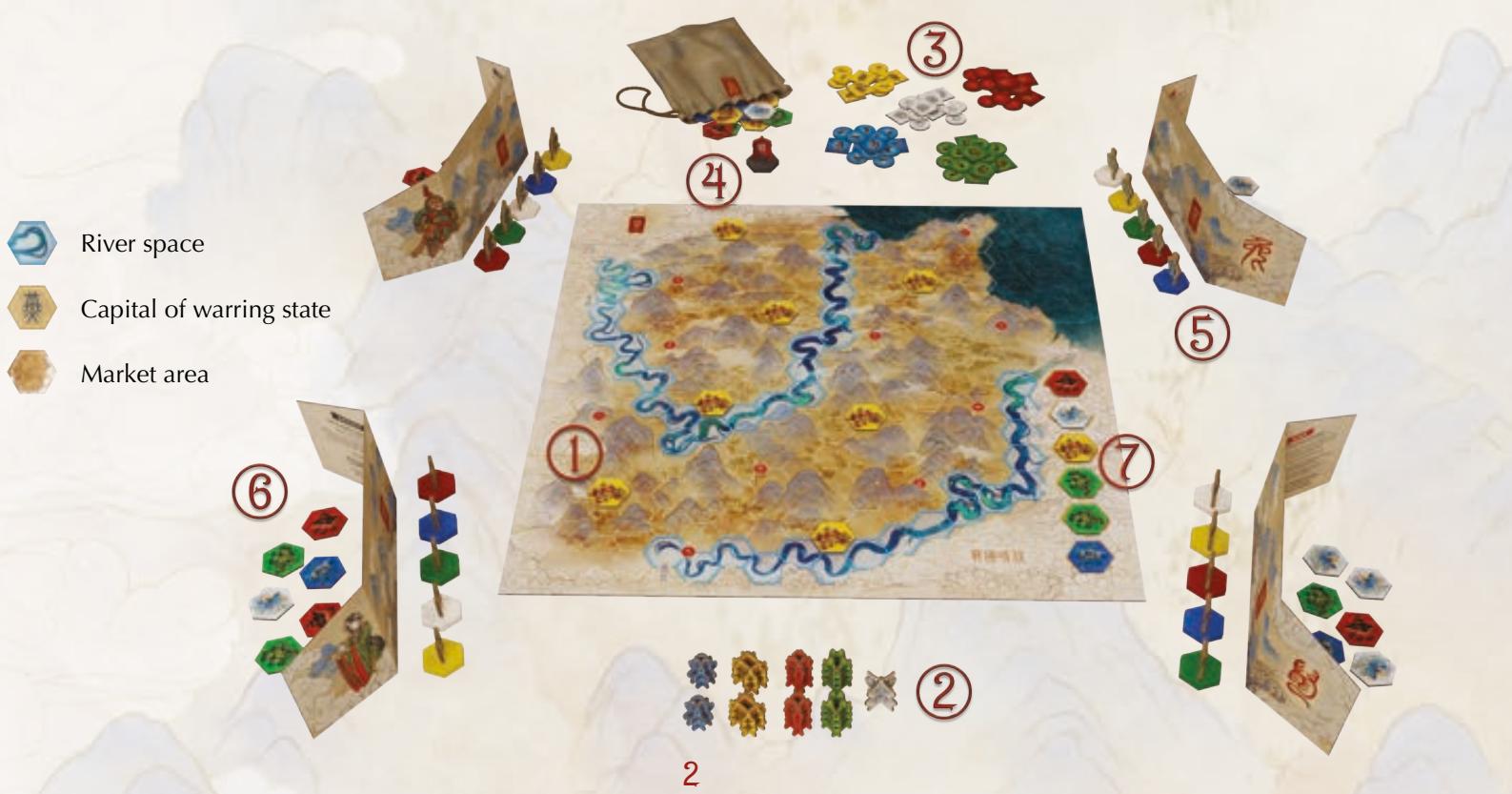
a screen in front of them, and places their 5 leaders in front of the screen [5]. Put any spare screens and leaders back into the box.
Each player draws 6 tiles from the bag and places them behind their screen [6]. A further 6 tiles are drawn from the bag and placed face up in the Market area of the board [7].
皇 STATES 皇
Tiles and leaders with a common edge are adjacent. Tiles or leaders are linked if they are adjacent or if they are connected through a chain of adjacent tiles and leaders.
A state is one or more linked tiles and at least one linked leader on the board. As long as a state only contains leaders of different colours, everything is peaceful. Conflicts arise when there are 2 leaders of the same colour within one state.
皇
Choose a starting player at random. Play proceeds in a clockwise order from that player.
During your turn, you must resolve 2 actions. There are 5 possible actions. You may choose 2 different actions, or the same action twice. You may do these in any order:
Position a leader
Place a tile
Discard 2 blue Farmer tiles to cause a peasants' riot
Discard 2 green Trader tiles to establish a pagoda
Replace up to 6 tiles from behind your screen
POSITIONING A LEADER
You control a dynasty of 5 leaders. Each leader in your dynasty has the same appearance, but is one of 5 different colours, corresponding with the 5 tile types:

A leader can be:
Placed on the board (from in front of your screen), OR
Repositioned from another space on the board, OR
H Withdrawn from the board and placed back in front of your screen.
When placing or reposition a leader on the board, the following restrictions apply:
A leader must be placed on an empty space.
A leader can only be placed adjacent to a yellow Governor tile.
A leader cannot be placed in such a way as to unite states leading to a conflict. (Note: As long as no conflict arises, a leader may be placed to unite 2 or more states.)
A leader cannot be placed on a river space.
If the last yellow Governor tile adjacent to one of your leaders is removed from the board, the leader is removed and returned to in front of your screen.
PLACE A TILE
There are 5 different types of tiles:

Governor
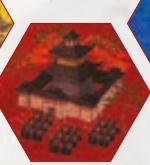


Artisan
Soldier

Trader
To place a tile, take a tile from behind your screen and place it on the board. The following restrictions apply:
A tile must be placed face up on an empty space.
Blue Farmer tiles can only be placed on river spaces. (Farming needs irrigation).
No other tile type can be placed on a river space.
Special Green Trader Tile and Blue Farmer Tile Effects
After placing a green Trader tile on the board, you may choose 1 of the face-up tiles from the Market area and place it behind your screen.
After placing a blue Farmer tile, you may continue to place additional blue Farmer tiles within the same action, as long as the next tile is always played adjacent to the previous tile and the placement of the previous tile did not lead to a war or the placement of a new pagoda.
Victory Points
There are 5 types of victory points:


Yellow - representing Order
Red - epresenting Power
Blue - representing Food representing Trade
White - representing Wealth
A victory point is gained for placing a tile under the following circumstances:
出 If the tile is placed in a state, and this state contains a leader of the same colour, then a victory point of that colour is gained by the player controlling that leader.
If there is no leader of the respective colour, but there is a yellow Governor leader within the state, then a victory point of that tile's colour is gained by the player controlling the yellow Governor leader.
If several blue Farmer tiles are placed within the same action, a blue victory point is gained for each of these tiles if the above circumstances apply.
No victory point is gained if the tile is placed so that it unites 2 or more states leading to a conflict. (Note: As long as no conflict arises, a victory point is gained if the above circumstances apply).
Victory points are kept hidden behind the players' screens. At any time during your turn, you may exchange 5 markers valued at “1″ for 1 marker valued at “5”.
DISCARD 2 BLUE FARMER TILES TO CAUSE A PEASANTS' RIOT
To cause a peasants' riot, reveal then discard 2 blue Farmer tiles from behind your screen face down into the box. Then choose any 1 tile from the board and discard it face down into the box. This can include a starting yellow Governor tile placed on a capital space. That space has no effect after set-up. The space where the tile was removed becomes empty.
Note: A peasants' riot may divide a state into 2 or more parts. If a peasants' riot removes the last yellow Governor tile adjacent to a leader, that leader is removed and returned to its player. If a tile is removed from below a building (pagoda, granary or the royal palace), then the building is also removed and placed next to the board – see Pagodas and Optional Rules sections below.
Special Blue Farmer Leader Effect
If you have your blue Farmer leader in front of your screen (hence not on the board), this leader may (but does not have to) represent 1 of the 2 required tiles. You then only discard 1 blue Farmer tile from behind your screen to cause a peasants' riot.
DISCARD 2 GREEN TRADER TILES TO ESTABLISH A PAGODA
This action is described under the Pagodas section below.
REPLACE UP TO 6 TILES FROM BEHIND THE SCREEN
You may discard up to 6 tiles from behind your screen face down into the box. Then draw the same number of tiles from the bag and place them behind your screen.
END OF A TURN
At the end of your turn, after resolving 2 actions, collect victory points for any pagodas you control – see Pagodas section below.
Finally, refill your tiles by drawing from the bag so that you end your turn with 6 tiles behind your screen. If other players have fewer than 6 tiles at this point, they also refill their tiles to 6. If there are fewer than 6 tiles left in the Market, these are also replenished from the bag. Then it is the next player's turn.
皇 PAGODAS
There are 5 types of pagodas:


Court
Garrison
Granary


Market
Workshop
After placing a tile, you may establish a pagoda if the tile has been placed such that creates a 'triangle' of 3 tiles of the same colour, provided that:

a) the tile placed does not create a war; and b) none of the three tiles of the triangle is yet supporting another building (pagoda, granary or the royal palace).
You then take a pagoda of the corresponding colour from next to the board and place it on the triangle. If no such pagoda is available, take a matching pagoda already placed on the board and reposition it.
The decision to establish a pagoda is optional.
Note: The tiles forming the triangle remain face up and they still count when located under the pagoda. In particular, adjacent leaders are still supported by yellow Governor tiles under a yellow pagoda.
A pagoda provides victory points. At the end of your turn, check if 1 or more of your leaders is in the same state as a same-coloured pagoda. For each such leader, gain 1 victory point of the leader's colour for each same-coloured pagoda in the same state.
Note: While the placement of a tile can allow the yellow Governor leader to gain victory points in other colours (in the absence of the respective leader), this does not apply for pagodas. Now we are able to describe the outstanding action:
DISCARD 2 GREEN TRADER TILES TO ESTABLISH A PAGODA
To establish a pagoda on a 'triangle' of tiles that has been created earlier by any player, reveal then discard 2 green Trader tiles from behind your screen face down into the box. Then establish a pagoda of the corresponding colour on the given triangle. If available, take the pagoda from next to the board. If no such pagoda is available, take a matching pagoda already placed on the board and reposition it.
Special Green Trader Leader Effect
X If you have your green Trader leader in front of your screen (hence not on the board), this leader may (but does not have to) represent 1 of the 2 required tiles. You then only discard 1 green Trader tile from behind your screen to establish a pagoda.
CONFLICTS
A conflict occurs when there are 2 like-coloured leaders in a state. There are two different types of conflicts:
Revolts
Wars
An action does not end until the conflict is resolved and all states only contain leaders of different colours.
REVOLTS
A revolt occurs when a leader is positioned in a state that already contains a leader of the same colour. During a revolt, the player positioning the new leader is the attacker. The player who controls the existing leader of the same colour in the state is the defender.
Resolve revolts as follows:
The attacker and the defender draw their strength from yellow Governor tiles adjacent to their leaders. It is possible that a yellow Governor tile counts for both leaders.
First the attacker, and then the defender, may increase their strength by committing to the conflict any number of extra yellow Governor tiles from behind their screens, placing them face up in front of their screens.
Whoever has the higher total strength (total number of yellow Governor tiles plus yellow Governor Leader effect) wins the conflict. If there is a tie, the defender wins.
The consequences of a revolt are as follows:
If you are the loser, you must withdraw your leader from the board.
If you are the victor, gain 1 victory point in the colour of the conflicting leaders.
Both players then discard their committed yellow Governor tiles face down into the box.
Yellow Governor Leader Effect
If you have a yellow Governor Leader in front of your
screen (hence not on the board) and you are participating in a revolt as an attacker or defender, this leader may (but does not have to) add 1 extra strength to your side.
WARS
Wars occur when 2 or more states are united through the placement of a new tile, and the new, larger state contains leaders of the same colour.
Place the unification marker on top of the unifying tile. It remains there until the war is resolved. The unifying tile does not have any other effect – it does not reward victory points, count towards strength (if red) or allow you to take a tile from the market (if green).

Wars are resolved as follows:
All warring states draw their strength from red Soldier tiles in the state, and supporting red Soldier Leaders not on the board.
Starting with the player to the left of the player who played the unifying tile and progressing in a clockwise order, each player may now increase the strength of 1 warring state of their choice by committing any number of extra red Soldier tiles from behind their screen, placing them face up next to the board close to the supported state. They may also contribute their red Soldier Leader (see below). All the players may contribute to the war, even if none of their leaders is involved in the conflict. The player who played the unifying tile is always the last player to contribute.
Whichever warring state has the highest total strength (total number of red Soldier tiles plus red Soldier Leader effect(s)) wins the war. If there is a tie, the player who played the unifying tile decides which of the tied states wins.
The consequences of a war are as follows:
X Note the total strength of each losing state (if more than one). Then simultaneously remove all conflicting leaders and all red Soldier tiles from all the losing states. If the tile placed that led to the war was a red Soldier tile, do not remove it, it is not considered to have participated in the war. Only non-conflicting leaders remain in the losing states.
For each leader removed and returned to its player, the player who controls the like-coloured leader in the winning state gains 1 victory point in that colour.
Compare the total strength of all the losing states (if more than 1 losing state). The highest of these totals now defines the number of red Soldier tiles that must also be discarded by the winning state. First discard all the red Soldier tiles committed for the winning state. If this number is not sufficient, then the player who played the unifying tile chooses and removes red Soldier tiles from the winning state itself until the total number of discarded red Soldier tiles matches the required total.
After the war, remove the unification marker and place it by the board. The tile underneath the unification marker remains in place.
Red Soldier Leader Effect
If you have a red Soldier leader in front of your screen (hence not on the board), you may (but do not have to) use this leader to count as 1 extra strength for one of the warring sides.


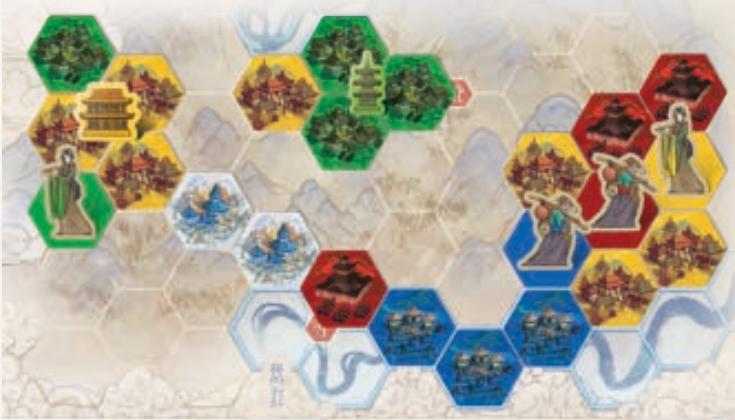
Example: Scott, the Rat, places a tile to unify 2 states. This causes a war. No victory point is gained for this placement, instead the unification marker is placed on the new tile.
Currently, the state on the left has strength 2 (2 red Soldier tiles) and the state on the right has strength 4 (4 red Soldier tiles).
Monica, the Tiger, follows Scott in clockwise order. She is the first to commit extra tiles. She places 2 red Soldier tiles from behind her screen next to the state on the left where her leaders are.
Gerry, the Goat, follows next. He does not want to commit extra tiles, but as his red Soldier leader is not on the board, he decides to use this leader to support the state on the left.
Finally, the order comes back to Scott to commit extra tiles. The current strength is 5 for the state on the left, and 4 for the state on the right where his leaders are. Scott commits 3 red Soldier tiles from behind his screen and places them next to the state on the right.
The state on the right wins the war. The conflicting red Tiger and yellow Tiger are removed from the losing state and returned to Monica. The 2 red Solider tiles on the losing state are also removed. The red tile under the unification marker is not affected. Scott gains 1 red victory point for his victorious red leader, and Gerry gains 1 yellow victory point for his victorious yellow leader. The green leader and the blue leader remain unaffected as there are no conflicting like-coloured leaders.
The total strength of the losing state is 5. The 3 committed tiles for the state on the right are not enough to match this total. Therefore, Scott, who played the unifying tile, must remove 2 more red Soldier tiles from the victorious state on the right. This also causes the red pagoda to be lost and placed next to the board.
All the committed and removed red Soldier tiles are discarded face down into the box. The unification marker is removed, and the war is over.
GAME END AND WINNER
The game end is triggered when a player who is attempting to draw a tile for any purpose is unable to do so because the bag is empty.
At this point, all players remove their screens. Each player totals the number of victory points they have in each of the 4 colours (yellow, red, blue, and green). They then freely allocate white victory points to any colour. (Each white victory point is wild and can count as any other colour.) The colour in which a player has the fewest victory points is their victory point total.
The player with the highest total is the winner. In the case of a tie, the tied players determine in which of the 4 colours they have their second fewest victory points and compare these, and so on.
In the event that players are tied across all non-white colours, the player with the fewest white victory points is the winner.
In the unlikely event that there is still a tie, no one wins. No state is able to unite the empire. The warlord Xiang Yu takes control, and the period of the Eighteen Kingdoms (see page 1 1) arrives early.

HHUANG
OPTIONAL RULES
ROGUE BANDITS
During the period of the Warring States, gangs of rogue bandits terrorised the lands. To unify the empire and establish peace, these bandits must be defeated.
RULES

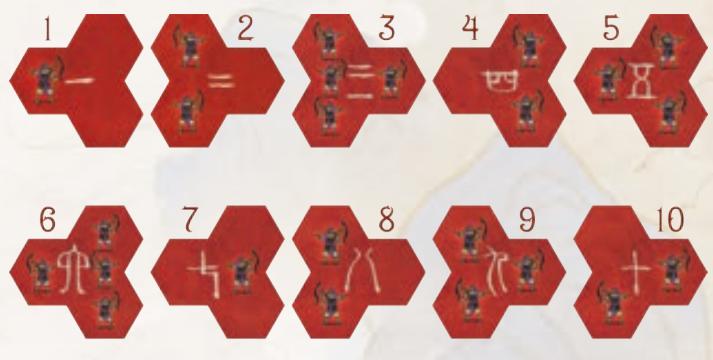
There are 10 Bandit tiles with symbols corresponding with 10 spaces on the board. Five of these locations, randomly determined, are used in a game.
To determine the locations, shuffle the 10 tiles face down. Reveal a first tile to determine a corresponding placement location, then reveal another tile and place this other tile face up in the determined location, while discarding the first tile into the box. Continue in this way, until there are 5 Bandit tiles on the board and 5 Bandit tiles in the box.

- Bandit location
During play, leaders may not be placed next to a Bandit tile. Furthermore, you may only place a tile adjacent to a Bandit tile if that tile unites the Bandit tile with a state with at least as many red Soldier tiles as bandits shown on the Bandit tile.
No victory point is gained for placing the tile, instead the unification marker is placed on the unifying tile.
If there is a red Soldier leader in the state, the player who controls this leader receives as many red victory points as there are bandits shown on the Bandit tile.
The player who placed the unifying tile then chooses and removes as many red Soldier tiles from the state as shown on the Bandit tile. The Bandit tile is removed from the board and discarded into the box. The bandits are defeated! The unification marker is placed by the board again.
Note: the Rogue Bandits optional rule cannot be combined with the Eighteen Kingdoms optional rule.
EIGHTEEN KINGDOMS
Huang is set during the period of the Warring States (475 – 221BC). The seven states that fought during this period were finally united in 221BC under the emperor Qin Shi Huang, leader of the Qin dynasty.
But the period of peace was short-lived. Qin Shi Huang died in 210BC, and within two years most of the empire was in revolt against his son. Amidst an atmosphere of rebellion, retribution and great famine, the warlord Xiang Yu took power in 206BC, splitting the empire into 18 states.
Xiang Yu's rival Liu Bad waged a long revolt against him. After Xiang Yu's death, Liu Bang reunified the empire and became the first emperor of the Han dynasty (202BC – 220AD). Tributes of grain from the former state capitals began to pour in.
You can replay this dramatic period of Chinese history using the Eighteen Kingdoms optional rule.
Note: counting the homeland of Qin itself, there were 19 states in total, each with their own state capital.

RULES
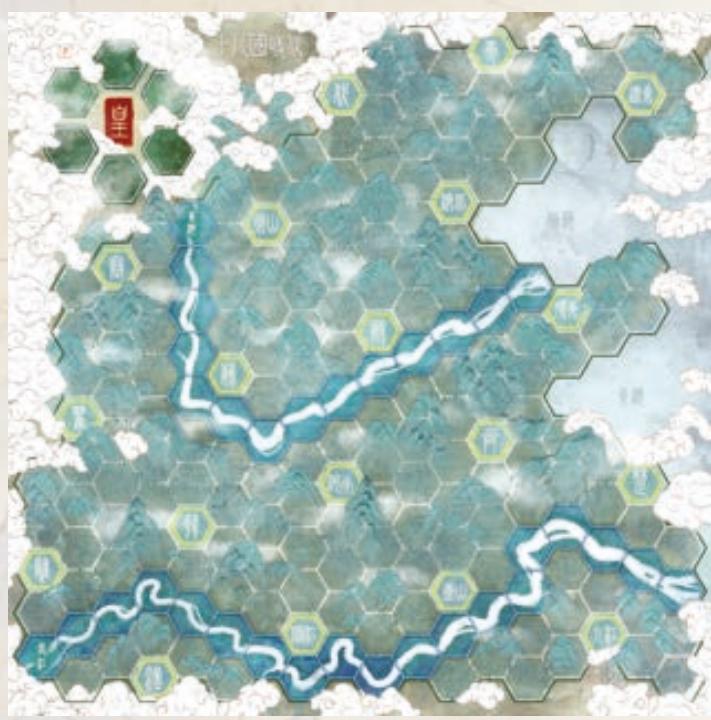
The Eighteen Kingdoms optional rule uses the reverse side of the main board. This introduces a new board layout with more capitals and different topographical features. It also introduces granaries that provide an alternative source of victory points.
Place a yellow Governor tile and a granary on each of the 19 capital spaces on the board.
Due to the new path of the rivers, there are no opportunities to establish blue pagodas - these can remain in the box. Instead, the granaries now allow the players to gain additional blue victory points.
If you end your turn with your blue Farmer leader in a state that contains more than 1 granary, you can remove all but the last granary from that state, and place them behind your player screen.
At the game end, each granary counts as 2 blue victory points.
The palace was a magnificent building, and it can be added to the game using the following rules.
RULES
The royal palace can be established on 4 yellow Governor tiles if these form the corresponding shape. The same rules apply for the royal palace as for pagodas, including the '2 green Trader tiles'and 'Peasants'Riot' rules.
The royal palace does not provide victory points. Instead, if at the end of your turn you control the yellow Governor leader in a state with the royal palace, draw up to 7 tiles behind your screen.
Note: the royal palace can be used with any optional rule.
GAMEFOUND EXCLUSIVES
ROYAL PALACE

After the unification, the royal palace of the state of Qin became the palace of the first emperor Qin Shi Huang.

Components: 1 royal palace building
DRAGON DYNASTY

The Dragon Dynasty is a fifth player expansion. The fifth player uses the same set-up and play rules as the other players.

Note: the Dragon Dynasty can be used with any optional rule.
Credits
Designer: Reiner Knizia | Art: Bartłomiej Jędrzejewski | Creative Director: Jaro Andruszkiewicz
Gamefound Campaign Manager: Adrian Turzański | Editor: James Buckley | Production: Agata Jurczyszyn
3D design: Maciej Krasuń, Mateusz Kamiński, Bartłomiej Płóciennik | DTP: Katarzyna Jasińska
Playtesters: Reiner Knizia thanks all the playtesters who contributed, in particular lain Adams, Drak, Gavin Hamilton,
Martin Higham, Ross Inglis, Kevin Jacklin, Chris Lawson, and Dave Spring
下载 Markdown原文为社区整理/出版社公开资料,版权归原作者,仅供个人学习查阅。