
深夜动物园Night At The Zoo
一句话概览
深夜动物园 是一款已收录于村了吗规则库的桌游,支持 1–4 人,原名 Night At The Zoo。
本页内容:一句话概览 · 游戏概述 · 1. 游戏组件 · 2. 游戏设置 · 3. 游戏流程 · 4. 选取阶段 · 5. 板块放置阶段 · 6. 维护阶段 · 7. 终局计分 · 8. 特殊动物规则 · 9. 单人模式 · 关键规则与常见问题 · 常见问题
深夜动物园 规则速览
以下规则速览由本站整理,与官方规则书表述不同,仅供快速上手参考。
游戏概述
深夜时分,动物园里有些动物偷偷溜出了围栏!玩家将帮助这些逃跑的动物在昏暗的动物园中探明路线,铺出一条回到各自围栏的通路,让它们安全归巢。每种动物的移动方式各不相同,计分条件也各有差异。游戏进行 3 轮(每轮 5 次选取),最终获得最多胜利点数(VP)的玩家获胜。
核心机制: 板块选取与放置、路径构建、工人放置、差异化计分
1. 游戏组件
| 组件 | 数量 | 说明 |
|---|---|---|
| 游戏版图 | 1 块 | 中央版图,含选秀市场、剩余区、动物园格、废弃格等 |
| 玩家版图 | 4 块 | 每位玩家一块,用于放置板块和排列动物 |
| 动物板块 | 6 块 | 标有字母 A-C 及难度等级(月亮数),展示各种特殊动物 |
| 动物模型 | 72 个 | 6 种类型各 12 个 |
| 花粉标记 | 48 个 | 蝴蝶计分用 |
| 行动板块 | 75 块 | 背面显示选取图标,正面显示行动符号和食物符号 |
| 奖励板块 | 42 块 | 不含行动符号,可触发面板上的空格效果 |
| 设置板块 | 9 块 | 每块标记一种动物类型及其初始位置 |
| 起始玩家标记 | 1 个 | |
| 单人游戏板块 | 6 块 | 单人模式使用 |
| 计分倍率标记 | 4 个 | 单人模式计分用 |
| 计分标记 | 4 个 | 追踪玩家分数 |
配件缺失或损坏?请联系发行商 info@albi.cz 补发。
2. 游戏设置
2.1 版图放置
将游戏版图放置到桌面中央,确保所有玩家都能轻松触及。
2.2 奖励板块准备
将奖励板块(背面空白)按地形类型分类,组成三叠正面朝上的供应堆:
- 草地
- 岩石
- 沙地
放置在游戏版图旁。
2.3 动物板块准备
- 将动物板块洗匀,随机抽取三张。
- 这三张板块的难度等级(月亮数)总和必须至少为 6。若不满足此条件,则重新洗匀并再次抽取。
- 将抽出的三张动物板块正面朝上放置到游戏版图上方的指定插槽(A、B、C)中。
- 每位玩家拿取每种抽出的动物类型的 3 个动物模型。
2.4 行动板块与市场设置
- 将行动板块背面洗匀,组成一叠背面朝下的牌堆,放置在游戏版图旁。
- 抽取数量等于玩家人数 + 1的行动板块。将这些板块正面朝上放置到游戏版图的浅蓝色空格(最上一排)上——这个区域称为选秀市场。
2.5 玩家个人设置
- 每位玩家拿取一块玩家版图,选择一种颜色。
- 将对应颜色的计分追踪标记放到游戏版图计分轨道的「0」格上。
- 每位玩家随机抽取一块设置板块。按照该板块所示,将动物模型放置到玩家版图上「未发现动物」的对应位置。每种动物类型与设置板块上的字母标记对应。
- 设置板块上标有入口图标的每种动物各放 1 个,直接放置到玩家版图的入口格上。
> 示例:将所有树懒放置到玩家版图上标有字母 A 的「未发现动物」位置。该玩家版图左侧的树懒模型从入口格开始。
- 将设置板块翻到背面。此板块后续用于存放已抵达动物园的动物(终局计分用)。
2.6 确定起始玩家
选择起始玩家。可以是最近见过或帮助过动物的人。若无法决定,则随机选择。起始玩家拿取起始玩家标记。
3. 游戏流程
游戏进行 3 轮。每轮中,玩家进行 5 次选取。每次选取包含三个阶段,按以下顺序执行:
- 选取阶段 — 从选秀市场选取行动板块
- 板块放置阶段 — 使用已收集的板块
- 维护阶段 — 刷新市场、传递起始标记、处理轮末事件
当第 3 轮结束(完成 15 次选取)后,游戏立即结束,进入终局计分。
4. 选取阶段
从起始玩家开始,按顺时针方向,每位玩家必须从游戏版图的选秀市场上拿取一块行动板块。
选取完成后,将剩余的板块移至市场下方的剩余区,放置到最左侧的空格上。
关于板块
板块分为两种类型:
- 行动板块: 正面显示行动符号或食物符号。行动符号在板块放置阶段执行;食物符号仅用于终局计分。若板块显示两个行动符号,你必须选择只执行其中一个。
- 奖励板块: 不含任何行动符号,但可在放置时触发玩家版图上的空格行动。
两种板块均会显示三种地形之一:岩石、草地、沙地。
5. 板块放置阶段
在此阶段,你使用已收集的板块。你有以下三种选择:
- 将板块放置到你的邻近区域(玩家版图内侧的 5×5 网格)
- 将板块放入你的仓库
- 弃置板块以执行特殊移动
5.1 将板块放置到邻近区域
将板块放置到邻近区域的任何空格(无板块的位置)上。此时根据格子条件和板块符号触发相应行动。
行动触发规则
- 若该格或该板块显示行动符号,你可以立即执行该行动。
- 若格子和板块都赋予你行动,你可以按任意顺序执行。但你必须完全执行完一个行动后,才能执行另一个。
- 若某格有条件,你必须用符合条件的板块覆盖它才能激活该行动。若不想激活,也可以放置不符合条件的板块(不触发效果)。
板块一旦放置,不可移动。
格子条件
| 条件类型 | 说明 |
|---|---|
| 行动符号 | 必须将显示此符号的行动板块放置到对应格子上。不必执行板块上的行动来满足条件 |
| 特定地形 | 必须将特定地形类型(草地/岩石/沙地)的行动板块或奖励板块放置到此格子上 |
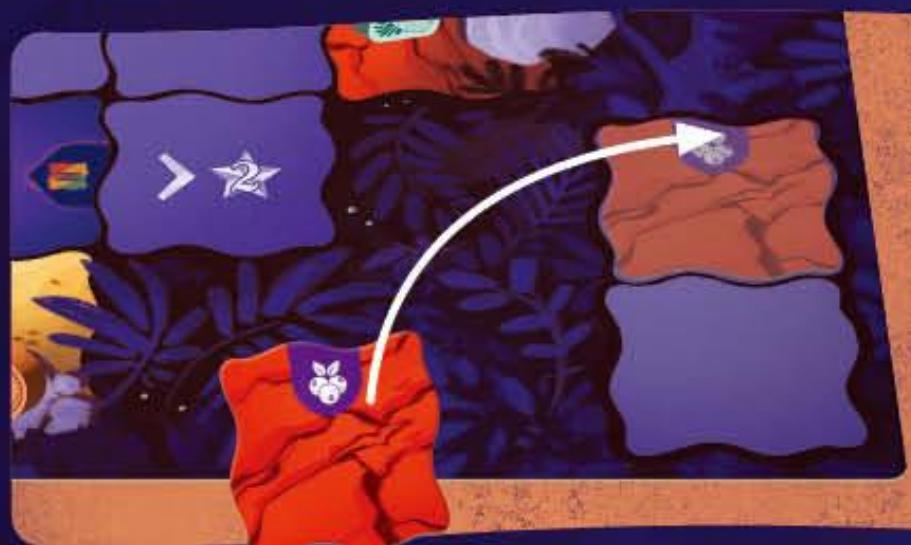
| 双格覆盖(深色格子) | 必须用相同地形类型的板块覆盖两个相邻格子才能触发。你将获得一次奖励(5 分 / 2 次移动 / 2 块奖励板块),但仅在覆盖完两个格子之后才生效 |
格子行动详解
| 行动 | 效果 |
|---|---|
| 发现新动物 | 将任意一个尚未被发现的动物模型放置到玩家版图上对应的入口格。从现在起,该动物可以被移动 |
| 拿取奖励板块 | 从供应区拿取一块自选地形类型的奖励板块。你可以立即将其放置到邻近区域、放入仓库,或弃置 |
| 即时胜利点数 | 获得符号所示数量的胜利点数,并立即在计分轨道上向前移动你的计分追踪标记 |
| 动物移动 | 默认情况下,1 个箭头允许你将 1 个动物模型移动 1 格 |
动物移动规则
- 动物只能移动到正交相邻(共享边)的格子上。
- 双箭头可以作为 1 只动物的两次移动,或作为 2 只动物各移动 1 格。
- 某些动物板块会修改该特定动物的移动规则(详见第 8 节特殊动物规则)。
- 多个动物模型可以占据同一格。
- 当动物到达动物园(玩家版图中央格)时,即已安全归巢——将其从版图上移除并放到设置板块背面用于终局计分。该动物剩余的移动点数全部作废。
- 动物模型任何时候都不可返回入口格或未发现动物格。
- 任何动物任何时候都不可移动到没有任何类型板块的格子上(动物园格除外)。
5.2 将板块放置到仓库
将刚获得的板块放入仓库以备后用。游戏中任何时候仓库最多存放两块板块。你可以在自己的回合中任何时候使用仓库中的板块(同一行动获得的 2 次移动之间除外),要么将其放置到邻近区域,要么弃置以执行特殊移动。
5.3 弃置板块以执行特殊移动
在你的回合中,你可以弃置一块行动板块或奖励板块(刚选取的或来自仓库的),以执行特殊移动。
效果: 移动所有当前站在与弃置板块相同地形类型上的动物,包括入口格上的动物。这些移动遵循标准动物移动规则。
- 你可以在板块放置阶段的任何时候重复执行此行动。
- 同一行动获得的 2 次移动之间除外。
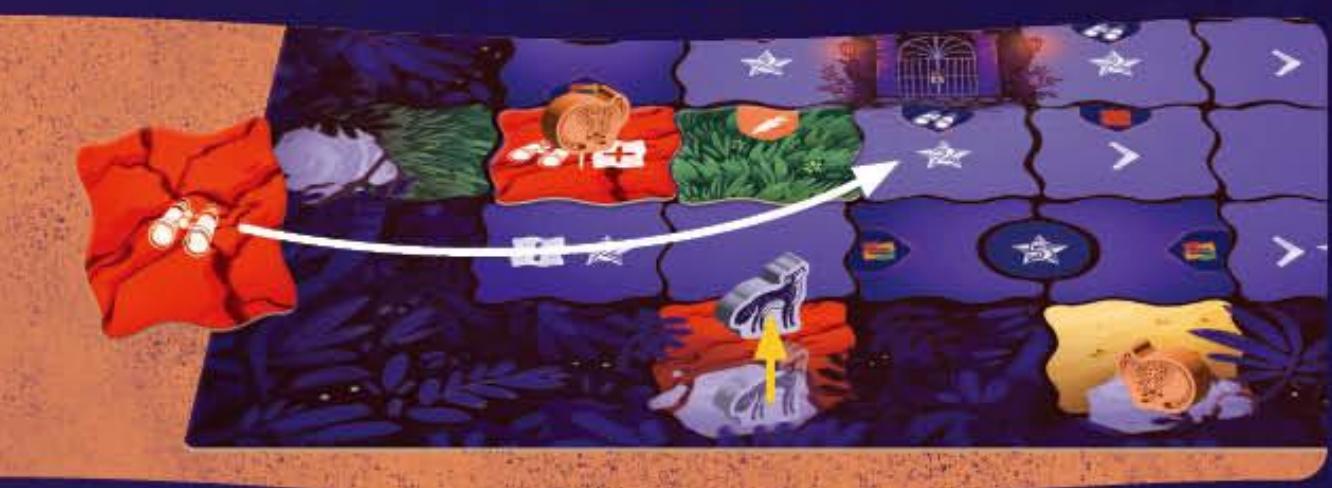
> 示例:从仓库弃置了一块草地板块。因此,他可以移动所有站在草地上的动物。他将猎豹移动两格(得益于猎豹弃置板块时的特殊移动能力),并让树懒躺下睡觉(树懒的特殊移动能力)。
6. 维护阶段
所有玩家完成板块放置阶段后,进入选取的最后阶段——维护阶段。
6.1 刷新市场
从牌堆抽取数量等于玩家人数 + 1的行动板块。将它们正面朝上放置到游戏版图的选秀市场空格上。
6.2 传递起始玩家标记
将起始玩家标记传给顺时针方向的下一位玩家。该玩家从刷新后的市场中选择行动板块,开始下一次选取。
6.3 轮次结束移动
每轮结束时(第 5、10、15 次选取后),发生轮次结束移动。此移动授予所有玩家,可以同时执行。
执行步骤:
- 确定剩余区(最下一排)中出现最频繁的地形类型。若出现平局,最左侧空格的地形类型赢得平局。
- 所有当前站在该地形类型上的已发现动物(包括入口格上的动物)执行一次移动,遵循每种被移动动物的标准移动规则。
- 弃置剩余区的所有板块,将它们放到游戏版图旁的正面朝上的弃置堆中,以记录已进行的轮次数。
> 示例:剩余区中的板块为岩石 - 沙地 - 岩石 - 沙地 - 草地。岩石与沙地出现平局(各两块)。由于岩石板块位于最左侧,赢得平局,因此所有站在岩石地形上的动物执行一次移动。
7. 终局计分
第 3 轮结束时,游戏结束。按以下标准计算分数(从高到低):
7.1 动物园中的动物
每只成功抵达动物园的动物,根据其动物板块上所示的独特计分规则获得分数。不同动物的得分方式各异:
| 动物 | 计分方式 |
|---|---|
| 企鹅 | 每只 5 分 |
| 猎豹 | 每只 6 分 |
| 蛇 | 每只 10 分 |
| 树懒 | 每只 15 分 |
| 蝴蝶 | 根据花粉数量计分(见下方表格) |
| 狼 | 按总数阶梯计分(见下方表格) |
蝴蝶计分表:
| 花粉数量 | 1 | 2 | 3 | 4 |
|---|---|---|---|---|
| 分数 | 5 | 7 | 9 | 11 |
狼计分表:
| 抵达数量 | 1 只 | 2 只 | 3 只 |
|---|---|---|---|
| 分数 | 7 | 16 | 27 |
7.2 已发现但未归巢的动物
每只已发现但未抵达动物园的动物(包括入口格上的动物),获得 1 点胜利点数。
7.3 食物符号
行动板块上有 7 种独特的食物符号。统计你收集到的每种食物的数量,查表对照得分:
| 食物数量 | 2 | 3 | 4 | 5 | 6 | 7 |
|---|---|---|---|---|---|---|
| 分数 | 6 | 8 | 11 | 16 | 22 | 30 |
> 示例:玩家为回到动物园的动物获得 39 分。然后为邻近区域中的动物获得 3 分。最后为他收集到的 3 种不同食物符号获得 8 分,总分 50 分。
最高分者获胜。
8. 特殊动物规则
任何动物任何时候都不可移动到没有任何类型板块的格子上(动物园格除外)。这条规则对所有特殊动物同样适用。
企鹅 🐧
移动方式: 移动时沿直线滑行到最远的板块格。企鹅到达动物园时,立即停止移动。
计分: 每只抵达动物园的企鹅获得 5 分。
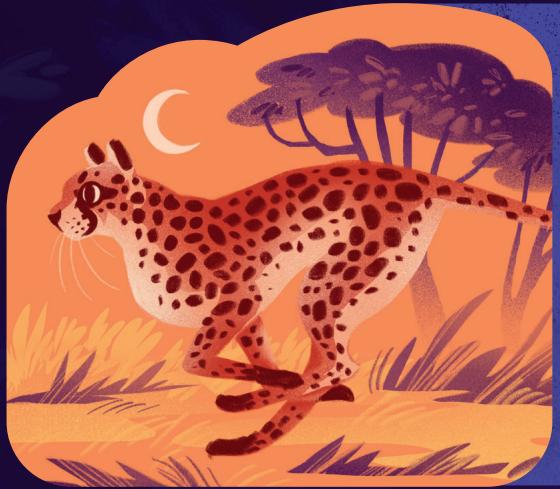
猎豹 🐆
移动方式: 执行特殊移动(通过弃置板块)时,猎豹额外执行 1 格移动。
计分: 每只抵达动物园的猎豹获得 6 分。
狼 🐺
移动方式: 标准移动。
计分: 根据抵达动物园的狼的数量阶梯计分:1 只狼 7 分,2 只狼 16 分,3 只狼 27 分。
蛇 🐍
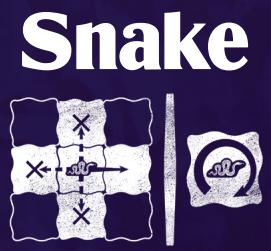
移动方式: 移动时朝其面向的方向执行标准 1 格移动。它不能自由向左或向右转弯。你可以通过花费 1 次移动来改变其方向。
初始朝向: 被发现时,蛇初始面向邻近区域。
计分: 每只抵达动物园的蛇获得 10 分。
蝴蝶 🦋
特殊准备: 游戏设置时准备好花粉标记。
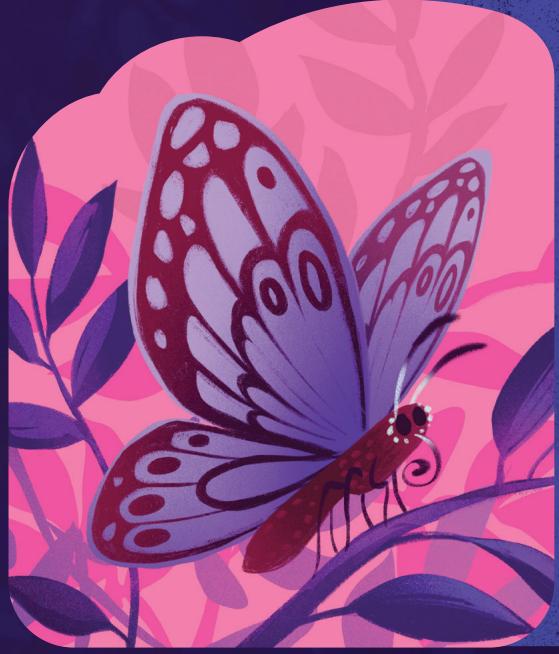
移动方式: 执行特殊移动(通过弃置板块)时,若蝴蝶移动,它获得 1 个花粉标记放到其模型上(每只蝴蝶最多 4 花粉)。
计分: 每只抵达动物园的蝴蝶根据收集的花粉数量获得分数:1 花粉 = 5 分,2 花粉 = 7 分,3 花粉 = 9 分,4 花粉 = 11 分。
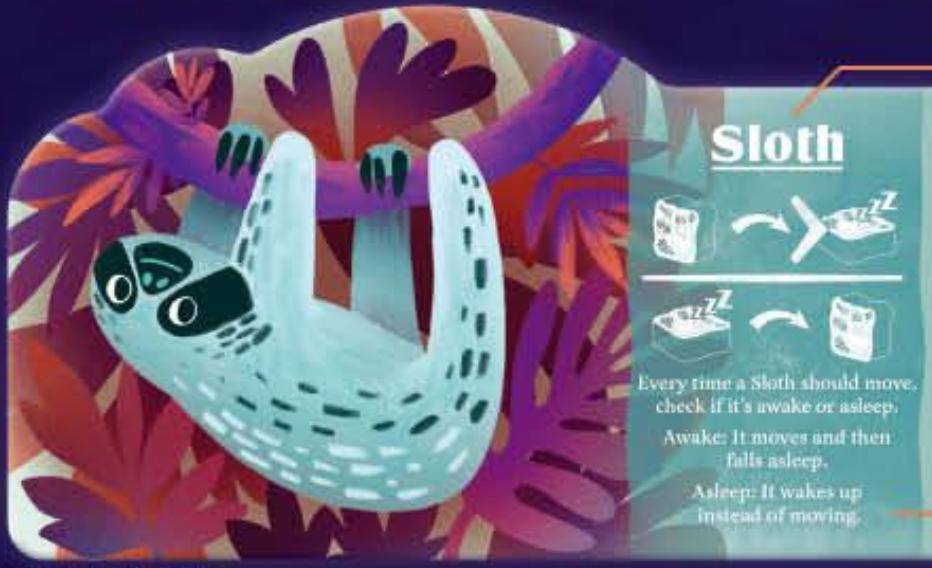
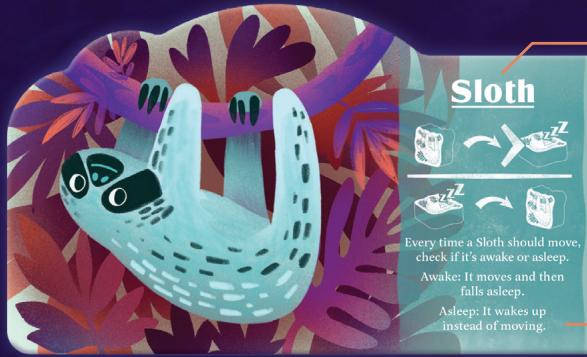
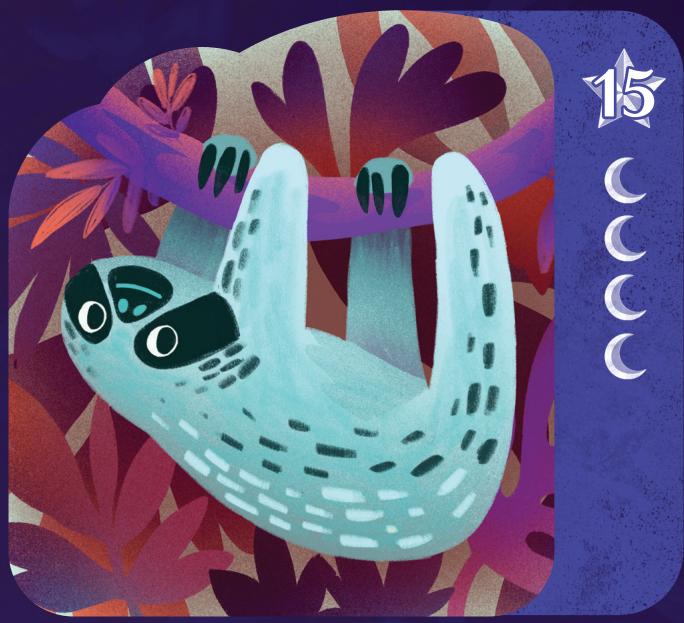
树懒 🦥
移动方式: 移动前,必须检查树懒是睡着还是醒着。
- 醒着: 执行 1 格移动然后入睡。将树懒模型侧放表示入睡。
- 睡着: 不执行移动,而是醒来。将模型竖直放置表示醒来。
初始状态: 被发现时,树懒初始为醒着。
计分: 每只抵达动物园的树懒获得 15 分。
9. 单人模式
在单人模式中,你将与一位名叫利奥的饲养员竞争。利奥像双人游戏中的对手一样从选秀市场选取板块。
9.1 设置调整
- 只准备一块玩家版图(给你自己)。
- 拿取 6 块单人游戏板块,洗匀后正面朝下放置到游戏版图旁,组成抽牌堆。
- 抽取行动板块时,抽取 3 块(如同双人游戏)。
9.2 游戏流程
游戏开始时,起始玩家标记分配给利奥。游戏随后按标准规则进行:
- 轮流选取: 起始玩家标记在你和利奥之间交替。利奥先手,他优先选取最左侧的板块并直接从游戏中移除。你选择拿取最右侧的板块。中间的板块随后移至剩余区。
- 单人游戏板块: 选取阶段开始时,翻开单人游戏牌堆顶的板块。利奥从当前翻开板块上标有①的位置选取板块;若该位置没有板块,则从位置②选取。将利奥选择的板块从游戏中移除。
- 洗匀: 若翻开的单人游戏板块显示洗匀符号,将所有单人游戏板块(已翻开的和抽牌堆中剩余的)一起洗匀,组成新的抽牌堆。
- 继续以此方式进行,直到游戏结束。每轮结束后重新洗匀单人游戏板块。
9.3 计分评级
计算你的分数后,与下表对比评定动物技能等级:
| 分数 | 等级名称 |
|---|---|
| 90+ | 动物园幽灵 |
| 80-89 | 逃跑老虎 |
| 65-79 | 聪明黑猩猩 |
| 50-64 | 狡猾黄鼠狼 |
| 0-49 | 迷路狐猴 |
关键规则与常见问题
易错规则
- 行动板块两个符号选其一: 若板块显示两个行动符号,必须选择只执行其中一个。
- 仓库上限两块: 任何时刻仓库最多存放两块板块。
- 同一行动的两次移动之间不可用仓库: 同一行动获得的 2 次移动之间,不能使用仓库中的板块。
- 弃置后可重复再弃置: 可以在板块放置阶段多次弃置板块执行特殊移动(上述例外情况除外)。
- 轮末移动判定优先级: 剩余区地形类型看最频繁者,平局看最左侧。
- 未发现的动物不可移动: 只有放置在入口格上后才算"已发现",才能被移动。
- 空格不可停留: 动物不可移动到无任何类型板块覆盖的格子上(动物园格除外)。
- 归巢后移动点数作废: 动物到达动物园后立即移除,剩余移动点数不累积。
- 入口格与未发现动物格不可逆向进入: 动物一旦离开入口格,永远不能返回。
- 双格覆盖必须先覆盖两个才生效: 先用一个板块盖住格子不触发,第二个同地形板块盖上后才结算奖励。
- 食物符号是累加而非去重: 统计总共有多少种食物以及各自的累计数量,查表出分。
常见问题
- Q:行动板块上有两个符号怎么办?
A:你必须选择只执行其中一个行动,不能两个都做。
- Q:奖励板块能放在哪里?
A:奖励板块不含行动符号,但可以放入邻近区域(触发格子效果)、存入仓库,或者弃置执行特殊移动。
- Q:奖励板块放在邻近区域时会触发什么?
A:奖励板块本身没有符号,但它覆盖格子后会触发该格子的效果。
- Q:如何判断哪些动物已被发现?
A:被放置到玩家版图入口格上的动物视为已发现,可以正常移动。仍在「未发现动物」位置的动物不可移动。
- Q:轮次结束移动谁先动?
A:轮次结束移动无需按顺序执行,所有玩家同时移动各自站在对应地形上的动物。
- Q:特殊移动时可以移动入口格上的动物吗?
A:可以。弃置板块触发的特殊移动会移动所有站在相同地形类型上的动物,包括入口格上的。
- Q:树懒的"醒/睡"状态如何记录?
A:模型直立于玩家版面上表示"醒着",侧放表示"睡着"。醒着时移动一格然后入睡;睡着时不移动,改为醒来。
- Q:蝴蝶的花粉怎么获取?上限多少?
A:在执行特殊移动(弃置板块)且蝴蝶被移动时,获得 1 个花粉标记。每只蝴蝶最多 4 个花粉。
- Q:单人模式下利奥怎么选板块?
A:利奥从当前翻开的单人游戏板块上标有①的位置选取;①没板块则选②。选完直接从游戏中移除,不进入任何区域。
- Q:单人游戏板块的洗匀符号什么时候触发?
A:翻开单人游戏板块时若显示洗匀符号☐,立刻将所有单人游戏板块(已翻开的 + 抽牌堆剩余)一起洗匀,重组成新的抽牌堆。
常见问题(FAQ)
以下 1 条问答中 0 条来自站内玩家的真实提问,其余 1 条为本站整理的常见疑问;答复内容保持原样。
深夜动物园支持几个人玩?
1–4 人。
去哪查完整规则
想核对具体规则细节、卡牌效果或某个回合的结算方式,可以在村了吗里选中这款游戏后直接提问。
同类桌游
- 卡坦岛德式
- 工业革命:伯明翰德式
- 勃艮第城堡:特别典藏版德式
- 方舟动物园德式
- 重塑宇宙德式
- 埃多拉的德鲁伊德式
- 1817 (2020)德式
- 甜蜜国度德式
- 卡里普索德式
- 铁路环游德式
规则原文(Markdown)
本站收录这款游戏的规则原文 2 个文件,此处内联渲染 2 个,可直接展开阅读或下载。
rules_zh_Night_at_the_Zoo_48533.md18.2 KB
Albi
规则书 中文翻译:陈斌华深夜时分,动物园里有些动物偷偷溜出了围栏!现在它们需要你的帮助,在饲养员发现之前找到回家的路。
帮助这些逃跑的动物在昏暗的动物园中探明路线,铺出一条回到各自围栏的通路,让它们安全归巢。每种动物的移动方式各不相同,计分条件也各有差异,因此要明智地选择移动时机、善用行动——并时刻留意所有逃跑的动物,确保每只都能安然回窝!

不想阅读规则?
观看视频教程!
配件

1 块游戏版图

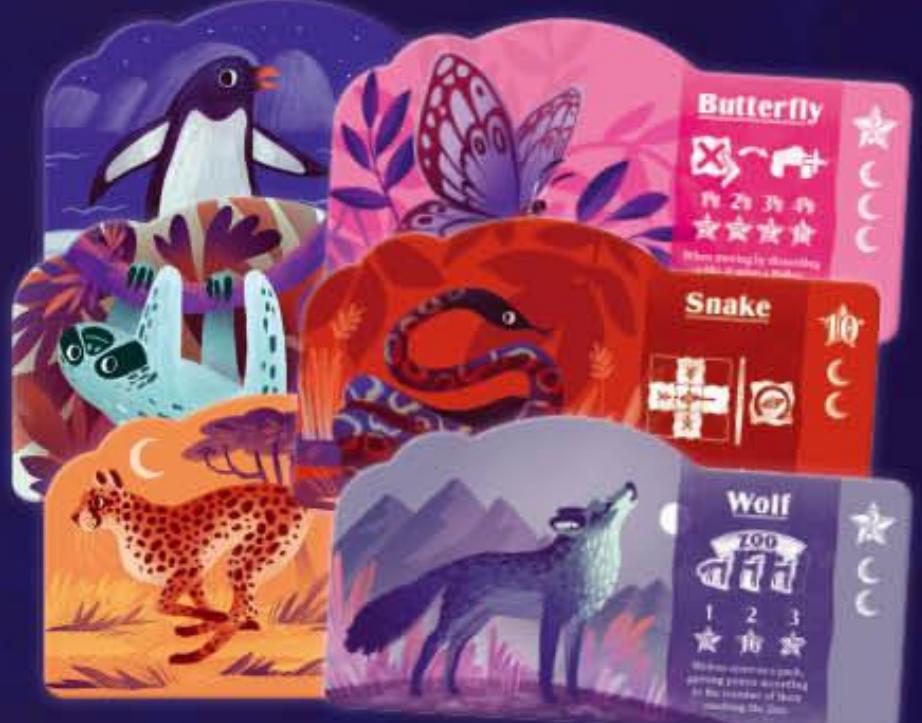
4 块玩家版图
6 块动物板块


72个动物模型(每种类型12个)
48个花粉标记

75块行动板块

42 块奖励板块

9块设置板块

1个起始玩家标记
配件缺失或损坏?
请发邮件至 info@albi.cz,
我们将免费为你补发!



6 块单人游戏板块 4 个计分倍率标记 4 个计分标记
配件说明
动物板块
15
C
C
C

游戏版图

玩家版图
游戏目标
动物类型
抵达动物园时获得的分
难度等级
特殊能力与计分条件
动物板块插槽
选秀市场
剩余区
VP 计分轨道
终局计分
邻近区域
入口格
动物园
未发现动物空格
仓库
游戏目标是最高效地引导你的动物回到动物园。你将在玩家版图上选取并放置板块以触发行动,并为你的动物铺出通路。游戏进行3轮(每轮5次选取),胜利点数(分)最高的玩家获胜。

游戏目标
1 将游戏版图放置到桌面中央,确保所有玩家都能轻松触及。
2 每位玩家拿取一块玩家版图并选择一种颜色。将玩家版图放置到自己面前,将对应颜色的计分追踪标记放到游戏版图计分轨道的「0」格上。
3 将奖励板块(背面空白)按地形类型(草地、岩石、沙地)分类,每种类型各组成一叠正面朝上的供应堆,放置到游戏版图旁。
4 将动物板块洗匀,随机抽取三张。这三张板块的难度等级(月亮数量C)总和必须至少为6。若不足,重新洗匀并再次抽取。将抽出的三张动物板块正面朝上放置到游戏版图上方的指定插槽(A、B、C)中。每位玩家拿取每种抽出的动物类型的3个动物模型。
5 将行动板块(背面显示选取图标)洗匀,组成一叠背面朝下的牌堆,放置到游戏版图旁。
6 抽取数量等于玩家人数 + 1 的行动板块。将这些板块正面朝上放置到游戏版图的浅蓝色空格(最上一排)上。此区域称为
选秀市场。
7 每位玩家随机抽取一块设置板块。按照设置板块所示,将动物模型放置到玩家版图上「未发现动物」的对应位置。每种动物类型在游戏版图上以字母标记,与设置板块上的字母对应。设置板块上标有图标的每种动物各1个,直接放置到玩家版图的入口格上。
示例:将所有树懒放置到玩家版图上标有字母 A 的「未发现动物」位置。玩家版图左侧的树懒模型从入口格开始。
8 将设置板块翻到背面。你将用此板块来存放已经抵达动物园的动物。
9 选择起始玩家。可以是最近见过或帮助过动物的人。若无法决定,则随机选择。起始玩家拿取起始玩家标记。

游戏流程
游戏进行 3 轮。每轮中,玩家进行 5 次选取。每次选取包含三个阶段,按以下顺序执行:
1. 选取阶段
2. 板块放置阶段
3. 维护阶段
1. 选取阶段
从起始玩家开始,按顺时针方向,每位玩家必须从游戏版图的选秀市场上拿取一块行动板块。所有玩家拿取完毕后,将剩余的板块移至市场下方的剩余区,放置到最左侧的空格上。

关于板块 板块分为两种类型:

行动板块:在选取阶段获得。可能显示行动符号或食物符号。行动符号在板块放置阶段执行,食物符号用于终局计分。若板块显示两个行动符号,你必须选择并只执行其中一个。

奖励板块:通过行动获得。这些板块不含任何行动符号,但仍可触发玩家版图上的行动。
两种板块均显示三种地形类型
岩石
草地
沙地

2. 板块放置阶段
在此阶段,你使用已收集的板块。你有三种选择:
- 将板块放置到你的邻近区域。
- 将板块放置到你的仓库。
- 弃置板块以执行特殊移动。
将板块放置到邻近区域
将板块放置到你的邻近区域(玩家版图内侧的 5×5 区域)时,你可以将其放到任何空格(无板块的位置)上。若该格或该板块显示行动符号,你可以立即执行该行动。若格子和板块均赋予你行动,你可以按任意顺序执行。然而,你必须完全执行完一个行动后,才能执行另一个。若某格有条件(见下文),你必须用符合条件的板块覆盖它才能激活该行动。若你不想激活该行动,也可以放置不符合条件的板块。板块一旦放置,不可移动。

示例:约翰放置了一块草地板块。他满足了所选格子的条件,因此获得一次动物移动行动。
条件




要满足此条件,你必须将显示此符号的行动板块放置到对应格子上。你不必执行板块上的行动来满足格子的条件。
要满足此条件,你必须将特定地形类型的行动板块或奖励板块放置到此格子上。
要满足此特殊条件(玩家版图上以深色格子标示),你必须用相同地形类型的板块覆盖两个格子才能触发行动。你将获得一次奖励,但仅一次,且仅在覆盖完两个格子之后(5分、2次移动或2块奖励板块)。
发现新动物:将任意一个尚未被发现的动物模型放置到玩家版图上对应的入口格。从现在起,该动物可以被移动。
拿取奖励板块:从供应区拿取一块自选地形类型的奖励板块。你可以立即将其放置到邻近区域、放入仓库,或弃置。奖励板块上没有任何行动符号,但放置它们时可以照常触发玩家版图上的符号。

即时胜利点数:获得符号所示数量的胜利点数,并立即在计分轨道上向前移动你的计分追踪标记。

动物移动:默认情况下,1个箭头允许你将1个动物模型移动1格。动物只能移动到正交相邻(共享边)的格子上。双箭头可以作为1只动物的两次移动,或作为2只动物各移动1格。某些动物板块会修改该特定动物的移动规则。多个动物模型可以占据同一格。移动过程中的任何时候,当动物到达动物园(玩家版图中央格)时,即已安全归巢,将其从版图上移除并放到设置板块背面用于终局计分。该动物剩余的移动点数(如有)全部作废。动物模型任何时候都不可返回入口格或未发现动物格。
将板块放置到仓库将刚获得的板块放入仓库以备后用。游戏中任何时候仓库最多存放两块板块。你可以在自己的回合中任何时候使用仓库中的板块(同一行动获得的2次移动之间除外),要么将其放置到邻近区域,要么弃置以执行特殊移动。

示例:约翰放置了一块带有双箭头的板块,他可以执行最多两次移动,决定将这两次移动分配给狼和猎豹。
弃置板块以执行特殊移动

在你的回合中,你可以弃置一块行动板块或奖励板块(刚选取的或来自仓库的),以执行特殊移动。执行时,移动所有当前站在与弃置板块相同地形类型上的动物,包括入口格上的动物。这些移动遵循标准动物移动规则。你可以在板块放置阶段的任何时候重复执行此行动,同一行动获得的2次移动之间除外。
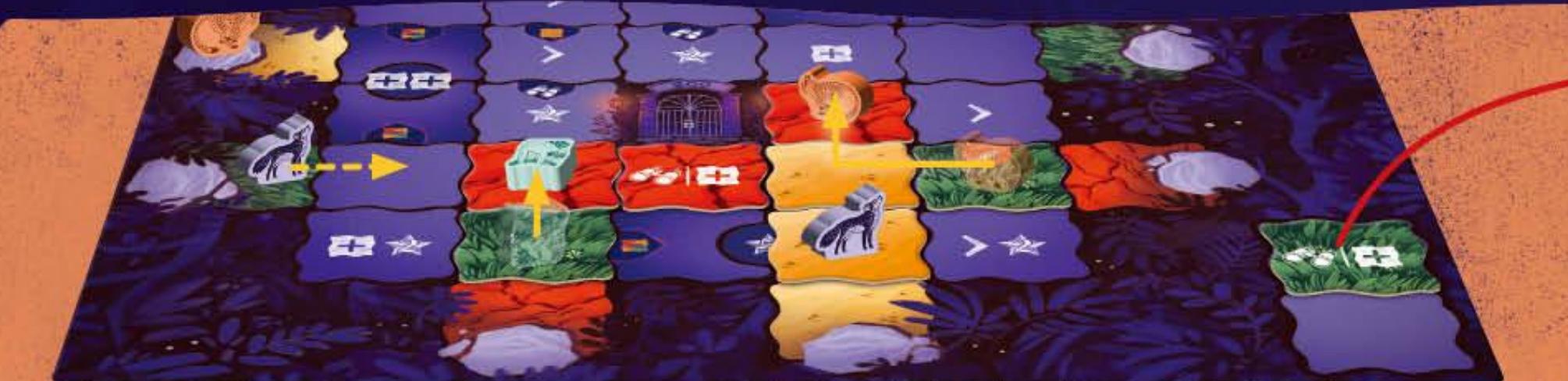
示例:查尔斯从仓库弃置了一块草地板块。因此,他可以移动所有站在草地上的动物。他将猎豹移动两格(得益于猎豹弃置板块时的特殊移动能力),并让树懒躺下睡觉(这是树懒的特殊移动能力)。他本想也移动狼,但无法做到,因为狼没有相邻的格子可以移动上去。
3. 维护阶段
所有玩家完成板块放置阶段后,选取的最后阶段开始——维护阶段。
刷新市场
从牌堆抽取数量等于玩家人数 + 1 的行动板块。将它们正面朝上放置到游戏版图的选秀市场空格上。
起始玩家标记
将起始玩家标记传给顺时针方向的下一位玩家。该玩家从刷新后的市场中选择行动板块,开始下一次选取。
轮次结束移动
每轮结束时(第 5、10、15 次选取后),发生轮次结束移动。此移动授予所有玩家,可以同时执行。
轮次结束时,确定剩余区(最下一排)中出现最频繁的地形类型。若出现平局,最左侧空格的地形类型赢得平局。所有当前站在该地形类型上的已发现动物(包括入口格上的动物)执行一次移动,遵循每种被移动动物的标准移动规则。然后弃置剩余区的所有板块,将它们放到游戏版图旁的正面朝上的弃置堆中,以记录已进行的轮次数。

示例:剩余区中的板块为岩石-沙地-岩石-沙地-草地。岩石与沙地出现平局(各两块)。由于岩石板块位于最左侧,赢得平局,因此所有站在岩石地形上的动物执行一次移动。
游戏结束
第 3 轮结束时,游戏结束。根据以下标准计分:

动物园中的动物
每只成功抵达动物园的动物,根据其动物板块上所示的独特计分规则获得分数。

已发现但未归巢的动物
每只已发现但未抵达动物园的动物(包括入口格上的动物),获得 1 点胜利点数。
食物符号
行动板块上有 7 种独特的食物符号 🎧 🍎 🍎 🍎 🍎 🍎 🍎 🍎 🍎 🍎 🍎 🍎 🍎 🍎 🍎 🍎 🍎 🍎 🍎 🍎 🍎 🍎 🍎 🍎 🍎 🍎 🍎 🍎 🍎 🍎 🍎 🍎 🍎 🍎 🍎
2 | 3 | 4 | 5 | 6 | 7
6 | 8 | 11 | 16 | 22 | 30
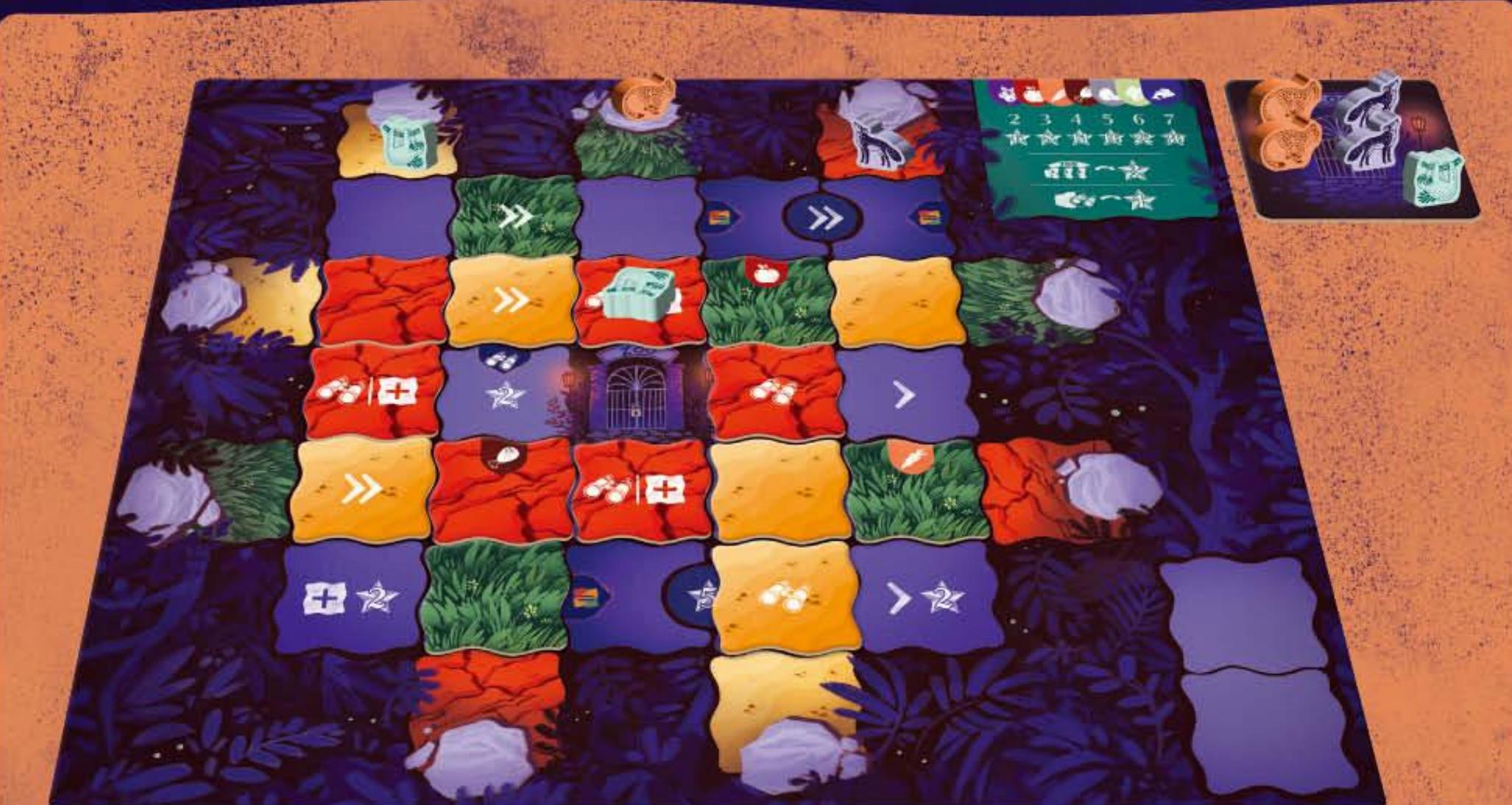
示例:游戏结束时,查尔斯为回到动物园的动物获得39分。然后为邻近区域中的动物获得3分。最后,他为收集到的3种不同食物符号(肉、胡萝卜、苹果)获得8分,总分50分。
单人模式
在单人模式中,你将与一位名叫利奥的饲养员一较高下。利奥像双人游戏中的对手一样从选秀市场选取板块。
设置
设置遵循标准规则,有以下例外:
- 只准备一块玩家版图(给你自己)。
- 拿取 6 块单人游戏板块,洗匀后正面朝下放置到游戏版图旁,组成抽牌堆。
- 抽取行动板块时,抽取3块(如同双人游戏)。
游戏流程
游戏开始时,起始玩家标记分配给利奥。游戏随后按标准规则进行,利奥作为普通玩家行动,但他没有玩家版图。在板块选取之间,起始玩家标记在你和利奥之间交替。

示例:利奥先手。他优先选取最左侧的板块。他将其拿走并从游戏中移除。你选择拿取最右侧的板块。中间的板块随后移至剩余区。
你像多人游戏一样进行你的回合。你和利奥都拿取板块后,将剩余板块移至选秀市场下方的剩余区,放到最左侧的空格上。
重新洗匀单人游戏板块:
继续以此方式进行,直到游戏结束。
若翻开的单人游戏板块显示洗匀符号☐,将所有单人游戏板块(已翻开的和抽牌堆中剩余的)一起洗匀,组成新的抽牌堆。
选取阶段:
选取阶段开始时,翻开单人游戏牌堆顶的板块。起始玩家先行动。
按照标准规则计算你的胜利点数。然后,将你的分数与右侧表格中利奥的表现进行比较,以评定你的动物技能等级。
计分
利奥的回合中,他从当前翻开的单人游戏板块上标有①的位置选取板块。若该位置没有板块,利奥从位置②选取。将利奥选择的板块从游戏中移除。
利奥的表现
90+ 动物园幽灵
80-89 逃跑老虎
65-79 聪明黑猩猩
50-64 狡猾黄鼠狼
0-49 迷路狐猴
Albi

DTP and Graphics: Anežka Bělohoubková
特殊动物规则
任何动物任何时候都不可移动到没有任何类型板块的格子上(动物园格除外)。即使它们的移动能力允许特殊互动,这条标准规则也必须始终遵守。

6 ?


企鹅

移动时,企鹅沿直线滑行到最远的板块格。企鹅到达动物园时,立即停止移动。每只抵达动物园的企鹅游戏结束时获得5分。
猎豹
× 4
执行特殊移动(通过弃置板块)时,猎豹额外执行1格移动。每只抵达动物园的猎豹游戏结束时获得6分。
狼

游戏结束时,根据抵达动物园的狼的数量获得分:1只狼7分,2只狼16分,3只狼27分。
10

? C C C

15
C C C C


移动时,蛇朝其面向的方向执行标准1格移动。它不能自由向左或向右转弯。你可以通过花费1次移动来改变其方向。被发现时,蛇初始面向邻近区域。在游戏结束时每只抵达动物园的蛇价值10分。
蝴蝶
× →

游戏设置时,准备好花粉标记。
执行特殊移动(通过弃置板块)时,若蝴蝶移动,它获得1个花粉标记放到其模型上(每只蝴蝶最多4花粉)。每只抵达动物园的蝴蝶根据收集的花粉数量获得分数:1花粉=5分,2花粉=7分,3花粉=9分,4花粉=11分。
树懒
The image contains no text. It is a diagram showing a transformation process where a transformation from a 3D block to a 2D block is a transformation of a 3D block to a 2D block. Therefore, the transformation is a transformation of a 3D block to a 2D block.
移动前,必须检查树懒是睡着还是醒着。若醒着,它执行1格移动然后入睡。将树懒模型侧放表示入睡。若睡着,树懒不执行移动,而是醒来。将模型竖直放置表示醒来。被发现时,树懒初始为醒着。每只抵达动物园的树懒游戏结束时获得15分。
下载 MarkdownNight at the zoo_rules_EN.md19.5 KB
Albi
Rulebook
It's late night at the zoo, and some of the animals have secretly ventured outside! Now they need your help to find their way back in before the zookeepers notice they are gone.
Help the escaped animals to map out the darkened zoo and create a path back to their enclosures, so they can get home safely. Each
animal has a unique way of moving and a different scoring condition,
so choose wisely when to move, what actions to use – and keep track of all the runaways to get everyone back to bed!
Don't feel like
reading the rules?
Watch the video
tutorial!

Components
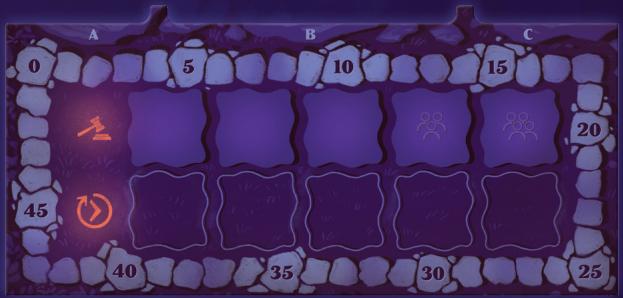
1 Game board

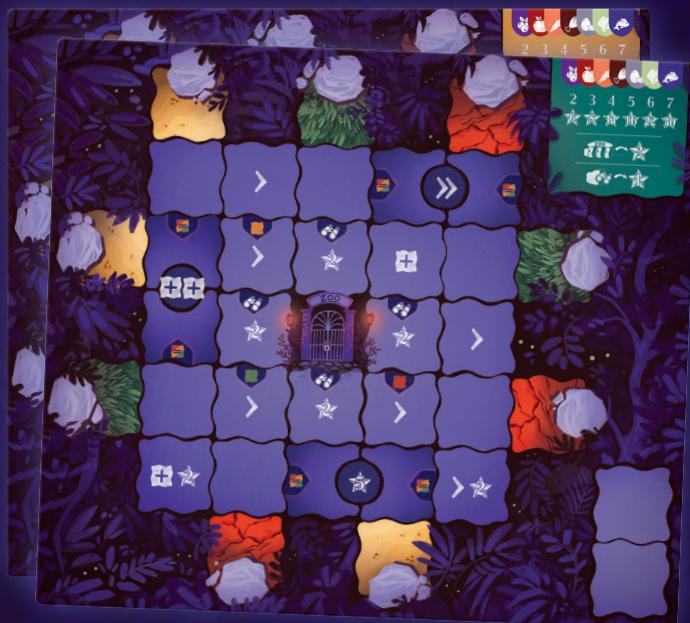
4 Player boards
6 Animal tiles


72 Animal figures (12 figures of each type)
48 Pollen tokens

75 Action tiles

42 Bonus tiles

9 Setup tiles

1 First Player token
Any components missing or damaged? Contact us at info@albi.cz, and we will send you a replacement free of charge!

6 Solo game tiles

4 Score multipliers

4 Score trackers
Component Description
肾CCCC
Animal tile

Game board

Player board
Animal type
VPs upon reaching the Zoo
Level of difficulty
Special abilities and scoring conditions
Slots for Animal tiles
Draft market
Leftover zone
VP score track
Endgame scoring
Neighborhood
Entrance space
The Zoo
Space for not discovered animal
Warehouse
Goal of the Game
The goal of the game is to guide your animals back to the Zoo most effectively. You will draft and place tiles on your Player boards to trigger actions and create a path for your animals. The game ends after 3 rounds (each round with 5 drafts), and the player with the most Victory points (VPs) wins.
Game Setup
Place the Game board in the center of the table so that it is easy to reach for all players.
Each player takes a Player board and chooses a color. Place your Player board in front of you and put the Score tracker in your color on the “0” space of the score track on the Game board.
)Sort the Bonus tiles (with a blank back) by their terrain type (Grass, Rocks and Sand) and create a supply pile for each type face-up next to the Game board.
4 Shuffle the Animal tiles. Draw three tiles randomly. The total Level of difficulty (number of moons C) of these three tiles must be at least 6. If not, reshuffle and draw new tiles. Place the three drawn Animal tiles face-up in the designated slots (A, B, and C) above the Game board. Each player takes 3 Animal figures of each of the three drawn animal types.
Shuffle the Action tiles (showing a draft icon on the back) into a face-down pile and place it next to the Game board.
Draw a number of Action tiles equal to the number of players plus one. Place these tiles face-up on the light blue spaces (top row) of the Game board. This area is called Draft market.
Each player randomly selects one Setup tile. Place your Animal figures on spots for “not discovered animals" on your Player board as shown on your Setup tile. Each animal type is marked with a letter on a Game board that matches the letters on the Setup tiles. One animal of each type marked with a icon on your Setup tile starts directly on an Entrance space on your Player board.
Example: Place all Sloths on spots for not discovered animals with the letter A on your Setup tile. The Sloth igure on the left side of the Player board starts on an Entrance space.
Flip the Setup tile on its back side. You will use this tile to store your animals that already arrived at the Zoo.
Choose a starting player. This can be the person who most recently saw or helped an animal. If you can't decide, choose randomly. The starting player takes the First Player token.

The game is played over 3 rounds. In each round, the players take 5 drafts. Each draft has three phases, which are performed in the following order:
-
Drafting Phase
-
Tile Placement Phase
-
Maintenance Phase
1. Drafting Phase
Starting with the first player and continuing clockwise, each player must take one Action tile from the Draft market on the Game board. Once all players have taken a tile, move the remaining tile to the Leftover zone under the market, placing it on the leftmost empty space.

About the Tiles
There are two types of tiles:

Action tiles: Obtained during the Drafting Phase. They may display action symbols or food symbols. Action symbols are resolved during the Tile Placement Phase, while food symbols are used for endgame scoring. If a tile shows two action symbols, you must choose and resolve only one.
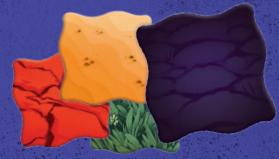
Bonus tiles: Obtained through actions. These tiles do not contain any action symbols, but they can still trigger actions on the Player board.
Both tile types show three terrain types:

Rocks
Grass
Sand
2. Tile Placement Phase
During this phase, you use the tiles you have collected. You have three options:
• Place a tile in your Neighborhood.
• Place a tile in your Warehouse.
• Discard a tile to make a special move.
Place a tile in your Neighborhood
When you place a tile in your Neighborhood (the inner 5×5 area of your Player board), you can place it on any empty space (without a tile). If the space or the tile shows an action symbol, you can perform that action immediately. In case both the tile and the space grant you an action, you can perform them in any order you want. However, you must always fully resolve one action before performing the other. If a space has a condition (see below), you must cover it with the corresponding tile to activate the action. If you don't want to activate the action, you may also place a tile that doesn't meet the required condition. Once you place the tile, it cannot be moved.

Example: John places a Grass tile. He meets the condition of the selected space, so he is granted an Animal movement action.
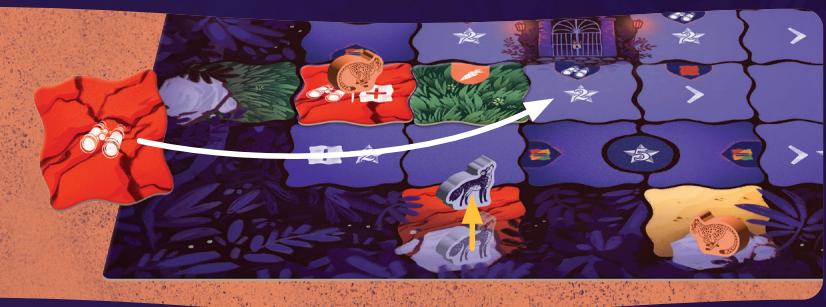
Conditions

To fulfill this condition you must place an Action tile that shows this symbol on the corresponding space. You don't have to perform an action on the tile to fulfill the condition of the space.

To fulfill this condition you must place an Action or Bonus tile of the specific terrain type on this space.

To fulfill this special condition (marked by darker-colored spaces on the Player board),
you must cover both spaces with a tile
of the same terrain type to trigger the ac
tion. You will then get a bonus, but only
once and only after covering both spaces
(5 VPs, 2 movements or 2 Bonus tiles).
Action symbols

Discover a new animal: Place any of your Animal figures that hasn't been discovered yet onto its Entrance space on your Player board. From now on this animal can be moved.
Take a Bonus tile: Take a Bonus tile with a terrain type of your choice from the supply. You can either place it immediately into your Neighborhood or into your Warehouse or discard it. Bonus tiles do not have any action symbols on them, but placing them can trigger the symbols on your Player board as usual.

Immediate Victory points: Gain the number of Victory points shown by the symbol and immediately move your Score tracker forward on the score track.
Animal movement: By default, 1 arrow allows you to move one Animal figure by 1 tile. Animals may move only onto an orthogonally adjacent (sharing a side) tile. A double arrow may be used either as two movements for one Animal or as one movement for each of two Animals. Some Animal tiles modify the movement rules for that specific Animal. Multiple Animal figures can occupy the same tile. At any time during movement, when an animal reaches the Zoo (the middle space of the Player board), it has returned home safely and is removed from the board and added to the back side of your Setup tile for endgame scoring. Any remaining movement points for that Animal (if any) are lost. Animal figures cannot at any point return to the Entrance spaces or Spaces for not discovered animals.

Example: By placing a tile with a double arrow, John may perform up to two movements, which he decides to split between Wolf and Cheetah.
Place a tile in your Warehouse
Place a tile you just gained into your Warehouse for later use. You can never have more than two tiles stored here at any time during the game. You can use the tiles from your Warehouse at any time during your turn (except between 2 movements gained from the same action), either to place them in your Neighborhood or to discard them to make a special move.

Discard a tile to make a special move

X Du , m are currently standing on the terrain type matching the discarded tile, including those on Entrance spaces. These movements follow the standard animal movement rules. You may perform this action repeatedly and anytime during your Tile Placement Phase, except between 2 movements gained from the same action.

Example: Charles discards a Grass tile from his Warehouse. As a result, he may move all his animals that are standing on Grass. He moves his Cheetah two tiles (thanks to the Cheetah's special movement ability when discarding a tile) and his Sloth, which he lays to sleep (as that is the Sloth's specific movement ability). He would also move his Wolf, but he cannot do so because there is no adjacent tile it can move onto.
3. Maintenance Phase
After all players have finished the Tile Placement Phase, the final phase of the draft begins – the Maintenance Phase.
Refresh the Market
Draw new Action tiles from the pile equal to the number of players plus one. Place them face-up in the Draft market spaces on the Game board.
First Player Token
Pass the First Player token to the next player in clockwise order. This player then starts the next draft by choosing an Action tile from the refreshed market.
End of Round Movement
At the end of each round (after the 5th, 10th and 15th draft), an end of round movement occurs.
This movement is granted to all players and can be resolved simultaneously.
At the end of a round, determine which terrain type appears most frequently in the Leftover zone (bottom row). In case of a tie, the terrain type on the leftmost space wins the tie. All discovered animals currently standing on that terrain type (including Entrance spaces) perform one movement, following the standard movement rules for each type of moved animal. Then you discard all tiles from the Leftover zone and place them in a face-up stack next to the Game board, to count how many rounds have passed.

Example: The tiles in the Leftover zone are Rocks - Sand - Rocks - Sand - Grass. There is a tie between Rocks and Sand (two of each). Since the Rocks tile is the leftmost, it wins the tie, so all animals standing on a Rocks terrain type perform one movement.
End of the Game
The game ends when the 3rd round is over. You score points based on the following criteria:

Animals in the Zoo
You score points for each animal that has successfully reached your Zoo, according to the unique scoring rules shown on its Animal tile.

Discovered animals
You score 1 VP for each discovered animal that did not reach the Zoo (including animals on the Entrance spaces).
Food Symbols
There are 7 unique types of food symbols on the Action tiles You score points based on the number of different food types you have collected on your tiles in your Neighborhood. Tiles with a food symbol in your Warehouse do not count. You score only once for your best set of different symbols (see table on the right).
2 3 4 5 6 6811162230
The player with the most Victory points wins the game! In case of a tie, the player with more animals in their Zoo wins. Still tied? Then all tied players share victory.

Example: At the end of the game, Charles scores 39 VPs for animals that have returned to his Zoo. Then he scores 3 VPs for the animals in his Neighborhood. Finally he scores 8 VPs for his collection of 3 different food symbols (meat, carrot and apple), totalling his score at 50 VPs.
Solo game
In the solo game, you will test your skills against a Zookeeper called Leo. Leo drafts tiles from the Draft market just like an opponent would in a 2-player game.
Setup
The setup follows the standard rules, with the following exceptions:
• Prepare only one Player board (for yourself).
Take the 6 Solo game tiles, shuffle them, and place them face-down next to the Game board to form a draw pile.
• While drawing Action tiles, draw 3 of them (as for the 2-player game).
Gameplay
The game starts with the First Player token assigned to Leo. The game then proceeds according to the standard rules and Leo acts as a regular player, however, he does not have a Player board. Between the tile drafts, the First Player token alternates between you and Leo.

Example: Leo is playing first. He prioritizes the leftmost tile. He takes it and removes it from the game. You choose to take the rightmost tile. The middle tile is then moved to the Leftover zone.
Drafting Phase:
At the start of the Drafting Phase, reveal the top tile of the Solo pile. The starting player takes their turn first.
In his turn, Leo selects the tile from the position marked with 1 on the currently revealed Solo Game tile. If there is no tile on that position, Leo takes the tile from position 2. Remove the tile chosen by Leo from the game.
You take your turn as in a multiplayer game. After you and Leo both took a tile, move the remaining tile to the Leftover zone under the Draft market, placing it on the leftmost empty space.
Reshuffling Solo Game tiles:
If the revealed Solo Game tile shows the Shuffle symbol, take all Solo Game tiles (both revealed and the remaining ones in the draw pile), shuffle them together, and form a new draw pile.
Continue playing in this manner until the game ends.
Scoring
Calculate your Victory points according to the standard rules. Then, compare your score with Leo's performance in the table on the right to determine your animal skills.
Leo's performance
90+ Zoo Ghost
80-89 Runaway Tiger
65-79 Clever Chimp
50-64 Sneaky Weasel
0-49Lost Lemur
Albi

Designer: Tomáš Holek
Illustrations: Tereza Kovandová
DTP and Graphics: Anežka Bělohoubková
Rules Editing: Barbora Šulcová, Tomáš Benda
Proofreading: Corinna Spellerberg (Textguru)
Special Animal Rules
No animal can ever move onto a space that doesn't have a tile of any type (except the Zoo space). Even when their movement abilities allow special interactions, this standard rule must be followed at all times.

6 UU

Penguin
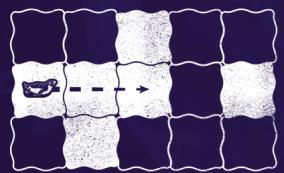
When moving, the Penguin slides to the furthest tile in a straight line. When the Penguin reaches the Zoo, it immediately stops its movement there.
Each Penguin that reaches the Zoo scores 5 VPs at the end of the game.
Cheetah
x\~4
When performing a special move (by discarding a tile), the Cheetah performs an additional 1-tile move.
Each Cheetah that reaches the Zoo scores 6 VPs at the end of the game.
Wolf

At the end of the game, you score VPs based on how many Wolves have reached your Zoo: 7 VPs for one Wolf, 16 VPs for two Wolves, and 27 VPs for three Wolves.
10
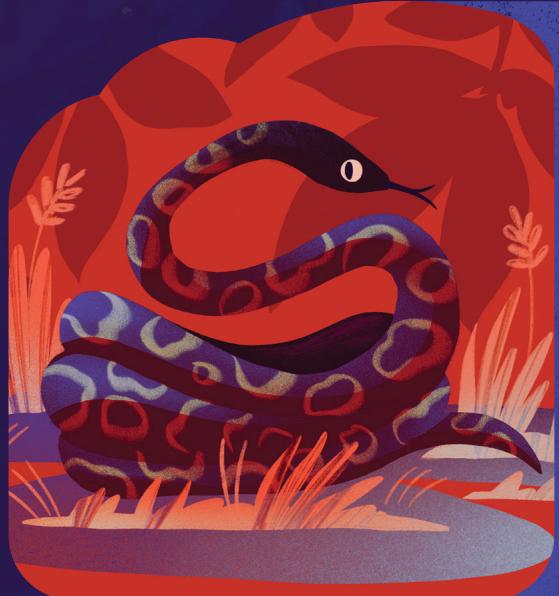
When moving, the Snake performs a default 1-tile move in the direction it is facing. It cannot turn freely to the left or right. You can change its direction by spending one movement. When discovered, the Snake starts facing the Neighborhood.
Each Snake that reaches the Zoo scores 10 VPs at the end of the game.
Butterfly X\~n+
During the Game Setup prepare the Pollen tokens.
When performing a special move (by discarding a tile), if the Butterfly moves, it gains 1 Pollen token onto its figure (maximum 4 Pollen per figure).
Each Butterfly that reaches the Zoo scores VPs based on the number of Pollen it has collected: 5 VPs for 1 Pollen, 7 VPs for 2 Pollen, 9 VPs for 3 Pollen, and 11 VPs for 4 Pollen.
Sloth
Before moving, you must check if the Sloth is asleep or awake. If awake, it performs a 1-tile move and then falls asleep. Represent this by placing the Sloth figure on its side. If it is asleep, instead of performing the movement, the Sloth awakens. Represent this by placing the figure upright. When discovered, the Sloth starts awake.
Each Sloth that reaches the Zoo scores 15 VPs at the end of the game.
下载 Markdown原文为社区整理/出版社公开资料,版权归原作者,仅供个人学习查阅。