
遗落之境:阿特拉斯铁路Railways of the Lost Atlas
一句话概览
遗落之境:阿特拉斯铁路 是一款已收录于村了吗规则库的桌游,支持 2–5 人,原名 Railways of the Lost Atlas。
本页内容:一句话概览 · 游戏概述 · 1. 游戏组件 · 2. 游戏设置 · 3. 游戏流程 / 回合结构 · 4. 核心概念:玩家 vs 总裁 · 5. 控制权变更 · 6. 股票回合(Stock Round) · 7. 股票轨道标记移动 · 8. 运营回合(Operating Round) · 9. 强制火车购买 · 10. 破产(Bankruptcy) · 11. 合并回合(Merger Round) · 12. 出口火车(Export a Train) · 13. 游戏结束 · 14. 特殊小型公司能力 · 15. 可选/变体模式 · 常见问题
遗落之境:阿特拉斯铁路 规则速览
本页收录规则速览的前 16 节(篇幅所限省略了后 1 节),完整规则速览与卡牌可在村了吗查询。
游戏概述
玩家扮演投资人,用少量启动资金创办小型公司(Minor Company),建设铁路基础设施、产生收入,最终合并为大型公司(Major Corporation)以增加个人财富。每局地图由玩家搭建,小型公司以随机顺序入场,游戏体验各不相同。
核心机制: 竞拍创办、股票投资、轨道铺设、路线运营、收入分配、公司合并
1. 游戏组件
| 组件 | 数量/说明 |
|---|---|
| 轨道瓦片(Track Tiles) | 135块 |
| 股票轨道(Stock Track) | 1条 |
| 三角六边形地图瓦片(Tri-Hex Map Tiles) | 33块 |
| 首都项目瓦片(Capital City Project Tiles) | 3块 |
| 回合/周期追踪板(Round/Cycle Tracker Board) | 1块 |
| 首都覆盖瓦片(Capital City Overlay Tiles) | 3块 |
| 双面覆盖瓦片(Extra 2-Sided Overlay Tiles) | 12块 |
| 每股收益图(Earnings per Share Chart) | 1张 |
| 优先玩家标记(Priority Player Marker) | 1个 |
| 回合/周期追踪标记 | 2个 |
| 大型公司(Major Corporation) | 6家(各含两种身份选项及丝印标记) |
| 小型公司(Minor Company) | 12家(含丝印标记) |
| 火车卡(Train Cards) | 30张 |
| 阶段/淘汰提醒卡(Phase/Rust Reminder Cards) | 3张(双面) |
| 金钱卡(Money Cards) | 285张 |
| 概要卡和玩家辅助卡 | 各若干 |
| 远距目的地收入卡(Distant Destination Revenue Cards) | 4张(其中1张可自定义) |
2. 游戏设置
2.1 短局模式调整
若游玩短局(Short Game),移除以下组件:
- 地图瓦片 9、10、11、21、26
- 地图瓦片 12、13、14 各移除一张
- 一块首都项目瓦片
- 对应的小型公司
> 2人游戏仅限短局。
2.2 地图搭建
地图由三角六边形地图瓦片和项目瓦片组成,堆叠内容由游戏模式决定。
- 选择并放置一张远距目的地收入卡(推荐新手使用 30/40/70/100 卡)。
- 随机玩家翻开堆叠顶瓦片放中央,之后顺时针轮流放置。
- 放置规则:
- 必须与已放瓦片至少共享 3 条边
- 不得与黑色边框六边形共享边
- 不得与其他瓦片重叠 - 若翻出项目瓦片,按指示放置对应组件;无法放置则放回堆底再翻一张。
- 若共识无法合法放置,收集所有瓦片重新开始(罕见情况)。
- 12块单六边形空白瓦片为可选组件,用于补充小型公司家乡空间,不得与黑色边框相邻。
2.3 小型公司设置
- 12张小型公司特许状洗匀后面朝上分 3 列、每列 4 张。
- 短局仅 8 家小型公司,分 2 列。
- 仅底行可竞拍;拍出后该列下一张变为可用。
2.4 股票轨道、收益板与回合追踪器
- 放置股票轨道、收益板、回合/周期追踪器于地图附近。
- 回合追踪标记放在"股票回合"位,周期追踪标记放在"周期1"位。
- 大型公司特许状/标记/证书放在附近待用。
2.5 火车设置
- 短局移除每种火车各一(7/∞ 除外)。
- 4人及以上游戏加入额外 3 火车和 6 火车;不足 4 人时移除。
- 按价格从低到高排序成堆,仅 2 火车可见;提醒卡可放在首张 3/4/5 火车下。
2.6 轨道瓦片设置
- 布置所有轨道瓦片使其可见。
- 开局仅黄瓦可用,其余可先收起。
2.7 起始资金
| 人数 | 起始资金 |
|---|---|
| 2人(仅短局) | 450 |
| 3人 | 300 |
| 4人 | 275 |
| 5人(仅长局) | 220 |
2.8 优先玩家
随机确定起始玩家,放置优先玩家标记。
3. 游戏流程 / 回合结构
游戏由 循环(Cycle) 构成,短局 4 个循环,长局 6 个循环。
每个循环包含:
1. 出口火车(从第 2 个循环起,新股票回合前执行)
2. 股票回合(Stock Round) — 玩家用个人资金操作
3. 运营回合(Operating Round)× 2 — 公司用金库资金操作
4. 合并回合(Merger Round) — 满足条件时执行
4. 核心概念:玩家 vs 总裁
- 股票回合: 玩家用个人资金操作,扩大个人投资组合。
- 运营回合: 公司/大型公司在总裁指示下,用公司金库资金操作。
- 两个资金池必须严格分开:通常玩家不能为公司花钱,公司也不能为总裁花钱。
5. 控制权变更
- 当其他玩家持有多于当前总裁的股份时,总裁权立即转移(同股数时,顺时针方向下一个同股玩家获得)。
- 持有他人公司 2 股即暴露成为该公司总裁的风险。
- 转移时交换总裁证书和两张单股。
6. 股票回合(Stock Round)
从优先玩家开始,每人选择一个行动:
6.1 发起小型公司竞拍
- 竞拍从 120 起,加价以 5 为单位递增。
- 最高出价者获该公司总裁证书,初始股价 = 出价 ÷ 2 向下取整。
- 可用初始股价范围随阶段变化:黄阶段 60–90,绿阶段 60–110,紫/灰阶段 60–135。
- 发起人设首次出价,顺时针加价或通过,通过者不得再加入。
- 最后一人选择一家可用小型公司创办。
- 办公司时:总裁证书归赢家,竞拍金额入公司金库,其余股份也入金库。
- 股票轨道放标记,收益板放标记,地图家乡位置放枢纽标记。
6.2 卖出和/或购买股份
卖出限制:
- 不得卖出导致公司无总裁的股份。
- 未运营过的小型公司股份不得卖出。
- 银行池中同一公司股份不得超过 50%。
- 卖出时股价跌一格(不论卖几股)。
- 所有待卖股份必须同时卖出,每回合仅一次卖出机会。
购买规则:
- 可从公司金库或银行池以当前股价购买一股。
- 玩家持股不超过公司 60%(总裁证书 + 1 股为小型公司;总裁证书 + 4 股为大型公司)。
- 本回合卖出某公司股份后不得再买该公司股份。
总裁权转移: 若其他玩家持股超过总裁,总裁权立即转移(同股时顺时针决定)。交换总裁证书和两张单股。
无证书总数限制。
6.3 过(Pass)
- 过后继续轮到下家,过不退出股票回合。
- 若所有玩家连续过(中间无其他行动),股票回合结束。
- 若初始股票回合无人创办公司,重洗小型公司特许状并重开。
6.4 股票回合结束
- 最后一个非"过"行动的顺时针下家获得优先玩家标记。
- 若某公司被玩家 100% 持有,股价上升一格。
- 推进回合追踪器至 OR1,进入运营回合。
7. 股票轨道标记移动
- 同股价的标记按入列顺序堆叠(先入者在上)。
- 股价变动时标记放在该列最下方。
- 维持股价(支付 >0 但 < 当前股价的股息)时标记移至该行最下方。
- 公司运营完后翻面标记,运营回合结束时翻回。
- 股价归零: 公司解散——股份移除,金库归还银行,火车入银行池,枢纽标记从地图移除。
8. 运营回合(Operating Round)
每个周期含两个连续运营回合。按股价从高到低运营(同股价从上到下)。总裁做出所有决策,费用从公司金库支出。
8.1 可选:新创办小型公司购买先导火车
- 每家小型公司首次运营回合可从可用堆或银行池以面值购买一列火车(不可从其他公司购买)。
- 当回合可运行路线产生收入。
8.2 可选:发行或赎回一股
- 发行: 将一股从金库转银行,获得当前股价入金库,股价跌一格。
- 赎回: 支付当前股价给银行,取回一股入金库。不改变股价。
8.3 可选:铺设轨道瓦片
- 每回合最多放 2 块黄瓦 或 升级 1 块瓦(按阶段可用瓦片)。
- 黄瓦/非城市升级瓦必须让公司能追踪到新轨道的至少一部分。
- 城市升级瓦必须让公司能追踪进入该瓦片。
- 不得放置轨道朝向: 水六边形边缘、远距目的地六边形空白边、黑色边框边、地图边缘。
- 黄瓦不得放在水上、远距目的地、黑色边框、已有轨道的六边形。
- 放置瓦片时不得创建或移除城市。
- 升级瓦仅替换前一阶段瓦片(绿替换黄,紫替换绿),被替换瓦片归还。
- 升级必须完全保持已有轨道。
- 带 ⊗ 符号的瓦片必须用相同符号瓦片升级。
- 所有印刷费用从公司金库支付。
- 瓦片数量有限。
- 升级城市瓦片时保持枢纽标记。
- 未创办小型公司的印刷枢纽位置保留(用标记标注),升级时至少留一个城市位。
8.4 可选:放置枢纽标记
- 大型公司(或 Expansive Company)可支付印制费用,在可追踪路线的空闲未保留城市位放枢纽标记。
- 每块瓦片上每家公司仅一个枢纽标记。
8.5 运行火车
路线定义:
- 可追踪的连续轨道线,至少包含一个有本公司枢纽标记的城市位,不重复经过任何轨道段。
- 运行数量等于拥有火车数,每列火车独立路线。
- 停站数 ≤ 火车编号(2/3/4…),同一公司各路线不共享轨道段(但可在城市和某些绿/紫瓦交叉)。
- 不得穿过满枢纽且无本公司标记的城市(但可以该城市为起点/终点并计入收入)。
- 路线可从远距目的地开始或结束,但不得穿过。
- 单列路线不得包含同一城市或远距目的地两次。
特殊瓦片规则:
- 港口瓦片:单列火车不得同时跑两侧。
- 矿场瓦片 ⊗ 含两个独立停站,同一火车可跑。
- 有方向性的岔道不得使用急转弯(Sharp turn)。城市瓦片作为枢纽,任何未跑过的转弯均可。
路线价值 = 列车经过的停站(城市/远距目的地)总值,停站数 ≤ 火车编号。不可跳站延展路线。
∞ 火车: 停站数无上限,但遵守其他路线规则。
本地路线(Local): 仅一个停站(枢纽城市内),不使用已建轨道,可在同一城市运行多条本地路线。
城市价值 = 六边形印制数字。远距目的地价值随阶段变化。
无火车的公司收入视为 0,分配收益时股价跌一格。
8.6 分配收益
总裁选择:
- 支付给股东: 每股分享收益的 20%(小型公司)或 10%(大型公司)。从银行支付给每位股东(含公司自身持有的股份)。
- 支付 >0 但 < 当前股价:股价不变,标记移至列底。
- 支付 ≥ 当前股价但 < 2倍:股价升一格。
- 支付 ≥ 2倍当前股价:股价升两格。
- 全部保留: 银行支付全额入公司金库,股价跌一格。
8.7 购买火车
- 若当前火车数 < 阶段限制,可购买:可用堆顶火车(面值)、银行池火车(印制价)、其他公司火车(≥1,双方总裁同意,从金库付入对方金库)。
- 无火车的公司必须购买至少一列。
- 可购买多列(只要有钱有空间)。
- 仅强制购买时玩家可出个人资金。
8.8 淘汰事件(Rust Events)
| 触发条件 | 淘汰对象 |
|---|---|
| 第一列 4 火车购入 | 所有 2 火车 |
| 第一列 6 火车购入 | 所有 3 火车 |
| 第一列 7/∞ 火车购入 | 所有 4 火车 |
- 从可用堆购买触发淘汰时立即执行,淘汰火车移除游戏。
8.9 阶段变化(Phase Changes)
- 从可用堆购买首列绿/紫/灰火车时立即进入该阶段。
- 新火车限制生效,超限公司必须将一列火车放入银行池。
- 新阶段瓦片可用,初始股价范围扩展。
8.10 火车规格表
| 火车 | 初始股价范围 | 价格 | 被…淘汰 | 火车限制(小型/大型) |
|---|---|---|---|---|
| 2 | 60–90 | 100 | 4 | 2 / — |
| 3 | 60–110 | 200 | 6 | 2 / 4 |
| 4 | 60–110 | 300 | 7/∞ | 2 / 3 |
| 5 | 60–135 | 450 | — | 1 / 2 |
| 6 | 60–135 | 550 | — | 1 / 2 |
| 7 | 60–135 | 750 | — | 1 / 2 |
| 7/∞ | 60–135 | 1,000(或 800 + 交回一列未淘汰火车) | — | 1 / 2 |
- 7/∞ 火车供应无限;若不足可用已出口或淘汰火车代替。
- 银行池火车按印制价出售。
- 从其他公司购买火车 ≥1,双方总裁同意。
8.11 传递回合
无更多公司需运营时,推进回合追踪器,继续下一回合。
9. 强制火车购买
- 无火车的公司必须购买。
- 若金库不足且无法从他司购买,总裁必须出个人资金购买最低价火车。
- 先用金库 → 再用个人现金 → 不够则开始卖股直至够钱或无法再卖(破产)。
- 强制卖股时股价调整:所有卖股完成后,每家被卖的公司仅跌一格。
- 强制卖股不得导致本公司总裁权变更或银行池 >50%。
10. 破产(Bankruptcy)
- 强制购买后仍无法买火车 → 总裁破产。
- 破产通常触发游戏结束。若继续:破产玩家出局,其公司立即移除,火车入银行池,枢纽标记移除,其他玩家可按最终股价同时兑换破产公司股份(不跌价),然后移除股票轨道标记。
11. 合并回合(Merger Round)
11.1 触发条件
两个运营回合完成后,若首列绿火车已被购买或出口,则有合并回合(否则直接进入"出口火车"步骤)。
11.2 合并提议
- 按股价从高到低,小型公司总裁可提议与另一家可追踪路线的小型公司合并,或通过。
- 若任一总裁拒绝,该合并在本轮不得再提议。
11.3 合并执行
- 特许状替换: 两公司特许状并排,选中的大型公司特许状覆盖其上。新总裁获得总裁证明,另一小公司总裁证明拆为两张单股。大公司保留组成它的所有小公司的全部能力。
- 股价确定: 股票轨上按两家小公司股价向下取整的平均值放置大公司代币,移除两家小公司的股票轨和收益板代币。收益板上放一个代币。
- 枢纽标记替换: 两家小公司的 hub 代币均替换为大公司 hub 代币;若同一格有两个 hub 代币,一个替换为大公司 hub 代币,另一个回到章程上的 FREE 位。额外的两个 hub 代币放在章程最右两个位置。
- 财政与火车合并: 火车和金库资金合并。若合并后火车数量超过当前火车上限,总裁选择一列火车放回银行。
- 清理: 两家小公司的所有代币和证明归盒。
- 总裁权: 持股最多者获总裁证书;同股时,总裁权归在运营回合中顺序靠前的公司总裁。
12. 出口火车(Export a Train)
- 每轮循环开始新股票回合前,从可购买火车堆顶移除一列火车出游戏。
- 若出口的是 2-火车,所有剩余 2-火车一并出口,首个 3-火车成为下一张可购火车。
- 若此操作导致首个 4-、6- 或 7/∞- 火车被移除,视为该火车被购买,相应执行淘汰事件。
- 若导致首个绿、紫或灰火车被移除,游戏阶段立即推进,新火车限制生效,下一轮运营轮可用新板块。
- 若阶段从黄色变为绿色,此时不进行合并回合,直接进入股票回合。
13. 游戏结束
- 短局:4 个循环;长局:6 个循环。
- 最终得分 = 个人现金 + 所持全部股票价值。 公司金库不计入最终得分。
- 平局时,担任在轮次顺序中最先行动的公司总裁的玩家获胜。
14. 特殊小型公司能力
| 公司 | 能力 |
|---|---|
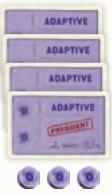
| Adaptive Company | 家乡设在任意空基本城市位(不得选其他公司的保留位),由首任总裁在创办时选择。不参与短局。 |
| Agricultural Company | 允许先升级瓦片后再放一块黄瓦。 |
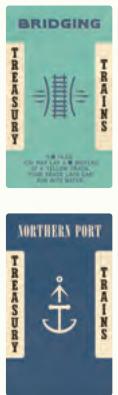
| Bridging Company | 拥有 5 块桥瓦(2 直 / 2 宽弯 / 1 急弯),可放在水上代替正常黄瓦。桥梁板块不可升级。所有轨道铺设允许轨道段进入水域格边缘。不参与短局。 |
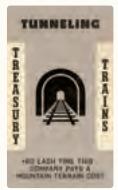
| Tunneling Company | 每次挖山六边形获 60 入金库(挖掘费 40 先付,净得 20)。每放置一块板块后立即支付。 |
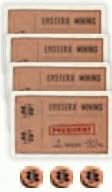
| Eastern Mining Company | 家乡在特殊瓦片上,有专用升级瓦。每块升级板块有两种放置方向(顺时针/逆时针),保持已有连接即可。任何公司可升级该格。 |
| Northern Port Company | 家乡在特殊瓦片上,有专用升级瓦。任何公司可升级该格。 |
| Expansive Company | 额外一个枢纽标记,花 40 从金库放置。遵循正常 hub 代币放置规则。若合并前未放,转为大型公司标记,留在原 40 位。 |
| Overnight Company | 路线可跳过已封锁(满 token)的城市,被跳过的城市计入路线但不算站点且不计收入。能力也适用于判断能否放置/升级板块、能否合并小公司、合并后枢纽放置。不参与短局。 |
| Express Company | 仅持一列火车时,该火车多一个站点。用专用标记标识享受加成的火车。 |
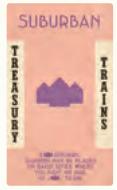
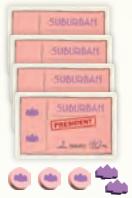
| Suburban Company | 可在无自身 hub 的基本城市格放置最多 2 个郊区代币(每格限 1 个),放置格必须可达。运营轮中随时放置。郊区城市为该公司每列经过的火车各 +10 收入。放置后不可移动。 |
| Spacious Company | 始终比当前火车限制多一个火车槽位(未合并用小型限制,已合并用大型限制)。不参与短局。 |
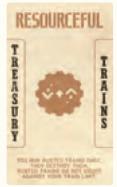
| Resourceful Company | 火车应被淘汰时不丢弃,可额外运行一次后再清除。淘汰火车不计入火车限制,不可卖/交易,不可用于兑换 ∞-火车。 |
优先级: 若小型公司能力与规则冲突,以能力为准。
15. 可选/变体模式
15.1 本地列车(Local Trains)
允许单站路线,让受困位置的小型公司仍有竞争力。可移除此规则以要求至少两站。
15.2 按股跌价(Stock-Drops Per Share)
可改为每卖出一股跌一格(而非每次卖出操作跌一格)。
15.3 不同远方目的地(Different Distant Destinations)
每个远方目的地地图格配一张独特的收入卡;洗混面朝下放一旁。每当抽取远方目的地地图格时,翻出顶收入卡与之配对放置。
15.4 短局 + 随机小公司(Short Game with Randomized Minors)
洗混全部 12 个小公司主格,面朝下移除 4 个(格 21 代表 Adaptive Company 的家,但不要求必须在该格开局)。同时各移除一张地图格 12–14、一张地图格 26、一张资本项目格。仅使用出现在地图上的小公司。
15.5 敌意合并(Hostile Mergers)
- 合并可由持有任一相关公司至少一股的玩家提议(连接限制仍适用)。
- 合并轮中按股价降序改为玩家轮流提议或跳过,直到所有人连续跳过。
- 提议合并时两家公司每持一股享一票,多数票胜。
- 银行池中股票:股价会上涨 → 投赞成票,不变 → 弃权,下跌 → 反对票。公司财政部内股票弃权。
- 投票通过则立即合并;失败(平票视为失败)则该合并本轮不可再提议。
- 合并轮中优先玩家标记不移动。
15.6 银行破产(Bank Break)
- 传统 8,000 元银行替代固定轮数结束规则。
- 银行总计 8,000(移除所有 2,000 面额和五张 500 面额),其余钱备用。
- 银行耗尽时游戏结束,用备用钱完成当组运营轮。
- 使用长游戏设置规则(不含循环计数器)。
- 证书上限: 3 人 16 张,4 人 12 张,5 人 10 张。
- 不得购买超限股票;因合并或总裁变更超限者须在下一次股票回合卖出至限内。
- 玩家宣布破产立即结束游戏并计算最终得分。
15.7 总部(Headquarters)
- 大公司的旗舰位置,放置后每个运营轮大公司回合开始时,支付其所在城市印刷值的 50% 给公司金库(城市价值修正不影响此支付)。
- 总部代币 = 大公司 hub 代币叠加在每个组成小公司的 hub 代币之上。
- 可在合并时替换小公司 hub 代币,或保留在大公司章程上之后按 hub 代币放置规则放置。
- 放置时总裁从三个初始效果中选一:
- Tax Break: 公司金库获得 80。
- Land Grant: 可放置最多 4 块黄色板块(每次一块,遵循正常放置规则)。
- Commercial Zoning: 可升级最多 2 块不同板块(相邻总部格且含总部格),不必与总部有轨道连接,可突破阶段限制。
15.8 自定义/预制地图(Custom and Pre-Made Maps)
可直接指定每块板块位置而非随机。附赠额外单格空白/山脉、空白/水域、空白/城市板块增加灵活性。
15.9 微型游戏(Micro Games)
快速、低人数模式,适合新手教学。玩家可执行所有正常操作,会经历一次淘汰事件和一次阶段变化。无银行破产或甩锅公司的预期。
3 人规则:
- 移除地图格 26 和一张资本项目格归盒。
- 地图格分两堆(各含 1 张远方目的地格、6 张小公司主格、1 张资本项目格、等分其余格),选一堆洗混建图。
- 列出地图上出现的小公司排成两列各三个。
- 火车堆:5 张 2-火车、4 张 3-火车、4 张 4-火车。
- 每玩家起始资金 225。进行 4 个循环,无火车出口。
常见问题(FAQ)
以下 1 条问答中 0 条来自站内玩家的真实提问,其余 1 条为本站整理的常见疑问;答复内容保持原样。
遗落之境:阿特拉斯铁路支持几个人玩?
2–5 人。
去哪查完整规则
想核对具体规则细节、卡牌效果或某个回合的结算方式,可以在村了吗里选中这款游戏后直接提问。
同类桌游
- 卡坦岛德式
- 工业革命:伯明翰德式
- 勃艮第城堡:特别典藏版德式
- 方舟动物园德式
- 重塑宇宙德式
- 埃多拉的德鲁伊德式
- 1817 (2020)德式
- 甜蜜国度德式
- 卡里普索德式
- 铁路环游德式
规则原文(Markdown)
本站收录这款游戏的规则原文 2 个文件,此处内联渲染 2 个,可直接展开阅读或下载。
Railways-EN-2nd-Rulebook.md69.1 KB
WELCOME TO RAILWAYS OF THE LOST ATLAS
In this game players take on the role of individual investors, using a small amount of starting capital to launch Minor Companies that will build infrastructure, generate revenue, and merge into Major Corporations to increase their personal wealth. Every game is different with maps built by the players and Minor Companies entering the game in a random order.
Mix and match variant modes to customize the gameplay experience for your group. To learn the mechanisms and systems of the game, try playing one of the micro game variants in the back of this book or using one of the introductory maps included as a separate sheet, which have been balanced to show off the various interactions the game may present.
COMPONENTS
135 Track Tiles

1 Stock Track
33 Tri-Hex Map Tiles

3 Capital City Project Tiles
1 Round/Cycle Tracker Board

3 Capital City Overlay Tiles
12 Extra 2-Sided Overlay Tiles for further customization

1 Earnings per Share Chart


1 Priority Player Marker
2 Round/Cycle Tracker Tokens

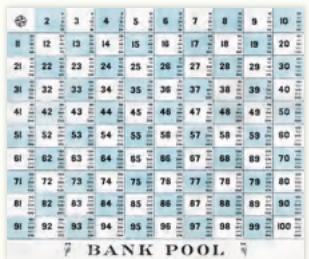

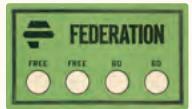
6 Major Corporations, each with two identity options and silkscreened tokens


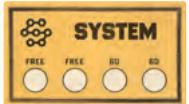

12 Minor Companies with silkscreened tokens
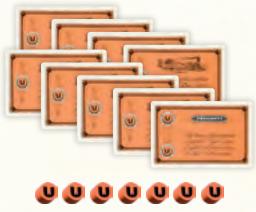


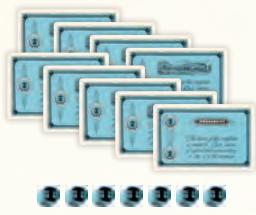

eeeeeee


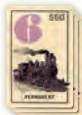
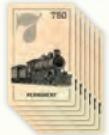
30 Train Cards
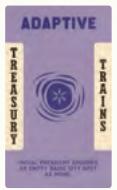


3 Phase/Rust Reminder Cards(2-sided)


285 Money Cards


Summary Cards and Player Aids

4 Distant Destination Revenue Cards (One to customize yourself)






Key Concepts for NEW PLAYERS
Notes for EXPERIENCED PLAYERS
ACTING AS A PLAYER VS. ACTING AS A PRESIDENT
In most circumstances, players cannot spend money for Companies or Corporations, and Companies and Corporations cannot spend money for their president.
In Stock Rounds, players act with their personal money to increase their personal portfolio.
In Operating Rounds, Companies and Corporations act with the money from their treasuries under the direction of their president.
It is important to keep these cash pools separate.
CHANGE OF OWNERSHIP
It is possible for control of a Company or Corporation to change hands in the course of a game, sometimes multiple times. This can occur when another player purchases more shares than the current president, or when the current president sells enough shares that another player receives the presidency.
So sometimes other players can take your companies, and you can take other players companies. There is the possibility of having a bad company dumped on you. Owning 2 shares of another player's company exposes you to the risk of becoming the president of that company.
FEATURES
• Game setup changes depending on the mode your group chooses to play.
• Minor Companies are auctioned from a matrix; auctions are not for specific Companies but for choice from available Companies. Bids are for the president's share, and the available price range expands with phase changes. Only Minor Companies can be auctioned; Major Corporations form through merging.
• Incremental Capitalization.
• Leadoff trains – A new Minor Company may purchase a train at the start of their first Operating Round. It must be purchased from the bank pool or available trains stack, not from another company.
• Track laying – 2 yellow or 1 upgrade, no costs other than mountain terrain.
• Full pay or full withhold. Double jumps are possible.
• Merging – In Green phase and later, two Minor Companies can merge if presidents agree. Merged stock price is the average of both Minor Companies rounded down. Minor Company abilities persist after merging.
• No certificate limit.
• Fixed rounds (4 or 6).
CUT-THROAT CONVERSION
LOCAL TRAINS
The allowance of local routes is intended to keep Minor Companies competitive even when they are in compromised positions on the map. If your group prefers harsher map environments and the ability to cut routes off completely, you can remove this rule and play with the more traditional requirement of at least two stops for a legal route.
STOCK-DROPS PER SHARE
If your group prefers harsher stock trashing, you may consider stock-drops per share sold rather than stock-drops per sale.
MINOR COMPANY CHARTER

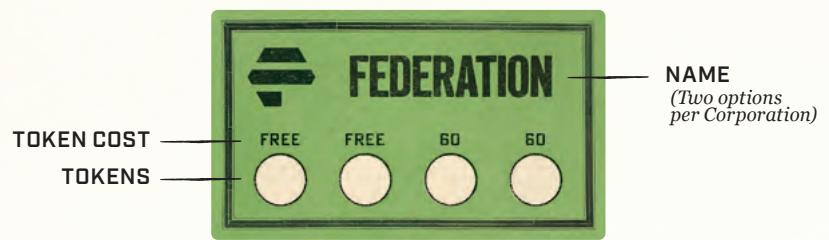
MAJOR CORPORATION CHARTER
STOCK CERTIFICATES

TRAIN CARDS

TRACK TILES
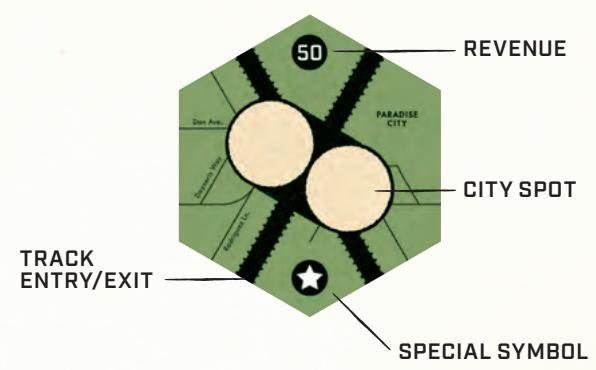

BLANK

WATER

MAP LEGEND
BASIC CITY

COMPANY HOME

MOUNTAIN

DISTANT DESTINATION

BORDER


SETUP
If you are playing the Short Game, remove the following components from play:
Map tiles 9,10,11, 21, and 26 One of each map tile 12, 13, 14 One Capital Project tile Minor Companies扑

Diagram 1
The tile cannot be placed in position 1 or 2 because black border hexes cannot be adjacent to other hexes. The tile cannot be placed in position 3 because it would only share 2 edges with already placed map tiles. There are no restrictions on placement of pre-printed track in the map building step.
MAP BUILDING
The map is assembled from a stack of tri-hex map tiles and tri-hex project tiles. The makeup of this stack is determined by the game mode (Short, Long, and any included variants). These map tiles create the overall map the game will be played on.
Choose and place a Distant Destination Revenue card near the playing area visible to all players. This card will determine the values of all Distant Destinations during the game.
For new players, we recommend the 30 40 70 100 card.
Shuffle the tri-hex map tiles together face down and set the stack to the side of the play area. Choose a player at random to place the first map tile; that player flips over the top map tile of the stack and places it into the center of the play area. The next player clockwise flips the top map tile of the stack and places it onto the play area according to the following rules:
(see Diagram 1)
Map tiles must share at least three edges with one or more already placed map tiles.
No map tiles may share an edge with a black border hex.
All map tiles must be placed flat with no hexes overlapping other map tiles.
If a project tile is flipped, the active player places the corresponding component as instructed and returns the project tile to the box. If the project component can't be placed, the project tile is put on the bottom of the map tiles stack, and a new map tile is drawn.
If it is by consensus impossible to place a map tile legally, collect all placed map tiles and restart the map building process (this will be rare).
Repeat until all map tiles have been placed and all project tiles have been resolved. Shift the map toward the center of the play space if necessary.
There are 12 single-hex blank tiles included in the box as an optional component players can use to shore up any minor home spaces that came out late in the map building and/or didn't get surrounding tiles to allow them to upgrade to their full extent. The blank hexes can be placed around those minor home tiles to give them a little extra space to grow. No tiles, including these single-hex tiles, may share an edge with a black border hex.
MINOR COMPANIES
Minor Company charters are used to identify the holdings of the Company once it has launched.
Shuffle the 12 Minor Company charters face down and distribute them into three face-up columns, each with four charters. (see Diagram 2)
Place the Minor Company certificates and tokens near the Minor Company charters.
If you are playing the Short Game, there will only be eight Minor Companies. Distribute them into two columns of four charters.

Diagram 2
When Minor Companies are initially laid out, only the bottom row is available to be launched in a Stock Round. When a Minor Company is launched, the next company in that column becomes available.
STOCK, EARNINGS, ROUNDTRACKER
These components are used to track the game state.
Place the stock track, earnings board, and round/ cycle tracker near the map easily visible to all players. Place a round tracker token on the Stock Round spot of the round tracker and another on Cycle 1 of the cycle tracker. Place the Major Corporation charters, tokens, and certificates nearby; these will enter the game in a later round.
TRAINS
Trains serve as revenue generators, and they advance the game state through phase changes and rust events.
If you are playing the Short Game, remove one of each train (except 7/∞) from the game before setting up the trains stack.
Note: There is an extra 3-Train and an extra 6-Train marked for inclusion in games with 4 or more players; they should be removed from games with less than 4 players.
Sort the trains from lowest to highest price and set out as a single stack with the 2-trains visible on top. If players want reminders about the effects of certain trains being purchased, the three reminder cards can be placed under the first 3-, 4-, and 5-trains. Place the stack nearby.
TRACK TILES
Track tiles are how Companies and Corporations create routes on the map and expand their reach.
Lay out the track tiles so they are visible to all players. Only yellow tiles will be available at the start of the game, so you may choose to set aside other colors until needed. Keep in mind the amount of space available for these if you choose to wait.
DISTRIBUTE STARTING CAPITAL
Personal cash to build your portfolio.
Lay out the money cards, sorted by denomination, accessible to all players. Each player receives starting capital based on the number of players.
| PLAYER COUNT | STARTING CAPITAL |
| 2(Short Game only) | 450 |
| 3 | 300 |
| 4 | 275 |
| 5(Long Game only) | 220 |
PRIORITY PLAYER
Whose turn is it?
Randomly determine the priority player and place the Priority Player Marker in front of them.
| 3日号日10 | 2121820 | 华容书30 | 幸富员放40 | 省鉴货SD | 器川宝案80 | 室货员87O | 3R8U880 | 装机日出16 | 售0 | tarPOOLBANKts. |
| SEEUE9 | 出口世:含19 | BUARE29 | 此加吉不39 | *31三蛋49 | 世日西拍责59 | BRERU9 | 当日第日部79 | GR自3689 | 推日美安茶99 | |
| 津兴用节等8 | 消品R181 | 国服完菜28 | RABRA3 | 非3家R48 | 禁不日用置58 | 御页院汉GB | 请民品目日78 | 感消用号面8 | 国正R专N98 | |
| 3出兴章7 | s=2ig17 | 费日27 | 此日37 | 本案公宝47 | 行热用贸575 | 器兴提司部67 | 盗五卷用7 | 兴盟司排基87 | 三提导号17 | |
| 中ESA6 | OES16 | 精盗指25 | 口苏茶35 | SE46 | 节兰55 | 日井高花5 | 朋日蛋日费76 | 做川流打宵能8 | 川贵等然96 | |
| 盗共牌5 | 菜中盟行章15 | 国积基日路25 | RESH35 | 幸日福片然45 | 费问费SS | 器问货开能S5 | 保日鉴用盟75 | 那兴里专印署85 | 用提与格55 | |
| 口渔兴流我4 | 用出公4 | 学に非B24 | 零日各公员34 | 年日6员摄4 | 香洋典公54 | 群当系64 | 梦三公74 | 指川指行靠84 | 能线公茶4 | |
| SPOss3 | 我票式13 | BS发店22 | $33 | 8省S盗43 | 西当前送票S3 | 西日临3 | 宝E器73 | 富R日车383 | E动部33 | |
| TUNDD2 | AM销UC12 | SHnRg22 | S2E1R32 | 本日家R42 | 春费用出52 | 泰复供服E2 | 国售用72 | 苏生g浙82 | 代专92 | |
| 4 | 共s= | 学U321 | 第8831 | 华U基员主44 | 鉴川蛋当ss | 徐光装1 | 堂利摄三 | 第汉器号き88 | 禁仁进出16 |


Diagram 3
In the initial Stock Round of a 2-Player Short Game, Player 1 launches a Minor Company Auction by bidding 140. Player 2 increases the bid to 16o and Player 1 passes. Player 2 chooses to launch Expansive Company. The stock token is placed at the top of the 8o column (16o divided by 2)(1). Since the auction was initiated on Player 1's turn, it is now Player 2's turn. Player 2 chooses to launch another auction by bidding 16o. Player 1 chooses to increase the bid to 165 and Player 2 passes. Player 1 chooses to launch Resourceful Company (available because Expansive has been launched). The stock token is placed below the Expansive token in the 8o column (165 divided by 2 rounded down)(2). Since the auction was initiated on Player 2's turn, it is now Player 1's turn. Player 1 chooses to initiate a Minor Company Auction by bidding 14o. Player 2 passes and Player 1 chooses to launch Tunneling Company. The stock token is placed at the top of the 70 column (140 divided by 2)(3).

Adaptive Company establishes its home on any empty basic city spot (noor reserved spaces of other Companies may be chosen). This decision is made by the initial president as the Company launches in a Stock Round. It may choose a spot that has no track tile on it or a spot that has track already, provided the restriction on city types and reserved spaces is followed.
The Stock Round is when players take turns using personal capital to grow their net worth.
Beginning with the priority player, players choose one of three actions:
-
Initiate a Minor Company auction
-
Sell share(s) and/or purchase a single share
- Pass
INITIATE A MINOR COMPANY AUCTION
Bids are minimum 120 in increments of 5. The final bid will earn the winning player the presidency of an available Company of their choice and will determine the initial stock price of the Company (One-half the bid rounded down). The range of possible initial stock prices is determined by the phase of the game. The player initiating the auction sets the first bid. Players act in clockwise order either increasing the bid price by any amount they can afford (in increments of 5) or passing. A player who passes may not rejoin the auction at a later point. This continues until all but one player has passed; the remaining player selects one of the available Minor Company charters and launches it. This ends the auction, and the next player clockwise from the player who initiated the auction takes the next Stock Round turn.
When a player launches a Minor Company, they collect all of the shares, tokens, and any additional components related to that Minor Company. They take the president's certificate and put it in front of them and place their winning bid into the Minor Company's treasury. The rest of the shares are placed into the Minor
Company's treasury. Place a token onto the stock track indicating the initial stock value of the Minor Company (this will be equal to half the winning bid rounded down to the nearest printed value in the section of the stock track that matches the current phase of the game or a previous phase of the game, 6o-90 in yellow, 60-110 in green, 60-135 in purple and grey).
(see Diagram 3)
Place one token onto the earnings board. Finally, place one token as a hub onto the Minor Company's start location on the map (for Adaptive Company ), this is the point where the president chooses the starting location).
SELL SHARE(S) AND/ORPURCHASE A SHARE
A player may sell any number of shares at current stock value and collect that money from the bank with the following restrictions:
• You may not sell a share that would leave a Company or Corporation without a president.
• You may not sell a share of a Minor Company that has not performed an Operating Round. (In the initial Stock Round, there will be no shares that can be sold.)
• No more than 50% of a Company or Corporation's shares may be in the bank pool at any time.
• When shares are sold by a player, the share price of the Company or Corporation drops one increment on the stock track regardless of how many shares were sold. (see Token Movement on the Stock Track)
• All shares a player wishes to sell on their turn must be sold at the same time, and sales can only happen once per Stock Round turn.
And/or, after choosing whether or not to sell shares, a player may purchase one share at the current price indicated by that Company or Corporation's token on the stock track.
• Shares may be purchased directly from the treasury of a Company or Corporation. The current stock value is paid directly into that treasury.
• Shares may also be purchased from the bank pool if there are any. The current stock value is paid into the bank.
• No player may own more than 60% of any Company or Corporation (president certificate plus a single certificate for Minor Companies, president certificate plus four single certificates for Major Corporations).
• A player may not purchase shares of a Company or Corporation the player sold shares of in this Stock Round.
If at any time due to either sale or purchase of shares a player other than the president owns more shares of a Company or Corporation than the president, the presidency (control of the Company or Corporation and all of its assets) is immediately moved to the player with the most shares of that Company or Corporation (in the event of a tie for most shares, the presidency is moved to the next tied player clockwise from the player who is losing the presidency). Exchange the president's certificate and two single shares between the two players to indicate the change.
Note: There is no limit to the total number of stock certificates any player can own.
PASS
When a player passes, play moves to the next player in clockwise order. Passing does not remove a player from the Stock Round. When play returns to that player, they again choose from the Stock Round actions. If all players pass consecutively with no other actions between passes, the Stock Round ends.
Note: If no Minor Companies are launched in the initial Stock Round, shuffle the Minor Company charters and redistribute them according to setup rules, then restart the initial Stock Round.
END OF STOCK ROUND
At the end of each Stock Round, the player clockwise from the player who took the last non-pass action takes the Priority Player Marker, and Company and Corporation positions are reviewed to identify any entities that are fully owned by players. If a Company or Corporation is fully owned by players, its share price increases by one increment on the stock track (see Token Movement on the Stock Track). Advance the round tracker to OR1 and proceed to Operating Rounds.
TOKEN MOVEMENT ON THE STOCK TRACK
Share prices for Companies and Corporations are tracked using tokens on the stock track. Tokens should be kept in a column in the order they entered the space. The first token to enter a column will be the top token in that column. Any new tokens in that column will be placed below any tokens already in the column. This includes the initial launch of a Minor Company or the entry of a merged Corporation and any share price changes that may occur due to sales, issuing a share, withholding or paying dividends, or the fully sold bonus at the end of each Stock Round. The stock token for a Company or Corporation that maintains its current stock price due to paying out more than O but less than its current price in dividends moves to the bottom of that row as if it just entered. When a Company or Corporation completes its Operating Round, its token should be flipped to indicate that the Company or Corporation has acted. This will prevent Companies and Corporations that drop in share price from taking additional turns in an Operating Round. At the end of an Operating Round, all Company and Corporation tokens should be flipped back to their logo side.
If the stock price of a Company or Corporation ever reaches O for any reason (shares sold by players, issuing, withholding, or failure to generate revenue), the Company or Corporation is dissolved. All shares are removed from the game; any money in the treasury of the Company or Corporation is returned to the bank, and any trains owned by the Company or Corporation are placed in the bank pool available for purchase by other Companies and Corporations. Hub tokens of the closed Company or Corporation that were placed on the map are removed from the game.

In order to place a tile, the operating Company must be able to trace a route to the new tile. One of the new sections of track on non-city upgrade tiles must be reachable by the operating Company.
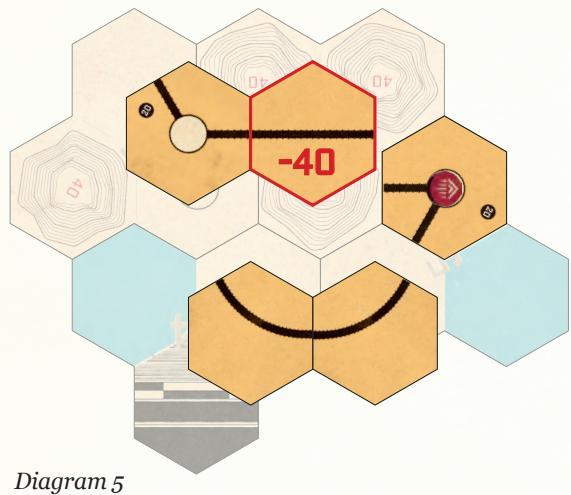
Laying track through a mountain space costs 40 but may provide a faster path to your destination.
Operating Rounds are when Companies and Corporations make changes to the map, run routes to generate revenue, and buy trains. The president of each Company or Corporation makes all decisions for that Company or Corporation during these rounds, and all costs are spent from the acting Company or Corporation's treasury. Each cycle includes two consecutive operating rounds.
If a Minor Company ability contradicts the rules of the game, the Minor Company ability takes precedence.
UPGRADES AND NAMING IN THE LOST ATLAS
You may notice that with upgraded tracks come new background road layouts, new road names, and new city names. Upgrades represent some passage of time, and like a lot of societies, the people who inhabit the world of the Lost Atlas experience collective shifts, in preference and propriety. Naming conventions follow those shifts, so we sometimes see a city renamed, a new road built, an old road removed, etc. — the small movements of a society advancing.
Companies and Corporations operate in descending stock price order (Companies and Corporations with the same stock price operate from top to bottom). The following actions must be taken in order.
1. Optionally, purchase a leadoff train when running a newly launched Minor Company
¤ Each Minor Company, on their first Operating Round in the game, has the option to purchase a train from the available stack of trains or the bank pool at face value. Full price must be paid from the Company treasury. Trains purchased in this step will be able to run their route and generate revenue that turn. (See 7. Train purchasing on page 16 for additional information on the process of acquiring trains.)
2. Optionally, issue or redeem one share
A Company or Corporation may issue a share from its treasury to the bank. The Company or Corporation treasury then receives its current share value from the bank, and the share price drops one spot on the stock track. (see Token Movement on the Stock Track)
OR
A Company or Corporation may redeem one share from the bank. The Company or Corporation pays an amount equal to its current share value to the bank and takes one of its shares from the bank pool and returns it to the treasury. This does not change the share price.
3. Optionally, lay track tiles
A Company or Corporation may place up to two yellow tiles or upgrade one tile per round from among the available tiles based on game phase.
Yellow tiles and non-city upgrade tiles must be placed in a way that the Company or Corporation can trace a route through at least some of the new track. (see Diagram 4)
¤City upgrade tiles must be placed in a way that the Company or Corporation can trace a route into that tile.
Track cannot be placed such that it runs into the edge of a water hex, a blank edge of a Distant Destination hex, the edge of a black border hex, or the edge of the map. 非
Yellow tiles cannot be placed on water, Distant Destinations, black border hexes, or any hex that already contains track.
¤ Cities cannot be created or removed while placing a tile. (They will often gain additional city spots.)
Upgrade tiles can only replace a tile from the previous phase, e.g., green must replace a yellow tile, purple must replace a green tile. The replaced tiles are returned to the available tiles area.
Upgrades must maintain the tracks that already exist exactly.
Tiles with a ⊗ symbol must be upgraded using a tile that shares the same symbol.

All printed costs must be paid from the Company or Corporation treasury when placing a track tile. (see Diagram 5)
¤Tiles are finite in supply, and some options may not always be available.
Hub tokens are maintained as city tiles are upgraded.
¤Printed hubs for unlaunched Minor Companies are reserved until that Company launches; these spots should be marked with the Company token when the tile is upgraded. If a tile has a reservation on it, at least one city spot must remain unclaimed until the Company the spot is reserved for enters the game. This spot is not considered blocked while it is reserved. (see Diagram 6)

Diagram 6
When a track tile is placed over the home space of a Minor Company that has not launched yet, the spot remains reserved for that Company. This is indicated by placing a token of the reserved Company near the city spot, but not over it, as routes may still run through a spot that is reserved.

Agricultural Company is allowed to lay a yellow tile after it places a tile upgrade.

Bridging Company is equipped with 5 bridge tiles (2 straight, 2 broad curve, 1 sharp curve) that it may lay over water hexes in place of normal yellow tile lays. Bridge tiles cannot be upgraded. In addition, any track lays that this Company makes may have segments of track that run into the edge of a water hex.
Bridging Company is not included in the Short Game.

Tunneling Company gains 60 into its treasury each time it digs a mountain hex. The cost for digging still must be paid first, so the overall gain is 20 per mountain tunneled. This payment is made into Tunneling Company's treasury after each tile is placed.

Eastern Mining Company & Northern Port Company home spots are on the and tiles, respectively, which have special sets of tiles they upgrade into.
The and tiles can be upgraded by any Company as long as regular upgrading rules are followed.
The tile upgrades can each be placed in two ways, either with the new leg clockwise or counterclockwise. The existing connection to a side of the hex is what must be maintained, not the specific shape of the track or placement of cities. (see below)
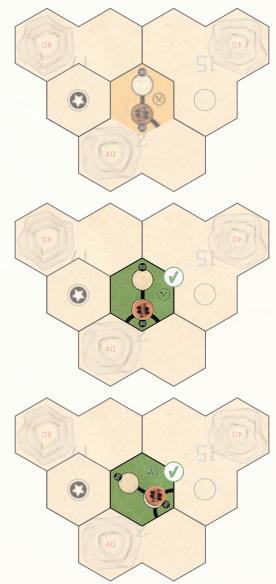

During the Operating Round, Expansive Company may place a hub token on either of the spots with a check mark. The Company may not place a hub token on any of the X marks because (1) a route cannot be traced due to another Company token blocking the route, (2) an inability to trace a route, and (3) a spot being reserved for a Company that has not launched yet.

Expansive Company comes with an extra hub token that can be placed during an Operating Round by spending 40 from the Company treasury. All normal hub token placement rules apply. If the token is not placed when the Company merges into a Major Corporation, it is converted to a token matching the new Major Corporation identity and stays on the 40 spot of the Minor Company charter.

Overnight Company may skip over blocked (fully tokened) cities while tracing a route. Blocked cities that are skipped do not count as stops, and their revenue is not added to the run. This ability can also be used when determining if the Company can place/ upgrade a tile and if the Company can merge with another Minor Company. After merging into a Major Corporation, the ability can be used when determining where a hub token can be placed.
Overnight Company is not included in the Short Game.
4. Optionally, place a hub token
A Corporation (or Expansive Company) may place an available hub token by paying its printed cost and placing the token in any open and unreserved city spot that the Company or Corporation can trace a route to. A Company or Corporation may only have one hub token on any single tile. (see Diagram 7)
5. Run trains if able
A route is a continuous traceable line of track that includes at least one city spot with the Company or Corporation's hub token and does not require any piece of track to be touched more than once. (see Diagram 8)
Companies and Corporations run routes equal to the number of trains they own. Each train runs a separate route that includes a number of stops up to it's number (2, 3, 4...), never using the same section of track as any other train run by the same Company, although routes may cross each other at cities and some green and purple track tiles. (see Diagram 8)
A route may not pass through a city that is full of hub tokens unless a token of the operating Company or Corporation is present. A route may start or end at these cities and include the city's value in its total. O
¤ A route may start or end at a Distant Destination, but it may not pass through.
A single train route may not include the same city or the same Distant Destination more than once. Multiple trains may be able to count these locations during the same Operating Round so long as they do not use any piece of track more than once. (see Diagram 8)
¤A single train cannot run to both sides of the port tile . The mine tile ⊗ contains two separate stops linked by track, so both stops can be run by the same train.
Some tracks with forks have a directionality to the turn. A route cannot use the sharp turn on these tiles. City tiles operate as junctions, so any turn that doesn't run on track that has already been run by a train is allowed. (see Diagram 8)
The value of a route is equal to the total value of stops (continuous cities and/or Distant Destinations) touched by a train up to its number (i.e., a 3-train can count one, two, or three stops in its value).You may not elect to skip a stop to extend the route. ∞-trains do not have a limit to how many stops they can include in their route, but all other route tracing rules must be followed.
Note: Being able to run to fewer stops than the train number means a Company that can't reach a second city on their first turn, or a Company that has more trains than they have routes built, can still run all their trains by reducing some to what we call Local routes, a single stop within the hub city. Because they are not using built track, any number of Local routes can be run in the same city.
· A city's value is equal to the number printed on its hex.
· Distant Destination value is variable depending on the phase of the game.
The total value of the routes determines a Company or Corporation's earnings.
If a Company has no train during this action, its revenue is considered to be o and its share price decreases by one increment when earnings would be distributed.
Note: You can use the earnings track to mark the value of settled routes while you trace additional ones.
6. Distributing earnings
The president of the Company or Corporation chooses how to distribute the earnings each Operating Round.
They may either:
Pay out to the shareholders
OR
Withhold the total amount
WHAT ABOUT THE WORKERS?
Since all of the revenue generated by running trains can either be paid out to shareholders or withheld by the company, some may wonder who is working for these Companies? How does a train get from point A to point B with 100% profit? All workers in the world of the Lost Atlas are paid a living wage. The revenue in the game represents profits after all expenses have been paid.
TO PAY OUT THE EARNINGS
Each Minor Company share is entitled to 20% of the total payout, and each Major Corporation share is entitled to 1o% of the total payout (note the difference between a share and a certificate). This money is taken from the bank and given to each shareholder, including the Company or Corporation itself, which may hold its own shares in its treasury. This number should be marked on the earnings track.
If the total payout is greater than o but less than the current share price of the Company or Corporation, no adjustment is made to the share price, but the share price token is moved below any other tokens in its current share price column.
If the total payout is equal to or greater than (but less than double) the current share price, the share price increases by one increment.
If the total payout is equal to or greater than double the current share price, the share price increases by two increments.
TO WITHHOLD THE EARNINGS
The Company or Corporation takes, from the bank, the total earnings and puts that money into its treasury. The share price of the Company or Corporation decreases by one increment.

Diagram 8
Assume the Northern Port Company has two 4-trains to run. The blue and green routes are both legal as no sections of track are shared, neither route runs to the same city more than once, and both routes include the Company's hub token. It may not run from its hub token to the adjacent city and then to the other city spot on the tile as it is considered the same city the route started in.
It also cannot run from the city to the Distant Destination tile because a train cannot make the sharp turn on the intervening track tile.
Revenue for these routes would be 60+30+50+20 and 60+20+50+20 for a total of 310 to be either paid out or withheld. If the revenue is paid out, each share would receive 62.


Express Company boosts its train by one stop as long as it only owns one train. The is used to mark a train that receives this bonus as a reminder.
Suburban Company has twotokens it can place on basic cities where it has no hub (no or ), limit one suburb token per tile. Suburb tokens are placed at any time during their Operating Round. One or both tokens can be placed in an Operating Round. The tile a suburb token is placed on must be reachable by the Company/ Corporation. Suburb cities generate +10 for each train this Company runs that includes them in a route. Suburb tokens cannot be moved once they are placed.

Spacious Company always has one extra train slot beyond the current limit. Use Minor Company limits if the Company is unmerged and Major Corporation limits if the Company has merged.
Spacious Company is not included in the Short Game.

Resourceful Company's trains are not discarded when they would become rusted; instead, they run one additional time, after which the trains are discarded like normal. Rusted trains do not count against the train limit and cannot be sold to another Company or Corporation or traded in for ∞-trains.
7. Train purchasing
If a Company or Corporation has fewer trains than the current phase limit , it may purchase the top train of the available trains stack, a train from another Company or Corporation, or a train from the bank pool. If a Company or Corporation does not own a train, it must purchase one before ending its Operating Round actions. Companies and Corporations may purchase as many trains as they have space and funds for.
Players may not contribute personal cash toward any train purchase unless it is during a forced train purchase.
RUST EVENTS
Rust events happen when a new train is purchased or exported that eliminates an older type of train. There are three possible rust events: The first 4-train purchased rusts all 2-trains, the first 6-train purchased rusts all 3-trains, and the first 7/∞-train purchased rusts all 4-trains. If a train purchased from the available trains stack is the first of a type that triggers a rust event, that rust event is resolved immediately, and the rusted trains are removed from the game.

PHASE CHANGES
If a train purchased from the available trains stack is the first purchased train of its color (green, purple, grey) the game advances to that phase immediately. New train limits are imposed such that any Company or Corporation that is now over the current train limit must place a train of their choice from their holdings into the bank pool. Tiles for the new phase can be laid out and are available for the next Company or Corporation to act in an Operating Round. The range of available initial stock prices expands when the green phase and the purple phase are entered.
| TRAIN LASTPURCHASED/EXPORTED | INITIALSTOCKPRICE | PRICE | RUSTEDBY | TRAIN LIMITMINOR/MAJOR |
| 2 | 60-90 | 100 | 4 | 2/- |
| 3 | 60-110 | 200 | 6 | 2/4 |
| 4 | 60-110 | 300 | 7/00 | 2/3 |
| 5 | 60-135 | 450 | 1/2 | |
| 6 | 60-135 | 550 | 1/2 | |
| 7 | 60-135 | 750 | 1/2 | |
| 8 | 60-135 | 1,000(or 890+trade) | 1/2 |
¤The top train of the available trains stack is always available for purchase at face value.
Note: The ∞-train has an additional option to pay the lower price (8oo) and turn in any non-rusted train to the bank.
¤Trains in the bank pool may be bought for their printed price.
A train may be purchased from another Company or Corporation for at least 1 as long as both presidents consent to the sale. The purchasing Company or Corporation must pay for the train with cash from its treasury, and the cash is paid directly to the treasury of the Company or Corporation selling the train.
If a Company or Corporation does not have enough cash in its treasury to purchase a train and it does not own one, it must initiate a forced train purchase.
Note: The supply of 7/∞ trains is intended to be unlimited. If a train is needed but the supply has run out, players may use previously exported 7/∞ trains or use a rusted train to represent it.
FORCED TRAIN PURCHASE
It is required that any Company or Corporation that does not own a train purchase a train before ending its Operating Round actions.
If the Company or Corporation does not have enough cash in its treasury to purchase a train from the bank pool or available trains stack and no deal is made to purchase a train from another Company or Corporation, the president of the Company or Corporation must contribute money from their personal holdings to purchase the lowest-priced train between the bank pool and available trains stack.
The cash in the Company or Corporation's treasury must be used first (shares in the Company or Corporation's treasury are not considered during a forced train purchase). Then the president contributes their cash on hand toward the purchase If these two amounts are not enough to purchase a train, the president must begin selling shares one at a time until they have either acquired enough cash to complete the purchase or they are unable to sell any more shares, at which point the president is considered bankrupt (see Bankruptcy). Share sales during this process do affect the stock prices of the Companies or Corporations whose shares are sold. Stock prices are adjusted downwards once all share sales for the forced train purchase action have been decided so each Company or Corporation whose share(s) are sold only moves down one increment.
Note: The president may not sell shares of the active Company or Corporation that would result in a change of presidency for the active Company or Corporation or a share that would put the bank pool holdings of that Company or Corporation above 50% during these forced share sales.
BANKRUPTCY
If a Company or Corporation is still unable to purchase a train after following the steps of the forced train purchase, the president of that Company or Corporation is declared bankrupt. It is common for bankruptcy to immediately trigger the end of the game. If non-bankrupt players wish to continue they may follow these steps to remove the bankrupt player from the game. Any Companies or Corporations that player presided over as president of are immediately removed from the game. Trains owned by those Companies or Corporations are sent to the bank pool available for purchase. Any hub tokens in cities are removed. All players other than the bankrupted player may exchange the shares of the closed Companies for their final stock value (this happens simultaneously, and the price is not reduced). Then, remove the Company or Corporation markers from the stock track. Play resumes with the remaining players.
8. Pass the turn and continue with the next Company or Corporation in descending stock price order.
If there are no more Companies or Corporations to operate in the Operating Round, the round tracker is advanced, and play continues from the new round.
MERGERROUND

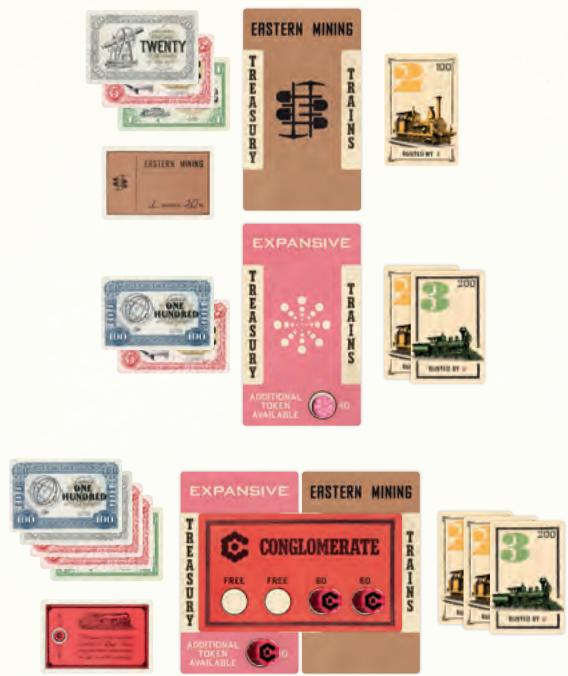
Diagram 9
When two companies merge, the Minor Company charters are placed side-by-side, and the chosen Corporation charter is placed over them. Trains and money in the treasuries are consolidated in their new respective zones. All Minor Company shares are exchanged for an equal number of Corporation shares. The player who owns the most shares of the merging Companies takes the president's certificate, and the other Minor president's certificate is converted to two single shares. If two different players own the merging Companies and own the same number of merging shares, the new president's certificate goes to the player who controls the merging Company that would operate earlier in turn order during an Operating Round.
During the Merger Round, pairs of Minor Companies can combine to form Major Corporations.
After both Operating Rounds are completed, as long as the first green train has been purchased or exported, there is a Merger Round. If the first green train has not been purchased or exported, play proceeds to the Export a Train step. In descending stock price order, each Minor Company's president may choose to propose a merger with another Minor Company with at least one hub token they can trace a route to or pass. If one of the presidents declines the merger, that exact merger may not be proposed again during that Merger Round.
When both presidents agree to the merger:
(It is common for one player to be the president of both.)
The president of the new Corporation will be the player who owns the most shares of the merging Companies. If players are tied for the most shares, the presidency is given to the player who is president of the Company that is earliest in turn order on the stock track. That player chooses a Corporation for the merging Companies and takes the tokens, charter, and stock certificates that match.
Replace each merged Company certificate with a Corporation certificate giving the newly created president's certificate to the new president and turning the other Minor Company president's certificate into two single Corporation certificates. Place both Company charters side-by-side and place the Corporation charter on top to create the merged charter. A Major Corporation retains all abilities of the Minor Companies that were used to create it.
One token is placed onto the earnings board. One token is placed onto the stock track at the average price of the two merged Companies rounded down. Remove both merged Companies' tokens from the stock track and earnings board. For each hub token belonging to either of the merged Companies, replace it with a new Corporation hub token. If there would be two hub tokens on the same tile, replace one with the Corporation's hub token and return the other to the charter as an available hub token on a FREE spot. Two of the extra hub tokens are placed onto the charter occupying the two rightmost spaces. If there is an additional unused token, it can be returned to the box.
Treasuries and trains of the merged Companies are combined. If the new Corporation has more trains than are allowed by the current train limit, the president selects one train and places it in the bank.
Return all of the tokens and certificates for both of the merged Minor Companies to the box. (see Diagram 9)
EXPORT A TRAIN
Each cycle of rounds, a single train is removed from the game revealing the next available train for purchase. This may lead to rust events and/or phase changes.
Before entering a new Stock Round, the top train of the available trains stack is exported out of the game. If a 2-train is exported, all remaining 2-trains are exported with it, leaving the first 3-train as the next available train on the stack. If this results in the first 4-, 6-, or 7/∞-train being removed from the game, treat it as though the train was purchased and rust the appropriate trains accordingly. If this results in the first green, purple, or grey train being removed from the game, the game phase advances immediately, new train limits are imposed, and new tiles are available for use in the next Operating Round. If the phase changed from yellow to green, there is no Merger Round at this time; play proceeds to the Stock Round.
ADVANCE THE ROUND AND CYCLE COUNTERS
If this was the last cycle of the game, proceed to End of Game. Otherwise, advance the cycle counter and move the round counter to SR for the next Stock Round.
END OF GAME
The game ends after either four cycles (in the Short Game)or six cycles (in the Long Game). A cycle is a full rotation of a Stock Round, two Operating Rounds, and a Merger Round.
Players add their personal cash and the value of all shares they own to arrive at their final score. Company treasuries are not considered in the final score count. The player with the highest score wins. In the unlikely event of a tie, the player who is the president of the Company or Corporation that would act earliest in turn order is the winner.
GENERAL TIPS
• Build the map you want to play on.
• The value of a Minor Company is a composition of its starting position, special ability, and potential merging partners.
• Cross-investing in other players' Companies is useful; just be careful when buying enough to constitute a president's share.
• Issuing a share during a Company's Operating Round is a good way to generate quick cash. Make sure you have a use for it, though.
• Have a plan for how Companies will buy their next trains. Filling your slots with trains that will rust soon may leave you stranded when they do.
• Tile lays can increase revenue, access, or both.
• Focus on your position before looking for ways to block others, but watch for opportunities that do both.
• The best routes are built with minimal basic cities; only hit the ones you have to.
• Share count is often a good indicator of who is in the lead. More shares means more payouts and more gains when stock prices go up. Sometimes the best share is a worse purchase than two inferior shares.
VARIANTS
Railways of the Lost Atlas was built from the ground up to support variants and custom rulesets.
Some variants to consider are:
DIFFERENT DISTANT DESTINATIONS
Place a unique Distant Destination revenue card for each Distant Destination map tile.
Shuffle the Distant Destination revenue cards face down and set aside during map building. Whenever a Distant Destination map tile is drawn, the top Distant Destination revenue card is drawn and paired with the map tile before placement. Keep the card close to the map tile to clearly indicate its revenue during the game.
SHORT GAME WITH RANDOMIZED MINORS
Mix up the Minors to give all the Companies a shot.
Before setup, instead of removing the set tiles and Minor Companies for the Short Game, shuffle all 12 Minor Company home tiles (in this mode, map tile 21 represents Adaptive Company's home, though it is not required to start on that tile) and remove four from the game, face down. Also remove one of each map tile 12-14, map tile 26, and a Capital Project tile. Setup then proceeds as normal. When setting up the Minor Company charters, only use Companies that appear on the map.
HOSTILE MERGERS
Take that!
Allow mergers based on share voting instead of presidential consent. A merger can be proposed by any player owning at least one share of one of the Companies; connection restrictions still apply. During the Merger Rounds, instead of Companies acting in descending stock value order, starting with the priority player in clockwise order, players are allowed to propose a merger or pass. This continues until all players pass in order. When a merger is proposed, each share of both Companies grants one vote to the owner of that share, and the majority among voted shares wins. Shares in the bank pool vote for the merger if the share would increase in price, abstain if the share would stay the same price, and vote against if the share would decrease in price. Shares in the Company treasury abstain. Abstained shares do not vote and are not counted when determining majority. If the vote succeeds, the merger happens immediately before the round continues. If the vote fails (ties are considered failures), that exact merger may not be proposed again during this round. The Priority Player Marker does not move during Merger Rounds.
BANK BREAK
A traditional 8,0oo bank to end the game replacing the set number of rounds.
Create a bank totaling 8,000 (remove all 2,000s and five 50os) and set the rest of the money aside. It will only be used if required once the bank has been depleted. Instead of ending the game after a set number of rounds, the game ends when the bank is depleted. Finish the set of Operating Rounds using the additional money set aside. Determine the winner using the normal end-of-game rules for counting final score. Follow the setup rules for the Long Game other than the cycle counter. Additionally, players must abide by a certificate
内容过长,此处只内联前一部分;完整内容请下载或到规则页阅读。
下载 Markdownrules_en_railways-of-the-lost-atlas-landmarks-of-the-lost-atlas_438903.md34.5 KB
Railways of the Lost Atlas: Landmarks of the Lost Atlas
逐页 VLM 转写(qwen3-vl-plus),保留原文结构,未翻译。
LANDMARKS OF THE LOST ATLAS
WELCOME TO LANDMARKS OF THE LOST ATLAS
Landmarks of the Lost Atlas introduces four new modules, as well as a few mini-modules and miscellaneous variants, to expand your Railways of the Lost Atlas games. These modules can be included individually or in any combination:
| LANDMARKS | THE METROPOLITAN TRANSIT DEPARTMENT | EVENTS | NEW MINORS AND MAJORS |
|---|---|---|---|
| Landmarks add new strategies as well as more flavor to maps that include them. | The Metropolitan adds a neutral Corporation to the game that players can use to benefit their own interests and/or hinder others. | Events create temporary changes to the core rules of the game that players will need to adapt to. | New Minor Companies and Major Corporations add variety to the company abilities available in the game. |
| DIFFICULTY...........Decreased | DIFFICULTY...........Increased | DIFFICULTY...........Decreased | DIFFICULTY...........No Change |
| VARIANCE............No Change | VARIANCE............No Change | VARIANCE............Increased | VARIANCE............No Change |
| GAME LENGTH ... Possibly Increased | GAME LENGTH ... Increased | GAME LENGTH ... Possibly Increased | GAME LENGTH ... No Change |
COMPONENTS
-
14 Landmark Tiles
[图: 14个六边形/星形/不规则多边形地标板块,含CANYON、CLIFF、CAVE、WATERFALL、PARK、VOID、GRAND JUNCTION、ANCIENT RUINS、ODD DESERT、EVEN DESERT、WILDFLOWER VALLEY等标签] -
11 Landmark Project Tiles
[图: 11个三叶形黑色边框地标项目板块,内嵌不同地标图案与文字,如ANCIENT RUINS、CLIFF、PARK、CAVE、VOID、WILDFLOWER VALLEY等] -
12 Waterfall Mini-Postcards
[图: 3叠共12张“WATERFALL”迷你明信片,蓝绿色调] -
12 Rock Formation Mini-Postcards
[图: 3叠共12张“ROCK FORMATION”迷你明信片,橙红色调] -
16 Park Entrance Markers
[图: 16个绿色小树图标标记] -
4 Ancient Ruins Blank Markers
[图: 4个米色圆形空白标记] -
3 Train Cards (for 6–7 Player Variant)
[图: 3张火车卡,含蒸汽机车与火车头图案] -
5 Direct-to-Major Partner Charters
each with 2 identity options
[图: 5张竖版卡片,标题分别为FRIENDLY LOCAL, REGIONAL, INDEPENDENT, GRAND, BIG;每张卡片左侧竖排文字“TREASURY”,右侧竖排文字“TRAINS”]
-
5 Minor Company Home Tiles
[图: 8 hexagonal tiles in beige, blue, and brown with icons and numbers like “40”, “2”, “L-3”] -
1 Minor Company Project Tile
[图: A black-and-white triangular tile labeled “TWIN CITIES” with a blue center and rail lines] -
4 Minor Companies with silkscreened tokens
[图: Four sets of cards: “TWIN CITIES” (blue), “CIRCUS” (purple), “COUPLING” (teal), “MANUFACTURING” (gold); each set includes Treasury, Trains, and President cards, plus colored circular tokens] -
4 Coupling Markers
[图: Four teal square markers with a white “C” symbol] -
1 Manufacturing Permanent 2-Train Card
[图: A small card with “2” and a steam locomotive illustration] -
2 Major Corporations, each with 2 identity options and silkscreened tokens
[图: Two stacks of corporation cards: “AUTHORITY” (gray) and “LEAGUE” (dark gray), each with four circular token slots; below each stack are six matching tokens (triangles for AUTHORITY, circles for LEAGUE)] -
6 Additional Major Hubs
[图: Six colored circular tokens: red, yellow, green, blue, purple, gray] -
Extra 7/∞ Train
(Combine with base game)
[图: A small card showing a steam locomotive with “750” and “PERMANENT”] -
1 Metropolitan Board
[图: A board titled “METROPOLITAN TRANSIT DEPARTMENT” with two blank rectangles, rows of circles labeled “TRAINS”, and a row of numbered red/orange squares from -30 to -1] -
21 Metropolitan Certificates
[图: Two stacks of certificates labeled “METROPOLITAN”, one with blue borders, one with dark blue stripes] -
12 Metropolitan Hubs
[图: Twelve blue circular tokens] -
3 Distant Destination Revenue Cards
(Combine with base game)
[图: Three red rectangular cards labeled “DISTANT DESTINATION REVENUE” with number circles: e.g., 0, 30, 60, 120; and 30, 30, 80, 80] -
14 Event Cards
[图: Two fanned stacks of event cards: “RURAL EXPANSION” and “TYCOONS REJOICE”] -
4 Player Aids
(Double-sided)
[图: Four double-sided reference sheets covering “PAGE”, “LANDMARKS SETUP”, “5–7 PLAYER MODE SETUP”, “EVENTS SETUP”, and diagrams] -
2 Extra Map Tiles
(Optional substitution with base game)
[图: Two hexagonal map tiles: one beige with “40” and “5-1”, one teal with “40” and “40”] -
19 Distant Destination Tile Markers
[图: Nineteen small rectangular markers in orange/red with various symbols and numbers]
LANDMARKS
SETUP
During the Map Building portion of Setup, add Landmark project tiles, selected at random according to the game mode chosen, into the stack before shuffling the map tiles.
Note: These are in addition to any other project tiles included in Setup.
- 3 Landmark project tiles for the Long Game
- 2 Landmark project tiles for the Short Game
- 1 Landmark project tile for Micro Games
When a Landmark project tile is revealed during Map Building, the active player places the corresponding Landmark map tile(s) following the normal restrictions and returns the project tile to the box. Note: The Mirage and Parks map tiles need only two adjacent hex edges to be placed instead of the normal three adjacent hex edge restriction. If the Landmark map tile(s) can’t be placed, shuffle the corresponding project tile back into the remaining map tiles and continue Map Building with a new tile. After a Landmark tile is placed, each subsequent tile that shares an edge with it must also share at least one edge with a non-Landmark terrain hex (blank, mountain, water, Distant Destination, or city).
During gameplay, Landmark hexes are considered to be blank hexes for tile laying purposes (i.e., track can run into the edge of the tile). Track tiles cannot be placed over any Landmark hexes. If printed track terminates within the Landmark tile, a route may start or end at that tile but may not pass through it.
[图: Green checkmark icon labeled "Counts as a stop." and red crossed-out circle icon labeled "Does not count as a stop."]
Note: Landmarks that generate revenue are not considered cities, even if they count as a stop.
ANCIENT RUINS ✅
A Company or Corporation may include the Ancient Ruins in their route, though it provides no revenue. After revenue is determined, the Ancient Ruins allows the Company or Corporation that ran to it to relocate one hub token to a different available token location. They must be able to trace a route from the original location of the token to its destination location. The hub token does not need to have been used as a stop on the route that includes the Ancient Ruin in order to be relocated. If the token being relocated would leave behind a printed Company logo (🟦, 🟩, ⚓, 🟨) on the tile, place a blank marker over it indicating that the token spot is no longer reserved.
CAVE ❌
The Cave generates additional revenue based on phase. The Cave does not count as a stop but must be included at the start or end of a route.
CLIFF ✅
Once during a Company or Corporation’s Operating Round, they may include the Cliff in their route(s). If they do, they may sell the train (or one part of a 🚂 train) that ran to the Cliff to the bank pool for half of its printed value. The sale occurs after determining routes and before distributing revenue. Resourceful Company cannot sell rusted trains. Money generated by the Cliff is placed into the treasury of the Company or Corporation.
CANYON ✅
The Canyon has no effect prior to the first 4-train being purchased or exported. A Company or Corporation may include the Canyon in a route during their Operating Round, though it provides no revenue. After revenue is distributed, the Canyon allows the Company or Corporation that ran to it to acquire (at no cost) a 2-train that has rusted. This 2-train is permanent, can’t be sold or traded in, can be discarded at any time, and does count against the train limit. A Company or Corporation that has owned a permanent 2-train from the Canyon may not acquire another. If two Companies that own permanent 2-trains from the Canyon merge, they may keep both.
GRAND JUNCTION ❌
Each section of track on the Junction tile is independently connected to every other section of track on the Junction tile. Normal route rules apply (i.e., you may not use the same section of track more than once in an Operating Round). Multiple routes can pass through the Grand Junction in the same Operating Round turn, and a single train can even go through multiple times provided it follows all other route rules.
Mirage (+DESERTS) ✅
Note: During Setup, when the Mirage project tile is revealed, all three single hex tiles are placed on the board individually by the player who revealed the project tile. Because the Mirage and Deserts swap places regularly, it may be helpful to place some extra blank hex tiles under each one to make them easier to remove from the map.
Once, during a Company or Corporation's Operating Round, the Mirage tile may be included in one route and counts as a 60 revenue stop. At the end of the run trains step, if the Mirage tile was run as a stop, it is swapped with either the Odd Desert or the Even Desert tile based on the train that ran to it. If the printed train (or sum of 🚂 trains) had an odd number, the Mirage swaps with the Odd Desert. If the printed train (or sum of 🚂 trains) had an even number, the Mirage swaps with the Even Desert. The ∞ train is considered to be even.
ROCK FORMATION ❌
After revenue is determined, if the Rock Formation was included in the route, the Company or Corporation that ran to it increases their share price by two increments and takes a Rock Formation Postcard. This happens before revenue is distributed. One Rock Formation Postcard stays with Corporations after merging (return extras to the stack). Companies and Corporations with a Rock Formation Postcard may not include the Rock Formation in a route.
PARK ❌
Parks add 10 to the revenue value of each adjacent city tile (other than Distant Destination) that has a section of track connected to it. This bonus is marked with a 🌲 (a city may have both a 🌲 and a 🏙️ token). Trains cannot run into a Park. Multiple connections to the same Park do not add any additional revenue to the connected city tiles. A city tile value may be increased by both Park tiles if it has a direct connection to each.
The isolated stop on the Eastern Mining home tile cannot be directly connected to a Park tile. Each half of the Northern Port home tile requires its own connection to receive the value increase (this may lead to one half being more valuable than the other).
(See Diagram 1)
[图: A hexagonal tile layout showing multiple Park tiles (green with "PARK" text), city tiles with tokens (🌲, 🏙️, 🟦, 🟪), and track connections; includes labels like "PARK +10", "PARK +10", and numbered stops.]
Diagram 1
The Manufacturing and Twin Cities home tiles each have two Park bonuses (+20) because they are adjacent to and directly connected to both Park tiles. The Circus home tile has one Park bonus (+10) because it is connected to both Park tiles but only adjacent to one (so only one direct connection is possible). The Coupling home tile does not have any Park bonuses because it is not adjacent to a Park tile.
VOID ❌
Once per Operating Round a Company or Corporation may run a train into the Void and continue their route from any unblocked city spot on the map. All normal route rules apply. The Void cannot be used for track laying, hub token placement, or merging.
WATERFALL ✅
The Waterfall adds revenue to the route based on phase. When a Company runs to the Waterfall, they take a Waterfall Postcard. One Waterfall Postcard stays with Corporations after merging (return extras to the stack). Companies and Corporations with a Waterfall Postcard may not include the Waterfall in a route.
WILDFLOWER VALLEY ❌
When a train runs to a stop before the Wildflower Valley and a stop after the Wildflower Valley, 20 is added to the revenue for that route.
THE METROPOLITAN TRANSIT DEPARTMENT (Not available in Micro games)
SETUP
After initial Setup, place the Metropolitan board above the earnings per share board.
Place Metropolitan hub tokens according to the chosen game mode as well as two spare tokens, one for earnings and one for the Stock Track.
Place a stack of Metropolitan certificates totaling three times the number of players near the Metropolitan board. The Metropolitan will come into play as the game progresses, so no setup on the map is needed at this time.
Note: The Metropolitan has no treasury, it earns no money for itself, and expenses are paid through revenue debt, a process which is explained below.
ENTERING PLAY
Each time a yellow Capital city tile is built, one of the ⚪ Metropolitan hub tokens is immediately placed in the empty token spot.
At the start of the first Stock Round following the first Metropolitan hub token placement, the Metropolitan stock price is set to the highest stock price among existing Companies and Corporations and above all Companies and Corporations in that column.
ACQUIRING TRAINS
The Metropolitan does not purchase trains; instead, any train that is exported is placed into the Metropolitan’s train slots. It follows Minor Company train limits. If the Metropolitan acquires a train that puts it above the limit, or it is above the limit due to a phase change, the lowest value train is discarded as a result (as if it had been exported). If a 7/∞ train is exported, the Metropolitan receives a 7.
STOCK ROUNDS
Any player may purchase an available Metropolitan share during their Stock Round turn. This purchase is made at the current stock price and counts as that player’s stock purchase for the turn.
There is no president’s certificate; all certificates are single shares.
There is no limit to how many shares of the Metropolitan any one player can hold.
When any Metropolitan shares are sold by a player, the share price drops one increment on the Stock Track.
Metropolitan shares cannot be sold in the first Stock Round they are available because the Metropolitan has not operated yet.
Metropolitan shares that are sold do not go into the bank pool; instead, they are placed back into the stack of Metropolitan shares next to the Metropolitan board.
At the end of a Stock Round, if all Metropolitan shares are owned by players, its stock price increases by one increment at the same time other fully sold share prices are adjusted.
OPERATING ROUNDS
During the Metropolitan’s Operating Round, all players who own at least one share of it will have the opportunity to control some of the Metropolitan’s actions.
Starting with the player holding the Priority Deal token and moving clockwise, players act as the Metropolitan based on how many shares of it they hold:
- One share: The player may take a track laying action of two yellow tiles or one upgrade.
- Two or more shares: The player may take a track laying action of two yellow tiles or one upgrade and may place a hub token following normal hub token placement rules.
Any costs for these actions are marked as deductions from the current round’s earnings using the negative earnings track on the Metropolitan board.
(See Diagram 2)
Note: The Metropolitan cannot use the following Events: Rural Expansion, Unions Win!
The Metropolitan cannot use the following Landmarks: Ancient Ruins, Canyon, Cliff, Rock Formation.
During the Run Trains step, all players collectively determine the highest value route. (If no players own any Metropolitan shares, no earnings are paid out, but the share value is adjusted as though it did.)
If the Metropolitan has multiple highest value routes (equal in revenue) with additional effects to consider (i.e., including the Mirage tile with an even or odd train), the player who owns the most Metropolitan shares determines which highest value route to run. If there is a tie for most shares owned, the tied player who is closest to the Priority player in clockwise order chooses.
Earnings are always paid out with each share collecting 10% of the payout (even if there are fewer or more than 10 shares in play). If, after determining the highest value route, the revenue does not bring the earnings marker to a positive payout, each shareholder must pay the remaining negative amount for each share they own to the bank. If any players are unable to pay the amount they owe, those players must sell one Metropolitan share in order to complete their payment. If any shares are sold in this manner, the share price drops one increment on the Stock Track. The share price then drops one increment on the Stock Track due to no payout, and the earnings marker is reset to the first space of the positive earnings track. If the payout was positive, normal token movement on the Stock Track rules apply, and the earnings marker is reset to the first space of the positive earnings track. (Players may choose to leave the earnings marker on the positive value until the next Operating Round as a reminder of past revenue, but the marker should be reset at the beginning of that Operating Round.)
END OF GAME
Metropolitan share values are counted toward a player’s final score like any other share.
[图: Diagram 2 — a Metropolitan Transit Department board section showing trains, share tokens, a grid of negative/positive earnings values, and a green curved arrow labeled 1–3 indicating a sample route and earnings tracker movement.]
Diagram 2
During an Operating Round, players utilize the Metropolitan to lay track tiles over two mountains and to place two hub tokens, for a total cost of 200.
The Metropolitan earnings tracker is set to -20 (1). Assuming a total run of 180, the earnings tracker would be moved to -2 (2), dividends would be -2 per share, and the stock price would drop by one increment. Players who own shares of the Metropolitan would need to pay 2 per share into the bank. The earnings marker then resets to the first space (3).
EVENTS
SETUP
After the initial Setup, but before the first Stock Round, shuffle the Town Chronicle and New City Herald events separately.
Place New City Herald event cards equal to half the number of cycles in a face-down stack (if playing the Bank Break variant, place all New City Herald event cards in the stack). Then place Town Chronicle event cards equal to half the number of cycles face down on top of the New City Herald event cards just placed. (If playing the Bank Break variant, place three Town Chronicle event cards on the stack.) (See Diagram 3) Reveal the top event card, then begin the Initial Stock Round.
GAMEPLAY
The currently revealed event is active for one full cycle. At the end of each cycle, before entering the next Stock Round, the top card of the events stack is revealed and becomes the active event for the next cycle.
[图: Diagram 3 — stacked event cards labeled “The Town Chronicle” and “Herald”, with labels indicating stacking order for “Bank Break”, “Long Game”, and “Short/Micro Games”]
| GAME TYPE | TOWN CHRONICLE | NEW CITY HERALD |
|---|---|---|
| Short/Micro | 2 cards | 2 cards |
| Long | 3 cards | 3 cards |
| Bank Break | 3 cards | All cards |
TOWN CHRONICLE EVENTS
CEOS GET RICH!
Companies and Corporations may pay their president 20 each Operating Round.
THE FUTURE IS HERE!
Tile upgrades may break phase restriction. For example, in the Green Phase, green tiles may be upgraded to purple.
GHOST TOWNS RAZED!
Non-home, basic cities with no hub tokens in them may be laid or upgraded using non-city tiles. If the city is being upgraded, all track segments must be maintained on the tile, but paths through the tile may be altered. If a city with a 🌲 and/or 🏙️ token on it is razed, the token is removed from the tile. A 🏙️ token removed this way may be placed in a future Operating Round.
(See Diagram 4)
[图: Diagram 4 — two hex-tile examples showing city razing: left shows a pink city tile with a hub token and adjacent track; right shows a green tile with a hub token and track connections preserved on edges but not through the tile]
The above examples are both allowed while the Ghost Towns Razed! event is active. Note that the green tile maintains existing connections on both edges of the tile but not the path through.
OVERTIME!
Play a third Operating Round immediately after the second Operating Round this cycle.
RAPID GROWTH
Players may launch a Minor Company from the first or second row in a column when they win a Minor Company auction during the Stock Round. If the second Minor Company in a column is chosen, the first Minor Company remains in place and is still available to be auctioned. The new second Minor Company in the column is now available for this Stock Round as well.
RURAL EXPANSION
Companies and Corporations may lay extra yellow tiles after their track laying action (including Headquarters track lays if playing with that variant) at a cost of 20 per extra tile. There is no limit to how many extra tiles a Company or Corporation may lay as long as each tile is paid for. Note: Bridges are considered yellow tiles for this event. If Tunneling Company lays an extra tile over a mountain, the tunneling payment is made into Tunneling Company’s treasury immediately after the tile is placed.
STOCK BONANZA!
Issuing shares does not drop a Company or Corporation’s stock price.
NEW CITY HERALD EVENTS
CORPORATE SUBSIDIES
Companies launched this Stock Round receive an additional 50% of the winning bid (rounded down to the nearest 5) from the bank in their treasury. For example, a bid of 155 will result in an initial stock price of 70 and 155 + 75 = 230 being placed in the Company treasury on launch.
MERGER MANIA!
There is an extra Merge Round between Operating Round 1 and Operating Round 2.
OVERTIME!
Play a third Operating Round immediately after the second Operating Round this cycle.
UNIONS WIN!
Companies and Corporations may choose to half-pay dividends. When a Company or Corporation chooses to half-pay, half of the total payout (rounded up to the nearest 10) is placed in their treasury, and half of the total payout (rounded down to the nearest 10) is paid out to shareholders. For example, with a payout of 130, the Company would receive 70 into their treasury and the remaining 60 would be split evenly among shares (including those still in the treasury of the Company or Corporation). A Company or Corporation’s stock price is adjusted based on the amount paid out to shareholders. In this example 60 would be the value used.
TRAIN AUCTION TODAY
There is an immediate auction for the Pullman Car. All Companies and Corporations may privately select an amount to bid, and all bids are revealed simultaneously. In the case of a tie, the earliest tied Company or Corporation in Operating Order wins. The winning bid is paid to the bank; all other bids are returned to their respective treasuries.
PULLMAN CAR
- Doubles the highest stop on one route each Operating Round
- Has no value once purchased
- Cannot be bought, sold, or traded in
- Does not occupy a train slot
- Is discarded if the owning Company/Corporation owns no trains
TYCOONS REJOICE
Presidents may own 80% of their Companies and Corporations during this cycle. If there is another Stock Round, any president owning more than 60% of their Company or Corporation must sell shares down to 60% at their first opportunity.
RECORD GAINS!
If a Company or Corporation’s total payout is equal to or greater than triple the current share price, the share price increases by three increments.
9
NEW MINORS AND MAJORS
SETUP
New Minor Companies can be integrated into the base game in one of two ways:
- Select a specific set of Minor Companies to play with based on the mode.
- Use the Randomized Minors variant.
Combine new Majors with the Majors of the base game; they are available as new options with no additional setup needed.
| MINOR COMPANIES | GAME TYPE |
|---|---|
| 4 | 2-player Micro Game |
| 6 | 3-player Micro Game |
| 8 | Short Game |
| 12 | Long Game |
[图: Diagram 5 shows a train route across hex tiles with a Circus Company token (purple star) and a train running through cities labeled x1, x2 (2 STOPS), and x0; a $200 stock certificate for a company "RUSTED BY G" is shown beside it.]
Diagram 5
Circus Company may run 20+50+50 instead of 20+50+20.
COMPANY DETAILS
CIRCUS
Once per Operating Round, during the Run Trains step, Circus Company may double the revenue of a city or Distant Destination by counting it as two stops. The final route that is run must follow all normal route rules (must contain a hub token, cannot run the same piece of track twice, etc.).
(See Diagram 5)
MANUFACTURING
On launch, Manufacturing Company must pay 50 from their treasury to the bank, receives the Manufacturing 2-train, and cannot purchase a leadoff train. The Manufacturing 2-train is permanent, occupies a train slot, has no value, and cannot be bought, sold, or traded in. The owning Company or Corporation may choose to discard this train at any time during their Operating Round, removing it from the game.
COUPLING
During the Run Trains step, if Coupling Company owns exactly one non-∞ train, they may choose to uncouple that train into two trains of size 2 or greater that sum to the total of the original train value (e.g., a 7-train may be uncoupled into a 2-train and a 5-train or a 3-train, and a 4-train). If Coupling Company owns more than one train they may choose to combine individual trains together to run as the sum of their values. Each connection is marked with a coupling marker. They may combine some trains and leave others to run alone.
For example, if Coupling Company is part of a Corporation that has two 2-trains and a 3-train, they may choose to couple a 2-train and a 3-train together to run as a 5-train while also running the second 2-train on its own. Each train card counts against the train limit, but for ownership purposes (such as when merged with Express Company), coupled trains are considered single trains, while an uncoupled train is considered two trains. The couple/uncouple choices are made each Operating Round.
10
SAMPLE MAP
TWIN CITIES
When randomizing Minor Companies during Setup or in the map tile stack, the Twin Cities project tile is used instead of either home tile.
When the project tile is revealed, place both two-hex tiles as home tiles. Each Twin Cities home tile must still share three edges with the rest of the map. When Twin Cities Company is launched, both home tiles receive a token. During the Operating Rounds, either/both tokens may be used for track laying and running train routes (standard rules for running each train are still applied). For merging, at least one token must be connected to the other merging Company. If Twin Cities Company merges with Expansive Company, eight Corporation tokens are needed. Extra tokens for each base game Corporation are included in this expansion for this purpose.
[图: Sample map titled “MICRO GAME WITH 4 NEW MINOR COMPANIES”, showing a hexagonal grid layout with various terrain tiles (e.g., forest, lake, mountain), numbered locations (e.g., 12, 15, 17, 18, 27), company tokens, a red “EAGLE BAY” tile, a green “CAVE” tile with resource icons, and a black arrow pointing to a hex with a star token.]
MISCELLANEOUS VARIANTS
SPECIAL TILES (S-1 AND S-2)
During Setup, remove two terrain (non-home, non-project, non-Distant Destination) map tiles and replace them with tiles S-1 and S-2. Tiles removed can be selected randomly or by player consensus.
NEW DISTANT DESTINATION REVENUES
Recommended to be used with the Different Distant Destinations variant from the base game (assign a random Distant Destination revenue card to each Distant Destination tile as it is revealed during Map Building).
CROWDED MAP (SHORT/LONG)
During Setup, remove four terrain (non-home, non-project, non-Distant Destination) map tiles and replace them with four additional Minor Company home tiles. After Map Building, shuffle the 12 (Short Game) or 16 (Long Game) Minor Company charters face down and distribute them into three (Short Game) or four (Long Game) face-up columns, each with four charters.
LONG GAME WITH RANDOMIZED MINORS
Before Setup, shuffle all 16 Minor Company home tiles (in this mode, map tile 21 represents Adaptive Company’s home, though it is not required to start on that tile, and the Twin Cities project tile represents Twin Cities Company’s home) and remove four from the game, face down. Setup then proceeds as normal. When setting up the Minor Company charters, only use Companies that appear on the map.
LAUNCHING DIRECT-TO-MAJOR
In the Purple and Grey Phases, players who win a Minor Company auction may choose to launch as a Minor Company or as a Major Corporation. To launch as a Corporation, select an available Minor Company and immediately convert it to an available Corporation using a blank partner charter. The new Corporation will have eight shares in their treasury, one home token, two available 60 cost hub tokens (no FREE hub tokens), and one Company ability. They may buy a leadoff train during their first Operating Round if they can afford one. Shares of a Direct-to-Major launched Corporation may not be sold until the Corporation has performed an Operating Round.
6-7 PLAYER MODE
During Setup, shuffle all map tiles (including special tiles S-1 and S-2, all Minor home tiles, and the Twin Cities project tile) and Capital project tiles together. When playing with Landmarks, randomly select three Landmark project tiles to shuffle into the map tile stack at the same time. When playing with Events, construct the Events stack with two New City Herald Events on bottom and three Town Chronicle Events on top. Include the extra 🚂 and 🚂 trains in the available trains stack. Players each start with 265 (6-player) or 225 (7-player) depending on player count. Play five cycles.
Note: It is recommended to play this mode using the Hostile Mergers and Launching Direct-to-Major variants.
SEEDING THE MAP TILE STACK
Some groups may find that Landmarks, Distant Destination tiles, and Capital project tiles can feel awkward or underwhelming if flipped at inopportune times. Here are some suggestions from our playtesters for additional steps to take after the tiles for the chosen mode have been selected:
THE KIDDER METHOD:
-
This method ensures no Landmarks come out too early or too late.
-
Shuffle all non-Landmark map tiles and set aside eight of them. Shuffle the Landmarks into the remaining tiles. Place four of the set-aside tiles on the bottom of the stack and the last four on the top of the stack.
THE SPANISH METHOD:
-
This method front-loads Landmarks so the rest of the map can be built around them.
-
Shuffle all non-Landmark tiles and set aside 12 of them. Shuffle all Landmarks into the set-aside tiles and place that stack on top of the remaining stack.
THE WALKER METHOD:
-
Evenly distribute different features for a very balanced sequence.
-
Create several subsets of features like Distant Destinations, Minor home tiles, Landmarks, Capital project tiles, and terrain tiles. For example, a subset may have a Distant Destination, a Landmark, a Capital project tile, a few Minor home tiles, and several non-home terrain tiles. Shuffle each subset individually and stack them to form the complete map tile stack.
Special thanks to everyone who participated in our playtest games and provided feedback.
Group Leaders:
Jon Duford, Hinokodo, Jim Kayer, Jeremy Kidder, Kim Kopowski, Henry H Lo, Ben Mandelker, Paikung, Cameron Rothlisberger, Hiroki Sakamoto, Joe Salerno, John Severn, Chris Shaffer, Francesc Sistach, Jason Stone, Tim Walker
Playtesters:
Ballayoo, James Bloom, Chris Busse, Nattharee C., PATAPAT C., Brady Calaway, Claudio Campuzano, Fang.Cha, Phil Chen, Matt Corluka, Bob Crawford, John Crowe, Jackie Duford, Jacob E., Mengji E., Urko Ellakuria, Jesse Fleming, Kevin Fleming, fuziqura, gatoxu, Gessai, Raj Giridharagopal, Christian Gómez, Scott Hampton, Tyler Harrington, hatanaoki, Mike Hawthorne, David Hernández, hikohiko, Teddy Holloway, Hummingbird, Dion Hutchings, Alex Iverson, Greg Jarvinetti, WEERAPOJ K., Amy Kayer, Abner Kidder, Eliana Kidder, Sophie Kidder, Zadok Kidder, Zach Kulthozuer, Eugene Lin, Sam Livemore, Bus Lhong Marigold, Matt McDowell, mic789123, momokasi & family, Joe Neville, Scott Nicholson, Noss NK, Tiger NK, Nok nnOnboard, Norfolk Game Group, nyaaagazer, Kyle O’ Connell, black OX, SASIN P., Timothy P., Craig Parker, tritaporn Peerabool, Alexander Petrie, Jim Puccio, Xandre Puig, Keegan Rothlisberger, Adam Ruprecht, RYOHE, Stephen S., Saya, Jordan Sayyh, Paul Seetachitt, Danielle Severn, Kesra Severn, James Simenc, Jim Snell, Samantha Snell, Adelaida Soler, Sophon, Dan Stanley, Bill Stoffel, Joe Sturgis, Ryan Tracy, Nigel Vanderford, Erin Walker, Etta Walker, Lincoln Walker, Tom Walker, Jonathan Work, Tong Yan, Yorke, Yui, zaki, スライムマン, ノイジー, ばらでぃ, 黒胡椒
TableTop Simulator implementation: Scott Seifert
© 2025 Asterisk Games
Designers: Jacob Schacht and Kevin Delger
Art & Graphic Design: Studio Delger
Manufactured by: Panda Game Manufacturing
Asterisk-Games.com
Missing or damaged components?
Email contact@asterisk-games.com
13
下载 Markdown原文为社区整理/出版社公开资料,版权归原作者,仅供个人学习查阅。