
恒河王侯Rajas of the Ganges
一句话概览
恒河王侯 是一款已收录于村了吗规则库的桌游,支持 2–4 人,原名 Rajas of the Ganges。
本页内容:一句话概览 · 游戏概述 · 1. 游戏组件 · 2. 游戏设置 · 3. 游戏流程 · 4. 建造行动(采石场) · 5. 建筑升级 · 6. 市场行动(市场广场) · 7. 宫殿行动 · 8. 河流行动(港口) · 9. 业力(Karma) · 10. 工人、奖励轨道与额外工人 · 11. 回合结束与起始玩家更替 · 12. 游戏结束与胜负判定 · 13. 纳瓦拉特纳斯进阶版 · 14. 恒河模组(Ganga Module) · 关键规则与常见问题 · 常见问题
恒河王侯 规则速览
以下规则速览由本站整理,与官方规则书表述不同,仅供快速上手参考。
游戏概述
在莫卧儿帝国鼎盛时期,玩家扮演印度的王侯(Raja)与王妃(Rani),通过开采石材、建造省份、开拓市场、进入莫卧儿大帝宫殿以及沿恒河航行来扩张领地,平衡声望(Fame)与财富(Money)的双重轨道,使两个标记相遇或交错的玩家赢得游戏胜利。
核心机制: 骰子资源管理、工人放置、双重轨道竞速、省份板块拼放
1. 游戏组件
| 组件 | 数量/说明 |
|---|---|
| 游戏板 | 1块(双面:2人面 / 3-4人面) |
| 省份面板 | 4块(每位玩家1块) |
| 迦梨女神板(Kali Statue) | 4块(每位玩家1块,兼做骰子存储架,每只手可放1颗骰子) |
| 骰子 | 48颗(每色12颗:红、绿、蓝、橙,共4色) |
| 省份板块 | 64块(每色16块,背面按蛇/牛/虎3种符号分12组) |
| 工人 | 24个(每色6个) |
| 船 | 4艘(每色1艘) |
| 金钱标记 | 4个(每色1个) |
| 方块 | 20个(每色5个:4个升级方块 + 1个业力方块) |
| 声望标记 | 4个(每色1个) |
| 奖励标记 | 4个(用于金钱轨道奖励追踪) |
| 遮盖板块 | 2块(3人游戏用) |
| 起始玩家大象 | 1个 |
| 收益板块(Yield Tiles) | 30块(白色8块、黄色9块、红色6块、棕色7块) |
| 河流板块(River Tiles) | 8块(恒河模组用) |
2. 游戏设置
2.1 板块与公共供应
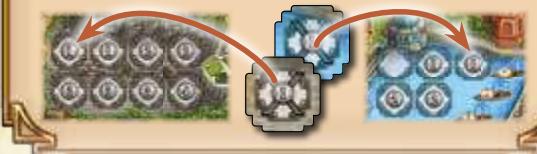
- 根据玩家人数选择游戏板对应面朝上("2人"或"3-4人")。3人游戏用遮盖板块盖住标记位置。
- 48颗骰子全部放在游戏板旁作为公共供应。
- 省份板块先按颜色再按背面符号(蛇/牛/虎)分成12组,分别洗混后面朝上放在游戏板旁。
- 将8块白色收益板块洗混后面朝下叠放在寺庙位置。
2.2 玩家个人设置
每位玩家获得:1块省份面板、1块迦梨女神板(对应颜色)、6个工人、1艘船、5个方块(1个业力+4个升级)、1个金钱标记、1个声望标记、1个奖励标记。
- 声望标记放在声望轨道第0格。
- 金钱标记:起始玩家放在金钱轨道第3格,其左手玩家放第4格,再下一位放第5格……越后行动起始金钱越多。
- 奖励标记正面朝上放在金钱轨道第12格。
- 业力方块放在业力轨道第1级。
- 每个"建筑发展"卷轴的左栏(价值2)放1个升级方块。
- 3个工人放在各自标记位置:声望轨道第15格、金钱轨道第20格、河流桥梁处。
- 3个工人放在迦梨女神板下方。
- 船放在河流起始格。
2.3 起始玩家与起始骰子
- 掷总和最低的玩家成为起始玩家(平局则最近吃过印度食物者优先),在迦梨女神板旁放起始玩家大象。
- 每位玩家取4种颜色骰子各1颗掷出,将结果面朝上放在迦梨女神板任意空闲手臂上。
3. 游戏流程
3.1 回合结构
游戏进行若干回合,每回合包含多个阶段。每个阶段中,玩家按顺时针顺序(从起始玩家开始)轮流放置1个工人、支付费用(如需要)、立即执行对应行动,直到所有人都无法再放置工人为止。之后所有玩家收回工人,开始新回合。
3.2 放置工人的标准流程
- 放置1个工人
- 支付费用(如需要):交出金钱和/或骰子
- 执行对应行动
3.3 工人可放置的四大区域
| 区域 | 目的 | 放置规则 |
|---|---|---|
| 采石场(Quarry) | 执行建造行动 | 按行从左到右依次放置 |
| 市场(Market Place) | 通过市场结算获得金钱 | 可选择任意空闲位置 |
| 莫卧儿大帝宫殿(Palace) | 获取各种收益 | 可选择任意空闲位置 |
| 港口(Harbor) | 在河流上前进 | 按行从左到右依次放置 |
3.4 费用说明
- 每个行动格位上方标注费用:免费 / 1金钱 / 1颗特定颜色骰子。
- 支付金钱:将金钱标记在金钱轨道上后退对应格数。标记在0时无金钱,无法执行付费行动。
- 支付骰子:将骰子交回公共供应(非放到游戏板上)。无合适骰子则无法执行该行动。
3.5 骰子规则
- 从公共供应获得骰子时,立即掷出并以结果面朝上放在自己的迦梨女神板上(值为掷出数字1-6)。
- 最多持有10颗骰子(基本版)。若获得骰子会超限,需先归还再取新骰子。
- 若某色骰子暂时在供应中缺失,该色不可取用。
4. 建造行动(采石场)
4.1 步骤
- 将工人放在采石场某个格位(支付1-4金钱)。
- 从公共显示的12块省份板块中选取1块。
- 交出满足该板块要求的骰子(颜色和最低总值均需匹配,允许超额支付)。
- 将板块放置到省份面板上。
4.2 省份面板拼放规则
- 每块新板块的路端必须与已有道路连接,确保与住所(面板顶部中央)连通。
- 板块可任意旋转方向,也可用路端截断相邻板块的道路——只要每块板块至少有一条路与住所相连。
- 板块一旦放置不可移动。
4.3 建造结算
放置板块后立即结算:
- 市场帐篷:板块上有1或2个市场帐篷,标注货物种类(丝绸/茶叶/香料)和金钱值,立即获得对应金钱。
- 建筑:板块上有1或2个建筑(寺庙/宫殿/堡垒/磨坊),每个建筑获得的声望取决于对应建筑在游戏板上的升级等级(2/3/4点)。
- 特殊收益:省份面板边缘印有特殊收益符号。当通过道路将其与住所连通时,在板块结算之后立即获得该收益。
5. 建筑升级
5.1 升级机制
游戏板上有4种建筑类型,每种有升级卷轴(左→右3级:价值2→3→4)。起始时所有升级方块在第1级(价值2)。
5.2 升级方式
- 宫殿中向拉贾·曼·辛格献上1颗值为4的骰子。
- 河流特定格位。
- 穿越声望轨道第5格奖励空间时自动获得1次升级。
- 连接省份面板上特定特殊收益时获得1次升级。
升级时选择1种建筑类型,将对应升级方块右移1格。
重要: 升级仅对之后新放入的建筑生效,已放置板块上的建筑不受影响。
6. 市场行动(市场广场)
将工人放在市场格位,为已建造的市场结算收入。市场有3种货物:丝绸、茶叶、香料。
6.1 综合货物市场
放置工人后,可为每种货物类型最多结算1个市场。例如:省份中有3个茶叶市场和1个丝绸市场,放置在此可结算1个丝绸+1个茶叶市场,共获得对应金钱。
6.2 单一货物市场
需交出1颗任意骰子,然后可结算同一货物类型的市场,数量上限等于所交骰子的面值。例如:交出值为4的骰子,可结算最多4个茶叶市场。
3-4人游戏限制: 每回合每位玩家只能在综合货物市场放置1个工人。
7. 宫殿行动
放置工人在宫殿中,可能免费或需交出特定骰子。
7.1 外露台(免费)
获得2金钱,可重掷任意数量的己方骰子。
7.2 露台(免费)
从公共供应取1颗对应颜色骰子,掷出后放在迦梨女神板上。
7.3 阳台(费用:1颗特定颜色骰子)
交出1颗指定颜色骰子,获得2颗不同颜色骰子(掷出后放置)。
7.4 内殿(费用:1颗精确点数骰子)
| 角色 | 交出骰子 | 收益 |
|---|---|---|
| 莫卧儿大帝 | 值为1的骰子 | 获得2声望点,成为下回合起始玩家 |
| 舞者 | 值为2的骰子 | 取任意2颗骰子 + 抽1块白色收益板块并立即结算(1骰子/3金钱/1升级/1业力) |
| 瑜伽士 | 值为3的骰子 | 获得2点业力 + 1颗任选骰子 |
| 拉贾·曼·辛格 | 值为4的骰子 | 升级1种建筑 + 获得3金钱 |
| 大建筑师 | 值为5的骰子 | 用公共供应中的板块覆盖省份中任意1块板块(新板块必须更贵,支付差价;所有板块仍需与住所连通;每块板块仅可被覆盖1次;覆盖时不重新结算特殊收益) |
| 葡萄牙商人 | 值为6的骰子 | 在河流上精确前进6个未被占据的格位并获得对应收益 |
注意: 葡萄牙商人在河流最后6格时不可使用。
8. 河流行动(港口)
8.1 基本规则
交出值为1、2或3的骰子,根据骰子面值在河流上前进对应数量的未被占据格位:
- 值1:前进恰好1格
- 值2:前进1或2格
- 值3:前进最多3格
其他玩家船只占据的格位跳过不计数,每格最多1艘船(起始格和终点格除外)。到达终点格后不可再使用河流行动。
8.2 港口费用
第1个工人免费,后续工人需支付1或2金钱。
8.3 河流格位收益一览
| 收益 | 说明 |
|---|---|
| 骰子 | 取任意2颗骰子 |
| 业力 | 业力等级+2 |
| 金钱 | 获得标注数量的金钱 |
| 宫殿行动 | 立即执行内殿角色行动之一(无需放工人/交骰子) |
| 按业力取骰子 | 当前每有1级业力,取对应颜色1颗骰子(0-3颗) |
| 声望 | 获得标注数量的声望点 |
| 升级 | 1种建筑升级1级 |
| 按市场收金钱 | 每有1个已建市场获得1金钱 |
| 综合货物结算 | 最多结算3种不同货物市场 |
| 单一货物结算 | 结算最多标注数量的单一货物市场(无需交骰子) |
| 按升级收声望 | 每次已做的建筑升级获1声望点 |
| 按升级收金钱 | 每次已做的建筑升级获2金钱 |
| 按业力收声望 | 当前每有1级业力获2声望点 |
9. 业力(Karma)
- 起始业力等级为1,最高为3。
- 消耗1点业力:可在交出骰子时将迦梨女神板上任意1颗骰子翻到对面(1↔6,2↔5,3↔4)。
- 无需放置工人,可在回合中任何时候使用业力。每使用1次,业力方块下降1级(可降至0)。
- 获取业力的方式:宫殿内殿瑜伽士(+2)、河流特定格位(+2)、声望轨道第24格(+2)。
10. 工人、奖励轨道与额外工人
10.1 获得额外工人
起始每位玩家有3个活跃工人。可通过以下途径各获得1个额外工人(最多2个):
| 条件 | 触发 |
|---|---|
| 金钱轨道 | 标记到达或越过第20格 |
| 声望轨道 | 标记到达或越过第15格 |
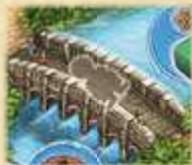
| 河流 | 船只经过桥梁(桥梁本身不占河流格位) |
重要: 当第2个非活跃工人被激活时(无论来自哪个轨道),立即取走并移除该工人。已激活的工人永不因标记后退而失去。
10.2 声望轨道奖励空间
| 空间 | 奖励 |
|---|---|
| 第5格 | 升级1种建筑类型(下回合起生效) |
| 第24格 | 业力+2级 |
| 第31格 | 船只前进到下一个未被占据的河流格位并获得收益 |
10.3 金钱轨道奖励空间
| 空间 | 奖励 |
|---|---|
| 第12格 | 船只前进到下一个未被占据的河流格位并获得收益 |
| 第33格 | 取任意2颗骰子,掷出后放在迦梨女神板上 |
| 第44格 | 船只前进到下一个未被占据的河流格位并获得收益 |
| 第55格 | 取任意2颗骰子,掷出后放在迦梨女神板上 |
金钱轨道使用专用奖励标记追踪:到达第12格后翻面放到第33格,到达第33格后再翻面放到第44格,依此类推。
注意: 奖励仅适用于所在轨道本身,不会触发相邻轨道的奖励。
11. 回合结束与起始玩家更替
- 所有活跃工人用完后回合结束。
- 若有人在大帝宫殿放置过工人,该玩家成为下回合起始玩家并获得大象。
- 若无人使用宫殿,大象顺时针传给下一位玩家。
- 所有玩家收回全部活跃工人。
12. 游戏结束与胜负判定
12.1 触发条件
当某位玩家的声望标记和金钱标记相遇或交错时,触发游戏结束。当前阶段继续完成——在触发者与当前起始玩家之间的所有玩家仍可各放置1个工人并执行行动。
12.2 胜负判定
- 若多位玩家在最终回合同时交错,每位玩家计算声望标记与金钱标记之间的声望点差值,差值最大者获胜。
- 差值相同时,最先交错者获胜。
- 排名依据:计算声望标记与金钱标记之间剩余的声望点差值。
13. 纳瓦拉特纳斯进阶版
在基本版熟练后可选用此进阶变体:
| 变更项 | 说明 |
|---|---|
| 工人数量 | 可激活全部3个非活跃工人,最多6个活跃工人 |
| 迦梨女神板 | 使用背面(可存储骰子上限降为8颗) |
| 省份面板 | 使用背面,特殊收益较小但可通过收益板块提升 |
| 棕色收益板块 | 开始时每人随机抽1块放在省份面板上,连接时按当前进度结算(如每有1个含市场的板块获1声望等) |
| 白/黄/红收益板块 | 面朝上放在游戏板同色建筑上,游戏中可获取并放置到省份面板对应位置 |
| 舞者收益 | 收益板块不再立即结算,仅在通过道路连通后才结算 |
| 工人差距补偿 | 活跃工人少于其他玩家时,在对应阶段可额外获得收益板块(少1人取1块,少2人取2块) |
注意: 每次先结算省份板块本身的收益,再结算收益板块;已放置的收益板块不可移动或覆盖。
14. 恒河模组(Ganga Module)
使用8块河流板块修改河流格位收益:
- 游戏开始时洗混河流板块面朝下,掷骰子计数从起始格后的第1格开始,盲抽1块放在此格替换原收益。
- 重复掷骰、计数、放置,直到板块用完或河流结束。
- 终点格不可被覆盖,剩余板块放回盒中。
河流板块收益包括:按业力取骰子、取3颗特定颜色骰子、执行内殿角色行动、单一货物市场结算(无需交骰子)、在河流上最多前进3格。
关键规则与常见问题
易错规则
- 骰子上限10颗(基本版):获得新骰子前若超限,需先归还旧骰子
- 升级仅对未来生效:升级后才放置的建筑才按新等级计分
- 每格最多1艘船:河流格位被其他船只占据时跳过,但起始格和终点格可多船共存
- 采石场和港口按行从左到右放置:市场和宫殿可任意选择
- 大建筑师覆盖板块必须更贵:支付差价而非全额,且每块仅可被覆盖1次
- 葡萄牙商人在河流最后6格不可使用
- 金钱轨道奖励用专用标记追踪:不可反复触发同一奖励空间
- 业力消耗不需放工人:可在回合中任何时候使用
- 3-4人游戏每人每回合仅可在综合货物市场放1个工人
- 大帝宫殿舞者:抽到的白色收益板块立即结算后放入弃牌堆,用完后洗混重用
- 工人一旦激活永不失去:即使金钱标记后退也不影响
常见问题
-
Q:骰子放在哪里?
A:始终放在自己的迦梨女神板上(公共供应或个人供应),绝不放在游戏板上。 -
Q:超额支付骰子可以吗?
A:建造省份板块时允许超额支付。内殿角色行动必须精确点数。 -
Q:覆盖板块后还能再次获得特殊收益吗?
A:不能,覆盖时不重新结算特殊收益。 -
Q:如何确定谁是起始玩家?
A:使用宫殿行动"莫卧儿大帝"的玩家自动成为下回合起始玩家;无人使用宫殿则大象顺时针传递。 -
Q:白色收益板块用完后怎么办?
A:将弃牌堆洗混重新形成新的供应。 -
Q:业力可以降到0以下吗?
A:不可以,最低为0。 -
Q:声望轨道和金钱轨道的奖励可以互相触发吗?
A:不可以,各轨道的奖励仅对本轨道有效。 -
Q:纳瓦拉特纳斯版中工人少于其他玩家会怎样?
A:在你无法放置工人的阶段,可额外获得收益板块放置到省份面板上(需有对应颜色空位)。
常见问题(FAQ)
以下 1 条问答中 0 条来自站内玩家的真实提问,其余 1 条为本站整理的常见疑问;答复内容保持原样。
恒河王侯支持几个人玩?
2–4 人。
去哪查完整规则
想核对具体规则细节、卡牌效果或某个回合的结算方式,可以在村了吗里选中这款游戏后直接提问。
同类桌游
- 卡坦岛德式
- 工业革命:伯明翰德式
- 勃艮第城堡:特别典藏版德式
- 方舟动物园德式
- 重塑宇宙德式
- 埃多拉的德鲁伊德式
- 1817 (2020)德式
- 甜蜜国度德式
- 卡里普索德式
- 铁路环游德式
规则原文(Markdown)
本站收录这款游戏的规则原文 1 个文件,此处内联渲染 1 个,可直接展开阅读或下载。
f7-rajas-of-the-ganges-rulebook.md47.6 KB
GANGES RAJAS OF THE For 2 to 4 players, 12 years and up
India in the era of the aspiring Mogul empire. New lands are being gained along with great prosperity attained through the trading of silk, tea, and spices. Imposing structures such as the Taj Mahal and the Red Fort are built, and gorgeous gárdens are created alongside new buildings and parks that will impress generations to come even centuries later.
At a time when the empire has almost reached its greatest dimensions and is in a phase of relative stability, players, representing rajas and ranis, are called upon to live up to the requirements of their role as venerable sovereigns. They must improve their éstates into magnificent and wealthy provinces. Keeping in mind the important role of karma, players balance their growth in a demanding interplay of prestige and prosperity. The one with the most successful outcome will truly become one of the nation's legendary leaders.
GONTENTS
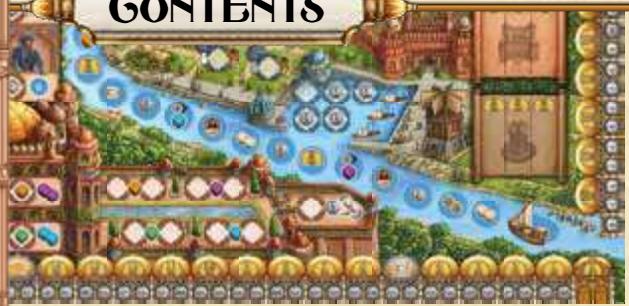
1 (double-sided) gameboard (2 players or 3 and 4 players)

4 province boards

4 "Kali statue" boards

48 dice (12 per color)

64 province tiles (16 per color)

24 workers (6 per color)


4 boats (1 per color),
4 money markers (1 per color)


20 cubes (5 per color: 4x upgrade and 1x karma)
2 cover tiles (for the 3-player game)

4 bonus markers
4 fame markers (1 per color)
1 starting player elephant (to be put together before the first game)

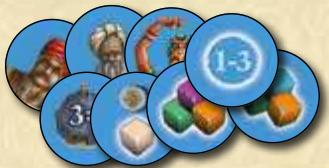
30 yield tiles (8 in white, 9 in yellow, 6 in red, 7 in brown) 8 river tiles
OBJEGT OF THE GAME
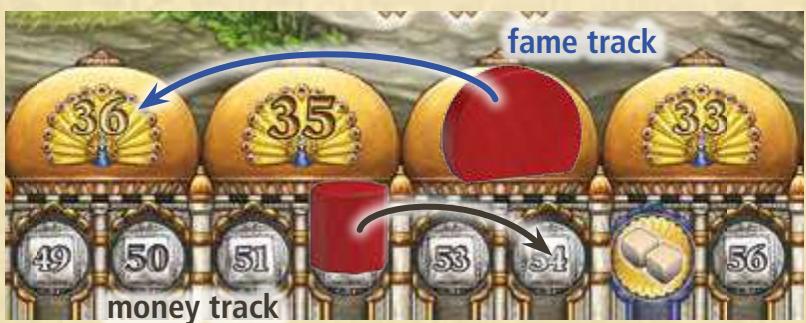
Your task is to develop your province with the help of your workers and the clever use of your accumulated dice. In the end, you must win the race with a combination of wealth and fame. The fame track and the money track run parallel to each other in opposite directions around the gameboard. The fame markers are moved clockwise, the money markers, counter-clockwise.
As you build and expand, you attempt to increase both your fame and wealth so that your fame marker and your money marker intersect. The first player to have his fame marker and his money marker converge or even pass each other on their tracks, has a good chance to win.


SET-UP
Place the gameboard in
the middle of the table with
the side that corresponds to
the number of players facing
up (“2 players“ or “3 and 4
players “). In a 3-player game,
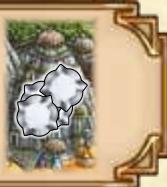
cover the marked spaces with the cover tiles:

Not needed: the yellow, red, and brown yield tiles (you use them only for the Navaratnas version) and the 8 river tiles (for the Ganga-Module).
Put all 48 dice next to the gameboard as a general supply.
Sort the province tiles, first by colors and then by the symbol on their backs (snake, cow, tiger) so that you get 12 stacks. Mix the 12 stacks separately and put them face up next to the gameboard, well visible to everybody.

The player who has rolled the lowest total value becomes the starting player. In case of a tie, it's the player who ate Indian food last. He places the starting player elephant by his Kali statue and puts his money marker on space 3 of the money track. The player to his left (i.e., in player order) puts his money marker on space 4, the player to the left of that player puts his on space 5, and so on; consequently, the player to go last in the first round starts with the most money.
Each player takes one die in each color, rolls these 4 dice, and puts them, with the rolled result facing up, on any unoccupied arms of his Kali statue.
Mix the 8 white yield tiles and put them as a face-down stack on the temple.


Put your bonus marker for the money track with the river space side up on the first bonus space of the money track (space 12).
Put your fame marker on space 0 of the fame track.

Each player gets a province board and the players's components in one color: one Kali statue board, 6 workers, 1 boat, 5 cubes (karma and upgrade), 1 money marker and 1 fame marker, plus 1 bonus marker for the money track.
Place 3 workers on the applicable spaces on the record tracks (fame: 15, money: 20) and on the river (bridge).
Put the Kali statue and the province board with the depicted sides facing up in front of you.
Place 3 of your workers below your Kali statue.
Put your boat on the starting space of the river.

Place your karma cube on level 1 of the karma path.

Put 1 upgrade cube in the left column (value 2) of each "Building development“ scroll.
GOURSE OF THE GAME
The game proceeds over several rounds, each of which consists of several stages. In each stage, players, in turn – in clockwise order, beginning with the starting player – place one worker, pay the costs, if required, and immediately carry out the associated action. This continues until nobody can place a worker any more. After that, each player takes his workers back, and a new round begins.
Workers can be placed in the following areas on the gameboard:
I. At the quarry, in order to carry out building actions on your province board.
II. At the market place, in order to receive money through market scorings later in the game.
III. In the Great Mogul's palace, in order to get various benefits there.
IV. At the harbor, in order to advance on the river and thus reach lucrative river spaces.
At the quarry and at the harbor, workers are always placed row by row from left to right. At the market place and in the palace, you can choose any (unoccupied) action space.
While advancing on the fame and money tracks and developing your province board, you will have chances to obtain valuable bonuses.
Placing workers and carrying out the associated actions
The placement of workers always proceeds in this order:
-
Place a worker
-
Pay costs, if required: give up money and/or dice
-
Carry out the action
Costs: Depending on what action space you place a worker on, you might have to pay costs for being allowed to carry out the applicable action. Some spaces are for free; for others, you have to give up dice or money. How much it costs to place a worker on an action space is shown on the action space itself.

cost-free

1 money

1 die of the applicable color
On each action space there may be only one worker. Dice are never placed onto the board, but always into the (general or personal) supply!
Pay money for an action: Every time you have to pay money for an action (e.g., at the harbor or the quarry), you move your money marker back on the money track accordingly – 1 space for each money you have to pay. If your marker is sitting on 0, you have no money left and temporarily cannot carry out any actions that cost money.
The same applies to actions for which you have to pay dice – if you don't have any (suitable) dice, you can't carry out the applicable action.


Dice are the most important resource in this game. Whenever you get a die from the general supply, you roll it immediately and, with the rolled number facing up, add it to your own supply, i.e., on your Kali statue. The value of the die conforms to the number rolled (from 1 to 6).
Attention! You may store only as many dice as Kali has free hands – that means, in the basic game you may own a maximum of 10 dice. If you get into a situation that would get you more dice, you either take fewer dice or put dice from your Kali statue back into the general supply before taking new ones.
If a die color is temporarily unavailable in the supply, you can't take this color at that moment.


Building action (quarry)
Place a province tile in your province and get fame points and/or money for this
In order to develop your province, you need to send workers into the quarry. Depending on the space where you place the worker, you pay 1 to 4 money on the money track. In return, you acquire one of the 12 province tiles on open display. On the top left of the tiles you can see what dice with which total minimum value you have to give up in order to take the tile. Put dice of the respective color back into the supply. Their total value has to be at least as high as the one shown on the tile. When building, you are allowed to overpay. That means: In order to acquire a tile with the value “blue 7,“ you can pay with a blue 3 and a blue 5, for example.
Besides the costs, the tiles also depict roads, buildings and/or markets. Once you acquire a province tile, you immediately have to place it onto your province board.

Example: Rajesh sends one of his workers into the quarry. He pays 1 money. Then he puts 2 orange dice back into the supply. He takes the tile with the orange 9 and connects it to an already-existing road on his province board.
The province boards
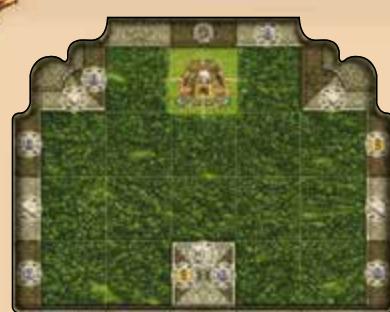
The province board shows the territory that you, being a raja, control and strive to expand. Your residence is in the middle on the top; from there, 3 roads lead into the country. Every time you add a new province tile, the end of one of its roads has to connect to an
already-existing road, so that there is a connection to the residence. You can turn the new tile in any direction. You may also orient a tile in such a way that it cuts off a road of an adjacent tile; not all road ends need to be connected – it is sufficient that each tile is connected to the residence through at least one road. Once placed, the tiles cannot be relocated later on. Be careful not to cut off all roads, so that you always have good possibilities for placing a tile.
Special yields – There are yields printed on the edge of the province boards (symbolically, for special gains due to trade relations you have established). You get these immediately when you have connected them to your residence via a road, after scoring for the province tile itself (see below).
Example: Leila puts a province tile with a bend in the corner on the left. Since the ends of the road on the tile connect to
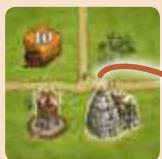
both adjacent yields and are thus connected to the residence, Leila is allowed to take any 1 die from the supply and advance her money marker 5 spaces.

Of course, it is also possible to place a tile without creating a connection to the special yield. In this case, you don't get anything extra.
When you have added a new tile to your province, you immediately score money and/or fame for it. Some tiles show one or two market tents with certain goods (silk, tea, or spices) of a certain value; other tiles show one or two buildings (temple, palace, fort, or mill); and a few tiles show a combination of both.
When you add a tile with one or two markets to your province, you immediately receive the amount of money indicated on that tile. When you add a tile with one or two buildings, you immediately receive 2, 3, or 4 fame points for each building, depending on where your upgrade cube is on the scroll for the corresponding building on the gameboard.

The upgades of the buildings
The 4 types of buildings that you can erect in your province are shown on the gameboard. At the beginning of the game, your upgrade cubes lie on the first level of eāch building – i.e., you earn 2 fame points when you add a province tile with 1 building (or, likewise, 4 fame points for 2 buildings)
1Upgrades enable you to improve your constructional skills and to earn 3 (or 4) points for a certain building type in later building actions.

upgrade symbol


You can acquire upgrades from the raja at the palace by giving up a value-4 die there (see p. 18, "The Chambers“). In addition, there is a river space that allows you an upgrade. And you may upgrade a building automatically after you have crossed the applicable bonus space (space 5) on the fame track or connect the applicable special yield on your province board. When you are allowed to upgrade, you choose one of the four building types and move your upgrade cube one space to the right in the corresponding row.
Attention! Upgrades don't count for buildings on tiles that are already lying in your province, but only for buildings that you add after upgrading.
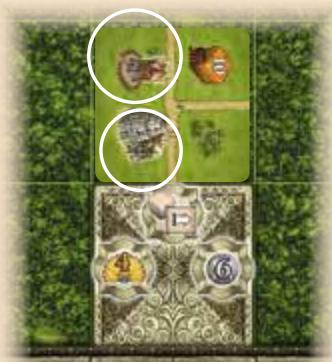
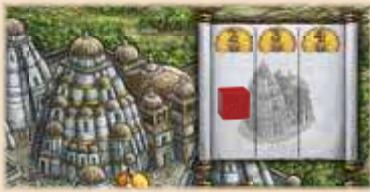


Example: There are 2 buildings on the bend that Leila has added. She advances her fame marker 5 spaces, since she earns 2 points for the temple plus 3 points for the mill – which she already upgraded once in an earlier turn.
Since she has connected a special yield to the road network and the residence by placing the tile, she may – after scoring for the tile – take another die of any color and upgrade a building of her choice.


Market action (market place) Collect money for certain markets in your province
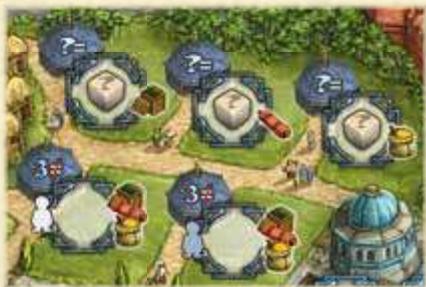
Every time you send a worker to one of the market spaces, you generate income for the markets laid out in your province. There are markets with 3 kinds of goods:

silk

tea

spices
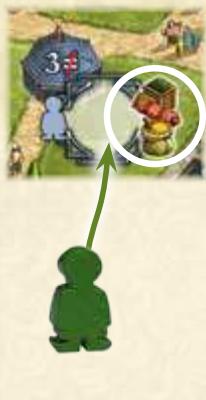
Assorted goods – when you place a worker here, you may score for exactly one market per kind of good.

Example:
There are 4 markets on display in Rajesh's province – three of them with tea and one with silk. If he places one of his workers on this market space, he can score for 2 markets: the silk market plus one of the 3 tea markets. For this, he gets 5 money.

Goods of one kind – when you place a worker here, you have to give up any one die. Then you may score for up to a maximum of as many markets of one kind of good as corresponds to the value of the die.

Example: If Rajesh places his worker on this market space and gives up a die with a value of 4, he can score for all 3 tea markets and gets 7 money for this.

Attention! In the 3- or 4-player game, you may place only one of your workers on the assorted goods market in a round; that means, if you have placed a worker on the first space, the second space is no longer available to you in this round. It can then only be used by another player. However, you still have the possibility to place workers on the other market type.

Actions at the palace Give up a die, if required, and get a benefit
When you place a worker in the Great Mogul's palace, this can be without cost or may require giving up one die – a die of either a specific color or an exact number.
The palace has the following areas:

The outer terrace (cost: free) Take 2 money. You may also reroll as many of your dice as you want.
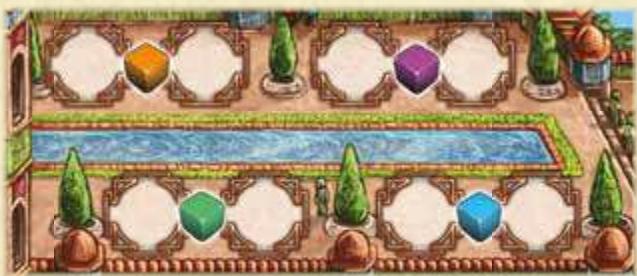
The terrace (cost: free)
Take 1 die of the applicable color from the supply.

Example: Leila takes one orange die from the supply, rolls it and puts it on her Kali statue.


The balconies (cost: 1 die of a specific color)
Give up 1 die of a specific color and get 2 dice of a different color.


Example: Rajesh gives up one blue die (of any value) and takes 2 orange dice; he rolls them immediately and puts them on his Kali statue.

The chambers (cost: 1 die of any color with an exact number)

Great Mogul – Give up one die showing a "1." In return, you get 2 fame points and become the starting player in the next round.

Dancer – Give up one die showing a "2." In return, you take any 2 dice from the supply and draw a face-down white yield tile. You immediately earn the yield of the tile (1 die, 3 money, 1 upgrade, or 1 karma). Then the yield tile is put aside to form a discard pile. When you run out of tiles, reshuffle the used ones and form a new supply.
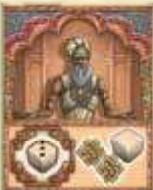
Yogi – Give up one die showing a "3." In return, you get 2 karma and 1 die of your choice (see p. 20, explanations of the karma).

Raja Man Singh – Give up one die showing a “4." In return, you upgrade a building type of your choice and earn 3 money.


Master builder – Give up one die showing a "5." Cover any tile in your province with another one from the supply. All tiles still need to have a connection to the residence. You cannot use the master builder if you have no matching tiles or dice. Important: The new tile has to be more expensive than the old one; just pay the difference by giving up 1 (or more) dice in the color of the new tile. You may overpay.
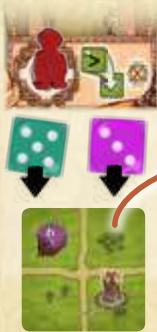

Example: Leila gives up a green value-5 die. She wants to overbuild the tile with the orange “4” by covering it with the tile with the violet “6." To do so, she has to give up a violet die with a value of at least 2.
When covering a tile, you do not receive any special yield again. You may cover every province tile only once.

Portuguese - Give up one die showing a “6." In return, you advance exactly 6 unoccupied spaces on the river and get the applicable earnings.
Attention! When you have advanced to the last 6 spaces on the river, you may not use the Portuguese anymore.
River action (harbor)
Give up a die showing a 1, 2, or 3 and advance up to three unoccupied spaces on the river

The river action can be used only if you give up a "1," "2," or "3."
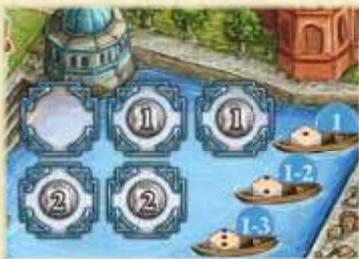
Every time you place a worker at the harbor, you may advance your boat up to three unoccupied spaces on the river, depending on the number on the die you have given up. The harbor provides space for several workers. The first worker placed here doesn't cost anything; workers placed later cost 1 or 2 money.
If you give up a die showing a “1," you advance exactly one unoccupied space; if you give up a “2," you advance one or two unoccupied spaces; if you give up a “3," you may advance up to three unoccupied spaces. Spaces occupied by other players' boats are not included in the count but are skipped. So there can never be more than one boat on any particular river space. The only exceptions to this are the starting space and the final river space where multiple boats may rest.
You immediately get the earnings of the space where you stop your boat.

Example: Leila places a worker at the harbor. For this, she has to pay 1 money. Then she gives up a die showing a“2” and advances
her boat 2 spaces. She doesn't include the space that is occupied by another player's yellow boat in the count. She earns an upgrade of one building type. She moves her upgrade cube at the mill from “3” to“4.”

Explanation of the earnings on the river:

Take 2 dice of any colors from the supply, roll them, and put them on your Kali statue.

Increase your karma 2 levels (see p. 20, explanations of the karma).

Receive the amount of money indicated; advance accordingly on the money track.


Choose any of the palace actions 2 - 6 (Dancer, Yogi, Raja, Master builder or Portuguese) and carry it out immediately without placing a worker in the palace or giving up a die (the space in the palace may even be occupied)
For each level of karma that you have at this moment, take one die in the depicted color (so receive 0 to 3 dice).

Receive the number of fame points indicated; advance accordingly on the fame track.


Upgrade a building type 1 level (e.g., move your temple cube from 2 to 3).
Receive 1 money for each market that you have built in your province so far (if you have 5 markets, for example, you advance your money marker 5 spaces on the money track).

Conduct a market scoring for up to a maximum of markets of assorted goods. Collect the money for up to 3 different markets (see p. 17, explanation of the markets).

Conduct a market scoring for goods of one kind that you have in your province, up to the maximum indicated on the river. If you have 4 silk markets, for example, you can score for all of them and advance on the money track àccordingly. You do not have to give up a die for this (see p. 17, explanation of the markets).

Receive 1 fame point per building upgrade that you have done up to now (if you have already upgraded buildings 3 times, for example, you advance 3 spaces on the fame track).

Receive 2 money per building upgrade that you have done up to now (if you have already upgraded buildings 3 times, for example, you advance 6 spaces on the money track).

Receive 2 fame points per karma that you have at the moment (if your karma is at level 2, for example, you advance 4 spaces on the fame track).
When you have arrived at the final river space, you can no longer use the river action.
Karma
Give up 1 karma and turn a die to the number on the opposite side
You can influence the result of a die roll through karma. One karma allows you to turn any die on your Kali statue to the opposite side when you place it; that means a “ 1" can turn into a "6” and vice versa, a “2” into a “5," etc.
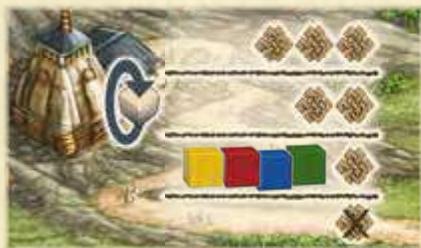
You start the game with karma at level 1. Over the course of the game, you can improve your karma - for instance, by sending a worker to the Yogi in the palace (see p. 18, "The Chambers" "Yogi") or by stopping your boat on the applicable river space (see p. 19, “River action").
Besides this, there is a bonus space on the fame track (space 24) that increases your karma 2 levels if your fame marker stops on that space or crosses it. The highest karma level is 3; that means you may have a maximum of 3 karma.
In order to use karma, you don't have to place any worker - you may use your karma anytime during your turn when giving up a die. For each karma you use, you move your karma cube 1 level down. So the karma can even go down to zero.
Move forward on the scoring tracks or on the river and receive more workers
At the beginning of the game, each player has 3 active workers at his disposal.
During the course of the game, you can get up to 2 additional workers. If you have advanced far enough on the respective scoring tracks (money: space 20; fame: space 15) or on the river (bridge), you receive extra workers.
Important: As soon as you have received your second inactive worker (no matter whether on one of the tracks or the river), you immediately take your extra one off the board and remove him from the game.
Get new workers

You never lose a worker once you have activated him this way, even if your marker falls back (which can happen only on the money track). You can place a new worker even in the same round in which you have obtained him.

Arrive at the space and receive the bonus
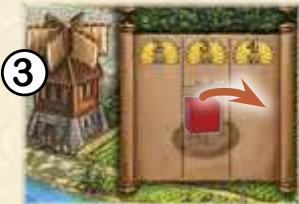
Bonuses on the scoring tracks
The fame and the money tracks as well as the river each have one space with an inactive worker per player color. The spaces on the scoring tracks with the inactive workers are regular spaces; at the moment when your money marker or fame marker stops on the respective space or crosses it, you take the worker of your color. With this, he becomes active. The inactive worker on the river doesn't have his own river space (the bridge doesn't count as a river space); that means, when your boat has passed the bridge, you take the worker of your color.


Besides the inactive workers, the two scoring tracks also have special spaces; when you reach or cross them, you immediately get the corresponding bonus. The fame track has 3 bonus spaces:
Space 5: You receive an upgrade of a building type of your choice. (This upgrade counts from your next turn on.)


Space 24: You may increase your karma 2 levels.
Space 31: You may move your boat to the next unoccupied river space and get the applicable earnings.
The money track has 4 bonus spaces:

Spaces 12 and 44: You may move your boat to the next unoccupied river space and get the applicable earnings.

Spaces 33 and 55: You may take any 2 dice from the supply, roll them, and put them on your Kali statue.


Since you pay money and can thus fall back on the money track there is a special bonus marker of your color that indicates which bonus you'll get next on the money track. When you reach or cross space 12 for the first time and get the applicable bonus, you take the marker of your color, turn it over and put it on space 33 (die side facing up). When your money marker reaches or crosses this space as well, you turn the marker back and put it on space 44 (river space side facing up), etc. After you have crossed the last bonus space on the money track, you remove your marker from the game.
Attention! A bonus applies only to the track where it is printed. If, for example, your money marker passes a bonus space printed on the adjoining fame track, you don't get the bonus from there, of course.
BND OF A ROUND

After you have placed all of your active workers and carried out the applicable actions, the round ends. If one of the players has placed a worker at the Great Mogul, he now gets the starting player elephant and becomes the starting player
BND OF THE GAME
As soon as one player manages to have his fame marker and his money marker converge or pass each other, the end of the game is triggered. The current stage will still be completed – i.e., all players who are sitting between the player who has triggered the end of the game and the current starting player still have a chance to win and may place one more worker (provided they have any left) and carry out the applicable action.
of the following round. If nobody has sent a worker to the Great Mogul, the elephant goes from the previous starting player clockwise to the next player. All players take all their active workers off the gameboard and put them back below their Kali statue. After that, the starting player begins the new round.
After that, players check who has won. If there are two or more players whose markers passed each other on their final turn, each of the players involved counts the difference of fame points between his money marker and his fame marker; the player with the most points wins the game. In case of a tie, the first player whose two markers passed each other wins.
(To find out who is second and third, etc., count the number of fame points that are still separating your fame marker from your money marker.)


Example: Rajesh's money marker has passed his fame marker. His money marker is now on space 65 of the money track, his fame marker on space 30 of the fame track. Then Leila has her final turn. She also manages to have her two markers pass each other. Her money marker ends up on space 52 of the money track, her fame marker on space 37 of the fame track. So Rajesh and Leila both have a difference of 2 fame points (it doesn't matter where the money marker is). Since Rajesh was the first to have his two markers pass each other, he ekes out the win.
NOTES
In order to develop your province successfully and to win the race, you primarily need money, dice, and workers. It is important to make sure that you don't run out of dice or of money and don't have to make do with fewer workers than the other players for too long.
To summarize in brief:
Gain additional workers by advancing on the two scoring tracks and on the river.
Generate money primarily through markets; build them in your province and use workers to activate them. Additionally, bonuses on your province board, on the river, and from the raja in the palace are good sources of money. Such bonus spaces can get you extra dice as well. The palace also provides opportunities to obtain and exchange individual dice.
To fulfill the winning conditions, you need to establish a well thought-out road network within your province and gain as many special yields as possible. To this end, you will use the building action on the gameboard, for which you pay money and dice. Buildings in your province give you fame points; markets give you money.
NAVARATNAS VERSION
Play with 6 workers, 8 dice, and upgraded special yields
After having played the basic version for one or more games, you can opt for the “Navaratnas“ version for advanced players (English “The Nine Gems", see p. 24, Mogul Lexicon → Raja Man Singh l). Here, the following modifications apply:
You can activate all 3 inactive workers.
So you may play with up to 6 workers.
You play with the back of your Kali statue and you may store only up to 8 dice.


You play on the back of your province board. Here also, special yields are printed on the edge of the province board, which you can connect to your road network. However, these are only minor yields, but you can improve them during the course of the game.
At the beginning of the game, mix the brown yield tiles. Each player randomly picks one, reveals it and puts it on one of the two possible spaces on his province board. You decide which of the special yields on the board you wish to cover.
At the moment when you connect them, the brown yield tiles give you a special yield that depends on the progress you have made so far in a specific field:

1 fame point for each tile in your province that has at least 1 market

1 fame point for every 3 river spaces you have advanced so far (the starting space doesn't count)

1 money per building in your province


2 money for each yield tile you have connected
2 fame points for each bend that you have built in your province

2 money per upgrade you have made so far

1 fame point for each active worker you have
Now place the remaining brown yield tiles as well as all other yield tiles face up on the buildings of the same color on the gameboard. You may get them during the game to enhance the special yield you can get from your province board.
The white, yellow, and red yield tiles give you special yields as follows:

Dice (1 or 2 of specific colors or of your choice)

Money


1 building upgrade
1 boat move (onto the next unoccupied river space)

Karma (1 or 2)
Attention! Always score for the province tile first before you take the special yield. You may not move or cover yield tiles already placed on the board.
There are 2 ways to obtain additional yield tiles during the game:
a) When you are at the dancer
Every time you place a worker at the dancer and give up one value-2 die of any color, you may take 2 dice of your choice from the supply and choose any yield tile. You immediately put this tile face up on an (as yet) unoccupied space of the corresponding color on your province board. Different from the basic game, here you earn the yield not immediately but only when you have connected the yield tile to a road on your province board.
b) When you have fewer active workers than other players
If, for example, you have a total of 4 active workers, but at least one of the other players already has 5 workers at his disposal, you get 1 yield tile in the fifth stage of the current round if it were your turn to place a worker but you don't have any left. You immediately decide on which unoccupied space of your board you want to place the new yield tile (face up and color-matching).
If at least one other player even has 2 more active workers than you, you take another yield tile and place it as if it were your turn to place a worker but you can't place any for the second time.
Attention! You may only take yield tiles in a color for which you still have space available on your board. You may also refrain from taking a yield tile.
For Mixed Player Groups
For advanced players who play with a group that includes beginners, it is also possible to play with handicaps.
In this case, the advanced players use the Navaratnas side

of their
board and the back of their Kali statue, whereas the beginners use the basic

of their board and the front of their Kali statue.
You can have up to 5 workers. The yellow, red, and brown yield tiles stay in the box. You play according to the basic rules and use only the white yield tiles for which you get a yield only at the dancer (as in the basic game) to use immediately.

THE GANGA MODULE
Modify river spaces using river tiles
For this version, you add the 8 river tiles to the game. They modify the river earnings. At the beginning of the game, shuffle the river tiles face down. Roll a die, count the spaces, beginning with the first space after the starting space, draw the first tile blindly and place it face up on the corresponding river space. For example, if you roll a “2," you place the first river tile on the second space and, in doing so, replace the 2 karma shown there.

Roll again, count the next spaces and place a tile until either you run out of tiles or the river ends. The final space may never be covered by a river tile. Return remaining river tiles to the game box.
The river tiles:

Take as many dice of any colors from the supply as you have karma at this moment (e.g., 3 dice of the same color or of different colors, if your karma is at level 3).
Take 3 dice, one of each color shown.

Take the palace action, depending on the character shown (see page 18, The “Chambers“).
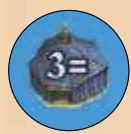

Conduct a market scoring for goods of one kind. Collect the money for up to 3 mārkets of one type in your province, for which you do not have to pay an extra die (see p. 17, explanation of the markets).
Advance up to 3 unoccupied spaces on the river and collect the earnings of the space where you stop.

MOGUL BEXIGON

Mogul empire (1526-1858) – The Mogul empire was a great empire that developed in the Indus-Ganges plain in North India. At the peak of its power (17th century), it comprised almost the entire India (as we know it today) and some parts of Afghanistan. In 1858, the remaining part of the empire was occupied
by the British and ceased to exist. A rich heritage of architecture, painting, and poetry shaped by Persian and Indian artists have been preserved to the present day. The empire was named after its rulers, the Great Moguls.

Great Mogul – Also called 'Mogul' or 'Mogul Emperor.' The name probably came to Europe through the Portuguese (in Portuguese, Grão Mogol) who were the dominating power in the Indian Ocean territory at that time. The word Mogul is derived from the Persian mughul, which means 'Mongol,' referring to the fact that some Mogul's ancestor had married into the clan of Genghis Khan.
The most prominent Mogul ruler in history was Akbar the Great (reign: 1556-1605); he brought the empire to prosperity in military, political, and economic terms. Under Shah Jahan (reign: 1627-1658), the Mogul empire reached its cultural peak. At that time, the Taj Mahal, the Red Fort (Delhi), and the Shalimar Gardens in Lahore were established - all of them inscribed as UNESCO world heritage sites (in 1982, 2007, and 1981).
This game symbolically deals with the era from Akbar to Shah Jahan.
These are a few elements significant for the era of the Great Moguls or for the India of today that are showcased in the game:

Kali -A Hindu goddess that represents destruction and renewal. Her destructive power, however, mainly targets demons and the injustice of the world. Popular belief is that she can grant wishes.

(Blue) Peafowl – Since 1963, the blue peafowl has officially been ranked among the national animals of India (besides the Bengal tiger and the Ganges river dolphin). Originally, it came from the Indian subcontinent where it is considered a sacred animal since it gives warning of tigers and severe weather
© 2017 HUCH!

and kills (young) poisonous snakes, among other things. Whereas the western world often associates the peafowl not only with beauty but also with arrogance and vanity, Indians primarily consider it a symbol of regality and immortality. Therefore, peacock statues were prominently designed also on the throne of the Mogul emperors.
Distributor USA: R&R Games, Inc. PO Box 130195 Tampa, FL 33681 USA
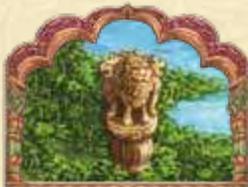
Ashoka Pillar – The present coat of arms of India shows the adapted capital of an Ashoka pillar, the famous “Four Lions of Sarnath." Erected around 250 BC under Ashoka, the Indian ruler at that time, who had numerous monumental pillars set up during his

Authors: Inka & Markus Brand Illustration: Dennis Lohausen 3D: Andreas Resch Design: HUCH!, atelier198 Product Manager: Britta Stöckmann Editing: Frank DiLorenzo English translation: Sybille & Bruce Whitehill, “Word for Wort"
Peacock Throne - The Peacock Throne was a throne chair decorated with an abundance of pearls, gold, and gems (more than 26,000) that was manufactured by order of Shah Jahan and inaugurated in 1635. The production took seven years and was said to
GREDITS
reign at many strategic places, such as border towns and trade routes. Their capitals were used to proclaim his edicts. Some of these then-numerous and widespread pillars have been preserved down to the present day. They are silent witnesses of the bygone Great Indian Empire whose cultural heritage has stood the test of time.
have been twice as expensive as the construction of the Taj Mahal; this was considered very extravagant even for a Mogul emperor. Since the Red Fort (Delhi) was plundered in the 18th century, the Peacock Throne has been presumed lost.

Raja Man Singh I– Raja Man Singh I was an important commander of the imperial armed forces. As a governor of several provinces, he had forest areas cultivated for agricultural progress, commissioned a variety of palaces, forts, and temples to be built, and
was even engaged as a city founder. Additionally, Man Singh I gained a high reputation for being a member of the Navaratnas, the "Nine Gems" of Akbar, a small group of extraordinary personalities at the Mogul emperor's court.
THE GAMES YOU WANT TO PLAY!
Manufacturer + distributor: Hutter Trade GmbH + Co KG Bgm.-Landmann-Platz 1-5 89312 Günzburg, GERMANY www.hutter-trade.com
Warning! Choking hazard. Not suitable for children under age of 3 due to small parts.
下载 Markdown原文为社区整理/出版社公开资料,版权归原作者,仅供个人学习查阅。