
马可波罗The Voyages of Marco Polo
一句话概览
马可波罗 是一款已收录于村了吗规则库的桌游,支持 2–4 人,原名 The Voyages of Marco Polo。
本页内容:一句话概览 · 游戏概述 · 1. 游戏组件 · 2. 游戏设置 · 3. 游戏流程 · 4. 行动详解 · 5. 奖励行动 · 6. 使用已占用行动位 · 7. 低骰补偿 · 8. 终局计分 · 9. 2-3 人变体 · 10. 专家变体 · 关键规则与常见问题 · 常见问题
马可波罗 规则速览
以下规则速览由本站整理,与官方规则书表述不同,仅供快速上手参考。
游戏概述
玩家扮演马可波罗的旅伴,在丝绸之路及周边地区旅行,通过完成合同(Contract)和访问有利可图的城市来积累胜利点数。完成合同不仅提供胜利点数,还能获得城市折扣和特权,同时触发终局目标。5 轮结束后胜利点数最高者获胜。
核心机制: 骰子驱动行动选择、合同完成、路线旅行与贸易站放置、资源管理(货物与骆驼)
1. 游戏组件
| 组件 | 数量 |
|---|---|
| 游戏板 | 1 块 |
| 玩家面板 | 4 块 |
| 角色板块 | 10 块 |
| 城市奖励标记 | 6 个 |
| 骰子 | 26 颗(蓝/黄/绿/红各 5 颗 + 白色 1 颗) |
| 金币 | 40 枚(1 元 ×20、5 元 ×10、10 元 ×10) |
| 合同卡 | 44 张 |
| 城市卡 | 31 张 |
| 目标卡(Goal Card) | 18 张 |
| 前哨奖励板块 | 10 块 |
| 金条 | 15 块(小 ×12、大 ×3) |
| 丝绸 | 15 捆(小 ×12、大 ×3) |
| 胡椒 | 16 袋(小 ×12、大 ×4) |
| 骆驼 | 27 个(小 ×20、大 ×7) |
| 棋子 | 12 个(蓝/黄/绿/红各 3 个) |
| 贸易站 | 38 个(蓝/黄/绿/红各 9 个 + 黑色 2 个) |
| 50/100 计分卡 | 4 张 |
| 起始玩家标记(沙漏) | 1 个 |
| 玩家辅助卡 | 4 张 |
> 大号货物/骆驼 1 个等于 3 个小号。货物与骆驼供应不限,若耗尽可用替代物。
2. 游戏设置
2.1 板面设置
- 游戏板放在桌子中央,50/100 计分卡放在计分轨道 50 分旁边。
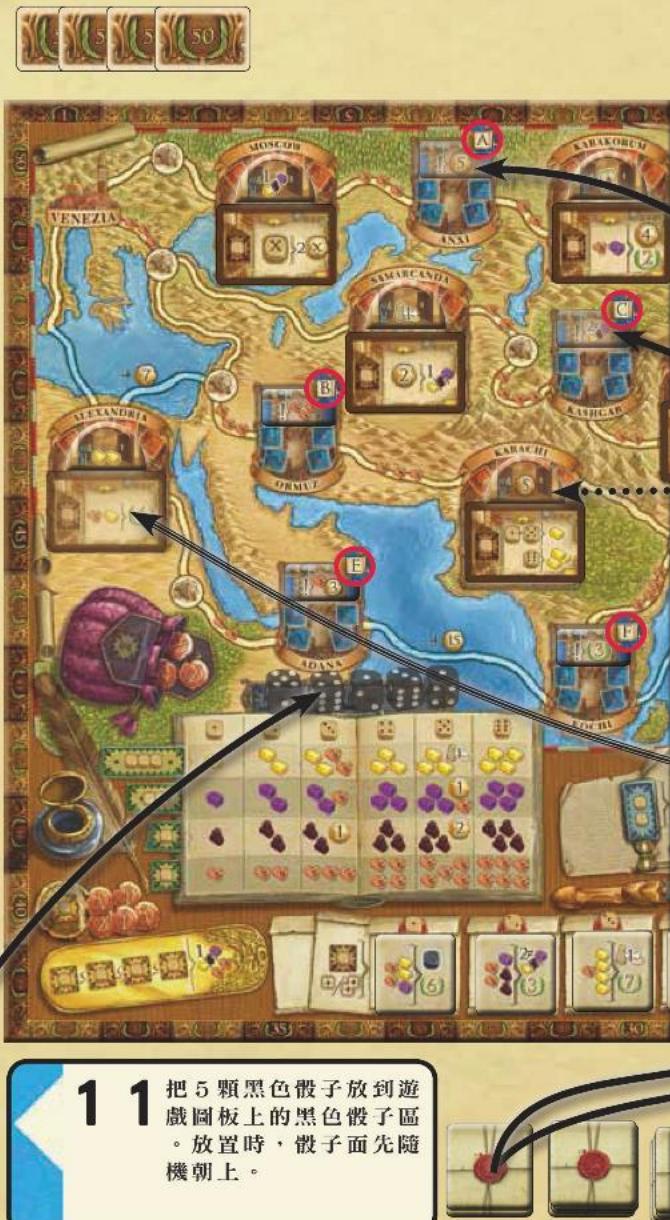
- 黑色骰子(1 颗)放在板面的黑色骰子位上,面值无关。
- 40 枚金币作为公共供应放在板旁。
- 6 个城市奖励标记按字母对应放到板面小城市位置上。
- 货物(金条、胡椒、丝绸)和骆驼放在公共供应区。
- 每个大城市放置 1 块前哨奖励板块(面朝上),3 块未用的放回盒中。
- 城市卡洗匀面朝下,取 9 张面朝上放到板面各城市卡位置,其余放回盒中。
- 合同卡洗匀面朝下,组成 5 每堆 6 张的合同堆。取其中 1 堆面朝上放到板面各合同位置,剩余 4 堆放在板旁。剩余 8 张组成特殊合同堆放在稍远处。
2.2 玩家个人设置
每位玩家:
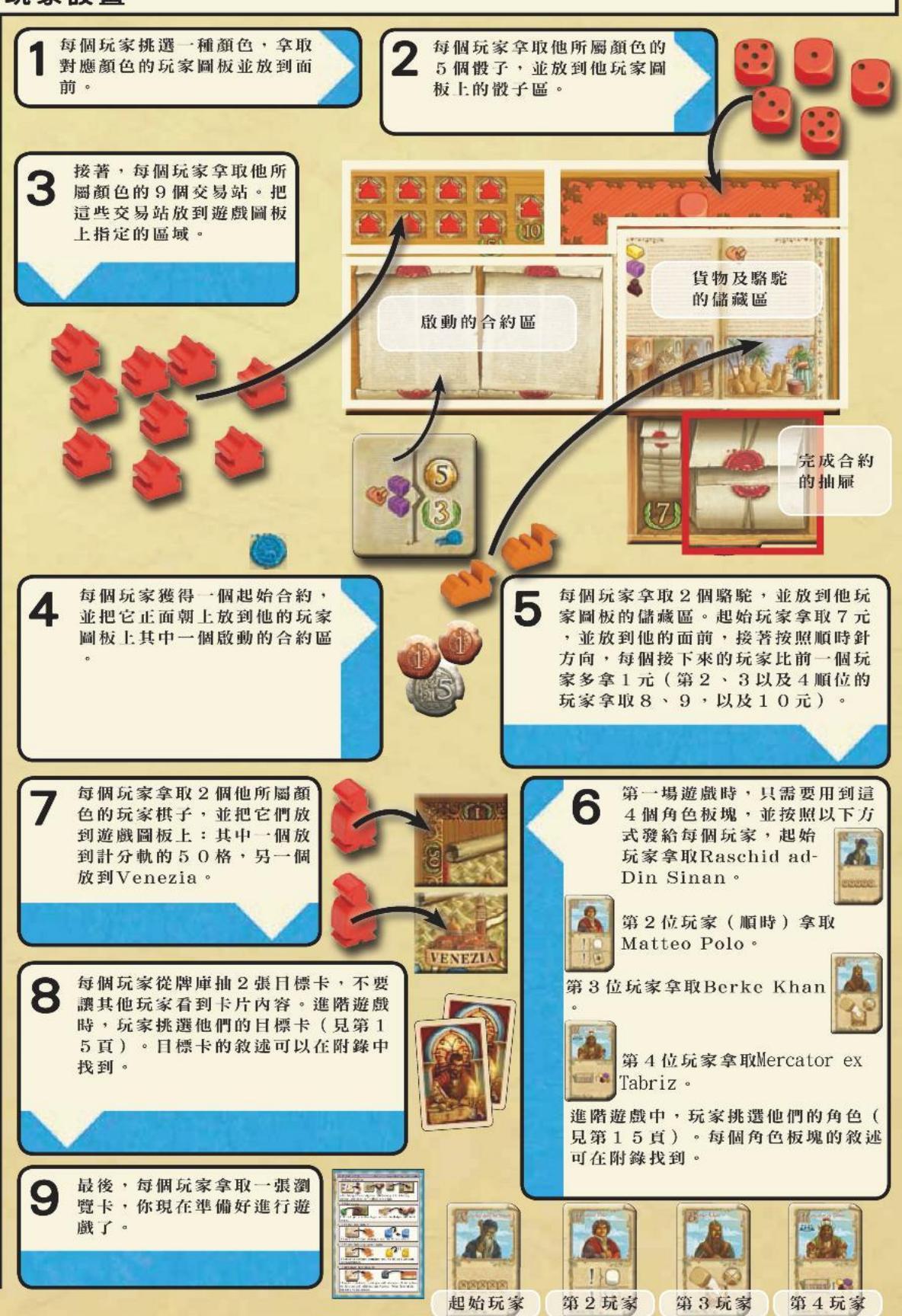
1. 选择颜色,拿取对应玩家面板。
2. 拿取该颜色 5 颗骰子,放到面板右上角骰子区。
3. 从起始合同中选 1 张面朝下,放到面板的 2 个活跃合同位之一。
4. 拿取 2 个棋子:1 个放在计分轨道 50 分位置,1 个放在威尼斯(Venezia)。
5. 拿取 2 个骆驼放入仓库。
6. 起始资金:起始玩家 7 元,下一顺位 8 元,再下一顺位 9 元,最后一位 10 元。
7. 发放 2 张目标卡(面朝下保密)。熟悉游戏后可挑选目标卡。
8. 首次游戏:起始玩家获得拉希德·丁·西南(Rashid ad-Din Sinan),第二位马可·波罗(Matteo Polo),第三位伯克汗(Berke Khan),第四位塔布里兹商人(Mercator ex Tabriz)。熟悉游戏后可自由选角色。
9. 发放玩家辅助卡。
3. 游戏流程
3.1 总体结构
游戏共 5 轮。每轮所有玩家轮流行动直到骰子用尽,然后进入下一轮。可通过板上剩余合同堆数判断剩余轮数——最后一堆合同放上板后进行最后一轮。
3.2 回合开始阶段
按以下顺序执行:
- 确定新起始玩家(第 1 轮除外):上一轮最后使用「旅行」行动的玩家成为新起始玩家。若上轮无人旅行,则起始玩家不变。
- 发放城市与角色奖励:所有拥有贸易站的小城市向该玩家发放奖励;所有角色发放对应奖励。
- 回收所有骰子:将板上所有骰子收回玩家面板;黑骰归还板面。
- 投掷所有骰子:所有玩家同时投掷。若骰子总点数低于 15,可获得补偿——每差 1 点可取 1 元或 1 骆驼(可混合)。
3.3 回合中行动
从起始玩家开始顺时针轮流行动。每回合:
- 可选:执行奖励行动(任意数量,需支付费用)
- 必须:选择并执行 1 个主要行动
- 可选:执行奖励行动(任意数量,需支付费用)
只要有骰子剩余就必须行动,骰子用尽则自动跳过本轮剩余回合。
3.4 回合结束阶段
- 清除板上所有剩余合同(放入特殊合同堆底部)。
- 从合同堆中取 1 堆(6 张)放到板面合同位置(第 5 轮结束后不执行此步)。
4. 行动详解
行动通用规则
- 只能使用自己的骰子。
- 必须使用行动位所标注数量的骰子。
- 可放置在未被占用的棕色或蓝色行动位上,或已被占用的蓝色行动位上。棕色行动位已被占用则不可使用。
- 使用已被占用的蓝色行动位需额外支付金币(见下文)。
- 同一行动位上每种玩家颜色(蓝/黄/绿/红)只能出现一次。
- 放置骰子后立即执行行动。
- 骰子点数决定行动效果的强度(「取 5 元」除外),通常取最小点数的骰子值。
- 若可多次执行某行动,可选择少执行(至少执行 1 次)。
- 行动执行三步曲: ①放置骰子 → ②支付必要费用 → ③执行行动。
4.1 取 5 元(Take 5 Coins)
- 放置 1 颗骰子到「取 5 元」行动位。
- 骰子点数无关,固定获得 5 元。
- 若行动位已被占用,需先付费再执行。
4.2 大集市(Grand Bazaar)——获取货物与骆驼
用于获取丝绸、金条、胡椒等货物,以及骆驼。
步骤:
1. 在 4 个不同行动位(丝绸/金条/胡椒/骆驼)中选择 1 个,放置所需数量的骰子。
2. 根据最小骰子点数查表确定获得的货物数量。
3. 从公共供应区取货物放入仓库。
货物表(最小骰子点数 → 获得数量,具体数值见板面旁表)。
- 可选择使用低于最小骰子的点数来获取不同种类的组合(例如点数 4 可选 3 个同种货物,或 2 个货物 + 1 元)。
- 骆驼行动同理,但通常无理由降值。
4.3 可汗的恩宠(Khan's Favor)
- 放置 1 颗骰子,获得 1 个自选货物 + 2 个骆驼。
- 特殊规则:行动位从左到右依次放置,后放的骰子点数必须 ≥ 前一颗。
- 共 4 个行动位,满后本轮不可再选此行动。
- 每种颜色在同一行动位只能出现 1 次。
4.4 接取合同(Take Contracts)
- 放置 1 颗骰子,可拿取 1 或 2 张合同放到面板活跃合同位。
- 骰子点数决定可选合同的位置(对应板面上该点数下方的合同)。
- 取 5 点下方的合同额外获得 1 元或 1 骆驼;取 6 点下方的合同额外获得 2 元或 2 骆驼。
- 拿取后将剩余合同向左滑动填补空位。
- 若板上只剩 1 张合同则只能取 1 张。
- 若所有合同位为空(回合开始时),从特殊合同堆抽 2 张放到 1 号和 2 号位。
- 面板仅有 2 个活跃合同位,满时必须先弃掉旧合同(放入特殊合同堆底部),再放入新合同。
- 合同在活跃位上不产生任何效果,必须先完成。
4.5 旅行(Travel)
- 放置 2 颗骰子,最小骰子点数决定可移动步数。
- 移动步骤:
①放置骰子
②支付旅行费用:按行动位旁的费用表支付金币(仅支付实际移动的步数)。
③支付路线附加费用:部分连接路线有额外的骆驼或金币费用。
④移动棋子并放置贸易站:沿路线移动,可经过绿洲、小城市和大城市,必须停在其中一个位置。允许来回移动和重复经过同一位置。
到达不同位置的效果:
| 位置类型 | 效果 |
|---|---|
| 大城市 | 必须放置 1 个贸易站;从下回合起可用骰子激活城市卡 |
| 小城市 | 必须放置 1 个贸易站;立即获得标记所示奖励,之后每轮开始再获得一次 |
| 绿洲 | 无任何效果,仅延缓旅行 |
- 北京(Beijing):放置贸易站时选择点数最高的空位,终局时计分。
- 前哨奖励:第一个在大城市放置贸易站的玩家获得该城前哨奖励。
- 贸易站放置规则:从面板左上角开始依次放置。第 8 个贸易站放置时立即得 5 分,第 9 个得 10 分。
- 每个城市最多 1 个贸易站。
- 已放完全部贸易站后,再次旅行时改为移动已有贸易站。
- 威尼斯不可放置贸易站。
4.6 城市卡(City Cards)
- 需在对应大城市有贸易站。
- 放置 1 颗骰子到城市卡行动位,执行卡面效果。
- 城市卡每轮只能使用 1 次(被占用后本轮不可再用)。
- 点数通常决定可执行次数。
5. 奖励行动
在你的回合内,可在主要行动前或后自由执行任意数量的奖励行动(需支付费用):
| 奖励行动 | 费用/条件 | 效果 |
|---|---|---|
| 完成 1 个合同 | 支付合同左侧所需骆驼和货物 | 获得合同右侧所有奖励(胜利点数 + 其他),合同面朝下面板放入抽屉 |
| 取 3 元 | 放 1 颗骰子到钱袋位,无费用 | 固定获得 3 元,可重复执行 |
| 重投 1 颗骰子 | 支付 1 骆驼 | 重投 1 颗自己的骰子 |
| 调整 1 颗骰子 ±1 | 支付 2 骆驼 | 将 1 颗骰子点数 +1 或 -1(不可 6↔1) |
| 取 1 颗黑骰 | 支付 3 骆驼 | 从公共供应取 1 颗黑骰立即投掷放入面板 |
- 完成合同:需面板活跃位上的合同,仓库中拥有足够货物和骆驼。
- 取 3 元:可将最后一颗骰子放在该位。
- 黑骰每回合每人只能取 1 颗;黑骰数量有限,每轮结束归还板面。
- 白骰和黑骰不视为玩家颜色,可与自己的颜色骰子放在同一行动位。
- 同一颜色骰子在同一行动位只能出现 1 次(取 3 元位除外)。
6. 使用已占用行动位
可使用已被他人占用的蓝色行动位(城市卡除外,城市卡每轮仅 1 人可用)。
- 费用:支付金币 = 你所用骰子中最低点数的值(与他人骰子无关)。
- 付费后正常执行行动。
- 骰子可叠放或从左到右排列,最右/最上为最后使用者。
7. 低骰补偿
若一轮开始时所有骰子点数总和 低于 15,可获得补偿:每差 1 点取 1 元或 1 骆驼(可混合)。
8. 终局计分
游戏在第 5 轮结束后进行终局计分:
| 计分项目 | 说明 |
|---|---|
| 目标卡 | 2 张目标卡各计分 |
| 剩余金币 | 每 10 元 = 1 分 |
| 北京贸易站 | 获得贸易站所在位置所示点数 |
| 北京剩余货物 | 在北京有贸易站的玩家,每 2 个剩余货物 = 1 分(骆驼不算货物) |
| 最多完成合同 | 完成合同最多的玩家获得 7 分(可并列) |
平局:骆驼最多的玩家获胜;仍平局则多人共胜。
9. 2-3 人变体
3 人游戏: 将 1 颗未使用颜色的骰子(面朝 1)放在「可汗的恩宠」第 1 个位置,全程不移除。黑骰使用 4 颗。
2 人游戏: 将 2 颗未使用颜色的骰子(面朝 1)放在「可汗的恩宠」前 2 个位置,再将 1 颗放在「取 5 元」位,全程不移除。黑骰使用 3 颗。
10. 专家变体
在标准规则基础上,可选择以下一项或多项调整(按顺序执行):
- 城市奖励随机分配:将城市奖励标记随机放到各小城市,忽略字母标记。
- 角色选择:洗匀角色板块,翻开比玩家数多 1 的数量,最后顺位先选,依次逆序选择。
- 目标卡选择:每位玩家发 4 张目标卡,秘密保留 2 张,归还其余。
关键规则与常见问题
易错规则
- 行动位每色限一次:同一行动位上每种颜色骰子只能出现 1 次(取 3 元位除外)。
- 白骰/黑骰无颜色限制:可与自己颜色骰子组合使用,不计入颜色限制。
- 使用已占用蓝色位需付费:费用 = 你最低骰子点数,与他人骰子无关。
- 棕色位已占用不可使用:只有蓝色位允许多人使用。
- 骰子点数决定行动强度:取最小点数,但「取 5 元」和「取 3 元」固定不受点数影响。
- 旅行需 2 颗骰子:其他大部分行动只需 1 颗。
- 合同在活跃位不计分:必须通过奖励行动完成才能获得奖励。
- 面板仅有 2 个活跃合同位:满时取新合同须先弃旧的。
- 城市卡每轮仅 1 次:被占用后本轮无人可用。
- 北京贸易站选最高点数空位。
- 每轮最后旅行者为下轮起始玩家。
- 第 8 个贸易站 +5 分,第 9 个 +10 分。
- 骆驼不是货物:终局北京剩余货物计分时骆驼不算。
- 低骰补偿阈值为 15。
- 黑骰每回合每人仅限取 1 颗。
- 调整骰子不可 6 变 1 或 1 变 6。
常见问题
-
Q:骰子点数总和低于 15 时如何补偿?
A:每差 1 点可取 1 元或 1 骆驼,可混合。 -
Q:能否在同回合多次取 3 元?
A:可以,只要有骰子剩余即可重复。 -
Q:黑骰和白骰是否计入玩家颜色限制?
A:不计入,它们无颜色。 -
Q:旅行可以来回移动吗?
A:可以,允许经过或停留在同一位置多次。 -
Q:同一个城市能否放多个贸易站?
A:不能,每城市最多 1 个。 -
Q:何时获得小城市奖励?
A:到达时立即获得,之后每轮开始阶段再获得一次。 -
Q:大城市前哨奖励何时获得?
A:第一个在该大城市放置贸易站的玩家立即获得,板块移出游戏。 -
Q:2 人游戏中放在板上的骰子何时移除?
A:全程不移除,整局游戏保持不变。 -
Q:完成合同的步骤是什么?
A:作为奖励行动,支付合同左侧所需骆驼和货物,获得右侧奖励,合同面朝下放入抽屉。 -
Q:取新合同但面板已满怎么办?
A:必须先弃掉 1 或 2 个旧合同(放入特殊合同堆底部),再放入新合同。
常见问题(FAQ)
以下 1 条问答中 0 条来自站内玩家的真实提问,其余 1 条为本站整理的常见疑问;答复内容保持原样。
马可波罗支持几个人玩?
2–4 人。
去哪查完整规则
想核对具体规则细节、卡牌效果或某个回合的结算方式,可以在村了吗里选中这款游戏后直接提问。
同类桌游
- 卡坦岛德式
- 工业革命:伯明翰德式
- 勃艮第城堡:特别典藏版德式
- 方舟动物园德式
- 重塑宇宙德式
- 埃多拉的德鲁伊德式
- 1817 (2020)德式
- 甜蜜国度德式
- 卡里普索德式
- 铁路环游德式
规则原文(Markdown)
本站收录这款游戏的规则原文 4 个文件,此处内联渲染 3 个,可直接展开阅读或下载。
rules_zh_马可波罗_1160.md56.1 KB
遊戲配件與遊戲设置
遊戲配件
1個遊戲圖版
1個起始玩家標記(沙漏)
4個玩家圖板
6個小鎮獎勵板塊
1 0個大城市辦公室獎勵
10角色板塊
40個錢幣(1元20個、5元10個、10元10個)
44個合約板塊
4個50/100分指示物
1 8 張目標卡
3 1 張大城市卡
15個金條(12個小型及3個大型)
15個絲綢(12個小型及3個大型)
15個胡椒(12個小型及3個大型)
28個駱駝(21個小型及7個大型)
12個玩家棋子(每種顏色3個:藍色、黃色、綠色、紅色)
26個骰子(每種顏色5個:藍色、黃色、綠色、紅色,5個黑色,以及1個白色)
38交易站(每種顏色9個:藍色、黃色、綠色、紅色,2個黑色)
1 本規则書
1 張附錄
1 張設置卡
5 張瀏覽卡


剩餘的配件發給每個玩家。詳細見第4頁的說明。

把遊戲圖板放到場中央。把50/100分指示物,並放到計分軌的50格。
2 最近有到世界各地旅 游AHIG記(沙漏)

配件。把2個黑色交易站、白色骰子,以及1每種顏色的1個玩家棋子放回遊戲盒中,需使用時再取出。每個角色板塊的敘述可以在附錄中找到。

玩家設置
關於規則
由於遊戲的複雜度,我們會先說明基本遊戲的玩法,之後才解釋個自的行動及特殊情況的細節。如果你閱讀時發現有些沒解釋的地方,請別驚慌,規則書裡都有說明。畢竟,馬可波羅自己也沒辦法把他的旅程用一頁就寫完...
遊戲瀏覽
每個玩家扮演知名探險家一馬可波羅的其中一個同伴。每個玩家嘗試藉山完成合約以及造訪利潤豐厚的城市來收集分數。一個完成的合約也會給予玩家更多的利益,而他也可以使用造訪的城市開放的特權。遊戲結束時,玩家可以完成秘密目標以獲取額外的分數。
遊戲進行好幾輪,每輪玩家按照順時針方向輪流進行回合。玩家每回合擲他們自己的骰子,並把骰子放到遊戲圖板上的行動區以執行各種行動。
玩家輪流進行回合,直到他們使用過自己的所有骰子,這時一輪結束。遊戲進行5輪,遊戲結束時會有最終計分。
在第15頁與第16頁可以找到完整的一輪非常詳細的敘述,因此從此刻起,我們只會給予你進行一個回合的簡短瀏覽,然後繼續敘述所有開放的行動。我們希望你享受偉大探險家在「馬可波羅遊記」中的冒現!
一个回合的流程
輪到玩家的回合時,他必須從他的玩家圖板拿取至少1個骰子(先前擲過的),並把骰子放到他所挑選的行動區。他可以把骰子放到一個空的行動區,或者放到一個他已經佔據的行動區。接著他可以立刻執行對應的行動。
在執行一個主要行動之前或之後,玩家可以執行1個或多個「額外」的行動(見第12頁及第13頁的說明)。這些行動總是選擇性的。所有開放的「額外」行動可以在玩家瀏覽卡上找到。只要玩家的玩家圖板上還有任何未使用的骰子,玩家每個回合必須執行1個主要行動。且玩家

開放的「額外行動」顯示在瀏覽卡上。
沒有骰子,輪到他的回合時他自動跳過,這一輪再也不能執行任何動作!
按照順時針方向,下一個順位的玩家繼續進行他的回合。持續進行直到所有玩家都把他們所有的骰子都放到行動區上,接著這一輪結束。接著我們會瀏覽一下遊戲圖板,並解釋各個行動。
遊戲圖板 一圖板上的各個區域以及相關的行動
遊戲圖板上包含以下6個主要行動的區域:拿5元、市場、可汗的賞腸、獲得合約、旅行,以及大城市卡行動。
拿5元見第6頁
市場
見第6頁及第7頁
可汗的賞賜見第7頁說明
額外的行動
見第12頁及第13頁
獲得合約見第8頁
大城市卡行動見第11頁
旅行見第9頁到第11頁
總共有5個額外的行動:完成1個合約、拿3元、重骰1個骰子,調整一個骰子數值+1/-1,以及拿取1個黑色骰子。接下來幾頁將說明不同的區域及相關行動。

主要行動
當執行其中一個主要行動時,必須遵守以下的一般規則:
玩家只能把自己的骰子放到行動區,不能拿其他玩家的骰子。
放到一個行動區的骰子數量必須和行動區上顯示的骰子數量相同。

玩家可以把他的骰子放到空的或已占據的行動區(例外:大城市卡行動,見第11頁說明),在這本規則的所有情況中,我們總是先假設一個行動區域是空的。
如果一個行動區已經被占據了,玩家必須付錢才執行該行動(見第13頁及第14頁的「特殊情況」
每個行動區只能被一個玩家顏色(藍色、黃色、綠色、紅色)使用一次(見第14頁說明)。
一旦玩家放置他的骰子到一個行動區後,他立刻執行對應的行動。
放在行動區上的骰子點數,代表一個行動可以執行幾次,或者種物件可以獲得幾個(例外:拿5元,見下方說明)。決定數量的總是以點數最小的骰子。
如果玩家可以執行一個行動一次以上,或者拿取一種物件多次,他可以執行不超過允許次數的行動,或者拿取不超過允許數量的物件。不過,他必須總是使用該行動最少1次。
一個回合進行的確切順序是如何?
1、玩家把他骰子(或多顆骰子)放到一個行動區。
2、如果他把骰子放到一個已經被占據的行動,該玩家支付金錢(見13、14頁說明
3、玩家執行該行動。


拿5元-「不勞而獲」
為了拿5元,玩家必須放置1個骰子到「拿5元」行動區。骰子上的點數是多少無所謂;執行這個行動時不考慮骰子點數。執行這個行動時,玩家總是獲得5元。如果這個行動區已經被占據,玩家必須支付放置骰子到該行動區的費用(見第13貞及第14頁) 0
元9元
黃色玩家把一個骰子(點數3)放到「拿5元」行動區。他從一般供應區拿取5元
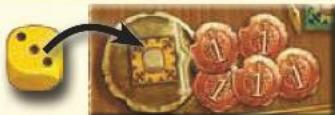


市場一很多任務都需要貨物
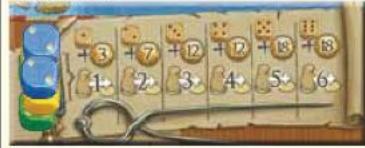
完成合約需要貨物。此外,特定大城市的行動區可以讓玩家把貨物轉換成金錢、駱駝,或者是分數。貨物也會讓玩家在遊戲結束時獲得額外的分數。
流程:
1、玩家放置骰子。

2、接著他判定他將獲得多少貨物。
3、他從一般供應區拿取該數量的貨物並放到他的玩家圖板上。
1、玩家放置骰子
玩家把行動區所需的這麼多骰子放到該區域。
1
範例:藍色玩家把2個骰子(一個點數4一個點數5)放到市場的絲網」行動區上。
2、他判定他將獲得多少貨物

市
該行動區的石側有個顯示貨物種類,以及骰子點數1到6可以換得的貨物數量。放在該行動區中點數最小的骰子決定獲得哪一個欄位的貨物。
2
由於藍色玩家放在該行動區的骰子最小點數是4,所以他可以獲
得3個絲綢。

市場一很多任務都需要貨物
3、他從一般供應區拿取該數量的貨物,並放到他的玩家圖板上貨物從一般供應區拿取,並把貨物放到他玩家圖板上的儲藏區。
3
藍色玩家從一般供應區拿取3個絲綢,並放到他玩家圖板上的儲藏區。

如果玩家想這個做,玩家可以選擇任何比他最小骰子點數還小的欄位(例如,他可以從這些開放的欄位(比最小骰點還小的欄位)中選擇想獲得的貨物)。
範例: 紅 色玩家把一個骰子 (點數4 放到市場的 L胡椒」 行動 區 a 因此 • 他可以從一般供應 區 拿取3個胡椒。不過 他也可以改為選擇拿取2個胡椒1元
或

駱駝一不可缺少的旅行夥伴
完成合約需要駱駝,並且需要在地圖上的特定路線旅行。此外,特定的大城市卡也會需要駱駝才能獲得利益。玩家以和獲得貨物相同的方式獲得駱駝:把1個骰子(任意點數)放到市場的「駱駝」行動區並從一般供應區拿取和骰點相同數量的駱駝,並放到他玩家圖板上的儲藏區。
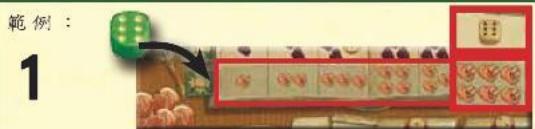
綠色玩家把一個骰子(骰點6)放到市場的「駱駝」行動區,這讓他可以拿取6個駱駝。

綠色玩家從一般供應區拿取6個駱駝,並把駱駝放到他玩家圖版的儲藏區。
註記:當挑選獲得的駱駝時,沒有道理會選擇比較低欄位的駱駝。
可汗的賞賜一另一個獲得貨物的方式
在這裡,玩家把1個骰子放到「可汗的賞賜」行動區。他接著從一般供應區拿取他所挑選的1個貨物以及2個駱駝,並放到他玩家圖板上的儲藏區。

細節
第一個使用這個區域的玩家,可以把任意點數的骰子放在最左邊的行動區。下一個想要使用這個區域的玩家,他的骰子點数必須等於或大於該行動區左邊的骰子點數(如果無法,他不能執行這個行動),他接著可以拿取1個他所挑選的貨物以及2個駱駝。每個其他想要執行這個行動的玩家,必須也遵守這個放置規則。
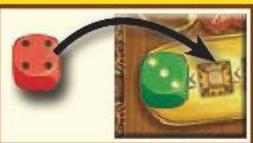
範例:
綠色玩家放置一個點數3的骰子到「可汗的赏 賜 行 動 區的第 一格 。他接著從一般供應 區 取 1 個貨物(這裡範例顯示金條)以及2個駱駝。
2

紅色玩家現在必須放置一個點數至少為3的骰子,才能執行這個行動。他放置一個骰點4的骰子,並從一般供應區拿取1個貨物(這裡範例顯示黃金)及2個駱駝。

註記:這裡只有4個骰子區域,一旦所有區域都滿了,這輪這個行動就再也不能執行了。
獲得合約一可以造訪市場來完成
為了獲得合約,玩家必須放置1個骰子到 「獲得合約」 行動區 。接著他可以從和骰子點數相應的合約區拿取1個或2個合約板塊,或者從點數較小的合約區拿取1個或2個合約板塊,並放到他玩家圖板上任個空的啟動合約區(見下圖) 。

藍色玩家把一個點數3的骰子放到「獲得合約」行動區。

藍色玩家可以從欄位「1」「2」,或「3」拿取1個或2個板塊·並放他的玩家圖板上

如果玩家從欄位「5」拿取一個合約板塊,他同時也從一般供應區拿取1元或1個駱駝。如果他從欄位「6」拿取一個合約,他同時也從一般供應區拿取2元或2個駱駝。
範例:

綠色玩家把一個骰點6的骰子放到「獲得合約」行動區。他可以從任一個欄位挑選1個或2個合約。
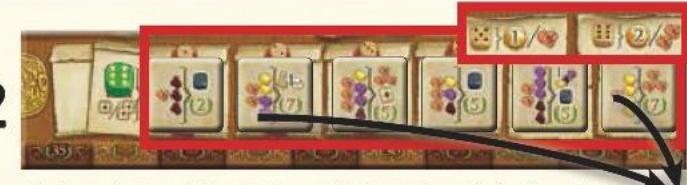
綠色玩家拿取欄位「2」及欄位「6」的合約,並決定為他欄位「6」的額外獎勵拿取2個駱駝。他也可以改成挑選欄位「5」及「6」的合約,並拿取額外獎勵。
「獲得合約」有什麼其它的規則?
在玩家拿取1個或2個合約後,所有圖板上剩餘的合約板塊往左側移動以填補任何空的區域。
在「」的会地教的,位「

如果一輪中,圖板上已經沒有剩餘的合約板塊,特殊板塊疊中抽2個板塊,並放到圖板上的欄位「1」及「2」。
*每個玩家圖板上有2個啟動合約區。每當玩家拿取一個新的合約板塊後,他必須要有空位來放置新的合約板塊。如果兩個區域都已經有合約板塊,則其中一個(或這兩個)板塊必須要正面朝下放在合約的特殊板塊疊最下方。如果是起始合約板塊 ,則把它們從遊戲中移除。
範例:
綠色玩家從圖板上拿取1個合約板塊·但是他的玩家圖板上目前没有空位。因此,他移除1個板塊,並把這個板塊放到特殊板塊叠的最下方·以腾出空間放置新拿取的合約。

註記:以下規則只適用於特殊情況。
*玩家不能從圖板上拿取一個合約板塊後,立刻把它放到特殊板塊跌下方。一個新拿取的合約板塊必須總是先放在玩家圖板上“
*只要玩家圖板上的啟動合約區有一個合約板塊,它們不會帶給玩家任何東西。為了獲得合約提供的利益,玩家必須完成這個合約(見第13頁及瀏覽卡說明)
旅行一玩家在地圖上移動他們的棋子
為了在遊戲圖板上的地圖移動他的棋子,玩家必須把2個骰了放到「旅行」行動區。移動的流程如下所
範例:
紅色玩家把2個骰子放到「旅行」行動區,接著他可以根據放置的骰子點数,在移動上移動他的棋子。

在地圖上移動一個棋子的流程是如何進行的?
玩家必須遵守以下進行的順序:
1、玩家把2個骰了放到「旅行」行動區。
2、玩家接著支付旅行費用。
3、如果有需要,玩家也必須支付地圖上任何的額外費用。
4、玩家移動他的棋了,並且可以建造一個交易站。
1、玩家把2個骰子放到「旅行」行動區。
玩家可以在地圖移動的步數,和放置的2個骰子中點數校小的骰子相等。
範例: 紅 色 玩 家 放置 2 個骰子點行數因 2 及 般 點 4 到 旅 行 7
1 動由区校 9 因数 司 的 以 以子 决的定 步此 他 可 以在地圖 上移動最多 2 步

註記:玩家總是可以移動比較小點數的骰子所允許的步數還要少的步數,但是必須至少移動1步。
2、玩家接著支付旅行費用。
每個「旅行」行動區的區域都會顯示移動的費用。玩家必須支付這個費用,不過無論骰子點數是多少,玩家只需要為他移動的步數支付對應的移動費用就行了。所有支付的錢都放回一般供應區。
2
紅色玩家想要在地圖上移動2步。移動的費用是7元,他把7元放到一般供應區。


3、如果有需要,玩家也必須支付地圖上任何的額外費用。
通常2個地點之間的路線會顯示特定數量的駱駝或金錢。在這種情況下,除了行動區上的費用以外,玩家還必須支付路線上顯示的駱駝或金錢。

為了在這個路線旅行,玩家必須支付2個駱駝(除了行動區顯示的費用

為了在這個路線旅行玩家必须支付7元 (除了行動區顯示的费用)
4、玩家移動他的棋子,並且可以建造一個交易站。
玩家現在把他的棋子從一個地點移動到另一個地點,移動步數根據他所挑選的行動區而定。玩家可以停在綠洲、小鎮,或者大城市。他不能停在2個地點之間。
旅行 一玩家在地圖上移動他們的棋子
範例:紅色玩家移動到一個大城市

或者移動到一個小鎮

或者移動到一個綠洲

棋子不能停在2 點地點之間
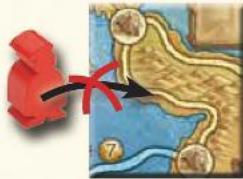
*如果玩家停在一個大城市,他必須把一個交易站(從他的玩家圖板上拿取)放到該大城市上。該玩家的下一個回合開始,他可以把一個骰子放到這張大城市卡上,以執行卡片上的行動(見第11頁的說明)。大城市卡總是放在大城市,不會被拿走。
範例:
紅色玩家把他其中一個交易站放到大城市上。

之後的回合,紅色玩家可以把一個骰子放到大城市卡上並執行卡片上的行動(見第11頁的說明)。
如果玩家停在一個小鎮,他必須把一個交易站(從他的玩家圖板上拿取)放到該小鎮上。該玩家立刻獲得小鎮獎勵板塊上顯示的獎勵(見附錄了解更多細節)。此外,之後每次新的一輪開始時,他會再次獲得該獎勵(見第16頁的說明)

如果玩家停在綠洲,沒有事發生。綠洲只會讓移動變慢。
「旅行」行動有什麼額外的規則?
當要把交易站放到地圖上時,玩家總是從他玩家圖板最左邊的欄位開始,並由上到下移走交易站。如果玩家移動時經過一個大城市或小鎮,但是沒有停在那裏,則不能把交易站放在經過的大城市或小鎮上。
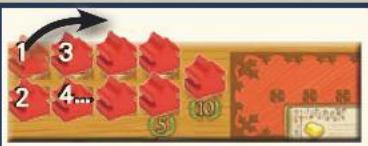
如果玩家把他的第8個交易站放到地圖上,他立刻獲得5分,並把他計分軌上的棋子往前移動對應的步數。如果玩家把他的第9個交易站放到地圖上,他立刻獲得10分1。
如果玩家把他的棋子移動到北京,他已經抵達他的終點,並把它的交易站放到顯示數字最大的開放區域。遊戲結束時,他會獲得該區域顯示的獎勵分數(見第14頁說明)。註記:即使玩家已經抵達北京,他之後的回合還是可以繼續執行旅行」行動。

回到地圖上之前造訪過的地點是允許的 0 也就是說 , 玩家可以重複經過或停在地圖上任何一個地點 D註記:每個玩家在任何的大城市或小鎮的地點只能有1個交易站。因此,一個玩家在一個地點上不能有多個交易站 。
「旅行」行動決定每個新的一輪一開始的起始玩家(見第15頁及第16頁的說明)。
大城市辦公室獎勵是什麼?
第一個把交易站放到一個大城市的玩家獲得該城市的大城市辦公室獎勵。獲得大城市辦公室獎勵板塊上顯示的獎勵後(從一般供應區拿取),他把板塊從遊戲圖板上移除並放回遊戲盒中,遊戲剩餘的時間裡再也不會用到。

旅行一玩家在地圖上移動他們的棋子
註記:以下規則適用於特殊情況。
*游戲一開始 , 所有玩家 會從威尼斯開始 出發 。如果遊戲過程中有玩家回到威尼斯並停在那裏 他不 能把交 易站放在那裏 0

*如果有玩家已經把他所有的交 易 站都放在地圖 上 + 而稍後他停在 另 一個地點並需要蓋一個交易站他必須把他其中一個 已 經放到地 上的交易站移動到這個新地點
一個「旅行」行動的範例:

黄色玩家把2個骰子(點數3及點數5)放到「旅行」行動區。
3


黃色玩家從撒馬爾罕移動到一個綠洲·再到喀什,最後停在蘭州。這次移動需要額外支付8個駱駝,他把駱駝放到一般供應區。

黄色玩家想要在地圖上移動3步,而且必須支付12元的費用。他把錢放到一般供應區。
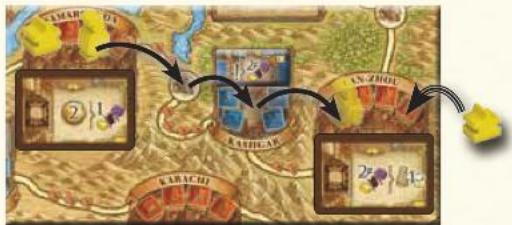
黃色玩家移動棋子3步·只能在蘭州放置1個交易站,因為他最後停在那裏。
大城市卡行動 一許多其它的選擇
圖板上所有的大城市都有一張大城市卡(蘇門答腊有3張卡片)。為了執行一張大城市卡的行動,玩家在該城市必須有一個交易站。他接著必須把1個骰子放到這張卡片的行動區,並執行這張卡片的行動。有關城市卡上的符號說明,可以在附錄中找到。
黃色玩家有一個交易站在亞歷山卓。他可以把一個骰子放到這張城市卡的行動區,並執行該行動。

這是這張城市卡的行動區,玩家可以放置一個骰子到這裡執行卡片的行動。

這張城市卡提供的獎勵會顯示在括號右側。
括號左側顯示必須支付的物件
重 要 : 張城市卡的行動一 輪只能被 一個玩家使用 一次 e 一 旦這張卡片 的行 動區 已經被玩家佔據 , 該行動這輪就不再開放 , 直到下一輪 。註記: 大多数的情况下 , 放 到 一張卡片行動區的骰子點數會決定該行動可以執行的最大次數
範例:
黄色玩家把一個骰子放到這張城市卡的行動區。他可以執行這張卡片的行動最多3次。
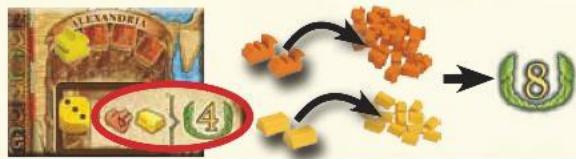
黃 色玩家支付2個略一 駝 及 2應 個區 金 條 到般 供 並 且獲得 8 3分(2 X 4)
| 其它行動 一這些行動是選擇性的 輪到玩家的回合時,在執行其中一個主要行動之前或之後,他也可以執行任意數量的其它行動。不過, | ||
| 這些行動不能在執行一個主要行動的過程中執行。 其它行動有哪些? 1、完成1個合約 2、拿3元 | ||
| 3、重骰1個骰子 4、調整一個骰子點數+1/-1 5、拿1個黑色骰子 1、完成1個合約 首先,我們將說明一個合約板塊的構成:合約板塊左側顯示需求的貨物以及/或者駱駝。板塊右側顯示 完成合約會獲得的獎勵。合約板塊上的符號說明可以在附錄中找到。 | ||
完成這個合約需要的 骆駝数量 完成這個合約可以獲 完成這個合約需要的  得的獎勵 | ||
| 貨物数量 玩家只能完成他已經拿取的合約,而且該合約目 前放在他玩家圖板上的啟動合約區。 | ||
| *為了完成個合約,玩家的玩家圖板儲藏區必須 有所有需求的貨物以及/或者駱駝。 所有需求的貨物以及/或者駱駝從儲藏區拿取, 並放到一般供應區。 *玩家接著獲得合約板塊右側所有顯示的獎勵。合 約板塊上的符號說明可以在附錄中找到。 | 範例: 1  | 綠色玩家想要完成放在他 玩家圖板上的這個合約。 |
 | ||
| 綠色玩家已經完成了這個合约,並獲得3元及4 分。 *最後,玩家把完成的合約板塊正面朝下放在他玩 家圖板的抽屉區。 2、拿3元 | ||
| 玩家把1個骰子放到圖板上所描繪的錢袋區,並從一般供應區拿3元。同時請注意: *即使該行動區已經被其他玩家的骰子佔據,這個行動沒有額外的費用。 *放在這個行動區的骰子點數不會影響該行動。也就是說,玩家執行該行動總是拿3元,無關骰子點數 *玩家在輸到他的回合時,可以執行多次「拿3元」的行動,只要他有開放的骰子可以執行。一輪中, | ||
任何玩家都可以有多個骰子放在這個行動區。 範例: 2 1   綠色玩家把一個般點「2」的骰子放到錢袋上。 綠色玩家從一般供應區拿3元。 | ||
其它行動一這些行動是選擇性的
3、重骰1個骰子
為了重骰自己的1個骰子,該玩家把1個駱駝放回一般供應區。
範例:

2
藍色玩家把1個駱駝放到一般供應區,並重骰他的1個骰子。

藍色玩家把他骰點「2」的骰子重骰,並骰到「5」。
4、調整1個骰子+1/-1
為了把自己的1個骰子點數往上或往下調整1點,該玩家把2個駱駝放回一般供應區。
註記:骰子不能從「1」調成「6」,反之亦然。
範例:

黃色玩家把2個駱駝放到一般供應區,並調整他的1個骰子的點數1點。
2

黃色玩家把他骰點「2」的骰子調成「3
5、拿1個黑色骰子
為了從圖板上拿1個黑色骰子,該玩家把3駱駝放回一般供應區。他立刻把這個黑色骰子放到他玩家圖板上的骰子區。這個骰子可以讓他在當輪當作一個額外的骰子放置。一輪結束時,任何拿取的黑色骰子必須放回圖板上的黑色骰子區,下一輪會再開放給玩家拿取。
範例:
1
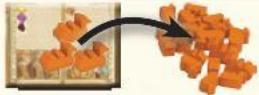
紅色玩家把3個駱駝放到一般供應區。

紅色玩家從圖板上拿1個黑色骰子,並把它放到他玩家圖板上的骰子區。
重要:每個玩家每回合只能拿1個黑色骰子。
其它行動有什麼其它的規則?
玩家輸到他的回合時,可以執行任意數量的其它行動任意次數(例外:拿1個黑色骰子)。例如,他可以先拿1個黑色骰子(花費3個駱駝)、重骰他2個骰子(花費2個駱駝),然後調整他1個骰子的點數1點(花費2個駱駝)。這些行動花費他7個駱駝,並把駱駝放到一般供應區。
提醒:玩家一個回合裡執行主要行動的過程中,不能執行任何的其它行動。其它行動只能在主要行動執行之前或之後才能執行。
玩家一個回合中可以重骰或調整任何他所擁有的黑色或白色骰子的點數。
特殊情況 一特殊情況該怎麼做
如果遊戲過程中出現以下特殊情況,按照以下說明進行:
玩家可以使用一個已經被另一個玩家佔據的行動區嗎?
可以:一般來說,幾乎所有的行動區都可以被多個玩家佔據(例外:大城市行動區,見第11頁的說明)。如果玩家想要使用一個已經被占據的行動區,則必須遵守以下的規則:
玩家想要使用一個已經被占據的行動區,必須支付費用才能使用。支付的金錢數量等同於他放在該行動區的骰子中,點數最小的骰子點數,與放在該行動區的骰子數量無關。一旦玩家支付完放置的費用後,他就可以照常執行該行動。
範例:

紅色玩家想要執行市場的「絲網」行動,並放置了2個骰子(骰點「4」及骰點「5」)到該行動區,不過該行動區已經有2個藍色玩家的骰子。

紅色玩家把4元放到一般供應區(因
為最小的骰子點數是4),並拿取3
個絲網,並把絲綢放到他的儲藏區。
特殊情況一特殊情況該怎麼做
玩家把他的骰子疊到占據該行動區的骰子上方。因此,玩家總是可以看到哪個玩家最近有執行該行動。如果行動區的骰子數量太多導致疊放骰子有困難,骰子可以按照玩家放置的順序,邊對邊平放在行動區旁。例外:可汗的賞賜行動區(見第7頁說明)總共只開放4個骰子放置區。當執行該行動時,骰子不會疊在另一個骰子上方。
黑色及白色骰子不算是玩家白己顏色(藍色、黃色、綠色、紅色)的骰子。因此,有黑色或白色骰子玩家,即使該行動區已經有他的顏色的骰子,一輪裡可以使用這些骰子再次執行該行動。
✽當放置骰子到行動區時,玩家可以把黑色或白色骰子與他自己顏色的骰子併用。
提醒:無論如何,玩家每輪只能把他顏色的骰子放到一個行動區一次。

綠色玩家已經執行過這輪的市場「駱駝」行動。他不能把他的綠色骰子再放到該行動區。不過他可以把他這輪獲得的黑色骰子放到該行動區,並再次執行該行動。

註記:同一輪一個行動區可以有任意數量的黑色或白色骰子佔據。
玩家擲到的骰子點數都很小會有補償嗎?
如果玩家一輪開始時所有的骰子都擲到很小的點數,而且所有骰子點數加總後低於15點,他可以獲得金錢或駱駝的補償。他擲骰的總點數與15點的每點差距,可以讓他獲得1元或1個駱駝。如果他能夠獲得多次,他可以拿取任意組合的錢及駱駝。
範例:

綠色玩家總點數是13。他因此可以拿2元、2個駱駝,或者拿1元及1個駱駝。
遊戲結束与最終計分
遊戲結束
遊戲在第5輪後結束。遊戲圖板旁的合約板塊疊可以用以判斷遊戲剩餘的輪數。當最後一疊的6個合約板塊(遊戲設置時放到遊戲圖板旁)放到遊戲圖板上的「獲得合約」區時,遊戲進行最後一輪。最後輪進行完,接著進行最終計分
最終計分
最終計分時,玩家獲得以下所列的分數:
每個完成他其中一張或兩張目標卡的玩家,獲得卡片上顯示的分數。目標卡的說明可以在附錄中找到。
每個玩家每擁有10元可以獲得1分。


17④1
任何北京有交易站的玩家都會獲得他的交易站佔據區域的分數。
任何北京有交易站的玩家,他每有任意種類的2個貨物也會獲得1分。北京沒有交易站的玩家,他所剩餘的貨物不會有任何分數。註記:駱駝不算是貨物!

完成最多合約的玩家獲得7分,平手時都獲得7分。
計算以上分數後,最高分的玩家獲勝。

平手判定
如果最高分平手,則平手的玩家中儲藏區剩餘最多駱駝的玩家獲勝。如果還是平手,則平手的玩家共享勝利

3人遊戲或2人遊戲的规则调整
如果進行3人或2人遊戲,規則按照以下進行調整:
3人避戲
遊戲設置時,只把4個黑色骰了放到圖板上的黑色骰子區。此外,把1個沒有玩家使用顏色的骰了轉到1點,放到「可汗的賞賜」行動區的第一格。
註記:整場遊戲這個骰子會持續佔據第一格,不會移除!
2人进戲
遊戲設置時,只把3個黑色骰子放到圖板上的黑色骰子區。此外,把2個沒有玩家使用顏色的骰子部轉到1點,放到「可汗的賞賜」行動區的第一格及第二格。同時,把1個沒有玩家使用顏色的骰子轉到1點,放到「拿5元」行動區。
註記:整場遊戲這些骰子會持續佔據·不會移除!
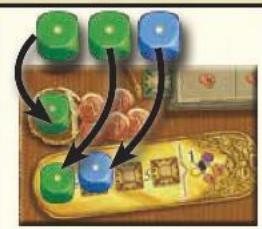
進階遊戲
進階遊戲與一般遊戲有一些規則上的更動。更動的部分說明如下,所有其它的規則與一般規則相同。玩家可以挑選並組合這些變體,或者使用所有的這些變體。我們建議按照以下順序一次使用一個變體。
分發小鎮獎勵板塊
在這個進階變體中,隨機把小鎮獎勵板塊放在地圖上。放置時忽略小鎮板塊上顯示的字母AF

分發角色板塊
遊戲設置時,洗混8個不同的角色板塊 註記 Mercator e x Tabriz板塊有3種不同的版本·版塊左上角顯示玩家人數符號 只使用對應玩家人數的板塊) 把對應玩家人數+1的角色板塊正面朝上放在桌上。按照回合順位,順位最後的玩家起始玩家的右手邊玩家)先挑選1個角色板塊並放到面前,接著按照逆時針方向下一個玩家挑選1個角色板塊並放到面前,依此類推,直到所有玩家都挑選了一個角色板塊。剩餘的板塊放回遊戲盒中,遊戲中不會再用到。每個角色板塊的說明可以在附錄中找到。
4人遊戲
3人遊戲
2人遊戲
分發目標卡
在這個變體中,每個玩家從正面朝下的牌庫抽4張目標卡,秘密地挑選2張保留,並正面朝下放在他面前,另外2張正面朝下放回遊戲盒中。日標卡的說明可以在附錄中找到。
遊戲現在可以按照一般規則進行。
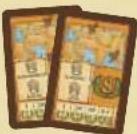
一輪 流程 一完整的一輪如何進行?
一輪一開始:
一輪一開始需要做什麼?
1、決定一個新的起始玩家(第一輪不須執行)。
2、獲得小鎮及角色獎勵。
3、玩家從圖板上拿回他們骰子。
4、玩家擲他們的骰子,並放到他們的玩家圖板上(有需要的話,獲得補償)。
1、決定一個新的起始玩家
每輪決定一個新的起始玩家。前一輪最後一個執行「旅行」行動的玩家成為新一輪的起始玩家。他拿取起始玩家標記(沙漏)。
註記:因為任何行動區不同玩家的骰子會疊放在另一個玩家的骰子上,則最後一個執行「旅行行動的玩家將會是骰子叠放在 r 旅行」 行動區最上面的玩家

一輪流程 一完整的一輪如何進行?
例外:如果前·一輪沒有玩家執行「旅行」行動,則起始玩家不變。
Example:
例外:如果最後執行「旅行」行動的玩家使用一個黑色獲白色骰子,玩家們要記得這個骰子是屬於哪個玩家的。或者,上述所提的玩家在執行「旅行」行動後立刻拿取起始玩家標記。
Green has traveled first this round, followed Hellow, and thenBlue. Therefor®lue is the start player in the next round and takes the Start Player Marker.
2、獲得小鎮及角色獎勵
所有顯示「!」的小鎮現在給予獎勵。每個有交易站在該小鎮上的玩家獲得對應的獎勵。小鎮獎勵板塊上的符號說明可以在附錄中找到。
所有顯示「!」的角色板塊現在給予獎勵。詳細說明可以在附錄中找到。

3、玩家從圖板上拿回他們的骰子
所有玩家現在從圖板上拿回他們的骰子並放到他們的玩家圖板上。所有的黑色骰子放回圖板上的黑色骰子區
4、玩家擲他們的骰子,並放到他們的玩家圖板上(有需要的話,獲得補償)
最後,所有玩家同時擲骰。如果有任何玩家擲骰總點數小於15,他獲得駱駝或錢的補償(見第14頁說明)。所有玩家擲骰後,新的一輪開始。
這輪開始進行
由起始玩家開始,並按照順時針方向,玩家現在輪流進行回合。持續進行回合,直到所有玩家都放完他們所有的骰子。
玩家的一個回合流程是如何進行?
1、如果想這麼做,玩家執行1個或多個其它行動。
2、玩家必須執行1個主要行動。
3、如果想這麼做,玩家執行1個或多個其它行動。
1、如果想這麼做,玩家執行1個或多個其它行動
玩家可以在他的主要行動前執行1個或多個的其它行動。其它行動的說明可以在第12頁及第13頁找到
2、玩家必須執行1個主要行動
玩家必須把骰子放到適用的行動區域,以執行1個主要行動。接著立刻執行該行動。主要行動的說明可以在第6頁到第11頁找到。
3、如果想這麼做,玩家執行1個或多個其它行動
玩家可以在他的主要行動後執行1個或多個的其它行動。其它行動的說明可以在第12頁及第13頁找到
一輪結束時:
一輪結束時要做什麼?
1、清除所有留在圖板上的合約板塊。
2、把6個新的合約板塊放到圖板上。
1、清除所有留在圖板上的合約板塊
一輪結束時,把所有留在圖板上的合約板塊放到合約的「特殊板塊疊」下方。
2、把6個新的合約板塊放到圖板上
接著,拿取圖板旁下一個合約板塊疊,並把這6個新的合約放到圖板上對應的區域。(如果這是第5輪結束,則無須進行此步驟)
© 2015 Hans im Gl ck Verlags-Gm bH
The author and publisher would like to thank the many test players, including: Antonio, Ido, Bruno, Luca, Aska, Simone, Camilla, Andrea, and Gregor Abraham, Tom Hilgert, Klaus Knechtskern, Helmut Ohley, Karen and Leo Seyfarth, Karl-Heinz Schmiel, and as always, a special thanks to Dieter Hornung. Special thanks to Samantha who has tested the game about 1,000 times. Rules Editing: Gregor Abraham, Hanna & Alex Weiss

Suggestions, questions, or comments? Write to us at our e-mail address: info@hans-im-glueck.de or at Hans im Gl ck Verlag, Birnauer Str. 15, 80809 M nchen www.hans-im-glueck.de / www.cundco.de
附錄
符號 一各个符號代表什麼意思?
遊戲中出現的符號說明如下。使用的方式相同,因此它們代表的意思都相同。如果你看到一個不了解的符號,你可以在這裡查閱。
貨物、駱駝、錢,以及分數:



這些符號是1個金條、1個絲綢、1個胡椒,以及1個駱駝。這些符號代表遊戲中使用的木製配件。

這些符號代表玩家可以選擇顯示的貨物(金條、胡椒,或絲綢)。數字代表可以拿的或物數量。不過,當可以拿2個貨物時,必須總是拿取不同的貨物。
這些符號代表錢或分數。
其它的符號:

玩家從「特殊板塊疊」拿取最上面的合約板塊,並把它正面朝上放到他玩家圖板上空的啟動合約區。如果兩個啟動合約區都滿了,他可以替換掉其中1個,或者棄掉新的這合約板塊。不管是哪一種情況,該板塊不會再使用,並放到「特殊板塊疊」底部。

玩家在地圖上沿著任何一條路線往前移動1步。因為他沒有使用「旅行」行動來這麼做,因此他不必支付任何旅行費用。不過路線上其它的費用(駱駝或錢)還是要照付。如果玩家停在小鎮或大城市,他如往常放置一個交易站(假設該地點還沒有他的交易站)。
重要:如果玩家必須支付额外費用(駱駝或錢)來移動,而他沒有足夠的資源可以支付,則他不能移動,這一步取消了。
註記:一個回合中玩家可以放置多個交易站。例如,執行一個「旅行」行動,然後完成一個可以讓他走一步的合約。

玩家獲得1個黑色骰子。他從圖板上的黑色骰子區拿取黑色骰子,並立刻擲這個骰子,接著把它放到他玩家圖板的骰子區。他這輪可以使用這個黑色骰子,一輪結束後必須把它放回圖板上的黑色骰子區。黑色骰子的數量是有限的,因此如果圖板上已經沒以黑色骰子可以拿取,則玩家不會拿到任何黑色骰子。

驚嘆號代表每輪一開始會給予玩家的獎勵。驚嘆號可以在小鎮獎勵板塊上找到,有些角色板塊上也會有。
「玩家選擇」的小鎮獎勵板塊:

如果玩家把一個交易站放在有這個小鎮獎勵板塊的小鎮上,那麼每輪一開始,該玩家可以從任一個還沒有他的交易站的小鎮板塊獎勵。
大城市卡的符號:

骰子的點數決定玩家獲得什麼。
範例:玩家放置點數2的骰子。他可以從一般供應區拿取1個絲網。

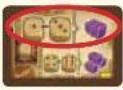
這個符號讓玩家可以用貨物換駱駝(或駱駝換貨物),或者錢換分數(或分數換錢)。這可能會讓玩家有負分的狀況發生。
符號 一各個符号代表什么意思?

這個符號代表完成的合約 (已經放在玩家圖板抽屜區的合約板塊 重 要 : 放在 張有這個符號的卡片的骰子, 其點数決定列入計算的完成的合約板塊数量 0 如果玩家完成的合約板塊數量比骰子點數還多 ,他仍舊只獲得骰子點數所指示一定數量的分數或金錢

範例 1 : 玩 家 把 一 個 骰點 3 的骰子放到這 張 大城市 卡 他 每 有 一 個 完 成 的 合 約板塊就獲得 2 元 他總 共 有 4 個 完成的合约板塊 , 不過因 為他放的骰子點數是 3 只有 3 個完成的合約板塊列 入 計算 , 所以他只會獲 得 6 元 a
範例 2 : 玩家把一個骰點 5 的骰子放到這張大城市卡上 ·這可以讓他計算5個完成的合約板塊 a 不過他的抽屜區 只有 2 個 完成 的 合約 ,所以他只會獲得 4元

這個符號代表玩家已經放在地圖 上的交易站 0 重 要 放在 張有 這個符號的卡 片 的骰子其點數決定列入計算 的交易 站數量 如果玩家 放 置 的交 易站數量比骰子點數還 多 ,他仍舊 只獲得骰子點數所指 示 定 数量 的分數 或 金錢 e
這個符號的功能和完成的合約板塊

相似,範例請參考上面欄位的說明。

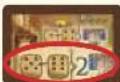
範例 1 玩家把 個骰點 5 的骰子放到這張大城市 卡 上 他现在 可 以挑選 2 個小鎮並獲得獎勵 0 他目前只在 及 有 交 易站 + 所以他只能選擇這 2 個 小鎮並獲得獎勵 0

範例2:玩家把一個骰點4的骰子放到這張大城市卡上 。如果他想獲得最多4個有他交易站的小鎮獎勵,他現在必須把最多4元放到一般供應區。最後他決定把3元放到一般供應區,並獲得 A E·以及 小鎮的獎勵。

把骰子放到有這個符號的大城市卡上時,骰子點數決定可以交易的次數。玩家可以用1個駱駝換3元,或用1元換1個駱駝。當執行這個行動一次以上時,玩家必須決定全都要用駱駝換錢,還是用錢換駱駝。

範例:玩家把一個骰點5的骰子放到這張大城市卡上。他現在必須決定要用5個駱駝换15元,或是用5元换5個駱駝。

玩家獲得骰子點數2倍的金錢。

範例:玩家放置了點數5的骰子到這張大城市卡上。他獲得10元。
目標卡一目標卡如何運作?
每個玩家有2張目標卡,遊戲結束時可能會代來分數。每張目標卡指定2個特定的地點(大城市或小鎮)。遊戲結束時,如果他在指定的兩個地點都有交易站,他可以獲得分數。目標卡說明如下:
遊戲結束時需要有一個交易站的地點
占據不同地點會獲得的額外分數
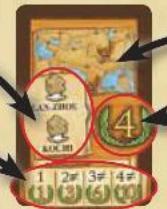
地圖顯示需要有交易站的地點
如果兩個地點都有玩家的交易站,可以獲得的分數
日標卡的分數來源有2個:
1、卡片上指定的兩個地點都有玩家的交易站。
2、玩家的交易站占據了一定數量不同的地點。
目標卡 一目標卡如何運作?
1、卡片上指定的兩個地點都有玩家的交易站
如果玩家在目標卡上指定的的兩個地點都放有交易站,遊戲結束時會獲得卡片右側顯示的分數。如果只有其中一個指定的地點放有交易站,或者兩個地點都沒有交易站,則玩家不會獲得任何分數。
玩家的目標卡會個別結算。
範例:
綠色玩家的2張目標卡如圖所示。他在蘭州和柯枝都有交易站,因此完成了右圖這張目標卡,並獲得4分。

綠色玩家沒有 完成第 二 張 目 標卡 因 為他 只 有 一 個 交 站 在蘇門 答 臘 安 5 没 有 交 易 站, 他 因 此 不獲 得 這張 卡 的 分 數

2、玩家的交易站占據了一定數量不同的地點
接著,結算目標卡的下半部。每張目標卡下半部的表格都相同。因為每張卡都列了兩個指定放置交易站的地點,而且因為每個玩家有2張目標卡,所以最多可能占據4個不同的地點。每個有他自己交易站的不同地點(列在玩家的2張目標卡上),玩家可以在遊戲結束時根據表格獲得分數。

例如,如果他只占據1個地點,則獲得1分。如果占據2個不同的地點,則獲得3分,依此類推。
範例:
綠色玩家有 2 張 目標 卡 這 2 張 目 標卡上列的三個地點有他的交 易 站 : 蘭 州 、 柯枝 以及蘇門答臘。他只少了在安西的交易站。

綠色玩家因為這3個不同的地點獲得6分。
重要:為了計分,地點必須不同!因此,如果有玩家的兩張目標卡列了同一個地點,而玩家也有一個交易站在該地點,它還是只算作是1個不同的地點。
範例:
黄色玩家完成了它的兩張目 標卡獲得 太 片 的 分數。 1 張 卡 片 列 莫斯科及 西 安 • 另 一 張列了 莫斯科與喀什。他在這3個地點都放有交易站。


黄色玩家因為占據3個不同的地點,根據計分表格,他可以獲得6分。兩張目標卡都有出現莫斯科,但是不算作是2個不同的地點。
角色卡一他們如何幫助玩家?
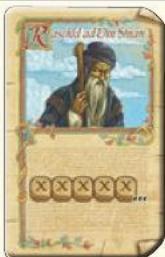
Raschid ad-Din Sinan
持有這個角色的玩家不用擲他的骰子。每當玩家想要執行一個行動時,他可以把骰子轉成任和點數。這也適用於該玩家遊戲中獲得的任何黑色骰子。
註記:這個玩家不會獲得擲骰點數小的補償(見第14頁的說明)。
註記:使用一個占據的行動區,該玩家還是必須支付费用,而且也必須支付「旅行」行動任何的額外費用。


範例:紅色玩家想要執行市場的「胡椒」行動。他把他的1個骰子轉成「6」點,並把它放到合適的行動區,他接著從一般供應區拿取4個胡椒。
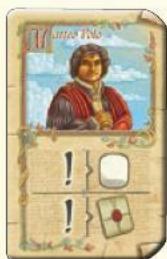
Matteo Polo
持有這個角色的玩家在每輸一開始就獲得白色骰子。他把這個白色骰子與他自己的骰子一起擲。此外,他每輸一開始可以從合約的「特殊板塊疊」抽1個合約板塊。見附錄第S1頁有關「合約板塊」上的符號說明。
角色卡 一他們如何幫助玩家?
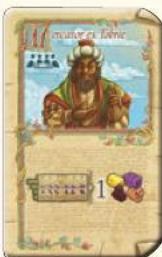
Mercator ex Tabriz
註記:這個角色有3種不同的版本,不同玩家人數使用1種,如這個板塊的左上角所示。只使用對應玩家人數的板塊。
4人避戲
持有這個角色的玩家,每當有另一個玩家執行「市場」行動時,他就可以獲得1個物件。該玩家獲得的物件種類與另一個執行這個行動的玩家所獲得的物件種類相同。無論另一個玩家獲得多少的物件,該玩家總是只獲得1個物件。
範例:綠色玩家把2個骰子放到市場絲網」行動區, 並拿取3個絲網持有這個角色的藍 色玩家獲得1個絲網 。

3人遊戲
獎勵和4人遊戲相同。此外,每當有另一個玩家執行「可汗的賞腸」行動時,該玩家獲得1個駱駝。
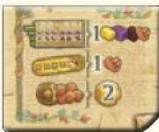
2人遊戲
獎勵和3人遊戲相同。此外,每當有另一個玩家執行「拿5元」行動時,該玩家獲得2元。
註記:持有這個角色的玩家,在其他玩家的回合中因此獲得物件時·快速回應「感謝你」是個不錯的表現!

Kubilai Khan
持有這個角色的玩家,遊戲開始時他的棋子就在北京(而不是在威尼斯)。因此,他一開始就從北京出發。此外,遊戲一開始,他的1個交易站就放在北京的「10」分區。

Johannes Caprini
持有這個角色的玩家可以把他的棋子從地圖上的一個綠洲跳到任一個其它的綠洲。兩個綠洲之間的一次跳躍花費1步移動。如果他有足夠的步數,它可以從一個地點移動到一個綠洲,然後跳到其它的綠洲。此外,每輪開始他會獲得3元。
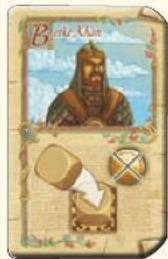
Berke Khan
持有這個角色的玩家可以使用圖板上任何已經被占據的行動區,無須支付費用。
註記:如同一般規則,他仍舊不能使用一個已經被占據的大城市卡行動。

Niccolo and Marco Polo持有這個角色的玩家遊戲一開始就有第二個棋子。他的這兩個棋子遊戲一開始都從威尼斯出發。
註記: 如果玩家執行 一個 旅行 行·兩 動 , 而 且 可 以 讓 他 移 動多 步 他 可 以把 步 數任意 分 配在這 個棋 子 。 每輪 一開始他也會獲得1個駱駝。
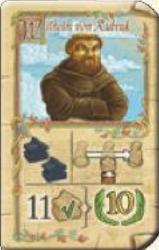
Wilhelm von Rubruk
持有這個角色的玩家,遊戲一開始獲得2個黑色的交易站。他把這兩個交易站放到他的的玩家圖板上。如果遊戲結束時,他可以把所有的11個交易站都放在圖板上,則遊戲結束時他會獲得額外的10分。此外,即使他沒有停在該地點,他還是可以把1個交易站放到他經過的任何一個地點。也就是說,每個他經過的大城市及小鎮都可以放置1個交易站。
註記:該玩家可以回到他已經經過的地點。無論如何,每個地點他只能有1個自己的交易站(包含黑色的交易站)。

範例 ++ 黄 色 玩 家 選擇 旅 行 」 行 動 這 讓他 可以 在 地 图 上 移 動 3 步 從 亞 歷 山 卓 開始 , 他 移 動 到 一 個 綠 洲 L 跳到 」 另 一 個綠洲 ' 然 後 移動 到北 京 。 如 同 般規 则 1他現在放置 1 個交 易站到北京

3b-the-voyages-of-marco-polo-rulebook.md44.4 KB
COMPONENTS AND SETUP
GAME COMPONENTS
1 game board
4 player boards
10 Character tiles
6 City Bonus markers
26 dice (5 each in blue, yellow, green, red, and black, along with 1 white)
40 coins (20x1, 10x5, 10x10)
44 different contracts
31 City cards
18 Goal cards
10 outpost bonuses
15 gold bars (12 small and 3 large)
15 silk bundles (12 small and 3 large)
16 pepper bags (12 small and 4 large)
27 camels (20 small and 7 large)
12 figures (3 each in blue, yellow, green, and red)
38 trading posts (9 each in blue, yellow, green, and red, along with 2 black) 4 50/100 point cards 1 start player marker (hourglass)
4 player aids 1 rules and 1 supplement 1 quick setup sheet

Various game components will be left over and need to be distributed to the players. What each player receives and how it should be arranged is shown on the next page.
Place the game board in the middle of the table. • Put the 50/100 point cards next to the 50 space on the score track.


The player who most recently embarked on a voyage around the world is the start player. Give that player the hourglass.
11 Ponte the bla dicee space showing a black die. The die values don't matter.


Some characters have special extras: leave and one figure in each color in the box for now. A summary of the different characters may be found on the supplement.




facedown pile next to the board.


Front side
2 Place the money 3,(40 coins including 1s, 5s, and 10s) in a general supply next to the board.

Place the 6 City Bonus markers ⊃,on the board spaces whose letters correspond to those on the tiles.
4 Place the goods
4(gold, pepper, silk) and camels in a general supply next to the board. The larger pieces count as three of the smaller ones. The supply of goods and camels is not limited. In the rare event that the supply runs out, use something else as a substitute.




- bonuses facedown.st Place one outpost bonus, faceup, onto each large city on the board. Return the 3 unused bonuses to the game box.

Shuffle the 31 City cards • facedown. Place one card, face up, onto each of the 9 City card spaces on the board. Return the remaining city cards to the game box. They are not needed for the game.
Starting contract
to the side for now,



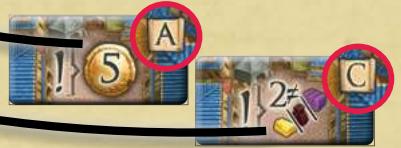
Shuffle the remaining contracts facedown and form 5 piles, each with 6 contracts. You will have 8 left over. Take one of the piles and place one contract, faceup, onto each contract space on the board. Place the remaining 4 piles next to the board. Take the remaining 8 contracts and form a special pile. Put this pile next to the board as well, somewhat removed from the others.
Special pile

Reverse side
9 Placethe l haeter tle.
PLAYER SETUP
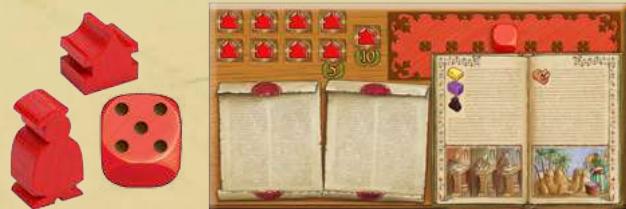
Each player chooses a color. Take the corresponding player board and place it in front of yourself.
Take the 5 dice in your color • and put them onto the marked dice space in the upper right corner of your board.

Use the starting contracts previously set aside. Each player chooses one facedown contract, placing it faceup onto one of the two active contract spaces on their player boards.
Give each player 2 figures in their • color. Place one onto the 50-point space of the score track, and the other onto Venezia.
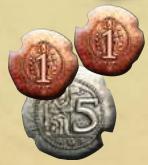
Give each player 2 camels, which they put into their warehouses. Give the starting player 7 coins. The next player in clockwise order gets 8 coins, the next player after that gets 9 coins, and the last player gets 10 coins. Players should keep their money on the table in front of themselves.

Q Deal each player 2 facedown cards from the ,Goal card pile. Players should keep their Goal cards secret.
Once you are familiar with the game you
can pick your Goal cards. The Goal cards are presented in the supplement.
For your first game, you will need the
O following 4 characters: Give the starting player Rashid ad-Din Sinan,

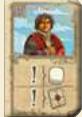
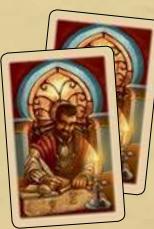
the second player (in clockwise order) Matteo Polo,
the third player Berke Khan,
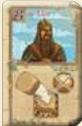

and the fourth player Mercator ex Tabriz.
Finally, give each player • a player aid. The game can now begin.
Once you are familiar with the game you can pick your characters, see page 15. The character abilities are summarized on the summary.


1st player
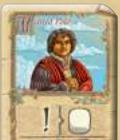
2nd player

3rd player

4th player
ABOUT THESE RULES
Because of the complexity of the game, we are going to start by explaining the basic gameplay. We will then, step by step, explain individual options or special cases in more detail. So don't panic if it seems like something is missing.…. it is coming. Even Marco's tales didn't fit on a single page.
INTRODUCTION
Players play as associates of Marco Polo, who traveled with him and in the surrounding areas. Each player tries to collect points by completing contracts and visiting as many lucrative cities as possible. Completed contracts provide more than just victory points, they also offer discounts and the ability to use privileges in the cities you visit. On top of that, they let you reach goals for the end of the game. At the end of the game, the winner is the player with the most victory points,
Play proceeds in clockwise order, with each player acting in turn, Players roll their dice and use them to occupy action spaces on the board. Players keep taking turns until all of the dice have been used, at which point the round ends. The game lasts a total of 5 rounds, and then ends after a short final scoring. A detailed summary of a game round has been provided at the end of the rules on page 16. For now, we will start with a single game turn and then continue with the actions.
A GAME TURN
A turn in this game means choosing at least 1 die from your player board and placing it onto the action space of your choice. You can add your dice to an unoccupied brown or blue action space, or to an already occupied blue action space. You then
immediately perform the corresponding action.
Number of dice required
You can also perform 1 or more bonus actions, either before or after your regular action. This is always up to you, see pages 12 and 13. Refer to your player aid for a summary of the possible bonus actions.
Possible bonus actions on the player aids

As long as you have dice left, you must choose and perform exactly 1 action. Once you are out of dice, you pass automatically. You will not have any more turns this round! Once you have taken your turn, the next player in clockwise order takes a turn. Players keep taking turns until all of their dice have been placed. This ends the round. Next, we will take a look at the game board, followed by the individual actions.
THE GAME BOARD - The various regions and their associated actions.
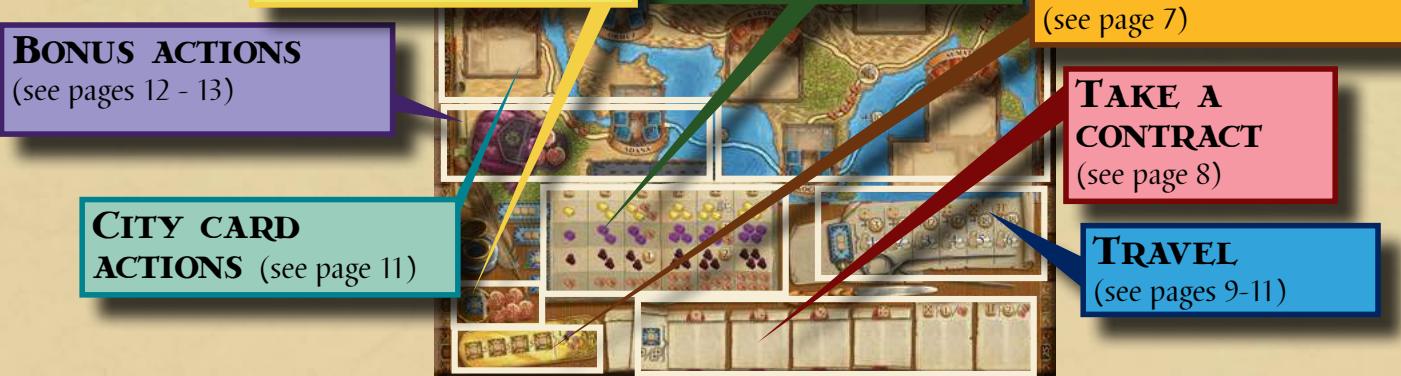
The following 6 actions are possible: Take 5 coins, go to the bazaar, seek the Khan's favor, take a contract, travel, and City card actions.
TAKE 5 GOLD (see page 6)
GO TO THE BAZAAR (see pages 6-7)
SEEK THE KHAN'S
FAVOR
(see page 7)
The bonus actions are: Complete 1 contract, take 3 coins, reroll 1 die, adjust 1 die result by 1, and take 1 black die. We will now explain the various regions and their associated actions,
THE ACTIONS - General.
The following explains what should be kept in mind when performing an action:
* You can only use your own dice, never those of the other players.
* You must use as many dice as are shown on the action space you want to use.

*You can place your dice on unoccupied brown or blue spaces, or occupied blue spaces. For the time being, we will assume that the action space is always unoccupied.
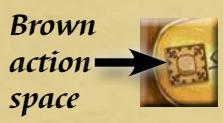
* lf you want to use an occupied blue action space, then you must pay coins, see pages 13 and 14. lf a brown action space is already occupied, you are not allowed to use it.
* Each player color (blue, yellow, green, red) can only be used once on each action space, see page 14.
* After you have placed your dice, you immediately perform the corresponding action.
* The dice themselves indicate how many times you can perform the action, or how much the action gets you (exception: Take 5 coins). Apart from a few exceptions, this is always the lowest die.
* Ilf you are allowed to perform an action out multiple times or get more from the action, you can always choose to perform the action out fewer times or get less. You must always perform the action at least once.
IMPORTANT: HOW EXACTLY IS AN ACTION CARRIED OUT? 1. Place your dice.
-
Pay the necessary coins, if any.
-
Perform the action.

TAKE 5 COINS - No cash, no options.
To take 5 coins, you must add exactly 1 die to the “Take 5 coins” action space.
The die value you use is irrelevant and does not affect the action. You always take 5 coins. lf the space is occupied, you must first pay to place your die (see page 13) before performing the action.
Example;
Yellow places a 3-value die onto the “Take 5 coins” action space. She takes 5 coins from the general supply.


THE GRAND BAZAAR - Goods are useful for many contracts.
Above all else, you will need goods to complete contracts.
Additionally, you can use certain City cards, located in the larger cities (see page 11), to trade goods in for coins, camels, or points. Goods may also bring you points during final scoring. Sequence;
-
Place your dice on 1 of the 4 distinct action spaces,
-
Determine how many goods you receive,
-
Take the goods and add them to your player board,
-
Place your dice on 1 of the 4 distinct action spaces.
You must use as many dice as indicated by the action space you are using.
Example; Blue places 2 dice (a 4 and a 5) 1 onto the “silk” action space.

2. Determine how many goods your receive.
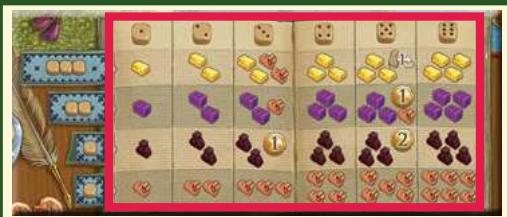
To the right of the action spaces is a table indicating how many goods a player receives. The value of the lowest numbered die used to perform the action determines how many goods you will receive.
The lowest die value Blue used is 2 a 4 , which means that he can take 3 silk from the supply.

THE GRAND BAZAAR - Goods are useful for many contracts.
- Take the goods and add them to your player board. Take the goods from the general supply and place them in your player board's warehouse,
3
Blue takes 3 silk from the general supply and adds them to his warehouse.

You can also choose to use a value lower than your lowest die value. This usually only makes sense when this gives you some variety in what you receive.
Example; Red places a single 4-value die onto the “Pepper” action space. She could take 3 pepper from the general supply. She could also, however, choose to use a lower number and take 2 pepper and a coin.


THE CAMELS - Your constant companions.
You will need camels to complete certain contracts, to be able to move along certain routes, to adjust die results, and to claim black dice. Some of the City cards in the large cities also require camels. You receive camels in the same way as goods: Take as many camels from the general supply as indicated by your die's value. Add the camels to your warehouse.

Green places a 6 onto the “Camels" action space. He can take up to 6 camels.

Green takes the 6 camels from the general supply and adds them to his warehouse
Note ; There is not much point in using a lower value when taking camels.
THE KHAN'S FAVOR - Another way to get the goods.
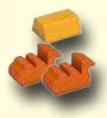
Place exactly 1 die onto the « Khan's Favor » action space. Then take 1 good of your choice and 2 camels from the general supply, adding them to your warehouse.
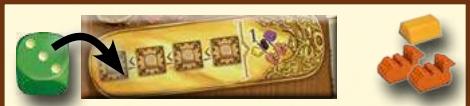
SPECIAL RULES
The first player to seek the Khan's favor places her die onto the left-most die-space and claims her reward. The next player who wishes to use this action must place his die on the next die-space over. The next die to be used must have a value equal to or greater than the previously-placed die, or the action may not be used. These same rules are in effect for the remaining players.
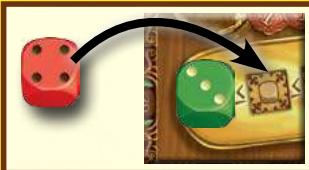
Example; Green places a 3 on the first “Khan's Favor' action space. He takes 1 gold and 2 camels from the supply.
2

Red places a 4 on the next “Khan's Favor” action space. She also takes 1 gold (but could have chosen something different) and 2 camels from the supply.


Note : There are only 4 distinct spaces in this action space. When those 4 spaces are occupied, it is no longer possible to choose this action for the rest of the round. Each player color can only be used once on this action space.
Green places a 6 onto the
THE CONTRACTS - The reason we go to the bazaar.
To take contracts, you must place exactly 1 die onto the “Contracts” action space. You can then take 1 or 2 contracts from the contract spaces on the board, placing them onto the spaces for active contracts on your player board. The value of the die you use here determines the contract(s) you may choose from,

Blue places one of his dice (a 3) onto the “Čontracts” action space.

Blue takes 1 or 2 contracts and adds them to his player board.

If you take the contract below the 5, you also receive an additional 1 coin or 1 camel from the general supply.
lf you take the contract below the 6, you receive 2 coins or 2 camels.
Example; 1


Green takes 2 contracts: the one under the 2 and the one under the 6. For the contract below the 6, he takes an additional 2 camels. He could have also chosen to take the two contracts below the 5 and the 6.
WHAT ELSE NEEDS TO BE OBSERVED?
* lmmediately after taking your contracts, slide the remaining ones on the board to the left, filling in any gaps left from the contracts you took. There should never be empty spaces between contracts.
As soon as you have taken your contracts, slide all remaining contracts to the left.

* lf there is only 1 contract on the contract spaces, you can only take that one during your turn.
* lf all contract spaces are empty at the beginning of your turn (before you take any action), draw two contracts from the special contracts pile and place them beneath contract spaces 1 and 2.
* There is room on your player board for 2 contracts. When you take new contracts, you must also have room for them – or you will need to make some. lf you do not have enough space, you must discard one or both of your ‘older' contracts first, adding them to the bottom of the special contract pile.
Example:
Green takes 1 contract from the board. He has no empty space on his player board. He chooses to discard one of his older' contracts, adding it to the bottom of the special pile. He then places his new contract on his player board.
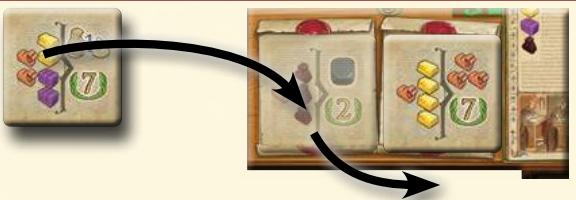
SPECIAL RULES - These are only relevant in special cases and can be reviewed in detail later.
* You are not allowed to take contracts from the board and add them directly to the special pile. New contracts must always be added to your player board first.
* As long as your contracts are on your active contract spaces, they are not worth anything. You must first complete them, see page 13.
TRA VEL - Moving your figure around the map.
Place exactly 2 dice onto the “Travel” action space. This allows you to move your figure around the map.
The steps involved in moving your figure are outlined below.
Example;
Red places 2 dice onto the action space.

HOW EXACTLY DO YOU MOVE?
You need to complete the following steps:
1, Place your dice,
-
Pay your travel costs,
-
Pay any additional costs,
-
Move your figure and possibly place a trading post,
1. Place your dice.
The value of the
lowest numbered die
used to perform the action determines how many spaces you can move.
Example;
Red places a 2 and a 4 onto the action space. She can therefore move up to 2 spaces on the map, as the lowest die value is a 2.

Note ; You can always choose to move fewer spaces but you must move at least 1 space.
2. Pay your travel costs.
Each “Travel” action spaces shows the costs for movement. This means that you must always pay for your movement. You only pay for the spaces you actually moved. Return your payment to the general supply.
Red wants to move 2 spaces on the map. This will cost her 7 coins. Red returns the necessary coins to the general supply.


3. Pay any additional costs.
Many of the routes connecting two locations show additional costs, either camels or coins. ln these cases, you must additionally pay those costs or your movement, returning the necessary camels or coins to the general supply.
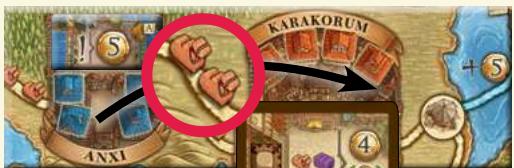
To use this route, you must take 2 camels from your warehouse, returning them to the general supply.
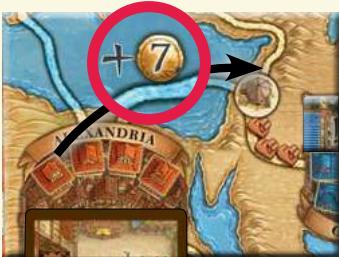
To use this route, you must pay 7 coins, returning them to the general supply.
4. Move your figure and possibly place a trading post.
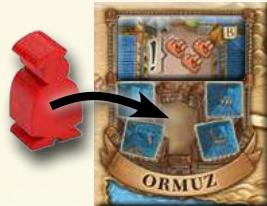
Move from location to location. You will encounter oases, small cities, and large cities in your travels, and you must end your movement in one of these. You may not stop between two locations.
TRA VEL - Moving your figure around the map.
Example; Red moves either... ...to a large city

or ...to an oasis

She may never stop her movement between two locations.
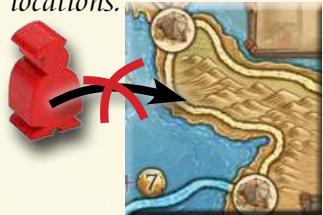
lf your “Travel” action ends in a large city, then you must place a trading post there. From your next turn on, you can use a die to activate the City card located there (see page 11). The card itself remains in the city.
Example; Red places one of her trading posts in the large city.

Starting with her next turn, Red may now place a die to use the city action (see page 11).
* If your “Travel" action ends in a small city, then you must place a trading post there. You immediately receive the indicated bonus (see supplement). The tile itself remains in the city. At the start of each subsequent round, you receive the indicated bonus again (see page 16).
Example; Red places one of her trading posts in the small city.
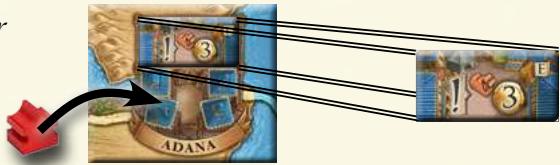
Red immediately receives the city bonus in this case 1 camel and 3 coins.

* If your “Travel” ends in an oasis, nothing happens. Oases have no function other than slowing down travel.
WHAT ELSE NEEDS TO BE OBSERVED?
* When placing trading posts, start with the one in the upper left corner of your player board and continue working your way down and to the right.
Once you place your 8th trading post, you immediately receive 5 victory points , which are immediately scored on the score track. Once you place your 9th trading post, you immediately score another 10 victory points (10.

* lf you end your movement in Beijing, you place a trading post in the city as usual. Place it on the empty space showing the largest number of victory points. You will score these points at the end of the game.
* Moving back and forth is allowed. This means that you can pass through or end your movement on the same location multiple times.

Note; You may never have more than 1 trading post in any large or small city. You may not place another trading post, even when visiting a city for the second time.
* The “Travel” action determines the start player for the next round (see page 15)
WHAT IS THE OUTPOST BONUS?
The first player to place a trading post in a large city receives the outpost bonus for that city. Take the indicated bonus from the general supply and add it your holdings. Return the outpost bonus tile to the game box, it is no longer needed for the rest of the game.

TRAVEL - Moving your figure around the map.
SPECIAL RULES - These can be reviewed in detail later.
* At the start of the game, all players start in Venice. lt can occur during play that you move your figure back to Venice. lf this happens, you do not place a trading post there.

* Once you have placed all of your trading posts onto the board, the next time you must place a trading post, you must instead move an existing trading post from one location to the other.
“Travel” action example;
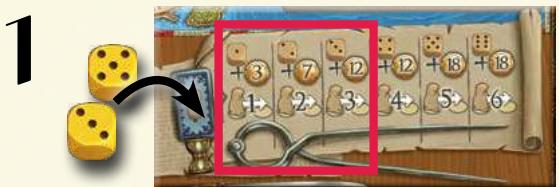
Yellow places 2 dice (3 and 5) onto the space.

3
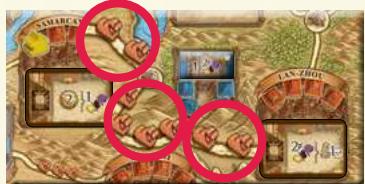

Yllow wants to move 3 spaces on the map. She must pay 12 coins. She does so, returning the coins to the general supply.
Yellow wants to move to Lan-Zhou from Samarkand, passing through an oasis and Kashgar along the way. This costs another 8 camels which she also returns to the general supply.

Yellow moves her figure 3 spaces and places a trading post in Lan-Zhou, as her travel ended there.
THE CITY CARDS - So many possibilities.
Each large city on the board has 1 City card in it. To use a City card, you must have a trading post in the corresponding city. You must then place exactly 1 die onto the City card's action space to be able to perform the action. The individual city actions are summarized in the supplement.
This is the space for 1 die. Once occupied, no other player can choose to use this card.
Yellow has a trading post in Alexandria.
She can place a die on the card and use the action. 8


This is the beneit that the city card provides.
This is the payment or prerequisite that you must provide or fulfill.
Note; City cards can only be used once per round. Once a player has occupied a City card space with a die, then no one else may use the action until the start of the next round.
Note; ln most cases, the value of the die you use determines the number of times you may use these actions.
Example;
Yellow places 1 die (a 3). Since she placed a 3, she can do this action three times.

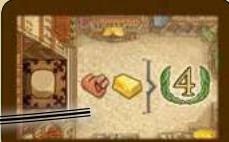
Yellow returns 2 gold and 2 camels to the supply, giving her 8 points (2 x 4).
BONUS ACTIONS - Always freely chosen.
As long as it is your turn, you can choose to perform one or more bonus actions before or after your main action.
WHAT BONUS ACTIONS ARE AVAILABLE?
-
Complete 1 contract
-
Take 3 coins
-
Reroll 1 die
-
Adjust 1 die result by 1
-
Take 1 black die
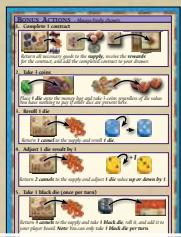
1. Complete 1 contract
Player aid
On the left side of each contract you will see the required camels and goods. On the right side of each contract you will see the rewards you get when you complete the contract. An explanation of the symbols can be found on the supplement.
Camels required to complete the contract
Goods required to complete the contract
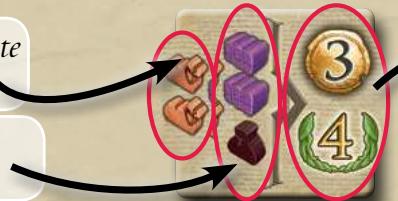
Rewards for completing the contract
*You can only complete contracts on the active contract spaces of your player board.
Example;
To complete a contract, you must have the necessary goods and camels in your warehouse. Pay all of the necessary goods and camels, returning them to the general supply.

Green wants to complete this contract. He has it on his player board.
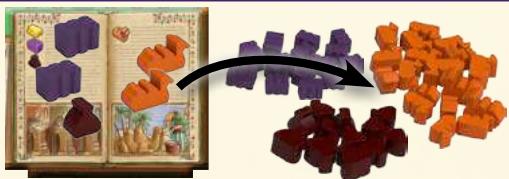
Green pays 2 camels, 2 silk, and 1 pepper.
Receive all of the rewards indicated on the right side. These rewards are always a combination of victory points and something else. The symbols are explained on the supplement.
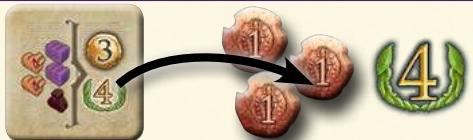
Green has completed the contract. He receives 3 coins and scores 4 victory points.
X Finally, put the completed contract facedown into your drawer, in the bottom right corner of your player board.
2. Take 3 coins
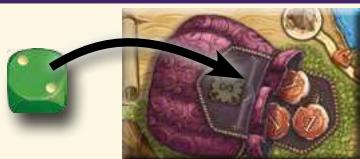
Place exactly 1 die onto the money bag on the game board. Take 3 coins from the general supply. Furthermore:

Green places the completed contract facedown into his drawer.
* This space has no cost, whether it is occupied or not.
* The die value used when performing this action does not matter. Regardless of the number on the die you place there, you always take 3 coins.
* As long as you have any dice left, you can continue to choose to perform the “Take 3 coins” bonus action.
Note; lt is possible to place your last die on this action space, even if this is not a main action.
Example;

BONUS ACTIONS - Always freely chosen.
3. Reroll 1 die
You can pay 1 camel to reroll 1 of your dice once.


Blue pays 1 camel to reroll one of his dice

Blue rerolls a 2. He gets a 5.
4. Adjust 1 die result by 1
You can pay 2 camels to adjust one of your die results up or down by 1.
Note; You may not adjust a 6 to a 1 or vice versa.
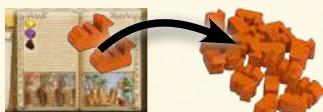
Yellow pays 2 camels to adjust a die result up or down by 1.

Yellow chooses to adjust her 2 to a 3.
5. Take 1 black die
You can pay 3 camels to take 1 black die from the general supply. Roll t immediately and add it to the remaining dice on your player board.
The black dice are limited. However, all black dice are returned to the board at the end of each round. Consequently, players will have a chance to get more black dice during the following round.
Example; 1
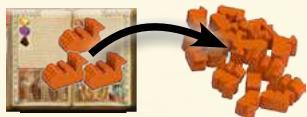
Red pays 3 camels to the supply.
2

Red takes a black die, rolls it, and adds it to her player board.
Note; Each player can only take 1 black die per turn with this bonus action.
WHAT ELSE NEEDS TO BE OBSERVED?
* A player may realize a single bonus action multiple times during his turn (exception: take 1 black die). However, the cost must be paid each time. For example, if a player wants to adjust 1 die twice, he would have to pay 4 camels.
*You can only perform bonus actions before or after your main action.
* If a player has black and/or white dice, he may reroll and/or adjust them.
ADDITIONAL POINTS - What else needs to be considered?
There are a few other things to remember. These are explained below.
CAN YOU CHOOSE AN ALREADY OCCUPIED ACTION SPACE?
Yes, in general action spaces can be occupied by multiple players. All players are allowed to use an action space (except for City cards, see page11). When doing so note the following:
* When you want to use an already-occupied action space, you must pay for it. You must pay as many coins as the die value of the lowest-value die you are using to perform the action.
This is independent of any dice already present on the action space. The die values of other players' dice do not matter. Once you have paid, then you can perform the action as usual.
Example;

There are already 2 Blue dice on the “Silk” action space. Red would like to buy some silk as well this round. Red places 2 dice (4 and 5) onto the action space.
2
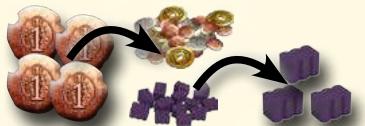
Red pays 4 coins (as her lowest die value was a 4). She then takes up to 3 silk and adds them to her warehouse.
ADDITIONAL POINTS - What else needs to be considered?
When a player wishes to place dice on an occupied space, stack them one on top of the other. This will make it easier to see who is the last player to have chosen that action. lf need be (too many dice), place them next to one another, from left to right. The one to the right will now be the last one to have chosen this action. Exception: The Khan's Favor, seen on page 7, only offers four action spaces. When those four spaces are occupied, it is no longer possible to choose this action for the rest of the round.
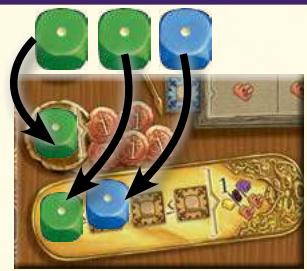
White and black dice are not considered player colors (blue, yellow, green, red). As such, a player with those types of dice could reuse an action space they have already used with their player color.
* A player may combine black and white dice with dice of their color. However, your color dice may never be more than once on the same action space (exception : Take 3 coins).
Note; There is no limit to how many white or black dice can be on an action space.
Example;

Green has already taken camels this round. He cannot use his Green dice to take any more camels this round. He has a black die left, though, which he can use to take more camels if he wishes.

COMPENSATION FOR LOW DIE ROLLS
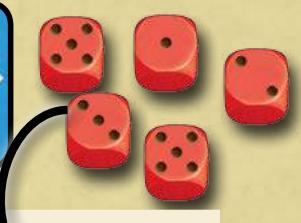
If the sum total of all of your dice at the start of a round is less than 15, then you receive compensation in the form of coins or camels. You can take 1 coin or 1 camel for each point of difference between your total and 15. You are allowed to take a combination of both should you be able to take more than 1.
Example:田0000
Green has rolled a total of 13. He has 2 points of compensation: 2 camels, 2 coins, or 1 camel and 1 coin.
GAME END AND FINAL SCORING
GAME END
The game is over after 5 rounds. You can tell how many rounds are left by how many contract piles are left.
The final round of the game happens after the last pile of contracts is added to the board.
Final scoring occurs after the final round.
FINAL SCORING
During final scoring, players score victory points for various items:
* Each player scores the points for their 2 Goal cards. Goal cards are described in the supplement.
* Score 1 victory point for every 10 coins you have left.

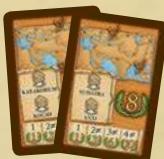
*1f you have a trading post in Beijing you score the victory points ((10(7)(41) indicated by the space your trading post is on.
* lf you have a trading post in Beijing, you score 1 victory point for every 2 goods you have left.

Players without a trading post in Beijing score nothing for their remaining goods. lmportant; Camels are not goods!
* The player(s) with the most completed contracts score 7 victory points.
The player with the most points is the winner.

TIE GAME
If there is a tie, then the winner is the tied player with the most camels.
If there is still a tie, then there are multiple winners.

THE GAME WITH 2 OR 3 PLAYERS
When playing with 2 or 3 players, apply the following changes:
Only use a number of black dice equal to the number of players + 1. As such, with 3 players, there will be 4 black dice, and with 2 players, 3 black dice
3 PLAYERS
At the beginning of the game, place one die (on 1) from an unused player color on the first space of the “Khan's Favor” action.
Important; This die will stay in place for the whole game! Do not remove it from the board,
2 PLAYERS
At the beginning of the game, place two dice (each on 1) from an unused player color on the first two spaces of the “Khan's Favor” action. Additionally, place one die (here, the value is unimportant) on the “Take 5 coins” action space. lmportant; These dice will stay in place for the whole game! Do not remove them from the board.
THE EXPERT VARIANT
There are a few small changes to the game in the expert variant. All of the regular rules remain in effect.
You can choose one or more of the following distribution methods. However, if you choose to include them one after the other, proceed in the order described below.
DISTRIBUTION OF CITY BONUSES
Randomly distribute the city bonuses across the small cities. lgnore the lettersA Fwhile placing the bonus markers.

DISTRIBUTION OF CHARACTERS
During setup, randomly shuffle the 8 different characters.
4 players
(There are 3 copies of the “Mercator ex Tabriz” in the game). Shuffle in the version you need, according to the number of players.
3 players
2 players
Next, reveal as many character cards as there are players taking part plus 1. The last player in turn order (the player to the right of the start player) chooses a character first, placing it in front of him or herself. The players then continue by each taking one character card in reverse turn order. Return the remaining character to the box. The individual characters are summarized on the supplement.
DISTRIBUTION OF GOAL CARDS
Deal each player 4 Goal cards, facedown, at the start of the game. Each player secretly chooses 2 of them to keep, returning the rest of them to the game box.
The game then begins as usual.

A GAME ROUND - How exactly does a round of play go?
AT THE START OF A ROUND
WHAT NEEDS TO BE DONE AT THE START OF A ROUND?
1, Choose a new start player, (Except during the first round,)
-
Award city and character bonuses,
-
Retrieve all dice,
-
Roll all dice, possible compensation,
1, Choose a new start player
A new start player is determined at the beginning of a new round. The player who last chose the “Travel” action during the previous round is the new start player.
Hint; Stack dice on this action. This will allow you to quickly see who is the last player to have played on this action; it will be the one on top of the “Travel” action.
A GAME ROUND - How exactly does a round of play go?
Exception ; If nobody moved in the previous round, then the current start player remains the start player for the next round.
Example;
Exception ; lf the last player to move used white or black dice to do so, then players should make sure to remember which
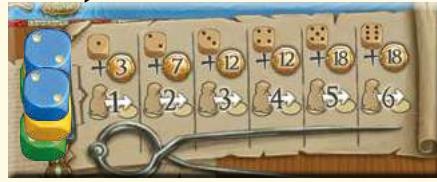
Green moved first this round, followed by Yellow and nally Blue. Blue receives the hourglass and will the start player in the next round.
player that was. lf you know you are the last player to move and you used black or white dice, then you can take the hourglass right away to avoid confusion.
2. Award city and character bonuses.
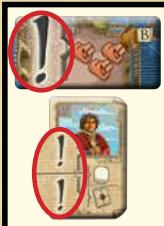
* All small cities (with a ! symbol) award bonuses. Each player receives bonuses from each small city in which he or she has a trading post, see supplement.
* All characters (with a ! symbol) award bonuses, see supplement.
3. Retrieve all dice
Retrieve all of your dice from the board, returning them to your player board.
Return the black dice to their space on the board.
4. Roll all dice, possible compensation
All players roll their dice simultaneously. If you rolled less than 15, you receive compensation, see page 14.
Once all players have rolled their dice, the new round can begin.
A ROUND
Players take turns, in clockwise direction, starting with the start player.
This continues until all players are out of dice.
HOW DOES AN INDIVIDUAL TURN GO?
1, Perform bonus actions if desired,
-
Choose and perform 1 action,
-
Perform bonus actions if desired,
1. Perform bonus actions if desired
You can choose to perform bonus actions before your main action. You can perform as many of them as you wish (provided you can pay for them). The bonus actions are summarized on pages 12-13.
2. Choose and perform 1 action,
Choose 1 action and place the necessary dice on the board to perform it. Perform the action immediately.
The actions are described from page 6 through 11.
3. Perform bonus actions if desired
You can choose to perform bonus actions after your main action. You can perform as many of them as you wish (provided you can pay for them). The bonus actions are summarized on pages 12-13.
AT THE END OF A ROUND
WHAT NEEDS TO BE DONE AT THE END OF A ROUND?
1, Clear any remaining contracts,
- Add new contracts to the board,
1. Clear any remaining contracts
Remove any remaining contracts from the board, adding them to the bottom of the special contracts pile.
2. Add new contracts to the board
Choose one of the contract piles and add 6 new contracts to the board. (Not needed at the end of the 5th round.)

© 2015 Hans im Glück Verlags-GmbH
© 2015 F2Z Entertainment lnc. for the English version
31 rue de la Coopérative
Rigaud QC J0P 1P0
Canada
For questions, comments and requests:
www.zmangames.com
info@zmangames.com
The testers: Samantha, who played it at least 1,000 times, Antonio, ldo, Bruno, Luca, Aska, Simone, Camilla and Andrea, also Gregor Abraham, Tom Hilgert, Klaus Knechtskern, Helmut Ohley, Karen and Leo Seyfarth, Karl-Heinz Schmiel, and Dieter Hornung. Very special thanks to Patrick Korner for the English text. Special thanks to Adam Marostica and Michael Young for their proofing skills.
下载 Markdownthe-voyages-of-marco-polo-the-new-characters-rulebook-english.md31.4 KB
原文本层提取版本已由本版替换(2026-10-31),正文相似度 0.58
Characters
Expansion #3
Artwork by
Misda & Christine Deschamps
for
The Werewolves
of Miller's Hollow
A game by
Philippe des Pallières
and Hervé Marly
For 8 to 28 players, aged 10 and up
For many lunar cycles, tranquility had returned to the area around “Miller's Hollow”.
Until a “wild child” returned to the deep forest and started howling each night.
A short time later, new disappearances and the finding of half-eaten remains convinced the inhabitants that shape-changing monsters more fearsome than they'd ever seen were living among them.
They then summoned, from the far reaches of the country, other “Characters” who were very powerful, to struggle against this abominable spawn...
Philippe & Hervé
The basic rules of "The Werewolves of Miller's Hollow" game do not change. In case they're needed, refer to the rules from the basic box.
Contents: 24 cards
〔图:images/c4dca991749ddedf220130ab4ef4eacfd8acf334d578dcf9859be67efef1ca5d.jpg〕
Bonus characters:
(see p. 26)
Attached to the survival of the village, the following characters defend the harmony of their village with determination.
Faced with threats, they must, even if it might hurt them, eliminate those they suspect of having become too dangerous.
The Villager-Villager
〔图:images/7940820e5aa3867f45faec01272d499cc90de5cfca951f4ebd3967db087d9cd6.jpg〕
This character possesses a soul as clear and transparent as the water from a mountain stream. He will deserve the attentive ear of his peers and will speak his definitive word in crucial moments. What power could be greater than to inspire in honest people a
sense of absolute confidence? Will the Werewolves rush to eliminate this being with no secret powers? Will they prefer unearthing villagers with more threatening powers?
On both of its sides, this card has the illustration of a Simple Villager. Upon distribution, the village will thus have the absolute certainty that its owner is truly an innocent Simple Villager.
Advice for the Narrator: this character can become a trusted Sheriff or Town Crier.
The Two Sisters
〔图:images/365d77e0566054de6512b8430c3752a0c3ea43be371675b1b78b2de6e76eab3c.jpg〕
Some locals confuse the two of them when they meet one of the Two Sisters in the bend of a deep road. The smile which lights up the face of the young woman after one has tried their luck at the name game is hard to decipher: is the young one
happy to have been identified, or is she laughing at the mistake? In any case, the Two Sisters are like the fingers of a hand or feathers of a bird. It's indeed comforting to have someone close you can count on during uncertain times!
The first night, upon the narrator's call, they wake together and recognize one another.
For experienced players: during the course of the game, once in a while (every other turn, or whenever the narrator feels like it), they wake up again and quickly (and quietly) agree on the decisions they take to save the village.
Advice for the Narrator: really powerful when given to players who know sign language.
The Three Brothers
〔图:images/bbfc32439ed3c9011db67d663b745b02ff62eccd96ebe0e440d6b1bd267ea7b4.jpg〕
The entire village rings with the joyous sound of their voices when they return home after a day of work. During the debates, a single glance at one another will allow them to take a good decision as to the future of the village.
The first night, upon the narrator's call, they wake together and recognize each another.
For experienced players: during the course of the game, once in a while (every other turn, or whenever the narrator feels like it), they wake up again and quickly (and quietly) agree on the decisions to take to save the village.
Advice for the Narrator: even more powerful when given to players who know sign language. To be used only in large villages. If the village is very large, you can even add the Two Sisters to it!
The Angel
〔图:images/a5a02174a8cd030faddbbc8716c4d06259e080a528f1943c5d2f1e00bc7e6334.jpg〕
The muddy life of a village infested by evil creatures disgusts him; he wishes to be the victim of the worst nightmare, to finally be able to wake up in his comfortable bed.
When the Angel is in play, the game always begins
with the village's debate followed by an eliminating vote, then a first night.
If the Angel manages to attract the discriminatory vote of the villagers, or the devouring vindictiveness of the lycanthropes to be eliminated during the first turn, he'll be able to successfully leave his nightmare and win the game. The game then ends: the players can immediately begin a new game.
If he fails, he becomes a Simple Villager for the rest of the game.
Advice for the Narrator: don't hesitate to remind players of the possible presence of the Angel on the first day! The debates will only become more animated, with loudmouths being protected by this angelic menace!
The Stuttering Judge
〔图:images/f99e1548c45476831a0900da93a0ea1a52a0a8e3b798c0a84dbf091d4b664580.jpg〕
The youngest son of the miller was good in school and dreamed about becoming a lawyer. As his father had had some success in his business, he sent him to learn law in the nearest big city. A slight speech impediment barred the young man from getting the coveted
prestige of being the defender of the widow and the orphan. However, he returned to the village of Miller's Hollow proudly bearing the only slightly less prestigious title of wandering judge.
Once per game, the Stuttering Judge can decide that there will be 2 consecutive votes and two suspect eliminations.
The Stuttering Judge lets the narrator know their decision using a specific distinctive sign used to designate an inhabitant during the village's vote. The second vote starts immediately after the first one without debate.
The “St-st-stuttering Ju-ju-judge” will have shown their distinctive sign during the first night, upon the narrator's call.
Advice for the Narrator: always be very attentive to the behavior of the Stuttering Judge during the votes, in order to not miss his distinctive sign.
The Knight with the Rusty Sword
〔图:images/63100e0c5e175d2b73384854aab23f69a7f95f250987318f119d5bda290907a8.jpg〕
“Sir Mc Coughing” is an old retired knight. He's been rather exhausted by a life of quest throughout the world and no longer maintains his noble tool properly. Rust has slowly started appearing on the dulled edge of his faithful protector, but he'll never
abandon it for another. He still sleeps with it every night: intruders beware!
If the Knight is devoured, he is eliminated, but one of the Werewolves becomes diseased from the rusted sword's wound. From among the Werewolves guilty of that elimination, the first Werewolf to the left of the Knight with the Rusty Sword will be eliminated the following night. This elimination caused by disease will be revealed in the morning by the narrator after the disappearance of the Werewolf, who will thus have survived his wound for a full day.
Note: clever players will be able to deduce that all inhabitants seated between the dead Knight with the Rusty Sword and the diseased Werewolf are innocent villagers.
The Actor
〔图:images/fbad045c9e6685d623c9435166be56db8ebd72d3a220f920590b4659d3597fa5.jpg〕
A tireless wandering artist, he stopped in the village to give a few shows before leaving to spend winter in more welcoming lands. As gifted at telling jokes and puns as at performing great tragedies, he has every talent necessary to perform the entire back
catalog of national plays.
Before the game, the narrator chooses 3 character cards with special powers. After the distribution of the roles, these cards are placed face-down in the middle of the table.
Each night, upon the narrator's call, the Actor can choose one of these cards and use the corresponding power until the next night. If the Actor uses a character card, the narrator removes that card from the table. It can no longer be used.
Note: the cards offered cannot be Werewolf cards.
Advice for the Narrator: in the choice of cards offered to the Actor, you can introduce a bit of chaos for the village, or otherwise help counter a very strong clan of werewolves.
The Devoted Servant
〔图:images/18f446ee6f6062df92f456ee9263d9125e50587af4f4e4571d3f1fed50492d19.jpg〕
Who could dream of a better servant than the one who gives their life for their master? Don't rejoice too fast, for the devouring ambition inhabiting her could cause the end of the village!
Before revealing the card of the player killed by the
village's vote, she can reveal herself by showing her card. In that case, the Devoted Servant loses her card and gains the card of the eliminated player without showing it to the other players, taking on the role of the eliminated player until the end of the game.
Note: if she is one of the lovers, the Devoted Servant cannot use her power, as her love is stronger than her desire to change characters.
Advice for the Narrator: wait before revealing the card of the player eliminated by the village, in order to give time to the Devoted Servant to reveal herself.
After the card switch, the Narrator looks at the Devoted Servant's new card. The Servant's new role must be called on the next night, so that the Narrator and her can trade any necessary information, if need be.
.../...
As a general rule, this new role taken on by the Devoted Servant sees its power renewed and must be played as though it was the first night.
However, any potential effects previously applied to the eliminated player will be canceled.
Clarifications:
- If the eliminated player was cursed*, in love, charmed, Sheriff, Town Crier, or Cupido, the ex-Devoted Servant isn't.
- If the ex-Devoted Servant was charmed, Sheriff, or Town Crier, she no longer is.
- If the ex-Devoted Servant was cursed*, she still is.
-
If the ex-Devoted Servant becomes:
-
The Piper, the narrator indicates to this new Piper which players were previously charmed.
- Actor, Town Crier, Gypsy: new cards are not dealt; only those remaining are used.
* See the Cursed Wolf-Father, page 20.
〔图:images/5dc758fe7f3456921f11e6ed566d9dcf83faa8dc23ea503c4ab19c1c5a2ba8c3.jpg〕
For more clarifications, see from p. 27 to p. 30.
To balance out the power of the Werewolves, two characters are particularly sensitive to the lycanthropic nature of the inhabitants...
The Fox
〔图:images/cbd604ef844e3fc63b1a78cbbfa7e9d1669a185bad03817fec832e621cd97013.jpg〕
In Miller's Hollow, everyone appreciates the flair of this vivacious and discreet character, other than maybe the chickens and especially the Werewolves.
At night, upon the Narrator's call, the Fox can designate a group of three neighboring players, of which
he points to the center player. If in that group is at least one Werewolf, then the Narrator makes a positive gesture to the Fox. In that case, the Fox will be able to use his power again the next night. If no Werewolf is among the chosen group, the Fox loses his power for good; however, he has important information clearing three players at once.
Note: the Narrator calls upon the Fox each night, but that player is not required to use his power each night.
Advice for the Narrator: the Fox doesn't see the cards - the Narrator simply lets him know if there are or aren't any Werewolves among these three players.
The Bear Tamer
〔图:images/b7170cd92051293ae3432b9f3602b797d82069afb8748edb908cec82d0b7464f.jpg〕
Oh! How nice it is, in my memories; that sound of chains clinking on the cobblestones of the “Three-Roads Plaza”, accompanied by the grunting of Ursus. Oh! How long it's been since Titan, the Bear Tamer, would brilliantly lead his companion in such a grace-
ful ballet that'd we'd cry at the sight each summer in Miller's Hollow. Ursus even had that precious power, that of detecting lycanthropes hidden near him.
Each morning, right after the revelation of any nocturnal victims, if at least one Werewolf is or becomes the direct neighbor of the Bear Tamer, then the Narrator grunts to tell the players that the Tamer's bear has smelled the danger.
Only the neighbors still in play are taken into account.
Advice for the Narrator: in order to simplify things, the eliminated players leave the game, or move away from the table. If the Bear Tamer is cursed*, then the Narrator will grunt each turn, as long as the Bear Tamer is not eliminated.
* See the Cursed Wolf-Father, page 20.
The following characters can be lethally dangerous and put into question the survival of the village.
The Prejudiced Manipulator
〔图:images/5ad3c5ce937c82dc16897ad9765222291ed51398e89060aa33cae880ec2df22c.jpg〕
Since childhood, this poor soul loathed himself, probably due to a lack of affection or attention from those close to him. While growing up, he shifted that hatred to those who are different from him. It's why he is now known as the Prejudiced Manipulator.
Before the beginning of the game, the Narrator divides the village into 2 groups, according to an obvious criterion (gender, glasses, size, age, etc.) and announces it out loud to the village. The Prejudiced Manipulator will obviously be part of one of these two groups. The goal of that character is the elimination of all the players from the group he doesn't belong to. In that case, and only in that case, he wins the game. He has no special powers: his skill at manipulating the inhabitants of the village is his only weapon!
Advice for the Narrator: it's not necessary to make up 2 groups of identical sizes. Don't hesitate to specify, if necessary, in front of everyone to which group which inhabitant belongs.
The Wild Child
〔图:images/3afa9286c22092ca86556dba395d527b393f83d5e2cf78ce25e7432558349f0c.jpg〕
Abandoned in the forest from his earliest years, he was raised there by wolves. As soon as he could walk on all fours, the Wild child began wandering near Miller's Hollow.
One day, he was fascinated by an inhabitant from the
village who walked on two legs with grace and presence, and secretly made him his role model. He thus decided to join the community of Miller's Hollow and entered, unsure, in the village. The community was moved by his frailty, adopted him and welcomed him among them.
What will happen to him: will he become an honest Villager or a terrible Werewolf? For his entire life, the heart of the Wild Child has balanced between these two alternatives. May his model confirm the newfound humanity in his soul.
The Wild Child is a Villager. The first night, upon the Narrator's call, the Child chooses a role model. If, during the game, that model is eliminated, the Wild child becomes a Werewolf and will wake up the following night with his brethren, to devour with them each night until the end of the game.
However, as long as his model is alive, the Wild Child remains a Villager. Whether or not his role model is a Werewolf makes no difference!
Nothing keeps the Wild Child from taking part in the elimination of his role model if he so desires.
If his role model is alive when all the Werewolves are eliminated, he wins with the Villagers. If his model is eliminated and the Werewolves win, then it's also a victory for our Wild Child.
Advice for the Narrator: not revealing the true nature of the Wild Child eliminated by the village's vote can be amusing. The doubt regarding his true identity will then remain: was he a Villager or a Werewolf before being eliminated?
〔图:images/63ec8c19bb188039e3ea04b4eab4b52cb79e04063103e4d2d1ae27e36f9281b4.jpg〕
The Wolf Hound
〔图:images/13fba1676615e37f18f75dfbab3e8df8cd79397a3dfb8e2a5b8d3784824c2892.jpg〕
All dogs know in the bottom of their hearts that their ancestors were wolves and that it's Man who has kept them in this state of fearful and childlike, yet faithful and generous companions.
In any case, only the Wolf Hound can decide if he'll
obey his human and civilized master or if he'll follow the call of the wild hidden deep within him.
On the first night, he decides if he wants to be a Simple Villager or a Werewolf. If he wants to be a Werewolf, he'll wake up with them each night from then on and will take part in the choosing of the devoured victim. Otherwise, he keeps his eyes closed and will win with the Villagers.
This choice is final!
Advice for the Narrator: not revealing the true nature of the Wolf Hound eliminated by the village's vote can be amusing. The doubt regarding his true identity will then remain: was he a Villager or a Werewolf before being eliminated?
The White Werewolf
〔图:images/bc799c1ab535fac458c53a642dca9e86890848f694fdeb9639d7d646b96c5a80.jpg〕
This very wretched character hates the Werewolves as much as the Villagers! In a recent work, entitled “The Village”, it is said that a strange mutation has taken place in the very heart of the lycanthropic population.
Each night, he wakes up and devours with the other
Werewolves. But every other night, upon the Narrator's call, he wakes up alone and can eliminate a Werewolf. The goal of this character is to be the sole survivor in the village. In that case, and only in that case, he wins the game.
The Big Bad Wolf
〔图:images/21a1f65b5f3eeccaee4c27456e862d1209d6cbe953e8ef760b2a350975b22338.jpg〕
In Miller's Hollow, the little pigs are not the only ones to fear the Big Bad Wolf. He's huge and his appetite is gigantic. Because of him, entire villages were wiped from the map!
Each night, he wakes up and devours with the other
Werewolves. But as long as no Werewolf, Wild Child or Wolf Hound has been eliminated, he wakes up alone a second time and devours another victim. He cannot devour a Werewolf.
The Cursed Wolf-Father
〔图:images/8263b2e068dd868c5f09fac2d49eb57bc6c02e6f243fd9cc1f9e4039f07e529c.jpg〕
The very first Werewolf in our land, the father of all their fathers, had two powers: the first was to spread his curse through a special bite, and the second to flee our world by sleeping for a few centuries. Thankfully for our recent ancestors, he had been
sleeping for quite some time.
The authors of this work wish much courage to the present-day villagers and would like to notify them that the Cursed Wolf-Father has just woken up from a long sleep and is famished!
Each night, he wakes up and devours with the other Werewolves. But, if he so wishes, after the Werewolves have gone to sleep, he raises his hand. That means that the victim isn't devoured, but is instead cursed.
The Cursed Wolf-Father can only use his special power once per game. The Narrator touches the cursed inhabitant who then immediately (and secretly) becomes a Werewolf - that character will now partake each night in the Werewolves' feast. If the character had a nocturnal power, he will be woken up by the Narrator the following turns to use that power, in addition to being called with the Werewolves.
GENERAL ADVICE FOR PLAYERS
- More than ever, be attentive during the debates.
• Who are the players who always have the same opinion?
• Who regularly accuses the same players? - What are people who have important information and don't want to be found out by the Werewolves trying to make you understand?
- Beware those who try to manipulate you, such as the Prejudiced Manipulator, or a cursed Villager-Villager...
- The double vote of the Stuttering Judge is a fearsome weapon at the end of the game, to be used with caution!
GENERAL ADVICE FOR NARRATORS
- With beginning players, progressively introduce new character cards. Don't put too many inhabitants with powers in a given game. That would run the risk of unbalancing the game in one direction or the other.
-
Don't hesitate to choose an assistant who isn't playing, or to be helped by the first player to be eliminated.
-
When you call upon their role at night, you can briefly remind beginning players of how their powers are used.
- It will be easier for you to manage the players if you've jotted down on a piece of paper the characters present, the calling order and their placement around the table.
- When you talk, be very careful not to let slip any hints on the secret identity of the characters, i.e.: “Congratulations! The village has eliminated a Werewolf... err... no, the Wild Child...”. Don't make references to the gender of the player “I'm calling the Bear Tameress, err, sorry, the Bear Tamer.”.
- Go completely around the table when designating the cursed inhabitant.
- Thanks to the richness of these new characters, the certainties of the inhabitants are more frequently questioned. Emphasize this with your interventions, the game's ambiance will only be improved.
ROLE DIVISION
- Easily compatible characters: Simple-Villager, Villager-Villager, Gypsy, Town Crier, Cupido, 2 Sisters or 3 Brothers, Fortune Teller, Werewolves, Wolf Hound, Wild Child, Witch, Thief, Comedian.
- You need a very large village to be able to play both the 2 Sisters and the 3 Brothers at once.
- Putting these characters together makes the game very hard for the Werewolves: The Fox, the Gypsy, the Bear Tamer, the Little Girl, the Fortune Teller.
- These characters together makes the game very hard for the village (but is often a lot of fun): White Werewolf, Big Bad Wolf, Cursed Wolf-Father.
- Putting these characters together makes the game very chaotic (but is often a lot of fun): Piper, Prejudiced Manipulator.
- As a general rule of thumb, don't put too many inhabitants with powers in a given game. That would run the risk of unbalancing it in one direction or the other.
New Moon
〔图:images/331b0c2be0304fc91cc24d70425adad80ae86c8d5274f6efdbd6707bdea809a0.jpg〕
What is this?
36 Event cards
for games
full of surprising
twists
8 Variants such as
"The Black Plague"
or "Lycanthropic
Fascination"
5 new characters
〔图:images/b502cc3c33d06d0688b5ed40eec63e98d26f77258c4b87bcf126daefdb37f00e.jpg〕
For the players who own the “New Moon” expansion, here are 2 bonus characters who will allow you to use the Event and Spiritualism cards to unmask the Werewolves.
The Gypsy
〔图:images/1df169a8f7135cad1109330bc0b1941a708b1c37699b306f5fcfc391f1f2715d.jpg〕
Esmeralda's sister, who was simply nicknamed the Gypsy, knew the Ways of Beyond. All she needed, with no artifice or balm, was to concentrate and gaze at the sky during the new moon to communicate with the souls of the departed.
At the beginning of the game, the Narrator takes the 5 Spiritualism cards from “New Moon” and keeps them in hand. Each night, the Narrator calls upon the Gypsy and asks her is she wants to use her power. If the answer is affirmative, the Narrator reads out loud the 4 questions of a spiritualism card of their choice. The Gypsy picks one of the questions with a gesture. Then, she points to the Narrator an inhabitant who will have to ask that question.
The next morning, the chosen player becomes spirit-talker and asks the question out loud. With a strong sepulchral voice, the first eliminated player answers the question with a "YEEEEESSSSS" or a "NOOOOO". The card is then discarded.
The Town Crier
〔图:images/287f557d0591288bb478f416907bf9e56c55b1448d05a630ee38851393bd4353.jpg〕
Every Villager has dreamed of one day wearing that prestigious uniform, of “rolling” the Town Crier's drum, and reading out with a powerful voice the events important to the entire hamlet, as if they had chosen them themselves.
This is an extra power granted by the Sheriff to an inhabitant of their choice, in a visible way and in addition to a character card. There is no way of combining the responsibilities: the Sheriff cannot name themself. Before the game, the Narrator chooses a certain number of Event cards (other than the Spiritualism cards). They will be given to the Town Crier as soon as they are chosen. Each morning, starting from the day after their nomination, the Narrator asks the Town Crier if they have something to announce. If the answer is affirmative, the Town Crier then reads out loud the event card of their choice, as if it was a public announcement. At any point, after the announcement of an event and before the village's vote, the Sheriff can revoke the Town Crier then name a new one.
Advice for the Narrator: don't prepare more than 5 cards for players who are unfamiliar with "New Moon". Be careful, some of these cards are lethal...
Note:
- If a Town Crier is chosen as new Sheriff, they must pass on the charge of Town Crier to a new inhabitant.
- If the Town Crier is eliminated, it's the Sheriff who chooses their successor.
- If the Sheriff is eliminated, the new Sheriff can choose a new Town Crier or keep the same.
〔图:images/107ffe604fd49b3b462f0b38d5e067cb5812ea29c012d1cf89899b76ec703dc6.jpg〕
Clarifications regarding the Devoted Servant:
If the player eliminated by the village was:
- One of the Lovers: the ex-Servant doesn't become a Lover. But the old lover, distraught at having lost their true love, dies of sorrow.
- Sheriff: the ex-Servant doesn't become the Sheriff. The eliminated player, the former Sheriff, immediately chooses their next successor. Be careful-a player may not hold the titles of both Sheriff and Town Crier.
- Town Crier: the ex-Servant doesn't become the Town Crier. The Sheriff immediately chooses a new Town Crier, who could be the ex-Servant. Be careful - a player may not hold the titles of both Sheriff and Town Crier.
- Charmed or Infected: the ex-Servant doesn't become charmed or infected.
The ex-Devoted Servant was:
• One of the Lovers: the ex-Servant cannot use her Servant power!
- The Sheriff: the ex-Servant is no longer Sheriff. The ex-Servant, formerly the Sheriff, now immediately chooses their successor. The new Sheriff chooses the possible new Town Crier, who could be the ex-Servant. Be careful - a player may not hold the titles of both Sheriff and Town Crier.
- The Town Crier: the ex-Servant remains the Town Crier. New cards are not dealt, only the unused ones remain.
- Charmed or Infected: the ex-Servant remains chamed or infected.
The ex-Devoted Servant becomes:
- Prejudiced Manipulator: her goal will be to eliminate the group to which she doesn't belong, which can bring about a change as to which group to eliminate in regards to the previous Prejudiced Manipulator.
- Angel: she doesn't win the game if she gets eliminated in the next vote of the village.
-
Knight with the Rusty Sword: her sword will cause the death of a Werewolf if she gets eaten. From among the Werewolves who have taken part in the elimination, the first one to the left of the Knight will die the next night.
-
Wolf Hound: she chooses her alignment the next night, by waking up with the Werewolves or not. This can cause the immediate victory of a side over the other.
- Actor: she can only use the remaining cards. Too bad if there are none left...
- Cupido: the next night, she chooses 2 new lovers. So there could be 2 sets of lovers, or else one lover caught in 2 couples (ouch), or even the renewal of the 2 old lovers ;-)
- Wild Child: she chooses a new model player. By coincidence, it might be the same player as the one previously chosen.
- Brother or Sister: she won't know the other members of her brother/sister-hood. However, the others will know that they have a new brother or sister in their family.
- Gypsy: she can only use the remaining cards. Too bad if there are none left...
- Big Bad Wolf: on the following nights, after her Werewolf brethren, she will be able to devour one extra Villager, but only as long as no Werewolf is eliminated.
-
Cursed Wolf-Father: she will now be able to infect one, and only one, victim of the Werewolves, if no other victim had been previously infected.
-
Piper: on the following night, she wakes up upon being called by the Narrator, who will show her who the charmed players are. She will then charm 2 new players.
- Stuttering Judge: a new code will be set up with the Narrator
- Werewolf: she will wake up the next night on the call of the nightly awakening of the Werewolves.
- White Werewolf: she will wake up the next night on the nightly awakening of the Werewolves and will have to wait until the following night to also be able to use her power as the White Werewolf.
- Bear Tamer: the bear will wait for the next morning to possibly grunt.
- Witch: she gets the 2 potions, unused. And will be able to use them as early as the following night.
- Fox: she can use her power, even if the previous Fox had lost it. She doesn't know the secret identity of the players who were previously spied on.
- Protector: it's possible that she decides to protect the player protected on the previous night again.
- Simple Villager: normal role of the Simple Villager.
- Villager-villager: normal role of the Simple Villager.
- Fortune Teller: she doesn't know the secret identity of the players who were previously spied on.
For this expansion, the authors would like to thank:
Alain Balaÿ, Laurent Clavere, Maëva Da Silva, Cédric Di Noto, Christine Deschamps, Bruno Faidutti, Anne Hermine, Gregory Houdebine, Bertrand Vignon, the girls from the Quai Vert, as well as all the playtesters whose name we've forgotten during this busy wrapping-up period...
Expansion by Philippe des Pallières & Hervé Marly
Artwork by Misda & Christine Deschamps,
except for the Villager, Werewolves cards, as well as the card backs,
whose artwork is by Alexios Tjoyas.
Layout: Caroline Ottavis
Translation: Eric Harlaux - Revision: Eric Franklin - Ruby Nikolopoulou
© éditions « lui-même » - june 2013 / october 2012 in France
〔图:images/c6dabde756e08cf295325af7958c4f703f7e1ab313d8061e9e45c3acd4ce26c7.jpg〕
Werewolves of Miller's Hollow collection
The Werewolves of Miller's Hollow - 2003 (2001 for french vers.)
New Moon, expansion #1 - 2006 (2005 for french vers.)
The Village, base game + expansion #2, cardboard - 2009
The Werewolves of Miller's Hollow “Special edition” - 2012
Character calling order, to be modified according to their presence
Preparation at the beginning of the game
- Splitting of the village in 2 groups
- The Gypsy's cards
• The Town Crier's cards - The Thief's cards
• The Comedian's cards
At night
- Actor
- Fortune Teller
- The Fox
- The Protector
- All Werewolves, Wolf Hound (first night only), Wild Child
• White Werewolf (alternating nights) - Witch
- Gypsy
- Piper
- Charmed players
• 2 Sisters and/or 3 Brothers (if experienced players)
Characters only called on the 1st night
- Thief
- Cupido
- The Lovers
- Stuttering Judge (sign)
• 2 Sisters and/or 3 Brothers - Wild Child
- Bear Tamer, then other cards...
During the day
- Revelation of the victims
- Bear's grunt
- Spirit-talker
- Town Crier
- Debate
- Vote
- Devoted Servant
- Possible second vote (if the Stuttering Judge decides on it)
• Angel (only during the 1st vote) - New night, etc.
原文为社区整理/出版社公开资料,版权归原作者,仅供个人学习查阅。