
历史巨轮:人类历史文明的故事Through the Ages: A Story of Civilization
一句话概览
历史巨轮:人类历史文明的故事 是一款已收录于村了吗规则库的桌游,支持 2–4 人,原名 Through the Ages: A Story of Civilization。
本页内容:一句话概览 · 游戏概述 · 1. 游戏组件 · 2. 游戏设置 · 3. 游戏流程 / 回合结构 · 4. 民事行动(Civil Actions) · 5. 军事行动(Military Actions) · 6. 奇观(Wonders) · 7. 更换政府(Government) · 8. 幸福度与不满工人(Happiness / Discontent Workers) · 9. 腐化(Corruption,高级规则) · 10. 军事卡(Military Cards,高级规则) · 11. 政治行动(Political Actions,高级规则) · 12. 战术(Tactics,高级规则) · 13. 年代更替(End of an Age) · 14. 完整游戏(Full Game) · 15. 简单版终局计分 · 16. 特殊技术(Special Technologies,蓝色卡) · 17. 变体规则(Variants) · 常见问题
历史巨轮:人类历史文明的故事 规则速览
本页收录规则速览的前 18 节(篇幅所限省略了后 1 节),完整规则速览与卡牌可在村了吗查询。
游戏概述
玩家从古代发展文明至现代,通过文学、戏剧、宗教、奇观、领袖、条约等获得文化点(Culture Points),最终文化点最高者获胜。
核心流程: 每回合补充卡牌行→执行民事/军事行动→自动生产与维护。文明从原始部落起步,通过获取科技、建造建筑与单位、更换政府、殖民领地不断壮大。
核心机制: 手牌管理、资源生产与消耗、科技升级、军事对抗、政治行动、幸福度维护
1. 游戏组件
| 组件 | 数量/说明 |
|---|---|
| 游戏板 | 1 块(含卡牌行与计分板区域) |
| 规则书 | 1 本 |
| 木制标记 | 275 个:黄色 120、蓝色 90、白色 35、红色 30 |
| 玩家方块 | 40 个(每色 10 个,用于计分板追踪) |
| 玩家版图 | 4 张(每张含 6 张初始科技卡) |
| 参考卡 | 4 张 |
| 文明卡牌 | 341 张:185 张文明卡(Civil,浅色背面)+ 155 张军事卡(Military,深色背面)+ 1 张起始玩家卡 |
| 文明卡牌堆 | 8 堆:4 个时代各有 1 Civil Deck + 1 Military Deck |
2. 游戏设置
2.1 时代划分
| 时代 | 代号 | 历史时期 |
|---|---|---|
| 古代 | A — Antiquity | 公元前 500 至公元 1000 |
| 中世纪 | I — Middle Ages | 1000–1500 |
| 探索时代 | II — Age of Exploration | 1500–1900 |
| 现代 | III — Modern Age | 1900 至今 |
2.2 简单版设置
- 排除 Age II、III 的文明卡;排除 Age I、II、III 的军事卡
- 排除 Military Deck A 中的"Development of Politics"卡
- 剩余 9 张军事卡洗匀,面朝下放 Current Events 区域
- 洗匀 Civil Deck A,发 13 张到卡牌行:第 1 区域(最左/最亮色)5 张、第 2 区域 4 张、第 3 区域 4 张,剩余放旁边
- 按玩家人数排除多余卡牌:2 人排除标有 3+ 和 4+ 的卡;3 人排除 4+;4 人不排
- 选择起始玩家
2.3 玩家初始配置
每人获得:
- 1 张对应颜色的文明卡 + 计分标记方块
- 25 个黄色 token(人口/Worker)、18 个蓝色 token(Food/Resources)、4 个白色 token(民事行动)、2 个红色 token(军事行动)
2.4 黄色 token(人口/Worker)
- 25 个初始分配:18 个在 Yellow Bank(人口银行)、6 个放在初始科技卡上、1 个在 Unused Workers Pool
- Yellow Bank 分 5 个区域:
- 最右区域有 token 时:人口稀疏,无需支付食物消费,人口增长花费 2 Food
- 最右区域清空后:需支付 1 Food/回合消费,人口增长花费 3 Food
- 全部用完:需支付 6 Food/回合消费,不能再增长人口
- 消费符号看最左空区域;增长费用看取 token 所在区域中心的数字
2.5 蓝色 token(Food / Resources)
- 18 个初始全在 Blue Bank
- 在 Farm 卡上代表 Food,在 Mine 卡上代表 Resources
- Blue Bank 用完则无法再生产 Food/Resources(无存储空间)
- 简单版忽略 Blue Bank 的分区和数字
2.6 初始科技(6 张在文明版图上)
| 卡牌 | 颜色 | 类型 | 初始 Worker |
|---|---|---|---|
| Bronze Working | 棕色 | 矿业科技 | 2 → 可建 Mine |
| Agriculture | 棕色 | 农业科技 | 2 → 可建 Farm |
| Religion | 灰色 | 城市建筑科技 | 0(可建 Temple 但初始无人) |
| Philosophy | 灰色 | 城市建筑科技 | 1 → 可建 Lab |
| Warriors | 红色 | 军事科技 | 1 → 可建 Infantry(Strength 1) |
初始状态:2 Mine、2 Farm、1 Lab、1 Infantry;Religion 无 Worker 故无 Temple。
2.7 政府(Government)
- 初始政府:Despotism(专制)
- 提供 4 个民事行动(白 token)+ 2 个军事行动(红 token)
- Urban Building Limit = 2(每种城市建筑最多 2 个)
- Farm、Mine、军事单位数量不受限
- 更高级政府有更多 Action 和更高城市建筑限制
2.8 指示器
| 指示器 | 说明 | 上限 |
|---|---|---|
| Culture Points(文化点) | 累积胜利点数,最大 190 格后从头重计,无上限 | — |
| Science Points(科学点) | 累积科学点数,最大 40 格后停在最右格 | 40 |
| Culture 指示器 | 每回合产出的文化分 | 30 |
| Science 指示器 | 每回合产出的科学分 | 30 |
| Strength 指示器 | 文明军事强度 | 60 |
| Happy Face(幸福度) | 简单版仅终局计分用 | 8 |
3. 游戏流程 / 回合结构
3.1 回合总览
- 补充卡牌行(Add Cards to Card Row)
- 政治行动(仅高级/完整游戏,每回合最多 1 次)
- 执行民事行动与军事行动(可任意顺序、交替使用)
- 生产与维护(自动执行)
3.2 第 1 回合特殊规则
- 不能建造任何东西,只能用民事行动取卡
- 起始玩家限 1 次民事行动;第 2 人限 2 次;第 3 人限 3 次;第 4 人可用全部 4 次
- 从第 3 回合起每回合翻开 Current Events 事件卡
3.3 补充卡牌行步骤
- 移除前端卡牌: 2 人移除前 3 张,3 人移除前 2 张,4 人移除前 1 张;空位不补
- 所有卡左移填空
- 从 Civil Deck 补牌到空位: 第 2 回合起始玩家从 Deck A 补,此后所有人从 Deck I 补
- Deck A 用完 后放回盒中,Age I(中世纪)正式开始
3.4 生产与维护
- Science 和 Culture: 按指示器显示推进各自 Points counter
- Food 生产: 每个 Worker 在 Farm 科技卡上 = 1 个 Farm;每 Farm 放 1 蓝 token,Food 值见卡底符号(如 Agriculture 上每个蓝 token = 1 Food,Irrigation 上 = 2 Food)
- Food 消费: 按 Yellow Bank 最左空区域的消费数字支付(蓝 token 从 Farm 卡移回 Blue Bank)
- Resource 生产: 类似 Food,Worker 在 Mining 科技卡上 = Mine,每 Mine 放 1 蓝 token(如 Bronze 上每个蓝 token = 1 Resource)
- 未使用的蓝 token 不流失,留在卡上可积攒;但若蓝 token 耗尽则无法继续生产
3.5 饥荒(Hunger)
- 若无法支付 Food → 每欠 1 Food 损失 4 Culture Points
4. 民事行动(Civil Actions)
每个民事行动花费 1 次民事行动(移 1 个白 token off Government 卡)。
4.1 增加人口(Increase Population)
花费 1 Civil Action + Food 费用,从 Yellow Bank 取 Worker 到 Unused Workers Pool。
4.2 建造 Mine / Farm
花费 1 Civil Action + Resources,从 Unused Pool 移 Worker 到对应科技卡。
4.3 建造城市建筑(Urban Building)
花费 1 Civil Action + Resources,需未达城市建筑上限。Despotism 下每种类型最多 2 个。
4.4 升级 Mine / Farm / Building
- 等级划分:Age A = Level 0,Age I = Level 1,Age II = Level 2,Age III = Level 3
- 从低级同类型卡移 Worker 到高级卡,支付 差价(新卡费用 − 旧卡费用),花费 1 Civil Action
- Farm 只能从 Farm 升级,Mine 从 Mine 升级,Urban Building 从同类型升级(Temple→Temple,不能→Theater)
- 跨级升级: 无需经过中间技术(如可直接从 Bronze 升级到 Coal)
- 也可以直接建造高级建筑,且仍可建造旧 Age 的建筑
4.5 摧毁 Mine / Farm / Building
花费 1 Civil Action,Worker 回 Unused Pool,不退还 Resources。
4.6 建造奇观阶段(Construct Wonder Stage)
花费 1 Civil Action + Resources。分阶段建造,每阶段花 1 Civil Action + 指定 Resources,必须按顺序。阶段可跨回合建造,同回合内可建多个阶段。
4.7 打出领袖(Put Leader into Play)
花费 1 Civil Action。效果上场即生效。每个时代只能取 1 张 Leader 卡。文明同一时间只能有 1 个 Leader,新 Leader 上场时移除旧 Leader。
4.8 研发科技(Discover New Technology)
花费 1 Civil Action + 足够 Science Points(卡牌下方蓝色数字)。科技卡颜色分类:
- 棕色: Farming / Mining Tech
- 灰色: Urban Building Tech
- 红色: Military Tech
- 橙色: Government Tech
- 蓝色: Special Tech(特殊效果,不需建造,打出即生效)
不能取与手中或场上同名的科技卡。大多数科技卡有多份副本(依玩家人数)。
4.9 使用行动卡(Play Action Card)
花费 1 Civil Action。不能在取卡的同一回合使用(必须等到下一回合)。使用后执行效果并弃牌。可提供额外 Resource/Food、即时文化/科学分、建造折扣等。
4.10 取文明卡(Take Civil Card from Card Row)
按卡牌行区域花费 Action:第 1 区域(最左/最亮)1 Action,第 2 区域 2 Action,第 3 区域 3 Action。
三种卡牌类型:
- Leader(绿色): 取后放入手牌
- Action Card(黄色): 取后放入手牌
- Wonder(紫色): 取后直接放桌上"under construction",不入手牌
4.11 手牌限制
手中 Civil Cards 数量 ≤ 白 token 总数(即政府 Action token 数)。Despotism 下最多 4 张手牌。超过限制不必弃牌,只是不能再取新卡入手中。Wonder 卡不入手牌,不受此限制。
5. 军事行动(Military Actions)
每个军事行动花费 1 次军事行动(移 1 个红 token off Government 卡)。
5.1 建造军事单位(Build Military Unit)
花费 1 Military Action + Resources,Worker 从 Unused Pool 放到军事科技卡,调整 Strength 指示器。
5.2 升级军事单位(Upgrade Unit)
花费 1 Military Action,与升级建筑相同逻辑,支付差价。升级后调整 Strength 指示器。给 Unit 建造额外 Resources 的卡效果同样适用于升级。
5.3 解散军事单位(Disband Unit)
花费 1 Military Action,Worker 回 Unused Pool,调整 Strength 指示器。
5.4 特殊资源
部分领袖和行动卡提供"建造军事单位用"的特殊 Resources(记在脑中,非蓝 token)。优先使用特殊 Resources 建造/升级单位,用完才用蓝 token。回合结束未用完的特殊 Resources 作废。
6. 奇观(Wonders)
- 取后直接放桌上("under construction"),不入手牌
- 同一时间只能有 1 个奇观在建
- 取奇观的 Civil Action 费用 = 卡牌行区域费用 + 已建成奇观数量(每建成 1 个 +1 Action)
- 分阶段建造,每阶段花 1 Civil Action + 指定 Resources,必须按顺序
- 阶段可跨回合建造,同回合内可建多个阶段
- 建造时用蓝 token 覆盖已建阶段数字(仅作标记用)
- 完工后蓝 token 归还 Blue Bank,卡移到政府卡上方,效果立即生效
- 奇观不需要 Worker,自动产出(区别于城市建筑)
7. 更换政府(Government)
更先进政府提供更多 Action、更高 Urban Building Limit、可能有特殊加成。
7.1 革命(Revolution)
- 必须是回合中唯一且第一个 Civil Action(所有白 token 必须在旧 Government 卡上)
- 支付较低的 Science Points 费用(卡上两个数字中较小的)
- 替换旧 Government 卡,按新政府重新计算 Civil/Military Actions
- 所有白 token 放在新 Government 卡旁表示本回合已用尽;红 token 使用数应与革命前一致
- 仍可使用所有 Military Actions
7.2 和平变更(Peaceful Change)
- 花费 1 Civil Action + 支付较高的 Science Points 费用(括号中的数字)
- 替换旧 Government 卡,重新计算 Actions
- 变更后已用 Civil Actions = 变更前 + 1,已用 Military Actions 不变
8. 幸福度与不满工人(Happiness / Discontent Workers)
8.1 简单版
幸福度仅在游戏结束时给少量奖励文化分。
8.2 高级版
- 必须维持足够的 Happy Faces: 若 Yellow Bank 某区域无黄色 token,你必须至少有该区域指定的 Happy Faces 数
- 缺少的每个 Happy Face → 从 Unused Workers Pool 移 1 个黄 token 到 Happy Face 指示器上(不满工人)
- 不满工人不工作,但可用于建造建筑/农场/矿场(仅建造时可用,生产维护阶段不可用)
- 不满工人 token 仍算在 Unused Workers Pool 中
8.3 起义(Uprising)
- 触发条件: 不满工人数量 > 闲置工人数量
- 效果: 跳过生产和维护阶段——不得分、不产出资源/食物(但也不消耗食物、不受腐化损失);不得抽取军事卡
- 避免起义比失去生产更好——宁可摧毁建筑/解散单位释放工人
9. 腐化(Corruption,高级规则)
- 蓝银行(Blue Bank)分为多个区域,最左侧空区域的腐化数字 = 需支付的资源数
- 腐化在资源生产之后计算,始终用资源支付,不用食物
- 蓝银行最右侧区域有 token → 无腐化
- 清空最右侧区域 → 支付 2 资源
- 前两区域均清空 → 支付 4 资源
- 蓝银行完全清空 → 支付 6 资源
可选腐化规则: 矿场生产时可选择减少 1 个蓝 token 产出(仅矿场,农场必须全部生产)。
10. 军事卡(Military Cards,高级规则)
10.1 抽取规则
- 生产维护阶段:每未用 Military Action 抽 1 张,每回合最多抽 3 张
- 第 2 回合起方可抽军事卡,当回合不能使用刚抽的军事卡
- 若手牌中 Military Card 超过 Military Actions 上限 → 需在下回合 Political Action 后弃多余卡
10.2 卡牌类型
| 类型 | 颜色 | 说明 |
|---|---|---|
| Political Action Cards | 绿/棕/蓝 | Events、New Territories、Aggressions、Pacts,作为 Political Action 打出 |
| Tactics(战术) | 红色 | 花 1 Military Action 打出,指定军队组成方式,每支 Army 给 Strength 加值 |
| Defense / Colonization Bonus | 双色 | 用于 Defense 或 Colonization 时给不同 bonus |
11. 政治行动(Political Actions,高级规则)
- 每回合在 Card Row 添加新卡后,可执行 1 个 Political Action(上限 1 个/回合)
- 事件不再自动翻开,而是通过 Political Action 触发
11.1 打出 Future Event / 新领地卡
将手中 Event / New Territory 卡面朝下放 FUTURE EVENTS 堆,立即获得等于该卡 Age 数的 Culture Points(Age I 卡 → 1 CP)。然后翻开 CURRENT EVENTS 堆顶牌并执行:
- New Territory → 所有人可殖民
- Event → 执行效果后弃到 OLD EVENTS 堆
- 若 CURRENT EVENTS 耗尽 → 洗牌 FUTURE EVENTS 堆成为新 CURRENT EVENTS
11.2 殖民新领地(Colonizing New Territories)
- 最高出兵 Strength 者赢得 New Territory
- 竞价 = 你愿意牺牲的 Strength 数量;轮流竞价直到仅剩 1 人
- 获胜后牺牲 Military Unit(s)(总 Strength + Colonization Bonus ≥ 竞价)
- 不能仅用 Bonus 支付,必须至少牺牲 1 个 Unit
- 获胜后 New Territory 成为 Colony,放在 Government 卡左侧
- 永久 bonus: Strength 加成、Happy Faces、额外蓝/黄 token
- 即时效果: Food / Resources / Culture / Science Points / Military Cards / 增加人口 → 立即结算
- 失去 Colony 只失去永久 bonus,即时效果不回退
11.3 侵略(Aggression)
作为 Political Action 攻击较弱文明,花费卡上指定 Military Actions。
- 攻击 Strength = 文明 Strength + 牺牲 Unit 的 Strength(Unit 贡献双倍:本身 + 文明 Strength)
- 防御 Strength = 防御方文明 Strength + 牺牲 Unit 的 Strength + Defense Bonus 卡
- 防御方在攻击 Strength 确定后才决定牺牲 Unit 和打 Bonus 卡
- 防御方在并列时获胜
侵略步骤:
1. Political Action 打出卡,宣告目标,支付 Military Actions
2. 指定牺牲 Units,宣告攻击总 Strength
3. 防御方指定牺牲 Units、打 Defense Bonus 卡、宣告防御总 Strength
4. 攻击方 Strength 更高 → 效果生效;否则无效果
5. 弃 Aggression 卡,双方归还牺牲 token,调整 Strength
防御方有明显优势: 可后手决策、并列获胜、可用 Defense Bonus。
11.4 协定(Pacts)
- 仅 3+ 人游戏使用
- 作为 Political Action 向另一玩家提出,对方可接受或拒绝
- 你面前只能有 1 个你发起的 Pact;接受别人 Pact 不取消你已有的 Pact
- 非对称 Pact: 提出时必须指定己方是 A 还是 B,对方不能反转角色接受
- 可用 Political Action 取消参与的任何 Pact → 取消 Pact 用掉 Political Action,同回合不能攻击
12. 战术(Tactics,高级规则)
- 花费 1 Military Action 打出红色战术卡
- 战术卡指定组成军队(Army)所需的单位类型和数量
- 场上只能有 1 张战术卡,打出新卡自动替换旧卡
- 每组成一支军队,按战术卡上的加值提升文明 Strength
- 重要的是单位类型,不是等级
- 牺牲整支军队时,军队加值算入牺牲单位的总 Strength
- 过时单位: 高级战术卡要求单位不能比战术卡老超过 1 个年代,否则该军队只能获得括号内的较小加值
13. 年代更替(End of an Age)
- Civil Deck 最后一张牌放入卡牌行 → 该年代结束
- 弃置规则: 弃掉两个时代前的以下内容:
- 手牌中该年代的卡
- 领袖(Leader)
- 在建奇观(Wonder Under Construction)→ 蓝 token 归还蓝银行
- 条约(Pact)
- 不弃置: 技术、战术、殖民地、已完成奇观
- 刚结束的年代的卡牌直到下个年代结束才过时
- 更换新年代的 Civil Deck 和 Military Deck
14. 完整游戏(Full Game)
14.1 设置差异
- 使用所有卡牌
- 从 Military Deck A 随机抽 4/5/6 张(按人数 2/3/4 人)作为 Current Events 牌堆
- Military Deck III 洗牌后逐张翻开直到 4 张绿色 Event 牌 → 公开放置(决定终局 4 个 bonus),其余放回盒中
14.2 核心差异
- 每次年代结束(Age I、II、III),每个文明从黄银行归还 2 个黄 token 到盒中
- 不必归还正在使用的 token;黄银行无 token 则不归还
- 这使人口增长更贵、更易起义
14.3 空军(Air Force)
- 新型军事单位,可加入任何军队
- 将其所在军队的战术加值翻倍
- 战术卡不要求空军单位,每支军队最多 1 个空军单位
- 多余的空军单位仍计入文明 Strength,但不提供额外战术加值
14.4 战争(Wars)
- 黑色军事卡,使用方式与 Aggression 相同:Political Action + 支付 Military Actions
- 关键区别: 结果不在声明时确定,而是在下一回合开始时确定;双方各有 1 回合准备
- 不可使用 Defense Bonus 卡影响战争结果
- 强度优势方胜,差额 = "Strength Advantage",奖惩按差额大小成比例
- 解决后弃置战争卡,该战争是上回合的 Political Action,本回合仍有 Political Action 可用
14.5 结束游戏与 Age IV
- Civil Deck III 最后一张牌放入卡牌行 → Age III 结束、Age IV 开始
- Age IV 无卡牌,不新增卡牌、不抽军事卡
- 最后一轮规则:
- 若 Age III 在起始玩家回合开始时结束 → 最后一轮,每人再打 1 回合
- 若在其他人回合开始时结束 → 打完本轮,然后每人再 1 回合
- 确保每人至少有 1 回合在 Age III 结束后行动
- 最后一轮不得声明战争(无下一回合解决)
- 最后一轮不得牺牲单位
- 解决前一轮战争时,按当前 Strength 决定胜负
14.6 Age III 事件卡计分
- 所有 Age III 事件卡给文化点奖励
- 作为 FUTURE EVENT 打出的保证会计分
- 游戏结束时,翻出 Current Events 和 Future Events 中所有剩余 Age III 事件卡并计分
14.7 体面退场(Leaving the Game Honorably)
- 回合开始时可宣布文明灭亡,退出游戏,得分不算
- 即使已被宣战也可退出 → 战争卡弃置无效果
15. 简单版终局计分
| 项目 | 分值 |
|---|---|
| 每个 Age I Technology 在场(含 Government) | 2 Culture Points |
| 每点 Strength | 2 Culture Points |
| 每个 Happy Face | 2 Culture Points(上限 16 CP) |
| 每回合产 Science Points | 每点 1 Culture Point |
| 每回合产 Food + Resources | 每点 1 Culture Point |
剩余 Food / Resources / Science Points / 手牌无价值。
16. 特殊技术(Special Technologies,蓝色卡)
- 无前置条件: 可直接玩 Age II 或 Age III 的技术
- 替换制: 同插图的特殊技术替换旧版,不与旧版累加效果(如 Code of Laws +1 民事行动 → Justice System +1 民事行动 + 3 蓝 token,不是 +2 民事行动)
- 建筑折扣技术: Masonry(所有 Level 1+ 城市建筑减 1 资源)、Architecture(Level 1 减 1、Level 2 减 2)等。升级时折扣不会使差价变低——两个等级各减相同数额,差额不变
17. 变体规则(Variants)
| 变体 | 规则 |
|---|---|
| 简单变体 | 每玩家初始多 1 黄 token;城市建筑上限 +1 |
| 禁止围攻变体 | 一回合内一个文明只能被一个敌人攻击 |
| 和平变体 | 移除所有侵略和战争卡;殖民仍需军事力量 |
| 军事卡行动抽取变体 | 回合结束不自动抽军事卡,改为花 1 军事行动抽 1 张 |
| 公开奖励卡变体 | 从 Military Deck III 取 13 张事件卡,翻 4 张公开放置作为终局 bonus |
| 私人奖励卡变体 | 12 张分给玩家,每人选 1 张保密至游戏结束 |
| 更少奖励变体 | 不计分未揭示的 Age III 事件卡 |
常见问题(FAQ)
以下 2 条问答来自站内玩家的真实提问,答复由本站依据规则资料作答;答复内容保持原样,仅对提问做了去口语化的轻微整理。
获得的额外红点呢?
结论:革命当回合获得的额外红点(Military Actions)可以使用。
条件与做法:
- 革命时按新政府重新取放红、白 token;计算 Civil/Military Actions 总数时,要把 Wonders、Leaders、Special Technologies 提供的额外行动一并算入。
- 白 token 全部放到政府卡旁边,表示本回合已全部用尽,本回合不能再使用。
- 红 token 的使用数量应与革命前已使用的数量一致,即革命前尚未用掉的红点仍然可用。
- 原文明确:革命当回合你仍然可以使用全部 Military Actions,只是不能做别的事。
- 例子:Adam 用 Hammurabi,革命成 Monarchy 后有 6 个白点、2 个红点;白 token 放到卡旁表示已用尽,红 token 放在卡上,因为他仍能使用这两个 Military Actions。
例外/相关:
- 若用 Breakthrough 行动卡发动革命,它必须是本回合唯一的 Civil Action,且同样消耗你全部 Civil Actions。
- 关于 Maximilien Robespierre:原文说他会在革命中把 Civil 与 Military Actions 的角色对调——发动革命必须所有 Military Actions 未使用,革命消耗你全部 Military Actions;革命后已使用的 Civil Actions 数量与革命前相同。原文未说明这种对调情形下额外红点是否可用,规则原文里没有找到这一条。
本内容仅供参考,如有冲突以说明书和身边大佬为准。
历史巨轮里革命政体获得的额外白点可以使用吗?
结论:不可以。 革命(Revolution)当回合,新政府带来的白点(Civil Action)全部视为已用尽,本回合不能使用。
条件与做法:
- 革命必须是本回合第一个且唯一的 Civil Action(所有白 token 必须还在旧 Government 卡上)。
- 支付政府卡上两个 Science Point 费用中较低的那个。
- 用新政府卡替换旧政府卡,按新政府重新计算 Civil/Military Actions;计算总数时要把 Wonders、Leaders、Special Technologies 提供的额外行动一并算入。
- 关键限制:把所有白 token 放到 Government 卡旁边,表示本回合已全部用尽。也就是说,即使新政府(含各种加成)让你拥有更多白点,这些白点本回合也不能用,要等下回合开始才随其他 token 回到卡上。
- 红 token(Military Actions)的使用数量应与革命前保持一致,本回合仍可继续使用剩余的 Military Actions。
例外/相关说明:
- 若用 Breakthrough 行动卡来发动革命,它仍必须是本回合唯一的 Civil Action,且同样消耗你全部 Civil Actions。
- 与和平变更(Peaceful Change)对比:和平变更花 1 Civil Action、付较高的 Science Points,变更后已用 Civil Actions = 变更前 + 1,其余行动照常使用。
本内容仅供参考,如有冲突以说明书和身边大佬为准。
去哪查完整规则
想核对具体规则细节、卡牌效果或某个回合的结算方式,可以在村了吗里选中这款游戏后直接提问。
同类桌游
- 卡坦岛德式
- 工业革命:伯明翰德式
- 勃艮第城堡:特别典藏版德式
- 方舟动物园德式
- 重塑宇宙德式
- 埃多拉的德鲁伊德式
- 1817 (2020)德式
- 甜蜜国度德式
- 卡里普索德式
- 铁路环游德式
规则原文(Markdown)
本站收录这款游戏的规则原文 7 个文件,此处内联渲染 3 个,可直接展开阅读或下载。
TTA_English_Rules.md130.2 KB
THROUGH dAGES
A STORY OF CIVILIZATION
INTRODUCTION
Each player develops a civilization from Antiquity to Modern Times, striving to leave a lasting impression on history.
Your civilization scores Culture Points for its influence on world affairs through literature, drama, religion, wondrous constructions, great leaders, and even international treaties. Not all influence is positive: You can spread your culture with spear and sword, or make history with a fateful assassination. It is up to you to decide if your civilization will make its mark by encouraging the arts, by launching a crusade, or by building fast food franchises.
ABOUT THIs RULEBOOK
THREE WaYs To PLaY
You do not have to read this entire rulebook before you play your first game of Through the Ages. This book contains rules for the Simple, Advanced, and Full versions of the game.
You should start with the Simple Game, which introduces the basic game mechanics. In addition to being a shorter game, it is less confrontational, giving new players a chance to learn how to build civilizations without the threat of an aggressive rival destroying what they have built. Experienced players may want to return to the Simple Game when introducing a new player to Through the Ages.
The Advanced Game includes game mechanics which make the game more interactive. You will be able to play it once you understand the concepts in the Simple Game. It gives experienced players a shorter alternative to the Full Game
The Full Game is the longest and most complex version. This is the version that allows you to develop your civilization from the Bronze Age through the ages to Modern Times. Be warned: even the Simple Game can take several hours, when played for the first time. You should not try the Full Game until you know how long it takes you to play the Advanced Game.
NOTES ON THE TEXT
The rules and game mechanics are presented in the order in which you will encounter them during play. Thus it is possible to play your first game while reading this rulebook. In addition, each player has an Overview Card providing a brief summary of key points of the game.
When you need to look something up, key points and examples are highlighted.
KEY POINT: THE KEY POINTS OF THE GAME ARE EXPLAINED IN BOXES LIKE THIS ONE.
Example: Examples of how the rules work are written like this.
Tip: Although part of the fun of a new game lies in exploring the strategy, the tips written in boxes like this will help you to discover your own strategy more quickly and help new players avoid costly mistakes.
INITIAL SET UP
This shows the initial set up for a civilization. As the picture applies to all three versions of the game, it is on the first page for ease of reference.

This version of Through the Ages is designed to teach you the basic game mechanics. You can begin playing the game as one player reads the rules in this section. All players can follow along by looking at their Overview Cards (side named Simple Game). If something is unclear, refer to the Grand Example at the end of the Simple Game section on page 10.
SET UP
GAME COMPONENTS
1 Game Board
1 Rulebook
275 Wooden Counters (120 yellow, 90 blue, 35 white, 30 red)
40 Player Cubes (10 of each player color)
4 Player Mats
4 Reference Cards
341 Cards (185 Civil, 155 Military, 1 start player)
THE PLAYING FIELD
Through the Ages is a card game. Rather than conquering territory on a map, players develop their civilizations by laying cards on the table in front of them. The center of the table is reserved for the game board:
The Card Row is the long strip from which players will select their cards The Score Board keeps track of points and provides a place to put the various decks of cards.
CARDS
There are two types of cards: Civil Cards (with light-colored backs) and Military Cards (with dark-colored backs). The cards are classified according to the Age in which they appear:
A − ANTIQUTTY (500 B.C. To 1000 A.D.)
I - MIDDLE AGES (1000 A.D. TO 1500 A.D.)
II - AGE OF EXPLORATION (1500 A.D. TO 1900 A.D.)
III - MODERN AGE (1900 A.D. TO THE PRESENT)
Cards should be divided into eight decks – a Civil Deck and a Military Deck for each Age.
In addition, there are 4 Civilization Cards (or player mat) with 6 Initial Technology cards on them. Each player should take a player mat corresponding to his or her color.
CARDS USED IN THE SIMPLE GAME
For the Simple Game, set aside the Civil Cards from Ages II and III and the Military Cards from Ages I, II, and III. These cards are not used in this version of the game.
The Development of Politics card from Military Deck A should also be set aside. Shuffle the remaining 9 Military Cards and set them face down on the Score Board in the place named CURRENT EVENTS.
Shuffle Civil Deck A. (Be careful not to get cards from other Ages mixed in.) Deal 13 of these cards onto the Gard Row so that 5 are in the first (lightest color) section and 4 are in each of the other two sections. Place the rest of this deck next to the Card Row.
Each Civil Deck from the other Ages (Ages I, II, and III) has 5 cards marked 3+ (for 3 or 4 players) and 5 marked 4+ (for 4 players).
IF THERE ARE ONLY 2 PLAYERS, SET ASIDE THE CARDS MARKED ③+ OR 4+.
IF THERE ARE ONLY 3 PLAYERS, SET ASIDE THE CARDS MARKED 4+.
IF THERE ARE 4 PLAYERS, DO NOT WORRY ABOUT SETTING THESE CARDS ASIDE.
Of course, for the Simple Game, Civil Decks II and III have already been set aside, so you only need to concern yourself with Civil Deck I.
Shuffle Civil Deck I and place it on the light square of the Score Board.
Finally, choose the player who gets the Starting Player card
CIVILIZATIONS
Each player chooses a color and takes the corresponding Civilization Card and Score Markers (colored blocks). Each player also takes 25 yellow tokens, 18 blue tokens, 4 white tokens, and 2 red tokens. Each player also gets an Overview Card.
The Civilization Card and tokens are placed in front of the player as shown in the Initial Set Up on the first page of these rules.
YELLOW ToKENs
POPULATION IS REPRESENTED BY THE YELLOW WORKER TOKENS. EACH PLAYER HAS A PERSONAL SUPPLY OF YELLOW TOKENS.
Of your 25 Worker tokens, place 18 in your Yellow Bank, the yellow strip on your Civilization Card. The remaining 7 form the initial population of your civilization. Of these, 6 are placed on the cards as shown in the picture of the Initial Set Up. They will work and produce something. The remaining Worker is placed in the orange rectangle, which designates your Unused Workers Pool. Unused Workers do not produce anything, but they can be put to work during the course of the game.
When your civilization's population increases, take one Worker from your own
YellowBankandplaceitontheUnusedWorkersrectangle.Thenew Workerisreadytobeassignedajob.Ifyourcivilization'spopulation decreases, take one Worker from one of your cards or from your Unused Workers Pool and return it to your Yellow Bank.

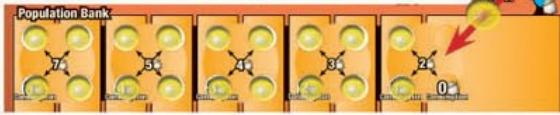
These 25 tokens are the maximum population of your civilization. Tokens in your Yellow Bank are arranged from left to right, so it is easy to see how many you have left.
You can think of the tokens in your Yellow Bank as representing territory your civilization could expand into. When your population increases, you gain a Worker, but the increase in population means that less territory remains for expansion.
The Yellow Bank is divided into five separate regions. As long as there is at least 1 yellow token left in the right-most region, the territory is only sparsely populated. The ①symbol means that the people do not need any Food. (They can hunt or grow it for themselves.) The 2 with the arrows pointing to the tokens mean that increasing the population costs 2 Food.
After you take the final yellow token from the right-most region of your Yellow Bank, your territory is more densely populated. Now the symbol applies, meaning that it requires 1 Food to feed your population every turn. Population increases now cost 3 Food.
The applicable consumption symbol is the one in the left-most empty area of your population bank. The cost to increase population is centered inside the area from which the token is generated. If you have no yellow tokens left in your Yellow Bank, your civilization consumes 6 Food every turn and can not increase its population.
BLUE TOKENS
EACH PIAYER HAS HIS OR HER OWN SET OF BLUE TOKENS. A BLUE TOKEN CAN REPRESENT ETTHER FOOD OR RESOURGES, DEPENDING ON THE CARD THAT PRODUCED IT.
The blue strip on your Civilization Card is your Blue Bank where you keep the blue tokens that are currently not available to your civilization. At the beginning of the game, all your blue tokens are in your Blue Bank.

BLUE TOKENS CAN REPRESENT EITHER FOODOR RESOURCES.
A blue token represents Food when it is sitting on a Farm card and Resources when it is sitting on a Mine card. When Food is consumed or Resources are used, some of your blue tokens are returned to your civilization's Blue Bank.
Your civilization's ability to stockpile Food and Resources is limited. Once you take the last blue token from your Blue Bank, your civilization can not produce any more Food or Resources. You can not produce more Food or Resources unless you have at least one blue token in your Blue Bank.
You can think of the blue tokens in your Blue Bank as representing how much storage space is left to store your civilization's Food and Resources. In the Advanced Game, stockpiling Food and Resources - i.e., having few tokens left in your Blue Bank – encourages Corruption. In the Simple Game, just ignore the divisions and numbers of the Blue Bank.
INITIAL TECHNOLOGIES
THE SIX CARDS ON YOUR CIVILIZATION CARD ARE YOUR INITIAL TECHNOLOGIES. THEY REPRESENT WHAT YOUR CIVILIZATION KNOWS AND WHAT IT CAN BUILD.
The two brown cards are Production Technologies. Bronze Working is a Mining Technology, which allows you to build Mines. Agriculture is a Farming Technology, which allows you to build Farms
The two gray cards are Urban Building Tecbnologies. Religion allows you to build Temples and Philosophy allows you to build Labs
The red card is a Military Technology. Warriors allow you to build Infantry Units ↓0
HAVING THE TECHNOLOGY TO BUILD SOMETHING IS NOT THE SAME AS HAVING THAT THING. THE NUMBER YOU HAVE IS DETERMINED BY THE NUMBER OF WORKER TOKENS ON THE CARD.
At the beginning of the game, you have 2 Mines, 2 Farms, 1 Lab, and 1 Infantry Unit. This is represented by the 6 yellow Worker tokens on the 4 cards. Your civilization has the potential to build a Temple but does not have one yet as there is no Worker token on your Religion card.
GOVERNMENT
THE ORANGE CARD REPRESENTS THE CIVILIZATION'S SYSTEM OF GOVERNMENT.
IT SPECIFIES THE NUMBER OF CIVIL AND MILITARY ACTIONS AVAILABLE EACH TURN.
Every civilization begins with the Government Despotism. The 4 white symbols and 2 red symbolsindicate that you can perform up to 4 Civil Actions and 2 Military Actions on your turn. To help keep track of Actions, you place 4 white tokens and 2 red tokens on the card. When you perform an action, remove the corresponding token. All the tokens are returned to the Government card at the beginning of your next turn.
The symbol specifies the Urban Building Limit of that particular form of Government. For Despotism, the number 2 means that you can build at most 2 Temples and 2 Labs. The number of Farms, Mines, and Military Units is unlimited. More civilized forms of Government have a higher Urban Building Limit (simulating their ability to manage a greater number of large cities).
CULTURE POINTS AND SCIENCE POINTs
The Score Board has two point counters on it. Your Culture Point and Science Point totals are represented by the position of your marker blocks on the counters.
The larger counter is for keeping track of Culture Points. When the game ends, the player with the most Culture Points is the winner.
THE CULTURE POINTS COUNTER CAN RECORD A MAXIMUM OF 190 POINTS. IF YOU GET MORE THAN 19O, JUST MAKE A NOTE OF IT AND START COUNTING AGAIN FROM THE BEGINNING. THERE IS NO LIMIT TO THE NUMBER OF CULTURE POINTS YOU CAN HAVE.
The smaller counter is for keeping track of Science Points. Science Points are spent on new Technologies, so your Science Point total will go up and down.
YOU CAN NOT ACCUMULATE MORE THAN 40 SCIENCE POINTS. IF YOU GAIN MORE SCIENCE POINTS THAN CAN BE SHOWN ON THE COUNTER, YOU LEAVE YOUR SCIENCE MARKER IN THE LAST SQUARE ON THE RIGHT END OF THE POINT COUNTER.
At the beginning of the game, no one has any Culture or Science Points.
Everyone's marker starts at zero.
CULTURE , SCIENCE , AND STRENGTH
THREE INDICATORS HELP TO KEEP TRACK OF THE CURRENT STATE OF THE CIVILIZA-TIONS' CULTURE, SCIENCE, AND MILITARY STRENGTH.
Every civilization produces a certain amount of Culture and Science every turn. Symbols at the bottom of your cards indicate what they can produce.
At the beginning of the game, you produce no Culture. Religion allows you to build Temples which produce 1 Culture Point each. This is depicted on the bottom of the card: 1. If you had 2 Workers on this card, your civilization would make 2 Culture Points every turn. When you have no Workers on it, it produces nothing, so your block begins at zero on the Culture indicator.
The Philosophy card allows you to build Labs which produce 1 Science Point each. This is represented at the bottom of the card: 1. Because you begin with 1 Worker on this card, vou already have 1 Lab. Your marker block should be on square 1 of the Science indicator to show that your civilization is producing 1 Science Point every turn. (Because you have not yet had a turn, your Science Point score counter is still at 0.)
The Warriors card allows you to build Infantry Units with a Strength of 1. This is represented by the white number at the bottom of the card. Because you begin with 1 Worker on this card, you already have 1 Warrior Unit; thus, the Strength of your civilization is 1, and your marker block begins on square 1 of the Strength indicator.
While Culture Points and Science Points are accumulated throughout the game, the Culture, Science, and Strength indicators just reflect the current state of your civilization. Their purpose is to save you time by eliminating the need to re-count these values every turn.
A CIVILIZATION'S CULTURE, SCIENCE, AND STRENGTH RATINGS ARE LIMITED BY THE MAXIMUM VALUES ALLOWED BY THE INDICATORS.
Because the Culture indicator only goes up to 30, you can only gain 30 Culture Points per turn. Because the Science indicator only goes up to 30, you can only gain 30 Science Points per turn. Because the Strength indicator only goes up to 60, your civilization can not have Strength greater than 60. If any of these values exceeds the maximum value of its indicator, your marker remains on the last square.
HaPpY FaCes
The Religion card has a Happy Face indicating that Temples, in addition to producing Culture, make the population happier.
YOUR HAPPINESS INDICATOR IS ON YOUR CIVILIZATION CARD. USE ONE OF YOUR MARKER BLOCKS TO INDICATE YOUR CIVILIZATION'S HAPPINESS.
e Happiness 8 7 6 5 3 2
Your civilization's Happiness begins at 0. (Although you have the Religion Technology, you do not have any Temples yet.) When you build a Temple it moves to 1. A second Temple will move it to 2.
Other cards also have Happy Faces, sometimes several. A few cards have an Unbappy Face that cancels out 1 Happy Face. Your civilization always has Happiness at least 0 and never has more Happiness than 8.
In the Advanced and Full Game, it is important to keep your civilization happy. In the Simple Game, your civilization's Happiness gives you a few bonus Culture Points at the end of the game.
ExTRa CARds ANd ToKENS
Put the extra cards and tokens in the game box so they do not get mixed up with those being used in the game. Players may occasionally gain (or lose) extra tokens, but mostly each plays with his or her own personal supply
Tip: Keep the extra tokens out of reach. This prevents people from accidentally taking extra tokens from the box or returning their tokens to the box instead of to their personal supply.
PLAYING THE GAME
get the same number of turns – so the player on the Starting Player's right will get the last turn of the game.
The game begins in Antiquity, which serves as a preparatory round for the rest of the game. In the first round, players just choose a few cards to shape the way their civilizations will grow and keep track of that turn's production.
The game begins to pick up speed in the second round when players can use all their allotted Civil and Military Actions. Before each player's turn, a few new Civil Cards appear in the Card Row. The appearance of cards from Age I harbinges the beginning of the Middle Ages. From the third round on, CURRENT' EVENTS cards are revealed. These can affect the fortunes of all civilizations.
When the last Civil Card is placed in the Card Row, the game is almost over. Those who have not vet plaved in that round take their turns, and the game ends when the player to the right of the Starting Player finishes his or her turn. Players score any end-of-game bonus points that may be applicable, and the plaver with the most Culture Points is the winner.
FIRST ROUND
In the first round, players can not build anything. They can only use their actions to take Civil Cards.
THe Card Row
The Card Row begins with 13 Civil Cards from Antiquity (labeled "A"). The first 5 are in the region marked , 4 are in the region marked , and the remaining 4 are in the region marked .
TAKING A CARD FROM THE FIRST REGION USES UP 1 CIVIL ACTION. TAKING A CARD FROM THE MIDDLE REGION USES UP 2 CIVIL ACTIONS. TAKING A CARD FROM THE THIRD REGION USES UP 3 CIVIL ACTIONS.
For most of the game, the number of Civil Actions you can take is determined by your system of Government. (Despotism lets you take 4.) In the first round, however, the following rule applies:
IN THE FIRST ROUND, THE STARTING PIAYER CAN ONLY USE 1 CIVIL ACTION. THE SECOND PLAYER CAN ONLY USE 2, THE THIRD PLAYER CAN ONLY USE 3, AND THE FOURTH PLAYER MAY USE ALL 4.
Thus, in the first round, the Starting Player can only take one of the 5 cards in the first region of the Card Row. The second player can take 2 cards from that region, or 1 card from the middle region. The third player can take 3 from the first region, 1 from the first region and 1 from the middle region, or 1 from the third region. Players do not have to use all their actions if they do not want to. There are 3 types of cards in Antiquity – Leaders (green), Action Cards (yellow), and Wonders (purple).
LEADERS (GREEN CIVIL CARDS)

You can choose a historic personality to be the Leader of your civilization. This person's leadership can give your civilization special abilities and benefits.
When you take a Leader card, you keep it in your hand. Leaders can be put into play (except during the first round) for 1 Civil Action. A Leader card's effects apply as soon as it is put into play.
YOU CAN ONLY TAKE 1 LEADER CARD FROM EACH AGE.
So, if you take one Leader card from Age A, you can never take any more Leader cards from Antiquity, regardless of whether or not you actually put your Leader card into play. This does not prevent you from taking a Leader card from Age I.
WONDERS (PURPLE CIVIL CARDS)

Wonders are the most extravagant constructions in the game. They provide significant benefits, but they take time and Resources to build
Wonders are the only cards that you put directly into play. You never keep a Wonder in your hand. If you take a Wonder, place it next to your Government card. The Wonder is now said to be "under construction"
YOU ARE ONLY ALLOWED TO HAVE 1 WONDER "UNDER CONSTRUCTION" AT A TIME. YOU CAN NOT TAKE A NEW WONDER CARD IF YOU ALREADY HAVE A WONDER "UN-DER CONSTRUCTION".
When you complete the Wonder, place it above your Government card to indicate that it has been built. The Wonder's effects begin to apply and you are now allowed to take a new Wonder card - if you can afford it.
THE COST TO TAKE A WONDER CARD IS INCREASED BY 1 CIVIL ACTION FOR EVERY WONDER YOU ALREADY HAVE BUILT.
Example: Karl has already built 2 Wonders. He wants to take a Wonder card from the middle region of the Card Row. Beginning construction on that Wonder will use up 4 Civil Actions (2 to take a card from the middle region and 2 more because he already has 2 Wonders built).
Tip: Before you take a Wonder card, make sure you can build it and make sure you want it. There is no easy way to get rid of a Wonder "under construction", and it can keep you from obtaining a Wonder you need more.
ACTION CARDS (YELLOW CIVIL CARDS)

Unlike most other cards in the game, Action Cards have an immediate, one-time effect. It costs 1 Civil Action to play an Action Card, so you may only play one during your own turn. When you play an Action Card, do what is written on the card and then discard it.
YOU CAN NOT TAKE AN ACTION CARD AND PLAY IT DURING THE SAME TURN. ANY ACTION GARDS YOU TAKE CAN NOT BE USED BEFORE YOUR NEXT TURN.
EXAMPLE OF TAKING CARDSIN THE FIRST ROUND
Three players are choosing from among the following cards:

Adam is the Starting Player, so he has only 1 Civil Action. He takes the Leader Moses into his hand.
Barbara has 2 Civil Actions. She takes the Colossus and places it next to her Despotism card to show that it is "under construction". She decides to use her second Civil Action to take the Engineering Genius card to help build her Wonder more quickly. Until the Colossus is built, she can not take another Wonder card.
Cynthia has 3 Civil Actions. She would like to spend 2 Civil Actions to take Hammurabi, but that would leave her with 1 Civil Action that she could not use. The only cards left in the first region of the Card Row are Leaders, and if she takes Hammurabi she can not take a second Leader from Age A. She decides to take Aristotle for 1 Civil Action and the Library of Alexandria for 2 Civil Actions. Aristotle goes into her hand, and the Library of Alexandria is placed next to her Despotism card to show it is “under construction".
PRODUCTION AND MAINTENANCE
Production and maintenance happen automatically at the end of each player's turn.
PRODUCTION OF SCIENCE AND CULTURE
ADVANCE YOUR MARKERS ON THE CULTURE POINTS AND SCIENCE POINTS COUNTERS. THE AMOUNT BY WHICH TO ADVANCE SHOULD BE SHOWN ON YOUR CULTUREAND SCIENCEINDICATORS.
In the first round, players are not allowed to take actions that would alter the amount of Culture or Science produced by their civilizations, so at the end of your turn, you will score 1 Science Point but no Culture Points.
FOOD PRODUCTION AND CONSUMPTION Every Farm produces Food.
YOU HAVE ONE FARM FOR EVERY WORKER ON A FARMING TECHNOLOGY CARD. FOR EACH FARM, PLACE 1 BLUE RESOURCE TOKEN ON THE CARD. THIS TOKEN REPRESENTS THE AMOUNT OF FOOD SHOWN ON THE BOTTOM OF THE CARD.

In the first round you have 2 Workers on the Agriculture card. Take 2 blue tokens from your Blue Bank and place them on your Agriculture card. Farms using this Technology produce 1 Food each (because of the symbol), so these 2 tokens represent 2 Food.
Later in the game, you might get a new Farming Tecbnology card that allows you to build more efficient Farms. The Irriga-
tion card allows you to build Farms that produce 2 Food. When these Farms produce Food, you still only put 1 blue token on the card for each Farm (i.e., each yellow token makes one blue token). Because of the 2 symbol, each blue token on an Irrigation card represents 2 Food.
AFTER FOOD IS PRODUCED, YOUR CIVILIZATION CONSUMES THE AMOUNT OF FOOD INDICATED BY YOUR YELLOW BANK. THE AMOUNT CONSUMED IS DETERMINED BY THE CONSUMPTION NUMBER NEXT TO THE ICON IN THE LEFT -MOST EMPTY REGION OF YOUR YELLOW BANK.
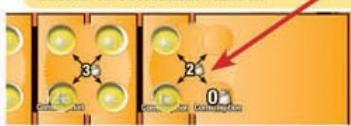
In the first round, you do not pay anything because you still have yellow tokens in the first region of your Yellow Bank. The ① symbol on the right of the region
indicates that you pay nothing. Later, after two Workers have been added to your population, thefirstregion ofyour Yellow Bankwillbeemptyandyouwillhavetopay 1 Food every turn because the second region has the symbol. You will pay 1 Food by moving a blue token from your Agriculture card to your Blue Bank.
RESOURCE PRODUCTION

YOU HAVE ONE MINE FOR EVERY WORKER ON A MINING TECHNOLOGY CARD. FOR EACH MINE, PLACE 1 BLUE TOKEN ON THE CARD. THIS TOKEN REPRESENTS THE AMOUNT OF RESOURCESSHOWN ON THE BOTTOM OF THE CARD.
Mine production works like Farm production. In the first round. you take 2 blue tokens from your Blue Bank and place them on your Bronze card. (The numbers on your Blue Bank represent Corruption. They do not apply to the Simple Game, so just ignore them.)
Resources represent various raw materials, not just metals. The Bronze Tecbnology is a symbol of how advanced your industry is.
THE SECOND ROUND
THE TURN
EACH PLAYER GETS ONE TURN. ON YOUR TURN YOU DO THE FOLLOWING THINGS IN THIS ORDER:
-
ADD CARDS TO THE CARD ROW.
-
PLAY YOUR CIVIL AND MILITARY ACTIONS.
-
PERFORM PRODUCTION AND MAINTENANCE.
THe Card Row
Except during the first round, each player begins his or her turn by adding new Civil Cards to the Card Row. This is done in three steps:
1) REMOVE CARDS AT THE FRONT OF THE CARD ROW:
IN A 2-PLAYER GAME, REMOVE CARDS FROM THE FIRST 3 POSITIONS IN A 3-PLAYER GAME, REMOVE CARDS FROM THE FIRST 2 POSITIONS. IN A 4-PLAYER GAME, REMOVE THE CARD IN THE FIRST POSITION. IF A POSITION IS EMPTY (BECAUSE THE PREVIOUS PLAYER TOOK A CARD FROM THERE) THEN DO NOT TAKE A CARD FROM ANOTHER POSITION. IF THERE ARE NO CARDS IN THE FIRST POSITIONS THEN NO CARDS ARE REMOVED.
Cards removed this way do not come back into the game. Put these cards in the box so that they do not return to the game.
Example: In the previous example, the first card in the Card Row was taken, but the second was not. Because it is a 3-plaver game, cards must be removed from the first two positions. Adam is the Starting Player, so he begins the second round. He starts his turn by removing the Homer card from the second position and placing it in the box.
2) ALL CARDS MOVE TO THE LEFT, LEAVING NO OPEN POSITIONS BETWEEN THEM. Thus cards move from more expensive positions to less expensive positions. The Card Row now has several empty positions, all of them on the right.
3) DEAL ONE CARD FROM THE CIVIL DECK TO EACH EMPTY POSITION.
On the Starting Player's turn in the second round, all these cards will come from Civil Deck A. Everyone else, however, will deal their cards from Civil Deck I. Place the remaining Civil Deck A cards in the box and start using Civil Deck I on the light square on the Score Board. This marks the beginning of Age I, the Middle Ages.
IN ROUND TWO, THE STARTING PLAYER ADDS CARDS TO THE CARD ROW FROM CIVIL DECK A. AFTER THIS, CARDS ARE ALWAYS ADDED FROM CIVIL DECK I.
UsING CIVIL AND MILITARY ACTIONS
You are limited to the number of Actions allowed by your civilization's system of Government. Under Despotism you can perform 4 Civil Actions and 2 Military Actions. The 4 white tokens and 2 red tokens are used to keep track of these Actions. When you use an Action, take the corresponding token off your Government card (white for Civil Actions, red for Military Actions). You may perform your Actions in any order, possibly alternating between Civil and Military Actions if you wish. Unless otherwise specified, you may perform the same Action as many times as you can pay for it. You do not have to use all yourActions, but you can not use more Actions than your system of Government allows.
POTENTIAL CIVIL ACTIONS:
INCREASE POPULATION
• BUILD A MINE OR A FARM
• BUILD AN URBAN BUILDING
• UPGRADE A MINE, FARM, OR BUILDING*
• DESTROY A MINE, FARM, OR BUILDING
• CONSTRUCT ONE STAGE OF A WONDER
• PUT A LEADER INTO PLAY
• DISCOVER A NEW TEGHNOLOGY AND PUT IT INTO PLAY*
• PLAY AN ACTION CARD
• TAKE A CIVIL CARD FROM THE CARD ROW
POTENTIAL MILITARY ACTIONS:
• BUILD A MILITARY UNIT
• UPGRADE A UNIT *
• DISBAND A UNIT
Actions marked with asterix (*) are described later because it is unlikely that you will have the ability to perform them in the second round.
INCREASE POPULATION
It costs 1 Civil Action to increase your population. Take one yellow token from the right-most occupied region of your Yellow Bank and pay the amount of Food specified by the number pointing to the token. Place the Work-
er token in the Unused Workers Pool (the orange rectangle on your Civilization Card).


At first, increasing your population only costs 2 Food. At the end of your first turn, your civilization produced 2 Food, so you are able to increase your population in round two. (The 2 Food are represented by the 2 blue tokens sitting on the Agriculture card. The card says that each of these tokens is worth 1 Food.)
To INCREASE YOUR POPULATION:
• You use 1 CIviL Action
(MOVE 1 WHITE TOKEN OFF YOUR GOVERNMENT CARD).
• YOU PAY A SPECIFIED AMOUNT OF FOOD (MOVE BLUE TOKENS FROM A FARMING TECHNOLOGY CARD TO YOUR BLUE BANK).
• YOU INCREASE YOUR POPULATION (MOVE ONE YELLOW TOKEN FROM YOUR YELLOW BANK TO YOUR UNUSED WORKERS POOL).
BuIld A MINe Or Farm
It costs 1 Civil Action to build a Mine or Farm. In addition, you must pay the amount of Resources specified on the Tecbnology card (the red number on the left). Move one Worker from the Unused Workers Pool to the Technology card. That yellow token now represents a Mine or a Farm, depending on whether it is a Mining Tecbnology or a Farming Technology. If you do not have enough Resources or if you do not have an Unused Worker, then you can not build. At the end of your turn in round one, your civilization produced 2 Resources. (On your Bronze card are two blue tokens. The card indicates that each is worth 1 Resource.) This is enough to build one Farm on the Agriculture card or one Mine on the Bronze card.
To BUIld A FARM Or A MINe:
• You use 1 CIvit Action
(MOVE 1 WHITE TOKEN OFF YOUR GOVERNMENT CARD).
• YOU PAY A SPECIFIED AMOUNT OF RESOURGES (MOVE BLUE TOKENS FROM A MINING TECHNOLOGY CARD TO YOUR BLUE BANK).
• YOU BUILD THE FARM OR MINE (MOVE ONE YELLOW TOKEN FROM YOUR UNUSED WORKERS POOL TO THE FARMING OR MINING TECHNOLOGY CARD)
Your new Farm or Mine will be producing during the production and maintenance phase of your turn.
BUILD AN URBAN BUILDING
You will probably not be able to build an Urban Building in the second round because those available to you cost 3 Resources, but it is possible if you have the right Action Card. Urban Buildings are built the same way Farms and Mines are. However, they are limited by the system of Government. (Your Urban Building Limit is the number in the lower right corner of your Government card.)
YOU CAN NOT HAVE MORE URBAN BUILDINGS OF THE SAME TYPE THAN THE URBAN BUILDING LIMIT SHOWN ON YOUR GOVERNMENT CARD.
Under Despotism, you can have a maximum of two Labs and two Temples.
To BUILD AN URBAN BUILDING:
• YOU CHECK TO MAKE SURE YOU ARE NOT ALREADY AT THE LIMIT ALLOWED BY YOUR TYPE OF GOVERNMENT.
• YOU USE 1 GIVIL ACTION(MOVE 1 WHITE TOKEN OFF YOUR GOVERNMENT CARD).
• YOU PAY A SPECIFIED AMOUNT OF RESOURGES (MOVE BLUE TOKENS FROM A MINING TECHNOLOGY CARD TO YOUR BLUE BANK).
• YOU BUILD THE URBAN BUILDING (MOVE ONE YELLOW TOKEN FROM YOUR UNUSED WORKERS POOL TO THE URBAN TECHNOLOGY CARD).
• YOU ADJUST YOUR INDICATORS.
Your new Urban Building increases your civilization's production of Science, Culture, and/or Happy Faces. Adjust your markers on the indicators to show this. If you build a Lab, your Science indicator marker should be moved forward 1 square (but not vour Science Points marker - the Lab will not produce Science until the production phase of your turn). If you build a Temple, move your Culture indicator marker and your Happy Face indicator marker ahead one square (but not your Culture Points marker).
DESTROY A BUILDING, FARM OR MINE
You can remove a Worker token from a Building, Farming, or Mining Technology card by spending 1 Civil Action. This destroys the improvement. It no longer produces, and you should adjust your indicators accordingly. The Worker is returned to your Unused Workers Pool. You do not put the token back in your Yellow Bank. No Resources are refunded when you destroy an improvement. All you get is an Unused Worker.
To DESTROY AN IMPROVEMENT:
• You Use 1 CIviL Action
(MOVE 1 WHITE TOKEN OFF YOUR GOVERNMENT CARD).
• YOU DESTROY THE IMPROVEMENT (MOVE 1 YELLOW TOKEN OFF THE TECHNOLOGY CARD AND PLACE IT IN YOUR UNUSED WORKERS POOL).
• YOU ADJUST YOUR INDICATORS (IF YOU DESTROYED AN URBAN BUILDING).
BUILD A MILITARY UNIT
You can conscript a Military Unit the same way you build an improvement. The only difference is that conscription requires 1 Military Action. The cost in Resources is given by the red number on the Military Technology card. You may have as many Units of each type as you want. Once you build a Unit, adjust your Strength indicator marker.
To BUILD A MILITARY UNIT:
YOU USE 1 MILITARY ACTION(MOVE 1 RED TOKEN OFF YOUR GOVERNMENT CARD).
• YOU PAY A SPECIFIED AMOUNT OF RESOURCES (MOVE BLUE TOKENS FROM A MINING TECHNOLOGY CARD TO YOUR BLUE BANK).
• YOU BUILD THE UNIT (MOVE ONE YELLOW TOKEN FROM YOUR UNUSED WORKERS POOL TO THE MILITARY TECHNOLOGY CARD).
• YOU ADJUST YOUR STRENGTH INDICATOR.
The Leader Homer and some Action Cards give you special Resources "for building Military Units". Instead of using blue tokens to represent these Resources, you keep track of them in your head. When you build or upgrade a Military Unit, you use these special Resources first. This may give you some Units for free. When you have used up all these special Resources, you go back to paying for Units the usual way. Any special Resources left unused are lost at the end of your turn.
DISBAND A MILITARY UNIT
Disbanding a Military Unit is like destroying an improvement except that it costs 1 Military Action instead of 1 Civil Action.
To DISBAND A MILITARY UNIT:
YOU USE 1 MILITARY ACTION(MOVE 1 RED TOKEN OFF YOUR GOVERNMENT CARD).
• YOU DISBAND THE UNIT (MOVE 1 YELLOW TOKEN OFF THE MILITARY TECHNOLOGY CARD AND PUT IT IN YOUR UNUSED WORKERS POOL).
• YOU ADJUST YOUR STRENGTH INDICATOR.
CONSTRUCT ONE STAGE OF A WONDER
Wonders are built in several stages. For each stage, you must pay 1 Civil Action and the number of Resources specified by the numbers on the bottom of the Wonder card. For example, the Pyramids cost 3 2 1to build. This means you have to build it in three stages; the first stage of construction costs 3 Resources, the second stage 2 Resources, and finishing the Pyramids costs 1 Resource. These stages must be built in order, and each stage costs 1 Civil Action. It is not necessary to build all the stages in the same turn, but you are allowed to build as many times as you can pay for.
When you build a stage, use a blue token from your Blue Bank to cover up the number corresponding to that stage. These tokens do not represent Food or Resources. They merely serve to keep track of which stages have been built. (These missing tokens may prevent you from being able to produce if you run out of tokens in your Blue Bank. In the other versions of the game, taking these tokens may increase Corruption, but in the Simple Game you do not have to worry about the effects of unscrupulous government contractors.)
When the last stage is built, the Wonder is complete. Return the blue tokens to your Blue Bank and move the Wonder to the space above your Government card to show that it has been built. It takes effect immediately. If it produces anything, it will begin producing this turn and any special abilities it gives you can be used immediately.
A WONDER WORKS ITS WONDERS WITHOUT WORKERS. YOU NEVER PUT WORKERS ON A WONDER. A WONDER PRODUCES AUTOMATICALLY, UNLIKE AN URBAN BUILDING WHICH IS PRODUCING ONCE FOR EACH WORKER ON THE CARD.
This is the advantage of a Wonder over a Building, but Wonders are more difficult to build than Buildings. Furthermore, for each Wonder you have built, you must pay 1 additional Civil Action when you take another Wonder card from the Card Row.
To BUILD ONE STAGE OF A WONDER:
• You use 1 CIVIL AcTioN
(MOVE 1 WHITE TOKEN OFF YOUR GOVERNMENT CARD).
• YOU PAY A SPECIFIED AMOUNT OF RESOURCES (MOVE BLUE TOKENS FROM A MINING TECHNOLOGY CARD TO YOUR BLUE BANK).
• YOU BUILD THAT STAGE OF THE WONDER (TAKE ONE BLUE TOKEN FROM YOUR BLUE BANK AND USE IT TO COVER UP THE NUMBER REPRESENTING THE COST OF THE STAGE THAT YOU BUILT).
ONCE YOU HAVE BUILT THE LAST STAGE OF THE WONDER:
• YOU RETURN THE BLUE TOKENS ON YOUR WONDER CARD TO YOUR BLUE BANK.
• YOU PLACE THE WONDER CARD ABOVE YOUR GOVERNMENT CARD.
• YOU ADJUST YOUR INDICATORS.
• YOU DEAL WITH THE WONDER'S SPECIAL EFFECTS, IF IT HAS ANY. (SEE BELOW.)
PUT A LEADER INTO PLAY
Every civilization can have a Leader- a historical personality whose influence is felt throughout the entire Age.
Putting a Leader into play costs 1 Civil Action. Take the card from your hand and put it on the table next to your Government card. You may put the card into play even if you drew it from the Card Row this turn. (Note that drawing a Leader card from the Card Row and putting it into play are two separate Actions.) The Leader's effects begin immediately.
Your civilization can only have one Leader. Furthermore, if you draw a Leader card, you are not allowed to draw any more Leader cards from that Age. If you have a Leader in play and you play a new Leader (from a different Age, of course) then discard the old Leader. The old Leader's effects no longer work, and the new Leader's effects begin immediately.
To PUT A LEADER INTO PLAY:
• You Use 1 CIvIL AcTioN
(MOVE 1 WHITE TOKEN OFF YOUR GOVERNMENT CARD).
• YOU REMOVE YOUR PREVIOUS LEADER FROM PLAY (IF THERE WAS ONE) AND LOSE ANY BONUSES THAT LEADER GAVE YOU. (ADJUST YOUR INDICATORS.)
• YOU PUT THE NEW LEADER CARD ON THE TABLE NEXT TO YOUR GOVERNMENT CARD.
• YOU ADJUST YOUR INDICATORS TO REFLECT ANY BONUSES PROVIDED BY YOUR NEW LEADER.
• DEAL WITH ANY SPECIAL EFFECTS YOUR NEW LEADER HAS. (SEE BELOW.)
SPECIAL EFFECTS OF WONDERS AND LEADERS
Some Wonders and Leaders have additional special effects which are written on the card. Some can increase your number of Actions. The Pyramids, for example, give you 1 extra Civil Action each round. When you complete the Pyramids you immediately take one white token from the box and put it on your Government card. (So you can use it on the turn you build the Pyramids.) Hammurabi also gives you 1 extra Civil Action, but takes away one Military Action, so you put one of your red tokens back in the box when you take the new white token out. When your civilization gets a Leader to replace Hammurabi you put one of your white tokens back and take back a red token and put it on your Government card. Note that when you gain an Action token, you put it on your Government card and can use it that turn; when you lose an Action token you can take away one of the tokens that you have already used that turn.
Tip: Some Leaders and Wonders have special effects or limitations that do not apply to the Simple Game. (Examples include the Colossus, Columbus, or Genghis Khan.) Just ignore any effects you do not understand.
PLAY AN ACTION CARD
Playing an Action Card costs 1 Civil Action. Unlike other cards, you can not use an Action Card the turn you draw it from the Card Row. Action Cards have an effect which takes place immediately. Once you play the card, discard it.
Action Cards can give you extra Resources or Food. When you gain a Resource this way, you take a blue token from your Blue Bank and place it on the proper Technology card, just as if it were produced by a Mine or a Farm.
Action Cards can give you Culture Points or Ścience Points. Score the points on the point counter immediately. Note that this does not affect your indicators at all, only your counters. The points are only gained on the turn you play the card. Some Action Cards include the effect of another Action. A card that allows you to build a Building at a discount includes the Action of building in its effect. A card that allows you to increase your population and gives you back Food includes the Action of increasing your population. (Note this is not the same as a discount; you can only use the card if you could increase your population without it.) You do not have to pay any extra Civil Actions to perform the Action included in the card.
To PLAY AN ACTION CARD:
• You use 1 CIviL Action
(MOVE 1 WHITE TOKEN OFF YOUR GOVERNMENT CARD).
• YOU DO WHAT IT SAYS ON THE CARD (WHICH MAY INCLUDE ANOTHER ACTION).
• YOU DISCARD THE ACTION CARD.
YOU CAN NOT PLAY AN ACTION CARD THAT YOU TOOK FROM THE CARD ROW DURING THE SAME TURN.
Example: In the first round, Barbara placed the Colossus "under construction". She only has 2 Resources and it costs 3 to build the first stage of the Colossus. She is holding the Action Card Engineering Genius, which she drew on her previous turn. This card allows her to build one stage of a Wonder for 2 Resources less. She plays this card, pays 1 Resource, and builds the first stage of the Colossus. This cost her 1 Action Poínt, so she has 3 left. In the Card Row is another Engineering Genius card which costs 2 Action Poínts to take (because it is in the middle region of the Card Row). She can take this card, but can not use it this turn because Action Cards can not be used the turn they are taken. This would leave her with 1 Action which she could use to increase her civilization's population or to take another card.
Tip: The Action Cards that include another Action are advantageous because they save you one Civil Action. However, those that do not include an Action provide more general effects and are helpful in more situations.
TAKE A CARD FROM THE CARD ROW
This is the same as in round one. In the Age I deck, however, you encounter a new type of card: Tecbnologies. Under the Technology card's name is a blue number and the symbol. That tells you how many Science Points it costs to put the Technology into play. In the second round, you only have 1 Science Point, so you probably can not put any Technology cards into play this round, but you can take one from the Card Row and save it for later.
Tecbnology cards come in several colors. Most of them have already been discussed in the section on Initial Technologies. The brown ones are Farming or Mining Tecbnologies, the gray ones are Urban Building Technologies, the red ones are Military Technologies, and the orange ones are systems of Government. There are also blue Special Technology cards. They have special effects that do not require you to build anything.
There are multiple copies of most Technology cards. (How many copies depends on the number of players.) So even if someone else takes the Technology you need, you still have a chance to get it later.
YOU ARE NOT ALLOWED TO TAKE A TECHNOLOGY CARD IF YOU ALREADY HAVE THAT SAME TECHNOLOGY IN YOUR HAND OR IN PLAY ON THE TABLE.
SUMMARY OF CIVIL CARDS
LIMITATIONS ON TAKING CIVIL CARDS:
• YOU CAN ONLY TAKE ONE LEADER (GREEN CARD) FROM EACH AGE.
• YOU CAN ONLY TAKE A WONDER (PURPLE CARD) IF YOU HAVE NO WONDER "UNDER CONSTRUCTION". To TAKE A WONDER, YOU MUST PAY 1 EXTRA CIVIL ACTION FOR EACH WONDER YOU ALREADY HAVE BUILT. THE WONDER CARD IS PLACED ON THE TABLE IMMEDIATELY, INDICATING THAT IT IS "UNDER CONSTRUCTION".
• YOU CAN TAKE AS MANY ACTION GARDS (YELLOW CARDS) AS YOU CAN PAY FOR. YOU CAN NOT PLAY AN ACTION CARD THE SAME TURN YOU TAKE IT.
• YOU CAN NOT TAKE A TECHNOLOGY CARD (ORANGE, RED, BLUE, BROWN, OR GRAY CARD) WITH THE SAME NAME AS A TECHNOLOGY CARD YOU ALREADY HAVE IN YOUR HAND OR IN PLAY ON THE TABLE.
here is a limit to the number of Civil Cards you can keep in your hand. YOU CAN NOT TAKE A NEW CIVIL CGARD INTO YOUR HAND UNLESS THE NUMBER OF CARDS CURRENTLY IN YOUR HAND IS LESS THAN YOUR TOTAL NUMBER OF WHITE TOKENS.
So at the beginning of the game, you are limited to 4 Civil Cards. If you are holding 4, you can not take a new one into your hand until you play one of them. You can, however, take a Wonder because that does not go into your hand. If for some reason you have more cards in your hand than allowed, you do not have to discard any. The limit only prevents you from taking new cards.
Tip: Think carefully about the cards you take. If you are holding cards you can not play, then you may be unable to take the cards you need and you may be unable to use all of your Civil Actions.
PRODUCTION AND MAINTENANCE
Production and maintenance are the same as in round one. In round two, however, the civilizations begin to differentiate. A civilization that built a third Farm will produce 3 Food instead of 2. A civilization that built a third Mine will produce 3 Resources instead of 2. A civilization that built an Urban Building will produce a Culture Point or an extra Science Point depending on the type of Building. Food and Resources that were not used during the turn are not lost. The blue tokens remain on the cards, even as new blue tokens are added, making it possible to save up for bigger projects in later turns. (But be careful: if you run out of blue tokens, you can not produce any more Food or Resources until some blue tokens are spent.)
Tip: A typical second round tactic is to increase population and build 1 Farm or Mine. This uses up all your Food and Resources. Your two remaining Civil Actions depend on the cards you took in the first round and the opportunities available in the Card Row.
In the Símple Game, military Strength is not important. Military build-up can pay off at the end of the game, when it earns you bonus Culture Poínts, but there is no reason to spend Resources on it in the early rounds. Even in the Full Game, players usually wait a few turns before beginning military build-up.
LATER ROUNDs
It usually takes a few rounds to build up the Science Points to play a Technology card. These cards can give you the ability to upgrade your Units, Buildings, Mines, and Farms. Also, Events begin occurring in the third round.
EVENTS
During set up, you should have placed 9 Event cards from Military Deck A on the CURRENT EVENTS stack. Beginning in round three, the Starting Player should reveal the top card before taking his or her turn. The Event described by the card applies to all players.
Events in Age A are positive, benefiting the civilizations. For example, Development of Agriculture says, "Each civilization produces 2 Food." This means you take 2 blue tokens from your Blue Bank and put them on your Agriculture card, where they represent 1 Food each. (If you have already discovered the Irrigation Tecbnology, you may instead take 1 blue token from your Blue Bank and put it on the Irrigation card where it represents 2 Food.)
Tip: Some Events allow you to build a Unit or a Building for free, but they require you to have an Unused Worker. It is a good idea to keep one Unused Worker in your Unused Workers Pool so you can take advantage of these opportunities.
In the other versions of the game, Events work a bit differently.
PLAY A TECHNOLOGY CARD
For 1 Civil Action, you can play a Technology card from your hand, if you have enough Science Points to pay for it. (Government Technology cards have a special cost. See below.) You may play a Tecbnology that you drew this turn or one you drew earlier. The number of Science Points to pay is given by the blue number next to the symbol. Move your Science Points marker back that many spaces. If you do not have that many Science Points, you can not play that card yet.
Many Tecbnology cards are improvements over your Initial Technologies. The type of Technology is described on the card. Iron, for example, is a Mining Technology, allowing you to build Mines. It is played so that it partially covers your Bronze card. Blue and yellow tokens on your Bronze card remain there, and your Iron card has no tokens initially.
Some Technology cards allow you to build new types of Urban Buildings (Theaters, Arenas, and Libraries) or Military Units (Cavalry). These cards should be placed next to the cards of the same color that you already have in place.
A new Building, Farming, Mining, or Unit Tecbnology only gives you the ability to build something. It does not give you the thing itself until you take the action that moves a Worker token onto the card.
The Special Technologies (blue cards), however, give you their bonuses immediately - they do not require a Worker. Some give you additional Civil or Military Actions (allowing you to take a white or red token from the box and put it on your Government card). Some give a discount on building projects or Wonders. Some increase your military Strength (adjust your indicator immediately). The Cartography card gives you a bonus during Colonization. This bonus has no meaning in the Simple Game because you will not be Colonizing. Special Technology cards should be placed next to your Government card.
To PLAY A TECHNOLOGY:
• You Use 1 CrvIL AcTioN
(MOVE 1 WHITE TOKEN OFF YOUR GOVERNMENT CARD).
• YOU PAY THE SPECIFIED NUMBER OF SCIENCE POINTS(MOVE YOUR SCIENCE POINTS MARKER THAT MANY SPACES BACK).
• YOU PLACE THE CARD ON THE TABLE.
• IF YOU PLAY A SPEGIAL TECHNOLOGY CARD, YOU APPLY ITS EFFECT (WHICH MAY INVOLVE ADJUSTING YOUR INDICATORS).
The picture at the end of the Simple Game section shows where your Technology cards should be played.
PLAY A GOVERNMENT CARD
Your system of Government is also represented by a Technology card. However, changing your Government is not as easy as playing other Technologies. But it can be worth the price: more advanced Governments give you more Actions, they have higher Urban Building Limits, and sometimes they give special bonuses. There are two ways to change your system of Government.
REVOLUTION
Revolution represents change of Government by force. It costs you all of your Civil Actions - you are not allowed to take any Civil Actions on your turn. In addition, you must pay the lesser of the two Science Point costs specified on the card.
To DECLARE A REVOLUTION:
• IT MUST BE YOUR FIRST AND ONLY CIVIL ACTION ON YOUR TURN. (ALL YOUR WHITE TOKENS MUST BE ON YOUR OLD GOVERNMENT CARI
• YOU PAY THE LESSER NUMBER OF SCIENGE POINTS SPECIFIED BY THE GOVERN-MENT CARD. (MOVE YOUR SGIENGE POINT COUNTER BACK THAT MANY SPACES.)
• YOU REPLACE YOUR OLD GOVERNMENT CARD WITH YOUR NEW GOVERNMENT CARD.
TAKE RED AND WHITE TOKENS FROM THE BOX — OR PUT SOME BACK — ACCORDING TO THE NUMBER OF ACTIONS ALLOWED BY YOUR NEW GOVERNMENT. WHEN COMPUTING YOUR TOTAL NUMBER OF CIVIL AND MILITARY ACTIONS, INCLUDE ANY BONUS ACTIONS PROVIDED BY WONDERS, LEADERS, AND SPECIAL TECHNOLOGIES.
• PLACE ALL YOUR WHITE TOKENS NEXT TO YOUR GOVERNMENT CARD TO SHOW THAT THEY HAVE ALL BEEN USED THIS TURN. THE NUMBER OF RED TOKENS USED SHOULD CORRESPOND TO THE NUMBER THAT WERE USED BEFORE YOU DECLARED REVOLUTION,
• RESOLVE ANY OTHER EFFECTS ON THE NEW GOVERNMENT CARD. (THEOCRACY, FOR EXAMPLE, GIVES YOU ADDITIONAL HAPPY FACES.)
Although you can still use all your Military Actions on the turn in which you declare a Revolution, you do not get to do much else. (The Breakthrough Action Card can be used to declare a Revolution, if it is your only Civil Action. Breakthrough allows you to play a Technology and then gain Science Points and a Government is a Technology. It still costs you all of your Civil Actions to declare a Revolution with a Breakthrough card.)

Example: Adam's civilization is governed by Despotism under the Leader Hammurabi, so he has 5 Civil Actions and 1 Military Action. For 1 Civil Action, Adam takes Monarchy from the Card Row. He can not declare a Revolution
to Monarchy that turn because he needs all his Civil Actions to do so. On his next turn, Adam chooses Revolution as his first and only Civil Action. He pays 3 Science Points, and replaces Despotism with Monarchy. Monarchy normally gives 5 Civil Actions and 3 Military Ac-
tions. Because Adam has Hammurabi, however, he will have 6 Civil Actions and 2 Military Actions. He takes tokens from the box so that he has 6 white tokens and 2 red tokens. He places the white tokens next to his Monarchy card to show that his Civil Actions have been used. The red tokens are placed on the card because he still can use both his Military Actions.

PEACEFUL CHANGE OF GOVERNMENT It is possible to change your Government for only 1 Civil Action.
CHANGING YOUR GOVERNMENT COSTS ONLY 1 CIVIL ACTION IF YOU PAY THE GREATER NUMBER OF SCIENCE POINTS (THE PRICE IN PARENTHESES).
In a peaceful change of Government, you still must replace your old Government card and re-compute your total number of Civil and Military Actions. After the change, the number of used Civil Actions will be 1 more than it was before the change. The number of used Military Actions will be the same.
Example: If Adam had 9 Science Points in the previous example, he could take Monarchy for 1 Civil Action. Then for his second Civil Action, he could play Monarchy for 9 Science Points. As calculated above, Monarchy combines with Hammurabi to give Adam 6 Civil Actions. He will have 2 white tokens beside the Monarchy card and 4 white tokens on the card to represent the 4 Civil Actions he still has available this turn.
UPGRADE A BUILDING, Mine, Or Farm
Initially, you can only build Buildings, Mines, and Farms from Age A. Technologies from Age I allow you to build Level I Buildings, Mines, and Farms.
THE LEVEL OF A BUILDING, MINE, OR FARM IS THE SAME AS THE AGE THE CARD IS FROM. THOSE FROM AGE A ARE LEVEL O.
Playing the Technology does not automatically give you Buildings, Mines, or Farms of the new Level. You must either build them directly as described above or upgrade old ones. Upgrading works like building except that the Worker comes from a lower level card of the same type (instead of your Unused Workers Pool) and the cost is the difference between the new one and the old one.
To UPGRADE A BUILDING:
• You Use 1 CIvIt AcTion YOU USE 1 CIVIL ACTION
(MOVE 1 WHITE TOKEN OFF YOUR GOVERNMENT CARD).
YOU PAY A NUMBER OF RESOURCES EQUAL TO THE DIFFERENCE BETWEEN THE BUILDING COST OF THE NEW BUILDING AND THE BUILDING COST OF THE OLD BUILDING (MOVE BLUE TOKENS REPRESENTING THAT MANY RESOURGES FROM YOUR MINING MINING CARDS TO YOUR BLUE BANK).
• UPGRADE THE BUILDING (MOVE 1 WORKER TOKEN FROM THE OLD CARD TO THE NEW CARD).
• ADJUST YOUR INDICATORS.
Upgrading a Farm or a Mine works exactly the same way (except that indicators do not need to be adjusted). A Farm can only be upgraded from another Farm. A Mine can only be upgraded from another Mine. An Urban Building can only be upgraded from another Building of the same type: Temples must be upgraded to Temples, not Theaters or Labs.
Upgrading Buildings makes your Workers more efficient – one Worker can produce more. Do not forget that you can build advanced Buildings, Mines, and Farms directly. Furthermore, you can still build ones from an older Age even if you have the Technology that allows you to build those of a newer Age.
Example: In the picture, Barbara has 4 Level 0 Mines and 8 Resources. She has just played Iron for 5 Science Points and 1 Civil Action.

Iron allows Barbara to build a Level I Mine for 5 Resources or upgrade a Level 0 Mine to Level 1 for 3 Resources. She could upgrade 2 of her Mines to Level I for 6 Resources and 2 Civil Actions. That would leave her with 2 Resources. For 1 Civil Action she could use them to build a new Level 0 Mine. This would be ineffective, however. For the same amount of Resources (8), she can build one Level I Mine for 5 and upgrade one Level 0 Mine for 3. Either way gives her 2 Level I Mines
and 3 Level 0 Mines, but the second option only costs 2 Civil Actions.
THE URBAN BUILDING LIMIT
In addition to producing more per Worker, higher level Urban Buildings allow you to produce more while staying within the Urban Building Limit defined by your Government.
Tip: Despotism only allows you 2 Buildings of each type. Once you have 2 Labs and 2 Temples, you can not build any more Urban Buildings unless you play a new Technology. You could change to a new Government with a higher Urban Building Limit. The Drama Tecbnology will allow you to build Theaters. Or
you could play Alchemy which would allow you to upgrade both your Labs. Note that the Urban Building Limit applies to each type of Urban Building, regardless of Level. Thus a Despotism can only have 2 Labs, 2 Temples 2 Libraries, 2 Theaters, and 2 Arenas. The number of Farms, Mines, Wonders, and Units is not limited.
HIGHER LEVEL FARMS AND MINES
DURING PRODUCTION, EVERY YELLOW WORKER TOKEN ON A FARM OR MINE PRODUCES 1 BLUE TOKEN. THIS BLUE TOKEN REPRESENTS THE AMOUNT OF FOOD OR RESOURCES INDICATED BY THE CARD ON WHICH IT RESTS.
So if you have a Level I Mine (represented by a Worker on your Iron card), you place 1 blue token on your Iron card during production. But this blue token represents 2 Resources instead of 1 because of the symbol on the Iron card. When you use this token to pay for something (by returning it to your Blue Bank) it counts as 2 Resources.
You are allowed to make change(s) by moving a blue token from a higher level Mine to a lower level Mine. Moving a blue token from your Iron card (where it represents 2 Resources) to vour Bronze card (where it represents 1 Resource) is the same as paving 1 Resource. However, it is never legal to move a blue token from a lower level card to a higher level card. For example, you can not remove 2 blue tokens from your Bronze card and put one on your Iron card and one in your Blue Bank, even though such a maneuver would not increase your total number of Resources. Analogous rules apply for Food.
Sometimes after upgrading or making change(s), you will have blue tokens on a card that has no yellow tokens. This is legal. For example, you can use your Bronze card for making change(s) even if you do not have a Level 0 Mine. Similarly, if a card says "Your civilization produces 2 resources", you may take 1 blue token from your Blue Bank and place it on Iron, whether or not there is a Worker on Iron.
Example: In the previous example, Barbara spent all her Resources,
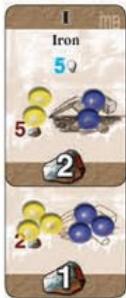
ending up with 3 Level 0
内容过长,此处只内联前一部分;完整内容请下载或到规则页阅读。
下载 Markdownrules_en_through-the-ages-a-story-of-civilization_25613_ocr.md100.2 KB
来源类型:OCR 文本(非 PDF 源,早期 OCR 产物)
说明:原文未改动,仅调整存放位置与文件名;非 PDF 扫描件,无对应原书 PDF
[第1页]
Viaapa Crvatin’s
A STORY OF CIVILIZATION :
Each player develops a civilization from Antiquity to Modern Times, striving to leave a lasting impression on history.
Your civilization scores Culture Points for its influence on world affairs through literature, drama, religion, wondrous constructions, great leaders, and
even international treaties, Not all influence is postive: You can spread your culture with spear and sword, ot make history with a fateful assassination,
tis up o you to decide if your civilization will make its mark by encouraging the ars, by launching a crusade, or by building fastfood franchises.
THREE Ways To PLay NoreEs ON THE TEXT
You do not have to read this entire rulebook before you play your first game of ‘The rules and game mechanics are presented in the order in which you will
Through the Ages. This book contains rules for the Simple, Advanced, and encounter them during play. Thus it is possible o play your first game while
Full versions of the game. reading this rulebook. In addition, each player has an Overview Card provid-
You should start with the Simple Game, which introduces the basic game me- ing a brief summary of key points of the game,
chanics. In addition to being a shorter game, itis less confrontational, giving When you need to look something up, Key points and examples are highlighted.
new players a chance to learn how to build civilizations without the threat of
‘want to return to the Simple Game when introducing a new player to Through
the Ages. Example: Examples of how the rules work are written like this.
The Advanced Game includes game mechanics which make the game More ws 4 ar aR OFA NSN NS BRO Ne LER
ineractive. You willbe able to pay it once you understand the concepts in| seal al al oes ecient cL
the Simple Game. It gives experienced players a shorter alternative to the Full | UES UNS A pdpian appa rected tae,
Game quickly and help new players avoid costly mistakes,
The Full Game is the longest and most complex version. This i the version that
allows you to develop your civilization from the Bronze Age through the ages
to Modern Times. Be warned: even the Simple Game can take several hours,
‘when played for the first time, You should not try the Ful Game until you know
how long it takes you to play the Advanced Game,
This shows the initial set up fora civilization. As the picture applies to all three versions ofthe game, it ison the first page for ease of reference.
Philosophy elgon ey ieee
é — a A a
3e eo 3a wy pa 29 2
— xe Al el © |
, ‘ Bee
L - Supply ss ee sure
20"
le lel le leX® le
©, 0, 0,06) 0.6) Ea | [rappess
a ree site os? T
Ae
[第2页]
| Simp_LeE GAME
This version of Through the Ages is designed to teach you the basic game mechanics. You can begin playing the game as one
player reads the rules in this section. All players can follow along by looking at their Overview Cards (side named
‘Simple Game). \fsomething is unclear, refer to the Grand Example atthe end of the Simple Game section on page 10.
Set Up
Game ComPoneENTS YeELLow Tokens @
1 Game Board
275 Wooden Counters (120 yellow, 90 blue, 35 white, 30 red)
40 Player Cubes (10 of each player color) Of your 25 Worker tokens, place 18 in your Yellow Bank, the yellow strip on
4 Player Mats: your Civilization Card. The remaining 7 form the initial population of your
‘Reference Cards Civilization, Of these, 6 are placed on the cards as shown in the picture of the
341 Cards (185 Civil, 155 Military, 1 start player) Initial Set Up. They will work and produce something. The remaining Worker
is placed in the orange rectangle, which designates your Unused Workers Pool.
Tue Piayine Fretp thased Workers do aot produce anything, but cae be put to work during
‘Through the Ages isacard game. Rather than conquering territory on amap, the course of the game.
players develop their civilizations by laying cards on the table in front of them. When your civilization’s population increases, take one Worker from your own
The cemter of the table is reserved for the game board: Yellow Bankandplaceitonthe Unused Workersrectangle. Thenew
The Card Row is the long strip from which players will select their cards. Workerisreadytobeassigned ajob.{fyourchilizatioa'spopulation [il
The Score Board keeps track of points and provides a place to put the various decreases, take one Worker from one of your cards or from your
decks of cards. Unused Workers Pool and return it to your Yellow Bank, weer fo
There are two types of cards: Civil Cards (with light-colored backs) and i a f os ‘
Military Cards (with dark-colored backs). The cards are classified according ar ’ ’ =) 03
to the Age in which they appear:
These 25 tokens are the maximum population of your civilization. Tokens in
your Yellow Bank are arranged from left to right, so it is easy to see how many
you have left.
You can think of the tokens in your Yellow Bank as representing territory
- . - - your civilization could expand into, When your population increases, you gain
Cards should be divided into eight decks ~ a Cini! Deck and a Military Deck 4 worker, but the increase in population means that less territory remains for
for each Age, expansion.
In addition, there are 4 Civilization Cards (or player mat) with 6 Initial Tech- The Yellow Bank is divided into five separate regions. As long as there is atleast
nology cards on them, Each player should take a player mat corresponding to yellow token left in the right-most region, the territory is only sparsely popu-
his or her color. lated. The OZ symbol means that the people do not need any Food. (They can
CARDS USED IN THE SIMPLE GAME hunt or grow it for themselves.) The 2 with the arrows pointing to the tokens
For the Simple Game, set aside the Civil Cards from Ages IL and II and the ™ean that increasing the population costs 2 Food.
‘Military Cards from Ages 1, 11, and IIL. These cards are not used in this version After you take the final yellow token from the right-most B. of your Yellow
cof the game, Bank, your territory is more densely populated. Now the {J2} symbol applies,
‘The Development of Politics card from Military Deck A should also be set_ Meaning that it requires 1 Food to feed your population every turn, Population
aside, Shuffle the remaining 9 Military Cards and set them face down on the increases now cost 3 Food.
Score Board in the place named CURRENT EVENTS. The applicable {2 consumption symbol is the one in the left-most empty
Shuffle Givil Deck A. (Be careful not to get cards from other Ages mixed in) area of your population bank. The cost to increase population is centered
Deal 13 of these cards onto the Card Row so that 5 are in the first (lightest inside the area from which the token is generated. If you have no yellow
color) section and 4 are in each of the other two sections. Place the rest of this tokens left in your Yellow Bank, your civilization consumes 6 Food every
deck next to the Card Row. turn and can not increase its population.
Each Civil Deck from the other Ages (Ages 1, Il, and Ill) has 5 cards marked
@ (for 3 or 4 players) and 5 marked 4B (for 4 players). BLuE ToKENS (*)
EE The blue strip on your Civilization Card is your Blue Bank where you keep the
Of course, for the Simple Game, Civil Decks 1 and 111 have already been set blue tokens that are currently not available to your civilization. At the begin-
aside, so you only need to concern yourself with Civil Deck I. ning of the game, all your blue tokens are in your Blue Bank.
Shuffle Givil Deck \ and place it on the light square of the Score Board.
Finally, choose the player who gets the Starting Player card. = .
CIvILIZATIONS nloc D0.
Each player chooses color and takes the corresponding Cieilization Card and roy
Score Markers (colored blocks). Each player also takes 25 yellow tokens,
18 blue tokens, 4 white tokens, and 2 red tokens. Each player also gets an --BUIETONENS CAN REPRESENT te Foo Fon Rasoincas a>. )))))
Overview Card. A blue token represents Food when itis sitting on a Farm card and Resources
‘The Civilization Card and tokens are placed in front of the player as shown in when it is sitting on a Mine card. When Food is consumed or Resources are
the Initial Set Up on the first page of these rules. used, some of your blue tokens are returned to your civilization’s Blue Bank.
2
[第3页]
‘Your civilization’s ability to stockpile Food and Resources is limited. Once you G w Ss Q
take the last blue token from your Blue Bank, your civilization can not produce ULTURE ©, a >
any more Food or Resources. You can not produce more Food or Resources
unless you have at least one blue token in your Blue Bank. AND STRENGTH
Youcan think ofthe blue tokens in your Blue Bank as representing how much Sa ae
storage space is left to store your civilization’s Food and Resources. In the
Advanced Game, stockpiling Food and Resources ~ i.e., having few tokens left Every civilization produces a certain amount of Culture and Science every
in your Blue Bank — encourages Corruption. In the Simple Game, just ignore turn, Symbols at the bottom of your cards indicate what they can produce.
the divisions and numbers of the Blue Bank. PW Arthe beginning of the game, you produce no Culture. Religion allows you
to build Temples i produce 1 Gulture Point each. This is depicted on the
bottom of the card: @1. If you had 2 Workers on this card, your civilization
INTIAL TECHNOLOGIES would make 2 Culture Points every turn. When you have no Workers on i, it
produces nothing, so your block begins at zero on the Culture indicator.
Point each. This is represented at the bottom of the card: Q1. Because you
The two brown cards are Production Technologies. Bronze Working begin with 1 Worker on this card, you already have 1 Lab. Your marker block
is a Mining Technology, which allows you to build Mines A®. Agriculture should be on square 1 of the Science indicator to show that your civilization is
is a Farming Technology, which allows you to build Farms producing 1 Science Point every turn, (Because you have not yet had a turn,
The two gray cards are Urban Building Technologies, Religion allows you to your Science Point score counter is still at 0.)
build Temples & and Philosophy allows you to build Labs & . 7] The Warriors card allows you to build /nfantry Units with a Strength
The red card is a Military Technology. Warriors allow you to build Infantry of 1. This is represented by the white number at the bottom of the card.
Units {Y. Because you begin with 1 Worker on this card, you already have 1 Warrior Unit;
thus, the Strength of your civilization is 1, and your marker block begins on
square I of the Strength indicator.
While Culture Points and Science Points are accumulated throughout the
game, the Culture, Science, and Strength indicators just reflect the current
Atthe beginning of the game, you have 2 Mines, 2 Farms, | Lab, and 1 Infantry state of your civilization, Their purpose is to save you time by eliminating the
Unit. This is represented by the 6 yellow Worker tokens on the 4 cards. Your need to re-count these values every turn,
civilization has the potential to build a Temple but does not have one yet as
GOVERNMENT Because the Culture indicator only goes up to 30, you can only gain 30 Culture
Points per turn, Because the Science indicator only goes up to 30, you can only
to 60, your civilization can not have Strength greater than 60. If any of these
Every civilization begins with the Government Despotism. The 4 white sym- values exceeds the maximum value of its indicator, your marker remains on
bols © and 2 red symbols @ indicate that you can perform up to 4 Civil the last square.
Actions and 2 Military Actions on your turn. To help keep track of Actions,
you place 4 white tokens and 2 red tokens on the card. When you perform
an action, remove the corresponding token. All the tokens are returned to the Happy Faces (2)
Government card at the beginning of your next turn. ‘The Religion card has a Happy Face © indicating that Temples, in addition
The t symbol specifies the Urban Building Limit of that particular form _ to producing Culture, make the population happier.
of Government, For Despotism, the number 2 means that you can build at
unlimited, More civilized forms of Government have a higher Urban Building
Limit (simulating their ability to manage a greater number of large cities). ©-©0-0_0_-0_0 oO —
8) ae) Mish rayeear ia vio
Cutrure Points G Your civilization’s Happiness begins at 0. (Although you have the Religion
Technology, you do not have any Temples yet.) When you build a Temple it
AND SCIENCE Points Q moves to 1. A second Temple will move it to 2.
The Score Board has two point counters on it. Your Culture Point and — Other cards also have Happy Faces, sometimes several. A few cards have an
Science Point tals are represented by the position of your marker blocks on Unbappy Face @ that cancels out 1 Happy Face. Your civilization always has
the counters. ‘Happiness at least 0 and never has more Happiness than 8.
® The larger counter is for keeping track of Culture Points. When the game In the Advanced and Full Game, it is important to keep your civilization
ends, the player with the most Culture Points is the winner. happy. In the Simple Game, your civilization’s Happiness gives you a few bonus
Sarena “Well ee
Extra Carps AND TOKENS
Q The smaller counter is for keeping track of Science Points. Science Points Putthe extra cards and tokens in the game box so they do not get mixed up with
are spent on new Technologies, so your Science Point total will go up and those being used in the game. Players may occasionally gain (or lose) extra
down. tokens, but mostly each plays with his or her own personal supply.
At the beginning of the game, no one has any Culture or Science Points.
Everyone's marker starts at zero,
thn
[第4页]
RE 0%
PLAYING THE GAME
Players take turns beginning with the Starting Player (the one holding the Starting Player card) and proceeding to the lef. Every player will
get the same number of turns ~ so the player on the Starting Player's right wil get the last turn ofthe game.
‘The game begins in Antiquity, which serves as a preparatory round for the rest ofthe gume. In the first round, players just choose a few cards to
shape the way their civilizations will grow and keep track ofthat turn’s production.
The game begins to pick up speed in the second round when players can use all thei alloted Gioil and Military Actions. Before each player's
turn, a few new Civil Cards appear in the Card Row. The appearance of cards from Age I harbinges the beginning of the Middle Ages.
From the third round on, CURRENT EVENTS cards are revealed. These can affect the fortunes of all civilizations.
When the lat Civil Gard is placed in the Card Row, the game is almost over. Those who have not yet played in that round take their turns, and
the game ends when the player to the right of the Starting Player finishes his or her turn. Players score any end-of-game bonus points that
may be applicable, and the player with the most Culture Points isthe winner.
First Kounp
{In the first round, players can not build anything. They can only use their actions to take Civil Cards
Tie Cano Row mnie!
The Card Row begins with 13 Civil Cards from Antiquity (labeled “A"), The
first 5 are in the region marie 4 ‘are in the region marked QO), and the Example: Karl has already built 2 Wonders. He wants to take a Wonder
remaining 4 are in the region marked (I). card from the middle region of the Card Row. Beginning construction on
that Wonder will use up 4 Civil Actions (2 o take a card from the middle
mia Fn domes oe TB es Wn, sao
byyour system of Government. (Despotism lets you take 4.) In the first round,
however, the following rule applies:
AcTION Carbs (YELLOow Crvit Carbs)
(SREANEM alike most other cards in the game, ction Gads have an
immediate, one-time effect. It costs 1 Civil Action to play an
| Action Card, so you may only play one during your own turn.
Thus, inthe first round, the Starting Player can only take one of the 5 cards in = | When you play an Action Card, do what is written on the card
the first region of the Gard Row. The second player can take 2 cards from that : | and then discard it,
region, or I card from the middle region. The third player can take 3 from the
fet reon, fom efit region and fom the mle reo, or om he Sota ts
third region, Players do not have to use all their actions if they do not want to,
There are 3 types of cards in Antiquity ~ Leaders (green), Action Cards
(yellow), and Wonders (purple).
ne ‘iat EXaMPLeE OF TAKING CarpDs
Leavers (GREEN Crivit Carbs) IN THE First RouND
; You can choose a historic personality to be the Leader of your Three players are choosing from among the following cards:
SF omcy | cWilization, This person's leadership can give your civilization
AS | special abilities and benefits. =—T ) = G = =
"SEXEIS Jeaders can be put into play (except during the first round) for = bes
bea = 1 Civil Action, \ Leader card’s effects apply as soon as it is put
feel into play. Adam is the Starting Player, so he has only 1 Civil Action. He takes the
YovexoarnsetLammammmanaarAae grisea ha
So, ifyou take one Leader car from Age A, you can never take any more Leader jer bees ang al Oe ee
cards from Antiquity, regardless of whether or not you actually put your Leaders pesboumen tn EIN Ml Ei ibee
card into play. This does not prevent you from taking a Leader card from Age I. feb Weeds cocgue al reps Gita eats
Wonpers (Purpve Crivit Carbs) another Wonder card.
GEBAGED Wonders are the most extravagant constructions in the game. Cynthia has 3 Ciil Actions, She would like to spend 2 Givil Actions to
J namie | They provide significant benefits, but they take time and take Hammurabi, but that would leave her with 1 Ciei! Action that she
Resources to build. could not use. The only cards left in the first region of the Card Row
Wonders are the only cards that you put directly into play. are Leaders, and if she takes Hammurabi she can not take a second
‘ewniousee | You never keep a Wonder in your hand. If you take a Wonder, Leader from Age A. She decides to take Aristotle for 1 Civil Action and the
3.21 | place itnext to your Government card. The Wonder is now said Library of Alexandria for 2 Civil Actions. Aristotle goes into her hand,
(GOD 10 be “under construction” Sauber ata
rary of Alexandria is placed next to her Despotism card to
show it is “under construction”.
When you complete the Wonder, place it above your Government card to AND MAINTENANCE ‘
indicate that it has been built. The Wonder's effects begin to apply and you are
now allowed to take a new Wonder card — if you can afford it. Production and maintenance happen automatically atthe end of each player's
turn,
ae
[第5页]
PRODUCTION OF SCIENCE AND CULTURE Arter Foon 1s PRODUCED, YOUR CIVILIZATION CONSUMES THE AMOUNT OF FooD
ADVANCE YOUR MARKERS ON THE Crirree Pons @5 ano Science Ponts Q INDICATED BY YOUR Yezzow Bak, THe AMOUNT CONSUMED 1S DETERMINED BY
COUNTERS, THE AMOUNT BY WHICH TO ADVANCE SHOULD BE SHOWN ON YOUR ‘THE CONSUMPTION NUMBER NEXT TO THE ©) ICON IN THE LEFT-Mosr EMPTY
Current 5 avo Science *) wworearors. Recios oF your Yawow Bax,
In the first round, players are not allowed to take actions that would alter the '- re y In the first round, you do not pay
amount of Culture or Science produced by their civilizations, so at the end of 7 7 anything because you still have
your turn, you will score I Science Point but no Gulture Points, Y. X aa i yellow tokens in the first region
li Rom of your Yellow Bank. The
Foop Propuction AND CONSUMPTION - symbol on the right of the region
Every Farm produces Food. indicates that you pay nothing. Later, after two Workers have been added to your
Ya Fa i Fa Taw a) ntti ee nk tenn
For man Fave, piace 1 pune Respunce TOKEN ON THE CARD. THIS TONE — 1 Fo by moving a blue token from your Agriculture card to your Blue Bank.
REPRESENTS THE AMOUNT OF Foon @) SHOWN ON THE BOTTOM OF THE CARD, : 3
Inthe firs round you have 2 Workers on the Agriculture card. RESOURCE PRODUCTION
Agrestare | Take 2 blue tokens from your Blue Bank and place them on You nave ove Mave ror every Worker ox 4 Mavive Tecuvovocy caro. For
2 your Agriculture card. Farms using this Technology produce excH Mive, PLACE 1 BLE TOKEN ON THE CARD. THIS TOKEN REPRESENTS THE
e a 1 Food each (because of the {J} symbol), so these 2 tokens AMOUNT OF RESOURCES @ SHOWN ON THE BOTTOM OF THE CARD,
= | represent 2 Food.
emeEiedl Lzter in the game, you might get a new Farming Technology Mine production works like Farm production. In the first round,
a card that allows you to build more efficient Farms. The Irriga- rome | you take 2 blue tokens from your Blue Bank and place them on
tion card allows you to build Farms that produce 2 Food. When these Farms | @ @.. | your Bronze card.(The numbers on your Blue Bank represe~
produce Food, you still only put 1 blue token on the card for each Farm (ie, | 8; nt Corruption. They do not apply to the Simple Game, so just
cach yellow token makes one blue token). Because ofthe @ symbol each blue | 94 @2S<P | ignore them.)
token on an Irrigation card represents 2 Food. Resources represent various raw materials, not just metals. The
el Bronze Technology is a symbol of how advanced your industry is.
Tue Turn Usine Crvit
EACH PLAYER GETS ONE TURN. ON YOUR TURN YOU DO THE FOLLOWING AND Mititary ACTIONS
ee Ae caese ees Cl RO You are limited to the number of Actions allowed by your civilization’s
OPiar ate ie ated system of Government. Under Despotism you can perform 4 Civil Actions and
eee ee eee 2 Military Actions, The 4 white tokens and 2 red tokens are used to keep track
3. PERFORM PRODUCTION AND MAINTENANCE, of these Actions. When you use an Action, take the corresponding token off
your Government card (white for Civil Actions, red for Military Actions).
You may perform your Actions in any order, possibly alternating between Civil
and Military Actions if you wish. Unless otherwise specified, you may perform the
Tue Carp Row same Action as many times as you can pay for it. You do not have to use all your Ac-
Except during the first round, each player begins his or her turn by adding new tons, but you can not use more Actions than your system of Government allows.
Civil Cards to the Card Row. This is done in three steps: PU ERTUE CTASIONS:
1) Remove canos ar THe rronr or THe Carp Row: ‘© INCREASE POPULATION
G34 IN A 2-PLAYER GAME, REMOVE CARDS FROM THE FIRST 3 POSITIONS © BUILD A Mive on 4 Far
GYM. IN A 3-PLAYER GAME, REMOVE CARDS FROM THE FIRST 2 POSITIONS. e Bu AN Urnav Bowing
4909969 IN A 4-PIAYER GAME, REMOVE THE CARD IN THE FIRST POSITION. © upcrape a Mive, Faru, on Beupinc*
Tr A POSITION Is EMPTY (BECAUSE THE PREVIOUS PLAYER TOOK A CARD FROM © pestroy a Mive, Fae, or Buuping
THERE) THEN DO NOT TAKE A CARD FROM ANOTHER POSITION, IF THERE ARE NO ‘© CONSTRUCT ONE STAGE OF A Woxper
‘CARDS IN THE FIRST POSITIONS THEN NO CARDS ARE REMOVED. ‘© Put A LEADER INTO PLAY
Cards removed this way do not come back into the game. Put these cards in the ‘© DISCOVER A NEW TECHNOLOGY AND PUT IT INTO PLAY*
box so that they do not return to the game. © puay aN Acrion Cao
Example: In the previous example, the first card inthe Card Row was taken, @ 1a A Cou Ceo rnom Tae Caro Row
but the second was not. Because it isa 3-player game, cards must be removed Porenruat Bfturary Acrioxs:
from the first two positions. Adam is the Starting Player, so he begins the © pup a Muraey Unrr
second round, He starts his turn by removing the Homer card from the sec- cemenines
‘ond position and placing it inthe box. © pisuanp a Ur
2) ALL CARDS MOVE TO THE LEFT, LEAVING NO OPEN POSITIONS BETWEEN THEM. Actions marked with asterix (*) are described later because itis unlikely that
Thus cards move from more expensive positions to less expensive positions. you will have the ability to perform them in the second round,
The Card Row now has several empty positions, all of them on the right. I P
NCREASE POPULATION
3) Dew. ont caro rrow Tae Ch. Deck To each EMPTY PosmmON. It costs I Givil Action to increase your population, Take one
On the Starting Player's turn in the second round, all these cards will come yellow token from the right-most occupied region of your ,
from Civil Deck A. Everyone else, however, will deal their cards from Givi Yellow Bank and pay the amount of Food specified by | A
Deck | Place the remaining Giri! Deck A cards inthe box and start using Civil the number pointing to the token. Place the Work. AGEiEa®
Deck 1 on the light square on the Score Board, This marks the beginning of Age er token in the Unused Workers é
1, the Middle Ages. Pool (the orange rectangle on your Te e@ >
Jy ROUND Two, That STARTING PravER ADs canos To Tit Ceo Row exo — “tilization Card). if 4 ;
Com Deck A. AeveR This, CARDS ARE ALWAYS ADDED FROM Civit Deck 1. ORG
-5-
[第6页]
fist, increasing your population only costs 2 Food. At the end of your first turn,
your civilization produced 2 Food, so you are able to increase your population BUILD A MiaLirary UNIT
in round two. (The 2 Food are represented by the 2 blue tokens sitting on the You can conscript a Military Unit the same way you build an improvement.
Agriculture card. The card says that each of these tokens is worth | Food.) ‘The only difference is that conscription requires 1 Military Action. The cost
IE as in Resources is given by the red number on the Military Technology card.
reatonuee:t! Gaya Amriew You may have as many Units of each type as you want. Once you build a Unit,
Goa Leree cen ew GovemtarTan); adjust your Strength indicator marker.
‘© You pay A SPECIFIED AMOUNT OF FOOD (MOVE BLUE TOKENS FROM ‘To wun s Miurrary Uvir:
\ FaruinG Tecuvotocy caxo 10 Your Bice Bank). You use 1 Muusary Acrioy
‘© YOU INCREASE YOUR POPULATION (MOVE ONE YELLOW TOKEN FROM (Move 1 RED TOKEN OFF YOUR GOVERNWENT CARD).
your Yizzow Baxk 70 your Uvusen Workers Poot). ‘© YOU PAY A SPECIFIED AMOUNT OF RESOURCES (MOVE BLUE TOKENS FROM
AMINING senadt ‘cARD TO YouR Biv Bank),
You sito THE Ur (MOVE ONE YELLOW TOKEN FROM YOUR
Buivp A MINE OR FaRM "hee Vie
It costs 1 Gioil Action to build a Mine or Farm. In addition, you must pay the . SEG ORACLE as
amount of Resources specified on the Technology card (the red number on the ae ; ey
lef). Move one Worker from the Unused Workers Pool othe Technology card, The Leader Homer and some Action Cards give you special Resources “for
That yellow token now represents a Mine or a Farm, depending on whether it uilding Military Unis’. Instead of using blue tokens to represent these
is a Mining Technology o a Farming Technology. It you do not have enough Resources, you keep track of them in your head. When you build or upgrade
Resources or if you do not have an Unused Worker, then you can not build. Aes Cd, YOU ie nese spree ese Ces ics its md JOS Fane
tthe end of your turn in round one, your civilization produced 2 Resources. its for free. When you have used up all these special Resources, you go back
(On your Bronze card are two blue tokens. The card indicates that each is ‘© Paying for Units the usual way. Any special Resources lft unused are lost at
worth 1 Resource) This is enough to build one Farm on the Agriculture card the end of your turn.
Oe ata ERIE DisBanp a Miuitary Unit
‘¢ You use 1 Gv Acnow Disbanding a Military Unit is like destroying an improvement except that it
(wove 1 WHITE TOKEN OFF YOUR GoveRNMeNT CARD) costs 1 Military Action instead of 1 Civil Action,
‘© You PAy A SPECIFIED AMOUNT OF RESOURCES (MOVE BLUE TOKENS FROM ‘To piseano a Mfuurrary Unir:
A Mivtne: Trcayonocy caro 10 your Bure Bank). ec ou weal Marker Acne
‘© You Buitp THE Fikw on Mive (Move ONE YELLOW TOKEN FROM YOUR (stove: 1 RED TOKEN OFF YOUR GovaiewwenT CARD).
Uusep Woekees Poo ro re Fucus om Mane Trcnvoxocy cae. TO pees er are ne Ot
Your = La a tn wl be producing during the production and male SAGER RA HME ACTER
BuILp AN URBAN BUILDING Construct ONE STAGE OF A WONDER
You will probably not be able to build an Urban Building in the second round Wonders are built in several stages. For each stage, you must pay 1 Civil
because those available to you cost 3 Resources, but itis possible ifyou have the Action and the number of Resources specified by the numbers on the bottom
right Action Card. Urban Buildings are built the same way Farms and Mines are. of the Wonder card. For example, the Pyramids cost 3 2 1 @ to build. This
However, they are limited by the system of Government. (Your Urban Building means you have to build it in three stages; the first stage of construction costs
Limit is the number in the lower right corner of your Government card.) 3 Resources, the second stage 2 Resources, and finishing the Pyramids costs
‘You cas Nor HAVE MORE Unni Buibists'or Tie Sime TPE THAN mu Un’ 1 Resource. These stages must be builtin order, and each stage costs 1 Civil
Bilis Luar Sate bt Wik GIGLI CAEL Action, It is not necessary to build all the stages in the same turn, but you are
: allowed to build as many times as you can pay for.
Under Despotism, you can have a maximum of two Labs and two Temples. When you build a stage, use a blue token from your Ble Bank to cover up the
To sump AN Urean Burnie: number corresponding to that stage. These tokens do not represent Food or Re-
‘e YoU CHECK TO MAKE SURE YOU ARE NOT ALREADY AT THE LIMIT sources. They merely serve to keep track of which stages have been built. (These
ALLOWED BY YOUR TYPE oF GovzeuweN7. missing tokens may prevent you from being able to produce if you run out of
© You use 1 Grn Acnioy tokens in your Blue Bank, In the other versions of the game, taking these
(Move 1 WHITE TOKEN OFF YOUR GOVERNMENT CARD). tokens may increase Corruption, but in the Simple Game you do not have to
«© You pay a seecirtep AMOUNT oF Resouces (MOVE BLUE TOKENS FROM worry about the effects of unscrupulous government contractors.)
APA aOR TELA When the last stage is built, the Wonder is complete, Return the blue tokens to
= Yorticy tea Ooeas Bokioie Gaia oes aoe Ton your Blue Bank and move the Wonder to the space above your Government
asic theese: Wares tick 0 Ge Teka Thee coca. card to show that it has been built. It takes effect immediately. If it produces
oar inal wn ueecits anything, it will begin producing this turn and any special abilities it gives you
Your new Urban Building increases your chillaio's production of Sci- ae
ence, Culture, and/or Happy Faces, Adjust your markers on the indicators to my ae ing ieee |e papi
show this. If you build a Lab, your Science indicator marker should be moved DS OA Teen ONNR OUCES AEMATR ALLY UA
forward 1 square (but not your Science Points marker ~ the Lab will not __-BUnpIN whncH.S PRonLerNG once FoR act Woke ON THE CARD,
produce Science until the production phase of your turn). Ifyou build a Temple, this is the advantage of a Wonder over a Building, but Wonders are more
‘move your Culture indicator marker and your Happy Face indicator marker difficult to build than Buildings. Furthermore, for each Wonder you have built,
ahead one square (but not your Culture Points marker). you must pay 1 additional Civil Action when you take another Wonder card
from the Card Row.
Destroy A BUILDING, FARM OR MINE pea re Ts
You can remove a Worker token from a Building, Farming, or Mining Voli mes GeAcra re
Technology card by spending 1 Civil Action. This destroys the improvement. (ace Liver ean Gomme eAD)
It no longer produces, and you should adjust your indicators accordingly. ¥ Risctacs Gao
The Worker is returned to your Unused Workers Pool. You do not put the token ea ta re te
back in your Yellow Bank. No Resources are refunded when you destroy an AMsinc Tecunovocy can 10 your Bust Bank).
SSS A mere: Ee unt). S
YOU HAVE BUILT THE LAST STAGE OF THE WONDER:
pe are ene mor So ee _ You Tun TH nL TOKENS Ov voUR Wage caRd 10 oUR Burt Bavk
DESTROY vEMENT * You " .
Thc a. a mn Wo Pe tees ee
© You ADJUST YOUR INDICATORS (IF You DEsTRovED AN Uknan Bunpinc). © You peat wrt THE Wovner’s special EFFECTS, IF IT HAS ANY, (SEE BELOW.)
6
[第7页]
Pur a Leaver Intro Pay take this card, but can not use it this turn because Action Cards can not be
Every civilization can have a Leader — a historical personality whose influence used the turn they are taken. This would leave her with 1 Action which she
is felt throughout the entire Age. could use to increase her civilization’s population or to take another card.
Putting a Leader into play costs 1 Cioil Action. Take the card from your hand
and put it on the table next to your Government card. You may put the card
into play even if you drew it from the Gard Row this turn, (Note that drawing,
a Leader card from the Gard Row and putting it into play are two separate
Actions.) The Leader's effects begin immediately.
Your civilization can only have one Leader. Furthermore, if you draw a Leader. "TAKE A CARD FROM THE CarD Row
card, you are not allowed to draw any more Leader cards from that Age. This is the same as in round one. In the Age I deck, however, you encounter
Ifyou have a Leader in play and you play a new Leader (from a different Age, new type of card: Technologies. Under the Technology card's name is a blue
of course) then discard the old Leader. The old Leader's effects no longer work, number and the symbol. That tells you how many Science Points it costs to
and the new Leader's effects begin immediately. put the Technology into play. In the second round, you only have 1 Science
Point, so you probably can not put any Technology cards into play this round,
but you can take one from the Gard Row and save it for later.
Technology cards come in several colors, Most of them have already been
discussed in the section on /nitial Technologies. The brown ones are
Farming or Mining Technologies, the gray ones are Urban Building
Technologies, the red ones are Military Technologies, and the orange ones are
systems of Government. There are also blue Special Technology cards. They
have special effects that do not require you to build anything.
There are multiple copies of most Technology cards. (How many copies
depends on the number of players.) So even if someone else takes the
Technology you need, you still have a chance to get it later.
AND LEADERS
Some Wonders and Leaders have additional special effects which are written
‘on the card, Some can increase your smn of Actions The Pyramids, for SUMMARY OF Civit CARDS
example, give you 1 extra Civil Action each round, When you complete the Pyr-
amids you imimediately take one white token from the box and put it on your
Government card. (So you can use it on the turn you build the Pyramids.)
Hammurabi also gives you 1 extra Civil Action, but takes away one Military
Action, so you put one of your red tokens back in the box when you take the new
white token out, When your civilization gets a Leader to replace Hammurabi,
you put one of your white tokens back and take back a red token and put it on
your Government card. Note that when you gain an Action token, you put it on
your Government card and can use it that turn; when you lose an Action token,
you can take away one of the tokens that you have already used that turn.
PLay aN ACTION Cap Som henner
Playing an Action Card costs | Civil Action. Unlike other cards, you can notuse go at the beginning of the game, are limited to 4 Civil Cards, If you are
an Action Card the turn you draw it from the Card Row, Action Cards have an ling i, at OAK bow Sob nts fon had vel ou ply Gad ote
effect which takes place immediately. Once you play the card, discard it. You can, however, take a Wonder because that does not go into your hand. If for
fete jan grey iy ater food Nien sie epee some reason you have more cards in your hand than allowed, you do not have
criby ail Reet tvs eed Gide chee to discard any, The limit only prevents you from taking new cards,
Action Cards can give you Culture Points or Science Points. Score the points on
all, only your counters. The points are only gained on the turn you play the card.
‘Some Action Cards include the effect of another Action. A card that allows you
to build a Building at a discount includes the Action of building in its effect. PRODUCTION
Acard that allows you to increase your population and gives you back Food
includes the Action of increasing your population. (Note this is not the same AND MAINTENANCE
as.a discount; you can only use the card if you could increase your population” production and maintenance are the same as in round one. In round two, how:
Wehoutit) You do not haveto pay any extra Ci! Actions to perform the Action vere iilizatons egin to diferentiate. A civilization that built tied Farm
. will produce 3 Food instead of 2. A civilization that built a third Mine will produce
3 Resources instead of 2. A civilization that built an Urban Building will produce
a Culture Point or an extra Science Point depending on the type of Building.
Food and Resources that were not used during the turn are not lost. The blue
tokens remain on the cards, even as new blue tokens are added, making it pos-
sible to save up for bigger projects in later turns. (But be careful: if you run out
of blue tokens, you can not produce any more Food or Resources until some
blue tokens are spent.)
Example: In the first round, Barbara placed the Colossus “under con-
struction”, She only has 2 Resources and it costs 3 to build the first stage of
the Colossus. She is holding the Action Card Engineering Genius, which
she drew on her previous turn. This card allows her to build one stage of a
Wonder for 2 Resources less. She plays this card, pays 1 Resource, and builds
the first stage of the Colossus. This cost her | Action Point, so she has 3 left,
In the Card Row is another Engineering Genius card which costs 2 Action
Points to take (because it is in the middle region of the Card Row). She can
7
[第8页]
Later RKounps
Ttusually takes a few rounds to build up the Science Points to play a Tecnology card. These cards can give you the ability
to upgrade your Units, Buildings, Mines, and Farms. Also, Events begin occurring in the third round.
Events REVOLUTION
Revolution is change of Government by force. It costs you all of
During setup, you should have placed 9 vent cards fom Miltary Deck Non hry actons yoo arenataoned taken Ce Actonsonyote tien Ind
the CURRENT EVENTS stack. Beginning in round three, the Starting Player sist bay the lesce of tye (wo Sclescw Postal Caste spcciiad ats tartl
fdicald’reveal the top card beloce taking his or her tura./The Event described 10) 2oUuuust Day lhe lesser of fie two Science Aavsé coms specie ct
by the card applies o all players.
Events in Age A are positive, benefiting the civilizations. For example, Devel-
‘opment of Agriculture says, “Each civilization produces 2 Food.” This means
you take 2 blue tokens from your Blue Bank and put them on your Agriculture
card, where they represent 1 Food each. (If you have already discovered the
Irrigation Technology, you may instead take 1 blue token from your Blue
Bank and put it on the Irrigation card where it represents 2 Food.)
In the other versions of the game, Events work a bit differently.
Pray a TECHNOLOGY CarD
For 1 Civil Action, you can play a Technology card from your hand, if you
have enough Science Points to pay for it. (Government Technology cards have
4 special cost. See below.) You may play a Technology that you drew this turn
or one you drew earlier. The number of Science Points to pay is given by the though iil use all your Military Act , whi
bie number next to the Q symbol. Move your Science Ponts marker back Although you can sil use oRaescrieg pita re eta
re pent oe Ifyou do not have that many Science Points, you can not play Action Card can be used to declare a Revolution, ifit is your only Civil Action.
at card yet Breakthrough allows you to play a Technology and then gain Science Points,
Many Tecnology cards are improvements over your Initial Technologies. The and a Government isa Technology. It still costs you all of your Civil Actions to
type of Technology is described on the card. Iron, for example, is @ Mining eclare-a Revolution with a Breakthrough card.)
Technology, allowing you to build Mines. tis played so that it partially covers Trample: Adam's ciation Is
your Bronze card. Blue and yellow tokens on your Bronze card remain there, Des ais
and your Iron card has no tokens initially, — oem wig! — o cage
Some Technology cards allow you to build new types of Urban Buildings (The- | oe ns Mas
aters, Arenas, and Libraries) or Military Units (Cavalry). These cards should sap 5 Civil Actions and | Military Action.
be placed next to the cards of the same color that you already have in place. 2@ | [Reon eee | Yor 1 Civil Action, Adam takes
Anew Building, Farming, Mining, ot Unit Technology only gives you the ability | Monarchy from the Card Row.
to build something. It does not give you the thing itself until you take the action (COMBED) He can not declare a Revolution
that moves a Worker token onto the card. ; ; ; to Monarchy that turn because he needs all his Cieil Actions to do so.
a rate fener aerel bis cards), en give you bint agentes On his next turn, Adam chooses Revolution as his first and only Gfeil
mediately ~ they do not require a Worker. Some give you additional Civil or Action, He pays 3 Science Points, and Despotism with Mon-
Miltary Actions (allowing you to take a white or red token fom the box and “Seehy” Monarchy normally gives 5 pnirlanereg areal
put it on your Government card). Some give a discount on building projects or aa x Recast je j ponte hevenen
Wonders. Some increase your military Strength (adjust your indicator imme- teu ken 6 mp pp ?
diately). The Cartography card gives you a bonus during Colonization. This e will have 6 Civil Actions and 2 Milléary Actions. Coal
bonus has no meaning in the Simple Game because you will not be Colonizing. He takes tokens from the box so that he has 6 white |
Special Technology cards should be placed next to your Government card. tokens and 2 red tokens. He places the white tokens | § ppp
next to his Monarchy card to show that his Civil Ac- 3q@D ]
tions have been used. The red tokens are placed on the cy
card because he still can use both his Military Actions.
PEACEFUL CHANGE OF GOVERNMENT
Itis possible to change your Government for only 1 Civil Action.
The picture at the end of the Simple Game section shows where your — jn sou asa
: ’ peaceful change of Government, you still must replace your old Govern-
Technology cards should be played. ‘ment card and re-compute your total number of Civil and Military Actions.
After the change, the number of used Ciei! Actions will be 1 more than it was
before the change. The number of used Military Actions will be the same.
Pay A GOVERNMENT CARD Example: If Adam had 9 Science Points in the previous example, he
Your system of Government is also represented by a Technology card. How- could take Monarchy for 1 Gieil Action. Then for his second Ctoil Action,
ever, changing your Government is not as easy as playing other Technologies. he could play Monarchy for 9 Science Points. As calculated above, Mon-
But it can be worth the price: more advanced Governments give you more archy combines with Hammurabi to give Adam 6 Civil Actions. He will
Actions, they have higher Urban Building Limits, and sometimes they give have 2 white tokens beside the Monarchy card and 4 white tokens on the
special bonuses. There are two ways to change your system of Government. card to represent the 4 Cfeil Actions he still has available this turn,
-8-
[第9页]
a r
You are allowed to make change(s) by moving a blue token from a higher level
Urcrave 4 Burtpine, Mine to 3 lower level Mine. Moving a blue token from your Iron card (where it
MINE, OR FARM represents 2 Resources) to your Bronze card (where it represents 1 Resource)
hs ‘ ‘ is the same as paying 1 Resource. However, it is never legal to move a blue token
Iniialy you can only uild Butdings Mins, an Farms from Age A. Tech- from a lower level card to a higher lve card. For example, you can not remove
nologies from Age 1 allow you to build Level I Buildings, Mines, and Farms. > sive iokens from your Bronze card and put one on your Iron card and one
pany el ulmi in your Blue Bank, eventhough such a maneuver would not increase yout total
number of Resources. Analogous rules apply for Food.
Playing the Technology does not automatically give you Buildings, Mines, ot Sometimes after upgrading or making change(S), you will have blue tokens on
Farms of the new Level. You must either build them directly as described above a card that has no yellow tokens. This is legal. For example, you can use your
or upgrade old ones. Upgrading works like building except that the Worker Bronze card for making change(s) even if you do not have a Level 0 Mine.
comes from a lower level card of the same type (instead of your Unused Work- Similarly, ifa card says “Your civilization produces 2 resources”, you may take
rs Pool) and the cost is the difference between the new one and the old one. 1 blue token from your Blue Bank and place it on Iron, whether or not there
isa Worker on Iron.
Example: In the previous example, Barbara spent all her Resources,
ending up with 3 Level 0 Mines and 2 Level | Mines.
During her production phase, each produced 1 blue
token, The 5 blue tokens represent 7 Resources,
“gy. | On her next turn, Barbara upgrades a Mine. She moves
Sefer | yellow token from Bronze to Iron, She pays
3 Resources by moving the 3 blue tokens from her
2 Bronze card to her Blue Bank, (Instead, she could have
taken 1 from her Bronze card and 1 from her Iron
Upgrading a Farm or a Mine works exactly the same way (except that Be card, but it is more efficient to have more tokens in her
indicators do not need to be adjusted). A Farm can only be upgraded from ‘Blue Bank) She still has 2 blue tokens eft. Because they
another Farm. \ Mine can only be upgraded from another Mine. An Urban A are on her Iron card they represent 4 Resources, She
Building can only be upgraded from another Building of the same type: decides to use these to upgrade another Mine. This time,
Temples must be upgraded to Temples, not Theaters or Labs. she pays 3 Resources by moving 1 blue token from Iron to Bronze and the
Upgrading Buildings makes your Workers more efficient — one Worker can other from Iron to her Blue Bank.
produce more. Do not forget that you can build advanced Buildings, Mines, and
Farms directly. Furthermore, you can still build ones from an older Age even if
you have the Technology that allows you to build those of a newer Age.
Example: In the picture, Barbara has 4 Level 0 Mines
rod and 8 Resources. She has just played Iron for 5 Science
|) 50 Points and 1 Citi Action,
| Iron allows Barbara to build a Level | Mine for
5 Resources or upgrade a Level 0 Mine to Levet | for Upcrapbe A UNIT
5a 3 Resources, She could upgrade 2 of her Mines to Level |
her with 2 Resources. For 1 iil Action she could use
them to build a new Level 0 Mine. This would be inef- After upgrading a Unit, adjust your Strength indicator. Ifa card gives you extra Re-
fective, however. For the same amount of Resources (8), sources for building Units, these extra Resources also apply to upgrading Units,
she can build one Level | Mine for 5 and upgrade one Example: Adam pays | Civil Action to play Patriotism 1, which gives him
Level 0 Mine for 3. Bither way gives her 2 Level | Mines an extra Military Action and 2 extra Resources for Units. He can upgrade one
and 3 Level 0 Mines, but the second option only costs 2 Civil Actions. Warrior (nit (costing 2 Resources) to Swordsmen (costing 3 Resources).
This would normaly cost 1 Military Action and 1. Resource, but he pays
‘THE URBAN BuiLpincG Limit nothing — he uses his extra Military Action and one of the extra Resources.
In addition to producing more per Worker, higher level Urban Buildings allow To build a second Swordsmen Unt, he uses the remaining extra Resource
you to produce more while staying within the Urban Building Limit defined by from Patriotism I, so he only pays 1 Military Action and 2 Resources.
your Government. Ihe decides to use another Military Action to build. third Swordsmen Unit
he will pay the full price of 3 Resources.
MAINTENANCE
Don't forget that your people need to eat. After producing Food, you must
Note that the Urban Building Limit applies to each type of Urban Building, pay the consumption number shown in the left-most empty region of your
regardless of Level, Thus a Despotism can only have 2 Labs, 2 Temples, Yellow Bank.
2 Libraries, 2 Theaters, and 2 Arenas. The number of Farms, Mines, Wonders,
and Units is not limited.
HIGHER LEVEL FarMs AND MINES
ace 1 blue token on your Iron card during production. But this blue token ee —
Sree Fepiareic ita of 1 because of ihe @ sybol on the Tron UsvAly, will not come to this because Arad ts produced Ima traaaanS
, a snceione you pay. Just make sure your civilization is always producing at least as much
card. When you use this token to pay for something (by returning it to your ye. it ea
Blue Bank) it counts as 2 Resources, ”
-9-
[第10页]
SPEEDING Up THE GAME and playing his or her Actions. Meanwhile, you can finish up your production
and maintenance.
‘Once everyone understands the basic mechanics, players can speed up the game
by allowing one player to begin his or her turn while another player is finishing.
As soon as you are done using your Military and Civil Actions, let everyone
know. The next player can immediately begin adding cards to the Card Row
‘The Simple Game is over at the end of the round in which the last Civil Card is
placed in the Card Row. Each player still discards cards from the first positions
of the Gard Row and slides the remaining cards forward, but no new cards are
added. Once the player to the right of the Starting Player finishes his or her
turn, each civilization scores the bonus points.
Leftover Food, Resources, and Science Points are not worth anything, nor are
cards that remain in hand. Players should try to use up as much as they can
before the game ends.
GRAND EXAMPLE
In addition to showing how to score the bonus points at the end of the game, this example shows where one’s cards should
be placed on the table and what a developed civilization looks like.
urban
buildings mines units
farms
= AE 7 =
Varun sea 49 4 59
a OG ae | 49
joes So Religion :
omnes 5a oe 60S. ° - 8 r |
eEEE 2EC D Ce ~ 62 M2" ia
ane GEaETh ° : 5 = com
of Nexans, Basilica
Fe a ees (Bere gee
fopestind| | satel yerar tinct ~
Stal | one A © Unused
12212 44a eee . Works nhs
GEE GEE 7 88ee: Ga aee 2.6
finished wonders Soo mea er 3 oe
ET ye | |x @eh
Ber: | Versa cl 5 SL” See o> :
ted ©0090 0-6) \ SH)
repent | | ttomezeen | S Happy ee
| me
civilization card
special technologies ~
(fle Great
=
eo: 2a
wonder ° Lot) } } J
“under construction" ‘scoring board
Let's check the indicators first: The civilization produces 6 Science per round.
With 1 Warrior Unit (Strength 1), 2 Swordsmen Units (each Strength 2), and the _Note that the Great Wall gives no benefits because it is still “under construction”.
Cartography Technology (+1 Strength bonus), the civilization has a Strength of 6. How many bonus points does this civilization score in the Simple Game? The 8
‘With one Level | Theater (2 Culture), three Level 0 Temples (1 Culture each), Technologies from Age | are worth 16 Culture Points. Its Strength of 6 is worth 12
‘St. Peter's Basilica (2 Culture), the Library of Alexandria (1 Culture), Culture Points. ts Happy Faces are worth 16 Culture Points, which is the
and Theocracy (1 Culture), the civilization produces 9 Culture per round. ‘maximum. It produces 7 Resources and 4 Food, so those are worth 11 Culture
The Theater and Temples also produce a total of 4 Happy Faces. Theocracy Points. Its production of 6 Science is worth 6 more Culture Points. In total, this
produces another 2. St. Peter's Basilica doubles the number of Happy Faces civilization will score 61 bonus Culture Points at the end of the game. When added
‘so the indicator is at "8+". 10 the Culture Points scored during the game, this should be more than enough to.
The Library of Alexandria produces 1 Science. Each Level 1 Lab would win. (Don't worry if your civilization doesn’t measure up — this civilization was just
produce 2 Science, but thanks to Leonardo da Vinci, one of them produces 3. created for this example.)
-10-
[第11页]
2 ADVANCED GAME
After playing the Simple Game, you are probably ready to
learn the additional mechanics in the Advanced Game. This
version includes the cards from Age I and introduces more
interaction between the civilizations.
The Simple Game is only designed to teach new players the
basics of Through the Ages, but the Advanced Game is de-
signed to be a shorter alternative to the Full Game, providing
plenty of challenges.
Ser Up
‘The Adeanced Game uses Civil and Military Decks A,1, and Wand some cards one side until they are needed (Age I1). Do not forget to sort out the cards marked
from Military Deck 111. If there are fewer than 4 players, do not forget to remove @@ and/or @B from the Civil Decks when less than 4 players are playing.
cards from Civil Decks | and I. Military Deck WW contains the cards which determine the 4 bonuses that will
Remove the 4 black War cards from Military Deck Il and place them in the box. _be given out at the end of the game. Shuffle this deck and then reveal cards
Ina 2-player game, you should also remove the 6 blue Pact cards from Miliary one at a time until you have revealed 4 green Event cards. Put them someplace
Decks Vand IL where everyone can read them. The other cards from Military Deck Ill can be
Shuffle Military Deck A and count out 2 more cards than there are players. returned to the box.
Place them face down on the CURRENT EVENTS square of the Score Board. Civilizations are set up as in the Simple Game. (See the Initial Set Up picture on
Place the rest of the deck in the box. Do not let anyone look at these cards. the first page.) The spots in your Yellow and Blue Banks are marked to show you
Place cards from Givil Deck Aon the Gard Row. As in the Simple Game, the — where you put your tokens during initial set up. It is possible, however, to gain
remainder of this deck will be discarded after the Starting Player uses itto add —_additional blue and yellow tokens in the Advanced Game. If you have more tokens
cards to the Gard Row in round two. Shuffle Givil Deck Land Military Deck and than you have marked spots, just keep the extras in the right-most region of your
place them on the game board. Civil Deck Il and Military Deck should be setto Yellow or Blue Bank.
PLAYING THE GAME
The first round is the same as in the Simple Game. From the second round — When the last Civil Card from Deck 1 is placed in the Gard Row, it marks the
‘on, however, you may draw 1 Military Card (from Deck 1) for each unused beginning of Age II and the end of Age I. This makes some cards from Age A
Military Action, These cards are drawn after you deal with production and obsolete.
maintenance, so it is not possible to use a Military Card on the turn on which When the last Civil Card from Deck Il is placed in the Card Row, it marks the
you drew it. end of Age II. This can make some cards from Age I obsolete. Furthermore,
In addition to elements introduced by the Military Cards, players must concern it marks the end of the game: at the end of the round, the players add on the
themselves with Happiness and Corruption. bonus points determined by the 4 Age III Event cards and the civilization with
Events are not automatically revealed in the Adranced Game. Instead they are the most Culture Points is the winner.
revealed as an effect of a player's Political Action. (See below.)
Miuirary Carbs
Tyres or Mititary Carps DeFENSE/COLONIZATION
As with Civil Cards, the types of Military Cards can be distinguished by their Defense Bonus Carps
color and by the type name in the upper right corner. +2 ‘Two-color Bonus cards give you a bonus either for Defense or
Colonization. Defense is needed when a stronger foe tries to play
Po.iticaL ACTION CARDS ME an Averession card against you. Colonization is used when a
eS Gey a Events (green), New Territories New Territory appears. Each Bonus card gives one bonus if itis
p m le Ter Sahota (also green), — Aggressions used for Defense and a different bonus if used for Colonization.
awl PRP ORREN (brown), and Pacts (blue) are
Ps played at the beginning of your
: Fick goon ica Actos Drawine Miuitary Carps
‘They are covered in the next
f Tactics In round 1, you have no Military Actions, so you will not have any Military
Red Tactics cards are played for 1 Military Action. They — Cards before the end of your second turn.
describe how your civilization organizes its Armies (and give
a =
Al.
[第12页]
x 4
Discarpinc Miuitary CARDS at the beginning of your next turn. (You must discard them even if you choose
not to use your Political Action.)
If the number of Military Cards in your hand exceeds the number of Military Military Cards are discarded face down. Keep a separate pile for each Age. Keep
Actions your civilization may take, you have to discard some of them. Unlike the used and discarded Military Cards from the current Age close by. I the Mili-
with Cfoil Cards, you may take Military Cards even ifyou have met or exceeded tary Deck runs out of cards, shuffle this discard pile and continue drawing from
this limit, You discard excess cards of your choice after your Political Action it. Military Card discard piles from previous Ages can be kept in the box.
PouiticaAL AcTIONS
After adding new cards to the Card Row, you may take 1 Political Action.
You cas never par Mone Tuan 1 Pouca Acrioy PER ROUND,
Future Events
(Green Canps) [or tae
(QT As your Political Action, you may playan Event Thus these cards will not affect both players of a two-player game the same way.
ik or New Territory card from your hand. These
cards are played face down on the FUTURE
Ps EVENTS deck. Your civilization has taken an
action that will change the course of history:
You immediately score a number of Gulture
(QD) Points equal to the Age the card is from. (This
ismarked on the back of the card, so everyone can see.) So, for an Age I card, you
score 1 Culture Point (even if you wait until Age II to play it).
Every time someone plays a FUTURE EVENT card this way, a CURRENT EVENT
‘occurs: turn up the top card from the CURRENT EVENTS deck. (Note that these
cards are not automatically turned up as they are in the Simple Game) If itis
a New Territory, everyone gets a chance to Colonize it, If itis an Event, do what If a card would force you to give up more of something than you actually have,
the card says and discard it to the OLD EVENTS pile. you only lose as much as you have,
Once the last CURRENT EVENT has been revealed, shuffle the FUTURE EVENTS — When a card says you must “decrease” your population, you return 1 yellow
deck and place it on the CURRENT EVENTS spot. If the FUTURE EVENTS deck con- token from your Unused Workers Pool to your Yellow Bank. If you have no
tains cards from different Ages, order the cards (only looking atthe back side) so. Unused Workers, you must remove (and return to your Yellow Bank) a Worker
that all the cards from the earlier Age are drawn before those from the later Age. from one of your cards. Do not forget to adjust your indicators.
The Event card should be placed in the OLD EVENTS discard pile to ensure that
it is not accidentally shuffled back into one of the other decks,
COoLoNniziNG New TERRITORIES
When a New Territory is revealed as a CURRENT EVENT, the player whose
turn it is may either make a bid or pass. Each play
内容过长,此处只内联前一部分;完整内容请下载或到规则页阅读。
下载 Markdown02.md21.5 KB
cach yellow token makes one blue token). Because ofthe @ symbol each blue | 94 @2S<P | ignore them.)
token on an Irrigation card represents 2 Food. Resources represent various raw materials, not just metals. The
el Bronze Technology is a symbol of how advanced your industry is.
Tue Turn Usine Crvit
EACH PLAYER GETS ONE TURN. ON YOUR TURN YOU DO THE FOLLOWING AND Mititary ACTIONS
ee Ae caese ees Cl RO You are limited to the number of Actions allowed by your civilization’s
OPiar ate ie ated system of Government. Under Despotism you can perform 4 Civil Actions and
eee ee eee 2 Military Actions, The 4 white tokens and 2 red tokens are used to keep track
3. PERFORM PRODUCTION AND MAINTENANCE, of these Actions. When you use an Action, take the corresponding token off
your Government card (white for Civil Actions, red for Military Actions).
You may perform your Actions in any order, possibly alternating between Civil
and Military Actions if you wish. Unless otherwise specified, you may perform the
Tue Carp Row same Action as many times as you can pay for it. You do not have to use all your Ac-
Except during the first round, each player begins his or her turn by adding new tons, but you can not use more Actions than your system of Government allows.
Civil Cards to the Card Row. This is done in three steps: PU ERTUE CTASIONS:
1) Remove canos ar THe rronr or THe Carp Row: ‘© INCREASE POPULATION
G34 IN A 2-PLAYER GAME, REMOVE CARDS FROM THE FIRST 3 POSITIONS © BUILD A Mive on 4 Far
GYM. IN A 3-PLAYER GAME, REMOVE CARDS FROM THE FIRST 2 POSITIONS. e Bu AN Urnav Bowing
4909969 IN A 4-PIAYER GAME, REMOVE THE CARD IN THE FIRST POSITION. © upcrape a Mive, Faru, on Beupinc*
Tr A POSITION Is EMPTY (BECAUSE THE PREVIOUS PLAYER TOOK A CARD FROM © pestroy a Mive, Fae, or Buuping
THERE) THEN DO NOT TAKE A CARD FROM ANOTHER POSITION, IF THERE ARE NO ‘© CONSTRUCT ONE STAGE OF A Woxper
‘CARDS IN THE FIRST POSITIONS THEN NO CARDS ARE REMOVED. ‘© Put A LEADER INTO PLAY
Cards removed this way do not come back into the game. Put these cards in the ‘© DISCOVER A NEW TECHNOLOGY AND PUT IT INTO PLAY*
box so that they do not return to the game. © puay aN Acrion Cao
Example: In the previous example, the first card inthe Card Row was taken, @ 1a A Cou Ceo rnom Tae Caro Row
but the second was not. Because it isa 3-player game, cards must be removed Porenruat Bfturary Acrioxs:
from the first two positions. Adam is the Starting Player, so he begins the © pup a Muraey Unrr
second round, He starts his turn by removing the Homer card from the sec- cemenines
‘ond position and placing it inthe box. © pisuanp a Ur
2) ALL CARDS MOVE TO THE LEFT, LEAVING NO OPEN POSITIONS BETWEEN THEM. Actions marked with asterix (*) are described later because itis unlikely that
Thus cards move from more expensive positions to less expensive positions. you will have the ability to perform them in the second round,
The Card Row now has several empty positions, all of them on the right. I P
NCREASE POPULATION
3) Dew. ont caro rrow Tae Ch. Deck To each EMPTY PosmmON. It costs I Givil Action to increase your population, Take one
On the Starting Player's turn in the second round, all these cards will come yellow token from the right-most occupied region of your ,
from Civil Deck A. Everyone else, however, will deal their cards from Givi Yellow Bank and pay the amount of Food specified by | A
Deck | Place the remaining Giri! Deck A cards inthe box and start using Civil the number pointing to the token. Place the Work. AGEiEa®
Deck 1 on the light square on the Score Board, This marks the beginning of Age er token in the Unused Workers é
1, the Middle Ages. Pool (the orange rectangle on your Te e@ >
Jy ROUND Two, That STARTING PravER ADs canos To Tit Ceo Row exo — “tilization Card). if 4 ;
Com Deck A. AeveR This, CARDS ARE ALWAYS ADDED FROM Civit Deck 1. ORG
-5-
[第6页]
fist, increasing your population only costs 2 Food. At the end of your first turn,
your civilization produced 2 Food, so you are able to increase your population BUILD A MiaLirary UNIT
in round two. (The 2 Food are represented by the 2 blue tokens sitting on the You can conscript a Military Unit the same way you build an improvement.
Agriculture card. The card says that each of these tokens is worth | Food.) ‘The only difference is that conscription requires 1 Military Action. The cost
IE as in Resources is given by the red number on the Military Technology card.
reatonuee:t! Gaya Amriew You may have as many Units of each type as you want. Once you build a Unit,
Goa Leree cen ew GovemtarTan); adjust your Strength indicator marker.
‘© You pay A SPECIFIED AMOUNT OF FOOD (MOVE BLUE TOKENS FROM ‘To wun s Miurrary Uvir:
\ FaruinG Tecuvotocy caxo 10 Your Bice Bank). You use 1 Muusary Acrioy
‘© YOU INCREASE YOUR POPULATION (MOVE ONE YELLOW TOKEN FROM (Move 1 RED TOKEN OFF YOUR GOVERNWENT CARD).
your Yizzow Baxk 70 your Uvusen Workers Poot). ‘© YOU PAY A SPECIFIED AMOUNT OF RESOURCES (MOVE BLUE TOKENS FROM
AMINING senadt ‘cARD TO YouR Biv Bank),
You sito THE Ur (MOVE ONE YELLOW TOKEN FROM YOUR
Buivp A MINE OR FaRM "hee Vie
It costs 1 Gioil Action to build a Mine or Farm. In addition, you must pay the . SEG ORACLE as
amount of Resources specified on the Technology card (the red number on the ae ; ey
lef). Move one Worker from the Unused Workers Pool othe Technology card, The Leader Homer and some Action Cards give you special Resources “for
That yellow token now represents a Mine or a Farm, depending on whether it uilding Military Unis’. Instead of using blue tokens to represent these
is a Mining Technology o a Farming Technology. It you do not have enough Resources, you keep track of them in your head. When you build or upgrade
Resources or if you do not have an Unused Worker, then you can not build. Aes Cd, YOU ie nese spree ese Ces ics its md JOS Fane
tthe end of your turn in round one, your civilization produced 2 Resources. its for free. When you have used up all these special Resources, you go back
(On your Bronze card are two blue tokens. The card indicates that each is ‘© Paying for Units the usual way. Any special Resources lft unused are lost at
worth 1 Resource) This is enough to build one Farm on the Agriculture card the end of your turn.
Oe ata ERIE DisBanp a Miuitary Unit
‘¢ You use 1 Gv Acnow Disbanding a Military Unit is like destroying an improvement except that it
(wove 1 WHITE TOKEN OFF YOUR GoveRNMeNT CARD) costs 1 Military Action instead of 1 Civil Action,
‘© You PAy A SPECIFIED AMOUNT OF RESOURCES (MOVE BLUE TOKENS FROM ‘To piseano a Mfuurrary Unir:
A Mivtne: Trcayonocy caro 10 your Bure Bank). ec ou weal Marker Acne
‘© You Buitp THE Fikw on Mive (Move ONE YELLOW TOKEN FROM YOUR (stove: 1 RED TOKEN OFF YOUR GovaiewwenT CARD).
Uusep Woekees Poo ro re Fucus om Mane Trcnvoxocy cae. TO pees er are ne Ot
Your = La a tn wl be producing during the production and male SAGER RA HME ACTER
BuILp AN URBAN BUILDING Construct ONE STAGE OF A WONDER
You will probably not be able to build an Urban Building in the second round Wonders are built in several stages. For each stage, you must pay 1 Civil
because those available to you cost 3 Resources, but itis possible ifyou have the Action and the number of Resources specified by the numbers on the bottom
right Action Card. Urban Buildings are built the same way Farms and Mines are. of the Wonder card. For example, the Pyramids cost 3 2 1 @ to build. This
However, they are limited by the system of Government. (Your Urban Building means you have to build it in three stages; the first stage of construction costs
Limit is the number in the lower right corner of your Government card.) 3 Resources, the second stage 2 Resources, and finishing the Pyramids costs
‘You cas Nor HAVE MORE Unni Buibists'or Tie Sime TPE THAN mu Un’ 1 Resource. These stages must be builtin order, and each stage costs 1 Civil
Bilis Luar Sate bt Wik GIGLI CAEL Action, It is not necessary to build all the stages in the same turn, but you are
: allowed to build as many times as you can pay for.
Under Despotism, you can have a maximum of two Labs and two Temples. When you build a stage, use a blue token from your Ble Bank to cover up the
To sump AN Urean Burnie: number corresponding to that stage. These tokens do not represent Food or Re-
‘e YoU CHECK TO MAKE SURE YOU ARE NOT ALREADY AT THE LIMIT sources. They merely serve to keep track of which stages have been built. (These
ALLOWED BY YOUR TYPE oF GovzeuweN7. missing tokens may prevent you from being able to produce if you run out of
© You use 1 Grn Acnioy tokens in your Blue Bank, In the other versions of the game, taking these
(Move 1 WHITE TOKEN OFF YOUR GOVERNMENT CARD). tokens may increase Corruption, but in the Simple Game you do not have to
«© You pay a seecirtep AMOUNT oF Resouces (MOVE BLUE TOKENS FROM worry about the effects of unscrupulous government contractors.)
APA aOR TELA When the last stage is built, the Wonder is complete, Return the blue tokens to
= Yorticy tea Ooeas Bokioie Gaia oes aoe Ton your Blue Bank and move the Wonder to the space above your Government
asic theese: Wares tick 0 Ge Teka Thee coca. card to show that it has been built. It takes effect immediately. If it produces
oar inal wn ueecits anything, it will begin producing this turn and any special abilities it gives you
Your new Urban Building increases your chillaio's production of Sci- ae
ence, Culture, and/or Happy Faces, Adjust your markers on the indicators to my ae ing ieee |e papi
show this. If you build a Lab, your Science indicator marker should be moved DS OA Teen ONNR OUCES AEMATR ALLY UA
forward 1 square (but not your Science Points marker ~ the Lab will not __-BUnpIN whncH.S PRonLerNG once FoR act Woke ON THE CARD,
produce Science until the production phase of your turn). Ifyou build a Temple, this is the advantage of a Wonder over a Building, but Wonders are more
‘move your Culture indicator marker and your Happy Face indicator marker difficult to build than Buildings. Furthermore, for each Wonder you have built,
ahead one square (but not your Culture Points marker). you must pay 1 additional Civil Action when you take another Wonder card
from the Card Row.
Destroy A BUILDING, FARM OR MINE pea re Ts
You can remove a Worker token from a Building, Farming, or Mining Voli mes GeAcra re
Technology card by spending 1 Civil Action. This destroys the improvement. (ace Liver ean Gomme eAD)
It no longer produces, and you should adjust your indicators accordingly. ¥ Risctacs Gao
The Worker is returned to your Unused Workers Pool. You do not put the token ea ta re te
back in your Yellow Bank. No Resources are refunded when you destroy an AMsinc Tecunovocy can 10 your Bust Bank).
SSS A mere: Ee unt). S
YOU HAVE BUILT THE LAST STAGE OF THE WONDER:
pe are ene mor So ee _ You Tun TH nL TOKENS Ov voUR Wage caRd 10 oUR Burt Bavk
DESTROY vEMENT * You " .
Thc a. a mn Wo Pe tees ee
© You ADJUST YOUR INDICATORS (IF You DEsTRovED AN Uknan Bunpinc). © You peat wrt THE Wovner’s special EFFECTS, IF IT HAS ANY, (SEE BELOW.)
6
[第7页]
Pur a Leaver Intro Pay take this card, but can not use it this turn because Action Cards can not be
Every civilization can have a Leader — a historical personality whose influence used the turn they are taken. This would leave her with 1 Action which she
is felt throughout the entire Age. could use to increase her civilization’s population or to take another card.
Putting a Leader into play costs 1 Cioil Action. Take the card from your hand
and put it on the table next to your Government card. You may put the card
into play even if you drew it from the Gard Row this turn, (Note that drawing,
a Leader card from the Gard Row and putting it into play are two separate
Actions.) The Leader's effects begin immediately.
Your civilization can only have one Leader. Furthermore, if you draw a Leader. "TAKE A CARD FROM THE CarD Row
card, you are not allowed to draw any more Leader cards from that Age. This is the same as in round one. In the Age I deck, however, you encounter
Ifyou have a Leader in play and you play a new Leader (from a different Age, new type of card: Technologies. Under the Technology card's name is a blue
of course) then discard the old Leader. The old Leader's effects no longer work, number and the symbol. That tells you how many Science Points it costs to
and the new Leader's effects begin immediately. put the Technology into play. In the second round, you only have 1 Science
Point, so you probably can not put any Technology cards into play this round,
but you can take one from the Gard Row and save it for later.
Technology cards come in several colors, Most of them have already been
discussed in the section on /nitial Technologies. The brown ones are
Farming or Mining Technologies, the gray ones are Urban Building
Technologies, the red ones are Military Technologies, and the orange ones are
systems of Government. There are also blue Special Technology cards. They
have special effects that do not require you to build anything.
There are multiple copies of most Technology cards. (How many copies
depends on the number of players.) So even if someone else takes the
Technology you need, you still have a chance to get it later.
AND LEADERS
Some Wonders and Leaders have additional special effects which are written
‘on the card, Some can increase your smn of Actions The Pyramids, for SUMMARY OF Civit CARDS
example, give you 1 extra Civil Action each round, When you complete the Pyr-
amids you imimediately take one white token from the box and put it on your
Government card. (So you can use it on the turn you build the Pyramids.)
Hammurabi also gives you 1 extra Civil Action, but takes away one Military
Action, so you put one of your red tokens back in the box when you take the new
white token out, When your civilization gets a Leader to replace Hammurabi,
you put one of your white tokens back and take back a red token and put it on
your Government card. Note that when you gain an Action token, you put it on
your Government card and can use it that turn; when you lose an Action token,
you can take away one of the tokens that you have already used that turn.
PLay aN ACTION Cap Som henner
Playing an Action Card costs | Civil Action. Unlike other cards, you can notuse go at the beginning of the game, are limited to 4 Civil Cards, If you are
an Action Card the turn you draw it from the Card Row, Action Cards have an ling i, at OAK bow Sob nts fon had vel ou ply Gad ote
effect which takes place immediately. Once you play the card, discard it. You can, however, take a Wonder because that does not go into your hand. If for
fete jan grey iy ater food Nien sie epee some reason you have more cards in your hand than allowed, you do not have
criby ail Reet tvs eed Gide chee to discard any, The limit only prevents you from taking new cards,
Action Cards can give you Culture Points or Science Points. Score the points on
all, only your counters. The points are only gained on the turn you play the card.
‘Some Action Cards include the effect of another Action. A card that allows you
to build a Building at a discount includes the Action of building in its effect. PRODUCTION
Acard that allows you to increase your population and gives you back Food
includes the Action of increasing your population. (Note this is not the same AND MAINTENANCE
as.a discount; you can only use the card if you could increase your population” production and maintenance are the same as in round one. In round two, how:
Wehoutit) You do not haveto pay any extra Ci! Actions to perform the Action vere iilizatons egin to diferentiate. A civilization that built tied Farm
. will produce 3 Food instead of 2. A civilization that built a third Mine will produce
3 Resources instead of 2. A civilization that built an Urban Building will produce
a Culture Point or an extra Science Point depending on the type of Building.
Food and Resources that were not used during the turn are not lost. The blue
tokens remain on the cards, even as new blue tokens are added, making it pos-
sible to save up for bigger projects in later turns. (But be careful: if you run out
of blue tokens, you can not produce any more Food or Resources until some
blue tokens are spent.)
Example: In the first round, Barbara placed the Colossus “under con-
struction”, She only has 2 Resources and it costs 3 to build the first stage of
the Colossus. She is holding the Action Card Engineering Genius, which
she drew on her previous turn. This card allows her to build one stage of a
Wonder for 2 Resources less. She plays this card, pays 1 Resource, and builds
the first stage of the Colossus. This cost her | Action Point, so she has 3 left,
In the Card Row is another Engineering Genius card which costs 2 Action
Points to take (because it is in the middle region of the Card Row). She can
7
[第8页]
Later RKounps
Ttusually takes a few rounds to build up the Science Points to play a Tecnology card. These cards can give you the ability
to upgrade your Units, Buildings, Mines, and Farms. Also, Events begin occurring in the third round.
Events REVOLUTION
Revolution is change of Government by force. It costs you all of
During setup, you should have placed 9 vent cards fom Miltary Deck Non hry actons yoo arenataoned taken Ce Actonsonyote tien Ind
the CURRENT EVENTS stack. Beginning in round three, the Starting Player sist bay the lesce of tye (wo Sclescw Postal Caste spcciiad ats tartl
fdicald’reveal the top card beloce taking his or her tura./The Event described 10) 2oUuuust Day lhe lesser of fie two Science Aavsé coms specie ct
by the card applies o all players.
Events in Age A are positive, benefiting the civilizations. For example, Devel-
‘opment of Agriculture says, “Each civilization produces 2 Food.” This means
you take 2 blue tokens from your Blue Bank and put them on your Agriculture
card, where they represent 1 Food each. (If you have already discovered the
Irrigation Technology, you may instead take 1 blue token from your Blue
Bank and put it on the Irrigation card where it represents 2 Food.)
In the other versions of the game, Events work a bit differently.
Pray a TECHNOLOGY CarD
For 1 Civil Action, you can play a Technology card from your hand, if you
have enough Science Points to pay for it. (Government Technology cards have
4 special cost. See below.) You may play a Technology that you drew this turn
or one you drew earlier. The number of Science Points to pay is given by the though iil use all your Military Act , whi
bie number next to the Q symbol. Move your Science Ponts marker back Although you can sil use oRaescrieg pita re eta
re pent oe Ifyou do not have that many Science Points, you can not play Action Card can be used to declare a Revolution, ifit is your only Civil Action.
at card yet Breakthrough allows you to play a Technology and then gain Science Points,
Many Tecnology cards are improvements over your Initial Technologies. The and a Government isa Technology. It still costs you all of your Civil Actions to
type of Technology is described on the card. Iron, for example, is @ Mining eclare-a Revolution with a Breakthrough card.)
Technology, allowing you to build Mines. tis played so that it partially covers Trample: Adam's ciation Is
your Bronze card. Blue and yellow tokens on your Bronze card remain there, Des ais
and your Iron card has no tokens initially, — oem wig! — o cage
Some Technology cards allow you to build new types of Urban Buildings (The- | oe ns Mas
aters, Arenas, and Libraries) or Military Units (Cavalry). These cards should sap 5 Civil Actions and | Military Action.
be placed next to the cards of the same color that you already have in place. 2@ | [Reon eee | Yor 1 Civil Action, Adam takes
Anew Building, Farming, Mining, ot Unit Technology only gives you the ability | Monarchy from the Card Row.
to build something. It does not give you the thing itself until you take the action (COMBED) He can not declare a Revolution
that moves a Worker token onto the card. ; ; ; to Monarchy that turn because he needs all his Cieil Actions to do so.
a rate fener aerel bis cards), en give you bint agentes On his next turn, Adam chooses Revolution as his first and only Gfeil
mediately ~ they do not require a Worker. Some give you additional Civil or Action, He pays 3 Science Points, and Despotism with Mon-
Miltary Actions (allowing you to take a white or red token fom the box and “Seehy” Monarchy normally gives 5 pnirlanereg areal
put it on your Government card). Some give a discount on building projects or aa x Recast je j ponte hevenen
Wonders. Some increase your military Strength (adjust your indicator imme- teu ken 6 mp pp ?
diately). The Cartography card gives you a bonus during Colonization. This e will have 6 Civil Actions and 2 Milléary Actions. Coal
bonus has no meaning in the Simple Game because you will not be Colonizing. He takes tokens from the box so that he has 6 white |
Special Technology cards should be placed next to your Government card. tokens and 2 red tokens. He places the white tokens | § ppp
next to his Monarchy card to show that his Civil Ac- 3q@D ]
tions have been used. The red tokens are placed on the cy
card because he still can use both his Military Actions.
PEACEFUL CHANGE OF GOVERNMENT
Itis possible to change your Government for only 1 Civil Action.
The picture at the end of the Simple Game section shows where your — jn sou asa
: ’ peaceful change of Government, you still must replace your old Govern-
Technology cards should be played. ‘ment card and re-compute your total number of Civil and Military Actions.
原文为社区整理/出版社公开资料,版权归原作者,仅供个人学习查阅。