
特鲁瓦Troyes
一句话概览
特鲁瓦 是一款已收录于村了吗规则库的桌游,支持 1–4 人,原名 Troyes。
本页内容:一句话概览 · 游戏概述 · 1. 游戏组件 · 2. 游戏设置 · 3. 初始放置 · 4. 游戏流程 · 5. 影响力系统 · 6. 事件卡详解 · 7. 角色卡与终局计分 · 关键规则与常见问题 · 常见问题
特鲁瓦 规则速览
以下规则速览由本站整理,与官方规则书表述不同,仅供快速上手参考。
游戏概述
公元1200年,特鲁瓦大教堂奠基,历经四个世纪方得建成。玩家扮演法国香槟地区的显赫家族,通过招募和管理三个阶层的市民——军事(红色)、宗教(白色)、市民(黄色)——来推动城市发展。骰子代表市民的劳动力,每回合利用骰子执行行动:建设大教堂、对抗入侵事件、使用活动卡、放置市民或经营农业。终局时声望(胜利点数,VP)最高者获胜。
核心机制: 骰子驱动、骰子购买与拼组、工人放置、资源管理、隐秘角色计分
1. 游戏组件
| 组件 | 数量与说明 |
|---|---|
| 游戏板 | 1块 |
| 金币(代尼耶) | 面值1×24、面值5×12、面值10×4 |
| 市民人偶 | 56个:4种玩家色各12个,中立灰色8个 |
| 方块 | 90个:4种玩家色各20个,中立灰色10个(数量无限,用替代品补充即可) |
| 胜利点数标记 | 面值1×24、3×10、5×10、10×10 |
| 骰子 | 24颗:红6颗(军事)、白6颗(宗教)、黄6颗(市民)、黑6颗(敌人) |
| 木片 | 8个:4色各2个(每人1个影响力标记 + 1个区域标记) |
| 活动卡 | 27张:红/白/黄各9张(背面标有出场轮次编号1 / 2 / 3) |
| 事件卡 | 16张:红8张、白4张、黄4张 |
| 角色卡 | 6张 |
| 起始玩家卡 | 1张 |
| 附录页 | 1张(活动卡、事件卡、角色卡效果速查) |
| 玩家辅助卡 | 数量依玩家人数 |
2. 游戏设置
2.1 公共供应
将中立市民、骰子、金币、胜利点数标记放在游戏板旁,组成通用供应。
2.2 活动卡设置
按颜色和出场轮次整理。每种颜色下,将编号1 / 2 / 3的卡面朝下依次放在对应卡槽的前三格。未使用的卡收起不看。
2.3 事件卡设置
组成3叠牌堆:红色、白色、黄色各1叠。红色牌堆的卡数决定游戏总轮数:
- 4人游戏:6张 → 共6轮
- 3人游戏:5张 → 共5轮
- 2人游戏:4张 → 共4轮
剩余卡收起不看。
2.4 玩家个人设置
每位玩家选择一种颜色,获得:
- 区域标记 ×1:放在城市广场5个灰色圆盘之一上(选离自己座位最近的)
- 金币 ×5(游戏过程中公开可见)
- 影响力标记 ×1:放在影响力轨道第4格
- 市民人偶:4人→4个,3人→5个,2人→6个(放入个人供应;上限12个市民)
- 角色卡 ×1:随机抽取,秘密保留(2人游戏每人抽2张)
- 方块 ×20
2.5 起始玩家
最近读过历史书的玩家获得起始玩家卡。
3. 初始放置
游戏开始时进行一次性的市民放置。每位玩家将个人供应中的市民放到3座主要建筑上:宫殿(Palace)、主教座堂(Bishopric)、市政厅(City Hall)。
放置流程:
- 从起始玩家开始顺时针进行第1轮放置
- 第2轮从最后一位玩家开始逆时针放置
- 后续轮次交替方向,直到每位玩家放完全部市民
- 结束后,空位由中立灰色市民填补
2人游戏特殊规则: 先在中立位置上摆放灰色市民,再进行玩家初始放置。
4. 游戏流程
游戏共进行若干轮(4人6轮、3人5轮、2人4轮)。前3轮每轮含6个阶段,之后每轮含5个阶段(无阶段0)。
4.1 阶段0:翻开活动卡
仅前3轮执行。每种颜色翻开与当前轮次编号对应的活动卡——即每轮各色新增1张可用卡。
4.2 阶段1:收入与薪饷
- 每位玩家获得固定收入 10枚金币
- 然后支付市民薪饷:主教座堂中每名市民 1枚金币,宫殿中每名市民 2枚金币,市政厅中的市民 免费
- 无法支付全部薪饷时,尽量支付,然后 失去2VP(没有VP则不扣)
4.3 阶段2:集结劳动力
每位玩家按所在建筑的市民数掷骰子:
- 市政厅中每有1个市民 → 掷1颗黄色骰子
- 主教座堂中每有1个市民 → 掷1颗白色骰子
- 宫殿中每有1个市民 → 掷1颗红色骰子
将掷出的骰子放在城市广场中自己的区域上,保持朝上面的数值不变。起始玩家再掷中立市民对应的骰子,放在不属于任何玩家的灰色区域上。
4.4 阶段3:事件
每轮翻开2张新事件卡。
- 翻开红色事件牌堆顶牌,放入事件队列右侧
- 该红牌会要求翻开第二张卡(白或黄),同样放入队列尾部
事件从左到右依次结算。 两类事件:
- 军事事件:标注黑色骰子数量。起始玩家从通用供应取出对应数量的黑骰握在手中
- 其他事件:效果见卡牌说明
无法完全执行某事件时,尽力执行后 失去2VP。
结算完事件效果后,掷黑骰对抗: 起始玩家掷手中所有黑骰,从最高值开始依次对抗。
对抗规则:
- 从最高值的黑骰开始,由起始玩家用自己的骰子对抗
- 所选骰子总值 ≥ 黑骰值 → 成功,骰子与黑骰一同移除
- 无法击败 → 移除黑骰但 失去2VP(不损失骰子)
- 接下来左侧相邻玩家对抗下一个最高黑骰,依此类推
- 起始玩家可能需对抗多个黑骰
对抗黑骰要点:
- 红色骰子的数值 翻倍计算
- 可混用不同颜色的骰子对抗同一黑骰
- 可一次对抗多个黑骰(最高值的 + 自选其他)
- 每成功对抗1个黑骰 获得1点影响力
- 对抗前可使用影响力点数
- 不可购买其他玩家的骰子来对抗黑骰
注意: "掠夺"(Marauding)事件始终存在场上,不会被移除。所有事件卡处理完后,所有人取回自己放置的方块,放置最多方块的玩家拿走该事件卡(若为中立则丢弃)。"掠夺"事件无人拿走。
4.5 阶段4:行动
从起始玩家开始顺时针,每位玩家选择执行1项行动或跳过。当骰子用完或所有玩家均已跳过时,本阶段结束。
每次行动需使用 1至3颗同色骰子(来自任意区域)。使用他人的骰子需付费,费用取决于行动所需骰子总数:
|| 行动骰子数 | 每颗来自他人区域的骰子费用 ||-----------|------------------------|| 1颗 | 2枚金币 || 2颗 | 每颗4枚金币 || 3颗 | 每颗6枚金币 |
先拼好骰子组再统一付费。使用自己的骰子免费,使用中立方块的费用等于银行收取的标准。
五种行动:
行动1:激活城市中的活动卡
前提: 你必须在目标活动卡上有你自己的"工匠"(tradesman)。若没有,先雇佣一个——支付卡面左上角标注的金币,将你的市民放在卡上第一个空位作为工匠(市民来自个人供应;若无则可花2点影响力从通用供应招募)。
激活步骤:
1. 使用1至3颗与卡牌颜色对应的骰子(黄→市民卡、白→宗教卡、红→军事卡)
2. 骰子总值 ÷ 卡牌左下角除数(向下取整) = 可激活次数
两种效果类型:
- 即时效果卡:效果立即生效(如每激活1次获得相应收益)
- 延迟效果卡(右下角沙漏图标):激活时在卡牌插画上放置与你激活次数等量的方块。每个方块可在后续你的行动中消耗1次来修改该行动的骰子组合——但一次行动最多只能修改1次。不可用这些方块对抗黑骰。
重要限制:
- 每人每张活动卡 只能放1个工匠
- 雇佣工匠后 必须至少激活该卡1次
- 工匠被移走后,其空位可被其他玩家使用
- 全满时将工匠放在插画上(终局不计分)
- 无工匠且无法雇佣 → 不能激活该卡
红色活动卡(军事):
| 名称 | 效果 |
|---|---|
| 铁匠(Blacksmith) | 一组红色骰子的总值+5;不可用于将市民放置到宫殿 |
| 队长(Captain) | 每张你有方块的事件卡获得1VP(含掠夺) |
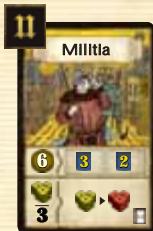
| 民兵(Militia) | 将1至3颗黄色骰子当红色骰子使用,保留原值 |
| 猎人(Hunting) | 获得3点影响力 |
| 弓箭手(Archer) | 掷1颗骰子,3 / 4 / 5 / 6可在事件卡上各放1个方块(获1点影响力);此骰结果不可修改 |
| 佣兵(Mercenary) | 获得3枚金币 |
| 圣殿骑士(Templar) | 将1颗白色骰子当2颗同值红色骰子使用;若取自他人区域费用为2金币;不可额外增加红色骰子 |
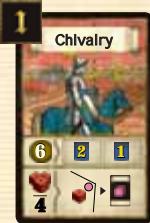
| 骑士精神(Chivalry) | 你区域中每有1颗红色骰子可在事件卡上放置1个方块(获1点影响力);可分布在不同事件卡上 |
白色活动卡(宗教):
| 名称 | 效果 |
|---|---|
| 牧师(Priest) | 黄色骰子组中每颗骰子+3;数值可超过6;不可用于市政厅放置 |
| 僧侣(Monk) | 将1颗白色骰子变为3颗同值黄色骰子;若取自他人费用2金币;不可额外添加黄色骰子 |
| 朝圣(Pilgrimage) | 获得2VP;唯一可以混用三色骰子激活的活动卡;只有学徒制和忏悔可用于修改混色组的骰子值;也可单色激活 |
| 忏悔(Confession) | 骰子组中每颗骰子+2;数值可超过6;不可用于建筑或大教堂放置 |
| 学徒制(Apprenticeship) | 骰子组中每颗骰子变5;可修改混色组;不可用于放置市民或建造大教堂 |
黄色活动卡(市民):
| 名称 | 效果 |
|---|---|
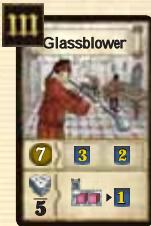
| 玻璃匠(Glassblower) | 大教堂上每有你的一对方块获1VP |
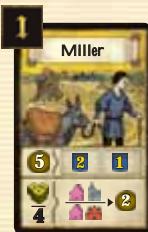
| 磨坊主(Miller) | 选择宫殿或主教座堂,获得该建筑中你的市民数×2枚金币(被驱逐的不计);每次可换选择 |
| 税吏(Tax Collector) | 每位玩家(含银行替中立市民)按其在市政厅的市民数向你缴纳税金;被驱逐的不缴;付不起仅支付能付部分 |
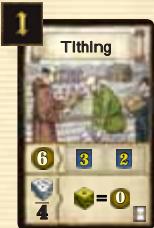
| 什一税(Tithing) | 组拼骰子组时,可从每位玩家(含中立)免费取1颗黄色骰子 |
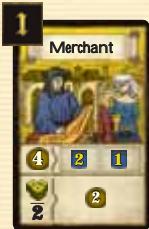
| 商人(Merchant) | 获得2枚金币 |
| 旅店老板(Innkeeper) | 花1枚金币购买1点影响力 |
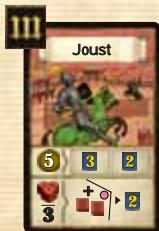
| 比武(Joust) | 你区域中红色骰子总值最高者获2VP(含中立,平局均获) |
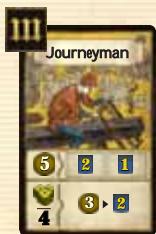
| 学徒(Journeyman) | 将3枚金币转化为2VP |
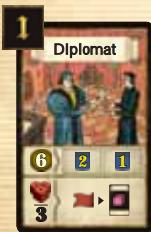
| 外交官(Diplomat) | 每花1点影响力可在事件卡上放1个方块(同时获1点影响力);可分布在多张卡上 |
| 巡游(Procession) | 你区域中骰子数最多者获2VP(含中立,平局均获);需至少1颗骰子 |
行动2:建造大教堂
使用1至3颗 白色骰子 参与建设。每颗骰子可在大教堂对应数值的位置上放置1个你的方块。
规则:
- 大教堂分3层:底层(第1层)、第2层、顶层(第3层)
- 在上层放置方块时,下层同数值位置 必须已被占据
- 每个位置限放1个方块
收益:
- 放在数值1至3的格子:每颗方块获 1VP + 1点影响力
- 放在数值4至6的格子:每颗方块获 1VP + 2点影响力
行动3:对抗事件
使用1至3颗骰子对抗威胁城市的事件卡。事件卡左侧标注的激活费用决定:
- 需使用的骰子颜色
- 可放置的方块数 = 骰子总值 ÷ 除数(向下取整)
规则:
- 从卡牌上的小旗标识开始依次放置方块
- 每放1个方块立即获得 1点影响力
- 一次行动 只能 在1张事件卡上放方块(除非使用了特定的军事活动卡)
对抗完成后结算:
- 放置方块最多的玩家获得较大VP奖励(上方数值)
- 第二多的玩家获得较小VP奖励(下方数值)
- 第一名平局:平分第1和第2名VP(向下取整),以下名次无奖励
- 第二名平局:平分第2名VP(向下取整)
- 仅1人有方块:获得两档奖励之和
- 中立方块参与多数判定,可抢占名次
- 最多方块的玩家拿走该事件卡(平局则先放者获;中立最多则丢弃)
- 所有人取回自己放置的方块
掠夺事件特殊规则: 对抗完成后按上述规则分配VP,但 无人拿走卡牌,方块移除后可重新接受对抗。
行动4:在主要建筑上放置市民
使用 恰好1颗骰子 放置1个市民。颜色决定建筑:红→宫殿、白→主教座堂、黄→市政厅。骰子数值决定建筑内位置。
市政厅 / 主教座堂: 新市民放在对应数值行的首位空位。该行满时原有市民向右各移1格,最右端被挤出者放在建筑插画上(称为"被驱逐")。
宫殿: 新市民直接放对应数值位置。若有市民在此,原市民被驱逐放于插画上。
保护规则:
- 若你的市民已在某建筑插画上,其他人不能再次驱逐该建筑的你的市民(但该市民在本轮结束时仍回到你的个人供应)
- 若放置会挤出已在插画上的同色市民,则该位置不可放置
- 个人供应为空时可花费2点影响力招募
行动5:使用农业
使用1至3颗 黄色骰子,无需工匠。获得金币 = 骰子总值 ÷ 2(向下取整)。
行动6:跳过
不想继续行动时,获得 2枚金币(放置在你的区域上)。本轮不能再行动,但后续每次轮到你时额外获得1枚金币。
4.6 阶段5:回合结束
满足任一条件时本轮结束:
- 所有玩家均已跳过
- 城市广场所有区域已无骰子
结算:
- 每位玩家取回区域上的金币
- 被驱逐市民回到所属玩家的个人供应
- 未使用的骰子归还通用供应
- 起始玩家卡传给左侧邻座
事件队列: 若因事件卡被移除产生空隙,将右侧卡片左移填补。
5. 影响力系统
在执行行动或对抗黑骰之前(或同时),可花费影响力点数执行操作(可多次、任意组合):
|| 花费 | 效果 ||------|------|| 1点 | 重掷你自己区域中的1颗骰子(不可重掷他人骰子,包括已购买的) || 2点 | 从通用供应招募1个市民到你的个人供应 || 4点 | 翻转你自己区域中1至3颗骰子(变为对立面,两面之和为7);可翻不同颜色 |
影响力上限:20点。 超出作废。
6. 事件卡详解
| 事件卡 | 效果 |
|---|---|
| 掠夺(Marauding) | 常驻事件;提供1颗黑骰;不会被移除 |
| 小规模冲突(Skirmishes)×2 | 额外提供1颗黑骰 |
| 战争(War) | 根据等级提供相应数量黑骰 |
| 诺曼人进攻(Normans Attack) | 额外提供2颗黑骰 |
| 盗贼(Brigands)×3 | 额外提供1颗黑骰 |
| 干旱(Drought) | 每位玩家按市政厅中自己的市民数支付金币(被驱逐的不计) |
| 旅人(Wayfarers) | 掷1颗黑骰,在市政厅对应行首位放入1个中立市民,原有市民右移,最右者被驱逐至插画上 |
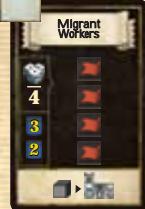
| 流动工人(Migrant Workers) | 在大教堂最低层最低数值的空格上放1个灰色方块(无空格则不放) |
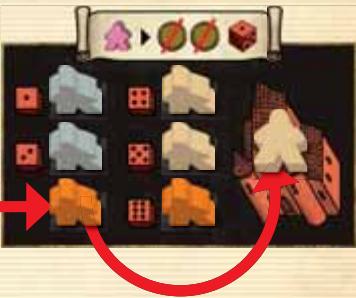
| 继承冲突(Succession Conflict) | 掷骰子在宫殿对应位置放入1个中立市民,原市民被驱逐至插画上 |
| 支援(Support) | 在本卡左侧2张事件卡上各放1个灰色方块(若仅左侧1张则只放1个) |
| 神学冲突(Theological Conflict) | 掷1颗黑骰,在主教座堂对应行首位放入1个中立市民,原有市民右移,最右者被驱逐 |
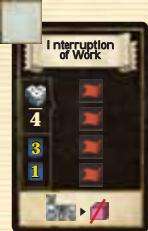
| 工作中断(Interruption of Work) | 移除大教堂上数值最高的方块(包括灰色方块) |
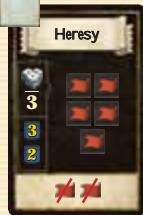
| 异端(Heresy) | 每位玩家失去2点影响力 |
| 内战(Civil War) | 每位玩家失去3枚金币 |
注意: 8个中立市民已全部在场时,不再添加新中立市民。
7. 角色卡与终局计分
游戏在 最后一张红色事件卡 进入游戏的那一轮结束时终止。
7.1 终局计分顺序
每位玩家依次结算:
- 加上游戏中获得的VP标记
- 每张你有方块但 未被对抗完的事件卡 获 1VP(含掠夺)
- 加上活动卡上你的工匠所在位置标注的VP
- 大教堂 每有1层 你没有方块,失去2VP(三层最多扣6VP)
- 翻开角色卡,每张角色卡评估 所有 玩家并按标准发放VP
7.2 角色卡计分表
| 角色 | 计分条件 |
|---|---|
| 克雷蒂安·德·特鲁瓦<br>(Chrétien de Troyes) | 三大建筑上你的市民总数:3–4→1VP,5–6→3VP,7+→6VP<br>(2人:4–5→1VP,6–7→3VP,8+→6VP) |
| 乌尔班四世<br>(Urbain IV) | 影响力点数:5–9→1VP,10–14→3VP,15+→6VP |
| 于格·德·帕扬<br>(Hugues de Payens) | 大教堂上你的方块数:3–4→1VP,5–6→3VP,7+→6VP<br>(2人:4–5→1VP,6–7→3VP,8+→6VP) |
| 勒·佛罗伦丁<br>(Le Florentin) | 活动卡上你的工匠数:2–3→1VP,4–5→3VP,6+→6VP |
| 蒂博二世<br>(Thibaut II) | 持有金币:6–11→1VP,12–17→3VP,18+→6VP |
| 亨利一世<br>(Henry I) | 获得的事件卡数:1–2→1VP,3–4→3VP,5+→6VP |
每位角色评估所有玩家——因此猜测对手角色并据此制定策略至关重要。同时应适当伪装误导对手。
关键规则与常见问题
易错规则
- 前3轮有6个阶段(含阶段0),之后只有5个阶段
- 每人每轮固定收入10枚金币,与建筑和市民数无关
- 骰子购买费取决于行动总骰子数——1颗2金、2颗每颗4金、3颗每颗6金;先拼组后付费
- 雇佣工匠后必须至少激活该卡1次
- 每人每张活动卡只能放1个工匠
- 即时效果与延迟效果不同: 延迟效果使用方块,即时效果直接结算
- 对抗黑骰时红色骰子数值翻倍
- 不可购买其他玩家骰子来对抗黑骰
- 放置市民必须恰好使用1颗骰子(不是1至3颗)
- 被驱逐市民本轮结束时回到个人供应,非永久丢失
- 被驱逐已有保护: 你在某建筑上的市民已在插画上时,其他人不能再次驱逐
- 大教堂逐层建造: 上层同数值位置必须先被下层占据
- 延迟效果的方块不能用于对抗黑骰
- 一次行动最多用1个方块修改
- 影响力上限20点,超出作废
- 跳过也能获得金币(首跳2枚,后续每轮+1枚)
- 大教堂每层无方块扣2VP(三层最多扣6VP)
- 事件卡对抗后放置最多方块的玩家拿走卡牌(中立最多则丢弃)
- 角色卡评估的是所有玩家,不仅是你自己
- 中立市民共有8个,全部在场后不再添加
常见问题
- Q:可以不雇工匠就激活活动卡吗?
A:不可以。必须先在卡上放一个你的市民作为工匠。
- Q:个人供应空了如何获得市民?
A:花费2点影响力从通用供应招募。
- Q:延迟效果方块可以对抗黑骰吗?
A:不可以。只能用于修改行动骰子。
- Q:同一次行动可以用多个方块修改吗?
A:不可以。每次行动最多用1个方块。
- Q:购买中立区域的骰子要付费吗?
A:要。向银行支付标准费用,同购买他人骰子的规则。
- Q:购买其他玩家骰子来对抗黑骰可以吗?
A:不可以。对抗黑骰只能用你自己区域中的骰子。
- Q:对抗黑骰时红色骰子怎么算?
A:数值翻倍。红色显示3即为6。
- Q:大教堂放置方块的收益是多少?
A:数值1–3格子:1VP + 1点影响力;数值4–6格子:1VP + 2点影响力。
- Q:角色卡是只评估自己吗?
A:不是。每张角色卡评估所有玩家。任何人都能从任何角色卡得分。
- Q:中立方块会影响事件对抗排名吗?
A:会。中立方块参与多数判定,可抢占第一或第二名。
- Q:掠夺事件有什么特殊?
A:它始终存在于场上,不会移除。对抗后无人拿走卡牌,可反复对抗。
- Q:如何确定游戏还剩几轮?
A:看红色事件牌堆里放了几个——4人6张=6轮,3人5张=5轮,2人4张=4轮。最后一张入队那轮结束时游戏结束。
常见问题(FAQ)
以下 1 条问答中 0 条来自站内玩家的真实提问,其余 1 条为本站整理的常见疑问;答复内容保持原样。
特鲁瓦支持几个人玩?
1–4 人。
去哪查完整规则
想核对具体规则细节、卡牌效果或某个回合的结算方式,可以在村了吗里选中这款游戏后直接提问。
同类桌游
- 卡坦岛德式
- 工业革命:伯明翰德式
- 勃艮第城堡:特别典藏版德式
- 方舟动物园德式
- 重塑宇宙德式
- 埃多拉的德鲁伊德式
- 1817 (2020)德式
- 甜蜜国度德式
- 卡里普索德式
- 铁路环游德式
规则原文(Markdown)
本站收录这款游戏的规则原文 6 个文件,此处内联渲染 3 个,可直接展开阅读或下载。
rules_zh_特鲁瓦_4660.md29.5 KB
SÉBASTIEN DUIJARDIN-XAVIER GEORGES -ALAIN ORBAN
Lroyes
Artwork: Alexandre Roche
1200年,托瓦城教堂已经奠基完成,但经历了无数波折后,这教堂才在400年后完工。这游戏邀请你来一起体验这四个世纪的历史,并参与这座西方文化史上最精致的城市之一建设和发展过程。当时的社会由三个阶层组成:贵族、牧师和农民。贵族控制着军事力量,肩负正义和保卫特鲁瓦的责任。牧师是人们的精神向导,同时他们也对文化知识领域的发展也起到一定的作用。而农民和工匠等处在社会最低层的阶级总是不能受到足够的重视,然而他们对整个社会的发展的贡献却是最大的
Concept of the game
托瓦城是一个策略游戏,你将扮演一个在法国香槟地区的富裕家族,运用影响力来雇用和领导三个阶层的人们:包括军队(各种红色的相关配件)、宗教(白色)和平民(黄色)。
每个领域都会提供不同的得益:军队允许你用较大的效力队伍来对抗入侵。牧师的着力于建设托瓦城教堂,还有教育农民和军队。农民则为增加你的资产而辛勤劳动。
这个城市的市民供应劳动力,由骰子代替。你可以在不同方面使用劳动力:扮演各种各样商人的活动监督,建设教堂应对不幸的事件,还有招募新的市民。每个行动要求利用1-3一组的骰子。
在你的回合,总会访问著名人物为目标以加大你扮演的家族的势力。这些非常有影响力的人物作用是今天帮助你建设这座城市的人!实际上,如果你能理解他们的作用,而其他玩家跟随其后,你可以完全运用你自有的声望,因为每一个家族会猜测这些著名的人物。
玩家在游戏中以获得胜利点数的形式,收集最多的声望,将会在游戏中获胜!
Contents
第纳尔
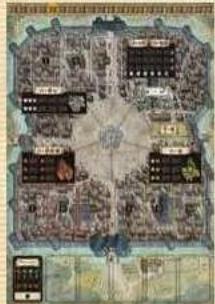
1(×24),5(×12),
10(×4)

1 一张游戏版图
每个玩家有12个同颜色市民指示物,分别为 白色、蓝色、绿色、橙色和8个灰色中立市 民指示物。


每种类型有9张行动卡红色代表军队,白色代表宗教,黄色代表市民。这些行动卡又1-3组成,代表他们进入游戏的回合。

胜利点数指示物单位
90个立方体指示物
每个玩家有20个同颜色立方体指示物,分别为白色、蓝色、绿色、橙色和10个中立立方体指示物。
1(×24),3(×10),5(×10),10(× 10)


8个木质圆盘
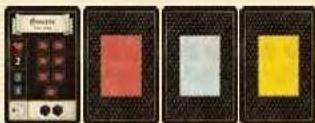
16张事件卡
8张红色、4张白色、4张黄色

每个玩家有2个同颜色的木质圆盘,分别为白色、蓝色、绿色、橙色,每位玩家使用个用于影响力记录,另一个用于区域记录。
6张人物卡
24个骰子
4种类型的骰子,6颗红色骰子代表军队,6颗白色骰子代表宗教,6颗黄色骰子代表市民,6颗黑色骰子代表敌人。
一页行动、事件和人物卡牌描述 的卡纸

1个起始玩家卡

6张玩家指示卡
Setting up the game
将中立市民、骰子、法币和胜利分数指示物放置于游戏面板旁边,建立一个供应库。每个玩家选择一种颜色,开始如下:

将1个 区域标志 放置于城市广场5个灰色圆盘之中,每个玩家挑选他们在城市广场里面的区域,就近于他们围绕游戏面板旁所对应的位置,这个区域属于他。

获得5第纳尔和1个影响力标志
(所有法郎在游戏中是展示的)。1个影响力标示物放置于影响力记录条4上.

4个玩家每人4个市民
(3个玩家每人5个,2个玩家每人6个);每位玩家建立一个市民供应库(将剩下的市民放进供应库),在游戏中每位玩家最多可以使用12个市民。

每人秘密随机抽取1张角色卡牌(两名玩家时,抽取两张)

20个立方体指示物

(这些立方体指示物没有限制数量;如果一个玩家用玩了,他可以用其他东西来代替立方体指示物)。
行动卡按照他们的颜色和回合数字分类放入游戏
(在卡片的背部)。不要看牌,牌面朝下以它的
颜色放置:将一张1的卡牌放置在对应颜色的第一个位置,2放在第二个位置,3放在第三个位置,将不用的卡牌放回盒子(不要偷看卡牌正面)。
建立3种颜色的事件牌库:
1叠红色,1叠白色和1叠黄色。红色事件卡牌的数
量取决于游戏人数:4人游戏下放置6张卡牌(3人放置5张,2人放置4张)。将剩余的卡牌放进盒子里面。玩家中最近读过关于历史书籍的作为起始玩家。
Initial placement
在游戏开始时每位玩家在开始时只放置一次。
每位玩家从他们的供应库里把市民指示物放置于游戏面板上的三个建筑上(分别是宫殿、教堂(主教管辖区)和城市大厅)。
只能单独放置在三座建筑物的空缺处。在游戏开始放置时,一旦市民指示物放置后不能再移动。
从开始玩家开始第一回合放置,顺时针方向结束于最后玩家。第二回合则从最后玩家开始,逆时针方向结束于第一回合的起始玩家。随后的回合,轮流交替放置直到每位玩家把他们的市民指示物从他们的供应区放置完毕。在每位玩家放置结束后,将灰色的中立市民指示物放置在建筑物未放置完毕的位置。(二人特殊规则,开始放置回合先将灰色的中立市民指示物放置于建筑物中。举例说明在本页说明书底部。)
Example:4人游戏,Anna
4人游戏,Anna的起始玩家,把一个村民放在了宫殿的6的格子里;Faye,把村民房在了教区,Ceoffrey把村民放了1个在城镇中心,Emily,放了一个村民在宫殿;下面接着由Emily放1个自然色的村民放宫殿,然后Ceoffrey放了一个村民在城镇中心……如此反复,请看下图顺序(红底白字数字表示摆放的顺序)


二人游戏规则
在放置工人前,将中立工人按下图放置


Gameplay
4人游戏时进行6个回合(3人游戏时进行5回合,2人游戏时进行4回合)。前3回合每回合由6个阶段组成。而后每回合由5个阶段组成
PhaseO:揭开行动卡牌
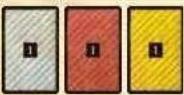
前三回合,揭开每种颜色对应回合的行动牌:前3回合,每回合揭开各种颜色卡牌1张。
Phase1:收入和发薪水
每个玩家收取10法郎的收入,之后他需要支付他放置于教堂的市民薪水(每个市民1法郎),宫殿的市民薪水(每个市民2法郎)。不需要支付薪水与放置在城市广场的市民。(如果没有VPS可扣,则不需要再扣)。
Example:
Anna为他的工人支付3第纳尔,Faye●为他的工人支付3第纳尔,Ceoffrey为自己的工人支付1第纳尔,Emily为自己的工人支付7第纳尔

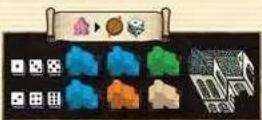


Phase 2:收集劳动力
田田
每名玩家根据他放进的市民,掷对应的骰子:每个市政厅里的市民用黄色骰子代替,教堂主教区里的市民用白色骰子代替,宫殿里的市民用红色骰子代替。每名玩家将他们掷完后的骰子集中放置于中间城市广场的区域,小心保留位于骰子上面的数字。然后,起事玩家根据灰色中立市民在3个建筑物里面的的人数掷对应的骰子,并把掷后的骰子放置于中间城市广场不属于任何玩家的空缺处(灰色的区域)。这中心圆盘代表这个城市的市民劳动力,并使玩家执行他们的行动。
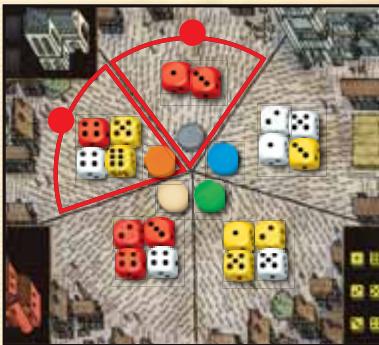
Example:
①Anna需要从筛子堆里面拿出2个黄色筛子、1个红色筛子和1个白色筛子,一共是4个筛子一起投筛子!完毕之后把投出结果的筛子小心的移动到自己的扇形区块里面
所有玩家按照顺序做完毕之后,起始玩家帮中立的米宝(按米宝数量投一次筛子。比方说中立的米宝有2个,那么就投2个红色的筛子,把结果平移到中立的扇形区域内。

0+日
Phase 3:事件卡
每回合,会有两个新的事件进入游戏。翻开红色牌组最上面的事件牌,看看有什么正在威胁着这个城市。这张卡会决定开第二张卡究竟是白色还是黄色,红卡上有标示。在事件阶段结束后,放置好第二张牌。这些卡牌列的事件卡从左到右开始生效。由掠夺开始。事件卡分为两种:
军事事件通过黑色骰子显示:针对卡牌显示的黑色骰子数,起始玩家将对应的黑色骰子放到手里面。这些黑色的骰子代表敌人正在攻击城市。

其他事件,根据牌上的文字执行。
如果一个玩家尽能力也不能抵御所有事件,他将会失去2VPS(如果一个玩家没有VP,不会再扣)。
当翻开事件卡牌后,起始玩家掷事件卡牌上显示的对应数量的黑色骰子。起始玩家必须在他的区域里,防御数值最高的颗或更多的黑色骰子:被选上的骰子总点数必须等同或者高于黑色骰子的点数。被选中用以抵御的骰子,抵御黑色骰子后与黑色骰子一起弃掉。跟着左手边的玩家需要挑选第二高数值的黑色骰子同样处理,如此类推,直到没有黑色骰子需要防御(最后,有可能起始玩家不得不防御几颗黑色骰子)。如果个玩家的骰子数值不允许他对抗黑色骰子,他可以废弃一颗骰子,但必须扣减2VPS
Important:
当抵御黑色骰子的时候,红色骰子的数字加倍;
玩家可以用不同颜色的骰子来抵御黑色骰子;
每抵御一颗黑色骰子,玩家会到到一点影响力点数;
可以在抵御黑色骰子之前使用影响力点数;
不能购买其他玩家的骰子来对抗黑色骰子。
Notes:劫掠(Marauding)事件一直存在,而不离开游戏。其他牌直到玩家将其处理掉之前都留在游戏中。侵扰城市的事件牌的数量没有上限:如果需要,事件队列可以一直排到版图外。
Example:
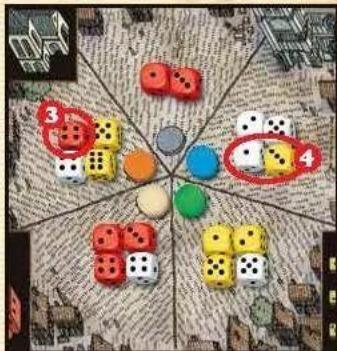
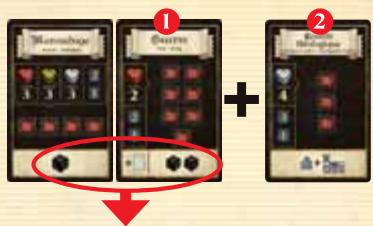
翻出事件牌:战争(War)。这张牌引出一张白色牌,翻出的白色牌是信仰冲突(Theological Conflict)。2现在结算3个事件:Anna拿取3个黑色骰(劫掠(Marauding)一个,战争(War)2个),然后她按照附录中的解释结算信仰冲突(Theol--ogical Conflict)。
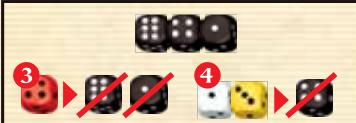
Anna掷出3个黑色骰,得到4点,6点和1点。她必须用自己地区中的骰子对抗黑色6。她决定使用自己的红色4。红色骰点数双倍计算,所以她也选择同时对抗黑色1,因而得到2点影响力。
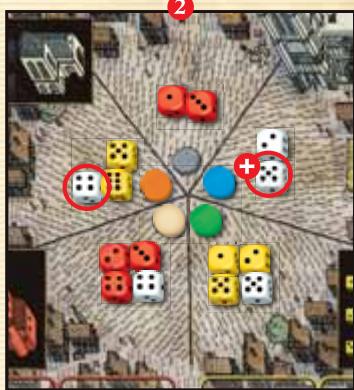
这样,她为她左手的玩家Faye留下1个4点黑色骰。Faye使用白色1和黄色3与之对抗。她得到1点影响力。


Phase 4:行动
从起始玩家开始,按顺时针方向,每个玩家可以用他的劳动力执行1个行动,或者放弃。当没有骰子可用,或者所有玩家都选择放弃后,本轮结束(见轮次结束说明)。每个行动需要使用由同色的1到3个骰子组成的骰子组,可以从城市区域的5个地区中的1个或多个地区中选取这些骰子。从其他玩家的地区中拿取的骰子需要向该玩家购买,该玩家不能拒绝交易。使用灰色中立地区的骰子时,向银行支付费用。使用自己的骰子时不用支付费用。骰子用过后,将其弃入公共供应堆。
骰子的费用取决于玩家用于行动的骰子的个数:
如果使用1个骰子,他要花费2个第纳尔(如果骰子属于其他玩家),
如果使用2个骰子,每个来自其他玩家的骰子花去他4个第纳尔,
如果使用3个骰子,每个来自其他玩家的骰子花去他6个第纳尔。
骰子的费用取决于该行动所需的骰子的个数,所以在向不同玩家支付费用前,要先将该组骰子放在一起。
玩家必须从5个行动中选择1个,或者放弃:
1-从城市中激活1张行动牌,
2-建造大教堂,
3-对抗事件
4-将市民放置在主要建筑上,
5-使用农业
6-放弃
1从城市中激活1张行动牌
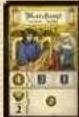
你可以使用由1到3个骰子组成的骰子组,将部分劳动力分派到一张可用行动牌上描述的行动中。黄色骰允许你激活平民牌;白色骰对应宗教牌;红色骰对应军事牌。要激活一张行动牌,玩家必须拥有一个可以指导市民工作的商人。可能有两种情况发生:
你在牌上没有商人
你必须首先支付牌左上部分所示的但尼尔来雇佣一个商人。将个你的颜色的市民放在牌上的空位上,当做商人。市民必须来自你的个人供应堆(如果你没有市民,你必须花费2点影响力雇佣一个一一见影响力说明),或者来自版图上的任何位置(行动牌,或者主要建筑物,甚至平放在建筑中的被驱逐的市民)。
一旦雇佣了商人,玩家必须用一组骰子来激活该行动牌。
Example:比如Anna希望得到16点从而激活某事件,那么图中看到
1她有2个黄色筛子,那么她需要Coeffrey玩家的一个黄5就可以达到16点。那么她需要问Coeffrey要那个黄5。但是一共是3个筛子激活事件,因此他就需要给Coeffrey6个金币。
如果Anna决定不激活刚才的事件,而换一个激活。根据新卡片的需求,Anna决定只需要9点就可以,于是改用白筛子。那么她可以问Faye借用一个白5就可以了。总计用了2个筛子,所以需要给Faye支付4个金币。
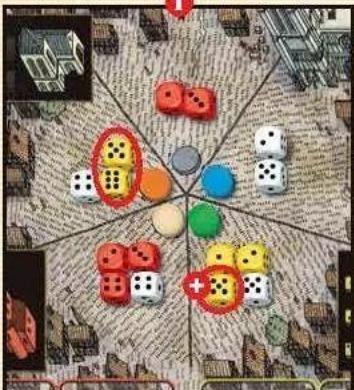

8888
色骰的劳动力分派去做零售商(Merchant)行动。因为她在这张牌上还没有商人,她必须先雇佣一个。
①花费:她支付4但尼尔雇佣1个商人。
3激活费用:黄色骰总点数为16,因而她可以使用这张行动牌8次(16/2=8)。
生效:该牌效果立即生效,因为她激活这张牌8次,所以她得到16第纳尔。

你在这张牌上已经有了1个商人
这种情况下,你不用再雇佣和放置商人到这张牌上:你只需立刻使用一组骰子激活该行动牌。
可以使用的两种行动:

立即生效的牌:牌的效果立刻生效。牌左下角所示的激活费用,表明为了激活这张牌所需的骰子的颜色,据此可以算出其效果可以被使用的次数(次数为:骰子组的点数和,除以分数线下的数字,向下取整)。


延迟生效的牌:这些牌的右下角印有沙漏图标,用来与立即生效的牌相区分。当你激活此类牌时,将你的颜色的方块放置在牌的图片区。方
块个数等于激活费用。在随后的游戏里,你可以在你的行动中使用这些方块,但是在一个行动中只能使用一次且只能使用一个方块。在事件阶段中不能使用这些方块对抗黑色骰。
2 建筑大教堂

你可以使用由1到3个白色骰组成的骰子组来为建筑大教堂工作。每个骰子允许你在大教堂中与骰子点数相同的建筑点上放置1个方块。建筑点被分为3个等级:
最下一行对应1级,第二行对应2级,第三行对应3级。你必须遵守以下建筑规则:同一个点数的建筑点上,只有当低一级的建筑点中已有方块时,才能在其高一级的建筑点中放置方块(注意:每个位置只能放置一个方块)。
在数字为1到3的位置放置方块时,每放置1个方块立即得到1VP和1点影响力,在数字为4到6的位置放置方块时,每放置1个方块立即得到1VP和2点影响力。

3 对抗事件

你可以使用由1到3个骰子组成的骰子组与威胁城市的事件对抗。事件牌左边显示的激活花费表明:
在与事件对抗时,你必须使用的骰子的种类
玩家可以放置在这张牌上的方块个数(个数为:这组骰子的点数和,除以分数线下的数字,向下取整)。
将你的方块放置在牌上的小旗帜上,从左上的一个开始。每在牌上放置一个方块,你立即得到1点影响力。有可能在不激活某些军事行动牌时,在一个行动里向多张牌上放置方块。
旗帜数表明消除这个事件所需的方块个数(也可能放置的方块数多于旗帜数)。一旦事件被消除:
放置了最多方块的玩家得到较大的VP奖励(显示在上面)。当出现平局时,打平的玩家们平分所有VP奖励的总和(向下取整),其他排在下面的玩家没有奖励。如果牌上只有一个玩家的方块,该玩家得到牌上的所有的VP奖励。
放置了第二多方块的玩家得到较小的VP奖励。当第二的位置出现平局时,打平的玩家平分第二位的VP奖励(向下取整)。
玩家取回自己的方块并放回到个人供应堆中。
放置最多方块的玩家拿取这张事件牌(如果是中立玩家,弃掉这张牌)。如果平局,第一个在牌上放置方块的玩家获胜。在游戏结束,评估人物牌任务时,你得到的牌会带给你VP。
:::, Example:Faye

希望将她2个白色
骰代表的劳动力分派去激活牧师(Priest)。她使用自己地区中的白色5,并且从Anna那里花费4但尼尔买来白色4(因为这组骰子包含2个
8
02 放置的花费:她支付8但尼尔雇佣商人。现在Faye在这张牌上有了商人,她以后不用再支付8但尼尔来激活这张牌和放置方块。
③ 激活费用:她的白色骰点数总和为9,允许她将这张行动牌激活3次(9/3=3)。

效果:因为这张牌有延迟效果,她在牌上放3个方块。在随后的游戏里,在黄色的行动中,Faye可以从牌上丢弃1个方块,从而使用这张牌的效果(她骰子组中的每个黄色骰点数+3)。
remark:
如果你在牌上没有商人,而你也无法雇佣1个商人,那么你不能激活这张牌。
在游戏结束后,商人获取其所占据位置的VP。
同一个玩家不能在同一张牌上放置2个商人。
如果所有的位置都已被占据,玩家可以将商人放置在牌的图片区域,但是游戏结束后不会得到VP。
如果你雇佣了1个商人,你必须至少激活该牌1次。
如果1个商人被移动到另一个行动牌上,他的位置被释放出来,其他玩家可以使用这个位置。这张牌上的其他市民不能移动到这个新空出的位置上
他的y
白色5,Faye的2点骰,Emily的4点骰来参加大教堂的建造。他向Emily和Faye各支付6第纳尔购买他们的骰子。

他在第1级的2和5点位置上各放置1个方块,在第2级的4点位置上放置1个方块。他得到5点影响力和3VP。
Example: Emily希望去除事件卡
Succession Conflic的影响,她拥有红2红3和红4。根据计算结果,在卡片上她可以放2个小方块((2+3+4)/4取整为2),从而立刻获得2点影响力;如图所示,卡片上所有的红旗都被小方块占满了,因这个事件卡的响力到此结束。
Emily和●Ceoffrey是小方块的数量一样多打成平手,因此每个人获得3个VP((4+2)/2=3)。Anna不获得任何VP因为排名第三。执绿色的Ceoffrey拿回这张卡片因为他先放的小方块。

Note:
当劫掠卡牌事件被完成的时候,卡牌上VP立刻被分配,但是这个事件卡不属于任何玩家,同时移除所有的小方块,此卡牌再次开始生效,同时可以使用新的小方块来解决这个卡牌事件

4 把市民放置在主要建筑(宫殿,主教区,或市政厅)
与其他行动不同,你总是使用1个骰子来把1个市民放置在1个主要建筑里。从你的个人供应
堆拿取1个你的市民(如果已经没有市民,你必须花费2点影响力购买1个一一见影响力说明),或者从版图上已有的市民中拿取1个,并将其放置在与你所选骰子颜色对应的主要建筑上。红色骰对应宫殿;白色骰对应主教区;黄色骰对应市政厅。
骰子点数表示市民可以放置在建筑物中的位置。找出与你掷出的点数相同的骰子图案。把你的市民放在那里,详述如下:
在市政厅和主教区,新市民放置在对应行的第一个位置上。如果该行已经放入了其他的市民,将他们向右移动1个位置。如果1个市民被推出该行最右边的位置,将这个被驱逐的市民平放在建筑图片上。
在宫殿,新市民放在对应的位置上。如果那里已经有一个市民,将那个市民驱逐并平放在宫殿的图片上。
Important:
如果你已经有市民被驱逐到建筑物图片上,没人可以驱逐你这个建筑上的市民;然而,这一轮结束时,你要将你被驱逐的市民取回到你的个人供应堆中,所以这个保护只对当前轮有用。这也意味着,如果在一处放置市民后会驱逐1个市民,且被驱逐的市民与已经平放在建筑上的市民同色,那么就不能在这里放置市民。
5使用农业

通过农民(由1到3个黄色骰组成的骰子组)的辛勤劳动,农业行动使你得到金钱。该行动不需要商人。你得到但尼尔的数量,等于你骰子组点数总和除以2(向下取整)。
Pass
当你仍有骰子可用时,如果你这一轮不希望再执行任何行动,你可以放弃并得到2第纳尔,将这些钱放在你的地区中。在本轮剩下的时间里,你不能再执行任何行动,但是每次当又轮到你的回合时,再拿1第纳尔加到你的地区里。

的第一行放置1个市民,将她自己的市民驱逐出去。通过这个行动,她可以得到一个更安全的位置,并且避免自己的市民被其他人驱逐。

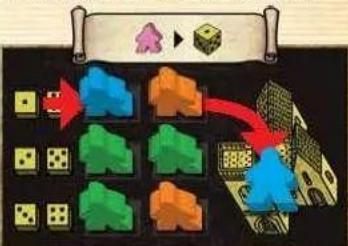

Anna
从灰色玩家那里花2但尼尔买到红色3。她在宫殿的3号位置放置1个市民,并将 Emily的市民驱逐,被驱逐的市民被平放在建筑物里。


Phase 5:轮次结束
当玩家行动后,如果出现以下情况,本轮结束:
所有玩家都已放弃(每个玩家的地区里都有第纳尔),或者城市区域的任何地区中都已经没有骰子。
玩家从他们的地区中取回第纳尔。平放在建筑物中的市民送
回到他们自己的个人供应堆中。未被使用的骰子返回到公共供应堆。起始玩家将起始玩家牌传给他左手边的玩家,下轮开始。
Influence
在对抗黑色骰,或执行行动前,在你的主要行动之外,你可以有几种方式花费你的影响力点数。
1点:你可以重掷你地区中的1个骰子(不允许重掷其他玩家的骰子—一包括中立玩家),
2点:从公共供应堆中拿取1个市民加到你的个人供应堆中,
4点:你可以翻转你地区中1到3个骰子(不允许翻转其他玩家的骰子一一包括中立玩家)。所选的骰子被翻转使朝下的一面朝上,注意骰子相对的两面的点数和始终为7。被翻转的骰子可以是不同的颜色。
可以以任何顺序执行多个行动
Note:你不能拥有超过20点影响力;超出的点数就浪费掉了。
Example:城市的地区中有2个骰子:中立玩家地区的红色1,Ceoffrey的地区的黄色2。现在是Ceoffrey的回合,他花费1点影响力重掷他的骰子:他掷出1点。他可以再支付1点影响力再重掷次,但是他决定花费4点影响力翻转他的骰子:他的1点变为6点。通过这个骰子他在劫掠(Marauding)事件上放置2个方块,从而得到2点影响力。

End of the game
最后一张红色事件牌进入游戏的那轮结束后,游戏结束。
除了游戏中得到的VP之外,
player:
每张未被消除的事件牌(包括劫掠(Marauding)),若他在其上有方块,得到1VP,
按照事件牌上他的市民所占据的位置上标示的数字获取VP,
大教堂的3级建筑点中,他若每级都有方块则不扣分,否则每缺1级则扣2VP,
翻开他的人物牌。每个人物都要评估所有的家族,根据人物任务检查他们的成绩。游戏中的每张人物牌,都按照其条件为每个玩家奖励VP。因为每个人物奖励所有玩家,所以试着
猜出其他玩家的人物牌是很重要的。类似的,通过使诈来误导其他玩家也是非常重要的。如果他们看不出你人物的任务是什么,他们就很难借助他得分。
得到最多VP的玩家获胜。
Note:
在游戏中,玩家的VP是不公开的。为了让最后的记分时有尽可能大的不确定性,对每类得分,每个玩家应该在他自己前面将10VP堆在一起。这也使得比较玩家的得分更加容易。
Designers: Sébastien Dujardin, Xavier Georges, Alain Orban ◆ Illustrations and Graphics: alexandre-roche.com Editing of the Rules : Sébastien Dujardin ◆ English Translation: Nathan Morse
Thanks
The designers thank the numerous playtesters and proofreaders who have contributed to the realization of this game, whom we hope will take no offense: It is unfortunately impossible to list them all! The publisher would like to thank Xavier and Alain for thetr confidence and for the good times during the creation of this game, and also his wife for her indispensable support.

rules_zh_troyes-the-ladies-of-troyes_908.md21.9 KB
troyes-the-ladies-of-troyes 规则(集石文档 908)
逐页 VLM 转写(qwen3-vl-plus),源:集石文档 908,未翻译。
特魯瓦城的女士 翻譯:小柴
SÉBASTIEN DUJARDIN – XAVIER GEORGES – ALAIN ORBAN
The Ladies of Troyes
Artwork: Alexandre Roche
有了這個擴充,基本版的規則會有五種不同方式的變動,而且你可以混和或是自由搭配這些擴充小模組。特魯瓦城的女士以 3 種新的角色卡形式出現,你可以把它們加進你的遊戲中。一個新的行動可以讓玩家的守衛在堡壘間移動,這是為了能夠參與城外的行動。每個玩家的當家由一個新的紫色骰子來代表,紫色骰子可以用來執行市民、軍事,或者宗教行動—全看你怎麼運用!其他的玩家不能購買這個骰子。這個擴充裡也有 27 張新的行動卡以及 6 張事件卡,來讓遊戲增添更多變化!
遊戲配件
-
• 27 張新的行動卡
(9 張軍事-9 張市民-9 張宗教)
[图: 一张行动卡示例,含图标与数字] -
• 6 張新的事件卡
[图: 一张事件卡示例,含图标与文字] -
• 9 張新的角色卡
[图: 一张角色卡示例,含人物插画与数值] -
• 8 張兩面的城外行動板塊
[图: 一张双面城外行动板块示例] -
• 額外的錢幣和分數指示物
[图: 一枚金币与一个蓝色分数标记] -
• 2 0 個大的玩家方塊(1 個大的方塊等於 3 個小的方塊)
[图: 四种颜色的大方块:橙、蓝、绿、米白] -
• 4 個玩家顏色的堡壘守衛
[图: 四个对应玩家颜色的守卫棋子:橙、蓝、绿、米白] -
• 4 張角色玩家幫助卡
[图: 一张角色帮助卡示例] -
• 2 個額外的黑色骰子
[图: 两个黑色六面骰] -
• 4 個紫色骰子
[图: 一个紫色六面骰] -
• 2 個額外的灰色中立市民
[图: 两个灰色市民棋子] -
• 1 頁附錄
-
• 1 本規則書
遊戲進行
玩這個擴充時需要特魯瓦城的基本遊戲。除了一些這本規則書提到的細節稍有改變以外,遊戲的目標和進行方式和基本遊戲相同,玩家間必須協議要把下列哪些模組加進遊戲中;你可以選擇一組、很多組,或甚至全部的組合來擴大遊戲中多種選擇的可能性。
模組 1:新的角色卡
遊戲設置:在把一張角色卡秘密地發給每個玩家之前,把新的 9 張角色卡取代基本遊戲中的 6 張(2 人遊戲時每人 2 個角色)。
如何運作:6 張角色卡和基本遊戲中的相同,3 張新的角色卡(特魯瓦城的女士)在附錄中有詳細說明。
變體:遊戲一開始在分卡片時,把一張角色卡翻開,每個玩家都會知道這張角色卡在遊戲結束時會給予分數的內容。
[图: 一张新角色卡示例,含人物插画与数值]
模組 2:新的行動卡
遊戲設置:你可以單獨使用這 27 張新卡片,或者把它們和基本遊戲中的 27 張卡片洗混併用。
如何運作:這些卡片在附錄中有詳細說明。
[图: 一张新行动卡示例]
重要:特魯瓦城的女士採用兩種新類型的卡片。混合型的卡片有立即和延遲效果。在第一次啟動時,你放置方塊在這張卡片上。之後啟動時,你可以使用方塊來得到卡片效果中帶來的好處。在同一個行動中同時放置方塊並使用它們這是不可能的。在你的行動時,你可以從這樣的卡片使用多個方塊。這些混合型的行動卡不受一個行動一次只能使用一個方塊這種限制。從其它的行動卡來使用一個方塊以增強混合型卡片的啟動是有可能的。 □ 類型的卡片效果是延遲到遊戲結束;玩家放在這種卡片上的方塊會在遊戲結束時計分。
模組 3:新的事件卡
設置:你可以單獨使用這 6 張新的事件卡,或者和基本遊戲中的事件卡混用。如何運作:這些卡片在附錄有詳細說明。
模組 4:一家之主
遊戲設置:每個玩家增加一顆紫色骰子使用。把任何沒有用到的紫色骰子放回盒中。如何運作:階段 2:分配工作能力:每個玩家增加一顆紫色骰子(他的家族的一家之主)到其他他所獲得的骰子中。這顆紫骰和其它的骰子都會一併放到你的市鎮廣場的區域中。紫色骰子在這個階段擲出,如同其他骰子一樣。階段 3:事件及階段 4:行動紫色骰子和其它顏色的骰子一樣,可以對抗一顆黑骰(階段 3)或者執行一個行動(階段 4)。你也可以利用影響力點數來重擲或翻轉這顆紫骰。使用紫骰的兩個特殊規則:・不能從其他玩家那裏購買紫骰。因此,只有擲出這顆紫骰的玩家可以使用它。・當你想要使用你的紫骰時,你可以選擇這顆紫骰的顏色效果,它可以當黃色、白色或紅色使用。但一般來說,放在圖板上的紫骰不能當作黃色、白色或紅骰來被購買。
注意:・如果紫骰被用來對抗一顆黑骰,它可以算做兩倍點數,因為它假設你一定會把這顆紫骰當紅骰用。・當宗教進行這張行動卡進場時,當計算哪個玩家他的廣場區域有最多骰子時,紫骰也會被計算在內。
模組 5:堡壘守衛和城外行動
遊戲設置:特魯瓦城的堡壘形成 20 格的軌道,每個玩家的守衛將能夠在堡壘上巡邏。每個沿著城牆的塔及城門都是這個軌道的一格,如右圖所示。每個玩家放置他的顏色的守衛在最上面的城門,軌道上 0 的位置。
注意:一個城門只代表 1 格,即使上面描繪了兩座塔。
隨機拿取每個等級的一塊城外行動板塊(等級在每個板塊的上方有指示)。根據板塊的等級,把這四個板塊沿著特魯瓦城放到四個城門外(等級 1 的板塊放到第一個城門外;等級 2 的板塊放到第二個城門外,依此類推)。城外行動板塊是雙面的;隨機選擇一面來玩。
如何運作:階段 4:行動:有新的行動可選擇:
7 使用你的堡壘守衛
用任何顏色的一顆骰子,來驅動你的堡壘守衛。這顆骰子不能用延遲效果的卡片來調整;然而,你可以藉由把錢幣付給銀行來增加這顆骰子的數值。每個你付的錢幣都可以增加骰子一點,但最大不能超過 6 點。骰子的數值等同於你的行動點數,你可以照以下方式使用你的行動點數,你可以選擇:
- 以順時針方向前進你的守衛。不能前進超過第 20 格(見附錄中城外行動的詳細說明)。
- 放置一個方塊到一個你進入的城外行動板塊上。一旦你的守衛到達或經過一個城門,遊戲的剩餘時間中,都視為你已經進入該城門的城外行動板塊。
[图: 特鲁瓦城堡垒轨道示意图,标有0至20编号格位及四个城门外的城外行动板块位置]
選擇行動 7 — 使用你的堡壘守衛時,玩家在每個城外行動卡上只能放置一個方塊。方塊允許你從城外行動卡獲得好處,就和基本遊戲中的延遲效果行動卡一樣,其中的差異是,你可以在其他玩家的回合或者階段 3:事件的時候使用城外行動的方塊。每個城外行動在第 4 頁有詳細說明。
重要:
在相同行動中,從延遲效果的卡片和城外行動板塊上的一個方塊是可以的。在相同行動中,從不同的城外行動板塊上使用兩個方塊是可以的;然而,在相同行動中,從相同的城外行動板塊上使用兩個方塊是不可以的(即使這個行動是由對手所執行)。
- 當你的守衛第一個到達圖板上方的城門時,你必須把它放到等級四的城外行動板塊上。你不能再從堡壘上移動守衛;然而,你仍然可以使用行動 7 — 使用你的堡壘守衛來放置方塊到 4 個城外行動板塊上。
- 遊戲中城堡守衛不能從堡壘上移開做別的用途。
範例:非兒的守衛 🎲
在和等級三的城外行動卡相鄰城門前的塔上。在她的回合時,她選擇使用她一顆數值 4 的黃骰來執行行動 7 — 使用你的堡壘守衛。她決定移動她的守衛一格,讓她可以進入等級三的城外行動板塊。接著她使用她剩餘的 3 點行動點數來放方塊,她把三個方塊放到每個她進入的城外行動板塊上(等級一、二及三)。
[图: 一张游戏版图,中央为城堡区域,四周分布多个城外行动板块;左下角标有罗马数字 III 的蓝色守卫棋子被红色箭头指示移动至相邻板块;另有两个蓝色棋子位于右下与右上板块旁,以红色箭头标示方向]
比賽變體
這個簡單的變體是設計給 3 或 4 人遊戲時比賽。在階段 5:一輪結束的倒數第二輪時,起始玩家把起始玩家卡傳給他的右手邊玩家(而不是左手邊)。以逆時針方向進行最後一輪遊戲。
- 遊戲設計:Sebastien Dujardin、Xavier Georges、Alain Orban・插圖及圖像:alexandre-roche.com
- 規則編輯:Sebastien Dujardin・英文翻譯:Nathan Morse・中文翻譯:小崇
感謝
設計師想要感謝無數的遊戲測試員及校稿員,他們幫助理解這款遊戲,我們希望這沒有冒犯到他們:不幸地,沒有辦法他們的名單全列出來。出版社想要感謝 Xavier 及 Alain 的信賴和創作這款遊戲的好時光,以及他的太太必要的支持。
Z-MAN
games
© 2012 Z-Man Games, Inc.
Z-Man Games Inc. 3250 F.X. Tessier,
Vaudreuil-Dorion, Qu bec, Canada, J7V 5Y5
Copyright Z-Man Games, Inc
www.zmangames.com
[图: Pearl Games 标志,含盾形徽章内人物头像与字母 a,下方标有 “PEARL GAMES” 及网址 www.pearlgames.be]
© 2012 Pearl Games
© 2012 Z-Man Games
111
城外行動
-
當有個對手購買你至少一顆骰子時,你可以獲得 4 點影響力點數。在對手的回合時,需要從這個城外行動板塊上棄掉一個方塊。即使你的對手購買多顆骰子,你也只會獲得 4 點影響力點數。
[图: 水域旁有船隻與標示「●」的方塊] -
當放置一個市民到三個主要建築中的一個時,從這個城外行動板塊上棄掉一個方塊來獲得 4 點影響力點數。
[图: 市民圖示移至建築旁,並棄掉一塊方塊] -
當一個對手啟動一張有你的商人在上面的行動卡時,你可以獲得 4 元。在對手的回合時,需要從這個城外行動板塊上棄掉一個方塊。即使你的對手啟動這張卡片多次,你也只會獲得 4 元。
[图: 行動卡上有商人圖示,旁邊有金幣符號] -
當使用農業行動時,你從這個城外行動板塊上棄掉一個方塊來獲得 5 元。
[图: 農田場景,棄掉一塊方塊]
-
從這個城外行動板塊上棄掉一個方塊來和每個對手交換一個骰子,不能改變骰子的數值。你只能和每個對手交換一次。因此每個方塊可以讓你最多交換 3 個。你也可以跟中立玩家交換。交換的骰子可以是同顏色或不同顏色。紫色的骰子不能交換。
[图: 橋樑場景,雙方交換骰子] -
當階段 3:事件,你需要對抗最高數值的黑骰時,從這個城外行動板塊上棄掉一個方塊來摧毀一顆黑色骰子。(你會獲得影響力點數)。
你也可以從這個城外行動板塊使用方塊來避免階段 3:事件時的金錢損失(乾旱和內戰)、影響力點數損失(異端邪說),或者方塊的損失(嚴酷寒冬和工作中斷)。階段 3:事件時,使用許多的方塊來保護你自己不受到多種事件卡的損失是可以的。
[图: 建築群前有黑骰與紅心符號] -
從這個城外行動板塊上棄掉一個方塊來翻轉一個你剛從對手那買來的骰子,並執行一個行動。你必須馬上使用這個骰子來執行一個行動。
[图: 行動卡與骰子翻面示意] -
當你啟動一張延遲或混合型行動卡時,你可以把一個你在這個城外行動板塊上的方塊,放到你所選的一張延遲、混合型,或者延遲到遊戲結束的行動卡上。你不需要在其他的行動卡上有自己的商人。不必啟動的花費也不用管卡片的顏色。如果你選擇飼養員這張行動卡,你必須花三元來放置方塊。
[图: 行動卡上有方塊放置位置]
- 在執行你的行動前,從這個城外行動板塊上棄掉一個方塊來重設並獲得這個城外行動板塊上指定顏色的一顆骰子。從一般供應區拿取這顆骰子,並把它放到你的市鎮廣場的區域。你不必馬上使用它;你可以之後使用它,或者把它留給其他玩家購買。如果一般供應區沒有指定顏色的骰子,你不能使用這個城外行動。
[图: 四種不同顏色骰子與對應建築布局]
重要:你透過行動 7 — 使用你的堡壘守衛,用來放置一個方塊在這個城外行動板塊的骰子,必須和這個城外行動板塊上指定顏色的骰子不同顏色。例如,如果這個城外行動板塊允許你重設並獲得一顆黃色骰子,你不能使用一顆黃色骰子來放置一個方塊在這城外行動板塊上。
- 你不能有多於一顆的紫骰在你的市鎮廣場區域。
- 你必須花 2 元來重擲你的紫色骰子。
-
當放置至少一個方塊到教堂或者一個方塊到事件卡上時,從這個城外行動板塊上棄掉一個方塊來獲得 2 分。
[图: 教堂與事件卡旁有方塊棄置示意] -
所有玩家到達和這個城外行動板塊相鄰的城門時獲得 3 分。遊戲結束時,每個放在這裡的方塊可以讓擁有者獲得 1 分。
[图: 城門與方塊放置位置] -
遊戲結束時,放最多方塊在這個城外行動板塊上的玩家獲得 9 分。第二名得 6 分,第三名得 3 分。如果平手,對應名次的分數除以一半(向下捨去)。
[图: 多個玩家方塊堆疊於城外板塊] -
第一個到達和這個城外行動板塊相鄰的城門的玩家,放置它的守衛在第一格,並獲得 6 分。第二名的玩家放第二格,並獲得 4 分。第三名的玩家放第三格,並獲得 2 分。第四名的玩家放第四格,並獲得 1 分。不能在這個城外行動板塊上放置方塊。
[图: 城門旁四格守衛位置與分數標示]
IV
行動卡
1. Lumberjack (Mixed)
伐木工(混合型)
你可以:
- 放置一個方塊在這張卡上(砍木頭)
或
- 從這張卡上拿掉 1 個方塊,獲得 4 元(賣木頭)。
[图: 一名穿紅衣的伐木工人在樹林中揮斧]
1. Clog Maker (Immediate)
木屐製造商(立即)
每個你在市集裡的市民都可以讓你獲得 1 元。被驅逐的市民不會讓你獲得任何東西。
[图: 一名工匠正在製作木屐]
1. Weaver (Immediate)
織布工(立即)
你每個在行動卡上的商人會讓你得到 1 元,包含在這張卡上的商人。
[图: 一名婦女坐在織布機前工作]
11. Landlady (Immediate)
女房東(立即)
你可以獲得 4 點影響力點數或者 1 分(即使在同一個行動中,你也可以選擇這兩種選項不同啟動的組合)。
[图: 一名穿綠衣的婦女站在門口]
11. Distiller (Delayed)
蒸餾酒製造商(延遲)
這張卡片上的方塊可以讓你在使用骰子執行行動前,翻轉你的這一顆骰子到它的反面。不允許你翻轉一個對手的骰子,即使你已經購買它們也不行。
[图: 一名男子在操作蒸餾設備]
11. Viticulturist (Delayed)
葡萄栽培者(延遲)
這張卡片上的方塊可以讓你從一個你所選的對手那裏免費索取一個骰子,並使用它來執行一個行動。這顆骰子可以是集中玩家的;如果這個骰子要和其他的骰子合併使用,花費時你必須把它視為使用骰子的一部分,在費新舊金錢,記住:你不能拿其他玩家的彩色骰子。
範例:吉歐使用一個方塊來取得德林的紅色骰子 6。他用自己區域的紅色骰子 4 以及瑪德琳的一顆紅色骰子 5。他為這顆紅色骰子 5 付給梅德琳 6 元。
[图: 一名農夫在葡萄園中採摘葡萄]
111. Banker (Immediate)
銀行家(立即)
如果你擁有超過 30 元,你獲得 3 分。你不必花費金錢來獲得這個分數。
[图: 一名穿藍袍的男子坐在桌後處理帳目]
111. Breeder (Mixed)
飼養員(混合型)
你可以:
- 付 3 元放置一個方塊到這張卡上(購買家畜)
或者
- 從這張卡片拿掉 1 個方塊來獲得 2 分(出售家畜)。
[图: 一名男子牽著一隻羊]
111. Master Tradesman (Immediate)
工匠師傅(立即)
你每兩個在行動卡上的商人都讓你獲得 1 分,包含在這張卡上的商人。
[图: 一名穿藍衣的工匠手持工具]
1. Bishop (Immediate)
主教(立即)
每個你在教堂裡的方塊都可以讓你獲得 1 元。
[图: 一名穿紅白法衣的主教站在祭壇前]
1. Augustine (Delayed)
奧古斯汀(延遲)
使用多顆骰子時,你可以從這張卡片上使用一個方塊來當作你從你自己的市集廣場使用一顆黃色骰子 6。你不能單獨使用這個方塊;你必須把它和至少一顆其它的骰子一起來執行一個行動。這個方塊會算進最多只能用三顆骰子的限制中,而且購買其他骰子時,這個方塊也會算在使用骰子的一部分。
[图: 一名穿黑袍的修士在閱讀書籍]
1. Chief Templar (Delayed)
首席聖殿騎士(延遲)
這張卡片可以讓你從每個玩家那裏花 2 元套取最多 1 個紅色骰子來組成使用的骰子。例如:你可以使用 3 顆紅色骰子,從 2 個不同的玩家那裏各套取一個,然後一個從你自己的區域套取,付給這兩個玩家每人各 2 元。你不能使用其他的方塊來修正這些紅色骰子,因為每個行動只能用一個方塊。中立玩家的骰子也可以買,而且也是只花費 2 元。放置商人在這張卡片上花費 5 點影響力點數,不會花費任何金錢。
[图: 一名穿白袍配紅十字的騎士持劍站立]
11. Herbalist (Delayed)
藥師(延遲)
這張卡片讓你把一顆白骰當三顆相同數值的紅骰使用。當你從這張卡片使用一個方塊來增強一個行動時,你必須只使用一個白骰。如果這顆白骰來自其他玩家的區域,花費 2 元(你不能購買額外的紅骰)。
[图: 一名女子在整理草藥]
11. Master Builder (Immediate)
建築大師(立即)
這張卡片讓你放置一個方塊到教堂中一個你所選的空格,但要遵守建造規則(方塊必須放在所選欄位中最低層級的空格)。可以把方塊放起過前 3 層到第 4 層,把方塊放到想像的 6 個區域中的第 4 列上。為了要建造一個欄位的第 4 格,這格底下的 3 格必須被填滿,唯一放置一個方塊到第 4 層的方式,只能透過建築大師這張卡片。如果建築大師遺漏,遊戲結束時,沒有放置方塊到第 4 層的玩家都會扣 2 分。就如同本遊戲中的一樣,每個放置的方塊根據骰子的數值,可以得到影響力點數和分數。
[图: 一名男子手持建築圖紙與工具]
11. Preacher (Delayed)
牧師(延遲)
當你從這張卡片使用一個方塊時,把你使用的骰子全部變成使用的其中一個骰子的數值。
[图: 一名穿黑袍的牧師在講道]
111. Scribe (Immediate)
經書抄寫員(立即)
每個你在遊戲中透過對抗事件行動所飾勝而來的事件卡都可以讓你獲得 1 分。
[图: 一名男子在書桌前抄寫文稿]
111. Hermit (Delayed until the end of the game)
隱士(延遲至遊戲結束)
在這張卡片上放置一個方塊。遊戲結束時,每個在這張卡片上的方塊值 9 分,並減去所有玩家放在這張卡片上方塊總數。放置在這上面的每個方塊不會少於 1 分。範例:遊戲中,玩家已經在這張卡片上放置 6 個方塊了(2 個藍色、3 個橘色及 1 個綠色)。每個方塊值 3 分(9 − 6 = 3:藍色獲得 6 分、橘色獲得 9 分,而綠色獲得 3 分)。
[图: 一名穿灰袍的隱士坐在山洞口]
111. Nun (Immediate)
修女(立即)
你的市集廣場區域中的每個白骰都讓你獲得 1 分。這些白骰必須是你啟動這張卡片,並將除使用后的白骰之後所剩下放在廣場上的。
[图: 一名穿修女服的女子在祈禱]
1. Ransom (Immediate)
贖金(立即)
你可以花費 3 元並放置 1 個方塊到一張你所選的事件卡上。每個啟動(甚至是相同行動中多次啟動的其中一次),你可以選擇放置你的方塊到一張不同的卡片上。
[图: 一名穿綠衣的人被綁縛,旁有持劍者]
1. Catapult (Mixed)
投石器(混合型)
你可以:
- 放置 1 個方塊到這張卡片上(填裝投石器)
或者
- 從這張卡片拿掉 1 個方塊並從你的供應區拿取 2 個方塊到一張事件卡上(發射投石)
- 每個啟動(甚至是相同行動中多次啟動的其中一次),你可以選擇一張不同的事件卡來放置兩個方塊。
[图: 一座大型投石器架設在城牆上]
下载 Markdown69-troyes-rulebook.md44.8 KB
Troyes
Artwork: Alexandre Roche
In the year 1200, the foundation is laid for
the cathedral of Troyes, but it will not be finished until 400 years later; after innumerable incidents. This game invites you to experience four centuries of history by participating in the development of one of the finest medieval cities ever to make its mark on Western culture. The society of that day was organized into three orders: the nobility, the clergy, and the peasants. The nobility constituted the military force devoted to justice and to protecting the lands. The clergy were the spiritual guides of the community, contributing to maintaining and developing knowledge and culture. The peasants and artisans, in turn, were given very little consideration, although their hard work was essential to the daily life of the entire populace.
Concept of the game
Troyes is a strategy game in which you represent a rich family from the Champagne region of France, using your influence to recruit and supervise individuals from the three prominent domains: military (associated with the color red in every aspect of the game), religious (white), and civil (yellow).
Each domain offers different benefits: The military permits you to fight with greater efficacy against invasions. The clergy focuses on completion of the cathedral, and education of the peasants and the military. The peasants toil to fill your coffers.
The citizens of the city provide a work force, represented by dice. You use the work force in different ways: to perform various activities supervised by your tradesmen, to build the cathedral, to grapple with unfortunate events, or even to recruit new citizens. Each of these actions requires utilization of one group of 1 to 3 dice.
In your actions, always regard the goals of the famous character that inspires your family. This individual is one of several very influential people whose principles have helped make the city what it is today! In fact, if you can figure out whose principles the other families follow, you can maximize your own fame, because each family will be scrutinized by all of these famous figures.
The player who has garnered the most fame, in the form of victory points, will win the game!
Contents

• deniers in denominations of 1(×24),5(×12), and 10 (× 4)
• 1 game board

• 56 citizens (12 in each player color: natural, blue, green, and orange, plus 8 gray neutral citizens)


• 90 cubes (20 in each player color: natural, blue, green, and orange, plus 10 gray neutral cubes)
• victory point tokens in denominations of 1(× 24),3(×10),5(× 10),and 10(× 10)


• 24 dice in 4 different colors: 6 red dice (military), 6 white dice (religious), 6 yellow dice (civil), and 6 black dice (enemies)
• 8 wooden discs (2 in each player color: natural, blue, green, and orange): 1 Influence marker and 1 District marker for each player
• 1-page appendix that describes the Activity, Event, and Character cards

• 9 Activity cards of each type (military: red, religious: white, civil: yellow). The Activity cards are numbered from 1 to 3, indicating the turn they enter the game.
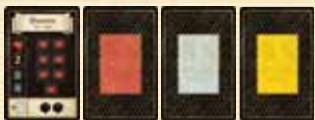
• 16 Event cards: 8 red, 4 white, 4 yellow

• 6 Character cards


Setting up the game
Place the neutral citizens, the dice, the deniers, and the victory points (VPs) beside the board, forming the general supply. Each player chooses a color and starts with:

A 1 District marker that he places on one of the 5 pictures of a small gray disc drawn on the city square. Each player chooses the district of the city square closest to his position around the table: this district belongs to him.

5 deniers (your deniers are visible during the game). 1 Influence marker that he places on space 4 of the influence track.


4 citizens with 4 players (5 with 3 players, 6 with 2 players); they form each player's personal supply (place the remaining citizens in the general supply). Each player has a maximum of 12 citizens at his disposal during the game.
1 randomly selected Character card, which he keeps secret (2 Character cards with 2 players).
20 cubes (the number of cubes is unlimited; if a player runs out, he can use something else to supplement his cubes).
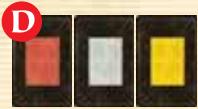

Sort the Activity cards by color and by the round number during which they enter the game (the number on the back of the cards). For each color, without looking at the cards, place face-down: a 1 card on the first space of the appropriate color, a 2 card on the second space, and then a 3 card on the third. Stow the unused cards in the box (don't look at them).
Form 3 decks of Event cards: 1 red, 1 white, and 1 yellow. The number of Event cards in the red deck determines the
number of turns in the game: for 4 players, place 6 cards in it (5 for 3 players, 4 for 2 players). Stow the unused cards in the box. The player who last read a history book receives the start player card.
I nitial placement
This initial placement only happens one time, at the beginning of the game.
Each player places the citizens from his personal supply on the 3 principal buildings on the game board (Palace, Bishopric, and City Hall). To place a citizen, simply put it on an empty space in one of the 3 buildings. Once a citizen is placed, it is not moved again during the initial placement.
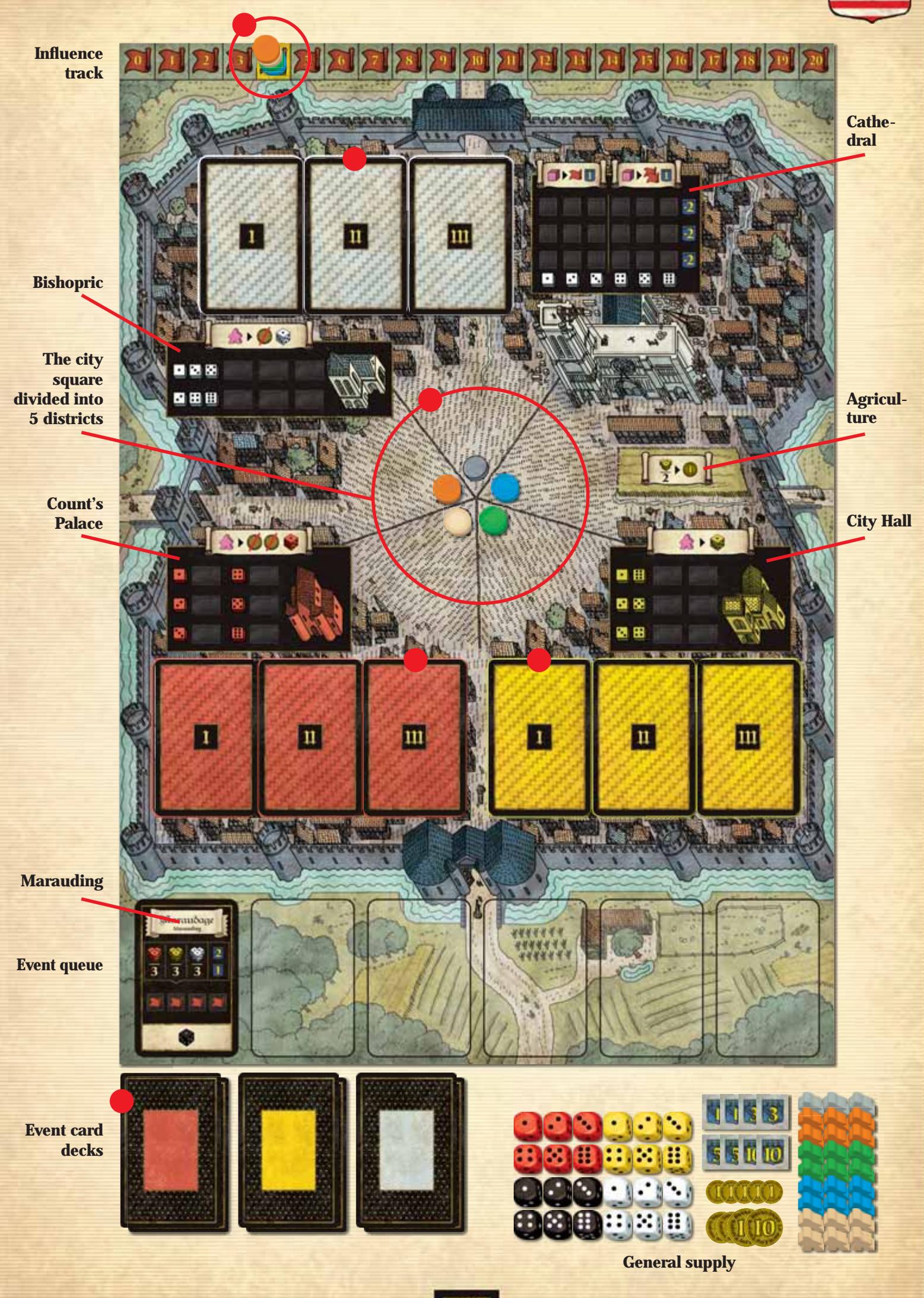
The 1st round of placement starts with the start player, and ends with the last player, going clockwise. The 2nd round of placement starts with the last player, and ends with the first
Example : Annagoes first, and starts the initial placement by placing a citizen on space 6 of the Palace. Fayeplaces one on the Bishopric. Geoffrey places one on City Hall. Next, Emilyplaces 1 citizen on the Palace. Emily is the first to play in the second placement round, which will go counterclockwise.


Special placement with 2 players With 2 players, place the neutral citizens before the players' initial placement. Place them as shown here:
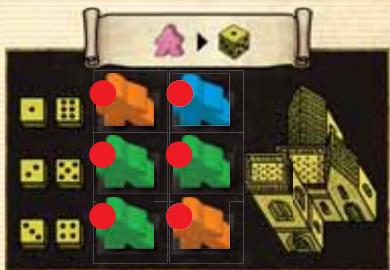
player, going counterclockwise. The subsequent placement rounds continue in that alternating fashion until each player has placed all the citizens from his personal supply. At the end of the initial placement, the gray neutral citizens are placed on each remaining empty building place (except in a 2-player game, in which the neutral citizens are placed at the beginning of the phase, as illustrated at the bottom of the page).
You can follow all the placements in the illustration by following the numbers indicated on the citizens. Once each player has placed 4 citizens, there are 2 empty spaces in the Palace, which neutral citizens will fill.


Gameplay
A game lasts 6 rounds with 4 players (5 rounds with 3 players, 4 rounds with 2 players). The first 3 rounds each comprise 6 phases. Thereafter, each turn comprises 5 phases:
Phase 0: Reveal the Activity cards

In the first 3 rounds, for each color, reveal the Activity card color whose number corresponds to the current round: thus 1
new Activity card of each color becomes available in each of the first 3 rounds.
Phase 1: Income and salaries

Bishopric (1 denier per citizen), and in the Palace (2 deniers per citizen). The citizens in City Hall cost nothing. If he cannot pay the salaries for all his citizens, he pays what he can, then loses 2VP (a player with no VPs loses nothing).
Example: Each player earns a fixed income of 10 deniers. After the initial placement at the beginning of the game, Annamust pay 1 denier salary for her religious citizen, and 2 deniers for her military citizen. Fayepays 3 deniers for her 3 religious citizens. Geoffreypays 1 denier for his religious citizen. Emily pays 1 denier for her religious citizen, and 6 deniers for her military citizens.


Phase 2: Assembling the workforce

Each player rolls the dice to which he is entitled: one yellow die per citizen located in City Hall, one white die per citizen located in the Bishopric, one red die per citizen located in the Palace. Each player then gathers his dice on his district of the city square, being careful to maintain the face-up values that he rolled. Next, the start player rolls the dice associated with the gray citizens placed on the 3 buildings, and places them on a district of the city square not belonging to any player (the gray district). The dice represent the workforce of the citizens of the city, and they enable the players to execute their actions.
Example:
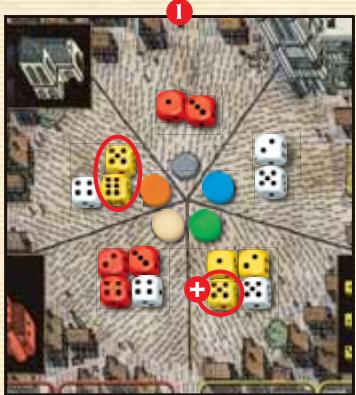
1 Annahas placed 2 civil citizens, 1 religious citizen, and 1 military citizen: she rolls 2 yellow dice, 1 white die, and 1 red die, which she places in her district. 2 Once each player has rolled his dice, Anna rolls the 2 red dice of the neutral player, and places them in the gray district.
Phase 3: Events

口 Each turn, two new events enter the game. II Reveal the top red Event card from the deck and place it in the event queue, to the right
of those already menacing the city. That card will call for a second card, either white or yellow, indicated by the symbol on the red card. Place the second card at the end of the event queue.
The Event cards in the queue take effect from left to right, beginning with Marauding. There are 2 types of events:

• military events are indicated by black dice: the start player
takes a black die into his hand for each die represented on the cards. These black dice represent the enemies attacking the city,
• various events whose effects are indicated on the card, and explained in detail in the annex.
If a player cannot totally execute an event, he does as much as he can, and then loses 2 VPs (a player with no VPs doesn't lose anything).
After resolution of the events, the start player rolls the black dice that have accumulated. The start player must counter the highest-valued black die with one or more dice from his district: the total value of the chosen dice must be equal to or greater than the value of the black die. The dice chosen by the player to counter the black die are discarded, along with the black die. Then, the player to the left of the start player must counter the next-highest black die in the same manner, and so on until all the black dice have been countered (as a result, it is possible that the start player will have to contend with several black dice). If a player's dice do not allow him to beat the black die he's up against, he discards it without losing a die, but loses 2 VPs.
Important:
• when combating black dice, the value of red dice is doubled,
• a player can use dice of different colors to counter a black die,
• a player can counter several black dice at once: the highest-valued one, plus any others he chooses,
• a player gains 1 point of influence for each black die he counters,
• it is possible to use Influence points before countering black dice (see Influence),
• it is not possible to buy other player's dice to counter black dice.
Notes : The Marauding event is always present; it never leaves play. The cards remain in play until they have been countered by the players. The number of cards menacing the city is not limited: Continue the queue off the board if necessary.
Example: A red card is drawn: War 1. This one calls for a white card, which turns out to be Theological Conflict2
We resolve the 3 events: Annatakes 3 black dice (1 for Marauding, 2 for War) into her hand, then she resolves the Theological Conflict card as explained in the annex. ③ Anna rolls the 3 black dice, and she gets 4, 6, and 1. She must counter the 6 with the dice in her district. She chooses to use her red 4. Red dice count double, so she also chooses to counter the 1, which gains her 2 points of influence.
4 That leaves one black die, the 4, with which Faye, her left-hand neighbor, must contend. She uses a white 1 and a yellow 3 to counter the black die. She gains 1 point of influence.

Phase 4: Actions
Beginning with the start player, then going clockwise, each player can either utilize his workforce to carry out one action, or pass. This round of the game ends once either there are no more dice available, or all the players have passed (see End of the round). Each action requires using a group of 1 to 3 dice of the same color, and those dice come from one or more of the city square's 5 districts. A die coming from the district of another player must be purchased from that player, who cannot refuse the transaction. Pay the bank to use the dice in the gray neutral player's district. You don't pay to use your own dice. After dice are used, they are discarded to the general supply.
The cost of a die depends on the number of dice the player is using for his action:
• if he is using 1 die, it costs him 2 deniers (if it belongs to another player),
• if he is using 2 dice, each die from another player costs him 4 deniers,
• if he is using 3 dice, each die from another player costs him 6 deniers.
The cost of the dice depends on how many dice are required for the action, so it is important to put together the group of dice before paying the different players.
The players must choose one of 5 actions, or pass:
1- Activate one Activity card from the city,
2- Construct the Cathedral,
3- Combat the Events,
4- Place a citizen on a principal building,
5- Use agriculture,
① Annahopes to attain a value of 16 with her dice in order to execute her action. She has 2 yellow dice in her district. With Geoffrey's5 die, she reaches 16. Her group of dice comprises 3 dice, so one die would cost her 6 deniers. She pays Geoffrey 6 deniers.
②Instead of doing a yellow action, Anna could have executed an action with her white die, and one of Faye's, in which case she would have paid Faye 4 deniers.
IActivate one Activity card from the city
6- Pass.
Example:
• you don't have a tradesman on the card

Once the tradesman is hired, the player must put together a group of dice to activate the Activity card.
You must first hire a tradesman by paying the amount in deniers indicated in the upper-left part of the card. Place a citizen of your color on a free space on the card to act as the tradesman. The citizen must come either from your personal supply (if you don't have any, you must hire one for 2 Influence points - see Influence), or from any location on the board (Activity cards, or the principal buildings, or even expelled citizens lying on a building).
You may use a group of 1 to 3 dice to assign a portion of the workforce to the activity described on one of the available Activity cards. The yellow dice permit you to activate a civil card; the white dice, a religious
card; and the red dice, a military card. In order to activate an Activity card, a player must possess a tradesman who can direct the citizens' work. Two situations can arise:
the Merchant activity. Because she doesn't yet have a tradesman on the card, she must first hire one.
1 Cost: She pays 4 deniers to hire a tradesman.
② Placement: She places her tradesman on the first available space, which in this case will be worth 2 VPs at the end of the game.
3 Activation cost: The yellow dice have a value of 16, which permits her to use the Activity card 8 times (16/2= 8).
4 Effect: The card's effect is immediate, so she immediately gains 16 deniers because she activated the card 8 times.
• you already have a tradesman on the card
In this case, you neither pay nor place a tradesman on the card: you just immediately put together a group of dice to activate the Activity card.
Two types of Activity cards can be used:

Cards with an immediate effect: the effect of the card is applied immediately. The activation cost, in the lower-left corner of the card, determines the color of dice required to activate the card, as well as the number of times the
effect can be used (this number is equal to the value of the group of dice, divided by the number under the division bar, rounded down to the nearest whole number).

Cards with a delayed effect: these cards can be distinguished from those with an immediate effect
by the hourglass icon in the lower-right corner of the card.
When you activate this type of card, place the cubes of
your color on the card's illustration. The number of cubes placed is defined by the activation cost. Each cube can be used later in the game during one of your actions, but an action can be modified by only one cube (two cubes can never modify the same action). It is not possible to use a cube to counter black dice in the Event phase.
2Construct the Cathedral

You may use a group of 1 to 3 white dice to work on constructing the cathedral. Each die allows you to place 1 cube on the same-numbered
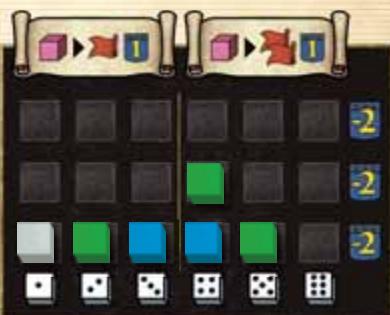
construction site of the cathedral. This construction site is divided into 3 levels: the bottom row corresponds to level 1, the 2nd to level 2, and the 3rd to level 3. You must respect this construction rule: In order to place a cube on a space in a level, the same-valued space in the lower level must exist (note: there's only one cube per space).
You immediately gain 1VP and 1 Influence point per cube that you place on the spaces numbered 1 to 3, and 1VP and 2 Influence points per cube that you place on the spaces numbered 4 to 6.
3 Combat the events
You may use a group of 1 to 3 dice to combat the events threatening the city. The activation cost shown on the left side of an Event card defines:
• the type of dice you must use to combat the event,
• the number of cubes that the player may place on the card (this number is equal to the value of the group of dice, divided by the number under the division bar, rounded down to the nearest whole number).
Place your cubes on the small banners on the card, starting with the one in the upper-left. For each cube placed on a card, you immediately gain 1 Influence point. It is impossible to place cubes on multiple cards in a single action without activating certain military Activity cards.
The number of banners defines the number of cubes required to counter the event (it is impossible to place more cubes than there are banners). Once the event is countered: • the player who placed the most cubes earns the larger VP reward (the upper one). In the case of a tie for first place, the tied players divide the VPs for 1st and 2nd place (rounded down to the nearest whole number) and any lower-ranked players earn nothing. If a player is the only one with cubes on the card, he gains the total VPs of both ranks The neutral player's cubes are considered in determining majorities, and the neutral player can deprive players of VPs,
• the player who placed the second-most cubes earns the smaller VP reward. In the case of a tie for second place, the tied players divide the VPs for 2nd place (rounded down to the nearest whole number),
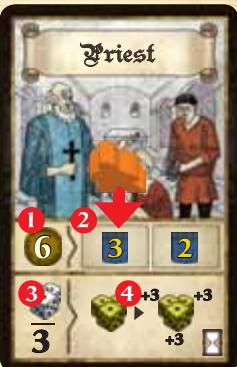
Example: Fayewishes to assign the workforce represented by 2 white dice to activate the Priest. She uses the white 5 from her district and buys a white 4 from Anna for 4 deniers (because the group comprises 2 dice).
①② Cost to place: She pays 8 deniers for her tradesman. Now that Faye has a tradesman on this card, she will no longer need to pay 8 deniers in order to activate it and place cubes.
3 Activation cost: Her white dice worth 9 permit her to activate the Activity card 3 times (9/3= 3).
4 Effect: She places 3 cubes on the card because it has a delayed effect. Later in the game, during a yellow action, Faye can discard 1 cube from the card

to benefit from the effect of the card (+ 3 for each yellow die in her group).
Remarks:
• If you don't have a tradesman on the card, and you can't hire one, then you can't activate the card.
• At the end of the game, the tradesman will yield the VPs indicated on his space.
• A single player cannot place 2 tradesmen on the same Activity card.
• If all the spaces are occupied, a player can place a tradesman on the card's illustration, but it won't earn any VPs at the end of the game.
• If you hire a tradesman, you are required to activate the card at least once. • If a tradesman gets moved to another Activity card, his space is freed up, making it available for the other players. Other citizens already on the card cannot be moved to the newly freed space.
Example: Geoffrey wishes to
participate in the construction of the cathedral with his white 5, Faye's 2, and Emily's 4. He pays Emily and Faye 6 deniers each to purchase their dice.
He places 1 cube in each of the spaces 2 and 5 of the 1st level, and 1 cube on space 4 of the 2nd level. He gains 5 Influence points and 3 VPs.
Example: Emilywishes to combat the Succession Conflict event with her 3 red dice (2, 3, and 4).
She can place 2 cubes on the card's banners (9/4= 2).
She immediately gains 2 Influence points.
The event is countered because all 5 of the banners are covered. Emily and Geoffreyeach earn 3VPs because they are tied for first. Annaearns nothing because she is 3rd. Geoffrey takes the card because he placed a cube before Emily.
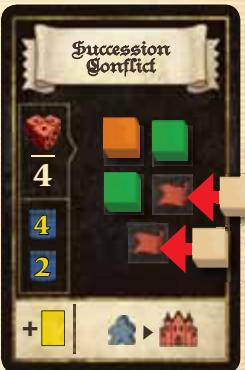
Note: When the Marauding event is countered, the VPs are distributed as indicated above, but nobody takes the card. The cubes are removed and the event is available again to receive new cubes in future actions.

• the players retrieve their cubes and put them in their personal supplies,
• the player who placed the most cubes takes the event card (if it is the neutral player, the card is discarded). In the case of a tie, the tied player who placed cubes on the card first wins. The cards gained can grant you VPs at the end of the game when the characters' missions are evaluated.
4 Place a citizen on a principal building (Palace, Bishopric, or City Hall)

Unlike the other actions, you always use exactly one die to place a citizen on one of the principal buildings. You take one of your citizens from your personal supply (if you don't have any, you must hire one for 2 Influence points - see Influence) or one of yours already on the board, and place it on the principal building corresponding with the color of the die you have chosen. A red die grants access to the Palace; a white die, the Bishopric; and a yellow die, City Hall.
The value of the die shows the location inside the building where the citizen is placed. Find the small picture of a die showing the same value that you rolled. Your citizen will go there, as detailed below: At City Hall and the Bishopric, the new citizen is placed on the first space of the matching row. If the row is filled with other citizens, they are shifted one space to the right. If that pushes a citizen out the right end of the row, lay the expelled citizen on the illustration of the building (More than one player can have a citizen lying on the illustration). In cases where there is an empty space, citizens fill the space as they are moved to the right.
At the Palace, the new citizen goes on the matching space. If there was already a citizen there, the old citizen is expelled and laid on the illustration of the Palace.
Important: If you already have a citizen lying on a building's illustration, nobody can expel your citizen from that building; however, you will retrieve your expelled citizens to your personal supply at the end of the round, so this small protection is only good for the current round. This also means that if placing a citizen would eject a color already lying on the building, nobody can place a citizen there.
5 Use agriculture

The Agriculture activity allows you to gain some money, thanks to the toil of the peasants (a group of 1 to 3 yellow dice). This activity does not require a tradesman. You gain a number of deniers equal to the total value of the group of dice, divided by 2 (rounded down to the nearest whole number).
6 Pass
If you do not wish to execute any more actions this round, while there are still dice in the city square (in any district) pass and receive 2 deniers, which you place in your district. During the remainder of this round, you can't take any more actions, but each time the turn comes around to you, another denier is added to your district.
Note: If a gap is formed by eliminating an event card, shift any cards right of the gap leftward to fill the gap.

Example: Fayebuys Geoffrey'syellow 1 for 2 deniers. She places a citizen in row 1 of City Hall, ejecting her own citizen. This move could be an interesting way to secure a better position and to avoid getting ejected by someone else.


Annabuys the red 3 from the gray player for 2 deniers. She places a citizen on space 3 of the Palace, ejecting Emily'scitizen, which is laid on the building.

Phase 5: End of the round
The game round ends after a player's action if: • all the players have passed (there are deniers in each player's district) or
• there are no more dice in any of the districts of the city square. The players retrieve the deniers from their districts. Citizens lying on buildings return to their owners' personal supplies. Unused dice are returned to the general supply. The start player passes the Start Player card to his left-hand neighbor, and the following round commences.

Influence
Before countering a black die, or executing an action, you may spend your influence points in various ways, in addition to your main action:
• 1 point: you may reroll 1 die from your district (it is forbidden to reroll anyone else's dice — even the neutral player's — even after purchasing them),
• 2 points: add a citizen from the general supply to your personal supply,
• 4 points: you may turn over 1 to 3 of the dice of your district (it is forbidden to turn over anyone else's dice - even the neutral player's). The chosen dice are turned to show the opposite face, keeping in mind that the sum of two opposite sides of a die is always equal to 7. The dice turned over may be of different colors. It is possible to execute several of these actions in any order.
Note: You may never have more than 20 Influence points: any earned beyond that are wasted.
Example: There are 2 dice in the city's districts: a red 1 on the neutral player's district, and a yellow 2 on Geoffrey's. It is Geoffrey'sturn, and he chooses to reroll his die for 1 Influence point: he rolls a 1. He could pay another Influence point to reroll a second time, but he prefers to turn his die over for 4 Influence points: his 1 becomes a 6. With this die, he chooses to place 2 cubes on the Marauding event, which earns him 2 Influence points.

End of the game
The game ends at the end of the round during which the final red event card enters the game.
In addition to the VP tokens gained during the game, each player:
• gains 1 VP per un-countered event card on which he has a presence (included the Marauding),
• gains the VPs indicated on the spaces occupied by his citizens on the Activity cards,
• loses 2 VPs for each of the 3 levels of the cathedral on which he has no cubes,
• reveals his Character card. Each Character will evaluate all the families, checking their performance on the character's mission. For each Character card in the game, award each player
VPs according to the Character card's criteria. Because each character rewards all the players, it is very important to try to figure out which characters the other players have. Similarly, it is important to bluff a bit in order to misdirect the other players. If they can't figure out your character's mission, they are going to have a hard time getting VPs by satisfying it!
The winner is the player with the most VPs.
Note: During the game, VPs are hidden. In order to maximize suspense during the final tally, for each type of scoring, each player should make piles of 10 VP in front of himself. This also makes it very easy to compare the players' scores.
Designers: Sébastien Dujardin, Xavier Georges, Alain Orban • Illustrations and Graphics: alexandre-roche.com Editing of the Rules: Sébastien Dujardin • English Translation: Nathan Morse
Publisher: Z-Man Games, Inc. © 2012 3250 F.X. Tessier, Vaudreuil-Dorion, QC, Canada, J7V 5V5
The Activity cards


The Artisan converts 1 point of influence into 6 deniers.
The Sculptor allows you to gain
The Blacksmith
adds 5 to the value of one group of red dice, regardless of how many dice compose the group. It does not allow you to modify the value of a die in order to place it at the Palace.
Apprenticeship
transforms each die of a group into a die with a value of 5. This card even works on groups with 3 colors. It does not allow you to modify the value of a die in order to place it on the Palace, the Bishopric, the City Hall or the Cathedral.

The Procession offers 2 VPs to the player that has the most dice in his district of the city square (excluding the dice used to activate this card), taking the neutral player into account, as well. In the case of a tie, the tied players all gain 2VPs. You must have at least 1 die in your district in order to gain the 2 VPs.
The Diplomat allows you to pay 1 Influence point to place 1 cube on an event card (you gain 1 Influence point per cube). If you activate the Diplomat multiple times, you can place the cubes on different Event cards. You must spend all the Influence points you want to use before starting to place the cubes.
The Captain allows you to gain 1 VP per Event card on which you have at least one cube. Marauding is included in the tally.
The Merchant enables you to gain 2 deniers.
The Militia allows you to use 1 to 3 yellow dice as if they were red dice. The player who activates this card can only use yellow dice for this action. The dice keep their values.
Tithing allows you to take 1 yellow die from each player for free, at the moment that you create a group of dice. For example, it is possible for you to put together a group of 3 yellow dice for free by taking one each from 2 players and one from your district. As usual, you may take a die from the neutral player's district. It is forbidden to use another cube to modify the yellow dice, because only one cube can be used per action.
Confessionadds 2 to the value of each die in your group of dice. The value of a die is not limited to 6. This does not allow you to modify the value of a die in order to place it on the Palace, the Bishopric, the City Hall or the Cathedral.

The Glassblower grants you 1 VP per pair of cubes you have at the Cathedral.


The Miller: Activate this card to choose between gaining 2 deniers per citizen of your color on the Palace, or 2 deniers per citizen in the Bishopric. Expelled citizens earn you nothing. You may choose differently each activation.
allows you to convert 3 deniers into 2 VPs.
The Journeyman
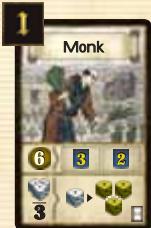


The Monk transforms a single white die into 3 yellow dice of the same value. Whenever you use a cube from this card to modify an action, you must use only a single white die - which if it comes from someone else's district, costs 2 deniers. It is impossible toaddanadditionalyellowdie.
The Templar
Hunting allows you to gain 3 Influence points.
allows you to use a single white die as if it were 2 red dice of the same value. Whenever you use a cube from this card to modify an action, you must use only one white die - which, if it comes from someone else's district, costs 2 deniers. It is impossible to add an additional red die.

The Archer allows you to attempt to place a cube on an Event card: you roll a die and can place a cube on any Event card if you roll a 3, 4, 5, or 6 (you gain 1 Influence point). It is impossible to modify the result of this die. If you activate this card multiple times, the player to your left counts the rolls. It is possible to place the cubes on different Event cards.


The Mercenary allows you to gain 3 deniers.



The Innkeeper
enables you to buy an Influence point for one denier.
The Goldsmith
allows you to gain 1 VP and 2 deniers.
The Joust allows you to gain 2 VPs if the total value of the red dice in your district of the city square (excluding the dice used to actived this card) is higher than anyone else's (including the neutral player). In case of a tie, all the tied players gain 2 VPs.
The Priest adds 3 to the value of each yellow die in your group of dice. The value of a die is not limited to 6. It does not permit you to modify the value of a die in order to place it on City Hall.
converts 3 Influence points into 2 VPs.
Pilgrimage allows you to gain 2 VPs. You may use a combination of all 3 colors of dice to activate this card: this is the only card that permits you to mix different colors of dice to activate it. Only the cards Apprenticeship and Confession can be used in order to modify the groups of different-colored dice that could be used to activate Pilgrimage. It is possible to activate the card with dice of the same color. In this case, the group can be modified by the other Activity cards.
The Troubadour
The Tax Collector levies a tax: for each citizen he has at City Hall, each player pays you 1 denier. The bank pays for each grey citizen in City Hall. They do not need to pay for expelled citizens lying on the illustration of City Hall. A player that can't pay is not punished, but must pay what he can.
Chivalry allows you to place cubes on the Event cards: you can place one cube per red die you have on your district of the city square (excluding the dice used to actived this card). You gain 1 Influence point per cube. It is possible to place cubes on different Event cards.
Note: Don't forget to use your Activity card as many times as allowed by your group of dice (e.g. Use Joust twice, to take 4 VPs instead of 2 VPs).
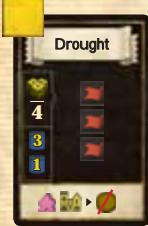



Drought
Each player pays 1 denier per citizen of his color sitting on City Hall. You don't pay for expelled citizens lying on the illustration of City Hall.
Wayfarers
Roll à black die and place a neutral citizen at the start of the indicated row of City Hall, shifting any citizens already present to the right, and expelling the rightmost if necessary. The expelled citizen is laid on the illustration of City Hall.
Migrant Workers
Placé a grey cube on the first free space of the Cathedral. i.e. the free space on the lowest level, having the lowest value. If there are no free spaces, don't place a grey cube.
Succession Conflict
Roll a die and place a neutral citizen on the designated space, expelling the citizen that was there. The expelled citizen is laid on the illustration of the Palace.
The events

Support
Place a grey cube on each of the 2 events to the left of this one. If there is only one event to the left of this one, place only one cube on this event

Theological Conflict
Roll a black die and place a neutral citizen at the start of the indicated row of the Bishopric, shifting any citizens already present to the right, and expelling the rightmost if necessary. The expelled citizen is laid on the illustration of the Bishopric.
Interruption of Work
Remove the cube with the highest value (the cube that is on the highest level, having the highest value) at the Cathedral, even if it is a grey cube.
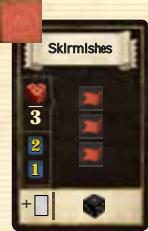
Skirmishes (x2) + 1 black die.
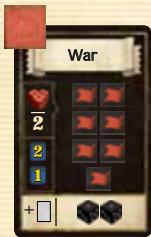



Civil War Each player loses 3 deniers.
War and
Normans Attack + 2 black dice.
Heresy
Brigands (x3) + 1 black die.
Each player loses 2 Influence points.
Note: : If the 8 neutral citizens are already in play, ignore the Event cards that add new ones.
Chrétien de Troyes
He created the legend of the Grail and with it, the modern literary concept of a romance. He needs readers, and rewards having a lot of citizens on the principal buildings.
• 1 VP if you have placed a total of 3 or 4 citizens on the 3 principal buildings (4 or 5 with 2 players)
• 3 VPs if you have placed 5 or 6 (6 or 7 with 2 players)
• 6 VPs if you have placed 7 or more (8 or more with 2 players)
The characters
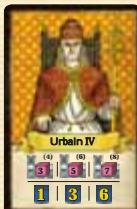
Son of a cobbler from Troyes, he became pope in 1261 after having been clerk for the Cathedral. He rewards the builders of the Cathedral.
This count founded the Knights Templar in 1118.
He rewards having a lot of influence.
• 1 VP if you have a total of 3 or 4 cubes on the Cathedral at the end of the game (4 or 5 with 2 players)
• 3 VPs if you have 5 or 6 (6 or 7 with 2 players)
Hugues de Payns
• 6 Ps if you have 7 or more (8 or more with 2 players)
Urbain IV
• 1 VP if you have from 5 to 9 Influence points
• 3 VPs if you have from 10 to 14 • 6 VPs if you have 15 or more
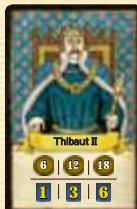
• 6 VPs if you have 18 or more
• 3 VPs if you have from 12 to 17

Le Florentin
Domenico del Barbieri, called The Florentine, participated in the reconstruction of the city after the fire of 1524. He rewards having a lot of tradesmen.
• 1 VP if you have a total of 2 or 3 tradesmen on Activity cards
• 3 VPs if you have 4 or 5
Thibaut ⅡI
• 6 VPs if you have 6 or more
• 1 VP if you have from 6 to 11 deniers
This count was the chief instigator of the grand fairs of Champagne. He rewards accumulation of money.

HenryI
He was knighted by the emperor and participated alongside Louis VII in the second Crusade. He rewards countering events
• 1 VP if you have gained 1 or 2 Event cards
• 3 VPs if you have gained 3 or 4
• 6 VPs if you have gained 5 or more
下载 Markdown原文为社区整理/出版社公开资料,版权归原作者,仅供个人学习查阅。