
中国象棋Xiangqi
一句话概览
中国象棋 是一款已收录于村了吗规则库的桌游,支持 2 人,原名 Xiangqi。
本页内容:一句话概览 · 游戏概述 · 1. 游戏组件 · 2. 游戏设置 · 3. 游戏流程 · 4. 棋子移动规则 · 5. 棋子相对价值 · 6. 胜负与和棋 · 7. 棋谱记法 · 关键规则与常见问题 · 常见问题
中国象棋 规则速览
以下规则速览由本站整理,与官方规则书表述不同,仅供快速上手参考。
游戏概述
中国象棋(象棋,xiàng qí)是流传于中国文化圈的经典两人策略棋戏。双方各执一军,以棋子在棋盘交叉点上行棋吃子,目标是"将死"(将帅无法逃脱攻击)对方的将/帅。游戏融合了攻防、布局与残局技巧,与国际象棋、日本将棋同属传统象棋家族。
核心机制: 棋子差异化移动、将军与将死、过河兵变、蹩腿/堵象限制
1. 游戏组件
| 组件 | 数量/说明 |
|---|---|
| 棋盘 | 1 块,9 条纵线 × 10 条横线,棋子置于交叉点 |
| 将/帅(General) | 各 1 枚 |
| 士/仕(Guard) | 各 2 枚 |
| 相/象(Elephant) | 各 2 枚 |
| 马(Horse) | 各 2 枚 |
| 车(Chariot) | 各 2 枚 |
| 炮(Cannon) | 各 2 枚 |
| 兵/卒(Soldier) | 各 5 枚 |
2. 游戏设置
2.1 棋盘布局
- 纵线:9 条,横线:10 条,棋子走在交叉点上。
- 九宫(Palace):棋盘两端各有一个 3×3 区域(9 个位置),四条对角线从中心向外延伸,形成十字形连接四角。
- 楚河汉界(River):位于第五与第六条横线之间,将棋盘分为两半,分隔对弈双方。
2.2 初始摆放
红方在下,黑方在上,双方从己方底线中轴线向两侧对称排列:
| 位置(从中间向两侧) | 棋子 |
|---|---|
| 中轴线 | 将/帅(各 1 枚) |
| 将/帅两侧 | 士/仕(各 2 枚) |
| 士/仕外侧 | 相/象(各 2 枚) |
| 相/象外侧 | 马(各 2 枚) |
| 马的外侧 | 车(各 2 枚) |
| 马前方两格 | 炮(各 2 枚) |
| 河界前一横线,隔一交叉点 | 兵/卒(各 5 枚) |
2.3 先手规则
红方先行,双方轮流各走一步。
3. 游戏流程
- 红方走第一步。
- 双方轮流,每回合移动己方 1 枚棋子。
- 移动到对方棋子所在位置即为"吃子",移除被吃棋子,己方棋子占据该位置。
- 游戏持续至一方将死对方、困毙对方、或判定和棋。
4. 棋子移动规则
4.1 将/帅(General)
- 每步在九宫内沿直线移动 1 格(上、下、左、右),不可斜走。
- 不可移出九宫范围。
- 可吃进入九宫的敌方棋子(除非该棋子被保护)。
- 飞将规则:双方将/帅不可在同一条纵线上直接"照面",中间必须有其他棋子阻隔。
4.2 士/仕(Guard)
- 防御型棋子,不可离开九宫。
- 沿九宫对角线移动 1 格,可吃该位置的敌方棋子。
4.3 相/象(Elephant)
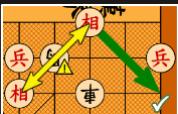
- 沿对角线移动恰好 2 格(走"田"字),可吃该位置的敌方棋子。
- 不可过河(仅能在己方半场活动)。
- 堵象规则:若"田"字中心点有棋子(无论己方或敌方),则不可移动。这意味着两只象可能互相阻挡,无法协防。
4.4 马(Horse)
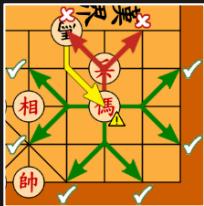
- 先沿直线走 1 格,再沿对角线走 1 格(即走"日"字)。
- 可吃落点处的敌方棋子。
- 蹩马腿规则:若第一步直线方向上有棋子阻挡,则不可移动。这意味着一匹马可能无法反击正在攻击它的另一匹马。
4.5 车(Chariot)
- 沿横线或纵线移动任意格数,直到遇到棋子或棋盘边缘。
- 遇到敌方棋子可吃之;遇到己方棋子则停在其前一格。
- 车是全盘最强棋子。
4.6 炮(Cannon)
- 移动方式与车相同:沿横线或纵线移动任意格数。
- 吃子特殊规则:吃子时必须跳过恰好 1 枚棋子(称为"炮架",可以是己方或敌方棋子)。无炮架则不可吃子。
4.7 兵/卒(Soldier)
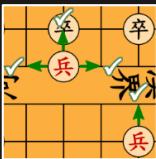
- 过河前:只能向前移动 1 格。
- 过河后:可向前、左或右移动 1 格,不可后退。
- 吃子方向与移动方向相同。
5. 棋子相对价值
| 棋子 | 大致分值 |
|---|---|
| 兵/卒(过河前) | 1 |
| 兵/卒(过河后) | 2 |
| 士/仕 | 2 |
| 相/象 | 2 |
| 马 | 4 |
| 炮 | 4.5 |
| 车 | 9 |
6. 胜负与和棋
6.1 将军(Check)
- 当一方的棋子攻击到对方的将/帅时,称为"将军"(jiāng)。
- 被将军的一方必须解除威胁(移动将帅、吃掉攻击棋子、或用其他棋子阻挡)。
6.2 将死(Checkmate)
- 将/帅被攻击且无法以任何方式解除威胁时,称为"将死"(jiàng sǐ),该方输掉游戏。
6.3 困毙(Stalemate)
- 将/帅未被直接攻击,但己方无合法且安全的着法可走,称为"困毙"(kùn bì),该方输掉游戏。
6.4 和棋(Draw)
- 双方均无法迫使对方将死或困毙时,判定为和棋(píng jú)。
6.5 重复局面规则
- 若一方连续三次以相同棋局位置将军或攻击对方的无保护棋子(长将/长捉),该方必须改变走法。若无法改变,该方判负。
- 同理,若一方连续三次以相同方式被将军,被将军方判负。
7. 棋谱记法
国际通用的记法系统,每步棋由四部分组成,可使用简体中文、繁体中文或罗马字母。
7.1 棋子符号
| 棋子 | 英文代号 | 中文记号 |
|---|---|---|
| 将/帅 | K | 帥/將 或 帅/将 |
| 士/仕 | A | 仕/士 |
| 相/象 | E | 相/象 |
| 马 | H | 馬/马 |
| 车 | R | 車/车 |
| 炮 | C | 炮 |
| 兵/卒 | P | 兵/卒 |
7.2 记法四要素
- 棋子符号:上述代号。
- 所在纵线编号:从己方右侧数起为第 1 线。红方用中文数字,黑方用阿拉伯数字。
- 移动方向:
- 前进:+或 進/进
- 后退:-或 退
- 平移:=或.或 平 - 落点信息:
- 直线移动棋子(车、炮、兵/卒平移):移动的格数。
- 非线性棋子(将/帅、士/仕、相/象、马):目标纵线编号。
7.3 同纵线同种棋子的区分
- 当同种棋子在同一条纵线上时,用"前"(+)表示前面的棋子,"后"(-)表示后面的棋子。
- 当两个或更多兵/卒在同一条纵线上时,按从前到后依次编号(1、2、3……)。
7.4 记法示例
- 最常见开局:
C2=5 H8+7(炮二平五,马八进七) - 三兵同线移动中兵:
25=4(二五平四)
关键规则与常见问题
易错规则
- 飞将规则:双方将/帅不可在同一直线上"照面",中间必须隔子。
- 蹩马腿:马的第一步直线方向有子则不可走。
- 堵象:象走"田"字,中心有子则不可走;象不可过河。
- 炮吃子必须跳过 1 枚棋子(炮架),无炮架只能移动不能吃。
- 过河兵/卒不可后退,但可左右移动。
- 士/仕不可离开九宫,只能沿对角线走。
- 将/帅不可出九宫,只能直线走 1 格。
- 困毙判负:不是和棋,是无合法着法的一方输。
- 长将/长捉必须变招,否则判负。
常见问题
-
Q:马可以跳过其他棋子吗?
A:可以,但第一步直线方向不能有棋子阻挡(蹩马腿)。 -
Q:炮移动时需要跳过棋子吗?
A:移动时不需要,与车相同沿直线走。只有吃子时才需要跳过 1 枚棋子。 -
Q:兵/卒过河后可以后退吗?
A:不可以,只能向前、左或右移动。 -
Q:两只象可以互相保护吗?
A:由于堵象规则,同一方的两只象可能无法互相到达对方位置。 -
Q:什么是"困毙"?
A:将/帅未被直接攻击,但己方所有棋子均无合法着法可走,该方判负。 -
Q:棋谱记法中纵线编号从哪边数起?
A:从己方右侧数起为第 1 线,双方视角不同,右左互换。
常见问题(FAQ)
以下 1 条问答中 0 条来自站内玩家的真实提问,其余 1 条为本站整理的常见疑问;答复内容保持原样。
中国象棋支持几个人玩?
2 人。
去哪查完整规则
想核对具体规则细节、卡牌效果或某个回合的结算方式,可以在村了吗里选中这款游戏后直接提问。
同类桌游
规则原文(Markdown)
本站收录这款游戏的规则原文 1 个文件,此处内联渲染 1 个,可直接展开阅读或下载。
Xiangqi Booklet.md16.9 KB

Introduction to Chinese Chess
Chinese Chess, or 象棋 xiàng qí as it is called in the Chinese language; is a popular game and pastime throughout the Chinese cultural sphere and many places in Asia with a significant Chinese community, such as Hong Kong, Taiwan, Malaysia and Singapore. It is also popular in Vietnam, where it is known as cờ tướng.
Since its conception centuries ago, the game has stayed true to original form. When the name is translated, it is called the Elephant Game. It comes from the same family of traditional chess games as Western Chess and the Japanese Shōgi.
Playing the Game
When setting up the game please refer to the starting position diagram at the back of this instruction manual while following this setup instructions.
The game board consists of nine vertical lines (files) and ten horizontal lines (ranks) with the pieces being played on the intersections of the lines. On each side of the board against the back edge is a 宮 gōng Palace, which is a 3 by 3 lines (9 positions) with four diagonal lines that extend outward from the center forming a cross shape that connects the four corners of the Palace. Dividing the two opposing sides of the board with a gap is the River, located between the fifth and sixth ranks. The River is sometimes marked with the Chinese characters, 楚河 Chǔ Hé meaning Chu River, and 漢界 Hàn Jiè (汉界 in simplified Chinese), meaning Han Border, a reference to a conflict in Ancient Chinese history known as the Chu-Han Contention (206 to 202 BC). Some boards have the starting points of Soldiers and Cannons marked to indicate their initial placement.
Each player begins with one General, two Guards, two Elephants, two Horses, two Chariots, two Cannons, and five Soldiers. They are placed from starting from middle to the sides on the bottom and top rows in a symmetrical way, from the General in the middle, then the Guards, Elephants, Horses, and Chariots. Cannons are placed two intersections in front of the Horses. Finally, the Soldiers are placed at every other intersection one rank back from the edge of the River.
The Object of the Game is to capture the enemy General. When the General is under attack, this is a 將 jiāng (Check) and the player in Check must move in such a way that their General is no longer threatened. If a player’s General is under attack and has no means of escape, this is 將死 jiàng sǐ (Checkmate), and they have lost the game.
Another way to win the game is if the enemy General is not under immediate threat but there is no legal and safe move to perform. This is 困毙 kùn bì (Stalemate).
However, should neither player be able to force a Checkmate or make the enemy General unable to make a legal and safe move, then it is a 平局 píng jú (Draw).
If a player checks or attacks an unprotected piece three times in a row while repeating the same board position, the player forcing the repetition must do something else. If they cannot, then they have forfeited the game. Similarly, if a player checks the other player three times in a row in a way that repeats their positions, the checked player has forfeited the game.
The Game Begins with Red making the first move. Each side alternates, moving one piece each turn. Once a piece has been captured by an enemy piece, it is removed from the board and the capturing piece takes its place.

General Moves

Guard Moves
Elephant Moves
Horse Moves

The General (King) moves one point back, forward, right, or left but cannot make a move diagonally, and cannot move outside the nine intersections of the Palace area. The General may capture enemy pieces which moves into the Palace area except ifthat piece is protected by another piece. Generals on the opposite sides of the board cannot be on the same file with each other without any other piece in between them.

The Guard (Advisor) is a defensive piece that stays in the Palace area and cannot leave it. The Guard moves and
captures other pieces one point along the diagonal lines of the Palace in either directions.
The Elephant moves and captures other pieces exactly two points diagonally and cannot cross the River. The Elephant also cannot move if there is a piece in between the two points. Note that this means that a pair of Elephants could be blocked and cannot defend each other.
The Horse moves and capture other pieces one point in any direction then one point diagonally. The Horse cannot move if there is a piece in front of the Horse blocking its path in any directions. Note that this means that it is possible for one Horse to be unable to counterattack against another Horse attacking it.
The Chariot moves as many points in a straight line horizontally or vertically along the rank and file, until it meets with another piece or the edge of the board.
The Cannon moves as many points in a straight line horizontally or vertically along the rank and file, until it meets with another piece or the edge of the board, but when it captures, there must be any one other piece to jump over from, either a friendly or an enemy piece.
The Soldier (Pawn) moves and captures other pieces one point forward. Once crossing the River, the Soldier may also move either one point to the left or right but not backwards.
Approximate Relative Values of Pieces
| Piece | Point(s) |
| Soldier before crossing the river | 1 |
| Soldier after crossing the river | 2 |
| Guard | 2 |
| Elephant | 2 |
| Horse | 4 |
| Cannon | 4½ |
| Chariot | 9 |

Chariot Moves

Cannon Moves
Soldier Moves
Notation System
There are several types of notation used to record xiàng qí games. Listed here is the commonly used notation system throughout the world. Each move is made up of four parts. Either Simplified or Traditional Chinese Hàn characters or Roman alphabet can be used to represent the piece moved.
The first part is a symbol of the piece. The notations for the various pieces are as follows:
| General(King) | Guard(Advisor) | Elephant | Horse | Chariot(Rook) | Cannon | Soldier(Pawn) |
| K | A | E | H | R | C | P |
| 帥將or帅将 | 仕士 | 相象 | 馬or马 | 車or车 | 炮 | 兵卒 |
The second part is the file number one to nine in which the chess piece is located. In notations that uses Hàn characters, Red use the Chinese numeral, while Black use the Arabic numeral. These number positions are counted from right to left on each player’s side; everything is relative to their positions. So, a player’s right file is the other player’s left file, and vice versa.
The third part is the direction of chess piece movement. These are as follows: 進 jìn or + plus sign for forward, 退 tuì or - minus sign for backward, or 平 píng or . dot / period sign or = equals sign for sideways movements.
The fourth part is the information of the number of the new intersection moved into. When referring to vertical movements, this indicates the number of intersections passed through. If the pieces move sideways or are pieces that does not move linearly, such as Guard, Elephant, or Horse pieces, this number refers to the file number in which they move into.
Thus, the most common opening in the game would be:
- C2.5 H8+7 or 1. C2=5 - H8+7 or 1. 炮二平五 馬 8 進 7
There may be instances where pieces of the same kind are positioned in tandem on the same file. In these cases, refer to the following system:
(Piece symbol) (前 qián or + plus sign for the front piece and 後 hòu or - minus sign for the rear piece) (Direction of movement) (Number of intersections passed through or new file number it was moving into)
There might even be rare cases where there are two or more Soldiers on the same file. In these cases, refer to the following system:
(Soldier number starting from 1, from the frontmost one) (File number on which it was on) (Direction of Movement) (File number it was moving into)
Thus, the notation to move the middle of a three tandem Red Soldiers in the 5th file to the 4th file would be:
- 25.4
or 1. 25=4
or 1. 二五平四
Once we had learned how the pieces moves, we can move on to learning about basic killing moves, then openings, midgames and then endgames. We can also learn more about xiàng qí puzzles and problems, look up for records of past games on the internet, or do post-mortem analyses of the games we had played. But this is beyond the scope and purpose of this small instruction manual, so please refer to the Links and Resources section for this purpose.
Facts, History and Trivia
象棋 Xiàng qíhas a long history, and although its precise origins have not yet been definitely confirmed, the earliest indications reveal the game may have been played as early as the first century AD. It is still hotly debated by scholars up until today what the name xiàng qí really means.
Those who believe they mean the Elephant Game thought that the game is a war simulation that portrays two armies facing off against each other on the battlefield, was used to prepare for an upcoming battle, and had evolved from an earlier Indian counterpart upon its arrival in China, sometime in the Warring States era (453 to 221 BC).
Others believe they mean the Figure Game, since the character 象 xiàng could also means figure, image or to resemble. The character originated as a stylized drawing of an elephant, and have that meaning because in Ancient China, paraphrasing philosopher and statesman 韩非子 Hán Fēi Zi (circa 221 BC); People rarely see living elephants and mostly came across skeletons of dead ones, from which they imagine its living form according to its features. Thus the character 象 xiàng cames to be used for imagining reality.
Still others believe they mean the Constellation Game. There are other games with board and pieces, such as 六博 or 陸博 liù bó, an early iteration of the game Backgammon that uses dice, and has many similarities with xiàng qí. It have markings on the board, five Pawns and a King, and a River on the board. Liù bó carries a strong astronomical theme, this also because the board could be used independently as a tool for divination, based on many excavations that had unearthed the board game. The game could have represented the movements of heavenly bodies and other celestial objects in the night sky, and features such as the River might represent the Milky Way.
Some believe that the Xiàng qí was not related to the Persian Shatranj, from which many argued that the traditional chess games known around the world develops; but was based on the Liù bó. It was transmitted from China to India during the Eastern Jin era (317 to 420 AD), where it developed into the Chaturanga, which was the game from which the both the Persian chess and the Chinese chess developed. However, the status of this claim is disputed.
The current form of Xiàng qí that is played nowadays took form no later than the Southern Song Dynasty (1127 to 1279 AD). In the past, Chess (used in a generic term to mean strategic board games) was one of the key factors to determine if you were a gentleman or not. Chess (Go and Xiàng qí) was listed second in the 四藝 sì yì Four Arts (琴棋書畫 qín qí shū huà) that gentlemen were supposed to be proficient. The other three were the playing the Zither (music), Chinese Calligraphy, and Chinese Paintings.
With the economic and cultural development during the Qing Dynasty (1636 to 1912), xiàng qí entered a new stage. Many different schools of chess circles and players came into prominence. With the popularization of xiàng qí, many books and manuals on the techniques of playing the game were published. They played an important role in popularizing xiàng qí and improving the techniques of play in modern times. Finally, a Western-style Encyclopedia of Chinese Chess Openings was written in the year 2004, and in the year 2018 the World Xiangqi Rules was published, which has strict rules as to how to write the Chinese chess notation.
Gallery of Awesome Sets



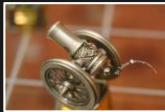
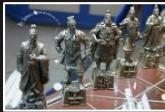


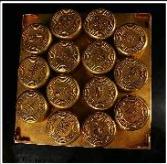


courtesy of BoardGameGeek and eBay
Links and Resources
www.xqinenglish.com The most complete xiàng qí resources available in English. Contains learning materials such as the basics of the game, basic kills, ancient manuals, opening, midgame, endgame, match records, and many more.
www.plateriver.net/community/xiangqi.php A website with animated learning materials and an app practice board where you can play against the computer.
www.xiangqi.com by Paul English. A website where you can play and compete against other players online in tournaments. Easy interface, free of charge but you would have to sign up for an account.
• www.01xq.com A huge amount of xiàng qígames database. Would be useful for analyzing moves of past matches, events and competitions.
wxf.ca/wxf/ The World Xiangqi Federation (WXF) website, in both Chinese and English.
Appendix
If you’ve purchased the Pictorial Style Set, the featured pieces below are those used, instead of the ones using traditional Chinese Hàn characters.


General


Guard

Elephant

Horse


Chariot

Cannon

Soldier
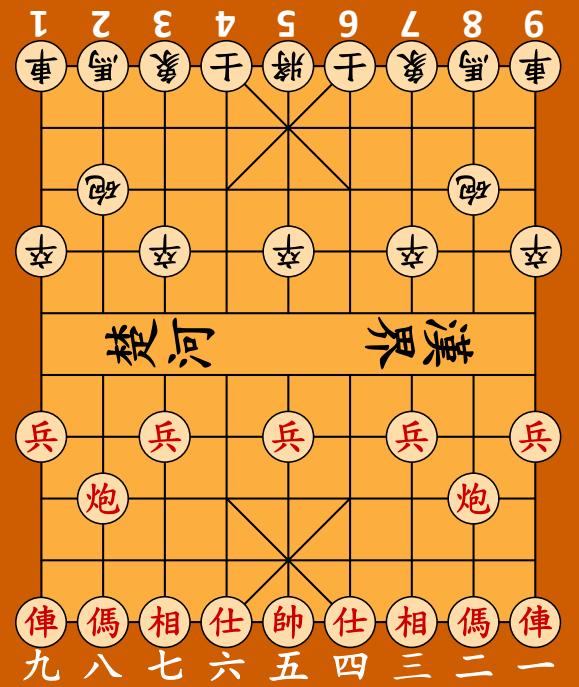
原文为社区整理/出版社公开资料,版权归原作者,仅供个人学习查阅。