
1848: Australia1848 Australia
一句话概览
1848: Australia 是一款已收录于村了吗规则库的桌游,支持 3–6 人,原名 1848 Australia。
本页内容:一句话概览 · 常见问题
这游戏怎么玩
- 本站已收录这款游戏的规则资料,可以在对话里直接提问规则细节。
常见问题(FAQ)
以下 1 条问答中 0 条来自站内玩家的真实提问,其余 1 条为本站整理的常见疑问;答复内容保持原样。
1848: Australia支持几个人玩?
3–6 人。
去哪查完整规则
想核对具体规则细节、卡牌效果或某个回合的结算方式,可以在村了吗里选中这款游戏后直接提问。
同类桌游
- 卡坦岛德式
- 工业革命:伯明翰德式
- 勃艮第城堡:特别典藏版德式
- 方舟动物园德式
- 卡卡颂抽象
- 瘟疫危机传承:第一季美式
- 阿瑞迪亚:勇踏征途美式
- 重塑宇宙德式
- 幽港迷城美式
- 埃多拉的德鲁伊德式
规则原文(Markdown)
本站收录这款游戏的规则原文 1 个文件,此处内联渲染 1 个,可直接展开阅读或下载。
1848-RULES-11a.md82.9 KB
1848 Australia
RULES OF PLAY
by Helmut Ohley and Leonhard Orgler
TABLE OF CONTENTS
- Introduction and History . 2
- Game Preparations . . 4
- The Start of the Game . 4
- Private Companies ...... 5
- Public Companies... 8
- Directors..... 8
- Operating Rounds (OR) . . . . 8
- Trains .... 10
- The Phase Track..... 11
- Train Income . 12
- Share Price Changes in an Operating Round .. 13
- Stock Rounds (SR)... 13
- End of the Game. . . . 14
Index.... 15
Tile Manifest and Upgrades . 16
1.0 Introduction and History
1.1 Introduction
1848 Australia is a train building and business game for 3 to 6 people. It is based on the game 1829 by Francis Tresham.
1848 Australia has simple mechanisms at its base. The yellow, green, brown and gray tiles are placed on the map to form a network of routes, connecting stations together. The trains (train cards) make notional journeys from station to station, thereby earning money as the travelers pay for their journeys. The (imaginary) travelers pay for their journeys. The more numerous and the more important the stations a train visits, the more money it earns for the company and its shareholders.
In the game you and your fellow players will own 6 Private Companies, shares in 8 Public Companies, as well as shares in the Bank of England. The Public Companies belong to their shareholders. The player with the most shares in a company is its Director and decides what the company will do.
1.2 History
The very first Australian railway was a horse-drawn railway which in 1831 connected coal mines to the quays on the Hunter River. By 1855 there were three coal railways in Newcastle.
These railways were industrial railways, which during the next 150 years came into being over the whole country, supporting such industries as mining, sugar plantations, logging, metal works and cement factories. For the most part they were owned by the industrial companies themselves and were therefore called “Private Railways" in order to distinguish them from the main railways owned by the States.
Australia's first railway company, the Sydney Railway Company, was founded in 1848. It proved ruinous for its founders and shortly before the opening of the first line (the 14 miles from Sydney to Parrametta) it was taken over by the New South Wales Government Railways. This also took over the second line, the one from Newcastle to Maitland.
In 1852 eight privately financed railways were planned in Victoria. Three of them were established but only one of them was a success—the Melbourne and Hobson's Railway Company, which was founded in 1852 and opened on the 12th of September 1854.
In May 1854 the first horse-drawn railway with iron rails was opened in Victoria, a 7 mile long stretch between Goolwa on Lake Alexandria and Port Eliot on the southern ocean.
So between 1854 and 1855 railways were set up in the three colonies of Victoria, South Australia and New South Wales. Tasmania and Western Australia would have to wait until the 1870s.
Before the founding of the Commonwealth of Australia on the on the 1st of January 1901 the Australian colonies were legally independent and self-governing entities, and each made its own decisions on which track gauges were suitable for them. The main types used were 1067 mm (Narrow Gauge) in Queensland, Western Australia, South Australia and Tasmania; 1435 mm (Standard Gauge) in New South Wales, South Australia, and later for the National Railway; and 1600 mm (Broad Gauge) in Victoria and South Australia. These different gauges led, as the sections joined up across the continent, to numerous incompatible interfaces in the network. It was not until 1970 that a 3961 km, Trans-Australian, East- West, straight-through link on standard gauge was opened.
The Ghan is the name of the railway that runs from Adelaide via Alice Springs to Darwin. At 2979 km it is one of the longest railway lines in the world. Construction in the south began in 1878 from Port Augusta, while construction in the north began in 1883 from Darwin. The Ghan began to operate in 1929 linking Port Augusta with Alice Springs. In 2001 construction from Alice Springs to Darwin began and by 2004 the entire route—from Adelaide to Darwin—was finished.
1.3 Components
A complete game of 1848 includes:
• 1 mounted game board
• 1 sheet of tokens
• 1 Private Company Auction Track/Revenue Track
• 100 track tiles (43 yellow; 31 green; 22 brown; 3 gray; 1 blue)
• 32 train cards (6 x 2/2+; 5 x 3/3+; 4 x 4/4+; 3 x 5/5+; 2 x 6/6+; 5 x 2E; 7 x 8/D)
• 6 Private Company certificates
• 72 shares in the 8 Public Companies (one 20% and eight 10% each)
• 10 shares in the Bank of England
• 8 Charters for the Public Companies
• 1 Corporation Charter for the Bank of England
• 12 white wooden disk
• 1 large wooden cylinder for keeping track of the changes between Stock Rounds (SR) and Operating Rounds (OR)
• 1 “First Player" Priority Card
• 9 denominations of game money (£10,000)
• 20 £100 notes for Bank of England (£2,000)
• 1 set of rules
x10

1848 Australia
PRIVATE COMPANY AUCTION TRACK
| beny Cocpany | Dodeadta | Tanain | The Ghan HR 3 | Trams | North 三 | Private Auction 6 Certif | ||||||||
| 65 | 110 | 1 | 1 20 15<.80 | 625 | E00 | |||||||||
| £5 INCOME Cas be bought by a Public | £10 INCOME Can be bo ay for between £1- £90 ght by a Public | 155 Can be bought by a Publio | INCOME £20 Can be b ght by a Pablic | £25 Public Cc | INCOME £30 Public Cormpany sale = NA | |||||||||
| BONUS one desert hex foe £40 less cost | BONUS: The owmer rortves the blue Tasmania tile | Cerspany Korr bety veen £1- £220 BONUS £100 rchte on the purchase of a ZE train (The Ghaa). | BONUS receives 10% share in the QG | BONUS Share in the CAR, which starts xes the Dirctor with a share price of É100. | ||||||||||
| 30 | 70 | 110 | 170 | 170 | 230 | P1 Melbourne and | ||||||||
| 25 | 65 60 | 105 | 165 | 165 | Hobson's Bay | Railway Company 3/3+: May be purchased by a | Public Co. for £1 to £40. £5 5/5+: All Privates closed INCOME | |||||||
| 20 15 | 55 | 100 | 160 | 160 | ||||||||||
| 95 | 155 | 155 | ||||||||||||
| 10 | 50 | 90 | 150 | 150 | ||||||||||
| 5 | 45 | 85 | 145 | 145 | 205 | |||||||||
| 0 | 40 | 80 | 140 | 140 | 200 | |||||||||
Private Company Auction Track and 6 Certificates

SR/OR cylinder and 12 disks
8 Charters for the Public Companies
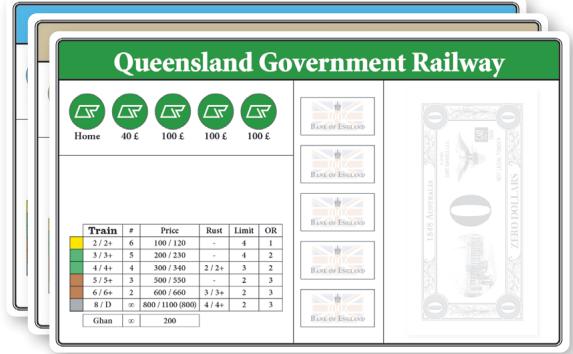

Bank






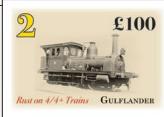
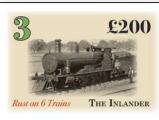
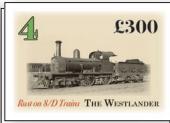
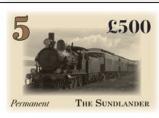
Trains


All 100 Track Tiles

Bank of England Corporation Charter, Certificates, and Loans
1848


x20 £100 notes

© 2021 GMT Games, LLC
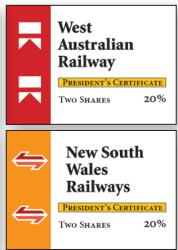
Public Company certificates
The Priority Deal Card

2.0 Game Preparations
2.1 Seating Order
The seating order is determined using the Private Company certificates, which are numbered. Deal one to each player. Players take their seats in clockwise order, beginning with the player who drew the lowest number and continuing in sequence.
In each Stock Round (SR) the players act in clockwise order. The player to the left of the last person to buy or sell in a SR is given the Priority Deal Card. The Priority Deal Card indicates that this player will be the first to have the option of taking action in the next SR.
2.2 Etiquette
Players should decide before the game starts what type of agreements are permitted and whether agreements are binding. Please follow these guidelines for proper etiquette:
• Agreements between several parties are, in general, forbidden.
• The entire holdings of players and companies should be viewable at all times.
• In order not to lengthen the playing time unnecessarily, each player should think about what he is going to do in his turn while other players are taking theirs.
• Each player must keep all his game material open and clearly visible on the table in front of him.
2.3 Starting Capital
The Starting Capital, which varies according to the number of players, is distributed to each player as shown in the table below:
| Number of players | 3 | 4 | 5 | 6 |
| Starting Capital | £840 | £630 | £510 | £430 |
2.4 Further Information
(2.4.1) The Banker: One player is chosen to be the Banker. He should have sufficient space near him to lay out the Bank's money (10,000 pounds) and the other game components.
(2.4.2) Private Company Certificates: The certificates for the Private Companies are laid ready next to the Private Company Auction Track.
(2.4.3) Track Tiles: The yellow tiles will also soon be needed. Lay out the yellow tiles close to the game map so that everyone can see what curves, straights and cities are available.
(2.4.3) Train Cards: Of the train cards, the 2/2+ trains will be needed first. Place these next to the game map. Sort the remaining trains into types and place them next to the currently available trains. If the currently available trains are sold out, the next type becomes available.
(2.4.5) Company Charters: The company charters for the Public Companies are made ready. During the game all of a company's possessions are kept on its chart: trains, cash, station tokens and loan markers. A company's cash must be kept strictly separate from that of players and other companies.
3.0 The Start of the Game
3.1 Purchase Private Companies
(3.1.1) Purchase or Reduce the Price: The game begins with the sale of the Private Companies. The player who drew the starting position in the turn order (2.1) can either buy a Private Company at its face value or reduce the cost of a Private Company by 5 pounds. Place a white disk next to the current price. Play then passes to the next player, who has the same choice of buying a company or lowering a price.
| 1848 Australia PRIVATE COMPANY AUCTION TRACK | ||||||||||||
| 1 Melbourne andHobson's BayRaihway Company | 2 OodnadattaRailway£40OffDesert Hex | 3 TasmanianRalbway | The GhanS100OfH 2ETrain | 5 TransAustralianRailway | P6 North 三1AustralianRaihway | |||||||
| sa peheellns/s-:tacNOE | na hsaeheollys.Ss-: #Pets d | 22- D SE | s./s- aat N2 | á/+ MPeuts doad 25SE | L/s- an dut E3 | |||||||
| £5INCOME | £10INCOME | £15INCOME | £20INCOME | £25INCOME | £30INCOME | |||||||
| Can be bought bv a PublicCompany for between €1-€40. | Can be bought by a PublicCompany for between £1-£80BONUS:Develop one desert hex for €40less cost. | Can be bought by a PublicCompany for between £1- £140BONUS:The owner receives the blueTasmania tile. | Can be bought by a PublicCompany for between 61- €220BONUS:€100 rebate on the purchase of a2E train (The Ghan). | Public Company sale = NABONUS:The owner receives 10% share inthe QG. | Public Company sale = NABONUS:The owner receives the Director'sShare in the CAR, which startswith a share price of € 100. | |||||||
| 30 | 70 | 110 | 170 | 170 | 230 | |||||||
| 25 | 65 | 105 | 165 | 165 | 225 | |||||||
| 20 | 60 | 100 | 160 | 160 | 220 | |||||||
| 15 | 55 | 95 | 155 | 155 | 215 | |||||||
| 10 | 50 | 90 | 150 | 150 | 210 | |||||||
| 5 | 45 | 85 | 145 | 145 | 205 | |||||||
| 0 | 40 | 80 | 140 | 140 | 200 | |||||||
| © 2021 GMT Games, LLC • Hanford, Califomia, 93232-1308 • www.GMTGames.com | ||||||||||||
Keep track of the current bid with the Auction Track.
(3.1.2) Mandatory Purchase: If a player is unable to reduce a price because all the companies are at their minimum price level, and if no Private Company has yet been bought by any player, then that player must buy a Private Company.
(3.1.3) Purchase or Pass: If a player is unable to reduce a price because all the companies are at their minimum price level, but at least one Private Company is in player hands, the player may either buy a Private Company or pass. A player who already owns a Private Company may pass each time.
(3.1.4) All Players Pass: If not all the Private Companies have been sold and all players have passed in turn, those companies that have been sold pay out their income and the process of selling the Private Companies resumes, with each player again having the opportunities to buy, to lower a price or to pass.
3.2 Begin First Stock Round (SR)
After all the Private Companies have been sold, the shares in the Public Railway Companies (5.0) and in the Bank of England (5.4) become available. The player to the left of the last player to take an action in 3.1 above receives the Priority Card.
4.0 Private Companies
4.1 General Information
• Private Companies are shares with a fixed income, which is paid to their owner (player or Public Company) by the Bank at the beginning of each Operating Round.
• Private Companies neither lay tiles nor own and operate trains.
• Private Companies do not count against Certificate Limits (12.2).
• From the sale of the first 3/3+ train, the Public Companies can buy Private Companies (P1 to P4) which are owned by their Director, at a price in the range indicated.
• From the sale of the first 3/3+ train, Public Companies can use the special powers of Private Companies owned either by the Public Company concerned or by its Director.
• The Bank of England may not own a Private Company.
• Private Companies are closed with the sale of the first 5/5+ train.
• The discounts of P2 and P4 continue to be awarded after the companies are closed.
• Private Companies can not be traded, either between players or between companies.
4.2 Melbourne & Hobson's Bay Railway Company (P1)
• Income 5 pounds
• No special powers
• Can be bought by a Public Company for between £1-40.
• Closed with the sale of the first 5/5+ train.
4.3 Oodnadatta Railway (P2)
• Income 10 pounds
• If the company is owned by a Public Company or its Director, that company can, on one occasion, place a yellow tile in a desert hex for free instead of paying the £40 terrain cost.
• If at the time of the sale of the first 5/5+ train the company is still owned by a player, that player retains the right to the rebate and can use it at a time of his choosing for a company of which he is the Director.
• If at the time of the sale of the first 5/5+ train the company is owned by a Public Company, that company retains the right to the rebate.
• Can be bought by a Public Company for between £1-80.
• Closed with the sale of the first 5/5+ train.
4.4 Tasmanian Railways (P3)
• Income 15 pounds
• The owner receives the blue Tasmania tile.
• The Tasmania tile can be placed by a Public Company on one of the dark blue hexes. This is in addition to the company's normal build that turn.
• Tasmania counts against a train's range.
• If the 5/5+ train is bought, the Tasmania tile must immediately be placed on one of the two earmarked dark blue hexes.
If the Private Company is owned by a player at this point, the player places the tile.
If the Private Company is owned by a Public Company at this point, the Director places the tile.
• Can be bought by a Public Company for between £1-140.
• Closed with the sale of the first 5/5+ train.
4.5 The Ghan (P4)
• Income 20 pounds
• The owner has a one-time rebate on the purchase of a 2E train, "The Ghan".
• If at the time of the sale of the first 5/5+ train the company is still owned by a player, that player retains the right to the rebate and can use it at a time of his choosing for a company of which he is the Director.
• If at the time of the sale of the first 5/5+ train the company is owned by a Public Company, that company retains the right to the rebate.
• Can be bought by a Public Company for between £1-220.
• Closed with the sale of the first 5/5+ train (though the right to the rebate is retained).
4.6 Trans-Australian Railway (P5)
• Income 25 pounds
• The owner receives in addition a 10% share in the QR.
• Closed with the sale of the first 5/5+ train.
4.7 North Australian Railway (P6)
• Income 30 pounds
• The owner receives the Director's Share in the CAR, which starts with a share price of £100.
• Closed when the CAR buys a train or with the sale of the first 5/5+ train.
Summary of Private Companies
| Beneit | Start-ing Bid | Income | Price to aPublic Co. | |
| P1 | none | £30 | £5 | £1- £40 |
| P2 | £40 Desert Discount | £70 | £10 | £1-£80 |
| P3 | Tasmanian Tile | £110 | £15 | £1-£140 |
| P4 | £100 Ghan TrainDiscount | £170 | £20 | £1-£220 |
| P5 | +10% Share (QR) | £170 | £25 | NA |
| P6 | +20% Director'sShare (CAR) | £230 | £30 | NA |
5.0 Public Companies
5.1 General Information
(5.1.1) Public Company Share Price: Each Public Company has a share price, which is shown on the Share Price Chart. The initial (par) share price of a Public Company is set at the time of purchase by the player who buys the Director's Share. As soon as a Public Company has a share price, 10% shares in the company can be bought and sold.
(5.1.2) The Director's Share: The first obtainable share is always the Director's Share (with the exception of the Bank of England). The Director's Share always corresponds to two standard shares but only counts as one certificate against the Certificate Limit.
(5.1.3) New Shares: These are shares that have not yet been owned. They can be bought in a Stock Round at their initial (par) share price.
(5.1.4) Old Shares: These are shares that have been sold to the Bank. They can be bought in a Stock Round at the share price shown on the Share Price Chart. Shares can also be sold at this price.
(5.1.5) Dividends: With the purchase of a share a player acquires a stake in the Public Company concerned. The owner of a share receives dividends during the Operating Round, unless the Director has decided that the company is withholding its earnings. Dividends of hitherto unsold shares and of shares in the Bank Pool are not paid out. The money is retained by the Bank.
| PublicCompany | Abbrevi-ation | Home City | Numberof Stationtokens | |
 | QueenslandGovernmentRailway | QR | BrisbaneB10 | 5 |
 | Common-wealthRailways | COM | Sydney (F9)andAdelaide (G3) | 5 |
 | FederalTerritoryRailway | FED | CanberraG7 | 4 |
 | VictorianRailway | VR | MelbourneH6 | 3 |
 | SouthAustralianRailway | SAR | AdelaideG3 | 4 |
 | WestAustralianRailway | WA | PerthD1 | 5 |
 | New SouthWalesRailway | NSW | SydneyF9 | 4 |
 | CentralAustralianRailway | CAR | Port AugustaE2 | 4 |
(5.1.6) Selling Shares: Shares can not be sold in the first Stock Round. Shares can not be sold if the sale would place more than 50% of the company's shares in the Bank Pool.
(5.1.7) Mandatory Trains: A Public Company which is in operation and has a route must, at the end of its operating turn, own a train.
5.2 "Normal" Public Companies
(5.2.1) Initial Share Price: The purchaser of the Director's Share sets the initial share price for the company. The possible initial share prices are 70, 80, 90 and 100 pounds. (The CAR always has an initial share price of 100 pounds.) From this point onwards the 10% shares in the company can be bought and sold.
(5.2.2) Public Company Launch: A company is launched and begins to operate once 60% of its shares have been bought. When a company is launched, it receives 10 times its initial share price as its starting capital.
5.3 Commonwealth Railways (COM)
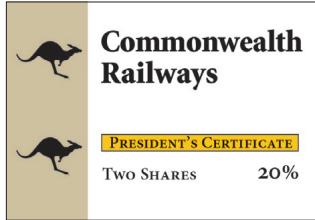
(5.3.1) Initial Share Price: The purchaser of the Director's Share sets the initial share price for the company. The possible initial share prices are 70, 80, 90 and 100 pounds. From this point onwards the 10% shares in the
company can be bought and sold.
(5.3.2) Sydney to Adelaide Link: The company is launched and begins to operate once 60% of its shares have been bought and a notional train of infinite range could travel from Sydney to Adelaide. (Station tokens don't act as blockers when applying the second part of this test.)
(5.3.3) Timing of Launch: If all the conditions for the launch of the COM are fulfilled before it would be the COM's turn to operate in the relevant OR (according to share price order), it starts to operate in the same OR. If the second condition (the Sydney-Adelaide link or the purchase of the first 6/6+ train) is fulfilled for the first time by a company with a lower share price, the COM will operate for the first time in the next OR.
(5.3.4) Starting Capital: When the company is launched, it receives 10 times its initial share price as its starting capital.
(5.3.5) 6/6+ Effects: With the purchase of the first 6/6+ train, the condition concerning the Sydney-Adelaide link (5.3.2) is dropped, the COM is then dealt with like a normal company and the only difference is the two home stations.
(5.3.6) No Starting Location: If in one or both of the cities there is no place for the home station for that city, the token is laid on the edge of the tile or undeveloped hex. A station token of the COM lying at the edge of a tile has the same properties as a “normally" placed station token. If as a result of the development/ upgrade of the hex/tile a free place becomes available, the token is immediately moved from the edge of the hex/tile to this place.
(5.3.7) Additional COM stations: The three further station tokens of the COM are available for placement using the normal rules and at a cost of 100 pounds each.
5.4 Bank of England

(5.4.1) In General: All players jointly manage the holdings of the Bank of England. These holdings are 2000 pounds of extra money and 20 loan markers which are laid out at the beginning of the game. The money from the sale
of shares in the Bank of England is paid to the “normal" Bank.
(5.4.2) Buying Shares in the Bank of England: Each share costs the current indicated price and distributes 10% per share of the Bank of England's income to the owner of the share. The shares are always bought and sold at the indicated price. Unlike those of other companies, the share price neither sinks because of a sale nor rises because all the shares have been sold.
(5.4.3) Dividends: The Bank of England distributes to the shareholders a minimum total dividend that depends on the phase:
• Yellow Phase 0 pounds
• Green Phase 100 pounds
• Brown Phase 200 pounds
• Gray Phase 300 pounds
The minimum total dividend is increased by the city value of each station owned by a company that is in receivership. Each share receives 10% of these totals.
(5.4.4) Train Removals: Trains are removed from the bank when the following occurs:
• At the moment the second company is taken over by the Bank of England, the cheapest permanent train (5/5+, 6/6+, 8/D) on sale from the Bank is removed from the game.
• At the moment the fifth company is taken over by the Bank of England, the cheapest permanent train (5/5+, 6/6+, 8/D) on sale from the Bank is removed from the game.
Trains removed from the game are regarded as having been sold and can bring about a phase change.
5.5 Companies in Receivership
(5.5.1) In General: If the share price marker of a company reaches the hatched area on the left-hand side of the Share Price Chart, the company is immediately taken over by the Bank of England.
(5.5.2) Compensation: The company must pay compensation, at the initial share price, for all shares owned by players other than the Director. (No compensation is paid for the Director's shares.) If the company doesn't have enough capital to pay the compensation, the Director is liable. The company may not in this situation take out further loans in order to pay the compensation to the other shareholders.
(5.5.3) The Director is Liable: If the Director doesn't have enough money, he must sell shares following the usual rules. If this does not raise enough money in order to pay out his fellow shareholders, he must borrow the remaining amount from the bank (interest free). As soon as the player has income (from dividends or the sale of shares) he must immediately pay back the borrowed money.
Compensation is not paid for shares in the Director's possession, shares in the Bank (new shares) or shares in the Bank Pool (used shares).
(5.5.4) Certificate Limit Adjustments: The Certificate Limit (12.2) is reduced for all players accordingly:
• In a 3 or 4 player game the share limit for the former Director is reduced by an additional 2.
• In a 5 or 6 player game the share limit for the former Director is reduced by an additional 1.
(5.5.5) Removal of Assets: Any possibly remaining money in the company's treasury is given back to the Bank. Trains and other company papers are removed from the game. Station tokens are flipped over and remain on the map for the Bank of England.
(5.5.6) Triggers End of Game: As soon as the fifth company goes into receivership, the game finishes at the end of the set of Operating Rounds.
(5.5.7) Increases Bank of England Income: The Bank of England administers the companies in receivership. For each company it adds the values of the cities under the station tokens to its basic income per round and pays out the result to its shareholders. If the Bank of England has more than one station token in a city, it counts the value of the city for each of them.
The share price of the Bank of England does not change as a result of paying out this income. The share price only goes up as a result of companies taking out loans.
5.6 Loans

(5.6.1) Taking Out Loans: Once the first 3/3+ train has been purchased companies can take out loans from the Bank of England. Whenever a company takes out
a loan, it receives from the Bank of England a loan marker and 100 pounds. The share price of the Bank of England goes up to the price which becomes visible as a result of the removal of the loan marker. (The loan markers must be removed in ascending order.)
A loan can be taken out at any time during the company's turn, including before laying a tile or placing a station token. The loan need and may never be paid back. It is an injection of finance from the Bank of England.
(5.6.2) Stock Market Effect: If a loan is taken out, the share price of the company is moved two spaces to the left and that of the Bank of England goes up one space.
If a company takes out more than 1 loan in an OR (only possible in the case of a compulsory train purchase), the second and subsequent loans each result in a share price fall of 3 to the left.
(5.6.3) Loan Limits: Each company may voluntarily take out up to 5 loans. It can take out more than 5 if they are needed to fund a compulsory train purchase. Taking more than 1 loan in an OR in order to fund a compulsory train purchase is only allowed if the train is being bought from the Bank.
6.0 Directors
6.1 General Information
Each company has a Director. The player with the most shares in a company is its Director. The Director alone decides what the company will and will not do.
6.2 Change of Director
If a player owns more shares in a company (as a result of purchases or sales) than the Director, there is a change of Director (in the event of equality there is no change of Director). The player with the most shares is the new Director. If there is a tie for most and the current Director is not part of that tie, the new Director is the player in the tie who is next in turn order after the old Director.
The only way that a Director can voluntarily surrender his office is by selling shares to the Bank. For this to happen at least one opponent must own at least two shares in the company and the Director must be able to meet the conditions for selling shares (see section 12, Sale of Shares).
EXAMPLE: Bill is the Director of COM with 6 shares, and Fred has 3 shares. Bill sells 4 shares to the Bank and now has 2 shares. Fred is now the Director of COM with 3 shares.
In the event of a change of Director, the old Director gives the Director's Share Certificate to the new Director and receives two of the company's standard shares in return.
The new Director receives the Company Charter and all the company's assets (cash, trains, station tokens).
If there are 4 shares of the company in the Bank, the Director is allowed to sell one of the shares that make up the Director's Share Certificate, provided this will result in a change of Director.
7.0 Operating Rounds (OR)
7.1 General Information
In an Operating Round it is the companies that take action rather than the players. The Director of each company has sole control over what the company does.
The number of ORs per SR changes:
• After each SR there will be at least one OR before the next SR.
• If a 3/3+ train has been sold, each subsequent SR will be followed by two OR before the next SR.
• If a 5/5+ train has been sold, each subsequent SR will be followed by three OR before the next SR.
7.2 Turn Order during an OR
The Private Companies operate first (paying out the stated income). The Bank of England operates next (paying out the dividend appropriate to the current phase). After this, those Public Companies that are in operation take their turns in the order of their share prices, beginning with the company with the highest share price.
If two or more companies have their Share Price markers in the same space, the one whose marker is on top begins.
If companies have the same Share Price but their markers are in different spaces, the one whose marker is furthest to the right begins.
7.3 The Sequence of Play in a Company Turn
A company's turn consists of the following actions, which are implemented in this order:
1.Build track: Lay a yellow tile (or from the Green Phase, up to two tiles) or upgrade an existing tile (7.4, 7.5).
2.Purchase and place Station Tokens (7.7).
3.Operate the company's trains.
• Calculate the income (10.3).
• Either pay out Dividends (10.3.3) or withhold.
-
Adjust the Share Price (11.0).
-
Purchase one or more trains (8.3).
NOTE: Actions 3 and 4 are compulsory; actions 1, 2 and 5 are not.
From Phase 3 onwards a company can, at any point during its turn:
• take out a loan from the Bank of England (5.6);
• buy a Private Company from the Director of the company currently operating (4.1).
The Operating Round ends when all companies currently in operation have been on turn once. Depending on the phase, there follows either another Operating Round or a Stock Round.
7.4 Laying Track Tiles
(7.4.1) In General: Track tiles can be laid on the spaces of the board's hexagonal grid. These tiles depict track. At first only the yellow tiles are available. The tile laid must be one that extends an already existing route that is accessible to the company. The newly laid tile must lead away from one of the company's station tokens and access to it must not be blocked by a token belonging to another company.


(7.4.2) One or Two Tiles: At the beginning of the game each company can lay one yellow tile during its operating round. After the purchase of the first 3/3+ train each company can lay one or two yellow tiles during its operating round.
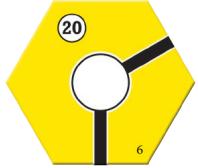
(7.4.3) Initial Track: In its first turn a company places a tile on the site of its home station, unless it starts from a hex where the station and track is already printed on the map, or one where a station tile has already been placed.

(7.4.4) Red and Blue Spaces: Black arrows on the red and blue spaces show track that

has already been built. These spaces can not be built on.
(7.4.5) Terrain Cost: The initial build on a hex containing a mountain or a desert requires payment. The cost (mountains £50, deserts £40) is marked on the map. The building company must pay the Bank from the company's treasury before laying the tile.
(7.4.6) Hex Restrictions:
• Only tiles with no stations on them may be placed on plain hexes (those with no dots or circles to indicate towns or cities).
• Only tiles with 2 black crossbars can be placed on hexes containing two small towns (2 small black dots).
• Only tiles with large stations (white circles) can be placed on hexes containing a white circle.
• Any yellow tile with a station (white circle) can be placed in a K hex; mark the hex with a “K" reminder marker until the tile is upgraded.
• Only tiles marked O-O can be placed on hexes with two large stations (large circles).
(7.4.7) Tile Facing Restrictions: Tiles may not be placed if any track on them:
• either runs off the edge of the map's hex-grid,
• or runs to the edge of a red hexagon, unless the appropriate edge of the hexagon has a black arrow to indicate that there is a continuation for the track,
• or leads into the dark blue (Tasmania) spaces, unless the placing of the Tasmania tile has created the necessary connection.
7.5 Upgrading Tiles
(7.5.1) Instead of placing one or two yellow tiles, a company can upgrade a tile that is already in place. Yellow tiles are upgraded to green, green tiles are upgraded to brown, and brown tiles are upgraded to gray.
A tile may be upgraded in such a way that track on it does not join up with track on a neighboring tile. It is not necessary for the new track on the tile to be usable by the company.
It is possible that, as the result of the upgrade of a city tile, additional places for station tokens (see section 7 “Stations") become available. As long as a free space remains on the tile, any company can trace a route through it for the purpose of laying or upgrading tiles.
Exchanged tiles are available for re-use.
(7.5.2) Upgrade Availability:
• Green tiles become available with the sale of the first 3/3+ train.
• Brown tiles become available with the sale of the first 5/5+ train.
• Gray tiles become available with the sale of the first 8/D train.
(7.5.3) Upgrade Restrictions:
• A company may only upgrade a tile if, after the upgrade, it contains track along which the company could run a train.
• Existing track may not be broken or lost as a result of an upgrade.
• Tiles without stations may only be upgraded to tiles without stations. Tiles with stations must after upgrade retain any stations they had before upgrade. Towns, standard cities, special cities and plain track tiles may never be exchanged for each other.
7.6 Changes of Gauge
Different parts of the Commonwealth of Australia used different gauges. This is indicated on the map by the three different background colors.
If as a result of the laying or upgrading of a tile a gauge change comes into being (track crosses from an area of one background color into an area of another), a gauge change marker (white disk) is placed between the two hexes. This marker counts against the range of trains running the route as though it were a large station of value 0.
The plus-trains can call at exactly one such marker in addition to their indicated range. For example, a 4+ train could call at 4 stations plus one gauge change marker, or 3 stations and two gauge change markers, and so on.
7.7 Station Tokens

(7.7.1) Home Station: Each company starts from its home station. As soon as the company operates for the first time, its first station token must be placed there. This first station token is free.
(7.7.2) Additional Stations: The companies own between 3 and 5 station tokens. The second station token that a company places costs 40 pounds. Each subsequent one costs 100 pounds. A company may place at most one of its tokens on each hex.
(7.7.3) Purpose: Stations serve the following purposes:
• Each route traveled by the company must contain at least one of its tokens at some point along its length.
• If a city is completely occupied by the station tokens of other companies, a company can not travel through it.
• Each route that a company builds must have one of the company's tokens at some point along its length.
(7.7.4) Station Placement Restrictions:
• In each round a company can only place one station token (in addition to its home station).
• A company may only place a new station token if there is a route connecting the location to one of the company's existing stations. The route may be of any length, but it must not involve reversing at junctions.
• If a city contains the home base of a company that is not yet in operation, other companies may only build stations there if they leave at least one free place on the tile for the not yet operating company to place its station token. (This rule does not apply to the home stations of the COM. See the special rules for the COM in section 5.)
8.0 Trains
8.1 General Information
Each company which is in operation and has a route must, at the end of its operating turn, own a train. (2E “The Ghan" does not fulfill this requirement.)
Trains in excess of the Train Limit as a result of a phase change are removed from the game (9.4).
Train deals with other Directors are only allowed at the printed face values.
8.2 Types of Train
(8.2.1) Standard or Plus Trains: The + trains are on the backside of the normal trains. When you buy a train from the bank, you decide if you will purchase the normal train or a + train; it will be a normal or a + from now to the end of the game.
(8.2.2) Standard Trains (2, 3, 4, 5, 6, 8)

The total number of large stations, off-board destinations, large harbors and gauge change markers called at may not exceed the range number stated on the train card. Skipping either stations or gauge change markers is not
allowed. A train may go to or through any number of small stations and small harbours without counting these towards the train's maximum range.
(8.2.3) Plus-Trains (2+, 3+, 4+, 5+, 6+)

The route of a plus-train may, in addition to its normal range entitlement (see Standard Trains, above), include an extra gauge change marker. Skipping either stations or gauge change markers is not allowed.
(8.2.4) Diesel Trains

These become available after the purchase of the second 6/6+ train. The route of a diesel may include any number of large stations, any number of small stations, any number of gauge change markers and any number of harbors. The
route must include at least one of the company's station tokens.
When the first train (8/D) is purchased in Phase 7, the purchaser can trade in a 4/4+ train and get a discount of 300 pounds from the cost of a D train.
(8.2.5) “The Ghan" (2E)

These become available after the purchase of the first 5/5+ train. A route for the 2E consists of two locations: it starts at one of the company's own station tokens and ends at the Alice Springs off-board location. Any number
of intervening stations may be skipped, but the route may not go through a city that is completely blocked by the station tokens of other companies. The following special rules apply to these trains:
• “The Ghan" train only counts Alice Springs and the city where it starts. It can never receive the K-K-bonus.
• Owning a 2E is not enough to meet the requirement that a company must own a train.
• A 2E does not count against a company's Train Limit.
• Each company may own at most one 2E.
• 2E trains can not be traded between companies.
8.3 Purchase of Trains
(8.3.1) When to Purchase: The purchase of trains takes place after the company has run its trains. A train can not, therefore, be used in the OR in which it is bought.
(8.3.2) How to Purchase from the Bank: New trains are bought from the Bank at the price printed on the card. Trains bought from the Bank must be bought in ascending sequence. A company may buy more than one train in its turn.
(8.3.3) Two Types per Card: A train can be bought as either a standard train or as a plus-train / diesel.
(8.3.4) How to Purchase from another Company: After the purchase of the first 3/3+ train, trains can be bought from other companies. When a company buys a train from another, the transaction takes place at the end of the purchasing company's turn. If a company buys a train from another company which has the same Director, the minimum price that must be paid is 1 pound. If a company buys a train from another company which has a different Director, the price paid must be the face value as printed on the card.
(8.3.5) Train Limit: The number of trains a company may own is dependent on the current phase (see section 9 below). A company which is already at its Train Limit may not buy new trains, even though the purchase might make some of its existing trains obsolete and thereby bring the company back within its Train Limit.
(8.3.6) Rusted Trains: Trains which become obsolete as a result of a phase change are removed from the game.
(8.3.7) Insufficient Capital: Should a company be obliged to buy a train but doesn't have enough capital in its treasury to fund the purchase either from the Bank (8.3.2) or from another company (8.3.4), it must buy a new train from the bank using the Compulsory Train Purchase rules (8.4).
8.4 Compulsory Train Purchase
(8.4.1) The company must buy a new train from the Bank and may/must raise the money by taking out loans until either it has enough cash to fund the purchase or its share price falls into the “receivership" part of the Share Price Chart.
(8.4.2) If the share price falls into the receivership area, the purchase is not made even if the company now has enough money. The train stays in the Bank and from this point onwards the company is administered by the Bank of England.
(8.4.3) Restrictions:
• The Director may not contribute private capital towards the purchase of the train.
• A company is only allowed to take out more than 1 loan in an operating round if it is obliged to buy a train.
(8.4.4) No Loans Remaining: If a company in this compulsory purchase situation is unable to take out further loans because the Bank of England has already given out 20 loans, then it is placed in receivership even if its share price has not fallen into the receivership area of the Share Price Chart.
9.0 The Phase Track
9.1 Starting Phase
The game has up to seven phases, it starts with the Startng Phase and proceeds to the next phase when the first new type of train is purchased (by any player) is purchased. Keep track of the current phase with the wooden cylinder. When a new phase is entered it brings with it new opportunities and restrictions as laid out below. In the Starting Phase the following can be done:
• Yellow tiles are available.
• A company may lay 1 yellow tile per operating round.
• The Train Limit is 4 (8.3.5).
• There is one Operating Round after each Stock Round.
9.2 2/2+ Phase
This occurs with the purchase of the first 2/2+ Train.
No change from the first phase.
9.3 3/3+ Phase
This occurs with the purchase of the first 3/3+ Train.
• Green tiles are available.
• A company may lay either lay one or two new yellow tiles or upgrade an existing tile from yellow to green per operating round.
• Private Companies (4.0) can be bought by Public Companies.
• The Bank of England pays a minimum dividend of £10 per share (5.4.3).
• It is possible to take out loans from the Bank of England.
• The sale of trains between companies is allowed.
• There are two Operating Rounds after each Stock Round.
9.4 4/4+ Phase
This occurs with the purchase of the first 4/4+ Train.
• 2/2+ trains become obsolete (“rust").
• The Train Limit is 3 (8.3.5).
9.5 5/5+ Phase
This occurs with the purchase of the first 5/5+ Train.
• Brown tiles are available.
• The 2E trains ("The Ghan") are available.
• The Bank of England pays a minimum dividend of £20 per share.
• There are three Operating Rounds after each Stock Round.
9.6 6/6+ Phase
This occurs with the purchase of the first 6/6+ Train.
• 3/3+ trains become obsolete.
• COM can operate without the necessity of a link from Adelaide to Sydney (5.3.2).
9.7 8/D Phase
This occurs with the purchase of the first 8/D Train.
• Gray tiles are available.
• 4/4+ trains become obsolete
• The Bank of England pays a minimum dividend of £30 per share.
| TRAINS | ||||
| Type | Numberavailable | StandardCost | + TrainCost | Rust Phase |
| 2/2+ | 6 | £100 | £120 | 4/4+ |
| 3/3+ | 5 | £200 | £230 | 6/6+ |
| 4/4+ | 4 | £300 | £340 | 8/D |
| 5/5+ | 3 | £500 | £550 | permanent |
| TheGhan | 8 | £200 | permanent | |
| 6/6+ | 2 | £600 | £660 | permanent |
| 8/D | 8 | £800 | £1100(800) | permanent |
∞ = unlimited, permanent = Train does not rust
10.0 Train Income
10.1 General Information
(10.1.1) Definition: A route consists of at least two different stations (large station, small station, off-board location, harbor) that are connected by track. A route can connect small stations, large stations, red off-board destinations and harbors. A route which travels just from a station to a gauge change marker is not legal.
(10.1.2) Restrictions: These restrictions apply to each route:
• Each route must have at least one of the operating company's station tokens at some point along its length.
• The number of large stations, off-board destinations and gauge change markers visited may not exceed the range of the train (the number printed on its card).
• Stations and gauge change markers that lie along the route may not be omitted.
• A route may contain 2 large stations on the same hex, if the stations lie on separate stretches of track.
• A route may not contain the same off-board location more than once.
• BLOCKED HEXES: A route can begin or end at a station where the company does not have a token and which has no remaining free spaces for tokens, but the route can not go through such a "blocked" station.
• A route can go through a station which is not blocked by the tokens of other companies.
• A route can not go over the same piece of track more than once (no matter how small the track section may be).
• A train which comes into a station along one piece of track can leave it along any other piece of track.
(10.1.3) Multiple Routes: If a company is running more than one route, the following restrictions apply:
• The track they involve must be completely separate.
• The routes may meet or cross at stations provided the routes use separate sections of track. For example, a junction on a stationless green tile may only be used by one of a company's routes, since the two branches of the track merge together.
10.2 Harbors and Tasmania
The two small harbors shown on the map do not count against a train's range, although the large harbor (Tasmania) does count. The special blue “Tasmania" tile can only be laid by the owner of the corresponding Private Company. A route from a city to a harbor is a legal route which can be used by a train.
10.3 Calculating Income
(10.3.1) Train Income: The income from a train is the sum of all the values of the stations, harbors and off-board locations on the route. The red off-board locations and the harbors have values which vary according to the current phase of the game. The background color indicates which value corresponds to which phase (see section 9).

EXAMPLE: If the Director of the CAR had one 2-Train and one 3-Train he could run two trains to Perth—one by the north route with the 2-Train (20+10+40) and one by the south with the 3-Train (20+20+40). The total income, assuming Perth is worth 40, would be £150.

EXAMPLE: If the Director of the Federal Territory Railway had one 3+ Train his income would be 50 (running his train through the town and on to the city and making two gauge changes). If he had a 3+ Train and a 2-Train he could run one train straight to city and the other via the town, his total income would be 90.
(10.3.2) Company Income: The income for a company is the sum of the incomes of all its trains. A company's income is paid to it by the Bank.
(10.3.3) Pay Dividends or Retain: The Director has the sole decision as to whether a company's income is paid out in dividends or retained in its entirety in the company's treasury. If the income is paid out in dividends, each player receives the percentage of the total that corresponds to the percentage of the shares that they own.
10.4 The K-K Bonus
• Whenever the route of one train includes two K-Cities there is a bonus of £50.
• Whenever the route of one train includes three K-Cities there is a bonus of £100.
• Whenever the route of one train includes four K-Cities there is a bonus of £150.
• Whenever the route of one train includes all five K-Cities there is a bonus of £200.
The bonus is added to the income. The Ghan can never receive this bonus even if its route passes through
内容过长,此处只内联前一部分;完整内容请下载或到规则页阅读。
下载 Markdown原文为社区整理/出版社公开资料,版权归原作者,仅供个人学习查阅。