
阿瑞迪亚:勇踏征途Arydia: The Paths We Dare Tread
一句话概览
阿瑞迪亚:勇踏征途 是一款已收录于村了吗规则库的桌游,支持 1–4 人,原名 Arydia: The Paths We Dare Tread。
本页内容:一句话概览 · 游戏概述 · 1. 游戏组件 · 2. 游戏设置(继续战役) · 3. 游戏流程 / 回合结构 · 4. 角色系统 · 5. 技能系统 · 6. 物品系统 · 7. d20 检定系统(Checks) · 8. Index 系统 · 9. 文本格式 · 10. 卡片类型 · 11. 世界地图与旅行 · 12. 城镇与公会行动 · 13. 地点探索 · 常见问题
阿瑞迪亚:勇踏征途 规则速览
本页收录规则速览的前 14 节(篇幅所限省略了后 9 节),完整规则速览与卡牌可在村了吗查询。
游戏概述
《阿瑞迪亚:勇踏征途》(Arydia: The Paths We Dare Tread)是一款 1–4 人合作开放世界战役制奇幻角色扮演游戏。玩家扮演流亡者(Exiles)踏上归乡之旅,在 Arydia 世界中探索城镇与地下城、与 NPC 对话、完成任务、对抗怪物并收集 Squill 以获赦免。
核心流程: 在世界地图上旅行 → 进入地点探索 → 遭遇战斗或事件 → 返回城镇休整升级 → 存档继续战役。
核心机制: d20 属性检定、技能树学习与精通、战役制存档、装备磨损系统、Threat/Combo 战斗资源管理。
1. 游戏组件
| 组件 | 数量 / 说明 |
|---|---|
| 世界地图 "The Basin" | 1 张(三层) |
| Mode token(双面) | 1 枚:Adventure / Combat |
| Travel tokens(木制) | 3 枚:指南针、羽毛、背包(双面 ready/exhausted) |
| Party token(金属) | 1 枚 |
| Threat cube + Combo tracker cube(塑料) | 各 1 枚 |
| Kae 代币 | 25 铜色 1Kae + 10 银色 5Kae + 5 金色 20Kae(均金属) |
| Wear tokens / Armor cubes / Wound tokens(塑料) | 各 80 / 40 / 80 |
| Hit Dice | 4 枚:红、蓝、黄、灰 |
| Path Base Rings | 6 组(16×1/3xp、12×5/10xp、8×25/50xp) |
| 事件 / 宝箱 / 推车 tokens | 5 Event + 1 Chest + 1 Cart |
| Glyph tokens / Foe Base Rings / Mastery tokens | 3 / 8 / 48(Mastery 双面) |
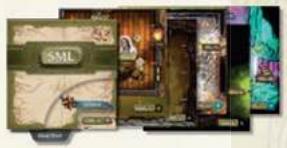
| 地图板 | 330 张:75 BIG、87 MED、95 SML、73 LNG |
| Map Index boxes + Dividers | 4 boxes + 8 dividers(各尺寸×2) |
| Card Index boxes + dividers | 3 boxes + 22 dividers |
| Event / Travel / Rules cards | 292 / 70 / 20 |
| NPC / Job / Threat / Foe cards | 165 / 34 / 54 / 203 |
| POI / Key / Day cards | 140 / 188 / 13 |
| Character skills | 9 张(1/角色) |
| FIG boxes(预涂装微缩模型) | 2 盒(50+ 模型) |
| Legacy boxes | 2 盒 |
| Slipcase + 3 Dossiers(双层) | 1 套 |
| Straw Pathless items + 预填 Pathless Chest | 8 + 1 |
| Replica Squill(木制) | 1 枚 |
| 每个 Path Slipcase 含 | Equipment mat、Character mat、Skill Tree mat |
| 每个 Path Tuckbox 含 | 2 Normal Action tokens、1 Minor Action token、1 d20、12 Starting Skills(2/Path)、6 Rank tokens、6 Path bodies(预涂装)、Path 特有 tokens、27 Path Practice Items、15 Marker cubes、1 Skill Tree card、17 Rules cards |
| 6 Path Chests | 各预填 Path Items |
| Character cards / portraits / tokens | 各 9(portraits 双面) |
| Character heads | 18(2/角色) |
| Title tokens / MAX Stat tokens | 6 / 24(双面,4 空白可自写) |
| Level tokens / MAX RP tokens / Stat cubes | 20(双面)/ 12 / 12 |
| Attribute tokens | 120(双面) |
> Tokens/cubes 无上限,用完可用替代品。
2. 游戏设置(继续战役)
- 世界地图:展开地图,放 Party token + Mode token(设为 Adventure mode)。
- 战斗追踪:Threat/Combo Track 设为 0;放 Threat Deck/discard + Hit Dice。
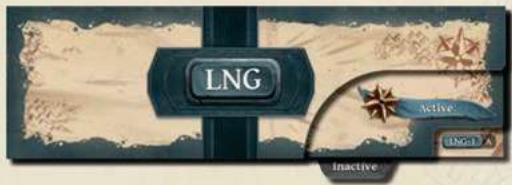
- 地图盒:按尺寸摆放 BIG / MED / SML / LNG Map boxes。
- 公共资源:XP tokens、Armor cubes、Kae tokens、Wound/Wear tokens、Chest/Event/Cart tokens、Pathless Chest。
- Travel 牌堆:Travel deck + tokens(面朝上)+ discard pile。
- Job / Day 牌堆:Job deck;Day deck + discard pile(DAY discard 始含 DAY-1,当前 Day 面朝上)。
- 索引:Card Indexes + Party Inventory cards。
- 世界地图还原:从 Party section 取回已存 HEX 放回地图,Party Token 放其上。
- 每位流亡者准备:Miniature、Reference cards + Path chest、Character mat、Equipment mat、Skill tree。
- 个人标记:从 tuckbox 取 Markers、Kae、HP/MP/SP cubes、Actions(2 Normal + 1 Minor)、d20。
- RP 设置:按队伍人数设 MAX RP(并放回已存的 RP)。
3. 游戏流程 / 回合结构
Arydia 有两种主要模式:Adventure(冒险) 和 Combat(战斗)。Mode token 标记当前模式。
冒险模式
- 玩家轮流行动,但允许同一玩家连续行动(主题合理时)。
- 可用行动:Travel(世界地图移动)、Enter/Leave Location、Interact、Skills、Items、Trade、Equip、Move(地点内)、Explore、Context Specific。
战斗模式
- 揭示敌人时翻 Mode token 到战斗面。
- 每回合两部分:①Foe Turn(抽 Threat 卡,可能激活敌人)→ ②Exile Turn(一名流亡者行动)。
- 第一回合由触发战斗的玩家先行动,之后顺时针传递。
- 战斗结束条件:全部敌人被击败;所有流亡者在 Exile Turn 结束时被击倒;流亡者逃跑;其他指定方式。
4. 角色系统
4.1 流亡者(Exiles)
- 游戏平衡于任意 exile 数,推荐每玩家控制 1 exile(solo 也可),最多 4 exile。
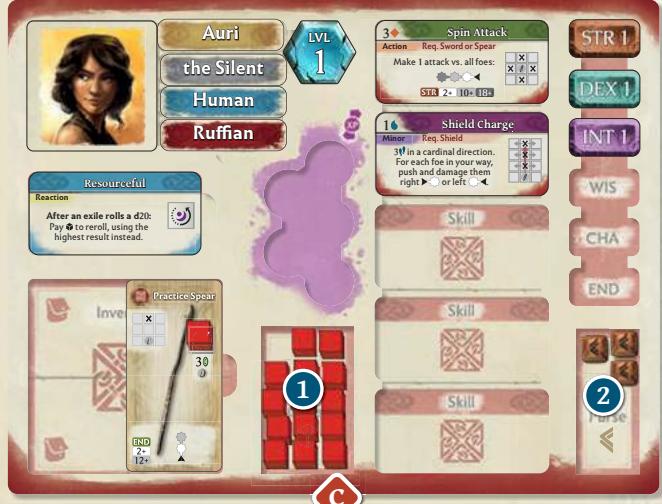
- Character mat 包含:Portrait、Name / Title / Character / Path Rank(组成全名)、Level、Character Skill、XP Pool、Inventory、Skill slots(最多 5 个 active path skills + 1 character skill = 6)、Attributes、Marker Cubes、Coin Purse(Kae 货币,战斗外可自由互给)。
4.2 三项核心属性
| 属性 | 说明 |
|---|---|
| HP(Hit Points) | 归 0 则 KO |
| MP(Mana Points) | 激活特殊技能/能力 |
| SP(Stamina Points) | 用于世界地图移动、战斗额外移动、使用物品/技能 |
4.3 六项属性(用于 d20 检定)
STR(力量)、DEX(敏捷)、INT(智力)、WIS(感知)、CHA(魅力)、END(耐力/意志)。
4.4 等级与经验值
- 起始 0 级,最高 10 级。初始属性值很低,升级后增长。
- 升级在 Exiles' Guild 花费 XP。不能跳级,每级花费递增(逐级花费,非累计)。
- XP 来源:击败敌人、完成任务、探索世界等。获得 XP 时,全队每位成员获得相同数量。
升级流程(Character card 背面,每列代表一级,从上到下解析):
- 找到该级 XP 花费,从 character mat 返还等量 XP 到 supply。
- 标记该级方框。
- 在 HP / MP / SP 中选一个标记方框,调整对应 MAX token,补充至满。
- 在 STR / DEX / INT / WIS / CHA / END 中选一个标记方框,调整对应 Attribute token。
- 学习新技能(Learning / Mastering Skills)。
> 所选属性/属性值立即设为新等级的值。方框不是从左到右填满。
5. 技能系统
5.1 技能数量与装备
- 最多 6 个 active skills:5 path skills + 1 character skill。
- 初始 3 个 skill tiles:2 path + 1 character。
- 升级时从 skill tree 学新技能。4 级起技能数超过 slot 数,须选 5 个装备。在 Exiles' Guild 可更换。
5.2 技能类型
| 类型 | 说明 |
|---|---|
| Action | 需 Normal action token + 费用 |
| Minor | 需任意 action token(Normal 或 Minor)+ 费用 |
| Free | 不需 action token,每次使用支付费用并满足要求 |
| Ongoing | 始终生效(满足要求时),必须在 6 个 active slots 内,KO 时仍生效 |
| Reaction | 不需 action token,有特定触发条件,KO 时不可用 |
| Delayed | mandatory,KO 时仍结算 |
5.3 Skill Tree / Learning / Mastering
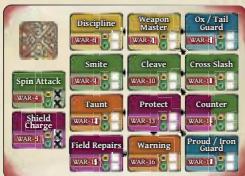
- Skill tree 含某 path 所有可学技能。黑色箭头表示前置条件(前置技能须先学会,不要求装备或 mastered)。
- Learning:升级时选一个满足前置的技能,从 skill tree 取出,Learned 面朝上放入 character mat slot。无空 slot 可立即卸下一个。在 skill tree 放 Mastery token(Learned 面朝上)。
- Mastering:
1. 学会的技能须先 mastered 才能使用。Mastery 要求在 Learned 面上。须装备才能 mastered。
2. 完成 Mastery 要求后翻转为 Mastered 面,在 skill tree 翻转 Mastery token。Mastered 永久保持。
3. Eureka Moment:若 Mastery 要求有 Eureka 图标,完成时可立即免费使用该技能(不消耗 MP/SP/HP),作为 reaction 使用,在结算 wounded Weak points 之前。需花费 SP 的技能用 supply 的 SP 代替。
6. 物品系统
6.1 物品类型
- Pathless Items(棕色 A 图标):通用,任何 path 可用。来源:城镇购买、击败敌人奖励、Pathless Chest。
- Path Items(彩色 Path 图标):专属对应 exile path。来源:世界中的 Path Chest。
6.2 规则卡(REF)
每种技能和物品都有对应 rules card。获得新物品/技能时按背面 ID 匹配 rules card。rules card 背面有 FAQ。rules card 文字优先于 skill tile 上的简略文字。
6.3 宝箱(Chests)
| 宝箱 | 说明 |
|---|---|
| Pathless Chest | 获得时从对应 chest 随机抽 1 件物品,1 名 exile 获得 |
| Path Chest | 获得时每位 exile 从各自 Path chest 随机获 1 件物品 |
| Empty Chest | chest 空时改为获得 3 Kae |
| Drawing Items | 必须盲抽,可按特定尺寸摸索;抽到带 marker 的物品自带 markers |
6.4 穿戴物品(Worn Items)
穿戴到 Equipment mat body 区域。正面含:Path/Pathless 图标、名称、Defense(防御值)、Durability(可容纳 Wear token 数,满则破损需修理)。
> exile 始终视为 "fully clothed",无论实际穿戴什么护甲。
6.5 持握物品(Held Items)
装备到两个大 held 空间之一,每手限 1 件。正面含:Path/Pathless 图标、名称、Positional Grid、Marker spaces、Check、Attack Pattern / Effect、Minor action。
6.6 腰带物品(Belt Items)
小型非护甲物品,可装备 belt 或 held 空间。每 held 空间限 1 件。
6.7 背包与库存
| 库存 | 说明 |
|---|---|
| Inventory | 存放未装备物品,最多 4 小件或 2 大件或组合。仅限自己的 Path items 和 Pathless items。战斗外可自由访问 |
| Party Inventory | 属于全队,任何成员随时可用,无数量限制 |
| Stash(存 tuckbox) | 无限容量。不能存放带 Wear token 的物品(须先修理)。存放时物品失去 markers。Guild 可 Retrieve,取回时不带 markers |
7. d20 检定系统(Checks)
掷 d20 + 对应属性,根据结果判定。四种类型:
| 类型 | 说明 |
|---|---|
| Success / Fail | d20 + 属性 ≥ 目标值 = 成功(绿色),< 目标值 = 失败(红色) |
| Threshold | 多级累积阈值(如 STR 2+、10+、20+),达到高级阈值包含所有低级结果。常见于武器攻击 |
| Tiered | 类似 Threshold 但不累积,只应用掷到的那一级 |
| Non-Attribute | 不加属性,直接用 d20 结果。可为 Success/Fail、Threshold 或 Tiered。如 Loot rolls |
自然掷骰
- Natural 1:自动失败(唯一例外是有重掷能力)。
- Natural 20:自动成功 + 即时奖励:
- 战斗中:获得 2 Combo。
- 冒险中:选择将 TRV-77 放入 travel discard 底部,或将 THR-77 放入 Threat deck(各有 2 张,已全满则无额外收益)。
- Loot Rolls:获得该 Foe AI card 上列出的 Pathless chest。
Roleplay Points (RP)
- 当前行动玩家为 active player,其左侧玩家为 Guide。Guide 为其他玩家朗读 cards/maps。
- RP 鼓励轮流当 Guide。Guide 朗读含 RP 图标的文本框时获得 1 RP。
- 每张 card 只能获得 1 次 RP。未领取 RP 的 card 返回 index 时标记为 Unexplored(除非 card 被 Banished 或改变状态,则未领取 RP 丢失)。
- MAX RP 按队伍人数:1 exile = 3;2 exiles = 2/人;3–4 exiles = 1/人。
- 花费 RP:作为 Reaction,在属性检定结果出来后,花费恰好 1 RP 将结果 +3(Natural 1 仍为失败)。Loot rolls 不可用 RP。
8. Index 系统
- 每个 card / hex / map 有唯一 ID(如 NPC-110、HEX-D4、POI-3)。
- States:同 ID 多版本用字母区分(如 NPC-0A、NPC-0B)。
- Active / Inactive Decks:有状态的组件在 index 中分两个 deck。Active deck 放当前活跃状态(每 ID 只有一个);Inactive deck 放非活跃状态。
- State Changes:如 "NPC-0 → B",从 Active deck 取出 NPC-0,用 Inactive deck 的 B 状态替换,旧状态放回 Inactive。
- Occupied Map State Change:改变地图状态时若 exile 微缩模型在该地图上,先读新地图背面,再替换旧地图,微缩模型放回原位。
- Back to Index(📥):将 card 放回 index,不看内容。
- Banishing(🔥):将 card 放入 index 末尾的 Banished 区域。
- Unexplored / Cleared:
- Cards:未探索 = ID/State 在左侧 + 顶部亮色条;已探索 = 翻转,ID 在右侧。
- NPC / POI:有 RP 的 card 须领取 RP 才算 cleared,否则返回 Unexplored。
- Maps:未探索 = 羊皮纸面朝上;已清除 = 地图面朝上。已清除地图不再放置 Foes / Event / Chest tokens。
9. 文本格式
| 格式 | 说明 |
|---|---|
| Narrative Text(蓝底白字) | Guide 朗读 |
| Rules Text(红底红字) | 必须严格遵守并执行 |
| Roleplay Text(棕底黑斜体) | Guide 扮演;"" 内为对话,< > 内为动作 |
| Choice Text(粗体) | 展示玩家可选回应 |
| Response Text | 匹配 Choice 的结果 |
| Nested Choice / Response | 嵌套在 response 中的粗体选项 |
| Town / Guild Text | 标明城镇/公会可用行动,有 Kae 费用须先支付 |
10. 卡片类型
NPC Cards
独一无二的角色。Guide 展示肖像,用 roleplay prompts 朗读正面至 Choice text,玩家选择后 Guide 匹配最佳选项并读背面 Response。"Any other topic" 帮助引导玩家。Nested Choices 在 response 文本后解锁。结束后返回 index。
POI Cards
代表可互动的地点。流程类似 NPC,含 Success/Fail Check。
Event Cards (EVT)
通常进行到解决。流程:Guide 读标题和叙述 → 翻面 → 读背面叙述 → 读规则并执行。通常以 Banished 或 Cleared 返回 index。
Key Cards (KEY)
代表特殊物品或信息。放在 Party Inventory,属于全队。
- Trigger Text:短语出现在其他组件上时,执行 Key 上的指示(通常是抽 Event card)。
- Splay Text:Trigger text 倒印在卡片底部,方便叠放多张 Key 以追踪所有 trigger text。
Job Cards (JOB)
Active Job deck 初始为空,游戏中从 Inactive 移入。作为 Town Action 可从 Active deck 选 1 个作为当前 Job(放 Party Inventory),全队同时最多 1 个 Job。
| 类型 | 说明 |
|---|---|
| Hunt Jobs | 追踪并击败指定敌人。前往起始 hex,将 TRV-90 Tracking! 洗入 Travel deck,在指定地形旅行时触发战斗。击败后到指定 hex 领奖 |
| Task Jobs | 前往指定 hex 执行检定(通常消耗 SP),至少 1 次成功后前往另一 hex 领奖 |
| Cart Jobs | 运送货物从一 hex 到另一 hex(须有连续 Road 路径)。Cart deck 提供挑战 |
| Special Jobs | 特殊规则和奖励 |
Day Cards (DAY)
Day deck 初始 3 张。指示抽 DAY 时,抽顶牌并执行,然后面朝上放入 discard pile。首次抽某 DAY card 通常有特殊指示(如加入新 Travel card)。
- Day Deck Empty:follow 顶部 discard pile 的 DAY card 文字,按顺序重建 deck 并抽 DAY-1。
- Once Per Day:某行动一天一次,直到新 Day card 被抽。忘记是否用过则偏向可用。
Squills
流亡者需获得 Squills 以获赦免。Squill 图标印在特定 cards 上,获得后含 Squill 的 card 放 Party Inventory。每个 Squill 有唯一编号,每个只计 1 个。
Dossiers (DOS)
含特殊 tiles/tokens,战役中逐步揭示。获取 DOS 组件时,从 dossier 背面小门推出指定 token。若是物品或 title,队伍决定哪位 exile 接收。
11. 世界地图与旅行
- 世界地图由六边形(hex)组成,队伍一起移动。Party token 标记当前位置。
- 7 种地形:Roads、Plains、Forest、Tall Grass、Mountains、Water、Snow。
- 每个 hex 有:地形图标、指针、Hex ID。
Travel Cards (TRV)
- 初始 Travel 牌堆含 12 张基础旅行卡(TRV-1 至 TRV-12)。牌堆用完时洗混弃牌堆重建。
- 抽卡后找到对应地形类型,按规则执行(通常需花费 SP 避免负面效果)。
- 特殊旅行卡无 Travel token 效果,常指示"再抽一张"。
- 活动 TRV 卡以外的卡均以 Inactive 状态开始战役,后续按指示增删。
Travel Tokens
- 3 个双面 token:指南针(导航)、羽毛(士气)、背包(饥饿)。
- 正面 = ready,背面 = exhausted。
- 有 token exhausted 时不能前往未探索 hex。
- 在城镇 Rest 可刷新所有 Travel tokens。
旅行步骤
- 将 Party token 放在当前 hex 与目标 hex 之间,注意连接地形类型。
- 抽 Travel 牌堆顶卡,按你的地形类型结算规则,然后弃卡。结算前可执行任意数量的技能/物品行动。
- 若目标 hex 未探索(背面),翻面揭示,放回地图,Party token 移至该 hex。
12. 城镇与公会行动
许多 POI 标记为 Town 或 Guild。Guild 是特殊 Town。可执行任意数量的城镇行动,每次支付费用。
城镇行动
| 行动 | 说明 |
|---|---|
| Job Board | 查看当前 Active JOB 卡,选一张(若你当前没有) |
| Supplies | 将全队背包物品全部填满标记 |
| Rest | 抽 DAY 牌堆顶卡结算;全队回复 ❤ 和资源;洗混 Travel 弃牌堆重建牌堆;刷新 Travel tokens。某些城镇可移除 Threat 牌堆中的 Exhaustion 卡。Rest 后可存档 |
| Apothecary | 将全队药水物品全部填满标记 |
| Smithy | 移除全队护甲上的 Wear token(自选),不同铁匠移除数量不同 |
| Stash | 存取/出售 tuckbox 中的物品 |
| Armorer | 首次发现时为每个插槽抽取对应等级的无路径物品。可按标价购买。可按 2× Kae 值回购之前卖过的物品 |
| Vendor | 按物品 Kae 值出售物品(含损坏/已消耗物品) |
公会行动(Guild Actions)
| 行动 | 说明 |
|---|---|
| Rest | 在 Guild 免费 Rest,但不移除 Exhaustion 卡 |
| Level Up | 花费 XP 升级。Max LVL 视地点而异。升到 Lv3 时抽取 EVT-903 |
| Train | 从已学技能中更换活跃技能 |
| Retrain | 付费遗忘已学技能(放回技能树),然后学新技能。抽取 EVT-94 |
| Leftovers | 全队所有完全空的药水/背包物品各加 1 标记 |
| Smithy (Apprentice) | 同普通 Smithy 但效果较弱 |
营地(Campsite)
- Rest:抽 DAY 卡,全队回复 ❤ 和资源,洗混 Travel 牌堆,刷新 Travel tokens。
- Stash:存取/出售物品。
- Smithy (Apprentice)。
- New Member Help:每天可免费各执行一次 Leftovers / Smithy。
13. 地点探索
从世界地图可进入地点。地点由一组地图(maps)组成,逐张探索。
地图与网格
- 地图有 BIG / MED / SML / LNG 四种。
- 每个方格最多放 1 个微缩模型。
边界(Borders)
| 边界类型 | 移动消耗 | 阻挡 Ranged | 阻挡 Melee | 阻挡 Area |
|---|---|---|---|---|
| Normal(单白虚线) | 1! | 否 | 否 | 否 |
| Difficult(双白虚线) | 2! | 否 | 否 | 否 |
| Obscure(黑虚线) | 1! | 是 | 否 | 否 |
| Impassable(实白线) | 不可通过 | 否 | 是 | 否 |
| Wall(实黑线) | 不可通过 | 是 | 是 | 是 |
- Implied Wall:未定义边界的方格边 = 隐式 Wall。
- Implied Normal:连接另一地图的地图边缘 = 隐式 Normal(除非继承边界)。
- Inherited Borders:在另一地图上方的地图,其边缘继承下方地图的边界。
相邻(Adjacent)
在自己方格内、与自己方格有可通行边界的相邻方格、或自己方格角上 = 相邻。角上的指针只与相交的方格相邻。
互动类型
| 类型 | 说明 |
|---|---|
| POI | 指定动作。Guide 抽对应 ID 卡朗读。其他玩家可移动至相邻参与 |
| EVT(事件) | 地图放置时(除非已清理)立即在指针上放 Event token。移动进入或相邻时移除 token,Guide 抽卡结算。Event token 存在时:只有活跃玩家可进入含 token 的方格 |
| NPC | 指定动作。Guide 抽卡朗读。其他玩家可移动至相邻参与对话 |
| Chest | 地图揭示时(除非已清理)放 Chest token。非战斗时指定动作可打开 |
探索(Explore)
- 前提:当前地图已清理(无 token、无敌人)。
- 相邻于地图指针时可探索。Guide 从 Active 牌堆抽地图,读背面文本,翻面并对接指针。
- Connectors:Line Up arrows(放旁边对齐美术)、On Top icon(放在上方对齐美术)。
- 楼层(Floors):通过楼梯连接。全队必须在同一楼层;换楼层时全员一起移动。
离开地点
- 作为行动,使用相邻 HEX 指针离开。所有流放者放在 Mode token 上,然后关闭地点。
- 关闭地点:将所有剩余组件归类回 Active 牌堆,注意已清除/未清除的朝向。
- Previously Cleared Maps:返回已清除地图时正面向上放置,忽略背面文本;不重新生成敌人/Event/Chest token。
常见问题(FAQ)
以下 1 条问答中 0 条来自站内玩家的真实提问,其余 1 条为本站整理的常见疑问;答复内容保持原样。
阿瑞迪亚:勇踏征途支持几个人玩?
1–4 人。
去哪查完整规则
想核对具体规则细节、卡牌效果或某个回合的结算方式,可以在村了吗里选中这款游戏后直接提问。
同类桌游
规则原文(Markdown)
本站收录这款游戏的规则原文 1 个文件,此处内联渲染 1 个,可直接展开阅读或下载。
Arydia_Rulebook.md169.2 KB
Rulebook
Welcome to Arydia!
Arydia is an open world, campaign-based,
cooperative fantasy role playing game for
1-4 players. You take on the role of exiles
trying to return home. Create a character, then
journey through the land of Arydia exploring
a fantasy world alive with characters, secrets,
monsters and magic!
Table of Contents
Components
Setup . 4
Player Characters (Exiles) . ....6
Universal Rules.............10
Card Types. .. ... .....12
Adventure .. .....15
Worldmaps ................16
Locations..................18
Combat ......... ...20
Foes .. .24
Exile Turns . . . .. ....29
Meta Rules. . .33
Soundtrack ........... ..35
Credits............... ..35
Glossary...................36
If this is your first time playing, start with the Quick Start Guide, which will help you learn the rules in a natural way by guiding you through an introduction.

If your armor is hit and has fewer Wear tokens than its durability, you must reduce the incoming damage by the defense value and add a Wear token to it. If the armor has maximum Wear tokens, it can't block any more damage.
Components
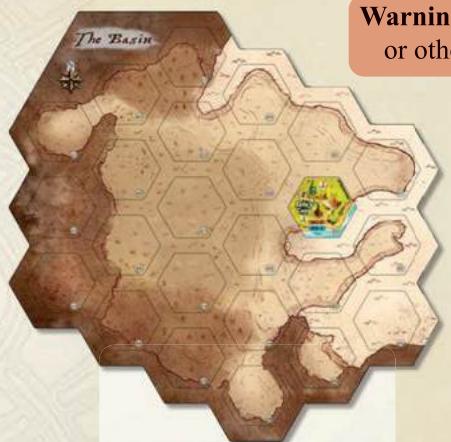
1 Worldmap “The Basin" (triple-layer)
Warning: Do not look through cards, maps, chests, or other components unless instructed to do so!
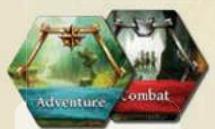
1 Mode token (double-sided)
3 Travel tokens (wooden)


1 Party token (metal)
1 Threat, 1 Combo tracker cubes (plastic)



25 'Copper 1Kae tokens (metal)


10 'Silver' 5Kae tokens (metal)
1 Threat/Combo Tracker (dual-layer)
4 Map Index boxes, 8 Dividers (2 of each size), 330 Maps (75 BIG, 87 MED, 95 SML, 73 LNG)

5 'Gold' 20≤Kae tokens (metal)

80 Wear tokens (plastic)

40 Armor cubes (plastic)

80 Wound tokens (plastic)


4 Hit Dice

6 Path Base Rings
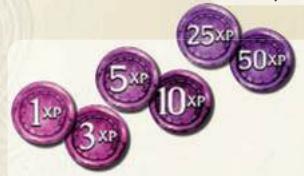
(16 1/3xp, 12 5/10xp, 8 25/50xp)
5 Event tokens
1 Replica Squill (wood)
1 Chest token

1 Cart token


Tokens/cubes are unlimited. If you run out, use substitutes.
8 Straw Pathless items
1 Pathless Chest pre-filled with Pathless Items


3 Glyph tokens
8 Foe Base Rings
48 Mastery tokens (double-sided)
Warning: Each index is filled with pre-sorted cards. DO NOT change the order of the cards or look through them unless instructed to do so!
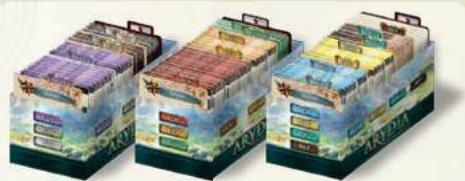
3 Card Index boxes with 22 dividers

The Divider Guide shows you where to insert the card dividers.

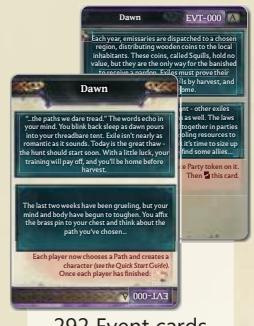
292 Event cards

70 Travel cards
Resting doesn't repair armor;you must repair it at aSmithy in town or use an appropriate skill.
20 Rules cards

165 NPC cards NPC

34 Job cards JOB

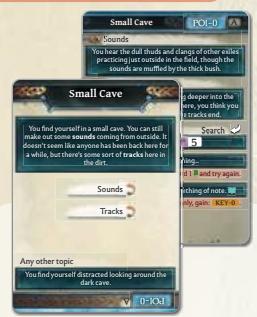
54 Threat cards THR

203 Foe cards FOE
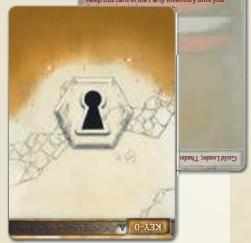
140 Point of Interest cards
188 Key cards KEY

13 Day cards DAY
9 Character skills (1 per Character)


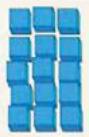
These items are only used in the Quick Start Guide.

1 Quick Start Guide

6 Combat Examples (1 per Path)

4 Dummy tokens
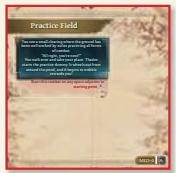
3 “MED-CE” maps (included in the 87 MED maps)
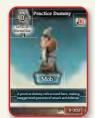
3 “FOE-CE” cards (included in the 203 FOE cards)
components. Do not open until instructed to do so!

2 FIG boxes (50+ pre-painted miniatures hidden inside)
2 Legacy boxes (Component list inside)

Slipcase with 3 Dossiers (dual-layer)
Character Components

6 Path Slipcases
Each Path Slipcase contains three mats.
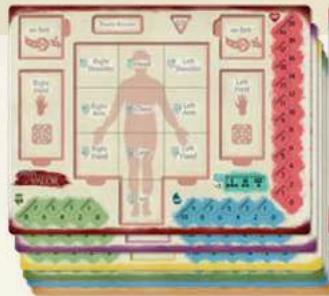
1 Equipment mat (6 total)

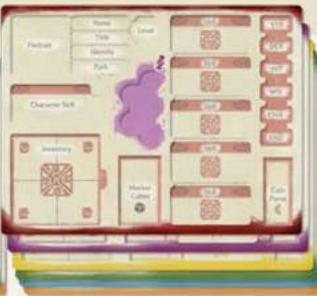
1 Character mat (6 total)

1 Skill Tree mat filled with Skill tiles (6 total)

Each Path Tuckbox contains:
6 Path Tuckboxes

2 Normal Action tokens (12 total)

1 Minor Action token (6 total)
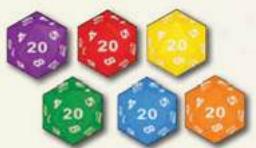
1 20-sided die (d20) (6 total)
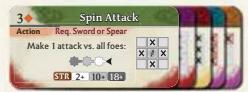

12 Starting Skills (2 per Path)

6 Rank tokens (1 per Path)

6 Path bodies (pre-painted, 1 per Path)


2 Shield tokens(Path of Valor)


1 Alert token, 6 Trap tokens, 1 Poison token (Path of Shadow)

27 Path 'Practice' ltems (4 or 5 per Path)
15Marker cubes (90 total)
1 Skill Tree card (6 total)
17 Rules cards (102 total)



6 Path Chests

pre-filled with Path Items (1 chest per Path)

9 Character cards (1 per Character)

9 Character portraits (double-sided, 1 per Character)

9 Character tokens (1 per Character)

18 Character heads (pre-painted, 2 per Character)

6 Title tokens
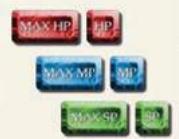
24 MAX Stat tokens (4 sets of 6 tokens)

(double-sided, 4 are blank, so you can write your own.)

20 Level tokens (double-sided)

8 MAX RP tokens (4 sets of 2 tokens)

12 Stat cubes
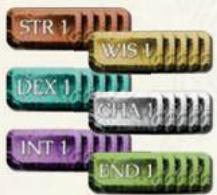
120 Attribute tokens (double-sided)
Setup
(These rules are for continuing your campaign after Saving. If this is your first time playing, use the Quick Start Guide.) Get the following components and place them on the table, leaving a play space in the middle.
Worldmapwith Party tokenand Mode token (set to Adventure mode)
②Threat / Combo Track and cubes (set to 0), Threat Deck / Threat discard pile, and Hit Dice.
③Map boxes with Maps (BIG, MED, SML, and LNG).
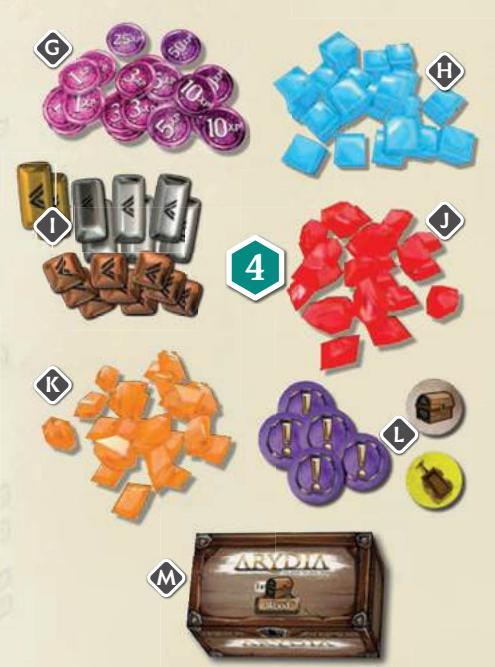
4 XP tokens, Armor cubes, Kae tokens, Wound tokens, Wear tokens, Chest/Event/Cart tokens and Pathless Chest

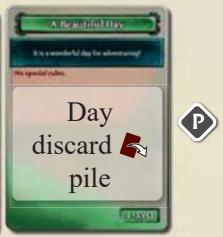
Travel deck, tokens (face up) and discard pile, Job deck, Day deck and the Day discard pilewith the current Day face up. (Day discard pile always includes DAY-1 as the first card in it)
Card Indexes
Party Inventory cards (if any)
8Retrieve saved Hex from Party section of Index, return it to the Worldmap and place Party Token on it.

Travel discard pile


Play Space

For each exile in the party, set out:

Miniature


Reference cards and Path chest

Character mat
Equipment mat

Skill tree
Get the following tokens (and any Path specific tokens) from your character's tuckbox:

Markers

Kae


HP, MP, and SP cubes

Actions (2 Normal Action tokens + 1 Minor Action token)

20-sided die (d20)


Set max RP for party size (and place if they were saved).
Any items previously stored face-down to indicate markers/Wear tokens should be placed face up with the indicated number ofmarkers/Wear tokens.
Now you're ready to play!

Character Mat


Player Characters (Exiles)
Player characters are called exiles. The game is balanced for any exile count, but we recommend that each player control a single exile, even in solo. You may choose to control more than one exile (up to 4 total in the party), though it can slow down play significantly. As you play through the campaign, your exile(s) will increase in power and expand their abilities!
Your character mat for your exile holds:
①Portrait: Your character's appearance.
Name / Title / Character / Path Rank: These combine to form your full name (e.g. Auri the Silent Human Ruffian). If you gain multiple tokens of one type (e.g. 2 titles), choose one to equip, keeping any excess in your Tuckbox.
3Level: Your character's current level.
Character Skill: A unique skill that your character possesses.
⑤XP Pool: Your earned XP 8 is kept here. XP is spent to Level Up.


Stats / Attributes
You have 3 core stats:
Hit Points: These represent your physical health. If your reaches 0, your character is knocked out (KO’d)!
Mana Points: These represent your reserve of non-physical energy.
You spend to activate special skills and abilities.
Stamina Points: These represent your reserve of physical energy. You spend to travel the Worldmap, for extra movement in combat, and to use items and skills.
Exile Creation
To create an exile, you will choose a unique Path and Character. You create your exile(s) at the beginning of a campaign in the Quick Start Guide. However, you can also create an exile mid-campaign to add a new player to your party (see: Drop In / Drop Out p.33).
Inventory: Where you keep unequipped items when you travel, but only what fits!
⑦Skill slots: You may have up to five active skills equipped here.
8Attributes: These are your current attribute bonuses (see: Checks p.10).
9Marker Cubes: All your unused (marker cubes) are kept here.
10Coin Purse: Kae is the currency in Arydia. You can keep any number of here. When you gain , the party decides how to divide it up among exiles. Exiles may freely give to each other out of combat.

You have 6 attributes. These are used when making d20 checks.
STR Strength: Your physical power and brute force.
DEX Dexterity: Your speed, precision, and agility.
INT Intelligence: Your logical reasoning and critical thinking.
W Wisdom: Your intuition and good judgment.
CHA Charisma: Your cunning, wit, charm, and understanding of others.
END Endurance: Your persistence, courage, and willpower.
Character Level

Level / Experience
Your character starts at level 0. By the end of the campaign, it is possible for your character to reach level 10. Your stats and attributes

begin very low, but as you level up, they will increase. You level up by spending at the Exiles’ Guild. (see: Town Actions p.17)
Experience points are collected as you play. Defeating foes, completing tasks, and exploring the world are some ways you can gain . These points can then be spent to advance your character's level, growing your skill and power. Whenever is gained, each member of the party gains the same amount of .

Experience Points (XP)

Character Cards / Level Up
When you created your exile, you chose a Character card. On the front is a description of your character. The back side is used to Level Up. Level Up: Once you gain enough , you can take the Level Up action at the Exiles’ Guild. You cannot skip levels! Each level costs more than the previous one (the cost is per-level, not total accumulated XP). Each column on your character card represents a level. To level up, find the column for the level you're gaining, and resolve it from top to bottom:
- Find the 8 XP Cost and spend the required 8 from your character mat by returning it to the supply (e.g. going from Level 3 to 4 requires 10).
(e.g. “Gain: 18” means EACH exile in the party gains exactly 18.)
-
Mark the box for the level you're gaining.
-
Mark one box in either HP, MP, or SP. On your player mat, adjust the corresponding MAX token, then replenish your❤, , and to full.
-
Learn a new skill (see: Learning / Mastering Skills p.7).

- Mark one box in either STR, DEX, INT, WIS, CHA, or END. On your player mat, adjust the corresponding Attribute token.

Note: Your chosen stat and attribute are immediately set to the new value according to your new level. The boxes are NOT filled left to right. (For example, the Human's MAX SP jumped from 1 to 4 at level 4, and their STR jumped from 1 to 5.)


Skills represent special abilities your character possesses. You can have up to 6 active skills total: your 5 active path skills plus your 1 character skill. You begin the game with 3 skill tiles: 2 for your chosen path and 1 for your chosen character. When you level up, you learn new skills from your skill tree. At the Exiles' Guild, you can change your active skills (see: Guild Actions p.17).
Skill Tiles
Title 2 Cost Type Requirements
Rules
Check and attack
pattern
Positional Grid
Marker space
ID / Rules card ID Mastery Requirement 11 Category
Types of Skills
There are 5 types of skills in Arydia: Action, Minor, Free, Ongoing, and Reaction. Each skill has a rules reference card; please read it carefully! Many skills have a cost (e.g. 1, 2, etc.) which is shown in the upper left corner of the skill tile.
• Action: These skills require a Normal action token, in addition to the cost.
• Minor: These skills require any action token (Normal or Minor) in addition to the cost.
• Free: These skills are used as an action, but do not require any action token. You pay the shown costs and must meet the requirements each time you use the skill.
• Ongoing: These skills are always in effect (as long as you meet their requirements, if any). Follow the rules for the specific skill to use it appropriately. Note that Ongoing skills (like all skills) must be among the 6 active skills on your character mat to gain their benefit. Ongoing skills remain in effect even when you are KO'd.
Skills

Skills have a Learned side and Mastered side. When you gain a new skill it sits Learned side up until it is Mastered.

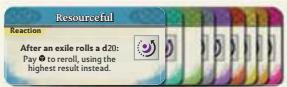
Reaction: These skills do not require an action token, and have a specific condition for their use. (e.g.“When attacked" or “At the start of your turn.") You may use a Reaction once, each time the condition is met, by paying the cost. Reactions are always optional and cannot be used while KO'd.
。Delayed: Unlike Reactions, delayed effects are mandatory and resolve even if you're KO’d! For example, a Rogue uses a Normal action to set a trap, the trap subsequently dealing damage to a foe is a Delayed effect. Please read the reference cards to learn details about each skill.
Skill Tree

Learning / Mastering Skills
The skill tree contains all the skills you can learn in your chosen path. You may look at the skills and rules cards to understand what the skill does before you choose to learn it. The black arrows on the skill tree represent the prerequisites for a skill. If a skill has one or more arrows pointing to it, all prerequisite skills must be learned first (but they don’t need to be equipped, nor mastered) before learning the new skill.
Learning Skills
When taking the Level Up action, you learn any one skill for which you meet all the prerequisites. Pop the skill out of the skill tree, and place it Learned side up, into a slot in your character mat. If there are no open slots, you may immediately unequip a skill to make room for the new skill.
To remove a skill: Push down on the bottom of the skill tile to pop the top of it up.

Place a Mastery token Learned () side up into the skill tree to show you've learned that skill. You may also mark the box on the back of your Path card.

Mastering Skills
-
Once a skill has been learned, you can't actually use it until you master it! Each skill's Mastery requirement is shown on the Learned side of the skill tile. Skills must be equipped in order to be Mastered.
-
Once you complete the Mastery requirement, flip the skill Mastered side up on your character mat, and flip the Mastery token ( side up) in your skill tree. You may also mark on the back of your path card.

Once a skill is Mastered, it remains Mastered for the rest of the campaign.
- Eureka Moment: If the “To Master" requirement has the Eureka icon , you get an instantaneous, one-time benefit: When you complete the Mastery requirement, you may immediately use the skill as a reaction without paying any costs (i.e. no// spent) before resolving wounded Weak points, if any. For skills that spend, don't spend the , instead use from the supply.
(To master the Taunt skill, as a Normal action while adjacent to a foe (in combat), pay 1 MP. Once you've completed this, flip the skill face up and you may use it for the rest of the campaign. Since it has a , you may immediately use the skill for free!)


Changing Active Skills
Once you reach Level 4, you will have more skills available than you have slots in your character mat. You must choose which five skills you have equipped. You may choose to equip any skills you've learned at the Exiles' Guild (see: Guild Actions p.17). Store any unused learned/mastered skills in your tuckbox.

Equipment Mat
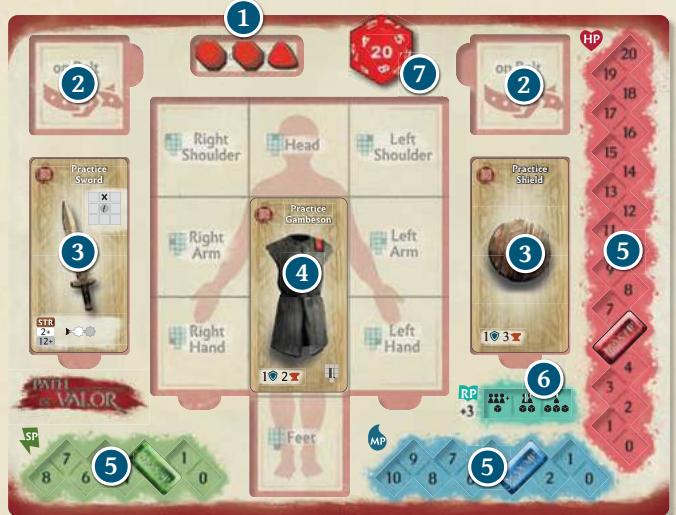
Your equipment mat for your exile holds:
①Ready Actions: Normal Action and Minor Action tokens ready to be spent (see: Actions (Combat) p.29)
②Belt slots: You can equip 1 Belt item in each slot.
③Held slots: You can equip 1 Held item in each slot.
Body: For worn items. (In combat, this is used in conjunction with Hit Dice to determine where an attack hits your exile's body.)
Tracks: Use the corresponding cubes to track your current ❤HP, MP, and SP. You cannot exceed your MAX HP/MP/SP as set by your Character Card.
RP Track: Place (marker cubes) to track your currentRP. You cannot exceed the MAX RP, as set by the current party size.

d20: Keep your d20 here when you're not rolling it.

Path Cards
On the back of each path card is a small version of the skill tree. In addition to the Mastery tokens, you can track learned and mastered skills by marking the boxes here.

Items

Items / Chests
There are many items that players can earn in the game. These items are generally used to increase the power of individual exiles. For example, a new sword might make the warrior more deadly in combat, while a new piece of armor will protect you from foe attacks. Some items are not directly offensive or defensive and include things like Knapsacks and Potions. Items are divided into Pathless and Path items.
Pathless Items:

These are identified by the brownA’ icon. Pathless items are generic and can be used by any path. These can be purchased from town, earned as rewards for defeating foes, or found in Pathless chests.
Pathless items (front)

Path Items:
These are identified by the colored Path icons. Path items are specific to each exile’s path and can only be used by exiles of that path. These items can only be gained from Path Chests found in the world.
Other Rules

There are more rules for items not covered in this section:
• Buying/Selling/Repairing Items (see: Town Actions p.17)
• Weapon Items (see: Exile Weapons p.30)

Every skill and type of item has a corresponding rules card. When you gain a new item, or skill, locate the correct rules card by matching the ID on the back of the skill/item to the ID of the rules card. REF cards are located in the index, Path cards are located in that Path's tuckbox. On the back of each rules card is an FAQ. The skill tiles are sometimes brief due to the limited space on the physical tile. The text on the rules card takes precedence and always describe the complete rules for that skill.
Chests
There are two types of chests: Pathless chests and Path chests.
Pathless Chests
When you gain a Pathless chest, 1x 1 item total is drawn randomly from the corresponding Pathless chest. One Wo exile gains the item (Pathless items may be traded freely among party members).


Pathless Chest
Path Chests
When you gain a Path Chest, each exile gains 1 item at random from their corresponding Path chest.
Empty Chest
If you would draw from a chest, but the chest is empty, gain 3Kae instead of gaining an item.


Drawing Items
When you draw an item from a chest, you must choose blindly from
Path Chests
the items. However, you may feel around for an item tile of a specific size. If you draw an item that holds markers, it comes filled with markers (e.g. a Knapsack comes full of markers).
Rules Cards REF


Worn Items
You can equip these items to your exile by placing them into the body spaces specified by the item. On the front, these items have:
①Path/Pathless Icon
②Name
③Artwork
Defense is the amount of damage the item blocks when it is hit by an attack.
⑤Durability【
represents how many Wear tokens this item can hold before becoming broken and needing repair.
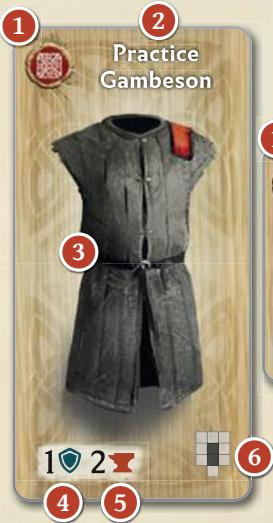

Exiles are always considered to be 'fully clothed' regardless of what armor is being worn.
Worn location: This denotes where you place the item on the body area of your equipment mat (feet, head, arm, etc.).
Held Items
You can equip these items to your exile by placing them into one of the two large held’ spaces. You may only hold one item in each hand at a time.

)Path/Pathless Icon

Name

Positional Grid

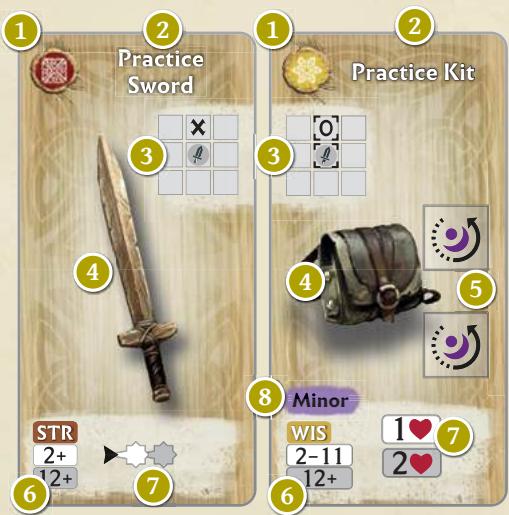
Artwork
⑤Marker spaces
Check

Attack Pattern / Effect

Minor action
Inventory

Your inventory is a place for you to store items that are currently unequipped. You can only hold items that will fit in your inventory spaces (up to 4 small items or 2 large items or a combination.) You may only hold items that belong to your Path and Pathless items. You may freely access items in your inventory while outside of combat. Once combat begins, you cannot (usually) use items directly from your inventory. You must first equip them via an Equip/Trade action. (see: Actions (Combat) p.29)

Saved Wear tokens / markers, used when you save and load your game. (see: Save/Load p.34)
Some cards are kept in the Party Inventory. These cards belong to the entire party, and are accessible by any party member at any time. There's no limit to the number of cards that can be kept in the Party Inventory. When storing the game, cards in the Party Inventory are kept in the index, behind the Party card divider.

Belt Items
①Path/Pathless Icon
These are small, non-armor items that you can equip either in a belt or held space on your equipment mat. You may equip only one item in each held space.
Artwork
Minor action
⑦Positional Grid
⑧Check
9Attack Pattern
1Range
Item Backs
The back of items have:
②The Kae value of this item.


Description
Chest type
⑤Rules card ID

Inventory / Stash
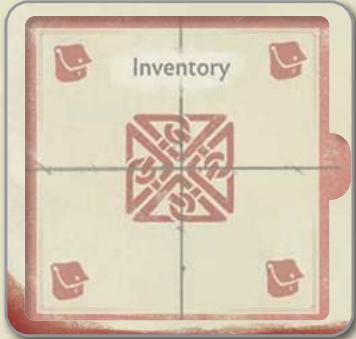
Party Inventory

Stash
While adventuring, if you have more items than you can or wish to carry, you may stow them in your stash (put them in your tuckbox). You cannot stow items with Wear tokens (they must first be repaired). Your stash has unlimited capacity. Items that hold markers lose their markers when stowed. At the Exiles Guild, you may Retrieve items that you have stowed. Retrieved items do not come with. (see: Guild Actions p.17)

Universal Rules

Checks (d20 System)
Checks (d20 System)
As with many traditional pen-and-paper RPGs, Arydia uses a d20 (twenty-sided die) system to simulate things that happen in the game world. Checks are used throughout Arydia to determine outcomes of a wide variety of actions, events, and experiences. The basis of a check is rolling your d20 and adding your character’s matching attribute. Depending on the result, different outcomes are possible. There are four types of checks: Success / Fail, Threshold, Tiered and Non-Attribute.
Success / Fail Checks
STR 10 DEX 5INT 12 WIS14 CHA20 END 8
Success / Fail checks have you roll the d20 and add your exile's specified attribute to the roll to get your result. If your result equals or exceeds the check, you are successful - go to the green . If your result is less than the check, go to the red
For brevity, sometimes checks may look like this: STR 12, WIS 20, and success / fail may look like this: √ and .
You look around and... INT5
(Example, INT 5 check, a result of 1-4 = Fail, a 5 or higher = Success)
Threshold Checks
These checks have you roll the d20 and add your exile’s attribute to get your result. Unlike Success/Fail
DEX 2+ 10+ INT 2+10+20+


checks, these checks have multiple, cumulative thresholds. As your rolls reach higher thresholds, each lower threshold is also included in the result. These checks are most common in weapons with attack patterns STR 2+ 10+20+ STR 2+10+20
(STR Threshold check for this attack pattern: A 1 would be a failure, a 2-9 would lead you to the white outcome, a 10-19 to the white + light gray outcome, and 20+ leading to white + light gray + dark gray outcome.)


Tiered Checks
These checks are similar to Threshold checks, however instead of including all the previous thresholds, tiered checks only include the single tier rolled. (e.g. if you got a result of 14 on this Charisma Tiered check, you'd only apply the light gray tier.)
CHA 2-11 12-16 17+
Non-Attribute Checks
These checks are not tied to any attribute. In this case you simply roll the d20 as your result. Non-Attribute checks can be Success/Fail, Threshold, or Tiered checks. Rewards (see: Victory p.33) are an example of a non-attribute tiered check:
18 +|2-9 1≤|10-19 2≤| 20 Wood
Natural Rolls
Whenever you're making any check (Success/Fail, Threshold, Tiered or Non-Attribute), a natural roll refers to the number on the die before any bonuses are applied.
Natural 1
If you roll a natural 1, the check automatically fails. (The only exception is if you have an ability that allows you to re-roll the die.)
Natural 20
If you roll a natural 20, the check automatically succeeds, and you gain an immediate benefit based on when you rolled the 20:
• Combat: Gain 2 (Combo).
• Adventure: Choose to add eitherTRV-77 Luck of the Road to the bottom of the travel discard pile, or THR-77 Luck of the Battlefield to the Threat deck. There are two copies of each of these cards, if you already have all four of these cards in their respective decks, no additional benefit is gained.

• Loot Rolls: Gain the Pathless chest listed on the Foe's AI card.
Roleplay Points
In Arydia, part of the fun is putting yourself into the role of different characters. You will create your own character, an exile, and will primarily play the game as that character. All players will also take turns as the Guide, filling the roles of characters you meet: shopkeepers, guards, other exiles, and more. That said, roleplaying is optional, and if your group doesn’t want to try it, feel free to simply read the story text instead of speaking it aloud.
The Guide
The player currently taking an action is called the active player, the player to their left acts as the Guide. The Guide draws and reads cards/ maps out loud for all the other players. Players take turns acting as the Guide.
Roleplay Points
You can earn Roleplay points () for being the Guide for other players. Roleplay points can be spent (with a little roleplaying) to increase the result of an Attribute check by +3.
RP Track
You can only hold a number of (marker cubes) based on the current party size, with eachrepresenting 1:
• 1 exile: That exile holds up to 3
• 2 exiles: Each exile holds up to 2
• 3-4 exiles: Each exile holds up to 1


RP points are designed to encourage players to take turns in Adventure mode in order to gain the biggest benefit
MAX RP Tokens: Use these tokens to limit the number of markers that can be placed in the RP track. In a 2-exile party, use the small token. In 3-4 exile parties use the large token. These tokens are also used to track current RP when you save / load.

EarningRP
You can earnby reading cards for other players as the Guide. As the Guide, when you get to a textbox with the icon, add 1 to the Roleplay track on your exile's equipment mat. points can only be earned once from a card. If you don't gain the from a card you interact with (either because your RP track is full, or you didn't get to the textbox with an RP), when you return it to the index, return it as Unexplored - this way you know theis still available. The only exception is if the card is Banished or changes state, then any unclaimedis lost.
SpendingRP
As a Reaction any time your exile is making an attribute check, after seeing the results of the roll, you can spend exactly 1to increase the result by +3 (A natural 1 is still always a failure). To earn the bonus, you are encouraged to describe (or act out) what your exile is doing. The goal is to have fun, be creative, and make the story your own!
(Loot rolls are non-attribute checks, so you can't use RP on Loot rolls!)
Arydia uses a simple but powerful index system. This system uses unique identifiers (ID) to identify components.
IDs
Each card, hex, and map is given a unique ID for example: NPC-110, HEX-D4, and POI-3 , are IDs for specific components.
States
If multiple versions of a component exist, those different versions are referred to as states. We use the ID followed by a letter, (A, B, C etc.) to show the state. For example: NPC-0A,NPC-0 B and NPC-0C.
Active / Inactive Decks
Not all components have multiple states, but for the ones that do, the Index system keeps two decks of each component, an Active deck and an Inactive deck.

Active Deck
These decks hold all the currently active states of each component. When you are asked to draw a component, you will get it from the Active deck. There can only be one of each unique ID in the Active deck.
Inactive Deck
The Inactive deck holds all the inactive states of each component. Some components will have multiple copies of unique identifiers in the Inactive deck, each denoting a different state. (Example:NPC-0 B, NPC-0 C, NPC-0 D, etc.)
Drawing Components
When you're asked to draw a component, the game will simply tell you to Draw (ID)’ for example Draw:NPC-0’. Get the index for the specified component (NPC in this case) go to the Active deck and locate the specified ID, drawing that card/component out.
State Changes
When you are directed to change a component's state, it will look like this example: NPC-0 → B
This is shorthand for: Make B the current Active state forNPC-0
To do this, find NPC-0 in the Active NPC deck, and (if it's not already in the specified state) replace it with the B state from the Inactive NPC deck. Then place the old state (if there was one) back into the Inactive NPC deck.
When directed to update a component's state, return it to the Index without looking at it!
Components that have changed states, such as NPCs, POIs, Maps, etc. will need to be encountered/explored again via a pointer. Often times state changes happen at the end of an encounter, and you will not come across the updated component for a while.
Occupied Map State Change: If you are changing the state of a map and exile miniatures are currently on that specific map component, immediately read the back of the new map then replace the old map with the new one, placing the miniatures back exactly where they were.
Back to Index
Some cards will instruct you to return a component to the index by using this icon: j. This icon means to place a card back in the index, without looking at it. This is used when a card has finished, or when a card will not be immediately available to use.
Banishing a Card
At the back of each index is a banished section marked with a . When a card is no longer needed, it may be Banished, which looks like this: KEY-0
To do that, you find the active state ofKEY-0 (usually KEYs will be in your party inventory, but if not they will be in the Active deck) and put it in the Banished section of the Index that card belongs to.
Cards may also banish themselves, usually at the end of a rules statement.
“...go forth and remember your training," Thades finishes.
NPC-0 → B then this card.
(Example, this card directs you to update NPC-0 to
the “B" state, then banish the current card, placing it into the Banished area of the index.)
Unexplored / Cleared
The index system also helps you track cards/maps that you’ve already encountered.
Cards: Unexplored cards start with their ID and State (if they have it) on the left of the card, as well as a bright stripe of color on the top.
When returning cards to the index after having interacted with them, face up and flipped over so

their IDs are on the right of the card. This way it's easy to identify cards you've already cleared.
• NPC/POI: If the card has a RP, you must claim the RP to clear the card, otherwise they are returned Unexplored. The only exception is if the card is Banished / changes state, then any unclaimed is lost.
Maps: Unexplored maps start with their parchment (back) side face up.
When returning maps to the index, if the map was cleared, return it face up, with the map artwork

showing. A cleared map contains no tokens (Event or Chest) or foes.
If the map was not cleared, return it unexplored (parchment side up).
Previously cleared maps: When drawing a map that has already been cleared (it will be face up in the Active deck) Foes, Event tokens, and Chest tokens are not placed again.
Many components use specific formatting of text to smoothly transition between story, rules, and different perspectives. We use different types of text to denote how they should be read and applied in the game.
Narrative Text
White text in a blue box. This text is used to narrate
A weatherbeaten man stands here, warming his hands by the fire.
what is happening. The Guide simply reads this text aloud to the rest of the party.
Rules Text
Red text (usually on a red background). This text denotes rules of the game to be followed exactly. Read it
Flip HEX-E2 and place Party token on it. Draw: BIG-0 Then this card.
out loud to all players and ensure all rules text is resolved.
Roleplay Text
Black italic text in a tan box. This text denotes that
a character is speaking and acting. The Guide acts out the Roleplay text. There are two kinds of roleplay text:
• Verbal text is in quotations “” which should be recited as the character being portrayed.
• Action text is inside of brackets < > which the Guide acts out (such as waving hands, coughing, bowing etc.)
Choice Text
This text often appears on the front of a card like this: Choice text is also denoted by bold words in text
boxes. Choice text is used to show the responses players can make. As players choose how to interact with events, characters, and points of interest, the Guide interprets their choice and tries to match it to one of the available choices. Choice text is usually on the front of the card, and the matching response text is on the back of the card.
Response text

Response text is usually found on the back of the Guild card and matches Choice text. After players make a Choice, find the matching Response and continue reading from there.
Nested Choice / Response text

Nested choice text is any bold text read inside of response text. Nested response text has a white arrow pointing it. When a nested choice is made, find and read the corresponding nested response text.
Town/Guild Text
This text denotes actions you can take while at a town, the Exiles’ Guild, or sometimes on specific cards. When the text has a Kae cost preceding it,
Rest: Draw aDAYcard. Whole party replenish ,shuffle Travel deck, refresh Travel tokens. Stash: Place/retrieve items from stash.
1- Apothecary: Fill a Potion with markers.
1- Smithy: Repair 7 durability.
players may only take the action if the cost is paid.
Card Types
There are more card types in Arydia than presented here. These card types are discussed in different sections of the rulebook: Character Cards p.6, Path Cards p.8, Rules Cards p.8, Travel Cards p.16, and Threat Cards p.24.
Non-Player Characters NPC


(either by roleplaying, or simply declaring it). The Guide determines which Choice text best matches how the players responded and reads the response section on the back of the card.
The term NPC stands for Non-Player Character. These are characters in the world of Arydia that you will meet and interact with. Each NPC is unique, and will have a unique set of actions or conversations you can have with it
NPC Cards
Portrait / Name
Roleplay Prompts
Narration Text
4Roleplay Text
Choice Text
Any other topic
ID and State
Response Sections
Nested Response
Conversation with an NPC

The Guide draws the card and shows just the portrait to the other players. Using the roleplay prompts, the Guide reads the front of the card out loud until they reach the Choice text. At this time, the players participating in the conversation make their choice

Any other topic
If the Guide doesn't feel the response from the player is very clear, they can use this text box to help the players towards a different choice. If the players are still having difficulty after that, the Guide can read the available choices out to the players for more clarity.
Nested Choices
Some response choices become available after reading a response section of text. (In this example, The Basin'becomes available as a choice after players read the Region section.)
Ending a Conversation
After resolving any response, players may choose another response, or end the conversation. To end the conversation, simply return the card to the index. If the card has a that wasn't claimed, return it as uncleared (card ID on the left). If the was claimed, return the card to the index as cleared (card ID on the right).
These cards represent places in Arydia where you can interact with your environment in a variety of ways.
Title
②Narrative Text
③Choice Text
Any other topic
Response Sections
Nested Response
Success / Fail Check
8ID and State
Interacting with a POI
The Guide draws the card and reads the front of the card out loud until they reach the choice text. At this time, the players participating in the interaction
Event cards can cover a variety of possible outcomes. Unlike POIs and NPCs, players run through an event until it is resolved. Events do not usually containRP.
Title
make their choice (either by roleplaying, or simply declaring it). The Guide determines which choice best matches how the players responded and reads the response section on the back of the card.
Narrative Text
3ID and State
4Rules Text

Events usually resolve with being banished, or returned the card to the index as cleared (card ID on the right).

Events EVT
Any other topic
If the response from the player isn't very clear, the Guide can use this text box to help the players towards a different choice.
Nested Choices
Some response choices become available after reading a response section of text. (Example: Search’ becomes available as a choice after players read the Tracks'section.)
End Interaction
After resolving any response for the POI, players may choose another response, or end the interaction. To end, simply return the card to the index. If the card has athat wasn't claimed, return it as uncleared (card ID on the left). If thewas claimed, return the card to the index as cleared (card ID on the right).
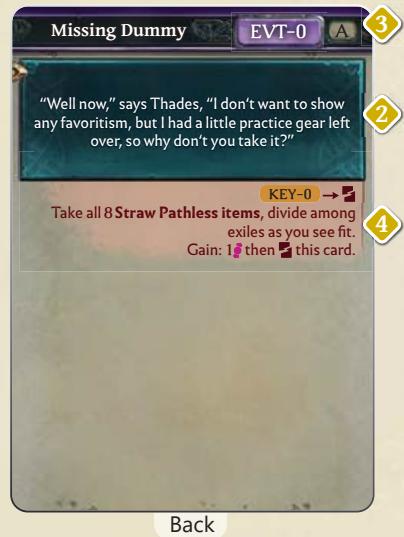
On the front of the card the Guide should read the title and the narration text; then seeing the flip icon, the Guide should flip the card. On the back of the card, the Guide should read the narration text and nish by reading the rules and resolving them.
Key cards represent special items or information that the party has. Key cards usually have:
①ID and State Title
Narrative Text Rules Text Trigger Text Splay Text
Gaining Keys Often times you will receive Key cards as the result
of interacting with characters, defeating foes, or searching points of interest. Key cards are kept in the Party Inventory, and belong to all exiles. The narrative text usually


describes how you obtained it, and a description of what was obtained. Key cards may have Trigger text.
Trigger Text
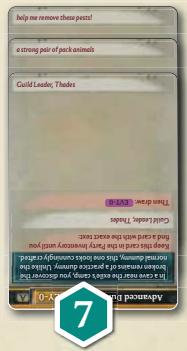
Trigger text is usually a short unique phrase that appears on another card or component in the game. When you find the exact trigger text on another component, follow the directions on the Key with the trigger text - usually this is drawing an Event card.
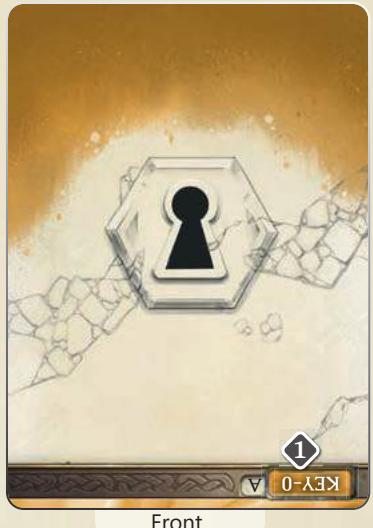
Splay Text
In order to help keep track of all of the trigger text in your party inventory, Key

cards have a copy of the Trigger text that is upside down on the bottom of the card called Splay text. This allows you to flip the splay text upright and stack multiple Key cards on each other, so you can track all
of the trigger texts you’re looking for more easily.


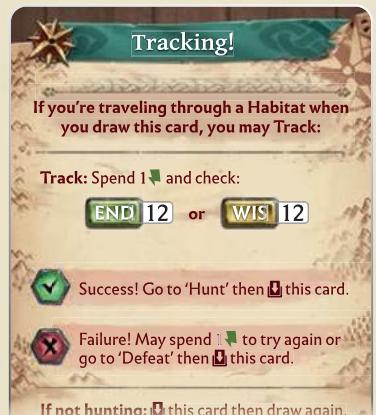

The Active Job deck starts out empty. As you play the campaign, you'll be asked to move JOB cards from the Inactive deck to the Active deck. As a Town Action, you can look through the Active Job deck and select one of the available jobs to be your current Job, adding it to your Party Inventory. The party can have at most 1 current Job at a time. When you complete your assignment, you will usually earn some Kae . When a Job fails, return it to the Active Job deck. Players may intentionally fail a Job at any point (and return it to the Job deck). There are four different job types.
Hunt Jobs
Hunt jobs have you track down and fight specific foes. First you'll travel to the specified starting hex and add theTRV-90 Tracking! card into the Travel deck. Travel to nearby hexes; if you drawTRV-90 Tracking! while traveling on one of the specified habitat' terrain types, trigger the Hunt and begin combat! The habitat terrain types represent the different maps where combat could occur. Defeat the foe(s), then go to the specified hex to claim the reward.
Back
①Title
②Description

Start Rules
④Habitat Terrain Types

⑤Combat Setup Rules
Victory/Defeat/Loot Rules

⑦Reward
⑧ID (no State)
Hunt cards provide you with additional opportunities to fight foes you've already encountered.

The Day deck begins with only 3 cards. When directed by the game (when you Rest for example) you will draw the top card of the DAY deck, resolve it, then discard it face up into the DAY discard pile. Often the first time a card is drawn during your campaign, you will be directed to do something. (e.g. the frst time you drawDAY-2, it will direct you to add a new card to the Travel deck. After that, whenever you drawDAY-2 again, there won't be any special rules to resolve.)
Front
Hunt: Rats
"Rabid rats are attacking travelers along the road. Help keep their population in check!"
Start: Travel to Raguld Junction then shuffle TRV-90 in with the top 2 of the Travel deck.
Hunt: Place BIG-90 . Place party on X.
Place a FOE-4 on Y and (leave 2 out).
Place FOE-5 on L.
Victory: Defeat all foes. Travel to Felsworn Village to claim the reward andthis card.
Defeat: If you lose or flee, return this to the Job deck. Loot: Don't loot after combat; ignore the rewards on the foe cards. Gain the reward below when you complete the job!
3≤18+ 2-91≤ 10-192≤ 20
If not hunting: this card then draw again.


Back
Job Cards JOB

Task Jobs
Task jobs require you to travel to a specific hex, perform one or more checks while at that hex (which usually costto perform). If you have at least one success, travel to another hex to claim the reward.


Description

Start Rules
Task Check
⑤Reward Rules
6Completion Rules
![](images/ebd6060af3a8
内容过长,此处只内联前一部分;完整内容请下载或到规则页阅读。
下载 Markdown原文为社区整理/出版社公开资料,版权归原作者,仅供个人学习查阅。