
杂牌马戏团3 Ring Circus
一句话概览
杂牌马戏团 是一款已收录于村了吗规则库的桌游,支持 1–4 人,原名 3 Ring Circus。
本页内容:一句话概览 · 常见问题
这游戏怎么玩
- 本站已收录这款游戏的规则资料,可以在对话里直接提问规则细节。
常见问题(FAQ)
以下 1 条问答中 0 条来自站内玩家的真实提问,其余 1 条为本站整理的常见疑问;答复内容保持原样。
杂牌马戏团支持几个人玩?
1–4 人。
去哪查完整规则
想核对具体规则细节、卡牌效果或某个回合的结算方式,可以在村了吗里选中这款游戏后直接提问。
同类桌游
- 卡坦岛德式
- 工业革命:伯明翰德式
- 勃艮第城堡:特别典藏版德式
- 方舟动物园德式
- 卡卡颂抽象
- 瘟疫危机传承:第一季美式
- 阿瑞迪亚:勇踏征途美式
- 重塑宇宙德式
- 幽港迷城美式
- 埃多拉的德鲁伊德式
规则原文(Markdown)
本站收录这款游戏的规则原文 1 个文件,此处内联渲染 1 个,可直接展开阅读或下载。
3RC_Rulebook_ENG_v2_baja.md52.3 KB

3 RING CIRGUS
In this game, each player is the director of a small 3 Ring Circus traveling across the U.S. at the end of the XIX Century.
They will hire artists and perform shows in various towns and cities, trying to gain fame. Shows in small towns are easy to perform and get you the initial resources to improve your cast; medium cities are more demanding, but grant access to better artists; big cities are even pickier and want to see very specific acts, but performing there gives you the most fame!
While your small circus is trying to survive, the much bigger Barnum Circus is traveling around, and when it reaches one of the main cities, it triggers a scoring for that region: circuses that do the best performances there will gain even more fame.
COMPONENTS
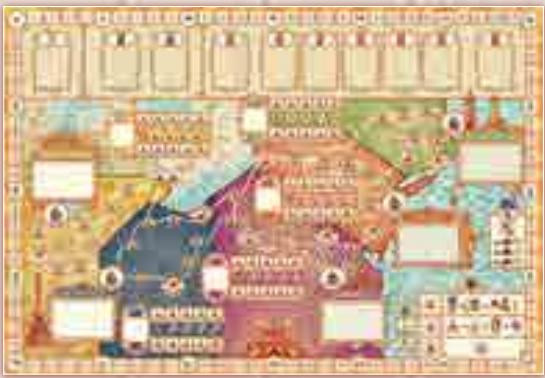
1mainboard

3ClosedRegiontiles

4Circusboards
32Cards


4Caravanpieces (1 per player color)

48 Circus tokens (12 per player color)

4Scoretokens (1 per player color)
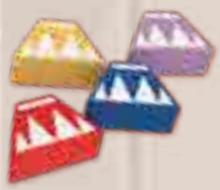
4Pedestaltokens(1 per player color)
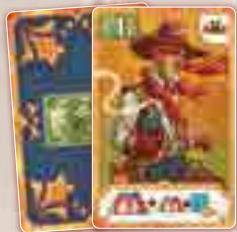
42Moneycards
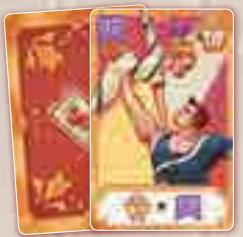
45Ticketcards
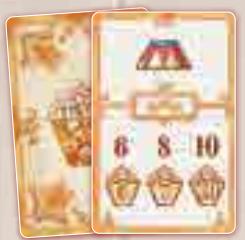
12EndGameScoringcards

6 City cards

6 City tokens

1Barnumtile

1Barnum Caravan
COMPONENTS FOR THE SPECTACULAR AUTOMATON SHOW

4Artisttiles (with the four basic types of Artist)

1Movementtoken

1Difficulty Levelindicator
1Soloboard For use with the Solo Variant—see page 19. (on the back of the Circus boards)

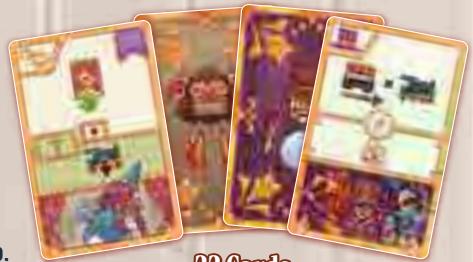
(two decks: 17 Fortune Teller cards and 15 Toy Monkey cards)

SETUP
The main board has spaces for the main decks at the top and a map of the North-Eastern United States, divided into 5 regions.
Each region has 1 main city

2 medium cities
, and 6 small towns

Depending on the number of players, some regions of the board might not be in play:
With 2 players, there will be 3 regions in play: New York City, Washington D.C., and either Boston or Indianapolis (players' choice). With 3 players there will be 4 regions in play, while either Boston or Chicago will be out of the game. With 4 players all regions are in play.
In order to mark a region as out of play, place the Closed Region tiles down on that region, blocking the roads between the two regions.
Before setting up the board, remove from the End Game Scoring deck the cards for the regions that are not in play (for example, if Chicago is not in the game, remove the Chicago card from the deck).
PLACE THE MAIN BOARD IN THE MIDDLE OF THE TABLE
Put 1 Score token for each player on space “0” of the Score Track. Any time you gain Fame Points during the game, mark them on this track.
12 Shuffle the End Game Scoring cards deck and place it face down on the matching space on the board.
matching space on the board.
4Shuhth e Ticke tck and place it face down on the
5R te t 5 car s from th tict deck and place
6 Shuchg e Cie t forns an d pn th p for each token, randomly pick 1 side to face up).
Shuffle the City cards and place 1 face up on each of the main cities in play (3, 4, or 5 cities depending on the number of players).
York City, if Boston is not in play).
9 ach player takes a Circus board and all peces of
10Deal End Game Scoring card,1 Ticke ard, and 4 Money cards to each player.
Pace th r edestal token on te "1 space of the
12 Thil be t pl ster ing ataend, add te s per srng e their right takes the Barnum tile and places it in front of them with the Barnum side facing up. The game will then proceed in clockwise order.
TWO-PLAYER GAME
In a two-player game, 6 neutral Circus tokens (from a third color) are placed on the board, 2 in each of the 3 regions in play. For each region, 1 Circus token is placed on the rightmost slot of the big city card, and the other on a small town as follows:
BOSTON: Natick NEW YORH: Syracuse WASHINGTON D.G.: Connellsville INDIANAPOLIS: Sandusky
These Circus tokens will be taken into account for the area majority scoring in those regions (see “Moving the Barnum Circus" on page 16.)

GAMEPLAY
On your first turn, you will put your Caravan on any of the main cities that does not have one already, and then you must Engage your first Artist.

NoTe: At the end of the frst round, each player will have exactly 1 Artist in their show and each main city in play will have exactly 1 Caravan, including the Barnum Caravan.
On your turn, you can take 1 of 2 possible actions: Engage an Artist or Perform a Show (see page 12).

ENGAGE AN ARTIST

This action consists of playing 1 card from your hand, placing it into an available slot of your Circus board. Each Circus board has 15 slots for Artists and 3 slots, on the left-hand side, for End Game Scoring cards. The Artist slots are arranged in 3 rows of 5 cards each—the 3 Rings of your circus!

CARD TYPES
During the game, you will handle 3 types of cards:

End Game Scoring cards provide end-game scoring opportunities, as long as they have been placed on your Circus board before the end of the game. You play them when completing the first 3 columns of your Čircus board (see page 26).

Money cards are basic cards that are easily acquired by performing a show in a small town. These include simple performances to add to your show. Āll Money cards can also be used to pay the cost of Artists (from Money or Ticket cards) so you can place them on your Circus board.

Some Money cards offer Instant effects: one-time abilities to play when performing a show (see them detailed on page 25).

Ticket cards can be acquired when performing in medium cities and represent performers that provide Fame Points for end of game scoring. Also, they are required in order to perform in the main cities.
If you run out of cards in any of the Money or Ticket decks, shuffle the discard pile and create a new one.
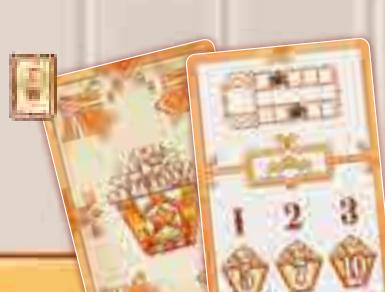

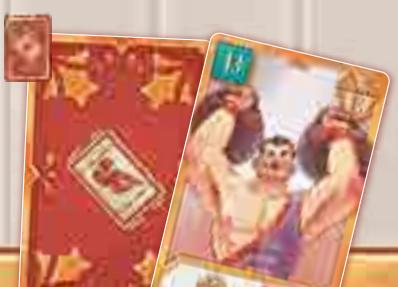

When you place cards on your Circus board, some symbols will become available or hidden, affecting the performances by your circus.
There are 3 main icons to pay attention to:

Pedestals are required in order to perform in a medium city.

Money lets you draw more Money cards at the end of each performance.

Movement determines how fast you can move around the map.

At the beginning of the game, your circus starts with 1 Pedestal, 1 Money, and 6 visible Movement icons.
As you place cards, some of those symbols will be covered, while new ones will be provided by the cards you play.
OTHER ICONS WILL COME UP IN THE GAME:

Immediate Fame points. When you gain these, update the scoring track immediately.

End of game Fame points. These are scored at the end of the game.

Play this card on your Circus board.


Take one card of this type.
Visible on your Circus board.


Both Money and Ticket cards have artists that you can hire for your circus show. Each Artist shows the following information:
The number in the top left corner is the value of the card. For Money cards, this value is the cost to engage the Artist on the card, but it also can be used to pay for engaging another Artist (by discarding the Money card). Artists are laid out in each row of cards on your Circus board in strictly increasing order from left to right, so that Artists with lower value will perform before their more valuable colleagues.
There are 16 Artist types, in 4 categories (basic artists, animals, acrobats, and special performers). Each category has a different shape and color, and each type has a different value:
The basic artists category cards are all in the Money cards deck and have values between 1 and 4. They have the following type of Artists: clowns pets, magicians and horse riders indicated by an icon in the top-right corner 2

Animals, acrobats, and special
performers are in the Ticket deck and have values between 5 and 16. The type is indicated along with their value 3].
Finally, at the bottom of all cards, there is an effect for each of them. On Money cards, this effect will increase the value of your show (i.e., the number of Pedestals) depending on the category of Artists performing after that artist in the same row. On Ticket cards, the effect could be an extra icon for your circus (Money, Pedestal, or Movement Icon) or end-game Fame Points.
2

This magician provides one PedestalAand an extra Pedestal for each acrobat performing after him in the same rowB. Update your Pedestal on the track of your Circus board accordingly during the game.

END OF GAME FAME POINTS
This tightrope walker provides 2 extra Fame Points at the end of the game for each animal performing before him€in the same row.
PLACING A CARD
When you Engage an Artist, you must assign it to 1 of your 3 rings (rows of cards). The card will then take its place in that row according to its value, so that all the cards in the same row are always in order of strictly increasing value, from left to right.
Thus, the first card you play in a row will always take the left-most slot in that row. When you play another card to a row, it will push any higher-value cards in that row 1 slot to the right in order to make room for it.
When you play a card, you must also pay its cost by discarding other Money cards from your hand whose total value adds up to at least the cost you have to pay (there is no “change”).
If you play a card into a row that already has other cards, its cost is the difference between the value of the card you are playing and the value of the highest-value card in that row (minimum 0).
IMPoRTAnT: Since cards in the same row must have strictly increasing values, you can't have 2 cards with the same value in the same row. They can still be played in different rows.


PEDESTALS

Placing cards in a row might increase the number of Pedestal symbols in your circus, either because the Pedestal is on the card itself or because the card you placed triggers an effect on a card that precedes it in the same row.
when you play a card, you should move your Pedestal marker to the corresponding space of the Pedestal Track on your Circus board (the number of Pedestal icons in your circus wil affect some of the shows you perform).

The circus in this example has 7 Pedestals: The first card in the first row provides 3 Pedestals, 1 on the card
itself and 2 for the 2 specíal performers following it. The second card provídes 1 from the card itself and 1 from
the animal act following it. The 6th Pedestal is printed on the board and still uncovered, and the 7th Pedestal is provided by the contortionist act in the third row.
PLACEMENT BONUSES

Some slots on your Circus board trigger a bonus when they are covered for the first time during the game, either by placing a card directly on top of them or by inserting a card in a preceding slot that pushes another card onto the bonus slot:

When you cover 1 of these icons, immediately draw 1 card from the corresponding deck and add it to your hand.

When you cover this icon, you may immediately play another card into your Circus board (paying for its cost if necessary).

When you cover this icon, you may immediately swap 2 cards from different rows. Those cards then take their places in their new rows according to their value (so that all cards in each row are still in strictly increasing order).
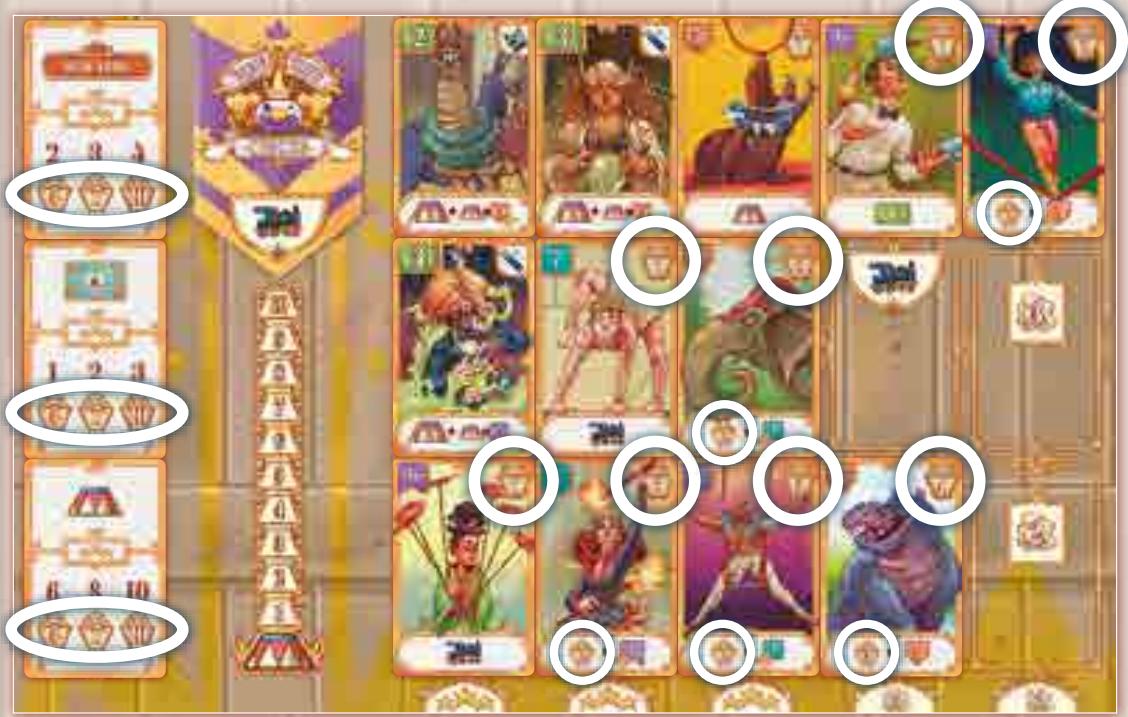
When you cover a popcorn icon, you immediately gain the number of Fame Points shown on it (between 2 and 5).
Moreover, whenever you complete a column (i.e., you have a card in every row in the same column), you get the bonus underneath it:

When you complete any of the first 3 columns, you must immediately place 1 of your End Game Scoring cards in 1 of the 3 slots on the left-hand side of your board. These cards will award some Fame points at the end of the game (see the Appendix on page 26 for a list of these cards).

When you complete one of the other columns, you immediately gain 5 Fame Points.
-PERFORMING A-SHOW

Instead of placing a card on your Circus board by Engaging an Artist, you can Perform a Show on your turn. In order to do so, follow these steps:

2 PERFORM IN A CITY

3 MOVE THE BARNUM CIRCUS

MOVEMENT

In order to Perform, you must first move to a different city or town. When moving, you must follow the tracks on the map in either direction. The maximum number of steps you can move is equal to the number of Movement Icons visible on your Circus board (i.e., how many Movement Icons are not covered by cards plus any extra Movement Icons that are printed on cards you have placed).
When moving, you must skip any town that already has a Circus token on it, and you may skip any city that already has a Caravan on it. Skipping a town or city does not count as a movement step.
2 PERFORM IN A CITY

There are 3 types of places where you can Perform a Show: small towns, medium cities, and main cities. Each player may perform only once in each place.

When Performing a Show, you may play 1 Money card with this icon. These cards are single use, and provide a one-time ability to your performance (see Appendix on page 25). They are then placed in the Money card discard pile.

SMALL TOWNS
日×+[×顺+]

Each small town can only host 1 show per game. The player who performs that show will then place 1 of their Circurs tokens on the town to show that the town can't host any more shows during the game.
These performances don't have any special requirements, and any show performed there will provide at least 1 Money card (from the locals) plus 1 additional Money card for each neighboring small town that has not hosted a show yet (because people from those towns also came to watch the show). Take these cards from the top of the Money card deck.
If your Circus board has any visible Money icons, you will get that many extra Money cards as well.

Roxanne moves 2 steps from Chicago to perform a show in Sturgis. She gains 3 Money cards because both neighboring towns haven't seen a performance yet. In the previous turn, Bob had a performance in Toledo and also gained 3 Money cards thanks to the 2 neighboring towns. It will not be possible to perform in either of these towns or the rest of the game.
MEDIUM CITHES

When performing in a medium city, you want to have as many Pedestal icons in your circus as possible. All basic Artists provide at least 1 Pedestal, and some Instant effects (see page 25) provide 1 or more.
Each medium city also has 1 preferred performer type, determined by the City tile randomly assigned to it during setup. This will provide a bonus of 2 temporary Pedestal icons when performing in that city.

With this City tile, shows in Detroit will témporarily get 2 extra Pedestals if they have at least 1 magician, while shows in St. Louis will if they have at least 1 clown.
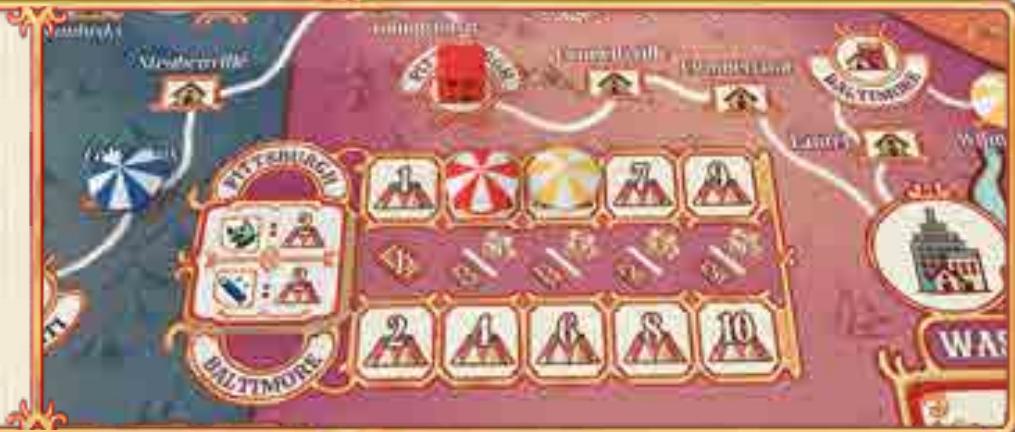
When Performing a Show in a medium city, you must place 1 of your Circurs tokens on an available slot in that city which shows a number of Pedestals that is equal to or lower than the number provided by your performance (the current value shown in your Circus board plus the temporary Pedestals provided by the preferred performer type of that city and any Instant effect cards). If you don't have enough Pedestals to match any of the slots available in that city, you cannot Perform a Show there.
Then you gain the bonus next to that slot. For higher-value shows, you must choose between getting Ticket cards or Fame Points.
Bob moves 1 step to Pittsburgh. His performance has 6 Pedestals, so it's not
enough to claim the 4th slot ānd the 3rd slot is already taken, so he
has to take the 2nd slot
and gain either 2 Ticket cards or 1 Fame Point. If he had just 1 more
Pedestal, he could take
the 4th slot and choose
between 3 Ticket cards and 5 Fame Points.
If you choose to take Ticket cards, you can pick that number of cards from the display or from the deck. New Ticket cards are added to the display only at the end of your turn, but you can draw from the top of the deck if you don't like the cards on display.
Moreover, you can draw additional Money cards for each Money icon in your circus, regardless of whether you took Ticket cards or Fame Points for your performance.
NoTe: Each player can visit each medium city only once, but multiple players can stop there at the same time.
MAIN CITIES

Each of the main cities has been assigned a card which determines what types of Artists that city wants to see (animals J, acrobats or special performers f). Each card has one specific required Artist in the middle, with two other types of supporting Artists to the sides. In order to erform a show in a main city, you must have in your show at least the required Artist type for that city, as ndicated in the middle of that City card.
You gain a base score of 6 Fame Points just for having the required Artist in your show.
If the required Artist in your show is preceded by an Artist of the Category shown to the left of the required Artist on the City card, you gain 4 additional Fame Points for your performance.
If the required Artist in your show is followed by an Artist of the type shown to the right of the required Artist on the card, you gain 5 additional Fame Points for your performance.
Each City card has 4 slots. You must place your Circus marker in one of these slots when you Perform a Show there. When performing in a main city, you must use the left-most available slot on the card. If you are the first player to perform in that city, you gain 3 more Fame Points and if you are the second player to perform there you gain 1 more Fame Point, as shown on the City card.
Like in all other places, if you have any visible Money icons on your Circus board, you will get that many additional Money cards.


The scoring will happen at the end of that player's turn.
[3 MOVING THE BARNUM CIRCUS

Immediately after each performance, the Barnum caravan will move one step, counterclockwise, following the outer route on the board and skipping any small towns that have a Circus token on them.
When the Barnum Caravan enters one of the main cities, it stops there and the player with the Barnum tile flips it over showing the Popcon side. If this happens during another player's turn, the game proceeds normally but the Barnum Caravan does not move again (and it will not move again until the tile is flipped to the Barnum side again).

At the end of the turn of the player holding the Barnum tile (the current turn if they caused the Barnum Caravan to enter a main city, or the next one if this happened during another player's turn), there will be a scoring2for the region where the Barnum Caravan stopped. Then the Barnum tile passes to the next player counterclockwise 8.

When the Barnum Caravan enters a main city, the player with the Barnum tile flips it to this side.


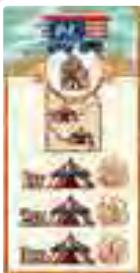
The player who has placed the most Circus tokens in that region (small towns, medium cities, and the main city) scores 10 Fame Points; the player in second place scores 6 Fame Points; and the player in third place scores 3 Fame Points.


After the scoring, the player flips the tile back to the Barnum side and passes it to the player on their right.
NoTe: In 2-player games, there will be Circus tokens from the dummy player that have to be taken into account.
Ties are broken as follows:
The player with a token on the left-most slot of the main city card wins the tie.
If none of the tied players have performed in the main city, the one with a token on the highestnumbered slot in a medium city in that region wins the tie.
If all of the tied players have only performed in small towns, the one who performed in the closest town to the main city wins the tie.
If still tied, the closest town in clockwise order along the outer road wins.

END OF A TURN
You have a hand limit of 10 cards in total. If you have more than 10 cards at the end of your turn, you must discard down to 10.
If there are any empty spaces for Ticket cards on the main board, fill them with cards from the Ticket deck.
Then the player to your left begins their turn.
GAME END

Once the Barnum Caravan does a full loop and triggers the scoring at its starting city, the game ends. At this point, there is a final scoring where each player tallies up their end of game Fame Points for all of the end of game effects on Ticket cards and for the End Game Scoring cards on their Circus board.
The player with the most Fame Points is the winner. In case of a tie, the winner is the tied player with the majority in the last region scored. If none of those players have performed there, then check the previous region, and so on.

VARIANTS
While we suggest playing your first games according to the rules above, with the Barnum Circus starting in Boston and moving counterclockwise, it is possible to try a few other variants where the Barnum Circus starts in other cities and moves either clockwise or counterclockwise.

4 PLAYERS
BARNUM STARTS IN CHIGAGO
When playing with 4 players, it is possible for the Barnum Caravan to start in Chicago and then move clockwise. The regions will score in this order: Boston, New York City, Washington D.C., Indianapolis, Chicago.

3 PLAYERS
· BARNUM STARTS IN CHIGAGO
In this setup, the Boston region is out of the game. Barnum starts in Chicago and moves clockwise. The regions will score in this order: New York City, Washington D.C., Indianapolis, Chicago.
BARNUM STARTS IN NEW YORK CITY
In this setup, the Boston region is out of the game. Barnum starts in New York City and moves counterclockwise. The regions will score in this order: Chicago, Indianapolis, Washington D.C., New York City.
2 PLAYERS
BARNUM STARTS IN WASHINGTON D.C.


· BARNUM STARTS IN INDIANAPOLIS
· BARNUM STARTS IN NEW YORK CITY
In this setup, both Boston and Chicago are out of the game. Barnum starts in Indianapolis and moves clockwise. The regions will score in this order: New York City, Washington D.C., Indianapolis.
In this setup, Chicago and Indianapolis are out of the game. Barnum starts in Washington D.C. and moves clockwise. The regions will score in this order: Boston, New York City, Washington D.C.
In this setup, both Boston and Chicago are out of the game. Barnum starts in New York City and moves counterclockwise. The regions will score in this order: Indianapolis, Washington D.C., New York City.


THE SPECTAGULAR AUTOMATON SHOW· SOLO MODE
Your good old circus show is competing against the very modern automaton show touring the United States. That state-of-the-art show combines traditional performances with fortune teller machines, mechanical animals, and all sorts of wondrous trinkets. Who will gain the favor of the public's eye?
SETUP
Choose one color for the Automaton Circus and leave its pieces near its board. Set up the game for two players, but with one of the Circus boards showing the solo board side.
Put the Pedestal token on slot 2 of the Pedestal Track on the solo board and the Movement token on slot 6 of the Movement Track. Place the Scoring and Caravan pieces as usual.
2] Then shuffle the 4 Artist tiles and place them face down on the matching slots of the solo board.
③ shue the 2 nmn os eco of cad s (separael) the t Touny stackface down on the
4 Chore at he ud o the me and ho me os cards Tht duing t he gme I ou wmt to ir in ill Easy mode, don't do anuthing. If you want to make it harder, cover this space on the solo board with the difficulty indicator as needed.

GAMEPLAY
The Automaton Circus will always start first. On the very first turn, flip the top Artist tile and place the Automaton Circus's Caravan in the next main city on Barnum's path (i.e., the first main city to score).
The Automaton will start playing with the Fortune Teller's cards. Once Barnum scores the first region, the Automaton Circus will use the Toy Monkey's cards.
In every subsequent turn, flip the next card of the Automaton Circus's deck onto the space to its right and resolve it. There are 2 types of Automaton cards:

ARTST ACToNS: They improve the Automaton Circus's show.

SH0w ACT0NS: They will make the Automaton Circus's Caravan move and perform a show.
Difficulty: Effects that are not labeled as 'Easy' or 'Hard' are always applied. Otherwise:
· Easy

Apply this effect only if playing in Easy mode.
·Hard

Apply this effect only if playing in Hard mode.

Easy

Medium

Hard

ARTIST ACTIONS


FLIP AN ARTIST TILE
Flip the next Artist tile and move the Pedestal token up 1 step.
Artist tiles are flipped from top to bottom and always increase Pedestals by 1.

ENGAGE AN ARTIST
Engage a revealed Artist Ticket card directly from the main board display into the Automaton Circus's show. Artist cards in the Automaton Circus's show are played in a single row, with strictly increasing numbers. The Automaton Circus always engages different-numbered Artists, so ignore any number already hired.
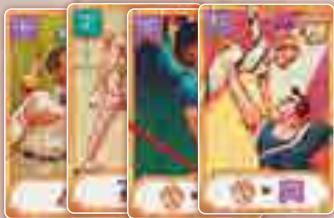
Pick the value number of the Artist to engage according to the following priorities:

1ailable ickth one reuire by the man t that wil sore fist.
options are available, pick the highest number.
[3] If none of the above apply, pick the highest available number on display.
If multiple Artists with the same number are available, pick the leftmost one.
NoTe: If all numbers on display are already present in the Automaton Circus's show, discard the 2 rightmost Artists from the display, slide the 3 remaining Artist cards to the right and rēveal 2 new Artists from the deck. If none of the Artists now on display can be engaged, shuffle this Action card back into the Automaton Circus's deck, and draw a new card.
Then, discard the rightmost card in the display, slide all the remaining cards to the right to fill any empty slots, and reveal new cards from the deck.

If the Artist card just engaged has a Pedestal or Movement Icon at the bottom, move the corresponding marker up 1 step (unless it has already reached the maximum value).
Once they have been applied, the icons at the bottom of the Artist cards are no longer relevant until the end of the game, so you can place the Automaton's Artist cards on top of each other with only their value in the top left corner showing.
Finally, according to your chosen difficulty level, apply the effects on the Automaton card, which could be to move the Pedestal maker 1 space up or the Movement marker 1 space down (unless they are already at the end of the track).

NoTE: When playing in solo mode, the Artist cards in the display always shift from left to right, whenever you gain Artist cards, remember to also shift the cards in the market so that the last revealed card is always in the leftmost position.
SHOW ACTIONS
PERFORM A SHOW
The Automaton Circus will move at least 1 step and up to its Movement limit and perform in a city or town according to the following priorities:
Perform in the next scoring region where the Automaton Circus does not have a winning majority (i.e., at least 3 Circus tokens in the region).
2 Perrd in tt n t in gi te A n igs ha alread engaged the
3 th the r r pc te oe th d rard he htast mr o e s ad cin Fame Points according to the Pedestal level, observing any currently revealed Artist tiles for temporary Pedestals offered in that location.
4 Otherwise, perform in a small town that is ahead of Barnum and which would grant the most Money. In case of a tie, pick the town closest to Barnum for that amount of Money. In this case, the Automaton Circus does not gain anything, but it will improve its standing for region scoring.

Automaton cards may have an immediate effect bonus, which can add 2 temporary Pedestals to the current show value, allow it to move 3 extra steps, or simply reward 2 additional Fame Points for the show.
Some of these bonuses apply only when playing in Hard mode.
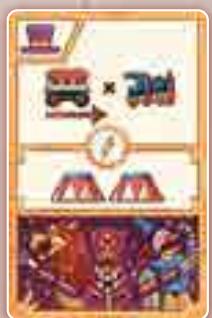
When performing in a medium city, this card provides the Automaton Circus 2 extra temporary Pedestals for their show.


The Automaton Circus can temporarily move up to 3 extra steps.


The Automaton Circus gains 2 additional Fame Points at the end of their show.


When Barnum reaches the first main city, there will be a scoring at the end of your turn (you are the last player). At that point, you will move the Barnum tile next to the solo board, remove the Fortune Teller's cards from the game and replace them with the Toy Monkey cards.

When Barnum reaches the second city, the scoring will be at the end of the Automaton Circus's turn, then you'll get the Barnum tile back as usual.
After the last city scores, the end game scoring for the Automaton Circus will work as follows:

Score the Fame Points for the Artists.
2 Coun the t ae t aints a the b i oeh ald e ath g cre in asa h g d sen that card itself).
on the difficulty level:
Easy

No Bonus Points.
Medium

1 Fame Point for each Artist
Hard

Automaton card played.
2 Fame Points for each Artist
Automaton card played.

THE ELEPHANT IN THE ROOM
The circus is an institution that has often been romanticized. Back in the day, a circus was all awe and wonder; fun and laughs for every attendee
to this great show. But that coin had an ugly face as well which has usually been swept under the rug. This game depicts a moment in time in which the circus industry did several things that we frown upon from our XXI Century perspective. Animals were taken away from their habitats and abused in performances that we consider totally out of place in this day and age. Even Mr. Barnum himself is regarded as a shady character at the very least.
As the publishers of this game, we do not condone these practices. We believe that knowing what happened helps us to avoid making the same mistakes again, and we invite you to play 3 Ring Circus fully informed.
APPENDIX
The highest-value Ticket cards for each Artist category provide additional Fame Points for all the cards you play on your Circus board (i.e., not necessarily in the same row).
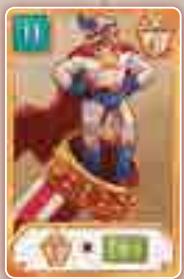
This card provides 3 Fame Points for each Money icon visible on your Cirčus board.


This card provides 2 Fame Points for each special performer on your Circus board (including itself).

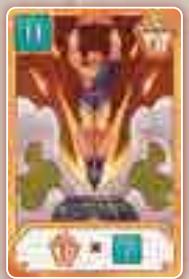
This card provides 3 Fame Points for each contortionist on your Circus board.

This card provides 2 Fame Points for each Movement Icon visible on your Circus board.

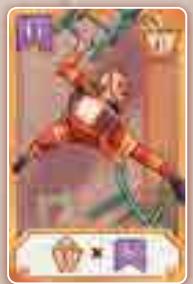
This card provides 2 Fame Points for each acrobat on your Circus board (including itself).

This card provides 3 Fame Points for each juggler on your Circus board.

This card provides 1 Fame Point for each Pedestal on your Circus board.
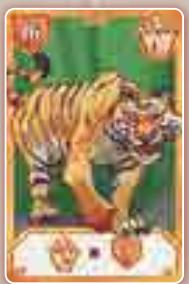
This card provides 2 Fame Points for each animal act on your Circus board (including itself).


This card provides 3 Fame Points for each water animal on your Circus board.
EQUIPMENT
SPECIAL GUEST
After your performance, the Barnum Caravan does not move.


INSTANT EFFeCTs: Only 1 card can be played when performing a show.

ANIMALCREW
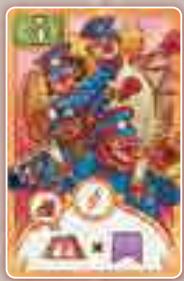
When performing in a medium city, each animal act in your circus provides an extra temporary Pedestal.
ORCHESTRA

When performing in a medium city, each acrobat in your circus provides an extra temporary Pedestal.

When performing in a medium city, this card provides 2 extra temporary Pedestals for your show.


POPCORNCART
Gain 2 extra Fame Points at the end of the show.
BACKSTAGECREW
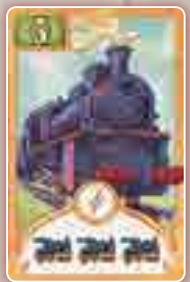
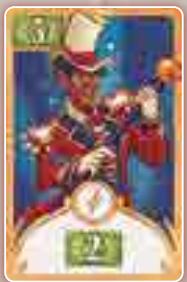
You can move 3 extra steps before performing your show.
RINGMASTER
Draw 2 extra Money cards at the end of the show (regardless of the type of city you are visiting).
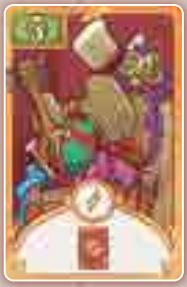

When performing in a medium city, each special performer in your circus provides an extra temporary Pedestal.

Draw a Ticket card at the end of your show, either from the display or from the top of the deck (regardless of the type of city you arē visiting).

APPENDIX

End Game Scoring cards can provide additional Fame Points if you manage to play them on your Circus board (by playing cards in the same column).


You gain 5/7/10 Fame Points for having 2/3/4 different acrobats in your circus (the cards must have different numbers).
There is 1 of these cards for each region in play. You gain 5/7/10 Fame Points for having placed 2/3/4 of your Circus tokens in that region (towns and cities).
You gain 5/7/10 Fame Points for having 2/3/4 different animal acts in your circus (the cards must have different numbers).

You gain 5/7/10 Fame Points for having 2/3/4 different special performers in your circus (the cards must have different numbers).

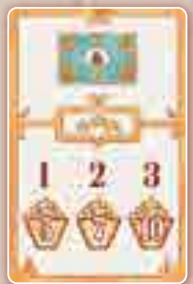
You gain 5/7/10 Fame Points if you performed in 1/2/3 main cities.

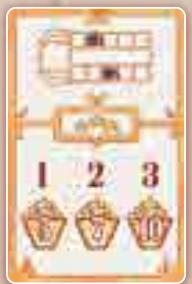
You gain 5/7/10 Fame Points if you performed in both medium cities of 1/2/3 different regions.

You gain 5/7/10 Fame Points if your circus has 6/8/10 Pedestals.


You gain 5/7/10 Fame Points if you have 10/11/12 Artist cards on your Circus board (End Game Scoring cards do not count).

GREDITS
AUTH0RS: Fabio Lopiano and Remo Conzadori
HLUSTRATOR: Edu Valls
S0Ł0 M0DE: David Turczi, Fabio Lopiano and Xavi Bordes
EDITOR: David Esbrí
PROOFREADER: William Niebling

LAY0UT: Meeple Foundry

MOVEMENT
Take 1 Card


your Board

GAMEPLAY


(see page 6)


(see page 12)













3MOVE THE BARNUM CIRCUS

(see page16)


Pedestals
(see page 7)


Money (see page 7)

(see page 7)

Inmediate Fame Points (see page 7)

End of Game Fame Points (see page 7)

Play Card (see page 7)

(see page 7)

Visible on

Clowns


(see page 8)
Pets (see page 8)


Magicians (see page 8)
Horse Riders (see page 8)
(see page 8)

(see page 7)

(see page 8)
Special Performers
(see page 8)

Draw 1 End Game Scoring Card (see page 11)

Draw 1Money Card(see page 11)

Draw 1 Ticket Card (see page 11)

Play another card (see page 11)

Swap 2 cards (see page 11)
Gain the number of Fame Points (see page 11)


(see page 11)

Gain 5 Fame Points (see page 11)


(see page 25)
原文为社区整理/出版社公开资料,版权归原作者,仅供个人学习查阅。