
新时代51st State The New Era
一句话概览
新时代 是一款已收录于村了吗规则库的桌游,支持 2–5 人,原名 51st State The New Era。
本页内容:一句话概览 · 游戏概述 · 1. 游戏组件 · 2. 游戏设置 · 3. 游戏流程 · 4. 卡牌与地点 · 5. 交流行动结算 · 6. 再开发与重建 · 7. 派遣工人 · 8. 胜利点结算与清理 · 9. 特殊规则:「3」之定理 · 10. 建造与放置规则 · 11. 游戏中的符号 · 12. 地点的行动与功能示例 · 关键规则与常见问题 · 常见问题
新时代 规则速览
以下规则速览由本站整理,与官方规则书表述不同,仅供快速上手参考;其中 1 节为节选,完整内容可在村了吗查询。
游戏概述
在核战与叛乱机械蹂躏三十年后的北美废墟上,五个派系开始争夺主导权。每位玩家选择一个派系,通过征服、合作与建设不断扩张领土,把派系力量转化为胜利点数(VP)。当有玩家达到或超过 33 点时,本回合打完,游戏在胜利点数结算阶段后结束,得分最高者获胜。
核心机制: 卡牌驱动、距离—指示物匹配、地点入场三选一(征服/合作/建造)、资源当回合消耗
1. 游戏组件
| 组件 | 说明 |
|---|---|
| 地点卡与即时卡 | 共 95 张,洗混后作为唯一牌堆 |
| 基地卡 | 5 张,每个派系 1 张 |
| 派系交流卡 | 每个派系 1 张 |
| 与对手的协约卡 | 每个派系 1 张 |
| 派系指示物 | 每个派系 7 个(计分栏用 1 个) |
| 工人指示物 | 基地卡每回合产出 |
| 资源指示物 | 废铁、燃料、武器、建筑材料四种 |
| 百搭资源指示物 | 22 个,可当任意资源使用 |
| 交流指示物 | 建造(1/2/3)、合作(1/2/3/4/5)、征服(1/2/3/4/5)、百搭交流 |
| 防御指示物 | 负值征服指示物(−1/−3),用于降低对手征服强度 |
| 胜利点数指示物 | 标记地点卡与基地卡上的得分 |
| 再开发指示物 | 由其他卡牌能力提供 |
| 起始玩家指示物 | 1 个,逐回合顺时针传递 |
| 计分栏 | 记录各派系总分 |
2. 游戏设置
- 选择派系: 每位玩家随机选取一个派系(基地卡),获得对应的派系交流卡、与对手的协约卡以及 7 个派系指示物。未被选中的派系连同其卡牌与指示物一并移出本局。
- 每位玩家把 1 个派系指示物放到计分栏 0 分位置,其余指示物放在自己基地卡旁。
- 随机决定一名起始玩家,把起始玩家指示物交给他。
- 牌组准备: 所有地点卡与即时卡洗混,向每位玩家随机派发 4 张,剩余卡牌面朝下形成摸牌堆。
- 由起始玩家从搜寻阶段开始游戏。
3. 游戏流程
游戏由数轮组成,每轮依次执行以下 5 个阶段,玩家在轮内由起始玩家开始顺时针行动。
3.1 回合结构
| 阶段 | 内容 |
|---|---|
| 1. 搜寻阶段 | 翻牌、选牌、补手牌 |
| 2. 生产阶段 | 结算基地卡、生产类地点、协约与战利品的收益 |
| 3. 行动执行阶段 | 依次执行行动,直到所有玩家跳过 |
| 4. 胜利点结算阶段 | 计算本回合得分,判定是否达到 33 点 |
| 5. 清理阶段 | 弃置未用指示物与工人,传递起始玩家标记 |
3.2 搜寻阶段
从摸牌堆翻开 5 张卡牌摆在桌上公开,然后所有玩家从中取 2 张面朝上的卡,并从摸牌堆另摸 1 张面朝下的卡。
- 第一张卡牌: 起始玩家从 5 张中选,其余顺位玩家从 4 张中选。
- 第二张卡牌: 非末位玩家从 3 张中选,末位玩家从 2 张中选。
- 第三张卡牌: 所有玩家从摸牌堆摸 1 张面朝下的卡。
展示卡不足所需数量时,从摸牌堆翻开新卡补充;最后一张无人选择的卡面朝上置入弃牌堆。手牌对其他玩家保密,手牌数量没有上限。摸牌堆摸完前若游戏未结束,将弃牌堆洗混形成新的摸牌堆。
3.3 生产阶段
玩家从基地卡、已建成的生产类(开放或封闭)地点、被征服的地点以及存在合作的地点依次获得:资源、工人、交流指示物、卡牌与额外胜利点数。涉及卡牌的效果立即从摸牌堆摸牌并加入手牌。
- 基地卡生产: 每张基地卡产出 3 个工人与一种特殊资源或交流指示物。
- 合作类生产: 已签署的协约按卡牌蓝色(协约)区域结算;与对手地点的合作同样给出该地点蓝色区域所列收益。
- 战利品生产: 玩家选择是否领取。领取则弃掉被征服的(压在基地卡下方)地点卡并获得其红色(战利品)区域收益;不领取则保留该卡但拿不到收益。
- 地点卡生产: 获得开放或封闭生产地点能力区域显示的收益。
收益的存放: 特殊地点卡产出的胜利点数放在该卡牌上,以合作或征服获得的胜利点数放在基地卡上,其余指示物放在基地卡旁的资源区。本阶段获得的收益只能在当回合花费,未使用的指示物(胜利点数除外)在回合结束时被弃掉。若在本阶段有玩家超过 33 分,游戏不会立即结束,本回合后续阶段照常执行,游戏在胜利点结算阶段后才结束。
3.4 行动执行阶段
玩家由起始玩家开始顺时针各执行一个行动,循环进行。玩家可以选择任意可选行动,也可以选择跳过;一旦跳过,本回合行动执行阶段内不能再行动,并在后续过程被忽略。属于已跳过玩家的地点对其他玩家处于关闭状态,不能作为征服、签订合作协约或废除合作协约的目标,也不能对其派遣工人。已在派遣状态中的工人继续有效。本阶段直到所有玩家跳过才结束,玩家能执行的行动总数没有限制。
3.5 可选行动一览
- 打出 1 张即时卡
- 执行派系交流卡上的 1 个行动
- 打出交流指示物(执行一次交流行动)
- 再开发
- 重建
- 弃掉 2 张手牌并从摸牌堆摸 1 张卡
- 派遣 1 个工人到 1 个地点工作
- 派遣 2 个工人到已派遣过工人的地点工作
- 派遣 1 个工人到对手的地点
- 牺牲 2 个工人换取 1 个任意类型的资源
4. 卡牌与地点
4.1 两类卡牌
即时卡: 打出后立即给予卡面所列收益(资源或交流指示物),随后弃置。若卡面上标有费用(通常是资源指示物),打出时必须弃掉对应指示物;未标费用则可免费使用。
地点卡: 可以通过三种方式之一进场——
- 征服: 在生产阶段获得卡牌红色区域(战利品)的一次性收益。
- 合作: 在每个生产阶段获得卡牌蓝色区域(协约)的收益。
- 建造: 该地点成为玩家领土的一部分,之后可以使用地点的能力(卡牌中央显示它属于功能型还是行动型)。
建造需要支付由卡上距离(黑色箭头符号标注)决定的花费。玩家必须用正确颜色的交流指示物或其独立的交流行动来补足距离,在一次行动中指示物的范围值可以叠加。交流指示物不能被拆分或找补:范围 3 的指示物不能同时与距离 2 和距离 1 的两个地点交流。
4.2 合作或征服其他玩家控制的地点
对位于其他玩家派系控制区域内的地点进行征服或合作时,地点卡的防御性距离值代替普通距离值结算。该值越高,对手越难通过合作或征服从该地点取得优势。
4.3 地点卡的四种类型
| 类型 | 规则 |
|---|---|
| 开放生产类 | 建造后立即获得能力区域收益,此后每个生产阶段也获得。对手可派遣工人到此类地点 |
| 封闭生产类 | 与开放生产类相同,唯一区别是对手不能派遣工人到此类地点 |
| 行动类 | 拥有者必须派遣工人到该地点才能取得能力区域收益。同一回合同一行动类地点最多使用两次:第一次派遣 1 个工人,第二次派遣 2 个工人 |
| 功能类 | 既不生产收益也不能派遣工人;依靠卡上功能,玩家可通过特定行动获得胜利点数或特殊资源 |
5. 交流行动结算
5.1 征服
- 征服手牌中的地点: 把该地点卡压在基地卡下方,只露出红色部分。之后在任何生产阶段都可弃掉这张卡,换取红色(战利品)区域的收益。协约与战利品压在基地卡下方的合计上限为 3 张。
- 征服属于对手的地点: 宣告征服强度并拿出等值指示物。当进攻方征服强度大于等于地点防御距离值时,地点被征服。进攻玩家立即获得该卡红色(战利品)收益,防御玩家获得蓝色(协约)收益。被征服的地点翻面留在场上作为废墟;被征服地点卡上的胜利点数与资源立即转移到防御玩家的基地卡或资源区。若对手已选择跳过,他不能成为征服目标。
- 防御与开战: 防御玩家若有防御指示物(负值的征服指示物),可以使用部分或全部来降低进攻方强度值。若进攻方强度低于防御强度值,进攻方可以更换距离更近的目标地点、增加征服标记或其他可行方法来提高强度;进攻方加码后,防守方若有可能也可以继续增加防御指示物。战斗持续到进攻方有能力征服当前范围内的某个地点,或防守方放弃抵抗;随后进攻方须选择一个在其范围内的地点完成征服,无需再增加指示物。
5.2 合作
- 与手牌中的地点合作: 把该地点卡压在基地卡下方,只露出蓝色部分。之后所有生产阶段都能获得蓝色(协约)区域的收益。
- 与其他玩家的地点合作: 把自己的派系指示物放在目标地点的蓝色协约区域,并把「与对手的协约卡」压在基地卡下方。该协约卡纯粹是提示物,提醒玩家在生产阶段结算来自对手地点的收益,不计入压在基地卡下 3 张的上限。与对手地点合作会立即获得一次该地点的合作收益,之后生产阶段照常运作。同一时间一名玩家最多与 3 个其他玩家的地点合作;除已跳过的玩家外,可在任意时间废弃既有的合作关系(合作立即取消,指示物返还拥有者)。
5.3 防御性地点
若通过合作让一张防御性地点(蓝色区域部分通常为棕色)入场,玩家先照常为合作支付花费(弃掉不小于该地点距离值的合作交流指示物),然后把这张防御性地点压在另一张自己已拥有的地点卡下方,只露出棕色部分。此后该防御性地点结付在目标地点上,提供等同于棕色区域数值的防御距离值加成,仅用于抵抗对手的征服行动,不适用于抵抗合作协约。不能对属于对手的防御性地点开展合作行动。
5.4 从手牌中执行建设行动
遵循地点放置规则,把卡牌放到基地卡旁。若卡牌为生产类(无论开放或封闭),玩家立即获得其生产收益。
6. 再开发与重建
6.1 再开发
摧毁自己领土内的一个地点并在其上新建一个地点。可从派系交流卡或使用再开发指示物(来源于其他卡牌能力)执行。被摧毁地点与新入场的地点卡至少要有一个地点类型标识相同;距离值不影响再开发。执行后获得 2 点胜利点数,放在基地卡上。
- 若目标地点上有胜利点数或资源指示物,转移到玩家的基地卡或资源区。
- 若其他玩家与该目标地点存在合作,合作立即取消,对手的派系指示物返还其拥有者。
- 若新入场地点为生产类(开放或封闭),玩家立即获得其生产收益。
- 不能对废墟执行再开发行动。
6.2 重建
重建只能对遭受征服后的废墟执行:玩家弃掉废墟卡和 1 个建筑材料指示物,并在其上建设一个新地点。距离值和地点类型都不影响重建。执行后获得 1 点胜利点数,放在基地卡上;若新地点为生产类,立即获得其生产收益。
7. 派遣工人
- 派遣 1 个工人到自己的地点: 玩家在领土内至少拥有一个行动类地点时才能执行。把工人指示物放到该地点卡上表示本回合已被使用,满足其他额外要求后立即获得对应收益或胜利点数。工人留在地点卡上直到回合结束;通过行动获得的胜利点数保留在执行行动的地点卡上。
- 派遣 2 个工人到已派遣过工人的地点: 同一地点行动在本回合第二次激活,需派遣 2 个工人。除工人数量外与第一次没有区别,地点上最多总共容纳 3 个工人。同一回合同一地点行动不能被激活第三次。
- 派遣 1 个工人到对手的地点: 只能对对手的开放生产类地点执行。玩家把自己的 1 个工人交给地点拥有者,并在该地点卡的灰色区域放 1 个自己的派系指示物,然后获得该地点生产的收益。同一回合不能用对手同一个地点(即不能使用已放置自己派系指示物的地点)。不能对已选择跳过的玩家所属地点派遣工人。每个玩家每回合最多使用其他玩家的地点 3 次。
- 牺牲 2 个工人并获得 1 个资源: 弃掉 2 个工人,立即获得 1 个任意类型(废铁、燃料、武器、建筑材料)的资源指示物。
8. 胜利点结算与清理
8.1 胜利点结算阶段
所有玩家跳过后进入。胜利点数每回合独立计算,不累积前一轮得分。玩家获得胜利点数的来源为:
| 来源 | 点数 |
|---|---|
| 地点卡上的胜利点数指示物 | 卡面所示 |
| 基地卡上的胜利点数指示物 | 卡面所示 |
| 领土内的地点数量(废墟除外) | 每个 1 分 |
将最终分数标记在计分栏。若有一个或多个玩家到达 33 分,游戏结束,得分最高者获胜。 平分时:手牌最多者获胜;仍不能分出则工人和资源最多者获胜;否则共同获胜。若无人达到 33 分,进入清理阶段。
计分示例:基地卡上有 7 分、地点卡上有 4 分、领土内有 5 个地点,合计 16 分。
8.2 清理阶段
本回合结束时,除手牌以及在特殊卡牌储藏区中的资源外,所有玩家弃掉未使用的收益(资源、工人、交流指示物和再开发指示物)。接着弃掉派遣到地点上的工人以及派系交流卡上用来激活行动的资源。将标记使用过对手开放生产地点的派系指示物返还拥有者手中。最后,本回合的起始玩家把起始玩家标记交给左手边(顺时针)的玩家,开始下一回合。
9. 特殊规则:「3」之定理
- 卡牌上的空位: 允许建造后赚取胜利点数的地点卡,每张每局只能使用 3 次。卡上最多容纳 3 个胜利点数指示物——若卡牌一次提供 1 点,上限 3 点;一次提供 2 点,上限 6 点,以此类推。卡牌在第 3 次提供胜利点数后停止运作。
- 基地卡下的卡牌: 压在基地卡下方的协约与战利品合计不能超过 3 张;与对手的合作不计入此上限(对手的卡牌并不在基地卡下方,与对手的协约卡只是提示物)。
- 派遣到其他玩家地点的工人: 同一回合每名玩家最多执行 3 次派遣工人到对手开放生产地点的行动(即至多 3 个工人),并同步放置派系指示物标记。若目标地点从游戏中移除(被再开发或被征服),派系指示物仍留在对手处,直到清理阶段才返还拥有者。
- 与其他玩家开展合作的地点: 一名玩家不能与其他玩家合作超过 3 次,因此只有 3 个派系指示物能用来标记合作。防御性地点不计入合作上限(玩家最多可拥有 6 个合作:3 个在基地卡下、3 个在其他玩家处)。
10. 建造与放置规则
征服、合作和建造行动都能通过派系交流卡的即时行动以及交流指示物来执行。派系卡的即时行动距离值不能与交流指示物叠加使用;若不执行即时行动,玩家可以获得一个等值的交流指示物,该指示物能在之后的行动中与其他指示物合并使用。通常情况下,交流指示物或交流行动的值不能被拆分使用。
地点放置规则:
- 生产类地点(开放和封闭)放在最顶上一行,邻近基地卡。
- 功能类卡牌放在中间一行。
- 行动类卡牌放在最底下一行。
- 除地点卡上的胜利点数外,其他指示物放在邻近基地卡的位置,称为资源区。
获得胜利点数:
- 任何地点卡被建造后都价值 1 胜利点数,废墟价值 0 点。
- 再开发行动后获得 2 点胜利点数放在基地卡上。
- 重建行动后获得 1 点胜利点数放在基地卡上。
- 生产阶段中,特定地点、战利品或协约提供的胜利点数按规则放在对应卡牌上。
- 某些地点被建造后能通过特殊功能或行动提供胜利点数。
- 若地点卡从游戏中被移除(被征服或再开发),将胜利点数指示物移动到基地卡上。
- 放在基地卡上的胜利点数指示物能够被找补(例如两个 1 点指示物换成一个 2 点指示物)。
11. 游戏中的符号
- 资源: 废铁、燃料、武器、建筑材料、百搭资源。百搭资源指示物等同于任意一种资源,获得时视作得到任意资源,使用时再决定其类型。
- 工人: 工人指示物。
- 交流: 建造指示物(1/2/3,允许建造距离值 1/2/3 的地点);合作指示物(1/2/3/4/5);征服指示物(1/2/3/4/5);防御指示物(−1/−3,降低对手的征服范围);百搭交流指示物(可作为任意类型的交流指示物执行建造、合作或征服)。
- 再开发指示物: 用于执行再开发行动。
- 卡牌符号:
- 一次性:建造卡牌后立即一次性获得收益。
- 储藏:放在该卡牌上的收益能在后面的回合使用,清理阶段不会被移除。
- 战利品/协约/战利品或协约:标明卡牌收益区域。
- 卡牌类型:与再开发行动相关,新建地点与旧地点必须至少有一个类型相同。
- 地基(Foundation):一种特例,没有其他地点卡能以「地基」作为再开发目标。
- 生产类卡牌:每个生产阶段提供收益;被建造后(通过建造、再开发、重建)立即获得卡牌收益。
- 需要 1 个工人:此类卡牌需派遣工人执行行动。
- 封闭地点:其他玩家不能派遣工人使用该地点。
- 功能类地点:不需要工人也能持续保持运作。
- 地点的距离值(0/1/2/3);地点的防御性距离值(3/4/5)。
若某些卡牌效果与通用规则冲突,以卡牌效果为准。
12. 地点的行动与功能示例
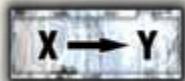
许多地点的行动需要派遣工人。若地点卡效果区域只显示一个资源图样,说明只需派遣工人激活即可得到对应资源,无需额外花费;若卡上有箭头(→)符号,则表示需要特定的费用,格式为「弃掉 X 获得 Y」。
行动类示例:
- 采集(Gatherers): 弃掉一个合作交流指示物,获取一个百搭资源。
- 修缮: 该行动可以在对应类型的地点放置 1 个胜利点数。此法放置的 1 点不计入卡牌「只能放 3 个胜利点数指示物」的限制,但每张地点卡只能通过此法放置 1 个胜利点数;为便于区分,把这样得到的指示物放在该卡的战利品区域。
- 生产大厅: 选择一个你已建造的生产类地点(开放或封闭),立即获取该地点在生产阶段所产生的收益。
- 有些疯狂的推销员(Slightly Mad Salesman): 花费一个合作指示物,获得两个等同于该花费指示物的合作行动。
- 柯利的典当铺(Kelly's Pawn Shop): 弃掉一个战利品,获得 2 点胜利点数。
功能类示例(满足条件时获得收益):
- 流放(Penal Colony): 每次执行再开发行动时,获得 1 个工人。
- 工厂(Factory): 建造完成一个要求类型的地点时,获得 2 点胜利点数。
- 工地: 每当有建筑材料指示物被生产,获得 1 点胜利点数(此类卡牌通常只在生产阶段获得指示物时才产生效果)。
- 货车(Truck): 每当完成一次征服或合作行动,获得 1 个百搭资源指示物。
- 避难所(Gang Hideout): 成功征服敌方地点时,可以选择只获取战利品,而不把目标地点翻面为废墟。
- 油罐车(Tank): 每当获得燃料指示物(在生产或行动阶段),获得 1 点胜利点数。
- 定居者(Settlers): 每完成 1 次建造行动,获得 1 个工人。
- 新邻居(New Neighbor): 每完成 1 个重建行动,获得 2 个工人。
- 博尔格的老巢(Borgo's Den): 每对一个距离值 3 或 3 以上的地点进行征服,获得 2 点胜利点数。
- 盗贼巢穴(Thieve's Den): 资源储藏区,能放置任意 2 种资源和 2 个工人在里面;放置资源是免费行动,不占用行动。
关键规则与常见问题
易错点
- 交流指示物不可拆分或找补: 一个范围 3 的指示物不能分别用于距离 2 与距离 1 的两个地点。
- 同类交流指示物可以叠加: 例如 2 距离的征服指示物加 3 距离的征服指示物,可达成范围 5 的征服。
- 派系交流卡上的即时交流行动不能与其他交流指示物叠加,但由它获得的交流指示物可以与其他指示物合并使用。
- 派系交流卡的 4 个特殊行动每回合各只能用一次;使用卡牌或指示物执行的行动在回合内没有次数限制。
- 生产阶段的收益只能当回合使用,回合结束弃掉(胜利点数除外);手牌与卡牌储藏区的资源不受清理影响。
- 对本回合已跳过的玩家: 他的地点对其他人关闭,不能被征服、合作或派遣工人;他本人也不能成为征服目标。
- 击败对手地点的结算: 进攻方拿红色战利品收益,防御方拿蓝色协约收益,地点翻面成为废墟。
- 再开发获得 2 点、重建获得 1 点,且重建只能对废墟执行;废墟不能再开发。
- 再开发要求新老地点至少共享一种类型标识,但距离值无关;重建则距离与类型都不影响。
- 压在基地卡下的协约与战利品合计最多 3 张,与对手的协约卡不算在内。
- 每回合最多使用其他玩家的地点 3 次,且每个对手地点当回合只能被同一玩家使用一次。
- 达到 33 分不是立即结束: 若在生产阶段达到,本回合剩余阶段照常执行,游戏在胜利点结算阶段后结束。
- 胜利点数不跨回合累积,每回合从场地与基地卡上的指示物重新统计。
- 胜负平手判定顺序: 最高分 → 手牌最多 → 工人和资源最多 → 共同获胜。
- 卡牌效果与通用规则冲突时以卡牌效果为准。
……(完整内容可在村了吗查询)
常见问题(FAQ)
以下 1 条问答中 0 条来自站内玩家的真实提问,其余 1 条为本站整理的常见疑问;答复内容保持原样。
新时代支持几个人玩?
2–5 人。
去哪查完整规则
想核对具体规则细节、卡牌效果或某个回合的结算方式,可以在村了吗里选中这款游戏后直接提问。
同类桌游
- 卡坦岛德式
- 工业革命:伯明翰德式
- 勃艮第城堡:特别典藏版德式
- 方舟动物园德式
- 卡卡颂抽象
- 瘟疫危机传承:第一季美式
- 阿瑞迪亚:勇踏征途美式
- 重塑宇宙德式
- 幽港迷城美式
- 埃多拉的德鲁伊德式
规则原文(Markdown)
本站收录这款游戏的规则原文 2 个文件,此处内联渲染 2 个,可直接展开阅读或下载。
rules_zh_新时代_9475.md40.0 KB

游戏规则书
记录着基础规则的计分栏
x 5
基地卡
(每个派系1张)
百搭资源
x 22
x 5

引言
由于受到大规模杀伤性武器的蹂躏,美利坚国土已然成为一片废墟。经年累月为资源而爆发的流血争夺以及受到来自叛乱机械的恐怖袭击,让这片土地成为了不毛之地。
在大灾难三十年后的今天,人类开始从灰烬中重新站起,许多新政权开始敢于宣称自身拥有凌驾于整个国家的力量。
在参与主导权争夺的五个派系中:除了借助其权力竭力控制混乱局势的纽约客;还有阿帕拉契联盟,一个封建贵族掌权的矿业工会,通过自身强力的矿业资源不断发展;而商贸协会的力量来源于战前剩余的大量物资以及大范围贸易网络支撑;突变体联盟则是一个崇尚勇士的部落,通过不断吸纳其他人种发展壮大,这其中包括一些可怕的堕落人类;还有霸权主义,一个由罪犯、暴徒以及各个帮派结成的松散的联盟组织。
在扩张的热潮中,各派系的目光不仅瞄准了荒废世界的土地,也瞄向了各自邻国。
人类历史的齿轮即将重新开始转动,欢迎来到新纪元的破晓时分!
游戏部件
卡牌
x 95
地点卡与即时卡
指示物
胜利点
x 35
x 12
再开发
x8
建造
x 4
x 3
x 5
x 3
x 5
x 4
x 3
征服
起始玩家
其他部件
x 5
与对手的协约卡
(每个派系1张)
x 3
合作
x 3
x 4
x 3
工人
x 4
x 12
x 12
x 12
百搭交流
废铁, 燃料, 武器, 以及建筑材料
x 7
派系交流卡
(每个派系1张)
x 7
x 7
派系
x 7
x 7
额外资源指示物
x 3
x 1
防御
游戏目标
为支配其他对手,每个玩家在5个可用派系中选择其一参与到这场权利的争夺之中。
游戏的目标在于扩大玩家自身派系的力量,通过不断积累胜利点数并且阻止对手获得点数,最终将派系推向最顶峰。获胜者将超越其他竞争者,不堪的国家历史将在其所属派系的旗帜下开创一个新纪元。当任何玩家获得(或超过)33点胜利点数时,游戏结束。
游戏概览
在每回合,玩家们获得新的卡牌,其中包含他们探索到的新地点。
这些地点卡可以通过3种不同的方式进场。
玩家能够选择征服该地点一次性获取卡牌红色部分展示的战利品。也可以选择与该地点建立合作关系,每轮获取卡牌蓝色部分表示的持续但较少的收益。第三种方式是建造,将该地点变为玩家所属国家中的一部分,并允许使用卡牌灰色部分的固有资源或特殊能力。
通过领土扩张与执行地点的行动,在游戏中玩家建立起来的派系力量以胜利点数来指代。
当有玩家胜利分数冲破33分时,该回合为游戏最终回合。在所有结算完成后,在这场竞争中获得优势的派系获得最终的胜利并凌驾于其他对手之上,支配其他被蹂躏的国家。
对玩家来说,这个游戏有很多可行的选择。是愿意通过石油开采,还是军火贸易来提升自己的国力?是愿意做一个和平主义者,将焦点放在贸易关系上,还是不断寻找新的猎物进行狩猎?是依靠兼并新的土地来发展国家,还是依靠与其他玩家进行合作以谋求发展?是想通过投入时间与资源将国土用铁丝网与其他玩家隔离开来,还是雇佣大量的帮派份子,卷入大规模冲突之中……
游戏中的卡牌
在新纪元中卡牌的类型有两种:即时卡与地点卡。
即时卡
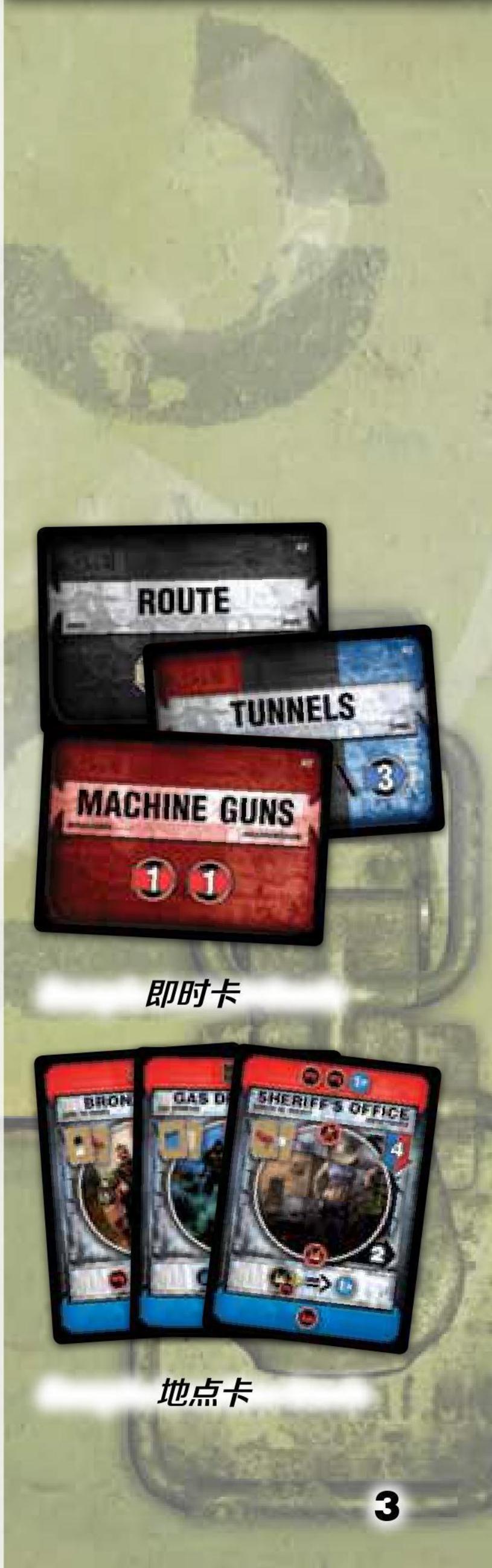
即时卡在打出后,立即给予玩家卡牌上列出的收益(资源或交流指示物)。然后该卡被弃置。
请访问我们的网站 www.portalpublishing.eu 获得
游戏进程实例
游戏5阶段的游戏视频演示
常见问题解答地点卡
的距离符号




交流指示物实例:建造、征服、合作

战利品区域
协约区域

地点能力区域
地点卡
地点卡能够从手中通过以下三种不同的方式之一打出:
建造

玩家需要支付的成本是由地点卡上的距离(标注在黑色箭头符号上)来决定。
为了弥补这个距离,玩家必须根据地点卡使用正确颜色的交流指示物或独立的交流行动。在一个行动中,指示物使用时范围值是可以叠加的。
注意: 交流指示物不能被拆分或找补。例如: 范围3的交流指示物不能用于与距离2和1的两个地点卡同时进行交流。
根据地点卡打出的方式,会产生不同的收益:
征服
在生产阶段,征服将获得卡牌红色区域(战利品区域)显示的一次性收益。
合作
在每个生产阶段,将获得卡牌蓝色区域(协约区域)产生的收益。
建造
该地点成为玩家领土中的一个组成部分—从现在起玩家能够使用地点的能力(地点卡中央部分显示了该地点属于功能型还是行动型)
合作或征服其他玩家控制的地点
新纪元中允许对其他玩家派系控制区域中的地点进行征服或合作。在此时,地点卡的防御性距离值代替了普通距离值进行结算。这个值越高,对玩家来说,就越难从地点上通过合作与征服的方式获取优势。
地点卡的四种类型
地点卡通过卡牌中间的两个图标(一个在插画上方,一个在插画下方,请参阅下一页的实例),能够分为开放生产,封闭生产,行动类,功能类四种类型。
开放生产类
此类卡牌允许玩家获得卡牌上能力区域显示的收益。玩家在建造该地点后立即获得该卡收益,并且在此后每个生产阶段也会获得此收益。对手可以按照开放生产卡牌的相关规则,派遣他们的工人到此类地点卡上。(参阅行动执行阶段)
封闭生产类
封闭生产类的卡牌规则基本与开放生产类相同。唯一的差异点在于对手不能派遣他们的工人到此类地点卡上。
行动类卡牌
为了获取该类地点能力区域的收益,地点拥有者必须派遣他的工人到此类地点卡上。
备注:地点拥有者在一个回合中只可使用同一个行动类地点的行动两次,第一次需派遣1个工人,第二次需派遣2个工人。
功能类卡牌
功能类地点卡既不会生产收益,也不能派遣工人。而依靠卡牌上的功能,玩家可以在游戏中通过执行特定行动来获得胜利点数或特殊的资源。
游戏设置
选择派系
在游戏开始时,每个玩家随机选择一个派系(派系基地卡)。然后获得对应的派系交流卡,与对手的协约卡以及7个派系指示物。
将没被选择到的派系基地卡与交流卡以及派系指示物放到一旁——它们在此局游戏中不会被使用。
接下来,所有玩家将它们的1个派系指示物放到计分栏0分的位置。剩余的派系指示物放在自己基地卡旁。
最后,随机选择一名起始玩家,并将起始玩家指示物交给他。
牌组准备
将所有地点卡和即时卡洗混并向每名玩家随机派发4张。剩余的卡牌面朝下形成摸牌堆。
由起始玩家从搜寻阶段开始游戏。

起始玩家指示物
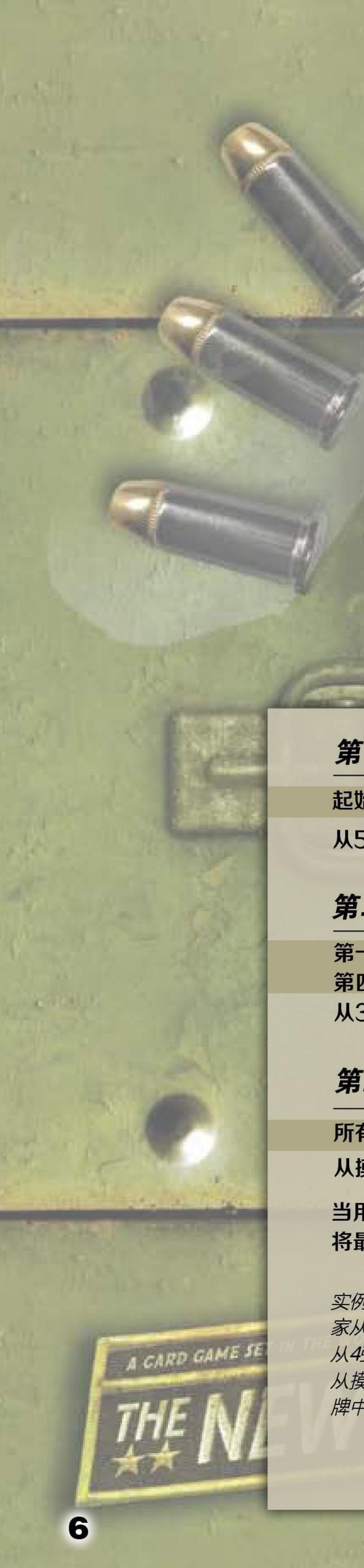
回合流程
游戏过程包含数回合,每个回合包括如下5个阶段,玩家在回合中由起始玩家开始顺时针进行各自的行动:
-
搜寻阶段
-
生产阶段
-
行动执行阶段
-
胜利点结算阶段
-
清理阶段
在每个回合中,各个阶段需按同样的顺序执行。以下是各个阶段的详细解说。
搜寻阶段
此阶段开始时,从摸牌堆翻开5张卡牌并放在桌上展示让所有玩家能够看到。然后所有玩家从中获得2张牌面朝上的卡牌并从摸牌堆中获得1张牌面朝下的卡牌。
根据玩家数量,按照以下的方式抽取用于展示的卡牌:
第一张卡牌
起始玩家
从5张卡牌中选择
第二、第三、第四及第五顺位玩家
从4张卡牌中选择
第二张卡牌
第一、第二、第三及
第四顺位玩家
末位玩家
从3张卡牌中选择
从2张卡牌中选择
第三张卡牌
所有玩家
从摸牌堆摸1张牌
当用于展示的卡牌不足所需数量时,从摸牌堆翻开新的卡牌作为补充。将最后一张没有人选择的卡牌,面朝上置入弃牌堆中。
实例:在一场3人游戏中,起始玩家从5张卡牌中选择了他的第一张卡牌,第二顺位玩家从剩下的4张卡牌中选择一张卡牌。之后从摸牌堆补充一张卡牌,第三顺位玩家依然从4张卡牌中进行选择。接着起始玩家从剩余的3张卡牌中选择他的第二张卡牌,接着从摸牌堆补充一张卡牌,第二顺位玩家选择一张。第三顺位(末位)玩家从剩下的2张牌中进行选择。最后,每个玩家再从摸牌堆中摸一张面朝下的卡牌。
备注:手牌内容对其他对手需要保密。
在新纪元中,玩家手牌数量没有任何限制。
如果在游戏结束前摸牌堆被摸完,将弃牌堆的卡牌洗混重新形成一个新的摸牌堆。
生产阶段
在本阶段中,玩家将从基地卡、已建成的生产类(无论开放或封闭)地点,被征服的地点以及与本派系存在合作的地点中获得以下收益:资源,工人,交流指示物,卡牌以及额外的胜利点数。
在获得这些收益时,玩家立刻将对应的指示物放到自己基地旁。特殊地点卡所生产出的胜利点数应放在自身卡牌上,以合作或征服方式获得的胜利点数放在基地卡上。
执行获得卡牌效果时立即从摸牌堆摸取卡牌并加入玩家手牌中。
备注:
在生产阶段中玩家获得的收益只能在当回合被花费使用掉。所有未使用的指示物(除胜利点数)将在回合结束时被弃掉(参阅:游戏区域的清理阶段)
基地卡生产
每个派系的基地卡将会生产三个工人与一种特殊资源或交流指示物。
合作类生产
在游戏中签署的合作协约将给予玩家卡牌蓝色区域中的收益。如果玩家与对手的地点存在合作,也会获得该地点卡蓝色(协约)区域所列出的资源。
战利品生产
玩家决定是否需要获取战利品。若是,弃掉被征服的(放在基地卡下方)地点卡并获得红色(战利品)区域列出的收益。若否,则不会弃掉被征服的地点卡,但是也无法获得卡上提供的收益。
地点卡生产
获得开放生产或封闭生产地点卡能力区域显示的收益。
备注:玩家获得收益时,由起始玩家开始顺时针进行。每个玩家有机会考虑其他玩家发展的可能性。


从基地卡与合作协约上进行生产的实例


从战利品上进行生产的实例
可执行的行动:
打出即时卡
执行派系交流卡上的行动
打出交流指示物
再开发
重建
弃掉2张卡牌并从摸牌堆摸取1张卡牌
派遣1个工人到1个地点工作
派遣2个工人再次到已派遣过工人的地点工作
派遣1个工人到对手的地点
牺牲2个工人并获得1个资源
百搭资源指示物是一种等同于任意资源类型的指示物。玩家获得百搭资源指示物时如同得到任意一种资源,并在使用时决定其为何种资源。
在生产阶段中玩家也可以获得胜利点数(通过前期执行的合作、征服或地点建设行动)。在本阶段有玩家超过33分并不意味着游戏结束。本回合后续的阶段照常执行,游戏在胜利点数结算阶段后结束。
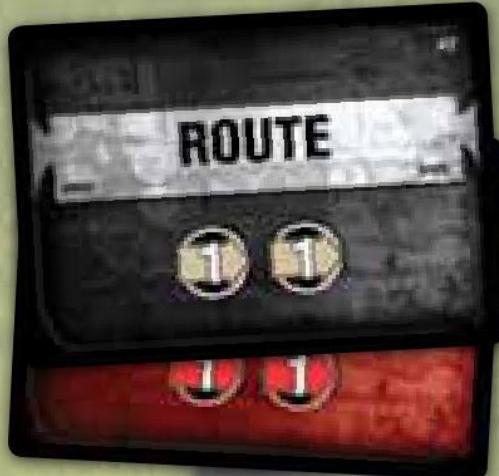
即时卡示例
行动执行阶段
在本阶段中玩家们依次执行各自行动(包括征服、签订合作协约、建设,以及执行派系交流卡上的行动等)
玩家能够选择任何可选行动或选择跳过。选择跳过的玩家在该回合的行动执行阶段不能再执行任何行动,并且在行动执行过程中被忽略。
玩家们由起始玩家开始顺时针方向执行一个行动,依此循环。
备注:属于已跳过玩家的地点对其他玩家来说为关闭状态,不能将其作为征服、签订合作协约或废除合作协约的目标,也不能指派工人到跳过玩家所拥有的地点。
本阶段直到所有玩家选择跳过后结束。
在本阶段,玩家执行的行动数总数没有限制。
玩家可执行的行动如下所示:
打出即时卡
玩家从手牌中打出一张即时卡,并立即获得卡牌上的收益。将获得的指示物立即放置在基地卡旁。
即时卡有可能需要支付卡牌上标明的费用(一般是资源指示物),玩家打出此类卡牌必须弃掉卡牌上标注的对应资源指示物。
若卡牌上没有列出任何的费用,那么意味着此卡牌可以免费使用。
A CARD GAME SET IN THE WO
执行派系交流卡上的行动
玩家放置一个或多个资源指示物在派系交流卡的特殊区域,获得对应类型的交流指示物,或立即直接使用这种交流指示物对在其范围值内的地点(距离值≤范围值)触发对应的行动效果(分别为征服、合作或建造)。

从派系交流卡上打出的交流行动不能与其他交流指示物叠加使用。
相反,从派系交流卡获得的交流指示物能够与其他的交流指示物合并使用。
备注:派系交流卡上的4个特殊行动每个回合只能使用一次。而使用卡牌或指示物执行的行动在回合中没有限制。
在执行派系交流卡上的行动选择时,是立即执行行动还是获取指示物,属于玩家策略的组成部分。前者能够快速执行一个行动,后者给予了对手一个信号:你正在为对更远距离地点采取行动而筹备。
打出交流指示物
当打出一个交流指示物时,玩家执行一个交流行动。这能够建立起合作关系,制造一次征服或建立一个新地点。
备注:同类交流指示物能够叠加使用以获得更远的范围值。例如,一个2距离值的征服指示物与一个3距离值的征服指示物叠加使用,能够达成最远范围5的征服行动。
备注:3种交流行动详细结算请参阅第11页。
再开发
再开发行动可分解为摧毁一个玩家领土内的地点,并在此之上新建一个地点。玩家能够从派系交流卡上或使用再开发指示物(来源于其他卡牌能力)执行再开发行动。
执行再开发行动,被摧毁地点与新入场的地点卡至少要有一种地点类型标识相同。
再开发时,地点的距离不会有影响。
再开发行动会为玩家带来2点胜利点数—将胜利点数指示物放在玩家的基地卡上。
如果再开发的目标地点上存在胜利点数或资源指示物,将其转移到玩家的基地卡上或玩家的资源存储区(参阅第15页,地点放置规则)
如果其他玩家与再开发的目标地点存在合作关系—合作将被立即取消,并将对手的派系指示物返还给其拥有者。
如果新入场的地点为生产(开放或封闭)类型,玩家立即获得此地点的生产收益。
不能对废墟执行再开发行动。
交流指示物能够被合并,但不能拆分或找补
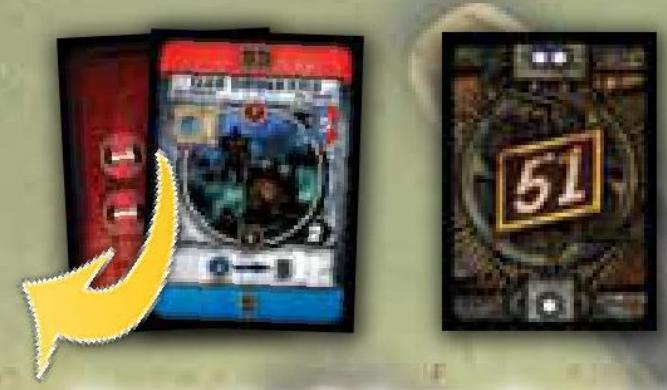
弃掉2张卡牌并从摸牌堆摸取1张面朝下的卡牌

派遣1个工人到1个地点卡
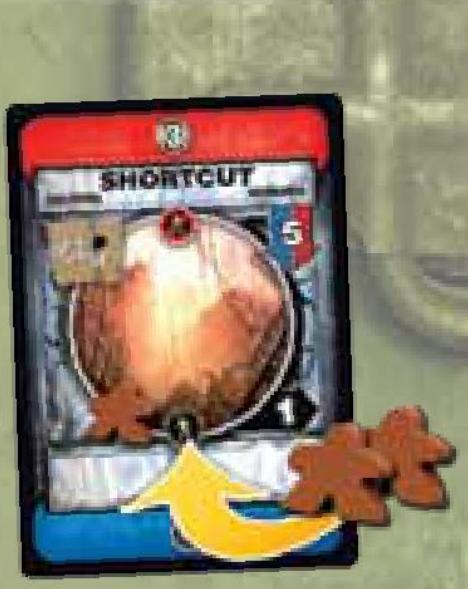
派遣2个工人到已派遣过工人的地点工作

派遣1个工人到对手的地点
重建
重建行动只能对遭受征服后的废墟执行。玩家将弃掉废墟卡和一个建筑材料指示物,并在其之上建设一个新的地点。
距离值和地点类型都不会影响重建行动。
重建行动会为玩家带来1点胜利点数—将胜利点数指示物放在玩家的基地卡上。
如果新入场的地点为生产(开放或封闭)类型,玩家立即获得此地点的生产收益。
弃掉2张卡牌并从摸牌堆摸取1张卡牌
玩家从手牌中选择弃掉2张卡牌进入弃牌堆,并从摸牌堆面朝下摸取1张卡牌。
派遣1个工人到1个地点工作
如果玩家在其领土内至少拥有一个行动类地点,那么他能够派遣1个工人去激活该行动。玩家放置工人指示物在地点卡上表明该行动本回合已被使用,然后满足其他额外要求(若有),并立即获得对应的收益或胜利点数。
同样的地点卡行动在一个回合内再次被激活,需要玩家执行派遣2个工人到已派遣过工人的地点工作。
直到回合结束前,被派遣的工人都会留在地点卡上。通过行动获得的胜利点数将会保留在执行行动的地点卡上。
可执行的地点卡行动详细描述可在本手册文末部分查询。
派遣2个工人到已派遣过工人的地点工作
同一回合第二次使用同一地点卡行动,玩家需要派遣2个工人到该地点。除工人数量差别外,其他与派遣1个工人时没有区别。将2个工人指示物放置到地点卡上(地点上最多总共容纳3个工人)。
直到回合结束前,被派遣的工人都会留在地点卡上。同一回合同一地点行动不能被激活第三次。
派遣1个工人到对手的地点
玩家能够派遣他自己的工人到对手的开放生产类地点获得地点的收益。
玩家将一个他自己的工人交给他希望使用地点的拥有者,并放置1个自己的派系指示物到使用过的地点卡灰色区域,然后获得该地点生产的收益。
玩家在同一回合不能使用对手相同的地点。换而言之,不能使用已放置自己派系指示物的地点。
不能对已选择跳过的玩家所属地点派遣工人。
每个玩家每回合能够使用其他玩家的地点最多3次。
牺牲2个工人并获得1个资源
玩家能够牺牲2个工人获得1个任意类型的资源(废铁, 燃料, 武器, 以及建筑材料)。玩家弃掉2个工人并立即获得指示物。
交流行动结算

征服手牌中的地点
玩家选择手牌中的1个地点并将其放在基地卡下方,只露出红色部分可视。在任何生产阶段中,玩家可以弃掉这张卡牌获得红色(战利品)区域的收益。
牺牲2个工人并获得1个资源

要征服一个属于对手领土内的地点,玩家必须宣告自身的征服强度值并拿出等值的指示物。
征服属于对手的地点
放在基地卡下的战利品
一旦战斗结算结果为进攻方征服强度大于等于地点的防御距离值。该地点被征服,进攻玩家立即获得地点卡战利品区域(红色)的收益。防御玩家获得该地点卡协约区域(蓝色)的收益。
将被征服的地点翻面留在场上作为废墟。任何被征服的地点卡上的胜利点数和资源立即转移到防御玩家的基地卡或资源区。
重要:如果对手已选择跳过,他不能成为征服目标。
开战
如果防御玩家有防御指示物(拥有负值的征服指示物),他就可以使用部分或全部来减少进攻方的强度值。若进攻方强度值低于防御强度值,进攻方能够通过更换距离更近的目标地点或增加征服标记,以及其他任何可行的方法,来达到增加进攻强度值的目的。若进攻玩家增加指示物后,防守玩家若有可能,也能够增加更多的防御指示物。
这场战斗将持续到进攻玩家有能力征服一个当前范围值内的地点或防守玩家选择放弃抵抗,然后进攻方需要选择一个在其范围值内的地点进行征服,无需再增加更多的征服指示物。
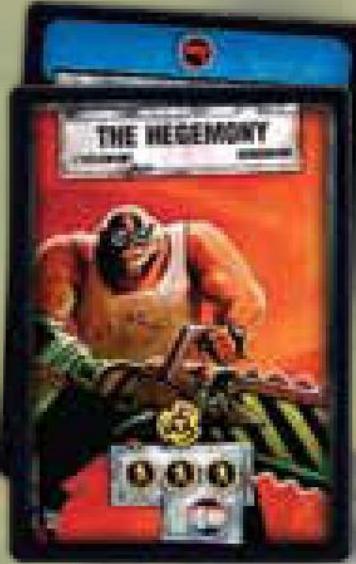
放在基地卡下的合作卡

与其他玩家建立合作关系后,将“与对手的协约卡”放在基地卡下
与手牌中的地点开展合作
玩家选择手牌中的1个地点并将其放在基地卡下方,只露出蓝色部分可视。在之后的所有生产阶段玩家都将获得蓝色协约区域的收益。
与其他玩家的地点开展合作
玩家将他的派系指示物放在目标地点的蓝色协约区域,并将与对手的协约卡放在其基地卡下方。
“与对手的协约卡”纯粹作为提示物存在,不计算在战利品与合作协约只能存在3个的限制之中。它只是用来提醒玩家在生产阶段获得来自其他玩家地点的收益。
不同于与手牌中的地点合作,与其他玩家所属的地点开展合作会在第一时间立即获得地点的合作收益。而在之后的生产阶段同样照常运作获得收益。
同一时间内,一个玩家能与至多3个其他玩家的地点开展合作。且除对已选择跳过的玩家外,能够在任意时间废弃前期建立的合作关系。

防御性地点
如果玩家通过开展合作让一张防御性地点(通常蓝色区域的部分为棕色)入场,他首先如同通常一样为合作行动支付花费(弃掉不小于地点距离值的合作交流指示物),然后将防御性地点放置在另一张玩家已拥有的地点卡下方,只露出棕色部分可视。
从此时起该防御性地点结付在了目标地点上,并为其提供了等同于棕色区域数值的防御距离值加成。该变动仅对于抵抗对手的征服行动,不适用于抵抗合作协约。
备注:不能对属于对手的防御性地点开展合作行动。
THE NEW

从手牌中执行建设行动
遵循地点放置规则,通过建设行动将卡牌放置在你的基地卡旁。(参阅特殊规则章节)
如果卡牌类型为生产类(无论开放或封闭),玩家立即获得生产收益。
胜利点结算阶段
当所有玩家选择跳过后进入胜利点结算阶段。胜利点数每回合都会独立计算,不会累积前一轮的得分。玩家从地点卡上以及基地卡获得胜利点数,并且领土内的地点数量(除废墟外)也会计入胜利点数。将最终分数标记在得分栏。
如果有一个或多个玩家得分到达33分,游戏结束。得分最高的玩家获胜。
如果多人得分相同,拥有最多手牌的玩家获胜。如果还不能分出胜负,拥有最多工人和资源的玩家获胜,否则共同获胜。
如果没有玩家达到33分,游戏进入清理阶段。
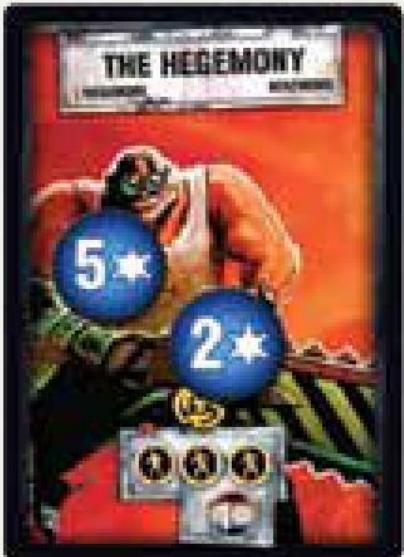
清理阶段
本回合结束时,除了手牌以及在特殊卡牌上储藏区的资源,所有玩家弃掉未使用的收益(包括资源,工人,交流指示物和再开发指示物)。
接下来,弃掉派遣到地点上的工人以及派系交流卡上用来激活行动的资源。
将用来标记使用过对手开放生产地点的派系指示物返还拥有者手中。
本回合的起始玩家将起始玩家标记交个左手边(顺时针)的玩家,下回合开始。
胜利点数来源于:
地点卡上的胜利点数指示物

基地卡上的胜利点数指示物

领土内的地点数量(每个1分)

计分示例:
(在基地卡上有7分,在地点卡上有4分,领土内有5个地点)

行动:征服 战利品
行动:合作
特殊规则
“3”之定理
卡牌上的空位
部分地点卡允许玩家在建造后赚取胜利点数。这些卡在游戏中每张只能使用3次。为方便标记,放置在卡牌上的胜利点数指示物只能放置3个,因此如果某卡牌能够通过行动或其他方式提供1点胜利点数,那么它最多卡上能容纳3点胜利点数。如果一次提供2点,那么最多上限为6,以此类推。
卡牌在第3次提供胜利点数后将停止运作。
基地卡下的卡牌
能够放置在基地卡下方的协约与战利品合计上限不能超过3。与对手的合作不计入此上限,因为对手的卡牌并未放置在基地卡下,与对手的协约卡牌只是1个提示物。
派遣到其他玩家地点的工人
在同一回合中,每个玩家能够执行派遣工人到对手的开放生产地点的行动至多3次,即使用至多3个工人。同时放置派系指示物到地点上作为标记。
如果目标地点从游戏中移除(例如再开发或被征服),派系指示物仍保留在对手处,直到清理阶段再返还拥有者。
与其他玩家开展合作的地点
玩家不能与其他玩家进行合作超过3次。因此只有3个派系指示物能够用来标记合作。
备注:防御性地点并不计算在合作的上限中(玩家最大能够拥有的合作上限为6,3个在基地卡下,3个在其他玩家处)
建造地点规则
地点卡在游戏中有3种表现,有5种影响放置方法的行动。以下是示例图:
行动:建造
行动:再开发
行动:重建
地点
征服、合作和建造行动能够通过派系交流卡的即时行动和交流指示物来执行。派系卡的即时行动距离值不能与交流指示物叠加使用。相反,若不执行即时行动,玩家可以获得一个等值的交流指示物。这个指示物能够与其他指示物在后面的行动中合并进行交流行动。在通常情况下,交流指示物或交流行动的值不能被拆分使用。
地点放置规则
在游戏中,当放置地点时需遵循以下原则:
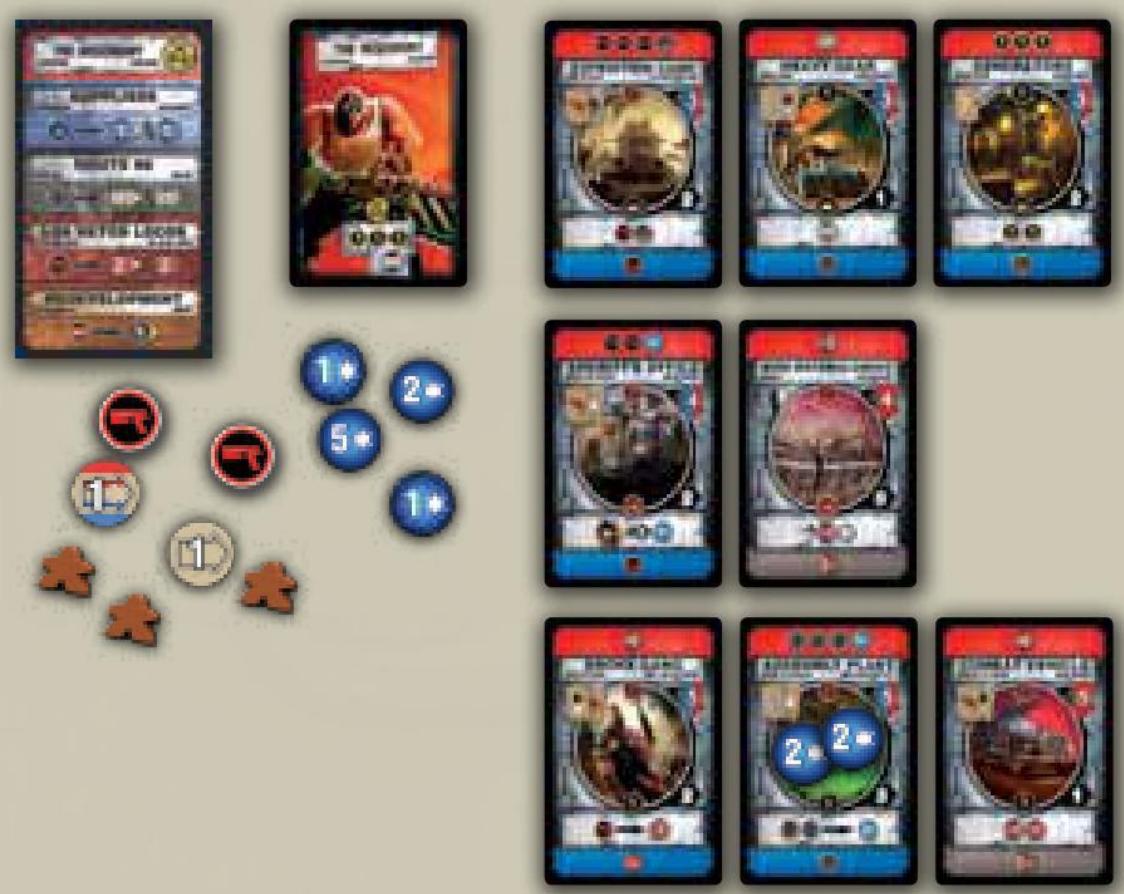

生产类地点(开放和封闭)赢放置在最顶上一行,邻近基地卡。
功能类卡牌应放在中间一行。
行动类卡牌应放在最底下的一行。
除地点卡上的胜利点数外,其他指示物放在邻近基地卡的位置,称为资源区。
获得胜利点数
任何地点卡被建造后都价值1胜利点数,而废墟价值0点。
任何再开发行动执行后,获得2点胜利点数放在基地卡上。
任何重建行动执行后,获得1点胜利点数放在基地卡上。
在生产阶段,特定的地点,战利品或协约提供的胜利点数按照规则放在对应的卡牌上。
某些地点被建造后能够通过特殊功能或行动提供胜利点数。
若地点卡从游戏中被移除(被征服或再开发),将胜利点数指示物移动到基地卡上。
放置在基地卡上的胜利点数指示物能够被找补(例如两个1点指示物换成一个2点指示物)。
游戏中的符号
备注:某些卡牌效果可能会与游戏的通用规则上有所冲突,此时以卡牌效果为准。
收益
资源

- 废铁


武器
( )

燃料
( )

建筑材料
)

百搭资源
工人

- 工人
交流
( )

- 建造指示物 (1/2/3)
允许建造距离值 1/2/3 的地点
12345
合作指示物 (1/2/3/4/5)
允许与距离值 1/2/3/4/5的地点开展合作
12345
征服指示物(1/2/3/4/5)
允许征服距离值1/2/3/4/5的地点
-1-33
降低对手的征服范围(-1/-3)

- 百搭交流指示物
可以作为任意类型的交流指示物执行建造、合作或征服。

再开发指示物

NEUROCHIMA
建造行动

征服行动

合作行动

再开发行动
胜利点数

- 胜利点数指示物

- 胜利点数指示物

- 胜利点数指示物

胜利点数指示物
卡牌

- 手牌中的卡牌
- 摸牌堆中面朝下的卡牌

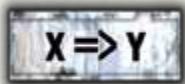
意即,当玩家打出即时卡时,可以从X或Y中选择1个收益。

- 一次性
玩家在建造卡牌后,立即一次性获得收益。

储藏
放在该卡牌上的收益能够在后面的回合使用,在清理阶段不会被移除。

- 战利品

- 协约

- 战利品或协约
- 卡牌类型
卡牌类型与再开发行动相关,新建的地点与旧的地点必须至少有一个类型相同。

- 地基
“地基”(Foundation)是一种特例。没有其他地点卡能够被“地基”作为再开发目标。

- 生产类卡牌
在每个生产阶段提供收益。在被建造后(通过建造、再开发、重建)立即获得卡牌收益。

- 需要1个工人
此类卡牌需要工人去执行行动

- 封闭地点
其他玩家不能派遣工人去使用该地点

- 功能类地点
功能类地点不需要工人也能够持续保持运作

- 地点的距离值 (0/1/2/3)

- 地点的防御性距离值 (3/4/5)
地点的行动
许多地点使用行动时需要工人
如果该地点卡效果区域显示只有一个资源图样,那么意味着只需要派遣工人去激活便能够得到对应的资源,无需额外花费。
如果有一个 $\rightarrow$ 符号在卡牌上,则意味需要特定的费用。

弃掉X获得Y
示例:

- 柯利的典当铺
(Kelly's Pawn Shop)
弃掉一个战利品或的2点
胜利点数

- 采集(Gatherers)
弃掉一个合作交流指示物获取一个百搭资源。

- 修缮
这个行动可以放置1个胜利点数
在对应类型的地点。通过此法放置的这1点胜利点数,不计入卡牌上只能放置3个胜利点指示物的限制。每个地点卡只能通过此法放置一个1点胜利点数。为便于区分,将此法获得的指示物放在卡牌的战利品区域。

- 生产大厅
选择一个你以建造的生产类地点(开放或封闭)并立即获取该地点在生产阶段所产生的收益。
功能类地点

满足X的条件时获得Y
示例:

- 流放(Penal Colony)每次当你执行再开发行动你获得一个工人。

- 工厂 (Factory)
当建造完成一个要求类型的地点时获得2点胜利点数。

-工地
每个建筑材料指示物被生产
你获得1点胜利点数。这种类型的卡牌通常只会在生产阶段获得指示物时才会产生效果。

- 货车(Truck)
每当完成征服或合作行动,你获得1个百搭资源指示物。

- 避难所(Gang Hideout)
当成功地征服敌方地点时你能
够选择只获取战利品,而不将目标地点翻面为废墟。
建造行动

示例:



- 重建行动
示例:
- 新邻居(New Neighbor)
每当你完成1个重建行动,你获得2个工人。

老鼠(Rat)

特定资源生产
得1资源行动后,你可以从摸牌堆抽取1张卡牌。


中文规则翻译:卡纳斯(TOTO)
游戏作者: Ignacy Trzewiczek, Michał „Ozi”
Ozon (Hegemony Faction design)
游戏规则: Magdalena Zachara, Szymon Zachara
卡牌设计: Mariusz Gandzel, Piotr Foksowicz, Mateusz „Night” Bielski, Tomasz Jędruszek, Daniel Grzeszkiewicz, Michał Oracz
游戏包装设计: Dark Crayon / Piotr Cieśliński
卡牌与图板设计: Michał Oracz, Maciej Szpakowski
游戏规则设计: Rafał Szyma
游戏规则翻译: Magdalena Zachara
发行商: Portal Publishing
ul. Św. Urbana 15; 44-100 Gliwice
tel./fax. (032) 334 85 38
www.portalpublishing.eu, e-mail: portal@wydawnictwoportal.pl
- 油罐车(Tank)
每当获得燃料指示物(在生产或行动阶段)你获得1点胜利点数。
示例:
- 定居者(Settlers)
每当你完成1次建造行动,
你获得1个工人。
- 博尔格的老巢(Borgo's Den)
每当你对一个距离值3或3以上的地点进行征服时,你获得2点胜利点数。
- 盗贼巢穴(Thieve'sDen)
资源储藏区。能够放置任意2种资源和2个工人在里面。放置资源是免费行动(不占用行动)。
- 有些疯狂的推销员
(Slightly Mad Salesman)
花费一个合作指示物,获得两个等同于花费指示物的合作行动。
感谢:
在此特别感谢Tycjan, Moniq, Arti, Zachi and Merry.
我要感谢所有参与游戏测试以及促成游戏发售的人们: Alchemik, Cnidius, Grzegorz Polewka, Neurocide, Rafał Szyma, Michał Oracz, Sheva, WC, Browarion, Grzech, Ryu, Klema, Yann Wenz, Cysorz, Szpaku, Iwan... 以及所有曾帮助过我的人。
本规则书仅供桌游爱好者研究使用,请勿用作其他商业行为,或直接盗取本人翻译和制作成果作为他用。

简略游戏指南
1. 游戏设置
a. 玩家选择派系
b. 玩家获得对应的基地卡,交流卡和指示物。将未使用的派系移除游戏
c. 将即时卡和地点卡洗混形成牌堆
d. 每个玩家随机派发4张卡牌
e. 随机选择一个起始玩家,并获取起始玩家指示物
2. 回合流程
a. 搜寻阶段: 玩家选择2张面朝上的卡牌并从摸牌堆摸取1张面朝下的卡牌
b. 生产阶段: 获得基地卡、生产类地点、协约和战利品区域的收益。
c. 行动阶段: 玩家依次执行行动直至所有玩家选择跳过。
可选行动:
打出1张即时卡
执行派系交流卡的1个行动
交流征服行动(针对手牌中的地点或其他玩家的地点)
合作行动(针对手牌中的地点或其他玩家的地点)
建造手牌中的地点
再开发
重建
弃掉2张手牌,从摸牌堆摸取1张卡牌
派遣1个工人到1个地点卡
派遣2个工人到已派遣过工人的地点工作
派遣1个工人到另一个玩家的地点卡
牺牲2个工人换取1个任意类型的资源指示物
d. 胜利点数结算阶段: 所有玩家计算他们已获取的胜利点数。
若任何玩家达到33分,游戏结束,最高分玩家获胜。
e. 清理阶段: 将未使用的收益, 派遣到地点上的工人和使用在派系交流卡上的资源弃掉。标记使用对手地点的派系指示物返还到拥有者处。起始玩家指示物传递给左手边玩家。下一回合的搜寻阶段开始。
下载 MarkdownNE_instrukcjaENG final lores.md49.4 KB
Introduction
United States lay in ruins. Burnt by the weapons of mass destruction, bled with long years of ruthless struggle for resources and terrorized by rebelled machines, the lands have changed into the endless planes of wastelands and ruins.
Today, more than thirty years after the holocaust, mankind rises from the ashes. Numerous centers of new power more and more boldly claim the supremacy over the entire country.
In the struggle for dominance five Factions clash: New York, that with all its powers strives to control the chaos, the Appalachian Federation, a feudal-mining union of barons, strong with its mining and continuous development, the Merchants' Guild, with power based on extensive network of contacts and trade in remnants of the pre-war goods; Mutants' Union, a warrior horde of, according to some, new and according to others, horribly degenerated humanity and the Hegemony, a loose union of criminals, thugs and gangs.
In the heat of expansion, Factions direct their gaze not only toward the countless sites of the desolate world, but also towards neighboring lands.
History of humanity begins anew. Welcome to the dawn of the New Era!
Contents

Goal
Each Player enters the struggle for power and domination over their opponents commanding one of the five available Factions. The goal of the game is to expand the power of the Player's Faction in order to reach its heights by accumulating the biggest number of Victory Points at the same time not allowing the opponents to gain their points. The winner will rise above others and the New Era in the Shitty States history will start under his or her Faction's banner. The game ends when one of the Players wins (or exceeds) the number of 33 Victory Points.
Overview
Each turn, Players acquire new Cards, including, among others, the Locations they discover.
These Locations may enter the game in 3 different ways.
A Player can choose to Conquer the Location to obtain Spoils shown in the red part of the Card in order to use it once. One may also choose to establish Cooperation with this Location, which yields a regular but smaller benefit every turn, as represented by the blue part of the Card. The third way is an Incorporation, making a Location a part of Player's State and allowing him a permanent use of Locations' inherent resources or special abilities represented by the central grey part of the Card.
Through the expansion of territory and performing Actions in the Locations, Players build the power of their Factions represented by Victory Points in the Game.
The turn in which one of the Players manages to cross the border line of 33 Victory Points is the last one in the game. After its completion, the Faction that outdistanced all the others triumphs in the race for dominance over the ravaged country.
There are a lot of choices available to the Player. Do they prefer to build the power of their State on oil production or rather on trading in arms? Are they a peaceful person and will want to focus on trade relations or will they attack constantly in search of new prey? Will they develop their State by annexing new Locations or base the development on collaboration with other Players' Locations? Do they want to devote time and resources to separate their State from those of other Players with barbed wire or employ numerous gangs and enter into an open conflict with thems... by employing numerous gangs.
Cards in the game
In the New Era there are two types of Cards: Instant Cards and Location Cards.
Instant Cards
Instant Cards give the Player Profits listed on the Card (Resources or Contact tokens) immediately after the Card is played. Afterwards, the Instant Card is discarded.
Please, visit our website at www.portalpublishing.eu for
detailed example of gameplay
videopresentation of 5 phases of the game
0 FAQ

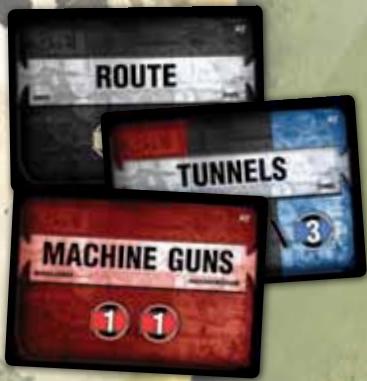
Sample Instant Cards
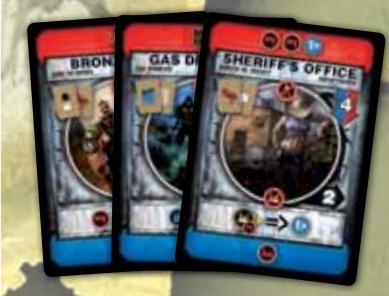
Sample Location Cards
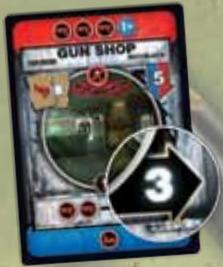
Location's Distance symbol

Examples of Contact tokens: Incorporation, Conquest, Cooperation

Spoils field

Agreement field
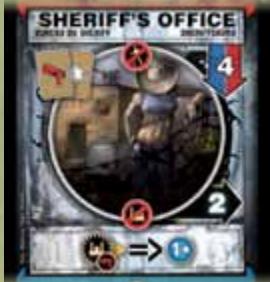
Capability field

Defense Distance symbol
Location Cards
Location Cards can be played from hand in one of three different ways:Incorporation,Cooperation or Conquest.
The cost a Player has to pay is determined by the Distance to the Location - indicated on the black arrow symbol.
In order to cover this distance a Player has to use Contact tokens or single Contact Action in the color appropriate to the way he wants to use this Location Card. Ranges of tokens used in one Action are added.
Note: Contact tokens cannot be divided nor changed: e.g. Contact token of Range 3 cannot be used to make contact with 2 Locations of respective Distances of 2 and 1.
Depending on how the Location has been played, it generates various Profits:
Conquest
Once, in the Production Phase, Conquest will bring Profit shown on the red part of the Card (Spoils field).
Cooperation
During each Production Phase a Card will generate Profits marked on the blue part of the Card (Agreement field).
Incorporation
The Location becomes an integral part of the Player's State - from now on the Player can use the Locations Capabilities (features or actions shown on the middle part of the Location Card).
Cooperation and Conquest of other Players' Locations
New Era allows for Conquest and Cooperation with Locations placed in areas controlled by other Players' Factions. In such cases, Location's Defense Distance is taken into account instead of normal Distance. T'he higher this value, the harder it is for the Players to take advantage of the Location, both in terms of Cooperation and Conquest.
Four types of Location Cards
Location Cards can be divided into those with the rule of Open Production, Closed Production, Action or Feature. Those are depicted with two icons in the middle part of the Card (one above and one below the illustration, see examples on the next page).
Open Production
The Card allows the Player to get Profits shown in Card's Capability field. The Player receives them immediately after this Card's Incorporation and during each Production Phase. Opponents may send their Workers to Locations with the rule of Open Production (see Action Execution Phase).
Closed Production
Card with the rule of Closed Production operates almost the same as the Card with Open Production. The only difference is that Opponents cannot send their Workers to this Location.
Card with Action
In order to take advantage of Location's Capability field, the owner has to send his Worker to this Location.
Note: The owner may use Location's Action only twice during one turn, sending 1 Worker the first time and 2 Workers the second.
Card with Feature
Locations with Feature neither produce Profits, nor can a Worker be sent there. Depending on the Card's Feature a Player may acquire e.g. Victory Points or specific Resources for performing certain Actions in the game.
Game setup
Choosing a Faction
In the beginning of the game each Player randomly chooses one of the Factions (Faction's Base Card) he will try to lead to victory. The proper Contact Card, Cooperation with other Players Card and 7 Faction tokens should be taken with the chosen Faction.
Factions' Base Cards together with their Contact Card, Cooperation with other Players Cards and Faction tokens that have not been chosen, should be put aside – they will not be used in this game.
Furthermore, Players take one of their Factions'tokens and put it on the Score track on the field marked with 0 points. The rest of their Factions' tokens should be placed next to their Base Cards.
The last element of preparations is the random choice of the Player who will begin the turn and thus receive the First Player token.
Deck preparation
All Location Cards and Instant Cards should be shuffled and then four random Cards should be given to each Player. The rest of the Cards should be placed face down in a Stack in the center of the playing area.
The Player with the First Player token starts the game from the Lookout Phase.


| First, Second, third and fourth Player | Last Player |
| chooses from 3 Cards | chooses from 2 Cards |
The Turn Sequence
The game consists of a series of turns, each divided into the following five Phases. Players make their Actions in turns, starting from the Player with First Player token and going clockwise.:
-
Lookout Phase
-
Production Phase
-
Actions Execution Phase
-
Victory Points Count Phase
-
Cleanup Phase
In each turn the Phases are executed in the same sequence. Below the exact description of each Phase is described.
Lookout Phase
At the beginning of this Phase 5 Cards should be revealed from the Stack and placed face-up on the table between the Players. Then, the Players pick two face-up Cards and draw one face-down Card from the Stack.
Depending on the number of Players, the pattern of drawing the revealed Cards is as follows:
First Card
First Player
chooses from 5 Cards
Second, third, fourth, fifth Player
chooses from
4 Cards
Second Card
Third Card
All Players
draw 1 Card each from the Stack
Lacking Cards should be continuously added from the Stack to those already lined face-up on the table.
The last Card, not chosen by anyone, is discarded face-up to the discard pile.
Example: In 3-Players game the first Player chooses his first Card from 5 Cards, and the second Player chooses from 4. After adding one card from the Stack, the third Player also chooses from 4 Cards. Now the first Player chooses his second Card from the remaining 3 Cards, just like the second Player, after adding one from the Stack. T'hird Player (that is the last one) chooses from last 2 cards. At the end, every Players draw 1 more Card from a Stack of face down Cards.

In New Era, Players can hold any number of Cards on the hand - there is no limit to this number at any moment of play.
If the Stack runs out of Cards before the end of the game, the Cards from discard pile should be shuffled and a new Stack of face down Cards should be created.
Production Phase
In this Phase, the Base Card and the incorporated Locations with the rule of Production (Open and Closed), conquered Locations (Spoils) and those ones the Faction cooperates with (Agreement), produce the Profits: Resources, Workers, Contact tokens, Cards or additional Victory Points.
In the moment of obtaining those Profits, the Players immediately take the corresponding tokens and place them next to their Base Cards. Victory Points produced by specific Locations should be placed on their Cards, while the Victory Points derived from Agreements and Spoils have their place on the Base Card.
Acquired Cards are immediately drawn from the Stack and placed in Players' hands.
Note:
In Production Phase Players obtain their Profits to spend only during the given turn. All unused tokens (apart from Victory Points) are discarded at the end of the turn (see: Cleaning of the Playing Area Phase).
Base production
The Base of each Faction produces three Workers and a specific Resource or Contact token.
Agreements production
Agreements signed during the game give the Players Profits indicated in the blue (Agreement) field of the Card. If a Player has entered into an Agreement with opponents' Locations he also receives the resources listed in the blue (Agreement) fields of those Locations.
Spoils production
Player decides whether they want to realize their Spoils. If yes, they discard the Conquered Location Card (placed under the Base Card) and receives the Profits listed on the red (Spoils) field. If not - they don't discard the Conquered Location Card, but also don't receive Profits generated by this Card.
Locations production
Locations with the rule of Open and Closed Production produce the Profits shown on Location's Capability field.
Note: Players draw the generated Profits in turn starting from the Player with the First Player token and going clockwise. Each Player has a chance to consider possibilities open to other Players.
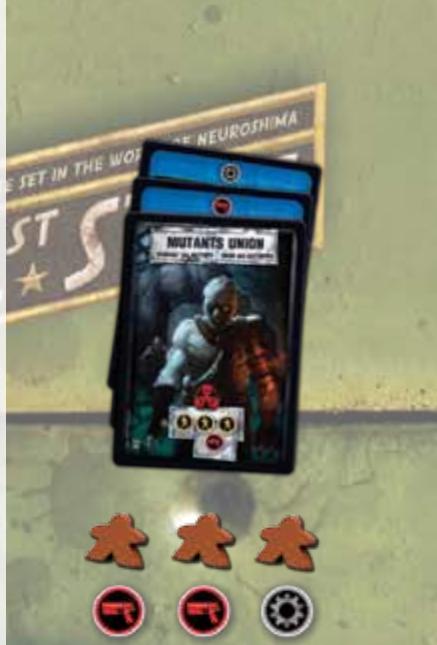
Example of Production from Base and Agreements


Example of Production from Spoils
Possible Actions:
Play the Instant Card
Perform Action from
Faction Contacts Card
Play the Contact token
Redevelop the Location
Reconstruct the Location
Discard 2 Cards and get 1 Card from the Stack
Send a Worker to work in a Location
Send 2 Workers to work again in the Location
Send a Worker to opponent's Location
Send 2 Workers to get 1 Resource

Sample Instant Cards
Universal Resource token is an equivalent of 1 yet any Resource token. T'he Player gets Universal Resource token just like any other and in the moment of its usage decides what kind of Resource it stands for.
In the Production Phase the Player may also acquire (through previously done Cooperation, Conquests or Locations' Incorporations) the Victory Points. Exceeding the borderline of 33 points at this stage does not mean the end of the game yet. All the following Phases of this turn are played normally, and the game actually ends after the Victory Points Count Phase.
Actions Execution Phase
In this Phase Players sequentially perform their Actions (including Conquest, signing Agreements and Incorporations, but also performing actions from annexed Location Cards and others).
Players, starting from the First Player and going clockwise, perform one of their Actions. The sequence then repeats.
The Player can choose any available Action or pass. The Player who had passed in the Actions Execution Phase cannot perform any more Actions in this turn and is ignored in the sequence of performing the Actions.
Note: Locations of the Player who has passed are closed to other Players. T'hey cannot Conquer, sign or break the Agreements with them nor send Workers to the Locations.
The turn lasts until all Players had passed.
There are no limitations to the order or number of total Actions performed by the Player in the Phase.
Possible Actions to perform are as follows:
Play the Instant Card
Playing an Instant Card from hand, a Player discards the Card and immediately collects Profits listed on it. If the Instant Card allows the Player to choose the kind of Profit to receive the Player chooses which of the Profits they want to get. The Player immediately collects the tokens and places them next to their Base Card.
Instant Card may have a price (specified in the Resources tokens) to pay in order to benefit from the Card's capabilities. To play such Instant Card, the Player must discard the Resources' tokens as shown on the Card.
If the Card doesn't have any price listed, it means it's free to use.
Perform Action from Faction Contacts Card
Player places one or more of their Resource tokens on a specified field on the Faction Contact Card and collects the appropriate Contact token or puts this Contact into effect at once (respectively - Conquest, Cooperation or Incorporation) with a Location Card of a Distance not larger than the Range of the Contact Action allowed by the Action from Faction Contacts Card. The effect of such Contact may be an Agreement signed, Spoils taken or Location Incorporated.
Contact Actions played from Faction Contacts Card cannot be combined with any other Contact tokens.
However, Contact tokens obtained from Faction Contacts Card can be combined with other respective Contact tokens.
Note: Each of the 4 Actions specified on the Faction Contacts Card may be played only once each turn. It does not limit in any way the Contact Actions played from other Cards or tokens.
T'he choice between the immediate execution of Action from Faction Contacts Card and Contact tokens accumulation is a part of Player's strategy In the first case, he can quickly perform an Action, the second choice gives, so to speak, a signal to opponents that he is preparing Contact Action with a Location at a greater Distance.
Play the Contact token
By playing a Contact token, the Player performs a Contact Action. This can lead to establishing Cooperation, making a Conquest or Incorporating the Location.
Note: Contact tokens of the same kind can be combined to obtain greater Range. For example, a Conquest token with a value of 2 Range combined with a token with a value of 3 allow for making the Conquest at the maximum Range of 5.
Note: Cbeck the effects of these 3 Actions in Contact Resolution section on page 11.
Redevelop the Location
Redevelopment Action involves the destruction of a Location from the Player's State and building a new one in its place. A Player can use Redevelopment Action from Faction Contacts Card or from Redevelopment tokens acquired with other Cards' capabilities during the game.
In order to be able to perform a Redevelopment Action at least one Location Type icon of the destroyed Location has to match the icon on the Card that enters the game in its place.
In case of Redevelopment the Location's Distance is not taken into account.
Redevelopment Action brings 2 Victory Points to the Player – the proper token should be placed on the Player's Base Card.
If there were Victory Points on the Redeveloped Location or this Location stored any Resource tokens, these are transferred to the Player's Base Card or his Resource Storage respectively (see Location Placement rules, page 15).
Ifother Players had Agreements with the Location that is being discarded due to its Redevelopment – those Agreements are immediately canceled and Factions' tokens are returned to their owners.
If the newly introduced Location has a Production rule (Open or Closed) the Player immediately gains the Profits produced by this Location.
It is impossible to perform Redevelopment Action on the Debris.
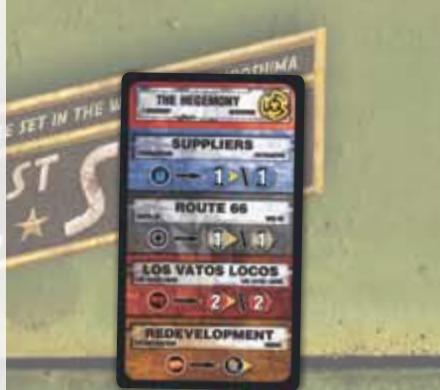
A Faction Contacts Card


Contact tokens may be added, yet they cannot be divided nor changed

Example of matching Cards' types

Redevelopment token
Building material token

Example of discarding two cards from hand for one card from face down Stock
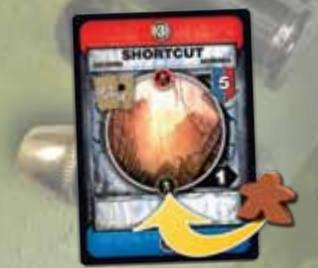
Example of sending a Worker to a Location
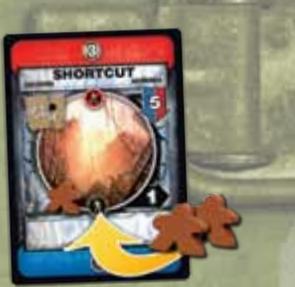
Example of activating a Location again by sending 2 Workers

Example of sending Worker to opponent's Location
Reconstruct the Location
Reconstruction Action may only be performed on the remaining Debris after a hostile Conquest. The Player discards the Debris Card and one token of Building Material
Range nor Type of the Reconstructed card aren't taken into account.
Reconstruction Action brings 1 VP to the Player - the proper token should be placed on the Player's Base Card.
If Reconstructed Location has a Production rule the Player immediately gains the Profits produced by this Location.
Discard 2 Cards and get 1 Card from the Stack
The Player picks and discards 2 Cards from their hand onto the discard pile then draws 1 Card from the face down Stack.
Send a Worker to work in a Location
If Player has a Location Card with an Action Rule within their State they can send a Worker to activate this action. The Player places the Worker token on the Location to mark that the action of this Location has already been used this turn, then fulfills the additional requirements (if any) and immediately receives the appropriate Profits or Victory Points.
To activate the Action on the same Location Card again in the same turn the Player needs to send 2 more Workers to the Location by using the Send 2 Workers to work again in the Location Action.
The Worker remains on the Location Card until the end of turn. Victory Points provided by an Action are placed on that Action's respective Location Card.
A detailed description of possible Location Actions can be found at the end of this manual.
Send 2 Workers to work again in the Location
In order to use the Action Rule of the Location Card for a second time within the same turn the Player needs to send 2 additional Workers to the Location. This is done in the same manner as sending a single worker to the Location, with the exception that two Worker tokens are now placed on the Location Card the Action Rule is activated (for the total of three).
Workers sent to the Location remain there until the end of turn. A Location cannot be activated for the third time within the same turn.
Send a Worker to opponent's Location
A Player can send their own Workers to an opponent's Location in order to receive its Profits if that Location has an Open Production Rule.
The Player passes one of their Workers to the opponent whose Location they want to use and marks the Location by placing one of their
faction tokens in the central, grey field of the Card. He then receives the Profits produced by that Location
A Player cannot use the same Location belonging to an opponent more than once per turn. In other words, they cannot use the Location where they have already placed their Faction token.
It is not possible to send a worker to Locations belonging to another Player once they have passed.
Each Player can visit no more than 3 Locations belonging to other Players each turn.
Send 2 Workers to get 1 Resource
The Player can sacrifice two Workers to receive a single token of any of the four resources (Scrap, Fuel, Weapons, Building Material). The Player discards the two Workers and immediately receives the token.
Contact Resolution
Conquering a Location from hand
The Player selects one of the Location Cards in their hand and places it under the Base Card so that only the red part of it is visible. In any Production Phase the Player may discard this Card to receive the Profits shown in the Spoils field.
Conquering Locations belonging to another Player
To Conquer a Location belonging to their opponent's territory a Player must declare the strength of their Conquest and present the tokens with value equal to that amount.
Once the shootout is resolved the attacker selects which Location they intend to Conquer, the Location's Defense Distance cannot be greater than the total value of Conquest tokens used.If the Location is conquered the attacking Player immediately receives Profits shown on the Spoils (red) field of the Card. The defending Player receives the Profits shown on the Agreement (blue) field of the Card.
The Conquered Location Card is turned face down and remains in play as Debris.
Any Victory Points or Resource tokens that were on the Card when it was Conquered are immediately transferred to the Faction Base Card or Resource Pool, as appropriate, of the defending Player.
Important: If opponent passes he or she may not be Conquered.

Example of getting Weapon resource by sending away two workers.

Spoils placed under the Base Card
Shootout
If the defending Player has any Defense tokens (Conquest tokens with negative value) they can, any or all, be usēd to reduce the attacker's strength by their Range value. This begins the shootout between the Factions. The initial Attack Strength is now reduced by the declared Defense Strength. The attacking Player can decide to proceed with Conquest at reduced Range or add Conquest token(s), if any are avaiīable, to increase the Attack Strength. If the attacking Player added any tokens the defending Player can then add further Defense tokens. This exchange of fire continues until either the attacking Player decides to Conquer a Location at their current Range or the defending Player passes, at which point the attacker needs to choose a Location within their present Range without adding any more Conquest tokens.

Agreement Card under the Base Card

After cooperation with other player Action the Agreements with other Players Card” is put under Base.
Starting Cooperation with a Location from hand
The Player selects one of the Location Cards in their hand and places it under the Base Card so that only the blue part is visible. In any further Production Phase they will receive the Profits shown on the blue Agreement field.
Starting Cooperation with another Player's Location
The Player places one of their Faction tokens on the blue Agreement field of the Location and places the Agreements with other Players Card under their Base Card.
The “Agreements with other Players Card” serves purely as a reminder, it does not count against the three slot limit for Spoils and Agreements. It is only there to remind the Player to collect the Profits from the Agreements with other Players' Locations in the production phase.
As opposed to Cooperation with a Card from hand, the Profits provided by an Agreement with another Player's Location are collected for the first time immediately upon creating the Agreement. In the following Production Phases the Profits will be provided in the same manner as in the case of an ordinary Agreement.
A Player can have no more than 3 Agreements with Locations belonging to other Players at the same time. The Player can break a previously created Agreement at any time, except no Agreements can be made or broken with Locations of a Player who had already passed.

Defensive Locations
If a Player enters into an Agreement with a Defensive Location (Locations with a brown fied where the blue Agreement field normally is) he pays the cost of the Cooperation Action (by discarding Cooperation Contact tokens with a total sum no less than the Distance of the Location) as normal. Then the Defensive Location Card is placed under another Location Card already belonging to that Player's State so that the brown field remains visible.
From this moment on the Location with the Defensive Location attached has its Defense Distance increased by the number on the brown field of the Defensive Location. This change only applies in case of Conquest, not in the case of starting Cooperation by another Player.
Note: It is not possible to initiate Cooperation with Defensive Locations belonging to other Players.
THENEW
Incorporating Cards from hand
The result of Incorporation is the placement of the Card on the table next to the Player's Base, in accordance with the Location placement Rules (see chapter: Specific Rules).
If the Card has a Production Rule (whether it is Open or Closed) the Player immediately receives the Profits from this Location.
Victory Points Count Phase
After all the Players have passed in the Action Phase the Victory Point Count Phase begins. Victory Points are calculated separately each turn, they do not add to the result previous turns. The Players add Victory Points from the Location Cards, the Base Card and the number to territories within their state excluding Debris. The final result is marked on the score track.
If after adding the score one or more Players have reached 33 Victory Points the game is over and the Player with the highest score wins.
If two or more Players finished with the same top score the Player with more Cards left on hand wins. If this doesn't settle the draw the Player with more Workers and Resources left wins. If this doesn't settle the draw either the game ends with a draw.

If after the Victor Points Count none of the Player reached 33 points the game proceeds to the Cleanup Phase.
Cleanup Phase
At the end of the turn each Player discards all the unused Profits (Resources, Workers, Contact tokens and Redevelopment tokens). The exception from this are the Cards in hand and Resources on Cards with a storage icon.
Next, all the Profits that have been used in this turn are also discarded: Workers that were sent to operate Locations and Resources used to activate Actions on the Faction Contacts Cards.
Faction tokens left on the Location Cards belonging to other Players in order to signify the use of Open Production Rule are returned to their owners.
The Player in possession of the First Player token passes it to the Player on their left (clockwise) and the next turn begins.

Victory Points are calculated from:
Victory Point tokens on Location Cards
Victory Point tokens on the Base Card
The Number of Locations within the State (1VP each)

Sample VPs calculation: The Player has 16 VP total (7 on the Base Card + 5 Locations within the State + 4 tokens on Locations)

ACTION: COOPERATION
Specific Rules
The Rule Of Three...
...Slots on the Card
A number of Location Cards allow the Player to earn Victory Points after Incorporating them into the State. Each of these Cards can only be used three times during the game. To signify that the Card has been used the Player places one VP token of a given value on the Location Card rather than on the Base Card. Each Card can only hold 3 VP tokens, which means that if a Card provides (through Action or other means) 1 Victory Point token it can hold up to 3 Victory Points. If it provides 2 Victory Points it can hold up to 6, and so on.
After providing the third Victory Point token the Card ceases to provide any further.
... Cards under the Base Card
The sum of Agreements and Spoils that can be placed under the Base Card cannot exceed 3. Agreements with other Player's Locations do not count against this limit, since their Cards are not placed under the Base Card, nor does the Agreements with other Players Card, since it is only a reminder.
... Workers sent to work in other Player's Locations.
During a single turn, each Player can perform Action of Sending a Worker to opponent's Location up to three times using up to three workers. Player places the Faction token on the used Location Card with an Open Production Rule.
ACTION: CONQUEST
If one of the Locations that the Player used is somehow removed from the game (for example through Redevelopment or Conquest) the Faction token remains with the Player who controlled the Location and is only returned to the Player during the Cleanup phase.
... Simultaneous Agreements with other Players' Locations
The Player cannot at any one time have more than three Agreements with other Players' Locations. For this reason there only three Faction tokens are reserved for the purpose of marking these Agreements.
Note: Defensive Location doesn't count towards 6 Agreements total (3 under a Base and 3 with other Players)
Location Incorporation Rule
There are three roles that the Locations can have within the game but five actions that affect their placement. This is illustrated in the table below:
SPOILS
AGREEMENT
ACTION: INCORPORATIONACTION: REDEVELOPMENTACTION: RECONSTRUCTION
LOCATION
Conquest, Cooperation and Incorporation Actions can be performed with an Instant Action from the Faction Contact Card or with the Contact tokens. The Range of the Actions from the Faction Card cannot be increased with accumulated Contact tokens. However, instead of performing the Action the Player can receive a Contact token of equal Range value. This token can then be used in one of the later Actions when it can be combined with other tokens to increase the total Range for a given Contact. Under no circumstances can the value of a token or Contact Action be divided between a couple of Conquest/Cooperation/Incorporation Actions.
Location Placement Rules
When placing Location Cards during the game the following rules should be followed:


Location Cards with Production Rule (both Open and Closed) should be placed on the topmost row, next to the Base Card.
Cards with a Feature Rule should be placed in the middle row.
Location Cards with an Action rule should be placed at the bottom row.
Tokens are put near to Base card (in so called Resource Storage) except VP tokens gained by Locations (which remains on these Locations).
Obtaining Victory Points
Any Location Card Incorporated into the State is worth 1VP, with the exception of Debris which are worth 0VP.
Any Redevelopment generates 2VP which are placed on the Base Card.
Any Reconstruction generates 1VP placed on the Base Card Certain Locations, Spoils or Agreements provide VPs in the Production Phase according to the rules provided on the Cards. Locations Incorporated into the Player's State can provide VPs as a result of their specific Features or Actions.


If Location is removed from play (Conquered or Rebuilt) VP tokens are moved from this Location onto Base card.
VP tokens can be exchanged (ex. two 1VP tokens into one 2VP token) only if put on Base.
Merging New Era with the 51st State
The New Era can be merged with the 51st State by mixing both sets of Locations, both sets of Instant and the 51st Leader Cards into a single deck.
Since the 51st State Cards do not have a Defensive Distance value provided the following Rules should be followed:
Location Cards with a Production Rule (either Open or Closed) have the Defensive Distance value of 3;
Location Cards with a Feature Rule have the Defensive Distance value of 4;
Location Cards with an Action Rule have the Defensive Distance value of 5;
Leaders have no Defense Distance value, they cannot be targeted for Conquest.
The rules not covered in the manual for New Era (for example those relating to the placement and use of Leaders) are not affected and work like they did in the 51st State. Other than that all the normal rules of New Era apply.
Note: The 51st State Cards that provide extra slots for Agreements/Spoils (such as Incorporated Town Hall) operate in accordance with normal rules, that is they increase the limit of slots under the Base Card only. T'hey do not allow for extra Agreements with opponents’ Locations.
The Barracks and Robber Caravan Cards require 2 Workers for first and 3 Workers for second activation, in accordance with the 51st State rules.
The Bulldozer Card does not provide the Universal Redevelopment token as a result of its Action. After activating the Bulldozer's Action the Player performs the Universal Redevelopment immediately. The Universal Redevelopment cannot be used with Cards that have no Type (for example, it cannot be used to redevelop to from Barbed Wire Èntanglement or Radioactive Colony) or to turn another Location into a Foundation. If the Player has an Incorporated Location with a Feature providing extra profit from Redevelopment (for example Construction Works [0=>] the Player receives the bonus when using Universal Redevelopment.).

Symbols and Profits in the game
Note: Some of the Cards rules may modify the general rules of the game, in case of which the rule of the Card is more important than the general rule of the game
Profits
Resources

-Scrap


- Fuel


- Weapons


- Building Material


- Universal Resource
Workers

- Worker

Contacts

- Incorporation token (1/2/3)
Allows the Incorporation of a Location with 1/2/3 Distance

2345- Cooperation token (1/2/3/4/5)
Allows the Cooperation with a Location with 1/2/3/4/5 Distance
1234 (5 - Conquest token (1/2/3/4/5)
Allows the Conquest of a Location with 1/2/3/4/5 Distance
33- Decrease of opponent's Conquer Range. (-1/-3)
Gives protection against another Players' attack

Universal Contact token
May be used as any of the Contact tokens: Incorporation, Cooperation or Conquest token

- Redevelopment token

Incorporation Action

Conquest Action

Cooperation Action

Redevelopment Action
Victory Points

- Victory Point token

- Victory Points token

- Victory Points token

- Victory Points token
Cards

- Any Card from Player's hand

- Card from the Stack of face down Cards
Cards
X\Y" (for example:
Means that, when playing this Instant Card the
Player can pick the Profits from either the X or Y part of the Card.

- Once a game
The Player receives this Profit only once, immediately after placement of the Card.

- Storage
Profits placed on this Card can be stored for use in future turns. T'hey are not removed during the Cleanup Phase.

-Spoils

- Agreement

- Spoils or Agreement

- Card's Type The Card's type is relevant during redevelopment. Both the new and old Locations need
to share at least one Card Type marker.

- Foundation
The exception is the Foundation Card. No other Location can be redeveloped into a Foundation.

- Production Card
Provides profit in the Production Phase. After Incorporation into the State (through Incorporation, Redevelopment or Reconstruction) immediately collect the Profit provided by the Card.

- Requires a Worker
To use this Card the Player needs to use a worker.

- Closed Location
Other Players cannot send their Workers to use this Location.

- Location with a Feature
The Location's Feature works permanently and requires no Workers to be activated.
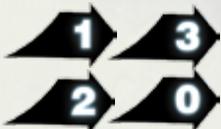
- Location's Distance (0/1/2/3)
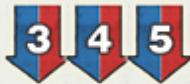
- Location's Defensive Distance (3/4/5)
Location's Actions
Using Actions in our Locations requires workers.
If the only things shown on the Location Card with an Action Rule are Resources this means its enough to send a Worker to operate a Location in order to receive said Resources without any extra cost.
If, however, there is ansymbol on the Card this means that certain extra conditions need to be met:
of at least 2 to receive a Universal Resource.
Discard X to receive Y
Examples:

- Kelly's Pawn Shop Discard one Conquest to receive 2VP

- Gatherers
Discard a Cooperation Contact token with a value

- Improvement
Improvement, place 1VP token on any Card of
this Type. T'he IVP token placed in this way does not count against the 3 tokens limit. At most 1VP token with a value of 1 can be placed on each of the Player's Locations in this manner. To differentiate this token from the ones obtained through normal means it should always be placed on the Spoils (red) field of the Card.

- Production Hall Pick one of the Locations incorporated into your State
that has a production icon (Open or Closed) and immediately collect the Profits provided by that Location in the Production Phase.
Location Features
Fulfill requirement X to receive Y
Examples:

receive a Worker.
- Penal Colony
Every time you perform the Redevelopment Action you

- Factory
For Incorporating a Card of a given type you receive 2VP.

- Construction Site
For every token of Building
Materials produced you receive IVP. A Card of this type (with a Resource to the left of the =) works only for the tokens received during the Production Phase, regardless of whether they came from Locations with Production rules, Agreements or Spoils.

- Truck
For every complete Conquest or Cooperation Action you
receive a Universal Resource token.

Gang Hideout
After a successful Conquest of an enemy's Location you
can take the Profits shown on the red Spoils part of the Card and then decide not to turn the Location into Debris.

– Reconstruction Action
Example:

- New Neighborhood
you receive 2 Workers.
Every time you complete a Reconstruction Action

- Rat
After completing a Send 2 Workers for a Resource you
may draw a Card from the Stack.

Action against a Location with Distance 3 or more.
- Production of particular Resource
Example

-Tank
For every gained Fuel token (during Production
or Action phase) you get 1 VP token.

- Incorporation Action

Example:
- Settlers
Each time you complete an
Incorporation Action you receive a Worker.

- Borgo
You get 2 VP token everytime you make Conquer

- Den
Resource Storage. A place to store any 2 Resources
and 2 Workers. Placing Resources and Workers on the Resource Storage is free (does not count as an Action).

ration actions of token's Range.
- Mad Salesman
Spend one Cooperation token to make two Coope-
GAME AUTHORS: Ignacy Trzewiczek,
Michał Ozi” Ozon (Hegemony Faction design)
GAME MANUAL: Magdalena Zachara, Szymon Zachara
BOX GRAPHICS AND BOX DESIGN: Dark Crayon / Piotr Cieśliński
CARD GRAPHICS: Mariusz Gandzel, Piotr Foksowicz, Mateusz Night” Bielski, Tomasz Jędruszek, Daniel Grzeszkiewicz, Michał Oracz
CARDS AND TILES DESIGN: Michał Oracz, Maciej Szpakowski
GAME MANUAL DESIGN: Rafał Szyma
GAME MANUAL TRANSLATION: Magdalena Zachara
PUBLISHER: Portal Publishing
ul. Św. Urbana 15; 44-100 Gliwice
tel./fax. (032) 334 85 38
www.portalpublishing.eu, e-mail: portal@wydawnictwoportal.pl
THANKS:
My special thanks to Tycjan, Moniq, Arti, Zachi and Merry. I would like to thank all the testers and the people who have contributed to the present state of the game: Alchemik, Cnidius, Grzegorz Polewka, Neurocide, Rafa Szyma, Michał Oracz, Sheva, WC, Browarion, Grzech, Ryu, Klema, Yann Wenz, Cysorz, Szpaku, Iwan...
...and all the people who have helped us with the game even in the slightest degree.

Abbreviated Game Guide
1. Game Setup
a. Players draw Factions
b. Players receive the associated Base Cards, Contact Cards and tokens. Factions that haven't been selected are removed from the game
c. The Instant and Location Cards are shuffled into one deck
d. Each Player receives 4 random Cards
e. A random Player receives the First Player token
2. Turn Sequence
a. Lookout phase: Players select 2 Cards out of the face-up Cards and draw one more from the face--down Stack.
b. Production phase: Base Cards, Location with Production Rules, Agreements and Spoils generate Profit.
c. Action phase: Players take turns performing actions until all the Players have passed.
Available actions:
Play an Instant Card
Play an Action from the Faction Contact Card
Conquest Action (of Location from hand or from another Player's State)
Cooperation Action (with Location from hand or from another Player's State)
Incorporation of a Location from hand
Redevelopment of a Location
Reconstruction of a Location
Discarding two Cards from hand and drawing a new one from the face-down Stack
Sending a Worker to operate a Location
Sending 2 Workers to operate a Location a second time
Sending a Worker to another Player's Location
Sending 2 Workers for a token of selected Resource
d. Victory points count phase: The Players calculate the number of points they managed to obtain.
If any Player reached the 33 point threshold the game ends and the Player with the most VP wins.
e. Cleanup phase: Unused Profits, Workers operating Locations and Resources from the Contact Cards are discarded. Faction tokens signifying sending a Worker to another Player's Location are returned to their owners. The First Player token is passed to the next Player. Another turn begins with the Lookout Phase.
下载 Markdown原文为社区整理/出版社公开资料,版权归原作者,仅供个人学习查阅。