
文艺复兴时代Age Of Renaissance
一句话概览
文艺复兴时代 是一款已收录于村了吗规则库的桌游,支持 3–6 人,原名 Age Of Renaissance。
本页内容:一句话概览 · 常见问题
这游戏怎么玩
- 本站已收录这款游戏的规则资料,可以在对话里直接提问规则细节。
常见问题(FAQ)
以下 1 条问答中 0 条来自站内玩家的真实提问,其余 1 条为本站整理的常见疑问;答复内容保持原样。
文艺复兴时代支持几个人玩?
3–6 人。
去哪查完整规则
想核对具体规则细节、卡牌效果或某个回合的结算方式,可以在村了吗里选中这款游戏后直接提问。
同类桌游
- 卡坦岛德式
- 工业革命:伯明翰德式
- 勃艮第城堡:特别典藏版德式
- 方舟动物园德式
- 卡卡颂抽象
- 瘟疫危机传承:第一季美式
- 阿瑞迪亚:勇踏征途美式
- 重塑宇宙德式
- 幽港迷城美式
- 埃多拉的德鲁伊德式
规则原文(Markdown)
本站收录这款游戏的规则原文 1 个文件,此处内联渲染 1 个,可直接展开阅读或下载。
AoR Euro Rules with Notes-DBC.md103.7 KB
Age of Renaissance Rulebook
Updated with Euro-rule modifications and clarifications By dbcopeland (BGG ID)
July 23, 2014
1. Introduction
1.1 Description
AGE OF RENAISSANCE is a strategy game for three to six players that traces western civilization from its origins in the early Middle Ages to its establishment as the world’s dominant culture during the Age of Enlightenment.
The western world’s rise to preeminence (approximately the 1,000 years from 750-1750) was the result of many factors. The game concentrates on the powerhouses of commerce (Venice, Genoa, London, Paris, Hamburg and Barcelona) that provided the financial foundation for the flowering of culture that became the Renaissance (14th through 16th centuries) and for the Enlightenment that followed.
1.2 Player Roles
Each player acts as the mastermind behind one of the six financial powerhouses.
Square tokens representing market penetration are placed on mapboard spaces called Provinces to dominate markets. If the number of tokens placed in a province matches the province Market Number with no opposing pieces present, all friendly pieces in that province are immediately replaced with a single round piece that may generate income. If opposing pieces are present, conflict must be resolved before a can be placed.
Income is used to purchase advances in six categories: Commerce, Science, Civics, Religion, Communication, and Exploration. Each Advance grants additional abilities.
Commodity, Event, and Leader cards from the History Deck are drawn to create opportunities.
Lastly, a Misery Index records the suppressed aspirations of each player’s populace.
The player who best manages these four elements wins.
2. Description of Play
2.1 Versions
There are three versions: Basic, Intermediate and Campaign. The play of all three is similar with only the stopping points varying between them (see 11.1). Players select the version to play, remembering that the Basic Game takes two hours, while the Intermediate will last four hours, and the Campaign Game will require six hours. Alternatively, players may agree to play to a predetermined time limit.
2.2 Phases
After determining Capitals and the Order of Play, action follows the Order of Play Display from first to last.
-
The first player announces whether he will negate any Shortage / Surplus by paying the base value of that commodity in cash. Then, each player, in turn, draws a card.
-
After all players have drawn, each player capable of doing so, buys an extra card, and/or discards (9.2), or passes.
-
Each player plays a card(s) from his hand or passes.
-
Each player then purchases one or more items in the following order:
A. A Ship Upgrade and/or
B. One or more Advances, and/or
C. Stabilization, and/or
D. Relief on the Misery Index,
or passes.
-
Each player, in turn, buys a card with tokens and/or places his Expansion / in those provinces he can reach from his presently occupied provinces while resolving any attack caused by his placement. The player with the most s in play (minimum of one) after all players have placed their tokens draws a free card.
-
All white / on the map are flipped to their colored / sides. Players collect income from the banker. The next turn’s commodity Shortage/Surplus status is determined. Each player secretly records Cash/Token allocations on his Turn Log. Token purchases are revealed simultaneously and moved from Stock to their Expansion mat sections after paying the bank \$1 for each token.
-
Player order for the following turn is set and recorded on the Order of Play display with players taking their turns in order of least cash spent for tokens.
In games with less than six players, the slots on the Order of Play display containing the number of players will be skipped. For example, in the three player game, the “1st,” “3rd,” and “5th” slots containing the “3” symbol will never be used and the three players will move 2nd, 4th, or 6th.
This sequence is repeated until the end of the turn in which the time limit is reached, or the end of a turn in which a player acquires all 26 Advances (see 11.1).
3. Components
A 22” x 32” mapboard
Six sets of playing pieces; one color per player
Six player mats
A pad of Advance Logs
64 History cards
Three six-sided dice (one white, one black, one colored)
Play money in denominations of 1, 5, 10, 20, and 100.
4. The Mapboard
4.1 Land Areas
Provinces: The spaces on the map depicting land are provinces. Each is named and bordered by black lines.
Coastal Provinces: Any province containing both land and light blue water (including Far East, New World, West Africa and Iceland). Dijon, for example, being entirely inland, is not a Coastal Province.

Impassable Areas: Unnamed spaces are out of play.
Insert Boxes: West
Africa and Iceland are special provinces that become accessible only after getting Seaworthy Vessels [S] or The Heavens [A] Advances. China, the East Indies, and India can be reached only after getting Ocean Navigation [T]. North and South America can be entered only after getting New World [U].
4.2 Bodies of Water
Blue portions with no land depiction along the boundary lines require shipping to cross (e.g., you may not move from Copenhagen to Malmo without shipping).
SEAS: Seas are named medium blue depictions containing no land (such as the Adriatic Sea). Seas can only be crossed with Seaworthy Vessels [S] or Galleys (with The Heavens [A]). Pieces may not end their turn in a Sea.
OCEAN: The Atlantic is the dark blue depiction separating the New World and Far East boxes from the rest of the map and can only be crossed with Ocean Navigation [T].
4.3 Market Numbers ③1
The number in each province is the maximum amount of tokens that province’s markets can support. Tokens that exceed that number trigger Market Competition (see 9.5.3). A province with a circled number (e.g.) can support one Domination (/) marker, or up to that number of tokens. A province whose market number is 1 cannot contain a Domination marker and will support only one token.
4.4 Capitals
A province whose Market Number is inside a colored circle () symbol instead of a white circle () is a Capital. A Capital is the starting point and economic home base of the player who selects it at game start. The strength of the original owner’s pieces are always doubled during attacks in its own Capital (see 9.5.3)
Clarification: Tokens in their capital are doubled for both defense and attacks.
4.5 Commodity
Provinces that were sources of (or transshipment points for) a significant trade good are color-coded for ease of recognition. For example, all Gold provinces (India, S. America, Suez, Sarai, Prague) are colored yellow. The five Overseas province boxes are multi-colored because each contains two/three commodities that are controlled with a single Domination marker.
4.6 Areas
The thick borderlines that divide the map into eight large playing areas define sections of the map that are out of play when playing with less than six players. Each Area is numbered with a Roman numeral that matches the color of its border (e.g., Area I contains Hamburg).
4.7 Control Panels
The mapboard contains several administrative tracks used to record game information. One player, deemed the most efficient by the others, becomes the broker. He is solely responsible for movement of all markers on the tracks, but should have an assistant to call out commodities gained and lost as conflict is resolved.
A third player becomes the banker. He pays out all income from the bank and collects the correct purchase price of all items from each player for the bank.
MISERY INDEX: This track records the degree to which each player has ignored the needs of his populace. A player whose Misery marker moves past the “1000” square is immediately out of play. A Misery marker may not move lower than the “0” square.
DRAW PILE: The History Deck is sorted by epoch number (1, 2, or 3) and divided into three piles. Epoch 1 becomes the initial Draw Pile and is placed facedown. In the Basic Game, only the Epoch 1 cards are used. When the Draw Pile is empty and another card is requested, the next epoch’s cards are shuffled with any cards from the Replay Pile to form a new Draw Pile.
REPLAY PILE: All used cards with a circled epoch number are placed here faceup. When the next epoch begins, shuffle the next epoch’s deck with all cards in the Replay Pile to form a new Draw Pile. Only the top card of the Replay Pile is ever open to inspection.
ORDER OF PLAY DISPLAY: Each player’s Turn marker is placed on this display from the bottom up in the order of most money spent for tokens in the previous turn.
SHIPPING DISPLAY: Each player’s current shipping capability is marked by placing his ship marker on the

appropriate space of the Shipping Display. Flip the ship marker to its three-masted side once it is benefiting from Seaworthy Vessels [S] and place it in the “10” section of the middle portion of the Shipping Display.
COMMODITY LOG: This track displays ownership of the game’s twelve commodities. The first space of each row identifies the commodity by color and base value and lists the number of commodity cards introduced in each epoch. If the number has an asterisk, that card is a dual commodity card that can be played as a different commodity. The remaining spaces each represent ownership of one province of that commodity. These spaces are color-coded by Area and list all provinces with that commodity in each Area. Each space also lists the payoff for that number of the commodity owned. When players gain or lose a Domination marker, the broker moves commodity markers along the track accordingly to show current totals of dominated Provinces. Each player should call out commodities won and lost as he removes/places the mapboard pieces so the broker can
adjust markers as the Expansion Phase is played.
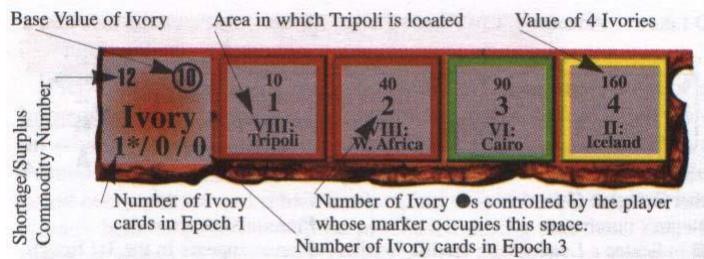
Multiple Commodities: The five rectangular Overseas provinces in the New World and Far East each have several commodities. A player controlling China, for example, gains two commodities with a single . Domination of one of the Americas controls three commodities. All other provinces yield only one.
5. Mats & Pieces
5.1 Mats
Each player has a player aid mat. Use the side of the mat corresponding to the number of players in the game; 3-4 or 5- 6. Tokens purchased for market expansion are placed on the right in the Expansion section white side up (). Each player’s Stock (the supply of tokens from which he can draw) is kept in the black section. It is recommended that tokens be kept in stacks of six for easy counting and movement.
The round Domination markers are kept on the mat covering the indicated circular spaces and then removed / returned in order during play. By doing this, each player will instantly know how many provinces he dominates by checking his income section for the last uncovered circular space.
5.2 Pieces
Each player has the following set of pieces:
• 36 square tokens: Expansion () or Controlled ().
• 25 round markers: Dominated markets old (•) or new ()
Players move their own pieces between the map and their mat while keeping their mat in full view.

5.3 Markers
Each player also has two small square markers to record his status on the Misery Index and Order of Play Display, plus a ship marker for placement on the Shipping Display, and 12 commodity markers for the Commodity Log.
5.4 MONEY
Money must be kept in view at all times, but may be piled in a stack to conceal its total value. However, all players are entitled to know the last recorded Cash figure (required at the end of each turn) for each player at any time.
6. Civilization Advances
The 26 items listed on the Advance Log Player represent progress made by the western world during this period. As each item is acquired, it is checked off the log by marking the ID Letter box. Opponents should also check it off the appropriate secondary listing (shown at right) of their own logs so they can keep an accurate record of the Advance status of all players. Once the turn is over, all ed boxes should be filled in solid to distinguish them from current buys.
7. The History Deck
7.1 Epochs
Each card contains a numeral “1”, “2” or “3” representing the game’s three epochs. These divisions correspond roughly to the years 750-1250, 1250-1500 and 1500-1750 respectively. The deck must be sorted into piles of “1”, “2” and “3” cards before play so that events will occur in a more historical order. There are three types of History cards:
7.1.1 Commodity Cards
There are 27 cards representing the 12 commodities shown on the map. The Commodity Log lists how many are found in each epoch, their value progression (payment) and location. Each card also contains a map highlighting provinces containing that commodity. Each commodity card is a “trigger” which, when played, allows all players to collect the value of their s controlling that commodity. There are ten payment boxes at the bottom of each card with progressively higher amounts corresponding to those listed on the Commodity Log. The played card is then discarded to the Replay Pile to be redrawn in the next epoch.
Two commodity cards (Wine/Cloth and Gold/Ivory) offer their owner a choice of commodities to select when played.
7.1.2 Event and Misery Cards
Event Cards: There are 18 Events. Those whose epoch numeral is printed on a circle are placed faceup in the Replay Pile after being played. Those whose epoch numeral appears on a square are removed after play.
Misery Cards: Some Events are voided by the play of other Events (e.g., Stirrups by Gunpowder). Voided cards are not removed from the game. They remain in play as nearly useless cards that increase Hand Size and Stability cost. Such Misery burdens can only be discarded by using Master Art [P] (9.2). They may, however, be traded via Written Record [N] (9.5.3).
7.13 LEADER CARDS
There are 19 Leaders, which are used to lessen the cost of certain Advances during the Purchase Phase if they are played in the preceding Play Cards Phase. Each is removed from play after the Purchase Phase.
8. Setting Up The Game
8.1 Cards & Money
Sort the History cards by epoch. Take the Epoch 1 cards, remove The Crusades, Walter The Penniless, Silk, Spice, and¸ Rashid Ad Din, then shuffle Epoch 1. Each player receives three cards, picks two and returns one to the deck. In a 3-4 player game, once each player has returned one card to the deck, replace the five cards removed, and shuffle the deck. In a 5-6 player game, return the cards to the deck after the 2nd turn. Place the other epochs aside. Give each player \$40 for their initial stake.
8.2 Playing Area
When playing with less than six players, only certain areas are used.
| # of Players | Capitals Areas Used |
| 3 | Venice, Genoa, Barcelona IV through VIII |
| 4 plus Paris | plus III |
| 5 | plus London plus II |
| 6 | plus Hamburg plus I |
Players may trace ship movement through Areas not in use, but may not leave pieces in those Areas.
8.3 Selecting Capitals
Sides are chosen by secret written bid. Each player records his bid for the right of first choice in the “Capital Bid” space of the Turn Log with the high bidder choosing first from among the available Capitals. The next highest bidder chooses second, and so on. As each player selects his Capital, he takes the playing pieces of the matching color and places them on his mat to form his Stock. His color is recorded in the appropriate “Choice” box beneath the Turn Log.
Tied bids are resolved by dice roll with the high roller choosing first. Upon selection, each Capital is marked with a Domination marker of the same color. Yours is the starting point of your financial empire. During play, all ties for Order of Play resolution will be broken in favor of the player who chose his Capital later. That player may choose to precede or follow any tied player in the Order of Play.
8.4 Misery
Each player places his Misery marker on the “0” space of the Misery Index.
9. Game Turn Sequence of Play
Each turn is divided into seven phases. Phases 2 through 6 are completed by each player, in turn, before the next phase is performed. Phases 1 and 7 are done simultaneously. Each phase is outlined in the center of your mat.
9.1 Order of Play Phase
All players secretly record their Total money, Tokens bought, and remaining Cash for the turn on their Turn Log. The Token purchases are then announced and the bank is paid \$1 for each token as they are moved from Stock to Expansion. Each player’s Turn marker is then placed on the Order of Play Display with the player using the least funds to buy tokens moving in the first available slot, followed by the player buying the next fewest tokens moving from the next available slot and so on. Ties are broken in favor of the player who selected his Capital later as recorded in the “Choice” boxes of the Turn Log.
Minimum Expansion: Players may spend money for no tokens in an attempt to go first in the next turn’s Order of Play; e.g. –1 costs \$1, gets no tokens, and is less than 0.
Clarification: A player cannot buy more expansion tokens than he has available to pay off Holy Indulgence [F] penalties, but he may pay more in order to attempt to go last during the Expansion Phase.
| Q | Renaissance120 | Once / turn trades Orderof Play with adjacentnon-owner. | PrerequisiteP |
| Ldrs: ②00 |
Renaissance: A player holding the Renaissance Advance [Q] may trade places once per turn at the start of any phase with any player directly above or below him in the Order of Play Display who does not also own Renaissance. If two or more players wish to trade places in the turn order during the same phase, they must do so in the currently established turn order.
Example: Paris and London are the only players with Renaissance. They are currently moving first and third respectively, while Barcelona moves second. At the start of the Expansion Phase, London decides to use its Renaissance attribute to move second during Expansion. However, Paris has the option to trade places first and does so, allowing Barcelona to move first. Since London no longer follows a player without Renaissance in the turn order, it can no longer move up in the Expansion Phase and declines the exchange rather than trading places with the player behind itself in the Order of Play.
Clarification: If a player owns Renaissance and is the victim of Civil War, the Civil War penalty is enacted first and the player may then have a chance to use Renaissance to change places.
9.2 Draw Card Phase
The first player in the Order of Play may spend cash equal to the base value of any commodity Shortage and/or Surplus to eliminate either or both. Then, each player, in turn, draws a card from the History Deck. When added to the one dealt to you prior to start, you will have two cards for the first Play Cards Phase. Skip this phase on the first turn.
| Urban Ascendancy 20 | May buy one extra card | Prerequisite | |
| 20 Cr | for $10 each turn. | Leaders: - |
Urban Ascendancy: This Advance allows you to buy one additional draw from the History Deck per turn by paying \$10 to the banker during the Buy Cards phase.
9.3 Buy Card Phase
Each player who has acquired Urban Ascendancy [V] may, in turn, buy one additional draw from the History Deck by paying \$10 to the bank.
| P | Master Art9010 Cr | May discard onecard/turn without effectin Buy Card Phase | Prerequisite0 |
| Leaders: |
Master Art: A player with the Master Art Advance [P] may discard one card from his hand (without it taking effect) each turn during the Buy Card Phase after buying or declining to buy an extra card. If the card has a circled epoch numeral, it is placed face up in the Replay Pile. Otherwise, it is removed from the game after being revealed.
Clarification (Euro): Master Art [P] does allow a player to immediately discard a card upon its purchase.
9.4 Play Cards Phase
Each player, in turn, may play any card(s) or pass.
9.4.1 Commodity Payments
A played commodity card triggers a payment from the bank to each player having a marker in a province(s) containing that commodity. The amount is listed on the card as an increasing value progression matching the number of such provinces dominated by that player
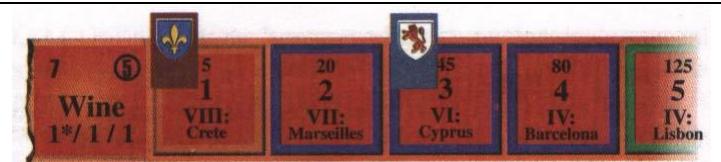
Example: The Barcelona player has s in Barcelona, Lisbon, and Marseilles. The Paris player dominates Strassbourg. When a Wine card is played by any player, the Barcelona player collects \$45 (the amount in the third payment box of the card); the Paris player gets \$5.
| M | Industry1105MR | Increase commodityvalue by one paymentbox | PrerequisiteL |
| Leaders: - |
Industry: The Industry Advance [M] increases the value progression of all commodity cards by one box. However, you may not trigger the first value box of a commodity that you do not possess. The Industry Advance may increase the value of an unlimited number of commodity cards in a turn.
Example: A player with Industry and one Wine may collect \$20 when a Wine card is played.
9.4.2 Event Cards and Elimination
Event Cards: Playing an Event recreates an historic occurrence. Most Events affect other players as well as the player who plays the card. However, the owner of the card will always choose who it affects when given a choice.
Some Events require replacement of s with a . If the owner has no tokens remaining in stock, he may replace the with a token from Expansion or leave the province empty.
Clarification: The Pirates/Vikings card can reduce domination markers in the Far East and New World boxes.
Clarification: If all expansion tokens have been purchased (none remain in stock) when a player loses a domination marker to a disaster (Rebellion, etc.) the player may, at his option, replace the marker with a square token from his expansion pool. Alternately, he may leave the space empty if he has no tokens in stock.
Clarification: Armor and Stirrups may be played in the same turn by the same player to gain a +2 advantage.
Clarification: If Armor / Stirrups has been played and Gunpowder / Long Bow is played later in the same Play Card Phase, the only effect is that the Armor / Stirrups card has no effect versus the player(s) who played Gunpowder / Long Bow. Armor / Stirrups is still used against other players and discarded at the end of the Expansion Phase. Since Armor / Stirrups is already in play, it cannot be held as a misery burden.
Clarification: In the case of a tie with the War card, rerolls occur at the start of each player’s portion of the Play Card Phase (possibly continuing to the next turn’s Play Card Phase). If a tied War continues into the next player’s Play Card Phase and that player is in the War, he can play a military advantage card prior to resolving the War. The War die roll, however, must be resolved before any non-military card is played.
Clarification: Gunpowder’s advantage over Long Bow applies to ties in War in addition to Gunpowder’s +1 which causes the tie.
Clarification: Cash spent on Urban Ascendancy [V] is not protected from Alchemist’s Gold except for the phrase “penalty cannot exceed current cash” if the Urban Ascendancy [V] card purchase was all of the player’s money.
| C | Laws of Matter9020 Cr | Voids Alchemy andlessons MysticismMisery | Prerequisite |
| Leaders: 0 |
Laws of Matter: This purchase protects the buyer from losing cash to Alchemy.
Elimination: Some Events involve an adjustment of Misery markers on the Misery Index. When instructed to “gain X spaces” on the Misery Index, your Misery marker is advanced that many spaces down the Index to a higher numbered square. If advanced to the Chaos square, you are out of the game; your pieces defend in place on the map and your unplayed cards are discarded out of play or to the Replay Pile. No Advance attributes apply to your pieces except Nationalism (if applicable). Income continues to be paid based on the number of players that began the game (see 9.6).
Clarification: Players in Chaos are assumed to be buying zero expansion tokens and play order is determined in the usual fashion. Thus, to buy off a Shortage/Surplus, a player must bid negative or win the tie at zero.
| K | Improved Agriculture 50 10 Cr t | Reduces Misery one space. Reduces effect of Famine | Prerequisite J |
| 25MR | Leaders: - |
Improved Agriculture: Besides reducing the Misery consequences of Famine and improving your Misery status, this Advance is necessary to purchase Interest & Profit and Middle Class.
9.4.3 Leader Cards
Playing a Leader announces the arrival of that person on the world scene and entitles you to the discounts listed on the card for the purchase of the specified Advances during the upcoming Purchase Phase. Place the card face up in the empty Leader Display or face up in front of you if the Leader Display is already filled. Whether used or not, the card is removed from play at the end of the Purchase Phase.
| E | Patronage30 & 1 MI20 Cr † | Allows investment inLeaders played by otherplayers. | Prerequisite |
| Leaders: 0 |
Patronage: All but the first Leader played in each turn is subject to Patronage claims by other players with Patronage [E]. The second Leader played is subject to Patronage by one other player, the third Leader played is subject to Patronage by two other players. Any Leaders played after the third are subject to Patronage by all other players. Patronage allows a player to use the credits of the Leader just as if that player had played the Leader.
Example: Venice plays Columbus as the second Leader played in the current turn, so Columbus is vulnerable to Patronage. Barcelona has Patronage and in his Purchase Phase declares that he is patronizing Columbus. Now both Venice and Barcelona are entitled to Columbus’ 60 Credits. Even if London owns Patronage, he may not patronize Columbus this turn since Columbus was played second and therefore can only be patronized by one player. Had Columbus been played third, the London could have claimed the Columbus credits along with Barcelona.
| 0 | Printed Word6020 Cr | Earns Leader DiscountRebate for any ownedAdvances. | PrerequisiteN |
| Ldrs.: ②②② |
Printed Word: With this advance, a Leader card may be played to earn a rebate of the Leader’s credit for any Advances listed thereon that have previously been acquired. A Leader with several credits may be used to discount one purchase and rebate another, but only if both Advances have already been acquired or will be purchased during that turn.
Clarification: A player may not claim a rebate with Printed Word [O] by patronizing a leader even if he owns Printed Word [O] and Patronage [E].
Clarification: If you own Printed Word [O] and play a Leader with credits toward two or more advances, one of which you already have, you may take the rebate even if you do not plan to buy the unowned Advance.
9.5 Purchase Phase
Each player, in turn, may make any purchases in the following order and/or pass:

9.5.1 SHIP UPGRADES
from their original, adjacent presence. , adjacent presence.
Without shipping, players may not place tokens in provinces separated by water
Example: The Paris player may not place tokens in London until he develops Galley 2 or Seaworthy Vessels [S]. With a Galley 2, on the first turn London can place two tokens in Edinburg, York, Portsmouth, Cornwall, St Malo, Paris, Bruges, and Amsterdam by sea.
There are three ship types with four grades of each. Ship Upgrades within each type must be purchased in ascending order (for example, from Galley 2 to Galley 4 to Galley 6 to Galley 8). Only one Upgrade may be purchased per player per turn. Each Upgrade costs \$10. When purchased, the player’s Ship marker moves to the appropriate space of the Shipping Display.
| A | The Heavens3020 Cr | Allows transit of onesea at a CoastalProvince | PrerequisiteN |
| Ldrs.: ②②0 |
The Heavens: The Galleys of a player with The Heavens [A] may cross one Sea as if it were a Coastal Province. For example, a presence in Stockholm could be used as the basis to ship two tokens each to Danzig and Riga across the Baltic Sea with a Galley 2. Without The Heavens [A], it could ship no further than Stettin by hugging the coastline with a Galley 2.
Ship transport is via Coastal Provinces only until the Seaworthy Vessels Advance [S] or The Heavens [A] has been acquired. Entering Oceans and the five rectangular Overseas Provinces is not allowed until the Ocean Navigation Advance [T] is held.
You may transport any number of tokens per turn, but may not land more tokens in the same province per turn than your shipping capacity. The Galley 2 allows you to transport two tokens to each province two Coastal Provinces away from any friendly or presence. By upgrading to Galley 4, you may transport up to four tokens to each province up to four Coastal Provinces away from any friendly or presence. The abilities increase similarly for each upgrade up to Galley 8.
Clarification: All Galleys of a player with The Heavens [A] may use it to cross one sea. The limit is one sea per shipment, not one sea per player.
| S | Seaworthy Vessels8020 Cr | May enter all CoastalProvinces except FarEast and New World | Prerequisite |
| Leaders: - |
Seaworthy Vessels: When a player acquires Seaworthy Vessels [S], his ship marker is flipped to its three-masted side and moved to the “Seaworthy Vessel 10” box of the Shipping Display. He may then place up to ten tokens in any Coastal Province (except for the five rectangular Overseas boxes or Area V if he lacks Overland East). Upgrading to 12, allows transport of up to 12 tokens, and soon. The 10 space of the Shipping Display cannot be reached with a \$10 upgrade from the Galley 8 space
| T | Ocean Navigation12020 Cr 5MR | Allows transit of FarEast | PrerequisiteA,S |
| Ldrs: ②②② |
Ocean Navigation: Acquiring Ocean Navigation [T] moves your ship marker to the “1” box of the Ocean Navigation Shipping Display. You may now transport unlimited tokens to any Coastal Province (except the Americas which also requires New World [U]), but can enter and maintain only one Overseas box. Another \$10 upgrade will move your ship to the “2” box of the Shipping Display, allowing entrance and maintenance of two Overseas boxes, and so on.
9.5.2 ADVANCES
Each player, in turn, may purchase one or more Advances. Purchases may include Leaders played in the preceding Play Cards Phase and credits from Advances bought in prior turns. Leader discounts must always be used (for purchase and/or rebates) during the turn the Leader card is played.
Credits: Advance credits may not be used in the same turn in which they are acquired. A player must wait until future turns to benefit from such discounts. However, Advance credits may be applied towards the purchase of multiple Advances during a turn.
Prerequisites: Advances and their prerequisites may be bought in the same turn by purchasing the prerequisite first.
Attributes: Advance attributes can be used immediately. For example, Patronage could be bought and used to claim the credits of a vulnerable Leader, or Institutional Research [X] could be your first purchase and used to aid your second purchase of the same turn.
| X | Industrial Research | Provides 10 Credits for | Prerequisite |
| 100 | any Advance except |
Industrial Research: Any future purchase of Science, Commerce, Communications, or Exploration is discounted \$10. the reminder brackets at the top of each category for discounts.
9.5.3 Stabilization
Your standing on the Misery Index will gain one or more spaces every turn unless you purchase Stabilization. Stabilization costs are based on the size of your Hand; the more cards held, the greater the cost of Stabilization. The first card costs \$1, the second costs an additional \$2, the third an additional \$3, etc. There is no limit to the number of cards held other than your willingness to pay for them.
Failure to pay the full cost of Stabilization results in a gain of Misery spaces whose value is greater than or equal to the Stabilization cost. Partial Stabilization payment is not allowed.
Example: Paris occupies the 90 space of the Misery Track and has failed to pay the \$15 Stabilization cost of his five-card hand. He must gain two Misery spaces to 125 since a gain of one Misery space to 100 is only worth 10 and is not greater than or equal to the unpaid Stabilization. Genoa, however, occupied the 100 space of the Misery Track and has failed to pay the \$21 Stabilization cost of his six-card hand. His Misery gain is only one space since that space is worth 25 and is greater than his unpaid Stabilization.
9.5.4 Misery Relief
Players improve their Misery Index standing during the Purchase Phase by buying certain advances. At the end of the first Purchase Phase where a player owns a minimum of two advances each in Science, Commerce, and Communications he improves his standing on the Misery Index by one space. When a player owns three advances each in Science, Commerce, and Communications he improves two more spaces on the Misery Index. Finally, when a player owns all advances in these three categories he improves three additional spaces on the Misery Index.
| B | Human Body6020 Cr | Reduces Misery onespace. LessonsMysticism Misery. | Prerequisite |
| Leaders: 0 |
Human Body: Immediately improves your standing on the Misery Index one space.
| D | Enlightenment12020 Cr | Reduces Misery onespace / Income Phase.Lessens Mystic. Misery | Prerequisite |
| Ldrs: ③③③ |
Enlightenment: A player holding Enlightenment [U] automatically improves his standing on the Misery Index by one space during each Income Phase regardless of any other factor.
9.6 Expansion Phase
Each player, in turn, places on the map any tokens. Placement of s may be in any province within reach of existing friendly / pieces except for impassable areas of the map.
| R | Overland East | Allows transit of Area V | Prerequisite |
| 40 20 Cr | Ldrs: 000 |
Overland East: Area V provinces cannot be entered (or won by War) without possession of the Overland East Advance [R].
Placement may be traced from both s and/or markers and/or a player’s Capital. A player’s Capital can be used as a friendly presence even if another player dominates it. To be within range of an existing friendly presence, placement must be in provinces sharing a common border with that original presence [Exception: Caravan]. Ship Upgrades (which allow multi-province traversing of coastlines) and certain Advances (which allow sea and ocean transit) increase the placement range of their owners.
| I | Caravan2010 Cr | May place s throughadjacent uncontrolledprovince. | Prerequisite |
| Leaders: - |
Caravan: Caravan [I] may be used to place s two spaces away over land boundaries if the first province entered is not controlled by another player. A province is controlled if it contains either a (not a O)) ors (not s) equal to its Market Number. Caravan cannot be used in combination with sea movement for a token placement.
Clarification: In using Caravan to go from Venice to Belgrade via Dubrovnik, you must compete with a player in Dubrovnik only if Dubrovnik is fully occupied at the time if transit. If fully occupied, you must place enough tokens to initiate competition in Dubrovnik only if successful may you pass through with more tokens to go to Belgrade.
Newly placed s/s cannot be used as a basis to place additional pieces in the same turn. Therefore, newly placed pieces are placed white side face up, and flipped to their colored side only during the Income Phase. Once placed on the map, pieces never actually “move.” They remain where placed until eliminated or exchanged for markers.
Unused tokens are returned to Stock. They cannot be saved for use in later turns
Once players become accustomed to the system, they may simply place a in a newly dominated province and move the required s directly from Expansion to Stock to save time and effort.
Clarification: You only get tokens that were available at the time of allocation between cash and tokens. You may not later collect expansion tokens that were not available at the time of allocation. (e.g. if more tokens were placed in stock by Black Death, etc.)
Clarification: You can attack a second province via Caravan [I] through a newly controlled province.
Clarification: You cannot place extra tokens in a friendly dominated province for defense purposes. A Dominated province cannot receive extra tokens except for the purpose of placing sufficient tokens to attack that Domination.
| F | Holy Indulgence60 & 1 MI20 Cr † | Collects two Expansions per turn from eachnon-owner. | Prerequisite |
| Leaders: - |
Holy Indulgence: At the start of the Expansion Phase, players with Holy Indulgence [F] increase their tokens by two for each player without Holy Indulgence. If lacking sufficient tokens in Stock to do so, you may collect \$1 from the bank for each token you are unable to create. Inability of an opponent to pay for Holy Indulgence does not deprive you of your entitled two tokens / dollars per non-owning player.
If without Holy Indulgence at the start of the Expansion Phase, you must return two tokens to your own Stock for each player with Holy Indulgence. If lacking sufficient tokens to pay for your Holy Indulgence, you must pay the remainder in cash to the bank or gain one space on the Misery Index.
9.6.1 Expansion Cards
Anytime during his Expansion Phase, each player may purchase one card from the Draw Pile by paying tokens to Stock. The price of the Expansion card varies according to the order in which it is purchased during the phase. The first card purchased during the phase costs three tokens; the second card purchased costs six tokens; the third card nine tokens; and so on. If the first player declines to purchase a card, the second player may purchase one for three tokens, and so on.
Clarification: A player cannot buy more than one card per Expansion Phase.
9.6.2 Satellites 1
Provinces with a 1 Market Number are Satellites. They cannot contain a /O marker. The only allowed occupant of a Satellite after competition is a single /. However, each Satellite controlled with a (not a ) adjacent to a Domination marker of the same nation adds 1 to the base defense value of that Domination marker in competition. Satellites have arrows embedded in their borders pointing to the provinces they support.
Example: The province of Leon is a Satellite of Lisbon. A •/O in Lisbon normally has a strength of 3. However, if the owner also controls Leon with a (not a ), Lisbon has a strength of 4.
9.6.3 Competition
You may place s in already dominated provinces to attack that domination. Market competition exists in the form of attacks whenever a province’s Market Number is exceeded by the number of tokens (not their strength) present. To place tokens in a province that will make its total population exceed its Market Number, you must match the strength of the defending force(s) plus the Market Number and have at least as many tokens as the Market Number. Having done this, roll all three dice simultaneously to resolve the attack:
If the colored die is > your Order of Play, you win.
If the black die is > the white die, you win.
Otherwise, the defender(s) wins.
Remember that a Domination marker is worth a number of tokens equal to that province’s Market Number.
The resolution of attacks varies during any turn in which the attacker has a Military Advantage card in play. In addition to increasing the strength of the tokens, the attacker wins if the black die is greater than or equal to the white die roll. The colored (Order of Play) die roll is never affected by a Military advantage card.
Losing pieces are returned to their Stock. The winning pieces remain (or are replaced with a ).
Clarification: The loser of any competition loses all tokens in the province, both colored and white-side up.
Example: If Venice has s in an unfilled province coexisting with recently arrived London s; all Venice tokens are removed in a competition loss initiated by new Venice s.

Example: Venice controls Belgrade with and has Stirrups in play plus Nationalism. Since Belgrade is fully occupied by the , London must place six tokens there to contest Belgrade (Venice’s strength of 4 [= 2, plus 1 for Nationalism in its home area, plus 1 for Stirrups] plus Market Number of ()). Entry with less than six tokens is not allowed.
Assume that Belgrade contains only a single Venetian Because its Market Number is (), any number of tokens with Caravan may move through it, but only one may remain in the province without attacking. If London places more than one token in Belgrade, it must place five tokens to contest dominance (Venice’s strength of 3 [ = 1, plus 1 for Nationalism in its home area, plus 1 for Stirrups] plus Market Number of ).
Now assume that instead of London entering Belgrade, Genoa does. Genoa also has Nationalism and is in its Home Area also. If it places more than one token in Belgrade, it must attack and place four tokens to contest the province since its Nationalism advantage will neutralize that of Venice (Venice’s strength of 2 [ = 1, plus 1 for Stirrups] plus Market Number of ).
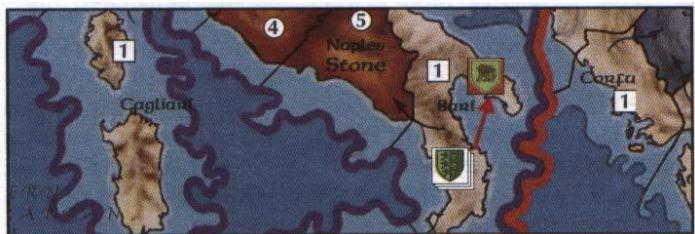
Example: Venice controls Barn with a and has Nationalism. Venice thus has a strength of 2 in Ban. For London to enter and contest Barn, it will need three tokens (two for Venice’s strength plus one for Market Number). However, if London has Gunpowder in play for a +1 Strength modifier, London may contest Ban with two tokens (1 strength 2 plus Market Number 1).
Assume that Genoa has Gunpowder in play plus Nationalism. It may contest Ban with a single token since the single token it needs for Market Number also has a strength of 3 due to + 1 strength modification for both Gunpowder and Nationalism.
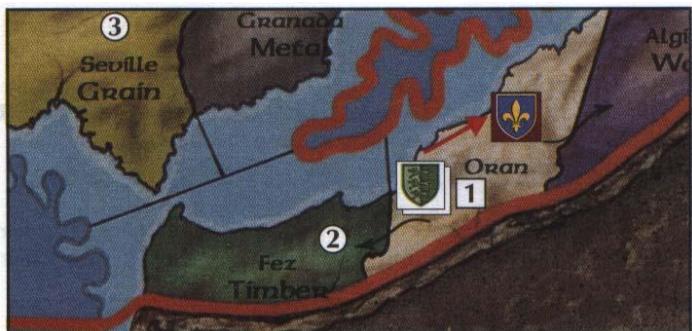
Example: Paris has one in Oran. London moves third in the turn and can reach Oran with its Galley 2. London matches the one in Oran by placing a there, and adds another. His dice roll includes a red 4, which is greater than his Order of Play (3) so the Parisian and the extra London are returned to their respective Stocks. If London had played a +1 Military Advantage card, it could have tried to take Oran with a single token. However, if Paris had the +1 Military Advantage card in play, it would have required three s to attempt to take Oran, which London could not carry with a Galley 2
Example: Paris has a in Fez. London can only land two s in Fez with its Galley 2, which is less than the four needed to replace the Parisian , so London cannot enter Fez.
However, let’s assume that London has a Seaworthy 10 ship. It can attack Fez by placing four s there. However, if Paris still had a in Oran, it would require five s to take Fez; three to match its strength (2 +1 for Satellite Oran) plus two more for Market Number .
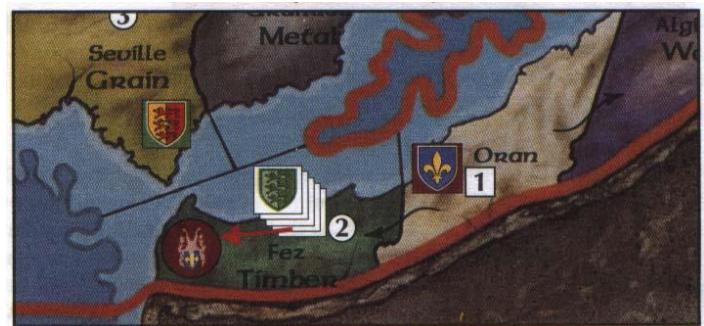
You may add more s to an already occupied province without attacking so long as the tokens present do not exceed the province’s Market Number.
A repulsed attack may be repeated in the same phase by again committing the necessary s to the attack until it succeeds or the attacker goes elsewhere.
Example: Altering our previous example, London again attacks Oran with two s landed by its Galley 2. But this time, London rolls a red 3 which is not > its Order of Play. Since the black die roll is also not > the white die roll, London loses. London’s two s are returned to Stock. London wants to repeat the attack, but cannot since it has already landed all the tokens at Oran its Galley 2 can carry
Let’s suppose, however, that London has a Galley 4. Now it can attack Oran once more with two more s. This time although London again rolls a red “3”, the black die roll is > the white die roll and the London attack succeeds. The Parisian is replaced with a London . The extra London is returned to Stock.
London now attacks Fez with four s and rolls a red 2, black 1 and white 2 — losing the attack and four s. London cannot repeat the attack without an adjacent presence from a prior turn or a shipping capacity of 8 or more. Let’s assume it has a Seaworthy 10 and repeats the attack with another four s and this time rolls a red 5 and wins the attack. The Parisian and the four London s are returned to their respective Stocks and a London is placed in Fez.
Clarification: As long as one of several defenders in a province has a military advantage, the attacker is required to place an additional token to counter the military advantage.
You may replace tokens with a if the province has a circled Market Number (e.g., ), and you have at least as many tokens in that province as its Market Number.
Players may also replace a with a in order to use the limited number of domination markers elsewhere.
Clarification: In order to voluntarily remove a , a player must actually need the as a result of having 25 s already in play. Even if this occurs, the does not count towards the expansion bonus.
Clarification: The conversion from s to to takes place immediately as each competition roll is conducted.
| Y | Cosmopolitan 150 | May add Satellite s to all adjacent province | Prerequisite R |
| 50 Cr | attacks | Ldrs: ② ② 3 | |
Cosmopolitan: A player with Cosmopolitan [V] may add one to the base strength of any attack (not just / defenses) for each he has in an adjacent Satellite able to affect that attack.
| G | Proselytism90 & i MI20 Cr † | Wins attack if coloreddie roll is >= Order ofPlay. | Prerequisite |
| Leaders: - |
Proselytism: Players holding Proselytism win all their attacks if their colored die roll is greater than or equal to their Order of Play.
| H | Cathedral120 & 1 MI20 Cr † | Automatically wins oneattack per turn vs. eachnon-owner | PrerequisiteF |
| Leaders: - |
Cathedral: A player with Cathedral [H] may choose to automatically win one attack per turn before any die roll resolution versus each player without Cathedral. This ability does not apply to War resolutions. As a memory aid in recalling which players have been so afflicted in the current turn, check off the appropriate Cathedral Usage box beneath the Turn Log.
Clarification: You cannot Cathedral a province that has more than one player in it unless all players in the province are nonowners of Cathedral.
If a province contains more than one player and all of the players are non-owner’s of Cathedral, a player may Cathedral that province but this competition counts as a Cathedral usage against all of the players in that province.
Cathedral can be used on either offense or defense, but only once against each non-owner.
| W | Nationalism 60 | Adds 1 to all attack | Prerequisite |
| 30 Cr | totals in home area | Leaders: 0 |
Nationalism: Nationalism [W] adds one to the strength of all your forces in the area containing their capital. Nationalism also modifies the War resolution die roll by +1 when the War card is played.
Clarification: Nationalism affects the doubling of a player’s capital by doubling the tokens after taking into account Nationalism.
Example: Genoa attacks its own capital held by Paris. Genoa needs 5 tokens (5 x 2 = 10). If Venice controls the province with Nationalism, Genoa needs 6 tokens (6 x 2 = 12). If Paris owns and Genoa has Nationalism, 5 tokens are still needed since the market number must be matched in tokens regardless of strength (4.4 / 9.5.3)
| N | Written Record 30 | May force a defeated non-owner to trade a | Prerequisite |
| 30 Cr | Ldrs: 000 | |
Written Record: After an owner of Written Record takes control of a province from a non-owner player, he may force the non-owner to trade one card. The owner chooses a card to give to the non-owner and places it face down on the table. The owner then randomly takes one card from the nonowner’s hand and places it in his own hand. The non-owner then puts the card on the table in his hand.
Clarification: You may not use Written Record [N] to force a trade if you co-existed with another player and then used competition to gain control. You must take the province “from another player” to use Written Record [N], meaning that the player must control it completely first.
Maximum Expansion: Token allocations can never exceed 36 since there are only 36 tokens available. This maximum is further reduced by the number of tokens already on the map. However, a player may spend more money for tokens that he has tokens available in an attempt to become the last player in the Order of Play.
9.6.4 Expansion Bonus
The player with the most s (not s) on the map at the end of the Expansion Phase draws one free card from the History Deck. Ties are resolved in favor of the player who moved first during the phase.
9.7 Income Phase
All /s are flipped to their colored side. Each player simultaneously collects money equal to the number in the last uncovered circle of his Income section. Use the top number if there is an odd number of players, and the bottom number if there is an even number of players. If a player is eliminated, the game income level stays the same (i.e., the level 4 income numbers continue to be used in a game which began with four players).
| L | Interest & Profit8010 Cr t | Doubles cash afterExpansion but only upto value of Income | PrerequisiteK |
| Leaders: - |
Interest & Profit: A player holding this Advance doubles his remaining cash up to a maximum of his mapboard income.
Example: In a 5-player game, London has 17 s in play for an Income of \$100. If London also owns Interest & Profit, and has \$108 before payment of Income, he receives an additional \$100.
| Z | Middle Class17060 Cr | Increases Income by$10 per turn. HalvesStabilization costs. | PrerequisiteK |
| Leaders: - |
Middle Class: A player with this Advance may collect an additional \$10 Income per turn. This bonus would raise the ceiling by \$10 on allowable profits from Interest & Profit. It also halves Stabilization costs (fractions rounded up)
| U | New World160 | May enter New World. | PrerequisiteV, T |
| Leaders: 0 |
New World: A player holding New World [U] may enter New World provinces.
9.7.1 Commodity Surplus / Shortage
At the end of the Income Phase, the three dice are rolled twice to create any commodity Surplus/Shortage for the following turn. The black and the white die roll are totaled to select a commodity with that Event Number on the Commodity Log (a commodity dice roll of 12 affects both Gold and Ivory equally). A colored die roll of 1, 2, or 3 results in a Shortage; a colored die roll of 4, 5, or 6 results in a Surplus. A Surplus decreases any payoff by one box. A Shortage increases any payoff by one payment box.
Majority: Anyone who controls more provinces of a given commodity than any other player is the majority holder. The majority holder of a commodity in Shortage draws one free card. The majority holder of a commodity in Surplus must pay the bank \$1 for each such province he controls.
A Shortage and a Surplus of the same commodity cancel each other so that neither occurs in that turn. Otherwise, each Shortage/Surplus lasts until that commodity is played or the end of the next turn (whichever comes first). Two Shortages or Surpluses in the same commodity in the same turn would affect the first two of those cards played in that turn, but are not additive for a given payoff.
The player moving first in the next turn may cancel either or both of the Surplus/Shortage conditions by paying cash equal to the base value of that commodity to the bank at the start of the Draw Phase.
Clarification: A commodity Shortage/Surplus roll of 12 (affecting both Gold and Ivory) does cause card draws or payments for both commodities. In shortage, two cards could be drawn.
Clarification: Only \$10 is paid to remove a joint Shortage / Surplus of Gold / Ivory.
Clarification: When there is a double Shortage or Surplus of a Commodity, the player will either draw twice or pay twice.

Example: A Surplus has occurred in Wine on a dice roll of red 4, black 4 and white 3. Barcelona has three Wine s, Paris has one. As the majority holder of Wine in this Surplus, Barcelona pays the bank \$3. If a Wine card is played, Barcelona will receive \$20, Paris none. If the Surplus had been a Shortage instead, Barcelona would receive a free card and, if Wine was played, \$80, Paris \$20. If two Wine cards are played, only the first is affected by the Shortage/Surplus. Let’s further assume that Barcelona managed to be the first player in the Order of Play. Before drawing a card in the Draw Cards Phase, he pays \$5 to the Bank to remove the Wine Surplus. Now when the Wine card is played, he will receive \$45 and Paris will receive \$5. Elimination of the Surplus/Shortage does not cancel the Majority holder’s bonus card or fine.
| J | Wind / Watermill4010 Cr t | Adjust Surplus/Shortagewhen moving last. | PrerequisiteI |
| Leaders: - |
Wind / Watermill: Whenever a player holding the Wind / Watermill Advance [J] moves last he may adjust the Shortage / Surplus track for either Grain, Cloth, Wine, or Metal from neutral, Shortage, or Surplus, to any other of these three following the first-moving player’s opportunity to buy off Shortages / Surpluses.
10. CONDUCT OF DIPLOMACY
Players may promise each other anything, but no agreement is binding. The only penalty for a player who breaks his word is the unhappy attention of the offended party. However, above this framework of “anything goes,” two rules apply:
All diplomacy must be conducted at the table in the open with all players free to comment.
A player may never show any of his cards to another player before they are played or forcibly traded.
A player violating either rule is immediately penalized one space on the Misery Index as well as forfeiting half his written Cash total for the turn. Should a player inadvertently reveal a card by dropping it, incorrectly playing it, or playing it and then changing his mind, that player must play the card at the first legal opportunity or pay the above penalty.
Clarification: Players may not pay cash
内容过长,此处只内联前一部分;完整内容请下载或到规则页阅读。
下载 Markdown原文为社区整理/出版社公开资料,版权归原作者,仅供个人学习查阅。