
苹果杰克Applejack
一句话概览
苹果杰克 是一款已收录于村了吗规则库的桌游,支持 1–4 人,原名 Applejack。
本页内容:一句话概览 · 游戏概述 · 1. 游戏组件 · 2. 游戏设置 · 3. 回合结构 · 4. 选取树板块或随机抓取 · 5. 支付费用或将板块翻到牧草地 · 6. 放置树板块 · 7. 收集蜂巢蜂蜜奖励 · 8. 移动苹果杰克 · 9. 游戏结束 · 10. 最终计分 · 11. 可选规则 · 12. 单人规则 · 13. 战役模式 · 关键规则与常见问题 · 常见问题
苹果杰克 规则速览
以下规则速览由本站整理,与官方规则书表述不同,仅供快速上手参考。
游戏概述
Uwe Rosenberg 与 Lukas Siegmon 合作设计的果园经营主题策略桌游。玩家扮演果园主,在 19 轮游戏中种植苹果树、培育蜂群、定期收获苹果以收集尽可能多的蜂蜜——蜂蜜最多的玩家获胜。核心流程为每轮选取树板块→支付费用或翻面→放置板块→收取蜂巢蜂蜜奖励→移动骰子触发收获;通过连接蜂巢面板获取额外蜂蜜,并根据果园中相邻苹果树形成的区域计算每次收获的产量(减去当前骰子点数后结算)。
核心机制: 板块放置、区域划分、资源管理、轨道追踪、按区域结算
1. 游戏组件
| 组件 | 数量 / 说明 |
|---|---|
| 树板块 | 100 块(一面为树木图案,一面为牧草地) |
| 果园板 | 4 块双面板(A 面用于基础游戏,B 面用于变体"独特果园") |
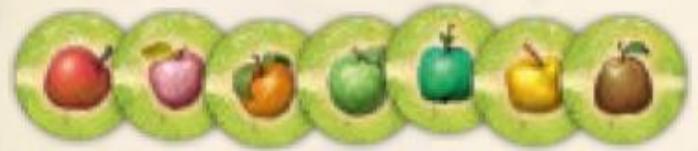
| 苹果板块 | 7 块(仅用于变体规则"苹果板块") |
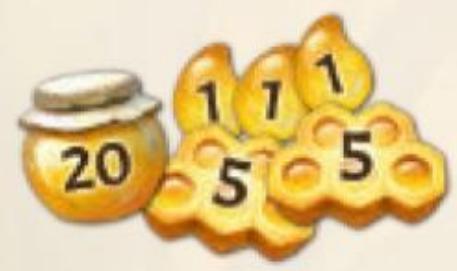
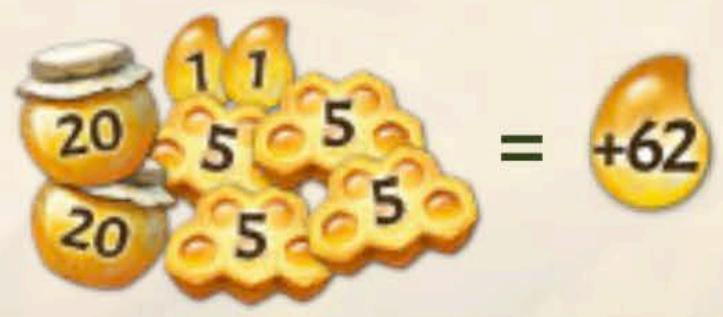
| 蜂蜜片 | 148 枚(108 滴蜂蜜、28 蜂巢蜜、12 蜂蜜罐,分色分类) |
| 苹果杰克骰子 | 1 枚六面骰,显示数字 1–6 及花朵符号 |
| 收获版图 | 2 块双面版(分别适配 2–3 人与 4 人/单人) |
| 计分纸 | 1 张 |
| 规则书 | 1 本 |
2. 游戏设置
2.1 准备果园区
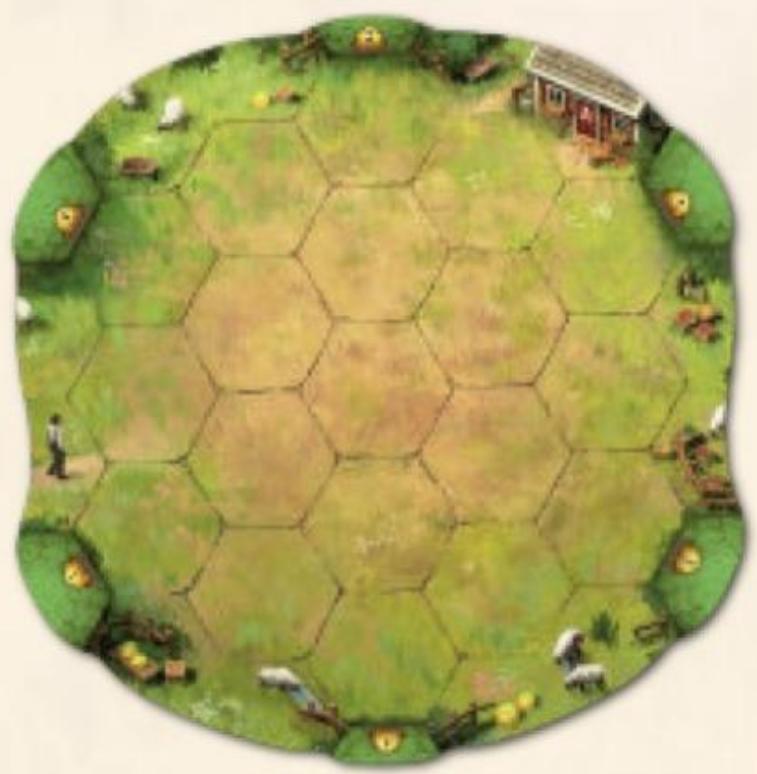
每位玩家获得一块果园板。将 A 面朝上置于各自面前。多余的果园板移出游戏。A 面的四个角落各有一个预印蜂箱,标有数值。
2.2 初始蜂蜜分配
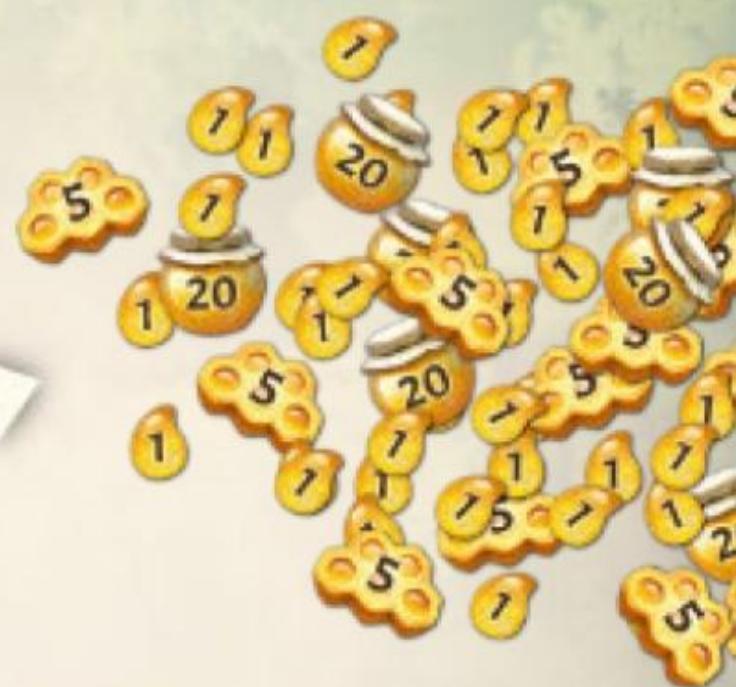
随机决定起始玩家。起始玩家的个人供应堆放 16 枚蜂蜜。其余玩家的初始供应量如下:
| 玩家人数 | 第 2 位 | 第 3 位 | 第 4 位 |
|---|---|---|---|
| 2 人 | — | — | — |
| 3 人 | 20 | 22 | — |
| 4 人 | 18 | 20 | 22 |
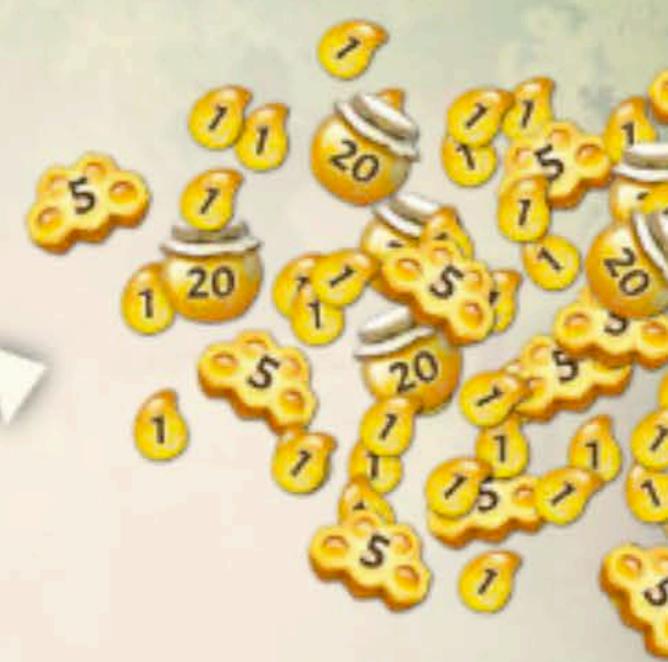
所有玩家将蜂蜜片按种类分好,放置在个人游戏区域旁作为供应堆。
2.3 设置收获版图
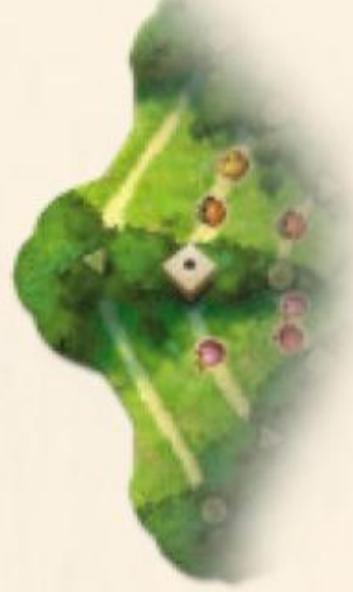
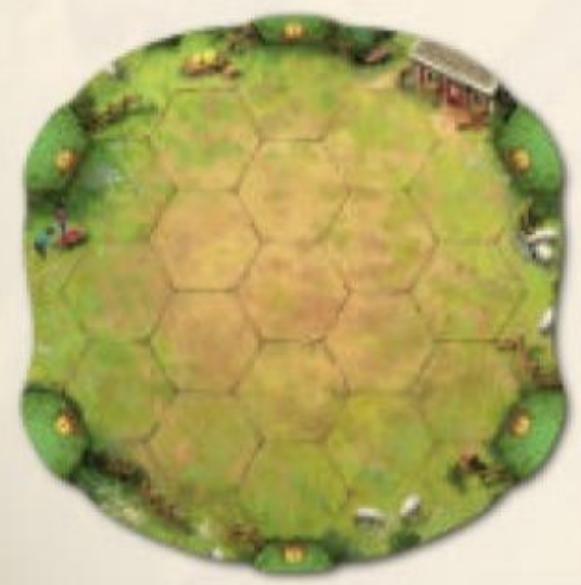
将与实际玩家人数匹配的收获版图(内圈已布置好对应数量的凹槽)放在桌子中央。将苹果杰克骰子转至"1 点"面朝上,放置在收获版图的起始区域。
2.4 准备树板块供应
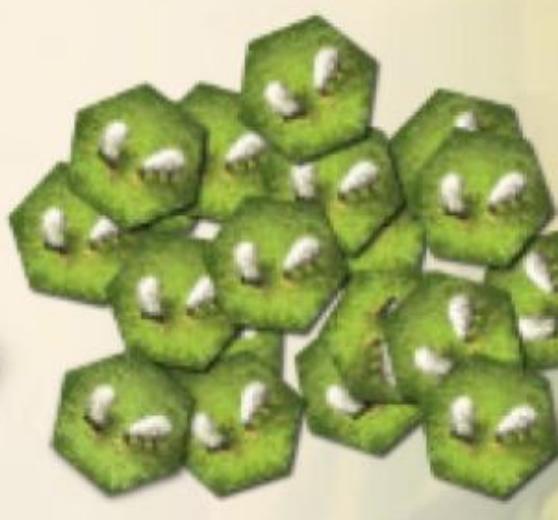
将全部树板块背面朝上(牧草地面)洗匀,放在所有玩家方便拿取的位置,形成公共供应堆。从供应堆顶部翻开 2 块 树面朝上的板块,放入每个凹槽内。
3. 回合结构
每位玩家按顺时针顺序轮流进行完整的一回合。整局共进行 19 个回合(每人约 4–5 回合)。你的回合依次执行以下 5 个步骤:
- 选取树板块或随机抓取
- 支付费用或将板块翻到牧草地
- 放置树板块
- 收集蜂巢蜂蜜奖励
- 移动苹果杰克
4. 选取树板块或随机抓取
查看骰子当前所在的区域。你必须在此刻从以下来源中选取 恰好 1 块 树板块:
- 槽位选择: 选取位于骰子所在区域相邻的两个凹槽之一内的任意树板块(树面朝上展示给你)。
- 随机抓取: 从公共供应堆顶盲抓 1 块树板块。
此步骤不可跳过。若某一凹槽已空,则该凹槽不再可选——沿直线追踪骰子区域到边缘即可确认哪些凹槽属于当前可访问范围。
> 补充规则: 当骰子移动到最内圈后,若某次行动结束后,相邻的两个凹槽中总共只提供了 ≤1 块可用树板块,则需立即从供应堆为每个凹槽各补充 1 块树面朝上的板块(从跟随骰子的凹槽开始按顺时针方向依次填充)。一个凹槽中可以累积无限多块树板块。
5. 支付费用或将板块翻到牧草地
要成功将选中的树板块放置于果园内,你需要支付其购买价格。
- 价格读取: 树板块上标有一到多个蜂巢图标和对应的数值。无论某个数值出现几次,只需支付一次该数值的蜂蜜。例如板块上有三个"(4)"标记,你只需支付 4 枚蜂蜜。
- 翻到牧草地: 如果不想支付或付不起,你可以将该板块翻转为牧草地面。此时你立即获得 2 枚蜂蜜作为补偿,但该板块后续只能以牧草地面朝上的方式放置在果园中(无法带来其他优势)。
6. 放置树板块
将新获得的树板块放置到你果园板的任意空格内:
- 新板块无需与已有板块相邻,可放置在任意空闲位置。
- 若选择了"翻到牧草地"的板块,则以牧草地面朝上放置。
7. 收集蜂巢蜂蜜奖励
检查新放置的树板块是否与你果园上的蜂巢产生了连接。
连接判定: 树板块的边缘与蜂箱标识接壤即视为"连接"。当你放置的一块板块同时接上了多个蜂箱时,对每一个连接单独结算。
蜂蜜收益: 每连接两个蜂箱时,你获得这两个蜂箱中数值较小者的蜂蜜。有时一个板块能同时连接多个蜂箱对,每个蜂箱对都独立结算并累加。
> 果园四角还预印有若干数值不同的固定蜂箱,你也可以利用这些固定蜂箱来创造新的连接,获得额外的蜂蜜收益。
8. 移动苹果杰克
将骰子沿收获版图路径顺时针方向精确地向前移动一格。根据骰子移动过程中越过的元素,可能触发三种情况:
8.1 收获
移动过程中每越过 1 枚苹果标记,就对该颜色进行一次收获结算。一次移动可能跨越 1 个或连续 2 个苹果,此时需要依次处理每种颜色(先遇到的颜色优先)。
收获结算步骤:
- 统计你的果园板上,所有与该苹果颜色相连的区域。两个不同板块之间若都是同种颜色且相邻(共用边),它们就组成同一个区域。单个板块也能独自构成一个区域。
- 对每个区域分别结算:将该区域内该颜色的苹果总数相加,再减去骰子当前的点数(未调高之前的值)。
- 若结果 > 0,你获得该结果的相应数量蜂蜜;若结果 ≤ 0,则该区域无收益(不会倒扣)。
- 将所有区域的收益累加即为本轮收获总量。
举例: 假设你的果园有三个浅绿色苹果分布在不同区域——一个区域有 2 个,另一个区域有 3 个,最后一个孤立区域有 1 个。骰子点数为 1:
- 第一个区域:2 − 1 = 1 枚蜂蜜
- 第二个区域:3 − 1 = 2 枚蜂蜜
- 第三个区域:1 − 1 = 0(无收益)
- 合计获得 3 枚蜂蜜。
注意: 如果你的一次移动同时越过了两种颜色的苹果(比如先过浅绿再过红色),先完成第一种颜色的全部收获结算,再进行第二种颜色的结算,以此类推。
8.2 补充树板块(仅发生在最内圈时)
当骰子移动后位于最内圈区域,且此时相邻凹槽中可用的树板块不足 2 块时,从供应堆立即为每个凹槽各补入 1 块树面朝上的板块,从紧挨着骰子位置的凹槽开始按顺时针方向依次补充。
8.3 进入下一轮 —— 花朵计分与骰子调高
当骰子被移动至收获版图的最内圈尽头时(通常位于带有秋叶标记的区域),它将跨过桥梁回到起始区域。此时触发以下连锁动作:
- 花朵计分: 计算骰子跨过的花朵符号次数,该次数取决于骰子当前的点数——骰子几点就计几次花。每次花朵计分中,你将果园板上所有树板块(无论是否连通)上的花朵图标逐一计数并累加。得到的总花朵数就是你的蜂蜜收益。
- 第一轮和第二轮经过桥时,骰子点数为 1 和 2,分别计花 1 次和 2 次。
- 第三轮经过桥时,花朵计分同样按骰子点数执行,但不会再次增加骰子点数。 - 提升骰子点数: 在非最后一轮的情况下,将骰子点数上调 +1。第一轮结束时骰子变为 2,第二轮变为 3。第三轮到达最内圈时无需再提升。
9. 游戏结束
满足以下条件时游戏立刻结束:
- 骰子点数为 3
- 骰子抵达最内圈的秋叶区域(表示已完成第三轮行驶)
- 所有玩家的果园均已填满,再无空格
此时最后一位玩家完成其剩余回合后,进入最终计分阶段。
10. 最终计分
最终计分按顺序执行以下步骤(每一步的收益均累加到总分):
10.1 最后收获
对所有 7 种苹果颜色依次进行收获结算(棕→浅绿→黄→红→蓝紫→粉→橙)。使用与途中完全相同的计算方法——将每个区域内的该色苹果数目相加后减去骰子点数(此时点数为 3)。所有颜色产生的正收益累加起来即为你最后的作物产量。
10.2 产量翻倍
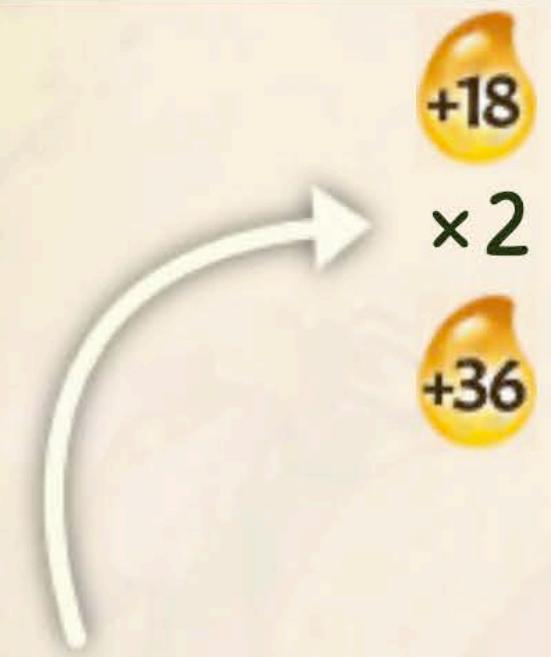
将上述"最后收获"的总产量乘以 2。
10.3 品种奖励
统计在最后收获中产出了正收益(≥1 枚蜂蜜)的不同苹果颜色数量,并按下表获得奖励:
| 盈利品种数 | 奖励 |
|---|---|
| 4 种 | +4 |
| 5 种 | +11 |
| 6 种 | +21 |
| 7 种 | +35 |
重要限制: 盈利的品种必须至少有 4 种是连续的(即按棕色→浅绿→黄→红→蓝紫→粉→橙的顺序排列时,包含至少一组长度 ≥4 的连续段)。不满足此条件的品种不计入奖励。
10.4 最后花朵计分
将你果园上所有树板块的花朵图标全部计数(无论是否连通),与途中花朵计分方式相同。每次都等于所有花朵的总和。
10.5 清点个人供应堆
把你剩余的个人蜂蜜供应堆中的所有蜂蜜加入总分。
总分最高的玩家赢得比赛。 若有平局,所有并列最高分的玩家均为赢家。
11. 可选规则
11.1 独特果园
将果园板的 B 面朝上进行游戏。四块果园 B 面各不相同——除了蜂箱外,某些角落还预印有苹果标记,在收获时可当作对应颜色的苹果参与结算。
11.2 苹果板块
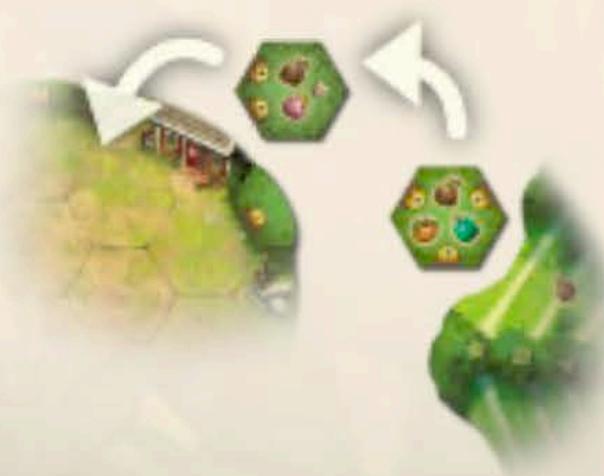
使用 7 个特制的苹果板块,覆盖收获版图上前 7 步路径中的预印苹果。借此可以改变前五轮(甚至更早)收获的颜色顺序,为开局引入更多变数。
11.3 额外树板块
在果园板右侧设有一座"苹果杰克的小屋"格。游戏开始时,从供应堆额外翻出 1 块树面朝上的板块放置于此格旁。
轮到你的回合时,你可选择直接放置这块储备板块(代替槽位或盲抓)。你可以照常付费将其树面朝上放置,也可翻为牧草地。之后立即从骰子附近的凹槽或供应堆取一块新板块填补空缺,并再将那块牌存入苹果杰克小屋以备后用。这个机制允许你"囤货",在将来不便付款或不想付款时使用。
12. 单人规则
单人游戏使用专门的单人用收获版图。它有一个位于中心区域的特殊格子和一条环形路径。
12.1 特殊功能
- 起始供应:14 枚蜂蜜。
- 每个凹槽暂时只放 1 块树面板(而非多人游戏的 2 块)。
- 另外,将一块树板块预先放在版图中间格子旁的三棵印刷树之一上。
12.2 骰子移到中间格
在单人游戏中,当骰子被推进中心的特殊格子时:
- 若格子旁的 3 棵印刷树上全为空:你立即获得 3 枚蜂蜜,然后用 2 块树面板将格子填满。
- 否则:你查看该格子上可见的花朵符号数量,立即获得等量的蜂蜜。然后你可以在该格中选择 1 块树板块放置(若可选不超过 1 块则立即补充至 2 块;正常补充时每格最多放 3 块)。
12.3 目标分数
单人模式无花朵计分。胜利条件是收集至少 65 枚蜂蜜;若能达到 80 枚则堪称出色表现。
12.4 游戏结束
当骰子到达版图中心格的末端(已填不满为止),果园也即将满格时,游戏结束——之后进行与多人游戏完全相同的最终计分。
12.5 可选规则兼容
单人游戏可以使用全部可选规则(独特果园、苹果板块、额外树板块)。
13. 战役模式
将连续 4 局 游戏串联为一场战役,保留上一局的成果到下一局:
- 第 1 局结束后:保留 1 块 树板块,带到第 2 局开局使用。
- 第 2 局结束后:再保留 1 块(累计 2 块),带到第 3 局使用。
- 第 3 局结束后:再保留 1 块(累计 3 块),带到第 4 局使用。
每一局可以选择保留不同的板块——第 1 局选的板不一定和第 2 局选的相同。
在后续每局开局时,把之前保留的树板块直接放在果园版图上靠近中心区域的预印树上(取代正常的随机抽取)。到了第 4 局开局时,所有预留的树板块都已派上用场。
关键规则与常见问题
易错规则
- 每次选取必须执行: 不能跳过选取树板块的步骤。
- 翻面补偿仅给 2 蜂蜜: 翻成牧草地立即得 2 枚,但该板块后续不会再产生除蜜蜂外的任何价值。
- 价格只看数值不看出现次数: 同一数值在板块上出现多次,只付一次的钱。
- 蜂巢收益取小值: 连接两个蜂箱时,收益等于两者中较小的那个数。一个板块同时连多个蜂箱对,每对各算一笔。
- 每个区域独立减骰子点数: 不是把所有同色苹果加总后减一次,而是对每个连通区域分别减骰子点数再求和。
- 收获顺不可颠倒: 一次移动越过多种颜色时,按骰子行进方向的先后依次结算。
- 花朵积分不用减骰子点数: 所有花朵不论是否相邻,直接计数即可获得等额蜂蜜。
- 第三轮不增加骰子点数: 骰子在第 3 轮走到最内圈时跨过桥回到起点,执行花朵计分但不继续增大点数。
- 最终计分第一步是所有 7 色都收一遍: 使用骰子点数 3 做减法。
- 产量翻倍只针对"最后收获"总额: 不包括品种奖励、花朵得分和剩余供应堆。
- 品种奖励要求至少 4 种连续盈利: 非连续的品种不计入,即使总数达 5 种但全部断裂也不行。
- 槽位不足时才补牌: 只有骰子在最内圈且相邻凹槽中提供的板块少于 2 块时才触发补充。
- 单人游戏无花朵计分: 单人模式收获版图没有桥梁和花朵符号。
常见问题
-
Q:骰子第一次经过桥变成几?
A:第一轮的骰子初始值为 1。走完一圈跨过桥后,点数提升到 2。第二轮走过一次后变为 3。第三轮走过最内圈时仍保持 3,不再提升。 -
Q:一个树板块能连几个蜂箱?怎么结算?
A:只要边缘接触到蜂箱就算连接。如果一个板块同时碰到 3 个蜂箱,它会分别与相邻的其他蜂箱配对计算——每对各自取较小值并累加。 -
Q:什么是"连续品种"?
A:按收获顺序排列的 7 种苹果颜色为:棕→浅绿→黄→红→蓝紫→粉→橙。在这个序列中,盈利的那些品种里必须有至少一段由不少于 4 种连在一起。例如盈利了棕色+浅绿+黄色+红色,这 4 种连续,满足条件。 -
Q:如果我的最后收获总产能为 0,翻倍后是多少?
A:0 × 2 = 0。没有惩罚,只是得不到加分。 -
Q:我可以连续多轮执行同一个步骤吗?
A:可以。例如两次选取槽位 1 和 2 之间的板块。没有任何限制说必须轮换执行。 -
Q:补充树板块后,我还能选新补的牌吗?
A:不能。补充发生在第 5 步"移动苹果杰克"阶段,而你只能在第 1 步选取。本次回合无法选择刚刚补充的牌,留待下次使用。
设计:Uwe Rosenberg · 美术:Lukas Siegmon · The Game Builders
常见问题(FAQ)
以下 1 条问答中 0 条来自站内玩家的真实提问,其余 1 条为本站整理的常见疑问;答复内容保持原样。
苹果杰克支持几个人玩?
1–4 人。
去哪查完整规则
想核对具体规则细节、卡牌效果或某个回合的结算方式,可以在村了吗里选中这款游戏后直接提问。
同类桌游
- 卡坦岛德式
- 工业革命:伯明翰德式
- 勃艮第城堡:特别典藏版德式
- 方舟动物园德式
- 卡卡颂抽象
- 瘟疫危机传承:第一季美式
- 阿瑞迪亚:勇踏征途美式
- 重塑宇宙德式
- 幽港迷城美式
- 埃多拉的德鲁伊德式
规则原文(Markdown)
本站收录这款游戏的规则原文 2 个文件,此处内联渲染 2 个,可直接展开阅读或下载。
rules_zh_苹果杰克_34740.md25.0 KB
1-4 8+ 30min
Applejack
Uwe Rosenberg / Lukas Siegmon
The GAME BUILDERS
中文翻译 & 排版:陈斌华
世界上有几千种不同的苹果品种。在这个游戏中,你将成长并收获其中的七种。你面前是一个果园,你种植的苹果树结着不同数量的果实。你的目标是种植和收获尽可能多的同一品种的苹果,以便在收获期间收集得分。同时,你想合并蜂箱,因为没有蜂箱就没有蜜蜂,没有蜜蜂就没有蜂蜜,没有蜂蜜就没有苹果。铺设板块时,看看谁最擅长将这两项任务结合起来?
感谢所有测试 Applejack 的人!
我们已知的有: Birgit Acker, David Bendfeld, Erica Caraça, Israel Cendrero, Michael Fuchs, Gerrit Gericke, Alva Hanson, Leif Hanson, Raimundo Henriques, Stefan Kalveram, Mike Keller, Jannick Keskenti, Julian Keskenti, Roman Keskenti, Carsten Lassmann, Martina Lassmann, Citie Lo, Raquel Raimundo, Björn Reinartz, Felix Potthast, Sheila Santos, Elke Schwarz, Christian Seidel, Karthik Setty, Lukas Siegmon, Julian Steindorfer, Christian Töööörner, Marco Vicente Suzan Vissering and Eerko Vissering.
特别感谢他们的支持:
Carsten Burak, Michael Bonet, Volker Nattermann, Dirk Schröder and KarinaWeening.
游戏配件
100 板块
背面
(牧草地)
正面
(树)
4 双面果园
(A 面用于基础游戏,B 面用于变体规则 - 独特果园)
7 苹果板块
(只用于变体规则 - 苹果板块)

148 蜂蜜片
(108 滴,28 蜂巢,12 蜂蜜罐)
1 骰子 (苹果杰克)

2 块双面收获版图
(对于分别有 2 名和 3 名玩家的游戏,4 人游戏和单人游戏)

1 规则书 1 计分纸
游戏目标
蜂蜜最多的玩家赢得比赛。你可以通过在果园中巧妙地放置树瓦片和定期收获苹果来收集蜂蜜。19 轮后,每位玩家都将拥有一个完整的果园,并将参与最终得分。
游戏设置
我们将首先向你解释 2 至 4 名玩家的游戏。单人规则见第 10 页。
果园
每位玩家获得一块果园。将A面朝上放在各自面前。多余的果园将被移出游戏。所有果园的A面角落内都有蜂箱。B面仅适用于变体规则-独立果园。

初始蜂蜜
随机决定谁开始游戏。该起始玩家开始时个人供应堆有16蜂蜜。
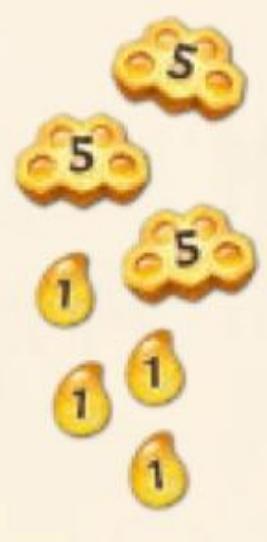
在一场 2 人游戏中,第二位玩家得到 20 个蜂蜜。在一场 3 人游戏中,第二位玩家得到 19 个蜂蜜,第三位玩家得到 22 个蜂蜜。(见右侧示例。)在一个由四位玩家组成的游戏中,第二位玩家得到 18 个,第三位玩家得到 20 个,第四位玩家得到 22 个蜂蜜。

蜂蜜
将蜂蜜片按照种类分类
放置在你的游戏区域上


收获版图和骰子
将与玩家数量匹配的收获版图放在桌子中间。将骰子转至1点并将其放置在起始区域:
树板块
洗混树板块并将其牧草地面朝上放在所有玩家方便拿取的位置。这里是公共供应堆。现在从公共供应堆翻开2块(树面朝上)板块放在每个收获版图的7个凹槽内。

如何玩这个游戏?
每位玩家按顺时针方向轮流进行完整一回合。游戏顺序不会在游戏中改变。你可以通过骰子当前所在的区域来判断是否该轮到你了。
你的回合
你的回合由 5 个步骤组成,你会一个接一个执行:
- 选择 1 块树板块或随意抓取
查看骰子所在区域。你可以选择位于此区域旁边的两个凹槽之一的一块树板块。或者,你可以从公共供应堆的产品中获取未知的树板块。你必须进行本步骤,不能跳过。
注意:在骰子围绕版图的第一圈中,很明显骰子与两个凹槽相邻。逐渐地,骰子移动到收获版图的内部。沿着树线一直走到版图的边缘,以确保你从正确的凹槽中选择树板块。这些树以直线表示,即使它们没有用线连接。
2. 为树板块支付费用或者将其翻到牧草地面
为了在步骤 3 中放置树面朝上的板块,你必须现在支付蜂蜜的价格。蜂房的板块上标明了购买价格。它在许多板块上被多次标注。就好像它只在板块上出现过一次一样支付价格。如果你不想或付不起价格,把板块转到牧草地面。然后,你立即收到 2 个蜂蜜,但必须在步骤 3 中将板块与牧草地面朝上放置。
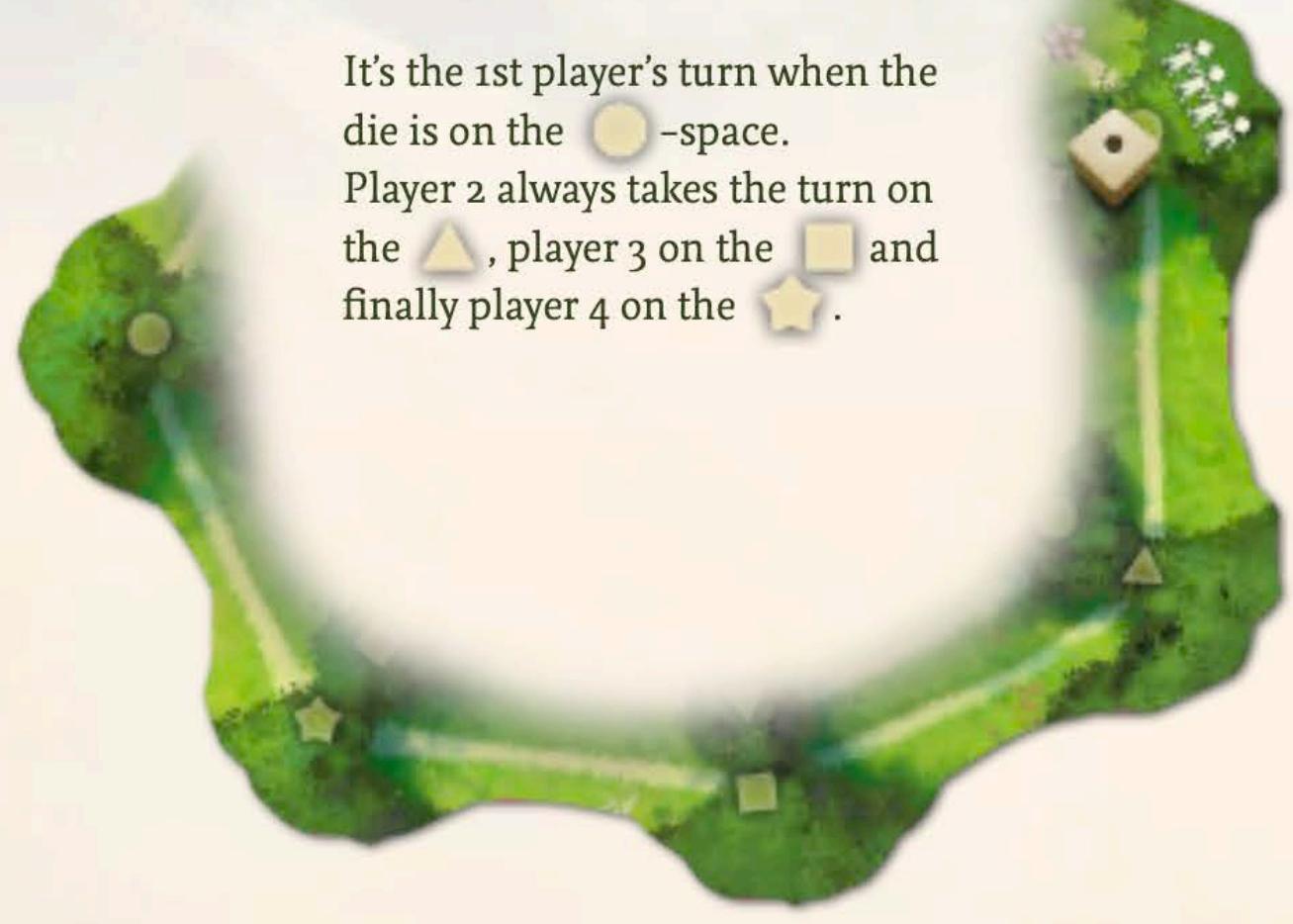
现在是起始玩家回合,骰子位于○区域上。玩家2通常在△进行回合,玩家3在□进行回合,玩家4在☆进行回合。
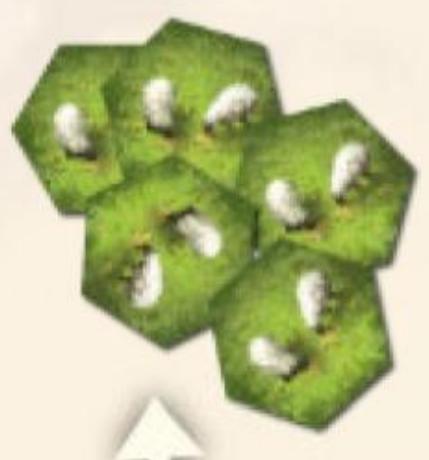
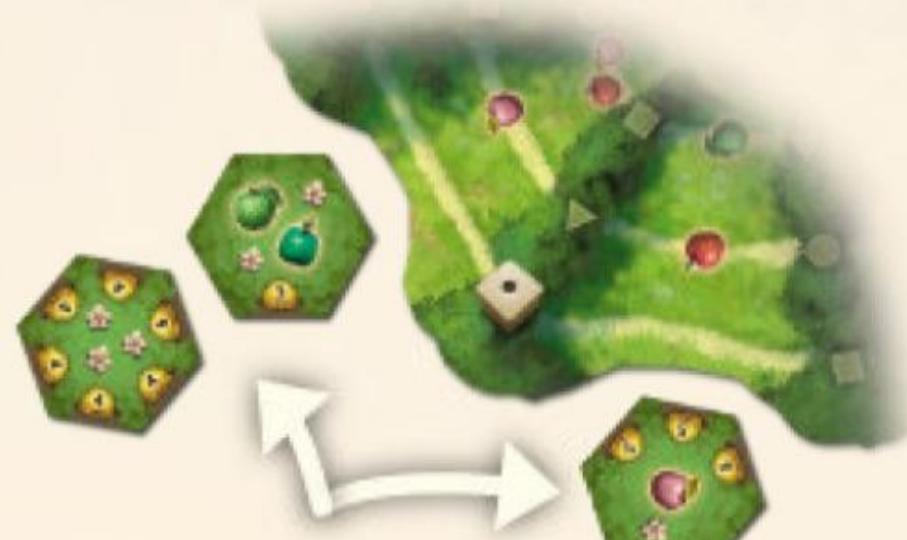
你可以在骰子相邻的 2 个凹槽内的所有板块中选择一块。或者,你可以从供应堆随机拿取一块。

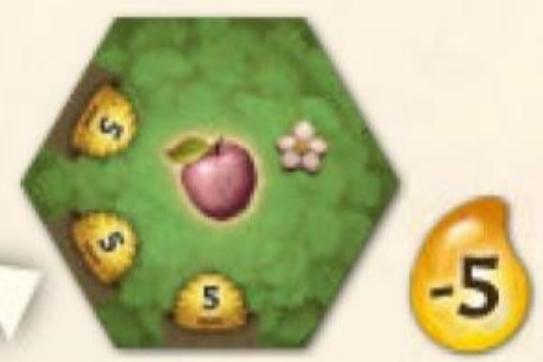
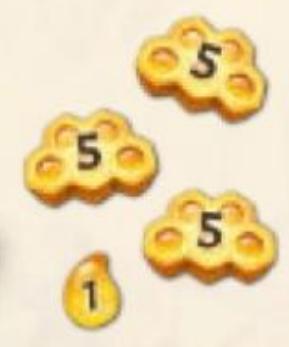
无论数字出现的频率有多高,树板块的购买价格由蜂箱中的数字表示(5)。
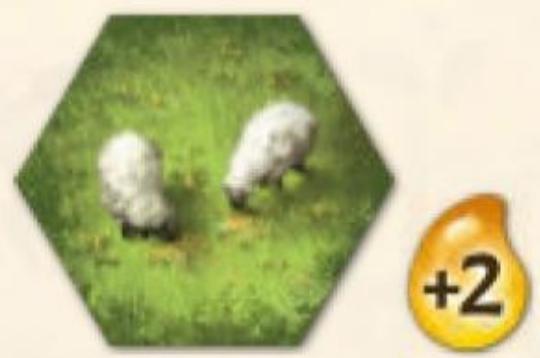
如果你将树板块翻到牧草地面,你将立即获得2蜂蜜。然而这块板块不会给你提供进一步优势。
3. 放置树板块
将新获得的树板块放在你果园内的任意空置格。树板块无需与已存在的树板块相邻。
4. 收集蜂蜜奖励
检查新放置板块的边缘。如果你连接 2 蜂箱。立即获得其中一个较小数值的蜂蜜。有时,当你放置板块时,你可能连接了多个蜂箱。此时你从每个连接中获得较小数值的蜂蜜!
在你果园的角落里,你也会找到一些含有数值的蜂箱。你可以使用它们,就像你板块上的数值,创造蜂箱连接。
5. 移动苹果杰克
在收获版图上按顺时针方向将骰子移动一格。注意以下事项:
收获:如果你在移动骰子时越过 1 个或 2 个苹果,短暂中断游戏。然后,你们每个人都将获得某些品种苹果的蜂蜜(参见“收获”)。
补充:如果骰子在移动后最多只能在相邻的两个凹槽中提供一个树板块供选择,那么请在七个凹槽中的每个凹槽中添加一个新的树板块。从顺时针方向跟随骰子的凹槽开始。在一个凹槽中可以放置的苹果板块数量是没有限制的。
新一轮:如果骰子在回合结束时位于收获版图的最里面,请将其移过桥回到起始区域。然后进行花朵计分(参见“花朵计分”)。收获版图上的花朵符号提示你这个特殊的得分。最后将骰子点数调高1点。
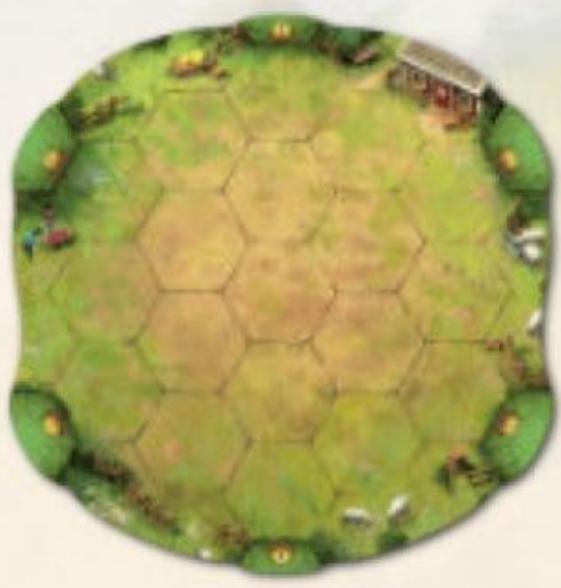


你可以放置树板块在你果园的任意空置格。树板块的放置无需与已存在的树板块相邻。
每当你放置树板块连接 2 蜂箱时,你获得这 2 个连接蜂箱中较低数值的蜂蜜。左侧的例子中,你将获得 4+5=9 蜂蜜。
4 + 5 = +9

骰子首先在浅绿色上移动,然后在红苹果上移动。你首先收获了浅绿色的苹果品种(见第6页)。然后你为红苹果品种进行收获。


当骰子抵达收获计划的最里面区域时,将其跨桥移回起始区域,然后执行花朵计分并将骰子点数调高1点。
当骰子抵达这个区域。只有1块树板块在相邻2个凹槽内。立即从供应堆为每个凹槽补充1块板块,从跟随骰子的槽开始。所有板块都是树面朝上放置。
收获
每当骰子沿着收获版图移动时穿过 1 个或 2 个苹果,所有玩家都会获得蜂蜜。苹果的颜色代表哪种苹果成熟可以收获。如果展示了 2 种颜色,两种类型的分别收获,一个接一个地收获。
这是确定作物产量的方法:
看看你收获版图上与收获相匹配的树板块。如果这些板块连接在一起,则它们形成一个区域。一个区域可以只由一块板块组成。在每一个地区,将收获的苹果品种加起来。从总和中减去骰子上的点数。如果你的结果高于零,你将立即收到蜂蜜的结果。如果你的结果低于或等于零,什么也不会发生;你不必付罚款!
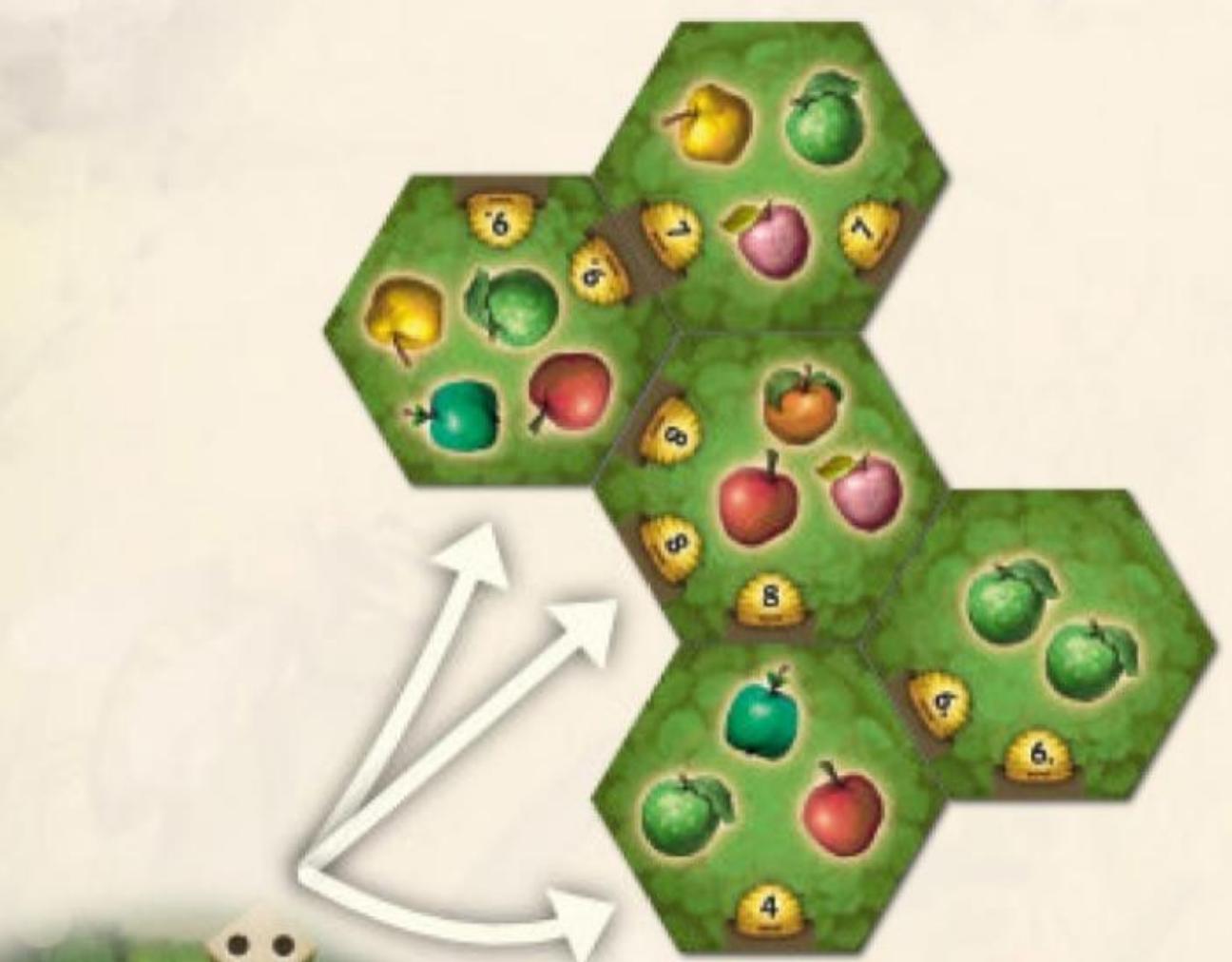


此时是骰子的第2次旅行:你收获红苹果。这3个红苹果分别位于相邻的树板块上,形成一个区域。所以你总计3红苹果并减去骰子点数(2)。你将收到1份蜂蜜作为作物产量。

骰子越过浅绿色区域并越过红色苹果。你首先收获浅绿色苹果品种。然后你再收获红色苹果品种。

你收获浅绿色苹果。你有两个区域,其中板块与这些苹果相连。你数到顶部有2个浅绿色苹果,底部有3个浅绿色苹果。你可以从中从每个区域减去骰子(1)的点数。你将从顶部收到1个蜂蜜,从底部收到2个蜂蜜,总共3个蜂蜜作为你的作物产量。

如果是浅绿色苹果在这块板块上,你将在这个区域收获6个苹果。所以你的作物产量在减去骰子点数后为5份蜂蜜。
花朵计分
在游戏过程中,骰子将两次穿过桥回到起始区域。每次发生这种情况时,进行花朵计分;根据骰子上显示的点数,在第一轮中计分一次,在第二轮中计分两次。这意味着你们每个人得到的蜂蜜与树上的花朵一样多。花朵不必像苹果那样相邻并形成相邻区域!你也不会减去骰子的点数。
有时候,在第一次围绕着骰子轮次来计划的时候,你会遇到一种情况,那就是你买不起你想买的板块。在这种情况下,你必须决定你想在哪个方向发展你的果园。在第一次计分之后,这不再是一个大问题了。你越来越有能力买得起你想要的树板块了。因此,你可以用你以前选择的方式来填满你的果园,而不会缺少蜂蜜。

骰子必须越过桥回到起始区域并越过花朵符号。你对花朵计分。如果骰子点数是2,则你计分2次。
在花朵计分后,将骰子点数加1点。

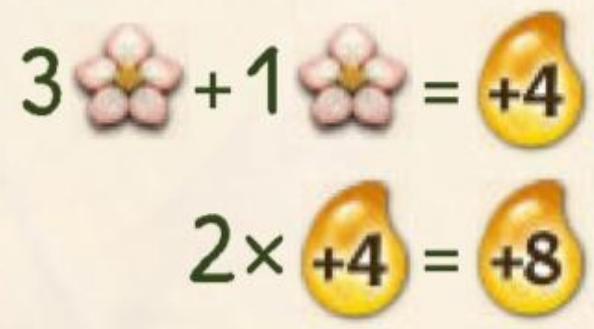
所有花朵(3+1=4),即时它们未被连接在一起。此时不会减去骰子点数。你获得4份蜂蜜。当你对花朵计分2次时,你获得2次4份蜂蜜,也就是8份蜂蜜。
游戏结束
一旦所有玩家完全完成各自果园,游戏就结束了。骰子点数为 3 并且已经抵达含有秋叶的区域(游戏结束区域)。现在进行最终计分,在下一页有举例。请使用记分板作为辅助工具。蜂蜜最多的玩家获胜。如果平局,多位玩家都是赢家。

如果骰子点数是 3 并且抵达含有秋叶的游戏结束区域,最后一位玩家进行完最后一回合。之后,游戏结束。

这个游戏结束区域的特殊符号帮助你在第三次骰子在棋盘上移动时识别游戏何时结束。此符号没有其他含义。
- 在最后收获中,每个苹果品种都会从棕色到黄色再次被收获。你需要减去骰子点数(-3)。
$$
\begin{array}{l l l l l} 5 & - & = & + 2 \ 5 & - & = & + 2 \ 1 & - & = & \text {无分} \ 6 & - & = & + 3 \ 1 1 & - & = & + 8 \ 6 & - & = & + 3 \ 1 & - & = & \text {无分} \end{array}
$$
最终计分
- 品种奖励。对于在最后一次收获时盈利的 4/5/6/7 不同苹果品种(意味着你至少产 1 份蜂蜜),你将获得 4/11/21/35 额外的蜂蜜。在这个例子中,除浅绿色和黄色外,所有品种都至少产 1 蜂蜜,给你 11 份蜂蜜作为 5 种不同品种的奖励。

4/5/6/7 = +4/+11/+21/+35
注意:
你必须至少有 4 个连续的苹果品种,才能在最后的收获中获利,并计入品种奖励得分!
- 最后花朵计分。你的树板块上的每个花朵都能让你获得 1 份蜂蜜。在这个例子中,你获得 12 份蜂蜜。

-
现在将你最后收获的作品数量加倍。举例,作物数量为 18,则最终计分加倍到 36 蜂蜜。
-
供应堆里的蜂蜜。现在将你个人供应堆的蜂蜜加入到最后的结果中。


可选规则
独特果园
你玩的是果园的背面(B面),它们都是不同的。除了蜂箱之外,你还会在角落里找到苹果,你可以将苹果与相邻的树板块连接起来,并在收获时算作各自颜色的苹果。
苹果板块
你可以使用 7 个苹果板块(随机或不随机)覆盖收获计划路径上的前 7 个预印的苹果(参见示例)。因此,你可以更改前 7 次收获的顺序。
额外苹果板块
在你果园平面图的右角,你可以看到苹果杰克的小屋。在游戏开始时,从旁边的供应物中额外放置1个树板块,树面朝上。当轮到你选择树板块时,你可以选择此板块,而不是从槽中选择板块或盲目抓取板块。像往常一样付板块的钱,或者把它翻到牧草地面放在你的果园里。然后,立即从骰子附近的槽中取出新板块或从供应堆中抓取板块。将此板块放置在苹果杰克的小屋旁边。这给你一个机会》从槽中储存《一块树板块,以备稍后回合时使用,但你不会或还无法付款。
果园角落里的橙色苹果也可能被收获。在这里,你可以在一次收获中收到4个橘色苹果。
使用苹果板块时,你可以更改路径前7个收获的顺序:在本例中,你从收获粉色苹果开始,而不是棕色苹果。
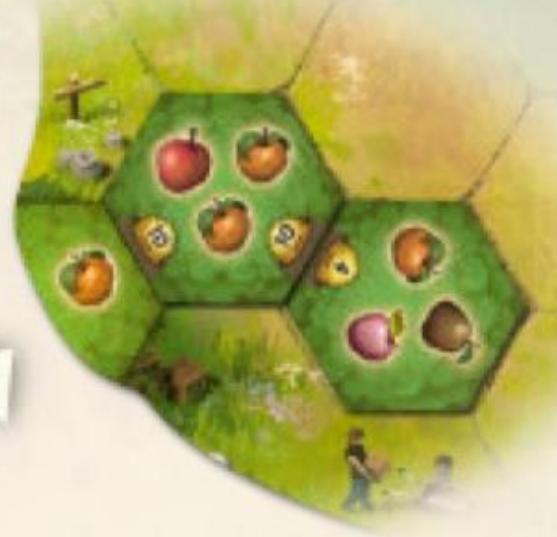


在游戏开始时,将额外一块板块放在苹果杰克的小屋右侧。
当你进行你回合时,你可以选择放置这块板块来代替凹槽或供应堆的板块。

单人规则
对于单人游戏,你需要一块收获版图。作为一个特殊功能,它在版图的中间有一个区域。你从14份蜂蜜开始。(暂时)只给七个槽配备一块树板块,而不是两个树板块。另外,在平面图中间空间旁边的三棵预印好的树之一上放置一个树板块。
你按照多人游戏的规则进行游戏,但有以下例外:如果你将骰子移动到平面图中间的区域,你将立即收到树上公开可见的蜂蜜符号数量的蜂蜜。您现在可以选择收获版图上的一个树板块。如果您只有一个或没有树板块可供选择,您可以立即填充收获版图,直到总共有两个树板块为止。否则,您可以像填充凹槽一样填充版图(使用1个树块),但此处最多可以容纳3块树板块。
游戏期间没有花朵评分。游戏结束时与多人游戏类似:骰子显示点数 3,并已到达游戏区域(平面图中间的区域)的末尾。你的果园已经满了。
像多人游戏那样进行最终计分,包括花朵计分。
你的目标是收集 65 蜂蜜(如果你甚至收集了 80 蜂蜜,这可以被评为一个出色的结果。与多人游戏中一样,你收到的蜂蜜更少,因为你的收获和花朵得分更少。)
你可以在单人游戏中使用所有可选规则(独特果园,苹果板块,额外树板块)
如果所有 3 个预印的树区域都是空的,当你到达版图中间区域时,你会立即收到 3 蜂蜜(公开可见的蜂蜜符号)。然后,用 2 块树板块将版图填满。
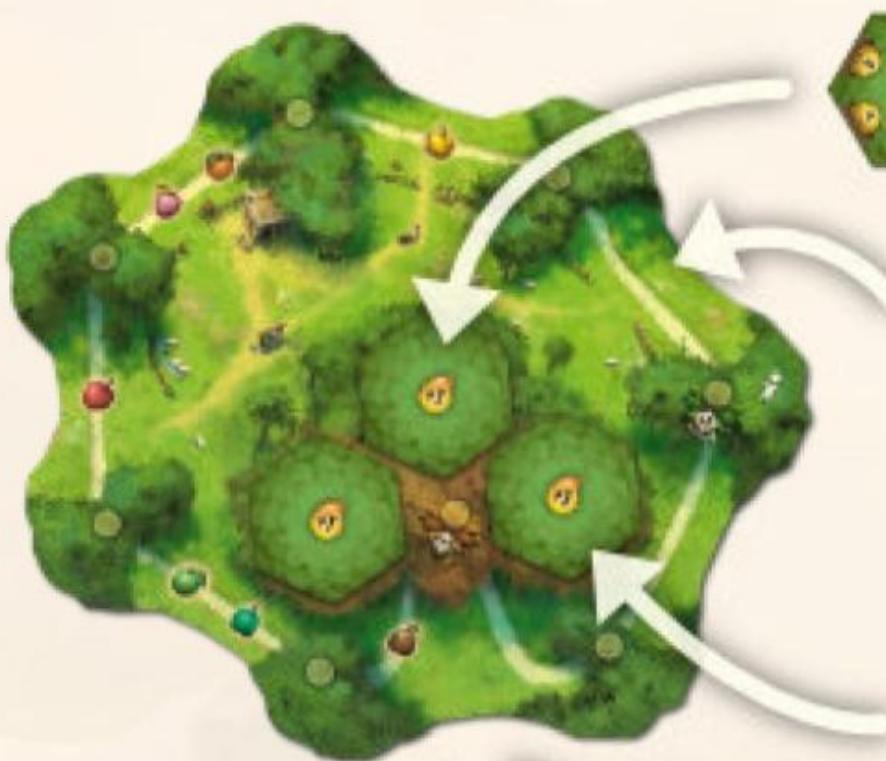

在单人游戏中,游戏过程中是没有花朵奖励的。这就是为什么这块收获版图上没有预印桥和花朵符号。
在单人游戏中你在第 2 回合和第 4 回合可以从这个凹槽选择。
在战役中,您在游戏开始时将保存的树板块放置在树上,而不是通常放置的树板块。
战役
你在连续 4 局游戏中进行此战役。第一局游戏结束后,你可以保留一块树板块,放置在果园中,供下一局游戏使用。在第二局游戏后,你可以保留其中的两个树板块,最后在第三局游戏后为第四局游戏保留三个树板块。保存的树板块在不同的游戏中不必相同。因此,你在第一局游戏后选择的树板块可能与你在第二局游戏后所选择的两个树板块不同。
在战役下一局游戏开始时,将你保存的树板块放在预印的树上,靠近版图中间区域(而不是随机树板块!)在第四局游戏开始时,所有预印的树都会被你选择的树牌填充。虽然你只会把它们都放在你的果园里,但如果你总是在骰子到达版图中间区域时选择其中一个树板块,那么在你最后一回合中选择第三个。
苹果的简短历史
我们所知道的苹果是果园苹果。它属于玫瑰植物的大家族,因此不仅与玫瑰有关,还与草莓、樱桃、李子、杏仁和梨有关。(不幸的是,德语中把苹果和梨作比较的说法在这里并不适用,因为说英语的人更喜欢把苹果和橙子作比较。)
最初,苹果可能来自亚洲,可以追溯到亚洲野生苹果。在今天的哈萨克斯坦地区,人们肯定在几千年前第一次种植了它。事实上,哈萨克城市阿拉木图的名字包含了“苹果”的哈萨克语“阿拉木图”。据说,直到罗马人,苹果树和水果种植才来到西欧。
顺便说一句,在拉丁语中,罗马人将苹果称为“malus”,意思是“邪恶”或“邪恶水果”。这可能与苹果在某些故事中的坏名声有关。因此,据说希腊女神厄里斯向女神赫拉、雅典娜和阿芙罗狄蒂扔下了所谓的“不和之苹果”,上面刻着“献给最美丽的女神”字样。年轻人帕里斯不得不决定三位女神随后的争吵。他选择了爱的女神阿芙罗狄蒂,随后在阿芙罗迪蒂的帮助下绑架了海伦,海伦也很漂亮,但却是另一个男人的妻子和他的掌上明珠,并引发了特洛伊战争。当然,《圣经》也(据说)为苹果树立了一座不受欢迎的纪念碑,因为亚当和夏娃非法吃了知识树上的苹果。让我们忽略这样一个事实:圣经只提到一种水果。谁不相信美味的苹果值得扔出天堂?
由于杂交和精加工,现在有数千种不同类型的苹果,从亚伯兰苹果到佐哈尔绿苹果。对于多品种树或家谱树,通常有三到四种品种在一棵树的枝条上成熟。是的,在德国的石勒苏益格-荷尔斯坦有一棵自豪的树,树上有100多种不同类型的苹果!然而,这种多样性在世界各地经历了一段艰难的时期,并有消失的危险。
今天,人们再次尝试保存这种品种繁多的苹果。除其他外,草地果园的创建也有助于实现这一目标。树木可以而且应该被允许在上面生长。明确要求多样化,最好具有地区特色。其中所含的草地起着重要作用。草本和草在这里茁壮成长,它为许多动物提供了家园:首先是为果树授粉的蜜蜂。谈到动物游客:除了提取干草外,果园还用于畜牧业。羊是最合适的,因为它看起来比牛或马更安静(对地面的负担更少),但声音大得足以赶走田鼠。此外,它的粪便价值连城,因为它可以作为天然肥料,吸引昆虫,而昆虫又吸引鸟类,幸好鸟类会吃掉一些树木害虫……
但是,这个苹果杰克到底是谁呢?
答案是在美国找到的。那里的殖民者制作了一种苹果白兰地,在一段时间内非常流行。为此,他们将新发酵的苹果酒放在寒冷的室外过冬。水冻成了冰,被敲掉了。一种酒精含量大大增加的饮料仍然存在。由于这种冰霜可能被称为“杰克”,他们也有一个合适的名字用于酿酒。但我们的苹果杰克,正如你在封面上看到的那样,更多的是一种不含酒精的苹果品尝剂。而这也符合那句老话。“一天一个苹果,医生远离你”。
1. 选取树板块 / 随机抓取树板块
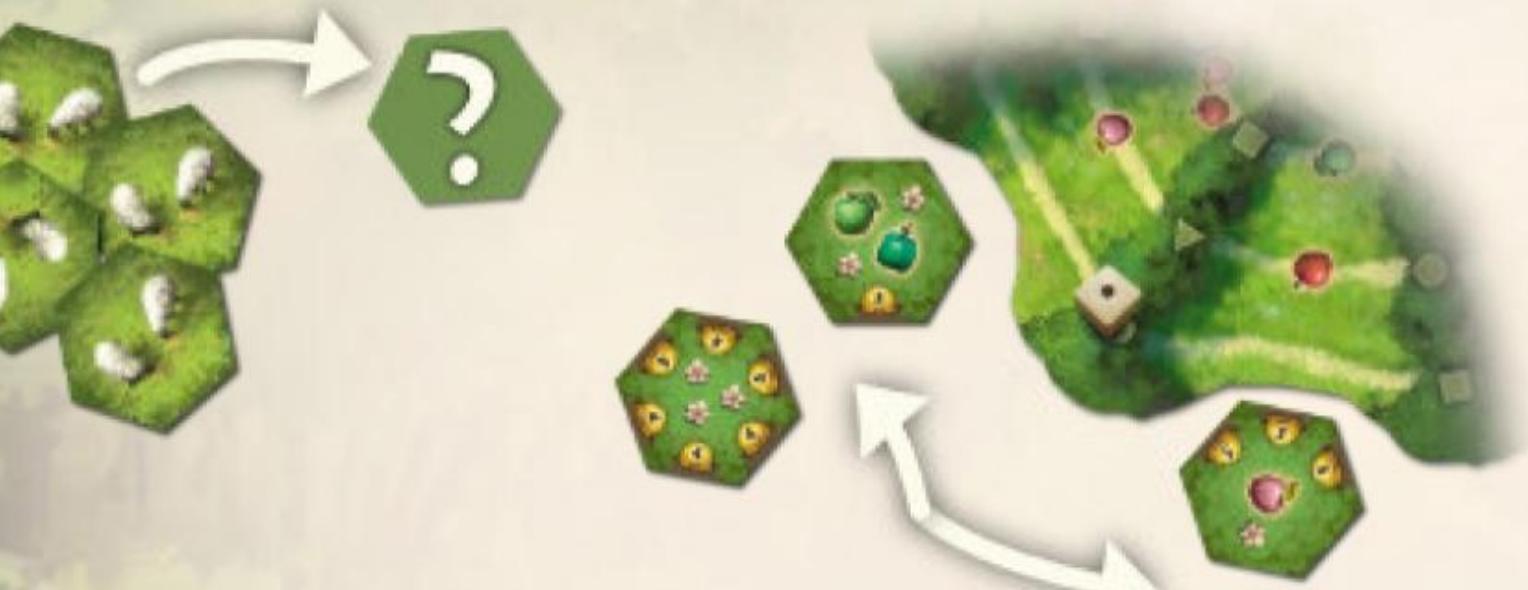
您可以在骰子旁边的两个槽中的所有板块之间进行选择。或者你可以随机从供应堆拿走一个。
2. 支付树板块的费用或者将其翻到牧草地面

树板块的购买价格由一个蜂蜜上的数值决定,无论该板块上有多少个,都只需支付一个数值的蜂蜜。
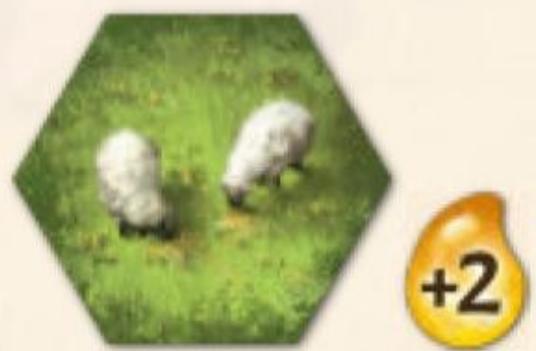
如果你将树板块翻到牧草地面,你将立即获得 2 蜂蜜。
2. 支付树板块的费用或者将其翻到牧草地面

你可以将树板块放到你果园上的任意空置格。刚放置的板块无需与已存在的树板块相邻。

© 2022 The Game Builders,
Ostendorf 7, 48612 Horstmar
www.gamebuilders.de
Realisation: The Game Builders
合概述
4. 收集蜂蜜奖励

每当你因为放置板块而连接 2 块板块时,你获得所连接 2 个数值中较小数值的蜂蜜。

5. 移动苹果杰克
沿着路径移动骰子。当骰子越过浅绿色并越过红色苹果时,你首先收获浅绿色苹果品种,然后收获红色苹果品种。

当骰子抵达这个区域。只有1块树板块在相邻2个凹槽内。立即从供应堆为每个凹槽补充1块板块,从跟随骰子的槽开始。所有板块都是树面朝上放置。
Design: Uwe Rosenberg
Arts: Lukas Siegmon
Layout: Björn Pollmeyer
Translation: Dirk Schröder
Distribution in Germany: Calderan, an Imprint of Kraterleuchten GmbH, Gartenstraße 3, 54550 Daun www.calderan.de
下载 Markdownapplejack-english-rulebook-update.md26.6 KB
AppLejack
Uwe RosenbergLukas Siegmon
WLAMDERS
There are several thousand different apple varieties in the world. In this game you will grow and harvest seven of them. In front of you is an orchard that you plant with apple trees that bear different numbers of fruits. Your goal is to grow and harvest as many apples of the same variety to collect for scoring during the harvest. At the same time, you want to combine beehives because without beehives there are no bees, and without bees there is no honey, and without honey there are no apples. Who is the best at combining these two tasks when laying the tiles?
Thanks to all, who tested Applejack!
Known to us are: Birgit Acker, David Bendfeld, Erica Caraça, Israel Cendrero, Michael Fuchs, Gerrit Gericke, Alva Hanson, Leif Hanson, Raimundo Henriques, Stefan Kalveram, Mike Keller, Jannick Keskenti, Julian Keskenti, Roman Keskenti, Carsten Lassmann, Martina Lassmann, Citie Lo, Raquel Raimundo, Björn Reinartz, Felix Potthast, Sheila Santos, Elke Schwarz, Christian Seidel, Karthik Setty, Lukas Siegmon, Julian Steindorfer, Christian Töööörner, Marco Vicente Suzan Vissering and Eerko Vissering.
Special thanks for their support go to:
Carsten Burak, Michael Bonet, Volker Nattermann, Dirk Schröder and Karina Weening.
The game material

The player with the most honey wins the game. You will collect honey by skillfully placing tree tiles in your orchard and through
regular apple harvests. After 19 turns each player will have a full orchard and will participate in final scoring.

Game Setup
We will first explain the game to you for 2 to 4 players. The solo rules can be found on page 1o.
Orchards
Each of you gets an orchard. Place it in front of you with the A-side up. Excess orchards are not needed and are taken out of the game. The beehives in the corners of the A-side have the same values on all orchards. The B-side is only needed for the variant »Individual Orchards«.

Initial honey

Determine randomly who starts the game. This player starts with 16 honey in their personal supply In a game for two, the second player receives 2o honey. In a game for three players, the second player receives 19 and the third receives 22 honey. (See example on the right.) In a game of four players, the second player receives 18, the third receives 2o, and the fourth receives 22 honey.


Honey
Spread the honey chips unsorted on the side of your playing area.


Harvest board and die Put the harvest board matching the number of players in the middle of the table. Turn the die to 1 and place it on the starting space:

Tree tiles
Shuffle the tree tiles and place them pasture side up in reach of all players. They form the general supply.
Now from this supply place 2 revealed (tree side up) tiles each in the seven troughs of the harvest board.

How to play the game
Each player takes a complete turn in clockwise order. The player order does not change during the game. You can always tell wether it's your turn by the space on which the die is currently located.
Your turn
Your turn consists of 5 steps that you perform one after the other:
1. Select a tree tile or draw blindly
Look at the space with the die. You choose ı tree tile that is located in one of the two troughs next to this space. Alternatively, you can take a hidden tree tile from the general supply. You must take a turn and cannot pass.
Note: During the die's first cycle around the board, it is still obvious which »both troughs« the die is adjacent to. Gradually, the die moves further to the inside of the harvest board. Follow the tree lines to the edge of the board to make sure you are choosing tree tiles from the correct troughs. The trees are illustrated in a straight line, even if they are not connected by lines.

2. Pay for the tree tile or turn it on the pasture side
In order to place a tile with its tree side facing up in step 3, you have to pay its price in honey now. The purchase price is indicated on the tile in the beehives. It is noted several times on many tiles. Pay the price as if it were only on the tile once. If you don't want to or can't pay the price, turn the tile to the pasture side. You then immediately receive 2 honey but have to place the tile with the pasture side up in step 3.
You have the choice between all the tiles that lie in the two troughs next to the space with the die. Alternatively, you can take one blindly from the supply.

The purchase price of a tree tile is indicated by the number in the beehives (5), no matter how often the number is present there.

If you turn a tree tile to the pasture side, you will immediately receive 2 honey. However, the tile offers no further advantages for you.
3. Placing the tree tile
Place the newly acquired tree tile on any free field in your orchard. Tree tiles do not have to be placed next to existing tree tiles.
4. Collecting honey reward
Check the edges of the newly placed tile. See if you connected two beehives. Then immediately receive the lower of the two numerical values in honey. Occasionally, when you lay a tree tile, you may have connected multiple beehives. In this case you get the lower number of each connection in honey! In the corners of your orchard you will also find beehives with numbers in it. You can use these - just like the ones on your tiles - to make beehive connections.
5. Move the Applejack
Move the die clockwise by one position on the harvest board. Keep the following in mind:
Harvesting: If you cross one or two of the apples when moving the die, interrupt the game briefly. Each of you will then receive honey for apples of certain varieties (see »The harvests«).
Replenishment: If the die only provides a maximum ofı tree tile to choose from in the two troughs that are next to it after moving, then please add exactly 1 new tree tile to each of the seven troughs. Start with the trough which follows the die clockwise. There is no limit to how many apple tiles may lay in any single trough.
New circulation: If the die is on the innermost space of the harvest board at the end of a turn, please move it back to the starting space across the bridge. Perform a blossom scoring then (see »The blossom scoring«). The blossom symbol on the harvest board reminds you of this special scoring. Finally turn the die one pip higher.


You can place the tree tile on any free field of your orchard. Tree tiles do not have to be placed next to existing tree tiles.
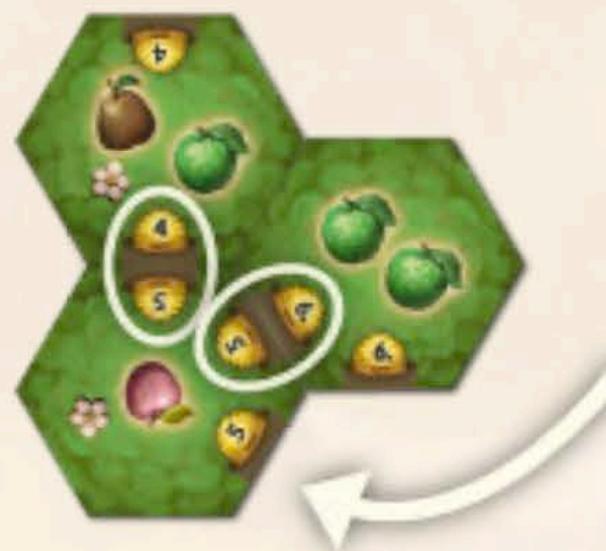
Whenever you connect two beehives when laying a tree tile, you receive the lower number of the two connected beehives in honey. In the example to the left you receive 4+5=9 honey.


The die moves first over the light green and then over the red apple. You first harvest (see p. 6) the light green apple variety. Then you carry out a harvest for the red apple variety.

When the die has reached the innermost space of the harvest plan move it back to the starting space across the bridge, then perform a blossom scoring and afterwards turn the die one pip higher.
When the die reaches the -space, there is only 1 tree tile left in the two neighbouring troughs. Immediately fill each trough with a tile from the supply, starting with the trough following the die. All tiles are placed with the tree side up.
The harvests
Whenever the die crosses one or two of the apples when moving along the harvest board, all players collect honey. The colour of the apple shows you which kind of apple is ripe for harvest. If two colours are shown, both varieties are harvested separately, one after the other.
This is how you determine the crop yield:
Look at the tree tiles on your harvest board that match the harvest. If these tiles are connected, they form an area. An area may consist of only one tile. In each of these areas, add up all the apples of the variety that is harvested. Subtract the number of pips on the die from the sum. If you are above zero, you will immediately receive the result in honey. If you are below or equal to zero, nothing happens; you do not have to pay a penalty!

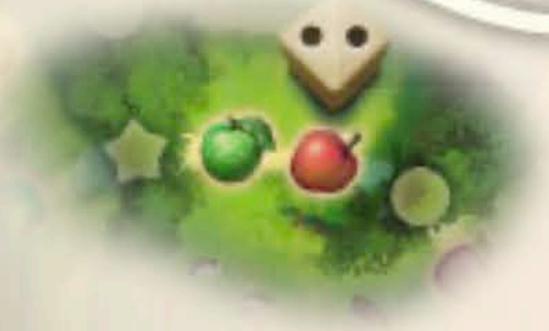

It's the second journey of the die: You harvest the red apples. The 3 red apples each lie on adjacent tree tiles and form an area. So you count 3 red apples and subtract the number of pips on the die (2). You will receive 1 honey as your crop yield.
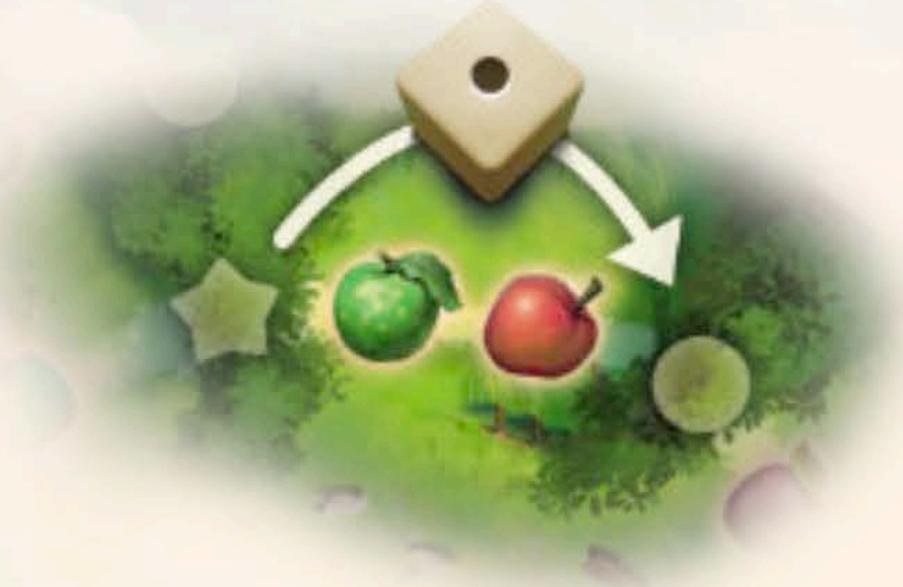
The die moves over the light green and then over the red apple. You first harvest the light green apple variety. Then you carry out a harvest for the red apple variety.

You harvest the light green apples. You have two areas where tiles with these apples are connected. You count 2 light green apples on the top and 3 light green apples on the bottom. From this you subtract the number of pips of the die (1) from each area. You will receive 1 honey from the top and 2 honey from the bottom, totaling 3 honey as your crop yield.

If there was a light green apple shown on this tile you could have harvested 6 apples in the area. So, your crop yield would have been 5 honey after subtracting the pips from the die.
The blossom scoring
The die will travel back to the starting space across the bridge twice during the course of play. Each time this happens carry out blossom scoring; once during the first loop and twice during the second one according to the number of pips showing on the die. This means that each of you gets paid as much honey as you have blossoms on your tree tiles. The blossoms do not have to be adjacent and form contiguous areas as the apples! You also do not subtract the number of pips of the die.

The die moves across the bridge back onto the starting space and passes the blossom symbol. You score the blossoms. You do this twice because the die shows two pips.
After blossom scoring, turn the die one pip higher.
From time to time during the first time the die circles around the plan, you will be in a situation that you can't afford a tile which you want to buy. In such a situation you will have to decide in which direction you want to develop your orchard. After the first blossom scoring this isn't so much of a problem anymore. You are more and more able to afford the tree tiles you want to have. So you can fill your orchard in the way you have chosen before without a lack of honey.

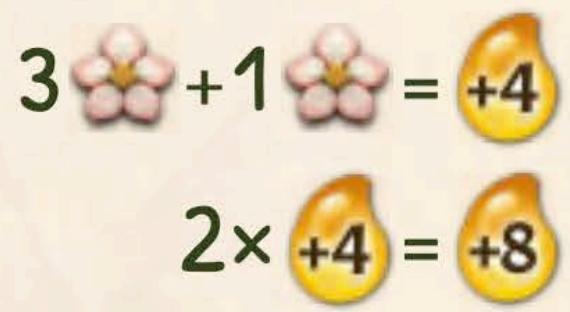
All blossoms (3+1=4) are counted, even if they are not connected. The number of pips of the die is not subtracted. You receive 4 honey. When you carry out the blossom scoring twice as the example above shows, you receive 4 honey twice, totaling 8 honey.
End of the game
The game is over as soon as all players have completely filled their orchard. The die shows 3 pips on it and has reached the space with the autumn leaves (end of the game space).
Now perform final scoring, as shown in the example on the next page. Please use the score pad as an aid. The player who has the most honey wins. In the event of a tie, there are several winners.
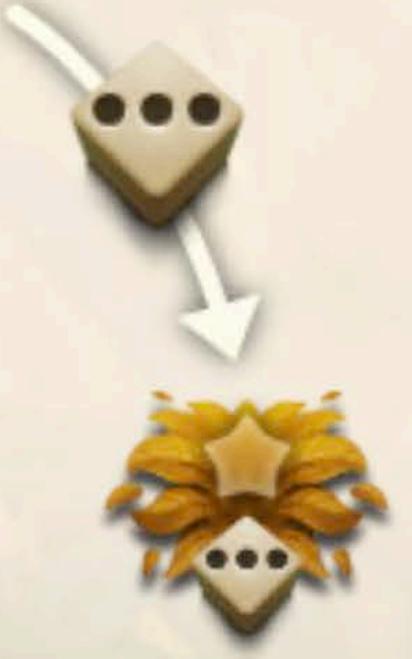
If the die shows three pips and reaches the end of the game space with the autumn leaves, the last player takes their final turn. After that, the game ends.
The special symbol of the end of the game space helps you to recognise when the game ends during the third time the die circles the board. There is no further meaning of this symbol.
The final scoring
- During the final harvest, each apple variety is harvested again from brown to yellow. You subtract the number of pips of the die (-3).
$$
{ \begin{array} { r c l } { 5 } & { 0 } & { - \nabla } & { = } & { { \binom { 2 } { 2 } } } \ { 5 } & { 0 } & { - \nabla } & { = } & { { \binom { 2 } { 2 } } } \ { 1 } & { 0 } & { - \nabla } & { = } & { \mathsf { n o x a n g } } \ { 6 } & { \theta } & { - \nabla } & { = } & { { \binom { 2 } { 3 } } } \ { 1 1 } & { \nabla } & { - \nabla } & { = } & { { \binom { 2 } { 3 } } } \ { 6 } & { 0 } & { - \nabla } & { = } & { { \binom { 2 } { 3 } } } \ { 1 } & { \partial } & { - \nabla } & { = } & { \mathsf { n o x a n g } } \end{array} }
$$
- Bonus for varieties. For $4 / 5 / 6 / 7$ different apple varieties that were profitable (meaning you scored at least one honey) in the final harvest you will receive 4/11/21/35 additional honey. In the example, all varieties except light green and yellow yielded at least one honey, granting you 11 honey as a bonus for 5 different varieties.

- Now double the crop yield of the last harvest. In the example the crop yield is 18 and doubled to 36 honey for your final scoring.

Note:
You must have at least 4 contiguous apples of a variety to make it profitable in the final harvest and count for the variety bonus scoring!
- Last blossom scoring. For each blossom on your tree tiles you receive 1 honey. In the example you receive 12 honey.

- Honey in the supply. Now add the honey in your personal supply to the final result.

Optional rules
Individual orchards
You play with the back sides (side B) of the orchards, which are all different. Instead of only beehives, you will also find apples in the corners, which you can connect with neighbouring tree tiles and count as an apple of the respective colour during harvests.
Apple tiles
You can use the 7 apple tiles (at random or not) to cover the first 7 printed apples on the path of the harvest plan (see example). So you can change the order of the first 7 harvests.
Additional tree tile
In the right corner of your orchard plan you see Applejack's cottage. At the beginning of the game place 1 additional tree tile from the supply right beside it, tree side up. When it's your turn to select a tree tile you are allowed to select this tile instead of a tile from the troughs or a tile blindly drawn. Pay for the tile as usual or turn it onto the pasture side and place it in your orchard. Then, immediately take a new tile from the trough adjacent to the die or draw from the supply. Place this tile next to Applejack's cottage. This give you a chance to »store« a tree tile from the troughs for a later turn that you won't or can't pay for yet.
The orange apple in the corner of the orchard may also be harvested. Here you would count 4 orange apples during a harvest.

When using the apple tiles you change the order of the first 7 harvests of the path: In this example you start with the harvest of the pink apples instead of the brown ones.


At the beginning of the game place here right beside Applejack's cottage an additional tile.
When it's your turn, you may choose to place this tile and replace it with a tile from the trough or the supply.
Solo rules
For the solo game you need the-harvest board. As a special feature, it has a space in the middle of the board. You start with 14 honey. Only equip the seven troughs (for the time being) with 1 tree tile each instead of 2 tree tiles. Also place a tree tile on one of the three pre-printed trees next to the space in the middle of the plan.
You play by the rules of the multiplayer game with these exceptions: If you move the die to the space in the middle of the plan, you will immediately receive honey in the amount of the openly visible honey symbols on the trees. You may now choose one of the tree tiles on the harvest board. If you have only one or no tree tiles to choose from, you immediately fill up the harvest board until there are 2 tree tiles total. Otherwise, you fill up the board like the troughs (with 1 tree tile), but a maximum of three tree tiles can be accommodated here.
There are no blossom scorings during the course of the game. The game ends like in the multiplayer game: The die shows the value 3 and has reached the end of the game space (the space in the middle of the plan). Your orchard is completely filled.
Perform the final scoring in the same way as in the multiplayer game, including a blossom scoring.
Your goal is to collect 65 honey. (If you even collect 8o honey, this can be rated as an outstanding result. You receive fewer honey as in the multiplayer game because you will have less harvests and blossom sco– rings.)
You may use all the optional rules (»Individual orchard«, »Apple tiles« and »Additional tree tile«) in the solo game.
If all three pre-printed trees are empty, when you reach the space in the middle of the board, you immediately receive 3 honey (the openly visible honey symbols). After that fill up the board with exactly 2 tree tiles.
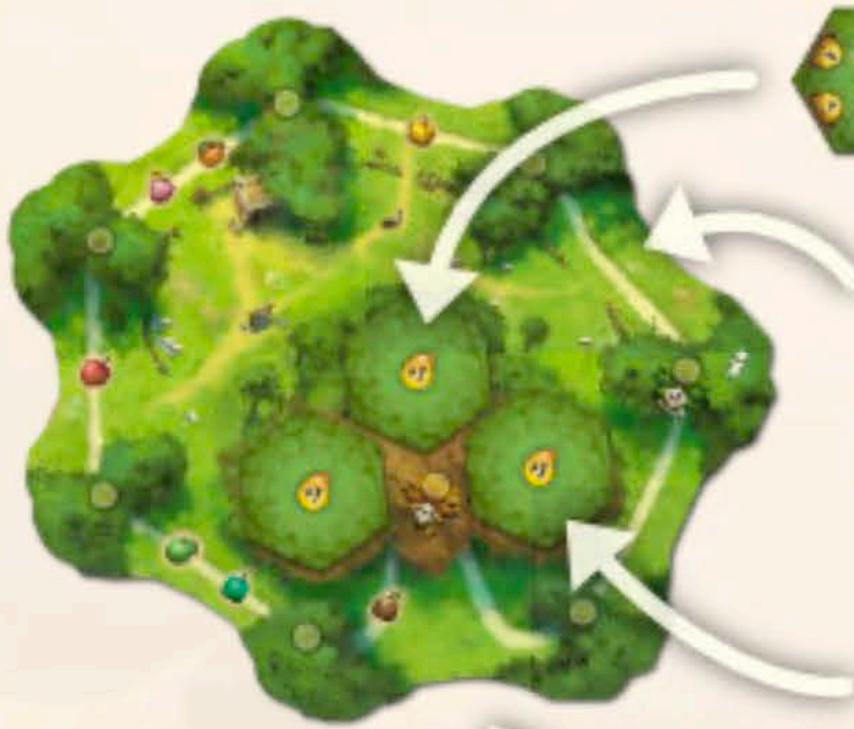

In the solo game there are no blossom scorings during the course of the game. That's why there is no bridge and no blossom symbol printed on this harvest board.
In the solo game you may select from this trough in turn 2 and turn 4.
In the campaign you place the saved tree tiles on the trees at the beginning of the game, instead of the normally placed tree tile.
Campaign
You play the campaign over 4 consecutive games. After the first game you can keep 1 of the tree tiles, which you placed on your orchard, for the next game. After the second game you can keep 2 of these tiles and finally you keep 3 tiles after the third game for the fourth one. Saved tree tiles need not be the same from game to game. So the tile which you choose after the first game may be different from the 2 tiles which you choose after the second game.
At the beginning of the next game of a campaign place your saved tree tiles on the pre-printed trees next to the space in the middle of the board (instead of the random tree tile!) At the beginning of the fourth game all pre-printed trees are filled with your chosen tree tiles. Though you will only place them all on your orchard, if you always select one of these tree tiles when the die reaches the space in the middle of the board, the third one in your very last turn.
A short history of the apple
The apple as we know it is the orchard apple. It belongs to the large family of rose plants and is therefore not only related to the roses, but also to strawberries, cherries, plums, almonds and pears. (Unfortunately the German saying of comparing apples with pears does not work here as English speakers prefer to compare apples with oranges.)
Originally, the apple probably comes from Asia and can be traced back to the Asian wild apple. In the area of today's Kazakhstan, people must have cultivated it for the first time a few thousand years ago. In fact, the name of the Kazakh city of Almaty contains the Kazakh word for apple »Alma«. It is not until the Romans that apple tree and fruit cultivation are said to have come to Western Europe.
By the way, in their language, Latin, the Romans called or better scolded the apple »malus« meaning »evil« or »evil fruit«. This may be related to the bad reputation the apple enjoys in some stories. Thus, the Greek goddess Eris is said to have thrown the socalled apple of discord between the goddesses Hera, Athena and Aphrodite, marked with the inscription »For the most beautiful«. The young man Paris had to decide the subsequent quarrel of the three goddesses. He chose the goddess of love, Aphrodite, and was afterwards helped by Aphrodite to kidnap Helen, who was also very beautiful but another man's wife and apple of his eye and triggered the Trojan War. Of course, the Bible has also (supposedly)set an unedifying monument to the apple, since Adam and Eve illegally ate an apple from the tree of knowledge. Let us ignore the fact that the Bible only speaks of a »fruit«. Who doesn't believe that a tasty apple is worth being thrown out of paradise?
Due to interbreeding and finishing today, there are several thousand different types of apples, from the Abram apple to the Zohar
Greening. And with multi-variety trees or family trees it is quite common for three or four of these varieties to ripen on the branches of only one tree. Yes, there are tales of a proud tree in Schleswig-Holstein, Germany, that carries more than 1oo different types of apples! However, this diversity has had a hard time all over the world and has threatened to disappear.
Today attempts are being made again to preserve this wide variety of apples. Among other things, the creation of meadow orchards contributes to this. The trees may and should be allowed to grow out on it. Variety is expressly desired, preferably with a regional touch. And the meadow contained plays an important role. Herbs and grasses thrive on it and it offers many animals a home: first and foremost the bees that pollinate the fruit trees. Speaking of animal visitors: In addition to hay extraction, orchards are used for livestock farming. The sheep is most suitable because it appears quieter than cattle or horses (which burdens the ground less), but loud enough to drive away voles. In addition, its dung is worth its weight in gold as it serves as a natural fertiliser and attracts insects, which in turn attract birds, which thankfully eat some tree pests..
But who the heck is this Applejack?
The answer is found in the USA. The colonial settlers there made an apple brandy that was very popular for a while. For this, they left freshly fermented cider outside in the cold over the winter. The water froze into ice and was knocked off. A drink with a greatly increased alcohol content remained.Since this frosting was probably called »jacking«, they also had a suitable name for the brewage. But our Applejack, as you can see on the cover, is more a non-alcoholic taster of apples. And that fits the old saying: »An apple a day keeps the doctor away«.
Turn overview
1. Select tree tile/draw blindly

You have the choice between all the tiles that sit in the two troughs next to the space with the die. Or you can take one blindly from the supply.
4. Collecting honey reward

Whenever you connect two beehives when placing a tree tile, you receive the lower number of the two connected numbers in honey.

2. Pay for the tree tile or turn it on its pasture side
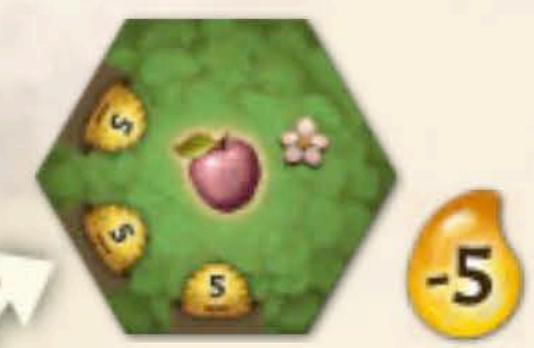

The purchase price of a tree tile is indicated by the number in the beehives (5), no matter how often the number is present there.
If you turn a tree tile on the pasture side, you will immediately receive 2 honey.
3. Placing the tree tile
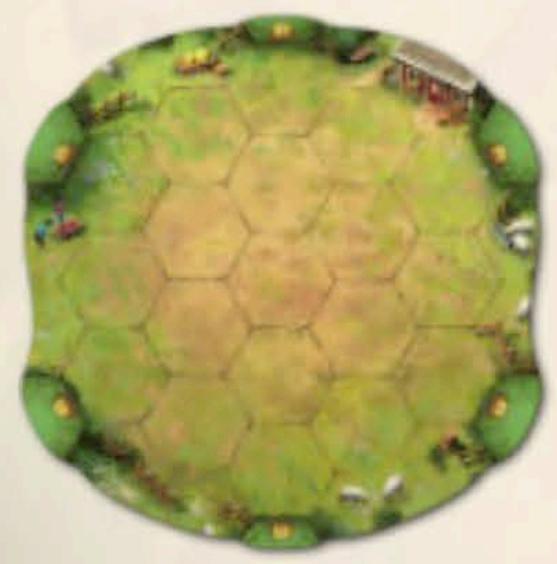
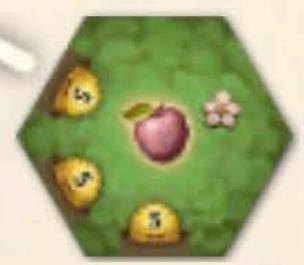
You can place the tree tile on any free field of your orchard. There is no need to place it next to an existing tree tile.

© 2022 The Game Builders, Ostendorf 7, 48612 Horstmar www.gamebuilders.de Realisation: The Game Builders
5. Move the Applejack
Move the die along the path. When the die moves over the light green and then over the red apple you first harvest the light green apple variety, then you harvest the red apple variety.
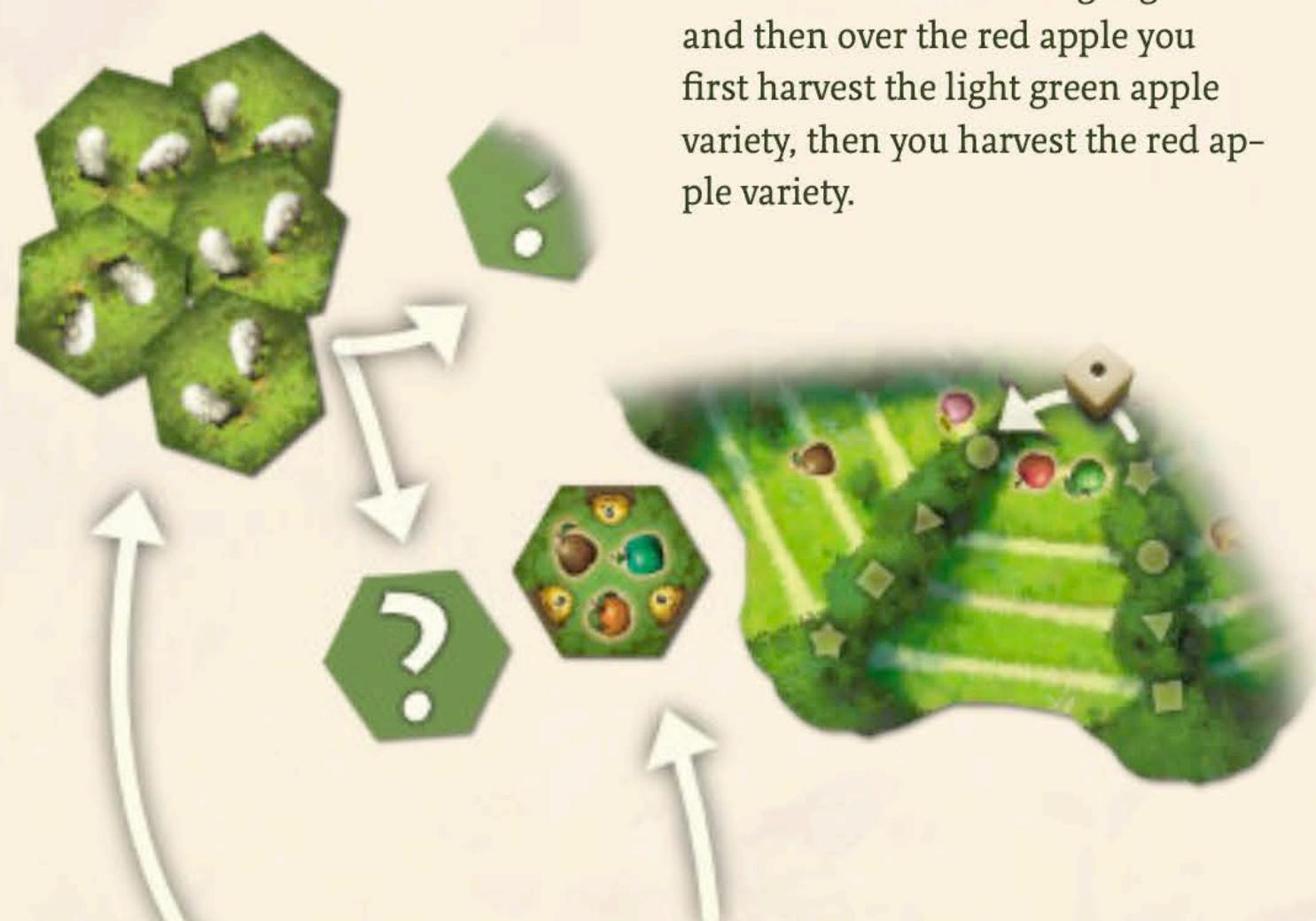
When the die reaches the-space and there is only 1 tree tile left in the two neighbouring troughs, immediately fill each trough with a tile from the supply, starting with the trough following the die.
Design: Uwe Rosenberg Arts: Lukas Siegmon Layout: Björn Pollmeyer Translation: Dirk Schröder
Distribution in Germany: Calderan, an Imprint of Kraterleuchten GmbH, Gartenstraße 3, 5455o Daun www.calderan.de
下载 Markdown原文为社区整理/出版社公开资料,版权归原作者,仅供个人学习查阅。