
BazaarBazaar
一句话概览
Bazaar 是一款已收录于村了吗规则库的桌游,支持 2–6 人,原名 Bazaar。
本页内容:一句话概览 · 常见问题
这游戏怎么玩
- 本站已收录这款游戏的规则资料,可以在对话里直接提问规则细节。
常见问题(FAQ)
以下 1 条问答中 0 条来自站内玩家的真实提问,其余 1 条为本站整理的常见疑问;答复内容保持原样。
Bazaar支持几个人玩?
2–6 人。
去哪查完整规则
想核对具体规则细节、卡牌效果或某个回合的结算方式,可以在村了吗里选中这款游戏后直接提问。
同类桌游
- 卡坦岛德式
- 工业革命:伯明翰德式
- 勃艮第城堡:特别典藏版德式
- 方舟动物园德式
- 卡卡颂抽象
- 瘟疫危机传承:第一季美式
- 阿瑞迪亚:勇踏征途美式
- 重塑宇宙德式
- 幽港迷城美式
- 埃多拉的德鲁伊德式
规则原文(Markdown)
本站收录这款游戏的规则原文 1 个文件,此处内联渲染 1 个,可直接展开阅读或下载。
Bazaar Rules.md7.6 KB
Bazaar

30-45 A Sid Sackson Game
Object of the Game
Through skillful trading and re-trading, each player attempts to gain the right combination of colored stones from the Bank to purchase the wares displayed in the Bazaar. Values of the various wares are determined by the number of stones the purchaser holds following his transaction. Trading is governed by the current rates posted at the Exchange. When all the wares from two of the stalls have been sold, the Bazaar is closed, the game ends, and the player with the highest score wins!
Components

| ¥* | |||
| 3 or more | 1 | 2 | 3 |
| 2 | 2 | 3 | 5 |
| 1 | 3 | 5 | 8 |
| 0 | 5 | 8 | 12 |
6 Player Reference Cards
10 Exchange Cards

1 Special Die

100 Stones -- 20 in each of 5 colors

45 Ware Cards
Setup
Two of the Exchange Cards, selected at random, are placed face up on the table for all to see. This creates the Exchange. The ten equations shown on these two Exchange Cards are the current rates of exchange and they govern trading for the entire game. Players may use any of these ten equations when making a trade. The Ware Cards (the Wares) are mixed and dealt, face down, into four stacks of five cards each. These are the stalls of the Bazaar. The remaining Ware Cards are set aside, and they are not used in this particular game. The youngest player goes first and play proceeds clockwise. All of the stones are piled in a heap on the table within reach of all players. This heap of stones is the Bank.
Play
On his first turn, each player rolls the die and takes one stone of the color rolled. If "Choice" is rolled, any color stone may be chosen. On subsequent turns, each player may either roll the die for another stone or "trade" stones in his possession. Trading consists of returning the stones matching either side of an equation to the Bank and then taking the stones matching the other side of that equation. Only one trade may be made per turn.
EXAMPLE: A game is being played with Exchange Card 1 in play. On his first turn, a player rolls the die and obtains a red stone. On his next turn, he may trade the red stone to the Bank and take either 1 blue, 1 green, 1 yellow and 1 white stone or 2 white stones. Note: Later in the game, a player may use this same equation again and trade 2 white stones for a red stone.
Limit on Stones: At the end of his turn, a player may not have more than ten stones in his possession. During his

turn, he may have more than ten stones provided that he purchases a Ware Card and reduces the number of stones in his possession to ten or fewer before his turn ends. If it is discovered that a player has more than ten stones after his turn, the number is reduced to ten by the player to his left who chooses any of the excess stones and returns them to the Bank.
Purchasing Ware Cards
When a player (by trading and/or by rolling the die) has five stones in his possession that match the five stones pictured on one of the four Ware Cards on
display, he may, as part of his turn, purchase that Ware Card by paying (returning) these stones to the Bank.

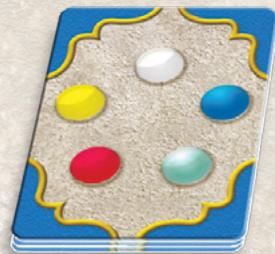
After taking the purchased Ware Card, the player's score is recorded (see Scoring). Note: A player must roll the die or trade before he may purchase a Ware Card on his turn. However, a player who is able
to purchase a Ware Card is not required to do so immediately. He may want to reduce his excess stones by trading, and thus increase his score. The risk is that if another player purchases this Ware Card in the meantime, the first player has lost his opportunity.
Scoring
| Icoring Point values of the various Ware | Gemstones Remaining | Point Value | ||
| Cards are determined by the number of stones the purchaser | 44 | |||
| holds following his transaction. These values are shown to the | 3 or more | 1 | 2 | 3 |
| right (and are found on the Player Reference Cards). | 2 | 2 | 3 | 5 |
| Thus, if a player purchases a | 1 | 3 | 5 | 8 |
| Ware Card which shows no star, and he has three stones | 0 | 5 | 8 | 12 |
remaining in his possession after this purchase, he is awarded one point. If he has no stones remaining, he is awarded five points. Use a pencil and paper to keep a running score for all players. Certain Ware Cards are marked with a star. These are worth more points when purchased. When these Ware Cards are purchased, refer to the column marked with a to determine values. Important: When all Ware Cards in one stack have been purchased, all subsequent Ware Cards purchased from the remaining stacks which have no stars are scored as if they had one star; and Ware Cards marked with one star are scored as double stars .
Ending the Game
As soon as all Ware Cards from two of the original four stacks have been sold, the Bazaar is closed and the game ends. The player with the highest score is the winner. In case of a tie for high score, the tying player with the least number of Ware Cards is the winner. If the number of Ware Cards is equal, the tying players share the victory!

Variants
Double Purchases
At the start of the game, players may agree to allow the purchase of two Ware Cards in one turn. The player making this double purchase must return five stones to the Bank for each Ware Card purchased. Wares are scored according to the number of stones remaining after the double purchase. If, after making a double purchase, one of the stacks is empty, the second Ware Card purchased is scored in the column. If one stack is empty and the player wishing to make a double purchase empties a second stack with his first purchase, the game is ended and the second purchase may not take place.
Solitaire
As an interesting and instructive pastime, choose two Exchange Cards and place one Ware Card face up. Trade and/or roll the die until the Ware Card is matched with no tokens remaining. If desired, a count may be kept of the number of turns it takes to accomplish this objective.
Use aTimer
If the pace of play is too slow, you might consider the use of a 6o-second sand timer or a stopwatch.
Gryphon

Designed by Sid Sackson
Developed by Rick Soued
Graphics by Pixel Productions Inc.
下载 Markdown原文为社区整理/出版社公开资料,版权归原作者,仅供个人学习查阅。