
Big PointsBig Points
一句话概览
Big Points 是一款已收录于村了吗规则库的桌游,支持 2–5 人,原名 Big Points。
本页内容:一句话概览 · 常见问题
这游戏怎么玩
- 本站已收录这款游戏的规则资料,可以在对话里直接提问规则细节。
常见问题(FAQ)
以下 1 条问答中 0 条来自站内玩家的真实提问,其余 1 条为本站整理的常见疑问;答复内容保持原样。
Big Points支持几个人玩?
2–5 人。
去哪查完整规则
想核对具体规则细节、卡牌效果或某个回合的结算方式,可以在村了吗里选中这款游戏后直接提问。
同类桌游
- 卡坦岛德式
- 工业革命:伯明翰德式
- 勃艮第城堡:特别典藏版德式
- 方舟动物园德式
- 卡卡颂抽象
- 瘟疫危机传承:第一季美式
- 阿瑞迪亚:勇踏征途美式
- 重塑宇宙德式
- 幽港迷城美式
- 埃多拉的德鲁伊德式
规则原文(Markdown)
本站收录这款游戏的规则原文 1 个文件,此处内联渲染 1 个,可直接展开阅读或下载。
BigPoints49002DFIGBNLE0.md4.9 KB
BigPoints
Material
� 60 wooden counters (10 blue, red, yellow, green, purple and 5 white and black)
� 5 playing pieces in the colours blue, red, yellow, green and purple
� 1 staircase
Aim of the game
Players move any playing piece onto the next counter of the same colour as the piece. They then collect the counter lying in front of or behind them. The value of the collected counters is determined
by the step of the staircase the playing pieces are standing on at the end of the game.
Before starting play please punch out the parts carefully and assemble the staircase as shown in the adjacent illustration.

Setting up the game
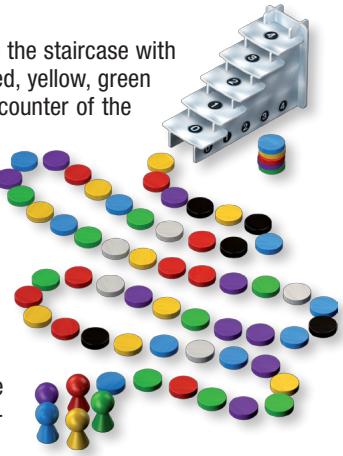
Make a pile of counters next to the staircase with one each of the colours blue, red, yellow, green and purple. (Players receive a counter of the
corresponding colour when the piece is moved onto the staircase.) The remaining counters (including white and black) are mixed and – starting from the steps – laid down as a pathway in any shape or form. The sequence of colours is irrelevant. The playing pieces are set up at the beginning of the pathway (illustration on right).
by Brigitte and Wolfgang Ditt for 2 to 5 players aged 8 years and up
How to play
A starting player is chosen, and then play continues in a clockwise direction. When it is a player’s turn he chooses any playing piece and moves it to the next counter with the same colour as the figure. Pieces may only be moved forwards, not backwards.
Then he removes a counter from the path. He can choose either the first empty counter in front of or behind his piece. Occupied counters may not be collected. Players keep their counters concealed in their hand until the game is over.
Example:
The player moves the blue piece to the next blue counter. Then he can either take the green counter in front of the blue piece or the black counter behind the purple piece.

Direction of play

� Note: If at the beginning of the game there is no empty counter behind the playing piece, the player must take the next empty counter in front of the piece. The same applies if a playing piece is moved to a counter in front of the staircase and there are no empty counters left in front of the piece. Then the player must take the last empty counter behind the piece.
If there is no counter in the figure’s colour left between the playing piece and the staircase, the piece is moved onto the staircase. It is placed on the highest empty step. The player may then take the counter of the same colour lying beside the staircase.
Black counters
Any black counters which are won can be used later for an additional move:
� A player can use a black counter to move another playing piece after finishing his move. He may move the same figure he has just moved, or any other piece. Afterwards he takes a coloured counter as described above. Then it is the next player’s turn.
� As an additional move (and only then) the player can move a piece backwards onto the next counter of the same colour.
It is not allowed to use more than one black counter during a turn. A black counter which has just been won may not be used immediately. The player has to wait until his next turn to use it.
The black counters handed in by the players are laid aside and do not re-enter the game.
End of play and scoring
The game ends immediately the last playing piece reaches the staircase. Now the scores are added up:
� Each counter gets the number of points written on the step where the figure of this colour is standing.
� Black counters count 0 points.
� Each white counter is worth the same number in points as the number of other different colours the player has collected.
Example:
At the end of the game the staircase is as illustrated.
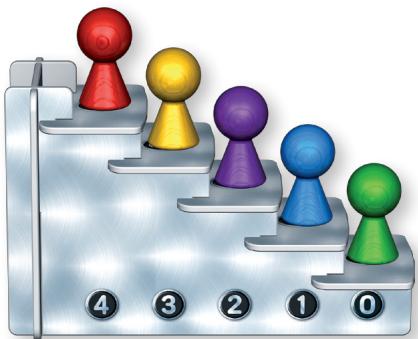
A player has the following counters at the end of the game:

Scoring:
2 x red (4 points) = 8 points
1 x purple (2 points) = 2 points
1 x green (0 points) = 0 points
1 x black (0 points) = 0 points
2 x white (in addition to white, the player has a further 4 colours, i.e. 4 points) = 8 points
Total 18 points
The player with the highest total score wins. In the event of a tie there are several winners.
Repeat rounds
The game is quickly played and so players will therefore likely want to carry on playing. One round is played for each player present, and in each game a different player starts. The points scored in each round are added up and the player with the highest total score wins. In the event of a tie there are several winners.
下载 Markdown原文为社区整理/出版社公开资料,版权归原作者,仅供个人学习查阅。