
黑帆Black Fleet
一句话概览
黑帆 是一款已收录于村了吗规则库的桌游,支持 3–4 人,原名 Black Fleet。
本页内容:一句话概览 · 常见问题
这游戏怎么玩
- 本站已收录这款游戏的规则资料,可以在对话里直接提问规则细节。
常见问题(FAQ)
以下 1 条问答中 0 条来自站内玩家的真实提问,其余 1 条为本站整理的常见疑问;答复内容保持原样。
黑帆支持几个人玩?
3–4 人。
去哪查完整规则
想核对具体规则细节、卡牌效果或某个回合的结算方式,可以在村了吗里选中这款游戏后直接提问。
同类桌游
- 卡坦岛德式
- 工业革命:伯明翰德式
- 勃艮第城堡:特别典藏版德式
- 方舟动物园德式
- 卡卡颂抽象
- 瘟疫危机传承:第一季美式
- 阿瑞迪亚:勇踏征途美式
- 重塑宇宙德式
- 幽港迷城美式
- 埃多拉的德鲁伊德式
规则原文(Markdown)
本站收录这款游戏的规则原文 1 个文件,此处内联渲染 1 个,可直接展开阅读或下载。
Black-fleet-rulebook.md18.1 KB
Black Fleel
Rulebook


merchant
pirate
navy ship
navy ship
You command a flotilla of ships on behalf of a nation in a far off corner of the Caribbean. Each turn, you will move your merchant ship, your pirate ship, and a navy ship to try and win doubloons. These riches will allow you to improve your ships and when your fleet is fully developed, you may pay the ransom of the governor's daughter to win the game.
Contents

1 board


10 ships (1 merchant and 1 pirate for each player, plus 2 navy ships)

65 goods cubes (13 goods of each color)

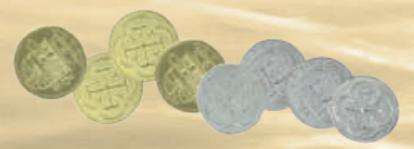
10 doubloons of value 5 (gold), 20 doubloons of value 1 (silver):
44 movement cards

44 fortune cards

24 development cards (with a numbered value on their back)


X 4 player identification cards (the backs of which complete the frieze of the development cards)
8 victory cards (4 with a 10 value on their back, 4 with a 20 value on their back).

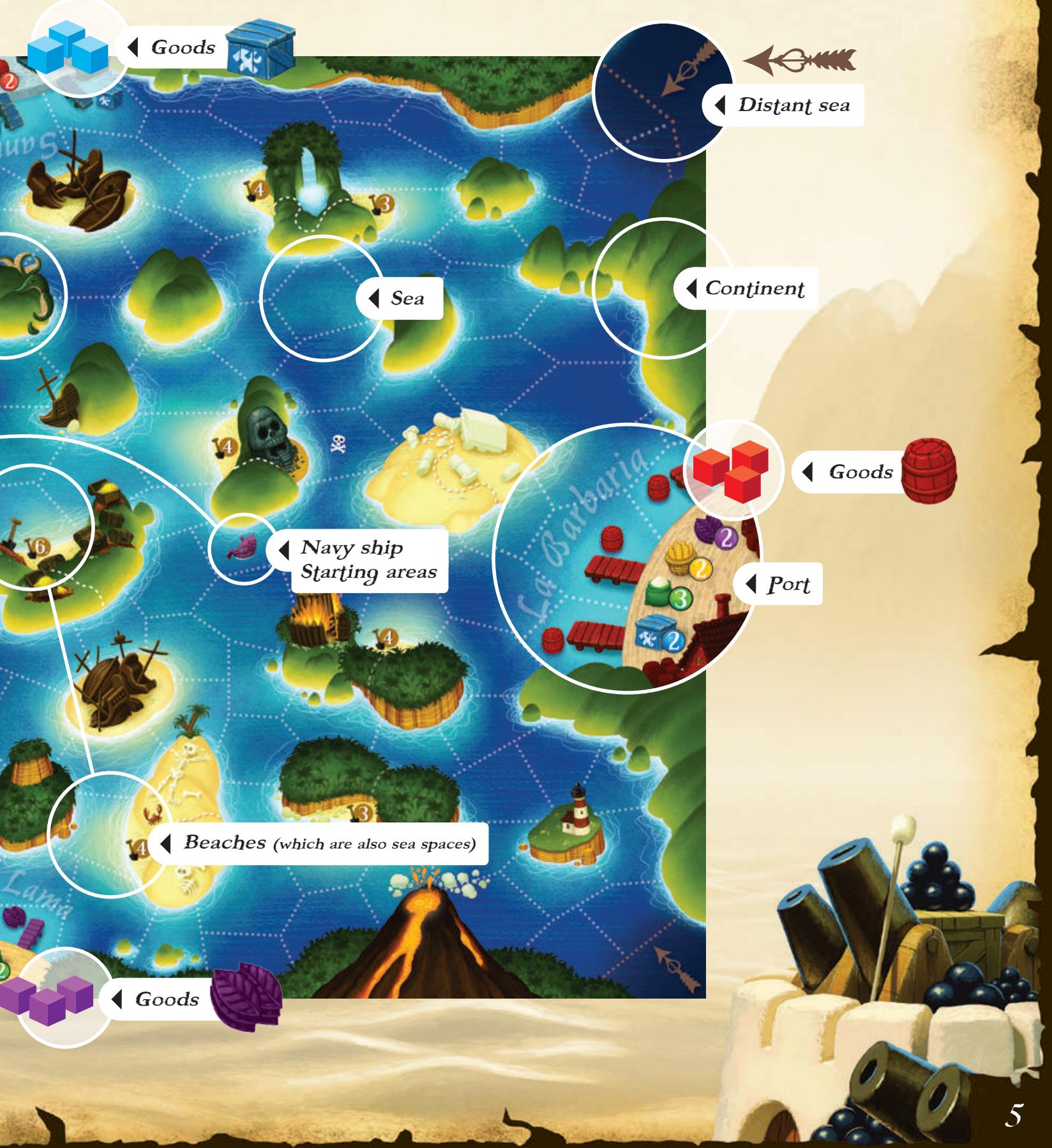
Place the board in the middle of the table. Place the two navy

ships in their starting areas and the goods in the appropriate ports.
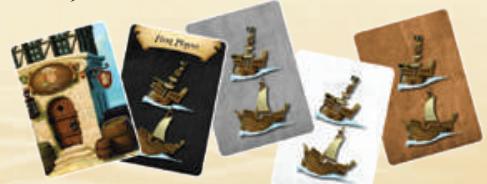
Separate the development cards into 4 decks of cards, each with the same number on their backs. Shuffle each deck and deal each player a card of each of the following values: 5, 8, 11, and 14. The extra cards are returned to the box. The players place the development cards in front of them, face-down, in increasing value from left to right. Players can look at their own development cards at any time. Players then place their victory card (the one with a value of 10 for the first game) to the right of their development cards. I

→ 1st player selection cards (which complete the display) are then dealt to each player and revealed. 1

→ Each player takes the ships matching the color of their card (a merchant able to hold 3 goods, and a pirate which can only hold one) and put these ships in front of them.
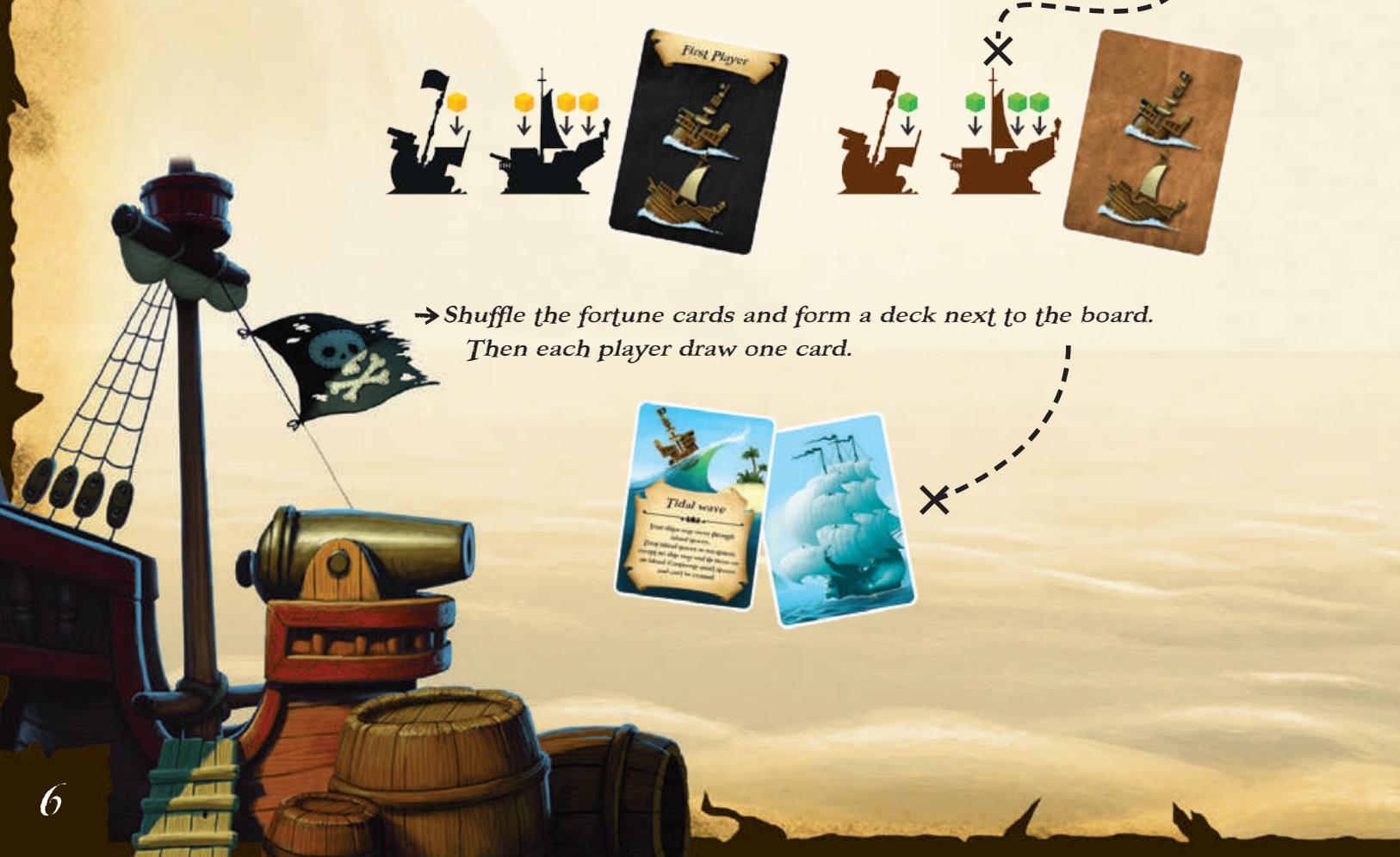
→ Shuffle the movement cards and deal 2 to each player. The other movement cards are shuffled into a deck next to the board.


→ The first player is always the one who has the black ships. Everyone will play the same number of turns (see end of the game).
The first player places his merchant ship on one of the three spaces adjacent to the port of his choice and loads 3 goods matching the port in question. The other players do the same going clockwise.

Once all the merchants are in play, the game can begin.
Pirate ships begin the game empty and out of the board. On their turn, each player moves their pirate ship into the board, starting from one of the distant sea zones.

Game Overview
The object of the game is to flip your victory card face-up by paying 10 doubloons.
→ First, you'll have to pay for and flip all of your development cards face-up.

→ You will earn doubloons by transporting goods to ports with your merchant, using your pirate to steal goods from opposing players' merchants, burying the stolen goods, and sending a navy ship to sink opposing pirates.
→ Moving to intercept and attack the other ships all the while avoiding your opponents to get your goods to port is the key to victory.
Turn Overview
The first player plays his turn, and then play continues clockwise. On your turn, you must resolve the following steps in this exact order:
→ Play a movement card;
→ Move your ships, perform actions, and sometimes play fortune cards;
→ Draw one movement card and sometimes one or more fortune cards;
→ If you choose so, pay for and flip a development/victory card face-up.
Play a movement card
The first thing to do is to choose one ofyour movement cards. The movement cards show four lines of information. We'll only consider the first three for now (the last one is used at the end of the turn).
→ Each of these lines represents a type of ship and a numbered value which indicates the corresponding movement capacity.


Draw two fortune cards
Play your ships
Once you have played your movement card, it's time to move your ships. You can also move one of the navy ships (the one shown on the card you've just played). Each ship can move a number of spaces ofyour choice, less than or equal to the value given on the line corresponding to it on the movement card.
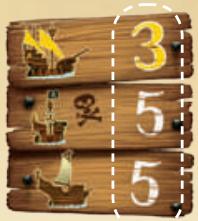
Ships can only move on sea spaces. They can move through friendly ships, but not through those belonging to opponents.
→ Friendly ships are: your pirate, your merchant and the navy ship(s) you can move on your turn. A ship can never end its movement on the same space as another ship.
→ A ship can only perform A SINGLE ACTION on its turn.
Important: you may move your ships in an order of your choice, which is not necessarily the order indicated by the movement card. Each ship movement must be completed before starting to move the next ship.

The role of the navy ship is to sink the pirates.
Before, during, or after its movement, the navy ship you are moving can attack an adjacent opposing pirate. That ship is sunk and returned to its owner. You win 2 doubloons. If it was carrying a goods cube, the cube is returned to the stock of the port of its color.
Attacking is an action.

The role of the merchant is to transport goods.
Your merchant starts the game fully loaded with goods. Your goal is to deliver these goods to the port ofyour choice in order to earn doubloons.
Before, during, or after your movement, ifyour merchant is in a space adjacent to a port, you can sell all of your cargo at the indicated price (2 or 3 doubloons per goods cube) at the port.
The goods cubes are returned to the stock of the port of their color. It's never possible to sell a cargo in a port which does not accept the goods' color in question. After having sold their cargo, the merchant must immediately stock up on 3 goods' cubes of the color of the port in which it has done its delivery. Selling and loading goods is an action. You can't load goods without selling first.

The merchant sells its cargo for 4 doubloons (2 goods worth 2 doubloons each).

This port (La Barbaria) buys the andgoods for 2 doubloons each.
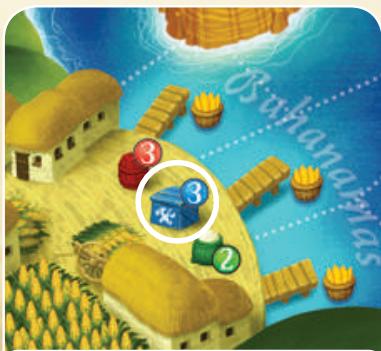
This port buysgoods for 3 doubloons each.

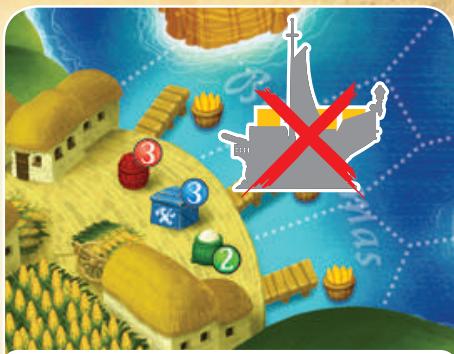
This port doesn't buyandgoods.

The merchant delivers its twogoods for 4 doubloons, and loads up 3goods.
→ If a player starts his turn without having his merchant in play (because it's been sunk), that player places it in a space adjacent to the port of their choice and loads it with 3 goods cubes of the corresponding color. It can then be played normally.
The role of the pirate is to steal goods cubes from the merchants, and then bury them as treasure on the beaches.
Before, during, or after its movement, an empty pirate can attack an adjacent opposing merchant. It steals one good cube from it, which is placed in its hold. The owner of the pirate ship earns 2 doubloons. If the merchant is now empty, it is sunk and returned to its owner. A goods cube held by a pirate ship is called a treasure.

The pirate moves 2 spaces.
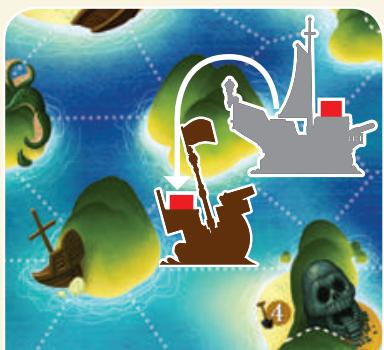
It attacks the merchant and steals a goods cube from it. The player earns 2 doubloons.

The pirate uses its remaining movement points to move away. The merchant still has one cube left, so it doesn't get sunk and remains in play.
Before, during, or after its movement, a pirate carrying a treasure can bury it on the beach space on which it is. The cube is returned to the stock of the port of its color. You win the number of doubloons indicated on the beach.
Burying a treasure is an action. Therefore you can't both attack and bury on the same turn.
→ If a player begins his turn without having his pirate ship in play (because it's been sunk or during the first turn of the game), the pirate places it on the distant sea area of his choice. It then undertakes its turn normally (movement and action), entering play through one of the adjacent spaces.

The pirate is already on the beach, so it doesn't need to move.

It buries its treasure and gains 6 doubloons.

It then moves 3 spaces. Despite the fact that the pirate is now adjacent to a merchant, it can't attack it, as it already performed one action this turn (burying a treasure).
Playing fortune cards

You can play as many fortune cards as you want on your turn. The effect of these cards is explained on each of them. If the text on the card contradicts the rules contained in this rulebook, the text on the fortune card is considered to have precedence. You can never play fortune cards during another player's turn.

End of Turn
Once all ofyour movements have been resolved, you'll end your turn by doing this:
Drawing movement and fortune cards
Draw enough movement cards to give you 2 of them in hand (most of the time, you'll only have to draw one).

On some movement cards, a symbol indicates that you'll also have to draw one or two fortune cards.

The maximum hand size is three fortune cards. When a player goes over three cards, he has to discard as many cards as necessary to get back down to only three cards in hand.

Some movement cards have this symbolX which shows that the player playing it must discard a fortune card. If the player has no fortune cards at that point, the symbol has no effect.
When one of the decks (either movement and/or fortune) is empty, shuffle the discard pile and form a new deck.
Flip a development/victory card face-up.
Once you've moved your three ships, you may buy a development/victory card ofyour choice.

To do this, pay the price indicated on the card and flip it face-up. You can purchase the development cards in the order you want.
The only exception to this is the victory card: you can only buy it after having bought all other development cards.

IMPORTANT:
Remember, you can buy only a single development/victory card per turn, even ifyou have enough doubloons to buy more than one.
Some of these cards allow players to make attacks on different types of ships or perform special actions. However, don't forget that you can only perform one action per ship, per turn unless stated specifically on a card.
Once this is done, your turn is over and play proceeds clockwise.
End of the game
As soon as any player buys his victory card, you are in the final round. Check to see who has the black fleet card (the first player)

The final turn ends with the player immediately to his right, meaning that everybody plays the same number of turns.

The winner is the player who has bought his victory card.
If more than one player has achieved this, the richest among them wins.
Option: as you may have noticed, there are two victory cards for each player (one with a value of 10 doubloons, the other with a value of 20 doubloons). For your first game, use the lower goal Afterward, for slightly longer games (allowing you to use the full development card combinațions more often), try going for a 20 doubloon victory! Finally, if you're playing with a beginner or a younger player, you can give them the value 10 Victory card while you use the value 20 cards.


Sebastian Bleasdale
I've always loved playing games, but I didn't start designing them until, in my twenties, I took part in some playtest sessions with Reiner Knizia. He was a hero to me - the designer of my favourite game "Euphrates and Tigris". I left the playtests believing that game design was awesome, and that I could do it too. It turned out that I was half right - game design was great fun but it took a decade of work (juggling my passion for design and my job valuing pensions) before I felt I'd really grasped it. In that decade, one of my earliest games, Black Fleet (named Jolly Roger at this time) developed with me. I hope you enjoy it, and agree it was worth the wait.

Denis Zilber
I was born in Minsk, USSR in 1976. At age 15 I moved to Israel with my parents. At age 25 I started my illustration career working with advertising agencies, magazines and newspapers. Since then I've had an opportunity to work with major international magazines
like FHM, GQ, Playboy, Maxim, Israeli newspapers like Yedioth, Maariv and Blazer, as well as
with numerous advertising agencies and a few major animation studios like Rhythm and Hues,
Nickelodeon, Hasbro Animation, Dreamworks and Universal Pictures. I also do children's books illustration working with clients like Penguin Group and Scholastic Books.
Recently I started to create designs for the game industry, mostly working on cardboard games.
Miniature ships original design : Christophe Madura 3D rendering and adaptation : Grégory Clavilier
Things you might forget
RULE NUMBER ONE : you'll want to do multiple actions with your pirate. Or sink two pirates with the navy ship you control. YOU JUST CAN'T. Each ship can do one single action each turn. Period.
Your merchant can be attacked on the starting port, or just after selling/loading cargo. There's no such thing as a sanctuary in the Carribeans !
You can only take cargo when you sell goods first. So, you may stand at a port, be attacked twice and you CAN'T load new cargo to replace the ones you lost. First sell the one(s) you still have. Yes, life is unfair.
You can't attack your own ships. Ever. Sometimes, it's tempting but, no, sorry. You can't sink your own pirate to earn your last two doubloons either, matey !
Pirates can attack on the turn they come back after being sunk. Also, merchants can deliver goods on the turn they come back in a port after having been sunk.
Cards are always right. Even when they seem to make rules wrong. So, yes, the pirate ship can sometimes bury a treasure just after attacking a merchant. We know, this contradicts rule number one, but there is a card for that !
Have you noticed the two little skulls on the board ? They¹re called pirate lairs and you¹ve found nothing about them in the rules. Don't worry, they appear on a card, and one ofyour opponents is probably smirking as you're wondering about them... no, we won't spill the beans.

Black Fleel
Rulebook
下载 Markdown原文为社区整理/出版社公开资料,版权归原作者,仅供个人学习查阅。