
破解密码Break The Code
一句话概览
破解密码 是一款已收录于村了吗规则库的桌游,支持 2–4 人,原名 Break The Code。
本页内容:一句话概览 · 常见问题
这游戏怎么玩
- 本站已收录这款游戏的规则资料,可以在对话里直接提问规则细节。
常见问题(FAQ)
以下 1 条问答中 0 条来自站内玩家的真实提问,其余 1 条为本站整理的常见疑问;答复内容保持原样。
破解密码支持几个人玩?
2–4 人。
去哪查完整规则
想核对具体规则细节、卡牌效果或某个回合的结算方式,可以在村了吗里选中这款游戏后直接提问。
同类桌游
- 卡坦岛德式
- 工业革命:伯明翰德式
- 勃艮第城堡:特别典藏版德式
- 方舟动物园德式
- 卡卡颂抽象
- 瘟疫危机传承:第一季美式
- 阿瑞迪亚:勇踏征途美式
- 重塑宇宙德式
- 幽港迷城美式
- 埃多拉的德鲁伊德式
规则原文(Markdown)
本站收录这款游戏的规则原文 1 个文件,此处内联渲染 1 个,可直接展开阅读或下载。
Break the Code English Rulebook.md12.5 KB
BREAK
C6DE THE

Game Rules
Will you break the code before your opponents?
Ask the best questions, and be the first player to decipher the code to win!
pages 3 to 5
pages 6 to 8
Overview and Goal of theGame
In a game of Break the Code, your goal is to guess the numbers and colors of unknown Cipher tiles. There are 6 Question cards in the middle of the table. On your turn, choose one card and ask a question to an opponent to learn more about the unknown Cipher tiles. Be the first player to correctly deduce the code to win the game.
Game Components

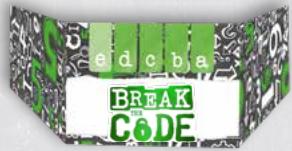
4 Screens
1 Rule booklet

21 Question cards
1 Notepad

20 Cipher tiles
ComponentDetails
Screens
Players hide their Cipher tiles behind their screen. Screens also provide a reminder of the setup and a list of possible actions.
Question cards
All Question cards are different. On each of them, you can read a question about the tiles' value, color, or relative position. Asking questions will allow you to get information about the other players'tiles.

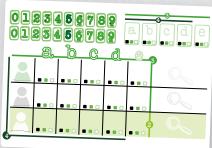
Notepad
Distribute one sheet to each player at game start. Use it to keep track of your progress, and to note down the clues that you collected.
2 players: only use the bottom line.
3 players: only use the top 2 lines.
4 players: use all 3 lines, but don't use column E.
The 20 figures in the upper left section may be used when taking notes.
The 5 empty spaces in the upper right section are reserved for your final answer (3- or 4- player game).
Cipher tiles
There are 20 Cipher tiles. There is one white copy and one black copy of each number (0 to 9), except for the 5 (both copies are green).
Setup
-
Distribute a Screen to each player. Each player places their screen in front of them.
-
Shuffle the 20 Cipher tiles and deal 5 tiles to each player, face down. Each player must now place these tiles face up, behind their screen, so that no one else can see them. When receiving your tiles, make sure to place them in ascending order, from left to right. If two tiles have the same number, place the tile with the black number first, on the left of the second tile with the white number. Place all remaining tiles back in the box.
-
Distribute one sheet from the notepad and a pencil to each player.
-
Shuffle the Question cards and form a draw pile in the middle of the table.
-
Draw the first 6 cards and place them face up in the middle of the table.
-
Randomly choose the 1st player.

Gameplay
In a 2-player game, the game plays in a succession of turns and ends when one of the two players correctly announces the 5 tiles hidden behind the screen of their opponent. On your turn, you may either Ask a Question or Guess the Tiles.

A. Ask a Question
You can choose one question among the 6 available cards.
-
Take the card of your choice and read it aloud.
-
Your opponent must answer honestly, using the corresponding letters of their screen to answer your question.
-
Note your opponent's answers on your sheet.
4.Then, discard your Question card and replace it with the top card from the draw pile (if any remain). If there are no more cards available in the middle of the table, the game ends.
- It is now your opponent's turn.
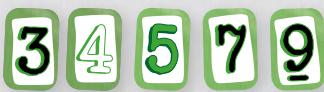

Examples:

Where are your #5 tiles?
If your opponent has a #5 tile, they must use the letters of their screen to tell you where it is – here, "I have a 5 on C."
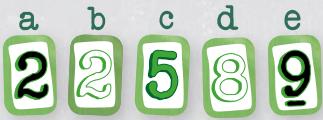
Where are your #1 or #2 tiles?
If you ask this question, you must first decide whether you're asking for #1 or #2 tiles. Here, if you ask for #2 tiles, your opponent would answer "I have a 2 on a.'

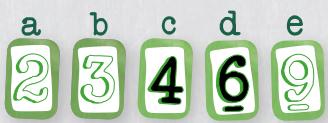
Which neighboring tiles have the same color?
If you have at least two neighboring tiles with the same color, then you must tell where they are. If there are several groups, you must distinguish them.
Here, you would say «Tiles on a and b have the same color ; and tiles on C,d and e have the same color»

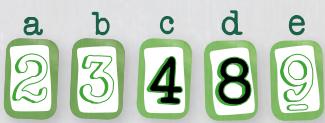
2 Which neighboring tiles have consecutive numbers
If you have at least two neighboring tiles with consecutive numbers, then you must tell where they are. If there are several groups, you must distinguish them.
Here, you would say « Tiles on a,b and C have consecutive numbers ; and tiles on d and é also have consecutive numbers. »

B. Guess the Tiles
In a 2-player game, you must identify the Cipher tiles hidden behind your opponent's screen.
If you think that you can correctly identify the 5 Cipher tiles, then you can try to Guess the Tiles, instead of Asking a Question. In this case, announce the 5 Cipher tiles out loud, from left to right.
For each tile, you must announce its number and its color. Your opponent waits until you've announced all tiles, then they tell you whether you're correct or not. Your opponent does not tell you how many tiles were correct, nor do they tell which numbers or colors were correct.

If you're correct:

If you were the starting player of the game, your opponent may immediately try to guess your tiles before the game ends. If they do so and correctly guess your tiles, the game ends in a tie. If they're wrong, you win the game.
If you're wrong:
Your turn ends, but you remain in the game. Your opponent may now play their turn, choosing between the two options: Ask a question, or Guess the tiles.
Example:
You announce your guess that your opponent's tiles are:
However the correct tiles are:
There is one slight mistake, which means that you're wrong: the 4 was black and you announced it as white. Your opponent does not give any detail – they simply tell you that you're wrong.
End of the Game
As soon as one player correctly guesses all of their opponent's tiles, that player wins the game. If both players correctly guess their opponent's tiles in the same turn, the game ends in a tie.
The following paragraphs only address the differences from à 2-player game. All game paragraphs that are not described below are the same as in a 2-PLAYER GAME, regardless of the number of players.
- Shuffle the 20 Cipher tiles and deal them to all players according to the attached chart. Each player must now place these tiles face up behind their Screen, so that no one else can see them. When receiving your tiles, make sure to place them in ascending order from left to right. If two tiles have the same number, place the tile with the black number first on the left of the second tile with the white number. Then, check the chart to know how many extra tiles are placed face down on the table.
Goal of the Game
In a 3 or 4 player game, your goal is to guess the tiles that are in the middle of the table.
Setup
These face down tiles may not be looked at until a guess is made, and then only by the guessing player (see Gameplay, next page).
| Number of players | 3 | 4 | |
| Cipher tiles | 5 | 4 | |
| received by each player | |||
| Cipher tiles placed face down | 5 | 4 | |

Gameplay
In a 3- or 4-player game, the game plays in a succession of turns and ends when one of the players correctly announces the tiles that are face-down in the middle of the table (the "central tiles"). The game also ends when all players are out of the game, or if all questions have been asked.
A. Ask a Question


3 players: take any available Question card and read it aloud. The two other players must answer honestly, according to their tiles. Then, the player on your left plays their turn.

4 players: Take any available Question card and read it aloud All players, including you, must answer the question. Then, the player on your left takes their turn.

B. Guess the Tiles
In a 3- or 4- player game, you must identify the central Cipher tiles.
If you think that you can correctly announce the central Cipher tiles, then you can try to Guess the Tiles instead of Asking a Question.
In that case, write your answer on your sheet, in the reserved upper right corner, from left to right, and in ascending order. For each Tile, you must write its number and its color. Then, check the central tiles and compare them with your answer. Don't tell anyone anything about the tiles' numbers or colors, or about what you correctly guessed.

If you're correct:
Announce out loud "I got it!" without adding anything. You're now out of the game, but you must still answer your opponents' questions. Whatever happens, you'll be one of the winners - maybe the only one?

If you're wrong:

You're out of the game, and you lose. You must stil answer your opponents' questions. The player on your left takes their turn.
Note: in 3- or 4- player games, you can only guess once. Don't rush it!
When a player correctly identifies the tiles, all players complete the current round if necessary (so that every player has the same number of turns), then the game ends. If all players are out of the game because they all failed to identify the central tiles, the game also ends.
Note : In Break the Code, you always ask questions to get information about your opponent's tiles. However, in a 2-player game, your goal is to guess your opponent's tiles, while in a 3- or 4-player game, your goal is to rule them out to deduce the central tiles.
End of the Game
The game ends as soon as one player correctly identifies the central tiles, provided that every player played the same number of turns. All players who correctly guessed the central tiles win. The game also ends if all players provided a wrong answer when trying to identify the central tiles, or if all Question cards have been used. In both cases, there is no winner. If you end the game on a tie... play again!
Credits
Designer: Ryohei Kurahashi
Project Lead: Xavier Taverne
Editing: Xavier Taverne
Graphic Design: Mélanie Walryck
Original Name: Tagiron
Originally Published By: Jelly Jelly Games
Translation: Antoine Prono
© 2016 PIZZICATO DESIGN INC.
© 2019 IELLO USA LLC. IELLO, BREAK THE CODE and their logos are trademarks of IELLO USA LLC All Rights Reserved. Made in Shanghai, China by Whatz Games.
For North America : IELLO USA LLC - 5550 Painted Mirage Rd. Suite 320 - Las Vegas, Nevada 89149 USA-Phone: 702-818-1789.info@iellogames.com
For Europe : IELLO - 9, av. des Érables - Lot 341 - 54180 Heillecourt France
Jeu en anglais. Importé au Canada par IELLO USA LLC
www.iello.com
Follow us on
下载 Markdown原文为社区整理/出版社公开资料,版权归原作者,仅供个人学习查阅。