
BrikksBrikks
一句话概览
Brikks 是一款已收录于村了吗规则库的桌游,支持 1–4 人,原名 Brikks。
本页内容:一句话概览 · 常见问题
这游戏怎么玩
- 本站已收录这款游戏的规则资料,可以在对话里直接提问规则细节。
常见问题(FAQ)
以下 1 条问答中 0 条来自站内玩家的真实提问,其余 1 条为本站整理的常见疑问;答复内容保持原样。
Brikks支持几个人玩?
1–4 人。
去哪查完整规则
想核对具体规则细节、卡牌效果或某个回合的结算方式,可以在村了吗里选中这款游戏后直接提问。
同类桌游
- 卡坦岛德式
- 工业革命:伯明翰德式
- 勃艮第城堡:特别典藏版德式
- 方舟动物园德式
- 卡卡颂抽象
- 瘟疫危机传承:第一季美式
- 阿瑞迪亚:勇踏征途美式
- 重塑宇宙德式
- 幽港迷城美式
- 埃多拉的德鲁伊德式
规则原文(Markdown)
本站收录这款游戏的规则原文 1 个文件,此处内联渲染 1 个,可直接展开阅读或下载。
SH Games Brikks rulebook for web 1.md13.2 KB
BRIKKS
The tricky block stacking game by Wolfgang Warsch for 1-4 players, ages 8+
Game description
The players let differently shaped blocks fall «downwards». If one block hits an obstacle, it stays in place. By using energy points, players are able to move blocks to the left or to the right, or rotate blocks. Players should try to maneuver blocks into matching gaps. The more complete a line is at the end of the game, the more points are gained. However, energy points should also be skillfully collected during the game. Whoever manages this the best wins Brikks.
Game preparation
Each player receives two game sheets, a Chip, and a Felt-tip pen. On the front side of one game sheet (arcade machine), the player marks blocks during the course of the game. The second game sheet is turned with the backside up. This is done in order to mark the current block with the Chip.
When played by two players, the 3rd and 4th circle on the energy bar are crossed out (deactivated). If played by three players, only the 4th circle is deactivated. The starting player gets appointed.
X X
Beginning with the player to the right of the starting player and then proceeding counterclockwise, each player chooses a block from the 1st column of the block-overview and marks it down on their bottom line. Players may not choose the same block as another player, nor can they rotate the block they have chosen. Thus, each player begins the game under slightly different starting conditions. Afterward, the starting player begins the game.
The Game Sheet:
BRIKKS
Colored circles
Victory point multipliers
Area to write down victory points
Bombs
10X →5|9X →2| SX →1
Bar for extra points
XxXXXX 013 6 1015212836445155647075
Victory point value for crosses.
Energy bar
③○○○○⊗○○ x 0080 O X
Energy costs for actions →00⑤76i
Energy points

Course of the game
The starting player rolls both dice. If they are unsatisfied with the result, they can reroll both dice once. It is not permitted to just roll one die. The die with the numbers determines the vertical column, while the colored die determines the horizontal line. The block that has been determined by both dice must be used by ALL players.
Players mark the respective block with their Chips on the overview. This block MUST be marked down by all players.
Marking down means that blocks always fall down from the top to the bottom until they hit the bottom or get stuck on another block. Each player gets to decide where a block falls down.

At the place where a block stops falling down, the player draws the outline of the block and makes a cross in every square of the block
Example: Lukas rolled green and 3. This block works for him, so he does not roll again. Now, he and all the other players have to draw the green block from the 3rd column. Lukas lets the block fall down in a way that it lies half on the ”black“ 4-block (starting block).
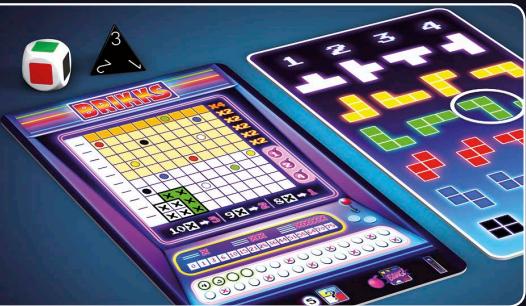
While falling down, a block can be moved to the left or to the right in order to move it into a matching gap or to maneuver it through a narrow place. However, it has to fit through by width. It is not enough if a block eventually fits in a gap but would have gotten stuck on the way down. Likewise, a block can be moved to the left or to the right as desired in order to move it ”under“ another block.
Example : The first yellow block would fit into Lukas’ gap, but as it is two squares wide, it would not fit through the one square narrow place.
1 3
If a block gets marked down in a way that it covers a circle of the same color as the block, a player gets to activate 2 energy points on the energy bar for later use, by drawing a circle around the next two free energy points on the energy bar.
Example : Nina marks down a white block in a way that it covers a white circle (A). As a result, she can activate
two new energy points
on the energy bar
(B).
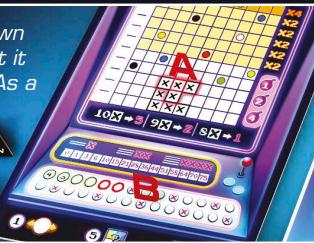

Energy bar and extra points bar
Energy points that have been marked by a circle around them on the energy bar have been activated and can be used for one of the following actions (afterward they get crossed out):
■ per energy point a player can move a Chip on their overview one column to the left or to the right (and thereby rotate the block). This is the only possible way to rotate blocks. If, for example, a player wants to move (rotate) a block from the 1st to the 3rd column, they have to cross out two energy points.
■ for five energy points, a player can exchange the current block for any block of their choice.
If a player draws a circle on the energy bar around an energy point that contains a pink X, they put a cross on the yellow extra points bar (beginning on the left). By doing this, extra points are activated. At the end of the game, a player receives extra points equal to the first unmarked field from the left on the extra points bar.
Example : Marie rolled a blue 1 during her first roll of the dice. As she is
not satisfied with this, she rolls the
dice again. She rolls a 4 and red.
Though she does not like this
either, this result has to be
used by all players. Lukas, by
using two energy points and 10X crossing them out on the
XXXE sheet (A), moves the 4 two
columns to the left and
marks the block down ac- 0 cording to its new orien
tation in column 2 (B). Since he
marks a red block on a red circle, he gets
two new energy points (C). Thereby he has activated a pink
X and gets another cross on the extra points bar (D). At the end of the game, he would receive 6 extra points now.
If a player manages to finish 2 complete lines without a gap by placing a new block, they are allowed to put 1 cross on the extra points bar. For 3 complete lines, they put 2 crosses, and for 4 complete lines, they put 4 crosses.
Example : Lukas finished two lines simultaneously with a red block. Thus, he puts one cross on the extra points bar. He was able to cross out the 6 on the extra points bar and would get 10 extra points at the end of the game.
Special case: If a player is able to put more than 14 crosses on the extra points bar, any more crosses are ignored. A player cannot earn more than 75 points on this bar.
Should a block in no way fit into a player’s plan, the player is able to blow up the current block by using a bomb. Blowing up a block eliminates it for the player. However, the player does not get a replacement block (in this round they do not draw a block on their sheet). Three bombs are available to players during the game. When a bomb is used (starting at the top), it gets marked as used (crossed out). If there are bombs left over at the end of the game, players get the victory points that are denoted on the bombs.
Example : Even by moving the red block to 2, Marie still has no use for it. She sacrifices one of her bombs and does not mark down a block for this dice roll.

End of the game
A player drops out of the game when they are no longer able to completely fit a block on their game sheet. They no longer roll the dice. The other players continue the game until they are also no longer able to fit a block on their game sheet. Once the last player drops out of the game, final scoring occurs.
Each player writes down their points for every line in the light blue area on the left side of their block:
■ A player receives 5 points for every complete line with 10 « X ».
For a line with 9 « X » (one gap in the row), they receive 2 points.
■ For a line with 8 « X » (two gaps), they receive 1 point.
There are no points for rows with three or more gaps.
In the
orange area (evaluation
lines 6 to
10), points
are doubled and in the
top line
quadrupled.
All points are added together:
light blue victory points bar
+ points from the yellow extra points bar
+ leftover bombs
+ 1 point per 2 activated, but unused energy points from the energy points bar
Example : A 3 and yellow have been rolled. Lukas is not able to rotate the block in a way that fits by using his energy points. He has one bomb left. He does not use it as he prefers to receive 4 points for having a leftover bomb. Now the game is over for him, as he is not able to mark down the block.
For the lines he receives 47 points (5+5+5+5+5+4+4+10+0+4+0=47). In addition, he receives 21 extra points, 4 points for the leftover bomb, and 1 point for the 2 activated and unused energy points. His final score is 73 points (47+21+4+1=73).
BRIKKS
×× x × ×× X X X ×××8 ×× ×× ×× ×× X ×× ×× × x×x× X x 10×+59×+28×+1
XXXXXX XXXXXX212536445155647075
01 07#
1 2 3 4
Level of difficulty
Brikks can be played on different levels of difficulty. The above mentioned base game equals level 2. If someone wants to play a slightly easier game or plays with children, they can use level 1. Someone who prefers to be challenged more can choose level 3 or even level 4.
■ Level 1 : As soon as a circle of the wrong color gets covered by a block, 1 energy point is activated. When a block of the same color covers a circle, 2 energy points are activated.
■ Level 2 : When a block of the same color covers a circle, 2 energy points are activated.
■ Level 3 : Same rule as level 2, but if a circle of the wrong color gets covered by a block, the player loses ONE already activated energy point.
■ Level 4 : Same rule as level 2, but if a circle of the wrong color gets covered by a block, the player loses TWO already activated energy points.
It is also possible that players of a game use different levels or difficulty. For example, children can play under the rules of level 1 while adults play according to level 2 or 3.
Brikks Duel (Variant for 2 players)
A duel is not about victory points. No extra points are used. The goal of a duel is to stay in the game the longest (meaning: to be able to place another block).
The rules stay the same, however a player marks a square with a cross, a “mini block” so to say (an outlined X), on the opponent’s sheet for every pink X they put on the energy bar or for finishing several complete lines with only one block. This mini block has to be marked down according to the rules. For example, it cannot be marked somewhere floating.
However, color points can be covered by mini blocks and thereby be made unusable for the opponent.
Should a player be allowed to mark down several mini blocks in one round, the mini blocks can, at most, touch each other across corners. Mini blocks can not be marked directly next to each other. For instance, 4 mini blocks can not be used to mark a 4 square block on the opponent’s game sheet.
Bombs are still used in the same way as in a regular game (and get much more important in this variant).
If both players are no longer able to mark down a block in the same round, then the points which the players have scored for complete rows are counted. This acts as a tie-breaker.
Solo game
There is no way to repeat a dice-roll in a solo game. Here a player has to use the first roll. In the solo game, the player starts with an additional (5th) activated energy point, right next to the 4 regular energy points a player starts with in a regular game. This extra energy point is marked by drawing a circle around it at the start of the game. All other rules stay the same.
How well a player can stack blocks is shown by the following chart. The chart outlines the points for difficulty level 1. For every higher level a player can add 5 points.
150
130 –150
110 –129
100 –109
90–99
80–89
70–79
60–69
<60
Brikks-Master 2000 !!! You Bragger!
You should be doing this professionally! Have you seen this?
Someone has practiced! Well done!
Your first time?
Summary

Block on circle of the same color = 2 energy points activated

1 energy point = Chip is moved by one column (= rotating a block)

5 energy points = current block can be replaced by any other block
xx
2 Lines = X
3 Lines = XX
4 Lines = XXXX
Marked down block finishes a complete line without gaps.

Current block does not have to be used (no replacement!)
Author: Wolfgang Warsch Illustration: Anne Pätzke Layout: Leon Schiffer Realization: Thorsten Gimmler Localization: T.R. Knight

Schmidt Spiele GmbH Lahnstraße 21 12055 Berlin
www.schmidtspiele.de www.schmidtspiele-shop.de
Stronghold Games
7964 Emerald Winds Circle
Boynton Beach, FL 33473 USA
Email: info@StrongholdGames.com
And visit our website at: StrongholdGames.com © 2019 Stronghold Games All Rights Reserved. Under license from Schmidt Spiele GmbH
下载 Markdown原文为社区整理/出版社公开资料,版权归原作者,仅供个人学习查阅。