
Campaign TrailCampaign Trail
一句话概览
Campaign Trail 是一款已收录于村了吗规则库的桌游,支持 1–6 人,原名 Campaign Trail。
本页内容:一句话概览 · 常见问题
这游戏怎么玩
- 本站已收录这款游戏的规则资料,可以在对话里直接提问规则细节。
常见问题(FAQ)
以下 1 条问答中 0 条来自站内玩家的真实提问,其余 1 条为本站整理的常见疑问;答复内容保持原样。
Campaign Trail支持几个人玩?
1–6 人。
去哪查完整规则
想核对具体规则细节、卡牌效果或某个回合的结算方式,可以在村了吗里选中这款游戏后直接提问。
同类桌游
- 卡坦岛德式
- 工业革命:伯明翰德式
- 勃艮第城堡:特别典藏版德式
- 方舟动物园德式
- 卡卡颂抽象
- 瘟疫危机传承:第一季美式
- 阿瑞迪亚:勇踏征途美式
- 重塑宇宙德式
- 幽港迷城美式
- 埃多拉的德鲁伊德式
规则原文(Markdown)
本站收录这款游戏的规则原文 1 个文件,此处内联渲染 1 个,可直接展开阅读或下载。
CampaignTrail_rulebook_pages_reducedsize.md77.6 KB

Congratulations on accepting your party's nomination for President of the United States! Ahead of you lies an exciting journey full of campaign stops, advertising, fundraisers, and voter registration drives. You have a modest war chest and a few voters who have registered with your party. Use these resources well. Your strategy over the coming months will determine if you sit in the Oval Office or if you will be heading home!
Table of Contents
Components …… 2
Setup
Candidates……6
Game Overview……
Scoring…7
Actions …
Dirty Politics …… 12
Debate … 14
Election Day …… 17
Credits and Acknowledgements ……………… 17
Appendix A: Solo Play …… 18
Appendix B: Politick Action Clarifications … 22
Appendix C: Candidate Ability Clarifications … 23

The Electoral College
In the United States, the president is elected indirectly by the electors that make up the Electoral College. These electors are delegates chosen from all 50 states plus the location of the U.S. Capital, the District of Columbia (also known as Washington DC). Each state has two electors, plus additional electors based on population. Therefore, more populous states end up with more electoral votes (e.g., California has 55) and less populous states end up with fewer (e.g., Wyoming has only 3).
During the popular election, the people of the United States actually vote for electors who have pledged to support their preferred presidential candidate. When a candidate wins the popular vote in a state, it means that the electors from that state have pledged to vote for that candidate in the Electoral College election. Most state's electors are chosen by a “winner-take-all" approach, so the candidate that wins the popular vote in a state wins all the electors for that state. There are a total of 538 electors, or electoral votes, available over all the states. Therefore, a candidate needs to win 270 electors to win the general election.
In Campaign Trail, the popular vote in each state is represented by the cubes placed on the board. However, the victory condition is collecting the most electoral votes, indicated by the counters on the Electoral College track. To win, a candidate must compete for popular vote majorities in states that add up to a majority of the Electoral College.
About This Rule Book
Throughout this rulebook, you will see callout boxes. These boxes provide useful information and are color-coded so that you can reference the exact information you want easily.
Definitions: Orange boxes will provide definitions of terms used throughout Campaign Trail.
Clarification: Green boxes provide an additional explanation or clarification of a certain rule.
Tips: Purple boxes provide strategy tips and hints that you can use during play. These boxes also contain our recommendations for various decisions throughout play.
Reminders: Yellow boxes provide reminders of easily forgotten rules.
Examples: Gray boxes show examples of play.
Components
1 Game board

State Banners: Each
state on the board has a NY stae ne r-Thiis isone 29 abbreviation as well as
the total electoral votes for that state.

Additionally, the stars on the state banner indicate the tiebreaker should there be a tie for the number of voters in the state. The star on the left of the icon is the color of the party that is the first tiebreaker. The star on the right of the icon is the color of the party that is the second tiebreaker (for ties not involving the first tiebreaker).
Callout Hexes: Certain geographically small states have callout hexes associated with them. Voters should be placed into these callout hexes during setup and gameplay instead of in the actual state on the map.
1 Four-part Electoral College Track

51 Electoral College Counters

50 yellow


105 Action Cards & 24 Dirty Politics Action Cards

3 Party Reference Booklets

3 Turn Order Markers

6 Home State Markers

240 Voter Tokens

80 blue
80 yellow
150 Three-count Voter Tokens
50 blue

There are some extra components that are not required for game play. To see these components see the Extra Components section on page 24.
1 Four-part Debate Arena

1 Three-part Register Track on reverse side of Debate Arena Tracks

10 Debate City Markers

12 Candidate Cards

42 Money Cards

63 Solo Play Cards

30 Debate Topic Cards
18 Debate Issue Markers




Candidates and Parties
Each player in the game assumes the role of a candidate – either for President or for Vice President. For the game, these two types are equal. Each candidate is a member of one ofthree political parties: Democrat, Libertarian, or Republican.
In a 2- or 4-player game you may choose any two of the three parties to play (you are not limited to only Republicans and Democrats). In 2- or 3- player games the Vice Presidents are not used. Return any unused pieces to the box.
Depending on the number of players, each party will have one or two candidates.
In a game with 4 to 6 players, both candidates in a party will work together, winning or losing the election as a team. Candidates on the same team are referred to as running mates and are free to discuss their plans and the cards in their hands.
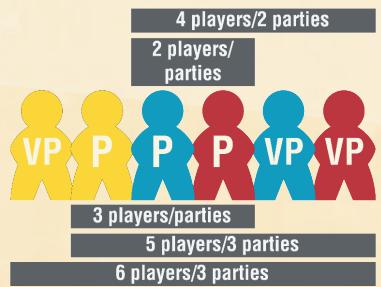
These are the components you will use for games of various player counts.

Unfold the game board and place it in the center of the play area.

Assemble the Electoral College track and place it above the game board.

Place each Electoral College counter in the groove of the party matching its state's primary tiebreaker, as shown in the state banner on the back of the counter.

Place all voter tokens (1-count and 3-count) next to the board. This will form the undecided voter supply. Each undecided voter supply should be within easy reach of the party it belongs to but kept separate from the play area of the party.
Undecided Voters: The voters in the general supply that are available for registering. Undecided voters can never go directly on the board unless specifically instructed to do so.

5 In each state on the board, place 2 voters of the party matching it's primary tiebreaker (left star on the state banner). Voters located on states on the board are referred to as committed voters.
Committed Voters: The voters in states that contribute to a party having a majority in that state and winning its electoral votes.
See the reference booklet for a visual guide on placing committed voters.

Separate the money cards into two separate stacks (one for each denomination) then place them on the indicated spaces on the board.
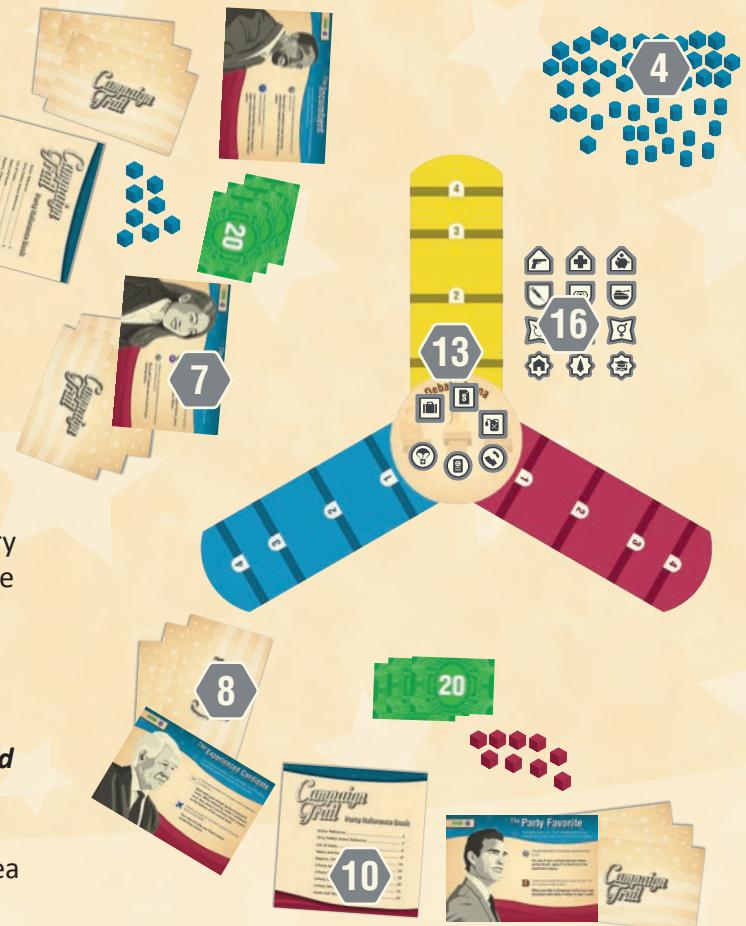

Shuffle the candidate cards and deal two to each player. Each player chooses one to keep and returns the other one to the box. Return the remaining candidate cards to the box.
In a team game, it is recommended that running mates discuss and select their candidates together.

Shuffle the action cards and deal a hand of five to each player.
Reminder: Be sure to adjust any starting resources (cards, starting committed voters, etc.) for any applicaable candidate abilities.

Divide the remaining action cards into three equal stacks and place one on each of the indicated month spaces.

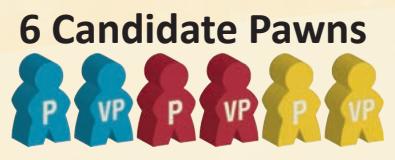
Give one party reference booklet, the corresponding home state markers, and corresponding candidate pawns to each party playing.


Each party takes the number of voters shown on their candidate card(s). This party resource is referred to as its registered voters.
Registered Voters: The voters in each party's personal supply that are available to be placed on the board.
These voters are doubled if there is only one player in the party.
The supplies of voters and money are assumed to be unlimited. If at any time either should run out, substitute any appropriate bit or token.
In a team game, players do not each have their own pool of resources – instead, each party's resources are shared by all candidates from that party.
The number of a party's registered voters and the size of its war chest is considered public knowledge. Campaign financing laws require you to accurately reveal this information any time your opponent asks.

Each party takes the amount of money shown on their candidate card(s). This party resource is referred to as its war chest.
War Chest: The money available to each party during the campaign.
These funds are doubled if there is only one player in the party.

Place the debate arena center piece beside the board. Select only the track pieces corresponding to each party in play and position them equidistant around the circle.

Shuffle the debate topic cards and randomly select two. Place one on each indicated space on the board. Return the remaining debate topic cards to the box.

Randomly select two debate city markers and place one on each indicated space on the board. Return the remaining debate city markers to the box.

Place the six debate issue markers corresponding to the icons shown on the first debate topic card on the center circle of the debate arena. Place the remaining 12 debate issue markers next to the debate arena.

Each player chooses a home state from among the reference states shown on the cards in their hand. Players must show that portion of their card to verify they have it. Each player places their home state marker and candidate pawn on the chosen state, and then places two of their party's voter tokens (from the undecided voters) onto that state.
Multiple players may have the same home state (even if from the same party – in which case you would add a total of 4 voter tokens).
Reminder: Be sure to update the Electoral College track if applicable.
In addition to the extra starting voters, your choice of home state has two other effects on the game:
Your candidate pawn starts the game in your home state.
• Some card actions will affect a candidate's home state.
Note: For game balance purposes, California, Texas, and any state with fewer than seven electoral votes do not appear as reference states.

The party with the player who voted most recently (for anything) goes first. Turns are taken by party in clockwise order. Place the turn order markers in the correct sequence on the indicated spaces on the board.
It is recommended that players of the same party sit together.
Setup Changes for Special Cases
In a 2-party game (2- or 4-player) make the following changes when setting up:

groove of the party not in play. Instead, place counters of states with a primary tiebreaker of the unused party in the groove of the party matching its state's secondary tiebreaker.

Do not place any voters for the party not in play. Instead, in states with a primary tiebreaker of the unused party, place one voter of the party matching its secondary tiebreaker.

In a 2-player game, before shuffling the action cards, remove the 15 with this icon:

In a 5-player game, the 5th player plays both roles of one party. However, they play with only 1 candidate pawn, 1 candidate card, 1 hand of cards, and 1 home state marker. Treat the 5th player as if they were a single player in a party: they get double the starting war chest and double the starting registered voters specified on their candidate card.
Candidates
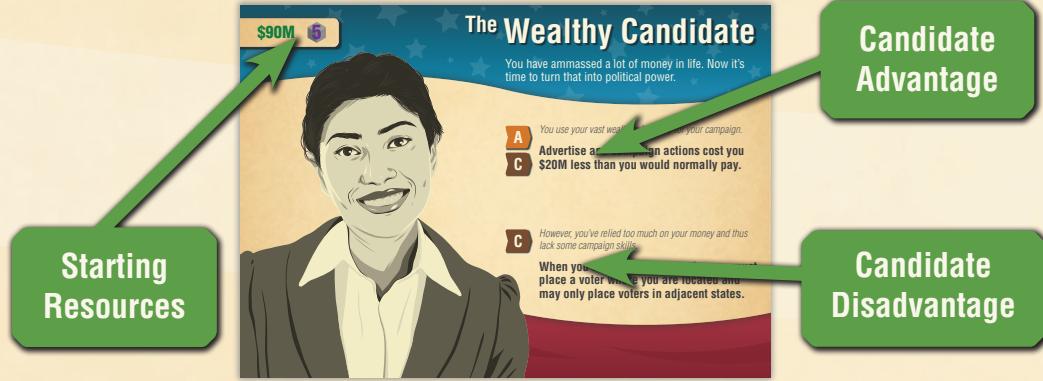
Each candidate comes with a unique advantage as well as a disadvantage. Each advantage and disadvantage affects a specific aspect of the game as indicated by the icon to the left of the text.
Game Overview
Campaign Trail is played over the span of three months: August, September, and October. Each month is represented by 1/3 of the action card deck. After the final card is drawn from each of the August and September decks, a debate is held. After the final card of the October deck is drawn, Election Day occurs – any final voters are placed (due to cards played throughout the game) and the winner is declared.
We recommend playing with the following candidates for your first game (in the following order, depending on player count):
• The Incumbent
• The Party Favorite
• The Establishment Candidate
• The Outsider
• The Experienced Candidate
Each candidate card is double-sided with the only difference being artwork. Use whichever artwork you prefer when playing your candidate.
• The Wealthy Candidate
Each month is divided into “rounds". In each round, every party takes one turn, going in turn order according to the turn order track on the board. When it is your party's turn, if there are two candidates in your party, you choose which candidate goes first and which goes second: each candidate in the party gets their own turn. After all candidates in the party have had their turn, the next party takes their turn(s).
When it is your turn, you must play one card from your hand, then
-
Choose one action from that card...
-
Carry out that action ...
-
Discard the played card (after all actions have been carried out)
-
Refresh up to 5 cards (if you are already at 5 cards, do not draw)
In the 5-player game, the 5th player (the one playing both roles of one party) takes two turns in a row during their party turn. They will play a card, take an action from that card, then refresh up to 5 cards. They will then repeat that process for their second turn.
After both candidates from a party have finished their individual turns, the two players may exchange cards in their hands (after both candidates have drawn to refill their hands). In order to exchange cards:
• Both candidates must be in the same region on the game board;
Each candidate must receive the same number of cards in the exchange (for example, if you give 2 cards, you must get 2 cards back, no more and no less).
• The candidates may exchange no more than 3 cards each turn.
Region: The Campaign Trail map is divided into 9 geographic regions. They are indicated on the board via different coloring on the states and are identified in the party reference booklet. The nine regions are:
• Pacific
• Mountain
• Great Lakes
• Gulf Coast
• Southeast
• Great Plains
• Appalachian
• Mid-Atlantic
• Northeast
Note: Though both candidates from a party take their turns together, they still have to take their own separate, individual turns. They cannot alternate actions between them: the first candidate must complete their entire turn before their running mate begins their turn.
Example turn: Shannon and Ryan are on a team playing the Libertarians. Lisa and Heather are on a team playing the Democrats. Joe is the 5th player playing the Republicans.
It is the Democrats' turn. They need registered voters so that they can do a campaign action. Lisa has a card with a good register action so together they decide that for this round Lisa will go first. She plays her card and takes the register action getting the party more registered voters. She then discards the played card and draws back up to 5 cards. Her turn is now over and Heather immediately takes her turn, playing her card and taking the campaign action.
Next, the Libertarians take their turn. They are in deperate need of resources – both money and registered voters. They decide it doesn't really matter who goes first since both are going to play cards to gain resources and they will not be using those resources on this turn.
Shannon goes first and plays a card and takes the fundraise action to gain money for the party's war chest. She then discards the played card and draws back up to 5 cards. It is now Ryan's turn. He plays his card and takes the register action to gain registered voters for the party. He finishes up his turn by discarding his played card and refreshing up to 5 cards. He realizes they are both located in the Great Plains region and suggests they trade some cards. Shannon has a debate coming up so she trades 2 of her cards to Ryan for 2 of his cards that will be useful to her in the upcoming debate.
Finally, it is the Republicans' turn. Joe wants to go to IL to campaign but he is currently in OK. For his first turn, he plays a card and takes a travel action, moving his candidate pawn to IL. He then discards the played card, draws back up to 5 cards, and proceeds with his second turn (since he is taking both turns for the Republicans). For his second turn, Joe plays a card and takes the campaign action. He then finishes his turn by discarding the played card and refreshing up to 5 cards. Play then continues to the next party in turn order – the Democrats.
Scoring
Campaign Trail uses real time scoring via the Electoral College track. Each Electoral College counter is scaled such that it represents an accurate depiction of the relative value of the state's real electoral votes. See image below.

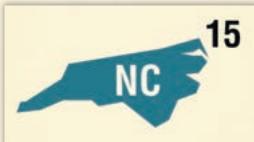

The Electoral College counters for each state are placed in the track of the party that has the majority of committed voters in that state (see page 2 for how tiebreakers work).
Majority: A party is said to hold a majority in a state if that party has the most committed voters in that state or is tied for the most and holds the applicable tiebreaker.
Whenever any voters are placed on the board, players should determine if the majority in that state has changed. If so, the Electoral College counter is immediately moved to the track of the new party holding the majority. All other counters are adjusted within the tracks so that there are no gaps in the track. 7
Scoring example: Greg is playing the Democrats and Megan is playing the Republicans. The current Electoral College track looks like this:
元“"
Greg is down by 2 voters in CT, so he takes an action that places 2 voters there. Both parties now hold a tie for majority in CT. Since the Democrats own the tiebreaker in CT, Greg now holds the majority there. He moves CT's counter to the Democrat track. The counter for OH (in the Republican track) is then shifted to the left so there are no gaps.
Reminder: Any time voters are added to the board, the Electoral College track should be updated for any new majorities.
Actions
There are six different actions in Campaign Trail. They are divided into two groups: support actions (those which set your party up to take other actions, such as gaining resources or [strategically] positioning your pawn) and direct actions (those which place voters out on the board).
Support actions:
Direct actions:
• Travel
• Campaign
• Fundraise
• Register
• Advertise
• Politick
Each card only contains four of the possible six actions – a player can only choose to take one of the actions contained on the card they play. They may not take an action that is not shown on the played card. The support actions are found on the left side of the card (as seen in the following illustration) and the direct actions are found on the right and bottom sides of the card.


Travelling is how you move your candidate pawn around the board to set yourself up for other actions (those that depend on location).
Most travel actions contain a number under the travel icon. To take a travel action that shows a number, simply move your candidate pawn up to the number of states indicated.
There are a few travel actions that contain a plane icon. These indicate travel to a city and are explained next.

City: There are 10 cities in Campaign Trail. They are marked on the board with a circle in the general location of the city as well as a plane icon to the upper left of the state banner. When you are instructed to put voters in (or move to) a city, place the voters in (or move to) the state that contains the city.
The 10 Cities are:
• Los Angeles, CA
• Seattle, WA
• Chicago, IL
• Atlanta, GA
• Dallas, TX
• Denver, CO
• Baltimore, MD
• Minneapolis, MN
• Cleveland, OH
• New York, NY

Plane + 1 – Move your candidate pawn to any city on the board, then you may move up to 1 additional state. Alternatively, you may move the “+1” first then move to any city.
5/x
5 or Plane – You may choose to either move up to 5 states OR you may move to any city.

Plane – You may move to any city.
Notes on adjacency:
• CA is adjacent to HI; WA is adjacent to AK as noted by the arrows on the board.
• The states in the “Four Corners” area (UT, CO, AZ, NM) are all adjacent to each other.
• DE is adjacent to NJ.
• You may move to Washington DC (DC). It is adjacent to MD and VA. However, DC is not a “city” in the sense of using a travel action with a plane icon. It is treated like a state in all respects.

Fundraise
Fundraising is how you gain money into your war chest. This money can later be used for other actions.
Fundraise actions contain a number under the fundraise icon. To take a fundraise action, simply take the amount of money indicated from the supply on the board and add it to your party war chest.


Register
Registering is how you gain registered voters for your party. These voters can later be used for other actions.
Register actions contain a number under the register icon. To take a register action, simply take the number of voters indicated from the undecided voter supply and add them to your party's registered voter supply.
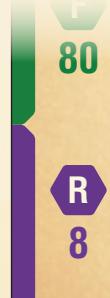
Support action example: In a 3-party game, Ben is playing the Republicans, Jordan is playing the Libertarians, and Lauren is playing the Democrats.
Ben needs some money in his war chest so he plays card #87 and takes the Fundraise action. He then takes \$70M from the board and adds it to his war chest.

Jordan needs to get his candidate pawn to Maryland for a future campaign action. He plays card #10 and since his candidate pawn is currently over five states away, he chooses to use the plane travel action and moves his candidate pawn to Baltimore, MD.
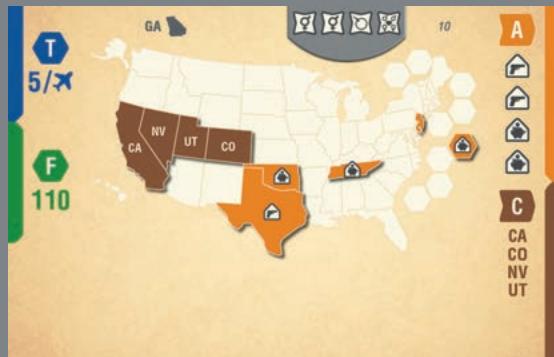
Lauren needs to register voters for a future advertise action she is planning. She plays card #29 and takes 10 voters from the undecided voter supply and adds them to her registered voter supply.

Advertise
Advertising is one way to place voters on the board. It is meant to place small numbers of voters in states which are geographically seperated, at a reduced cost.
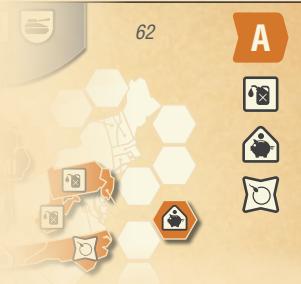
Advertise actions contain a list of issue icons under the advertise icon. Cards will have 2, 3, or 4 issues. These are the issues that you can advertise on. To take an advertise action you need to perform the following:
- You must pay \$20M per issue in which you want to advertise (you many choose any number of the issues shown on the card).
-
For each issue you pay for you must have registered voters available to place a voter in each state containing that issue.
-
Place exactly 1 voter (from your registered voters) into each state that contains the issue(s) you paid for.
In some advertise actions, an issue icon appears twice. You may may use these as if they were separate issues, paying \$20M for each time you use it and placing 1 voter each time (for a total of 2 voters) in each state containing that issue.
The card also has a map in the center which indicates the states in which you can advertise. These states are colored in orange on the map and are also marked with the the icon so that you can identify which states contain which icon.


Campaign
Campaigning is another way to place voters on the board. It is meant to place large numbers of voters in states which are geographically connected, but at a higher cost.
Most campaign actions contain a list of states under the campaign icon. These are the states that you can campaign in. To take a campaign action you need to perform the following:
- Your candidate pawn must be located in one of the states listed under the campaign icon.
C NJ MA MD CT Ri DE
-
You must pay \$60M.
-
You may place up to 6 voters (from your
registered voters) into the states shown under the campaign icon (they can be distributed among these states in any manner and do not have to go where your candidate pawn is located).

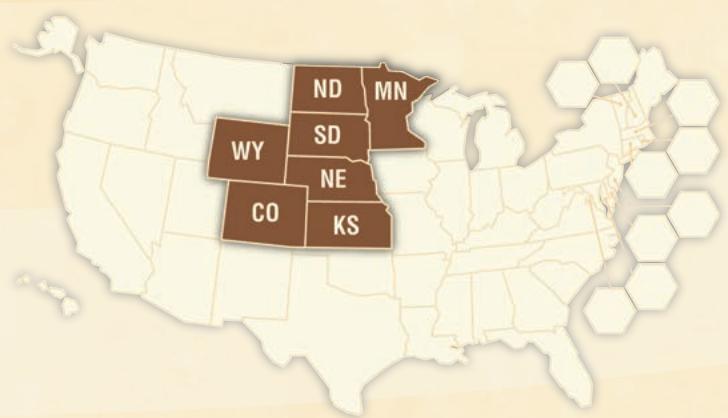
There are two campaign actions that contain a home state icon. These indicate the ability to campaign in the region in which your home state is located. Your candidate pawn must be in the region, you must pay \$60M, and the states available to place voters are every state in that region.
The card also has a map in the center which indicates the states in which you can campaign. These states are colored in brown on the map.

Politick
Politicking is the act of engaging in partisan political activity. It is meant as a miscellaneous action which can do a number of things: place voters on the board, change other's actions, set up resource gathering engines, and more.
Politick actions are carried out using three different methods. Each method has a different icon associated with it. To take a politick action you need to perform the following:

Instant - Carry out the text as written on the card. After carrying out the text, discard the card at the end of your turn.
Ongoing – Play this card on the table in front of you (do not discard). Starting at the beginning of your next turn, you may carry out the text on the card.
Each player plays their own unique individual politick actions. Your running mate does not get to carry out the text of ongoing politick actions you may have in play.
In general, politick actions are cumulative. Carry out the text for each one individually.

Response – This type of politick action is only played when it is not your turn. It is played in response to something an opponent does (the timing will be indicated in the text on the card). Play the card and carry out the text, then discard the card. You do not immediately draw to refresh your hand. You will do that at the end of your next turn.
For more detail on the politick actions see Appendix B on page 22.
Direct action example: In a 3-party game, Ben is playing the Republicans, Jordan is playing the Libertarians, and Lauren is playing the Democrats.
It is the Democrat's turn. Lauren has her 10 voters from her last action and is ready to take the advertise action she was planning.
She plays card #11 and chooses to advertise on Taxes twice and Energy Costs once. She cannot advertise on the second Energy Costs since she only has 10 registered voters and does not have the 4 voters required to advertise on Energy Costs again.
Social Media Post Take 9 of your voters from the undecided voter supply. Place 1 into a state in each region.
She pays \$60M (\$20M for each issue: two Taxes and one Energy Costs) and places 1 voter in MT, AR, WV, and PA (for Energy Costs) and 2 voters in GA, SC, and OH (for Taxes). She then discards the card and draws another to end her turn.
It is now the Republican's turn. Ben previously raised \$70M through his fundraise action but is looking for ways to not require as much money.
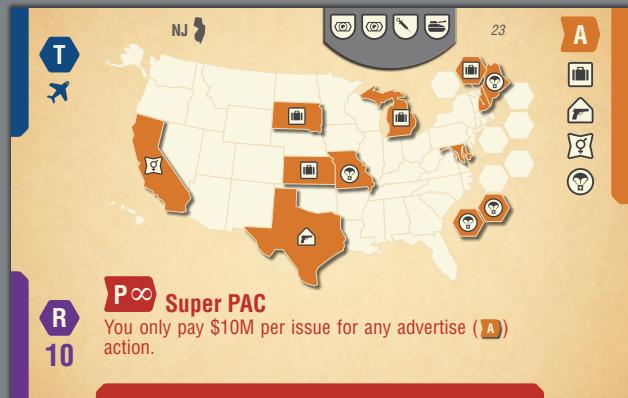
He plays card #23 and takes the politick action which is Super PAC. This is an ongoiing politick action so he plays it on the table in front of him.
Starting at the beginning of his next turn, he only has to pay \$10M per issue when he takes an advertise action. He then draws to refresh his hand to 5 cards and ends his turn.
Finally, it is the Libertarian's turn. Jordan had taken a travel action before to set himself up for a campaign action in MD. He decides to take that action now.
He plays card #97 and declares he is going to campaign in MD, VA, WV, DC, and KY. He can do this because his candidate pawn is located in MD due to his previous travel action. He starts to pay the \$60M when Lauren jumps in with a response politick action.

Lauren plays Local Funds Dry Up (card #73) which requires Jordan to pay \$20M per voter he puts out instead of the usual \$60M flat rate.

Since Jordan has a sizeable war chest he decides to still place the 6 voters and pays \$120M. He places 4 voters in VA, 1 voter in WV, and 1 voter in KY to complete his action.
Lauren and Jordan both discard their cards. Jordan draws back up to 5 cards to end his turn. Lauren will not refresh her hand until the end of her next turn.
Dirty Politics
The Dirty Politics module is a way to add a more cutthroat attacking style of play. If you do not want this style of play you can remove the Dirty Politics cards from the deck before setup.
The Dirty Politics cards have the same basic structure of other action cards, however the actions work in slightly different ways. Each Dirty Politics action will give you the opportunity to attack your opponent(s) by removing registered voters, war chest funds, or committed voters.
A Dirty Politics action card differs from a standard action card in three ways:
• The background color is different
The action icons have a different lettering scheme
• There are no debate issue icons on the Dirty Politics cards. Instead they are identified as Dirty Politics in that space.

Some of the Dirty Politics actions affect ethically minded states. When a card or rule refers to “your ethically minded states" it is referring to those states that are marked with the ethics icon corresponding to your party.
Ethically Minded State: Ethically minded states are those states that are concerned with a particular candidate's ethical behavior. Each party has their own unique ethically minded states.
They are marked on the board with the following icons (in each party color) to the upper right of the state banner.

The five ethically minded states for each party are:
Democrat
Libertarian
• Maryland (MD)
Republican
• North Carolina (NC)
• Georgia (GA)
• Massachusetts (MA)
• Virginia (VA)
• Kentucky (KY)
• New Jersey (NJ)
• Colorado (CO)
• MIssouri (MO)
• Connecticut (CT)
• MInnesota (MN)
• Arizona (AZ)
• Washington (WA)
• Oregon (OR)
• Alabama (AL)
Each Dirty Politics action corresponds to and is a subset of the actions on the standard action cards. While these actions have a different name to make them easily distinguishable they still count as the action they are a subset of for the purposes of politick actions that refer to players playing certain types of actions.
Example: A player who plays a smear campaign action is also playing a campaign action, a player who plays a mudslinging action is also playing an advertise action, and a player who plays a dirty tricks action is also playing a politick action.

Voter Suppression
Voter suppression is the act of moving around among the states and threatening or intimidating voters from other parties. You will move your pawn and remove opponents' voters from the state in which you end your movement.
Voter suppresion actions all contain an indicator of how many states you may move as well as the number of voters you remove from the state in which you end your movement. To take a voter suppression action, move your candidate pawn up to the number of states indicated, then remove voters (from any party) equal to the amount shown on the gray cube icon from the state where you end your movement.

Flip Contributors
Flip contributors is the act of convincing your opponents' financial backers to support your candidacy instead. You will be taking the money that they earned from their contibutors.
Flip contributors actions all contain a number to indicate how much money you take from your opponent. To take a flip contributors action pick a party and take money from their war chest equal to the number shown on the action.
SM Sway Minds
Sway minds is the act of convincing potential voters to switch their party registration. You will take your opponent's registered voters through trickery and deceit.
Sway Minds actions all contain a number to indicate how many registered voters you take from your opponent. To take a sway minds action pick a party, they must discard registered voters equal to the number shown on the action, then you gain registered voters equal to the number shown on the action.
Ms Mudslinging
Mudslinging on your opponents with radio and tv ads will convince their voters to abandon their campaign. Mudslinging is one of the Dirty Politics actions that will take voters off the board.
Mudslinging actions contain a list of issues under the mudslinging icon. These are the issues that you can remove voters from, however you will pay for the action a little differently. To take a mudslinging action you need to perform the following:
• You must "pay" (discard to undecided voter supply) 2 voters from among your ethically minded states per issue in which you want to mudsling (you many choose any number of the issues shown on the card).
• For each issue you pay for you remove 2 voters (from any party) from each state showing that issue and return them to the undecided voter supply.
SC Smear Campaign
Running a smear campaign in a local area is a great way to convince voters to stop supporting your opponent. Smear campaign is one of the Dirty Politics actions that will take voters off the board.
Smear campaign actions contain a list of states under the smear campaign icon. These are the states that you can remove voters from, however you will pay for the action a little differently. To take a smear campaign action you need to perform the following:

• Your candidate pawn must be located in one of the states listed under the smear campaign icon.
• You must discard 4 voters from among your ethically minded states.
You may remove up to 8 voters (from any party) from the states shown under the campaign icon (they are placed back in the undecided voter supply).
DT Dirty Tricks
Dirty tricks provide you a variety of ways to affect your opponents and mess up their plans. Dirty tricks is a miscellaneous action that can remove voters from the board or provide an ongoing attack.
There are two types of dirty tricks actions: Instant and Ongoing. There are no response dirty tricks actions. To take a dirty tricks action, carry out the text on the card. See Appendix B on page 22 for more information on specific dirty tricks actions.
Dirty politics example: In a 3-party game, Ben is playing the Republicans, Jordan is playing the Libertarians, and Lauren is playing the Democrats.
It is the Libertarian turn. Jordan remembers that Lauren made him pay extra for his campaign action so he wants to retaliate.
He plays Card #108 and takes a smear campaign action. He must remove 4 voters from his ethically minded states. He chooses to remove 3 from NC and 1 from OR. He then removes 6 Democrat voters and 2 Republican voters from CA and takes CA away from Lauren.

Dirty politics example (cont.): Next comes the Democrat turn. Lauren has just lost CA but unfortunately cannot do a whole lot right now. She was planning on travelling this turn to set herself up for a campaign action.

She plays card #112 and takes the voter suppression action. At least she will be able to affect Jordan a little bit. She moves her candidate pawn one state into NY and then removes 2 Libertarian voters from NY.
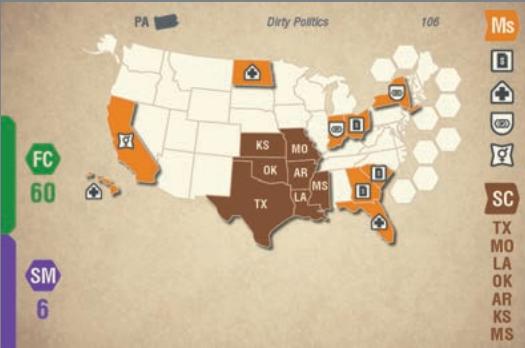
Now the Republican has a turn. Ben wants to get in on the Dirty Politics action as well. He plays card #106 and takes the mudslinging action. He doesn't want to lose 8 voters from his ethically minded states so he chooses to only use two of the issues (Gender Equality and Health Care)
from his ethically minded states (1 from AL, 2 from GA, and 1 from KY). He then removes 1 voter from each party from CA (Gender Equality); and 2 Libertarian voters from FL, 1 each from ND, and 2 Democrat voters from HI (Health Care).
Debate
Month End
During August and September the parties continue to take turns until the last card is drawn from the current month's deck. When this happens, continue to take turns until the end of the current round (i.e., until the last party on the turn order track has completed its turn – so that all parties have an equal number of turns). You may count the number of cards remaining in a month’s deck (without looking at them or rearranging them) to see how many rounds will be left that month.
If you need to draw cards when the deck is empty, draw them from the next month's deck instead (if August runs out, draw from September. If September runs out, draw from October).
When the round in which the August deck runs out is complete, proceed to the first debate. If this is a 4-6 player game, the first debate will take place among the Vice Presidential candidates. When the round in which the September deck runs out is complete, proceed to the second debate. The second debate is always among the Presidential candidates.
In a 2- or 3-player game the first debate is also held among the Presidential candidates. In the 5-player game, the 5th player participates in both debates.
1. Prepare for Debate
Reset the turn order – use the turn order markers and the turn order track on the board to set the turn order for the debate. The party that currently has the most electoral votes will go first, and the party with the fewest goes last. (This will also be the turn order that the players will follow for the next month).
All players participating in the debate must move their candidate (for free) to the city where the debate is being held, shown on the debate city marker for the current debate.
• If any Unprepared politick actions have been played, resolve them now.
• If any Debate Prep politick actions have been played, resolve them also.
2. Debate Rounds
Each debate is divided into three debate rounds. In each debate round, every candidate in the debate will have a turn to play one action card to influence the issues in their party's favor.
In turn order, each participating candidate may play 1 card from their hand that has at least one debate issue icon that matches an issue already on the debate arena (either from the debate topic card or an action card played earlier in the debate, called a rabbit trail). If a player does not have any cards that have matching issue icons, they must pass without playing a card. If they do not play an action card during a debate round, they may still play cards in later rounds.
Rabbit Trail: If there is a debate icon on the played card that does not match any of the debate issue markers already on the debate arena, a candidate has cleverly inserted a new issue into the debate! Add the matching marker for that issue to the center of the debate arena, then move it one space along that party's track in the debate arena for each time it appears on the card.
But there is a downside: for the rest of the debate, any player can play cards that match the new issue introduced to the debate – a tactic known as “going down the rabbit trail!
For every debate issue icon on the card you played, move the matching issue marker one space towards your party's side of the debate arena: If the marker is in the center of the arena, move it onto the track that matches your party's color; if the marker is already on your party's track, move it higher, away from the center of the arena; and if the token is on another party's track, move it towards the center of the arena. Move each marker one space (the center of the arena counts as one space) for each time the issue appears on the card you played.
Once all candidates in the debate have played one card, the first debate round ends. Then, play two more rounds with each candidate, in turn order, playing one card in each debate round (you will play a total of 3 cards).
If you place your cards near your party's track during the debate, it will be easier for players to check for rabbit trails and verify that all of the debate issue markers are on the correct spaces.
3. Voter Reaction
After all three debate rounds are complete, it's time to see how the voters react to the performance of the candidates. Starting with the first player and going in turn order, each candidate that participated in the debate places voters (taken from the undecided voter supply) on the board for each issue marker on their party's track in the debate arena.
For each of the markers in the first space of your track, place 1 voter in each state that has the matching icon. For each marker in the second space, place 2 voters in each state containing those icons. For all the markers in the third space, place 3 voters in the matching states, and for the markers in the fourth space, place 4 voters in the states containing those icons.
After all parties have placed their new committed voters, each candidate that participated in the debate refreshes their hand to their hand limit.
Debate example: In a 3-party game, Shannon is playing the Democrat Michael is playing the Republican, and Jen is playing the Libertarian.
This debate is on the topics of:
• Policies & Programs
• The Economy
Policies & Programs and The Economy


Debate Round One
Shannon goes first since she had the most electoral votes at the beginning of the Debate. She chooses to play card #55 containing the topics of Taxes, Energy Costs, and Jobs (which appears twice).
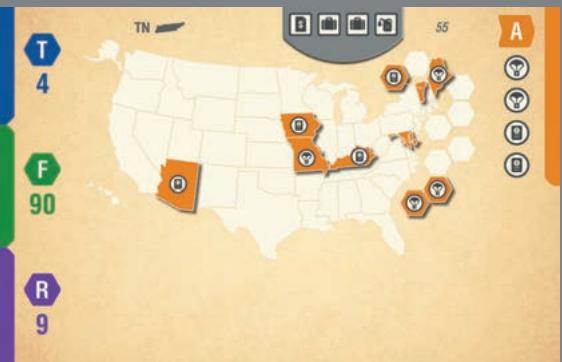
She then moves the marker for Taxes one space toward her party's track (blue for Democrat). She also moves Energy Costs one space and moves Jobs two spaces since it appears twice on the card.

Michael goes next and wants to counteract some of Shannon's points. So he plays card #79 addressing the issues of Energy Costs and Jobs.

He moves the marker for Jobs one space toward his side which puts it in the first slot of the blue track. He then moves the marker for Energy Costs two spaces toward his side (one space to the center and one space to the first slot on his track).

Jen takes the last turn in round one. She wants to get in on the issues that haven't been addressed yet so she plays card #82.
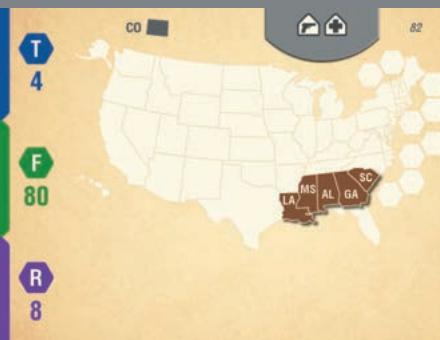
She moves the markers for Health Care and Gun Control one space toward her side of the track.
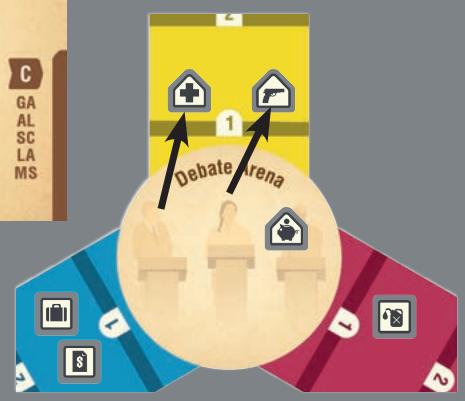
Debate Round Two

Shannon opens round two by playing card #72 (above). She moves the marker for Gun Contro/ back to the middle and moves the marker for National Debt to her track. She has also opened up a rabbit trail on Drug Trafficking. She gets to place the Drug Trafficking marker on the first space of her track, however she does open up the possibility for her opponents to play cards based off of Drug Trafficking as well as the original topics.
Michael goes next and plays card #100. He moves the markers for Jobs and Taxes away from the Democrat and back to the middle.
Jen takes the final turn in round two and plays card #93. She is glad Shannon opened up a rabbit trail as she did not prepare well for the debate and had no more cards containing the original topics. She places the markers for Affordable Housing and Immigration on space 1 of her track (these are new rabbit trails) and moves the marker for Drug Trafficking back to the middle (once a rabbit trail marker is in the arena it acts as any other marker).
The debate arena after round two looks like this:

Debate Round Three
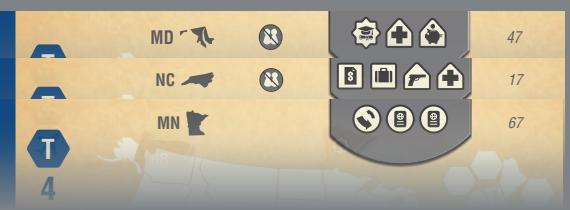
For the final round, Shannon plays card #47, Michaeal plays card #17, and Jen plays card #67. Each moves the appropriate markers leaving the debate arena looking like this:
Voter Reacation
Now the players place voters from the undecided supply into the states that contain the issues that show up on their tracks.
Shannon places 1 voter in each state containing Education and 2 voters in states containing National Debt. Michael then places 1 voter in each state containing Taxes, Jobs, Energy Costs, Gun Control, and Health Care. Finally, Jen places 1 voter in states containing Affordable Housing and International Trade and 3 voters in states containing Immigration. All players then refresh their hands to their hand limit (in turn order).
Reminders:
• Voters awarded for debates always come from the undecided voter supply.
Each debate lasts three rounds. Turn order is set at the beginning of the debate, and the candidates play cards in this order.
Each player is always moving markers toward their party's track. So, if any issue marker is on a high space of an opponent's track, playing a card with the matching icon may only move it down to a lower space of that opponent's track
Each issue only has one (or no) winner. The party that wins the issue (i.e., has that issue's marker on their track at the end of the debate) earns voters for that issue based on where the marker sits on their track.
An issue can never go above the fourth space on a track. If an issue is on the fourth space and a card with that issue is played by the player winning the issue, the issue marker is not moved.
Election Day
Month End
During October, the parties continue to take turns until the last card is drawn from the October deck. When this happens, continue to take turns until the end of the current round (i.e., until the last party on the turn order track has completed their turn – so that all parties have an equal number of turns). You may count the number of cards remaining in a month's deck (without looking at them or rearranging them) to see how many rounds will be left that month. Unlike August and September, in October you will not draw cards to refresh your hand when the deck is empty.
Declaring a Winner
At the end of the round, resolve any “End of Game” politick actions, such as October Surprise or Recount, in turn order. The campaign is now over! Make sure that the Electoral College track accurately shows which party controls each state.
The party with the most electoral votes is declared the winner and the next President and Vice President of the United States!
If the electoral college counters are too close to show a clear winner (within 3 EV), recount the actual electoral votes by adding them on a calculator to determine the winner.
If there is a tie, the tied party with the majority in the most individual states (regardless of size) is the winning party.
Runoff election: In a game with three parties, if two parties tie for the most states during the tie-breaker, remove all voters from the party in last place from the board. Give control of any states that party had the majority in to the new majority holder, updating the Electoral College track as you go. The party that now has the most electoral votes is the winner. If they are still tied, then the party with control of the most states is the winner.
Note: In the unlikely event that a state has no voters from any party, that state is treated as a 0-0 tie, and goes to the party with the tie-breaker in that state.
Credits and Ackowledgements
Designed by: David Cornelius, Nathan Cornelius, Jeff Cornelius
Developed by: Jeff Cornelius, Nathan Cornelius
Illustration & Graphic Design by: Chris Strain, Nathan Cornelius
Copy Editing by: William Niebling
Playtesters: Robert Ewing,Adam Carter, Andrew Smith, Brandon Stover, Christopher Schultz, Curtis Fulmer, Dan King, David Bray, Eva Glattner, John Shulters, Raymond Mullen, Rob Huddleston, Theron Mergott, Luke Laurie, Daniel George, JR Honeycut, Dave Armstrong,
David: Thanks to my Grandfather Ewing and my brothers, Allan, Don, and Phil, for teaching me the joy and the value of playing board games. Thanks to my wife, Peggy, for supporting me and even offering suggestions during the coming of age of Campaign Trail. Thanks to my sons, Jeff, Timothy, and Nathan, for encouraging me and even prodding me to get the game ready for Gen Con and for shaping it into what it is today.
Jeff and Nathan: First of all we would like to thank our Dad for giving us a love of gaming from early on, and for designing such a great game. We would also like to thank Betsy and Amanda. Without you both by our sides we would never have completed this. And finally to our boys, Bryce, Caden, Evan, and Ryan, we are incredibly happy to pass this legacy on to you.
We would also like to thank our 977 Kickstarter backers. Without you this game would not be possible. Thank you so much.
Appendix A: Solo Play
You can play Campaign Trail as a solitaire or 2-player co-op game instead of the normal competitive version. There are a few different ways you can play:
• Solo vs. 1 Al party
• Solo vs. 2 Al parties
• Co-op vs. 1 Al party
• Co-op vs. 2 Al parties
Al party: The Al party is the party (or parties) played by the Solo Play deck. In the Solo Play mode the Solo Play deck will “take actions” to put voters on the board and challenge you for states.
Game Components
In order to play solo or co-op, in addition to the normal components, you will need to use:
• 63 Solo Play cards
• Register track (found on the back of the debate arena tracks)

Setup
-
Choose the parties for all human and Al players. Place voter tokens for those parties near the game board. Set up the Electoral College track and committed voters on the board as normal (use 2-party rules for committed voters if playing against one Al player)
-
Assemble the register track (lay out pieces consecutively in number order) and place near the game board.
-
Place 12 voters for each Al party on the register track, three in each of the first four spaces (use the top of the space for one Al party and the bottom for the other Al party).
-
Shuffle the Solo Play cards:
• For one Al party, count off 40 cards and place them on the August deck space.
• For two Al parties, count off two decks of 30 cards each. Place one on the August deck space and one on the September deck space.
• Return any leftover Al party cards to the box without looking at them.
-
Set up the other cards and resources as normal, including candidate cards and starting resources for the human players.
-
There are no debates in the Solo Play variant so you do not set up the debate arena, debate topic cards, debate city markers, or debate issue markers.
-
When setting up the action card deck, shuffle and place the entire deck on the October space.
-
The Al August deck goes first, followed by the Al September deck (if applicable), followed by the human player.
Setup for solo vs. one Al party shown

Solo Play Cards
The Solo Play card has two sections, a register action section and a direct action section (can be advertise, campaign, or politick). The register action section shows how many voters you will place on the register track if the Al player takes a register action. The register action section also shows a diagram of the register track with a number of spaces filled with voter tokens. You will use this to determine if the Al party will take a register action or a direct action.
The direct action section shows how many voters will be placed in each state on the board. It also shows the threshold value for each state (given as a number on the state). A state will only receive voters from the register track if the Al party's lead in that state is less than the threshold value. If the Al player's lead is greater than or equal to the threshold value then no voters are place in that particular state.

Note: The type of direct action on the Solo Play card does not affect the Al party turn at all. They type varies from card to card so that the human player may make use of politick actions that give bonuses when an opponent plays a specific type of direct action.
Register Track
The register track
内容过长,此处只内联前一部分;完整内容请下载或到规则页阅读。
下载 Markdown原文为社区整理/出版社公开资料,版权归原作者,仅供个人学习查阅。