
Capital Lux 2: GenerationsCapital Lux 2 Generations
一句话概览
Capital Lux 2: Generations 是一款已收录于村了吗规则库的桌游,支持 2–4 人,原名 Capital Lux 2 Generations。
本页内容:一句话概览 · 常见问题
这游戏怎么玩
- 本站已收录这款游戏的规则资料,可以在对话里直接提问规则细节。
常见问题(FAQ)
以下 1 条问答中 0 条来自站内玩家的真实提问,其余 1 条为本站整理的常见疑问;答复内容保持原样。
Capital Lux 2: Generations支持几个人玩?
2–4 人。
去哪查完整规则
想核对具体规则细节、卡牌效果或某个回合的结算方式,可以在村了吗里选中这款游戏后直接提问。
同类桌游
- 卡坦岛德式
- 工业革命:伯明翰德式
- 勃艮第城堡:特别典藏版德式
- 方舟动物园德式
- 卡卡颂抽象
- 瘟疫危机传承:第一季美式
- 阿瑞迪亚:勇踏征途美式
- 重塑宇宙德式
- 幽港迷城美式
- 埃多拉的德鲁伊德式
规则原文(Markdown)
本站收录这款游戏的规则原文 1 个文件,此处内联渲染 1 个,可直接展开阅读或下载。
rules.md22.2 KB
APITAL LUX2 GENERATIONS
RULES
Lux and the surrounding areas are in constant change and development. The four families - the rebels [blue], the spirituals [pink], the nobles [yellow] and the scientists [green] - havealways been able to live side by side. As new generations growup,new challenges arise. The only thing that will never change is the emperor's law:Everyone must contribute to the commongood, sending qualified members to the capital.
Capital Lux 2: Generations provides, as did its predecessor, a rich tacticalexperience through its subtle and clean core system. Now, with thisnew edition, it also ensures high replay-value dueto its 16 unique powers, which may be combined in 256 differentways!
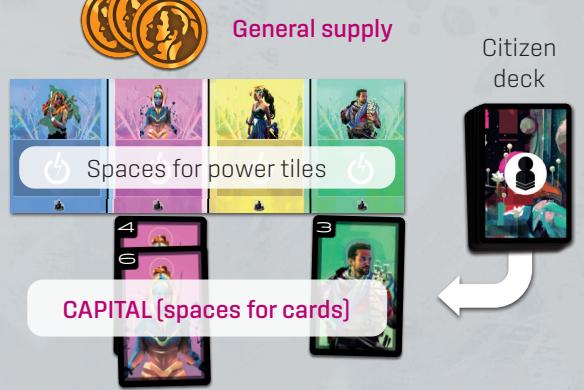
GENERAL COMPONENTS
The following components are used in every game. You will also use 4 of the power tiles. All power tiles, the corresponding components and their effects are displayed in a separate APPENDIX.
100 citizen cards: 25 of each color, valued 2-6


1 emperor tile:


20 gold tokens:


1 capital sheet:



4 home base sheets:


_


THE GOAL OF THE GAME
The game is played over 3 rounds. In each round, the players draft a hand of 6 cards and then take turns, playing cards either in front of themselves [their HOME BASE] or in the middle of the table [the CAPITAL]. Playing a card in the CAPITAL triggers the corresponding power tile. When the round ends, you compare the total value of cards in your HOME BASE with the total value in the CAPITAL. If your total in any color exceeds that of the CAPITAL, you lose all cards of that color. After three rounds, the game ends. Any cards remaining in your HOME BASE are worth points equal to their values. Add the values of any bonus cards and gold tokens you have acquired during the game. The player with the highest score wins the game.
The game can also be played solo - see pages 6-8.
If you are familiar with Capital Lux [1. ed], you may jump to the last page for a list of all changes.
SETUP
-
Place the capital sheet in the center of the table.
-
Place all gold tokens in the general supply above the capital sheet.
-
Shuffle the citizen cards and make a facedown deck at the right side of the capital sheet. This is the citizen deck.
-
Draw 3 random starting cards from the citizen deck and place them face up below their corresponding color of the capital sheet [let any cards of the same color overlap].

Example: 3 random starting cards in the CAPITAL
-
Each player takes a home base sheet and places it in their play area. Any unused sheets are returned to the box.
-
Choose a starting player by random. Give this player the emperor tile.


HOME BASE [spaces for cards]
- Sort the power tiles by their color, shuffle each stack and randomly draw one from each stack: one blue, pink, yellow and green. Place each drawn power tile face up on their respective space on the capital sheet.
In the APPENDIX, you will find all necessary instructions on how to set up the components for each of the chosen power tiles. Also, make sure each player knows all the rules for each of the power tiles. You don't have to read the whole APPENDIX before you start playing - only look up the four applicable power tiles.
BACKSIDES OF THE POWER TILES [4 of each color]:

The first time you play, instead of drawing random tiles [see bullet 7 above], we suggest that you start with one of the 4 predefined sets below. They are all good ways to (re]discover the game.
If you are not familiar with Capital Lux, we recommend set A ["The Beginning"].
Find all power tiles with a letter A in the headings. If you are familiar with Capital Lux, we recommend set B, C or D.
Find all power tiles with the corresponding letter in the headings.
| Set | Blue | Pink | Yellow | Green |
| A: The Beginning | Agent | Cleric | Merchant | Scholar |
| B: Revolution | Infiltrator | Doomsayer | Follower | Convertor |
| C: Harmony | Recruiter | Missionary | Aristocrat | Discoverer |
| D: Anarchy | Outsider | Mentalist | Sentinel | Dualist |
Example: You are familiar with Capital Lux and choose to play with the power tiles from set B [Revolution].
Find all power tiles with the letter B in the heading.

PLAYING A ROUND
In each of the 3 rounds, go through the following steps in the order shown:
1. DRAFT CARDS
2. PLAY CARDS
3. ROUND END
1. DRAFT CARDS
-
From the citizen deck, deal 6 cards face down to each player. Each player simultaneously looks at their cards and chooses 2 cards to keep, which are placed face down in front of the player. They send the remaining cards face down to the player seated to their left.
-
From the cards received from the player to their right, each player chooses another 2 cards to keep. Again, they pass the remaining cards to the player seated to their left.
-
All players keep the final cards they receive, which will conclude their starting hand of 6 cards.
The starting player begins. Then, the players take turns in a clockwise order. On your turn, you must play one card from your hand. You play the card...
EITHER in your own HOME BASE
– OR in the CAPITAL
Example: Victoria plays a pink card in the CAPITAL. She immediately carries out theeffect of the pink power tile.

Place the card face up below its matching color [see "Districts" below]. Let cards overlap.
– Playing a card in your HOME BASE may give you potential end game points.
– If you play a card in the CAPITAL, you must carry out the POWER effect of the matching power tile [see APPENDIX] after the card is played.
Note: Only if it's not possible to carry out the power, you may play a card in the CAPITAL without carrying out the power.
District: When playing a card in the CAPITAL or your HOME BASE, the card must be placed below its matching color. This is referred to as “matching district”. However, as a result of some power tile effects, cards could potentially end up in a different district than its actual card color. A district is therefore the collection of all cards lying directly below a specific color of the capital sheet or a home base sheet, independent of actual card colors. From now on, we will always use the term “district” instead of “color”.
Example: All cards lying below the pink color of the capital sheet belong to the pink district.
3. ROUND END
When a player has no more cards in hand at the end of their turn, each other player gets one last turn.
LAY DOWN CARDS:
Now, any player who still has cards left in hand, must lay these cards down in the matching districts in their HOME BASE.
Note: The number of cards left in the players' hands may differ due to certain powers.
RESOLVE:
District by district - first blue and then pink, yellow and green - each player now compares the total value of the cards in their HOME BASE with the total value in the CAPITAL.
The total card value in a CAPITAL district is the capital limit [MAX] of this district. If the total card value in your HOME BASE exceeds MAX, you must discard all cards from this home base district. If not, the cards remain in your HOME BASE.
Example: After his last turn, Adam has two cards left in hand. He must therefore lay them down in their matching districts in his HOME BASE.

CAPITAL:

HOME BASE:

Example: In the pink district, Victoria is above MAX [7 vs. 6]. She must therefore discard all cards from her pink district.
SCORE BONUS:
After all districts have been resolved, the players score BONUS CARDS. District by district - first blue and then pink, yellow and green - the player with the highest total value in their HOME BASE must take the highest valued card in the corresponding CAPITAL district, placing it face down in a score pile above their home base sheet.
Note: You must have a total value of at least 1 or more in your HOME BASE to be eligible for a bonus card or gold token - see below].
In case of a tie, each of the tied players adds 1 gold token to their score pile instead. Then, the highest valued card of that district is discarded. Note: The card is not discarded if the players are not eligible for bonus.
Gold is regarded as an unlimited resource, so if the gold reserve is exhausted, use any other tokens or tiles as gold tokens.
PREPARE NEXT ROUND:
At the end of round 1 and 2: The player with the emperor tile passes it to the player sitting to their left, who becomes the starting player in the next round.
Note: Cards in the CAPITAL and in the players' HOME BASES remain in place.
Adam's score pile

Example: In the green district, Adam has the highest value [8 vs. Victoria's 5] and gets to take the bonus card valued 6 from the green CAPITAL district, placing it face down in his score pile
Which card to take or discard if two or more cards have the same value (general rule]: If several cards in the CAPITAL district have the same value, the player whose turn it is, or the player who is about to take a bonus card, chooses which of the cards to take/ discard. Exception: If there is tie for a bonus card, and two or more cards in the capital has the same highest value, the last played/ placed card in that district is discarded.
GAME END
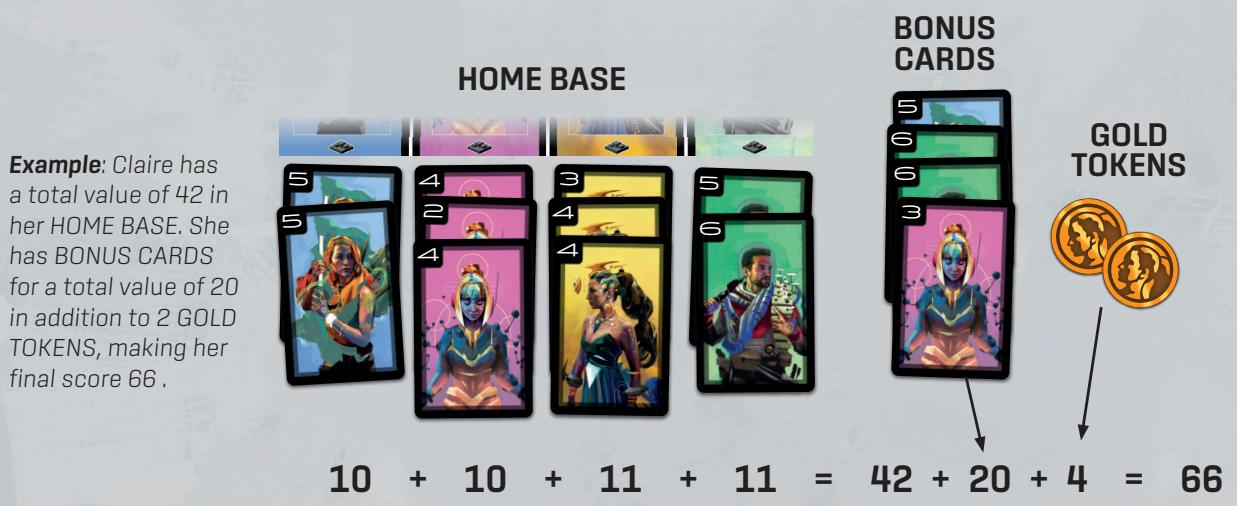
After SCORE BONUS in round 3, the game ends. Add up the values of all cards in your HOME BASE and the values of all your BoNUs cARDS. Add 2 points per GOLD TOKEN. The player with the highest total wins the game. In case of a tie, the tied player with least gold tokens wins (most points on cards]. If it's still a tie, the victory is shared.

You may play this game solo. Follow the standard rules (page 2-5] with the exceptions described below. You are opposing an automatic “player", called ROB. Try to beat ROB'S score to win the game!

Additional components: 14 ROB's cards
SETUP
Follow normal setup [page 2-3], and in addition...:
- Draw 1 additional starting card and place it face up in the CAPITAL [for a total of 4 starting cards].
– Draw 2 cards from the citizen deck and place them face up beside the deck. This is ROB's current hand.
– Place ROB'S home base sheet to the right of yours.
- Shuffle RoB's cards and make a facedown deck above ROB's home base sheet. This is RoB's deck.
– Draw 1 citizen card and place it face up in the matching district in ROB's HOME BASE.
Choose 4 power tiles to use, except for Outsider, Doomsayer and Convertor. For each power tile, check APPENDIX for rules and components to add.
Capital [example]

Citizen deck
ROB's hand [example]


YOUR HOME BASE

ROB's deck


ROB'S HOME BASE [example]
PLAYING A ROUND
As in the multiplayer game, the game is played over 3 rounds, in which you execute step 1 to 3. All 3 steps are replaced by the following rules:
1. DRAFT CARDS
Draw citizen cards so that there are 5 face-up cards to the right of ROB's home base sheet. This is ROB's reserve. At ROUND END, these cards could end up in ROB's HOME BASE.
Note: In round 2 and 3, only fill up the reserve. Example: If there are 2 cards left from previous round, only draw 3 more - for a total of 5 cards.


ROB'S HOME BASE [example]

Reserve [example]
Draw your hand of cards: Draw 3 random citizen cards and choose 2 to keep. Place the leftover card in a discard pile. Repeat this two more times until you have 6 cards in hand.
2. PLAY CARDS
Each round, ROB starts this step. Then, you and ROB take alternate turns. Your turn follows the standard rules [see page 4], including triggering CAPITAL powers. On ROB's turn, draw the top card from RoB's deck and place it face up in the following way: Example: Examnle:
If it is a red card [with countdown symbol on top], place it to the right of ROB's deck. Each red card should be separated.
- If it is a blue card, place it face up in a stack to the left of ROB's deck [with only the top card being visible].
Blue cards


Red cards


The just drawn ROB's card tells you which citizen card to select:

The left card in ROB's hand
The right card in ROB's hand
The top card from the citizen deck
ROB's bonus card
CAPITAL
The selected citizen card is played by strictly obeying ROB's rule:
The citizen card is played in..:
A] ROB'S HOME BASE if that home base district will not exceed the matching capital district after the card is played.
B] The CAPITAL if you can't play it in ROB'S HOME BASE [see "A"].

Bonus symbol
Additionally: If the card is played in the CAPITAL [and only then] and if the card shows a bonus symbol, you must take the lowest valued card from the CAPITAL, except for the one you just played, and place it face down in ROB's score pile. If there is a tie for lowest card, you choose which one of the tied cards to take.
Bonus symbol
ROB's hand

ROB'S score pile
Note: ROB never triggers any powers!
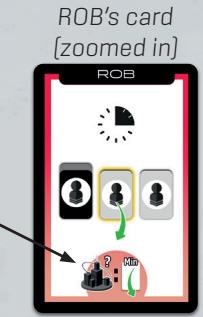
ROB'S HOME BASE
ROB'S turn ends by replenishing ROB's hand [if necessary] with a new citizen card from the deck.
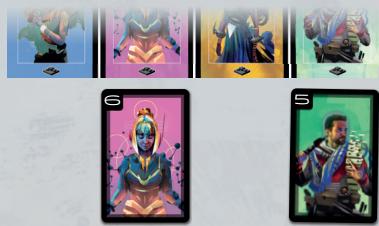
Example: ROB's card instructs you to take the left card in ROB's hand, the green 4. Since the home base value would have exceeded the capital value, it must be played in the CAPITAL instead. Also, you take the blue 3 [the lowest card] from the CAPITAL and place it in ROB's score pile.
3. ROUND END
ROUND END is triggered in one of two ways: [A] Either if you have no more cards in hand at the end of your turn, or [B] when there are 3 red cards at the right side of RoB's deck at the end of ROB's turn. Then, the other player [either you or ROB] gets one last turn.
Lay down cards: You follow the standard rules, while ROB plays his reserve, if possible: Play each of the 5 cards in ROB's reserve into ROB's HOME BASE, but only if the value of the district will not exceed the value of its matching CAPITAL district after the card is played. If the card cannot be played, it remains in the reserve. If two or more cards have the same color, start with the highest valued card.
Resolve & Score Bonus: Follow the standard rules [see p. 4-5]. ROB is also entitled to bonus cards [ties are resolved in a normal way by discarding highest card and gaining gold].
Before next round: Collect all 14 ROB's cards, shuffle them and form a new RoB's deck.

GAME END
After SCORE BONUS in round 3, the game ends. Check your score against ROB's score (the sum of ROB's HOME BASE, BONUS CARDS and GOLD TOKENS] to see if you won. If it is a tie, you win if you have fewer gold tokens than ROB. If you want to see how well you did, you should compare your skills with the table below. Your skills = Your score minus ROB's score:
Loss [(negative]: It should not be too easy to win, so try again!
0-6: Decent!
7-12: Good!
13-18: Very good!
19-24: Excellent!
24-30: Outstanding!
31+: World Class!
SYMBOLS USED ON POWER TILES
See APPENDIX for detailed description of the power tiles themselves.

Matching home base district

Any capital district
Face-up card/tile [white fill color]

Any home base district

Specific capital district [e.g. blue].
Facedown card/tile in the deck/stack [black fill color]

Outsider district

Your hand
CHANGES FROM CAPITAL LUX [1ST EDITION]
Even if you are familiar with Capital Lux [1. ed], there are a few changes that you should be aware of. These are summarized here:
GENERALSETup: Each player takes a home base sheet. Place the capital sheet in the middle of the table. Draw 3 random citizen cards as starting cards in the CAPITAL (instead of 1].
PowER TILEs [incl. SETuP]: Power tiles replace the capital cards. All 4 powers from the 1st edition [Agent, Cleric, Merchant, Scholar] are also included here, but Agent, Cleric and Merchant have changed slightly [read APPENDIX]. Instead of only 4 powers, there are now 16 different powers that can be mixed and matched. For each game, draw 4 random power tiles [one of each color] and place them on the capital sheet. For each power tile you draw, you must read the rules in the APPENDIX for additional setup and other in-game rules.
DRAFT cARDS: Each player gets 6 cards, regardless of the number of players [and not only 5 in a 4-player game].
THE"DIsTRIcT" TERM: Due to some power tiles, cards can end up in a different district than its actual card color. Therefore, we use "district" instead of "color" as a term.
TIEBREAK RULE FOR BONUS CARDS: Discard the highest card from the corresponding CAPITAL district, and each tied player gets one gold token, which is worth 2 points at game end (instead of 1]. So, the tied players no longer take cards from the CAPITAL.
PREPARE NEXT RouND: Starting player is the next player to the left.
TIEBREAK RULE IN FINAL ScORING: Now, the tied player with least gold tokens [highest total value on cards] wins the game. If it's still a tie, the victory is shared.
soLo MoDE: You can also play the game solo [see pages 6-8].
Thanks to all play testers, especially Lin Heidi Isaksen, Kjetil Svendsen, Geir André Wahlqvist, Kristian Elvsveen, Christian Magnus Fredheim, Vegard Stillerud, Robert Grønås, Vetle Oldeman Christensen and Terje Vedaa + all players that have given us valuable feedback of the first edition of the game.
Special thanks to Travis R. Chance for bringing the idea of a second edition of Capital Lux to the table! Game design: Eilif Svensson
& Kristian A. Østby
Artwork: Kwanchai Moriya
Graphic design: Anthony Questel & Gjermund Mørkved Bohne
© 2016-2020 Aporta Games AS. All rights reserved.

原文为社区整理/出版社公开资料,版权归原作者,仅供个人学习查阅。