
卡卡颂:穿越山丘Carcassonne Over Hill And Dale
一句话概览
卡卡颂:穿越山丘 是一款已收录于村了吗规则库的桌游,支持 2–5 人,原名 Carcassonne Over Hill And Dale。
本页内容:一句话概览 · 游戏概述 · 1. 游戏组件 · 2. 游戏设置 · 3. 游戏流程 · 4. 远足行动 · 5. 农田完成与农产品 token · 6. 马厩与动物、多数规则 · 7. 游戏结束与终局计分 · 关键规则与常见问题 · 常见问题
卡卡颂:穿越山丘 规则速览
以下规则速览由本站整理,与官方规则书表述不同,仅供快速上手参考。
游戏概述
《卡卡颂:穿越山丘》是卡卡颂系列的独立游戏(不需要基础版即可游玩),2014 年推出的农场主题作品。玩家轮流抽取并拼放地形板块,共同描绘出有道路、农田和草地的乡野风光;然后把自己的米宝放到道路上当远足者、放进农田当农夫,或者在草地上修建马厩。通过完成道路和农田、沿路远足赚分、收集农产品 token 和饲养动物,游戏结束时得分最高的玩家获胜。
核心机制:板块拼接、米宝放置与回收、替代行动(远足)、多数控制、成套收集
人数:2–5 人(盒面/集石标注)
1. 游戏组件
| 组件 | 数量与说明 |
|---|---|
| 地形板块 | 73 块(1 块起始板块、72 块普通板块),板块上印有道路、农田、草地、动物和农产品图标 |
| 米宝 | 5 种颜色,每种 5 个(其中 1 个放在记分板上,玩家手中实际持有 4 个) |
| 马厩 | 5 种颜色,每种 2 个 |
| 农产品 token | 33 个(向日葵、苹果、草莓、南瓜、小麦各 5 个,稻草人 8 个) |
| 记分板 | 1 块,放在桌边(英文规则补充) |
| 50/100 分数板块 | 5 块,用于超过 50 分后的超圈计分(英文规则补充) |
2. 游戏设置
- 将起始板块(背面为蓝色)正面朝上放在桌子中央。
- 其余板块充分洗匀,正面朝下分成若干堆,放在所有玩家都方便抽取的地方。
- 农产品 token 按种类分开,各自成堆放在桌上。
- 记分板放在桌边一侧,5 块 50/100 分数板块放在记分板旁备用。
- 每位玩家选择一种颜色,拿取 4 个米宝和 2 个马厩作为个人供应;每人第 5 个米宝放到记分板的 0 格上,全程用来记录分数。
- 未使用的米宝和马厩放回游戏盒。
- 最年轻的玩家先手,之后按顺时针方向轮流进行。
3. 游戏流程
每回合按顺序执行以下步骤:
3.1 抽取并拼放板块(必须)
- 从堆中抽取 1 块地形板块,拼入已有地图,至少与一块已放板块相邻。
- 相邻的边必须延续已有的地物(道路接道路、农田接农田、草地接草地),不能把道路口对上农田边。
- 极少数情况下,抽出的板块确实无处可合法放置时,把该板块移出游戏(放回盒子),另抽一块。
3.2 放置米宝或马厩(三选一,也可以不放)
只能放在刚拼好的那块板块上,且每回合至多做其中一个:
- 米宝放道路上,作为远足者:该道路(含被新板块延伸后的整条路)上不能已有其他远足者。
- 米宝放农田上,作为农夫:该农田区域(含延伸后)不能已有其他米宝。
- 马厩放草地上:马厩有排他性距离规则,任何已有马厩的板块,其周围 8 格内都不能再放第二个马厩;马厩一旦放置便不可移动,直到游戏结束才能拿回。
3.3 结算计分(必须)
- 拼放完成后,凡因这块板块而完成的地物立即计分,所有在完成地物上有米宝的玩家都参与判定(多数规则见第 6 节)。
- 计分结束后,该地物上的所有米宝归还各自玩家的供应。
3.4 远足行动(可选)
本回合没有放置米宝或马厩时,可改为远足,详见第 4 节。
4. 远足行动
前提条件:你此前已把一个米宝作为远足者放在某条道路上,并且本回合拼放的板块延伸了这条道路,同时本回合没有放置新米宝或马厩。
- 移动:选定一个方向,沿道路移动你的远足者,每进入 1 个板块得 1 分,并立即在记分板上推进。
- 可以经过路上其他远足者所在的路段,但不能停在有其他远足者的路段上(中文源表述:可以遇到其他远足者,但不能停在一个格子里)。
- 远足不能穿过十字路口。
- 每回合只能移动 1 个远足者,且只能走 1 个方向,即使有多种走法可选。
- 只能在自己的回合远足;别的玩家延伸了你远足者所在道路时,该远足者不能移动。
- 若道路在这次拼放中完成,先立即计分,不能在计分前先远足赚分。
5. 农田完成与农产品 token
农田被草地完全包围、内部没有空缺时即为完成:
- 完成农田按板块数计分,每板块 2 分;由农田里的农夫(多数)得分,随后米宝归还。
- 除分数外,按完成农田的全部板块上的农产品图标领取农产品 token:每有 1 个图标,就从对应 token 堆拿 1 个。
- 领到的 token 正面朝下放在自己面前保密存放,可随时自己查看(英文规则补充)。
- 农产品 token 的分数到游戏结束时才结算。
一个农田里有多家农夫时的 token 分配(按中文源例子归纳):
- 只有农夫数最多的玩家参与分配;农夫数少的玩家没有资格挑选。
- 若多家并列最多,由完成该农田的玩家先挑;若完成农田的玩家不在并列之列,则按当前回合次序由并列玩家先开始。
- 并列玩家轮流每次挑 1 个 token,直到所有 token 分完为止,各家拿到的数量可以不均。
6. 马厩与动物、多数规则
马厩:
- 马厩不参与游戏过程中的计分,只在游戏结束时计分。
- 结算时,马厩所在板块及其周围 8 个板块(共 9 格)上,每有 1 只动物(鸡、牛、马、羊、猪)得 1 分。
- 周围板块没有拼满不影响计分,没拼的格子上只是没有动物。
- 放置建议:把马厩建在紧邻动物多的板块旁。
多数规则(道路与农田通用):
- 同一地物中米宝最多的玩家独得该地物的全部分数;若多家并列最多,每家都获得全部分数。
- 米宝数量少的玩家不得分。
- 计分后该地物上所有米宝归还。
- 米宝放下后就不再移动(远足行动除外)。
7. 游戏结束与终局计分
板块全部抽完(无可再抽)时游戏结束,随后进行终局计分:
| 项目 | 终局得分 |
|---|---|
| 未完成道路 | 道路每板块 1 分,路上有远足者的玩家各自按此计分 |
| 未完成农田 | 农田每板块 1 分;终局不补发农产品 token |
| 马厩 | 所在板块及周围 8 格上,每只动物 1 分 |
| 农产品 token | 每个 1 分(稻草人也一样) |
| 成套农产品 | 每集齐一套(向日葵、苹果、草莓、南瓜、小麦各 1 个)额外 5 分;稻草人是百搭,可替代套中缺少的任意一种 |
计分板用法(英文规则补充):某玩家分数超过 49 分时,取一块 50/100 分数板块放在自己面前(50 面朝上),继续绕记分板计分;超过 100 分时把该板块翻到 100 面。
终局计分全部完成后,分数最高的玩家获胜;如有并列,并列的玩家共享胜利。
关键规则与常见问题
易错规则:
- 拼放板块必须延续相邻边的已有地物;确实无法放置的板块移出游戏并重抽。
- 每回合至多做一个放置行动:米宝(远足者或农夫)或马厩,也可以都不放(改为远足)。
- 米宝只能放在刚拼好的板块上,且其所在区域(含新板块延伸后的完整区域)不能已有其他米宝。
- 马厩的距离规则只限制马厩,不限制米宝;马厩放置后不可移动,到游戏结束才拿回并计分。
- 道路两端都落到十字路口或农田即为完成,道路自成闭环也算完成;完成道路每板块 1 分。
- 远足每进入 1 个板块得 1 分,不能穿过十字路口,不能停在有其他远足者的路段,每回合只能动 1 个远足者、走 1 个方向。
- 完成农田每板块 2 分;农产品 token 只在农田完成时领取,终局不再补发。
- 道路或农田里多家米宝时,只有多数玩家计分,并列则各得全部分数。
- 每次计分完成后米宝立刻归还。
- 农产品 token 每个终局 1 分,每凑齐 5 种农产品各 1 个再加 5 分,稻草人可当百搭补缺。
常见问题:
问:别人的远足者挡在路上,我能继续远足吗?
答:可以经过他所在的路段,但不能停在有其他远足者的路段上;同一条道路上已有远足者时,其他玩家也不能再往这条路放远足者。
问:游戏结束时未完成农田能领农产品 token 吗?
答:不能。token 只在农田完成的那一刻按图标领取,终局未完成农田只按每板块 1 分计分。
问:马厩周围 8 格有几格没拼板块,会影响得分吗?
答:不会。只统计已拼板块上的动物,每只动物 1 分,空格不扣分也不加分。
问:稻草人怎么用?
答:稻草人 token 每个终局本身 1 分;凑套装时可当百搭,替代缺少的任意一种农产品,但它本身不算一种农产品种类。
问:可以不放米宝也不放马厩吗?
答:可以。本回合没放米宝和马厩时,若你拼放的板块延伸了自己远足者所在道路,可以改为远足行动。
常见问题(FAQ)
以下 1 条问答中 0 条来自站内玩家的真实提问,其余 1 条为本站整理的常见疑问;答复内容保持原样。
卡卡颂:穿越山丘支持几个人玩?
2–5 人。
去哪查完整规则
想核对具体规则细节、卡牌效果或某个回合的结算方式,可以在村了吗里选中这款游戏后直接提问。
同类桌游
- 卡坦岛德式
- 工业革命:伯明翰德式
- 勃艮第城堡:特别典藏版德式
- 方舟动物园德式
- 卡卡颂抽象
- 瘟疫危机传承:第一季美式
- 阿瑞迪亚:勇踏征途美式
- 重塑宇宙德式
- 幽港迷城美式
- 埃多拉的德鲁伊德式
规则原文(Markdown)
本站收录这款游戏的规则原文 2 个文件,此处内联渲染 2 个,可直接展开阅读或下载。
rules_zh_卡卡颂穿越山丘_16579.md2.4 KB
卡卡颂-穿越山丘中文规则1.1
游戏配件:
73块板块(1块起始板块,72块普通板块)
5种颜色米宝,每种5个。(其中一个放在记分板上)
5种颜色马厩,每种2个。
33个农产品token(向日葵、苹果、草莓、南瓜、小麦各5个,稻草人8个)
游戏流程:
1. 放板块(规则同卡卡颂基础)
2. 放人
2.1 放米宝在路上,作为远足者,规则同卡卡颂基础*路*。
2.2 放米宝在农田上,作为农夫,规则同卡卡颂基础*城市*。
2.3 放马厩在草地上,马厩有排他性,周围8个格子不能放第二个马厩,放置后游戏结束才能拿回,规则类似*草地*。
2. 替代放人行动,远足行动
延伸了道路情况下,如果游戏中不放置米宝或者马厩,可以采取远足行动。移动你的一个远足者往一个方向移动,每移动一格,得1分。可以遇到其他远足者,但不能房子一个盒子里。
3. 获得农产品 token
完成的农田上有农产品 token,放置最多农夫玩家可以参与分配 token。
3.1 比如,完成农田上,只有红色玩家的农夫,红色玩家获得所有 token。
3.2 比如,红色玩家完成农田,不过这个农田上,有 2 个红色农夫和 2 个蓝色农夫,5 个 token,由红色玩家先开始挑选 token,然后轮到蓝色玩家,直到 5 个 token 选完。
3.3 比如,黄色玩家完成农田,不过这个农田上,有一个黄色农夫、2个红色农夫、和2个蓝色农夫,5个token,黄色玩家人最少,没有资格挑选token,由红色玩家和蓝色玩家按当前次序挑选token,5个token选完。
4. 计算分
4.1 每个远足者所在道路完成, 每有一个板块得 1 分。游戏结束未完成的路, 每个 1 分, 规则同卡卡颂基础*路*。
4.2 每个农夫所在农田完成,每有一个板块得 2 分。游戏结束未完成的农田,每个 1 分,规则同卡卡颂基础*城市*
4.3 每个马厩周围 8 个格子和包括自己所在格子,有 1 个动物,游戏结束得 1 分,规则类似卡卡颂基础*修道院*
4.4 农产品 token,每个游戏结束,得 1 分。
每收集一套农产品 token(向日葵、苹果、草莓、南瓜、小麦各一个),额外得 5 分。稻草人 token 是百搭牌,可以用于代替缺少农产品 token。
由 earth19970105 2021.10.5 整理
下载 MarkdownCarcassonne Over Hill and Dale - English Rules translation.md27.3 KB
Cdicassonne Klaus-Jürgen Wrede Over HILL and DALE

Front side Back side


A clever tile laying game for 2 to 5 players, ages 8 and up,
Take a hiking trip through the magnificent scenery of the countryside, and find yourself surrounded by fruit trees, wheat fields, and sunflowers! No one can resist a juicy apple straight from the tree or a fresh, sweet strawberry! This new version of Carcassonne has a peaceful, rural setting – but still provides strategic gameplay. The player who has the best harvest, hiking skills, and collection of farm animals has the best chance of winning.
GAME COMPONENTS AND SETUP
Welcome to Carcassonne; Over Hill and Dale! In this rule book we will quickly guide you through the simple rules of this latest version of the classic Carcassonne game. After reading over the rules, it will be easy to teach others how to play and enjoy the game. of course, you first must setup the components for the game, but this is quickly done. In the following setup section, we will also explain the various game components.
First, let's have a look at the LANDSCAPE TILES. On the 73 Land scape Tiles, you can see Hiking Trails and Farmlands, which are surrounded by lush Meadows. Animals and/or Harvest icons can also be seen on many of the tiles.

Tile with a Farmland and a Harvest icon

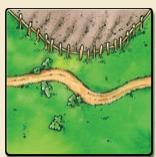
Tile with a Hiking Trail
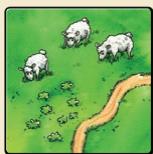
Tile with a Hiking Trail and Animals
One of the 73 Landscape Tiles has a blue back. This is the Starting Tile, which is placed on the table at the start of a new game.

Starting Tile with blue back

Normal Tile with yellow back
Next, here are the HARVEST TOKENS. There are 5 tokens each of Apples, Strawberries, Pumpkins, Sunflowers, and Wheat. ln addition, there are 8 Scarecrow tokens.


Front side
To begin the setup for a game, first place the Starting Tile in the center of the
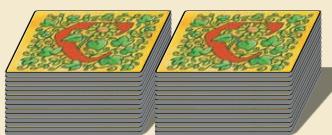
table. Thoroughly mix the Landscape Tiles and place them face down in
several stacks on the table, within easy reach of all players.
Sort the Harvest Tokens by type and
place them in individual stacks on
the table.
Starting Tile
Several stacks of face-down Landscape Tiles

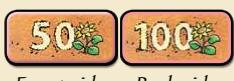
Then we have the SCORING TRACK, which is placed to one side of the table. Place the 5 50/100-Point Tiles near the Scoring Track, to be used later in the game to display scores of more than 50 points.

Lastly, let's take a look at the WOODEN PIECES. There are Player Figures (referred to as “Meeples”), of which you will find 25 total, 5 each in the 5 player colors Yellow, Red, Green, Blue and Black. ln addition, there are also 2 Stables in each of the 5 player colors.
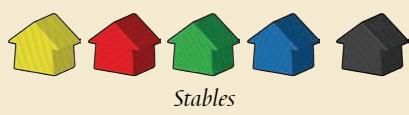
Give each player (including yourself) 4 Meeples and 2 Stables in a chosen color. These form each player's supply. Finally, place the 5th Meeple for each player on the “0” space of the Scoring Track. All unused Meeples and Stables are returned to the game box.
GOAL OF THE GAME
Before we begin with the rules, what is the goal in Carcassonne: Over Hill and Dale? Turn after turn, you and the other players will play tiles to the table in order to form the landscape of the countryside. You will create paths on which you can take long hikes, and farmlands that contain fields of fruits and vegetables. You can use your Meeples as Hikers or Farmers, or you may build one or both of your Stables in the Meadows. These actions earn points for the players, not only during the game, but at the end of the game as well. The winner, determined after the final scoring, is the player with the most points. Here we go...!
GAME PLAY
The youngest player is the start player, and play proceeds clockwise from there. On his turn, each player performs the following actions in the order shown below, and then the next player takes his turn, etc. First, we will describe the actions taken on a player's turn, and then we will explain the landscape tiles in more detail, based on the features depicted on them (Hiking Trails, Farmlands, and Animals in Meadows), and what actions can be taken with each.
Draw and place a landscape tile: The player must draw one tile from the face down stacks, and then places it on the table,
connecting it on one or more of its four sides to those of previously placed tiles.

On the newly-placed tile, the player may either:
2
2a) Place a Meeple, OR:
2b) Build a Stable.


3a) The player must perform all scorings that are triggered by placement of his landscape tile.
3b) Optionally, the player may Hike with one of his Meeples on a Hiking Trail, in order to earn additional points.


The Hiking Trails
1, Placing a tile containing a Hiking Trail
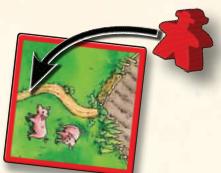
In this example, the tile you have drawn (bordered in red) shows 3 Hiking Trails emanating from a crossroads. When placing new tiles, they must always continue pre-existing features (Hiking Trails, Farmlands) on adjacent tiles.
2a, Placing a Meeple as a Hiker
After placing a tile containing a Hiking Trail, you may place a Meeple as a Hiker on the Trail, as long as there are no other Hikers already on any part of the same Trail. At this point, the Hiking Trail is not yet complete, so for the time being, no points will be scored (see Action 3 below). The next player now takes his turn.
As seen in the example at right, the next player draws a tile and places it. However, he may not place a Meeple as a Hiker on the Trail section, because your Hiker already occupies this Trail. Instead he places a Meeple as a Farmer on the Farmland setion of the newly-placed tile.
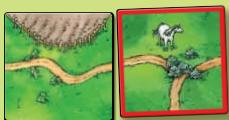
You place the red-bordered tile so that the Hiking Trail and Meadows continue correctly to the adjacent tile – good job!

On the newly-placed tile, you (Red) place a Meeple as a Hiker. Since there are currently no other Hikers on this Trail, this action is allowed.
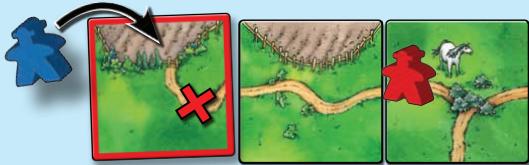
Since the Hiking Trail is already occupied, Blue decides to place a Meeple as a Farmer on the Farmland.
ln most cases, it is a good strategy to place a Meeple on a newly- placed tile, but it is not mandatory to do so. You may decide to skip this action.
3a, Triggering a Scoring with a completed Hiking Trail
Whenever a Hiking Trail ends at a crossroads or a Farmland on both sides,
or when the Hiking Trail forms a closed loop, it is considered to be complete, and a scoring occurs. ln our continuing example, we can see that there will be a scoring, since the Hiking Trail is terminated at both ends.
Although the other player has placed the tile that completed the Hiking Trail, you will score for it since you have a Hiker on it. You score 1 point for each tile comprising the completed Hiking Trail.

Because this completed Hiking Trail is made up of 3 tiles, you (Red) score 3 points.
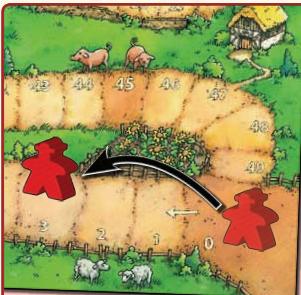
Now, we turn our attention to the Scoring Track, Whenever a player earns points with a scoring, that player's scoring Meeple is moved forward the appropriate number of spaces on the Scoring Track. In our example, you (Red) move your Meeple forward 3 spaces. After a Meeple has scored for a completed Hiking Trail, the Meeple is returned to that player's supply.

After scoring 3 points for the completed Hiking Trail, you (Red) return your Meeple to your supply. The Blue Meeple remains on its tile, since the Farmland has not scored yet.
As each player scores more and more points, it is possible that one or more of them may exceed 49 points. if this happens, that player takes a 50/100-Point Tile, places it in front of himself with the “50” side facing up, and simply continues on the Scoring Track past the 0-space. If a player earns more than 100 points, he flips the tile over to the “100” side.
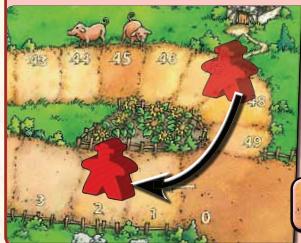


By taking the following optional action, a Hiker can earn additional points:
3b. Earning additional points by Hiking
Under certain conditions, it is now possible to move, or “Hike”, your Meeple across landscape tiles:
First, you need to have already placed a Meeple as a Hiker on a Hiking Trail during a previous turn. Next, in Step 1 on a new turn, you must place a tile that extends the Hiking Trail. Then, as long as you do not place a new Meeple or Stable on this turn, you may Hike with your Meeple on the Trail.
To Hike, decide which way you would like to move your Meeple, and move it along the Hiking Trail in that direction. You earn 1 point for each tile that your Hiker enters. You may move your Hiker past any other Meeples your Hiker encounters along the way, but you may not end the Hiker's movement on a

On your turn you place the red-bordered tile, and the Hiking Trail is extended. You may now move your Hiker.

Your (Red) Hiker Meple moves two tiles to the left (skipping past the Blue Meeple), and you score 2 points for it.
Trail section containing another Meeple. Finally, advance your scoring Meeple on the Scoring Track accordingly.
Additional Hiking rules;
• Your Hiker may not pass through a crossroads.
• lf a Hiking Trail containing one of your Hikers is completed, the scoring triggers immediately; your Hiker may not move again before the Trail scoring occurs (in order to try and earn additional Hiking points).
• Your Hikers may only Hike on your own turn. If another player extends a Trail containing one of your Hikers, that Hiker may not move.
• You may only Hike with one Hiker, and in one direction, on your turn (even if you could Hike in several ways).
The Farmlands
1, Placing a Farmland tile
As usual, you draw a tile and place it on the table, extending the landscape on at least one side by

continuing pre-existing
features on adjacent tiles. Of course, any side of a tile with a Farmland may only be placed next to other Farmlands.
2a, Placing a Meeple as a Farmer
Before placing a Meeple as a Farmer, first determine if there is already another Meeple on any section of
the extended Farmland. If there is not, you may place your Meeple.


By skillfully placing the red-bordered tile here, you have extended the lower center Farmland. Since this Farmland is still
unoccupied, you may now place a Méeple hére as a Farmer.
3, Triggering a Scoring with a completed Farmland
1.) Points for a completed Farmland
At a later point in our sample game, you draw the red-bordered tile shown here.
Fortunately, placement of this tile allows you to expand your Farmland. Fortunately, placement of this tile allows you to expand your Farmland.
In this case, this tile also completes the Farmland. When a Farmland area is completely surrounded by Meadows and has no empty spaces ("holes”) in it, it is considered to be complete. Since you (Red) have previoulsy placed a Meeple in the Farmland as a Farmer, you are now able to score it and earn points for it.
Each tile comprising a completed Farmland scores 2 points,
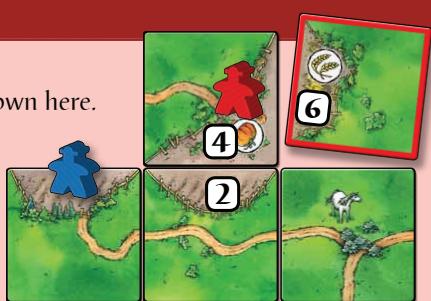
Because this completed Farmland is made up of 3 tiles, you (Red) score 6 points.
2.) Earning Harvest Tokens for a completed Farmland
When completing a Farmland, you earn Harvest Tokens in addition to the points earned for the Farmland tiles themselves.
For each Harvest icon present on all tiles in the completed Farmland, you, as the owning Farmer, take 1 corresponding Harvest Token from the stacks,
Keep all collected Harvest Tokens face down in your supply in order to keep them secret. You may, of course, look at them at ány time. You will score additional points for your collection of Harvest Tokens at the end of the game.
As usual, after a Meeple has scored for a completed Farmland (and a collected any Harvest Tokens), it is returned to your supply.
To determine the distribution of Harvest Tokens in a Farmland containing more than one Farmer, see page 7.


For the Pumpkin and Wheat icons present in the completed Farmland, you receive 1 Pumpkin token and 1 Wheat token.

The Stables
1, Placing a tile containing a Meadow
As usual, you draw a tile and place it on the table. Again, any adjacent sides must continue pre-existing features.
2b, Placing a Stable
At the start of the game, each player has 2 Stables in their supply. After placing a tile, you may place one of your Stables in a Meadow area of that tile. (lt does not matter in which particular Meadow area the Stable is placed.) Remember, on a turn, you have 3 placement options: 1) a Meeple as a Hiker; 2) a Meeple as a Farmer; 3) a Stable in a Meadow. You may only perform one of these actions on a turn.
If a Stable is placed on a tile, all players must observe the following distance rule: No Stables may be placed on any of the 8 tiles surrounding a tile that already contains a Stable, This distance rule only applies to Stables, not to Meeples.
Once placed, a Stable remains on the tile until the end of the game, and may not be moved. Stables will score at the end of the game.
When placing a Stable, it is recommended to place it adjacent to tiles with as many Animals on them as possible. At the end of the game, each Animal scores 1 point for any Stable it is adjacent to.
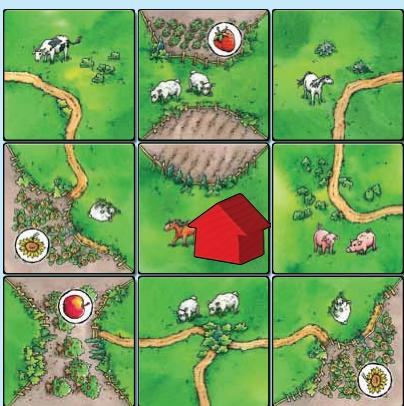
No further Stables may be placed on any of the 8 tiles surrounding the Red Stable.
3. Triggering a Scoring with Stables
As previously mentioned, Stables will not score during the game; only at the end of the game. At that time, each Animal adjacent to a Stable scores 1 point for the Stable's owner. See Final Scoring on page 7.
For your reference, here is a quick summary of the important rules, with some additional small details:
Rules Summary
1, Placing a Landscape Tile
• When placing a drawn tile, any adjacent sides of that tile must continue pre-existing features.
• In the very rare case that a drawn tile cannot be legally placed anywhere, return that tile to the game box and draw a new one.
2. Placing a Meeple or a Stable
• A Meeple or Stable may only be placed on the newly drawn and placed tile.
• A Meeple may not be placed in an area (possibly expanded by the new tile) that already contains another Meeple.
• Remember the distance rule for Stables: No further Stables may be placed on a Stable's 8 surrounding tiles.
3, Triggering a Scoring or Hike with a Meeple
• A Hiking Trail is always completed when both ends meet a crossroads or a Farmland, or the Trail forms a closed loop. Each tile comprsing the completed Hiking Trail scores 1 point for a Meeple on it.
• When extending a Hiking Trail containing one of your previously-placed Meeples, you may Hike with it, instead of placing a new Meeple or Stable this turn. For each tile the Hiker enters ăs you move it, you score 1 point.
• A Farmland is completed when it is fully surrounded by Meadows and has no empty spaces ("holes”) in it. A Farmer in a completed Farmland scores 2 points per Farmland tile, plus 1 Harvest Token for each Harvest icon
• A scoring is always triggered at the end of a turn. At that time, all players having Meeples in the completed feature will score points.
• After each scoring, all Meeples in the scored area are returned to the respective player's supply.
• If several players participate in a scoring, only the player with the majority of Meeples on a Hiking Trail or in a Farmland will score the points. lf several players have the same number of Meeples in a scored area, all tied players will receove the full score for the area.
(Note; How can there be more than one Meeple in an area? See the two detailed examples below.)
Several Meeples in the same area,,,
on a Hikng Trail;
The tile you have drawn, shown here, could be placed to extend the preexisting Hiking Trail. However, you would not be able to place a Meeple on it, since Yellow already has one
On a future turn, you draw the tile shown here and place it as shown. This placement combines the 2 separate Hiking Trails into 1 Trail contains 2 Hikers. Since the Trail is now complete, a scoring is triggered. Both you and Yellow score 4 points.

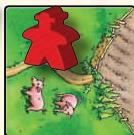

you decide to place the tile as shown, so the Hiking Trails are separate. You then place a Meeple on it.
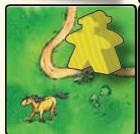
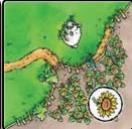
in a Farmland;
Hoping to eventually snatch Yellow's Farmland, you place the newly-drawn tile as shown, and place one of your Meeples on it as a Farmer. This is allowed, since the Farmland on this tile
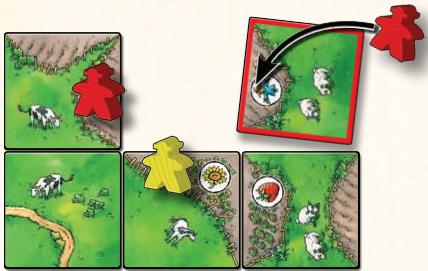
is not (yet) connected to any other Farmland segments containing a Farmer. lf you happen to draw the right tile on a later turn, you can connect the three separate Farmlands, combining them into one large Farmland containing 2 of your Farmers and only 1 of Yellow's Farmers.
Success! You manage to draw an appropriate tile, and combine the separate Farmlands into one, completing it as well. Since you now have the

majority of Farmers in this Farmland, you alone will score 10 points for the completed Farmland. In addition, you take 5 Harvest Tokens matching the 5 Harvest 1cons shown on the Farmland tiles. All Meeples are then returned to their owners' supplies

2.) Distribution of Harvest Tokens with multiple Farmers in a Farmland
As previously explained, the majority Farmer in a completed Farmland receives a Harvest Token for each Harvest icon present in the Farmland. If several players are tied for majority of Farmers, the Harvest Tokens are then distributed as follows:
1.) Gather all appropriate Harvest Tokens and place them on display.
2.) Starting with the player who completed the Farmland, or, if that player is not involved in the tied majority, the next player in turn order who is, each tied player selects one of the Tokens, one at a time, and places it in his supply.
3.) This continues until all Tokens have been distributed. lt is possible for some players to receive more Tokens than others.
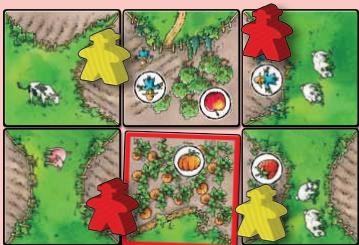
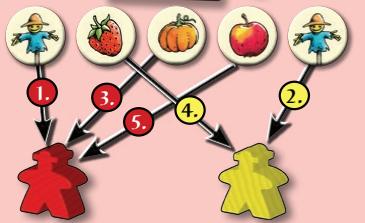
You (Red) place the redbordered tile, completing the Farmland. You then display the 5 Harvest Tokens shown on the Farmland tiles. Since you completed
the Farmland, you are the first to select 1 Harvest Token. Yellow then takes a Token, then you again, etc. In total,
you are able to take 3 Tokens, and Yellow receives 2.
GAME END AND FINAL SCORING
A game of Carcassonne; Over Hill and Dale ends when there are no landscape tiles left to draw. (lt's a pity that the game is over, but now we get to determine the winner!) There is now a final scoring to be performed.
At the end of the game, players receive additional points for:
HIKING TRAILS
Incomplete Hiking Trails score 1 point per Trail tile, for each player having Hikers on the Trail.
FARMLANDS
Incomplete Farmlands score 1 point per Farmland tile, for each player having Farmers in the Farmland. Harvest Tokens are not awarded at the end of the game!
STABLES
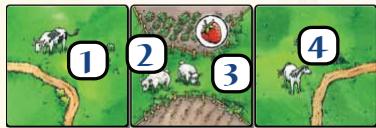
During the game, you have placed a Stable in the Meadow, as shown. Even though tiles were not placed on all surrounding spaces, you will still score 1 point for each Animal on these 7 tiles at the end of the game, for a total of 9 points.
On a tile containing a Stable, as well as the 8 tiles that surround that Stable, the Stable's owner scores 1 point per Animal (Rooster, Cow, Horse, Sheep, or Pig) present on those tiles.
HARVEST TOKENS
Each Harvest Token scores 1 point (including the Scarecrow). ln addition, each full set of 5 different Harvest Tokens showing crops (Apple, Strawberry, Pumpkin, Sunflower and Wheat) scores another 5 points. When assembling sets, the Scarecrow can be used as a wild Token, and can replace any missing Token in a set.
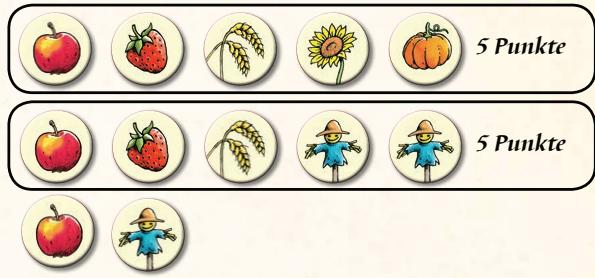
You have collected 12 Harvest Tokens during the game, and score 12 points for these. From these 12 Tokens, you can assemble 2 full sets of crops. For the second set, you use 2 Scarecrows for the missing Tokens.
These sets score an additional 5 x 2 = 10 points. In total, you score 22 points for your Harvest Tokens.
As the final scoring is performed, players advance their Meeples on the scoring track accordingly. When the final scoring is completed, the player with the most points is the winner, In case of a tie, all tied players share in the victory. Congratulations!
OVERVIEW OF LANDSCAPE TILES (73 Tiles) AND HARVEST TOKENS (33 Tokens)


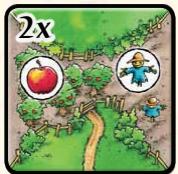
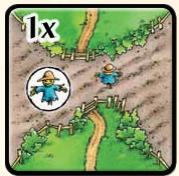


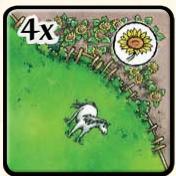


* This landscape tile layout also appears on the Starting Tile. Some landscape tiles contain different assortments of Animals and Harvest lcons than those shown above. For a detailed list of the landscape tiles, go to www.carcassonne.de.

Hans im Glück Verlags-GmbH
Birnauer Str. 15
80809 München
info@hans-im-glueck.de
www.hans-im-glueck.de
www.carcassonne.de
www.carcassonne-forum.de
We want to play with you! Every year we tour through Germany and set up our gaming tents, where you are welcome to come and play! Learn more at www.carcassonne-on-tour.de

Great merchandise, mini-expansions,
our spare parts service, and much
more can be found at:
www.cundco.de
Author; Klaus-Jürgen Wrede illustrations; Doris Matthäus Graphic Design; Christof Tisch 3D Images: Andreas Resch
In cooperation with the Bavarian State Ministry of Health and Care Services



Everything is healthy.
原文为社区整理/出版社公开资料,版权归原作者,仅供个人学习查阅。