
卡卡颂:城堡Carcassonne The Castle
一句话概览
卡卡颂:城堡 是一款已收录于村了吗规则库的桌游,支持 2 人,原名 Carcassonne The Castle。
本页内容:一句话概览 · 常见问题
这游戏怎么玩
- 本站已收录这款游戏的规则资料,可以在对话里直接提问规则细节。
常见问题(FAQ)
以下 1 条问答中 0 条来自站内玩家的真实提问,其余 1 条为本站整理的常见疑问;答复内容保持原样。
卡卡颂:城堡支持几个人玩?
2 人。
去哪查完整规则
想核对具体规则细节、卡牌效果或某个回合的结算方式,可以在村了吗里选中这款游戏后直接提问。
同类桌游
- 卡坦岛德式
- 工业革命:伯明翰德式
- 勃艮第城堡:特别典藏版德式
- 方舟动物园德式
- 卡卡颂抽象
- 瘟疫危机传承:第一季美式
- 阿瑞迪亚:勇踏征途美式
- 重塑宇宙德式
- 幽港迷城美式
- 埃多拉的德鲁伊德式
规则原文(Markdown)
本站收录这款游戏的规则原文 1 个文件,此处内联渲染 1 个,可直接展开阅读或下载。
Rulebook.md20.5 KB

A game for two players by Reiner Knizia using the Carcassonne game system created by Klaus Jurgen Wrede.
The imposing silhouette of the City of Carcassonne glows in the light of the setting
sun.Knights and serfs are stabling the horses. Noisy traders hawk their wares and heralds hurry to the Palace. Above all this rises the Castle, towering high and invincible with its impenetrable walls.
Game components
One castle wall, consisting of ten parts which must be assembled like the pieces of a puzzle before the start of each game. (The scoreboard runs around • Sixty castle titles the castle wall.)
The tiles of the castle

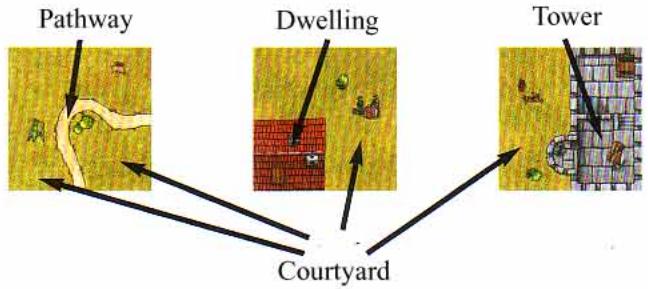
Special tiles

Courtyard with market stall

Pathway with market stall

Pathway with water well
Pathway with water well (The well does not divide the pathway into separate sections)


People, animals and objects depicted on the tiles have no significance.
• Eighteen bonus tiles (there are two of each tile). These are for use on the castle wall, as described below.


Rückseite
• Fourteen Followers in two colours.

• The rules


Two palaces, one in each colour
Object of the game
Players take it in turn to lay tiles within the Castle Wall. In the process, they create pathways of varying lengths, also towers, dwellings and courtyards of different sizes upon which they can place their followers in order to score points. Since it is possible to score points during the game as well as at the end of it, the winner becomes known only after the final scoring is complete.
Preparation for the game
The Castle Wall is constructed according to the illustration on page 1, so that the numbers run sequentially from 0 to 99.
The sixty castle tiles are well shuffled, face down, and put into several stacks at the edge of the p[laying area, outside the Castle Walls, where both players can reach them.

The eighteen bonus tiles are also well shuffled, face down. On each corner tower of the Castle Wall (with the exception of the tower numbered 0/1), one bonus tile is placed, face down. The remaining bonus tiles are placed back in the box, without either player seeing what they are, and are not used during the game.
Each player receives seven Followers and the Palace of one colour set and places one Follower, to be used as a score marker, on the wall space marked with a zero. The remaining six Followers and the Palace form each player's supply. The younger player decides who starts.
Order of Play
Each player takes it in turn to play. The player whose turn it is carries out the following actions in order: 1 The player must draw a castle tile from one of the face down stacks and play it (see below).
2 The player may take a Follower from his supply and place it on the tile that he has just played.
3 If a pathway, tower or dwelling is completed as a result of the tile placement, this must now be scored.
4 In moving his score marker, a player lands exactly on one of the corner towers of the Castle Wall, he collects the bonus tile, providing that there is still one there.
1 Playing a castle tile
At the start of his turn, a player must draw a tile from one of the face down stacks. He shows it to his opponent
(so that he can receive wise counsel) and places it face up. He must observe the following points:
- the first tile in the game must be played next to one of the starting fields on the Castle Wall.
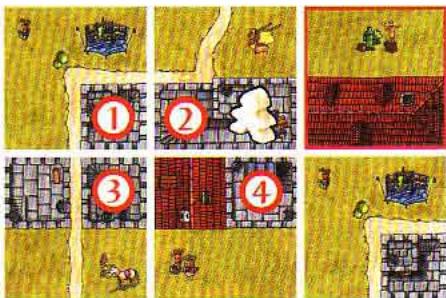
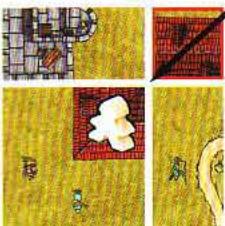
- each subsequent tile (always depicted in the illustrations with a red border) must be played with one side either adjoining one of the other starting fields or alongside a previously played tile. Placement so that the tiles only meet at one diagonal corner, or are offset from one another, is not permitted (see illustrations) - pathways must always be continued from tile to tile. Other areas - towers, dwellings and courtyards - can be played in any fashion
- any piece can be played alongside the Castle Wall (including pathways)
- if a tile cannot legally be played, it is removed from sthe game and a replacement drawn
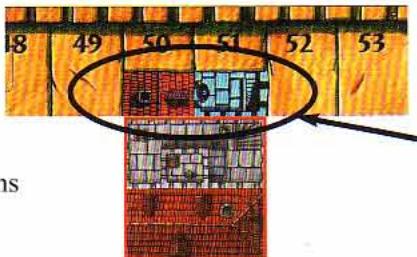
Legal placements

The first tile could for example be laid here. The whole of one edge must be adjacent to the starting field.

Illegal placements
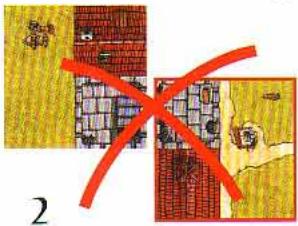
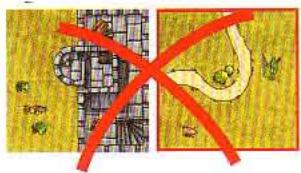
Knight
2 Placing Followers
When a player has played a new tile, he may place a Follower on it. He must observe the following points: - he may only place one Follower
- he must take this Follower from his supply
- he may only place the Follower on the tile that has just been played
- he must decide which area of the tile the Follower will occupy (Illustrations: as a herald on a pathway, as a knight on a tower, as a serf in a dwelling or as a trader in a courtyard.)
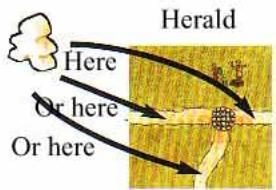
On a pathway
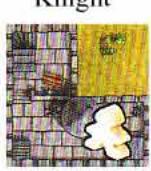
In a tower
Serf

In a dwelling

In the courtyard
- A new tile may extend an existing pathway, tower, dwelling or courtyard. If there is already a Follower on the relevant area from a previous turn, another one cannot be laid (by either player). It makes no difference how far away the other Follower is. This can be clarified by means of two examples. (Illustrations: On the newly extended dwelling, no serf can be placed, as a white serf is already there. A knight or trader could be placed on this tile.On the extended courtyard, no trader can be placed, as a white trader is already there. A serf could be placed on this tile.)

However, it is possible during the course of play for several Followers to coexist in one area. See explanation of merging of areas on page 4.
If, during the course of play, one player runs out of Followers, he cannot place any more Followers. But there is no cause for alarm: it is possible to get Followers back again.
Now the first player's turn is over and it is his opponent's turn.
Exception: if a pathway, tower or dwelling has been completed through the laying of a tile, the score must now be reckoned. Courtyards are not scored during the game (see section on final scoring).
3 Scoring of completed pathways, towers and dwellings
A completed pathway
A pathway is completed when a single section of path is terminated at each end by a square or by the Castle Wall, when it reaches a building or when it forms a closed loop. A pathway may be of any length (consisting of any number of tiles).
For a completed pathway, the player who has the most heralds on the pathway receives one point for each tile which makes up part of the pathway. (If the pathway starts or finishes on a relevant starting space, this is scored as if it were a tile.)
Like all other scores, the score is immediately recorded on the Castle Wall. The Castle Wall shows a circuit of 100 spaces. If a player passes space number 99, he starts on a second round. To show he has passed 100, he lays his score marker flat.
Square ends one pathway

Two points for two tile sections
Castle wall ends one pathway
If one or more wells are sited alongside the road being scored, the player receives two points for each tile with makes up part of the completed pathway. Even if there is more than one well, he only scores two points per tile.

Black earns eight points (Three tiles and the section in the starting space form the completed pathway. Because of the well, each tile scores two points.
A completed tower
A tower is completed when the individual sections are completely surrounded by pathways, dwellings, courtyards or the Castle Wall (and there are no gaps in the tower). A tower may be of any size (consisting of any number of tiles).
For a completed tower, the player who has the most knights on the tower receives two points for each tile which makes up part of the tower. (If the tower includes part of a relevant starting space, this is scored as if it were a tile.)
A completed dwelling - and the palace
A dwelling is completed when the individual sections are completely surrounded by pathways, towers, courtyards or the Castle Wall (and there are no gaps in the dwelling). A dwelling may be of any size (consisting of any number of tiles). HEAE
For a completed dwelling, the player who has the most serfs in the dwelling receives one point for each tile which makes up part of the dwelling. (If the dwelling includes part of a relevant starting space, this is scored as if it were a tile.)
General point: it does not matter which player completes an area (pathway, tower or dwelling). The points for the completed area are always awarded to the player who has the majority of Followers in that area.
Palaces: as soon as a player completes his first dwelling, he places his Palace on it. If he later completes a larger dwelling (with more tiles), in which he also has a majority of serfs, he moves his Palace to this dwelling. At the end of the game, the Palaces mark each player's largest dwelling.

Merging of areas
Areas can become merged through the placing of tiles. Through the merging of areas, it is possible to have several messengers on a pathway, several knights on a tower, several serfs in a dwelling or several traders in a courtyard.

When the players played their knights, the tower areas were separate. They became merged when the new tile was placed. Now they are both on the same tower, which has become completed through the placing of the latest tile.
In the scoring of completed pathways, towers or dwellings, it is first necessary to establish which player has a majority of Followers. This player alone receives the points. If both players have the same number of Followers in this area, then neither player receives points. (In the example above, neither Black nor White scores.)
Important: The existence of several Followers in an area does not contradict the rule on page 3: "If there is already a Follower on the relevant area from a previous turn, another one cannot be laid (by either player)." That rule governs the placing of Followers! Here we are concerned with the merging of areas. When placed, the Followers were in separate areas. They are in the same area only after the areas are merged.
Returning Followers to their owners
After a pathway, tower or dwelling is completed and scored - and only then - the Followers in that area (with the exception of traders) are returned to their owner. The player(s) take them back into their supply and may place them again in a subsequent turn, allocating whichever role they wish (depending on the area on which they are placed).
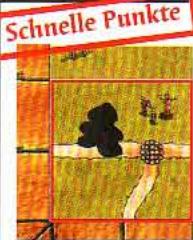
Instant one point
It is possible, in one turn, to place a Follower, to score it immediately
and to retrieve it. To do so, it is necessary - in this order - to:
1 Complete a pathway, tower or dwelling by placing the current tile.
2 Place a Follower (according to the rules on page 3)
3 Calculate the score for the completed area
4 Retrieve the Follower.
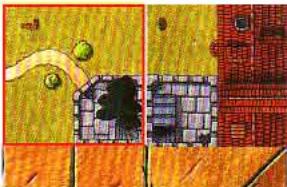
Instant four points
4 The Castle Walls
In moving his score marker, if a player lands exactly on one of the corner towers of the Castle Wall (ie on one of the two spaces separated by a diagonal line), he collects the bonus tile, providing that there is still one there, and places it face up in front of him. If he goes straight past the corner tower, he does not collect the tile!
The player may play this bonus tile any time from his next turn. During his turn, he can in fact play more than one bonus tile. A bonus tile that has been played is discarded from the game and not re-used. These tiles are described more fully on page 6.

For collection of bonus tiles it is important to note the following: if several scores are crystallised when a single tile is placed, the player who placed the tile moves his marker first.
The Courtyard
Courtyards are separated from one another by pathways, towers and dwellings. When a player places a trader in a courtyard, he should lie the trader down to indicate that this Follower will not be retrieved during the course of the game. Courtyards are only scored at the end of the game.
The end of the game

Three different areas of the courtyard
At the end of the turn in which the final Castle tile is placed, the game ends.
All bonus tiles that have not been collected are cleared from the walls and the final scoring is carried out.
Final scoring (Palace, courtyards and bonus tiles)
During the final scoring, the largest palace and the courtyards are scored.
Bonus tiles numbered from 4 through 9 also come into the reckoning.
Incomplete pathways, towers and dwellings do not score.
Exception: unless the player possesses bonus tiles 4, 5 or 6.
Scoring the largest palace
The player with the largest palace (the largest completed dwelling) receives points as follows:
Within the Castle Walls there are at the end of the game sixteen unoccupied squares. The largest such region is identified and the number of blank fields counted. These are then scored (at one point each) in favour of the player with the largest
Palace. If both players have a palace of the same size, neither scores the points. Important: look out for bonus tile number 8!

No tiles were placed in the white fields. The largest continuous area in this example is the size of eleven tiles. The player with the largest palace therefore receives eleven points.
Scoring the courtyards
The player who has the majority of traders in a courtyard receives three points for each market stall in the courtyard.
If both players have the same number of traders in the courtyard, neither receives the points.

White receives three points. There is one market stall in the small courtyard (which is separated by pathways and dwellings from the large courtyard).


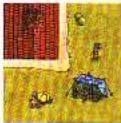
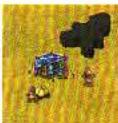


Finally the points for bonus tiles 4, 5 and 6 (for incomplete areas) and 9 are awarded, assuming that they have been played.
In the large courtyard there are five market stalls (including the one on the scoring track). Black has a majority of traders. Black receives fifteen points. White does not score for this courtyard. If Black were able to play bonus tile number 7, he would receive four points for each market stall, giving a total of 20 points.
The player with the highest score wins the game.

Take a complete second turn straightaway (during the game)
2

Description of bonus tiles
One completed tower will score double points for you (four points per tile during scoring)

One completed dwelling will score double points for you (two points per tile when scoring)
4

One incomplete pathway will score one point per tile during the final scoring
A player who wishes to play bonus tiles 2 through 7 must have a majority of Followers in the relevant area.

One incomplete tower will score two points per tile during the final scoring

One incomplete dwelling will score one point per tile during the final scoring

Each market stall in one courtyard will score four points during the final scoring


Your palace is two tiles larger. For example, if it consists of 5 tiles, score 7 points in the final scoring
You receive 5 bonus points during the final scorings
Translated by Tim Synge, November 2003. Formatted by Chuang Shyue Chou, December 2003.


© 2003 Hans im Glück Verlags-GmbH
Haben Sie Anregungen, Fragen oder Kritik?
Schreiben Sie an unsere E-Mail-Adresse:
info@hans-im-glueck.de
oder per Post: Hans im Glück Verlag
Birnauer Str. 15
80809 München
Fax: 089-302336
Für unzählige Testrunden, Anregungen und Vorschläge bedankt sich der Verlag bei lain Adams, André und Alex, Chris Bowyer, Martin Higham, Dieter Hornung, Ross Inglis, Kevin Jacklin, Chris Lawson, Karl-Heinz Schmiel, Schorsch und besonders bei Andreas Seyfarth. Spielen Sie Carcassonne auch online unter www.brettspielwelt.de und gewinnen Sie beim Preisrätsel unter www.carcassonne.de ein Hans im Glück Spiel.
下载 Markdown原文为社区整理/出版社公开资料,版权归原作者,仅供个人学习查阅。