
卡卡颂:大航海Carcassonne The Discovery
一句话概览
卡卡颂:大航海 是一款已收录于村了吗规则库的桌游,支持 2–5 人,原名 Carcassonne The Discovery。
本页内容:一句话概览 · 常见问题
这游戏怎么玩
- 本站已收录这款游戏的规则资料,可以在对话里直接提问规则细节。
常见问题(FAQ)
以下 1 条问答中 0 条来自站内玩家的真实提问,其余 1 条为本站整理的常见疑问;答复内容保持原样。
卡卡颂:大航海支持几个人玩?
2–5 人。
去哪查完整规则
想核对具体规则细节、卡牌效果或某个回合的结算方式,可以在村了吗里选中这款游戏后直接提问。
同类桌游
- 卡坦岛德式
- 工业革命:伯明翰德式
- 勃艮第城堡:特别典藏版德式
- 方舟动物园德式
- 卡卡颂抽象
- 瘟疫危机传承:第一季美式
- 阿瑞迪亚:勇踏征途美式
- 重塑宇宙德式
- 幽港迷城美式
- 埃多拉的德鲁伊德式
规则原文(Markdown)
本站收录这款游戏的规则原文 1 个文件,此处内联渲染 1 个,可直接展开阅读或下载。
Carc_Discovery_Rules.md15.6 KB

theDiscovery
A game by Leo Colovini based on the Carcassonne system by Klaus Jürgen Wrede for 2-5 players aged 10 and up
The people of the Carcassonne region have decided to expand to distant lands. The players explore and discover the geography of the surrounding area, facing the dangers of the sea and the mountains and exploring the vast grasslands. The skill and strategy of the players exploring these new territories and their approach to controlling them by deploying their followers as brigands, navigators, and explorers will determine who is victorious.
Contents
• 84 landscape tiles (including 1 starting tile), which picture mountain, grassland, and sea segments. On the shores of some mountain and grassland segments, there are port cities.
• 25 followers in 5 colors
Each follower can be used as a brigand (in the mountains), as a navigator (on the seas), or as an explorer (in the grasslands). One of each player's followers is the player's scoring marker.
• 1 scoring track, used to track players' scores.
• 5 summary cards
• 1 rule booklet

Overview
The players place land tiles turn by turn. As they do so, the mountains, grasslands and seas emerge and grow. On these, the players can deploy their followers to score points both during the game and at the end. The player with the most points after the final scoring is the winner.
Preparation
Place the starting tile face up in the middle of the table. Shuffle the remaining landscape tiles face down and stack them in several face-down stacks so that all players have easy access to them. Place the scoring track near one edge of the table to leave room for the players to place land tiles in the middle of the table.
Each player takes a summary card and the 5 followers in his color and places one as his scoring marker on space 0 of the scoring track. Each player places his remaining 4 followers before him on the table as his supply. The players choose a starting player using any method they want.
Playing the game
Players take turns, in clockwise order, beginning with the starting player. On a player's turn, he executes the following actions in the order shown:
■1.The player must draw and place a new land tile.
■ 2.The player may either deploy one of his followers from his supply on the landscape tile he just placed or score a territory by removing one of his previously deployed followers. Note that a player may never both deploy and remove a follower on the same turn.
When a player neither deploys nor withdraws a follower, he simply places a landscape tile and ends his turn.
■ 1. Placing landscape tiles
First a player must draw a landscape tile from one of the face-down stacks. He looks at it, shows it to his fellow players (so they can advise him on the "best“ placement of the tile), and places it on the table, using the following rules:
• The new tile (with red borders in the examples) must be placed with at least one edge abutting one previously placed tile. The new tile may not simply be placed corner to corner with a previous tile.
• The new tile must be placed so that all segments on the new tile continue any mountains, grasslands, and seas segments on all abutting tiles.

the grassland continues


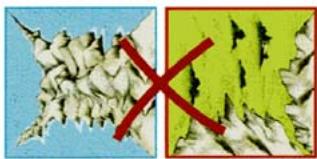


this is not a legal placement
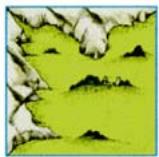
the mountain continues
on one side the sea continues on the other side the mountain continues
In the rare circumstance where a drawn tile has no legal placement (and all players agree), the player discards the tile from the game (into the box) and draws another tile
■ 2. Deploying followers
After the player places a land tile, he may deploy one of his followers, using the following rules:
• The player may only play 1 follower on a turn.
• The player must take it from his supply.
• The player may only deploy it to the tile he just placed.
• The player must choose where to deploy the follower on the tile:
explorer
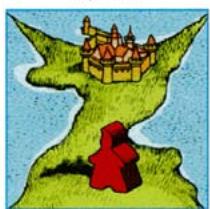
or
in the grasslands
brigand
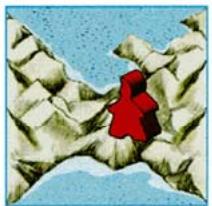
or
in the mountains
navigator

in the seas
• The player may not deploy a follower on a mountain, grassland, or sea segment if that segment connects to a segment on another tile (no matter how far away) that already has a follower (from any player) on it. See the following examples:

Red can only deploy a navigator, as there is already a brigand in a connected mountain segment.
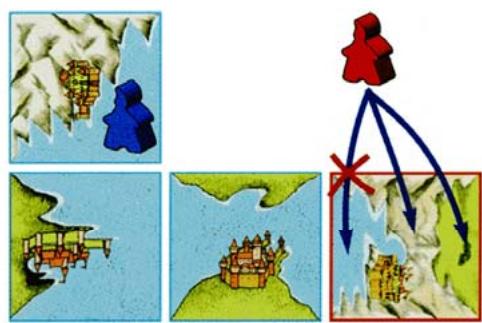
Red can deploy his follower as a brigand or an explorer, but not as a navigator, as there is already a navigator on a connected sea segment.
SCORING A TERRITORY
Instead of deploying a follower, a player can remove an already deployed follower and score the points for the territory where it was. The player moves his scoring marker forward on the scoring track a number of spaces equal to the points earned and places the removed follower back in his supply. He may deploy the follower in his next turn, if he chooses. A player may remove a follower and score any territory where he has one or more followers, whether the territory is completed or not and whether the follower removed shares the territory with other followers or not.
GRASSLANDS
If the grassland is incomplete, it is worth 1 point for each segment of the grassland (count the numbers of tiles).
Notice that an incomplete grassland can grow and be completed later.
If the grassland is complete (that is, completely surrounded by mountains or seas), it is worth 2points for each segment of the grassland (count the numbers of tiles). Note that a complete grassland cannot grow either in size or in value. In both cases, the presence of cities does not affect the value of the grassland.
Exception: when a complete grassland has just 2 tiles, it is worth only 2 points (instead of 4).
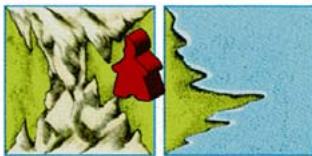
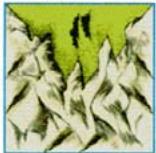
An incomplete grassland: it has
4 tiles and Red – removing his follower – scores 4 points

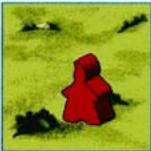
A complete grassland: it has 5 tiles and Red– removing his follower – scores 5x2= 10 points.
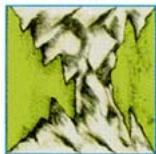

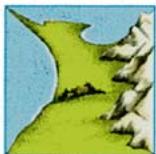


A complete grassland has only 2 tiles: Red – removing his follower – scores only 2 points.

MOUNTAIN
If the mountain is incomplete, it is worth 1 point for each city located in that mountain and in alladjacent grasslands.
Note that an incomplete mountain can grow and be completed later.
If the mountain is complete (that is, completely surrounded by grasslands or seas), it is worth 2 points for each city located in that mountain and in all adjacent grasslands. Note that a completed mountain cannot grow in size, but its value can increase, as new cities are added to adjacent grasslands.
Exception: when a completed mountain has just 2 tiles, it is worth only1 point (instead of 2) per city.


An incomplete mountain: there
are 4 cities (1 in the same territory and 3 in adjacent grasslands ) and Red – removing his follower – scores 4 points.


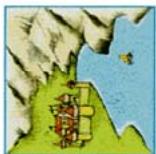


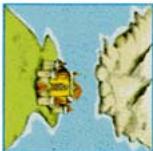


A complete mountain: in the figure there are 5 cities, but just 4 (1 in the mountain and 3 in adjacent grasslands) score points; the 5th isn't in an adjacent grassland. Red– removing his follower - scores 4x2=8 points


SEAS

A complete mountain has only 2 tiles: Red – removing his follower – scores only 4 points, 1 per city (it does not matter whether the adjacent grassland is complete or not nor how far from the mountain a city in the grassland is – a city may be several segments away as long as it can trace a connected path through the grassland to the mountain).
If the sea is incomplete, it is worth 1 point for each city located on its shores. Note that an incomplete sea can grow and be completed later.
If the sea is complete (that is completely surrounded by grasslands or mountains), it is worth 1 point for each city located on its shores plus1 point for each segment of the sea (count the tiles). Note that a completed sea cannot grow either in size or in value.
Exception: when a completed sea has just 2 tiles, it is worth only 1 point for each city located on its shores.

An incomplete sea: on its shores, there are 2 cities and Red – removing his followerscores 2 points.


A complete sea: there are 3 cities on its shores and it has 4 tiles and Red – removing his follower - scores 3 +4=7 points


A complete sea has only 2 tiles: Red – removing his follower – scores only 1 point, as there is 1 city on its shores.


■ A TERRITORY WITH MORE THAN ONE FOLLOWER
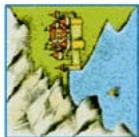
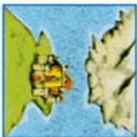
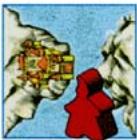
It is possible through clever placement of landscape tiles for there to be more than one explorer on a grassland, or more than one brigand on a mountain, or more than one navigator on a sea.
When this occurs, each follower is considered separately, as though it were alone. There are not majorities and minorities: each single follower can score the points for the territory.
For example, if a player has more followers in a territory, he may remove them in different turns, scoring for each the value of the territory when it is removed (note: he cannot remove them in the same turn).

the cities, as the sea is still incomplete, but the value may become much larger)
On the left, Red adds the tile with red borders and deploys a follower on the sea; he can do that because that sea, so far, is not connected to the sea with the yellow follower.
On the right, later, a new tile is added to join the 2 seas. Now both Red and Yellow have a navigator in the same sea and can score for this new, larger sea (so far only 4 points for


■AFTER REMOVING FROM AN INCOMPLETE TERRITORY
When a player removes a follower from an incomplete territory, this territory (if it has no other followers) becomes empty and it is possible for a player, by placing a new tile that enlarges the territory, to deploy a follower on it.
Game end
At the end of the player's turn when the last landscape tile is placed, the game ends. Then follows the final scoring.
Final scoring
Each player scores the points for his not yet removed followers, but note: to calculate the points, all the territories involved in the final scoring are considered incomplete, even if they are actually complete.
The player with the most points is the winner!
Variant drawing rule
At the beginning of the game, each player takes 2 tiles, randomly, which he keeps face up before him. On a player's turn, he chooses one of his 2 tiles, places it and then draws another tile to have 2 tiles for his next turn. Furthermore, at the beginning of the game, players may choose to remove some tiles from the game. Remove them randomly, but leave them face up near the scoring track. Remove 1 tile when playing with 2 or 5 players; remove 2 tiles when you play with 3 players; and 3 tiles when you play with 4 players. In this way, all players should have the same number of turns.

© 2005 Hans im Glück Verlags-GmbH If you have comments, questions, or suggestions, please write us at: RioGames@aol.com or by post to PO Box 45715, Rio Rancho, NM 87144, USA
You can find information on other great Rio Grande games, including other versions and expansions for Carcassonne by visiting our website at www.riograndegames.com.

原文为社区整理/出版社公开资料,版权归原作者,仅供个人学习查阅。