
Circus MaximusCircus Maximus
一句话概览
Circus Maximus 是一款已收录于村了吗规则库的桌游,支持 3–5 人,原名 Circus Maximus。
本页内容:一句话概览 · 常见问题
这游戏怎么玩
- 本站已收录这款游戏的规则资料,可以在对话里直接提问规则细节。
常见问题(FAQ)
以下 1 条问答中 0 条来自站内玩家的真实提问,其余 1 条为本站整理的常见疑问;答复内容保持原样。
Circus Maximus支持几个人玩?
3–5 人。
去哪查完整规则
想核对具体规则细节、卡牌效果或某个回合的结算方式,可以在村了吗里选中这款游戏后直接提问。
同类桌游
- 卡坦岛德式
- 工业革命:伯明翰德式
- 勃艮第城堡:特别典藏版德式
- 方舟动物园德式
- 卡卡颂抽象
- 瘟疫危机传承:第一季美式
- 阿瑞迪亚:勇踏征途美式
- 重塑宇宙德式
- 幽港迷城美式
- 埃多拉的德鲁伊德式
规则原文(Markdown)
本站收录这款游戏的规则原文 2 个文件,此处内联渲染 2 个,可直接展开阅读或下载。
rules_en_circus-maximus_37345.md90.6 KB
来源类型:纯文本规则(非 PDF 源,早期抓取/转换产物)
说明:原文未改动,仅调整存放位置与文件名;非 PDF 扫描件,无对应原书 PDF
Circus Maximus Rulebook | RulesPalRulesPalChatRulebookCircus MaximusCircus Maximus Rulebook Table of Contents Table of Contents 1. Introduction
- Components Replacement Parts
Basic Game 3. Setup & Prepare for Play 3.61 Driver Hits Chart
3.63 Team Speed Chart
3.64 Team Endurance Chart
-
Basic Description of Play
-
Sequence of Play
-
Movement
-
Chariot Flip 7.32 Corner Strain Chart
-
Endurance
-
Combat 9.42 Driver Lash Attack Table
9.5 Horse Injury Table
9.54 Damage to Cars Table
9.55 Wheel Damage Effect Chart
- Ending the Race
Second Edition
Design Credits
Game Questions
Advanced Game 11. Reaction Time
-
Wreck Location 12.2 Wreck Location Chart
-
Critical Injuries 13.1 Critical Hits Table
-
Running Over Wrecks 14.3 Running Over Wrecks Chart
-
Runaway Teams
-
Dragged Drivers
-
Running for Cover
-
Enlarged Field
The Campaign Game 19. Solitaire Play
-
The Racing Season
-
Spending Money 21.41 New Horse Speed Chart
-
Recovering from Injuries
-
Experience 23.1 Experience Point Chart
-
Skullduggery
-
Security
-
Betting
Designer's Notes
Quick Reference Charts 3.61 Driver Hits Chart
3.63 Team Speed Chart
3.64 Team Endurance Chart
13.1 Critical Hits Table
14.3 Running Over Wrecks Chart
21.41 New Horse Speed Chart
7.32 Corner Strain Chart
9.42 Driver Lash Attack Table
9.5 Horse Injury Table
9.54 Damage to Cars Table
9.55 Wheel Damage Effect Chart
12.2 Wreck Location Chart
1. Introduction
CIRCUS MAXIMUS is a tactical simulation of chariot racing in ancient Rome. The game is played by two to eight players, each controlling one or more chariot teams. The game provides all the information needed to recreate this historic sport easily and accurately in an exciting format.
Each chariot is represented by a pair of counters which are moved as a single unit across the mapboard's square grid according to the individual movement abilities of each vehicle.
Orders for movement are written for each chariot on a racing information sheet hereafter referred to as a Log. The chariots are then moved one at a time per these written orders, and any attacks against rival chariots are made. Very careful planning, maneuvering, and an element of luck are needed to finish first . . . or to finish at all.
To those reading these rules who are new to the hobby of simulation gaming, or "wargaming" as it is more commonly known, a word of explanation is in order. CIRCUS MAXIMUS is a game that simulates reality in a game format. It represents the results of long research to accumulate facts and data to duplicate conditions as they were at the time of the actual event. Simulations come in many different forms. A scene being staged and shot for a movie is a "visual" simulation of reality. A scene described in a book can be regarded as a "written" simulation. Similarly, the mapboard, counters, and rules contained in this box constitute a "gaming" simulation of the "real thing". Absolute realism in any type of simulation is, of course, impossible, but within the framework of this game, the major factors and problems confronting the participants in ancient races are duplicated. Through the use of this game, players can gain increased appreciation of "how it really was" and what influenced the actual participants in their actions. However, unlike written or visual simulation, the game player does not merely take a passive role in reading or watching the simulation, but becomes an active participant in it and enjoys the vicarious adventure without any of the consequent dangers or discomfort.
2. Components
2.1 MAPBOARD: The mapboard forms the playing surface on which the counters are placed and moved. An oval track divided into spaces (hereafter referred to as squares) is printed on the mapboard, and is used to determine movement and position of the counters. This "active" area of the map is called the "track". An oval shaped area enclosed by the track is called the "spina". This inactive core or center is called the "spina". The mapboard also contains many of the charts necessary for resolving the race.
2.2 GAME COUNTERS: Included in the game is a sheet of die-cut playing pieces. These are color-coded for easy identification. Each color identifies a different "faction", and each player takes one or more factions depending on the number of players. Each faction has the following counters: a Team Counter and a Car Counter.
NOTE: When the team and car counters are combined, one behind the other on the track, as illustrated above, they are referred to as a "chariot". The following counters may replace the car counter in the Advanced Game: the Dragged Driver Counter, the Dismounted Driver Counter, and the Wrecked Car (Wreck) Counter.
NOTE: The Dolphin and Egg counters are used to mark the laps, and belong to no faction. The Sesterces counters represent money and are used only in the Campaign Game version of the game and are explained therein. The Color counters are used to determine the order of movement during each turn.
2.3 CHARIOT RACE LOG is used to write down movement orders for the chariots, and to record damage and actions affecting the car, horses, and driver.
2.4 RULES MANUAL contains all the information necessary to play the game. The rules are divided into a Basic Game, Advanced Game, and Campaign Game. It is recommended that players become proficient at one level of the game before proceeding to the next.
2.5 BETTING SHEET is used only in the Campaign Game to place bets and determine betting odds.
2.6 NOT INCLUDED, but necessary for play, are a pencil for each player, three six-sided dice, and an opaque cup or mug.
Replacement Parts
For a current replacement Parts/Price List, send a stamped self-addressed envelope to: The Avalon Hill Game Company, 4517 Harford Rd., Baltimore, MD 21214. For full-color catalog describing all our many exciting simulation games available both by mail and in discriminating retail outlets where simulation games are sold, see Current Parts/Price List for price.
Basic Game
3. Setup & Prepare for Play
3.1 Between two and eight people can play; the more the better. If there is a ninth participant he should assume the role of the racing steward. A tenth participant could act as the Money Changer in a Campaign Game.
3.2 Place the eight chariots randomly in their starting locations with the car counter of each chariot resting on a gray square containing the word "Lane", and the corresponding team counter on the square in front of it. Place the eight "Color" counters into a cup.
3.3 FACTION SELECTION—Each player, in turn, selects one Color counter (sight unseen) from the cup. The color selected is his faction. If there are two or four players repeat this process until all eight colors have been selected. If there are 3, 5, 6 or 7 played proceed to 3.4.
3.4 After all players have one faction, each player then rolls all three dice with the player rolling the highest total drawing a second faction, and the player rolling the next highest total drawing a second faction, etc. until all factions have been taken. This results in some players having more factions than others, but is balanced by weaker players tending to "gang up" on stronger players during the race. However, a player controlling more than one chariot cannot attack another chariot under his own control.
3.5 Each player fills in the necessary information for each chariot he controls on a Chariot Race Log sheet. Each sheet has separate areas, showing information about the team, car and driver, current movement, and damage suffered during the course of the race. The various categories are as follows:
PERFORMANCE CHART—A graphic illustration of how Preparation Points can be allotted to influence the type and quality of chariot available to each player.
FACTION—The color of the player's chariot.
DRIVER'S NAME—This information is not necessary. It is added only to personalize the game; use a fictional name and become Ben Hur or Messala, or merely use your own name.
DRIVER MODIFIER—A number representing the driver's overall skill (see 3.61).
CURRENT DRIVER MODIFIER—A number representing the driver's skill during the current game turn only. The Current Driver Modifier (hereafter referred to occasionally as CDM) is not entered into the CDM boxes until the CDM differs from the Driver Modifier, in which case the CDM is written in the first unmarked CDM box. Thereafter, as the CDM changes the latest CDM is entered in the next unmarked box.
DRIVER HITS—A record of damage sustained by the driver during the race. Damage is recorded by marking off empty boxes from right to left.
CAR—Mark the box indicating the type of chariot selected—light, normal, or heavy (see 3.62). Damage to the car is recorded by marking the boxes of the respective wheels from left to right so that the last marked box contains the total damage points sustained by the wheel to date.
HORSE/TOTAL SPEED/DAMAGE—Each horse will receive a number representing its speed. Each horse also has a damage record (in boxes); the number of boxes is equal to the horse's speed.
TEAM SPEED—The combined speed of all horses in a team. Whenever a horse suffers damage the team speed decreases, and the new team speed is entered in the next unmarked box.
ENDURANCE—A number of boxes equal to the team endurance at the start of the race. As endurance is used during the course of the race, boxes are marked from right to left such that the last unmarked box contains the current number of endurance points remaining.
TURN SPEED—Write the planned speed of the chariot in the corresponding turn box prior to the start of each game turn.
NOTE: Boxes are used on the Chariot Race Log to record losses during the game. At the start of the game, darken all boxes completely. During the game, as each box is lost, check it off with a simple "✓" or "x" so as to be able to instantly differentiate between those capabilities with which the game was begun and those capabilities which were lost due to damage incurred during the course of the game. Example: If a horse had a speed of 6, you would enter "6" in the Total Speed section of the HORSE/TOTAL SPEED/DAMAGE assembly, count out six white boxes from left to right, and then darken entirely the four remaining boxes on that line. Later, if the horse suffers a point of damage the "6" box is checked off. Once the race begins players may not conceal the information on their Chariot Race Log and must freely divulge it to any inquiring player.
3.6 Initially, all chariots have the same specification possibilities as listed on the Performance Chart above "0" Preparation Points. Each player may improve his chariot's specifications by adding a total of four Preparation Points to the various categories. Each player secretly indicates his Preparation Point allotments by crossing out the Preparation Point column which he is using in each category. When filled out correctly there will be only one column darkened in each category, and the sum of the numbers darkened in the Preparation Points row will be four. When all players have finished writing, the players take turns revealing their Preparation Point allocations and making the necessary die rolls to complete their specifications.
3.61 The Driver Modifier selected is entered on the Chariot Race Log in the Driver's Modifier box. A die is then rolled on the Driver Hits chart and modified by the Driver Modifier (the die roll is added to the modifier). This total determines the total hit capacity of the driver which is entered in the Log by completely filling in excess boxes such that the last white box contains the number of hits the driver can sustain. A driver can never have more than 10 hit boxes regardless of his Driver Modifier.
3.61 Driver Hits Chart
3.62 Cars always have ten hit boxes regardless of car type. When a car receives damage during ram attacks, the car type of the opposing chariot influences the damage sustained.
3.63 The Team Speed category determines the row of the Team Speed Chart to be cross indexed with a subsequent die roll to determine the Team Speed. The four numbers in each box of the Team Speed Chart represent each horse's speed/strength rating. The first (lefthand) number is the speed of horse number one, the second is the speed of horse number two, etc. Write this number in the Total Speed box and then darken the excess damage boxes in each line for each horse.
3.63 Team Speed Chart
3.64 The Endurance category determines the row of the Team Endurance Chart to be cross indexed with a subsequent die roll to determine Team Endurance. Write the number in the Team Endurance box and then darken all excess endurance boxes on the Endurance record.
3.64 Team Endurance Chart
3.7 Place three "Egg" counters on the "spina" (central oval inside the track) by the start and finish lines. Place the three "Dolphin" counters at the opposite end of the "spina".
3.8 The start lanes are printed in gray on the mapboard. No attacks are allowed from the gray squares during the initial turn of the race. Once the chariots leave these gray squares to enter the black squares, the gray squares are ignored thereafter. The finish line, at the end of the third lap, is at the end of the backstretch as shown.
(Diagram: oval track showing FINISH at the top of the backstretch, START at the bottom, and SPINA labeling the central island.)
3.9 Select one player or a non-playing bystander to act as the racing steward. He will announce the start of each turn and determine order of movement by randomly drawing the colored counters from a cup one at a time.
4. Basic Description of Play
Players record their planned Turn Speed for the coming turn. The Turn Speed can be any number up to the total of the Maximum Team Speed and CDM. Each player must evaluate the situation: the proximity of opposing chariots, corner speeds, endurance factor expenditure, possible attacks, and defensive maneuvers. The chariots are then moved one at a time per their marked speeds. All attacks and results are determined. This cycle is repeated for each chariot during the turn. When all chariots have moved, another turn begins.
5. Sequence of Play
5.1 MOVEMENT NOTATION—Each player secretly writes his Turn Speed for the coming turn in the "Turn Speed" section of his Chariot Race Log.
5.2 MOVEMENT ORDER PREPARATION—All faction (color) counters are placed in a cup and mixed by the racing steward.
5.3 FIRST MOVEMENT PHASE—A counter is drawn from the cup, and the faction with the matching color takes its move. The moving player may make attacks while moving. The other players may not move their chariots, except to avoid attacks (see 9.3), or as a mandatory result of attacks.
5.4 SECOND MOVEMENT PHASE—A second counter is drawn from the cup, and the faction with the matching color takes its move, as in the first movement phase.
5.5 FURTHER PHASES—Additional counters are drawn and movement phases taken until all other factions in the cup are removed. At this point, all factions have moved once and the turn is over. In the Advanced Game rules, certain end of turn movement by dismounted drivers may occur after all normal movement phases are complete, but in the Basic Game play now reverts to step 5.2 and is continued until the end of the race.
6. Movement
6.1 MOVEMENT NOTATION—"Turn Speed" is the number of movement factors the chariot can use in the upcoming movement phase without voluntarily straining his horses (see 6.5).
6.11 At the start of each turn all players secretly write down the actual speed including any change for driver modifier that their chariot will use in the coming turn. This number is written in the "Turn Speed" section of the Chariot Race Log.
6.12 The written "Turn Speed" cannot exceed the total of maximum team speed and Current Driver Modifier. However, it can be any amount less than that amount, including no movement at all. A chariot may never move "backwards" or against the main flow of the race except as a result of braking (see 6.6).
6.2 MOVEMENT EXECUTION—The "Turn Speed" selected and written (above) represents a number of movement factors the chariot must use in its ensuing movement phase.
6.21 Movement Factors (hereafter referred to as MF) can be used for one or more of the following actions, which can be combined in any order during the turn. Actions can be repeated during the turn, as long as MFs are available:
a. Forward movement
b. Lane change movement
c. Braking the movement of the chariot
d. Movement to avoid a blocking chariot (sideslip)
e. Making an attack on another chariot
f. Evading as a response to an enemy attack. The actual evasion movement is done earlier, at the instant of the enemy attack (i.e., during the enemy's movement phase). However, the MF expenditure is taken during the evading chariot's next movement phase, whether this occurs during the present turn or the next turn.
6.22 At no time may a chariot expend less MFs than the "Turn Speed" notation. All MFs must be used up during a chariot's movement phase. Therefore, chariot movement requires a certain amount of advance planning.
6.23 At no time may more than one car or team counter occupy the same square.
6.3 FORWARD MOVEMENT—A chariot moving straight ahead in its own lane expends one (1) MF for each new square entered.
Example: The chariot moves ahead three squares, using three MFs.
6.31 A chariot moving straight ahead into a corner (squares with curved sides) may not expend more MFs than the number printed on the mapboard in that corner lane without suffering a penalty.
6.311 Maximum safe corner speeds for each corner lane are printed on the mapboard in the first and last corner space of each lane.
6.312 If a chariot expends more MFs during its Movement Phase than the safe speed for its corner lane, it is straining in the corner and may also flip (see Corner Strain, 7.32).
6.32 Maximum safe corner speeds apply to a chariot as long as either part of the chariot, team or car, is in the corner.
6.4 LANE CHANGE MOVEMENT—A lane change is either toward the inside (to the left, closer to the "spina"), or toward the outside (to the right, away from the "spina"). A lane change to the inside costs two (2) MFs. A lane change to the outside costs one (1) MF.
6.41 When making a lane change while the team is on a straight stretch, move the chariot one square forward, and then directly sideways, left or right, depending on the type of lane change. Diagonal movement is not allowed.
Example: Lane change to the inside (2 MFs). Lane change to the outside (1 MF).
6.42 When making a lane change while the team is in a corner, a different procedure is used.
6.421 An inside corner lane change requires that the chariot move forward one square, and then sideways and backward to the new square.
Example: Corner lane change to inside (2 MFs). This lane change is not allowed if square A is occupied (6.45).
6.422 When making a corner lane change to the outside, move the chariot forward one square, and then sideways and forward to the new square.
Example: Corner lane change to outside (1 MF). This lane change is not allowed if square B is occupied (6.45).
6.423 Note that certain corner squares are laid out parallel to each other as opposed to slightly forwards or backwards. When making a lane change in these squares the lane change is always forward and sideways. There is no additional forward or backward movement after the sideways move.
("x" indicates parallel corner squares.)
6.43 When a chariot makes an inside corner lane change, it is subject to the Maximum Safe Speed of that new lane. If it exceeds the new Maximum Safe Speed, it is straining in the corner and must check the Corner Strain Table.
6.44 A chariot in the innermost lane (number one) which changes lane to the inside crashes into the wall of the "spina" and flips. The same is true of a chariot in the outermost lane (number eight) which changes lane to the outside thus crashing against the wall below the galleries.
6.45 Whenever making a lane change of any type there must be two unoccupied squares in the lane moved into—one for the team and one for the car. A chariot can never be left half in one lane and half in another.
6.5 STRAINING—There are two different forms of straining.
6.51 CORNER STRAIN—A chariot that exceeds the maximum safe speed in a corner lane is straining in a corner.
6.511 For each MF used during that movement phase in excess of the lowest maximum safe speed corner lane entered, the chariot loses one endurance point. Note that the actual number of MFs expended in a corner during the move that is compared to the maximum safe speed for that corner lane.
Example: Assume a chariot avoided attack by evading to the inside. This lane change, executed at the moment of the attack, was made at the cost of two MFs from its next Movement Phase. These two MFs, although not "used" during the Movement Phase, do count as total speed expended in determining strain/flip points for purposes of Corner Strain and Chariot Flip chances.
6.512 In addition to endurance costs, any chariot exceeding the maximum safe speed in a corner lane is subject to flipping (see Corner Strain, 7.32).
6.52 VOLUNTARY STRAINING—A player may voluntarily whip his horses to gain extra speed. The driver of the chariot must have his whip to use voluntary straining. All drivers start the race with a whip but may lose it during the course of Lash Attacks (see 9.43).
6.521 Voluntary straining is prohibited if the chariot has no endurance remaining, or the CDM is negative (see Jostle, 7.33), or if the driver will attempt to cut a horse free.
6.522 Voluntary straining must be announced at the start of the driver's movement phase before he begins his move, and after all players have written their Turn Speed for the coming game turn.
6.523 Voluntary straining is resolved by rolling a die and adding the resulting number to the recorded turn speed for the turn. In effect, the chariot's MFs are increased by the amount of the die roll. Note that straining can increase the MFs of a chariot beyond the team maximum speed.
6.524 Each MF added by voluntary straining reduces the chariot's remaining endurance factors by a like amount. If the die roll were "3", and three MFs were added, three endurance boxes would be checked off.
6.525 A team may not add more MFs than it has endurance factors remaining. Any voluntary straining number in excess of the number of remaining endurance factors is treated as equal to the number of remaining endurance factors. This is the only case where a player can use a number less than the voluntary straining roll to add to his recorded turn speed.
Example: A chariot with a "Turn Speed" of 11 enters the innermost corner lane where the maximum safe speed is eight. The chariot must lose three endurance points and check the Corner Strain Table. Had he elected to whip his own horses at the start of the turn and rolled a voluntary straining result of "2", his turn speed would be 13 and he would lose two endurance points for the whipping and another five endurance points for straining in the corner.
6.6 BRAKING—Braking may be used to either reduce speed by consuming movement factors, or to avoid attacks. Braking is allowed only if the chariot has endurance factors remaining. Once all endurance boxes have been used, further braking is not allowed.
6.61 A player "brakes" during his move simply by announcing he is braking one or more movement factors. Instead of moving the chariot, for each movement factor braked, he checks off one endurance box. For example, if a chariot comes up against an obstacle or corner with two MFs remaining, rather than take a chance he could brake for those two factors, and use up two endurance boxes instead of making further movement.
6.62 A chariot that brakes to avoid attack will do so during the attacker's movement phase. No movement factor adjustment is carried over into the defending chariot's next movement phase, but the endurance factors lost by braking are immediately marked off and the chariot is immediately moved backward one square. A chariot that brakes to avoid attack consumes two (2) endurance factors. A chariot cannot brake to avoid attack if another team or obstacle is in the square directly behind it.
6.7 SIDESLIP—Sideslip moves are allowed if called for by one of the combat table results or if all other means of movement are blocked, or if the driver can demonstrate that by not making a sideslip move at that point he would be forced to enter a blocked position (not a potentially blocked position) later during that same turn.
6.71 A chariot is blocked if another chariot is directly ahead of it, so that normal ahead and normal lane change movement is impossible without running into the back of the blocking chariot.
6.72 Blocking may occur at the start of a chariot's movement phase, or any time during the turn. A player may deliberately drive his chariot into a blocked position.
6.73 The sideslip move costs three (3) movement factors. The chariot is then moved directly sideways into an adjacent lane. The sideslipping chariot may change lanes either left or right, as desired. In either case, the movement cost is three factors. When sideslipping in the corner the "sideways" move must be to an adjacent square which is totally beside the occupied square or partially behind it.
Example: Sideslip in a corner lane.
6.74 A blocked chariot may be unable to sideslip due to other blocking chariots. In that case, it must brake to use up any remaining movement factors. If that is also impossible, due to lack of sufficient endurance factors, the chariot uses up all remaining endurance factors (if any) and then becomes the target of an involuntary ram attack by the blocking chariot ahead against its horses (see 9.6).
6.8 ATTACKING—Only a moving chariot can make attacks (although combat results might force a defending chariot to move in such a way as to conduct an involuntary ram attack of its own). An attack made by a chariot uses one (1) movement factor. A car cannot make more than one attack from the same square during the same movement phase.
6.9 EVADING—If a chariot is attacked it may conceivably evade by losing movement factors from its next turn. (See Evasion, 9.31.)
SPECIAL: During the first game turn only, all factions must roll a die at the start of their movement phase and deduct the result from their team speed for that turn. This does not prohibit the driver from announcing another die for voluntary straining but he must announce that option before seeing the first die roll. This rule simulates the loss of speed generated by movement from a dead start.
NOTE: It is recommended that players get in the habit of moving only their team counter as they make their move, leaving the car counter in the square it occupied at the start of the Movement Phase as a reminder of where the chariot began its move in case players should forget the movement factors they've expended up to that point, or there is a question regarding the legality of a move. Once the move is completed and accepted by the other players, the car counter can then be placed behind the team counter to reform the chariot.
7. Chariot Flip
7.1 A chariot is in danger of flipping whenever it strains in a corner, or whenever it has a damaged wheel. Each is a separate procedure, and a chariot with a damaged wheel straining through a corner would have to check twice in a movement phase, once for each cause.
7.2 STRAINING IN A CORNER—Whenever a chariot uses more MFs than the printed safe maximum speed for its corner lane, it must check the Corner Strain Chart.
7.21 The Corner Strain check occurs as soon as the chariot enters the first corner square at excess speed. If the chariot survives the check and is able to continue moving, no additional checks are needed during that turn for that corner lane.
7.22 If the chariot changes to a new corner lane on the inside, with a lower safe maximum speed, a new, updated corner strain check with an increased number of strain/flip points is instantly made, even if one has already been made that movement phase. However, if the chariot changes lanes to the outside, to a lane with a higher safe maximum speed, no new check is required because of it during that movement phase even if the chariot is still exceeding the safe maximum speed in its new lane.
7.23 If the chariot is again straining in the corner during its next movement phase, the chariot must check again, etc.
7.3 To determine what happens to a chariot while straining in a corner use the following procedure:
7.31 Take the total speed of the chariot (the written Turn Speed plus MFs gained through voluntary straining or enemy lash attacks) and subtract from it the safe maximum speed for the corner lane the team occupies. The difference is the number of strain/flip points. For example, if a chariot with a total speed of 12 enters a corner lane with a safe maximum speed of 8, the chariot has four (4) strain/flip points.
7.32 Corner Strain Chart
7.32 Roll three dice and subtract the CDM algebraically from the result. Note that if the Current Driver Modifier was negative in an addition to the three dice roll, the subtraction of that negative number actually results in an addition to the three dice roll (or in mathematical terms x - -n = x + n). Cross index this result with the strain/flip points on the Corner Strain Chart.
7.33 CORNER STRAIN CHART RESULTS:
— = No effect. Chariot safely negotiates the danger.
S = Sideslip. Chariot moves one lane to the outside. This is not a normal lane change. There is no movement cost for this event, but a chariot which must sideslip cannot willingly change lanes to the inside for the duration of that turn.
J = Jostled. Driver is jostled. Reduce driver's current modifier by three (-3). Driver is unable to use any straining including voluntary straining and cornering over the safe maximum speed (such as would be caused by making an inside corner lane change) for the balance of this turn and all following game turns in which its Current Driver Modifier is negative. Thus, all MFs gained during the present movement phase as a result of voluntary straining would be negated except for those necessary to reach the corner square at which the "J" result occurred. Endurance costs for any lost MFs must still be paid.
SS = Double Sideslip. Chariot immediately moves two lanes to the outside and may not use any straining for the balance of this turn (see J above) and the next game turn. This is not a normal lane change. There is no movement cost for this event, but a chariot which must double sideslip cannot willingly change lanes to the inside for the duration of that turn.
LH = Left outside horse injured. Check Horse Injury Chart.
RH = Right outside horse injured. Check Horse Injury Chart.
FP = Flip. Chariot flips, crashes, and is eliminated from the race. In the Basic Game it is simply removed from the board. See the Advanced Game for more detailed results.
7.34 If a chariot is forced to sideslip as a result of the Corner Strain Chart, and cannot because another chariot already blocks those squares, the sideslipping chariot immediately makes an involuntary ram attack (9.6) against the chariot that is blocking the sideslip to determine the result. A chariot forced to take a double sideslip by the Chariot Flip Chart but cannot even sideslip one lane because of the presence of an adjacent team need not sideslip at all, but suffers a double CDM penalty (-6) in the resulting Involuntary Ram Attack. If after sideslipping one lane, the chariot is confronted by a blocking chariot, only normal Current Driver Modifier penalties (-3) would apply in the ensuing Involuntary Ram Attack. A chariot cannot sideslip because it is already adjacent to the outside wall if it will flip instead.
7.35 If a driver is jostled, the reduction in his driver's modifier is only temporary, but it takes effect immediately, and can affect the remainder of the current movement phase and game turn.
7.351 Write the new driver modifier in the "CDM" box. Example: A driver with a normal driver modifier of 1 is jostled, his Current Driver Modifier is -2 (1 - 3 = -2).
7.352 When a driver is jostled the maximum turn speed is decreased by three (3) because the combined team speed plus CDM is always used to derive maximum turn speed. Therefore, a chariot may not use more movement factors than the total of the team and the CDM.
Example: A 4444 team and a +1 Driver normally has a maximum speed of 17. If the driver is jostled, the maximum speed becomes 14 (16 + -2 = 14).
7.353 If the current movement phase in which the jostle result was suffered used more movement factors than the new speed resulting from that "J" result, the excess movement factors are lost except for those excess MFs needed to have the chariot reach the square in which it suffered the "J" result.
7.354 The Current Driver Modifier is increased by +1 at the start of every turn until it equals the Permanent Driver Modifier. Thus, the maximum turn speed of our 4444 chariot in the example above on the turn after its jostle result would be 15.
7.355 As a reminder of the prohibition against straining in the next turn caused by a "J" or "SS" result, circle the current and next turn number on the Turn Speed Log.
7.356 The affects of "J" results are cumulative. Thus, a jostle result could theoretically reoccur before a previous one has worn off causing the CDM to be reduced by three as opposed to the permanent driver modifier being reduced by three.
7.4 FLIP DUE TO WHEEL DAMAGE—If a chariot's wheel has taken two or more points of damage in a ram attack, an immediate flip check is needed to see if the wheel falls off.
7.41 Any chariot with a wheel already damaged from previous attacks must check for flip (due to losing the wheel) at the start of any movement phase in which it will use "14" or more MFs, and/or if a chariot is straining in a corner lane at a speed of "14" or more it must check for flip twice—once for each cause.
7.42 Wheel damage flip checks are made as soon as the affected player rolls two dice. If the dice total is greater than (>) the current total damage to the wheel there is no effect. If the dice roll is equal to (=) the current total damage of the wheel, one more damage point is suffered by that wheel, but it remains on the chariot. If the dice total is less than (<) the current total damage of the wheel, the wheel flies off, eliminating it from the race.
7.43 If both wheels are damaged, make a separate check for each wheel each time a check is required. Thus, one wheel might remain on, while the other is lost, and flips the chariot.
8. Endurance
8.1 Each chariot team has an Endurance Factor, and a series of boxes for checking off the loss of endurance factors.
8.2 Endurance Factors are lost due to the following reasons:
STRAINING—One factor lost (-1) for each additional movement factor gained through voluntary straining.
STRAINING IN A CORNER—One factor lost for each excess speed used in a corner.
BRAKING TO USE MOVEMENT—One factor lost for each movement factor consumed.
BRAKING TO AVOID ATTACK—Two factors lost to avoid each attack.
SUFFER LASH ATTACK—Possible loss of one to six factors per attack (see 9.41).
8.3 Each endurance factor lost is immediately checked off on the Chariot Race Log. Endurance loss is permanent. It cannot be re-gained during a race.
8.4 If a chariot has 0 endurance left, the following rules apply:
8.41 The chariot may not use straining for the rest of the race. It must take all corner squares at the safe maximum speed for its lane, or automatically flip. However, team speed reductions (8.43-.44) are calculated first prior to determining if the chariot may be exceeding the safe corner speed.
8.42 The chariot may not brake for the rest of the race, including braking to avoid attacks.
8.43 The chariot's current team speed is reduced by one at the start of every subsequent game turn for the rest of the race. Thus, if a chariot used its last endurance factor during turn 15, on turn 18 its maximum team speed would be reduced by three plus any injuries the horses may have sustained up to that point. This reduction of team maximum speed is not treated as a horse injury.
8.44 The driver's permanent modifier is immediately reduced by one (-1) for the rest of the race. This may result in a negative driver modifier. Such adjustment of the driver modifier would further affect the chariot's maximum speed beyond the penalty listed in 8.43.
8.5 Reducing a team's endurance factor below 0 has no additional effect. If a team with no remaining endurance is subjected to a lash attack, it neither gains temporary speed as a result nor suffers additional penalty.
9. Combat
9.1 GENERAL RULES—The player taking his movement phase may attack other non-moving chariots providing his chariot does not occupy the gray squares used only at the start of each race. Only the moving chariot can attack, other chariots cannot voluntarily attack until their own moves. The moving chariot is termed the "attacker", the target of the attack is the "defender".
9.11 Each attack made by a chariot costs one (1) movement factor. Attacks are made during movement and as a part of movement. A chariot can move, attack, continue moving, etc.
9.12 A chariot may make multiple attacks against the same defender (one movement factor used for each attack), or it could make separate attacks against different defenders (again one factor for each), or a combination of both.
9.13 Attacks may be initiated at any time during a chariot's movement, including at the start and at the end of movement, providing movement factors are available and used.
9.14 A car may make only one attack per movement phase from the same square.
9.2 ATTACK PROCEDURE—The attacker's car must be directly beside (in a lane adjacent to) the defender's chariot to make an attack. To attack in a corner lane the attacking car must be in a square which is not partially behind the defending car's (or team's—depending on the object of the attack) square.
9.21 If the attacker's car is beside the defender's team, the attack is against the horses on that team. If the attacker's car is beside the defender's car, the attack is against the driver or car of the defender's chariot.
9.22 The attacker announces the type of attack when he is alongside. The attack can be either a "Ram" or "Lash" attack.
Example: The attacker (red) is not directly beside the black chariot and therefore cannot attack. However, if black were the attacker he could attack red's car or driver. Furthermore, if black's horses were in square A, red could still not attack because he is behind black's horses and not beside them with black's car due to the parallel corner space—red's space not overlapping with black due to the parallel corner space.
9.3 DEFENSE PROCEDURE—Once the attack is announced, the defender has three options. He can either:
HOLD—Do nothing, and receive the attack, or
BRAKE—Expend two endurance points, and move backwards to avoid the attack (see Braking, 6.62), or
EVADE—Make an instant lane change and avoid the attack (see Evasion, 9.31).
9.31 EVASION—A chariot evades by making a lane change away from the attacker. Normal lane change movement and procedure is used (see 6.4).
9.311 Depending on the lane change (to inside or outside), one or two movement factors are used. These are subtracted from the team speed available (but not necessarily his written move) for the evading chariot's next movement phase.
9.312 A lane change in a corner may cause straining, and a chance of a chariot flip, if the chariot evades to the inside, and its current turn speed exceeds the safe maximum speed of that lane.
9.313 If a chariot is unable to make a normal lane change away from the attacker, it cannot evade. Note that the walls of the track and/or other chariots may block a lane change, and thus prevent evasion.
9.32 In order to brake or evade, the defender must roll two dice and add his CDM to the result. The attacker does likewise. If the defender's total is equal to or greater than the attacker's total, the defender can brake or evade normally as he desires. If the attacker's total is greater than the defender's, however, the defender must hold and receive the attack.
9.4 LASH ATTACK—Lash attacks can be against either the horse team or the driver, depending on which element of the defender's chariot is beside the attacker's car.
9.41 An attack against the horse team is resolved by comparing the attacker's die roll and his CDM total to the die roll and CDM total of the defender. If the defender's total is equal to or greater than the attacker's total, the defender loses one endurance factor and gains (at his option) one MF during his coming movement phase. However, if the attacker's total is greater than the defender's total, the defender loses endurance factors equal to the difference between the two totals and must gain the same number of MFs during his next movement phase.
9.42 Attacks against the driver are resolved by both drivers rolling two dice and adding their CDMs to their respective dice rolls. The defender's total is then subtracted from the attacker's total. The result is the attacker's "lash" factor. Lash factors lower than -4 are treated as -4, factors higher than +5 are considered +5. The attacker then compares the lash factor with a two dice roll on the Driver Lash Attack Table.
9.42 Driver Lash Attack Table
9.43 DRIVER LASH ATTACK TABLE RESULTS ARE:
— = No Effect.
B = Brake. Defender must brake as if avoiding attack. No movement factor loss is applied, but the chariot is moved backwards one square and expends two endurance factors. If unable to brake, the defender suffers a "W" result instead.
S = Swerve. Defender must move sideways one lane away from the attacker. This lane change causes no loss of movement factors. However, if forced to make a corner lane change to the inside which would place the defender in a corner above the posted safe corner speed according to the speed of his "last" executed move, the defender would have to immediately roll on the corner strain table as well as pay any associated endurance costs for straining in the corner. If the lane change is blocked by another chariot an involuntary ram attack occurs against the blocking chariot. Note that a defender in lanes one or eight would be forced to swerve into the wall and flip.
M = Movement Loss. The defender rolls a die, and reduces his team maximum speed by that amount for his next movement phase.
W = Wound. Driver loses one box from Driver Hits. In addition, the defender suffers a movement factor loss (as per M above) during his ensuing movement phase. When all driver hit boxes are lost, the driver collapses and his chariot crashes. When half or more than half of the driver's original hit boxes are lost, the permanent Driver Modifier is reduced by one for the duration of the race. If a driver is reduced to one third or less of his original starting hit boxes, the permanent driver modifier is again reduced by one for the duration of the race.
G = Whip Grabbed. Attacker loses his whip and can no longer make lash attacks or voluntarily strain his team. Check off the "Whip Lost" box of the Chariot Race Log. The attacker can still strain in the corners by exceeding the safe maximum speed. The grabbed whip is discarded unless the defender currently has no whip, in which case he can keep the one he grabbed.
9.5 VOLUNTARY RAM ATTACK—Attacks against the horse team are resolved by rolling two dice and consulting the table below.
9.5 Horse Injury Table
*If the attacker's car has scythe blades (heavy chariot), the attacker adds three (+3) to his dice roll. If the attacker's car is light, the attacker subtracts three from his dice roll.
9.51 Injury points are used to check off damage boxes for the horse closest to the attacker's car. Injury points in excess of the horse's remaining damage boxes are ignored. Each box checked off reduces the team speed by one. This applies immediately. If the team speed falls below the currently planned "Turn Speed", the turn speed must be reduced accordingly.
9.52 When all damage boxes for a horse are checked off, the horse falls to the track. The chariot cannot move again until the horse is cut free. Even mandatory movement effects (as a result of combat) that would normally be ignored although any endurance or injury penalties from such an attack are still applied as applicable, except that the team cannot be attacked on the side where the dead horse has fallen until the horse is cut free (even after a successful attempt). A chariot which attempts an attack on such a target is still subject to any and all negative results which accrue. The CDM of any chariot which must attempt to cut a horse loose before it can move again is always 0 (unless already negative) for purposes of receiving attacks. When a horse is killed, the team loses a fourth of its remaining endurance factors (fractions rounded down). If the team loses a second horse, it loses a third of its remaining endurance factors, and if it loses a third horse it loses half of its remaining endurance factors.
9.53 A horse can be cut free at the start of the chariot's movement phase by rolling one die for each remaining horse, subtracting the driver's CDM from the total, and subtracting the remainder from that turn's written turn speed. The chariot may then use any remaining movement factors to move during the same movement phase. If the result is a negative number the attempt to cut the horse free failed and must be attempted again in the following turn. Only one "cut free" die roll is allowed per player turn. The driver may not voluntarily strain his horses while cutting a horse free.
9.54 CAR ATTACKS—Attacks against a defender's car are resolved by first determining which car(s) is damaged. The attacker rolls three dice, adds his CDM, and then subtracts the defender's CDM from the total. The resulting number is then found on the "Damage to Cars Table".
9.54 Damage to Cars Table
9.55 For each car damaged, a second roll of two dice is made on the Wheel Damage Effect Chart to determine how many damage points the wheel suffers. Damage points are applied to the wheel nearest the opposing chariot. For each point of damage, check off one wheel damage box.
9.55 Wheel Damage Effect Chart
*If the opposing chariot has scythe blades (heavy), the chariot suffering the damage must add three (+3) to the roll. If the opposing chariot is light, subtract three (-3) from the dice roll.
9.56 Whenever wheel damage is taken, the chariot must immediately check for flip (see Chariot Flip, 7.4). If all wheel boxes are checked off, the wheel is completely destroyed, and the chariot flips, eliminating it from the race.
9.6 INVOLUNTARY RAM ATTACKS—A chariot may be forced to ram another because of a forced movement result on the Chariot Flip and/or Driver Lash Attack charts. The chariot thus attacked may attempt to hold, brake, or evade normally.
9.61 If just a chariot's team is forced into another car, it receives a ram attack as if the opposing chariot attacked the horse team. Use the procedure in 9.5 to resolve, adding three to the dice roll if the opposing chariot has scythe blades, or subtracting three if the opposing chariot is light.
9.62 If a chariot's car is forced into another team or car, it is resolved as a normal ram attack, with one exception. The driver of the chariot making the involuntary attack must deduct three (-3) from his CDM for all attack procedures. The normal CDM is restored as soon as the involuntary attack is resolved.
9.63 In both of the above cases, reduce the maximum team speed of the attacking chariot by one for the following movement phase. The attacking chariot would not change lanes, even if the defender vacated the blocking square by braking or evading. The attempted involuntary attack replaces the "S" result.
10. Ending the Race
10.1 When the first chariot leaves a stretch and enters a corner, remove one of the Egg or Dolphin markers from the "spina" at that corner. This signifies that half of a lap has been completed.
10.2 When all three Dolphin counters have been removed, and only one Egg marker remains, the chariots are in the last stretch. The first chariot to complete this stretch, and remove the final Egg, transforms the current game turn into the final game turn.
10.3 Chariots are not obliged to take the corner after the last stretch. When they cross the finish line they are removed from the race, being careful to note remaining movement factors.
10.4 If two or more chariots cross the finish line on the same turn, the chariot with the greater number of remaining movement factors wins the race.
10.5 If two or more chariots cross the finish line on the same turn and with equal movement factors remaining, the winner is the chariot which crossed the finish line first by virtue of having his faction counter drawn from the cup prior to the other equal finisher(s).
STOP! You have read all that is necessary to play the Basic Game of CIRCUS MAXIMUS. We suggest you play it at least once to gain familiarity with the basic rules before proceeding to the more complicated versions which follow.
Second Edition
This is the second edition rulebook for CIRCUS MAXIMUS and supersedes the earlier version. Players should check to make sure they are familiar with the same set of rules before beginning play. The rule sections which underwent some degree of change between the editions are: 6.45, 6.62, 6.7, 7.33, 9.22, 9.311, 9.41-.43, 9.52-.53, 9.61, 12.4, 14.2, 15.25, 16.5-.7, and 23.1.
Design Credits
Research & Design: Michael Matheny
Development: Donald Greenwood
Play Testing: Alan R. Moon, Mick Uhl, Richard Hamblen, Jerry & Gwen Lee, Bob McNulty, Ricci Thomas, Lynn Weems, Arnold Hendricks.
Cover Art: Chris White, Michael Carroll
Counter Art: Cathy Chastain
Typesetting: Colonial Composition
Prep Dept. Coordinator: Elaine M. Adkins
Printing: Monarch Office Services
Game Questions
Questions on the play of this game will be gladly answered upon receipt of a self-addressed envelope bearing sufficient return postage. Questions on the actual design or history relating to the game itself cannot be answered. This type of information is available only in the pages of our bi-monthly gaming magazine, THE GENERAL, advertised elsewhere in this rulebook. Sorry, but absolutely no game related questions can be answered by phone.
Advanced Game
The Advanced Game provides greater detail in an important area of the game: what happens once a chariot is wrecked. In the Basic Game, the wrecked car, runaway teams, and dragged drivers all play a role in the continuation of the race. These rules add greater realism (and simulated bloodshed) to the game, but at the cost of additional playing time and complexity.
11. Reaction Time
11.1 Now that players are familiar with the game system, it is in the best interests of an enjoyable game for all concerned to quicken the pace so as to both shorten the playing time, and more closely reflect the lightning reflexes needed by a charioteer. Despite some initial complaints, ultimate player enjoyment will be greatly increased by ridding the game of those inevitable plodding players who seem to take forever to make their moves. In the Advanced Game all players are expected to have sufficient familiarity with the game to keep pace and abide by these rules.
11.2 Once moved from a square, a counter may not be returned to that square to "redo" its move except as a result of an illegal move cited by another player.
11.3 When the racing steward calls out the color (faction) to be moved next he should also count out the seconds elapsed ( . . . one thousand one, one thousand two, etc.) as the player begins moving his team. The moving player has a maximum of five seconds to begin movement. Failure to move (including announcing an attack or decision to voluntarily strain) in this time period results in forfeiture of the player's control over the team during that movement phase. The team is moved straight ahead in its current lane a number of spaces equal to its written turn speed for that turn, without making any attacks, braking, and changing lanes only if forced to due to blocking chariots where possible.
11.4 Actual physical counting of squares by drawing one's finger across the mapboard prior to movement is prohibited. Such counting should be done mentally as play proceeds and not the driver's actual turn. The fact that a player's faction was the first (or last) drawn during a turn is no excuse.
11.5 There is no time limit for the resolution of attacks and other necessary chart checks.
11.6 Once a player has started to move, time should not be a problem, but if it is, the steward should once again start his five second countdown during which the moving player must either announce an attack or move to a new square.
11.7 At the conclusion of each game turn, the steward announces the number of the upcoming game turn and commences his five second countdown. Any player whose turn speed is not written at the end of the countdown must duplicate his last recorded turn speed (if that is not possible due to combat results sustained in the interim, substitute the maximum speed possible) in the upcoming turn.
11.8 If the steward is also playing a faction, an assistant steward should also be appointed to conduct the countdown when the steward is moving his own chariot.
11.9 Once players become proficient at playing under such time pressures, the five second time limit should be lowered accordingly.
12. Wreck Location
12.1 When a chariot flips and crashes, it is not removed from play as in the Basic Game. Instead, the car and team part. The car portion of the chariot sails through the air and lands somewhere on the track, causing an obstacle, but not until the completion of the current mover's movement phase.
12.2 When a chariot is wrecked, roll two dice and find the result on the Wreck Location Chart. Place a "wreck" counter on that square of the track.
12.2 Wreck Location Chart
12.3 If the wreck would land outside the track due to lane changes, it instead hits the wall and remains in the edge lane. It then travels forward the appropriate number of squares in that same edge lane, and lands.
12.4 If the chariot wreck lands on another chariot, the falling wreck causes an immediate ram attack on the chariot team or car, as appropriate. The falling wreckage has no driver, and therefore no driver modifier is applied. The chariot being hit by the falling wreckage may attempt to brake or evade normally (if possible) to avoid the ram attack. If the wreck remains in the same square with that chariot, that chariot at the start of its move must chance the Running Over Wreck chart unless it is attacked prior to that and successfully brakes or evades off the wreck.
13. Critical Injuries
13.1 Whenever a "W" (wound) result occurs during a Driver Lash Attack, the normal penalties apply but in addition the defender must roll two dice and consult the Critical Hits Table for further developments.
13.1 Critical Hits Table
14. Running Over Wrecks
14.1 The creation of wrecks in rule 12 leaves an obstacle on the track which negates the passage rules. If a chariot cannot avoid a square containing a wreck or chooses to deliberately enter that square it must observe special penalties.
14.2 A chariot is moved over the wreck square at the normal movement cost, but should (does not have to) deduct endurance factors equal to the roll of one die. When it clears the wreckage and appears in the square beyond, roll three dice, deduct the CDM from the total, and consult the Running Over Wrecks Chart. If a chariot is unable to clear a wreck during its move (i.e. it does not have enough MFs to move beyond the wreck) it flips.
14.3 Add one to the dice roll for every endurance factor less than the roll which the chariot was unable (or unwilling) to pay for the jump attempt.
14.3 Running Over Wrecks Chart
15. Runaway Teams
15.1 When a chariot flips, the car wrecks but the team remains and completes its move. That team is now a "runaway team".
15.2 On each subsequent turn the team moves without a chariot when its faction counter is drawn. It is moved just like a normal chariot, and controlled by the owning player—or in his absence the player who was last in place at the end of the last completed game turn (in case of ties, last place is determined by possession of the outermost lane)—with the following special restrictions.
15.21 The team can change lanes only to avoid another chariot, team, wreck, or to evade an attack.
15.22 The team must move at maximum speed each turn. It cannot slow down or voluntarily strain.
15.23 The team cannot make any attacks, but can be braked.
15.24 A runaway team ignores safe maximum speeds in corners. It can travel at any speed safely in a corner, since there is no longer a car to flip.
15.25 A runaway team may be attacked, but since no car and driver exist, only the team can be attacked, by lash or ram attack, as the attacker desires. The team could evade automatically. If a horse is killed, the team must remain in that square where it is treated as a "wreck" henceforth except that any check to run over the "wreck" must add 3 to the dice roll (14.2). Any horse injuries are applied to both the jumping team and the "wreck" team.
16. Dragged Drivers
16.1 Whenever a chariot flips, the driver will be dragged along behind the runaway team. Place a "dragged driver" counter in the square behind the runaway team, to replace the car counter.
16.2 The dragged driver can attempt to cut himself free at the conclusion of the movement phase in which his chariot flipped before rolling for injuries sustained in that turn. He rolls two dice, subtracts his driver modifier, and if the total is less than or equal to his number of unmarked driver hit boxes, he is free. Even if freed, however, the driver counter is dragged a number of squares equal to the adjusted freeing dice roll (up to, but not greater than the distance actually traveled by the team at the point of the flip).
16.3 At the conclusion of each movement phase in which he has been dragged by the team, he rolls one die and suffers half the resulting number of "hit
内容过长,此处只内联前一部分;完整内容请下载或到规则页阅读。
下载 MarkdownCircus_Maximus_English_Rules.md17.7 KB
CIRCUS MAXIMUS
A game for 3-5 black market traders for players 10 years and older Design and English rules by Jeffrey D. Allers Published 2008 by Pegasus Spiele Formatting and editing by Dan Blum
In 2nd Century Rome, the people were offered plenty of entertainment options: chariot races in the Circus Maximus, dramatic performances in the Pompeius Theater, gladiatorial battles in the Colosseum—visitors flocked to these events, clamoring to get in to experience the excitement. Especially in demand were seats in the section next to Caesar’s box, offering the best view. But these seats were not cheap to obtain and could only be bought by knowing the right people. The black market boomed!
Game Idea
Each of the 3-5 players is leader of a gang of black market traders, who try to get the best tickets themselves so that they can make a hefty profit hawking them to wealthy tourists and senators. But each of the other gangs wants to enlarge its piece of the black market and supplant its rivals. Who can find the right tactics to make the most cash for the least effort? The players send their traders to Caesar’s villa to obtain favors. Afterwards they try to buy the most lucrative tickets at the Forum Romanum. And finally, the traders race to the three venues to sell their tickets to the wealthiest visitor. After 3 days of events, the player with the most coins wins the game.
Components
110 Cards total:


40 Traders (8 each in 5 colors) 18 Favor Cards
5 Locations

18 Tickets
16 Visitors

12 Coin Cards
1 Starting Player Card
In addition, paper and pencil are needed (not included with the game).
Preparation
The Caesar Card is taken out of the Visitor Card deck and removed from the game. It is only needed for the Advanced Variant, explained at the end of these rules.
With only 3 players, the following cards are sorted out:
One of each of the 9 different Favor Cards, so that 9 Favor Cards remain in the game.
One of each of the 5 different Visitor Cards, so that 10 Visitor Cards remain in the game (or 11 Visitor Cards, if playing the Advanced Variant with the Caesar Card).
The cards that are sorted out are placed back in the box.
They are not used in the 3-player game.
Each player takes a hand of the 8 Traders in one color.
The Locations are placed in a column in the middle of the table so that there is enough room on both sides to place additional cards. Caesar’s Villa is the top-most card, the Forum Romanum is placed under it, and the 3 Event Locations, Circus Maximus, Colosseum, an Pompeius-Theater, follow in any order.
The Starting Player Card is placed to the left of Caesar’s Villa.
The Favor Cards are shuffled. Then as many cards are drawn as the number of players and placed face-up in any order to the left of Caesar’s Villa and the Starting Player Card.
The Tickets are shuffled. Then twice as many cards as the number of players are drawn, sorted according to color, and placed face-up to the left of the Forum Romanum. Layer the cards so that the values (coins) for each ticket are visible.
The Visitors are shuffled. Then as many visitors are drawn and placed face-up for each Event Location as the number of tickets drawn for that location minus 1.
The Coin Cards are placed to the side. They will used later in the game for the special events. The decks of leftover Favor Cards, Tickets and Visitors is also placed to the side and will be needed for later.
The player who most recently bought a ticket to a museum, movie or stadium etc. is the starting player (He does not receive the Starting Player Card, however!).
Playing the Game
The game is played over 3 days of events, no matter how many players there are. The order of each day of events is the same. The only difference is the number of special events on each day:
1st Day: no special events
2nd Day: 1 special event
3rd Day: 2 special events
Each day is played in the following phases:
Phase I: Caesar’s Favor
Phase II: Tickets
Phase III: Events
Phase IV: Scoring
The individual phases are explained in detail below:
Phase I: Caesar’s Favor
Beginning with the Starting Player and continuing clockwise, each player has the choice between 2 actions:
Play a Trader
Pass
Note: starting in the second round, a third option is to use the special action from a Favor Card!
A player who passes can no longer take any actions during this phase. If a player plays a Trader, that card is placed face-up to the right of Caesar’s Villa. In this way the Traders are placed in the order of their rank (1-8) from left to right, with the higher rank to the left. (The rank shows the ability of the Trader to arrive earliest in line or push themselves to the front). If a Trader is played with the same rank as one that is already in line, the new Trader must be placed to the right of the previously placed one.
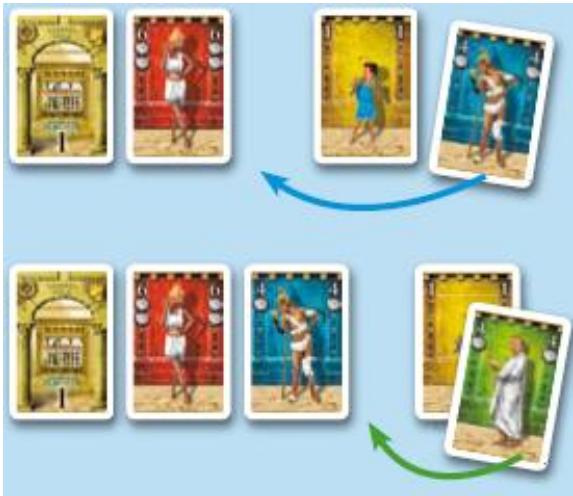
Example:
Yellow begins and plays his rank-1 Trader, placing it to the right of Caesar’s Villa. Then Red plays a rank-6 Trader which is placed to the left of the Yellow-1 (cards are shifted to the right as needed). Blue is next and plays a rank-4 Trader which is placed between the Red-6 and the Yellow-1. Afterwards Green takes her turn and plays the rank-4 Trader, which is placed between the Blue-4 and the Yellow-1.
The players continue in this way until every player has passed. Then the players collect Caesar’s favors in the form of the face-up Favor Cards. The player whose Trader is farthest to the left in line (closest to Caesar’s Villa) chooses a card first and adds it to his hand. Next the player whose Trader is in the second spot chooses, then the player whose Trader is third in line, and so forth, until all the Favor Cards have been taken (Traders too far back in line receive nothing), or until every Trader in line has receive a Favor (cards not taken are removed from the game).
Note: The function of the Favor Cards will be explained later.
Instead of a Favor Card, a player may take the Starting Player card, which the player then places face-up in front of him. He is now the new starting player. If no one selects the Starting Player Card, it is awarded to the player whose Trader was first in line!
The Trader Cards played remain in the line next to Caesar’s Villa until the end of the “day.”

Example:
In the first example, Green had last played the rank-4 card. After that, Yellow takes her turn and passes. A Red-2 and Blue-3 follow, and then Green passes. It’s Yellow’s turn again, however she has already passed and is therefore not allowed to play another Trader. Red and Blue both pass, and the actions are completed. Now the players take their Favor Cards: first Red chooses a card, then Blue and Green. Blue can then take a second card, as well as Red. After that, all Favor Cards, including the Starting Player Card, have been taken and Yellow’s last card receives nothing.
Note: the players should be cautious is using their Traders. Every Trader that is not used by a player earns as much money for him as the number of coins pictured under the Trader’s rank!
Phase II: Tickets
Now the players play Traders in order to buy Tickets. The Starting Player begins. Players take turns placing their Traders in the same way as in Phase I at Caesar’s Villa except they now form a line to the right of the Forum Romanum. At this time, Favor Cards may also be played (see “The Favor Cards”).
Note: The players should be careful to keep enough Traders for Phase III so that they can sell all of their Tickets!
Phase III: Events
In this phase, more Traders are played in order to sell the Tickets to Visitors. The Starting Player begins again, and turns involve playing Traders in the same way as in Phases I and II. This time, however, the Traders are placed to the right of the Circus Maximus, Pompeius-Theater or the Colosseum. As soon as one player passes, he can no longer perform any actions on any of the three Venues!
Phase IV: Scoring
Each player counts his coins for:
• Each Visitor to which he could sell a Ticket
Each Ticket that he could sell to a Visitor
Each Trader that he did not play
Note: unsold Tickets are worthless! Unused Favor Cards only count towards a player’s score at the end of the game, not at the end of the first and second days!

Example:
At the end of the first day, Green has the following cards in front of her: A balcony Ticket for the Colosseum which was sold to a Senator (1+6=7 coins), an arena Ticket for the Pompeius Theater, that a student bought (2+3=5 coins), and a balcony Ticket for the Pompeius Theater that did not find a buyer (0 coins). The player also still has the Trader cards of ranks 6, 3 and 2 (2+1+0=3 coins) and a Favor Card that does not count towards the
Choosing the Tickets also proceeds in the same manner as choosing the Favor Cards in Phase I in that the Trader farthest to the left has first choice, etc. It is important to note that the Tickets are for different Venues and each have different values (shown by how many coins are pictured), dependent upon whether their seats are box seats, arena, or balcony. The Tickets taken are placed face-up in front of each player. The Trader cards remain in the line until the end of the “day.”
Note: the players should only place Traders at Venues for which they have Tickets. If a Trader does not have a Ticket for a Venue, he may not take a Visitor Card.
As soon as all players have passed, the Tickets are sold. At each of the 3 Venues, as before, the player whose Trader is farthest to the left in the line has first choice of the Visitors to which he would like to sell his Ticket. The player takes the Visitor and places it over his Ticket in front of him, so that the coins pictured on the Ticket Card are still visible.
players score at this time. (At the end of the third day, however, this Favor Card would be worth 2 coins). Green scores a total of 7+5+3=15 coins for the day.
Each player’s coins are recorded on a piece of paper. At the end of the first and second days, the next events are now prepared:
Each player takes back all of his Trader into his hand Unused Favor Cards are kept in player’s hands
The Starting Player Card is placed to the left of Caesar’s Villa (the player who last had the card remains the Starting Player for Phase I of the next day!)
From the Favor Card deck, as many cards as the number of players are drawn as in the beginning of the game. (Note: the Favor Card deck is not shuffled again! Favor Cards that are played are taken out of the game!)
All Tickets are collected, shuffled again, drawn and placed in the same number and manner as in the beginning of the game.
All Visitor are collected, shuffled again, drawn and placed in the same number and manner as in the beginning of the game.
Now, however, the Special Events come into play.
The Special Events
On the second day, one of the three Venues holds a Special Event which provides the Traders with an even larger profit. To signify this, one extra Ticket is drawn and placed to the left of the Forum Romanum, and an additional Visitor is drawn and placed to the left of the Venue matching the Ticket. On this day, every Visitor at this Venue will pay one coin more for each Ticket! For this reason, one Coin Card is now placed under each Visitor Card at that Venue. When a Trader sells a Ticket to one of these Visitors in Phase III, he takes the Visitor Card together with the Coin Card and places them together with his Ticket in front of him.
On the third day, two special events take place! That means that two additional Tickets together with two more Visitors are drawn, and Coin Cards are added to all the Visitors at both Venues. Should both additional Tickets be for the same Venue, two Coin Cards are placed under each Visitor at that Venue. Those Visitors are willing to pay two coins more for Tickets!
End of Game
The game ends after Phase IV on the third day. Each player adds coins to his score from unused Favor Cards. Whoever has the most coins at the end of the 3 days wins the game. If a tie, then there is more than one winner.
Variant for Experienced Players

The Caesar Card is shuffled into the Visitor Card deck at the beginning of the game. If Caesar is drawn for one of the Venues, two additional Visitors are immediately drawn and added to this Venue! For this day, and at this Venue, a player may substitute a Favor Card from his hand for a Ticket! (in other words, he sells the Visitor a Favor which allows him to sit next to Caesar, the best seat in the house!)
Note: a player may place a Trader at this Venue, even though he does not have a Ticket for it, as long as he has at least one Favor Card!
In the game, it works as follows: when it is time for a player to use his Trader at the Venue to sell to a Visitor, he places a Favor Card from his hand face-up in front of him. Then he chooses a Visitor from that Venue and places the card on top of the Favor Card so that the coin(s) on the card are still visible. During scoring, the coins on the Favor Card are counted in the same way as the coins on a Ticket.
Before the next player takes his turn, the Caesar Card is taken and placed back on the Visitor deck. No other player may use a Favor Card as a Ticket on this day, since there are no more empty seats next to Caesar.
The Favor Cards
The Favor Cards offer player the opportunity to take special actions. There is no limit to the number of Favor Cards a player can hold in his hand. As soon as a Favor Card is played, its special action is immediately resolved and only takes effect once. Afterwards, the card is removed from the game.
When a player can play such a card is described in the first sentence of each card description. These are the following possibilities:
• The card is played instead of a Trader
• The card is played together with a Trader
• The card is played when a Trader takes an action at the end of a phase
Unused Favor Cards are worth the number of coins pictured on the card to that player at the end of the game. For this reason, each player must always weigh the amount the card is worth against the effects of the card, should he choose to use its special action!
Note: in the Variant with Caesar, the Favor Cards have yet another function!
Favor Card Translations
[Note: the explanations in the German rules are incorporated below.]
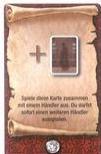
+Visitor
Play this card instead of a Trader. Draw an additional Visitor and place it at a Venue of your choice.

+Trader
Play this card together with a Trader. You may immediately play a second Trader this turn.
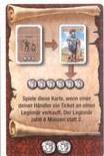
Ticket → Legionnaire
Play this card when a Trader sells a
Ticket to a Legionnaire.
The Legionnaire pays 6 Coins instead of 2.

II +Ticket
Play this card when one of your Traders is buying a Ticket at the Forum Romanum. He/she may buy 2 Tickets at once.

III +Ticket
Play this card when one of your Traders is selling tickets at a Venue. He/she is allowed to sell 2 tickets at once.

↓ Trader
Play this card instead of a Trader. Take one Trader from an earlier Phase and play it immediately again.

II +Ticket +Visitor
Play this card instead of a Trader during Phase II. Draw a new Ticket and place it in front of you. Then draw a new Visitor and place at the matching Venue.
With this card, it is important to note that the player immediately takes the new Ticket and places it in front of her, while at the same time, the new Visitor is placed to the left of the Venue matching the Ticket.
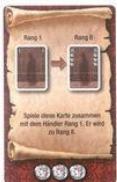
Rank 1 Visitor → Rank 8 Visitor Play this card together with a Trader with rank 1 and it becomes rank 8. The Trader becomes a rank of 8 for this phase only!
If played again (by using the appropriate favor card) it is rank 1 again!
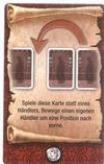
← Trader
Play this card instead of a Trader. Move one of your Traders ahead one place in line.
For the rest of the phase, the Trader that has been moved ahead in line is
considered the same rank as the Trader that he overtook.

Example: The red-2 is moved forward one position between the yellow-7 and the blue-5. From now one, the red-2 is treated as though it were a rank of 5. That means that every Trader with a rank higher than 5 will be placed to the left of red-2, and every Trader with a rank of 5 or lower will be placed to the right of blue-5.
原文为社区整理/出版社公开资料,版权归原作者,仅供个人学习查阅。