
钢铁之城City Of Iron
一句话概览
钢铁之城 是一款已收录于村了吗规则库的桌游,支持 2–4 人,原名 City Of Iron。
本页内容:一句话概览 · 游戏概述 · 1. 游戏组件 · 2. 游戏设置 · 3. 游戏流程 · 4. 行动详解 · 5. 特殊机制 · 6. 结束回合 · 7. 游戏结束 · 8. 扩展规则 · 关键规则与常见问题 · 常见问题
钢铁之城 规则速览
以下规则速览由本站整理,与官方规则书表述不同,仅供快速上手参考。
游戏概述
蒸汽时代的广袤大陆上,四个新兴国家——雅克城邦、欧姆蟾蜍工程师联盟、克鲁塞人学会、猪人共和国——竞相扩张实力。玩家扮演各国领袖,通过购买建筑卡建造城市、获取珍贵货物来获得胜利点数(VP)。核心目标:在第三张得分卡出现后的最后一回合结束时获得最多VP。
核心机制: 板块放置、手牌管理、收入系统、卡牌驱动能力、顺位拍卖
1. 游戏组件
| 组件 | 数量/说明 |
|---|---|
| 金币指示物 | 9个10元、9个5元、33个1元 |
| 科技点指示物 | 11个1点、4个2点 |
| 主版块 | 1块 |
| 指导表 | 1张 |
| 行动指示物 | 12个 |
| 玩家帮助卡 | 4张 |
| 国家特殊能力卡 | 4张(扩展内容) |
| 国家板块 | 4个(雅克/O姆/克鲁塞/猪人) |
| 城市/街道指示物 | 每个国家4个(双面使用:1个5格建筑容量、2个3格、1个2格) |
| 建筑卡A堆 | 26张 |
| 建筑卡B堆 | 22张 |
| 建筑卡C堆 | 18张 |
| 城镇卡 | 22张 |
| 大陆板块 | 12块 |
| 四色木质指示物 | 各14个 |
| 军队卡(黄色天空) | 4组,每组11张(按国家分字母A/O/R/C标识) |
| 居民卡(蓝绿天空) | 4组,每组14张(按国家分字母标识) |
| 分数卡 | 3张 |
2. 游戏设置
2.1 国家选择
每位玩家选择一个国家,将对应国家板块放至面前。领取以下物品:
- 相应国家的军队卡组和居民卡组(卡片上的字母标识国家:A=雅克城邦,O=蟾蜍发明联盟,R=猪人共和国,C=克鲁塞学会)
- 4个城市/地区标志物(1个5格容量、2个3格容量、1个2格容量,使用无加分标记的一面)
- 12个自己颜色的木质指示物
- 1个起始大陆板块(距离值为0)
- 3个行动标志物
- 1个玩家帮助卡
未提及的配件放回盒中。起始大陆板块放在玩家板块旁,将5格容量的城市标志物放在该大陆板块上——这就是你的起始城市。
2.2 起始卡牌堆
- 浏览所有军队卡和居民卡,取出:上尉、士兵、制图员、学者。
- 将上尉和士兵(按你偏好顺序)面朝下叠放于国家板块的"军队"位置。
- 将制图员和学者(按你偏好顺序)面朝下叠放于国家板块的"居民"位置。
- 剩余所有军队卡和居民卡洗匀,面朝下叠放于国家板块上方——这是未购买的卡牌堆。你可随时查看此堆。
- 在游戏过程中通过"购买军队/居民卡"行动可逐渐扩充这两个堆。
国家特殊能力: 若使用扩展规则,按"国家"章节说明将特殊能力卡加入未购买牌堆或起始卡组。初次游戏请忽略此步骤,将所有国家特殊能力卡移出游戏。
2.3 主版图摆放
- 将主版块放至桌面中央。
- 将金币和科技点指示物各分一堆置于主版块右侧。
- 将剩余的大陆板块分两行放置于主版块上方(将多余的距离为0的板块放回盒子)。
- 2人游戏时: 将所有右上角标记为数字"2"的大陆板块放回盒子。
2.4 建筑卡准备
- 将建筑卡按类型(A、B、C)分成三堆(类型标注在卡牌右下角)。
- 按玩家人数移除对应卡片后,每堆单独洗牌。
- 将三列牌堆自上而下以 A→B→C 的顺序纵向排列成一摞,放置于主版块旁。
- 从牌堆顶部从左至右翻开卡牌,补满对应人数的空位:
- 2人游戏:7个位置
- 3人游戏:10个位置
- 4人游戏:12个位置
2.5 城镇卡准备
- 将城镇卡按星级分成三堆(1星、2星、3星)。
- 3人游戏: 所有"demon"类别的城镇卡放回盒子。
- 2人游戏: 所有"demon"和"ore"类别的城镇卡放回盒子。
- 将城镇卡按要求组织摆放,"未被征服"面(朝上一面)朝上。
- 将城镇卡堆置于主版块旁。
- 无星星的城镇卡属于进阶扩展配件,初次游戏请勿使用。
2.6 玩家起始与拍卖
- 每位玩家拿取7个金币,从居民卡堆摸1张卡到手牌。
- 起始收入设为2:每位玩家将收入标记放置于国家板块收入轨"2"的位置。
- 随机决定起始拍卖顺序。每位玩家将木质指示物从左至右依次放置于主版块的拍卖轨上。
3. 游戏流程
3.1 回合结构
每回合分为两个阶段:
拍卖阶段 → 行动阶段 → 结束阶段
拍卖阶段
玩家按照从左至右的顺序依次竞拍顺位轨。每人只能竞拍1次(除蟾蜍联盟外)。当一名玩家竞拍时,将其木质指示物放入顺位轨任意空位,同时支付该位置显示的金币数。
所有竞拍完成后,顺位轨的执行顺序与拍卖轨相反:从右至左执行。
行动阶段
按顺位轨从右至左的顺序,玩家逐次执行行动。
- 每位玩家每回合有3个行动次数,由行动标志物的正反面表示(正面"A"朝上计为已用,反面朝上为可用)。
- 顺位竞拍行动每回合每种行动仅可使用1次(即只有第1个行动可以选择竞拍顺位)。
- 其他行动可在同一回合内多次执行。
- 每次执行行动后,将一个行动标志物翻面标记消耗。
结束阶段
见第4.6节。
4. 行动详解
4.1 建造
从主版图上购买一张建筑卡(或从储存中选择一张之前存下的建筑卡),放置到你的城市中。
条件与费用:
- 支付卡面标注的金币数和科技点数。
- 城市必须有可用的建筑空位(城市/街道指示物上的数值即为容量)。
- 空位的土地类型必须匹配建筑卡要求的土地类型。
- 同种名称的建筑卡只需支付一次科技点(首次建"恶魔贸易者"需付科技点,再建第二张同款则免科技点)。
- 新建筑生产货物时,用对应颜色和数量的木质指示物标记在卡上;同时将该建筑对应的收入值(+1)记录到国家板块的收入轨。
土地类型一览:
| 建筑名称 | 所需土地类型 |
|---|---|
| 芜菁农场 | 草地 |
| 牧场 | 草地 |
| 苔藓花园 | 森林 |
| 工厂 | 山地 |
| 矿场 | 山地 |
| 码头 | 海岸 |
| 盐田 | 沙漠 |
| 恶魔贸易者 | 沙漠 |
| 丝绸织工 | 丛林 |
| 水晶洞穴 | 浮空岛 |
摧毁建筑: 当城市已满但仍想建造时,可通过摧毁已有建筑来腾出位置(具体见第5.4节"摧毁建筑")。
4.2 储存建筑
购买一张当前可用的建筑卡但不建造入城,而是将建筑卡面朝下放置在你的国家板块旁边——这是"储存"状态。
- 储存的建筑卡不计入城市容量。
- 后续仍可将它建造入城(视为正常建造行动)。
- 储存上限:无限制。
4.3 摸牌
从你的军队卡堆或居民卡堆中各摸1张卡到手牌。
- 手牌无上限。
- 当可用牌被摸完时,将弃牌堆(保持原有顺序不洗牌)面朝下合并入牌堆。
- 如果牌堆中无任何可用牌,不能执行此行动。
4.4 税收
获得1个金币。
4.5 购买科技点
花费4个金币,获得1个科技点。
4.6 打出卡牌
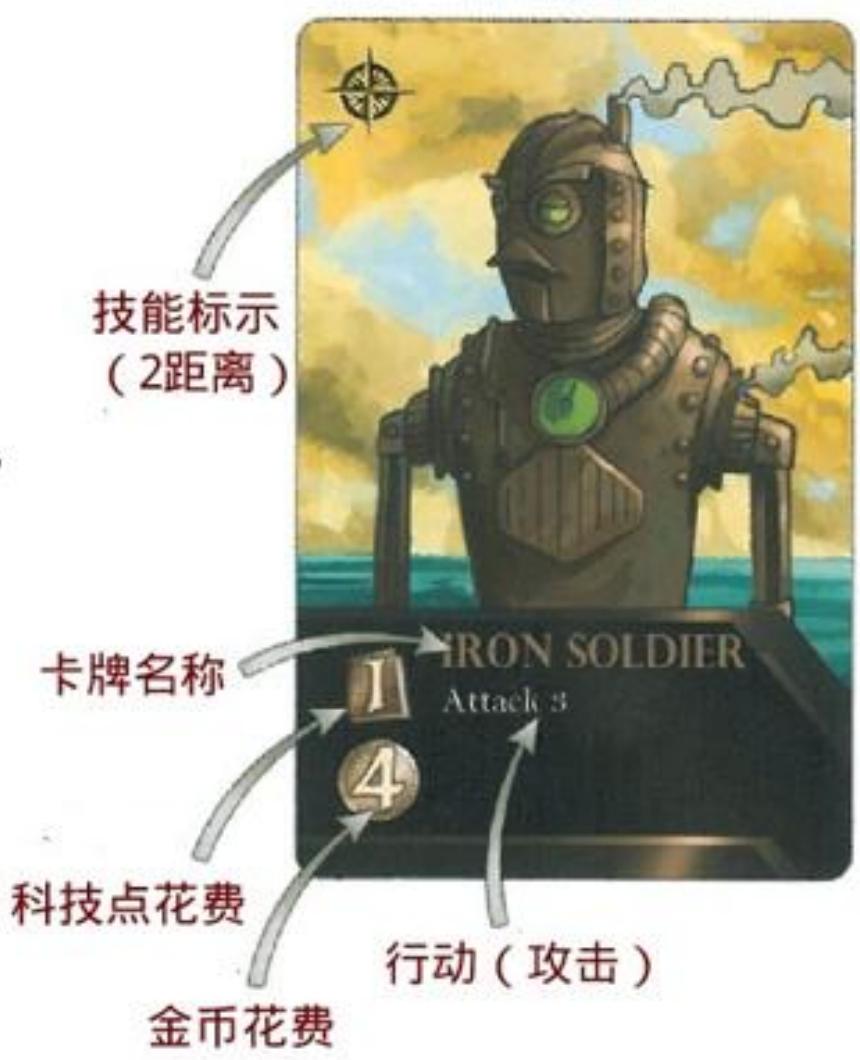
使用1张居民卡或军队卡的能力。打出时需额外打出指定卡牌来满足技能标示的要求。
卡牌基本规则:
- 每张卡左上角显示一个或多个技能标示:距离(指南针图标)和工时(锤子图标)。
- 一张卡在执行自身能力时,其左上角的技能标示不可使用(飞船卡和帆船卡除外,详见5.3节)。
- 打出的卡牌按类型(军队/居民)面朝上放置到对应弃牌堆。
- 免费行动: 部分卡牌标有"免费行动"。此类卡牌在执行正式行动前打出,不计入行动次数,不受"每轮仅用1个顺位竞拍"的限制。免费行动卡牌单独弃置。
- 你可以随时查看自己的弃牌堆但不能改变其顺序。弃牌堆不公开。
5. 特殊机制
5.1 城市与街道
城市容量
起始城市拥有5格建筑容量(由起始城市标志物决定)。每个额外的城市/街道标志物也有各自的容量:
- 5格容量的标志物:1个
- 3格容量的标志物:2个
- 2格容量的标志物:1个
总计最大建筑容量 = 5 + 3×2 + 2×1 = 14格。
每个城市/街道标志物在回合结束时还会提供摸牌机会(军事/居民标志数量决定摸牌数)。
扩展城市(增加街道)
使用"市长"居民卡的能力来扩展城市。
- 将一个街道指示物放置在你现有城市旁边的陆地板块上(使用街道面,即带"+"号的一面)。
- 根据选择的街道指示物获得1格或2格额外建筑空位。
- 该街道在回合结束时也提供摸牌机会。
- 一条城市可以有多个街道。
建造新城市
使用"探索者"居民卡的能力在新大陆上建立新城市。
- 探索者卡自身的距离技能不可使用,需额外打出卡牌补足所需的距离值。
- 某些远方大陆可能要求你拥有帆船或飞船。帆船和飞船卡的距离技能可以使用。
- 将新大陆板块紧邻你的起始大陆板块放置。
- 在新大陆上放置城市标志物。
- 根据选择的指示物获得2格或3格建筑空位及回合结束时摸牌机会。
5.2 攻击城镇
攻击中立城镇或其他玩家控制的城镇。
攻击条件:
- 需要打出至少1张或多张军队卡。
- 军队卡的攻击值("D"后数字)总和 ≥ 城镇卡防御值。
- 或军队卡的攻击距离(指南针后数字)≥ 城镇卡所需距离值。
- 每张卡只能使用攻击值或攻击距离之一,不可叠加计算。
攻击结果:
- 若攻击成功,将所有使用的军队卡面朝上放置(消耗掉)。
- 拿走攻陷的城镇卡,将获得的货物用木质指示物标记在卡上。
- 将城镇卡"控制"面(朝上)朝上放置——该卡不占用任何城市建筑空位。
- 如果城镇生产货物,收入轨+1格。
- 攻击中立城镇的附加效果: 同时丢弃主版图建筑轨最左边的4张建筑卡。
被控城镇防守加成: 玩家已控制的城镇,防御值 = 卡面基础防御值 + 2(注意是看"控制"面)。
攻陷敌方城镇: 若攻陷其他玩家的城镇,原主人损失1点收入和该城镇的货物,你获得1点收入和全部货物。
5.3 军队卡与居民卡
两种卡牌共享相同的技能系统,区别在于所属阵营和使用方式。
技能标示:
- 距离(指南针): 表示卡牌能影响的范围/距离,用于攻击城镇等场景。
- 工时(锤子): 表示卡牌作为技能支付的费用值,用于给其他卡牌做支撑。
打出顺序: 打出多张卡时按你想要的顺序面朝上放置到各自弃牌堆。一旦进入弃牌堆不可更改顺序或洗牌。
5.4 摧毁建筑
当城市建筑已满但还想继续建造时:
- 拆除城市中的某一栋建筑,释放其占据的空位。
- 释放后的空位可用于建造新的建筑。
- 被摧毁的建筑不再产生任何收益(收入、货物等)。
5.5 国家特殊能力
> 再次强调:初次游戏请跳过以下内容,将所有国家特殊能力卡移出游戏。
雅克城邦
- 没有特殊能力卡。
- 其军队卡中有一座建筑附带 +2 建筑空位奖励。
- 可以花费1个金币执行一次"在城市间移动建筑"的免费行动。
欧姆蟾蜍工程师联盟
- 起始居民卡额外加入"Fixer"(修理师)这张牌。
- 起始军队卡不变。
- 特权: 可以在顺位竞拍中拍两次(放置两个指示物到顺位轨上)。
克鲁塞学会
- 起始军队卡和居民卡按常规设置。
- 拥有一张特殊能力卡"Genius"(天才),将其加入未购买牌堆。
- 特权: 居民卡"学者"无需花费金币即可购买。
猪人共和国
- 起始居民卡按常规设置。
- 起始军队卡中的"上尉"被替换为"Gunslinger"(枪手)。
- 特殊能力卡"Strategist"(战略家)加入未购买居民卡牌堆。
6. 结束回合
当所有玩家执行完行动后,进入结束阶段。按以下顺序依次执行:
6.1 弃置与补牌
丢弃主版图最左侧的4张建筑卡(含可能的分数卡)。其余建筑卡向左平移填补空位。从牌堆顶部从左至右补充翻开的建筑卡直至达到对应人数的空位数。
若翻开的卡牌中包含分数卡,将其放置于建筑卡堆旁——下一回合结束时将结算胜利点。
6.2 计分(仅在分数卡触发时)
如果本回合结束时翻出了分数卡,所有玩家开始计算胜利点。
计分规则:
- 使用主版图参考每一玩家在每种货物上的数量。
- 每种货物数量最多的玩家和第二多的玩家分别获得对应的胜利点数(依据主版图表格)。
- 平手情况: 当某类货物的数量并列第一或第二时,并列的所有玩家均能获得该等级的胜利点。
- 即时评分: 当一个玩家拥有等于或大于主版图表格中该货物最低得分门槛的数量时,立即获得1个胜利点(即使不是第一名或第二名)。
- +3建筑卡奖励: 拥有"+3"标示的建筑卡C最多和第二多的玩家,分别额外获得3个胜利点。
- 用木质指示物将总分记录在胜利点轨道上。
- 如果这是第三次触发计分(即三张分数卡已全部翻出),本回合结束后游戏直接结束。
6.3 计算收入
- 每位玩家从银行获得等于其当前收入等级的金币。
- 收入计算来源:
- 起始收入: 2个金币。
- 生产货物的建筑卡: 每张+1金币收入(不按卡面生产的货物数量算,按"有无产出"计算)。
- 生产科技的建筑不算货物卡,不增加收入。
- 生产货物的城镇卡: 每张+1金币收入。
- 某类货物持有量最多: 额外+1金币(平手则并列玩家均获得)。 - 使用国家板块上的收入轨可以快速对照,不必逐张翻查建筑卡。
- 当城镇被占领或城市建筑被摧毁时,记得扣除相应的收入值。
6.4 收集科技点
每位玩家从学院区域收集科技点。此外,如果是普通的计分回合(非最终结算),每位玩家还可获得1个额外科技点(依据分数卡所示数值)。
6.5 摸军队卡与居民卡
所有玩家按照城市和建筑上的军事/居民标志数量来摸取军队卡和居民卡。起始城市提供1次摸居民卡的机会。
- 如果牌堆已无可用牌,将弃牌堆(不需洗牌、不要改变顺序)面朝下合并入牌堆后再摸。
6.6 购买军队卡与居民卡
- 玩家秘密选择想要购买的卡牌,面朝下放在自己面前。
- 所有人亮出所选卡牌并支付对应金币和科技点。
- 新购买的卡牌加入各自的手牌。
- 可同时购买任意数量的卡牌,只要花费足够即可。
7. 游戏结束
触发时机: 第三张得分卡出现后的下一个回合,当进行到结束阶段时游戏结束。此时建筑牌堆耗尽而主版图空位未满,请将建筑卡弃牌堆洗牌后补满空位。
最终结算: 照常计算胜利点,但不获得金币和科技点。此外还有以下附加奖励:
| 排名条件 | 奖励 |
|---|---|
| 最多金币(未使用) | +2 胜利点 |
| 最长距离(最远的大陆延伸) | +2 胜利点 |
| 某一货物数量最多 | +2 胜利点 |
| 最多军队卡/居民卡总数 | +3 胜利点 |
| 最多城镇数量 | +3 胜利点 |
| 永久储存惩罚 | 每2张未被建造的储存建筑卡扣1点 |
平手处理: 如果在某项特殊奖励上打平,没有任何玩家获得该项奖励。
所有胜利点计算完毕后,得分最高的玩家获胜。
8. 扩展规则
8.1 城镇卡扩展
使用0星城镇卡(不带星星标记的城镇卡)时:
- 将0星城镇卡单独洗匀,"未被控制"面朝上,放在基本城镇卡旁边。
- 从0星城镇卡堆抽取2张,使桌面上始终能看到3张0星城镇卡可见。
- 当有玩家攻克掉一张0星城镇时,从拓展堆顶补1张回来,保持桌上3张可见。
- 此时通常会有6张城镇卡可供攻克(3张基础+3张0星)。
0星城镇效果:
| 名称 | 效果 |
|---|---|
| Beast Belly | 回合结束时摸取1次军队卡并获得1金币 |
| Solara | 回合结束时摸取1次居民卡并获得1金币 |
| SnyLee | 回合结束时可选择一种已有货物,该货物在此回合结算中数量+2(每回合可重新选择) |
| Metgra | 2格建筑容量,土地类型为海岸+丛林。被其他玩家攻占时,卡上的建筑一并被带走 |
| Dar Embe | 增加3金币,最终结算时该城镇当做3个城镇计分 |
| Cumulus | 回合结束时获得1点科技点 |
| Cazum | 2格建筑容量,土地类型为海岸+山地。被其他玩家攻占时,卡上的建筑一并被带走 |
关键规则与常见问题
易错规则
- 顺位轨执行顺序与拍卖轨相反: 拍卖从左到右排,执行从右到左排。
- 同种建筑卡免二次科技点: 已建过"恶魔贸易者",再建同名牌不收科技点。
- 卡牌二选一原则: 一张卡只能用"行动能力"或"技能标示"之一,不可叠加。飞船卡和帆船卡可共用为例外。
- 建筑卡储存无上限: 可囤积任意数量的建筑卡供日后建造。
- 攻击城镇只取一项: 要么用攻击值达标,要么用攻击距离达标,不可两者合计。
- 攻陷敌方城镇会剥夺收入: 原主人少1点收入,且失去该城镇产出的全部货物。
- 收入按"产出货物的建筑数"而非货物总量计算: 每张产出货物的卡固定+1金币。
- 生产科技的建筑不算货物卡: 只产出科技点的建筑不增加收入。
- 弃牌堆合并时保持原有顺序: 不可洗牌。
- 免费行动不计入行动次数: 可在正式行动前打出任意数量免费行动卡。
- 城市初始容量5格: 加上3个额外标志物共14格封顶(5+3+3+2+1=14)。
- 分数卡出现才计分: 无分数卡的回合只做收入计算、摸牌和购卡。
- 第三次计分后游戏立刻结束。
- 攻击中立城镇会额外丢弃左边4张建筑卡。
- 蟾蜍联盟可拍两次顺位。
- 终结奖励平手无人得奖: 某项排行榜打平时没有人获得该奖励。
- 储存建筑卡扣分: 每2张未被建造的储存卡扣1VP。
常见问题
- Q:城市/街道指示物怎么分配?
A:每个玩家4个——1个5格容量、2个3格容量、1个2格容量。起始城市标志物先放上起始大陆板块,剩余的按需用于扩展街道或建造新城市。
- Q:收入轨怎么用?
A:每建一座产出货物的建筑就向前推一格。收入计算时只看当前指向的数字加"最多货物"奖励即可,不用逐张翻查建筑卡。被攻占的城镇或被摧毁的建筑记得减去对应格数。
- Q:弃牌堆什么时候回牌堆?需要洗牌吗?
A:当可摸的牌用完时,将弃牌堆不改变顺序地面朝下放到牌堆底部,然后继续摸。不需要洗牌。
- Q:分数卡在哪里找?
A:分数卡在建筑卡A、B、C三堆的最底端(每次翻开到底时会露出来)。当它被翻出时放到一边,下一回合结束时触发计分。
- Q:"即时评分"是什么意思?
A:即使你没拿到某类货物的第一或第二名,只要你拥有的数量达到了主版图表格中标注的最小得分门槛,就直接获得1个胜利点。
- Q:如何扩建城市?用什么手段?
A:用"市长"居民卡(增加街道)或"探索者"居民卡(建造新城市)。两者都需要满足各自能力的条件。
- Q:新城市建在什么位置?
A:新大陆板块需放置在起始大陆板块旁边。城市标志物放在新大陆板块上。
- Q:第一次玩要不要用国家特殊能力?
A:不需要。初次游戏请将所有国家特殊能力卡移出游戏。
- Q:城镇卡占城市容量吗?
A:不占。城镇卡放在城市旁边,不影响城市内部的建筑空间。
常见问题(FAQ)
以下 1 条问答中 0 条来自站内玩家的真实提问,其余 1 条为本站整理的常见疑问;答复内容保持原样。
钢铁之城支持几个人玩?
2–4 人。
去哪查完整规则
想核对具体规则细节、卡牌效果或某个回合的结算方式,可以在村了吗里选中这款游戏后直接提问。
同类桌游
- 卡坦岛德式
- 工业革命:伯明翰德式
- 勃艮第城堡:特别典藏版德式
- 方舟动物园德式
- 卡卡颂抽象
- 瘟疫危机传承:第一季美式
- 阿瑞迪亚:勇踏征途美式
- 重塑宇宙德式
- 幽港迷城美式
- 埃多拉的德鲁伊德式
规则原文(Markdown)
本站收录这款游戏的规则原文 2 个文件,此处内联渲染 2 个,可直接展开阅读或下载。
rules_zh_钢铁之城_5503.md24.3 KB
介绍
机器的时代开始来领。勇敢的冒险者,狡猾的领袖,聪明的学者,强大的魔法师4个民族开始密谋扩大自身的实力。它们将通过占领新的城邦来获得经济的强盛,广阔的土地和无与伦比的新科技。你将愿意带领勤劳的人类,蟾蜍工程师,克鲁塞学者还是聪明的猪人获得这场胜利?
你可以垄断市场上的货物;探索蒸汽时代的科技;雇佣雇佣兵来控制大陆;建造飞船或是帆船去到达远方大陆和悬浮岛屿。但你的城市的容量是有限制的,所以你必须决定哪些建筑保留,哪些建筑摧毁。
铁城是一个供2-4名玩家游戏的桌游。游戏的目标是控制最多数量的稀有和珍贵货物。玩家将通过从公共池购买建筑卡在他们的城市建造来获得这些货物。玩家同样可以购买居民卡和军队卡来获得它们特殊的能力,像是建造新城市,控制中立城镇。最后,哪位玩家能最好的组合好手中的卡片将会赢得胜利。
铁城的世界
铁城的世界处在一个未被探索的宽广大陆上,这里充斥着数不胜数的财富和奇迹。蒸汽时代的科技正迅速发展,但原有的传统和魔法的学习依旧强大。年轻的国家正在探索和发展自身的实力,彼此竞争着想要成为庞大的帝国。
在800年前,一场恐怖的战争笼罩在这片大路上,古老的帝国一个个陨落。这个世界变得混乱和危险,许多古老的知识因此遗失。现在,这片大陆似乎看起来从未经历过这场战争,即使战争的遗迹依然存留。
年轻的国家正带着希望与热情期待着未来。这四个主要的国家就是雅克城邦,欧姆蟾蜍工程师联盟,克鲁塞人学会和猪人共和国。
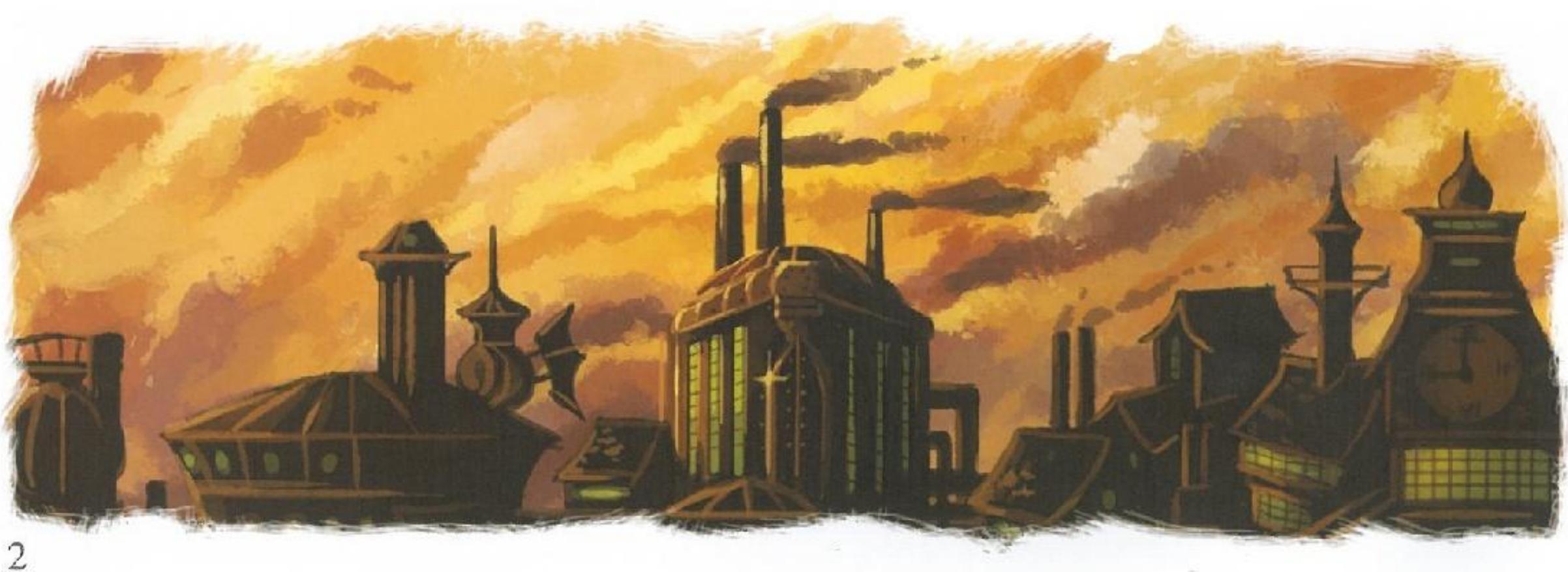
Dignitar
Beautiful flower of
the east continent, known
for its rare silk and
spices. Dignitar is one
of the oldest cities in
the known world. For
centuries it has been a
hub of trade and a
popular port. Two
centuries ago, much of
the city burned in an
horrific fire caused by a
recently hatched world
wyrn. It took the
council of mystics and
the Dignitar army two
days to fight the
creature off. The city
was rebuilt, and was eve
more beautiful than it
had been.
金币 科技点
(9个10元,9个5元,33个1元)(11个1点,4个2点)


主版块
指导表

行动指示物(12)


玩家帮助卡(4)

国家特殊能力卡(4)
国家板块(4)

每个国家4个城市/街道指示物(双面使用,每一组含1个5, 2个3, 1个2)

建筑卡A(26)

建筑卡B(22)

建筑卡C(18)

城镇卡 (22)


大陆卡(12)
四色木质指示物各14个

军队卡:黄色天空(4组,每个国家11张1组)
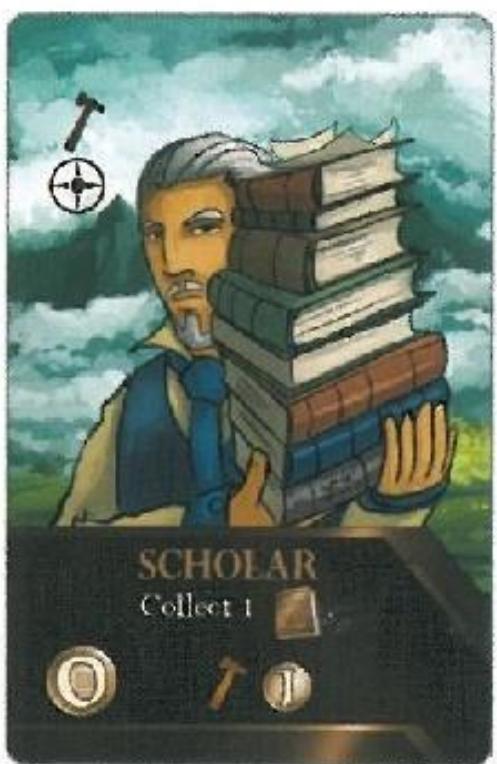
居民卡:蓝绿天空(4组,每个国家14张1组)
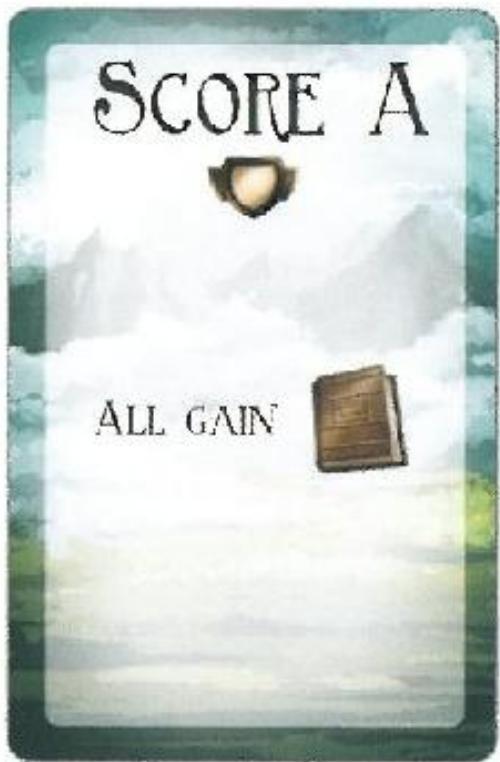
分数卡(3)
Setup
-
每个玩家选择一个国家,将国家板块放到自己面前。每个玩家将相应国家的军队卡和居民卡拿走。军队卡和居民卡上的字母显示对应哪个国家,A是雅克城邦,O是蟾蜍发明联盟,R是猪人共和国,C是克鲁塞学会。每个玩家拿取4个城市/地区标志物(1个5分,5个3分和1个2分,使用没有加分标志的一面),12个自己颜色的木质标志物,一个起始大陆板块(板块上距离为0),3个行动标志物和1个玩家帮助卡。所有上诉没有提及的内容物全部放回盒子。将起始大陆板块放在玩家版块一边。将5分城市标志物放上大陆板块。这就是你的起始城市。
-
每个玩家建造自己的起始军队卡和居民卡。浏览可用的军队卡和居民卡,将上尉,士兵,制图员和学者拿出。将上尉和士兵(按照你选的顺序)一起面朝下放置在国家版块的军队位置。将制图员和学者(按照你选的顺序)一起面朝下放置在国家板块的居民位置。将剩下的卡放成一堆面朝下的放置在国家板块上方。你可以在游戏过程中通过购买来将这些牌加入你的军队卡堆和居民卡堆。你可以随时查看此卡堆。
重要:如果你使用国家特殊能力卡,按照“国家”部分的指示将你的国家特殊能力卡添加到你的起始始卡堆或未购买卡牌堆里。如果这是你的初次游戏,忽略国家特殊能力卡片,将它放回盒子里。
3。将主板块放到桌子中间。将钱币和科学指示物分两堆摆放在主版块右边。将剩余的大陆板块如图所示分两行放在主版块上方(将剩余距离为0的板块放回盒子)。当2人游戏时,将所有右上角标志为2的大陆放回盒子里。
- 建造建筑卡排队。将建筑卡按照牌类型 (A. B. C) 分成三堆。建筑卡的类型在卡牌右下角显示。浏览每堆牌按照玩家数量移除卡牌。
4人游戏:0张移除。
3人游戏:移除所有号码为3的建筑卡,同时移除卡上对应花费的金币数。
2人游戏:移除所有号码为1和2的建筑卡,同时移除卡上对应花费的金币数。
当你移完对应卡片后,将每堆建筑卡牌单独洗牌。洗好后,将三列牌堆面朝下放置,按照C牌堆放最底,B牌堆中间,A牌堆最上的顺序列为一堆放置在主版块旁边。
-
摸建筑牌堆的牌按从左至右的顺序补满主版块上的建筑卡空位, 直到对应人数的位置被补满。(2人游戏时7个位置, 3人游戏时10个位置, 4人游戏时12个位置)
-
每个玩家拿取7个钱币和摸一张居民卡到手上。
-
将城镇卡分成三堆。(按1星,2星,3星)当三人游戏时,将所有城镇demon卡放回盒子里。2人游戏时,将所有城镇demon和ore卡放回盒子里。组织卡牌,将“未被征服”面朝上放置。将城镇卡堆放置在主版块旁边。没有星的城镇卡适用于进阶的扩展,具体请看“城市卡拓展”部分,初次游戏请勿使用。
-
起始收入是2. 请每位玩家将木质标志物放在自己国家板块上方的收入轨“2”的位置上。
-
随机决定起始拍卖顺序。每个玩家将木质标志物从左到右地放置在主版块的拍卖轨上。
7
3
回合顺序(上方)拍卖顺序(下方)
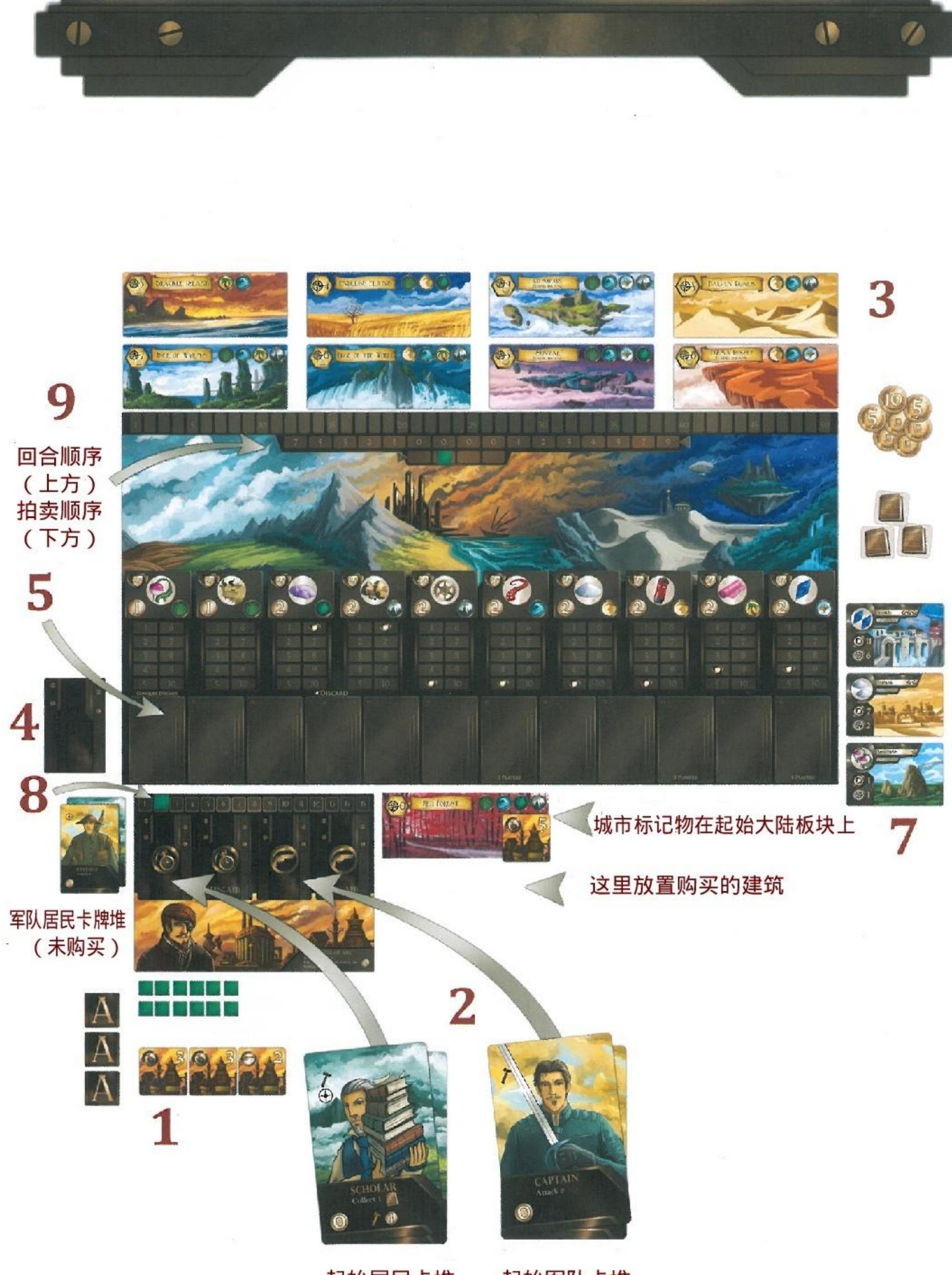
军队居民卡牌堆(未购买)
城市标记物在起始大陆板块上
这里放置购买的建筑
1
起始居民卡堆
起始军队卡堆
Overview
在铁城,玩家一个在陌生奇幻大陆上新兴国家的领导者。每个国家起始拥有一个可建造5座建筑的城市。决定哪些建筑卡放置在你的城市上将会是获胜的关键。通过建造建筑能获得货物。每回合,每种货物拥有最多数量的玩家额外获得1金币。在每次得分卡出现时(建筑卡A、B、C最底一张),每种货物最多数量的玩家还可以获得胜利点。玩家将会发现他们必须拓展城市或是在远方大路上建造新城市来获得更多的建筑。一些远方大陆需要使用帆船或飞船才能到达,但它们同时拥有着稀有而珍贵的货物。玩家还可以使用他们的军队卡和居民卡来获得特殊能力,例如得到特殊的行动,控制中立城镇和建造新城市。当建筑卡被耗尽时,游戏进入最后一回合。回合结束,最多胜利点的玩家获得胜利。
游戏回合
顺位轨
在回合开始前,玩家拍卖顺位。玩家按照拍卖轨上从左至右的顺序进行拍卖。当一位玩家开始竞拍时,他可以将他的木质指示物摆放在顺位轨上任一空位,但是他只能竞拍1次。当他放置木质指示物时,他必须同时给予顺位轨位置上所显示的金币。
当所有玩家竞拍完成,回合开始。顺位轨的顺序与拍卖轨顺序相反,从右至左开始。
顺位轨 (右至左)
拍卖轨 (左至右)
3个行动
按照顺位轨,玩家逐次执行行动。每位玩家每回合有3个可执行行动,但每轮只能使用1个。当玩家执行一项行动,他将他的行动标志物翻面(没有A的一面朝上)来帮助标记他在回合结束前还有多少行动可执行。玩家将从下面的行动中选择。每回合每个行动可以执行超过1次。
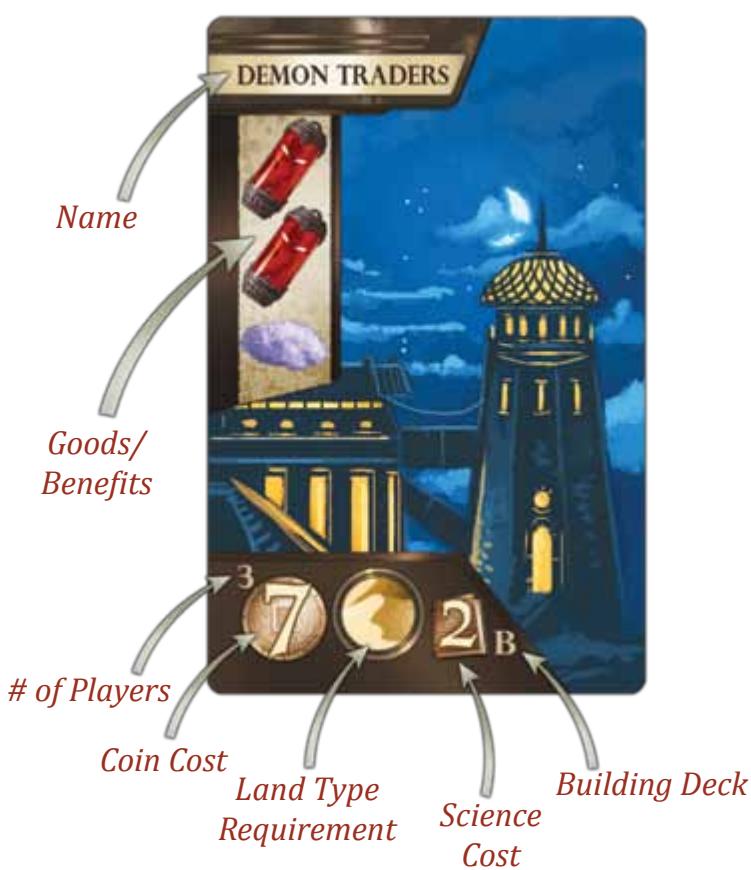
建造:你可以从主板块上的建筑卡堆购买一张建筑卡(或选择一张你在之前存下的建筑卡)。你必须支付卡上显示的金币和科技点。你的城市必须有建筑空位,同时该空位需符合建筑卡上需要的土地类型。当你购买了建筑卡,将它放置在你的城市下方。如果新的建筑卡生产货物,用你的木质标志物放置在卡上将货物数量和类型标示出来。同时,当你的建筑卡生产货物时,将你的国家板块的收入轨往前推进1格。
同样的建筑卡类型你只需要支付一次科技点。
举例:如果你已拥有“恶魔贸易者”,当你建造下一张“恶魔贸易者”时你不需支付科技点。你可以摧毁建筑来空出建筑位置。这个行动在“建筑”将会有进一步的解释。
这个行动在“建筑”将会有进一步的解释。
储存建筑:如果你想要为未来购买一张卡,你可以购买一张可用的储存卡并将它储存起来,将储存的建筑卡放置在你的国家板块旁边(并不是你的城市上)。建筑卡储存并没有上限。
建筑卡
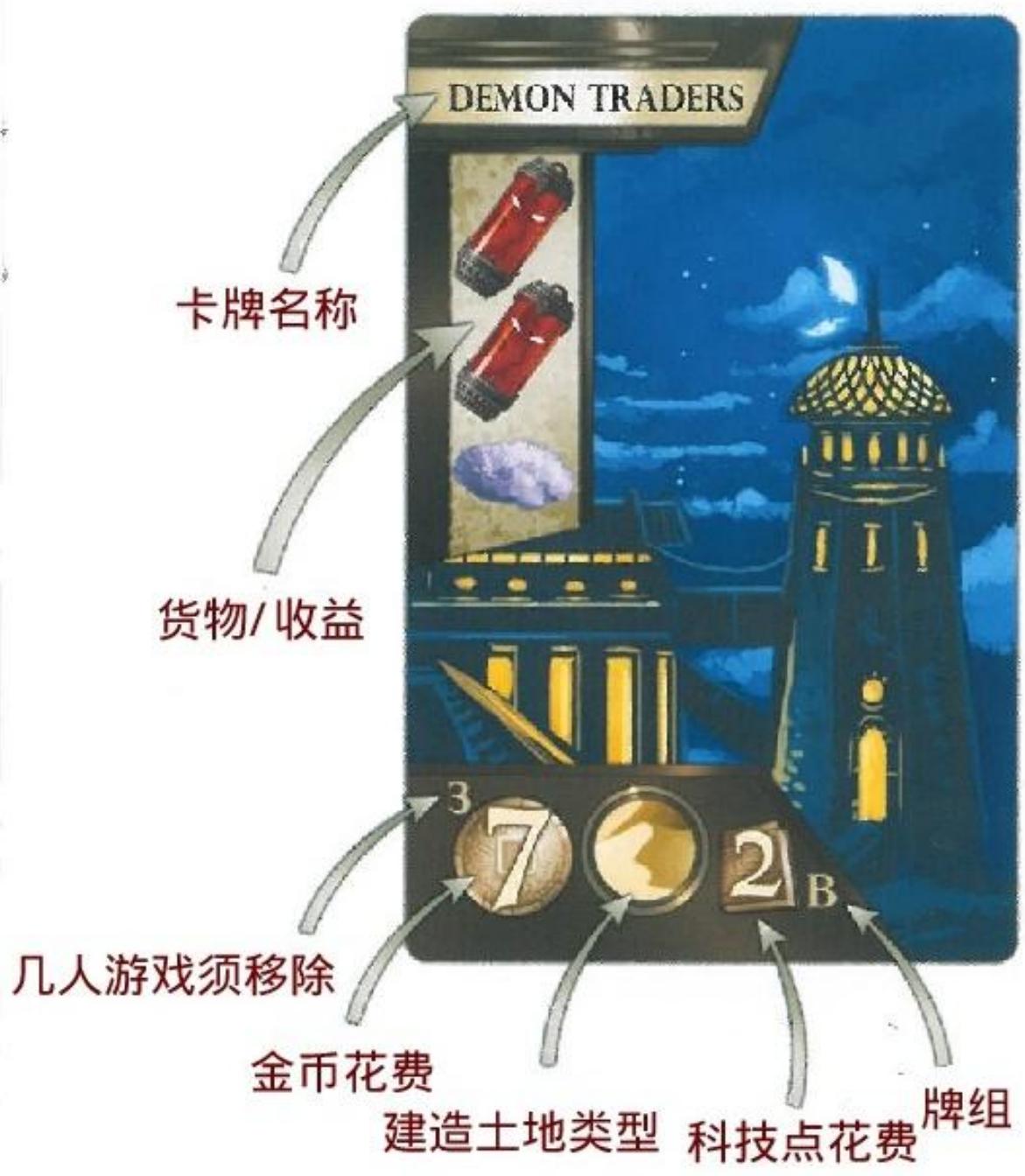
摸牌:你可以从你的军队卡堆和居民卡堆中摸一张牌到手上。手牌并没有上限。如果已经没有可用牌时,将弃牌堆(不要改变顺序)面朝下加入牌堆。如果牌堆已经没有任何一张牌,你不可执行摸牌行动。
税收:获得1金币。
购买科技点:使用4金币获得1科技点。
打出卡牌:你可以使用1张居民卡或军队卡的能力。当你执行卡牌能力时,你通常还需要打出额外的卡来满足卡牌上的技能标示。当你打出牌后,按军队或居民卡类型面朝上弃牌。这个行动将会在“军队卡和居民卡”部分进行进一步解释。
居民卡

攻击城镇:你可以攻击一个中立城镇或是一个玩家拥有的城镇。你需要1张或多张与你所攻击的城镇卡防御值相等攻击值(攻击值是D标示后数字)的军队卡,同样还需要使用有足够攻击距离(攻击距离是指南针后数字)的军队卡。一张卡的攻击距离和攻击值只能使用1项。将所有使用过的卡牌面朝上放置,拿走攻陷的城镇卡,将获得的货物标示在该卡上。城镇卡并不占据你城市上的建筑位置。(将城镇卡放到你的城市卡旁边)如果城镇卡生产货物,在你的国家板块上收入轨推进1格。请确认将城镇卡“被控制”的一面朝上放置。控制城镇将会有一个更高的防御值。作为最后一步,如果你攻击的城镇是中立城镇,弃掉主版块建筑轨上最左边的建筑卡。
城镇卡

结束回合
当所有玩家执行完他们的行动,回合结束步骤开始。弃掉在主版块上的最左边的4张城市卡。将剩余的卡片顺移至最左边,摸取建筑牌从左至右补足板块上的空位。如果你摸到了分数卡,将它放置在卡牌堆的旁边(在下一回合结束时你将会结算胜利点)。按顺序完成下列的步骤:
1 计分:如果你在前一回合结束时摸到分数卡,所有玩家开始计算胜利点。使用主版块来看每一玩家获得的分数。每一种货物最多的玩家和第二多的玩家将会获得胜利点。当货物数量一致时,都可获得该等级胜利点。同时,当一个玩家拥有等于或大于胜利计分板上该货物最小得分的数量,可以即刻得到1个胜利点(他可以不是该货物的第一、第二名)。同时,拥有“+3”标示的建筑卡C最多和第二多的玩家将能获得额外的胜利点。用木质标志物将胜利点数标志在胜利点轨道上(胜利点轨道在顺位轨的上方)。如果这是第三次计分,回合结束。
2 计算收入:所有玩家收集金币。每个玩家拥有2金币的起始收入。每个生产货物的卡片提供1金币收入(不按卡上货物数量计算)。生产科技的建筑不算做货物卡。每个城镇卡(生产货物的)同样提供1金币收入。拥有某一货物最多数量的玩家同样获得1金币收入。如果最多数量货物出现平手,平手玩家都可以获得奖励。
注意:使用好你板块上的收入轨将避免花费时间计算卡片。当计算收入时,只需要对照你的收入轨,再加上最多货物数量的奖励即可。但要留意你的城镇被占领或摧毁城市的时候,记得减去相应的收入。
货物(章鱼须)

4 摸军队卡和居民卡:所有玩家按照城市和建筑上的居民和军队标志数量来摸军队卡和居民卡(你的起始城市提供1张居民卡摸牌机会)。如果牌堆已经没有牌,将你的弃牌堆(不需洗牌不要改变顺序)面朝下加入牌堆,再摸牌。
5 购买军队卡和居民卡:玩家现在可以购买新的军队卡和居民卡。只要玩家有足够花费可以购买任意数量卡牌。玩家秘密选择他们想要购买的卡,将他们面朝下放置在自己面前。当所有人选择完毕,需亮出他们选择的卡并支付卡上的金币和科技点。支付完毕后,新购买的卡牌可以加入自身手牌。
3 计算科技点:每位玩家从学院收集科技点。同时,如果这是普通的计分回合,每位玩家可以如计分卡上所示获得一个额外的科学点。
游戏结束
游戏在第三张得分卡出现的下一回合结束。当第三张得分卡出现,将它放置在一旁。建筑牌堆此时会耗尽,而主版块上的空位还未填满。请将建筑卡弃牌堆洗牌,然后补满板块上的空位。
当你进行到回合结束阶段,照常计算胜利点(但不获得金币和科技点)。游戏结束玩家同样会因下列原因得到或失去胜利点。
最多金币:玩家拥有最多未使用金币。
+2胜利点
最长距离:玩家拥有最远距离的土地。
+2胜利点
最多货物数量:玩家拥有某一货物最多。
+2胜利点
最多居民卡/军队卡:玩家拥有最多数量军队卡和居民卡(手牌和为弃置的牌)
最多城镇:玩家拥有最多城镇。
+3胜利点
永久储存:每2个未被建造的储存建筑卡扣除1胜利点。
- 1胜利点/2张储存建筑牌
如果玩家在某一项特殊奖励上打平,没有任何玩家能够得到该奖励。
当所有的胜利点被计算,得分最高的玩家获胜。
建筑卡
建筑卡会给予你一定的利益,例如有些特殊的奖励、增加收入、增加科技点和生产货物,也就是会给你带来胜利点。当你建筑一张建筑卡是,你必须在你的城市有建筑空位。城市标志物上的数字表明这个城市的建筑容量。如果你达到了城市可拥有建筑数量的最大值但你仍想建造一个建筑时,你必须选择通过街道扩大你的城市,建造一个新城市或是摧毁一个已有建筑来取得建筑空位。
城市
街道
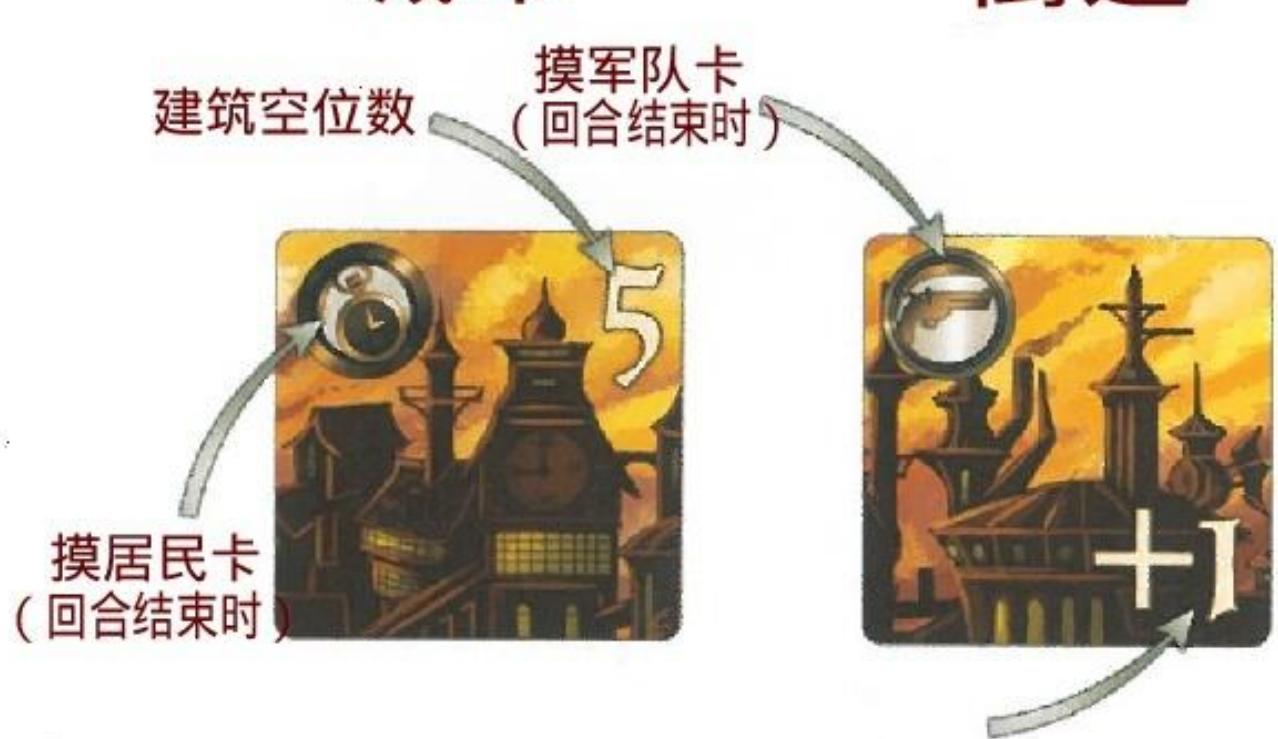
摸居民卡(回合结束时)
+1建筑空位
城市/街道标志物
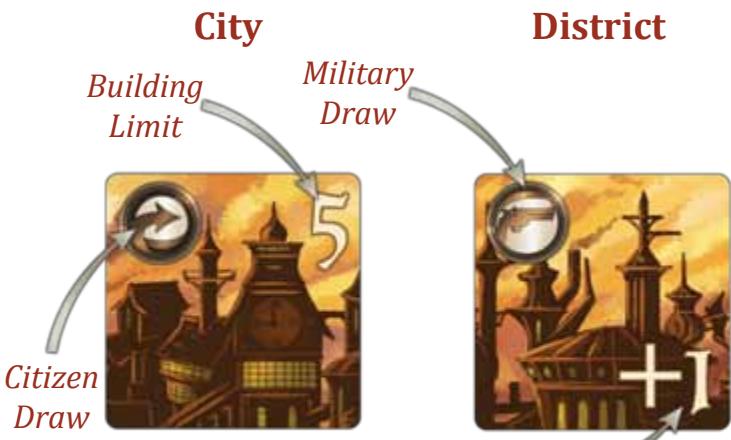
每个玩家将会获得一个起始城市标记物和三个额外的城市/街道标志物。每个额外的标志物有城市面和街道面(街道面为有+号一面)。每个标志物只能使用其中一面。当你在一片新土地建造时使用城市面,当你扩大城市时使用街道面。每个城市/街道标志物允许你建造一定数量的建筑卡,同时在回合结束时会给你的带来居民卡和军队卡的摸牌机会。
扩展城市
如果你打算通过增加街道扩展城市,你必须使用市长居民卡。当你拓展城市时,将一个街道指示物放在陆地板块的城市标志物旁边。根据你选择的街道指示物,你将获得1个或2个的建筑空位和在回合结束时摸取居民卡或军队卡。城市可以拥有几个街道。
建造新城市
如果你打算建造新城市,你必须拥有探索者居民卡。当你使用探索者,你必须使用额外的卡来满足探索新大陆的距离技能所需。当使用探索者的卡牌能力时,探索者卡上的距离技能不能使用。有些大陆可能要求你拥有帆船或者飞船。使用帆船和飞船卡能力时,它的距离技能可被使用。新的大陆板块放到你的起始大陆板块旁边,将城市标志物放在上面。根据你选择的城市指示物,你将获得2个或3个建筑空位和在回合结束时摸取居民卡或军队卡。
土地类型
建筑的科技点花费
在建造一些建筑时除了花费金币外还需要花费一定数量的科技点。你必须支付相应的科技点才能建造这一建筑。如果你已经拥有同样名字的建筑卡在你的城市,你不需要支付更多的科技点。(即每一种建筑卡,只需支付1次科技点)
建筑
土地类型
Turnip Farm Grass
Srika Pasture Grass
生产货物的建筑需要建在相应土地类型的土地上,也就是说你的城市必须有对应的土地类型才能建造 Factory Mountain 这一建筑。土地类型需求在建筑卡的下方可以找到。右边将列出所有生产货物建筑对应所需的土地类型。城市上的土地标记可以对应多个建筑。
Moss Garden Forest
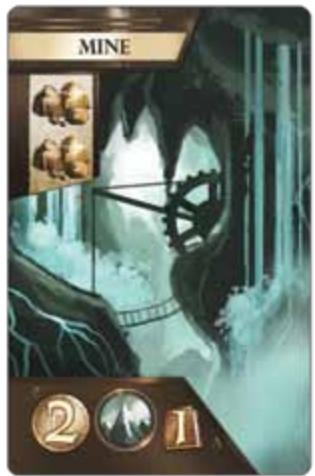
Mine Mountain
Docks Coast

Salt Fields Desert
Demon Traders Desert
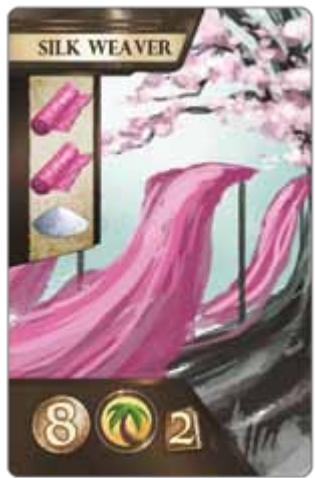
Silk Weaver Jungle
Crystal Caverns Flying Island
城镇
城镇卡是代表世界中独立并中立的城镇。玩家可以控制这些城镇来增加他们的收入和货物。当你控制了一个城镇时,将这张城镇卡放在你的城市旁边。如果这个城镇能生产货物,将你收入轨往前移1格,在主版块上将你增加的货物数量标记好。同时如果这个城镇是中立的(非其它玩家已拥有的城镇),弃掉主版块上最左的建筑卡。城镇卡并不占用你城市的建筑空位,同时你可拥有的城镇卡并无上限。占领一个城镇,你必须打出足够数量的军队卡使攻击值和距离满足城镇卡上显示的防御值和距离。卡牌只能使用一种技能值计算,不能同时使用攻击值和距离。
你可以控制一个板块上面朝上的中立城镇,也可以攻打一个别的玩家控制的城镇。玩家控制的城镇防御值是该城镇卡上防御值+2(注意是标记“控制”一面)。如果你攻陷了别的玩家的城镇,那一名玩家将减少1点收入和该城镇卡上的货物,而你将得到1点收入和卡上货物。
你可以随时查看中立城镇卡,但是不能改变它的顺序。
当玩家得到一个城镇时,需将它标记“已控制”的一面在上。否则,它应该讲“未被控制”一面朝上。
居民和军队卡
居民和军队卡有着非常广泛的用途。卡牌名称下方有该牌的能力描述,同时还会说明执行该能力所需的技能。所有的居民和军队卡左上角会显示一个或多个技能标示,它们代表可为其他卡行动时支付技能。技能有2种标示,一种是距离(指南针模样),一种是工时(锤子模样)。
当你使用一张卡的行动时,这张卡上的技能标示不可使用。即是它只能使用牌上行动或卡上技能标示两者不能同时使用。(除了飞船卡和帆船卡)当你打出卡牌后,按照你想要的顺序面朝上将牌弃到相应牌堆。一旦你将牌弃置到弃牌堆,你就不可以改变弃牌的顺序或是洗牌。
使用卡牌上的能力,需耗费一个行动,除非卡上写明这是一个“免费行动”。在这种情况下,你可以在你执行真正行动前,打出任意数量“免费行动”卡。你不可以在别的玩家行动时或是你真实行动后打出“免费行动”卡。“免费行动”卡请单独弃置。
玩家可以随时浏览他的居民卡和军队卡弃牌堆,但不能改变它的顺序。玩家们的弃牌堆是各自保密并不公开的。
军队卡
国家特殊能力
雅克城邦
雅克城邦并没有特殊能力卡。但是它的军队街道会有一个+2的建筑空位。同样,它还可以有一个免费行动,它可花费1金币在城市间移动建筑。
克鲁塞学会
克鲁塞学会的起始军队卡和居民卡如一般游戏时设置。它拥有一张“Geni us”的特殊能力卡,将这张特殊能力卡加入到未购买牌堆。同时,居民卡“学者”无需花费金币。
国家板块
猪人共和国
猪人共和国的起始居民卡如一般游戏设置,但它的起始军队卡中的“上尉”将会被替换成“Gunslinger”同时将它的特殊卡“Strategist”加入未购买居民卡牌中。
欧姆蟾蜍科技联盟
科技联盟起始居民卡加入“Fixer”这张牌,起始军卡牌不变。
同时,它还可以竞拍顺位轨2次。
注意:你的首次游戏请忽略国家特殊能力,并将特能力卡牌移出游戏。

建筑解释
只有拥有“+3胜利点”建筑数量第一位和第二位的玩家,才能获得这3点胜利点。
城镇卡拓展
加入城镇扩展时,你需要把没有星星的城镇卡单独洗混,同样地以“未被控制”那面向上。放在基本城镇卡的旁边。然后从0星城镇卡中抽取2张出来平铺在旁边,使桌子上能看到3张0星城镇卡。当有玩家攻克掉这些0星城镇,则将拓展城镇卡堆最上面一张放回此位,保证依然有3张0星城镇卡可见(在基本城镇卡旁边,所以使用城镇扩展时,一般会有6张城镇卡可被选择攻克)。
0星城镇卡效果如下:
Beast belly: 回合结束时摸取1次军队卡和获得1金币。
Solara:回合结束时摸取1次居民卡和获得1金币。
SnyI e:回合结束时,你可以选择一个你已经拥有的货物,然后使那个货物在此回合结算中数量+2。每一回合你都可以重新选择货物的种类。
Metgra:它是一个拥有2个建筑位的城市,陆地类型是Coast和Jungle。如果这张卡被其他玩家攻占,这张卡上的建筑也会连同带走。
Dar Embe:增加3个金币,结算最终奖励时,这个城镇当做3个城镇。
Cumulus: 回合结束时得到1点科技点。
Cazum: 它是拥有2个建筑位的城市,土地类型是“ Coast”和“ Mountain n”。如果这张卡被其他玩家攻占,这张卡上的建筑也会连同带走。
下载 MarkdownCity of Iron_rules_v2.md36.8 KB
RULEBOOK
Introduction
The age of machines is dawning. Four small nations plot to expand as they rally courageous explorers, cunning leaders, brilliant minds, and powerful magicians. It will take a strong economy, vast lands, and wondrous new technology to grow from a fledgling city-state. Will you lead the industrious humans, the toad engineers, the scholarly Cresarians, or the clever hogmen to victory?
Corner the market on goods like machine parts or bottled demons. Research steam-age technology and recruit mercenaries to control the continent. Build sea-going schooners or cloud-cutting airships to reach faraway lands and flying islands. Your cities have a limited capacity, so you must decide what to keep and what to demolish when building advanced structures.
City of Iron is a board game for 2-4 players. The goal of the game is to control the most of various, rare goods. Players gain control of goods by purchasing building cards from a community pool and placing the cards in their cities. Players can also purchase citizen and military cards, which can be used for special actions like settling new cities and conquering neutral towns. In the end, the player who creates the most efficient combination of cards will win.
The World of City of Iron
The world of City of Iron is covered in vast, unexplored continents filled with untold riches and wonders. Steam age technology is developing rapidly, though the old traditions and study of magic remain strong. The young nations of the world seek to become empires, and compete to explore and grow in power.
Eight hundred years ago, a terrible war covered the continents, and the ancient empires destroyed one another. The world became a chaotic, dangerous place, and much of the old knowledge was lost. Now it seems as though the war never happened, though traces of it still remain.
The young nations look forward to the future with hope and enthusiasm. The main contenders for power are the City-State of Arc, the Toad Inventors of Om, the Cresarian Scholars, and the Hogmen Republic.

The Family Game
City of Iron has two ways to play: the simplified family game, or the full game.
If you consider yourself a casual gamer, you should play the family game. When you feel more comfortable, you might want to try the full game.
If you consider yourself a veteran gamer, you will probably be just fine playing the full game (though your first game should be without the nation abilites).
When playing the family game, do the following:
-
Remove the military cards from the game and place them in the box (there is one deck of military cards per player). Also place all the town cards in the box.
-
Do not play with nation abilites.
-
Remove the 2 Barracks cards from the “A” deck. Remove the 2 War College cards from the “B” deck.
Components

Board

Victory Point Tokens
Action Tokens (13)

Coin Tokens
Science Tokens

Player Aid Cards (4)

Special Nation Cards (4)
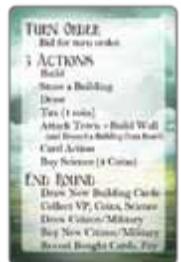
Nation Boards (4)
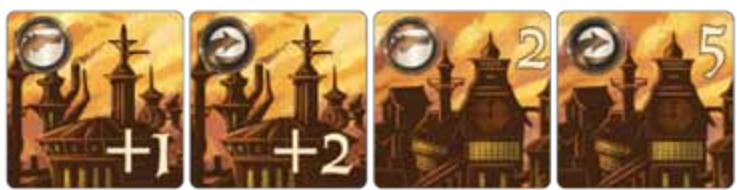
4 City/District Tokens for Each Nation (double sided)
Deck “A” Building Cards(24)

Deck “B” Building Cards (19)
Deck “C” Building Cards (16)

Town Cards (15)


Land Boards (12)
4 Color Sets of 14 Cubes

Military Deck: Yellow Sky (4, one deck for each nation.)

Citizen Deck: Blue-Green Sky (4, one deck for each nation.)

3 Score Cards
Setup
-
Each player chooses a Nation and places the Nation Board in front of him. Each player also takes the corresponding Military and Citizen Deck for his Nation, his Nation’s 4 City/District Tokens, 12 Cubes in his color, his starting Land Board (Board with 0 Distance), 3 Action Tokens, and a Player Aid Card. Any unused components listed above in a two and three player game should be put in the box. Place the starting Land Board to the side of the Player Board. Put the City Token marked with a 5 on the Land Board. This is your starting City.
-
Each player creates his starting Military and Citizen decks. Look through the available Military and Citizen cards and take out the Swordsman, Rifleman, Cartographer, and Scholar. Put the Swordsman and Rifleman together (in the order you choose) and place the cards face down on the Military Deck location on the Nation Board. Put the Cartographer and Scholar together (in the order you choose) and place them facedown on the Citizen Deck location on the Nation Board. Place the remaining cards in one deck, facedown, above the Nation Board. This deck consists of cards you may purchase and add to your Citizen or Military decks throughout the game. You may look through this deck at any time. Important: If you are playing with Nation special abilities, add your Nation’s special cards to your starting decks or pile of unpurchased cards according to the directions in the “Nations” section (pg. 12). If this is your first game, ignore the Nation special abilities and put the Nation special cards in the box.
-
Place the Board in the center of the table. Put the Coin Tokens, Science Tokens, and Victory Point Tokens in piles off to the side of the board. Line up the remaining Land Boards in two rows just above the board so that all are showing (put any extra boards with 0 distance in the box). If playing with 2 players, place all lands marked with a “2” in the bottom right corner in the box.
-
Create the Building Deck. Separate the Building cards into three piles according to type (A, B, C). Card type is indicated in the bottom right of each card. Go through each pile and remove cards depending on number of players:
4 Players: Remove no cards.
3 Players: Remove all cards with the number “3” located just above and to the left of the coin cost of the card.
2 Players: Remove all cards with the number “3” or “2” located just above and to the left of the coin cost of the card.
When you have removed the appropriate cards, shuffle each deck separately. Place the decks facedown. Place a normal Score Card (the Score Card with a book symbol) face down at the bottom of the A deck. Place a normal Score Card face down at the bottom of the B deck. Put the final Score Card (the Score Card with no book symbol) face down at the bottom of the C deck. Place deck B on deck C, then place deck A on deck B. Place the finished Building Deck next to the Board.
-
Fill the building card spaces on the Board by drawing from the building deck. Place buildings from left to right until you reach the indicated number of players on the card slots (7 with two players, 10 with three, and 12 with four).
-
Each player takes seven Coin Tokens and draws one Citizen Card into his hand.
-
Separate the three types of Town cards into three piles (one, two, and three stars). If you are playing with three players, put all towns with Demons in the box. If you are playing with two players, put all town with Demons and Ore in the box. Organize the cards so that the “Unconquered” sides are all face up. Shuffle each pile (by closing your eyes or looking away). Place each pile next to the board.
-
Each player places a cube on the second space on his income track at the top of his nation board. Base income is always 2.
-
Randomly determine beginning bid order. Take one cube from each player and place the cubes in bid order from left to right on the bid track on the Board.
You are now ready to play.


Overview
In City of Iron, players take on the role of leader of a growing nation in a strange, fantasy world. Each nation starts out with a single city with capacity for 5 Building Cards. Deciding which Building Cards to put in your city is key to winning the game. Buildings give access to various Goods. Each round, the player with the most goods of each type receives a coin bonus, and at each Score card (at the end of Building decks A, B, and C), players will also score Victory Points for having the most in each Good type. Players will find they must expand their City or settle new Cities in faraway lands to be able to build more buildings. Some of these faraway lands require Ships or Airships to reach, but they hold rare and powerful goods. Players must also use cards from their Military and Citizen decks, which grant special actions, let players conquer Neutral Towns, or settle new Cities. When the Building Deck is depleted, there is one last round. At the end, the player with the most Victory Points is the winner.
A Round of Play
Turn Order Bid
At the start of each round, players bid for turn order. Players bid in order from left to right on the bid order track. When a player bids, he may place his cube on any open spot on the turn order track (just above the bid order track), but he may only bid once. As soon as a player places his cube, he pays the indicated amount in coins.
When all players have bid, start the round. Turn order is opposite of bid order, right to left (as indicated by the arrows).
For an example of how this works, please see the second paragraph of the section “Sample Round of Play” on page 13.
3 Actions
In turn order, players take actions one at a time. Each player has three actions in the round, but may only use one each turn. When a player takes an action, he turns one of his action tokens to the opposite side (without an “A”) to help remember how many Actions he has left before the round ends. Players may choose from the following actions. Actions may be performed more than once in the round.
Build: You may buy a Building Card from the available Building Cards on the board (or a Building card you had stored in an earlier turn). You must pay the cost in Coins and Science. You must also have an available space in one of your Cities, as well as have the correct land type required by the Building in that City. When you buy the card, place it just below one of your Cities. Slide all remaining Building Cards on the board to the left so that there are no empty card slots between cards. If the new Building Card produces Goods, mark the numbers and types of goods indicated on the card on the board with your cubes. Also, if the Building Card produces Goods, increase the income on your Nation Board by one.
You only need to pay Science once per building type as long as you own it. For example, if you own “Demon Traders”, the next “Demon Traders” card you Build costs 0 Science.
You may destroy a building to make space for a new one.
This action will be further described in the section “Buildings”.

Building Card
Store a Building: If you want to save a card to purchase for later, you may take one of the available Building Cards and store it off to the side of your Nation Board (not in one of your Cities). There is no limit on the number of cards you can store.
Draw: You may draw one card from your Citizen Deck or Military Deck and put it in your hand. There is no hand limit. If there are no remaining cards in the draw pile, pick up the cards in the discard pile (do not change the order) and place them face down in the draw pile. If there are no cards in the discard or draw pile, you may not draw.
Tax: Gain one coin.
Buy Science: You may gain one Science token by paying four coins.
Card Action: You may play one of your Citizen or Military card actions. When you play a card action, you usually have to play additional cards to fuel the action with skill symbols. The action is described in the box at the bottom of the card, along with required skill symbols. When you play the action, discard all cards face up in their appropriate piles (Citizen or Military). You may choose the order of the cards discarded. This action will be further described in the section “Citizen and Military Cards”.
Citizen Card

Attack Town: You may attack a Neutral Town Card or a Town Card owned by another player. You need one or more Military Cards that have an Attack Value that equals the defense value of the Town Card you are attacking (the “D” symbol), along with sufficient cards with the Distance Skill that equal the Distance of the town. A card cannot be used for its attack value and its Distance Skill. Discard all used cards in their appropriate piles face up and take the Town card, gaining any appropriate Goods and marking them on the board. Town cards do not take a place in one of your Cities (place it to the side of your Cities). Also increase the income on your Nation Board by one. Make sure to flip the card so that the “Conquered” side is face up. Conquered towns have a higher defense value. As a last step, discard the left-most building card on the building track on the board if the town you attacked was “Unconquered”.
Town Card

End Round
When all players have taken all their actions, the End Round phase begins. Discard the four left-most Building Cards on the board. Slide the remaining buildings to the left so that there are no empty slots between cards or any empty slots to the left of the cards. Draw new Building Cards, filling up slots from left to right, until you’ve reached the slot for the indicated number of players. If you draw a Score Card, place it next to the draw pile (you will score Victory Points in the next End Round phase). Complete the following steps in order:
-
Score: If on the previous End Round phase you drew a Score Card, all players score Victory Points. Use the board to see how many points each player scores. Each Good type gives victory points to the player who has the most of that Good (the higher number in the Victory Point shield icon next to the good), and to the player who has the second-most of that Good (the lower number in the Victory Point shield icon next to the good). If players are tied for having the most of a Good, they both score the higher number. If players are tied for having the second-most of a Good, they both score the lower number. Also, if a player has an amount of Goods equal to or above where the small, numberless Victory Points Shield is located on the amount track, that player recieves +1 Victory Point (he need not have majority). Also include extra Victory Points for owning special “+2” C deck buildings (you recieve these extra Victory Points if you are in 1st or 2nd place). Victory Point tokens should be kept face up on each player’s Nation Board. If this is the 3rd time Scoring, the game ends.
-
Collect Income: All players collect coins. Each player has a base income of 2 coins. Also collect one coin for each card you own that produces goods (no matter the number of goods on the card). Buildings that give science do not count as Goods cards. Each Town Card also gives you one coin. Players also receive coins for having the most Goods of each type as indicated on the board. If players are tied for majority on a Good, both collect the bonus coins.

Note: the easiest way to keep track of income is to use the income track on your Nation Board. Each time you gain a card that increases your income (Town or Building with Goods), indicate it on the income track. Then when it’s time to collect income during the End Round phase, you only need to add the amount indicated on the track to any Goods majority bonuses without having to count cards each time. Note: Remember to decrease income if a town is conquered or you destroy a building.
-
Collect Science: All players collect Science tokens for Academies and Libraries. Also, if it is a normal scoring round, each player collects 1 extra science as indicated on the Score card.
-
Draw Military and Citizen Cards: All players draw Citizen and Military cards according to the number of Citizen and Military card icons on City tokens and Building Cards they own. (Your starting city gives you 1 Citizen draw). If there are no cards remaining in the draw pile of a deck and you need to draw, pick up the discard pile (do not shuffle it or change the order of cards), turn it face down and place it in the draw pile location, and draw.
-
Purchase Military and Citizen Cards: Players may now purchase new Military and Citizen Cards from their deck of unpurchased cards. Players can purchase as many cards as they want. Players select the cards they want to buy in secret, placing them face down in front of them. When all players declare they are finished, each player reveals all new cards and pays the total Coin and Science cost indicated on the cards. When everyone is finished paying, each player places the new cards directly in his hand.
Game End
The game is over one round after the third Score Card is drawn. When the third Score Card is drawn, place it to the side. The Building Deck will be depleted at this point and most likely you will need more Building Cards to fill in the remaining slots on the board for the final round. Shuffle the pile of discarded Building Cards and draw from that deck to fill in the remaining slots. When you reach the End Round, collect Victory Points and Coins as normal. Players also receive or lose Victory Points for having the most of the following at the end of the game:
Most Coins: Player with the most unspent coins. Do not collect coins on the last round. +2 Victory Points
Most Distance: Player with the most distance of all owned lands. +2 Victory Points
Most Buildings: Player with the most purchased buildings. +2 Victory Points
Most Military/Citizen Cards: Player with the most owned Military and Citizen cards (in hand or undrawn). +2 Victory Points
Most Conquered Towns: Player with the most currently owned conquered Towns. +3 Victory Points
Storing Penalty: Lose 1 Victory Point per stored, unbuilt building. -1 Victory Points/Stored
After all Victory Points have been counted, the player with the most is the winner. If players are tied, the player with the most coins is the winner. If players are still tied, the player with the most buildings is the winner.
Buildings
Building Cards give a range of benefits. Some give special bonuses or increase your income, some give you Science, and some produce Goods, which in turn give Victory Points. When you build a Building Card, you must have a place for it in one of your Cities. The number on the City Token is the limit of Building Cards that can exist in the City. If you have reached the limited number of Buildings but want to build a new Building Card, you must either expand the City with a District, settle a new City, or discard one of the already-built Building Cards to make room for the new one.
+1 Building Limit
City/District Tokens
Each player has one starting City Token, and three extra City/District Tokens. Each extra token has one City side (number without a plus sign), and one District side (number with a plus sign). Each of these tokens may be used as either a City or a District. Use the City side when you settle a new land, and use the District side when you are expanding a City. Each City/District allows for a number of Building Cards, and also gives you a Citizen or Military Card draw at the End Round phase.
Expand a City with a District
If you want to expand your City with a District, you must use the Mayor Citizen Card. When you expand the City, place a District Token next to the City Token on the Land Board. Depending on which District you choose, you will have +1 or +2 open spaces for Building Cards, as well as a Citizen or Military Card draw at the End Round phase. Cities may have multiple districts.
Settling a New City
If you want to settle a new City, you must use the Explorer Citizen Card. When you play the Explorer, you must also play additional cards with the Distince Skill to equal the distance of the new land. The Distance Skill of the Explorer cannot be used when using his Action. Some lands also require that you use an Airship Card or Ship Card. An Airship card or Ship card can be used for both its Distance Skill and Airship/Ship status. When you settle a new City, take the new Land Board and place it next to your starting Land Board. Place one of your City Tokens on it. Depending on the City you choose, you will have 2 or 3 open spaces for Building Cards, as well as a Citizen or Military draw at the End Round phase.

Grass

Forest

Mountain

Water

Jungle

Desert

Flying Island
Land Requirements
Buildings that produce Goods have land type requirements, which means that to build the Building Card in a City, that City must have the required land type. The land type requirement is found next to the Coin cost of the card. Below are listed the Goods-Producing Buildings and associated land type requirements:
| Building | Land Type |
| Turnip Farm | Grass |
| Srika Pasture | Grass |
| Moss Garden | Forest |
| Mine | Mountain |
| Docks | Coast |
| Salt Mine | Desert |
| Factory | Mountain |
| Demon Traders | Desert |
| Silk Weaver | Jungle |
| Crystal Mine | Flying Island |
Multiple buildings can use the same land symbol in the same city.
Science Cost of Buildings
Some Building Cards cost one or more Science tokens in addition to Coins. When you build the card, you must pay the Science. However, if you already own a Building Card of the same name in one of your Cities, you do not have to pay the Science cost again. The Science cost is then zero.
Towns
Town Cards represent independent, neutral Towns in the world. Players may conquer these towns to increase their income and Goods. When you conquer a town, take the Town Card and place it next to your Cities (not in them). Increase your income by one and mark your increased Goods on the board. As part of the action, also discard one of the available Building Cards on the board. Towns do not take a spot in a City, and there is no limit to the amount of Towns you can own.
To conquer a town, you must play sufficient Military Cards with attack value that equal the attack value of the town (the gun symbol). You must also play sufficient cards (Citizen or Military) with Distance Skill that equals the Distance of the town (the compass symbol). Cards may not be used for their attack value and Distance Skill.
You may conquer one of the available neutral, face up Towns on one of the three Town decks, or you may conquer a Town that another player owns. The amount of attack value and Distance Skill required to conquer a Town does not change when another player owns the town. If you conquer a Town from another player, that player loses one income and the Goods listed on the card. You gain one income and gain the Goods listed on the card. Turn the next Town card in the deck so that the “unconquered” side is face up.
If a player ever owns a Town card, the card should have the “conquered” side face up. It the town is uncontrolled, it should have the “unconquered” side face up.
Citizen and Military Cards
Citizen and Military Cards have a wide variety of uses. Most have an Action described below their name, along with any required Skill Symbols to pay for the Action. All Citizen and Military Cards also have one or more Skill Symbols in the up-
per left corner of the card that can be used to pay for other cards’ Actions. There are two types of Skills: Distance (the compass symbol) and Work (the hammer symbol).
If you play a card for its Action, you may not also use its Skill Symbols. Cards can be either used for the Action or Skill Symbols. When you play cards, place them in the appropriate discard piles (Citizen or Military), face up, in the order you choose. Once you place cards in the discard pile, you cannot rearrange the order or shuffle them.
Using a card Action takes one Action, unless it says it can be used as a “Free Action”. In this case, you may on your turn play as many “Free Actions” as you want, before you take your real Action. You may not play “Free Actions” on other players’ turns or after your real action.
Military Card

To use a card Action, discard the card with the action. Also discard additional cards to pay for the action with Skill Symbols. The Skill Symbols required are listed just below the Action description on the card. You cannot use a card for its Action and Skill Symbols.
If you are using the Conquer action to gain a Town Card, you must discard one or more Military Cards to equal the Attack Value of the Town. You must also discard additional cards (Citizen or Military) with sufficient Skill Symbols to equal the Distance of the Town. Cards may not be used for their Attack Value and Skill Symbols.
Nations
There are four Nations that players can choose from: the City State of Arc, the Cresarian Scholars, the Hogmen Republic, or the Toad Inventors of Om. Each Nation has unique abilities and Citizen/Military cards.
City-State of Arc
The City-State of Arc has no special cards, but starts with the Citizen and Military deck as
normal. Their starting city has a limit of 6 Buildings instead of 5. Also, as a free action, they may move buildings between cities for 1 coin.
Cresarian Scholars
The Cresarians start with the Citizen and Military decks as normal. They also have a special card, the “Genius”, that should be added to the pile of unpurchased cards. The “Scholar” card costs 0 Coins to use.
Hogmen Republic
The Hogmen start with the Citizen deck as normal, but replace the “Swordsman” with the “Gunslinger” in the starting Military deck. The Hogmen also should add the “Strategist” card to the pile of unpurchased cards. The starting city draw may be used for a Citizen or Military card each round.

Toad Inventors of Om
The Toads start with the “Fixer” Citizen card in their Citizen deck, and the Military deck as normal. They also may bid for turn order a second time, after everyone else has bid, paying the difference between the new bid and the previous bid.
Important: For your first game, ignore the special abilities of the Nations. Be sure to remove the unique cards from play as well and place them in the box. These cards are listed below:
Cresarian Scholars: Remove the “Genius” card from play.
Hogmen Republic: Remove the “Gunslinger” and “Strategist” cards from play.
Toad Inventors of Om: Remove the “Fixer” card from play.
It’s best to become familiar with the game before using the special abilities of the Nations. You may want to play one or two games before trying them out.
Sample Round of Play
Sam, Julia, Mark, and Mary are playing their first game. They have each chosen a Nation and completed the setup as described in the rules. They will not be using the Nations’ special abilities or cards as this is their first game.
Sam randomly decides starting bid order and places one cube from each player from left to right on the bid track. Sam is first, and bids on the zero the furthest to the right by placing his cube there. Next, Julia bids 0 and places her cube just left of him. Mark bids 0, placing his cube just left of her. Mary bids 1, placing her cube on the “1” square and pays a coin. The turn order for the round will be Mary, Sam, Julia, Mark (on the turn order track from right to left).
The round begins. Mary takes her first action and builds an Academy, one of the Building Cards on the board. She pays 5 coins and places it in her starting city area. She has to slide two cards on the board to the left to fill in the empty card slot between cards. Then she turns over one of her action tokens to the blank side to show she is finished.
Next, Sam draws from his Citizen Card deck. He now has his 2 Citizen cards in hand. He turns over an action token.
Julia takes her turn next. She builds a Srika Pasture from the Building Cards available on the board, paying the cost and sliding cards on the board to the left so that there is no empty slot between the left side of the board and the remaining cards. Because it produces Goods, the Srika Pasture gives her one income, so she increases her income track to 3 on her Nation Board using one of her cubes. The Srika Pasture also gives her 3 Srikas, so she takes one of her cubes and places it on the third space below the picture of the Srika on the board. She turns over her action token and her turn is over.
Mark builds a Turnip Farm, doing just what Julia did on her turn except that he places one of his cubes on the third space below the picture of the Turnip on the board because the Building card has three Turnips on it.
It’s Mary’s turn again. She builds a Srika Pasture, which gives her two Srikas and one Turnip and increases her income by one.
Sam decides to play his “Scholar” Citizen card as an action. It says he can gain one Science by paying a coin and using a Work Skill (hammer). He discards the Scholar, pays a coin, and also discards the Cartographer, using the Cartographer’s Work Skill (hammer) to fuel the action. He collects a Science token from the pile.

Julia builds an Academy on her turn.
Mark builds a second Turnip Farm on his turn.
On her last turn, Mary decides to Tax. She gains one coin.
Sam now builds a Moss Garden. He had been unable to build it until now, because he didn’t have a Science. He pays the coin cost and science cost. It gives him two Glow Moss.
On Julia’s last turn, she draws a card from her Military Deck.
Mark decides to store a Mine card. He can’t afford it now, so he doesn’t place it in his city, but he is planning to build it later. He places the card on the side of his board, not in his City area.
The round is over and the End Round phase begins. First, the four left-most cards on the Building Card track on the board are discarded. Sam slides the remaining cards to the left until there are no empty slots between the left of the board and the remaining cards. Then he draws cards from the Building Card deck and places them on the board from left to right until all slots are filled.
The four players now check to see if they collect Victory Points. There was no Score Card drawn at the last End Round phase (because this is the first End Round phase of the game), so they do not collect Victory Points.
Everyone now collects coins. Mary collects 3 coins (2 for her base income, +1 for the Srika Farm). She has no majority on any Goods. Sam collects 5 coins (2 for his base income, +1 for the Moss Garden, +2 for having the most Glow Moss Good because of his Moss Garden). Julia collects 4 (2 for her base income, +1 for the Srika Pasture, +1 for having the most Srikas). Mark collects 5 coins (2 for his base income, +1 each for the two Turnip Farms his built, and +1 for having the most Turnips).
Everyone collects Science tokens for any Academies they control. Mary and Julia each collect 1 Science.
Everyone now draws one Citizen card (because no one expanded their City with a District, settled a new City, or built any Building Cards with Citizen or Military draw symbols on them). Each player’s base city gives him/her one Citizen draw. No one has any Military draws.
Now the four players simultaneously look through their deck of unpurchased Citizen and Military cards to see if they want to buy any new cards. Sam buys one Military card, pays for it, does not show it to anyone but places it directly into his hand.
Everyone declares that they are finished and ready for the next round. Everyone turns over their three action tokens to the “A” side. Sam slides down the four players’ cubes on the Turn Order Track to the Bid Order Track, keeping them in the same order, and the next round starts with everyone bidding for turn order (from left to right).
Building Clarifications
Demon Engines: Gives 2 Coins for each “Factory” you own.
Citizen Cards
Starting
Scholar
Cartographer
Other
Cargo Ship
Cloud Skimmer
Engineer
Explorer
Genius
Mason
Mayor
Merchant
Junkbot
Scientist
Scholar
Scout Ship
Tax Collector
Wyvern Ship
Military Cards
Starting
Soldier
Swordsman
Other
Inventor
Iron Dragon
Iron Guard
Iron Soldier
Machinist
Magician
Rifleman
Spy
Warship
Illustration
Ryan Laukat
Special Thanks to...
Malorie Laukat, Jakob Nelson, Brandon Laukat, Scott Lewis, Chris D’Andrea, Cory Suter, Keith Leonard, Justin Nordhorn, Spencer Marstiller, Drew Sonnenberg, Mathijs Van Dijk, Brian Bezeredi, ...
Playtesters
Malorie Laukat, Jakob Nelson, Brandon Laukat, Ryan Hansen, T. Alex Davis, Travor Cram, Joshua Butterfield, Jen Hodge, Nick Sauer, Mike Knauer, Brian Palm, Craig Clawson, Christopher Oberst, Peter M. Baysdell, Josette Baysdell, Drew Sonnenberg, Jillian Neumann, Gary Sonnenberg, Karen Sonnenberg, Scott Lewis, Chris D’Andrea, Cory Suter, Keith Leonard, Justin Nordhorn, Chad W. Rathsack, Spencer Marstiller, Mathijs Van Dijk, Brian Bezeredi, ...
Please note this is the prototype version of the rules. Some things will change in the final version. Also, this is not a comprehensive list of all people that need to be thanked or that worked on the game.
Copyright 2012 Red Raven Games www.redravengames.com

Index
Actions 8
Airships 13
Attack Value 14
Building Cards 8, 12
Clarification of Cards 18
Science Cost 13
Buy Science 9
Card Actions 9, 14
Cities 12
Citizen Cards 14
List 18
Conquering Towns 14
Districts 12
Draw 9
End Round Phase 10
Free Actions 14
Goods 11
Income 10
Land Type Requirements 13
Most Goods Ties 10, 11
Military Cards 14
List 18
Nations 15
Score Cards 10
Setup 6
Ships 13
Skill Symbols 9, 14, 15
Store a Building 9
Tax 9
Towns 14
Turn Order Bid 8
Victory Points 10, 11
Icon List






原文为社区整理/出版社公开资料,版权归原作者,仅供个人学习查阅。