
幽闭恐惧1643Claustrophobia 1643
一句话概览
幽闭恐惧1643 是一款已收录于村了吗规则库的桌游,支持 2 人,原名 Claustrophobia 1643。
本页内容:一句话概览 · 游戏概述 · 1. 游戏组件 · 2. 游戏设置 · 3. 游戏流程 · 常见问题
幽闭恐惧1643 规则速览
本页收录规则速览的前 4 节(篇幅所限省略了后 1 节,其中 1 节为节选),完整规则速览与卡牌可在村了吗查询。
游戏概述
故事开始于1618年5月23日的布拉格。圣罗马帝国的皇帝、波西米亚国王和新教的代表被扔出了窗户,这次挑衅成为动乱的导火索。维新派与天主教派的矛盾越来越多,冲突不断升级。1631年,德国马格德堡被攻占,大屠杀和火灾来袭,六分之五的居民丧生。突然,官员收到奇怪的消息:在这座殉难城的易北河中,能看到令人惶恐的绿光,而且越来越明显——这是一个入口。为了探寻其终点,封存已久的河道终于打开,士兵们载着船只通向这幽暗的入口。
返还的探险者有的失明、有的重伤,还有的濒临疯狂的边缘。他们描述的景象超出人的想象:奇形怪状的怪兽,长着利爪和尖牙,成群结队向他们扑来,这些怪兽背后还有一些面目可憎的操纵者。随后人类远征规模扩大,在地城中建立营地,探索周围环境,并对抗恶魔与洞穴人。
今年是1643年。在黑暗中,血液将再次流动。
《幽闭恐惧1643》是一款冒险游戏,2名玩家在新耶路撒冷的地城隧道中战斗。基督徒的堡垒建在地城的中心:一方扮演果敢的西方人(人类玩家),另一方扮演拥有近乎无限军队的恶魔(恶魔玩家)。
核心机制: 非对称对抗(人类 vs 恶魔)、骰子分配(激活骰/命运骰)、地砖探索与拼接、移动与地砖占用/阻挡规则、战斗骰命中与分配、才能与天赋、剧本驱动
1. 游戏组件
| 组件 | 数量/说明 |
|---|---|
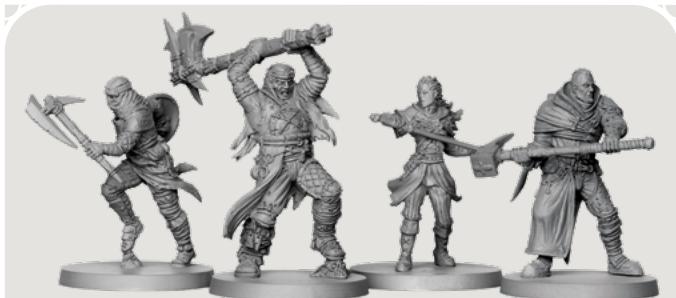
| 微缩模型 | 35个(代表两个派系的战士) |
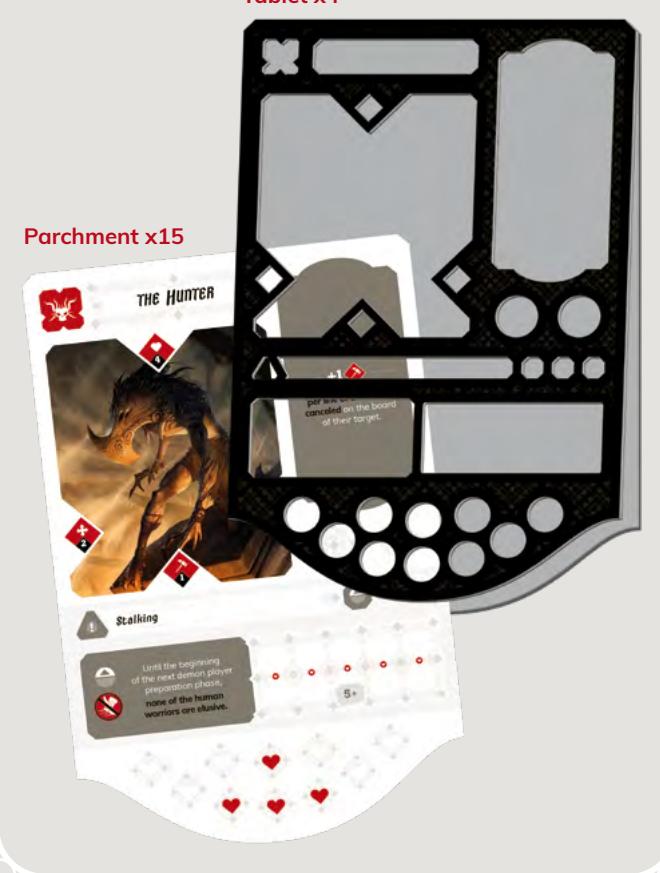
| 角色档案 | 7张(放入镂空板中使用) |
| 镂空板 | 4块 |
| 西部战士板 | 5块(人类派系,西部战士是无名的罪犯) |
| 恶魔 | 13个 |
| 地狱犬板 | 2块 |
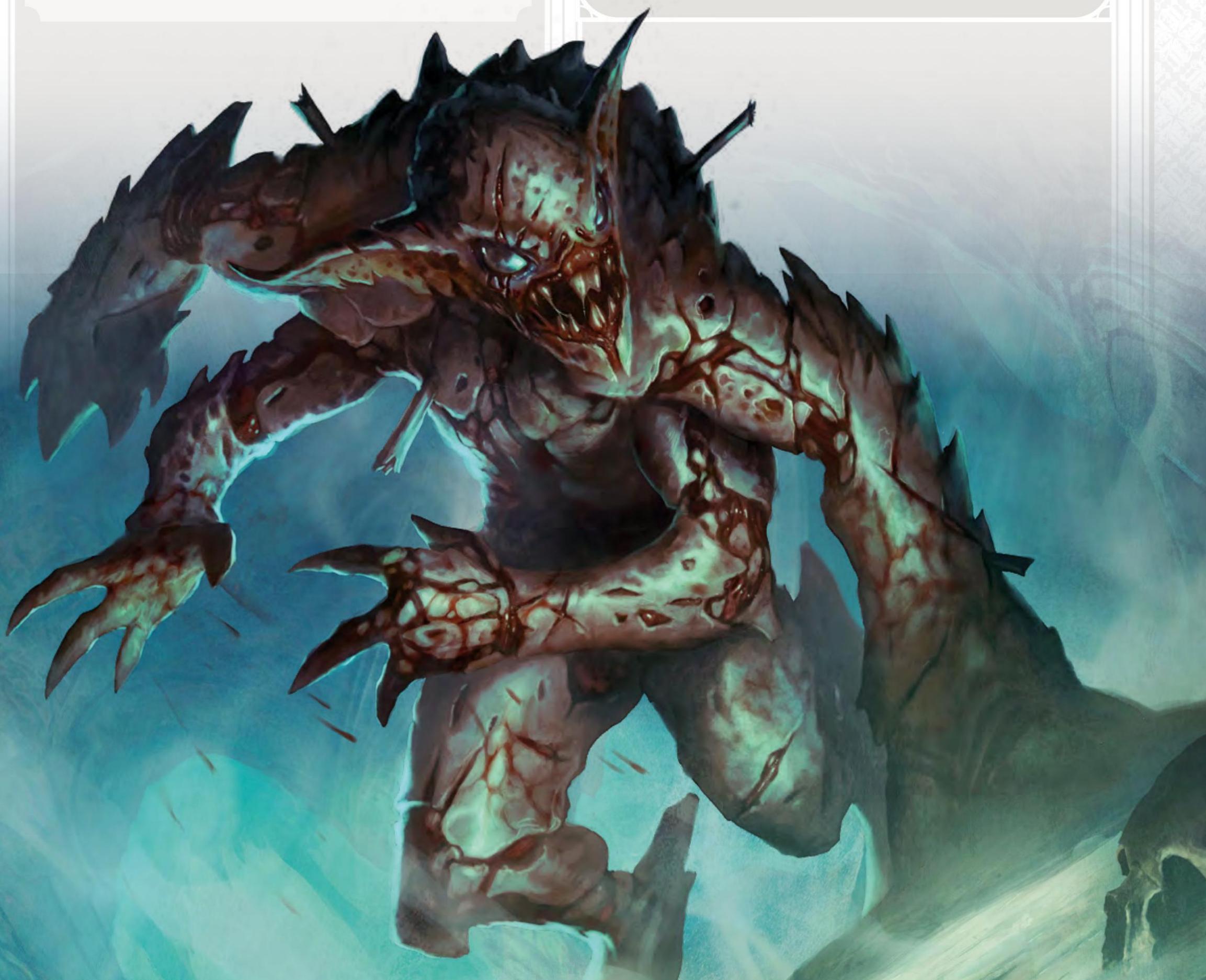
| 特殊洞穴人板 | 1块 |
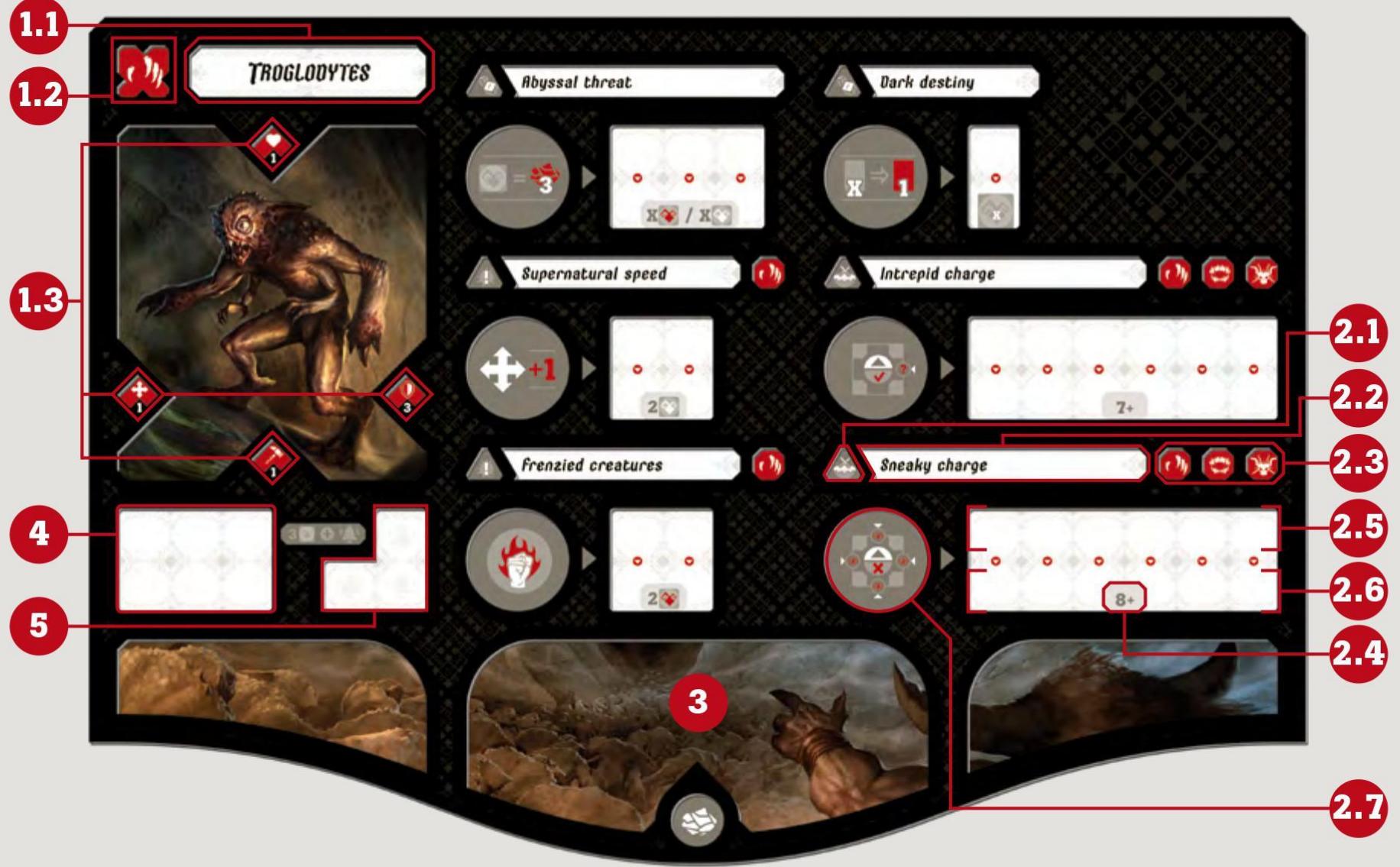
| 命运板 | 1块(恶魔玩家的控制面板) |
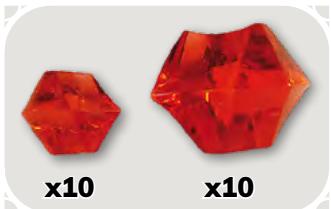
| 原初之石 | 20枚(10枚小宝石价值1威胁点TP、10枚大宝石价值3威胁点;恶魔玩家的货币) |
| 激活骰子 | 8颗(只能用于人类玩家激活战士) |
| 命运骰子 | 6颗(只能用于恶魔玩家激活恶魔或地狱犬的命运力量) |
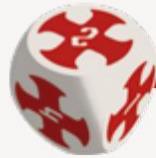
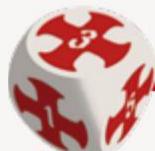
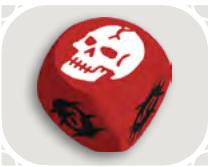
| 战斗骰子 | 10颗(双方玩家都可使用,投掷决定战斗伤害,骷髅代表6) |
| 伤害指示物 | 40个(双方玩家都可使用,记录战士受到的伤害值) |
| 天赋指示物 | 7个(根据剧本放在战士面板上) |
| 地砖 | 48块(代表战士们开拓的地城隧道) |
| 转向标记 | 1个(部分剧本使用,在转向轨道上移动,转向轨道在地砖背面) |
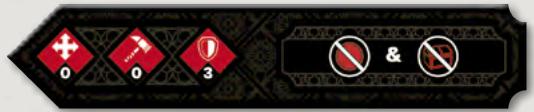
| 疲惫状态指示物 | 5个(放置在西部战士板上提醒玩家) |
| 装备卡 | 20张(根据剧本,西部战士可以装备武器或装甲) |
| 事件卡 | 24张(恶魔玩家在触发一些命运之力后可以抽取) |
| 本能卡 | 24张(人类玩家根据激活条效果抽取,两种用途,使用时必须选择其一) |
| 其他指示物 | 86个(见下表) |
其他指示物明细(86个): 3传送/保护印章、1爆炸物、1方向、1保留爆炸物、10已触发效果、4奇迹之水、4保留奇迹之水、1先知、5箱子、1祝福、5保留箱子、1上锁的门、3地洞、1岩石滑坡、18才能、6失去才能、2速度、2勇气、6逃逸、5愤怒、5疾行、1兴奋。
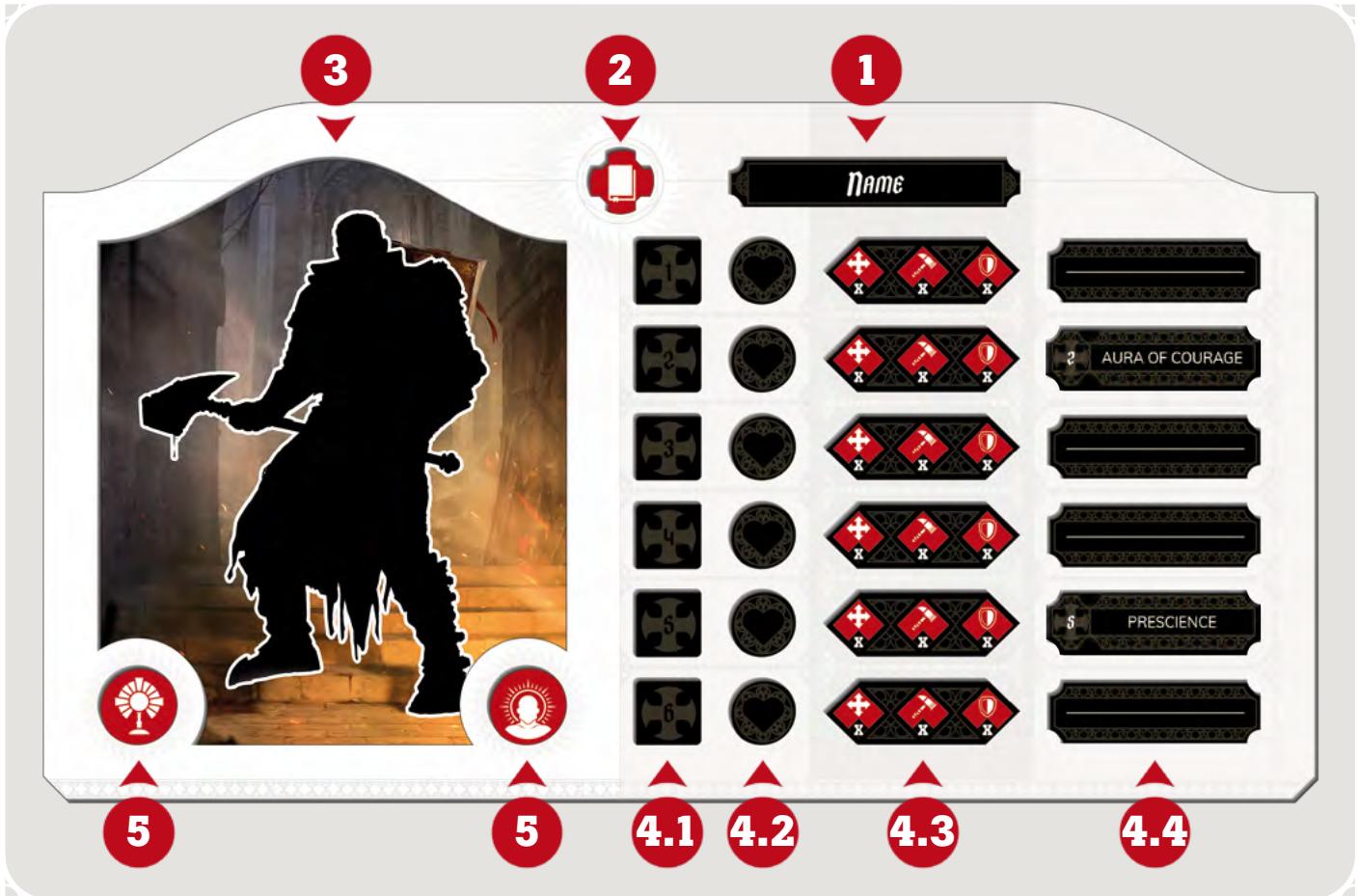
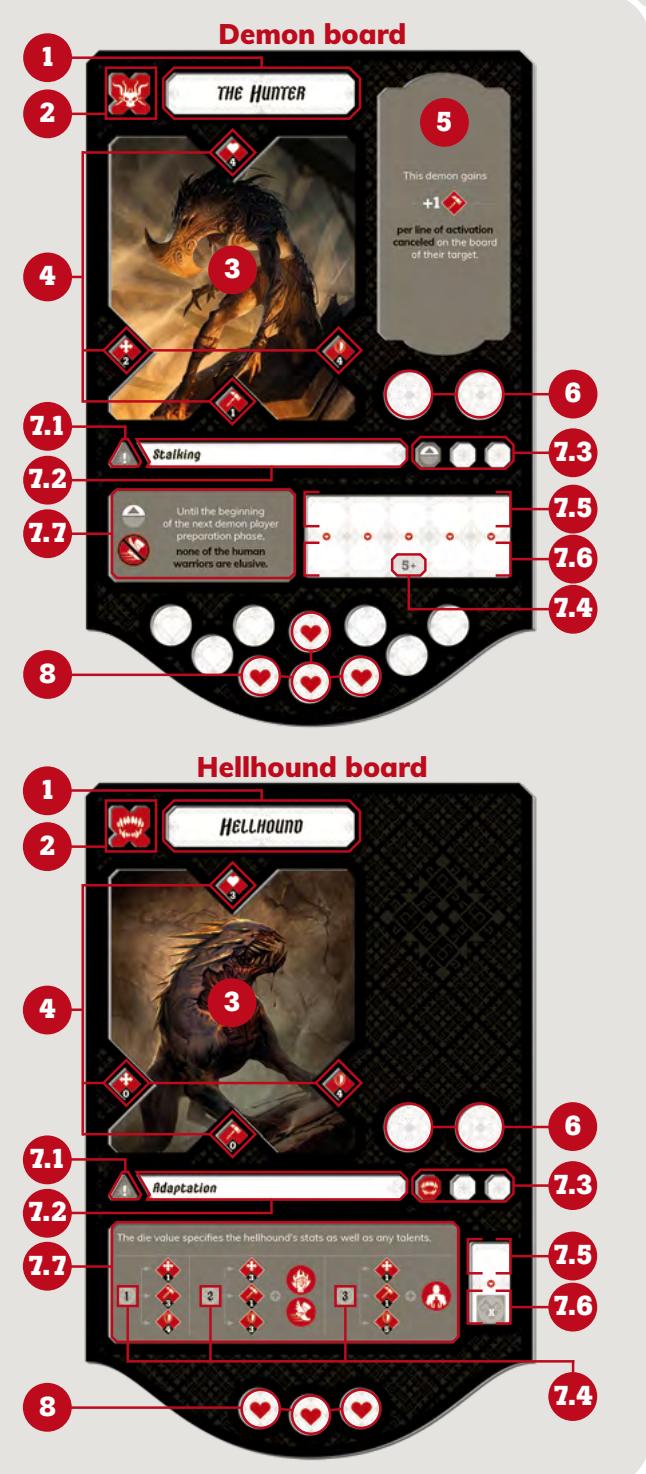
面板解析要点: 战士面板包含角色档案与镂空板两部分,需要使用一个微缩模型时,将对应的角色档案放入镂空板中。西部战士板标注:势力与类型(■领导者或攻击者)、激活条(含激活骰子区、伤害标记区、数值统计区、天赋指示物和本能卡堆区,数值统计区统计移动、战斗与防御值)、才能。恶魔与地狱犬板标注:移动、战斗、防御三值以及生命值(决定被消灭前能承受的伤害数)、能力、才能、命运力量(含阶段、名称、目标、触发条件、准备区域、触发区域、效果)。
2. 游戏设置
- 选择阵营: 一方选择人类,另一方选择恶魔。
- 选择剧本: 双方玩家都从场景本中选择要玩的剧本,初始剧本为"幸存者"。剧本描述了游戏的初始设置、每个玩家可以使用的部队、特定地点的效果等等。
- 每名玩家按照以下步骤进行准备。
人类玩家
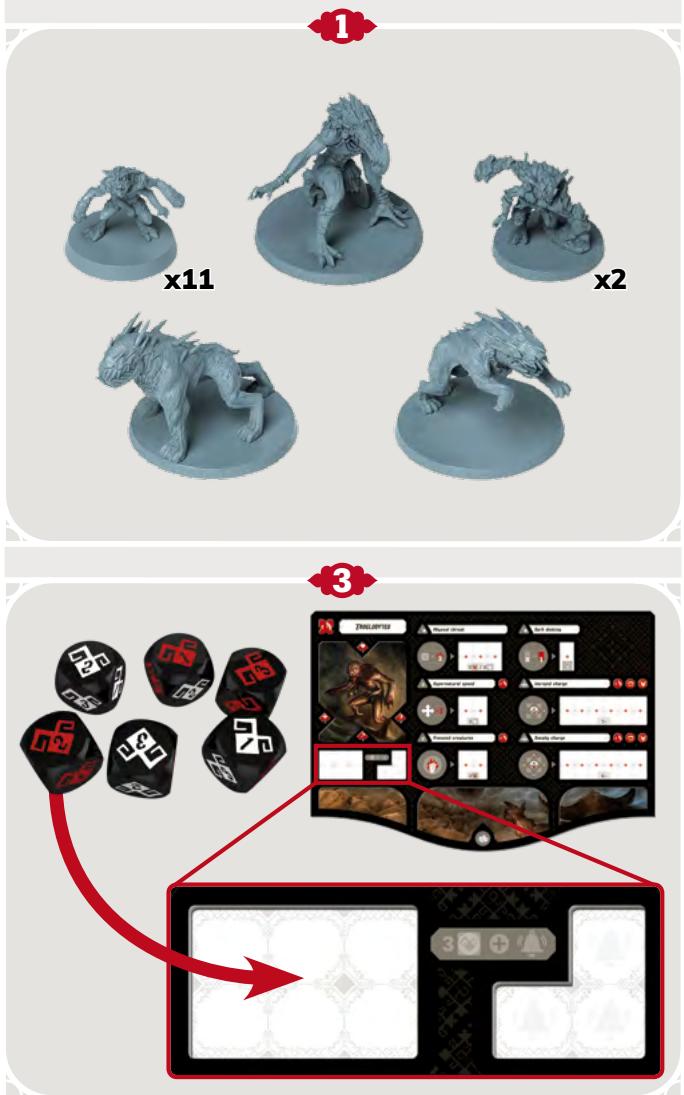
- 准备部队: 按照图1选择微缩模型和档案板,放在你面前。
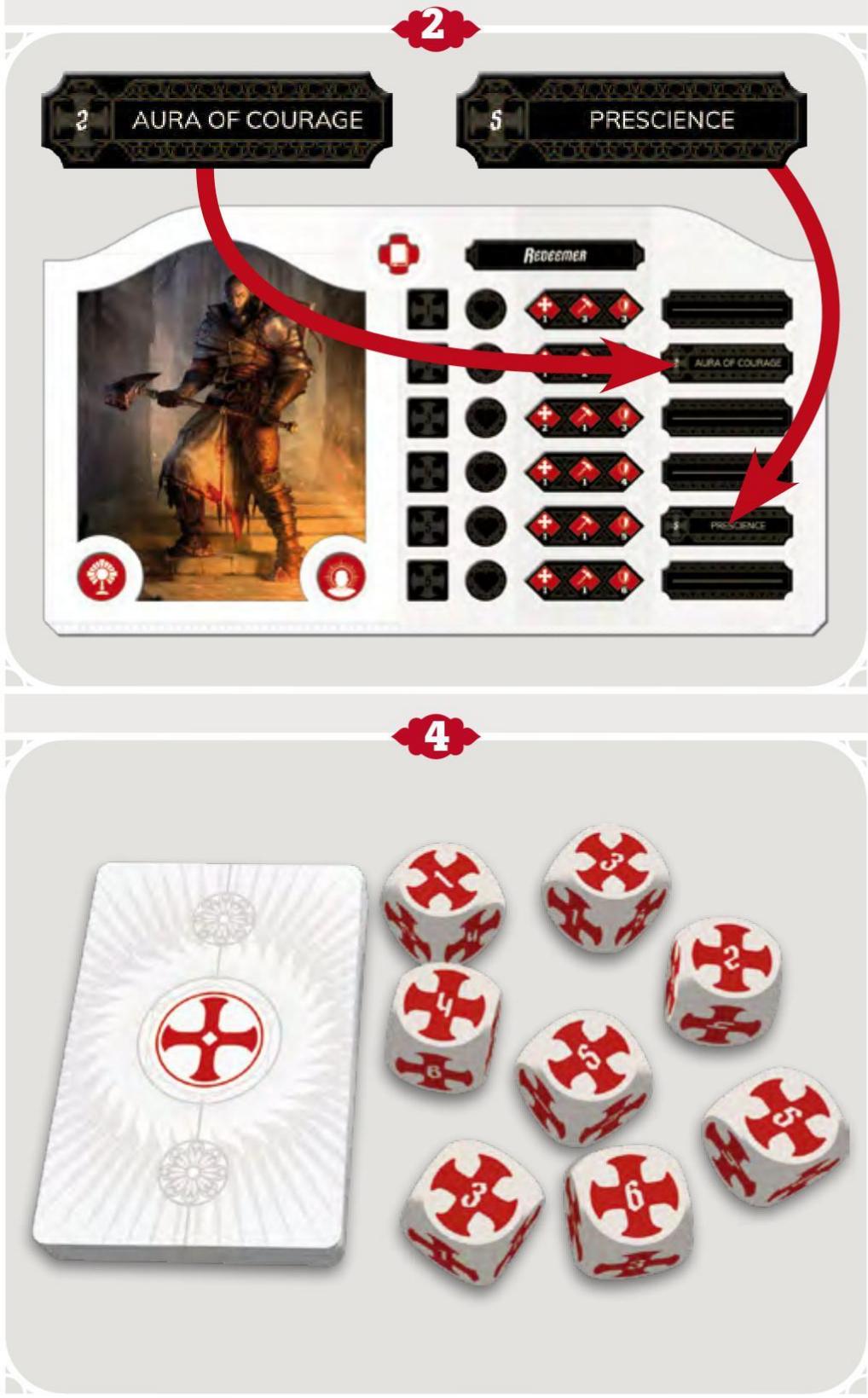
- 救赎者的神圣化: 选择天赋指示物"勇气光环"和"先知",并放进救赎者战士板的槽中。
- 装备部队: 将装备卡"老式短枪"放在一名死囚侦察兵的战士板上。
- 最终准备: 准备激活骰子,洗切本能卡堆并放在合适的位置。
恶魔玩家
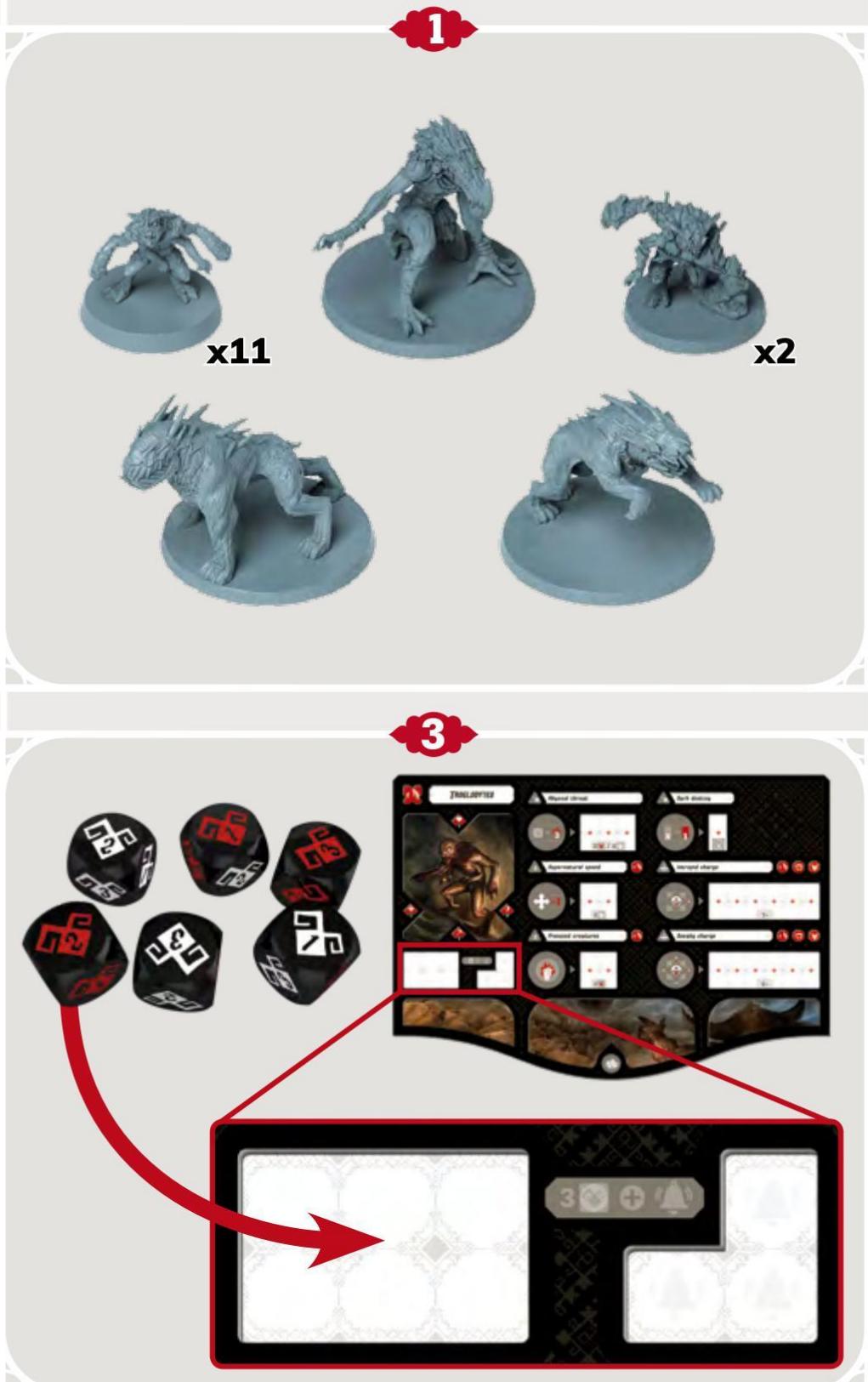
- 准备部队: 按照图1选择微缩模型,放在你面前。
- 整理顺序: 将命运板、恶魔"猎人"板和地狱犬板按照图2摆放,并放在你面前。
- 整理资源: 选择6枚命运骰子并将其放在命运板的可用骰子池。
- 最终准备: 准备原初之石,洗切事件卡堆并放在合适的位置。
规则优先级
游戏中卡牌、命运力量和能力等等具有很多效果,因此会出现两个规则相互矛盾的情况。矛盾出现时,按以下优先级适用:
1. 剧本
2. 地砖
3. 西部战士板
4. 恶魔、地狱犬和坚韧洞穴人板
5. 命运板
6. 天赋指示物
7. 装备卡
8. 事件卡
9. 本能卡
10. 规则书
3. 游戏流程
每次游戏分为多轮,每轮分为5个阶段,按照以下顺序进行:
1. 人类玩家的准备阶段: 人类玩家决定战士的各项数值。
2. 人类玩家的行动阶段: 人类战士移动和探索隧道,与洞穴人、地狱犬和恶魔战斗。
3. 恶魔玩家的准备阶段: 恶魔玩家选择要触发的命运力量。
4. 恶魔玩家的威胁阶段: 恶魔玩家将恶魔、地狱犬和洞穴人放进版图中。
5. 恶魔玩家的行动阶段: 恶魔玩家移动战士,与人类战士战斗。
3.1 人类玩家的准备阶段
- 将上回合放置的本能卡丢弃至本能卡弃牌堆中,移除之前分配的激活骰,移除疲惫状态指示物和任何其他失效的指示物。
- 按照活跃战士数目投掷激活骰子。
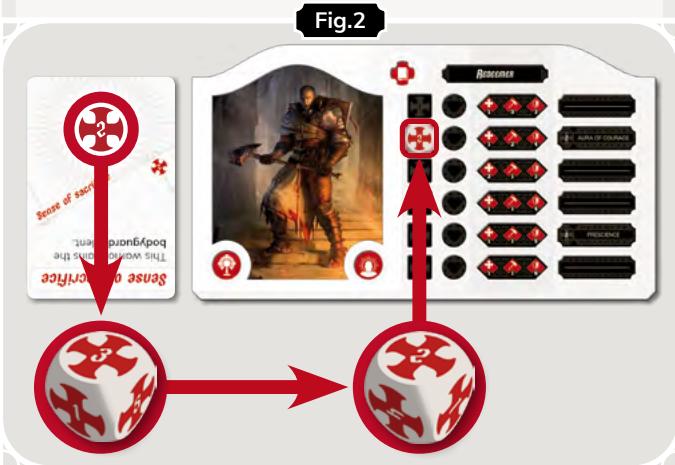
- 为每个战士选择一个激活骰,根据骰子点数放在战士板上的对应位置。接着为每个活跃战士添加一张本能卡,从本能卡的两个效果中选择一个使用(本能卡位于所选战士板旁边,所选效果对人类玩家可见);然后激活骰子的点数变更为本能卡上的值,将激活骰放在激活条上对应的槽中;或者直接使用卡牌上描述的效果。
- 将激活骰子的最终值对应的效果应用于每个战士。有些战士可以根据最终值抽取额外的本能卡或激活天赋。激活骰子在激活条上的最终位置决定了本回合战士的统计数值、可用天赋和可用本能卡。
疲惫状态: 如果西部战士的最终激活骰子被分配到了已经被伤害标记取消的激活条中,则该战士本回合中会变得疲惫不堪,将一个"疲惫状态指示物"放到该战士的面板上来示意。
- 疲惫的战士直到下一个准备阶段前,其统计数值为0、0、3;此外,他不能使用任何天赋,也不能抽取本能卡。除非卡上另有说明,否则他不能享受装备卡的加成;但是,对于统计数值的加成是可以享受的。
本能: 如果将激活骰子分配给了非疲惫状态的、并且对应激活条有本能图标的战士,则可以从本能卡堆中抽一张卡。手牌中本能卡上限等于游戏开始时玩家拥有的战士数量;任何时候本能卡数超过上限,就必须立刻丢弃至上限,进入弃牌堆且不能使用被丢弃卡的效果。该回合的剩余本能卡可以在下一个准备阶段使用。
天赋: 如果激活骰子被分配给了非疲惫状态的战士,并且对应激活条有天赋指示物,则可以使用该天赋的效果。
治疗: 某些卡的效果可以治愈之前被取消的激活条。治愈时人类玩家移除对应的伤害标记。如果刚刚被治愈的激活条是战士激活骰子在准备阶段指定的,则该激活条不再被认为是疲惫的,并可以正常行动。
3.2 人类玩家的行动阶段
每个人类战士现在可任意行动,每次仅能行动一名战士,每名战士必须在下一名战士开始行动前完成行动。在行动期间,战士可以:
- 首先移动,然后执行动作;或
- 首先执行动作,然后移动。
移动和执行动作都是可选的。一名战士不能首先移动、然后执行动作、最后再使用剩余移动点移动。
3.3 恶魔玩家的准备阶段
恶魔通过分配面板上适量的命运骰来选择:触发命运板上的命运能力、触发地狱犬的命运能力、本回合需要激活的恶魔。将命运骰放入对应的准备区域,直到满足触发命运力量的条件为止,然后将其移动到触发区域并执行命运力量的效果。具体步骤如下:
1. 丢弃上一回合放置的所有事件卡(放入事件卡弃牌堆);收集触发区域中所有的命运骰并组成可用骰子池;位于准备区域的命运骰子也可以被加入可用骰子池。
2. 从可用骰子池中投掷3枚命运骰;如果可用骰子池中的骰子数量不足3枚,则必须从准备区域取用骰子直到骰子数量达到3。
3. 将骰子按照自己喜欢的方式分配到任意的准备区域中,无论目标准备区域是否为空,你都可以进行分配。
4. 检查是否满足命运之力的触发条件。若满足,将准备区域的命运骰移动至触发区域;如果不满足触发条件,则被分配的命运骰保留在准备区域中,下一次准备阶段分配命运骰时可能会满足触发条件。
事件卡的手牌上限: 恶魔玩家手牌中事件卡的上限为4张。任何时候若手牌中的事件卡超过4张,就必须立刻丢弃至4张(进入弃牌堆且不能使用被丢弃卡的效果)。事件卡上写有该卡的使用时间,使用后必须丢弃。
命运板上的命运力量:
- 深渊威胁: 触发——分配1、2或3枚同色命运骰;效果——恶魔玩家获得3X的威胁点(TP),X为触发此力量所分配的骰子个数。
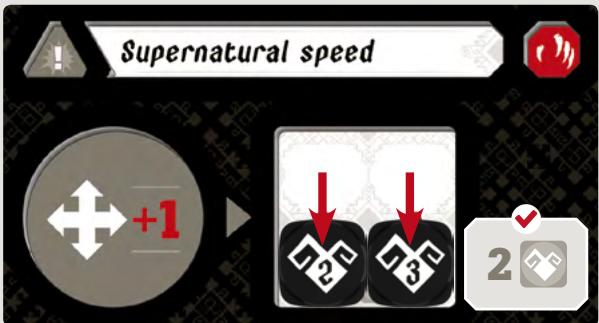
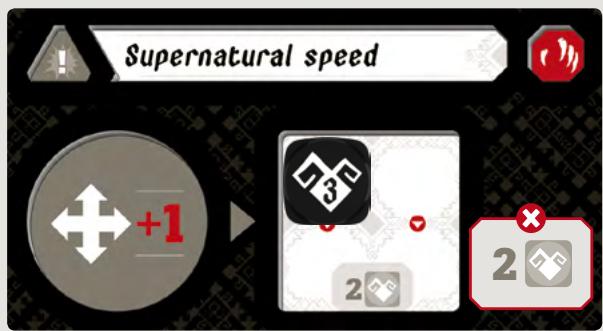
- 超自然之速: 触发——分配2枚白色命运骰;效果——在下个恶魔玩家准备阶段前,洞穴人获得+1移动。恶魔玩家在洞穴人图像上放置一枚速度指示物作为提示。
- 狂暴生物: 触发——分配2枚红色命运骰;效果——在下个恶魔玩家准备阶段前,洞穴人获得才能"疯狂"。放置一枚疯狂指示物作为提示。
- 黑暗命运: 触发——分配1枚命运骰;效果——恶魔玩家抽取X张牌,保留其中1张,丢弃剩余的牌(X为骰子点数)。
- 无畏充能: 触发——分配总和为7以上的命运骰;效果——在威胁阶段,恶魔玩家放置战士时可以无视空地砖限制。
- 暗中充能: 触发——分配总和为8以上的命运骰;效果——在威胁阶段,恶魔玩家放置战士时可以无视开口限制。
3.4 恶魔玩家的威胁阶段
一旦命运骰被分配并触发命运力量后,恶魔玩家就能将恶魔战士召唤进场。考虑到每个战士的召唤成本和使用限制,恶魔玩家应该尽可能花掉储存区中的威胁点(TP)。在绝大多数剧本中,恶魔玩家拥有11个洞穴人、2个地狱犬和1个恶魔。
- 洞穴人: 召唤需要花费1TP。其防御力为3、生命值为1(其余数值见板面)。
- 地狱犬: 召唤需要花费3TP;在任意一场游戏中,恶魔玩家最多只能拥有2只地狱犬;当地狱犬召唤进场时,恶魔玩家可立即从可用骰子池中使用一枚命运骰来触发地狱犬的命运力量,该骰子的点数由恶魔玩家选择。
- 恶魔: 恶魔玩家只能使用当前剧本指定的恶魔;恶魔的统计数值、才能、能力和命运力量都在面板中。
> 重要: 即使恶魔还没有被召唤进场,恶魔玩家依然可以在其准备阶段使用恶魔的命运力量。
召唤位置要求: 恶魔玩家召唤时需要选择其战士占用的地砖,需考虑地砖的占用限制,以及以下两个限制:
- 有开口的地砖: 该地砖至少有一个未探索的路口。如果一个路口没有通向另一块地砖,则视为未探索的。
- 空地砖: 该地砖不得包含任何敌方战士。
威胁阶段进场的战士可以在随后的行动阶段正常行动。
3.5 恶魔玩家的行动阶段
每个恶魔战士现在可以任意行动,每次仅行动一名战士,每名战士必须在下一名战士开始行动前完成行动。在行动期间,战士可以首先移动然后执行动作,或首先执行动作然后移动。移动和执行动作都是可选的。一名战士不能首先移动、然后执行动作、最后再使用剩余移动点移动。
3.6 移动
移动总是可选的。一名战士通过一个路口离开一块地砖;他们可在其次数限制中进行任意次移动,每次离开地砖需消耗1点移动。有些地砖会给战士带来不确定的后果。
相邻地砖: 如果两块地砖的边缘相邻,且路口相互直接连接,则被认为是相邻地砖。
移动限制:
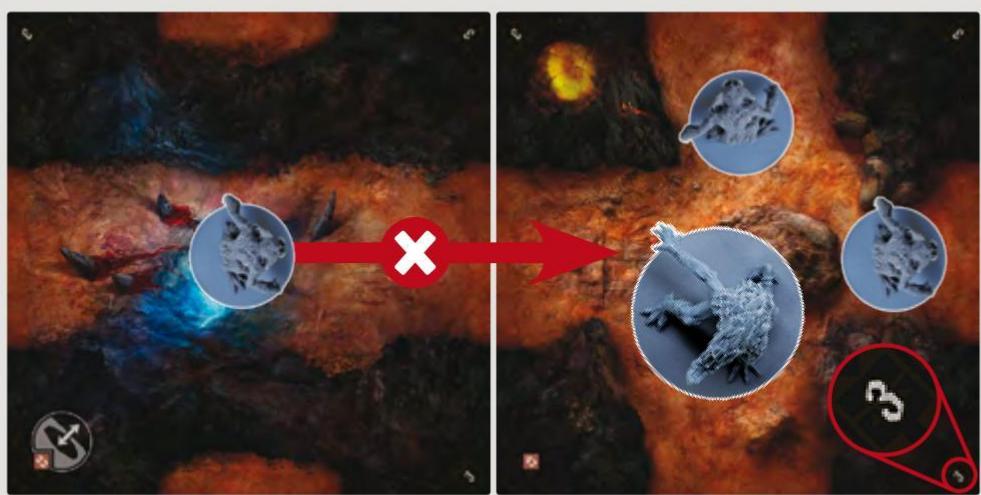
- 地砖占用限制: 要将战士移动到一块地砖上,战士控制者必须检查目标地砖是否可以容纳该战士。对每个派系来说,每个地砖能容纳的战士最大值会显示在地砖上。
- 阻挡规则: 对于一块地砖,若该地砖上的己方战士数量小于敌方战士,则己方战士不能离开该地砖。
3.7 探索
恶魔战士不能探索未探索的路口。 在人类战士的移动过程中,每个人类战士都能在未探索的路口进行一次探索。如果一个路口没有通向另一块地砖,则视为未探索的。探索按照以下步骤执行:
1. 人类玩家将战士放在想要探索的路口上。
2. 恶魔玩家从地砖堆中取出第一块地砖,并按照自己喜欢的方式将其与待探索的路口接触,只要新地砖能够供探索它的战士使用即可。
3. 人类战士移动到新地砖上。
4. 触发地砖的效果。
如果人类战士还剩余移动次数,他还可以继续移动并探索。
死路一条: 若在探索一个路口后,游戏区域中没有未探索的路口,恶魔玩家则将最后探索的地砖丢弃并抽取新的地砖,直到出现具有未探索路口的地砖为止。
3.8 战斗
一名战士可攻击与自己处于同一地砖的敌方战士。当战士攻击时,其控制者执行以下步骤:
1. 选择目标。 目标可以是一名人类战士、一只恶魔、一只地狱犬、一个特殊洞穴人,或同一地砖上的所有洞穴人。
2. 投掷命中骰。 玩家投掷等同于战士战斗点的骰子。大于等于敌方防御值的骰子视为命中,骷髅点数的骰子总是视为命中。
3. 分配命中。 由控制战士的玩家和控制被命中战士的玩家分配命中。
向洞穴人分配命中: 只需一点命中就足以杀死洞穴人,因为它们只有1点生命值。将其微缩模型从版图中移除并放回恶魔战士储备池。如果有多次命中,剩余命中都会转移到同一地砖上的其他洞穴人;每次成功命中都会击杀一个洞穴人。
> 示例:救赎者本回合拥有3点战斗力,他投掷3枚战斗骰子,点数分别为2、3和一个骷髅,获得2点成功命中,杀死了2个洞穴人(洞穴人的防御力为3)。
向一只地狱犬分配命中: 恶魔玩家根据成功命中的次数,在地狱犬板上放置对应数量的伤害标记。一旦伤害大于等于生命值,地狱犬就会被杀死;微缩模型不会返回恶魔战士储备池,而是从游戏中永久移除。
向一只恶魔分配命中: 恶魔玩家根据成功命中的次数,在恶魔板上放置对应数量的伤害标记。一旦伤害大于等于生命值,恶魔就会被杀死,将微缩模型放回恶魔战士储备池中。当恶魔第二次被杀死时,则不会返回恶魔战士储备池,而是从游戏中永久移除。
向一名西部战士分配命中: 人类玩家根据成功命中的次数,在战士板上的激活条放置对应数量的伤害标记,然后该激活条视为被取消。一旦西部战士的6个激活条均被取消,就会被击杀,立刻将其微缩模型从游戏中永久移除。
> 重要: 如果所选的激活条拥有本轮分配的激活骰,该战士并不会视为"疲惫";只有当他们在准备阶段获得与之前被取消的激活条数值匹配的激活骰时,西部战士才会进入疲惫状态。
3.9 装备
有些人类战士可以从装备中受益,增加统计数值或者赋予他们特殊的能力。剧本中描述了获得装备的条件。战士不得对该装备进行更换、丢弃、拾起或摧毁。当装备持有者被杀或离开游戏时,将装备卡从游戏中移除。
3.10 才能
部分战士的才能会赋予他们额外的能力。西部战士在疲惫状态下不得使用才能。 游戏中,一名战士只能从一项才能中获益一次。各项才能如下:
- 祝福: 准备阶段,拥有该才能的战士可以在激活骰被分配后,祝福自身以外的一名战士。一个战士不能同时获得祝福和本能卡(信仰和动物本能不能很好地结合);受祝福的战士直到下一个行动阶段结束,获得+1或+2奖励。此外,如果正在使用的激活条被取消,则立刻愈合。将祝福指示物的对应面放在战士板上的适当位置。该才能在一个剧本中只能使用一次,行动阶段结束时将祝福指示物丢弃。
- 保镖: 在一次攻击中,拥有该才能的战士可以选择替同一地砖上的盟军战士分担一些命中。
- 忠诚: 拥有该才能的战士可以使用与他们激活条相关的天赋(限定剧本)。若分配到该战士的激活骰对应的激活条有天赋,则可以使用该天赋。
- 神出鬼没: 拥有该才能的战士可以无视敌方战士数量进行移动(即忽略阻挡规则)。拥有才能"神出鬼没"的己方战士与一个或多个拥有才能"压力"的敌方战士同处一个地砖时,两个才能相互抵消,阻挡规则适用于所有战士。
- 疯狂: 在战斗的第二步中,若拥有该才能的战士未造成任何命中,则其可以将所有战斗骰重新投掷一次。
- 压力: 无论敌方战士有多少个,均不得从拥有该才能的战士所在的地砖离开。
- 远程作战: 拥有该才能的战士可以攻击自身所处的地砖或与其相邻地砖上的敌人。
- 耐力: 在每一个行动阶段,拥有该才能的战士忽略其受到的第一点命中。
3.11 天赋
拥有才能"忠诚"的战士可以使用天赋。天赋的获得由剧本决定:游戏设置时,将对应的天赋指示物放在战士板中。每一个天赋都与一个激活条相关联;如果战士不处于疲惫状态,且被分配的激活骰与天赋要求的值一致,就可以使用天赋。
- 惩罚恶鬼: 拥有该天赋的战士在投掷战斗骰后,无论目标是什么,大于等于2的结果均视为命中。如果该战士使用装备卡"手榴弹"或"老式短枪",则该天赋无效。
- 愤怒光环: 人类准备阶段结束时,该天赋生效。下个人类准备阶段开始前,所有人类战士获得+1。使用愤怒指示物对战士进行标记。
- 勇气光环: 人类准备阶段结束时生效。在下一个人类准备阶段开始前,选择一名盟军战士,其获得+1、+1、+1。使用勇气指示物对战士进行标记。
- 整装待发: 下一个准备阶段,人类玩家额外投掷2枚激活骰子,将额外的骰子放在接收战士的面板上进行表示。
- 按手礼: 人类准备阶段结束时生效。拥有该天赋的战士可以选择一名盟军战士,并治愈该战士的一个激活条,移除对应的伤害标记。
- 先知: 人类准备阶段结束时,玩家将先知指示物放在地砖堆上。在下一个行动阶段进行第一次探索时,该天赋生效:人类玩家从地砖堆顶拿取3块地砖,从中选择1块并按照喜欢的方向放置(放置时必须确保正在探索的战士可以使用),将其他2块地砖按照喜欢的顺序放回堆顶,那之后将先知指示物移除。
- 牺牲打击: 人类准备阶段结束时,拥有该天赋的战士可以对同一地砖上的另一名战士进行一次打击,投掷一枚战斗骰;若结果大于等于4,则该天赋的拥有者也会受到一次命中。该天赋在一个准备阶段中至多使用2次。
3.12 地砖
每个地砖上都给出了占用限制和便于进行游戏设置的编号。有些地砖的图标给出了特殊规则,这些特殊规则可能会产生有限的使用效果。效果生效后,将"已触发效果"指示物放在地砖的图标上,以表示效果已经生效并且无法再次被使用。
……(完整内容可在村了吗查询)
常见问题(FAQ)
以下 1 条问答中 0 条来自站内玩家的真实提问,其余 1 条为本站整理的常见疑问;答复内容保持原样。
幽闭恐惧1643支持几个人玩?
2 人。
去哪查完整规则
想核对具体规则细节、卡牌效果或某个回合的结算方式,可以在村了吗里选中这款游戏后直接提问。
同类桌游
- 卡坦岛德式
- 工业革命:伯明翰德式
- 勃艮第城堡:特别典藏版德式
- 方舟动物园德式
- 卡卡颂抽象
- 瘟疫危机传承:第一季美式
- 阿瑞迪亚:勇踏征途美式
- 重塑宇宙德式
- 幽港迷城美式
- 埃多拉的德鲁伊德式
规则原文(Markdown)
本站收录这款游戏的规则原文 2 个文件,此处内联渲染 2 个,可直接展开阅读或下载。
rules_zh_幽闭恐惧1643_9578.md49.3 KB
目录
游戏组件 p 6
西部战士板 p.7
恶魔板和地狱犬板 p.8
特殊洞穴人板 p.9
命运板 p.10
游戏设置和准备 p 14
人类玩家 p.14
恶魔玩家 p.15
规则优先级 p 16
游戏顺序 p 16
人类玩家的准备阶段 p.16
人类玩家的行动阶段 p.17
恶魔玩家的准备阶段 p.18
恶魔玩家的威胁阶段 p.19
恶魔玩家的行动阶段 p.20
移动 p 20
战斗 p 21
装备 p 22
才能 p 23
天赋 p 24
地砖 p 25
地城早已筑好
故事开始于1618年5月23日的布拉格。在和玛瑟亚斯王一世的一次会议中,谈判从来没有如此艰难,毫无进展。圣罗马帝国的皇帝,波西米亚国王和新教的代表被扔出了窗户。虽然窗外的粪堆救了他们一命,但这次挑衅足以成为动乱的导火索。
战士们早已准备好奔赴血腥的战场,这场战役的所在地是:欧洲。
维新派与天主教派的矛盾越来越多,无法调和,这对本就复杂的政治斗争和动荡不安的大陆来说简直就是火上浇油。各朝国王、家庭、教派人士等义愤填膺之人,都将愤怒投入了血腥的战场中。这些人组建了非正规军,在受灾区域为了金钱肆意屠杀,所到之处,哀鸿遍野。资金匮乏的时候,非正规军就会不受约束地烧杀抢掠。
冲突随着政治环境的恶化不断升级。伤亡不可计数,崩溃的人则更多。就是在这样恶劣的环境下,德国马格德堡被枪炮被包围了。
马格德堡既是一座战略城市,也是新教的堡垒。1631年,马格德堡被一位叫蒂利的布拉班特省天主教指挥官快速攻占。后来大屠杀和火灾来袭,尽管他努力保护他的军队,但无论是从传言还是现实来看,六分之五的居民都丧生了。火光烧遍了整个城市,并持续了数日,将一切燃烧殆尽。突然,官员收到了奇怪的消息,在这座殉难城的易北河中,能看到令人惶恐的绿光,而且越来越明显。根据神秘学者的调查,这是一个入口。为了探寻其终点,封存已久的河道终于打开,士兵们载着船只通向这幽暗的入口。
返还的探险者,有的失明,有的重伤,还有的濒临疯狂的边缘。他们描述的惨痛景象超出人的想象:奇形怪状的怪兽,长着利爪和尖牙,成群结队向他们扑来,这些怪兽背后还有一些面目可憎的操纵者。随行的宗教学家和鬼神学家一直在试图揭开地下世界的谜团。
为了理解恶魔的敌意,我们必须必须设身处地地着想。当恶魔成群结队地穿越地城时,遇到了半疯的愤怒士兵,这对恶魔来说完全就是无法理解的不速之客。地城的组织还没有完全建立,仍在混乱之中,因此不欢迎的声音占据了主要地位。
然而随着人类远征的规模逐渐扩大,准备愈加充分,地城的怪兽们被逐渐击败。怪兽们面对未曾经过的枪弹,自乱阵脚,节节败退,他们的首领不得不宣告撤回。很快,人们在地城中建立营地,开始探索周围的环境。人类的探险队深入到了饱经风霜的平原和山脉深处,眼前的景观犹如耶罗尼米斯·博斯的疯狂画作。
探险队中有会炼金术的专家,他们在这片罪恶的土地上发现了一级元素,这些未知的原料使他们在研究领域取得了巨大的进步。有些人猜测,他们能在这里找到原初之物,这是一种曾经仅停留在理想中的物质,它是制造贤者之石的必需品。地城的谣言不断地在欧洲散播:马格德堡哪里发现了无价之宝!至少那里发生了极为重要的事情!
就算地城的发现无法解决陆地的冲突,但至少可以减缓冲突的爆发。只要离开了教堂和寺庙,没人能保证自身的安全。部队不断向马格德堡集结,短暂而脆弱的联盟为战乱的欧洲带去了一丝安宁。权贵们都想从地城的宝藏中分一杯羹,权贵投入的兵力越多,就能击退更多的恶魔,占领更多的领地,从而稳固他们的地位。
地城的反击似乎一直没有什么凝聚力。
冲突持续了十几年。恶魔的反击最早可以追溯到千年前的秋天,在那次入侵中,恶魔的领袖发现了集聚力量的方法,然而其他恶魔却将部队转向他们的上级反;有些迷途的恶魔加入了失落的部队,这些没有首领和法律约束的怪兽在地城中肆意妄为,整个地城也因此陷入混乱。地城的混乱让人类趁虚而入,1643年,人类占领了地城的河岸,这足以让人类创建一个功能性的殖民地,一个真正的城市。
人类洗礼了新耶路撒冷。
真是讽刺,人们先推倒了这座圣城,又在这片经历大屠杀的殉难城市的废墟里,联合起来领导这座有城墙的城市。这里的居民里混杂着老百姓、雇佣兵、追求新生活的罪犯和或多或少心怀好意的权贵家族的仆人。正是因为这个强大的堡垒,人类才得以冒险进入地城。然而恶魔和堕天使终于联合起来,以对抗这些不受欢迎的入侵者,这些人类本应在死后才能来到这里。恶魔与堕天使是千年的对手,它们持有不同的意见,并都谋划了数百年的阴谋,却因反对这里的定居者人类而结盟,但它们从未真正能够真正将人类驱逐出去。
但我们真正感兴趣的是另一个故事。
新耶路撒冷有着灰岩色的天空和硫磺色的天花板,教堂塔顶和祈祷者都要面对它。这里的基建有着不可思议的隧道和路网。城市的领导人们惊奇地发现,这里充斥着成群的洞穴人,他们长着爪子和尖牙,饥饿的怪兽随时可能进行迁移,扑向城市居民进行杀戮。
更糟的是,在阴影的最暗处,可以看到恶魔在领导这些怪物。威胁是真实存在的。谁知道这些恐怖分子会在圣城之下编织出什么样的阴谋?由于居民的频繁失踪和谋杀,领导们做了一个草率的决定,让壮丁去阴影深处探索。
但是有哪个傻瓜愿意自己去冒险呢?正好,新耶路撒冷的监狱里挤满了罪犯,多数将被放逐或处决。领导很快决定征募他们去探索地下隧道。由一位绝对虔诚的骑士,他是一位救赎者。救赎者用信念锻造的锤子,带领这些死囚,蛮兵和童子军去净化城市的最深处。
他们黑暗中进行着激烈的抗争。救赎者和死囚们很快发现,这些怪兽是有组织的,他们想把新耶路撒冷烧成灰烬。事实证明,凶残的邪术可怕的召唤和异维门并不是它们唯一的力量。一场凶残的战斗开始了,人类军队取得了胜利,但代价是什么?为了让他们的盟友击退了洞穴人和他们的恶魔之主,许多救赎者失去生命。有些诸如卡尔凯蒂耶的怪兽,不仅拥有坚硬的鳞片,还试图利用人类。军队中女剑士和守护者,在流血冲突中结下了姐妹情谊,是最值得被尊敬的勇士。
新耶路撒冷安全了,但这又能持续多久呢?
九年过去了,这对于人类来说是一段相当长时间,他们不断稳固地盘,并准备获取原初之物。然而九年对地城来说却不过是一口呼吸,对天堂来说呢,那更不过是一眨眼而已。神秘学者和神学家曾警告殖民者,人的血肉在这里没有立足之地。癫狂的信使说,天使居然出现在了冥府之上,而这就是凡人的傲慢所导致的恶果,天使的痕迹与恶魔的猛攻不谋而合。但现在他们的争吵似乎结束了,至少是暂时结束了。恶魔寄主聚集了数百万怪兽,除了强大的Dis外,还有什么防御工事能抵抗这样的力量呢?
这些年来,人类一直在装备和强化巡逻队,来探索新耶路撒冷更深层的隧道,而且费了九二二虎之力才将洞穴人拒之门外。然而,隧道正在摇晃,岩石中在不断渗出腐烂的液体,你可以在黑暗的最深处的感受到不断再生的生命。阴影中,似乎有什么东西正在召唤它的力量,呼唤着支持,准备着新一轮的进攻。
今年是1643年。
在黑暗中,血液将再次流动。

幽闭恐惧1643是一款冒险游戏,2名玩家在新耶路撒冷的地城隧道中战斗。基督徒的堡垒建在地城的中心。一方扮演果敢的西方人,另一方扮演拥有近乎无限军队的恶魔。
游戏组件
微缩模型 x35
微缩模型代表两个派系的战士:
人类派系由人类玩家控制。在本游戏中,人类派系代表着西部战士的势力。
恶魔派系由恶魔玩家控制,在本游戏中,恶魔派系代表着恶魔战士的势力。
我们计划在未来创造更多的势力,为了区分不同势力,我们创建了这个标识符。来自同一派系的战士是盟军,来自不同派系的战士是敌人。
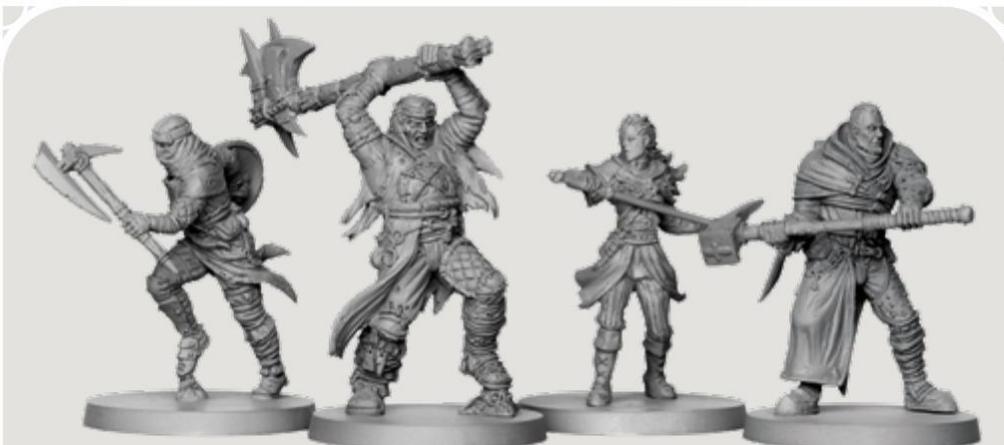
西部战士

恶魔战士
战士板块: 角色档案和镂空板
每名玩家都拥有用于操控战士的面板。战士面板包含两个部分:角色档案和镂空板。当玩家需要使用一个微缩模型时,玩家将对应的角色档案放入镂空板中。
角色档案 x7

镂空板×4

西部战士板 x5
名称:西部战士是无名的,因为通常是被牺牲的罪犯,可耻的人渣。他们经常被派去执行棘手和琐碎的任务。
2 势力和类型:图标的形状代表战士的势力,这是一名西部战士。图标内的图示表示战士的类型,■领导者或者 ✗攻击者。
3 插图 4 激活条:
4.1 激活骰子区:每个激活区需要对应值的骰子。
4.2 伤害标记区:当该战士受到一次伤害时,将获得一枚伤害标记,人类玩家自行选择一个区域放置该标记。
4.3 数值统计区:统计该战士的可用移动步数(⊕),战斗中进行攻击时的骰子数量()。和防御值()。
4.4 天赋指示物和本能卡堆区:该区域可以用于放置天赋指示物或者本能卡。

5 才能:有些战士具有才能,用图标表示。
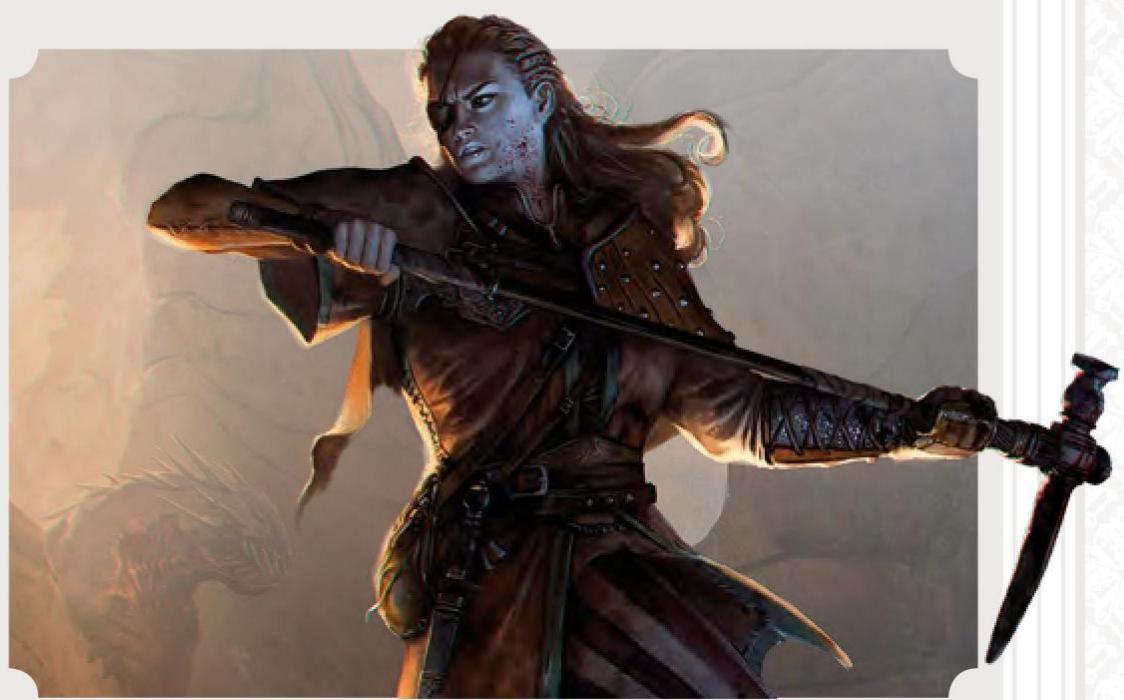

恶魔 x13 和 地狱犬板 x2
名称:每个恶魔都是独一无二的,每当西部人第一次见到它们时,就会给他们起名。地狱犬和洞穴人一样多,因此没有名字。
2 势力和类型:图标的形状代表战士的势力。这是一名恶魔战士。图标内的图示代表战士的类型
恶魔 或地狱犬
3 插画
4 统计数值区:恶魔和的地狱犬和西部战士一样
拥有移动( ✝ )战斗( ✗ )和防御值( ☑ )它们还拥有有生命值( ♥ ),这决定了它们在被消灭前能承受的伤害数。
能力:每个恶魔都拥有能力,效果和使用条件写在面板上。地狱犬没有任何能力。
6 才能:有些恶魔拥有一项或多项才能。
7 命运力量:有些恶魔和地狱犬拥有命运力量,需要使用命运骰子来激活。
7.1 阶段:该图标表示此功能在哪个阶段激活。
7.2 命运力量名称
7.3 目标:该图标表示受该力量影响的战士
7.4 触发条件:触发该力量所需的骰子值或骰子值组合。
命运骰子区域
7.5 准备区域:骰子临时存放区,骰子直到满足力量的触发条件时才能进行分配。
7.6 触发区域:当力量触发条件满足时,恶魔玩家将骰子从准备区域滑动至触发区域并触发效果。
7.7 效果:这个框中描述了每个恶魔和地狱犬的力量效果。它同时指示效果的持续时间。如果没有任何指示,则代表该效果立刻生效。
⑧伤害标记区域:使用红心的生命值

表示每个恶魔

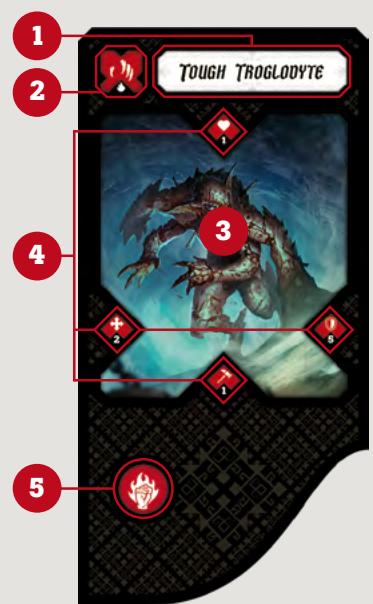
特殊洞穴人板 x1
1 名称
势力和名称:图标的形状代表战士的势力。这是一名恶魔战士。图标内的图示代表战士的类型,坚韧。
3 插画
4 数值统计区:移动(⊕),战斗()。防御()。生命值(♥)。
5 才能: 有些恶魔拥有一项或多项才能, 用图标表示。

命运板 x1
命运板是恶魔玩家的控制面板。面板允许玩家管理威胁点数和命运骰,玩家还能通过分配命运骰来激活命运力量。
1 洞穴人区
1.1 名称
1.2 势力和类型: 图标的形状代表战士的势力。这是一名恶魔战士。图标内的图示代表战士的类型, 坚韧。
1.3 数值统计区: 洞穴人和西部战士一样,拥有移动 ( ) 战斗 ( ) 和防御值 ( ) 它们还拥有有生命值 ( ), 这决定了它们在被消灭前能承受的伤害数。 ,
2 命运力量
2.1阶段:该图标表示此功能在哪个阶段激活
2.2命运力量名称
2.3目标:该图标表示受该力量影响的战士
2.4触发条件:触发该力量所需的骰子值或骰子值组合。
命运骰子区域
2.5 准备区域:骰子临时存放区,骰子直到满足力量的触发条件时才能进行分配。
2.6 触发区域:当力量触发条件满足时,恶魔玩家将骰子从准备区域滑动至触发区域并触发效果
2.7 效果:这个框中描述了每个恶魔和地狱犬的力量效果。它同时指示效果的持续时间。如果没有任何指示,则代表该效果立刻生效。
威胁点储存区:这是恶魔玩家储存威胁点的地方。
4 可用骰子池:容纳6枚命运骰子,可让恶魔玩家触发恶魔或者地狱犬的命运力量。
5 警报骰子区:通过警报地砖获得的额外骰子可放置在此,最多3枚,仅用于提醒。
命运板的命运力量:
深渊威胁
X
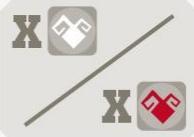
触发:分配1,2或3枚同色命运骰

效果:恶魔玩家获得3X的威胁点(TP,X为触发此力量所分配的骰子个数)。
超自然之速

触发:分配2枚白色命运骰

效果:在下个恶魔玩家准备阶段前,洞穴人获得+1 ✝。恶魔玩家在洞穴人图像上放置一枚速度指示物作为提示。
狂暴生物

触发:分配2枚红色命运骰

效果:在下个恶魔玩家准备阶段前,洞穴人获得才能“疯狂”。恶魔玩家在洞穴人图像上放置一枚疯狂指示物作为提示。
黑暗命运

触发: 分配1枚命运骰
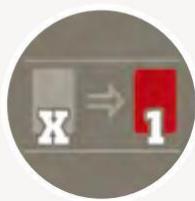
效果:恶魔玩家抽取X张牌,保留其中1张,丢弃剩余的牌。(X为骰子点数)
无畏充能
7+
触发:分配总和为7以上的命运骰
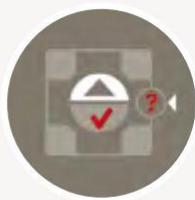
效果:在威胁阶段,恶魔玩家放置战士时可以无视空地砖限制。
暗中充能
8+
触发:分配总和为8以上的命运骰

效果:在威胁阶段,恶魔玩家放置战士时可以无视开口限制。


原初之石 x20

x10

x10
原初之石是一种罕见的石头,但在地城中却非常丰富。它因为强大的力量而受人追捧。
这些宝石是恶魔玩家的货币,放置战士时需要消耗宝石。小宝石价值1威胁点(TP),大宝石价值3威胁点。
激活骰子 x8
只能用于人类玩家激活战士。
命运骰子 x6

只能用于恶魔玩家激活恶魔或地狱犬的命运力量。
战斗骰子 x10

双方玩家都可使用,投掷战斗骰子决定战斗伤害,骷髅代表6。
伤害指示物 x40

双方玩家都可使用,用于记录战士受到的伤害值。
天赋指示物 x7

有些战士可以获得天赋,根据剧本的不同,将对应的指示物放在战士面板上。
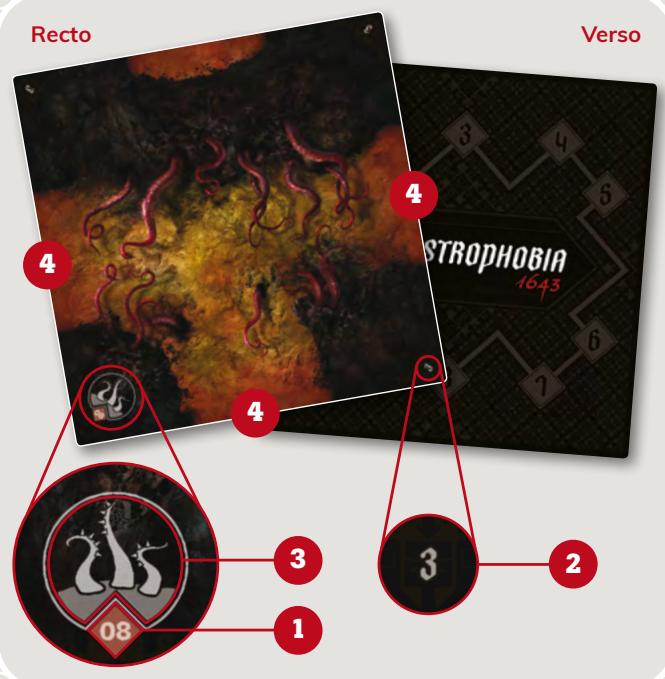
地砖 x48
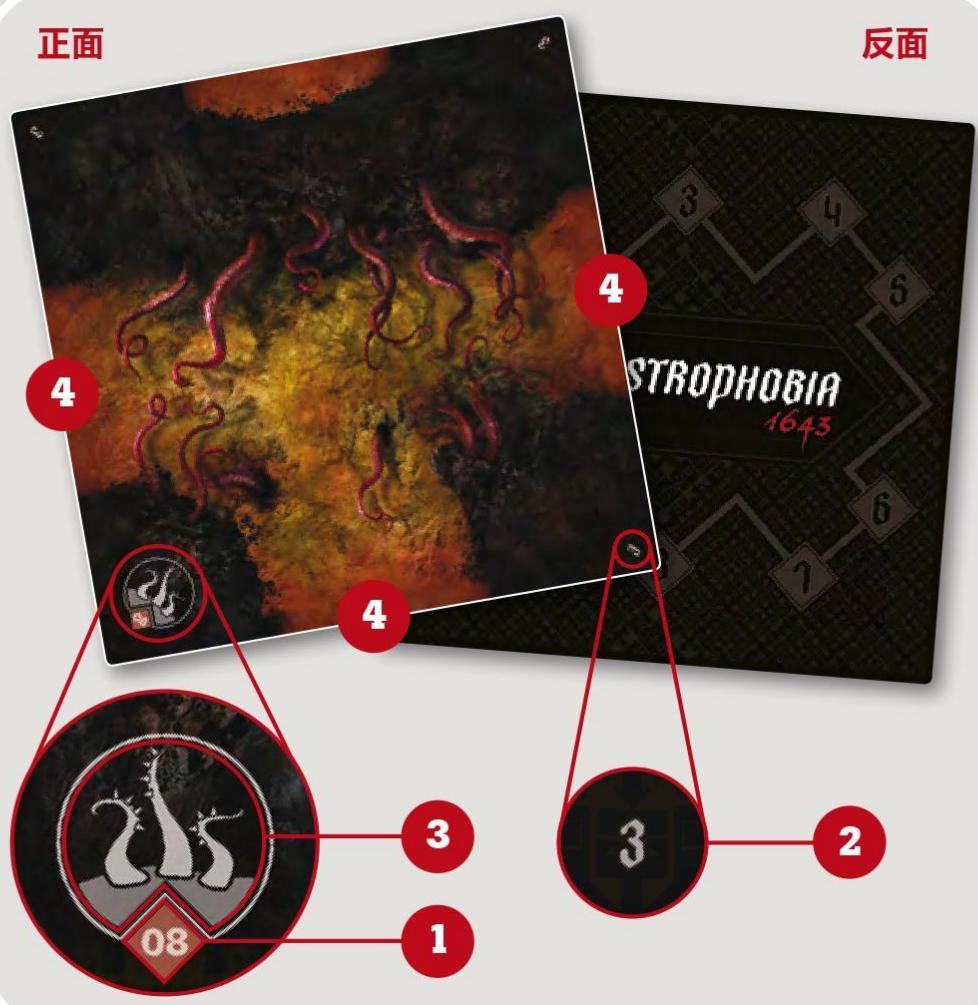
地砖代表战士们开拓的地城隧道。

编号:帮助玩家设置游戏区域。
2 占用限制:人类和恶魔玩家各能放置战士的最大数量。

3 效果标记:有些地砖有特殊规则,用标记示意

4 开放口
转向标记 x1
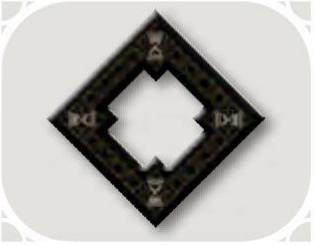
部分剧本需要使用转向标记,并在转向轨道上移动,转向轨道可以在地砖的背面找到。
疲惫状态指示物 x5

疲惫状态指示物被放置在西部战士板上,以在需要的时候提醒玩家。
装备卡 x20
正面


反面
根据剧本,西部战士可以装备武器或装甲。每张卡上都标明了效果和使用条件。
事件卡 x24
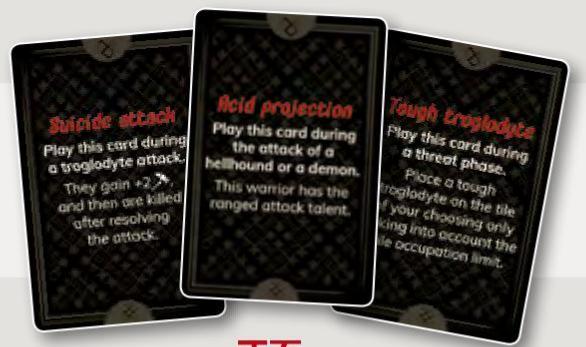
正面

反面
恶魔玩家在触发一些命运之力后可以抽取事件卡,卡的效果和使用条件已经在卡上标明。
本能卡 x24

人类玩家根据选择的激活条的效果抽取本能卡。这些卡有两种用途,玩家使用时必须选择其中一种。一方面,可以用于修改激活骰子的数值,另一方面,是一个一次性效果。
其他指示物 x86
幽闭恐惧1643有各种各样的指示物,其用途取决于效果(地砖、卡牌等)或选择的剧本,罗列如下。以下内容均省略“指示物”。

3 传送 / 保护印章

1 爆炸物
1 方向
1 保留爆炸物

10 已触发效果

4 奇迹之水


4 保留奇迹之水
1 先知


5 箱子
1 祝福
5 保留箱子
1 上锁的门

3 地洞

1 岩石滑坡

18 才能

6 失去才能

2 速度

2 勇气

6 逃逸
5 愤怒
5 疾行
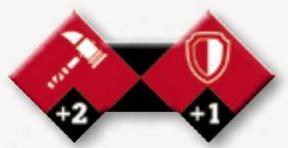
1 兴奋
游戏准备
1 选择阵营:一方选择人类,另一方选择恶魔
② 双方玩家都从场景本中选择要玩的剧本,我们选择“幸存者”作为初始剧本。剧本描述了游戏的初始设置、每个玩家可以使用的部队、特定地点的效果等等。
3 每名玩家按照以下步骤进行准备。


人类玩家
1 准备部队:按照图1选择微缩模型和档案板,放在你面前。
2 救赎者的神圣化:选择天赋指示物“勇气光环”和“先知”并放进救赎者战士板的槽中,如图所示。
装备部队:将装备卡“老式短枪”放在一名死囚侦察兵的战士板上。
4 最终准备:准备激活骰子,洗切本能卡堆并放在合适的位置。

恶魔玩家
1 准备部队:按照图1选择微缩模型,放在你面前。
2 整理顺序:将命运板、恶魔“猎人”板和地狱犬板按照图2摆放,并放在你面前。
3 整理资源:如图所示,选择6枚命运骰子并将其放在命运板的可用骰子池。
4 最终准备:准备原初之石,洗切事件卡堆并放在合适的位置。


规则优先级
幽闭恐惧1643中的卡牌、命运力量和能力等等具有很多效果,因此会出现两个规则相互矛盾的情况。矛盾出现时,按照以下优先级适用。
1 剧本
2 地砖
3 西部战士板
4 恶魔、地狱犬和坚韧洞穴人板
5 命运板
6 天赋指示物
7 装备卡
8 事件卡
9 本能卡
10 规则书
游戏顺序
每次游戏分为多轮,每轮分为5个阶段,按照以下顺序进行。
人类玩家的准备阶段:人类玩家决定战士的各项数值。
人类玩家的行动阶段:人类战士移动和探索隧道,与洞穴人、地狱犬和恶魔战斗。
恶魔玩家的准备阶段:恶魔玩家选择要触发的命运力量。
恶魔玩家的威胁阶段:恶魔玩家将恶魔、地狱犬和洞穴人放进版图中。
恶魔玩家的行动阶段:恶魔玩家移动战士,与人类战士战斗。
人类玩家的准备阶段
人类玩家按照以下步骤确定西部战士的各项数值:
将上回合放置的本能卡丢弃至本能卡弃牌堆(与本能卡堆相邻)中,移除之前分配的激活骰,移除疲惫状态指示物和任何其他失效的指示物。
2 按照活跃战士数目投掷激活骰子。
3 为每个战士选择一个激活骰,根据骰子点数放在战士板上的对应位置。
图1


为每个活跃战士添加一张本能卡,从本能卡的两个效果中选择一个使用。本能卡位于所选战士板旁边,所选效果对人类玩家可见。
然后,激活骰子的点数变更为本能卡上的值,将激活骰放在激活条上对应的槽中。(如图2)

或
使用卡牌上描述的效果。
4 将激活骰子的最终值对应的效果应用于每个战士。有些战士可以根据最终值抽取额外的本能卡或激活天赋。激活骰子在激活条上的最终位置决定了本回合战士的统计数值、可用天赋和可用本能卡。
疲惫状态
如果西部战士的最终激活骰子被分配到了已经被伤害标记取消的激活条中,则该战士本回合中会变得疲惫不堪。将一个“疲惫状态指示物”放到该战士的面板上来示意。(如图3)
本能

如果将激活骰子分配给了非疲惫状态的并且对应激活条有本能图标,则可以
Fig.3

从本能卡堆中抽一张卡。手牌中本能卡上限等于游戏开始时玩家拥有的战士数量,任何时候,本能卡数超过上限,就必须立刻丢弃至上限,进入弃牌堆且不能使用被丢弃卡的效果。该回合的剩余本能卡可以在下一个人类玩家的准备阶段使用。
天赋
如果激活骰子被分配给了非疲惫状态的战士,并且对应激活条有天赋指示物,则可以使用该天赋的效果。天赋效果在第24页有更加详细的描述。
治疗
某些卡的效果可以治愈之前被取消的激活条。治愈时,人类玩家移除对应的伤害标记。如果刚刚被治愈的激活条是战士激活骰子在准备阶段指定的,则该激活条不再被认为是疲惫的,并可以正常行动。
人类玩家的行动阶段
每个人类战士现在可任意行动。每次仅能行动一名战士。每名战士必须在下一名战士开始行动前完成行动。在行动期间,战士可以:
首先移动,然后执行动作(图4)
或

首先执行动作,然后移动(图5)图5
移动和执行动作都是可选的。一名战士不能首先移动,然后执行动作,最后再使用剩余移动点移动。
顺序不同的原因可能有:
进入战斗
执行剧本中的操作(由关键字“动作”表示)
使用装备(由关键字“动作”表示)移动和战斗的详细规则将在20页和21页描述。
疲惫的战士:拥有疲惫状态指示物的战士直到下一个准备阶段前,其统计数值为0 ,0 ,3 。此外,他不能使用任何天赋,也不能抽取本能卡。除非卡上另有说明,否则他不能享受装备卡的加成。但是,对于统计数值的加成是可以享受的。
恶魔玩家的准备阶段
恶魔通过分配面板上适量的命运骰来选择:
触发命运板上的命运能力;
触发地狱犬的命运能力;
本回合需要激活的恶魔。
将命运骰放入对应的准备区域,直到满足触发命运力量的条件为止,然后将其移动到触发区域并执行命运力量的效果。为了完成这些步骤,恶魔玩家按照以下步骤执行:
丢弃上一回合放置的所有事件卡,将这些事件卡放在事件卡弃牌堆(与事件卡堆相邻)中。收集触发区域中所有的命运骰,并组成可用骰子池。位于准备区域的命运骰子也可以被加入可用骰子池。
2 从可用骰子池中投掷3枚命运骰,如果可用骰子池中的骰子数量不足3枚,则必须从准备区域取用骰子直到骰子数量达到3。
3 将骰子按照自己喜欢的方式分配到任意的准备区域中,无论目标准备区域是否为空,你都可以进行分配。
4 检查是否满足命运之力的触发条件。(图6)
若满足,将准备区域的命运骰移动至触发区域。
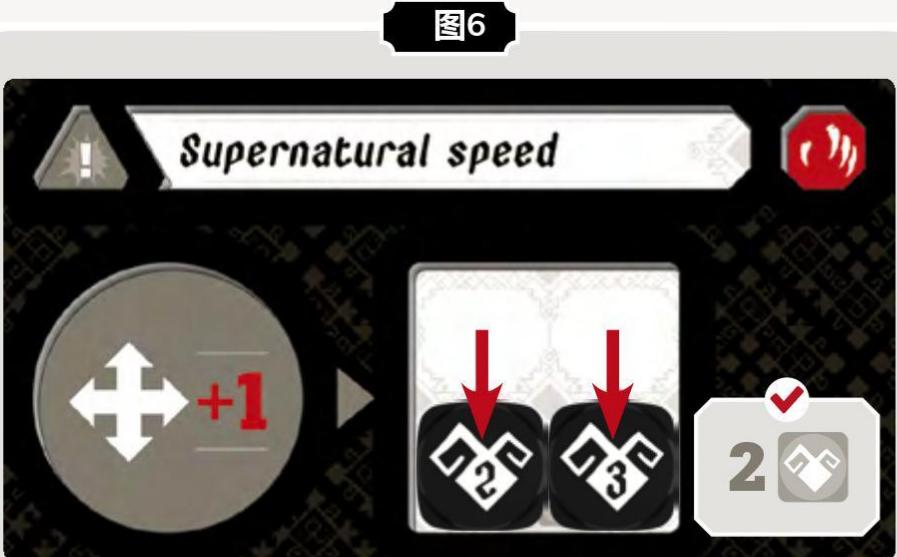
如果不满足触发条件,则被分配的命运骰保留在准备区域中。
下一次准备阶段分配命运骰时可能会满足命运力量的触发条件。(图7)

事件卡的手牌上限
恶魔玩家手牌中事件卡的上限为4。
任何时候,若手牌中的事件卡超过4张,就必须立刻丢弃至4张,进入弃牌堆且不能使用被丢弃卡的效果。事件卡上写有该卡的使用时间,使用后必须丢弃。

恶魔玩家的威胁阶段
一旦命运骰被分配并触发命运力量后,恶魔玩家就能将恶魔战士召唤进场。考虑到每个战士的召唤成本和使用限制,恶魔玩家应该尽可能的花费储存区中威胁点(TP)。
在绝大多数剧本中,恶魔玩家拥有11个洞穴人,2个地狱犬和1个恶魔,玩家可以将对应的微缩模型放进版图中。
洞穴人

召唤洞穴人需要花费1TP。洞穴人的统计数值如下:1 📄, 3 🌐 和 1 ❤️。
地狱犬
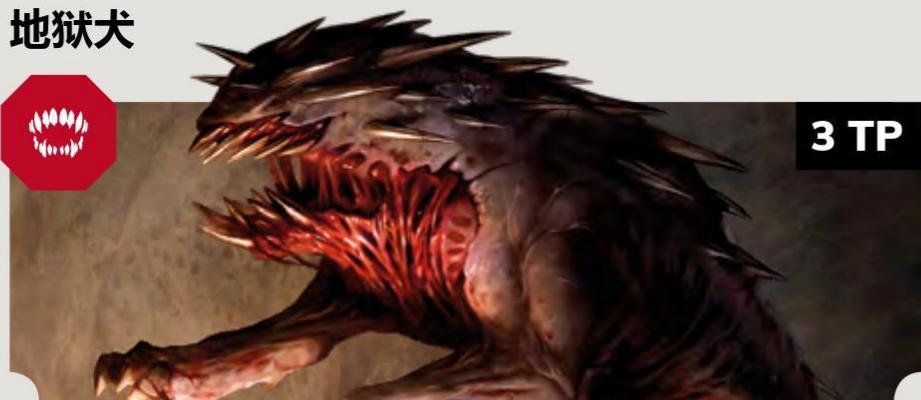
召唤洞穴人需要花费3TP。
在任意一场游戏中,恶魔玩家最多只能拥有2只地狱犬。
地狱犬的统计数值如下:
0,0,4 和 3
当地狱犬召唤进场时,恶魔玩家可立即从可用骰子池中使用一枚命运骰来触发地狱犬的命运力量,该骰子的点数由恶魔玩家选择。
恶魔
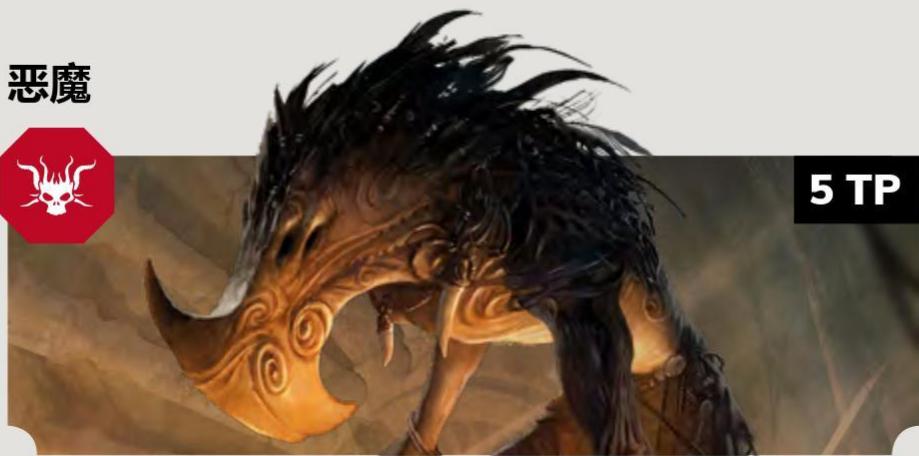
恶魔玩家只能使用当前剧本指定的恶魔。
恶魔的统计数值、才能、能力和命运力量都在面板中。
重要:即使恶魔还没有被召唤进场,恶魔玩家依然可以在其准备阶段使用恶魔的命运力量。
恶魔玩家召唤时,需要选择其战士占用的地砖,考虑到地砖的占用限制(参见移动:地砖占用规则),以及以下两个限制:
有开口的地砖
该地砖至少有一个未探索的路口。如果一个路口没有通向另一块地砖,则视为未探索的。
空地砖
该地砖不得包含任何敌方战士。
威胁阶段进场的战士可以在随后的行动阶段正常行动。
恶魔玩家的行动阶段
每个恶魔战士现在可以任意行动。每次仅行动一名战士。每名战士必须在下一名战士开始行动前完成行动。在行动期间,战士可以:
首先移动,然后执行动作。
或
首先执行动作,然后移动。
移动和执行动作都是可选的。一名战士不能首先移动,然后执行动作,最后再使用剩余移动点移动。
顺序不同的原因可能有:
进入战斗
执行剧本中的操作(由关键字“动作”表示)

移动
移动总是可选的,一名战士通过一个路口离开一块地砖。他们可在其次数限制中进行任意次移动,每次离开地砖需消耗1。
有些地砖会给战士带来不确定的后果,每个地砖效果的触发条件将在25页和26页描述。
相邻地砖
如果两块地砖的边缘相邻,且路口相互直接连接,则被认为是相邻地砖的。
限制
移动中有两个限制:
地砖占用限制:要将战士移动到一块地砖上,
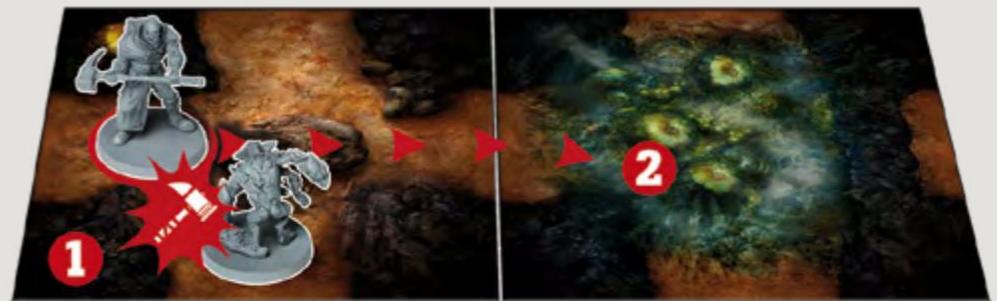
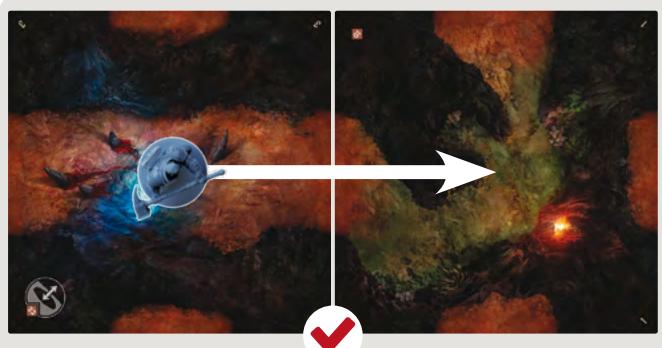
战士控制者必须检查目标地砖是否可以容纳该战士。对每个派系来说,每个地砖能容纳的战士最大值会显示在地砖上。(图8)
图8
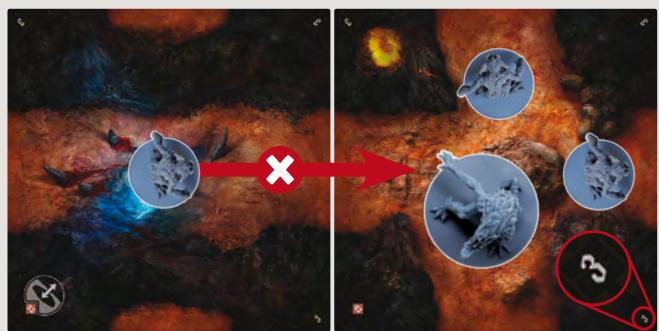
阻挡规则:对于一块地砖,若该地砖上的己方战士数量小于敌方战士,则己方战士不能离开该地砖。(图9)
图9

死囚侦察兵移动后,由于恶魔战士较多,救赎者不进行移动。
探索
恶魔战士不能探索未探索的路口。
在人类战士的移动过程中,每个人类战士都能在未探索的路口进行一次探索。如果一个路口没有通向另一块地砖,则视为未探索的。
探索按照以下步骤执行:
人类玩家将战士放在想要探索的路口上。
2 恶魔玩家从地砖堆中取出第一块地砖并按照自己喜欢的方式将其与待探索的路口接触,只要新地砖能够供探索它的战士使用即可(图10)。
3 人类战士移动到新地砖上。
4 触发地砖的效果(详见25页和26页)。
如果人类战士还剩余移动次数,他还可以继续移动并探索。
死路一条
若在探索一个路口后,游戏区域中没有未探索的路口,恶魔玩家则将最后探索的地砖丢弃并抽取新的地砖,直到出现具有未探索路口的地砖为止。
图10


战斗
一名战士可攻击与自己处于同一地砖的敌方战士。当战士攻击时,其控制者执行以下步骤:
选择目标。目标可以是一名人类战士、一只恶魔、一只地狱犬、一个特殊洞穴人或同一地砖上的所有洞穴人。
2 玩家投掷等同于战士战斗点的骰子 。大于等于敌方防御值 的骰子视为命中,骷髅点数 的骰子总是视为命中。
3 控制战士和控制被命中战士的玩家分配命中。
向洞穴人分配命中
只需一点命中就足以杀死洞穴人,因为它们只有1点生命值❤️。将其微缩模型从版图中移除并放回恶魔战士储备池。如果有多次命中,剩余命中都会转移到同一地砖上的其他洞穴人。每次成功命中都会击杀一个洞穴人。(图11)
图11
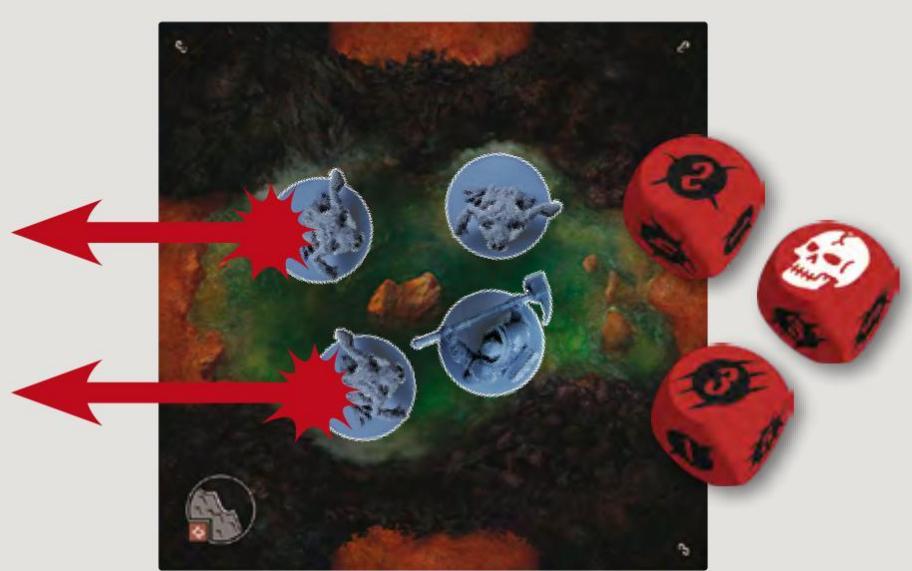
救赎者本回合拥有3点 ▶ 战斗力,他正在寻找洞穴人并发起攻击,投掷3枚战斗骰子,点数分别为2,3和 🖱️ 。他获得2点成功命中,并且杀死了2个洞穴人,因为洞穴人只有3点防御力 🖼️ 。
向一只地狱犬分配命中
恶魔玩家根据成功命中的次数,在地狱犬板上放置对应数量的伤害标记。一旦伤害大于等于生命值,地狱犬就会被杀死,微缩模型不会返回恶魔战士储备池,而是从游戏中永久移除。
向一只恶魔分配命中
恶魔玩家根据成功命中的次数,在恶魔板上放置对应数量的伤害标记。一旦伤害大于等于生命值,恶魔就会被杀死,将微缩模型放回恶魔战士储备池中。当恶魔第二次被杀死时,则不会返回恶魔战士储备池,而是从游戏中永久移除。
向一名西部战士分配命中
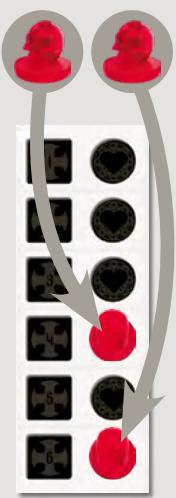
人类玩家根据成功命中的次数,在战士板上的激活条放置对应数量的伤害标记,然后该激活条视为被取消。一旦西部战士的6个激活条均被取消,就会被击杀,立刻将其微缩模型从游戏中永久移除。(图12)
图12
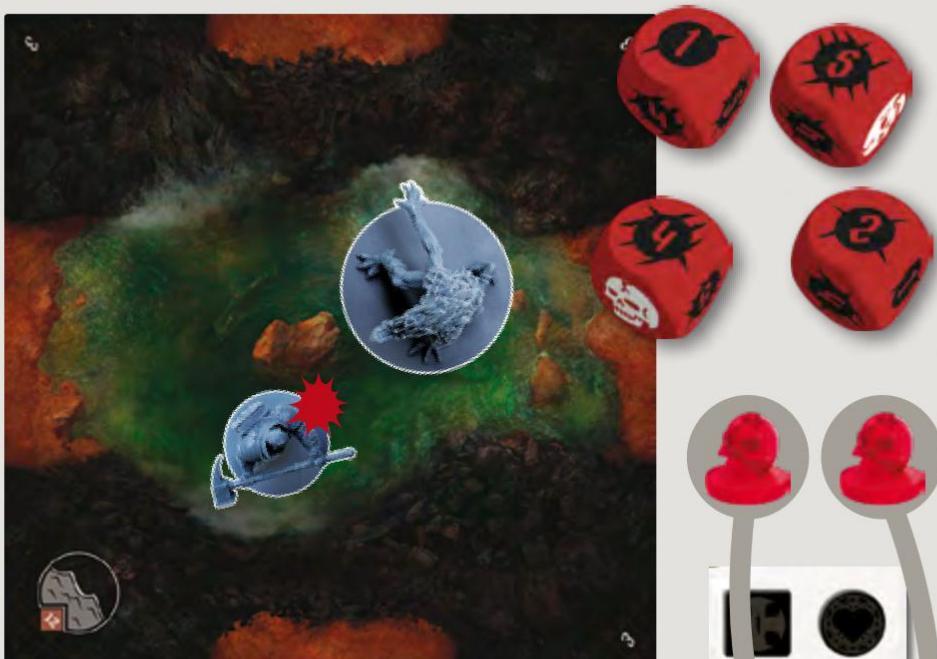
恶魔攻击它的敌人,恶魔拥有4点战斗力 ,因此恶魔玩家投掷4枚战斗骰子,分别为1,2,4,5,由于救赎者的防御值 为4,因此获得2点成功命中。人类玩家将伤害标记放在救赎者面板的激活条4和激活条6中。
重要:如果所选的激活条拥有本轮分配的激活骰,该战士并不会视为“疲惫”,只有当他们在准备阶段获得与之前被取消的激活条数值匹配的激活骰时,西部战士才会进入疲惫状态。
装备
有些人类战士可以从装备中受益,增加统计数值或者赋予他们特殊的能力。剧本中描述了获得装备的条件。战士不得对该装备进行更换、丢弃、拾起或摧毁。当装备持有者被杀或离开游戏时,将装备卡从游戏中移除。
才能
部分战士的才能会赋予他们额外的能力。西部战士在疲惫状态下不得使用才能。游戏中,一名战士只能从一项才能中获益一次。每项才能的使用方法如下。

祝福
准备阶段,拥有该才能的战士可以在激活骰被分配后,祝福自身以外的一名战士。一个战士不能同时获得祝福和本能卡(信仰和动物本能不能很好地结合),受祝福的战士直到下一个行动阶段结束,获得+1 或+2 奖励。
此外,如果正在使用的激活条被取消,则立刻愈合。
将祝福指示物的对应面放在战士板上的适当位置。
该才能在一个剧本中只能使用一次,行动阶段结束时,将祝福指示物丢弃。

保镖
在一次攻击中,拥有该才能的战士可以选择替同一地砖上的盟军战士分担一些命中。

忠诚
拥有该才能的战士可以使用与他们激活条相关的天赋(限定剧本)。若分配到该战士的激活骰对应的激活条有天赋,则可以使用该天赋。



神出鬼没
拥有该才能的战士可以无视敌方战士数量进行移动(即忽略阻挡规则),拥有才能“神出鬼没”的已方战士与一个或多个拥有才能“压力”的敌方战士同处一个地砖时,两个才能相互抵消,阻挡规则适用于所有战士。
疯狂
在战斗的第二步中,若拥有该才能的战士未造成任何命中,则其可以将所有战斗骰重新投掷一次。
压力
无论敌方战士有多少个,均不得从拥有该才能的战士所在的地砖离开。
远程作战
拥有该才能的战士可以攻击自身所处的地砖或与其相邻地砖上的敌人。
耐力
在每一个行动阶段,拥有该才能的战士忽略其受到的第一点命中。


天赋
拥有才能“忠诚”的战士可以使用天赋。天赋的获得是由剧本决定的。玩家在进行游戏设置时,将对应的天赋指示物放在战士板中。每一个天赋都与一个激活条相关联。如果战士不处于疲惫状态,且被分配的激活骰与天赋要求的值一致,就可以使用天赋。

PUNISH THE EVIL
惩罚恶鬼:拥有该天赋的战士在投掷战斗骰后,无论目标是什么,大于等于2的结果均视为命中。如果该战士使用装备卡“手榴弹”或“老式短枪”,则该天赋无效。
AURA OF ANGER
愤怒光环:人类准备阶段结束时,该天赋生效。下个人类准备阶段开始前,所有人类战士获得+1 使用愤怒指示物对战士进行标记。
AURA OF COURAGE
勇气光环:人类准备阶段结束时,该天赋生效。在下一个人类准备阶段开始前,选择一名盟军战士,其获得+1,+1,+1。使用勇气指示物对战士进行标记。
ASSEMBLY
整装待发:下一个准备阶段,人类玩家额外投掷2枚激活骰子,将额外的骰子放在接收战士的面板上进行表示。
LAYING ON OF HANDS
按手礼:人类准备阶段结束时,该天赋生效。拥有该天赋的战士可以选择一名盟军战士,并治愈该战士的一个激活条,移除对应的伤害标记。

PRESCIENCE
先知:人类准备阶段结束时,玩家将先知指示物放在地砖堆上。在下一个行动阶段进行第一次探索时,该天赋生效。人类玩家从地砖堆顶拿取3块地砖,从中选择1块,按照喜欢的方向放置,放置时必须确保正在探索的战士可以使用。将其他2块地砖按照喜欢的顺序放回堆顶,那之后,将先知指示物移除。
SACRIFICIAL STRIKE
牺牲打击:人类准备阶段结束时,拥有该天赋的战士可以对同一地砖上的另一名战士进行一次打击,投掷一枚战斗骰,若结果大于等于4,则该天赋的拥有者也会受到一次命中。该天赋在一个准备阶段中至多使用2次。
地砖
每个地砖上都给出了占用限制和便于进行游戏设置的编号。有些地砖的图标给出了特殊规则,这些特殊规则可能会产生有限的使用效果。效果生效后,将“已触发效果”指示物放在地砖的图标上,以表示效果已经生效并且无法再次被使用。

警报
该效果仅在人类战士第一次进入地砖时触发,下个威胁阶段,恶魔玩家额外投掷一枚命运骰,然后从所有命运骰中选择一枚放在命运板警报区域中。完成后,将“已触发效果”指示物放在地砖图标上。

荆棘隧道
该效果仅在人类战士第一次进入地砖时触发,恶魔玩家投掷一枚战斗骰,若结果大于等于3,则人类玩家受到一点命中。完成后,将“已触发效果”指示物放在地砖图标上。

嗜血隧道
处于该地砖的战士进行战斗时,命中翻倍。一点命中会击杀2个洞穴人。

好恶
恶魔玩家可以无视地砖的开口限制和空地砖限制,向该地砖召唤恶魔或地狱犬。若如此做,召唤恶魔所需的威胁点(TP)减少1。

吞噬矿坑
该地砖上的每个战士在其准备阶段开始时,其控制者投掷一枚战斗骰,若结果大于等于4,则该战士受到一点命中。

水淹隧道
战士进入该地砖时必须立刻停止移动(即使还有未使用的 ),离开该地砖时必须消耗所有的 $\rightarrow$ 。

雾霾

该地砖上的所有战士均拥有6
治疗之泉
该地砖上放置进场后,在该地砖上放置2枚“奇迹之水”指示物。在人类玩家的一个准备阶段开始时(投掷激活骰前),玩家可以丢弃一个指示物并治愈一个激活条,从战士板上将对应的伤害标记移除。该效果可以使用两次。

地洞
该地砖上放置进场后,恶魔玩家选择版图中的另一块地砖放置一枚“地洞”指示物。所有拥有地洞的地砖均视为相邻,可以进行移动。对洞穴人来说,所有地砖均视为拥有“地洞”标记,洞穴人在拥有“地洞”标记的地砖间进行移动时,可以忽略阻挡规则和天赋“压力”。

巢穴
恶魔玩家可以无视地砖的开口限制和空地砖限制,向该地砖召唤怪兽。

发光蘑菇
该地砖上所有战士的 🖱️ 不大于3。

避难所
当恶魔战士进入该地砖时,人类玩家投掷一枚战斗骰,若值大于等于5,则该战士受到一点命中。

藏宝处
该效果仅在限定剧本中使用。完成后,将“已触发效果”指示物放在地砖图标上。若剧本中未指定内容,则该地砖没有任何效果。

坟墓
该效果仅在人类战士第一次进入地砖时触发,人类玩家抽取一张本能卡,完成后,将“已触发效果”指示物放在地砖图标上。
索引
能力: p.8, 16, 19, 22, 23.
动作: p.18, 20.
阻挡: p.20, 23.
命运板: p.10, 11, 13, 15, 16, 18, 25.
卡:
装备卡: p.13, 14, 16, 18, 22.
事件卡: p.11, 13, 15, 16, 18, 19.
本能卡: p.7, 13, 14, 16, 17, 18, 23, 26.
战斗: p.7, 8, 9, 10, 12, 18, 20, 21, 23, 24, 25.
条件: p.8, 10, 11, 13, 14, 18, 20, 22.
防御: p.7, 8, 9, 10, 21.
恶魔: p.8, 15, 16, 19, 21, 22, 25.
激活骰: p.7, 12, 14, 16, 17, 22, 23, 24.
战斗骰: p.7, 12, 21, 23, 24, 25.
命运骰: p.8, 10, 11, 12, 15, 18, 19, 25.
疲惫: p.12, 16, 17, 18, 22, 23, 24.
探索: p.21, 24.
派系: p.6, 12, 14, 20.
势力: p.6, 7, 8, 9, 10, 14.
天赋: p.7, 12, 14, 16, 17, 23, 24.
手牌上限: p.17, 19.
治愈: p.17, 25.
地狱犬: p.8, 10, 12, 15, 16, 18, 19, 21, 22, 25.
命中: p.7, 8, 10, 21, 22, 23, 24, 25, 26.
生命值: p.8, 9, 10.
激活条: p.7, 13, 17, 22, 23, 24, 25.
移动: p.7, 8, 9, 10, 18, 20, 21, 25.
占用限制: p.12, 20, 25.
行动阶段: p.16, 17, 20, 23, 24.
准备阶段: p.11, 16, 17, 18, 19, 22, 23, 24, 25.
威胁阶段: p.11, 16, 19, 20, 25.
玩家:
人类玩家: p.6, 7, 12, 13, 14, 16, 17, 21,
22, 24, 25, 26.
恶魔玩家: p.6, 8, 10, 11, 12, 13, 15, 16,
18, 19, 20, 21, 22, 25.
命运力量: p.8, 10, 11, 12, 13, 16, 18, 19.
原初之石: p.12, 15.
储备池:
可用骰储备池: p.10, 18, 19.
恶魔战士储备池: p.19, 22.
区域:
准备区域: p.8, 10, 18, 19.
触发区域: p.8, 10, 11, 18.
统计数值: p.7, 8, 9, 10, 16, 17, 18, 19, 22.
才能: p.7, 8, 9, 11, 18, 19, 23, 24, 25.
目标: p.8, 10, 21, 24.
威胁点 (TP): p.10, 11, 12, 19, 25.
威胁点储备区: p.10, 19.
地砖:
相邻地砖: p.20, 23.
空地砖: p.11, 20, 25.
有开口的地砖: p.11, 20, 25.
击杀: p.22.
洞穴人: p.8, 9, 10, 11, 16, 19, 22, 25.
战士: 盟军战士:p.6, 23, 24.
恶魔战士: p.6, 8, 9, 10, 19, 22.
敌方战士: p.6, 20, 21, 23.
人类战士: p.6, 16, 17, 21, 22, 25, 26.
恶魔战士: p.6, 16, 20, 21, 26.
西部战士: p.6, 7, 8, 10, 12, 13, 16, 17, 22, 23.
战士板: p.6, 7, 12, 14, 16.

工作人员
游戏设计: CROC 和参与制作的 Laurent Pouchain.
角色和封面插图: Pascal Quidault.
地砖插图: David Demaret.
装备卡插图: Milan Nikolic.
模型设计: Gautier Giroud, Martin Lavat, Stéphane Simon & Stéphane Nguyen.
平面设计: Loïg Hascoët & Vincent Jamgotchian.
剧本编写: CROC, Guillaume Gigleux, Philippe Masson, Philippe Villé & Thierry Vareillaud.
翻译: Rebecca Sevoz & Bart Hulley.
介绍: Thomas Hervet.
出版: David Bertolo.
规则: Erwan Hascoët, Tony Berart & David Bertolo.
校对: Tony Berart, David Bertolo, Laurent Pouchain, Sylvain Thomas, Matt John, Barry Doublet, Tracey Fraser-Elliott & Chaz Elliott. 万分感谢来自 www.the-overlord.com 社区的反馈!
生产经理: Tracey Fraser-Elliott.
测试: David Bertolo, Tony Berart, Yohann Hériot & Manu Crochet.
感谢 Asmodee, Geoffrey Picard, Marc Mathaly 和为上一个版本工作的团队。
下载 MarkdownCLAUSTROPHOBIA_rulebook_EN_SD.md58.6 KB
CLAUSTROPHOBIA 1643
RULEBOOK

CONTENTS
GAME COMPONENTS p 6
Western warrior board p.7
Demon board and Hellhound board p.8
Special troglodyte board p.9
Board of destiny p. 10
GETTING SET-UP ANO REAOY TO PLAY p 14
HUMAN PLAYER P. 14
INFERNAL PLAYER P. 15
RULES PRIORITY HIERARCHY p 16
SEQUENCE OF PLAY p 16
PREPARATION PHASE OF THE HUMAN PLAYER P. 16
ACTIVATION PHASE OF THE HUMAN PLAYER P.17
PREPARATION PHASE OF THE INFERNAL PLAYER P. 18
THREAT PHASE OF THE INFERNAL PLAYER P. 19
ACTIVATION PHASE OF THE INFERNAL PLAYER P.20
MOUEMENT p 20
COMBAT p 21
EQUIPMENT p 22
TALENTS p 23
GIFTS p 24
TILES p 25
THE UNOERWORLO HAS ALWAYS BEEN PAUED
This story begins in Prague, May 23, 1618. During a meeting with King Matthias I, Emperor of the Holy Roman Empire and King of Bohemia, representatives of the Protestant religion were flung out of a window. Negotiations had rarely ended so badly. Even though a dung heap saved these people from certain death, the aggression lit the fuse of an already volatile situation.
This situation, ripe for a bloody war, had a name: Europe.
The conflicts between Reformists and Catholics were numerous and ran deep. They were also conducive to the multifaceted and complex political struggles that were shaking the continent. All the dynastic, family, religious and popular tensions accumulated, adding fuel to a particularly bloody war. Paying these irregular troops quickly became an issue. Led by captains whose allegiances were often just for the money, they plunged the affected areas into a bloodbath. Absence of pay often meant devastation and plundering. The payment of their stipend was sometimes not enough to rein in these soldiers.
The conflict evolved, changing ground according to the political conditions. Death followed wherever it went. There were hundreds of thousands of victims, perhaps even a million souls struck down. It was in this context of iron and powder that the German city of Magdeburg was besieged.
Strategic city and Protestant bastion, Magdeburg was taken by storm in 1631 by a certain Commander Tilly, a Catholic Brabant who struggled to retain his troops. Propaganda or reality, the ensuing massacre and fire decimated five out of every six inhabitants. These "festivities" were spread over several days. In time, strange reports got back to the officers: in the waves of the Elbe, the river that crosses the martyred city, disturbing green glimmers could be seen. The phenomenon soon grew. According to the occultists and other esotericists sent to investigate, there was no doubt about it; it was a portal. But where did it lead? In order to find out, soldiers were sent beyond this terrifying threshold which was now on the surface of the river; a roughly made crane first permitted boats to pass through it.
Those returning from the expeditions were wildeyed, wounded, and on the brink of madness. Men talked about landscapes of suffering that were quite impossible to conceive. Herds of grotesque creatures, armed with claws and fangs, descended upon them. Among these pitiful minions were the puppeteers of death--abominable in appearance and deeds--who served as their commanders. The doctors in demonology and religion who accompanied them pondered the discoveries they made in this strange subterannean realm.
In order to fully understand this hostile reception, we must place ourselves into the head and hooves of a demon who, while quietly leading their flock throughout the Underworld, happened upon these furious half-demented soldiers. The humans' sudden arrival in the demonic strata was an unwelcome and perplexing suprise. As the Underworld struggled to organize itself, discord reigned supreme.
Larger, better prepared expeditions allowed the mortals to push back these creatures. If the surprise effect had first played in their favor, musket bursts soon pushed them back, wailing and disorganized. Their demonic shepherds were forced to withdraw. Quickly, the humans set up a camp and explored the immediate surroundings. The mortal patrols plunged deeper into the tortured plains and mountain ranges, worthy of a delirious Hieronymus Bosch painting.
Among these stunned doctors, several were inquirers into the Great Work of Alchemy. They discovered elements of the first order in these impious lands, unsuspected reagents that made great leaps forward possible in their field of study. Several people speculated that it was in Hell that they would find the Prima Materia, a fantasized substance, the ultimate key to producing the Philosopher's Stone. The rumor swelled in Hell just as much as in Europe: wealth had been discovered in Magdeburg or, at least, something of prime importance was taking place there.
If the discovery of the Underworld did not solve the land conflicts, it at least slowed them down. No one was really safe from an attack while leaving a church or a temple, but the troops converged progressively towards the portal of Magdeburg. Through fragile alliances, a painful, rather uncertain calm settled in Europe. Those with power looked above all to carve a share of the tremendous riches that the Underworld represented. The greater the number of thrones that joined the invading forces, the more their thrusts destabilized the demonic ranks, allowing the settlers to strengthen their position.
The Underworld counter attacked without any real cohesion.
The conflicts that undermine mortals are, at worst, a few decades old. The demonic hostilities date from the Fall - thousands of years ago. In this invasion the demonic captains saw a means of gathering a little power; others turned their legions against their superiors. Some separated and joined the ranks of the Lost, those creatures without master or laws who carved out areas within the Underworld. Chaos reigned. So much so that the humans had the opportunity to claim a whole bank of the river Styx! At least a fairly substantial part, enough to found in 1634 a functional colony, a real city...
This, they baptized New Jerusalem.
It was rather ironic: upon the soil of a massacre, on the ruins of a martyred city, the foundations of a holy city were thrown down. Mortal forces joined together to lead this walled city, whose population was a haphazard mixture of mercenaries, ordinary people, former criminals in search of a new life and the servants, more or less well-intentioned, of powerful noble families. It was from this formidable fortress that human armies ventured into Hell. The demons and the fallen angels had at last organized themselves, in order to hold back those unwelcome intruders who have their place here – but only after their death. This alliance, undermined by dissent, centuries-old conspiracies and millennial rivalries, was against the settlers, but failed to dislodge them.
But it is another story that really interests us.
New Jerusalem has a sky of rocks and a ceiling of sulfur, towards which it raised its spires and prayers. For foundations, it has an impious network of tunnels and passages. The leaders of the city discovered with astonishment that swarms of troglodytes, small hungry creatures equipped with claws and sharp fangs, were likely to spring at any time to slay and remove city dwellers.
Even worse, demons were seen in the deepest shadows, leading these monstrosities. The threat was real. Who knew what Machiavellian plan these horrors could weave under the holy city? Because of the frequent disappearances and murders, the leaders made a hasty decision to send able-bodied men into these black and fetid bowels.
But what fool would venture there on their own accord? A solution was self-evident. The jails of New Jerusalem were crowded with criminals. Most were exiled or executed. It was quickly decided to enlist them to explore the underground tunnels. With a knight leading them, a man of absolute piety: a Redeemer. Armed with a hammer forged with faith, this holy man guided these condemned convicts - brutes and scouts - to purify the depths of the city.
It was a fierce struggle that took place in the darkness. The Brother and his condemned convicts very quickly understood that the demonic creatures were organized and were looking to burn New Jerusalem to ashes. As it turned out, grim invocations and inter-dimensional portals were not their only powers. A fierce battle started. The human forces secured victory, but at what cost? Many Redeemers lost their lives allowing their allies to push back the troglodytes and their demon masters. Some creatures, including Kartikeya, a powerful scaled entity, attempted to take advantage of the humans. Among the troops who fought against these creatures, swordswomen and guardians--mighty warriors who forged a bond of sisterhood during the bloodshed--proved to be the most worthy.
New Jerusalem was safe, but for how long?
Nine years have passed. This is a considerable lapse of time for mortals, who have consolidated their position and are about to get their hands on the Prima Materia. Nine years for the Underworld, is nothing but a breath. And for Heaven? A flutter of eyelids. The occultists and theologians had warned the colonists: human flesh and blood had no place here. Accounts of demented messengers told of angels, seen above the city of Dis, in the depths of the Underworld. This was how far the arrogance of mortals had led them. These angelic appearances coincided with an onslaught of vicious demons. But now their quarrels seemed to be over--at least for the moment. Demonic hosts gathered millions of creatures. What ramparts besides those of the mighty Dis could resist such power?
These years had been used to equip and prepare the patrols that explored the tunnels beneath New Jerusalem. They kept the troglodytes at bay and with considerable effort pushed back the demons. However, the tunnels were stirring. The rock oozed putrid fluids. The deepest bowels pulsated with regenerated life. In the shadows something gathered its strength and called for support, preparing itself.
The year is 1643.
In the darkness, blood will flow once more.

Claustrophobia 1643 is an adventure game that allows two players to battle in the underground tunnels below New Jerusalem, the Christian bastion built at the heart of the Underworld. One of the players plays the role of a group of resolute Westerners while the other leads an almost infinite army of demonic creatures.
GAME COMPONENTS
Miniatures x35
The miniatures represent the warriors from two factions:
The human faction controlled by the human player and composed of human warriors. In this box, the human faction is the Western warrior force.
The infernal faction controlled by the infernal player and composed of infernal warriors. In this box, the infernal faction is the demon warrior force.
We created this identifier as we plan on releasing additional Forces in future products. The warriors from the same faction are allied warriors and the warriors from different factions are enemy warriors.
Western warriors

Demon warriors
Warrior boards: character parchment and tablet
Each player has boards that allow them to control their warriors. A warrior board is composed of two parts: the character parchment and the tablet. When a player has to use a miniature, they slide the corresponding parchment into a tablet.
Parchment x7

Western warrior board x5
Name: Western Warriors are nameless as befits valueless scum. They are sacrificable convicts often sent on dead-end, futile missions.
Force and type: the shape of the icon indicates the warrior force. Here it is a Western warrior. The illustration of the icon itself indicates the type of warrior -leader or Xfighter.
Artwork
Lines of activation:
4.1 Space for the activation die: each line of activation corresponds to a value of the die.
4.2 Space for a damage marker: when this warrior suffers a hit, they receive a damage marker. The human player chooses which line of activation to place on it.
4.3 Statistics: these give the number of movement points they have available (movement ), the number of combat dice that the warrior rolls during an attack (combat )and its defense value (defense ).
4.4 Space for a gift token or to draw an instinct card: this space can hold a gift token or an instinct card icon.
Talents: some warriors have talents. These are represented by icons.
Demon x13 and hellhound board x2
Name: each demon is unique and has a name that was given to it by the Westerners on their first meeting. Hellhounds are numerous in the underworld in the same way as troglodytes and therefore do not have their own names.
Force and type: the shape of the icon indicates the warrior force. Here it is a demon warrior. The illustration of the icon itself indicates the type of warrior - demon or hellhound.
Artwork
Statistics: the demons and the hellhounds have the same statistics as the Western warriors - movement, combatand defense They also have a number of life points that determine the number of hits they can suffer before being killed.
Ability: each demon has an ability whose effects and the conditions of use are described on the board. The hellhounds do not have any abilities.
Talent: some demons have one or more talents that are represented by icons.
Power: some demons and hellhounds have a power that requires the use of the dice of destiny to trigger them.
7.1 Phase: this icon indicates during which phase of the game this power becomes active.
7.2 Name of the power
7.3 Target: these icons indicate the warriors who are affected by this power.
7.4 Trigger conditions: this indicates the value or combination of dice of destiny necessary to trigger the power.
Space for the dice of destiny
7.5 Preparation spaces: the dice are allocated here until the trigger conditions of the corresponding power are fulfilled.
7.6 Trigger spaces: when the trigger conditions of the power are fulfilled, the infernal player slides the dice from the preparation space to the trigger space and the effect is triggered.
7.7 Effect: the triggered effect is described for each demon and hellhound in this box. It also indicates the duration that the effect remains active. If nothing is indicated, the effect is immediate.
Space for the damage markers: a space is indicated by a red heart icon for each of the demon's life points.
Special troglodyte board x1
Name
Force and type: the shape of the icon indicates the warrior force. Here it is a demon warrior. The illustration of the icon itself indicates the type of warrior – tough troglodyte.
Artwork
Statistics:movement , combat defense , and a number of life points
Talent: some troglodytes have one or more talents that are represented by icons.

Board of destiny x1
The board of destiny is the control panel of the infernal player. It allows them to manage their threat points and dice of destiny but also to trigger their powers by assigning these dice.
Troglodyte zone
1.1 Name
1.2 Force and type: the shape of the icon indicates the warrior force. Here it is a demon warrior. The illustration of the icon itself indicates the type of warrior – troglodyte.
1.3 Statistics: the troglodytes have the same statistics as the Western warriors - movement $\clubsuit$ , combat $\Re$ and defense $\textcircled{9}$ They also have a number of life points that determine the number of hits they can suffer before being killed.
Powers
2.1 Phase: this icon indicates during which phase of the game this power becomes active.
2.2 Name of the power
小 2.3 Target: these icons indicate the warriors who are affected by this power.
2.4 Trigger conditions: this indicates the value or combination of dice of destiny necessary to trigger the power.
Space for the dice of destiny
2.5 Preparation spaces: the dice are allocated here until the trigger conditions of the corresponding power are fulfilled.
2.6 Trigger spaces: when the trigger conditions of the power are fulfilled, the infernal player slides the dice from the preparation space to the trigger space and the effect is triggered.
2.7 Effect: the triggered effect is represented by an icon. See the description of the board of destiny's effects, page 11.
Threat point storage zone: this is where the infernal player keeps the threat points they have gained.
Available dice pool: this reserve can hold the six dice of destiny that are available to the infernal player to trigger their powers and those of the demons and the hellhounds.
Alarm tile dice space: up to 3 bonus dice of destiny obtained through the effect of an alarm tile can be placed in this space. It is only used as a reminder.

Powers on the board of destiny :
Abyssal threat

Condition: the infernal player must allocate 1,2 or 3 dice of destiny of the same color to trigger this power.

Effect: the infernal player gains 3 TP per die of destiny allocated on the trigger space of this power.
Supernatural speed

Condition: the infernal player must allocate 2 dice with a white result to trigger this power.

Effect: the troglodytes gain +1 until the beginning of the next infernal player preparation phase. The infernal player allocates a speed token on the troglodyte image on the board of destiny as a reminder.
Frenzied creatures

Condition: the infernal player must allocate 2 dice with a red result to trigger this power.

Effect: the troglodytes gain the frenzied talent until the beginning of the next infernal player preparation phase. The infernal player allocates the frenzied token on the troglodyte zone on the board of destiny as a reminder.
Dark destiny

Condition: the infernal player must allocate 1 die to trigger this power.

Effect: the infernal player draws the same number of event cards as the value of the die on the trigger space of this power. They choose one of them to add to their hand; then discard the others.
Intrepid charge
7+
Condition: the infernal player must allocate several dice with a total value of at least 7 to trigger this power.

Effect: during the threat phase, the infernal player can bring their warriors into play ignoring the empty tile restriction.
Sneaky charge
8+

Condition: the infernal player must allocate several dice with a total value of at least 8 to trigger this power.
Effect: during the threat phase, the infernal player can bring their warriors into play ignoring any tile with an opening restriction.

Prima Matiera gems x20
The Prima Matiera is a rare stone but isabundant in the Underworld. It has great powers and is much sought after by humans.
These gems are the currency of the infernal player that allows them to bring into play their warriors. The small gems are worth 1 threat point (TP) and the big ones are worth 3 threat points.
Activation dice x8

The activation dice are only used by the human player to activate their warriors.
Dice of destiny x6

The dice of destiny are only used by the infernal player to activate their powers and those of their demons and hellhounds.
Combat dice x10
The combat dice are used by both players. Combat dice are rolled to determine the number of successful hits that occur during combat. The skull icon indicates a value of 6.
Damage markers x40

The damage markers are used by both players to record the hits suffered by their warriors.
Gift tokens x7

Some warriors can receive gifts. According to the scenario, the corresponding tokens are placed on the recipient warrior's board.
Tiles x48
The tiles represent the Underground tunnels which the warriors explore.
Number: each tile is numbered to help setting up the play area.
Occupation limit: this value indicates the maximum number of warriors of each faction that can be present at the same time on that tile. Effect icon: some tiles possess special rules that are indicated by an icon.
Opening
Turn marker x1

The turn marker is used in some of the scenarios and is moved on a turn track that can be found on the reverse side of each tile.
Exhausted state tokens x5
The exhausted state tokens are placed on the Western warrior board as a reminder to the player when required.
Equipment cards x20


Verso
According to the scenario, the Western warriors have access to equipment such as weapons or armor that are represented by these cards. The effects and conditions of use are indicated on each card.
Event cards x24

Recto

Verso
The infernal player can draw these cards after the triggering of one of the board of destiny's powers. The effects and conditions of use are indicated on each card.
Instinct cards x24

Depending upon the effects of the choice of the line of activation of their warriors, the human player may draw instinct cards. These cards have two uses and the player must choose one of them at the moment they are played. On the one hand they allow the result of an activation die to be modified and on the other a single effect.
Various tokens x86
The Claustrophobia 1643 box is full of various tokens whose uses depend on effects (tile, card etc.) or on the scenario being played. They are listed here:


3 teleportation / seal of protection tokens


1 explosive token

1 held explosive token
1 direction token

10 triggered effect tokens

4 miraculous water tokens


1 prescience token
4 held miraculous water tokens


5 chest tokens

1 blessed token
5 held chest tokens
1 locked door token

3 hole in the ground tokens

1 rock slide token

18 talent tokens


6 loss of talent tokens
2 speed tokens

2 courage tokens

6 escape tokens

5 anger tokens

5 pursuit tokens

1 exalted token
PREPARING FOR PLAY
Select a faction - one player selects the human faction - one player the infernal faction. Both players select a scenario from the scenario booklet to play. We chose the scenario “The Survivors” to guide you through the sequence of play.
Scenarios describe the tile layout required to set up the play area, the specific forces each player has access to, victory conditions, specific location effects etc.
Each player prepares their faction following the steps below.

THE HUMAN PLAYER
Gather your men: Select the miniatures and their corresponding assembled boards indicated in fig1 and place them in front of you.
Sanctify the Redeemer: Select the gift tokens “Aura of Courage” and “Prescience” and place them in the slots of the Redeemer warrior board as indicated.
Equip your men: Place the equipment card Blunderbuss by one of the Condemned scout's warrior board.
Final preparation: Gather the activation dice, shuffle the deck of instinct cards and place them within reach.


THE INFERNAL PLAYER
GatheryourInfernals: Select the miniatures indicated in fig1 and place them in front of you.
Order your ranks: Select the board of destiny and place it in front of you. Select the assembled board of the demon - The Hunter, the assembled boards for each of the Hellhounds and place them as indicated in fig 2.
Harness your resources: Select all 6 destiny dice and place them in the available die pool on the destiny board as indicated.
Final Preparation: Select all of the Prima Matiera gems, shuffle the deck of event cards and place them within reach.


RULES PRIORITY HIERARCHY
Claustrophobia 1643 contains game play where numerous effects due to cards, powers, abilities, etc occur. As such it is possible that two rules can seem to contradict each other.
When this occurs, the following priority hierarchy should be applied:
scenario
tile
Western warrior board
demon, hellhound and tough troglodyte board
board of destiny
gift token
equipment card
event card
instinct card
rulebook rules.
SEQUENCE OF PLAY
Each game is divided into a series of turns. These turns are divided into 5 phases. Those phases play in the following order:
Preparation phase of the human player The human player determines the statistics of their warriors.
Activation phase of the human player The human warriors move, explore the tunnels
and fight troglodytes, hellhounds and demons.
Preparation phase of the infernal player The infernal player selects which of their powers are triggered.
小 Threat phase of the infernal player The infernal player brings demons, hellhounds and troglodytes into play.
Activation phase of the infernal player The infernal warriors move and fight the human warriors.
PREPARATION PHASE OF THE HUMAN PLAYER
The human player determines the statistics of their Western warriors for the current turn using these steps:
Discards all instinct cards played during the last turn. Place these cards in the instinct deck discard pile. next to the instinct card deck. Remove all previously allocated activation dice. Remove the exhausted state tokens and any other invalid tokens.
Roll as many activation dice as there are active warriors.
Select an activation die for each of their warriors and place it on the warrior's board in the space indicated according to the result of that die roll. (Fig.1).
Fig.1


Choose to add a single instinct card to each of their active warriors. Choose which of the two effects enter play. The instinct card is placed next to the selected warrior's board with the chosen effect visible to the human player.
the rolled value on the activation dice is then changed to that shown on the instinct card. That activation die is placed in the appropriate slot on the line of activation. (Fig.2)
OR
the effects as described on the card are applied.
Finally apply any further effects created by the activation dice's final value to each of the warriors. Some warriors can draw additional instinct cards and/or activate gifts, based upon that final die value.
The final placement of the activation die determines the line of activation that warrior's statistics, available gifts and available instinct cards are defined BY this turn.
Exhausted state
If a Western warriors final activation die value assigns it in a line of activation that has been cancelled by a damage marker, that warrior becomes exhausted for that turn. An “exhausted state” token is placed on that warrior's board and they are considered exhausted (Fig.3).
Instinct

If an activation die is assigned to a line of activation that is not exhausted and contains an instinct icon, an instinct card can be drawn from the instinct card deck into the human players available instinct card hand. The number of instinct cards that the human player may have in his hand at any one time is limited to the amount of warriors that player starts the game with. If that number is exceeded at any time the human player must immediately discard down to match that number - the discarded cards are placed in the instinct card discard pile and none of their effects can be used. The remaining hand of instinct cards can be used during the next preparation phase of the human player.

Gifts
If an activation die is assigned to a line of activation that is not exhausted and contains a gift icon, that gifts effect is applied. Gift effects are described in more detail on page 24.
Healing
The effects of certain cards can “heal" a previously canceled line of activation. In this case, the corresponding damage marker should be removed by the human player. If the line that has just been healed is the line designated by the warrior's activation die in the preparation phase, then they are no longer considered to be exhausted and can act normally.
ACTIVATION PHASE OF THE HUMAN PLAYER
Each human warrior can now perform any action. Each warrior is activated one warrior at a time. Each warrior must complete their activation before the next warrior starts theirs. During their activation, a warrior can: move first, then perform an action (Fig.4),
OR perform an action first, then move (Fig.5). Fig.5
Fig.6

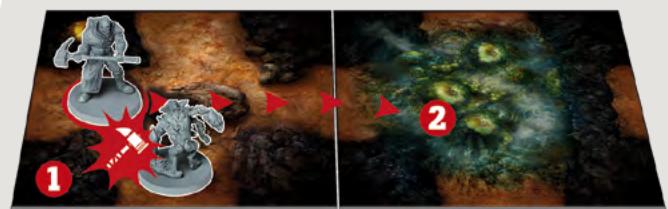
Both movement and perform an action are optional. A warrior cannot begin to move, perform an action, and then finish their movement.
The different possible actions are:
enter combat
perform an action described in the scenario (denoted by the keyword action).
Use any of their equipment (denoted by the keyword action).
The rules for movement and combat are described in detail on pages 20 and 21 respectively.
Exhausted warrior (with an exhausted state token) Any warrior that has an “exhausted state” token on their board has the following statistics until the next preparation phase: $0 \not , 0 \not \gg , 3 \not \textcircled { \mathbf { p } }$ In addition, they can no longer use any talents and do not draw an instinct card. They do not benefit from any of the advantages linked to their equipment cards unless otherwise indicated on the card. However, they can benefit from any eventual bonuses to their statistics.
PREPARATION PHASE OF THE INFERNAL PLAYER
The infernal player selects which powers of their board of destiny, which powers of their hellhounds and their demons are active this turn by allocating the appropriate amount of dice of destiny on the boards.
These allocated dice of destiny are placed into the appropriate preparation spaces until the conditions required to trigger the power have been fulfilled. They are then moved to to the trigger spaces and the power comes into effect. In order to do this the infernal player carries out the following steps:
Discards all event cards played during the last turn. Place these cards in the event deck discard pile next to the event card deck. Collect all of the dice of destiny located in the trigger spaces. This forms the available dice pool. Dice of destiny located in the preparation spaces may also be added to the available dice pool.
Roll 3 dice of destiny from their available dice pool. The rolling of 3 dice is mandatory - therefore dice of destiny from the preparation spaces MUST be used if not enough dice of destiny from the available dice pool are available.
Allocate all of the rolled dice in whatever manner they like between the different preparation spaces. These spaces can be empty or already have dice on them during this distribution.
Checks whether the active powers' trigger conditions have been fulfilled.
If fulfilled move the dice of destiny in the preparation spaces into the trigger spaces. (Fig.6).
If not fulfilled the allocated dice of destiny remain in the preparation spaces. Fulfilment may occur during the next preparation phase with the allocation of further dice. (Fig.7).
Event card hand size restriction
The number of event cards that the infernal player may have in his hand at any one time is limited to 4.
If that number is exceeded at any time the infernal player must immediately discard down to 4 - the discarded cards are placed in the event card discard pile and none of their effects can be used.
These cards can be used at the time indicated in their description and must then be discarded.
THREAT PHASE OF THE INFERNAL PLAYER
Once the dice of destiny have been allocated and the powers triggered, the infernal player can bring their demon warriors into play. In order to do this, they can spend as many TP as they choose from their threat point storage zone taking into account the cost of each warrior and their associated restrictions.
In most scenarios, the infernal player has a demon warrior reserve pool consisting of 11 troglodytes, 2 hellhounds and at least 1 demon, from which they take the miniatures to bring into play.
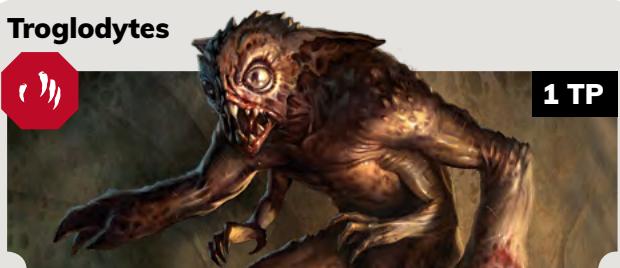
Each troglodyte costs 1TP to bring into play. Troglodytes have the following statistics: 1 1 , 3 et 1

A hellhound costs 3TP to bring into play. The infernal player has a maximum of 2 hellhounds in any one game.
Hellhounds have the following statistics:
04,0 λ,4①et 3❤.
When a hellhound is brought into play, the infernal player can use one of the die from their available dice reserve pool to immediately trigger their power. The value of this dice of destiny is chosen by the infernal player and triggers that hellhound's power.

The infernal player can only bring into play the demons specified by the scenario currently being played.
The statistics, talents, abilities and powers of these demons are described on their boards.
Important: the infernal player can trigger the power of the demon during its preparation phase even if its miniature is not yet in play!
The infernal player chooses the tile or tiles on which their warriors are brought into play, taking into consideration any tile occupation limits (see Movement: Tile occupation rule below), and the following two restrictions:
Tile with an opening
The tile must have at least one unexplored opening. An opening is considered “unexplored” when it does not lead to another tile.
Empty tile
The tile must not contain any enemy warriors.
Warriors that are brought into play during the threat phase can act normally during the following activation phase.
ACTIVATION PHASE OF THE INFERNAL PLAYER
Each infernal warrior on a tile can be activated. Each warrior is activated one warrior at a time. Each warrior must have finished their activation before the next warrior can be activated. During their activation, a warrior can:
move first, then perform an action, OR
perform an action first, then move.
Both movement and perform an action are optional. A warrior cannot begin to move, perform an action, and then finish their movement.
The different possible actions are:
enter combat
perform an action described in the scenario.
(denoted by the keyword action).

Fig.8
MOUEMENT
Movement is always optional. A warrior moves by leaving a tile by an opening. They can move as many times as they wish within the limit of their value. Leaving a tile costs 1.
Some tiles have an effect that has unfortunate consequences for the warriors. The trigger conditions of each tile's effects are described on pages 25 and 26.
Adjacent tiles
Tiles are considered adjacent if they are in edge to edge contact and an “opening" connects them directly to each other.
Restrictions
There are two restrictions to take into account during movement:
Tile occupation rule: to move onto a tile, the player controlling the warrior who moves must check that the destination tile can accommodate them. A tile cannot accommodate more warriors of each faction than is given by the tile occupation limit. The tile occupation limit is indicated on each tile (Fig.8).
Blocking rule: a warrior can only leave a tile containing enemy units if there are at least as many warriors from their faction as there are enemies (Fig.9).

After the Condemned Scout moves, the Redeemer cannot leave the tile anymore because of inferior numbers.
Exploration
The infernal warriors cannot explore an unexplored opening.
During their movement, each human warrior can leave a tile to explore an unexplored opening to reveal a new tile. This is called exploration. An opening is unexplored if it does not lead immediately to another tile. The player carries out the following steps:
They place their warrior on the opening they wish to explore.
The infernal player takes the first tile from the pile and places it in contact with the opening to be explored, any way they like, as long as the new tile is accessible to the warrior exploring it (Fig.10).
The human player then moves their warrior onto the new tile.
Any effects the tile generates are triggered (description of the tiles pages 25 et 26).
The human warrior may continue to move or explore additional tiles if they still have any remaining points.
Dead ends
If, after exploring an opening, the play area is left with no more unexplored openings, the last tile to have been placed is discarded by the infernal player and a new tile is drawn and so-on until a tile with an unexplored opening appears.


A warrior can attack an enemy warrior who is on the same tile as themselves.
When a warrior attacks, the player who controls them carries out the following steps:
They must choose which of the enemies on the same tile they are going to target. A target can be a human warrior, a demon, a hellhound, a special troglodyte or all of the troglodytes present on the same tile.
The player rolls a number of combat dice equal to the warrior's combat points. Each die with a value higher than or eqùal to the selected target's defense pointsis counted as a hit. Aresult on a combat die is always counted as ā hit.
The player that controls the warrior or warriors that have been hit must then allocate the hits.
Allocation of hits on the troglodytes
A single hit is enough to kill a troglodyte as they only have 1. The miniature is removed from the play area and returned to the demon warrior reserve pool. If several hits are successful, any additional hit is transferred to the next remaining troglodyte on the same tile. Each successful hit kills one troglodyte. (Fig.11).
Fig.11
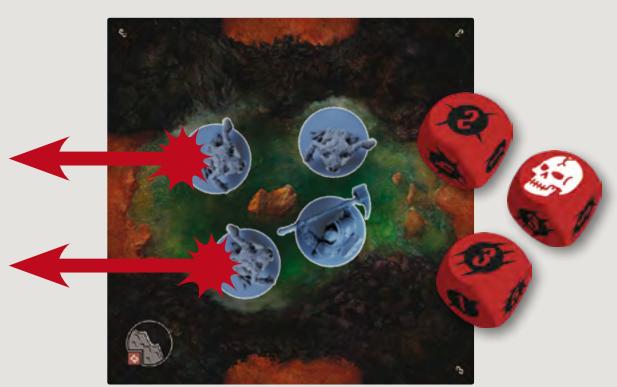
The Redeemer has a of 3 this turn. He is hunting troglodyte - he rolls 3 combat dice - a 2, 3, and . He scores 2 successful hits and kills 2 troglodytes as troglodytes have a of 3.
Allocation of hits on a hellhound
The infernal player places a damage marker for each successful hit on the corresponding hellhound's board. As soon as that damage equals or becomes greater than its, the hellhound is killed, and the miniature is not returned to the demon warrior reserve pool but instead permanently removed from the game.
Allocation of hits on a demon
The infernal player places a damage marker for each successful hit on the corresponding demon's board. As soon as that damage equals or becomes greater than its, the hellhound is killed, and the miniature is removed from the game and placed back into the demon warrior reserve pool. The second time the demon is killed, the miniature is not placed into the demon warrior reserve pool but is permanently removed from the game.
Allocation of hits on a Western warrior
Each successful hit requires the human player to select a line of activation. They then place a damage marker in the corresponding space and that line is then considered canceled. Once all 6 lines of activation of a Western warrior have been canceled, they are killed, and their miniature is immediately removed from the game (Fig.12).
Fig.12

The demon attacks his enemy. He has a of 4 so the Infernal player rolls 4 combat dice. 1,2,4 and 5 which corresponds to 2 successful hits as the Redemeer has a of 4. The Human player choices to place the damage tokens in lines of activation 4 and 6 on the board of the Redeemer.
Important: if the selected canceled line of activation contains the 2 that warrior is not considered “exhausted". A Western warrior becomes “exhausted" ONLY when they receive an activation die that matches a previously canceled line during the preparation phase.
EQUIPMENT
Some human warriors can benefit from equipment that increases their statistics or gives them special abilities. The conditions for obtaining these items of equipment are described in each scenario. Warriors cannot exchange this equipment, drop it, pick it up, or destroy it. Equipment is removed from the game when the owner is either killed or leaves the game.
TALENTS
Some warriors have talents which give them extra abilities during the game. A Western warrior cannot use any talent while they are considered to be exhausted.
A warrior can only benefit from a certain talent once during a game. The use of each talent is described below.

Blessed
The warrior with this talent can, during the preparation phase after the activation dice have been assigned, bless another warrior of their choice.
A warrior cannot be blessed and at the same time receive an instinct card (faith and animal instinct do not mix well). The blessed warrior gains either a bonus of +1or +2until the end of the following activation phase. Furthermore, if the line of activation that the warrior was using is canceled, it is immediately healed.
Place the blessing token, showing the appropriate side, on the blessed warrior's board.
This talent can only be used once per scenario. Discard the blessing token at the end of the activation phase of the warrior.

Bodyguard
During an attack a warrior with this talent can choose to suffer a number of hits allocated to an allied warrior in combat, on the same tile.

Devoted
A warrior with this talent can use certain gifts (scenario dictated) associated to certain lines of activation of their board. If the die chosen for this warrior corresponds to the line of activation of one of their gifts, it can be used.





Elusive
A warrior with this talent can move without taking into account the number of enemy warriors. They are therefore not affected by the blocking rule.
If a warrior with elusive is on the same tile as one or more enemies with impressive, the two talents cancel each other out and the normal blocking rule applies to all.
Frenzied
A warrior with this talent can re-roll each combat die once if it did not produce a hit the first time during step 2 of a combat.
Impressive
A warrior with this talent can prevent one or more enemies from leaving the tile that they are currently on.
If a warrior with elusive is on the same tile as one or more enemies with impressive, the two talents cancel each other out and the normal blocking rule applies to all.
Ranged combat
A warrior with this talent can attack an enemy warrior on the same tile or on an adjacent tile.
Resistant
A warrior with this talent ignores the first hit they suffer in each activation phase.


GIFTS
The devoted talent allows the warrior has it to use gifts. Which gifts are available to the owner of the talent are scenario dictated. For each of the indicated gifts, the player places the corresponding token on the warrior's board during setup. Each gift is associated with a die value. The gift is activated if the warrior receives an activation die of the same value and they are not exhausted.
PUNISH THE EVIL
After having rolled the dice during a combat, the warrior with this gift strikes a hit for all result higher or equal to 2 irrespective of the of their target.
This gift has no effect if the warrior uses a grenade or a blunderbuss.

The effect of this aura starts at the end of the preparation phase of the human player. All allied warriors gain +1 until the beginning of the preparation phase of the human player. Mark the warriors by using an anger token.
AURA OF COURAGE
The effect of this aura starts at the end of the preparation phase of the human player. Choose another allied warrior.
They gain +1 , +1and +1until the beginning of the next human players preparation phase.
Mark the chosen warrior's board using a courage token.

During their next preparation phase, the human player rolls 2 additional activation dice. These additional dice are then placed on the recipient's board to indicate receipt of the gift.
The effect of this gift starts at the end of the preparation phase of the human player. The warrior with this gift can immediately heal the line of activation of their choice of an allied warrior on the same tile as them. Remove the corresponding damage marker.

At the end of the human player's preparation phase, they place the prescience token on the pile of tiles.
The effect of this gift starts during the first exploration carried out during the following activation phase.
The human player secretly chooses the tile that is to be placed from the next 3 of the pile. Furthermore, they choose the orientation of this tile. They must however make sure that the chosen tile is accessible to the warrior who is exploring. The other 2 tiles are replaced on top of the pile in the order the player chooses.
The human player removes the token from the pile after the gift has been used.

At the end of the human player's preparation phase, the warrior with this gift can strike a hit on a warrior of their choice on the same tile. The player of the warrior thus hit then rolls a combat dice. If the result is more than or equal to 4, the holder of the gift also suffers a hit. This gift can be used twice per human player's preparation phase.
TILES
The tile occupation limit is given on each tile as well as a number to facilitate game setup. Some tiles carry special rules that are indicated by an icon. These special rules may produce limited-use effects. When this is the case, a resolved effect token is placed on the icon after resolution to signify that the effect has already been applied and can no longer be used.

Alarm
This effect is only triggered the first time a human warrior enters the tile. During the next threat phase, the infernal player rolls one additional die of destiny. The infernal player places a die of destiny on thealarm tile dice space on the board of destiny. After resolution of the effect, the player places a triggered effect token on the tile's icon.

Booby-trapped tunnel
This effect is only triggered the first time a human warrior enters this tile. The infernal player rolls a die. If the result is 3 or more, the human warrior suffers a hit. After resolution of the effect, the player places a triggered effect token on the tile's icon.

Carnivorous tunnel
Each time a warrior on this tile is hit during a combat, the effects of that hit are doubled. When a troglodyte is hit on this tile, two troglodytes are killed instead of one.

Demonic well
The infernal player can always bring into play a demon or a hellhound on this tile. They do not need to take into account the restrictions concerning a tile with an opening or an empty tile. If they do so, the cost of the demon is reduced by 1 TP.

Devouring pit

For every warrior on this tile at the start of their preparation phase, the controlling player rolls a combat die. If the resulting value is equal or higher than 4, that warrior suffers a hit.
Flooded tunnel
When a warrior enters this tile, they must immediately end their movement (even if theirpoint resource is not fully used up).
Leaving this tile will cost a warrior their fullpoint resource.


Fog
Any warrior on this tile has aof 6.
Healing fountain
When this tile is placed in the game, two miraculous water tokens are placed on it. At the start of one of their preparation phases (before rolling the dice) the human player can discard one of these tokens to heal a line of activation of their choice from a warrior on this tile. The corresponding damage marker is removed from the warrior's board. This healing effect can be carried out twice.

Hole in the ground
When this tile is played, the infernal player must place a hole in the ground token on another tile already in play. The troglodytes consider all the tiles with a hole in the ground token and all the hole in the ground tiles as adjacent and can move between them. Moreover, the blocking rule and the impressive talent are ignored if a troglodyte moves between tiles using a hole in the ground.

Lair
The infernal player does not need to take into account the restrictions concerning a tile with an opening and an empty tile.

Luminescent mushrooms
The of any warrior on this tile can never be higher than 3.
Board of destiny: p.10, 11, 13, 15, 16, 18, 25. Cards:

Sanctuary
The human player rolls a die for each of the infernal warriors who enters this tile. If the resulting value is equal or higher than 5, that warrior suffers a hit.

Stash
The effects of this tile are current scenario specific. After resolution of the effect, the player places a triggered effect token on the tile's icon. If nothing is specified in the special rules of the scenario, the tile has no effect.

Tomb
This effect is only triggered the first time a human warrior enters this tile. The human player draws an instinct card. After resolving the effect of the tile, the player places a resolved effect token on the tile's icon.
Index
Ability: p.8, 16, 19, 22, 23.
Action: p.18, 20.
Blocking: p.20, 23.
Equipment card: p.13, 14, 16, 18, 22.
Event card: p.11, 13, 15, 16, 18, 19.
Dice of destiny: p.8, 10, 11, 12, 15, 18, 19, 25.
Exhausted: p.12, 16, 17, 18, 22, 23, 24.
Exploration: p.21, 24.
Faction: p.6, 12, 14, 20.
Force: p.6, 7, 8, 9, 10, 14.
Gift: p.7, 12, 14, 16, 17, 23, 24.
Hand size restriction: p.17, 19.
Hellhound: p.8, 10, 12, 15, 16, 18, 19, 21, 22, 25.
Line of activation: p.7, 13, 17, 22, 23, 24, 25.
Movement: p.7, 8, 9, 10, 18, 20, 21, 25.
Occupation limit: p.12, 20, 25.
Phase of activation: p.16, 17, 20, 23, 24.
Phase of preparation: p.11, 16, 17, 18, 19, 22, 23, 24, 25.
Threat phase: p.11, 16, 19, 20, 25. Player:
Human player: p.6, 7, 12, 13, 14, 16, 17, 21, 22, 24, 25, 26.
Infernal player: p.6, 8, 10, 11, 12, 13, 15, 16, 18, 19, 20, 21, 22, 25.
Power: p.8, 10, 11, 12, 13, 16, 18, 19.
Prima Matiera gems: p.12, 15.
Available dice reserve pool: p.10, 18, 19.
Preparation space: p.8, 10, 18, 19.
Trigger space: p.8, 10, 11, 18.
Adjacent tile: p.20, 23.
Empty tile: p.11, 20, 25.
Tile with an opening: p.11, 20, 25.
To kill: p.22.
Troglodyte: p.8, 9, 10, 11, 16, 19, 22, 25. Warrior:
Allied warrior: p.6, 23, 24.
Demon warrior: p.6, 8, 9, 10, 19, 22.
Enemy warrior: p.6, 20, 21, 23.
Human warrior: p.6, 16, 17, 21, 22, 25, 26.
Infernal warrior: p.6, 16, 20, 21, 26.
Western warrior: p.6, 7, 8, 10, 12, 13, 16, 17, 22, 23.
Warrior board: p.6, 7, 12, 14, 16.
Game Designer: CROC with the participation of Laurent Pouchain.
Character and Cover Artwork: Pascal Quidault.
Tile Artwork: David Demaret.
Equipment Artwork: Milan Nikolic.
Sculptors: Gautier Giroud, Martin Lavat, Stéphane Simon & Stéphane Nguyen.
Graphic Design: Loïg Hascoët & Vincent Jamgotchian.
Scenario Writers: CROC, Guillaume Gigleux, Philippe Masson, Philippe Villé & Thierry Vareillaud.
Translators: Rebecca Sevoz & Bart Hulley.
Introduction: Thomas Hervet.
Publisher: David Bertolo.
Rules: Erwan Hascoët, Tony Berart & David Bertolo.
Proofreaders: Tony Berart, David Bertolo, Laurent Pouchain, Sylvain Thomas, Matt John, Barry Doublet, Tracey Fraser-Elliott & Chaz Elliott. Many thanks to the members of the www. the-overlord.com community for their feedback!
Production Manager: Tracey Fraser-Elliott.
Testers: David Bertolo, Tony Berart, Yohann Hériot & Manu Crochet.
Thanks to Asmodee, Geoffrey Picard, Marc Mathaly and the teams that worked on the previous version of the game.
下载 Markdown原文为社区整理/出版社公开资料,版权归原作者,仅供个人学习查阅。