
二氧化碳Co2
一句话概览
二氧化碳 是一款已收录于村了吗规则库的桌游,支持 1–5 人,原名 Co2。
本页内容:一句话概览 · 常见问题
这游戏怎么玩
- 本站已收录这款游戏的规则资料,可以在对话里直接提问规则细节。
常见问题(FAQ)
以下 1 条问答中 0 条来自站内玩家的真实提问,其余 1 条为本站整理的常见疑问;答复内容保持原样。
二氧化碳支持几个人玩?
1–5 人。
去哪查完整规则
想核对具体规则细节、卡牌效果或某个回合的结算方式,可以在村了吗里选中这款游戏后直接提问。
同类桌游
- 卡坦岛德式
- 工业革命:伯明翰德式
- 勃艮第城堡:特别典藏版德式
- 方舟动物园德式
- 卡卡颂抽象
- 瘟疫危机传承:第一季美式
- 阿瑞迪亚:勇踏征途美式
- 重塑宇宙德式
- 幽港迷城美式
- 埃多拉的德鲁伊德式
规则原文(Markdown)
本站收录这款游戏的规则原文 1 个文件,此处内联渲染 1 个,可直接展开阅读或下载。
co2 eng.md46.0 KB
| 30 two-sided project tiles 5 Forestation power plant tiles | 26 Lobby cards 13 UN Goal cards |
| 5 Biomass power plant tiles | 7 Company Goal cards |
| 5 Solar power plant tiles | 6 Event cards |
| 5 Recycling power plant tiles | 20 coins of $1 |
| 5 Cold fusion power plant tiles | 15 coins of $2 |
| 10 Coal power plant tiles | 10 coins of $5 |
| 10 Oil power plant tiles | 5 coins of $10 |
| 10 Natural Gas power plant tiles | 1 starting player tile |
| 8 Regional Agenda tiles | |
| 18 Summit tiles |

In the 1970s, the governments of the world faced unprecedented demand for energy, and pollutive power plants were built everywhere in order to meet that demand. Year after year, the pollution they generate increases, and nobody has done anything to reduce it. Now, the impact of this pollution has become too great, and humanity is starting to realize that we must meet our energy demands through clean sources of energy. Companies with expertise in clean, sustainable energy are called in to propose projects that will provide the required energy without polluting the environment. Regional governments are eager to fund these projects, and to invest in their implementation.
In the game $\left( 0 _ { 2 } , \right.$ each player manages an energy company responding to government requests for new, green power plants. The goal is to stop the increase of pollution, while meeting the rising demand for sustainable energy — and of course profiting from doing so. You will need enough expertise, money, and resources to build these clean power plants. Energy summits will promote global awareness, and allow companies to share a little of their expertise, while learning still more from others.
Remember, if the pollution isn’t stopped, it’s game over for all of us.
Game components
1 main board
100 wooden discs, 20 of each player color
20 wooden pawns, 4 of each player color
25 white tech resource cubes
40 CEPs: big, purple wooden discs
1 CEP Market Price marker: big, red wooden disc
1 Global ${ \sf { C } } 0 _ { 2 }$ Pollution Level marker
1 Decade counter
1 Round counter
Setup
Place the gameboard on the table. Each player chooses a color and takes:
-
All the discs of that color.
-
1 scientist pawn of that color. Put the other 3 scientists in the recruitment pool 1 .
-
From Start Player clockwise to 5th player: 3, 4, 4, 5, 5 coins
-
2 Carbon Emission Permits (CEPs)
Choose the starting player randomly;
give him the ‘Start Player tile’ 2 .
Each player places 1 color disc on the “0” number of the scoring track 3 . Player color discs will be also used to mark ownership of green power plants 4 and Expertise 5 in each energy source.
Decade & Round track
Place the Decade counter on the Decade track 6 and the Round counter on the Round track 7 on the space indicating the number of players for the game (assign each of the above tasks to the player sitting next to it. He will be responsible for managing it during the game).
Technological Resource cubes Place the white tech resource cubes on the board 8 .
Money
Make a bank outside the board, and choose a player to manage it 9 . Money is open to all during the game. If you ever want to know how much money another player has, you just have to ask.
Projects
Separate the projects by type (energy source symbol) and place them near the board 10 .
Green Power Plants
Separate the Green Power Plants by type, then organize each type by tech resource cost, (tiles with a lower resource numbers go on top), and place them near the board 4 .
World summits
Shufle all 2-topic Summit tiles. Place them randomly, face-up, in their proper places on the board 1 Shufle all the remaining Summit tiles (mix the 2-, 3-, and 4-topic ones together), and make a facedown pile 12 .
Regional Agenda tiles
Distribute the Regional Agenda tiles randomly in their proper places on the board, face-up, one to each region 13 . Remove the remaining tiles from the game.
Fossil Fuel Power Plant tiles
Make a random face-down pile with all the fossil fuel power plant tiles. 14 . For each region, take the top tile, and place it face-up on the leftmost space of the region’s energy demand spaces 15 .
Add up the ${ \sf { C } } 0 _ { 2 }$ pollution level of all fossil fuel power plants on the planet (all regions), using the following ${ \sf { C } } 0 _ { 2 }$ value for each one: Coal = 40 ppm, Oil = 30 ppm, Gas = 20 ppm. Place the Global CO₂ Pollution Level marker (black cylinder) on the corresponding number of the Global ${ \sf { C } } 0 _ { 2 }$ Pollution track 16 .

Example: In setup, the players end up placing 2 coal power plants, 3 oil power plants, and 1 gas power plant, giving a total of 190 ppm global CO₂ pollution at the start of the game: 80 for coal (2×40) + 90 for oil (3×30) + 20 for gas (1×20). The game will begin with the Global CO₂ Pollution Level marker at the number 190 on the Global $C O _ { 2 }$ Pollution track.
Carbon Emission Permits (CEPs) In each region, place a number of CEPs equal to the empty energy demand spaces 17 : 2 in Africa, 5 in Asia, etc ...). Make an outside bank with the leftovers.
Market
Place a pile of 2 CEPs in the middle of the market, and place the red CEP Market Price marker on the 3 space of the market price scale. This will be the initial price of the CEPs 18 .

Company Goal cards
Depending on the number of players, you need to remove certain Company Goal cards from the game:
1-player game: Remove numbers 27,
30, 32, and 33.
2-player game: Remove numbers 28,
30, and 33.
3-player game: Remove number 30. Secretly, give one Company Goal card 19 to each player. The spare ones are removed from the game.
UN Goal cards
Make a face-up display near the board with 10 cards (7 in the 2-player game) 20 . Remove the others from the game.
Event cards
Shufle all the Event cards, and create a face-down deck beside the board, near the Event space 21 . Reveal 1 Event card face-up on the Event space, then reveal the top card of the deck, such that 2 Event cards are visible.
Lobby cards
Shufle all the Lobby cards and give 5 to each player 22 . Experienced players are advised to use a card drafting system. In that case, choose 1 of the 5 cards and pass the other 4 to the player on your right. Then from the 4 received, take one and pass 3 to the left. Continue doing this until there aren’t any cards left to pass and each player has 5 cards in his hand.
You are ready to start playing!
Play the game
A game of ${ \sf { C } } 0 _ { 2 }$ spans 5 decades (6 in the 5-player game), each one split into the 2 following phases:
-
Supply Phase
-
Operations Phase
1 Supply Phase
Note: in the first decade, skip this phase, as it was replaced by the setup.
Players must do the following in order:
-
Distribute Income;
-
Energy Supply;
-
Resolve the Event.
1.1 Distribute income
Income is paid only to players in the 1st and 2nd positions in each energy source on the Expertise track (see 2.2.1.1 Expertise). In a 2-player game, only 1st place in each energy source receives income.
Players may choose to receive their Income as money and/or victory points. The amount of money / victory points earned as ‘income’ is depicted beside the player’s disc for each Expertise track. In case of a tie for 1st or 2nd place, all tied players receive the full income.

Example: Orange is the leading expert on biomass energy sources and he is second in recycling. At the side of those two orange discs on their respective Expertise tracks, he sees “4” and “2”. So, Orange receives 6 income for the turn. He decides to take the 6 income as 3 coins and 3 victory points.

Example: In solar Expertise, Purple and Blue are tied for first place. Orange, Yellow, and Black are tied for second place. Income is paid to all players.
1.2 Energy Supply
Each decade, any region with any tech resources consumes one; return the resource cube to the general supply.
Fossil Fuel Power Plants are the pollutive energy sources in the game. They are necessary to fulfill energy demand not covered by green power plants. Each type of Fossil Fuel Power Plant produces a diferent level of ${ \sf C } 0 _ { 2 }$ pollution in the game. Each time these Fossil Fuel Power Plants come into play during this step of the Supply phase, the global ${ \sf C } 0 _ { 2 }$ pollution level increases and a CEP must be paid to the bank.
Players have to determine which Regions need energy: Beginning in any region, and going clockwise around the world, players must see if the energy demand space that matches the current Decade number is empty or is occupied by a green power plant.
If it has a green power plant, or all spaces in a region are totally filled, move on to the next region.
If the space is empty:

-
Take the top fossil fuel power plant from the pile and fill that energy space with it; in the example above, a Natural Gas power plant is filling on the second space of South America to meet demand for the 2nd decade.
-
Increase the global CO₂ pollution level according to the ${ \sf { C } } 0 _ { 2 }$ output of the fossil fuel power plant. (Coal = 40 ppm, Oil = 30 ppm, Gas = 20 ppm).
-
The player who Controls the Region must pay 1 CEP to the bank from his hand, or from a region he controls (It doesn’t have to be this region!); if no one Controls the Region, the CEP is taken from the region’s pile. If you don’t have a CEP in your hand or in any of your controlled regions, you must buy one from the market. If you have insuficient money to buy a CEP from the market during the Supply phase (and only during this phase), you must exchange VPs for 1 coin each, until (and only until) you have enough to pay; move your disc one step back on the VP track for each coin taken. Negative points are allowed.
1.3 Events
If the global ${ \sf C O } _ { 2 }$ pollution level is 350 ppm or higher, a disaster occurs in the region specified by the event card on the event space of the event display.
In order to provide relief and help rebuild the region, any player that is not supplying power to the region (i.e. he doesn’t have at least one green power plant built there) must contribute one tech resource to the region. If player doesn’t have enough resources to help the region, he immediately loses 2 victory points for the callous neglect of a region struck by an environmental crisis (negative points are allowed).
If the global ${ \sf { C } } 0 _ { 2 }$ pollution level is in the safe zone (below 350 ppm), nothing happens to the region, but the event is still considered resolved. (Disaster averted!)
After the event is resolved, discard that location card and move the face-up card from the deck to the Event space. Flip the top card of the Event deck face-up on top of the deck.
The tech resources contributed to the region stay in the region. The regional government will ration these technological resources as grants for projects that will build new green power plants in the region. Each time someone builds a green power plant in the region, the regional government will provide one tech resource (if it still has any) to the project for free. That means that if you need two tech resources to build a power plant, the government pays one, and you pay the other.
2 Operations Phase
The Operations phase is split into rounds. The number of rounds each decade depends on the number of players in the game:
$$
\begin{array} { r l r } { { 2 } \mathsf { p l a y e r s } \quad } & { { } } & { 5 \mathsf { r o u n d s } } \ { 3 \mathsf { p l a y e r s } \quad } & { { } } & { 4 \mathsf { r o u n d s } } \ { 4 \mathsf { p l a y e r s } \quad } & { { } } & { 3 \mathsf { r o u n d s } } \ { 5 \mathsf { p l a y e r s } \quad } & { { } } & { 2 \mathsf { r o u n d s } } \end{array}
$$
Count the rounds by moving the pawn on the Round track one step up, until it reaches the last space.
Each round starts with the player in possession of the ‘Start Player tile’, and proceeds in clockwise order, with each player taking a turn. On your turn you must take 1 Action, and you have the option of also performing one or more Free Moves (see 2.2 Free Moves). Finally, you will choose one of your scientists on a project to increase your expertise (See 2.2.1.1 Expertise).
After all the rounds are complete (you just finished the round on the empty space), the Operations Phase is over:
-
Advance the Decade marker one space.
-
Return the Round marker to the space depicting the number of players in the game.
-
Pass the ‘Start Player tile’ to the left (or use the Auction Variant).
-
Begin a new Decade.
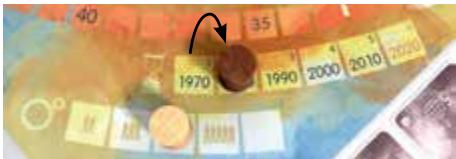
Example: The decade marker has been advanced from first to second decade.
2.1 Actions
The available actions are:
-
Propose Project
-
Install Project
-
Construct Power Plant
Projects are needed in order to build green power plants that rely on renewable resources. There are 5 sources of green energy in the game: forestation*, solar, cold fusion, biomass, recycling.
*Forestation is truly an important element in the control and reduction of global CO₂ emissions, and thus was an imperative element to include in this game. In an efort to keep the gameplay and rules terminology streamlined, forestation is being treated as a green energy source.
A project needs to be proposed, then installed before a power plant can be built with the construction action.
2.1.1 Propose Project

You have your company design a green energy project for a region. In exchange, your company receives a grant from the region. The region takes ownership of the project; it does not belong to any one player.
Choose a project of any energy source (solar in the example on the right), take the corresponding tile from the pool, and place it darkside-up on any empty project

space in any region that requires that source of energy. A region’s energy requirements are shown on its Regional Agenda tile.
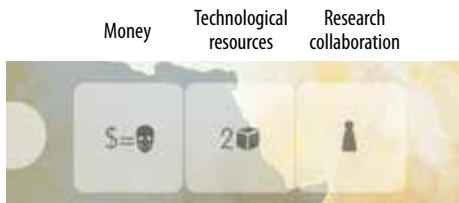
Proposing a project to a Region will always reward you with a diferent grant, depending on the space chosen. The grant is depicted on the space where the project is placed:
-
Money. Take money from the bank equal to the number of Carbon Emissions Permits (CEPs) in the region at that particular moment. If there are no CEPs in the region, you still get 1 coin.
-
Technological Resource cubes. Take two from the general supply.
-
Research collaboration. Choose one: a) Move one of your scientists or b) take one of your scientists from the recruitment pool to your hand. Once recruited, the scientist is available to you for the rest of the game.
2.1.2 Install Project

Your company installs the energy network and infrastructure to distribute the power that will be generated by the coming Power Plant, in exchange for some benefits.
In order to do that, you need to choose any proposed project, pay 1 CEP to the bank, and then flip the project tile. You receive the installation benefits shown on the flipped tile (see the solar example to the right).

Installation benefits depend on the project’s energy source:
Forestation: 2 CEPs from the Market
Solar: 3 tech resource cubes
Cold fusion: \$5 and 1 tech resource cube
Biomass: \$3, 1 tech resource cube, and 1 CEP from the Market
Recycling: \$5 and 1 CEP from the Market
Installing a project has no monetary costs to your Company, but the process creates pollution, leaving an ecological footprint. As a result, you have to pay 1 CEP to the bank. This CEP fee must be paid before you receive the installation benefits, and can be paid from your hand or from any Region you control.
If you have your own scientist on the project, you may leave it there after installation. If an opponent’s scientist is on the project, you must pay him to leave (See 2.2.1 Scientists).

2.1.3 Power Plant Construction This action allows the realization of any installed project as a new Green Power Plant (matching the project, of course). When built, these power plants score Victory Points and give Expertise to the player who built it.
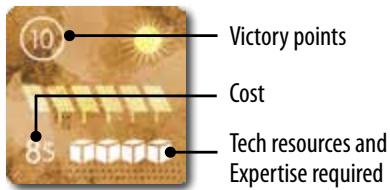
Diferent power plants (forestation, solar, cold fusion, biomass, recycling) have diferent costs, and need diferent amounts of technological resources and levels of Expertise in order to be built.
To build a Green Power Plant:
The region must have an installed project of the same energy source as the power
plant.
Your Company must have Expertise in that energy source, equal to or higher than the number of tech resources required to build it.
Your Company must have the amount of money and the technology resources (shown on the tile) to pay the construction cost.
To build the plant, perform the following steps:
-
Select the top power plant from any pile in the bank; find a region with a matching installed project (same energy source); pay the bank for the power plant. For example, you want to build a Solar power plant in order to realize an installed Solar project. The Solar power plant costs \$10 and 2 technology resources. You must be in the 2nd space or beyond in Solar Expertise. Pay the \$10 and tech resources to the bank.
-
Place the power plant tile on the region’s leftmost empty energy demand space on the board.
-
Mark your ownership by placing a disc of your color on the new power plant.
-
You score the amount of points shown in the top-left of the power plant tile. Advance your disc accordingly along the scoring track.
-
You also earn 1 Expertise in the energy source of the power plant.
-
See if you have taken Control of the Region’s Energy supply (see 3 Region control).
-
Send any scientist on the project away (see 2.2 Free Moves and 2.2.1 Scientists).
-
Lastly, remove the used project tile from the board and return it to the pool (it will be available again).
If all the Region spaces are already filled (without any empty spaces) the newly built power plant will replace the oldest fossil fuel power plant in the region. In that case:
Replace the leftmost fossil fuel power plant with the new green power plant.
Take 1 CEP from the Market and place it in the Region, respecting the Regional CEP Limit (see below).
Remove the replaced power plant from the game, and reduce the global CO₂ pollution level a number of steps equal to the pollution level of the replaced power plant. (Coal = 40 ppm, Oil = 30 ppm, Gas = 20 ppm).
Regional CEP Limit: Regions cannot support more CEPs than the number of their Energy Demand Spaces. (Africa can have a maximum of 3 CEPs; Asia, 6; Europe and North America, 5; Oceania and South America are limited to 4).

Note: Green Power Plants cannot be replaced. If a region only has green power plants, it is no longer possible to build power plants in that region. Any leftover installed projects in the region remain on the board. You can still propose and install projects that the region no longer needs. The regional government is corrupt enough to pay you anyway.
2.2 Free Moves
Anytime during your turn, you have the option of taking any or all of the following free moves once:
• Move 1 Scientist
Make 1 visit to the Market
• Play or score 1 card
2.2.1 Scientists

Representing the research of Companies worldwide in green energy sources, scientists work on projects and summits, earning Expertise for their Company. Scientists can be recruited to your company, sent to work on a project, and can travel from project to project around the world, and attend summits.
With a Free Move, you can move one of your Scientists:
from your hand to any vacant (without a scientist) project in any Region;
from any project to another vacant project or to your hand;
from any project to a summit topic about the same energy source as the project.
It’s also possible that one of your Scientists gets moved as part of another player’s Action, because your opponents may install or construct projects on which your scientists are working. In that case, the active player must pay you 1 coin before she can remove your scientist from that project. You take the scientist, and decide between:
keeping the scientist in your hand and earning 1 Expertise in the energy source of the project;
or sending the scientist to a summit topic about the same energy source as the project.
After sending your scientist away, the active player must immediately utilize the tile. She cannot use any Free Move between sending your scientist away and using the tile.
Example: It’s Blue’s turn. He wants to install a solar project. That project has a Purple scientist. Before installing it (flipping the tile), Blue returns the scientist to Purple, paying him 1 coin. Purple decides to take the scientist into his hand and immediately gain 1 Expertise in solar energy (note: same as the project). Now, Blue must install the project before he makes any of his remaining Free Moves.
Scientists are recruited from the recruitment pool using the Propose Project action on a space that grants Research collaboration (see Propose Project). Each player is limited to 4 scientists.
2.2.1.1 Expertise

Expertise is the knowledge and political value of the Companies in each of the green energy sources in the game.
You gain Expertise in an energy source when:
one of your scientists is working on a project. At the end of your turn, you choose 1 project overseen by one of your scientists, and score 1 Expertise in the same energy source as the project;
you build a new green power plant. For example, if you build a new Solar power plant, your Expertise in Solar immediately increases 1 step;
a Summit is completed. At the end of the turn in which that happens, each of your scientist participating in the summit earns your Company 1 Expertise in the energy source matching the ‘topic’ the scientist is on, and each Company participating in the summit earns 1 extra Expertise in any one of the topics of that summit (see 2.2.1.2 World Summits);
and when you choose to take a scientist back into your hand because another player installs or constructs a project on which one of your scientists is working (see 2.2.1 Scientists).
Example: It’s Orange’s turn, he has 1 scientist in a Cold fusion project in Europe. On his turn, he proposes a biomass project in Asia and sends a scientist from his hand to work on the newly proposed project. Because Orange now has scientists working on both projects, at the end of his turn, he may choose to earn 1 Expertise in Biomass or Nuclear cold fusion.
Your Expertise in each type of energy is tracked on the board by a player disc. When you earn your first point in Expertise in a energy source place your disc in the first space.
The benefits of Expertise:
Income: At the beginning of the Supply Phase, the players in 1st and 2nd place in each energy source, receive money and /or victory points.
License to Build: In order to build a power plant, you must have enough Expertise in that energy source. The construction icon
on the Expertise track indicates the minimum Expertise required to build the lowerlevel plant of this type.


Example: To build the lower-level forestation plant, your forestation Expertise needs to be at or beyond (as the yellow disc) the 3rd space of the track.
Region Control: Expertise are a tie-breaker when determining ‘Region Control’.
Bonus: When the Expertise disc reaches a specific space, a bonus is given.
The bonuses are:
Energy symbols: You gain 1 Expertise in the energy source matching the symbol.
Resource: You receive 1 tech resource cube.
Region CEP: You place a CEP from the market on any region of your choice.
Expertise symbol: You gain 1 Expertise in any energy source.
Note: It is possible to create combos with these bonuses!
2.2.1.2 World summits

Companies can send their Scientists to represent their interests at a World Summit, in order to gain Expertise in the Energy sources that are the topics of that summit. The scientists will share their knowledge — knowledge that they have acquired by researching green energy sources — with the world. They will also learn about other energy sources discussed at the summits.
In order to gain Expertise at these summits, interaction with other scientists is crucial in order to establish the types of protocols determined by a World Summit like Kyoto.
A “summit topic” is the climatic theme for discussion at a particular summit. It is represented by the energy source symbol depicted on the tile. When every topic at a summit has a scientist giving a talk on it at the end of any player’s turn, all participating players gain Expertise, in turn order, ending with the active player. There is only room for 1 scientist to talk per topic. But, at the same Summit, scientists from diferent players may speak on diferent topics.
After scoring, the scientists return to players’ hands, and a new summit tile replaces the completed one.
Note: A scientist can only be moved to a summit from a matching project. Once at the summit, the scientist cannot move away until the summit is completed.

The Expertise you gain from a summit is as follows:
Each of your scientists that spoke at the summit earns your company 1 Expertise in the energy source matching the topic that the scientist represented at that summit.
Additionally, by attending the summit, your company gains 1 extra Expertise in any topic covered at that summit.

Example: A Summit with Forestation, Nuclear Cold Fusion, and Recycling is completed. The Orange player has scientists speaking on 2 topics: Recycling and Nuclear Cold Fusion. The Purple player is speaking on 1 topic: Forestation. The Orange player gains 1 Expertise in Recycling, 1 Expertise in Fusion, and 1 additional Expertise in any one of the 3 summit fields — even the topic on which he wasn’t speaking, if he likes. Purple increases his Expertise in Forestation energy by 1, and 1 additional Expertise in any one of the 3 summit topics.
2.2.2 Market
The Red CEP over the numbered circle near the center of the board indicates the current price of the CEPs.
You can buy 1 CEP, taking it from the market pile to your hand, by paying the bank the price indicated. If the market pile runs out, you will see the word “STOP” to remind you that you can no longer sell during your turn, because the market price is changing. Refill the market with 2 CEPs from the bank, and increase the CEP price by 1 (maximum price: 8); otherwise, the price does not increase.
If and only if the market price has not changed yet during your turn, you can sell 1 CEP from your hand (and only from your hand) to the Market. To do this, place a CEP on top of the market pile, and receive money equal to the current price. The CEP price goes down by 1 (minimum price: 1).
You may never both sell and buy in the same turn, and you must complete the transaction before anything changes the market price.
Important Note:
Every CEP that enters play is taken from the market, with the exception of the ones that refill the market when it’s empty. Those come from the bank.
Every CEP paid/spent goes to the bank, except when you sell 1 CEP: In this case it is added to the CEP market.
2.2.3 Playing or scoring a Card During your turn, you may play 1 Lobby card or score 1 UN Goal card.

Lobby cards represent influence of political lobbyists.
When played, they provide some abilities to you. During your turn, you may play 1 lobby card from your hand. Then, the card is removed from the game.

Any lobby card can be used one of two ways: The main lobby at the center, and the minor lobby at the bottom. To get the main lobby benefit, you have to take a specific action, which is specified by an icon at the top of the card: propose, install, construct, send scientist to a summit, or take a market action. The minor lobby has no such condition, and may be taken anytime during your turn.
UN Goal cards represent rewards the UN ofers to the first company to accomplish them. They are scored from the faceup display, and provide the points indicated on the card. Once you have constructed all the types of green power plants

depicted on a UN card, pay one resource to the bank then take the card using your Free Move, score it, and place it face-down in front of yourself. Extra points are awarded at the end of the game to the player who has the most. Remember: On your turn, you can play a Lobby card, or claim a UN Goal card, but not both!
3 Region Control
Each region has a Regional Agenda tile. These tiles represent the only 3 clean energy sources the Region will accept.

If you provide the region the most types of these 3 sources, you control the region. That gives you some advantages (and one responsibility):
You can take CEPs from regions you control, anytime you need to spend them.
At the end of the game, you will receive all CEPs from regions you controls (which you will sell).
You are responsible for the CEPs your regions need during the ‘Energy Supply step’.
Whenever you build a new green power plant, check to determine whether you wrest control from the player who currently controls the region (if any). If no one controlled the region, you take control automatically, and place one of your color discs on the Region Control space near the region.
In case both of you provide the same number of diferent energy sources, control goes to the player with the energy source in the highest position on the Regional Agenda tile, counting from top to bottom, then second position, then third.
If you both have identical types of power plant in the region, compare Expertise. Only compare plant types you have built in the region. Keeping that in mind, region control goes to the player with more Expertise in the top energy source the Region requires. In the case of a tie, compare Expertise in the second energy source; and in the case of a further tie, compare Expertise in the third one. If Expertise is identical in all sources of energy that you have built there, you take Region Control from the player currently controlling the region. If you win, replace the current controller’s control token beside the region with your own.
Note: The only projects / power plants that are allowed to be in a region are those on its Regional Agenda tile.

Example 1: Whoever provides the region with more types of energy will control the region. Orange satisfies more of the region’s political agenda by supplying two of the region’s desired types of energy source — even though Purple has more total power plants. Orange has control in this region.
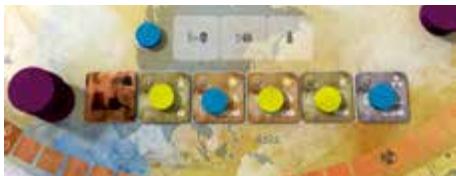
Example 2: Both players have the same number of energy types.
Both players have power plants in 2 diferent types of energy source; the energy source in the highest position on the Regional Agenda tile is the same, so, they check the 2nd-highest energy source on the tile: Fusion. Blue is in control.

Example 3. Both players have identical types of power plant.
There is a tie for region control, because each has only 1 source of energy, and of the same type. Whichever player has more Expertise in fusion takes control. If they have the same amount of Expertise in fusion, the active player takes control.
Game cards
There are 4 kinds of cards in the game.
-
Lobby cards
-
UN Goal cards
-
Event cards
-
Company Goal cards
Lobby cards and UN Goal cards are described in 2.2.3 Playing or Scoring a Card.
Company Goal cards represent the companies’ goals from the start of the game. One is given secretly to each player during the setup. They will be scored at the end of the game or you can discard yours at any time in exchange for 8 coins. These cards remain

secret at all times, even if they are discarded.
Event cards - These represent regional disasters and the relief efort provided by the players companies. There are 6 event cards representing the 6 regions in the game. Players not in the region will have to be prepared to send the region aid. Make
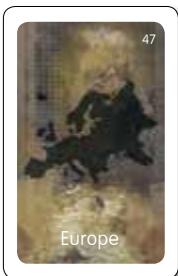
sure you already have either a power plant in the region, or a tech resource to spare; otherwise you will lose 2 points (see 1.3 Events).
CEP movements
The following is a summary of how CEPs move in the game. Please be sure to read it now and refer to it the first few times you play, because the CEP economy is crucial to the game, and getting CEPs to the right places is what makes it work.
About Market
- A CEP goes to the market:
a) From your hand when you sell a CEP;
b) From the bank when the market is empty and need to be refilled with two CEPs.
- All CEPs come from the Market.
About Players
- You take a CEP to your hand:
a) When you install (flip) a project with CEP(s) as a Benefit;
b) When you buy a CEP from the Market;
c) When you play the minor lobby of a Lobby card with a CEP for its minor lobby.
- You pay a CEP from your hand or from a Region
you Control to the bank:
a) When a fossil fuel power plant gets built to meet energy demands in a region you control; b) When you install (flip) a project, and pay 1 CEP for the ecological footprint;
c) As one payment option in the auction variant to determine the first player.
-
A Region pays a CEP to the bank when a fossil fuel power plant gets built to meet energy demands, and no one Controls that Region.
-
The Market sends a CEP to a Region:
a) When you replace a fossil fuel power plant with a new green power plant.
b) When your Expertise disc reaches the Region CEP bonus space.
Game End
Game is over at the end of the Operations phase:
Of the 5th decade (6th in a 5-player game);
If two regions are completely filled with only green power plants;
If the global CO₂ pollution level returns to the safe zone, under 350 ppm.
Game is over at the end of the Supply phase:
If the global CO₂ pollution level is at 500 ppm or higher. In this case everybody loses. Don’t bother to count the points: You need to find a new planet to inhabit.
Once a game-ending condition is met, do the following in this order:
-
Add all CEPs from the regions you Control to your respective hands.
-
Sell all CEPs to the market at the current price (do not adjust the market price).
-
Distribute Income to all players.
Add the following to your scores:
-
X points for meeting your Company Goal (or exchange it for 8 coins);
-
1 point for each 2 coins you have;
-
3 points for the player with the most tech resources in hand. In a tie, all tied players receive the 3 points;
-
3 points for the player who has scored the most UN Goal cards. In a tie, all tied players receive the 3 points.
The winner is the player with the highest score. In case of a tie, the tied player with the most green power plants wins. In case of a further tie, compare the tied players’ Expertise in each energy source, in order (forestation, solar, cold fusion, biomass, recycling) until someone is best. If still tied, whichever tied player control more Regions wins. If somehow it is still a tie, all tied players are winners.
Note: When your score reaches 50 VPs, place a second disc on the number 50 on the Global CO₂ Pollution track, and start the other disc back at 0 on the VP track. At 100 VPs, move the second disc to 100, and reset the other to 0 again, and so on.
Game Advice
CO₂ depicts pollution spinning out of control. Especially in your first game or two, you may feel like there is no hope for a happy ending. While you don’t yet have the technology to reverse the damage of reckless pollution, you work hard to stop pollution — or at least reduce it to a more manageable pace. If you “destroy the planet” on your first go, please don’t be discouraged. Finding the solution to a global problem does not normally happen on the first try. CO₂ gives you a reset button, so you can go back and try again.
Tips from the Designer
Since the projects played belong to the regions, try to protect them by placing a scientist on them. Then, if someone uses “your” project, you get a significant reward.
Try to have a scientist on a project at the end of every turn, even after sending one to a summit. That way, you always receive Expertise at the end of your turn.
Remember that only the first and the second player in each Expertise track can get income and you can take your income as a mix of money and VP.
Variants
Preset Fossil Fuel Power Plant Setups
For your usual games, we suggest that you place the fossil fuel power plants at random during setup.
But, you may also want to begin the game with a pre-configured setup. These are our suggestions:
a) Beginner (Green) - 4 gas, 1 oil, and 1 coal;
global CO₂ pollution starts at 150 ppm. b) Normal (Recycler) - 2 gas, 2 oil, and 2 coal;
global CO₂ pollution starts at 180 ppm. c) Expert (Industrialist) - 1 gas, 1 oil, 4 coal;
global CO₂ pollution starts at 210 ppm.
d) Extreme (Lobbyist) - 6 coal; global CO₂ pollution starts at 240 ppm. Take 6 gas power plant tiles out of the game.
Take the fossil fuel power plants described above place them at random (face-up), one in each region.
Auction to Determine First Player
Experienced players may want to use this auction variant to decide the first player each decade. To determine the first player for the decade, players make a once-around auction, in which they ofer a numeric ‘Value’. The first bidder is the player with the ´starting tile’, and the auction runs in clockwise order. Players may raise the previous bid, or pass. The player who ofered the highest ‘Value’ (it can be ‘0’), pays it, chooses who will be the first player for the next decade and gives him the ´starting player tile’. You are allowed to pay the ‘Value’ bid in coins, tech resources, and/or CEPs. Each coin is worth 1, each tech resource is worth 2, and each CEP’s ‘Value’ is equal to the market price at that moment. You get no change, so if you have pay more than your winning bid, tough!
Solitaire Variant
Earn as many points as you can before global CO₂ pollution rises above 500ppm. Use the base rules, with the following exceptions:
• Setup: Before taking your Company Goal, remove Company Goals 27, 30, 32 and 33 from the game. Keep the UN Goals in a face-down stack.
Select a region. Take 1 of each of the 5 projects into your hand, then draw one without peeking, and put it in the grant space of your choice there, without receiving the grant. If that region’s agenda does not accept that type of project, go to the next region clockwise that accepts that type, and place it there. Continue clockwise from there with the next random project until all 5 projects are placed. It’s possible that one region starts with more than one project. Remember: You don’t get the grants for these 5 starter projects! • Play 6 turns instead of 5 in each decade.
• When you play a lobby card using a free move, you receive another card from the face-down deck. If you used the Main Lobby (the center part of the card), reveal a new UN Goal from the stack, to the right of any existing ones; it is now available to be claimed.
• Each time a disaster occurs (see 1.3 Events), remove the leftmost face-up UN Goal in the display from the game.
• When the global CO₂ pollution level rises above 500 ppm during the Supply phase, the game ends, but you still score, because we know it takes more than one person to stop pollution. Total your victory points, but do not distribute income, since you just receive it in the income step of this Supply phase.
Card manifest
LOBBY CARDS
Minor lobbies: Take a tech cube, take 2 coins, take a CEP from the market to your hand, move a scientist.
Main Lobby: Proposing

01 to 06 When you propose a project in the region depicted, take 3 coins.
07 to 09 When you propose a project in the
grant space depicted, take 3 coins, take 1 tech resource, or move a scientist.
Main Lobby: Installing
10 to 14 When you install a project for the indicated type of energy source, receive what is depicted. For the biomass card (12), choose one of the two.
Main Lobby: Construct Power Plant

15 to 19 When you construct the indicated power plant, pay \$3 less.

Main Lobby: Summits
20 to 24 When you send a scientist to a summit, to talk about the indicated energy source, immediately receive 1 Expertise in that type of energy.
Main Lobby: Market
25 When you buy a CEP from the Market, earn 2 Victory Points.
26 When you sell a CEP to the Market, earn 3 more coins.
COMPANY GOAL CARDS
27 4 points for each region you control - Maximum of 16 Points.
28 3 points for each region where you have at least 1 power plant - Maximum of 15 Points.
29 3 points for each UN Goal card you have scored - Maximum of 15 Points.
30 3 points for each Power Plant you have built behind the first one - Maximum of 15 Points.
31 2 points for each CEP in your hand Maximum of 16 Points. Note: check this before you add to your hand the CEPs from the regions you Control.
32 4 points for each energy source in which you are the leading expert (ties count as leads) - Maximum of 16 Points.
33 3 points for each diferent energy source of Power Plant you have built.
UN GOAL CARDS
34 to 46 You must pay 1 tech resource to the bank in order to claim the UN Goal card, then use a Free Move to immediately score the amount of points depicted, if you have already built the green power plants shown on the card.
EVENT CARDS
47 to 52 Regional disasters. If the global CO₂ pollution level is 350 ppm or higher when this event occurs, any player that does not have at least one green power plant in the depicted region must send relief in the form of one tech resource.
Credits
Game Design: Vital Lacerda Illustrations: Giacomo Tappainer and Paula Simonetti Development: Michele Quondam
Thank you to all playtesters:
Alexandre Bezerra, Alexandre Garcia, Alison Roberts, Amy Cubberly-Yeager, Ana Abrantes, António Lobo Ramos, António Vale, Becca Morse, Bruno Valério, Carla Pereira, Carlos Ferreira, Carlos Tomás, Daciano Resende, David Dagoma, Duarte Conceição, Eduardo Cruz, Elsa Romão, Emanuel Santos, Filipe Nunes, Firmino Martínez, Geof Gambill, Gonçalo Moura, Harry Harker, Hélio Andrade, Inês Lacerda, Inês Santos, Jef Yeager, João Pedro Luís, João Madeira, João Tereso, Jorge Graça, José Almeida, José Carlos Santos,
José Luís Gama, José Mario Branco, Judith Ofermann, Lara Morris, Luís Evangelista, Luís Costa, Mac Gerdts, Marco Lima, Martin Wallace, Matt Hurst, Michael Hines, Miguel Amorim, Miguel Ucha, Mónica Meireles, Nathan Morse, Nuno Silva, Pam Ellis, Paula Cunha, Paulo Inácio, Paulo Soledade, Pedro Almeida, Pedro André Correia, Pedro Freitas, Pedro Sampaio, Pedro Silva, Rafael Duarte, Ricardo Gama, Rui Conde, Rui Malhado, Ruben Rodrigues, Sam DiRocco, Sandra Sarmento, Sérgio Martins, Sérgio Neves, Sgrovi, Sheryl Hurst, Silvio Carvalho, Tiago Duarte, Tim Black, Vasco Chita, Vitor Pires, and many, many others from Grupos de Lisboa, Leiria, Porto, the Columbus Area Boardgaming Society, and Arcádia Lusitana. Without their plays, suggestions, patience and advice, I could never design such a game.
Special thanks to my beloved wife and kids for their love and support. To Nathan Morse for his endless time, support, and suggestions during the entire creation process of the last 3 years. To Martin Wallace and Mac Gerdts for their great advice to a newbie designer. Also, to the entire Giochix team, especially Michele Quondam, who always believed in the game’s idea, and without whom this game may never have been published.
To the usual suspects, my total geek admiration and thank you: António Vale, Bruno Valério, Carlos Ferreira, Duarte Conceição, Gonçalo Moura, Hélio Andrade, Inês Santos, Sérgio Martins, Sgrovi, Tiago Duarte.
English version of the game edited by Nathan Morse.

All rights reserved (2012) Inmedia Srl, Roma, Italy www.giochix.it, info@giochix.it
下载 Markdown原文为社区整理/出版社公开资料,版权归原作者,仅供个人学习查阅。