
特工Covert
一句话概览
特工 是一款已收录于村了吗规则库的桌游,支持 2–4 人,原名 Covert。
本页内容:一句话概览 · 常见问题
这游戏怎么玩
- 本站已收录这款游戏的规则资料,可以在对话里直接提问规则细节。
常见问题(FAQ)
以下 2 条问答来自站内玩家的真实提问,答复由本站依据规则资料作答;答复内容保持原样,仅对提问做了去口语化的轻微整理。
心灵特工四个探员行动步骤是?
《特工》(Covert)一轮分为三个阶段,按顺序进行:
-
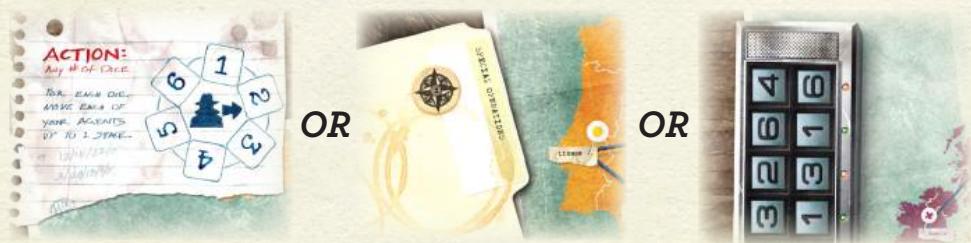
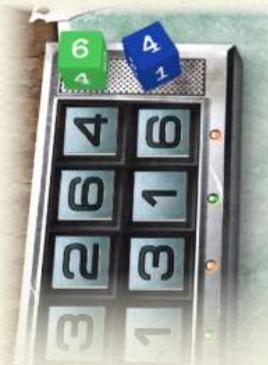
掷骰并放置骰子(Roll and Place Dice):所有玩家同时掷骰并公开摆好。从上一轮最后顺位的玩家开始(第一轮为起始玩家),顺时针轮流,每人一次放一颗骰子到四个行动圈的空格、特别行动文件夹或解码器上。放在行动圈时点数须与空格匹配,且若该圈已有骰子,新骰须与已有骰子相邻;放在特别行动文件夹上点数不限、数量不限,放上后立即抽一枚特别行动指示物;放在解码器上的骰子用于破译密码。当玩家没有骰子可放或不想再放时,取走编号最小的可用顺位标记,此后本轮不能再放骰子。所有玩家都取走顺位标记后进入下一阶段。
-
破译密码(Break Codes):按顺位标记顺序,用放在解码器上的骰子破译密码卡。
-
骰子结算(Dice Resolution):从持有 #1 顺位标记的玩家开始,按顺位顺序,每人每次执行一个行动,骰子可按任意顺序结算,执行时把骰子从行动圈取走。行动可以是单颗骰子,也可以是多颗骰子,取决于放置位置。持续到所有玩家结算完所有骰子。
四个行动圈对应的行动分别是:
- 完成任务(Complete Mission):该圈上每有一颗骰子可完成一张任务卡,须满足卡上全部条件——若要求特定装备,弃掉所需机构卡;若显示城市名,须在该城市有探员;若显示区域符号,须在该区域任一城市有探员;若显示机构卡图标,弃掉任意一张机构卡。完成单张任务算一个行动。
- 任务卡(Mission Cards):该圈上每有一颗骰子可取一张正面朝上或背面朝下的任务卡,藏在屏风后,手上最多同时持有三张,超出须弃到三张。抽单张任务卡算一个行动。
- 机构卡(Agency Cards):该圈上每有一颗骰子可取一张正面朝上的机构卡,但须在对应区域格所在区域的城市有探员;也可选择用两颗骰子来取任意一张正面朝上的机构卡或从牌堆背面抽一张。抽单张卡算一个行动,视情况用一颗或两颗骰子。
- 移动(Movement):该圈上每有一颗骰子,可让每名探员移动一格(相连城市)。探员离开城市时在该城留下一个情报方块;若没有情报方块则不放置。同一城市同色情报方块不能多于一个。玩家可把任意数量的移动骰作为单个行动结算。
补充:移动进入有他人情报方块的城市时,会拾取这些方块放到自己的角色卡上(从不拾取自己颜色的方块);当收集到同色第二个方块时,立即把这两个方块还给对应玩家(双人游戏中若不属于对手则弃掉),并从拾取第二个方块所在城市对应的区域格取一张机构卡,或从牌堆随机抽一张。
本内容仅供参考,如有冲突以说明书和身边大佬为准。
心灵特工初始设置?
《特工》(Covert)初始设置如下:
-
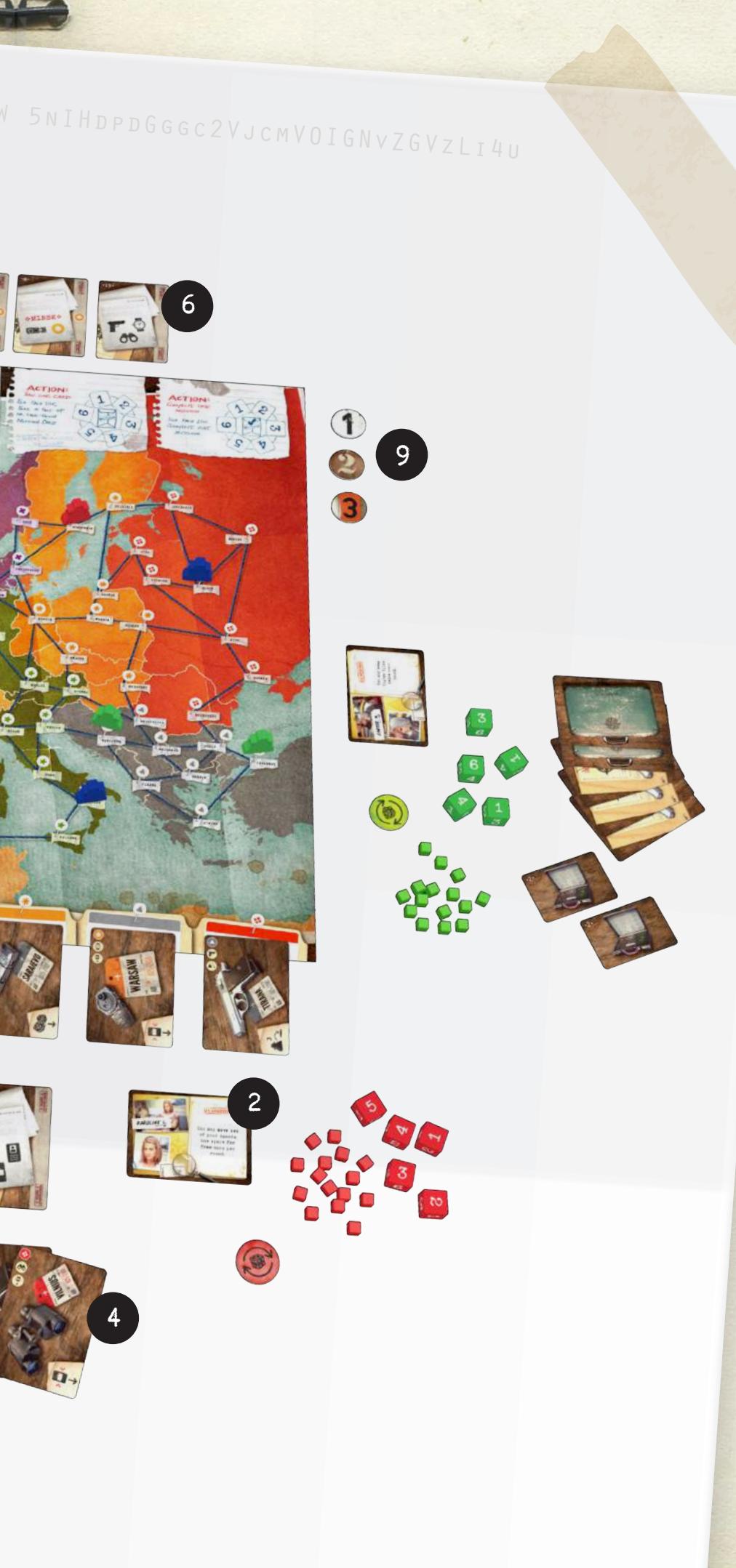
放置版图:把版图放在桌子中央。
-
发放角色卡与玩家配件:每位玩家随机发一张角色卡(若全体同意也可自行挑选),角色卡代表其间谍小组的领袖,提供只有该玩家拥有的特殊能力。每位玩家拿一块玩家屏风,以及自己颜色的一套配件:5 颗骰子、3 个探员棋子、1 枚重掷标记、15 个情报方块。
-
洗混机构卡并放置起始探员:洗混机构卡。每位玩家依次抽三张卡,并在卡上对应的城市放置一个探员,这就是其起始位置。
- 仅双人游戏:取两种未使用颜色各六个情报方块。然后一张一张抽 12 张机构卡,交替颜色地把这些方块放到对应城市。 -
重新洗牌并发手牌:所有玩家放好探员后,把所有机构卡重新洗混,给每位玩家发两张(秘密留在手中)。
-
布置正面朝上的机构卡:沿版图边缘的区域格,一张一张发六张正面朝上的机构卡。剩余牌堆面朝下放在这六张卡附近作为抽牌堆。
-
发任务卡:洗混后给每位玩家发三张任务卡。每人从中选两张放在屏风后,剩下的一张放回牌堆底部。牌堆面朝下放在版图附近,并把最上面三张翻成正面朝上放在抽牌堆旁。
-
发密码卡:洗混密码卡,给每位玩家发两张。剩余卡分成两副大致相等的牌堆,面朝下(装备面朝上)放在版图附近。玩家把自己的密码卡藏在屏风后(密码面朝上)。
-
布置密码指示物:洗混密码指示物,随机摆成两行、每行六个。
-
放置顺位标记:把顺位标记放在版图旁。游戏中有几位玩家就用几个(例如三人游戏用 1 到 3 号)。其余标记放回盒中。按数字顺序叠放,使 1 号在最上面。
-
放置特别行动指示物:把所有特别行动指示物放进袋子,把袋子放在桌上、版图上特别行动文件夹附近。
决定起始玩家:所有玩家在面前掷自己的骰子,掷出同一点数最多的人先手;若平局,则这些平局玩家中骰子点数总和最高者先手。或者,用最像肖恩·康纳利的声音说出“I am a super secret super spy”的人先手。
提示:如果是第一次玩《特工》,应通读整本规则书,但可以忽略每页附的白注——那些白注是规则摘要,用于帮助回忆规则和向新玩家教学。
本内容仅供参考,如有冲突以说明书和身边大佬为准。
去哪查完整规则
想核对具体规则细节、卡牌效果或某个回合的结算方式,可以在村了吗里选中这款游戏后直接提问。
同类桌游
- 卡坦岛德式
- 工业革命:伯明翰德式
- 勃艮第城堡:特别典藏版德式
- 方舟动物园德式
- 卡卡颂抽象
- 瘟疫危机传承:第一季美式
- 阿瑞迪亚:勇踏征途美式
- 重塑宇宙德式
- 幽港迷城美式
- 埃多拉的德鲁伊德式
规则原文(Markdown)
本站收录这款游戏的规则原文 1 个文件,此处内联渲染 1 个,可直接展开阅读或下载。
CVT_Rules.compressed.md27.0 KB
INSTRUCTIONS
COVERT
You have it in your sights: the dead drop. You've messaged back to Headquarters that your mission has been accomplished, and now you are awaiting new orders. Moscow, London, Belgrade... wherever it is they're sending you, you know you'll be prepared You'll be in and out before anyone knows you're coming. You are a super spy. You are undercover. You are CoVERT.
Covert is a game where players take on the roles of spies working covertly to accomplish missions. Over several rounds, players will collect the equipment needed and deploy their agents all across Europe in an effort to complete these missions. Utilize your assets. Make your move. Don't let anyone stand in your way.
Components:
20 Dice (5 of each of the 4 player colors)
12 Agent Pawns (3 of each of the 4 player colors)
60 Intel Cubes (15 of each of the 4 player colors)
48 Agency Cards
60 Mission Cards
6 Character Cards
4 Turn Order Tokens
4 Reroll Tokens
12 Cipher Tokens

Setup:
-
Place the board in the middle of the table.
-
Each player is dealt a random Character Card (or players can choose if they all agree). This shows the leader of their group of spies, and will give each player a special ability that only they possess. Each player takes a Player Screen, and the following in their chosen color: 5 Dice, 3 Agent pawns, 1 Reroll Token, and 15 Intel Cubes.
-
Shuffle the Agency Cards. Each player, in turn, will draw three cards and place an Agent in the matching city. This is their starting position.
TWO-PLAYER GAME ONLY: Take six Intel Cubes of each of the unused colors. Next, draw 12 Agency Cards, one at a time, and place one of these cubes in the matching city, alternating colors.
-
Once all players have placed their Agents, reshuffle all of the Agency Cards together and deal each player two cards (which they keep secret in their hands).
-
Deal six face-up Agency Cards, one at a time, in the Region Spaces along the edge of the board. Place the remainder of the deck face-down near these six cards as a draw deck.
-
Shuffle and deal each player three Mission Cards. Each player chooses two of these, places them behind his screen, and returns the remaining card to the bottom of the deck. Place the deck face-down near the board. Flip the top three cards face-up next to the draw deck.
-
Shuffle the Code Cards and deal two to each player. Split the remaining cards into two decks of approximately equal size, and place them face-down (Equipment side up) near the board. Players keep their Code Cards hidden behind their screen (Code side up).
-
Shuffle the Cipher Tokens and randomly place them in two lines of six tiles each.
-
Place the Turn Order Tokens next to the board. You will need one for each player in the game (i.e., in a three player game, use numbers one through three). Return the remaining tokens to the box. Stack the tokens in numerical order, so that the number 1 is on top of the stack.
-
Put all of the Special Operations Tokens into the bag. Place the bag on the table, near the Special Operations folder shown on the board.
To determine the start player, all players roll their dice in front of them, and the player who rolled the most dice of a single number goes first. If there is a tie, the tied player with the highest total value of dice goes first. Alternatively, the player who says "I am a super secret super spy" in the best Sean Connery voice goes first.
NOTE: If this is your first time playing Covert, you should read the entire rulebook, but you can ignore the attached white notes on each page. These attached white notes are a summary of the game rules and are meant to help refresh your memory on the rules and as an aid when teaching the game to new players.
Gameplay:
The game is played over multiple rounds, and each round is played in the following order:
* Roll and Place Dice
* Break Codes
* Dice Resolution
In Covert, you control a team of spies. You will earn points by completing Missions and breaking Codes.
The game is played over multiple rounds.
Each round has three phases.
• Roll and Place Dice
• Break Codes
• Dice Resolution
Roll and Place Dice:
All players simultaneously roll their dice in their play area, and place them so they are visible to all players. (It is helpful for each player to then line up their dice in numerical order.)

NOTE: Each player has one Reroll Token that can be used at any time during the game. To use it, the player discards the token from the game and rerolls as many of their dice as they would like.
Starting with the player who was last in turn order the previous round (or the start player in the first round), and continuing clockwise around the table, each player will place one die at a time onto the board. Dice are placed on the spaces on the four Action Circles, the Special Operations folder, or on the Decoder.
Players roll dice and line them up, visible to all players.
Reroll Token can be used once any time in the game.
Starting with the player last in turn order the previous round, continue clockwise placing one die at a time.
Place on four Action Circles, Special Operations folder, or Decoder.
If placing on one of the four Action Circles, a die must be placed on an open space and the face of the die must match the space where it is placed. If there is already a die on that Action Circle, then any new dice placed must be adjacent to a die already on the circle.

Example: Sam wants to move his Agents this round, so he needs to place a die on the Movement Action Circle. Since a 2 has already been placed here, he would need to place a 1 or a 3.
Any die can be placed on the Special Operations folder. The number on the die does not matter, and any number of dice can be placed on this space.
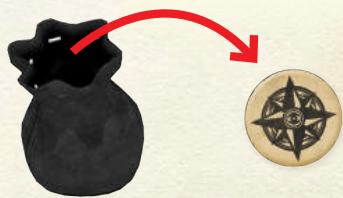
When a player places a die on the Special Operations folder, they immediately draw one Special Operations Token from the bag and place it behind their screen. The player will be able to activate its special ability on a future turn.

When used, return the token to the bag. See Special Operations for more information.
Dice placed on the Decoder will be used in order to break a Code. See Break Codes for more information.
Dice placed on the Action Circles must be adjacent to previously placed dice.
Any die can be placed on the Special Operations folder. Immediately draw a Special Operations Token.
Dice placed on the Decoder will be used to Break Codes.
When it is a player's turn to place a die, if they have no dice to place or do not wish to place any more dice, then they instead take the Turn Order Token with the lowest number available. This will be their position in turn order for the Break Codes phase and the Dice Resolution phase. Once a player takes a Turn Order Token, they can no longer place dice this round.
After all players have taken a Turn Order Marker, then move to the Break Codes phase.
A player drops out of the round by taking the lowest available Turn Order Token.
This determines turn order for Breaking Codes and Dice Resolution.
Break Codes:
Starting with the player with the #1 TurnOrder Token, and continuing in turn order, each player tries to break the codes shown on their Code Cards.
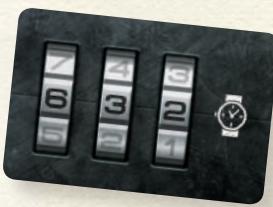
Each player has two Code Cards, each with a series of numbers on them. In order to break a code, the player needs to get the Cipher Tiles into the correct order. In turn order, each player will attempt to break their codes in the following way:
They may swap the position of two adjacent Cipher Tiles one time. Tiles are adjacent if they are next to each other in the same row, or if they are directly above and below each other in separate rows. The numbers on the ends of each row can also be swapped (i.e., the
6 and 1 in the top row of the below example could be swapped). Although the numbers on the ends of rows can be swapped, they are not considered adjacent for the purpose of breaking a code.
If they had placed any dice on the Decoder, they may place them on top of Cipher Tiles, thus changing the number to whatever the die shows.
If they were able to break a Code, they place the completed Code Card (Equipment side up) next to their Character Card.
Whether they were able to break any Codes or not, any dice placed here are taken back into their play area for use in the next round. NOTE: Each die can only be used to break a single code.
Lastly, they draw new Code Cards to replace any that were completed and place them behind their screen. When drawing new Code Cards, they may choose from either of the decks.
Example: Carrie has a Code Card showing 1 6 4. During the Roll and Place Dice phase she had placed a die showing a 1 on the Decoder. The Cipher Tokens currently show the following:

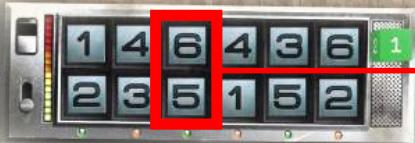
On her turn, she swaps the positions of the 5 in the top row and the 6 in the bottom row.
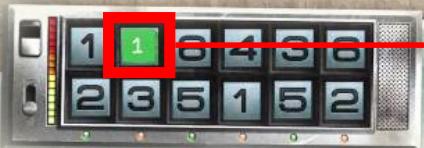
She then places her 1 die that she had placed on the Decoder on top of the leftmost 4 in the top row, thus changing it to a 1.
She now has 1 6 4 in order and breaks her Code Card as described above.

After all players have had a chance to Break Codes, move to the Dice Resolution phase.
In turn order, each player breaks up to two codes on their Code Cards.
A player may swap adjacent tiles, or tiles on the ends of rows one time.
Dice placed on the Decoder can be put on top of Cipher Tiles to change their numbers.
Completed Code Cards are placed tnext to the player's Character Card, Equipment side up.
Draw new Code Cards to replace completed ones. Draw from either deck.
Dice Resolution:
Starting with the player with the #1 Turn Order Token, and continuing in turn order, each player performs one Action on their turn. Dice can be resolved in any order. To track Actions, simply remove your dice from the Action Circle as you take an action. Actions can be a single die, or multiple dice, depending on where they were placed (see below). This continues until all players have resolved all of their dice.
In turn order, resolve dice one Action at a time, removing dice from the Action Circles as the Actions are performed.
The Action Circles:

Complete Mission:
A player can complete one Mission Card for each die they have on this Action Circle. To complete a Mission Card, the player must satisfy all conditions on the card:

* If the Mission requires certain Equipment, the player must discard the needed Agency Card(s).
* If the Mission shows a city name, then the player must have an Agent in that city.
* If the Mission shows a Region symbol, then the player must have an Agent in any city in that Region.
* If the Mission shows an Agency Card icon, then the player must discard any Agency Card.
Example: Nick is completing the Mission Card shown. To do so, he shows that he has an Agent in the city of Venice, an Agent in a city in the orange Region, and he discards an Agency Card with a Recording Device on it.

ACTION: Completing a single Mission is considered an Action.
For each die on the Complete Mission Action Circle, a player can complete one Mission.
To do so, they must satisfy the conditions on the card: Discard Agency Cards with the correct Equipment, have Agents in the correct cities and/or Regions, or discard any Agency Card.
Completing a single Mission is considered an Action.

Mission Cards:
A player may take one face-up or face-down Mission Card for each die they have in this Action Circle.
Mission Cards are kept hidden behind the player's screen. A player can have three Mission Cards at any one time. If a player draws a new Mission Card when they already have three, then they must discard one of their Mission Cards.

ACTION: Drawing a single Mission Card is considered an action.
For each die on the Mission Card Action Circle, a player can draw one Mission Card, either face-up or face-down.
Hand limit of three Mission Cards (kept behind screen). If taking a fourth card, discard down to three.
Drawing a single Mission Card is an Action.

Agency Cards:
For each die in the Agency Card Circle, a player can take one face-up Agency Card. In order to take an Agency Card, the player must have an Agent in a city matching the Region Space where the card is.
Example: Sam has one die in the Agency Card Circle. He has agents in London, Bonn, and Rome, so he could draw the card from either the Purple or Green Region Spaces.

A player may instead choose to use two dice on the Agency Card Circle in order to draw any one face-up Agency Card, or one from the facedown draw deck.
ACTION: Drawing a single card is considered an Action. Based on which card is drawn, the Action could use either one or two dice, as described above.
After drawing a card, immediately replace it with the top card from the draw deck. If the draw deck runs out, shuffle the discard pile and form a new draw deck.
For each die on the Agency Card Action Circle, a player may take one face-up Agency Card.
The player must have an Agent in a city matching the Region where the card is.
A player can use two dice at once to take any Agency Card, either face-up or face-down.
Replace face-up cards immediately from the draw deck.
Taking a single card is an Action.
Agency Cards taken are kept secret in a player's hand. Players have a hand limit of seven Agency Cards, and must discard down to seven at any time that they exceed the limit.
Agency Cards show three different pieces of information: a piece of Equipment, a flight tag for a specific city, and a Special Ability. Each Agency Card can be used as one of these things.
* Equipment: Discarded to complete a Mission (see Complete Mission)
* City: Discarded to fly an Agent to the city shown on the card
* Special Ability: Discarded to activate the Special Ability (see Special Operations)

Whichever way an Agency Card is used, it is discarded immediately. Flying to a city and the Special Operations are done on a player's turn, and are in addition to their normal turn of placing or resolving dice. There is no limit to the number of Special Operations and Fly Actions that can be performed.
Hand limit of seven Agency Cards
Agency Cards are used as Equipment to complete Missions, Plane Tickets to fly an Agent, or as a Special Ability.
In any case, the card is discarded when used.
Flying to a city and using Special Operations is in addition to a player's normal turn, with no limit.
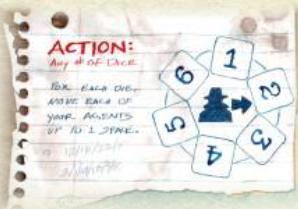
Movement:
For each die on the Movement Action Circle, a player can move each of their Agents one space (connected city). When an Agent leaves a city, they place one of their Intel Cubes in
that city. If a player does not have any Intel Cubes left, then they do not place any cubes at this time. NOTE: There can never be more than one Intel Cube of a color in the same city.
Example: Carrie has two dice on the Movement Action Circle. When she chooses to move, she will be able to move all of her Agents up to two spaces on the board. She moves her frst Agent from Berlin to Prague and then Viennac, placing an Intel Cube in both Berlin and Prague.

ACTION: A player can resolve any number of dice as a single Action. For example, if Kallen had three dice on the Movement Action Circle, on his turn he could move all of his Agents up to three spaces, or move them one or two spaces and resolve the remaining dice on a future turn.
NOTE: Any number of Agents can be in the same city at the same time.
These are big cities, and I trust that you can keep yourself hidden.
For each die on the Movement Action Circle, a player can move each of their Agents one space.
When an Agent moves, he leaves an Intel Cube behind in the city he left.
A player can resolve as many Movement Dice as they want as one Action.
Gathering Intel:
When a player moves into a city with any Intel Cubes that are not their own, they pick them up and place them on their Character Card. (Players never pick up Intel Cubes of their own color.)
If a player collects their second Intel Cube of the same color, they immediately return those two cubes to the appropriate player (or discard them in a two-player game if they do not belong to their opponent), and take the Agency Card from the Region Space matching the city where they are, or draw one random Agency Card from the draw deck.
Example: Nick already has one green Intel Cube on his Character Card. On his turn he moves one of his agents to Kiev and picks up a green Intel Cube. He returns these cubes to the green player and can now take one free Agency Card. He can choose to either take the card in the red Region Space (since she is in Kiev), or take a face-down Agency Card.

When a player moves into a city with Intel Cubes from other players, they pick them up.
If they have two of the same color they immediately return them to the appropriate player and get a free Agency Card.
The Agency Card will either be from the Region where they picked up the second Intel Cube, or from the draw deck.
Completed Missions and Codes:
Completed Mission Cards are placed face-up and tucked partially beneath the player's Character Card and previously completed Missions, and will score points at the end of the game. They may also provide an in-game benefit (shown at the bottom of the card).
* If a completed Mission Card shows a piece of Equipment at the bottom of the card, then this piece of Equipment can be used to satisfy future Mission Cards instead of discarding an Agency Card.
* If a completed Mission Card shows a Region icon at the bottom of the card, then this Region icon can be used to satisfy needing an Agent in a matching city or Region on future Mission Cards.

Completed Code Cards are placed Equipment side up to the left of the player's Character Card. Completed Code Cards show a piece of Equipment that, like completed Mission Cards, can be used to complete future Missions. However, if Equipment from a completed Code Card is used to complete a Mission, it is discarded and shuffled back into the Code Card draw deck, and is therefore a one-time benefit.

Instead of using a completed Code Card to complete a future Mission, a player can instead keep the Code Card in their play area, and this will be worth two points at the end of the game.
NOTE: If a Mission Card shows the icon requiring any Agency Card, the player must discard an Agency Card and cannot use symbols from completed Missions and Codes to satisfy that condition.
Completed Mission Cards score points at the end of the game and may give an in-game benefit.
Equipment at the bottom of a completed Mission allows a player to use this Equipment to complete future Missions.
A Region symbol is like having an Agent in any city in this Region, for the purpose of completing future Missions.
Completed Code Cards show Equipment which can be used to complete future Missions.
If the Equipment on a Code Card is used to complete a Mission, it is shuffled back into the Code Card deck.
Completed Code Cards still in a player's possession at the end of the game are worth two points.
The Equipment shown on completed Missions or Codes cannot be used to satisfy a Mission requiring that an Agency Card be discarded.
Special Operations (on cards and tokens):
Agency Cards and Special Operations Tokens can be discarded in order to activate their Special Abilities. Special Abilities can only be activated on a player's turn, either when placing or resolving dice (exceptions: Espionage and First). Activating a Special Ability is in addition to a player's normal turn. There is no limit to the number of Special Abilities a player can activate on their turn.

+1: Add one pip to a die when placing dice on the Action Circles or the Decoder. (6+1 = 1)

-1: Subtract one pip from a die when placing dice on the Action Circles or the Decoder. (1-1 = 6)

Move x3: Up to three movement points to be used between one or more of your Agents.

Espionage: When any player (including yourself) uses an Agency Card for any reason (complete a Mission, fly to a city, or Special Ability), you may take one of the used Agency Cards into your hand.

Sneak Attack: You may place two dice this turn instead of one.

First: This allows a player to resolve a single Action before the normal turn order begins in Dice Resolution, or to Break Codes first. If multiple players want to activate this ability, the player closest to first in turn order is the player who gets to activate the ability first. If, after that player does his action, the other player(s) still want to use the ability, they may.

Code Breaker: One additional Cipher Tile swap during the Break Codes phase.

Search: Draw the top three cards from the Agency Card or Mission Card deck. Keep one and put the other two on the bottom of the deck.
Special Abilities can be activated on a player's turn, either with Special Operations Tokens or Agency Cards.
There is no limit to the number of Special Abilities that can be activated by a player on their turn.
The Special Operations and Icons are shown on the inside of the Player Screens.
After all players have activated all of their Actions for the round (i.e., they have all of their dice back), player return their Turn Order Tokens, and a new round begins with all players rolling their dice. The player who was last in turn order the previous round will place a die first in the next round, and then play proceeds clockwise around the table. This process continues for the remainder of the game.
When all players have all of their dice back, the round ends and a new one begins.
Return the Turn Order Tokens.
The player who was last in turn order the previous round begins the new round.
Play then proceeds clockwise around the table.
Game End:
When a player completes their sixth Mission, finish the current round. After the final round, each player has the opportunity to complete one last Mission Card if they are able. No other Actions are taken, and dice are not placed, but Special Abilities from Agency Cards and Special Op erations Tokens may be activated. These final Missions are completed in the same turn order as the final round. After the final Missions have been completed, the game ends.
NOTE: When completing the fnal Missions, character abilities cannot be used. Players score points as follows:
* Points on Completed Missions
* Two points per Code Card they completed and still have in their play area


2+2+8+6+13+15+11+9 = 56

The player with the most points is the winner.
In the case of a tie, the tied player who completed the most Mission Cards is the winner. If there is still a tie, the tied player who completed the single highest value Mission Card is the winner.
When a player completes their sixth Mission, finish the current round.
Each player, in turn order, then has the opportunity to complete one last Mission, without taking any Actions.
Special Abilities from Agency Cards and Special Operations Tokens may be activated (including using an Agency Card to fly to a city).
Character Abilities may NOT be used.
The game ends and players score points for their completed Missions, and two points per completed Code Card they still have in their possession.
Credits:
Game Design: Kane Klenko
Art Direction: Kane Klenko
Lead Developer: Carrie Klenko
Cover Illustration: Chris Ostrowski
Character and Item Illustrations: Hokunin
Graphic Design and Cards Layout: Luis Francisco
Board Design: Scott Nicely and Luis Francisco
Rules Proofreading: Dustin Schwartz
Renegade Game Studios
President & Publisher: Scott Gaeta
Controller: Robyn Gaeta
Director of Sales & Marketing: Sara Erickson
Customer Service: Jenni Kingma
Demo Team Manager: Julia Smith
The designer would like to thank: My amazing wife, Carrie. Love and stuff. My boys, Carter and Kallen. All of the people who tested Covert, including: Sam Bottoni, Jenny Bottoni, Chelssey Klenko, Sandy Klenko-Blackmon, Caleb Klenko, Keith Matejka, Steve Kukasky, Pete Cymbalak, Enrique Gandara, Nick Neumann, Morgan Neumann, Brett Myers, Laura Holmes, Chad Krizan, Caylyn Krizan, Eric Jome, Ed Marriott, Mitch Zuleger, Ben Kopp, Cole Busse, Eric Schlautman, Marissa McConnell, Aaron Anderson, Jonathan Goetz, Julie Fromm, Kyle Fromm, Chris Strum, Erica Larson, Aaron Hendon, Nate Hendon, Kevin Byrnes, Matt Loomis, James Mathe, Stacci Barganz, Todd Barganz, Mark Bazata.

原文为社区整理/出版社公开资料,版权归原作者,仅供个人学习查阅。