
Cryptid: Urban LegendsCryptid Urban Legends
一句话概览
Cryptid: Urban Legends 是一款已收录于村了吗规则库的桌游,支持 2 人,原名 Cryptid Urban Legends。
本页内容:一句话概览 · 常见问题
这游戏怎么玩
- 本站已收录这款游戏的规则资料,可以在对话里直接提问规则细节。
常见问题(FAQ)
以下 1 条问答中 0 条来自站内玩家的真实提问,其余 1 条为本站整理的常见疑问;答复内容保持原样。
Cryptid: Urban Legends支持几个人玩?
2 人。
去哪查完整规则
想核对具体规则细节、卡牌效果或某个回合的结算方式,可以在村了吗里选中这款游戏后直接提问。
同类桌游
- 卡坦岛德式
- 工业革命:伯明翰德式
- 勃艮第城堡:特别典藏版德式
- 方舟动物园德式
- 卡卡颂抽象
- 瘟疫危机传承:第一季美式
- 阿瑞迪亚:勇踏征途美式
- 重塑宇宙德式
- 幽港迷城美式
- 埃多拉的德鲁伊德式
规则原文(Markdown)
本站收录这款游戏的规则原文 1 个文件,此处内联渲染 1 个,可直接展开阅读或下载。
CryUL_Rulebook_UPDATE.md17.7 KB
RUTH VEEVERS AND HAL DUNCAN ILLUSTRATED BY KWANCHAI MORIYA
There’s something hiding among us: an elusive
cryptid is prowling our city streets. The evidence
is clear but, without definitive proof, the scientific
community will never believe you. There’s nothing else to be done – you must track down this cryptid yourself!
In Cryptid: Urban Legends one of you will play as the Cryptid, moving from city block to city block as you attempt to avoid detection and make your escape. The other will take on the role of the Scientist, using high-tech sensors in a bid to track down the Cryptid and make the discovery of a lifetime.

Contents
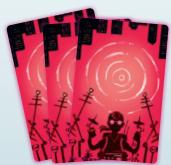
A 20 MOVEMENT CARDS 10 SCIENTIST MOVEMENT CARDS 10 CRYPTID MOVEMENT CARDS
B 2 WILD CARDS
C 2 REFERENCE CARDS
D 17 CITY BLOCKS
E 10 SENSORS
F 5 EVIDENCE COUNTERS

Scientist Back
G 4 PRESENCE COUNTERS
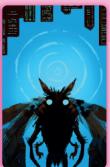
Cryptid Back


Front


-
Choose one player to be the Cryptid and one player to be the Scientist.
-
Separate the Cryptid and Scientist movement cards according to their backs. Take the ten movement cards for your role and shufle them into a face-down deck in front of you. Draw three movement cards to form your starting hand.
-
Place a wild card in front of you, face down.
-
Separate the ordinary city block cards from the mysterious city block cards. Set aside seven of the ordinary city blocks. Shufle all the other city blocks into a face-down deck and place it between you and your opponent. Then take four of the seven city blocks you set aside and place them on top of the deck. This way, the first four city blocks drawn will be ordinary.
-
Place the three remaining city blocks you set aside in the middle of the table in an alternating chequerboard pattern, forming two rows (as shown in the set up diagram). The row of two should be closer to the Scientist.
-
Place two pink sensors, two white sensors, and one black sensor to one side of the city block in the row of one. Place all the remaining sensors on the opposite side of the city block.
-
Place one presence counter on the city block in the row of one. Place the remaining presence counters next to the Cryptid.
-
Place the evidence counters within reach of both players.






How to Play
The game is played in a series of rounds. Each round is split into five phases:
-
The Sensor Phase, in which you move sensors from the active row of city blocks to the inactive row of city blocks.
-
The Hiding Phase, in which the Cryptid adds presence counters to the inactive row.
-
The Victory Phase, in which you check to see if the game has ended and who has won.
-
The Restrict Phase, in which the Scientist removes city blocks from the board.
-
The Expand Phase, in which you add city blocks to the active row.
Play continues like this until the end of the game is triggered during the Victory Phase.
GOAL OF THE GAME
As the Cryptid, you win by having your presence counters on the leftmost and rightmost city blocks simultaneously when there are seven blocks in play. That means you can’t win the first two turns of the game.
As the Scientist, you win by reducing the Cryptid down to one (or zero) presence counters on the board. You can win on turn one!
If the deck of city blocks runs out, the player who has collected the most evidence counters wins.
SENSOR PHASE
The row of city blocks that has sensors in it at the start of this phase is the active row for this round. The row of city blocks with no sensors at the start of the phase is the inactive row. By the end of the Sensor Phase, all the sensors will be in the inactive row.

At the start of the round, the active row will always have fewer city blocks than the inactive row.
In the first round, the active row is the row of one city block and the inactive row is the row of two city blocks.
Sensors are never placed on city blocks. They are only ever placed in spaces, which are the areas:
• between two city blocks
• to the left of the leftmost city block in the row
• to the right of the rightmost city block in the row.
Starting with the player closest to the active row, alternate taking turns. In the first round, the Cryptid goes first.
On your turn, take one of the following actions:
A) Play a movement card
B) Use your wild card (only if it is face up)
C) Draw two movement cards (up to a hand limit of four)
After taking your turn, if there are no sensors left in the active row, move on to the Hiding Phase. Otherwise, your opponent takes their turn.
A) PLAY A MOVEMENT CARD
You cannot take this action if you have no cards in your hand.
Play a movement card from your hand, resolving its efect as shown below. Then, place it in a face-up discard pile next to your movement card deck.

Split: Select a space in the active row. Move all the sensors in that space into diagonally adjacent spaces in the inactive row. You can move the sensors in any combination, but you must move at least one sensor into each diagonally adjacent space if possible. If there is only one sensor in the space you have selected, move it into either of the diagonally adjacent spaces in the inactive row.
Shufle: Select one sensor in the active row and move it one space left or right in the active row. Then move it into the diagonally adjacent space moving in the same direction in the inactive row. If you have selected a sensor in the leftmost space of the active row, you cannot move it left. If you have selected a sensor in the rightmost space, you cannot move it right.
Align: Choose one sensor colour and move. Move all the sensors of that colour in the active row into diagonally adjacent spaces in the inactive row in the same direction (left or right).
MOVEMENT EXAMPLE

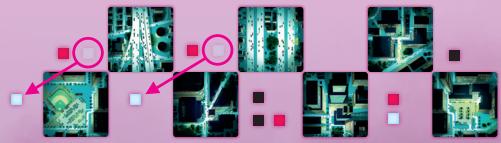
At the start of the Sensor Phase, the board looks like this: The Scientist plays a split card, and selects the third space from the left in the active row. They choose to move the white sensor to the space diagonally to the right in the inactive row, and the remaining three sensors into the space diagonally to the left.

Next, the Cryptid plays a shufle card, and selects a pink sensor in the active row. They choose to move the sensor to the right, so they first move it one space to the right along the active row and then move it diagonally to the right into the inactive row.

On their next turn, the Scientist plays an align card, and chooses the colour white and the direction left. They then move all the white sensors in the active row to the spaces diagonally to the left.
B) USE YOUR WILD CARD
You cannot take this action unless your wild card is face up.
Flip your wild card face down. Then choose and resolve any one of the three movement efects described on page six.
Flip your wild card face up whenever your opponent gains an evidence counter.
C) DRAW TWO MOVEMENT CARDS
You cannot take this action if you have four movement cards in your hand.
Draw two movement cards from your movement deck.
You can never have more than four cards in your hand. If you have three movement cards in hand when you take this action, draw one movement card only.
When your deck is empty, immediately shufle your discard pile to form a new movement deck and continue drawing if necessary.

HIDING PHASE
The Cryptid announces a feature (see below). For each city block in the inactive row, check if it
• matches the announced feature, and
• is diagonally adjacent to a presence counter in the active row.
For each city block where both of these things are true, the Cryptid places a presence counter on the block. If there are no presence counters in the supply, take one from the active row, as these will be returned to the supply at the end of this phase anyway.
If the Cryptid places a presence counter on a city block with an evidence counter on it, the Cryptid takes it. If any evidence counters are taken in this way and the Scientist’s wild card is face down, flip it face up. Evidence counters appear when mysterious city blocks are placed during the Expand Phase (see page 13).
Then remove all presence counters from the active row, returning them to the supply, and move on to the Victory Phase.
FEATURES
A feature is either a number of sensors or a combination of colours.
When you announce a number of sensors, only city blocks with that exact number of sensors in the two adjacent spaces combined are considered to match the feature.
When you announce a combination of colours, only city blocks with that exact combination of sensor colours in the two adjacent spaces are considered to match the feature. If a city block is adjacent to a colour not announced, it is not considered to match the feature. You can announce one, two, or three colours.
HIDING PHASE EXAMPLE

The Cryptid announces the colour combination pink and white. Although city blocks B and C are both adjacent to pink and white sensors, they are also adjacent to black sensors, so they don’t match the announced feature. Blocks A and D both match the feature, but block A isn’t diagonally adjacent to a presence counter, so the Cryptid would place a counter on block D only.
If the Cryptid instead announced five sensors, city blocks B, C, and D would all match. All three blocks are also diagonally adjacent to a presence counter, so the Cryptid would place a counter on all three and then take the evidence counter on block B. Then the players would remove the presence counters in the active row.
VICTORY PHASE
This is the only phase when the game can end.
First, check if the Cryptid has escaped or been captured.
If the Cryptid hasn’t escaped or been captured, check if time has run out. If time hasn’t run out, continue to the Restrict Phase.
THE CRYPTID ESCAPES
If there are seven city blocks on the table and there are presence counters on both the leftmost and rightmost city blocks in the inactive row, the game ends and the Cryptid wins!
There are too many contradicting clues and, amid the confusion, the Cryptid slips through the Scientist’s grasp.
THE CRYPTID IS CAPTURED
If there are one or fewer presence counters on city blocks, the game ends and the Scientist wins!
The Scientist corners the Cryptid and finally captures it.
TIME HAS RUN OUT
If there are no city blocks left in the city block deck, the game ends. Take all the evidence counters in the row that is closest to you. The player with the most evidence counters, including any gained earlier in the game, wins!
It was a close chase, but eventually one side gained the upper hand.
The Cryptid gains evidence counters by placing presence counters on mysterious city blocks in the Hiding Phase. The Scientist gains evidence counters by removing mysterious city blocks in the Restrict Phase.
RESTRICT PHASE
Skip this phase if there are fewer than seven city blocks on the table. This means there is no Restrict Phase in the first two rounds of the game.
The Scientist removes either the leftmost city blocks from both rows or the rightmost city blocks from both rows. They then place the two cards they removed into a discard pile. You cannot remove the leftmost city block from one row and the rightmost from the other.
If there are any evidence counters on the discarded city blocks, the Scientist takes them. If evidence counters are taken in this way and the Cryptid’s wild card is face down, flip it face up.

The Scientist cannot select a pair of blocks that has a presence counter.
If the Scientist removes the leftmost blocks and there are sensors to the left of those blocks, the Cryptid moves those sensors to any other space in the inactive row. If the Scientist removes the rightmost blocks and there are sensors to the right of those blocks, the Cryptid moves those sensors to any other space in the inactive row.
If moving more than one sensor in this way, you may move them to the same or diferent spaces in the inactive row.
Then continue to the Expand Phase.
RESTRICT PHASE EXAMPLE
The Scientist must choose to remove either the leftmost or the rightmost blocks from each row. The Scientist cannot choose the leftmost blocks because one of them has a presence counter, so instead they must discard the rightmost blocks from each row.
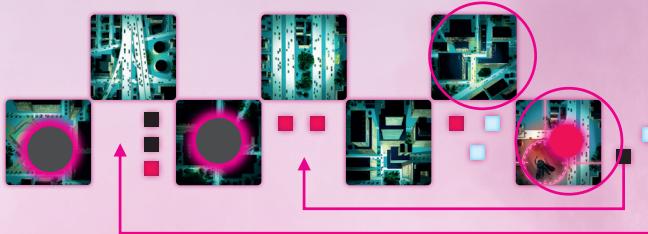
There is an evidence counter on the rightmost block of the inactive row, which the Scientist takes when they remove the block. As the Cryptid’s wild card is face down, they flip it face up.
The Cryptid then moves the white and black sensors to other spaces in the inactive row.
EXPAND PHASE
The player closest to the active row (which now has no sensors) draws the top two cards from the city block deck. They then place one of the cards on the leftmost end of the active row, so that it is touching the corner of the leftmost card in the inactive row. They place the other card on the rightmost end of the active row, touching the corner of the rightmost card of the inactive row.
The active row should now have one more block than the inactive row.
If you place any mysterious city blocks, place an evidence counter on each mysterious city block you place.
Then continue to the next round, starting with the Sensor Phase.
EXPAND PHASE EXAMPLE
The Cryptid is closest to the active row, so they draw two city blocks from the city block deck. They place a mysterious city block on the leftmost end of the active row, and immediately place an evidence counter on it. They place the remaining city block on the rightmost end of the active row.

Game design: Ruth Veevers & Hal Duncan
Illustration: Kwanchai Moriya
Game development: Filip Hartelius & Anthony Howgego
Graphic design: Kwanchai Moriya & James Hunter
First published in Great Britain in 2022 by OSPREY GAMES
Bloomsbury Publishing Plc
Kemp House, Chawley Park, Cumnor Hill, Oxford OX2 9PH, UK
29 Earlsfort Terrace, Dublin 2, Ireland
1385 Broadway, 5th Floor, New York, NY 10018, USA
OSPREY GAMES is a trademark of Osprey Publishing Ltd
© Ruth Veevers and Hal Duncan 2022. This edition © 2022 Osprey Publishing Ltd
All rights reserved.
www.ospreygames.co.uk
For more information or replacement parts, email info@ospreygames.co.uk
22 23 24 25 26 10 9 8 7 6 5 4 3 2 1
SENSOR PHASE
Starting with the player closest to the active row, take turns until the active row has no sensors.
On your turn, take one action:
A) Play movement card
B) Use wild card (if it’s face up)
C) Draw two cards (up to hand limit of four)
HIDING PHASE
Cryptid selects a feature (number of sensors or combination of colours) and places presence counters on blocks that both match the feature and are diagonally adjacent to an existing presence counter.
Remove all presence counters from the active row.
VICTORY PHASE
Check if the Cryptid has escaped or been captured, if not then check if time has run out.
Cryptid escaped: Seven city blocks in play and presence counters on both the leftmost and rightmost blocks – Cryptid wins!
Cryptid captured: One or zero presence counters in play – Scientist wins! Time has run out: No city blocks left in deck. Both players take all evidence counters on the row closest to them – player with most evidence counters wins!
RESTRICT PHASE
Scientist removes the two leftmost or two rightmost blocks.
Cannot remove blocks with presence counters.
EXPAND PHASE
Player closest to active row draws two city blocks and places one city block on either end of the inactive row.
Place an evidence counter on any mysterious city blocks added.
下载 Markdown原文为社区整理/出版社公开资料,版权归原作者,仅供个人学习查阅。