
十项全能Decathlon
一句话概览
十项全能 是一款已收录于村了吗规则库的桌游,支持 3–6 人,原名 Decathlon。
本页内容:一句话概览 · 常见问题
这游戏怎么玩
- 本站已收录这款游戏的规则资料,可以在对话里直接提问规则细节。
常见问题(FAQ)
以下 1 条问答中 0 条来自站内玩家的真实提问,其余 1 条为本站整理的常见疑问;答复内容保持原样。
十项全能支持几个人玩?
3–6 人。
去哪查完整规则
想核对具体规则细节、卡牌效果或某个回合的结算方式,可以在村了吗里选中这款游戏后直接提问。
同类桌游
- 卡坦岛德式
- 工业革命:伯明翰德式
- 勃艮第城堡:特别典藏版德式
- 方舟动物园德式
- 卡卡颂抽象
- 瘟疫危机传承:第一季美式
- 阿瑞迪亚:勇踏征途美式
- 重塑宇宙德式
- 幽港迷城美式
- 埃多拉的德鲁伊德式
规则原文(Markdown)
本站收录这款游戏的规则原文 1 个文件,此处内联渲染 1 个,可直接展开阅读或下载。
decathlonE.md13.6 KB

For 3–6 players aged 8 and up Play time: 30 minutes
Overview
Decathlon is said to be one of the hardest competitions in athletics. In this game, the players are athletes who must perform the 100m sprint, the long jump, the shot put, the high jump, the 400m, the 110m hurdles, the discus throw, the pole vault, the javelin throw and the 1500 meters race.
Players will need the ability to run, jump and throw. Balance those three abilities, and win the total competition to become the King of Athletes.
Goal of the Game
The goal of the game is to collect the VP (Victory Points) on the medal cards. The player who has the most VP when the game ends wins.
For each of the 10 events, a player must finish first or second in order to get a meal card.
Contents
1 Start Player card

20 Medal cards
With VP printed on them

| VP | 1 | 2 | 3 | 4 | 5 | 6 | 7 | 8 | 9 | 10 | 11 | 12 |
| # of cards | 1 | 1 | 2 | 2 | 2 | 2 | 2 | 2 | 2 | 2 | 1 | 1 |
74 Ability cards
Contains the ability name and level Ability name: One out of three types: "run", "jump" and "throw". There is also the almighty "All". The "All" card can be counted as any of the three types. Ability level: depicts the strength of the card, and varies from 3 to 10. (The number on the shirt in the picture has no influence on the game)

The cards are distributed as follows
28 run cards
| level | 3 | 4 | 5 | 6 | 7 | 8 | 9 | 10 |
| # of cards | 4 | 4 | 4 | 4 | 3 | 3 | 3 | 3 |
20 jump cards
| level | 3 | 4 | 5 | 6 | 7 | 8 | 9 | 10 |
| # of cards | 3 | 3 | 3 | 3 | 2 | 2 | 2 | 2 |
Contains the event name, rules and order number.
20 throw cards
| level | 3 | 4 | 5 | 6 | 7 | 8 | 9 | 10 |
| # of cards | 3 | 3 | 3 | 3 | 2 | 2 | 2 | 2 |
6 "All" cards
| level | 8 |
| # of cards | 6 |
Event cards

Order number
When playing with the basic rules, the events will be performed in numerical order
Event name…… Name of the event
Rules……Icons showing the rules for this event
Game Setup
The player who most recently participated in a decathlon is the start player. If no one has (recently) participated in a decathlon, choose start player in any suitable fashion. The start player takes the Start Player card and places it before him.
1 Deal "all" card to all players, put the rest back in the box.
They are not used in the game.
Then shufle the remaining Ability cards and deal 4 face down to each player. Put the remaining Ability cards in a face down pile reachable to all (the "Ability deck").
Thus, each player will have 5 cards in hand. Hold them in hand so that the other players cannot see their values. These are the players "hands".
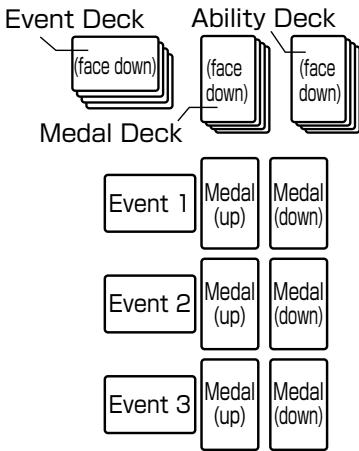
Place all Event cards face down in a pile in numerical order, so that the "10" is at the bottom and the "1" is at the top. This is the "Event deck".
Shufle all the Medal cards and place beside the play area. This is the "Medal deck".
Draw the top Event card from the Event Deck and place it face up beside the pile. Draw one face down and one face-up Medal card from the Medal deck and place beside the drawn Event card.
Repeat the above three times, so that you end up with 3 face up Event cards, each with 2 Medal cards: one face up, the other face down.
Please refer to the figure below
You are now ready to start playing.
Flow of the game
This game is played in 10 rounds. Each round consists of the following three phases:
(1) Preparation, (2) competition, (3) end-of-round
(1) Preparation
Take the Event card that lies closest to the Event Deck and place it in the middle of the table. This is the event that will be performed this round. Take the 2 Medal cards that belonged to it, revealing the face down Medal card, and place them beside the Event card.
Draw ability cards from the Ability Deck (depending on number of players) and place face in the middle of the play area. These are the "supplementary cards". If the Ability Deck runs out, shufle the discards to form a new Adility Deck.
| Players | # of suppl. cards |
| 3 | 4 |
| 4 | 6 |
| 5 | 8 |
| 6 | 10 |

(2) Competition
Players will compete to win this round's decathlon event. Please refer to the separate sheet for details about each event. Each Event card says what abilities, and how many the players should play, how they will be played and with what timing.
Unless the Event card specifies otherwise, players must at least play 1 Ability card.
Playing a card of a diferent type than the specified results in the strength being 0.
When cards have been played according to the rules specified on the Event cards, players compare their played cards and determine the result order. In case of a tie, the player closest to the start player has priority. Being the start player is thus slightly advantageous in this game.
All cards played during the round are discarded in a discard pile beside the Ability Deck. The discard pile is face up and can always be checked by all players.
(3) End of round
Once the competition has ended, the players renew their hands in the following way in reverse result order,
i.e. the player who came last in the competition draws first, then the player who came next to last and so on.
The 6th to 3rd player takes any two cards of the supplementary cards and add to their hands.
The 2nd player takes only 1 card of the remaining 2, and takes
the lowest of the two Medal cards.
The 1st player takes the remaining supplementary card and the remaining medal card. He also takes the Start player card and becomes the start player for the next round.
Medal cards are placed face down before the players who has them.
When all players have renewed their hands, each player checks their number of cards. Players with more than 8 cards in hand must discard down to 8 cards. The player chooses which cards to discard; put them on the discard pile. Players with less than 3 cards draws from the Ability Deck so that he has 3 cards. If necessary, discarding/drawing is done in clockwise order starting with the start player.
At the end of round 1–7, also draw the next Event card, and place it in the line of Event cards. Also draw 1 face up and 1 face down Medal card and place beside the Event card. At the end of round 8 and 9, there are no more Event cards to draw; just continue to the next round.

At the end of round 10, proceed to "Game end and victory conditions".
Game end and victory conditions
All players add up their number of Victory Points they have from their Medal cards. The player with the most points wins the game. In case of a tie, the number of cards left in hand is the tie breaker. If that also is a tie, then everyone explodes in a sea of lava.
Optional rule
When setting up the game, shufle the Event cards so that their order is unknown. It's still recommended, however, to keep the "1500 metres" as the last card.
Thank you for buying this game. Any comments can be mailed to OKAZU (okazubrand@gmail.com).
Production: OKAZU brand
(website at http://okazubrand.seesaa.net/)
Game design: Hisashi Hayasi (OKAZU)
Graphic design: ryo@nyamo
Manual editing: HAL99
Test play: The usual
Printed by: Popls
EVENT DETAILS

100 metres
Rules: All players simultaneously play one "run" card each.
Number 1

Order: The strength of the played card (highest wins).
Long jump
Number 2
Rules: From the start player and proceeding clockwise, each player plays one "run" card. Then from the start player and proceeding clockwise, each player plays one "jump" card.
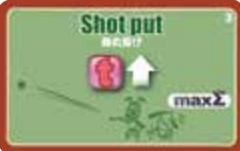
Order: The total strength of both played cards (highest wins).
Shot put
Number 3
Rules: All players simultaneously play one "throw" card each.
Order: The strength of the played card (highest wins).

High jump
Number 4
Rules: From the start player and proceeding clockwise, players choose to either play a "jump" card (higher than 0) or pass. Once passed, a player cannot play more cards. Continue until everyone has passed.
Order: the reverse order in which the players passed (first passed finish last).

400 metres
Number 5
Rules: First all players simultaneously play a "run" card. Then from the start player and proceeding clockwise, each player plays a "run" card.
Order: The total strength of both played cards (highest wins).
110 metres hurdles
Number 6

Rules: From the start player and proceeding clockwise, players play 2 cards each: one "run" and one "jump" card.
Order: The strength of the lowest card of each pair (highest wins). In case of a tie of the lowest card, also compare the other card (highest wins). If still a tie, break the ties as usual (closest to start player wins).

Discus throw
Number 7
Rules: From the start player and proceeding clockwise, players choose to either play a "throw" card (higher than 0) or pass. Once passed, a player cannot play more cards. Continue until everyone has passed.
Order: The total strength of all played cards (highest wins).
Pole vault
Number 8
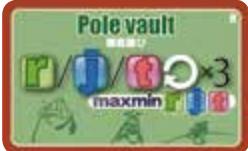
Rules: From the start player and proceeding clockwise, players play either a "run", "jump" or a "throw" card. When all have played one card each, repeat the process except that players cannot play a type of card they have already played. Finish when everyone has played 3 cards each.
Order: The strength of the lowest card of each trio (highest wins). In case of a tie of the lowest card, also compare the next lowest card (highest wins). If still a tie, also compare the last card (highest wins). If still a tie, break the tie as usual (closest to start player wins).

Javelin throw
Number 9
Rules: First all players simultaneously play a "run" card. Then from the start player and proceeding clockwise, each player plays 1 or more "throw" cards.
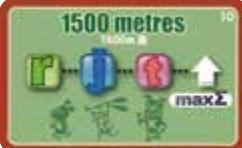
Order: The total strength of all played cards (highest wins).
1500 metres
Number 10
Rule: All players simultaneously play any number of cards.
Order: The total strength of all played cards (highest wins).
下载 Markdown原文为社区整理/出版社公开资料,版权归原作者,仅供个人学习查阅。