
维度棋Dimension
一句话概览
维度棋 是一款已收录于村了吗规则库的桌游,支持 1–4 人,原名 Dimension。
本页内容:一句话概览 · 游戏概述 · 1. 游戏组件 · 2. 游戏设置 · 3. 游戏流程 / 挑战进行 · 4. 卡片布局 · 5. 规则与难度级别 · 6. 规则符号详解 · 7. 接触的判定 · 8. 完成挑战与检查 · 关键规则与常见问题 · 常见问题
维度棋 规则速览
以下规则速览由本站整理,与官方规则书表述不同,仅供快速上手参考。
游戏概述
《维度棋》(Dimension: The Brain Game To Go)是一款紧凑的便携式单人解谜游戏,适合 1 人游玩,年龄 8 岁以上。游戏中包含 200 个挑战,从简单(青绿色)起步,难度与复杂度依次经过中级(绿色)、高级(橙色),最终达到专家级(红色)。玩家的目标是把 15 个椭球体配件排列成金字塔,使每一张卡片上给出的全部规则同时成立;完成全部 200 个挑战即通关。
一句话核心流程: 抽出要挑战的卡片放进盒子并盖好盖子,取出全部 15 个配件,按卡片上的规则符号把配件放入盖子顶部的插槽中堆叠成金字塔,完成后与解答页比对。
核心机制: 空间拼放与多层堆叠、颜色组合约束、逻辑条件满足。没有时间限制,可以随时停下再继续。
> 配件玩法说明:下载免费的 Kosmos Helper 应用并选择《维度:便携版脑力游戏》,即可在应用内查看解答。如果你拥有第二份《维度:便携版脑力游戏》,就可以与另一位玩家比赛谁先完成挑战。
1. 游戏组件
| 组件 | 数量/说明 |
|---|---|
| 塑料盒 | 1 个(盖子顶部有插槽,底部有抽屉) |
| 卡片 | 20 张,共包含 200 个挑战(每张卡片正反两面,每面 5 个挑战) |
| 塑料配件 | 15 个(椭球体) |
| 规则书 | 1 本(附带解答) |
2. 游戏设置
2.1 选择挑战
- 打开盒盖。
- 选择包含你想尝试的挑战的那张卡片。
- 将该卡片放在盒子内卡片堆的最上面,按图示把卡片堆放回盒子内。
- 盖上盖子。
2.2 取出配件
从盒子底部的抽屉中取出全部 15 个配件,把它们放在盒子旁边作为你的配件库,然后关上抽屉。建议按数字顺序解决挑战,但并非必须。
2.3 摆放环境
把盒子放在平整的表面上,通过将配件放在盖子顶部来解决挑战。
3. 游戏流程 / 挑战进行
盖上盖子后,根据你正在解决的那个挑战的规则,把配件放入盖子顶部的插槽中:
- 凹陷面朝向: 配件的凹陷面始终朝下。
- 金字塔结构: 配件可以排列成金字塔形状,分为三个层级——最底层最多可以放置六个配件,中间层放置三个配件,顶部放置一个配件。
- 放置要求: 确保配件正确地放入插槽中,或者彼此堆叠在一起。
- 配件数量: 每个挑战都需要十个配件,除非卡片上另有说明。
- 无时间限制: 你可以自由思考,卡住时可跳过该挑战,稍后再回来解决。
4. 卡片布局
卡片的一面为五个挑战预先填充了位置:
- 金字塔图像: 展示最多可以放置十个配件的位置。
- 卡片上半部分: 适用于该面全部五个挑战的规则。
- 卡片下半部分: 五个单独挑战的规则。
- 卡片编号: 标明适用于这张卡片上所有五个挑战的规则。
- 挑战编号与复选框: 完成每个挑战后进行标记。
- 所需配件数量: 解决该挑战所需的配件数量;除非此处特别说明,否则需要十个配件。
5. 规则与难度级别
每张卡片的一面有五个挑战。卡片上半部分包含适用于该面所有五个挑战的规则,这些规则是单个挑战规则的补充。
- 预置颜色: 如果金字塔图像中的一个圆圈被涂上了颜色,那就意味着对于卡片上的所有五个挑战,那个位置必须放置相应颜色的配件。
- 符号表示: 每条规则都由一个符号表示;每个挑战的解答可以另外查对。
- 颜色仅为示例: 规则可以与任何颜色组合,示意图中展示的颜色仅作为例子。
挑战的复杂性和难度会逐渐增加,进入更具挑战性的级别时会增加更多规则。卡片的背景颜色显示不同级别:
| 背景颜色 | 难度级别 |
|---|---|
| 青绿色 | 简单 |
| 绿色 | 中级 |
| 橙色 | 高级 |
| 红色 | 专家 |
注意: A 面总是比 B 面简单。但一个难度级别中最高的卡片,有时可能比下一个难度级别中最低的卡片更难。
6. 规则符号详解
以下规则按「图中颜色的关系」分类。除非规则中另有说明,否则图中示意颜色只是示例。
6.1 数量类规则
- 指定数量: 使用这种颜色的 X 个配件。X 可以是任何数字,包括 0(例如 0 个黄色配件)。
- 两色合计: 两种颜色的配件总数必须是 X。你可以使用其中一种颜色的 0 个配件。
- 数量相等: 每种颜色的配件数量必须相等。两种颜色的配件都可以使用 0 个。
- 数量不等: 每种颜色的配件数量必须不相等。你可以使用其中一种颜色的 0 个配件。
- 数量比较(左侧更多): 左侧的颜色必须比右侧的颜色出现得更频繁。你可以使用 0 个右侧颜色的配件。
- 数量比较(左侧更少): 左侧的颜色必须比右侧的颜色出现得更少。你可以使用 0 个左侧颜色的配件。
6.2 接触关系类规则
- 必须接触: 每种颜色的配件都必须接触另一种颜色的配件。每种颜色至少使用 1 个配件。如果规则显示两种相同颜色的配件,则至少使用 2 个配件。
- 不能接触: 两种颜色的配件不能相互接触。每种颜色至少使用 1 个配件。如果颜色相同,则至少使用 2 个该颜色的配件。
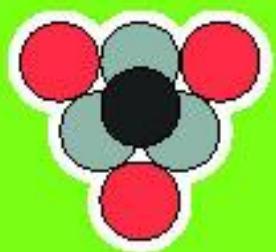
- 万能接触: 这种颜色的配件必须接触用于解决此挑战的所有其他颜色的配件。至少使用 1 个这种颜色的配件。
6.3 层级关系类规则
- 同层: 两种颜色的配件必须处于同一层级。每种颜色至少使用 1 个配件。如果颜色相同,则至少使用 2 个该颜色的配件。
- 左侧更高: 左侧的颜色必须处于比右侧颜色更高的层级。每种颜色至少使用 1 个配件。
- 左侧更低: 左侧的颜色必须处于比右侧颜色更低的层级。每种颜色至少使用 1 个配件。
- 不同层: 这些颜色的配件必须处于不同的层级。每种颜色至少使用 1 个配件。如果颜色相同,那么该颜色的配件必须出现在两个不同的层级上(并且你必须至少使用 2 个该颜色的配件)。
6.4 位置与形态类规则
- 必须占据角/顶点: 这种颜色的配件必须形成金字塔的三个角之一或金字塔的顶点。至少使用 1 个这种颜色的配件。
- 不得占据角/顶点: 这种颜色的配件不能形成金字塔的三个角之一或金字塔的顶点。至少使用 1 个这种颜色的配件。
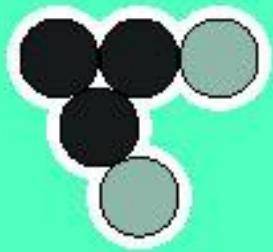
- 直线: 图中显示的颜色必须在金字塔的某处形成一条直线,顺序如图所示。不允许弯曲。直线的方向无关紧要。
- 开放链: 图中显示的所有颜色的配件必须是至少 3 个配件长的开放链的一部分。链的起始和结束配件必须恰好接触 1 个其他颜色的配件。链内的配件(不在起始或结束位置)必须恰好接触 2 个其他颜色的配件,且不能接触自己的颜色,除非显示的两种颜色相同。链的起始和结束不能是同一个配件。
7. 接触的判定
如果两个配件满足以下条件之一,则认为它们是相互接触的:
- 它们在同一层级内直接相邻;
- 它们是堆叠在一起的。
图示判定举例(说明接触与不接触的区别):
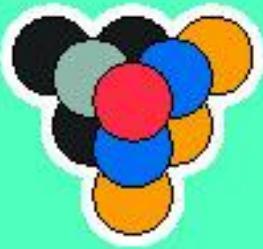
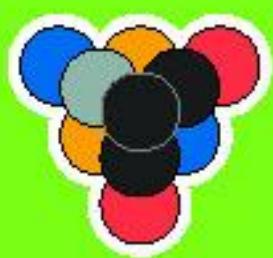
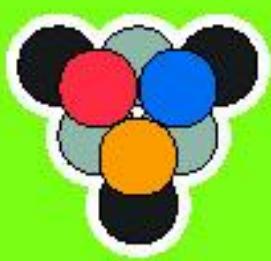
- 灰色配件接触两个黄色配件;红色配件接触两个蓝色配件和两个黄色配件。
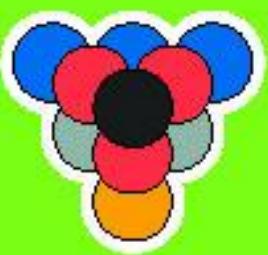
- 灰色配件接触红色、蓝色和黄色配件。
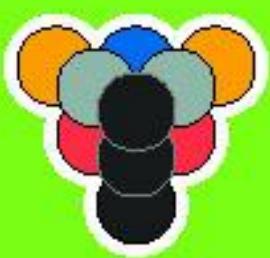
- 灰色配件接触黄色配件和两个蓝色配件,但不接触三个红色配件。
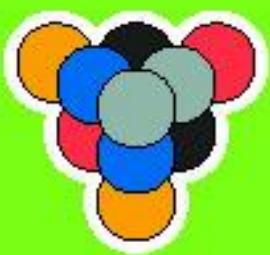
- 灰色配件接触红色配件和两个蓝色配件,但不接触三个黄色配件。
重要提示: 有时没有第 2 层,但有第 3 层。在这种情况下,可以在第 1 层的中心上方放置一个配件。
8. 完成挑战与检查
- 自行核对: 当你完成一个挑战后,可以通过将其与提供的答案进行比较来检查是否正确。
- 解法不唯一: 规则书中只提供了一种解决方案,但许多挑战有不止一种解决方案,你可以尝试把它们全部找出来。
8.1 你成功完成了一个挑战吗?
- 清除盖子上的配件,并把它们放回配件库。
- 继续下一个挑战。
- 一旦你完成了卡片 A 面的所有挑战,将卡片翻过来,继续在 B 面进行游戏。
- 完成卡片的 B 面后,将下一张卡片放在卡片堆的顶部,并确保 A 面朝上,依此类推。
- 如果你在某个挑战上卡住了,可以跳过它,稍后再回来解决。
游戏结束: 如果你成功解决了全部 200 个挑战,你就完成了游戏。
关键规则与常见问题
易错规则
- 凹陷面始终朝下: 所有配件的凹陷面一律朝下放置,放反不会符合规则。
- 默认每个挑战用 10 个配件: 只有卡片上特别标注了所需配件数量时才不按 10 个计算。
- 金字塔最多 10 个位置: 底层最多 6 个、中层 3 个、顶层 1 个;不能堆出 3 层以外的格局。
- 可能跳过第 2 层: 没有第 2 层但有第 3 层时,可以把配件放在第 1 层的中心正上方,这仍然算作有效的第 3 层。
- 卡片上半部分的规则对整面 5 个挑战都生效: 它是单个挑战规则的补充,不是可选条件。
- 金字塔图像中被涂色的圆圈是硬性预置: 该位置必须放置对应颜色的配件,且对整面 5 个挑战都适用。
- 规则中的颜色只是示例: 规则可以和任何颜色组合,颜色本身没有特殊含义。
- 「至少使用 1 个」的默认要求: 层级类、接触类规则一般要求每种颜色至少 1 个配件;若规则中显示的是同一种颜色的两个图标,则该颜色至少要放 2 个。
- 数量比较类规则允许为 0: 「左多右少」时可放 0 个右侧颜色;「左少右多」时可放 0 个左侧颜色;「数量不等」时其中一种颜色可以为 0;「数量相等」时两色都可以为 0。
- 直线规则不允许弯曲: 顺序必须如图,但直线整体的方向无所谓。
- 开放链必须两端封闭: 首尾配件只能接触 1 个其他颜色配件,中间配件恰好接触 2 个其他颜色配件且不能接触自己的颜色(除非图中两种颜色相同),首尾不能是同一个配件。
- 接触只看相邻与堆叠: 同一层级内直接相邻、或上下堆叠才算接触;斜对角、隔一个位置或不同层级不相邻都不算接触。
- A 面一定比 B 面简单: 同一张卡片先做 A 面再做 B 面;但级别之间并非严格排序,某一级别的最高卡片可能比下一级别的最低卡片更难。
- 解法不唯一: 规则书只给一个答案,遇到与答案不同但同样满足全部规则的摆法也算正确。
常见问题
-
Q:需要多少个配件才能完成一个挑战?
A:默认 10 个,除非卡片上另有说明。 -
Q:配件怎么放?
A:把盒子放到平整表面上,从底部抽屉取出全部 15 个配件作为配件库,然后把配件凹陷面朝下放入盖子顶部的插槽,堆成金字塔。 -
Q:金字塔有几层、每层能放几个?
A:三层。最底层最多 6 个,中间层 3 个,顶部 1 个。 -
Q:如果某一层空着但更高一层要放配件怎么办?
A:当没有第 2 层但有第 3 层时,可以把配件直接放在第 1 层的中心上方。 -
Q:卡片上半部分的规则和单个挑战的规则是什么关系?
A:上半部分的规则适用于该面全部五个挑战,是单个挑战规则的补充,必须同时满足。 -
Q:金字塔图像里被涂色的圆圈是什么意思?
A:该位置必须放置对应颜色的配件,而且对这张卡片该面的全部五个挑战都生效。 -
Q:规则示意图里的颜色是固定的吗?
A:不是。规则可以与任何颜色组合,示意颜色仅为示例。 -
Q:怎样判断两个配件是否接触?
A:两个配件在同一层级内直接相邻,或者它们堆叠在一起,就算相互接触。 -
Q:完成挑战后要做什么?
A:清除盖子上的配件并放回配件库,然后继续下一个挑战;A 面全部完成后翻到 B 面,B 面完成后换上下一张卡片并保持 A 面朝上。 -
Q:卡住了怎么办?
A:可以直接跳过该挑战,稍后再回来解决。 -
Q:多久要完成 200 个挑战?
A:没有时间限制,随时可以继续。
常见问题(FAQ)
以下 1 条问答中 0 条来自站内玩家的真实提问,其余 1 条为本站整理的常见疑问;答复内容保持原样。
维度棋支持几个人玩?
1–4 人。
去哪查完整规则
想核对具体规则细节、卡牌效果或某个回合的结算方式,可以在村了吗里选中这款游戏后直接提问。
同类桌游
- 卡坦岛德式
- 工业革命:伯明翰德式
- 勃艮第城堡:特别典藏版德式
- 方舟动物园德式
- 卡卡颂抽象
- 瘟疫危机传承:第一季美式
- 阿瑞迪亚:勇踏征途美式
- 重塑宇宙德式
- 幽港迷城美式
- 埃多拉的德鲁伊德式
规则原文(Markdown)
本站收录这款游戏的规则原文 2 个文件,此处内联渲染 2 个,可直接展开阅读或下载。
rules_zh_维度棋_3999.md24.6 KB
dimension the brain game to go
适合 1 人
年龄 8 岁 +
SOLUTION
HELP!*
游戏概述

这款紧凑的单人版《Dimension 维度》是为拼图爱好者设计的,可以随时随地畅玩。游戏中包含200个挑战,从简单(青绿色)开始,难度和复杂度逐步提升,依次为中级(绿色)、高级(橙色),最终达到专家级(红色)。你能完成全部200个挑战吗?
* 下载免费的 Kosmos Helper 应用程序并选择《Dimension 维度:便携版脑力游戏》。如果你有第二份《维度:便携版脑力游戏》,就可以与另一位玩家竞争完成挑战!
游戏配件
1个塑料盒
20张卡片,包含200个挑战
15个塑料配件
1本规则书(附带解答)

快速开始
按照规则排列椭球体配件以完成 200 个挑战。

每张卡片包含五个挑战,其中包含表示必须遵循的规则的符号(第6-7页)。每张卡片的顶部显示适用于该面所有挑战的规则(第4页)。

选择你想要解决的挑战所在的卡片,将该卡片放在盒子内的卡片堆顶部,然后盖上盖子。将盒子放在平整的表面上,然后从盒子底部的抽屉中取出配件。

通过将配件放在盖子上解决挑战。配件可以堆叠成金字塔形状。
没有时间限制。建议按数字顺序解决挑战,但并非必须。
游戏流程
想看游戏玩法视频请到第 9 页。
打开盖子,选择包含你想尝试的挑战的卡片,将该卡片放在卡片堆的最上面。按照图示将卡片堆放回盒子内,然后盖上盖子。

从盒子底部的抽屉中取出全部15个配件,将它们放在盒子旁边作为你的配件库。然后关上抽屉。
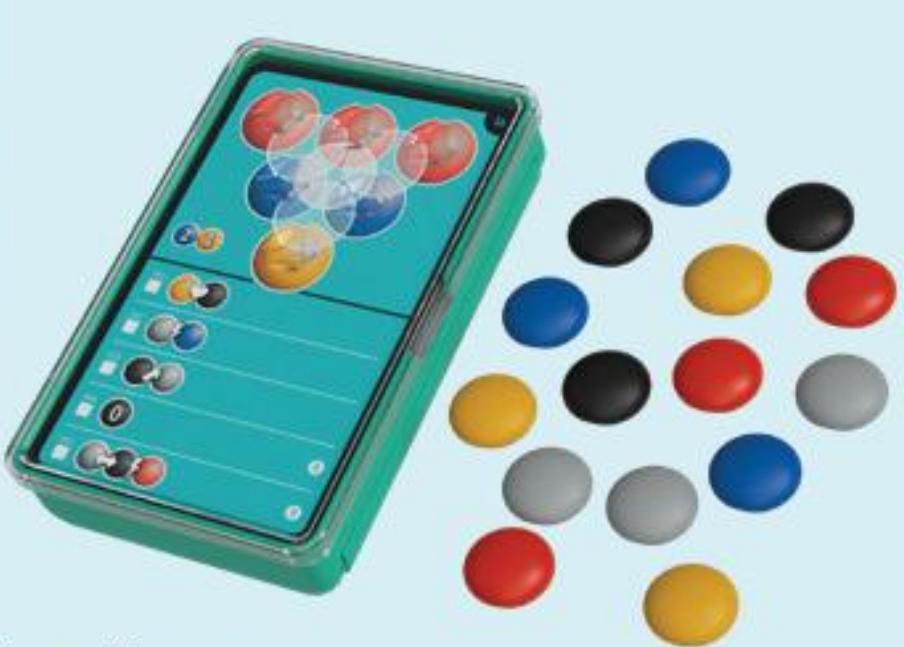
盖上盖子后,根据你正在解决的挑战的规则(见第6-7页),开始将配件放入盖子顶部的插槽中。注意:配件的凹陷面始终朝下。
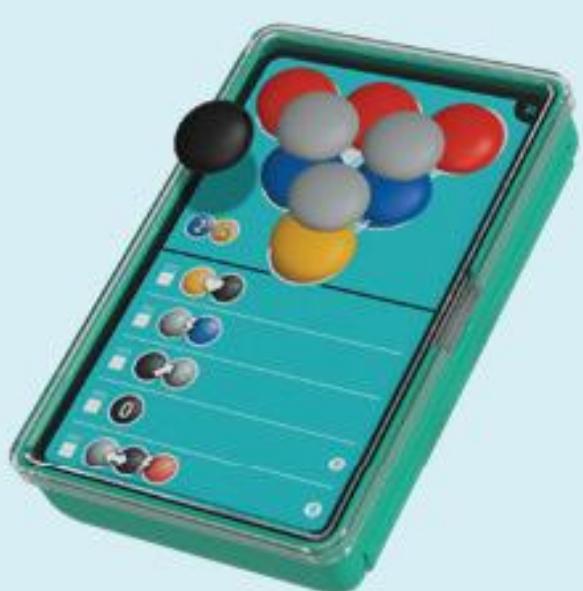
配件可以排列成一个金字塔形状,分为三个层级——最底层最多可以放置六个配件,中间层放置三个配件,顶部放置一个配件。确保配件正确地放入插槽中或者彼此堆叠在一起。每个挑战都需要十个配件,除非另有说明(关于卡片结构的详细信息,请参见第4页)。
卡牌布局
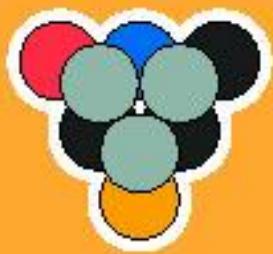
这是一个金字塔的图像,展示了最多可以放置十个配件的位置。
这张卡片的一面为五个挑战预先填充了位置。
每个单独挑战的规则
适用于这张卡片上所有五个挑战的规则卡牌编号

挑战编号和复选框。完成每个挑战后进行标记。
解决挑战所需的配件数量。除非在此处特别说明,否则需要十个配件。
规则
每张卡片的一面有五个挑战,显示在卡片的下半部分(见第4页)。卡片的上半部分包含适用于该面所有五个挑战的规则。
如果金字塔图像中的一个圆圈被涂上了颜色,那就意味着对于卡片上的所有五个挑战,那个位置必须放置相应颜色的配件。
在金字塔图像左侧、黑色线上方的规则适用于卡片上的所有五个挑战。这些规则是单独挑战规则的补充。
每条规则都由一个符号表示。规则的符号在第 6 页和第 7 页有说明。每个挑战的解答可以在第 10-15 页找到。
挑战的复杂性和难度会逐渐增加。当你进入更具挑战性的级别时,会增加更多规则。卡片的背景颜色显示了不同的级别:
青绿色:简单
绿色:中级
橙色:高级
红色:专家
注意: A 面总是比 B 面简单。然而, 一个难度级别中最高的卡片有时可能比下一个难度级别中最低的卡片更难。
翻页查看规则符号的说明。
重要提示:规则可以与任何颜色组合。下一页展示的颜色仅为示例。

使用这种颜色的 X 个配件。X 可以是任何数字,包括 0(例如 0 个黄色配件)。

两种颜色的配件总数必须是 X。你可以使用其中一种颜色的 0 个配件。

每种颜色的配件都必须接触另一种颜色的配件(见第8页)。每种颜色至少使用1个配件。如果规则显示两种相同颜色的配件,则至少使用2个配件。

两种颜色的配件不能相互接触。每种颜色至少使用 1 个配件。如果颜色相同,则至少使用 2 个该颜色的配件。

两种颜色的配件必须处于同一层级。每种颜色至少使用 1 个配件。如果颜色相同,则至少使用 2 个该颜色的配件。

左侧的颜色必须处于比右侧颜色更高的层级。每种颜色至少使用 1 个配件。

每种颜色的配件数量必须相等。两种颜色的配件都可以使用 0 个。

左侧的颜色必须比右侧的颜色出现得更频繁。你可以使用 0 个右侧颜色的配件。

左侧的颜色必须处于比右侧颜色更低的层级。每种颜色至少使用 1 个配件。

左侧的颜色必须比右侧的颜色出现得更少。你可以使用 0 个左侧颜色的配件。

每种颜色的配件数量必须不相等。你可以使用其中一种颜色的 0 个配件。

这些颜色的配件必须处于不同的层级。每种颜色至少使用 1 个配件。如果颜色相同,那么该颜色的配件必须出现在两个不同的层级上(并且你必须至少使用 2 个该颜色的配件)。

这种颜色的配件必须形成金字塔的三个角之一或金字塔的顶点。至少使用 1 个这种颜色的配件。

这种颜色的配件不能形成金字塔的三个角之一或金字塔的顶点。至少使用 1 个这种颜色的配件。

图中显示的颜色必须在金字塔的某处形成一条直线,顺序如图所示。不允许弯曲。直线的方向无关紧要。

这种颜色的配件必须接触用于解决此挑战的所有其他颜色的配件。至少使用 1 个这种颜色的配件。

图中显示的所有颜色的配件必须是至少3个配件长的开放链的一部分。链的起始和结束配件必须恰好接触1个其他颜色的配件。链内的配件(不在起始或结束位置)必须恰好接触2个其他颜色的配件,且不能接触自己的颜色,除非显示的两种颜色相同。链的起始和结束不能是同一个配件。

接触
如果两个配件满足以下条件之一,则认为它们是相互接触的:它们在同一层级内直接相邻;
它们是堆叠在一起的。

灰色配件接触两个黄色配件。红色配件接触两个蓝色配件和两个黄色配件。
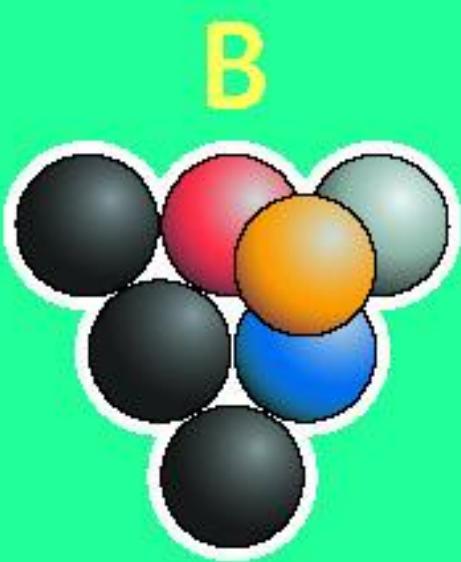
灰色配件接触红色、蓝色和黄色配件。

灰色配件接触黄色配件和两个蓝色配件,但不接触三个红色配件。
重要提示: 有时没有第 2 层, 但有第 3 层。在这种情况下, 可以在第 1 层的中心上方放置一个配件。
举例:

灰色配件接触红色配件和两个蓝色配件,但不接触三个黄色配件。
完成挑战
当你完成一个挑战后,你可以通过将其与提供的答案进行比较来检查是否正确。每个挑战的答案可以在第 10-15 页找到,或者在 Kosmos Helper 应用程序中查看。
重要提示:规则书和辅助应用程序中只提供了一种解决方案,但许多挑战有不止一种解决方案。你能找到它们全部吗?
你成功完成了一个挑战吗?
清除盖子上的配件,并将它们放回配件库。
继续下一个挑战。一旦你完成了卡片 A 面的所有挑战,将卡片翻过来,继续在 B 面进行游戏。
完成卡片的 B 面后,将下一张卡片放在卡片堆的顶部,并确保 A 面朝上,依此类推。
如果你在某个挑战上卡住了,你可以跳过它,稍后再回来解决。
如果你成功解决了全部 200 个挑战,你就完成了游戏。恭喜你!
扫描这个二维码,观看一个展示如何玩游戏的规则教程视频。
Dimension: The Brain Game To Go.

π
[No text detected]
π m
m
1

π+
10
6

2

11

21



26
16
7
31

12



3

27
8
22


17
32


9
13
4
14

18

23
19

28

33

24

29

34

5

10

15
20

25

30

35


B+
π
L
5
π
6
36
π
37
41
42
N
46
51
56
47
61
52
57
66
62
43
38
48
53
67
58
63
39
54
49
68
44
59
64
69
40
45
50
55
60
65
70



π
∞
71
72

76
77
81

86

πσ

82
87





91
73

78
101
96
92

74

83
84
88
89
79
97
93
102
10b
94
98
π11
103

12
99
104
75

80
85

90

95

100
105
14b | 14a | 13b | 13a | 12b | 12a | 11b
106

111

116

121

126

131

136

107

112

117

122

127

132

137

108

113

118

123
128

133

138

109

114

119

124

129

134

139

110

115

120

125

130

135

140


153
15b
16a
16b
17a
141

142

143
144

145


146
147

148
149
150




151
152
153
154
155

156

157
158

159

160

161
162

163
164
165



14

166
17b
168
167
169
170

18a
18b
19a
19b
20a
20b
171

172
176


181
177

186

191
182


187
196



178
183
173


192

188
197


184
193


174

179

198
189

194

199

175

180

185

190

195

200


Lauge Luchau 仍在从 20 世纪 80 年代的青少年经历中恢复过来,这段经历让他无法严肃对待任何事情,被诊断为 “X 世代”。现代的青少年女儿和气候危机的结合缓解了任何残留的症状。他与妻子和两个女
儿住在丹麦奥胡斯,白天作为一名游戏配件开发者工作,夜晚则努力通过一个谜题接一个谜题让世界变得更好。
Lauge Luchau 和 Kosmos 想要感谢所有参与游戏测试和编辑的人。
Lauge 特别感谢他的猫 Enya,它让他明白,在地板上滚动《维度》的配件比为它们想出新的关卡要有趣得多。安息吧,毛茸茸的朋友。
Graphic Design: Sensit
Communication, sensit.de
3D: Andreas Resch
Editing: Michael Sieber-Baskal
English Editing: Ted McGuire,
Hannah Mintz, Peter Bowen
© 2022 Franckh-Kosmos Verlags-GmbH & Co. KG
Pfizerstrasse 5-7
D-70184 Stuttgart
kosmos.de
All rights reserved.
PRINTED IN CHINA
© 2022 Thames & Kosmos, LLC,
Providence, RI, USA
Thames & Kosmos® is a registered
trademark of Thames & Kosmos,
LLC. All rights reserved.
Distributed in North America by
Thames & Kosmos, LLC.
Providence, RI 02903.
Phone: 800-587-2872
Web: thamesandkosmos.com
Distributed in United Kingdom by
Thames & Kosmos UK LP.
Cranbrook, Kent TN173HE.
Phone: 01580 713000
Web: thamesandkosmos.co.uk
Dimension - Unofficial EN Rules 20140404.md10.4 KB
Dimension
Game Idea
Each player tries to place colored balls in the right place. In each round, 6 task cards are revealed. These give the players rules for which colored balls are allowed to be next to each other or what balls are not allowed to touch. Whoever can solve the problems correctly gets points and the player with the most points at the end of 6 rounds is the winner.

Set Up
-
Each player takes a player tableau and puts it on the table.
-
Each takes 15 balls - Three balls of each Color (Orange, Blue, Green, Black, White) are placed in the five elongated recesses the tableau. The round holes remain free. (If there are less than 4 players, the remaining balls are placed in the box since they are not needed in this game.)
-
Everyone receives a summary table and sets it next to their tableau. The summary tables show a brief description of task cards. Everyone gets 10 points worth of chips (a 5 and five 1s).
-
The remaining points chips after sorted by their value and placed next to the bonus chips as a general stock.
-
The task cards are shuffled and ready in a face down pile.
-
The hourglass is visible to all players provided.
Game Play
A round proceeds as follows:
-
The top 6 Task cards are exposed and placed side by side in the center of the table. Each card specifies how the colored balls on the player boards should be placed. In the first game, the players should discuss how the task cards work together (see the "Cards" section).
-
The hourglass is flipped.
-
All players now try, while the hourglass is running, to fulfill the tasks on the cards with the balls on their own table. When stacking, the balls must be stacked such that one is on top of three underlying balls. Thus, the panel is for a maximum in 3 levels high with a total of 11 balls.
-
Receive or give points chips:
o First, each player receives 1 point for each ball on his Tableau. (So if you have placed 8 balls on your tableau, you receive 8 Points. If a player has placed 11 balls, he gets 11 points.)
o A player then reads the tasks of the cards one after another. For example, black and blue must touch. Each player checks his board and says, "Yes!" if he met the specific task and "No" if he has not met it. For each unsatisfied task card, the player must return 2 points worth of chips. (If a player, for example, does not satisfy one of the 6 task cards, he has to give 2 points worth of chips. If he had not satisfied 5 tasks, he has to give back 10 points worth of chips. )
- Get bonus chips: A player who has fulfilled all 6 task cards correctly may earn 1 or even 2 bonus chips. The number of collected bonus chips can determine victory or defeat (see the bonus chip index at "End Game").
o Bonus chip for all 5 colors: Any player who accommodated all 5 ball colors on his board receives 1 bonus chip.
o Bonus chip for less than most balls: Any player who placed fewer balls on his tableau than the player with the most balls gets 1 bonus chip. (If two or more players have the most balls, then the other players that used less balls with get 1 bonus chip each.)
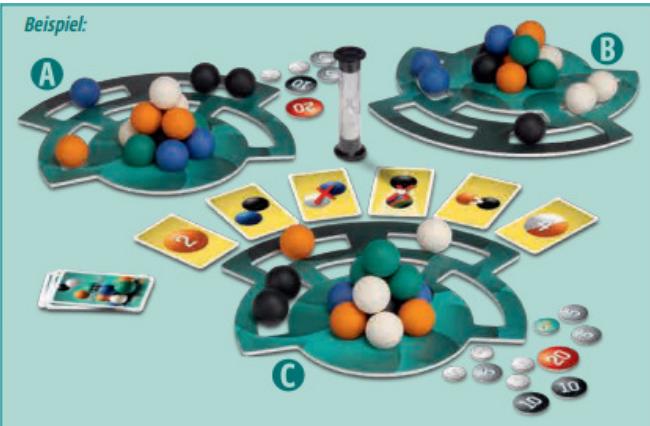
The lowest level for each player looks like this:

Points are distributed:
• Player A has placed 11 balls on his board and will receive 11 points.
• Player B receives 10 points for his 10 balls.
• Player C receives 11 points.
Secondary scoring:
Player A has met all the task cards, except for "Exactly 4 balls that are white and orange" and thus gives back 2 points chips. He does not receive bonus chips because not all 6 task cards were solved correctly.
Player B has fulfilled all the task cards except for "Exactly 2 orange balls", he gives back 2 points chips. He does not receive bonus chips because not all 6 task cards were solved correctly.
Player C has met all the task cards correctly and does not have to give any points back. Since Player C has correctly solved all of the task cards and also used 5 colors, he receives 1 bonus chip. The bonus chip for "less than most balls" is not given because he has tied for the most balls together with A. Had he used 10 instead of 11 balls, he would receive 1 Bonus chip for "Fewer balls used than the most."
Next Round:
-
Set aside the six task cards used in the previous round.
-
Each player returns the balls back to the elongated recesses in the player board.
-
Reveal 6 new task cards to begin the next round.
-
The game is played over a total of 6 rounds.
Game End
• After 6 rounds are played, the players get points for their bonus chips

| Bonus Chips | 0 | 1 | 2 | 3 | 4 | 5 | 6 | 7 | 8 | 9 | 10 | 11 | 12 |
| Points | -10 | -6 | -3 | -1 | 0 | 1 | 3 | 6 | 10 | 15 | 21 | 28 | 36 |
• Whoever has the most points wins. In case of a tie, the Tied player who had collected the most bonus chips wins. In the event of another Tie, there is more than one winner.
The cards
The 60 cards are explained together in groups.
Note: The player boards are die cut such that there is some distance between the balls in the lowest level, yet still "touch" all the other balls in the immediate vicinity:

The orange ball in the middles touches all balls around it. The black ball touches both orange balls and the blue ball.

The blue, two orange, and white balls all touch.
Just so much of it! – These task cards dictate that as many balls of the color shown are to be placed. In which level the balls are placed and whether the balls touch or not, does not matter. In the example, exactly 1 green ball and exactly 2 orange Balls are placed.
o Special case: If two of these cards showing the same ball color are revealed (for example: the green "1" + the green "2"), they must be met individually. Thus 3 green Balls are placed to meet both cards.


Must touch! – If both ball colors of a card on the Tableau are placed, each of these balls must touch at least one other color (next to or above). Placing both colors without touching or placing only one of the colors is not allowed. In the example, white balls must touch and blue and black ball must be touching.

Must not touch! – The colors sho wn on the card may not touch (directly next to or above each other). In the example, white and green balls do not touch and the blue balls do not touch. Note: The white and green balls in the second level do not touch!


Must not be over something! – The displayed ball must not be placed on top of other balls, but can be played underneath other balls. Therefore, it can only be placed in the lowest level. In the example, orange balls may not be located on top of other spheres, so oranges can only be played in level 1.


Note: The striped ball stands for any other ball color.
Must not be under anything! – The displayed ball must not be under any other balls. Therefore, no other balls are allowed on top of the displayed Ball. The colored ball shown can be displayed in any level as long as there is nothing on top. In the example, white balls may not be under other balls.

More than! – There must be more balls of the left color placed than of the right color. It does not matter the levels the balls are placed or whether or not the balls touch. Placing only the color that should be more of is allowed. In the example, more orange-colored balls must be placed than black balls.

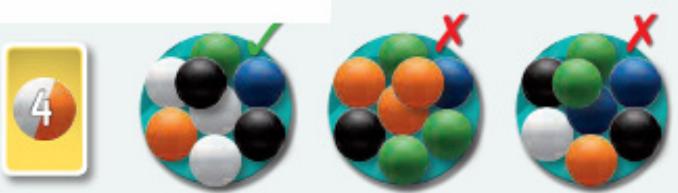
The sum of both must be exactly 4! – Exactly 4 balls of two colors shown must be placed. It does not matter if there are three of the one color and one of the other color, or two and two nor does it matter which levels the balls are placed or whether they touch. In the example, exactly 4 balls of orange and/or white must be placed.
Task Card Conflicts
If the requirements of task cards contradict (e.g. "Black and Blue must touch" and "Black and Blue may not touch"), the players must decide which one not to fulfill and accept a point loss. No bonus chips will be awarded.
Solo game
● Dimension can also be played alone. The game play is the same as the regular rules. Points are totaled at the end and compared with previous solo parts.
Variants
• To make the game more difficult, lay out 8 task cards for each round rather than just 6.
If the players prefer to not have conflicting task cards, they can slide a conflicting card under the stack (e.g.
"White and Orange must touch" and "White and Orange should not touch") and then reveal a new card.
Another way to reduce conflicting task cards is to remove the following cards: Just so much of it! / Must not be over something! / The sum of both must be exactly 4!
下载 Markdown原文为社区整理/出版社公开资料,版权归原作者,仅供个人学习查阅。