
优势物种Dominant Species
一句话概览
优势物种 是一款已收录于村了吗规则库的桌游,支持 2–6 人,原名 Dominant Species。
本页内容:一句话概览 · 游戏概述 · 1. 游戏组件 · 2. 游戏设置 · 3. 游戏流程 · 4. 六种元素与匹配系统 · 5. 十二种行动详解 · 6. 卡牌 · 7. 可选规则 · 关键规则与常见问题 · 常见问题
优势物种 规则速览
以下规则速览由本站整理,与官方规则书表述不同,仅供快速上手参考。
游戏概述
公元前90000年,冰河时代逼近,六大动物纲——哺乳纲、爬行纲、鸟纲、两栖纲、蛛形纲、昆虫纲——争夺地球霸权。玩家操控其中一个动物纲,通过行动棋子放置驱动行动,在板块地球上扩张物种、争夺优势(Dominance),并在终局时积累最多胜利点数(VP)者获胜。
核心机制: 行动棋子放置(工人放置)、元素匹配与优势争夺、物种增殖与迁移、冰河推进
1. 游戏组件
| 组件 | 数量 |
|---|---|
| 游戏板 | 1 块 |
| 动物面板(Animal Display) | 6 块 |
| 卡片 | 27 张(1 张生存卡 + 26 张优势卡) |
| 大六角板块 | 31 块(7 种地形 + 12 冻原 + 12 备用) |
| 小六角冻原板块 | 12 块 |
| 物种方块(Species Cubes) | 330 颗 |
| 行动棋子(Action Pawns, AP) | 60 个(圆柱体) |
| 优势标记(Domination Markers) | 60 个(锥体) |
| 元素圆片(Elements) | 120 个(6 种类型) |
| 先手标记 | 6 个(方形) |
| 抽取袋 | 1 个 |
2. 游戏设置
2.1 游戏板与动物分配
- 将游戏板正面朝上放在桌子中央。
- 每位玩家选择或随机分配一个动物纲,领取对应动物面板。
- 按食物链逆序(昆虫先、蛛形纲、两栖纲、鸟纲、爬行纲、哺乳纲最后)将先手标记放入先手轨道对应格位。无人使用的动物面板及先手标记放回盒中。
2.2 板块设置
- 将 7 种非冻原地形的大板块各 1 块放入游戏板中央六角网格的指定位置,将 1 块冻原板块叠放在海洋板块之上。
- 剩余 11 块冻原板块正面朝上叠放于"冰河板块"区。
- 剩余 24 块大板块正面朝下洗混,分成 3 叠各 8 块放于"探索板块"区,将每叠最上 1 块翻至正面朝上。
2.3 卡片设置
- 生存卡单独放在一旁。
- 从优势卡中取出"冰河时代"卡正面朝下放在板旁,剩余 25 张洗匀后叠放其上形成抽牌堆。
- 从抽牌堆顶抽 5 张正面朝上放在"可用优势卡"区。
2.4 元素设置
- 取每种元素各 2 个放在板上标注的板块角落位置(元素圆片跨放于板块交界处,可同时属于最多 3 个板块)。
- 其余元素放入抽取袋。
- 从袋中随机抽取 4 个放入适应区的叶形格,再抽 4 个放入丰裕区,再抽 4 个放入探索区。
2.5 物种设置
每位玩家领取自己颜色的:
- 10 个锥体(优势标记)
- 数量因玩家人数而定的圆柱体(行动棋子)和方块(物种基因库):
| 玩家人数 | 行动棋子 | 基因库物种 |
|---|---|---|
| 6 人 | 3 个 | 35 颗 |
| 5 人 | 4 个 | 40 颗 |
| 4 人 | 5 个 | 45 颗 |
| 3 人 | 6 个 | 50 颗 |
| 2 人 | 7 个 | 55 颗 |
- 每人取 1 颗物种方块放在 VP 轨道的"0"位作为计分标记。
- 起始物种放置位置:
| 动物纲 | 起始放置 |
|---|---|
| 昆虫 | 草原 2、湿地 1、沙漠 1 |
| 蛛形纲 | 丛林 2、森林 1、湿地 1 |
| 两栖纲 | 湿地 2、丛林 1、草原 1 |
| 鸟纲 | 森林 2、山地 1、丛林 1 |
| 爬行纲 | 沙漠 2、草原 1、山地 1 |
| 哺乳纲 | 山地 2、沙漠 1、森林 1 |
- 每个动物起始时即在其主要占据板块上拥有优势。
2.6 开始游戏
先手轨道最左侧的动物先行动,进入第一回合的规划阶段。
3. 游戏流程
每回合分三个阶段依次执行:规划阶段 → 执行阶段 → 重置阶段。
3.1 规划阶段(Planning Phase)
- 按先手轨道从左到右的顺序,每位玩家轮流将 1 个可用行动棋子(AP)放入行动显示区的任意空置"眼球"格位。每格最多放 1 个 AP,先到先得。
- 当最后一位玩家放完后,开始新一轮放置;从先手轨道最左侧重新开始。
- 重复直到所有玩家的 AP 均已放置完毕。
- 不可放入非眼球格位(如竞争区的蛛形纲图标格)。
3.2 执行阶段(Execution Phase)
- 按行动显示区从上到下、从左到右的顺序依次移除 AP,由该 AP 的所有者执行对应行动。
- 行动顺序固定为:
| 序号 | 行动 | 说明 |
|---|---|---|
| 1 | 先手(Initiative) | 交换先手顺序 |
| 2 | 适应(Adaptation) | 获取新元素 |
| 3 | 退化(Regression) | 移除多余元素 |
| 4 | 丰裕(Abundance) | 在地球上放置元素 |
| 5 | 废土(Wasteland) | 移除冻原旁的元素 |
| 6 | 耗竭(Depletion) | 移除地球上的元素 |
| 7 | 冰河化(Glaciation) | 将板块永久变为冻原 |
| 8 | 物种形成(Speciation) | 放置新物种 |
| 9 | 探索(Wanderlust) | 添加新板块扩张地球 |
| 10 | 迁移(Migration) | 移动物种 |
| 11 | 竞争(Competition) | 消灭敌人物种 |
| 12 | 统治(Domination) | 计分板块并获取优势卡 |
- 所有行动均为自愿,可放弃不执行。
- 大部分空区域可跳过,但以下始终生效:退化(影响所有动物)、废土(影响所有冻原板块)、物种形成(昆虫总有免费放置机会)、竞争(蛛形纲总有免费竞争机会)。
3.3 重置阶段(Reset Phase)
依次执行:
1. 灭绝(Extinction): 消灭所有濒危物种(放回盒中出局)。哺乳纲每回合可自动拯救 1 个自己的濒危物种。
2. 生存(Survival): 在冻原上拥有最多物种的动物获得生存卡;平局则无人持有。持有者按其占据的冻原板块数获得奖励 VP。
3. 再播种(Reseed): 若不是最后一回合,执行以下重置:
- 补满可用优势卡至 5 张正面朝上。
- 冰河区的 AP 向左滑动填补空位。
- 退化、耗竭、探索区的元素全部放回抽取袋。
- 废土区元素下移至耗竭区;丰裕区下移至废土区;适应区下移至退化区。
- 从袋中各抽 4 个新元素放入适应区、丰裕区、探索区。
- 将三叠探索板块最上一块翻至正面朝上(如仍有的话)。
4. 六种元素与匹配系统
六种元素类型:草(Grass)、虫(Grub)、肉(Meat)、种子(Seed)、阳光(Sun)、水(Water)。
- 动物面板上的元素 = 需求(Need);地球板块上的元素 = 供给(Supply)。
- 元素放置在板块角落,一个元素圆片可同时属于最多 3 个相邻板块。
匹配(Matching)计算
在某板块上,将动物面板上每种元素类型的数量乘以该板块上同类型元素的数量,所有类型求和即为匹配总数。匹配数最多的动物在该板块拥有优势(Dominance)。
濒危(Endangered)
物种所在板块上其动物匹配数为零时,该物种濒危。濒危物种不能声称优势,且在重置阶段的灭绝步骤中被消灭。
优势(Dominance)
- 在板块上至少有 1 个物种,且匹配数严格超过所有其他在场动物的,即拥有优势。
- 匹配数平局 = 无人拥有优势。
- 濒危物种永远不能拥有优势。
- 优势需玩家口头和物理上主动声称,不是自动发生的。
- 每个动物有 10 个优势锥体;超过 10 个时用任意方式标记。
5. 十二种行动详解
5.1 先手(Initiative)
- 移除 AP 后,将自己的先手标记与左侧相邻标记交换位置(即在先手轨道上前进一步)。已在最左侧则跳过此步骤。
- 将刚移除的 AP 放入任意空置的眼球格位(该 AP 实际上为本回合最后放置的一个)。
- 效果:本回合额外获得一次行动,且下回合规划阶段排序提前。
5.2 适应(Adaptation)
- 从适应区选取 1 个元素放到自己动物面板的空元素槽上。
- 面板元素总数上限 6 个(含固有元素);已达上限则此行动作废。
- 允许拥有同类型多个元素。
5.3 退化(Regression)
- 对退化盒中的每种元素类型,每只动物从面板上移除 1 个同类型元素。
- 在此区域有 AP 的动物,每个 AP 免除 1 个元素的移除。爬行纲在此区域始终有 1 个免费 AP。
- 固有元素(面板左上角印刷的元素)永远不能被移除。仅有固有元素的动物不受退化影响。
5.4 丰裕(Abundance)
- 从丰裕区选取 1 个元素放到地球上任意板块的空角落上(包括仅连接 1 个或 0 个其他板块的边缘角落)。
5.5 废土(Wasteland)
- 若此区域有 AP,持有者可将废土盒中的 1 个元素类型移回抽取袋。
- 无论有无 AP: 废土盒中仍存在的每种元素类型,地球上所有与冻原相邻的板块上该类型元素全部移除回抽取袋。
- 第一回合废土盒为空,此行动无效。
5.6 耗竭(Depletion)
- 移除 AP 后,选择地球上 1 个与耗竭盒中元素类型匹配的元素,从地球上移除放回抽取袋。
- 若耗竭盒中没有与地球上匹配的元素类型,此行动无效。
- 第一、二回合耗竭盒为空,此行动无效。
5.7 冰河化(Glaciation)
仅移除此区域最左侧的 1 个 AP,依次执行以下步骤:
1. 选择 1 个非冻原板块,该板块必须与至少 1 个现有冻原板块相邻。
2. 将该板块上所有物种暂时移出。
3. 将 1 块新冻原板块叠放在该板块上(从此永久视为冻原)。
4. 移除所有被恰好 3 个冻原板块包围的元素圆片。仅被 1 或 2 个冻原板块接触的边缘元素不受影响。
5. 获得奖励 VP:按新冻原板块相邻的现有冻原板块数量查奖励点数表。
6. 从暂时移出的物种中,每种动物各放 1 个回新冻原板块。
7. 剩余物种回到各自所有者的基因库(不是放回盒中)。
- 若冻原板块用尽(12 块全部放置),此行动作废。
5.8 物种形成(Speciation)
- 选择地球上 1 个与 AP 所在格位附带元素类型匹配的元素。在与该元素相邻的板块上从基因库中放置新物种:
| 地形类型 | 最多放置 |
|---|---|
| 海洋、湿地 | 4 个 |
| 草原、丛林、森林 | 3 个 |
| 沙漠、山地 | 2 个 |
| 冻原 | 1 个 |
- 只有被选中元素占据角落的 1~3 个板块可以放置物种。
- 所有物种形成行动结束后,昆虫纲玩家可免费从基因库取 1 个物种放到地球上任意板块。
5.9 探索(Wanderlust)
- 选取探索板块区 1 块正面朝上的大板块,放在游戏板上与现有地球相邻的空六角位。
- 可选择 1 个探索区的元素放到新板块的任意空角落。
- 按新板块相邻的现有板块数量获得奖励 VP。
- 然后按食物链顺序(哺乳纲→蛛形纲→昆虫纲),每位玩家可将自己与新板块相邻的物种全部、部分或不移入新板块。
5.10 迁移(Migration)
- 选取地球上最多 X 个自己的物种(X 为 AP 所在格位的数字),每个移动到相邻板块。
- 鸟纲特殊能力: 鸟纲物种可迁移两格远(经过一个相邻板块到达第二个板块),但不可穿越空六角位。
- 起始在同一板块的物种可一起移动到同一目标,也可分散到不同目标。
5.11 竞争(Competition)
- 观察 AP 所在格位对应的 3 种地形类型,每种地形选择地球上 1 个板块(须满足:该板块有自己的物种且有敌人物种),消灭 1 个敌人物种(放回盒中出局)。
- 蛛形纲特殊能力: 始终有 1 个免费竞争行动——可选择任意 1 种地形的 1 个板块竞争,但限 1 个板块。此免费行动在所有其他竞争之前执行。
5.12 统治(Domination)
- 选择 1 个本回合尚未计分的板块,按以下步骤计分:
1. 物种数量最多的动物获得 VP(按该地形在计分表上的第一列数值)。
2. 非冻原地形:物种数量第二多的动物获得 VP(第二列数值)。独占板块的动物不能同时获得第一和第二名。
3. 海洋、湿地、草原、丛林、森林:物种数量第三多的动物获得 VP(第三列数值)。
4. 海洋和湿地:物种数量第四多的动物获得 VP(海洋 2 VP,湿地 1 VP)。
5. 物种数量相同则按食物链顺序打破平局(哺乳纲 > 爬行纲 > 鸟纲 > 两栖纲 > 蛛形纲 > 昆虫纲)。 - 计分后,若该板块上有优势动物,该动物的控制者必须从可用优势卡中选取 1 张执行其效果,然后将卡永久移出游戏。
- 若选取"冰河时代"卡,游戏在当前回合结束时终止。
6. 卡牌
6.1 生存卡
- 游戏开始时放在一旁。在冻原上拥有最多物种的动物自动获得生存卡(平局则无人持有)。
- 每个重置阶段的生存步骤中,持有者按其占据的冻原板块数获得奖励 VP(占据的物种数量不重要,只看板块数)。
6.2 优势卡(26 张)
- 当统治行动计分某板块时,该板块上的优势动物必须选取并执行 1 张面朝上的优势卡效果。执行完毕后卡永久移出游戏。
- "冰河时代"卡被选取后,当前回合为最后一回合:完成剩余统治行动、执行灭绝、计分生存卡(跳过再播种),然后移除所有优势标记,对地球上每个板块做最终计分(只计 VP,不触发优势卡抽取)。最高 VP 者获胜;平局则食物链靠前者胜。
7. 可选规则
7.1 2-3 人游戏规则
- 多动物控制: 分配全部 6 个动物纲——3 人游戏每人控制 2 个,2 人游戏每人控制 3 个。每个动物各自领取 3 个行动棋子和 35 颗物种(同 6 人游戏配置),维持独立 VP 计分。
- 对立动物: 同一玩家的动物之间视为"对立"——例如优势卡提到"你的动物"时,仅指被计分板块上具有优势的那只。
- 终局计分: 每位玩家取其控制的动物中最低分的那个作为最终成绩。因此需均衡发展所有控制的动物。
7.2 随机地球设置
- 洗混所有大板块后随机抽取 7 块放入起始位置(冻原叠放在中央板块上)。
- 随机抽取 12 个元素放在 12 个起始角落。
- 每个动物按其关键元素类型在地球上放置起始物种(每个含 1 个该元素的板块放 1 个物种,含 2 个放 2 个,以此类推)。
- 物种最多的动物起始 VP 为 0;其余动物起始 VP = 最多物种数 − 自身物种数。
关键规则与常见问题
易错规则
- 优势必须主动声称: 优势变化不会自动发生,玩家有责任口头和物理上声明。
- 濒危物种不能拥有优势: 即使它是板块上唯一的动物。
- 固有元素不可移除: 退化只能移除后天添加的元素,面板左上角的印刷元素永远保留。
- 物种从地球移除后回盒中,不是回基因库: 唯一例外是冰河化步骤中多余的物种回到基因库。
- 冰河化每回合只执行 1 次: 只移除最左侧的 AP。
- 爬行纲在退化区有免费 AP,蛛形纲在竞争区有免费竞争机会,昆虫纲在物种形成后有免费物种放置。
- 统治行动计分的板块不能重复选择: 同一板块每回合只计分一次。
- 统治行动中优势动物可能不是计分者本身,也不是得分最多的动物。
- 竞争行动消灭的物种直接放回盒中,不是回基因库。
- 冻结时代的冰河化步骤: 被 3 个冻原板块包围的元素才移除;仅 1-2 个冻原接触的边缘元素保留。
- 迁移中鸟纲可移动两格,但不可穿越空白六角位。
- 冰河时代卡被选取后跳过再播种步骤,但仍执行灭绝和生存卡计分。
常见问题
-
Q:元素放在板块角落,一个元素能算几个板块的供给?
A:最多 3 个——角落是 3 个板块的交汇点。 -
Q:匹配数平局时谁有优势?
A:无人拥有优势。平局意味着该板块无优势动物。 -
Q:基因库用完了怎么办?
A:该动物无法进行物种形成和部分迁移,但仍有其他行动可选,且 VP 计分不受影响。 -
Q:冻原板块相邻但不物理接触,算相邻吗?
A:算。冻原叠放在大板块上,该大板块与其周围板块物理接触,因此冻原仍被视为与周围板块相邻。 -
Q:统治行动时板块上只有 1 个动物,能同时获得第一和第二名吗?
A:不能。必须有另一个动物在场才能获得第二名。同理第三、四名也需要对应的动物在场。 -
Q:2-3 人游戏中,同一玩家的动物互相算对立吗?
A:是的。所有行为和效果中,同玩家的不同动物视为对立动物。
常见问题(FAQ)
以下 1 条问答中 0 条来自站内玩家的真实提问,其余 1 条为本站整理的常见疑问;答复内容保持原样。
优势物种支持几个人玩?
2–6 人。
去哪查完整规则
想核对具体规则细节、卡牌效果或某个回合的结算方式,可以在村了吗里选中这款游戏后直接提问。
同类桌游
规则原文(Markdown)
本站收录这款游戏的规则原文 2 个文件,此处内联渲染 2 个,可直接展开阅读或下载。
rules_zh_优势物种_627.md63.0 KB
優勢物種

遊戲設計 Chad Jensen
遊戲介紹
在公元前90,000年,一個大冰河時期即將到來。而另一個為了成為萬物之王的大競爭,卻在動物物種之間悄悄地進行開來。
優勢物種這個遊戲抽象地重現了遠古歷史的一小部分:一個漫長且日益嚴重的冰河時期,以及什麼是生物努力去適應這個緩慢變化的地球所需要的。
每位玩家將扮演六大類動物其中之一種:哺乳動物、爬行動物、鳥類、兩棲動物、蛛形綱動物或昆蟲。每個遊戲開始時,或多或少都處於彼此之間是在一個自然平衡的狀態。但是,這樣的平衡是不會持續太久的:正所謂「適者生存」嘛!
透過謹慎地放置行動指示物,玩家們將努力地在許多不同的地形上,成為優勢的物種,從而盡可能地獲得卡牌強大的效果。玩家們也會想要繁殖他們各自的物種,以賺取各自動物的勝利分數。玩家將透過“物種生成”“遷徙”、“適應”等等行動,來努力達到勝利的目標。
所有這一切最終還是會導致遊戲的結束,也就是冰河時期到達最後的頂峰。在這個時候,積累最多勝利分數的玩家,便贏得遊戲,成為真正的優勢物種。
有些人在迅速地成為霸主這方面是很行的,但這樣只是會使到地球變得更加寒冷而已…
內容目錄
遊戲配件……………………………………………………2
遊戲概述………………………………2
詞彙………………………………………………3
遊戲設定……………4
地球……………………………………………………6
元素………………………………………6
抽取袋
匹配元素
瀕臨絕種的物種
優勢地位
物種…………………………8
基因庫
勝利分數記錄條……8
行動顯示區………8
遊戲流程…………9
規劃階段……………………9
執行階段…………………9
率先權順序………………………………………10
適應………10
衰退…11
充裕…11
荒原…12
枯竭…12
冰川作用……13
物種生成……………14
物種漫遊……………14
遷徒……15
競爭……………………………15
優勢…16
兩人和三人遊戲可選規則……17
可選(隨機)地球設定規則…………17
卡牌……………………………………………………………18
倖存卡
優勢卡
重置階段………………………………20
滅絕
倖存
再生
遊戲結束…………20
縱觀這本說明書,你會看到很多像這樣的文字框。這些文字框的內容可能是實例、闡釋、遊戲提示、設計說明以及其他各種智慧,來幫助你的遊戲進行得更輕鬆。
遊戲配件
· 27張卡牌:1張“倖存卡”和26張“優勢卡”
· 31塊大的、12塊小的六角形板塊,用來創造“地球”
· 330個木製方塊,代表六大類動物的所屬“物種”
60個木製柱狀物,作為動物的“行動指示物”
• 60個木製圓錐物,作為取得“優勢地位”動物的標誌
120個圓形標誌(圓盤),代表著地球的資源,即所謂的
• 6個方形標誌,用於顯示每種動物的“率先權順序”(規劃階段的順序)
• 1個布袋
遊戲概述
在整個遊戲中,使用大的六角形板塊來創造一個可能出現在遠古時代且不斷擴大的地球。隨著冰河時代的到來,將小的凍原板塊放到大的板塊上面,來象徵將它們轉換成凍原的過
柱狀物的行動指示物(AP)是驅使遊戲進行的重心。每個行動指示物都可以讓一位玩家來執行他可以採取的各項行動,如物種生成、環境變化、遷徙或冰川作用等。在規劃階段,將行動指示物放置在行動顯示區上面,之後到了執行階段時,便依據各個行動指示物來觸發其所屬玩家的指定行動。
一般來說,玩家會盡力提高自己動物的生存能力,同時試圖阻礙他們的對手動物的生存,並希望在過程中可以獲得更多寶貴的勝利分數。各種卡牌有助於達成這些努力,提供玩家有用的一次性效果,或者是再次獲得勝利分數的機會。
在整個遊戲中,物種方塊將被加入到在場中的板塊(地球)上,或移動進出這些板塊之間。元素圓盤將被添加到動物和地球上,或者是從動物和地球上移除。
當遊戲結束時,玩家將會在每一塊板塊上進行最後的得分計算。之後,控制獲得最多勝利分數的動物之玩家,便成為遊戲的最終贏家。
詞彙

行動指示物(AP)一為一組木製的柱狀物。每個回合中,玩家使用它們來標記他們想要進行的行動。
動物一哺乳動物、爬行動物、鳥類、兩棲動物、蛛形綱動物或昆蟲。在遊戲過程中,每位玩家將扮演六大類動物其中之一種。在地球上的每一類動物都由一組具有相同顏色的方塊來代表。每一類動物都有各自的動物顯示板和順序標誌。
勝利分數獎勵一
奖分数表
有些行動及卡牌效果可以讓玩家獲得“勝利分數獎勵”。
| 数量:勝利分数: | 1 | 2 | 3 | 4 | 5 | 6 | 7 | 8 | 9+ |
| 1 | 3 | 6 | 10 | 15 | 21 | 28 | 36 | 45 |
玩家可以參考位在遊戲圖板左下方的獎勵分數表,來獲得相對應的勝利分數獎勵。獎勵分數表的上排標示出行動或卡牌效果需要檢核對象的數量:例如,當倖存行動時,一類動物佔據了多少塊凍原板塊(詳見第20頁),而在這個數量對應正下方的數字便是獲得的勝利分數獎勵。
優勢卡一為一組26張的卡牌。當一塊板塊進行計分時,取得該板塊優勢地位的玩家可以選擇優勢卡。優勢卡給予玩家一次性效果。在這些卡牌當中有一張稱為「冰河時期的卡牌,會觸發遊戲結束。「倖存」卡並非優勢卡,它自有一套規則的(詳見第20頁)。


優勢地位一是指在一塊板塊上至少出現一個你的物種,而在那塊板塊上,你的動物所匹配的元素比起其他有出現物種的任何動物來得多的狀況。
地球一地球是由一組放在遊戲圖板上的六角形板塊所組成。玩家可以放置元素和他們的動物物種和優勢地位標誌,到地球的各種板塊上。
元素一草、蛆、肉、種子、陽光和水。這些圓形標誌

(圓盤),代表了各種動物茁壯成長所需要的資源。在動物顯示板上的元素代表著“需求”,而放置在地球上的則代表著“供給”。元素會放置到地球板塊的角上,所以單一個元素圓盤最多可以同時出現在三個不同的板塊上。
瀕臨絕種一在場中一個板塊上的任何物種,在那裡沒有一個元素是與其所屬玩家的動物需求相匹配(或板塊上是完全缺乏元素)的時候,該物種便瀕臨絕種。
食物鏈一在優勢行動中,計算一塊板塊的得分出現平手時,食物鏈的順序是用來打破僵局所使用的;另外有些其他的情況也可能會使用食物鏈。食物鏈從上到下(從位階高到低)的順序是:
•哺乳動物
• 鳥類
•爬行動物
• 兩棲動物
·蛛形綱動物
• 昆虫


順序標誌一為一組6個方形的標誌,使用在率先權順序記錄條上,來決定每個規劃階段時,玩家放置行動指示物的順序。(另外,如果玩家們不想使用設計師建議的動物代表顏色時,每個順序
標誌仍有一面是中立白色可供這種情形來使用。)
匹配一在玩家動物顯示板上的元素“A”數量,乘上該玩家的物種所佔據的一塊板塊上的相同元素“A”的數量。同理地去讓元素“B”進行匹配,讓元素“C”進行匹配,如此類推,得出一個所有元素類型的總匹配數。
詳見第7頁圖例。

物種一每個小木製方塊都代表著一個地球上的物種。每個相同顏色的方塊代表著同一類動物的不同物種。
地形一凍原、山脈、沙漠、森林、叢林、草原、濕地或海洋。
地球上的每塊板塊一定是這八個地形類型的其中之一個。
板塊一為大的及小的六角形紙板,代表著不同地形類型。這些板塊從遊戲開始創造地球的遊戲表面,到遊戲當中陸續擴展地球表面,都會使用得到。

勝利分數一每一類動物在遊戲中都需要去收集的。獲得最多勝利分數的玩家成為最終的贏家。


遊戲設定
游戲圖板
將遊戲圖板面朝上放在遊戲桌的中央。
動物
讓每位玩家選擇希望使用的動物。給予每位玩家所選擇的相對應動物顯示板。或者,你也可以隨機分配動物顯示板給每位玩家。
按照食物鏈的逆向順序,玩家將他們各自方形的動物順
序標誌,以顏色面朝上的方式放在“率先權順序”標籤下面的格子上,也就是說:先放昆蟲,然後蛛形綱動物,然後兩棲動物,如此類推。
如果玩家們不想使用預設的動物代表顏色時,取而代之的是將這些順序標誌以白色面朝上的方式來放置。
如果有少於6位玩家時,位在本區最右側的一個或多個格子,將會在整個遊戲中處於空置狀態。
將任何未分配出去的動物顯示板,連同牠們的順序標誌,一起放回遊戲盒中:它們將不會被使用。
板塊
將除了凍原地形以外的7種地形類型的板塊,每個類型各
1塊,放置在遊戲圖板中央的指定六角形網格上。然後將凍原板塊放到海洋板塊上面。
“冰川作用板塊”區上。
將其餘24塊大板塊翻面成面朝下,以任何方式將它們洗勻。然後,將它們分成3個(面朝下)板塊堆,每個板塊堆
E 有8塊大板塊。將這三個板塊堆分別放到遊戲圖板的“物種漫遊板塊”區的3個位置上。然後翻開每一個板塊堆最上面的那塊板塊。
卡牌
將「倖存」卡先放一旁。
將「冰河時期」卡從優勢卡牌庫中先移出來。然後把其餘
的25張優勢卡一起洗勻。將「冰河時期」卡面朝下放在遊戲圖板的旁邊,再把已經洗勻的優勢卡,以面朝下方式放到「冰河時期」卡上面,形成一個抽牌堆。
*若要進行一場時間較短的遊戲時,請參閱第19頁的敘述。
從這個抽牌堆上,抽出最上面的那5張卡牌,把它們面朝上分別放在遊戲圖板的“可選取優勢卡”區上。
元素
從6種元素中,每種元素拿出2個圓盤。將這12個元素圓盤,分別放置在遊戲圖板上、地球板塊所標示的指定位置。
放置這些元素圓盤時,可以稍微放在板塊交會處,讓它們與各個板塊重疊。
把其餘的元素圓盤收集起來,把它們放入遊戲所提供的布袋裡,形成一個抽取庫。
從布袋中隨機抽取4個元素圓盤,將它們放在遊戲圖板上,“適應”標籤旁邊的4個指定格子上(灰色正方格子)。再隨機抽取4個元素圓盤,將它們放在“充裕”標籤旁邊的4個灰色正方格子上。再隨機抽取另外4個元素圓盤,將它們放在“物種漫遊”標籤旁邊的4個灰色正方格子上。
物種
注意:如果玩家們不想使用預設的動物代表顏色時,每位玩家現在必須選擇一個顏色來代表各自的動物。
從木製配件中,每位玩家選擇一種顏色來代表他的動物。從他們所選擇的顏色配件中,每位玩家拿取10個圓錐物(作為優勢地位標誌),以及以下數量的柱狀物(作為行動指示物)和方塊(作為他們的物種基因庫):
· 6人遊戲-3個柱狀物和35個方塊
· 5人遊戲一4個柱狀物和40個方塊
· 4人遊戲-5個柱狀物和45個方塊
· 3人遊戲-6個柱狀物和50個方塊
· 2人遊戲一7個柱狀物和55個方塊
把剩下的柱狀物和方塊放回遊戲盒中。
從每位玩家的方塊堆中,拿取1個方塊作為勝利分數標誌來使用:把它們放置在勝利分數記錄條上“0”的位置。
然後,每位玩家從各自的基因庫中拿取物種(亦即方塊)並依據下述方式,放置在特定的起始板塊上面:
· 昆蟲一草原2個,濕地和沙漠各1個
• 蛛形綱動物一叢林2個,森林和濕地各1個
· 兩棲動物一濕地2個,叢林和草原各1個
鳥類一森林2個,山脈和叢林各1個
· 爬行動物一沙漠2個,草原和山脈各1個
· 哺乳動物一山脈2個,沙漠和森林各1個
少於6位玩家時,忽略所有沒參與遊戲的動物放置說明。另外請注意,在遊戲開始時,每類動物都會有各自處於優勢的中央板塊。
開始遊戲
遊戲從現在開始,進入第一回合的規劃階段。在率先權順序記錄條上,最靠近左側的順序標誌,其所屬動物的玩家開始進行第一個行動指示物的放置。
米。爹
子擀米

爬行动物
④Gfeee
地球
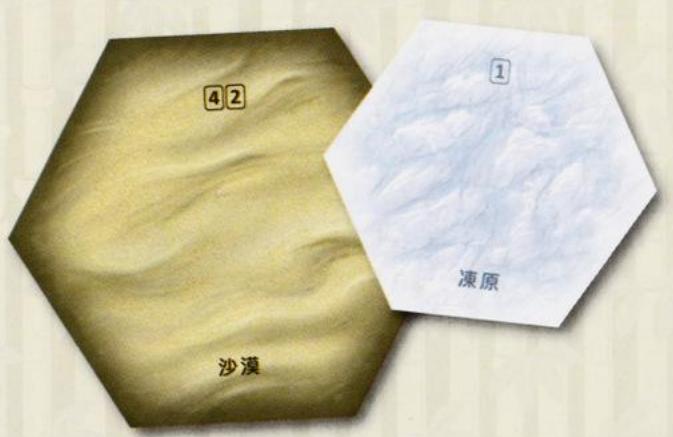
當大的和小的六角形板塊被放入遊戲圖板的遊戲區時,它們便會構成所謂的“地球”,亦即遊戲中大部分時間所關注的遊戲進行的地方。
每類動物的所屬物種,會從牠們各自的基因庫,被放置到地球板塊上。如果物種因為冰川作用(詳見第13頁)以外的任何原因,而被要求從地球上移除時,將物種放置回遊戲盒子中,不要把物種放回基因庫裡。
元素會佔據地球板塊的角落,不然就是動物顯示板上,或者是在行動顯示區上,也可能是在元素抽取袋裡等待部署。
圓錐物的優勢地位標誌會放到板塊上,來讓相對應的動物能在那裡可以聲稱取得優勢地位。
在玩家執行物種漫遊的行動時,可以把新的(大的板塊)海洋、濕地、草原、叢林、森林、沙漠和山脈板塊,添加到原來地球的邊緣。而這些板塊是取自於三個抽取堆的頂部。
在玩家執行冰川作用行動時,可以從凍原板塊堆上,拿取新的(小的板塊)凍原板塊,並放置於現在場中的(大的)板塊上。這樣做會把大的板塊,在遊戲剩下的期間中,轉換成凍原。
板塊間以一個共同邊緣相互接觸,這個情況便稱為相互“毗
即使凍原板塊比它所坐落的板塊略小,而沒辦法接觸到圍繞它的板塊,可是凍原板塊仍然被認為是與圍繞它的板塊相互毗連的,就像它所坐落的板塊一樣,毗連著圍繞它的
元素
這些圓形標誌,構成了優勢物種這個遊戲中所使用的六種元素:草、蛆、肉、種子、陽光和水。當一個元素被放置在一個地球板塊上時,代表著“供給”;當一個元素在動物顯示板上時,代表著“需求”。總括來說,這些元素提供了動物在每塊地球板塊的“匹配”元素。
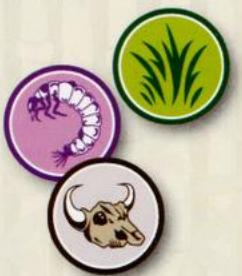
抽取袋
當元素不在動物顯示板上、行動顯示區上、或者是地球板塊上時,它們應該都是保存在抽取袋中。當需要加入新的一個元素時,它永遠必須是從抽取袋裡抽出的。相反,當一個元素從動物顯示板或遊戲圖板上被移除時,它永遠放回到抽取袋中,留待往後使用。


匹配元素實例:見右圖,在沙漠板塊上,即使昆蟲的單位數量比兩棲動物來得少,但牠們仍然取得那裡的優勢地位;優勢地位是重質不重量。
圖中的昆蟲總共匹配了3個元素(1個草+1個草+1個蛆+0個水),而兩棲動物只匹配了2個元素(1個蛆+1個蛆+0個肉+0個水+0個水+0個水)。
雖然爬行動物只有兩個預設的陽光元素,但是只要爬行動物有一個物種,從草原遷徙到沙漠的話,爬行動物便立即以
總共6個匹配元素(2個陽光×3次每個匹配),來奪去原來是昆蟲的優勢地位。
請注意,如果兩棲動物移動到草原時,那裡提供牠們的3個匹配的水(爬行動物只有2個匹配的陽光),將足以讓牠取得那裡的優勢地位。
還要注意的是,如果在這兩塊板塊上共有的陽光元素被移除的話,那麼處在草原上的爬行動物將會瀕臨絕種,因為牠們在那裡沒有任何匹配元素了。
匹配元素
有些效果會要求玩家去確定他的動物在一塊板塊上的“匹配”元素。要確定動物在一塊特定板塊上的匹配元素,請跟著以下幾點來進行:
·將動物顯示板上最左邊的元素與板塊上所對應的元素數量相剩,得出結果;
· 把這個結果加到,動物顯示板上第二個元素與板塊上所對應的元素數量相乘的結果上;
·如此類推去進行這種動物的第三、第四、第五和第六個元素(如果有的話)的計算,最後得出一個總和。
詳見下面圖例。
瀕臨絕種的物種
佔領一個板塊上的任何物種,其動物的匹配元素完全是零個的話,該物種便稱為“瀕臨絕種”。
瀕臨絕種的物種會在滅絕行動時被消滅,且不能宣稱取得板塊的優勢地位。
優勢地位
當一類動物至少有一個物種出現在一塊板塊上,並且該動物在那裡的匹配元素,比起其他任何一類也至少有一個物種在該板塊上的動物,都得多的時候,牠便可以取得該板塊的“優勢地位”。如果在最多的匹配元素數目出現平手時,則代表在那裡沒有動物取得“優勢地位”。
瀕臨絕種的物種永遠不能聲稱取得優勢地位,即使牠們是出現在板塊上唯一的物種也是不行的。
為了顯示一塊板塊上的優勢地位,玩家們可以放置取得優勢地位的動物所屬玩家顏色的一個木製圓錐物在該板塊上來代表。優勢地位可以在任何時間點之下取得或失去,並且會立即生效。另外,記得更迭優勢地位這回事是屬於玩家們的責任,它本身就不單純是屬於規則規定的範疇內。
換句話說,取得(或失去)優勢地位都必須在口頭上和實際上付諸實現的,而不是自動取得(或失去)的。所以一旦板塊上的優勢地位依照規則建立時,該優勢地位會保持有效,除非及直到另一位玩家:(一)聲稱他擁有的動物在那裡取得優勢地位時,或(二)在那裡取得最多的匹配元素數目平手時,才會移除原來的動物的優勢地位標誌。
玩家通常會在放置或移除元素的行動(例如:適應行動或枯竭行動)生效的情況下,檢查看看是否有任何動物取得或失去優勢地位。
每類動物都有10個優勢地位圓錐物。這不是一個硬性限制:萬一,一類單一動物在11塊或更多的板塊上取得優勢地位時,可以用任何方式來代替標誌。

物種
木製方塊代表了“物種”,每類動物都用自己的物種來表示牠們是活在地球上的。大多數物種在遊戲一開始的時候,都是在其擁有者的基因庫中。而大部分或全部物種最終都會佔據(放在)地球板塊上。如果物種因為“冰川作用”以外的任何原因,而被要求從地球上移除時,代表該物種永遠移出遊戲。
就算一位玩家,其基因庫的物種都用光了,並且在地球上的最後一個物種也被移除時,該位玩家也不會被判“出局的。而像這樣的動物是會陷入困境而將無法進行物種生成或遷徙等行動,但仍然可以進行其他可行的行動(並且仍然保有已取得的勝利分數)。
基因庫
動物的物種在放置到板塊之前,是以成堆的方式,放置在其所屬的玩家前面。每個這樣的物種堆被稱為“基因庫”。每當需要把一個物種添加到地球時,它始終是從該玩家的基因庫中拿取的。但是,每當一個物種因為“冰川作用”以外的任何原因,而被要求從地球上移除時,物種永遠是放回去遊戲盒中,永遠移出遊戲(不是回到玩家的基因庫中)。
勝利分數記錄條
“勝利分數記錄條”是圍繞著遊戲圖板的一條記錄條。在整個遊戲中,每類動物於記錄條上使用各自的一個方塊,用來記錄各自目前的勝利分數。
每當動物獲得或失去勝利分數時,其所屬方塊也會在記錄條上,跟著向前或向後移動。如果一類動物的勝利點數已經超過100分時,放置一個備用所屬顏色的方塊在“100”的格子上,以示識別。勝利分數永遠不會降到零以下。
可以使用先前移出遊戲的方塊,來作為那個100格子上的備用方塊。
行動顯示區
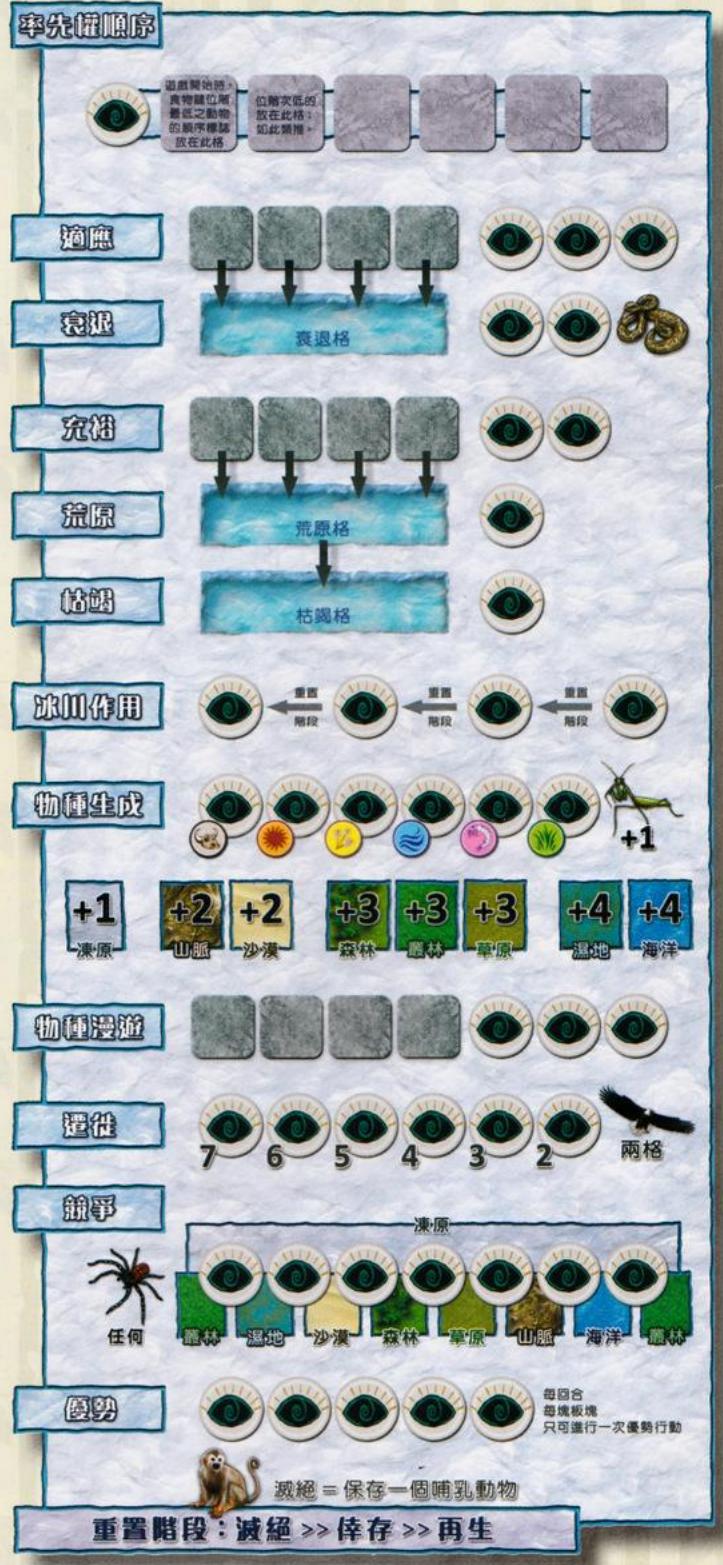
行動顯示區是位在遊戲圖板右邊,一個大的粉藍色方框區域。行動顯示區可以說是整個遊戲“靈魂”,它幫助了每位玩家去實現他們的需要和慾望,從而影響他們的動物在地球上的命
行動顯示區:
遊戲流程
優勢物種這個遊戲是以一系列的回合方式來進行的,所有玩家或多或少都共同參與了這個遊戲的進行。每一個回合分為三個階段:
規劃階段
執行階段
重置階段
在規劃階段,玩家將輪流把他們可使用的行動指示物(AP),放置到遊戲圖板右半邊行動顯示區的“眼球”格子上。每個行動指示物,代表著在接下來的執行階段時,其所屬玩家會採取的一個行動。每個行動格子只可以容納最多一個行動指示物,所以是先佔先得。當回合所有可使用的行動指示物都放置完畢之後,便會進入執行階段。
在執行階段,行動指示物會以從上到下,從左到右的方式,由行動顯示區中移走。每當以這樣的方式移走一個行動指示物時,該行動指示物所屬的玩家便可以根據該區的標籤欄(如“冰川作用”或“遷徙”)所示之行動去執行。
在重置階段(詳見第20頁),有些物種可能會滅絕,也可能會有一位玩家能夠透過倖存卡來獲得勝利分數。那麼,如果遊戲尚未結束的話,便會重置行動顯示區來準備下一個回合的
遊戲會以這樣的方式一個回合、一個回合來繼續進行,直到遊戲結束,並進行最後得分計算為止(詳見第20頁)。
規劃階段
在每一回合的規劃階段,玩家依照率先權順序,從左到右,一位接著一位,各自把他們一個可使用的行動指示物,放置到行動顯示區中任何空置的“眼球”行動格上。每個眼球格子最多只可以容納一個單一的行動指示物。
行動指示物不能被放置到非眼球的格子上,例如在競爭區的那個蜘蛛圖示上。
在率先權順序中最後的動物放置完一個行動指示物之後,目前的“規劃輪”便算結束,新的一個規劃輪會由率先權順序記錄條最前面的動物開始進行。規劃輪會繼續以率先權順序,從左到右進行下去,直到所有動物都用完牠們可使用的行動指示物為止。在每一個規劃輪中,進行到任何已用完可使用行動指示物的動物時,只要單純地跳過該動物便可以了。未參與遵戲的動物也同樣會被跳過。
執行階段
在執行階段中,於剛剛先前規劃階段時,放置在行動顯示區中的行動指示物都將被移除。每次一個行動指示物,以從上到下和從左到右的順序移除,並執行其所屬玩家適當的行動。其順序為:
-
率先權順序
-
适應
-
衰退
-
充裕
-
荒原
-
枯竭
-
冰川作用
-
物種生成
-
物種漫遊
-
遷徙
-
競爭
-
優勢
自願執行的行動
行動永遠不會強制執行的:當一位玩家的行動指示物從行動顯示區移除時,他是可以原封不動地選擇自願放棄所允許的行動。
跳過行動區
大部份行動顯示區中的行動區,如果它們沒有任何行動指示物存在的話,是都可以跳過的。但例外情況包括:
• 衰退一這行動區永遠會影響所有動物對應的添加元素;
· 荒原一這行動區永遠會影響所有的凍原及對應元素;
· 物種生成一昆蟲永遠有一個機會,可以加入牠的單一個物種到遊戲圖板上;
·競爭一蛛形綱動物永遠有一個機會,可以與單一個物種進行競爭。
各項行動會在下面幾頁,以實際進行遊戲時的執行順序,加以描述其細節。
行動也會按照執行順序,以摘要的方式呈現在每位玩家的動物顯示板上。
率先權順序

在執行階段一開始的時候,移走任何放在這裡的行動指示物。該行動指示物的所屬玩家進行下列行動:
在率先權順序記錄條上,將他所屬動物的順序標誌,直接與其左側的動物順序標誌交換位置,從而有效地在率先權順序記錄條上,向前移動一格。如果進行此行動的動物已經是位在率先權順序記錄條的最前面(最左側)時,忽略此行動。
·把剛剛才移走的那個行動指示物,放置到任何空置的眼球格子上。
選擇這個行動的玩家,其實隱含了他可以成為在本回合最後一位放置行動指示物的玩家,以及在接下來的回合時,順序可以提早一格,率先進行的效果。
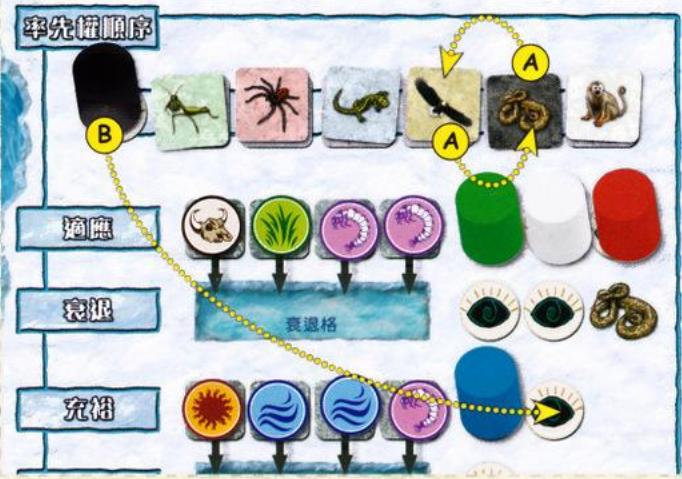
實例:在規劃階段,爬行動物玩家(黑色)決定對他在率先權順序記錄條上的位置改善一些,所以他在6人遊戲的第一個回合時,就把一個行動指示物放在這裡。
當他的行動指示物被移走時,他首先將爬行動物的順序標誌,與鳥類的順序標誌互換位置(A)。然後,他選擇了另一個空置的眼球格子,來放置那個剛剛被移除的行動指示物:他看到可以讓更多的陽光進入場中的一個機會,所以他把本回合最後一次放置行動指示物機會,用在充裕區的一個空置格子上(B)。
適應

在任何率先權順序行動已執行之後,在適應區的行動指示物,會以一次一個、從左到右的方式來移走。當玩家的一個行動指示物被移走時,該行動指示物的所屬玩家可以選擇目前呈現在本區的1個元素。目前行動玩家所選擇的元素會從行動顯示區上移出,並放到他的動物顯示板的一個空置(灰色)的元素格子上。
任何動物的動物顯示板上都不可以超過6個元素(包含預設元素和添加元素)。如果目前行動的動物已經擁有6個元素的話,那麼這個行動將會喪失效果。
動物是被允許可以擁有多個相同類型的元素。
實例:昆蟲玩家(綠色)想要多樣化一些。他得到先移走他的行動指示物的機會,並選擇可取用的肉元素,放到他的動物顯示板上(A)。白色玩家和紅色玩家只能選擇剩下蛆元素和草元素了。
當然昆蟲也可以不選擇肉元素而選擇草元素(B),加上他預設的2個草元素,就更加專一化了。選擇那兩個可取用的蛆元素其中一個(C)是有風險的,因為如果其他兩位玩家都沒有人選擇另一個蛆元素的話,那麼沒被選擇的蛆元素便會在本回合結束時下放到衰退格裡(D),這樣會迫使昆蟲在下一個回合時,需要花費一個珍貴的行動指示物來保存它。

衰退

在所有適應行動都已經執行過之後,衰退發生情況如下:依照位在衰退格裡的每個元素類型,每位玩家從他們的動物顯示板上,各自移除該類型的1個元素圓盤。
放置行動指示物的好處一在這裡出現的每個行動指示物,都可以避免這樣的一個元素從動物顯示板上被移除。注意在

這裡的第三個格子,印有爬行動物的圖示:爬行動物永遠都被視為在衰退區中有一個“免費”的行動指示物。
在規劃階段,爬行動物玩家依然可以正常地選擇把行動指示物放置在本區上(如果他打算這樣做的話)。
沒有任何動物的預設元素會被移除的(那些印在動物顯示板左上角的元素)。當動物只擁有牠們的預設元素時,是不會受到衰退的任何影響。
在任何或所有衰退發生後,將在這裡的任何行動指示物,返回它們的擁有者那裡。
實例:衰退格裡有2個蛆元素(雖然這也是只算一個元素類型)(A)。昆蟲玩家在這裡放置了一個行動指示物,從而保存了他的蛆元素免被移除(B)。爬行動物玩家在這裡的免費行動指示物,也同樣可以保存他的蛆元素(C)。
請注意,當位在適應區的陽光元素在本回合結束時,下放到衰退格的話,昆蟲玩家擁有的陽光元素便會在下個回合有被移除的危險了(D)。

充裕

在衰退行動發生之後,在充裕區的行動指示物,會以一次一個、從左到右的方式來移走。當玩家的一個行動指示物被移走時,該行動指示物的所屬玩家可以選擇目前呈現在本區的1個元素。目前行動玩家所選擇的元素會從行動顯示區上移出,並放到任何地球板塊的一個空置角上。
元素可以放在一塊板塊的任何一個空置角上,甚至該角只與一個其他板塊共享或沒有其他板塊共享(也就是那些目前位在地球邊緣的角),也都是可以的。
實例:兩棲動物獲得首先選擇權(A),並選擇一個可取用的水元素,如圖所示放置它。這讓兩棲動物在草原板塊,取得優勢地位:兩棲動物有6個匹配元素,昆蟲只有4個匹配元素而已(B)。
爬行動物獲得第二名選擇權(C),並選擇一個可取用陽光元素,如圖所示放置它。這將允許爬行動物在山脈上擴張而不怕這些物種瀕臨絕種。
荒原

在所有充裕行動都已經執行過之後,移走任何放在荒原區的行動指示物。該行動指示物所屬玩家,可以移除位在目前荒原格裡任何一個元素,並將其放回抽取袋中。
然後,不論是否有行動指示物放置在荒原區,荒原行動仍然會自動發生:所有凍原上的所有元素,只要是與依然位在荒原格裡的元素類型相同時,都會被全數移除。把移除的元素放回抽取袋中。
請注意,在整個遊戲的第一個回合時,荒原格會是空置的,所以可以跳過這個行動。
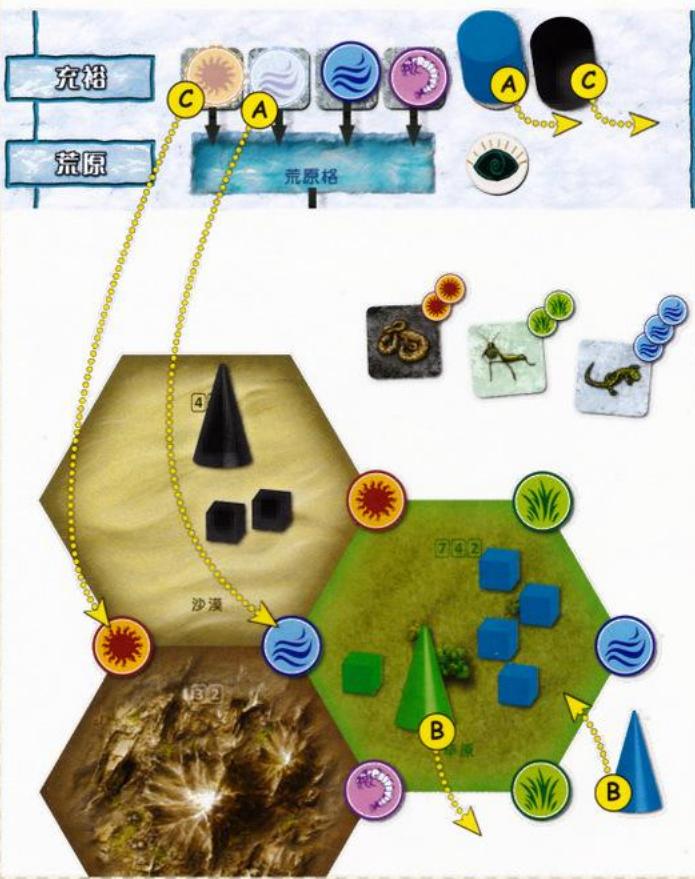
實例:蛛形綱動物玩家移走他的行動指示物,並選擇位在荒原格裡的1個蛆元素放回抽取袋中。因此,與凍原毗連的2個蛆元素得以保存下來(A)。
有1個水元素依然留在荒原格裡,因此在地球上所有目前與凍原毗連的水元素,都會被全數移除,並放回抽取袋中(B)。
現在,因為兩棲動物在沙漠板塊上是瀕臨絕種的物種了,所以牠們失去在沙漠板塊的優勢地位(C)。

枯竭

在任何荒原行動都已經執行過之後,移走任何放在枯竭區的行動指示物。該行動指示物所屬玩家,可以在地球上,選擇1個與枯竭格的元素類型相同的元素。所選擇的元素圓盤會從地球上被移除,並放回抽取袋中。
如果在枯竭格內沒有任何元素類型是與地球上的元素相同時,這個行動便沒有任何效果。
請注意,在整個遊戲的第一個回合及第二個回合時,枯竭格會是空置的,所以這個行動在這兩個回合時,也是沒有任何效果的。
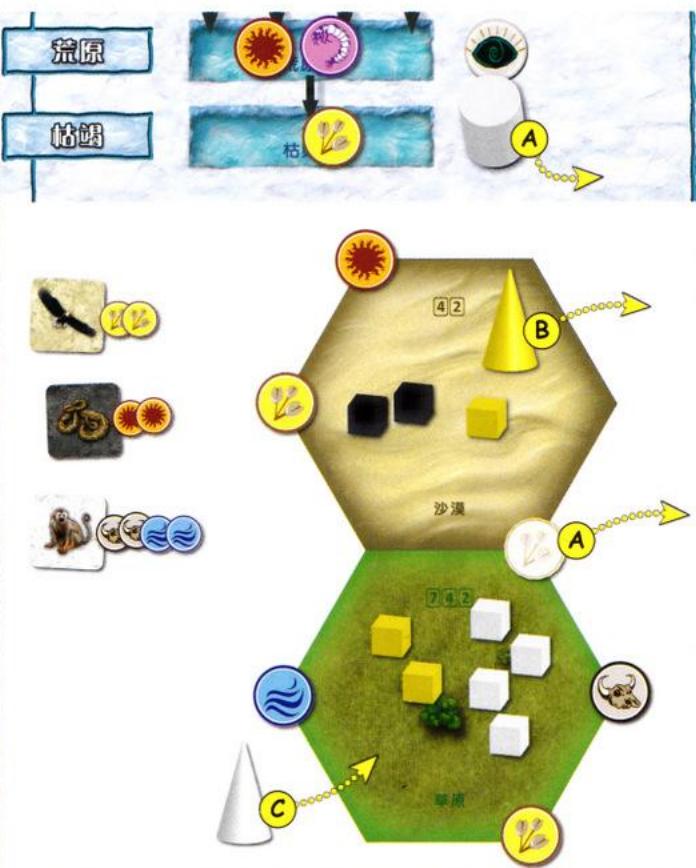
實例:哺乳動物玩家從本區移走他的行動指示物。在枯竭格只有1個種子元素,所以他可以從地球上,將任何一個種子元素移除掉。他選擇了橫跨沙漠和草原的1個種子元素(A)。
在這兩個板塊上的鳥類,其匹配元素都從4個降成2個。牠們現在與沙漠上的爬行動物平手了,所以失去沙漠的優勢地位(B)。而之前在草原與鳥類是平手的哺乳動物,將取得草原的優勢地位(C)。
冰川作用

在任何枯竭行動都已經執行過之後,從冰川作用區上,只移走最左側的那個行動指示物而已。該行動指示物所屬玩家,可以進行一次冰川作用行動,執行步驟如下:
-
選擇一塊非凍原的板塊,但這塊板塊必須毗連至少一塊其他的凍原板塊。
-
把所選擇的板塊上全部物種,暫時移出板塊,擱置在一旁。
-
放置一塊新的凍原板塊(從面朝上的凍原板塊堆上拿取)到所選擇的那塊板塊上。
所選擇的那塊板塊不再被認為是屬於之前的地形類型了;取而代之的是,它在餘下的遊戲中都會被視為是一塊“凍原板塊”。
- 從地球上,移除全部整整被3塊凍原板塊包圍的元素。
實例:爬行動物玩家取得本回合的“冰川作用”行動機會。他想給1塊草原進行冰川作用,因為這樣做不僅會讓新凍原毗連到兩塊現有的凍原,而給了他3分的勝利分數獎勵,而且還會給他控制倖存卡的機會(在凍原上的爬行動物總物種數是3,相較之下,蛛形綱動物只有2,昆蟲只有1)。不過,他不希望那個會被三塊凍原板塊整整包圍,
而孤立的陽光元素在第4步驟 被移除…
這意味著,如果一個元素所在的角,只毗連一塊或兩塊位在地球“邊緣”的凍原板塊的話,將不會受到影響。
-
依據新放置的凍原板塊,以其毗連的現有凍原板塊數量來獲得勝利分數獎勵(詳見第3頁)。
-
從擱置一旁的物種堆中,每類動物各自放回1個物種(方塊)到所選擇的那塊板塊上。
-
其餘被移出的物種(如果有的話),便會流離失所地回到其擁有者的基因庫中(而不是被消滅而放回遊戲盒內喔!)。
如果在板塊堆中已經沒有凍原板塊可以取用時(所有12塊凍原都已經在地球上了),這個行動便喪失效果。
請注意,如果在第二個、第三個或第四個眼球上有任何行動指示物的話,這些行動指示物都不會在這個時候被移走。相反,這些行動指示物將會在即將到來的重置階段時,才會往前移動。
玩家們應該發現冰川作用有著十分微妙的能力,因為只有它作為未來行動的投資,即使這意味著你可能需要付出一或兩個回合無法使用一個行動指示物的代價。
於是,他選擇了沙漠板塊,而不是草原板塊來進行冰川作用(步驟1)。他把全部位在沙漠板塊上的物種移出(步驟2),然後放置一塊新的凍原板塊在那塊沙漠板塊的上面(步驟3)。第4步驟沒有任何效果。在第5步驟他獲得1分勝利分數獎勵(因為有一塊現有的凍原與新的凍原毗連)。然後,在步驟2時擱置在一旁的物種有:昆蟲1個、鳥類2個和兩

物種生成
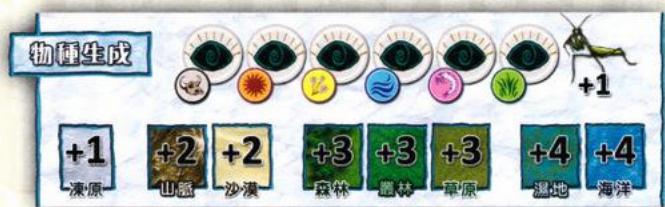
在冰川作用行動都已經執行過之後,在物種生成區的行動指示物,會以一次一個、從左到右的方式來移走。當玩家的一個行動指示物被移走時,該行動指示物的所屬玩家可以在地球上,選擇與其行動指示物所處格子下方的元素類型相同的1個元素。然後,該玩家從他的基因庫中放置新的物種,到所選擇元素毗連的每塊板塊上,可放置的新物種數量如下:
•如果板塊是海洋或濕地,最多4個物種。
●如果板塊是草原、叢林或森林,最多3個物種。
• 如果板塊是沙漠或山脈,最多2個物種。
●如果板塊是凍原,最多1個物種。
請注意,因為所選擇元素坐落角的關係,在同一時間,可能有一塊、兩塊或最多三塊的板塊會被放入新物種。
在所有物種生成行動都已執行過之後,昆蟲玩家可以從他的基因庫中,放置單一個物種到任何一塊地球板塊上。
在規劃階段,昆蟲玩家依然可以正常地選擇把行動指示物放置在本區其他格子上(如果他打算這樣做的話)。
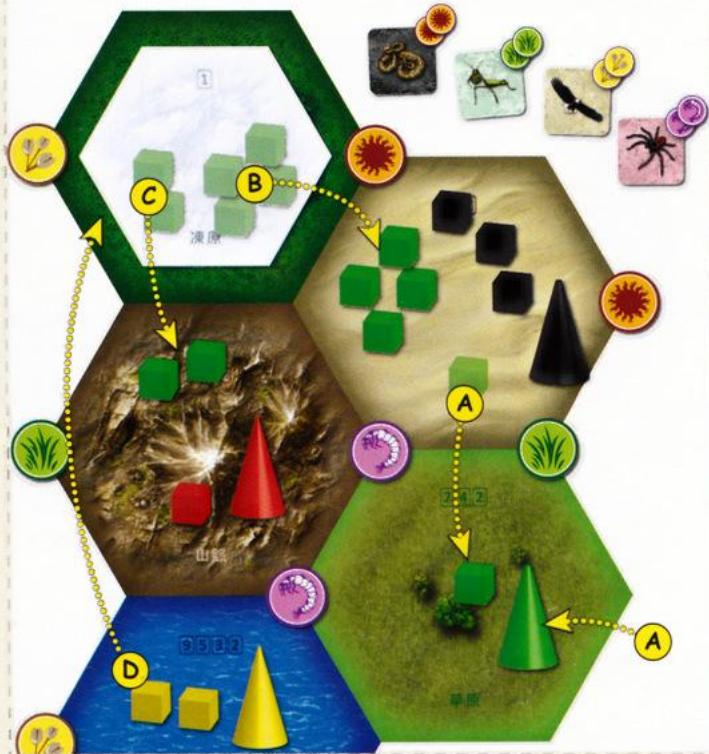
實例:蛛形綱動物玩家從“草元素”眼球格子上移走他的行動指示物。然後他選擇圖中(A)的草元素。這讓蛛形綱動物玩家可以把3個物種放到草原上(B),2個物種放到沙漠上(C)和1個物種放到凍原上(D)。
因為兩棲動物在沙漠上與蛛形綱動物同為3個匹配元素(E),形成平手狀況而失去了優勢地位。
然後,昆蟲玩家將他的一個物種,自行決定放置到草原上,以保持物種數量的領先(F)。

物種漫遊

在全部物種生成行動都已經執行過之後,在物種漫遊區的行動指示物,會以一次一個、從左到右的方式來移走。當玩家的一個行動指示物被移走時,該行動指示物的所屬玩家,可以在物種漫遊板塊堆中,選擇一塊可使用、面朝上的大板塊(亦即物種漫遊板塊堆中最上面的那幾塊板塊)。然後,他依照以下步驟進行行動:
-
在遊戲圖板上,選擇一塊空置(白色)的六角形網格,將剛才選擇的新板塊放在那裡。所選擇的六角形網格必須至少與一塊現有的地球板塊相毗連。
-
可以在行動顯示區的物種漫遊區中,選擇一個可取用的元素圓盤,並把它放到新放置板塊上任何空置的角上。
-
依據新放置的板塊,其毗連的現有板塊數量,來獲得勝利分數獎勵(詳見第3頁)。
最後,依照食物鏈的順序,每位玩家都可以移動各自的所有或部份他的物種,從目前的板塊到毗連的新板塊上;玩家當然也可以選擇不移動任何他的物種。
如果三個板塊堆中任何板塊堆的板塊都被取光的話,那麼物種漫遊行動可選擇的板塊數量便相應地減少。
實例:鳥類玩家首先進行物種漫遊行動。他選擇了一塊面朝上的濕地板塊,並放置在(A)的地方,隨後放置可取用的種子元素(B)。
新放置的濕地板塊毗連了兩塊現有的板塊(C):按照獎勵分數表,鳥類玩家可以獲得3分。
然後,鳥類玩家決定將其毗連板塊上的1個物種移動到新的濕地板塊上,立即聲稱取得優勢地位(D)。蛛形綱玩家選擇不移動(因為牠們在那裡會瀕臨絕種)。最後,昆蟲玩家將在2個物種移動到新的濕地板塊上(E)。

遷徙

在全部物種漫遊行動都已經執行過之後,在遷徙區的行動指示物,會以一次一個、從左到右的方式來移走。當玩家的一個行動指示物被移走時,該行動指示物的所屬玩家,可以選擇位在地球上任何地方的X個物種,當中的X為其行動指示物所處格子下方的數字。然後,每個選擇的物種都可以移動到毗連的板塊上。

每個鳥類的物種可以遷徙到最多兩塊板塊遠的板塊上,亦即:鳥類移動時可以穿過毗連的板塊到達第二塊板塊上。
鳥類遷徙時,是不能穿過到空白的網格上(亦即那些尚未有地形板塊的網格)。
參與遷徙的物種在一個遷徙行動開始時,如果位在同一塊板塊上的話,牠們是可以一起移動到同一塊板塊上,也可以分開移動到不同的板塊上,這是由擁有物種的玩家自行決定。
實例:昆蟲玩家從“7”的眼球格子上移走他的行動指示物。他將1個昆蟲物種從沙漠移到到毗連的草原上,並聲稱取得草原的優勢地位(A)。因為受到凍原上瀕臨絕種的威脅,昆蟲玩家使用自己剩下的6個遷徙名額,將凍原上的物種移出去:4個到沙漠(B)和2個到山脈(C)。
鳥類玩家在這個回合也放置了一個遷徙行動指示物。看到昆蟲做了什麼之後,鳥類玩家計劃利用自己的特殊能力,將一個物種從海洋移動到現在是空置的凍原上(D)。
競爭

在全部遷徙行動都已經執行過之後,在競爭區的行動指示物,會以一次一個、從左到右的方式來移走。當玩家的一個行動指示物被移走時,該行動指示物的所屬玩家,先了解其行動指示物所處格子底下的3個地形類型。然後,他可以在這三個地形類型中,每個地形類型最多選擇1塊目前位在地球上的板塊。所選擇的板塊必須是:
· 至少包含有一個行動玩家的動物物種;以及
• 至少包含有一個對手的物種。
然後,行動玩家可以在所選擇的每塊板塊上,消滅任何對手的一個物種(方塊)。將被消滅的物種放回去遊戲盒裡,移出遊戲(不是回到其擁有者的基因庫!)。

蛛形綱動物永遠被視為在競爭區有一個“免費”的行動指示物。牠們是優先執行競爭的,可以選擇任何地形類型,但只能在單一塊板塊上進行。
在規劃階段,蛛形綱動物玩家依然可以正常地選擇把行動指示物放置在本區其他格子上(如果他打算這樣做)。
實例:爬行動物玩家在“凍原一沙漠一森林”的眼球格子上有一個行動指示物(A)。他選擇了消滅最左邊的森林上的1個哺乳動物的物種(B)和位在凍原的1個昆蟲物種(C)。因為爬行動物玩家在沙漠上沒有物種存在,因此喪失了他的第三個競爭機會(D)。
即使爬行動物在海洋及第二塊森林存在著牠們的物種,但是在這回合中牠們仍然不能在那裡進行競爭(E)。

優勢

在全部競爭行動都已經執行過之後,在優勢區的行動指示物,會以一次一個、從左到右的方式來移走。當玩家的一個行動指示物被移走時,該行動指示物的所屬玩家,選擇一塊本回合尚未執行過優勢行動的地球板塊。該塊板塊會依照下列步驟進行計分:
-
在這塊板塊上,擁有最多物種(方塊)的動物,獲得勝利分數X分,其中X等於遊戲圖板上板塊計分表中,該地形類型的第一個數字。
-
如果進行計分的板塊不屬於凍原地形時,第二多物種的動物可以獲得等同於板塊計分表中,該地形類型第二個數字的分數。
只有單獨一類動物時,不能既宣稱獲得第一名,又宣稱獲得第二名。必須是在有另一類動物出現時才會分出第一名和第二名。

- 如果進行計分的板塊是屬於海洋、濕地、草原、叢林或森林時,第三多物種的動物可以獲得等同於板塊計分表中,該地形類型第三個數字的分數。
已宣稱獲得第一名或第二名的動物,不能又宣稱獲得第三名。必須是在有第三類動物出現時才會分出第一名、第二名和第三名。
- 如果進行計分的板塊是屬於海洋或濕地時,第四多物種的動物可以獲得2分(海洋)或1分(濕地)。
已宣稱獲得第一名、第二名或第三名的動物,不能又宣稱獲得第四名。必須是在有第四類動物出現時才會分出第一名、第二名、第三名和第四名。
• 重要的是:在上述所有情況下,在計分板塊上的物種數量平手時,便會以遞降的食物鏈順序來打破僵局(亦即,哺乳動物最贏,再來才是爬行動物,如此類推)。
- 最後,如果在計分板塊上,有一類動物取得優勢地位,該動物的所屬玩家必須選取並執行一張面朝上的優勢卡(如果可以,選擇一張可使用的)。在執行優勢卡時需要作出的任何選擇,都是由選取它的玩家來決定。優勢卡執行後,將卡牌放回去遊戲盒內,永久移出遊戲。
卡牌效果的闡釋,詳見第18-19頁。
請注意,當選擇「冰河時期」卡時,遊戲便會在當前回合結束時結束(詳見第20頁)。
還要注意的是,取得優勢地位的動物不一定是在那塊計分板塊上,獲得最高分的同一類動物。
最後要知道的是,每個回合中,第一位執行優勢行動的玩家,都有機會在五張可供選取的優勢卡中選取一張去執行,在此之後的選取機會,便隨著面朝上的卡牌減少而變得越來越少。
在全部優勢行動都已經執行過之後,執行階段便告結束,遊戲便會繼續進行到重置階段(詳見第20頁)。
實例:爬行動物玩家選擇一張在場的濕地板塊進行計分。第一名(8分)由佔有4個物種的兩棲動物獲得。爬行動物和鳥類分別都佔有2個物種:因為爬行動物在食物鏈上的位階較高,所以獲得第二名(4分)。鳥類獲得第三名(2分)。而沒有第四名動物來獲得那最後的1分。
然後,爬行動物在這塊板塊上取得優勢地位,所以爬行動物必須選取並執行一張面朝上的優勢卡。

兩人和三人遊戲可選規則
當只有2位或3位玩家進行優勢物種遊戲時,可以使用以下規則,來允許每位玩家控制多類動物。這些規則可能與這本說明書中的一些其他規則有所衝突:在有衝突的時候,以下述的規則為主。
(要注意的是,這個可選規則會大大增加了遊戲策略思考上的難度及複雜性,不建議沒有經驗的玩家們採用。)
控制多類動物
當遊戲設定中,需要分配動物給玩家來控制時,分配所有六類動物。因此,在一個3人遊戲中,每位玩家將會控制到2種不同的動物;在一個2人遊戲中,每位玩家將會控制3種不同的動物。
玩家必須指定每一類動物一組顏色的木製配件。每一類動物可以獲得3個柱狀物和35個方塊,就好像它是一個6人遊戲一樣。每一類動物各自擁有自己獨立的勝利分數。
行動
當一位玩家所控制的動物其中之一要進行行動時,他控制的其他動物們和牠們的物種,在任何情況下都會被視為是“對手”(不用說,如果牠們是由對手玩家控制時,更是對手了!)。例如,當一張優勢卡文本寫到“你的動物”時,指的只是在計分板塊上取得優勢地位的動物而已;在這種情況下,你控制的其他動物們將會被視為是對手。
最後計分
雖然表面上所有的六類動物,在整個遊戲中都會獲得勝利分數,但到了最後計分時,每位玩家只有一類動物會算數。在遊戲結束時,每位玩家控制的動物們中,得分最低的那一類動物,將成為該玩家的整體最終得分;而其他一樣由該玩家控制、得分較高的動物都會被忽略。
因此,你有必要去嘗試保持整場遊戲中,所控制的多類動物之間的平衡,而不是犧牲一類自己控制的動物,來成就另一類動物。
例如,在一個2人遊戲中,馬克所控制的動物們分別獲得70分、145分和160分,但最終只算他70分。如果鮑勃所控制的動物們分別獲得75分、85分和95分時,他最終會算數的得分將會是75分,由鮑勃獲勝。
可選(隨機)地球設定規則
以下可選用的地球設定規則當中,在遊戲開始時,動物們是處於不對稱的,但會在起始的勝利分數補償過來。這個可選規則可以使用在基礎遊戲,也可以聯同左邊所述的兩人和三人遊戲可選規則一起使用。
依照一般規則進行地球設定,除了下述部份以外:
板塊
在把板塊放置到遊戲圖板之前,先將大的板塊面朝下洗勻。隨機抽出7塊板塊,並把它們隨意放到7個起始網格上(其餘板塊照常組成3個抽取堆)。放置一塊凍原到中央板塊上面。
元素
從布袋中,一次一個地隨機抽出12個元素,跟正常遊戲一樣,將它們放置到起始12個板塊角的起始元素位置上。(行動顯示區上的元素照常方式放置。)
物種
放置1個哺乳動物物種到每一塊含有單1個肉元素的非凍原板塊上;放置2個哺乳動物物種到每一塊含有兩個肉元素的非凍原板塊上;放置3個哺乳動物物種到每一塊含有三個肉元素的非凍原板塊上,如此類推等等。
重複以上過程,只不過動物對應的元素會改變:爬行動物對應的是陽光;鳥類對應的是種子;兩棲動物對應的是水;蛛形綱動物對應的是蛆;昆蟲對應的是草。
統計所有動物的物種數量,並確定在地球上哪類動物的物種數量最多。最多動物物種的數量是多少個,就將每類動物的計分方塊放到多少分的格子上。然後每類動物失去等同於各自在地球上起始物種數量的勝利分數(亦即擁有最多物種數量的動物(們)在開始遊戲時的勝利分數會是0分)。
在這個可選規則下,動物可能會在遊戲開始時,在地球上一個物種都沒有,雖然可能性是不大,但還是有可能呀!如果發生這種情況,不要驚慌!這類動物將在遊戲開始時,在勝利分數上有一個很不錯的領先。並且這也意味著,牠想要的元素在往後從抽取袋中抽出來,放置到行動顯示區的機會大大提高。
卡牌
倖存卡
倖存卡在遊戲開始時是暫時放在一旁的。在遊戲進行期間,玩家們會計算他們各自佔據在所有凍原板塊上有多少個物種。取得唯一最多佔據凍原物種的玩家,將會自動地和立即地取得倖存卡的擁有權。如果有兩位或更多位玩家並列最多時,沒有一位玩家能控制此卡牌(它保持不受控制,並且不會給予任何玩家得分)。

在每個重置階段的滅絕進行後,控制倖存卡的玩家,依照他的一個或多個物種所佔據的凍原板塊數量,來獲得勝利分數獎勵(詳見第3頁)。
優勢卡
26張優勢卡是作為玩家在一個優勢行動時,取得一塊計分板塊的優勢地位的一種獎勵。當一張面朝上的優勢卡,在一個優勢行動中被玩家選用時該玩家必須解決該張卡牌上所有的效果(或至少盡可能就當前遊戲的情況進行解決)。然後把該張卡牌放回遊戲盒內,移出遊戲。

各張卡牌在遊戲中的效果、可能出現的疑問、提示和說明,都如下概述。
水棲動物
從抽取袋中把選定的元素拿出來。如果場中的海洋或濕地板塊都沒有任何空置角落,本卡牌的第一部分效果會喪失掉。如果你的基因庫中沒有留下任何物種時,本卡牌的第二部分效果會喪失掉。
生物多樣性
一塊包含超過一個對手物種的板塊,也不會讓你獲得更多勝利分數的:簡單來說就是每一塊有你的有他的物種的板塊,都可以讓你獲得1分。
生物量
如果你的動物是唯一且只有一個物種位在這樣一塊過度擁擠的板塊上時,還是必須消滅你的那一個位在那裡的物種。如果有多類動物的物種位在一塊過度擁擠的板塊上時,你可以選擇消滅那一個物種。
荒蕪
由取得優勢地位的玩家,選擇哪些元素會從選定的那塊板塊上移出去。
大災難
由取得優勢地位的玩家,選擇哪些物種會從選好的那塊板塊上消滅掉。另外這也是由該玩家選擇,毗連的板塊上哪一個物種會被移除。卡牌效果的第二部分是強制性的,所以如果取得優勢地位的玩家,在毗連的板塊上是唯一的佔據者時,他也是不得不消滅在那裡他自己的一個動物物種。
寒流
除了選取本卡牌的玩家所控制的動物以外,其他每一類動物都會在每塊凍原板塊上失去一個物種。
疾病
一個動物的預設(印刷的)元素是無法被移除的。如果移除順序會造成差別的話,依照食物鏈的順序進行移除。將任何被移除的元素放回抽取袋中。
生態多樣性
請記住,“陽光”是一個單一的元素“類型”。因此舉例來說,兩個預設的陽光元素,對爬行動物而這言,卡牌效果也只會算一次,而不會算兩次。
演化
你可以選擇在地球上任何地方的物種來進行取代,舉例來說,你不需要選擇一塊與選擇動物共享的板塊來進行效果。如果你沒有物種留在你的基因庫時,你便不能取代任何對手的物種;如果你只有一個物種留在你的基因庫時,那麼你就只能取代對手的一個物種了。
繁殖力
每塊已經有你的物種存在的板塊,都只會讓你+1個物種而已;並不是在板塊上每個物種都讓你+1個物種的。如果你在基因庫中剩餘的物種數量,比有你佔據的板塊數量少,你可以決定哪一塊板塊要加物種,哪一塊板塊是跳過。
多産
在選定的板塊上,每個物種(包括你的或對手的)都讓你獲得
棲息地
元素不是隨機在抽取袋抽出的,是玩家可以拿取任何目前位在抽取袋裡的元素。
冬眠
那些物種只可以是來自那些之前被消滅的物種(而不是來自位玩家的物種基因庫中的物種,更不是來自那些在遊戲一開始時放回遊戲盒裡的物種)。
冰河時期
本卡牌被選用時,遊戲便會在本回合結束時結束:在優勢行動之後,照常執行滅絕及倖存卡計分,但跳過再生步驟,然後進行最後的計分(詳見第20頁的遊戲結束)。
大冰原
卡牌的能力完全遵照正常冰川作用的規則(詳見第13頁)。
移入種*
動物們依照食物鏈的順序進行決定。動物只擁有預設(印刷的)元素時,是不能選擇進行卡牌上第一個選項,你想得美啦!
本能
該行動指示物可以放置在任何空置的眼球格子上,甚至是本回合至目前為止,尚未執行行動的一個空格。本卡牌通常作為下一個回合的超早期放置行動指示物之用。
智能*
如果食物鏈中最高位階的動物挑選這張卡牌的話,牠們將是唯一受惠的動物。從遊戲一開始就擱置一旁的行動指示物中重新得到一個新的行動指示物。
成群離去
由選取本卡牌的玩家移動全部動物,包括他對手的。只要該玩家認為合適,物種是要分開走,還是一起走到毗連的板塊,都是可以的。
蛻變
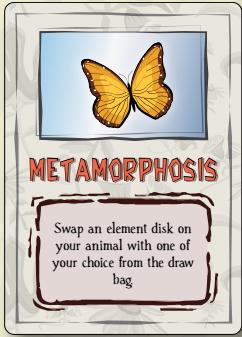
你不能拋棄你的那幾個預設(印刷的)元素。請注意,你選定一個元素從抽取袋裡拿出,而不是隨機抽出一個新的元素。
棲位生物群落
請記住,此卡牌是不會被選取,直到相關的板塊完全計分為止。板塊“第一名”的價值則是它在板塊計分表中最左邊的數字:例如,海洋是9,濕地是8,草原是7等等。
夜間活動
如果選取本卡牌的動物本來就位在率先權順序最前面時,本卡牌便不會有任何作用。
雜食動物
新的行動指示物是從遊戲一開始就擱置一旁的行動指示物中拿取。
寄生*
如果食物鏈中最低位階的動物挑選這張卡牌的話,牠們將是唯一受惠的動物。從遊戲一開始就擱置一旁的行動指示物中重新得到一個新的行動指示物。
捕食動物
注意本卡牌上“對手”這個詞:當板塊上只有你的物種存在時你無須消滅一個你自己的物種。對於每塊板塊,你都可以選擇不同對手動物的一個物種。
共生
本卡牌效果的計算是包括預設元素及添加元素的。
*若要進行一場時間較短遊戲的話,在遊戲設定時,將這四張卡牌留在遊戲盒內,也就是說你們只會使用22張卡牌來組成牌庫,而不是使用原來的26張卡牌來組成。
遊戲製作成員
遊戲設計 — Chad Jensen
遊戲開發— Kai Jensen
包裝設計 — Rodger MacGowan
圖像與規則藍圖— Chechu Nieto 及 Chad Jensen
額外遊戲測試員 — Alex Ostroumov, Mark Beyak, TerryBeyak, Devon Biasi, Bob Borbe, Kris Adamson, Martin ScottKris Skold, Wilma Flintstone, Paul Bravey, Richard Gage,Mike Chevalier 及Andy Lewis
協調製作 — Tony Curtis
製作人— Gene Billingsley, Tony Curtis, Andy Lewis,Rodger MacGowan 及Mark Simonitch
中文版翻譯—林中華(Chung-Wah Lam, cchopman)衷心感謝以下的每個人,他們付出寶貴的時間來幫忙校對原版說明書—David East, Kevin Morris 及 PaulMarjoram°

戰棋會出版有限公司
地址:香港旺角彌敦道678號華僑商業中心8樓B室
如有問題或建議,歡迎到我們的論壇查詢:
forum.wargames.com.hk
更多遊戲產品,請瀏覽本公司網頁:
www.wargames.com.hk
關注Facebook及微博,更新我們最新動向:
facebook.com/wargamesclub;weibo.com/wargamesclub
重置階段
在重置階段時,動物可能因為滅絕而失去物種,並且可能有一類動物透過「倖存」卡而能夠獲得勝利分數。然後,行動顯示區會進行重置,準備下一個回合的規劃階段的到來。
滅絕
首先,滅絕會依照以下情況進行:消滅全部瀕臨絕種的物種。被消滅的物種會從地球上被移除,並放回遊戲盒裡,移出遊戲。

例外:每個回合,哺乳動物玩家都可以自動地,保存他的一個瀕臨絕種的物種免於滅絕(如果他有一個以上瀕臨絕種的物種時,他自行選擇要保存那一個)。
倖存
接下來,確保最多佔據凍原板塊物種的玩家有獲得「倖存」卡。如果動物在最多凍原板塊物種出現平手時,沒有任何一位玩家可以獲得倖存卡。擁有倖存卡的玩家(如果有的話),依照他的一個或多個物種所佔據的凍原板塊數量(與每塊板塊的物種數量無關),來獲得勝利分數獎勵(詳見第3頁)。
再生
注意:如果這是遊戲最後一個回合時(透過打出「冰河時期」卡),你不需要執行此步驟。
最後,再為下一個回合作出準備,需要進行的事情如下:
• 從抽牌堆上面,抽取足夠新的優勢卡,以面朝上的方式,來填滿遊戲圖板的可選取優勢卡區的每個空置格子。任何早就存在本區的卡牌還是會留在原地的。如果在抽牌
堆中,沒有足夠的剩餘卡牌可以填滿每個卡牌格時,盡可能填補即可,其餘的就讓它空著。
當抽牌堆都用罄時,在剩下的遊戲期間都不會再補充新的卡牌了。
• 將任何在冰川作用區的第二格、第三格和第四格眼球的行動指示物,往左移動1格。
● 移除行動顯示區上衰退、枯竭及物種漫遊三個區域的全部元素。將它們放回抽取袋中。
· 將荒原格內的全部元素下放到枯竭格。
• 將充裕區內的全部元素下放到荒原格。
• 將適應區內的全部元素下放到衰退格。
• 從布袋中隨機抽出4個元素,把它們分別放在適應區的4個灰色正方格子上。
• 從布袋中隨機抽出另外4個元素,把它們分別放在充裕區的4個灰色正方格子上。
• 從布袋中隨機再抽出另外4個元素,把它們分別放在物種漫遊區的4個灰色正方格子上。
·三個大的板塊堆,每個板塊堆最上面的板塊,如果現在出現面朝下時,將其翻成面朝上。任何空的板塊堆還是維持空著。
遊戲繼續進行到下一個回合的規劃階段。
遊戲結束
當透過「冰河時期」卡讓遊戲結束時,完成餘下的優勢行動(如果有的話),然後執行滅絕和照常以「倖存」卡來計分。接下來,移除地球上全部優勢地位標誌,並且進行每塊地球板塊最後一次計分:在最終計分時,優勢行動會被忽略,也就是說,動物只會得到勝利分數,而不會得到任何剩下的優勢卡。
一旦最後計分完成時,獲得最多勝利分數的動物所屬玩家贏得遊戲。如果出現平手時,便由最接近食物鏈頂端的動物所屬玩家成為最後贏家。
下载 Markdown55-dominant-species-rulebook.md58.0 KB
Dominant Species
RULES OF PLAY
Game Design by Chad Jensen
INTRODUCTION
90,000 B.C. — A great ice age is fast approaching. Another titanic struggle for global supremacy has unwittingly commenced between the varying animal species.
Dominant Species is a game that abstractly recreates a tiny portion of ancient history: the ponderous encroachment of an ice age and what that entails for the living creatures trying to adapt to the slowly-changing earth.
Each player will assume the role of one of six major animal classes—mammal, reptile, bird, amphibian, arachnid or insect. Each begins the game more or less in a state of natural balance in relation to one another. But that won't last: It is indeed “survival of the fittest”.
Through wily action pawn placement, players will strive to become dominant on as many different terrain tiles as possible in order to claim powerful card effects. Players will also want to propagate their individual species in order to earn victory points for their particular animal. Players will be aided in these endeavors via speciation, migration and adaptation actions, among others.
All of this eventually leads to the end game – the final ascent of the ice age – where the player having accumulated the most victory points will have his animal crowned the Dominant Species.
But somebody better become dominant quickly, because it's getting mighty cold....
TABLE OF CONTENTS
Game Components. .
Game Overview. 23
Glossary.
Game Setup 4
Earth 6
Elements . . . 6
Draw Bag
Matching Elements
Endangered Species
Dominance
Species.. . . .
Gene Pool
Victory Point Track .
Action Display . 8
Sequence of Play. 9
Planning Phase
Execution Phase
Initiative. 10
Adaptation 10
Regression. 11
Abundance. 11
Wasteland. 12
Depletion 12
Glaciation .13
Speciation .14
Wanderlust . .14
Migration.. .15
Competition .15
Domination. 16
Optional Rules for 2- and 3-player Games. .
Optional (Random) Earth Setup 17
The Cards . 18
Survival Card
Dominance Cards
Reset Phase 20
Extinction
Survival
Reseed
Endgame. 20
Throughout this booklet you will see numerous shaded boxes such as this one. These boxes are filled with examples, clarifications, play hints, design notes, and other assorted wisdom in order to help ease you along.
GAME COMPONENTS
• this 20-page rulebook
• one game board
• six animal displays
• 27 cards—1 “Survival” and 26 “Dominance”
• 31 large and 12 small hexagonal tiles used to create “earth"
• 330 wooden cubes representing the “species" belonging to the six animal classes
• 60 wooden cylinders used for the animals' “action pawns”
• 60 wooden cones used as “domination" markers for the animals
• 120 round markers representing the earth's resources, called “elements”
• 6 square markers used to show each animal's “initiative" (turn order during the Planning Phase)
• one cloth bag
GAME OVERVIEW
The large hexagonal tiles are used throughout the game to create an ever-expanding interpretation of earth as it might have appeared a thousand centuries ago. The smaller tundra tiles will be placed atop the larger tiles – converting them into tundra in the process – as the ice age encroaches.
The cylindrical action pawns (or “AP"s) drive the game. Each AP will allow a player to perform the various actions that can be taken-such as speciation, environmental change, migration or glaciation. After being placed on the action display during the Planning Phase, an AP will trigger that particular action for the owning player during the Execution Phase.
Generally, players will be trying to enhance their own animal's survivability while simultaneously trying to hinder that of their opponents’—hopefully collecting valuable victory points (or “VP”s) along the way. The various cards will aid in these efforts, giving players useful one-time abilities or an opportunity for recurring VP gains.
Throughout the game, species cubes will be added to, moved about in, and removed from the tiles in play (the “earth”). Element disks will be added to and removed from both animals and earth.
When the game ends, players will conduct a final scoring of each tile—after which the player controlling the animal with the highest VP total wins the game.
GLOSSARY

Action Pawns (APs)—The set of wooden cylinders that players will use each turn to mark the actions they wish to perform.
Animal—Mammal, reptile, bird, amphibian, arachnid or insect. One of the six animal classes that each player will be representing throughout the game. Each animal class is represented on earth by a set of like-colored species cubes. Each animal has an animal display and an initiative marker.
Bonus VPs—
Some actions and card effects call for a player to earn
BONUS POINTS TABLE
| QUANTITVICTORY POINTS: | 1 | 2 | 3 | 4 | 5 | 6 | 0 | ||
| 0 | 3 | 10 | 15 | 21 | 28 | 364 | 5 |
“bonus VPs”. To earn bonus VPs, refer to the Bonus Points Track located in the bottom left of the game board. The top row of the Bonus Points Track lists the count that the action or card effect is checking – for example, how many tundra tiles are occupied by an animal during the Survival action (see page 20) – while the square directly below this number in the bottom row gives the amount of VPs gained based on that count.
Dominance Cards—The set of 26 cards that a player will choose from whenever a tile is scored where their animal is dominant. Dominance Cards grant a player one-time effects. One of these cards – “Ice Age” – will trigger the end of the game. The “Survival" Card is not a Dominance Card and has its own separate set of rules (see page 20).

Dominant / Dominance—Having at least one species present on a tile where your animal matches more elements than that of any other animal with species present on that same tile.
Earth—The group of tiles placed in the hex grid portion of the board. Players will place elements and their animals' species and dominance markers onto the various tiles making up the earth.
Element-Grass, grub, meat, seed, sun and water. These round

markers – or “disks" – represent the resources the various animals require to thrive. Elements are placed on the animal displays to show “need” and on earth to show “supply". When on earth, elements are placed on the corners of tiles– in this manner, a single element disk can be present on up to three different tiles simultaneously.
Endangered—Any species in play on a tile wherein none of that tile's elements match those of the player's animal (or if the tile is devoid of elements altogether).
FOOD CHAIN
Food Chain-Used to break ties when scoring a tile during a Domination action, among other things. In top-down order – best-to-worst – the food chain is:
• Mammal
• Reptile
• Bird
• Amphibian
• Arachnid
• Insect


Initiative Markers—The set of six square markers used on the Initiative track to determine the order of placement during each Planning Phase.
Matching—The number of element “A” on a player's animal display times the number of that same element “A" on a tile occupied by that player's species. To this is added matching element “B”, matching element “C”, etc. to arrive at a total number of matching elements of all types.
See the graphic example on page 7.

Species—Each small wooden cube represents one species. Each like-colored set of cubes represent the various species belonging to a single animal (known in real world terms as a “class” of animal).
Terrain—Tundra, mountain, desert, forest, jungle, savannah, wetland or sea. Each tile making up the earth is one of these eight terrain types.
Tile—The large and small hexagonal pieces representing the various terrain types. These are used to initially create – then during the game to add to - the earth's playing surface.

Victory Point (VP)—Collected during the game by each animal. Highest VP total determines final winner.


GAME SETUP
THE BOARD
Place the board – face up! – in the center of the table.
THE ANIMALS

Have each player choose the animal he would like to play. Give each player the animal display matching their choice. Alternately, you can assign one animal display to each player at random.
See page 17 for a suggested alternate method of assigning animals if there are only 2 or 3 players.

In reverse Food Chain order – that is, insects first, then arachnids, then amphibians, etc. – players place their animal’s square initiative marker into the boxes underneath the “Initiative" tag.
If there are fewer than six players, one or more of the right-most boxes in this section will remain vacant throughout the game.
Place any unassigned animal displays – along with their initiative markers – back in the game box: they will not be used.
THE TILES

Place one large tile belonging to each of the seven non-tundra terrain types into their assigned positions in the center of the hex grid. Place a tundra tile atop the sea tile.
Place the eleven remaining tundra tiles in a face up stack on the “Glaciation Tiles” section of the board.
Flip the remaining 24 large tiles face down and shuffle them up in any manner desired. Create three (face E down) stacks of 8 large tiles each. Place these stacks on the three “Wanderlust Tiles" sections of the board. Turn the top-most tile of each of these stacks face up.
THE CARDS
F Set the Survival Card off to the side for now.
Remove the Ice Age card from the deck of Dominance Cards. Shuffle the remaining 25 Dominance Cards together. Place the Ice Age card face down next to the board. Put the shuffled Dominance Cards face down atop this card to form a draw pile.
Draw the top five cards of this draw pile and place them face up in the “Available Dominance Cards” section of the game board.
THE ELEMENTS
Take two of each of the six element types and place them on the tiles of earth as indicated on the board.
Place these element disks so that they slightly overlap each of the tiles that meet at that intersection.
Gather up the rest of the elements and form a draw pool by placing them into the cloth bag provided.
Randomly draw 4 elements from the bag—place them on the board into the four squares allotted for them (the ones with the “leaf" symbol) next to the “Adaptation" tag. Draw 4 more elements at random to fill the leaf squares next to the “Abundance" tag, and another 4 random elements for the leaf squares next to the “Wanderlust” tag.
THE SPECIES
From amongst the wooden pieces, each player chooses a color to represent his animal. From their colored pieces, each player gathers up the ten cones (to be used as dominance markers) as well as the following number of cylinders (to be used as action pawns) and cubes (to form their species gene pool):

• 6-player game – 3 cylinders and 35 cubes
• 5-player game – 4 cylinders and 40 cubes
• 4-player game – 5 cylinders and 45 cubes
• 3-player game – 6 cylinders and 50 cubes
• 2-player game – 7 cylinders and 55 cubes
Put the rest of the cylinders and cubes back in the box.
From each player's gathered cubes, take one to use as a VP marker: place these on the “0” space of the Victory Point Track.

Each player then takes species from his gene pool and places them on certain starting tile as follows:

• Insects – 2 on savannah, 1 on wetland and desert
• Arachnids – 2 on jungle, 1 on forest and wetland
• Amphibians – 2 on wetland, 1 onjungle and savannah
• Birds – 2 on forest, 1 on mountain and jungle
• Reptiles – 2 on desert, 1 on savannah and mountain
• Mammals – 2 on mountain, 1 on desert and forest
With fewer than six players, ignore placement instructions for any animal not being played. Note that each animal begins the game Dominating its centrally-occupied tile.

BEGIN PLAY
The game now begins with the Planning Phase of the first turn, with the player in control of the animal having its initiative marker furthest to the left on the Initiative track conducting the first AP placement.

米。爹
子擀米
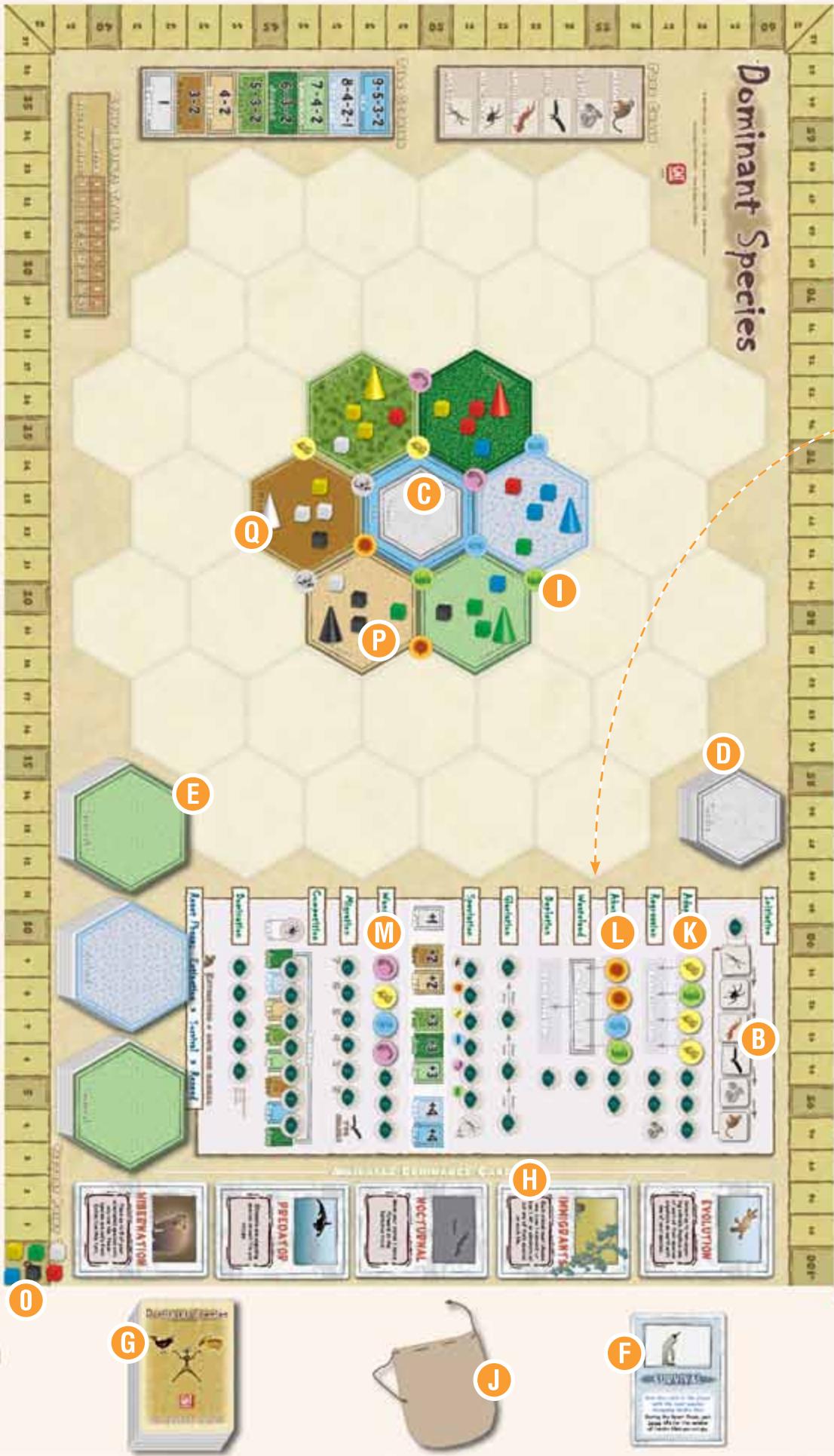
EARTH

The large and small hexagonal tiles will, when added to the game board's hexagonal play area, make up the “earth" the playing surface that much of the game will be focused on.
The species belonging to each animal will be placed on earth tiles from their respective gene pools. Species removed from earth for any reason other than Glaciation (see page 13) are placed back in the box, out of play—NOT back into the gene pools.
Elements will occupy the corners of the earth tiles when not on an animal display, on the action display, or awaiting deployment from the element draw bag.
The cone-shaped dominance markers will be placed on tiles of earth when the corresponding animal can claim dominance there.
New (large) sea, wetland, savannah, jungle, forest, desert and mountain tiles will be added to the edges of earth when players perform the Wanderlust action. These are taken from the top of the three tile draw stacks.
New (small) tundra tiles are taken from the tundra draw stack and placed onto existing (large) tiles when players perform the Glaciation action. This converts that large tile into a tundra tile for the remainder of the game.
Tiles that touch along a common edge are said to be “adjacent” to one another.
Even though a tundra tile is slightly smaller than the tile it sits upon – and therefore will not physically touch the six tiles that could conceivably surround it – it is still considered adjacent to those tiles as it converts the tile underneath it into tundra: which does physically touch the tiles next to it.
ELEMENTS
These are the round markers that make up the six elements used in Dominant Species: grass, grub, meat, seed, sun and water. When placed on a tile of earth, an element represents “supply”; when on an animal display, an element represents “need”. Taken together, these provide for an animal's “matching” elements on each tile of earth.

DRAW BAG
When not on an animal display, on the action display, or on a tile of earth, elements are kept in the draw bag. Whenever a new element is called for, it is always taken from this draw bag. Conversely, whenever an element is removed from an animal display or the game board it is always placed back in this draw bag for later use.
MATCHING ELEMENTS EXAMPLE: In the graphic at right, the insects dominate the desert tile even though they have fewer units there than the amphibians; dominance being based on quality, not quantity.
The insects match a total of 3 elements (1 grass + 1 grass + 1 grub + 0 water) to the amphibians' 2 elements (1 grub + 1 grub + 0 meat + 0 water three times over).
Even having just its two default sun elements, if one of the reptile species in the savannah migrated into the desert the reptiles could immediately claim dominance from the insects with a total of 6 matching elements (2 sun x 3 matches each).
Note that with three water the amphibians would dominate the savannah (3 to 2) if they were to move there.
Note also that if the sun element sitting on both these tiles were to be removed the reptiles would be endangered in the savannah, as they would no longer match any elements there.
MATCHING ELEMENTS
Some effects call for a player to determine his animal's “matching" elements on a tile. To determine an animal's matching elements on a particular tile, do the following:
• count the number of times the animal's left-most element type appears on the tile;
• to this count add the number of times the animal's second element appears on the tile;
• repeat for each of that animal's third, fourth, fifth and sixth element, if present, to arrive at a sum total.
See the graphic example below.
ENDANGERED SPECIES
Any species occupying a tile where its animal matches exactly zero elements is said to be “endangered”.
Endangered species are vulnerable to elimination during the Extinction action and cannot claim dominance of a tile.
DOMINANCE
When an animal has at least one of its species present on a tile and that animal matches more elements there than any other single animal with a species present, it is said to have “dominance" on that tile. A tie for greatest matching elements means no animal is dominant there.
Endangered species can never claim dominance, even if their animal has the only species present on the tile.
Dominance of a tile is signified by the placement of a wooden cone of that player's chosen color. Dominance can be gained or lost at any time and is effective immediately. Further, it is the responsibility of the players – not the rules in and of themselves – to call for a change of dominance.
In other words, dominance (or the loss of it) must be verbally and physically claimed and is not automatic. Thus once dominance of a tile is legally established, that dominance will remain in effect unless and until another player: (a) claims dominance there for his own animal, or (b) shows there to be a tie for greatest number of matching elements, thus removing the previous animal's dominance marker.
Players will usually want to check to see if any animals have gained or lost dominance at the conclusion of those actions affecting placement or removal of elements—the Adaptation or Depletion actions, for example.
Each animal has 10 dominance cones. This is not a hard limit: in the unlikely event that a single animal dominates 11 or more tiles, use any method desired to mark the excess.

SPECIES
The wooden cubes represent the “species" that each animal will use to represent itself on earth. Most species will begin the game in their owner's gene pool. Most or all of them will eventually occupy (be placed on) the tiles of earth. Species removed from earth for any reason other than Glaciation are permanently removed from the game.
A player is never “out of the game", even if he somehow both runs out of species in his gene pool and loses his last remaining species on earth. An animal caught in such a dilemma won't be able to speciate or migrate, for example, but still has other action options (and still maintains a VP total).
GENE POOL
Prior to being placed on a tile of earth, species belonging to an animal are kept in a pile in front of their owning player– each such pile is called a “gene pool”. Whenever a species is added to earth, it is always taken from that player's gene pool. However, whenever a species is removed from earth for any reason other than Glaciation it is always placed back into the box, out of play (not back into the player's gene pool).
VICTORY POINT TRACK
The “Victory Point Track” runs around the outside of the board. This is where, using one of its allotted cubes, each animal will keep track of its current VP score throughout the game.
Whenever an animal gains or loses VPs, move its cube forward or backward on the track accordingly. Place a spare like-colored cube in the “+100” space if an animal ever goes above 100 VPs. VPs may never drop below zero.
The spare cube may come from those previously removed from the game.
ACTION DISPLAY
This is the large pink-gray boxed area on the right side of the game board. The action display is the game's “engine”, so to speak, and will facilitate each player's wants and desires as far as furthering their animal's destiny on earth.
The action display:

SEQUENCE OF PLAY
Dominant Species is played in a series of turns in which all players take part more or less simultaneously. Each turn is divided into three Phases:
PLANNING PHASE
EXECUTION PHASE
RESET PHASE
During the Planning Phase, players will take turns placing their available action pawns (APs) into the “eyeball” spaces of the action display that dominates the right half of the board. Each AP will indicate an action to be taken by that player during the following Execution Phase. Each action space can hold a maximum of one AP so it's “first come, first served”.
During the Execution Phase – which begins once all available APs have been placed for the turn – APs are removed from the action display in top-to-bottom, left-to-right order. Each time an AP is removed in this fashion, the owning player performs the action indicated in that section's title bar (such as “Glaciation” or “Migration”).
During the Reset Phase (page 20), some species may go extinct and one player may be able to score VPs via the Survival Card. Then if the game hasn't ended yet the action display is reset for the following turn.
Play continues from turn to turn in this manner until the game ends and final scoring occurs (page 20).
PLANNING PHASE
During each turn's Planning Phase players will, one at a time in left-to-right Initiative order, place one of their available APs into any vacant “eyeball” action space of the action display. Each eyeball space can contain at most a single AP.
APs cannot be placed into non-eyeball spaces, such as the one with the arachnid icon in the Competition section.
After the last animal in Initiative order has placed an AP, the current “round“ ends and a new round begins with the animal at the front of the Initiative track. Rounds continue in left-to-right Initiative order until all animals have run out of available APs to place. In each round, any animal that has run out of available APs is simply skipped when its position on the track is reached. Unplayed animals are also skipped.
EXECUTION PHASE
During the Execution Phase, APs placed on the action display during the immediately preceding Planning Phase are removed – one at a time in top-down and left-right order - and the appropriate action performed by the owning player. The order is thus:
-
Initiative
-
Adaptation
-
Regression
-
Abundance
-
Wasteland
-
Depletion
-
Glaciation
-
Speciation
-
Wanderlust
-
Migration
-
Competition
-
Domination
VOLUNTARY ACTIONS
Actions are never mandatory: when a player's AP is removed from the action display he may choose to voluntarily forfeit the allowed action in its entirety.
SKIPPING SECTIONS
Most sections of the action display can be skipped if they contain no APs. Exceptions include:
• Regression—this section always affects all animals with matching added elements;
● Wasteland—this section always affects all tundra tiles with matching elements;
• Speciation—the insects always get a chance to add a single species to the board;
• Competition—the arachnids always get a chance to compete against a single opposing species.
The various actions are described on the following pages in detail, and are presented in the same order in which they are to be executed during actual play of the game.
The actions are also presented – in order of execution – in abbreviated form on each player's animal display.
INITIATIVE

At the start of the Execution Phase, remove any AP that was placed here. That player performs the following activities:
• On the Initiative track, swap his animal's initiative marker with that of the animal directly to the left of it—thus effectively moving one space forward on the Initiative track. Ignore this activity if the acting animal already occupies the front (left-most) Initiative spot.
Place the AP that was just removed into any vacant eyeball space.
The player effectively makes the very last AP placement of this turn, as well as moving forward in turn order for the following turn's Planning Phase.
EXAMPLE: In the Planning Phase the reptile player (black) decides to improve his position a bit on the Initiative track, so he places an AP here in the first turn of a six player game.
When his AP is removed, he first swaps positions with the bird player's initiative marker (A). He then chooses another empty eyeball space to place the AP that was just removed: seeing an opportunity to get more sun into play, he takes the last vacant space in the Abundance section (B).

ADAPTATION

After any Initiative action has been performed, APs are removed from this section one at a time in left-to-right order. When an animal's AP is removed, that player selects one of the elements currently present in this section. The chosen element is removed from the action display and placed on an empty (gray) element space on that animal's display.
No animal may ever have more than six elements on its animal display (counting both the inherent elements and added elements). If the acting animal already possesses six elements, this action is forfeited.
Animals are allowed to acquire multiples of the same element type.
EXAMPLE: The insect player (green) wants to diversify a bit. He gets to remove his AP first and chooses to place the available meat element on his animal display (A). The white and red players are left with grub and grass to choose from. The insects could have instead chosen to specialize by taking the grass element (B) to add to their two default grass. Taking one of the two available grubs (C) is risky because, if neither of the other two players took the other grub, it would move down to the Regression Box at the end of the turn (D) thereby forcing the insects to spend a precious AP next turn to save it.

REGRESSION

After all Adaptation actions have been performed, Regression occurs as follows: for each element type present in the Regression Box, every animal removes one element disk of the same type from its animal display.

Action Pawn Benefit—Each AP present in this section
prevents one such element from being removed from that animal. Note the third space here with the reptile symbol inside: the reptiles are always considered to have one “free” AP in this section.
During the Planning Phase the reptile player can still choose to place APs in this section as normal if he so desires.
No animal may ever have its default elements removed (those printed in the upper left corner of the animal displays). Animals possessing only their default elements cannot be affected by Regression in any way.
After any and all Regression occurs, return any APs in this section to their owners.
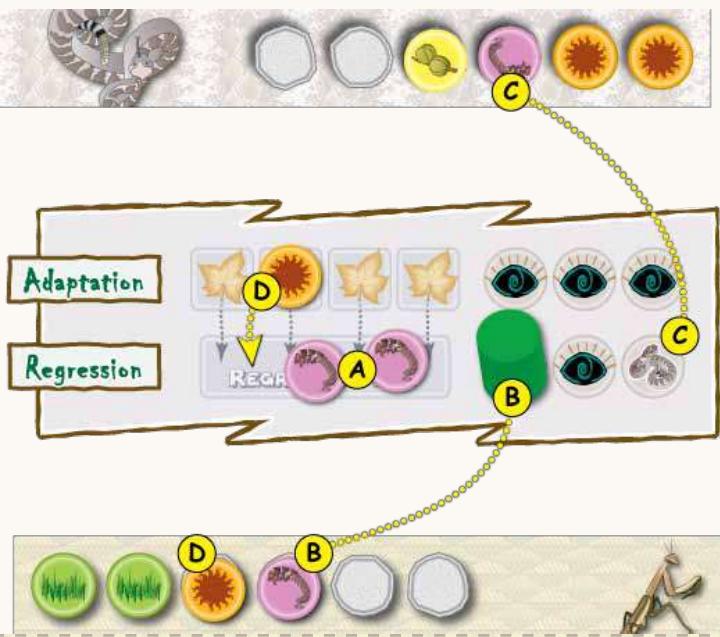
EXAMPLE: The Regression Box holds two grub elements (though this counts as only one element type) (A). The insect player placed an AP here, which saves his grub element from being removed (B). The reptile player's free AP here likewise saves his grub (C).
Note that the insect player's sun element is in danger of being removed next turn when the sun sitting in Adaptation is moved down into Regression at the end of the this turn (D).
ABUNDANCE

After the Regression action has occurred, APs are removed from this section one at a time in left-to-right order. When an animal's AP is removed, that player selects one of the elements currently present in this section. The chosen element is removed from the action display and placed on a vacant corner of any tile of earth.
Elements can be placed on any vacant corner of a tile, even a corner shared by only one or zero other tiles (that is, those tile corners currently on the “edge” of earth).
EXAMPLE: The amphibians get first pick (A) and choose to place one of the available water elements as indicated. This gives them dominance of the Savannah tile: 6 matching elements to the insect's 4 (B).
The reptiles get second pick (C) and choose to place the available sun tile as shown. This will allow them to later expand into the mountain tile without those species going extinct.
WASTELAND

After all Abundance actions have been performed, remove any AP that was placed here. That player removes any one element currently in the Wasteland Box, placing it back in the draw bag.
Then, regardless of whether there was an AP placed in this section or not, the Wasteland action automatically occurs: remove all elements from tundra tiles that match the element type(s) still present in the Wasteland Box. Removed elements are placed back in the draw bag.
Note that the Wasteland Box will be empty – and the action skipped – during the first turn of the game.
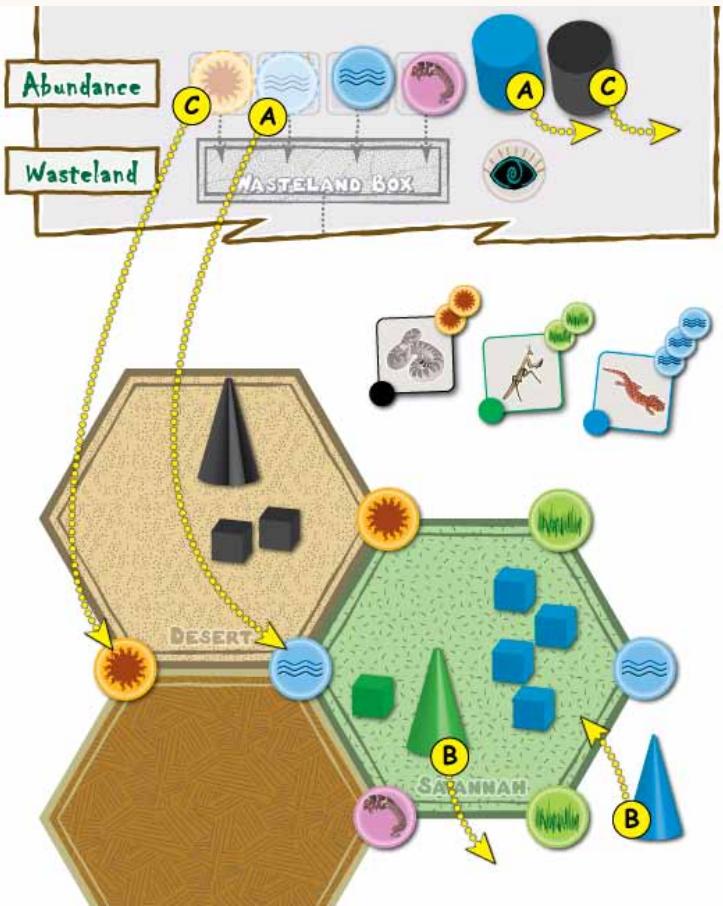
EXAMPLE: The arachnids remove their AP, choosing to place the grub element in the Wasteland Box back in the draw bag. Thus the two grubs adjacent to tundra are saved (A).
A water element remains in the Wasteland Box, so all water elements on earth that are currently adjacent to a tundra are removed and place back in the draw bag (B).
The amphibians lose their dominance of the desert tile because their species there are now endangered (C)

DEPLETION
After any Wasteland action has been performed, remove any AP that was placed here. That player selects one element on earth that matches an element type in the Depletion Box. The chosen element disk is removed from earth and placed back in the draw bag.
If none of the elements in the Depletion Box match elements on earth, this action can have no effect.
Note that the Depletion Box will be empty – and thus the action useless – during the first and second game turns.
EXAMPLE: The mammal player removes his AP from this section. There is a lone seed element in the Depletion Box so he may remove any one seed element from earth. He chooses the one straddling the desert and savannah (A).
On each tile the birds go from matching 4 elements to matching 2. They lose dominance of the desert as they are now tied with the reptiles (B). The mammals will gain dominance of the savannah where before it was a tie (C).

GLACIATION

After any Depletion action has been performed, remove the left-most AP (only) from this section. That player conducts a Glaciation action by performing the following steps:
-
Select a non-tundra tile that is adjacent to at least one other tundra tile.
-
Remove and temporarily set aside all species from the chosen tile.
-
Place a new tundra tile (from the face up stack) on top of the chosen tile.
The tile is no longer considered to be its former terrain type and is instead treated as a “tundra tile” for the rest of the game.
- Remove all elements from earth that are surrounded by exactly three tundra tiles.
EXAMPLE: The reptile player gets the Glaciation action this turn. He would like to glaciate the Savannah because, not only would it would give him 3 bonus VPs for placement next to two existing tundra tiles, but would also give him control of the Survival Card (3 total reptiles in tundra compared to 2 arachnids and 1 insect). However, he doesn't want the lone sun
element to become surrounded by three tundra and thus
be removed
during
step 4....
This means that an element occupying a corner of only one or two tundra tiles on the “edge” of earth are unaffected.
-
Gain bonus VPs (see page 3) based on the number of existing tundra tiles that are adjacent to the newlyplaced tile.
-
From the pile of set-aside species, place 1 belonging to each animal back onto the tile.
-
The remainder of the removed species, if any, are displaced back to their owners' gene pools (instead of being eliminated and put back in the box).
If there are no tundra tiles remaining in the stack (all 12 are already out on earth) this action is forfeit.
Note that if there are any APs in the second, third or fourth eyeball spaces these are not removed at this time. Instead, these will shift forward during the upcoming Reset Phase.
Players will find that Glaciation is subtly powerful enough to sometimes warrant investing in a future action, even if it means being without the use of an AP for a turn or two.
So he instead chooses the desert tile for Glaciation (step 1).
He removes all the species there (step 2) then places a new tundra tile atop it (step 3). Step 4 has no effect. In step 5
he scores 1 bonus VP (for there being one existing tundra adjacent to the new tile). Then, of the species removed in step 2 – 1 insect, 2 birds and 4 amphibians – one of each is put back on the new tundra
(step 6), with the remaining 1 bird and 3 amphibians being put back into their respective gene pools (step 7).

SPECIATION
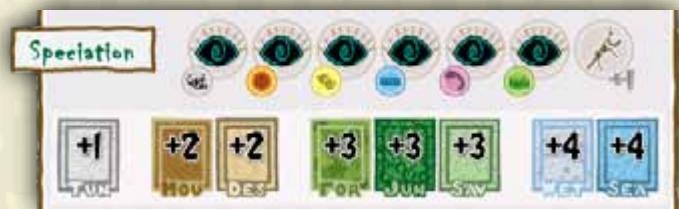
After any Glaciation action has been performed, APs are removed from this section one at a time in left-to-right order. When an animal's AP is removed, that player chooses any one element on earth that matches the element type accompanying the space from which the AP was taken. He then places new species from his gene pool onto the adjacent tiles as follows:
• Up to 4 species if the tile is sea or wetland.
• Up to 3 species if the tile is savannah, jungle or forest.
• Up to 2 species if the tile is desert or mountain.
• Up to 1 species if the tile is tundra.
Note that only one, two or three tiles can be populated at a time: those with a corner occupied by the chosen element.

After all Speciation actions have been performed, the insect player may place a single species from his gene pool onto any one tile of earth.
During the Planning Phase the insect player can still choose to place APs in other spaces within this section if he so desires.
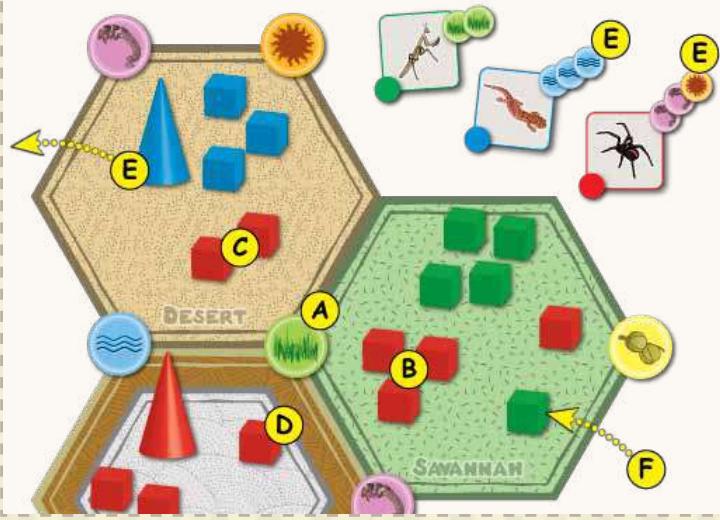
EXAMPLE: The arachnids remove an AP from the “grass" eyeball space. They choose the grass element shown below (A). This allows them to place 3 more species in the savannah (B), 2 in the desert (C), and 1 more into the tundra (D). The amphibians lose dominance of the desert since they are tied with the arachnids at 3 matching elements each (E). The insects then place their free species in the savannah in order to maintain the quantitative advantage there (F).
WANDERLUST

After all Speciation actions have been performed, APs are removed from this section one at a time in left-to-right order. When an animal's AP is removed, that player selects one of the available face up large tiles (those atop the Wanderlust Tiles stacks). He then performs the following activities in the order shown:
-
Select a vacant (white) hex on the game board and place the new tile there. The hex selected must be adjacent to at least one existing tile of earth.
-
May select one of the available element disks in the Wanderlust section of the action display and place it onto any vacant corner of the newly-placed tile.
-
Gain bonus VPs (see page 3) based on the number of existing tiles adjacent to the newly-placed tile.
Finally, in food chain order, every player may move all, some or none of his species that are currently adjacent to the newly-placed tile onto that tile.
If any of the three tile stacks becomes depleted, the number of possible Wanderlust actions will be reduced accordingly.
EXAMPLE: The birds are first. They choose a face up wetland tile to place (A) along with an available seed element (B). There exist 2 tiles adjacent to the new wetland tile (C): referencing the Bonus Points Table, this nets the birds 3 VPs. The birds then decide to move 1 of their adjacent species onto the new wetland tile, immediately claiming dominance (D). The arachnids decline (they would be endangered there). Finally, the insects move in 2 of their species (E).

MIGRATION

After all Wanderlust actions have been performed, APs are removed from this section one at a time in left-to-right order. When an animal's AP is removed, that player selects up to X of his animal's species anywhere on earth, where X is the number in the space from which the AP was taken. Each chosen species is then moved onto an adjacent tile.

Each bird species may Migrate to a tile up to two tiles away: that is, birds may be moved through an adjacent tile and onto a second tile.
Birds cannot migrate over blank hexes (those not yet containing a terrain tile).
Migrating species beginning a Migration action on the same tile may move together onto the same tile or be split up onto separate tiles, at the owning player's discretion.
EXAMPLE: The insects remove an AP from the “7” eyeball space. They move 1 insect from the desert to the adjacent savannah, claiming dominance (A). Being endangered on the tundra, they use their last 6 migrates to move their species out of there: 4 to the desert (B) and 2 to the mountain (C). The birds also have a Migration AP this turn. Seeing what the insects did, they plan to use their special ability to move one of their species from the sea to the now vacant tundra (D).

COMPETITION

After all Migration actions have been performed, APs are removed from this section one at a time in left-to-right order. When an animal's AP is removed, that player notes the three terrain types associated with the space from which the AP was taken. He then chooses up to 1 tile of each of those terrain types currently on earth. To choose a tile, it must contain:
• at least one of that animal's species; and
• at least one opposing species.
That player then eliminates any 1 opposing species on each of the chosen tiles. Place eliminated species back in the box, out of play (not back in their owners' gene pools).

The arachnids are always considered to have one “free" AP in this section. They compete first, in any terrain type, but only on a single tile.
In the Planning Phase the arachnid player can still choose to place APs in other spaces within this section if he so desires.
EXAMPLE: The reptiles have an APin the “tundra-desert-forest” eyeball space (A). They choose to eliminate 1 mammal in the left-most forest (B) and 1 insect in the tundra (C). They have no presence in the desert so forfeit their third competition (D). Even with presence, they cannot compete in the second forest nor in the sea this turn (E).
DOMINATION
Domination

After all Competition actions have been performed, APs are removed from this section one at a time in left-to-right order. When an animal's AP is removed, that player selects one tile on earth that has not yet been chosen for Domination this turn. That tile is then scored by performing the following steps:
-
The animal having the most species present on the tile gains X VPs, where X equals the first number listed for that terrain type on the Tile Scoring table on the game board.
-
If the tile being scored is any terrain other than tundra, the animal with the second highest number of species present gains a number of VPs equal to the second number listed for that terrain on the Tile Scoring table.
There must be another animal present— an animal alone on a tile cannot claim both first and second place.

- If the tile being scored is sea, wetland, savannah, jungle or forest, the animal with the third highest number of species present gains a number of VPs equal to the third number listed for that terrain on the Tile Scoring table.
There must be a third animal present—an animal claiming first or second place on a tile cannot also claim third place.
- If the tile being scored is sea or wetland, the animal with the fourth highest number of species present gains 2 or 1 VPs, respectively.
There must be a fourth animal present—an animal claiming first, second or third place on a tile cannot also claim fourth place.
• IMPORTANT: In all cases above, ties for number of species on the tile being scored are broken in descending food chain order (that is, mammals first, then reptiles, etc.).
- Finally, if there is a dominant animal on the tile being scored that player must select and execute one face up Dominance Card (if one is available). Any choices to be made in the execution of a Dominance Card are made by the player who chose it. After execution place the card back in the box, permanently out of play.
Clarifications of card effects can be found on pages 18-19.
Note that when the Ice Age card is selected, the game will end at the conclusion of the current turn (see page 20).
Note also that the dominant animal might not be the same as the animal that chose to score that particular tile, and might not be the animal that scored the most points.
Finally, be aware that the first player each turn to have a chance to select a Dominance Card will have five effects to choose from—after which the choices will become progressively fewer as face up Dominance Cards are selected and their effects resolved.
After all Domination actions have been performed, the Execution Phase is over and play proceeds to the Reset Phase (see page 20).
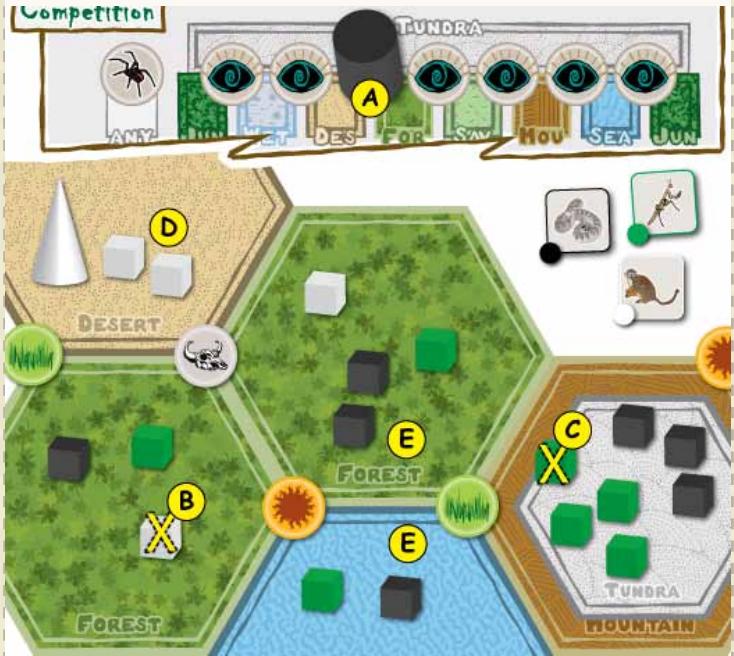
EXAMPLE: The reptile player has chosen to score the lone wetland tile in play. First place (8 VPs) goes to the amphibians with 4 species present. Reptiles and birds have 2 species each: the reptiles are higher on the food chain and so score 4 VPs for second place. The birds settle for third place (2 VPs) while no animal gets the last 1 VP for fourth place.
Then, being dominant on the tile, the reptiles must choose and execute one face up Dominance Card.

OPTIONAL 2- AND 3-PLAYER RULES
When playing Dominant Species with only 2 or 3 players, the following rules may be used which allow for each player to control multiple animals. These rules conflict with some of those found elsewhere in this rulebook: where there is conflict, the rules in this column take precedence.
MULTIPLE ANIMALS
When assigning animals to the players during set up, assign all six animals. Thus in a 3-player game each player will be in control of two different animals; in a 2-player game, each player will control three different animals.
Players should assign one colored set of wooden bits to each of their animals. Each animal receives 3 cylinders and 35 cubes as if it were a 6-player game. Each animal maintains its own separate VP total.
ACTIONS
When one of a player's animals is acting, his other animal(s) and their species are considered “opposing” for all purposes (exactly as if they were controlled by an opposing player). For example, when a Dominance Card refers to “your animal” it is referring only to the animal that was dominant on the scored tile—in this case your other controlled animal(s) would be treated as opposing.
FINAL SCORING
While all six animals will ostensibly gain VPs throughout the game, only one belonging to each player will count for the final score. At the end of the game, each player's animal with the lowest individual score will be that player's overall final score—animals with higher scores belonging to the same player are ignored.
Thus it behooves you to try to maintain a balance between your multiple animals throughout the game rather than sacrificing one for the benefit of another.
For example, in a 2-player game Mark's animals have scores of 70, 145 and 160—netting him only 70 VPs. If Bob's animals had 75, 85 and 95 points, his final score would be 75 for the win.
OPTIONAL (RANDOM) EARTH SETUP
The following alternate setup for earth will have the animals beginning the game unevenly matched but with varying starting VP levels to compensate. This option can be used with either the base game or in conjunction with the optional 2- and 3-player rules to the left.
Follow normal setup for earth except as follows:
TILES
Prior to placing tiles on the board, shuffle all the large tiles face down. Draw seven at random and place them into the seven starting spaces. (The remainder form the three draw piles as normal.) Place a tundra atop the central tile.
ELEMENTS
One at a time, randomly draw a total of twelve elements from the bag, placing them onto the twelve tile corners normally allotted for starting elements. (The action display is seeded with elements normally.)
SPECIES
Place 1 mammal species onto each non-tundra tile containing a single meat element; 2 mammals onto each non-tundra tile containing 2 meat; 3 mammals onto each non-tundra tile containing 3 meat; etc.
Repeat this process for reptiles and sun; birds and seed; amphibians and water; arachnids and grub; insects and grass.
Identify the animal having the most species on earth and count those species. Place every animal's VP cube into the space of the Victory Point Track equal to this count. Then each animal loses a number of starting VPs equal to the number of starting species it has on earth (thus the animal or animals with the greatest number of starting species will begin the game with 0 VPs).
It is possible, however unlikely, that an animal will begin the game with no species on earth. If this occurs, don't panic! That animal will start the game with a nice VP lead—plus it means that the odds of its preferred element coming out of the draw bag and onto the action display is enhanced.
THE CARDS
SURVIVAL CARD
The Survival Card is set aside at the beginning of the game. During play, players should keep track of how many of their species occupy tundra tiles. Any player with the sole highest count automatically and immediately takes possession of the Survival Card. If two or more players are tied for most, no player

controls the card (it remains uncontrolled and will not score points for any player).
During each Reset Phase, after Extinction, the player in control of the Survival Card earns bonus VPs (see page 3) for the number of tundra tiles occupied by one or more of his animal's species.
DOMINANCE CARDS
The 26 Dominance Cards are a player's reward for being dominant on a tile that is scored during a Dominance action. When a face up Dominance Card is selected during a Dominance action, that player must resolve all of the card's effect (or at least as much as possible given the current game situation). The card is then placed back in the box, out of play.

Should a question arise during play, hints and clarifications for the various card effects are outlined below.
AQUATIC
Take the chosen element from the draw bag. If there are no vacant corners on any sea or wetland tiles currently in play the first part of this card is forfeit. If you have no species remaining in your gene pool the second part of this card is forfeit.
BIODIVERSITY
You don't receive additional VPs if a tile contains more than one opposing species—it's simply 1 VP per tile that you occupy that has ANY opposing species on it.
BIOMASS
If your animal is alone on such an overcrowded tile you must eliminate one of your own species there. If multiple animals have species on an overcrowded tile, you choose which one dies out.
BLIGHT
The dominant player chooses which elements to remove from the chosen tile.
CATASTROPHE
The dominant player chooses which species to eliminate on the chosen tile. It is also that player's choice as to which single species to remove from adjacent tiles. The second part is mandatory, however, so if the dominant player is the sole occupant of an adjacent tile he will have to eliminate one of his own animal's species there.
COLD SNAP
Every animal except the one controlled by the player selecting this card loses one of its species on each tundra tile.
DISEASE
An animal's default (printed) elements can never be removed. If the order of removal makes a difference, they are removed in food chain order. Place any removed elements back into the draw bag.
ECODIVERSITY
Remember that “sun" is a single element “type"—so, for example, the two default sun elements on reptiles count once for this card effect, not twice.
EVOLUTION
You may select species anywhere on earth to replace—you don't need to share a tile with a chosen animal, for example. If you only have zero or one species remaining in your pool you can only replace zero or one opposing species, respectively.
FECUNDITY
You get only +1 per occupied tile; not +1 per species on that tile. If the number of species remaining in your gene pool is less than the number of tiles you occupy, you choose which tiles get the additional species and which are skipped.
FERTILE
It's 1 VP for every species on the chosen tile-yours or an opposing animal’s.
HABITAT
The element is not drawn at random-the player may choose any element currently in the draw bag.
HIBERNATION
The species may only come from those previously eliminated (not from a player's species gene pool and not from among those put back in the box at the start of the game).
ICE AGE
The game will end at the conclusion of the turn in which this card is selected—after Domination, perform Extinction and score the Survival Card as normal but skip the Reseed step. Then perform final scoring (see Endgame on page 20).
ICE SHEET
This ability follows all the normal rules for Glaciation (see page 13).
IMMIGRANTS
Animals make their decisions in food chain order. An animal having only its default (printed) elements cannot choose the first option—nice try!
INSTINCT
The AP may be placed into any empty eyeball space—even one that has yet to be acted upon this turn. This card generally acts as a super-early placement for the following turn.
INTELLIGENCE
If the animal highest in the food chain picks this card, they will be the only animal to benefit. Retrieve new action pawns from those set aside at the start of the game.
MASS EXODUS
The player choosing this card moves all animals, even his opponents’. Species may be split up amongst any and all adjacent tiles as the player sees fit.
METAMORPHOSIS
You cannot dump your two default (printed) elements. Note that you choose an element from the draw bag—the new element is not selected at random.
NICHE BIOMES
Remember that this card isn't chosen until after the relevant tile is fully scored. The “first place" value of a tile is its leftmost number on the Tile Scoring table: for example, 9 for sea, 8 for wetland, 7 for savannah, etc.
NOCTURNAL
This card has no effect if chosen by the animal already at the front of the line.
OMNIVORE
The new action pawn comes from those set aside at the start of the game.
PARASITISM
If the animal lowest in the food chain picks this card, they will be the only animal to benefit. Retrieve new action pawns from those set aside at the start of the game.
PREDATOR
Note the word “opposing" on this card: you don't have to eliminate one of your own species on tiles containing only your species. You may choose a different opposing animal's species on each tile.
SYMBIOTIC
This effect counts default as well as added elements.
CREDITS
Game Design — Chad Jensen
Developer — Kai Jensen
Packaging Design — Rodger MacGowan
Graphics & Rules Layout — Chad Jensen
Additional Playtesters — Alex Ostroumov, Mark Beyak, Terry Beyak, Devon Biasi, Bob Borbe, Kris Adamson, Martin Scott, Kris Skold, Mr. Magoo, Paul Bravey, Richard Gage, Mike Chevalier and Andy Lewis
Production Coordinator — Tony Curtis
Producers — Gene Billingsley, Tony Curtis, Andy Lewis, Rodger MacGowan and Mark Simonitch
A kind thanks to the following individuals for giving their time to help proofread this rulebook — David East, Kevin Morris and Paul Marjoram
RESET PHASE
During the Reset Phase, animals may lose species to extinction and one animal may be able to gain VPs via the Survival Card. Then the action display is reset in preparation for the next turn's Planning Phase.
EXTINCTION
First, Extinction occurs as follows: Eliminate all endangered species. Eliminated species are removed from earth and placed back into the box, out of play.

EXCEPTION: Each turn the mammal player may automatically save one of his endangered species from Extinction (his choice of which if he has more than one that is endangered).
SURVIVAL
Next, make sure the player having the most species on tundra tiles is in possession of the Survival Card. If there is a tie for most species, no player receives the card. The owning player, if any, then scores bonus VPs (see page 3) based on the total number of tundra tiles occupied by his species (the quantity of species on each tile is irrelevant).
RESEED
Note: You do not need to perform this step if this is the last turn of the game (via play of the Ice Age card).
Finally, in preparation for the next turn perform the following activities:
• Draw enough new Domination Cards off the top of the draw pile to fill – face up – each empty space of the Available Dominance Cards section of the game board. Any cards already occupying this section remain where they are. If there are not enough cards remaining in the draw pile to fill up every card slot, fill up as many as you can; the rest will remain vacant.
Once the draw pile is depleted, no new cards will be placed for the remainder of the game.
● Slide any APs in the second, then third, then fourth spaces of the Glaciation section one space to the left into empty eyeball spaces.
• Remove all elements from the Regression, Depletion and Wanderlust sections of the action display. Place them back into the draw bag.
● Slide all elements in the Wasteland Box down into the Depletion Box.
• Slide all elements in the Abundance section down into the Wasteland Box.
• Slide all elements in the Adaptation section down into the Regression Box.
● Draw 4 elements at random from the bag and place them into the four “leaf" squares of the Adaptation section.
● Draw another 4 elements at random and place them into the four “leaf” squares of the Abundance section.
• Draw another 4 elements at random and place them into the four “leaf” squares of the Wanderlust section.
● If face down, flip face up the top tile of each of the three large tile stacks. Any empty stack remains empty.
Play then proceeds to the next turn's Planning Phase.
ENDGAME
When the game ends via the Ice Age card, finish the remainder of the Domination actions, if any, then perform Extinction and score the Survival Card as normal. Then remove all Domination markers from earth and score each and every tile of earth one last time: Domination is ignored during final scoring—that is, animals gain VPs only, not any Dominance Cards that may be remaining.
Once final scoring is complete, the player in control of the animal with the highest VP total wins the game. In case of a tie for highest, the tied animal closest to the top of the food chain wins the game for its controller.
下载 Markdown原文为社区整理/出版社公开资料,版权归原作者,仅供个人学习查阅。