
翻转马戏团Drum Roll
一句话概览
翻转马戏团 是一款已收录于村了吗规则库的桌游,支持 2–4 人,原名 Drum Roll。
本页内容:一句话概览 · 常见问题
这游戏怎么玩
- 本站已收录这款游戏的规则资料,可以在对话里直接提问规则细节。
常见问题(FAQ)
以下 1 条问答中 0 条来自站内玩家的真实提问,其余 1 条为本站整理的常见疑问;答复内容保持原样。
翻转马戏团支持几个人玩?
2–4 人。
去哪查完整规则
想核对具体规则细节、卡牌效果或某个回合的结算方式,可以在村了吗里选中这款游戏后直接提问。
同类桌游
- 卡坦岛德式
- 工业革命:伯明翰德式
- 勃艮第城堡:特别典藏版德式
- 方舟动物园德式
- 卡卡颂抽象
- 瘟疫危机传承:第一季美式
- 阿瑞迪亚:勇踏征途美式
- 重塑宇宙德式
- 幽港迷城美式
- 埃多拉的德鲁伊德式
规则原文(Markdown)
本站收录这款游戏的规则原文 1 个文件,此处内联渲染 1 个,可直接展开阅读或下载。
drumroll_eng_rulebook.md35.4 KB
影聚影M 聚+是匙
KONSTANTINOS KOKKINIS - DIMITRIS DRAKOPOULOS
urope in the early 1900s. Players take over the role of circus owners traveling to various European cities to give shows and impress their crowd. Before each show, players must enrich their circus by hiring performers and fulfilling their needs to help them give their best performances. They also hire personnel and invest in order to create the most prestigious circus. After 3 shows, the player who earned the most prestige points is the winner.
1x Starting Player Tile

5x Region Tiles

58x Money Tokens (40x 1-coin tokens & 18x 5-coin tokens)

18x Trailer Tiles
44x Discount Tokens

& Show Tokens
45x Performer Cards

Round

30x Investment Cards

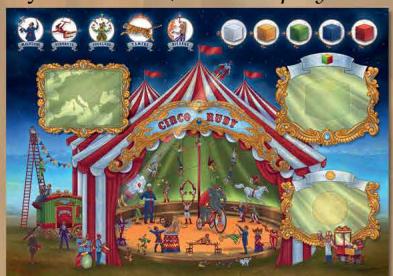
1x Main Board

4x Player Boards (1 in each player's color)
125x Resource Cubes (25 in each of 5 colors)

8x Score & Ticket Cubes (2 in each player's color)

12x Action Markers (3 in each player's color)

1x Rulebook



15x Personnel Cards

1x Performer Cover Card
4x Player Aid Cards

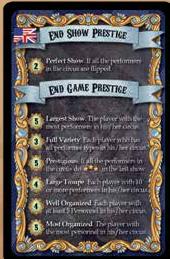
TABLE OF CONTENTS
| Contents 1 |
| Game Setup 2 |
| Symbols 4 |
| Game Play 4 |
| Action Phase 5 |
| Distribution Phase 6 |
| Turn End 7 |
| Vote 7 |
| Show 7 |
| Salary 7 |
| Show End 8 |
| Game End 8 |
| Regions 8 |
| Out of Stock 8 |
| Performers 9 |
| 10 Personnel |
| 10 Trailers |
| 11 Investment Cards |
| 12 Two Players |
| 12 Credits |

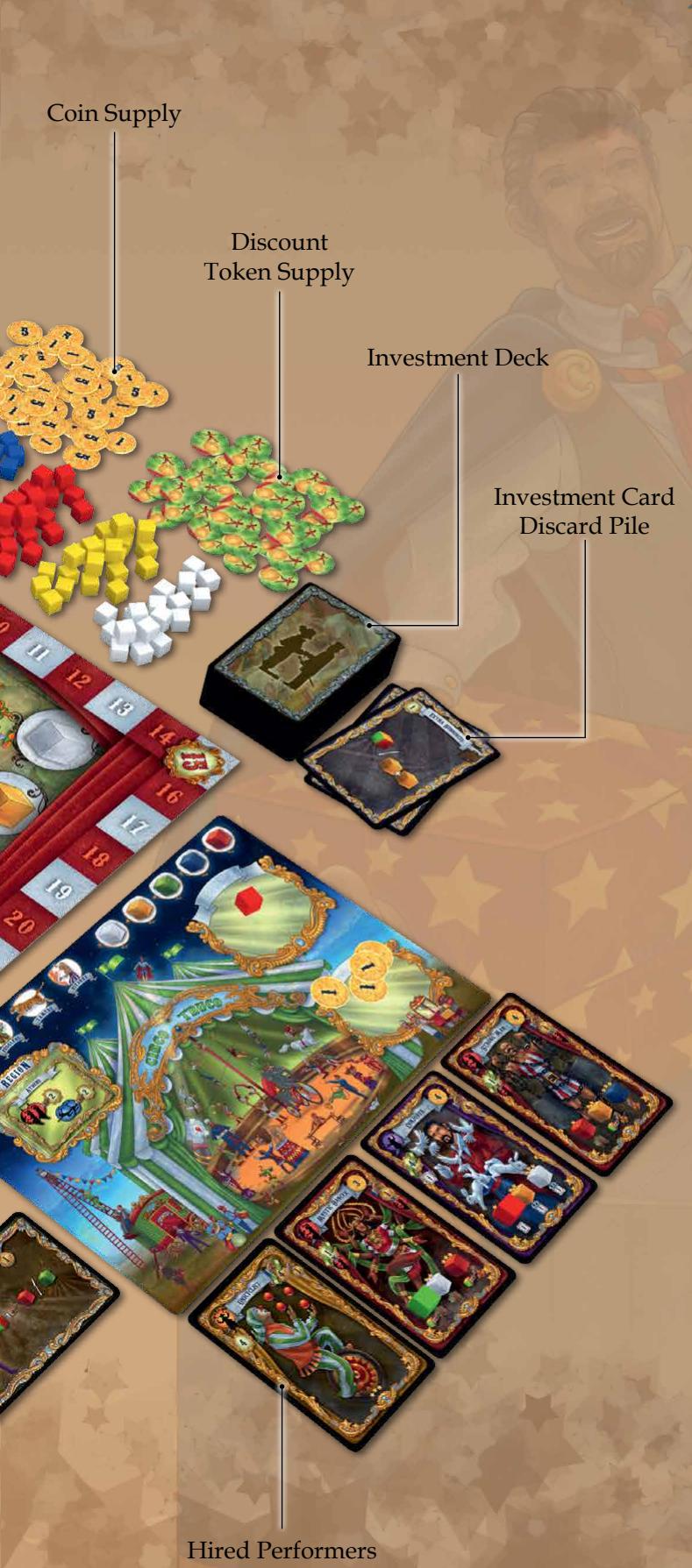
• Place the main board in the middle of the table.
Place the two brown markers on the main board (one on the preparation track and one on the first show)
Shuffle the personnel, performer and investment decks and place them next to the play area. Place the performer cover card on top of the performer deck. Each time you would deal from the performer deck, do it from the bottom of it.
Take the personnel deck and deal cards equal to the number of players face up, below the main board.
Take the performer deck and deal cards equal to the number of players + 1 face up, below the personnel cards. Each time new performers are dealt, if three performers of the same type (magician, acrobat etc.) are revealed, discard the last one revealed and deal a new one. Repeat the process until no more than 2 performers of the same type are in the hiring area.
Each player receives:
• A player board in the color of their choice.
The score & tickets cubes of their chosen color. Place one cube on the of the scoring track and the other on the starting ticket in the tickets area.
• 3 Action markers of their chosen color.
• One random region tile which they place on their player board.
Each player is dealt two performers from the bottom of the performer deck. They keep them secret from other players. Players choose which one of the performers they want to keep and all at the same time, give the other to the player on their left. After that, the performers are revealed and placed below the player boards.
Each player then chooses two resources and places them in their storage area on the player board (it can be two different resources or two of the same one).
Each player receivess minus the hiring cost of the two performers they have in their circus.
Example: Sandra has chosen a performer with hiring cost of and was given a performer from the player to her right, with a hiring cost of3. This means she must begin the game with
The player who most recently visited a circus becomes the starting player. In the case of a tie, choose randomly.
Acrobat


DRUM 聚+L影

Player

Show

Vote

Game End
Trailer


Positive Prestige

And (Plus)

Or (Choice)

If Used

If Not Used

Coin



Magician

Salary

Juggler
Tamer

Investment Card


Conversion

Discount

Bizarre
+1 Hand Size
When Flipped


Fired
Action Marker


Any Resource (Cube)

Look at the Top Two Cards of the Investment Deck and Pick One

Personnel

Performer

Outstanding Performance

Good Performance


Poor Performance
Do Not Lose Prestige

Do Not Pay a Salary

White Cube (Rehearsal)

Yellow Cube (Equipment)

Green Cube (Promotion)

Blue Cube (Costume)

Red Cube (Supplies)

Game
During the game, players give 3 shows. For each of these shows players have 5-7 turns of preparation. After these turns, the players start their shows and scoring begins. Each preparation turn consists of two phases:
• The Action phase where the players use their three actions to acquire resources, invest, sell tickets, hire
• The Distribution phase where players can equip their performers with resources.

PLAYER BOARD
MAIN BOARD
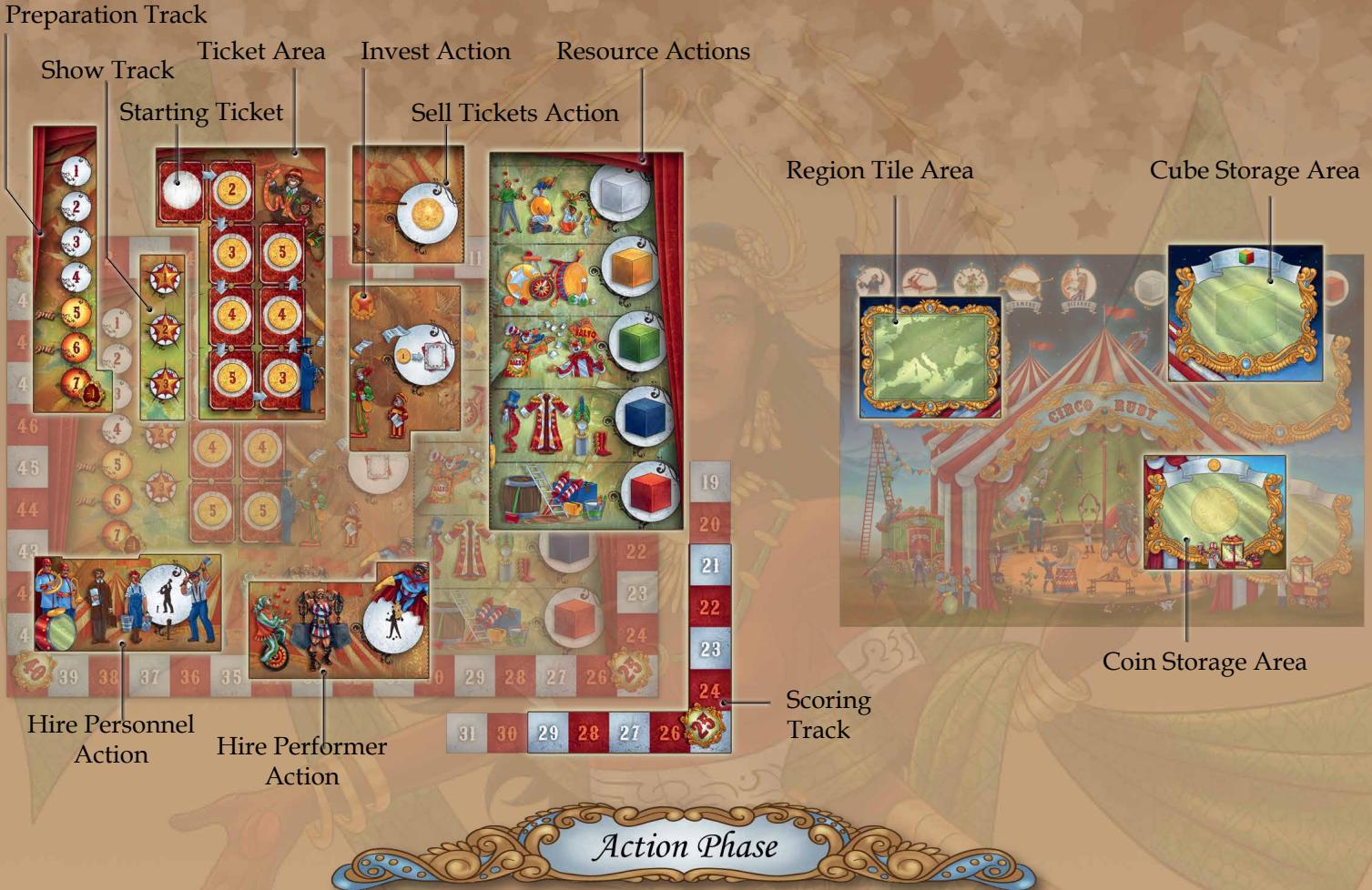
During the action phase each player uses their three action markers. Beginning with the starting player and continuing in a clockwise order, each player places one action marker on the action they want to perform. This is repeated until all players have placed their three action markers on the board. Note: In all actions where more than one action marker can be placed, action markers should be stacked to determine priority.

Rehearsal:
The player gets a white cube.
Limit: This action can only be
performed once
each turn and only by one player.

Equipment: The player gets a yellow cube. Limit: This action can only be performed once each turn and only by one player.
Promotion:
The player gets a green cube.
Limit: This action can only be
performed once
each turn and only by one player. Costume:
The player gets a blue cube.
Limit: This action can only be
performed once
each turn and only by one player. Supplies:
The player gets a red cube.
Limit: This action can only be
performed once
each turn and only by one player.

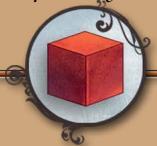
Cube action limit:
In a 4 player game, up to 4 cube actions can be performed each turn. One slot must remain empty.
In a 3 player game, up to 3 cube actions can be performed each turn. Two slots must remain empty.
In a 2 player game, up to 2 cube actions can be performed each turn. Three slots must remain empty.
All cubes acquired during the action phase are placed on the cube storage area on the player board.

Sell Tickets: The player gets coins. They move their ticket cube one slot ahead in the ticket area and get the corresponding amount. Once the last ticket slot is reached, the player cannot perform this action until the next show. After each show, all ticket cubes return to the starting position. Limit: This action can only be performed twice each turn by each player.

Invest: The player pays and takes the top card from the investment deck. Each player has a hand limit of 2 cards which can be increased by 1 for each magician in that player's circus. Limit: This action can only be performed twice each turn by each player.
Hire Performer: The
player may hire 1
performer for their
hiring cost (minus
any discount tokens). The performer is then placed in that player's circus below their player board.
Limit: This action can only be performed
once each turn by each player. Hire Personnel: The
player may hire 1 personnel member for their hiring cost (minus any discount tokens). The
hired personnel is then placed in that player's circus on the left of the player's board.
Limit: This action can only be performed
once each turn by each player.
Pass: A player may choose not to perform any number of actions. They receive for each action they do not perform.
Action resolution: After all players have chosen their actions, each player removes their action marker and performs the chosen action in the following order:
• Cube actions: They are all performed simultaneously and players receive cubes.
• Sell Tickets: It is performed simultaneously and players get coins.
• Invest: Players buy cards in the order they chose the action. (Use bottom to top priority on the stacked action markers)
• Hire Performer: Using the bottom to top priority on the stacked action markers, players hire the performer they want.
• Hire Personnel: Using bottom to top priority on the stacked action markers, players hire the personnel member they want.

Note: There will be several times when a player will not be able to hire the performer or the personnel member they wanted because another player just hired them. A player can always choose not to perform an action they put their action marker on. In that case, the player gets back their action marker but they do not receive
After all actions have been resolved, each personnel member and performer that was not hired during the action phase receives atoken. This means that during the next turn's action phase, those personnel members and performers will cost one coin less to hire. In the next turn all personnel members and performers that were not hired again receive a token (including the ones that already have discount tokens on them). This means that a personnel member or performer, who does not get hired for several turns, can end up being offered for free. When this happens, the card remains available for free hiring one last turn and then is discarded.
Distribution Phase
During this phase, all players simultaneously move up to two cubes from their cube storage area, on to their performers. Once a cube is moved on a performer, it cannot be removed and remains there for the rest of the game. Exception: When performers get fired, or are flipped for (see Performers on page 9 for details) all cubes on them are returned back to stock.


Turn
After a turn has ended, the following must be done:
• Replenish the number of available personnel cards. • Replenish the number of available performer cards. • Move the turn marker one step ahead on the preparation track. • Move the starting player tile to the next player on the left. Begin a new turn.
Vote
After the 5th turn has been played, the players vote if they want to start their show or delay it in order play a 6th turn and do some further preparation. All players take one action marker in their hand. They secretly choose to either keep it in their hand or not. Choosing to keep the marker, means that the player wants to delay the show for one more turn. Choosing not to keep the marker means that the player is ready to start the show. Once everyone has chosen, all players simultaneously reveal their hands. If the majority has an action marker in their hand, the show is delayed and a 6th turn is played as normal. If the majority of hands are empty, then the show starts. In the event of a tie, the starting player's vote is the only one that counts. If the show is delayed, the voting process is repeated after the 6th turn is played. If the majority votes to delay the show once more, a 7th turn is played and then the show starts without a vote. The players who voted for a delay on the 6th turn lose
Show
In player order, or in couples for 4 player games (to speed the process up), players give a show and receive benefits. Each player can choose the order their performers will appear in the show, and get benefits in the order they need them. Each performer does a performance based on the cubes the player moved on them. This will result in one of the following for each performer:
Poor performance: The player receives the benefits shown below the poor performance.
Good performance: The player receives the benefits shown below the good performance.
Outstanding performance: The player here has two options. The first one is to do the same as above and receive the benefits shown below the outstanding performance. The second option is to (once per game for each performer) flip the performer and immediately score the prestige points () the performer is offering.
No performance: This may occur if the player did not move any cubes on the performer during the distribution phases or because the cubes provided, did not result in any of the above levels of performance. In this case the performer must be immediately fired. The card is reoved from the player's circus. The player must pay the performer's hiring cost as compensation and lose . (See Performers on page 9 for details)
Salary
After each player gives their show and receives all benefits from performers and personnel members, they must pay salaries. The player must pay each member in their circus the cost displayed on each card. The player adds up all the salaries from all their performers and personnel members, and pays the total amount. For every coin a player cannot pay, they lose . This means that a player's score can drop below
Show
End
After all players have given their shows and paid salaries, all performer and personnel member cards in the hiring area are discarded and new cards are dealt for both, according to the number of players. The preparation track marker goes back to 1. The show marker moves to the next show. Each player passes their region tile to the player on their left. Each player's ticket cube r eturns to the starting ticket. The player on the left of the last starting player becomes the new starting player. The 1st preparation turn for the next show can now begin.
After the end of each show, the following end-show are awarded:
Perfect Show. If all the performers in the circus are flipped.

After the end of the 3rd show, the game ends. The end-game are awarded to the corresponding players, and the one who has gathered the most is the winner. In the event of a tie, the player who has the most remaining is the winner. If there is still a tie, it is a shared victory. End-game :
| 5 3 5 4 4 5 | |||||||
| Largest Show.The playerwith the mostperformersin his/hercircus. | Full Variety.Each player | Prestigious.If all the | Large Troupe.Each playerwith 10 ormore perform-ers in his/hercircus. | Well MostOrganized. Organized.Each player The player withwith at least 5 the most per-personnel in sonnel in his/his/her circus. her circus. | |||
| who has allperformertypes in his/hercircus. | perfor | performers in | |||||
| the cir | cus do | ||||||
| ★★in thelast show. | in the | ||||||
If there is a tie for any of the end-game bonuses, all tied players receive the full bonus.
Regions
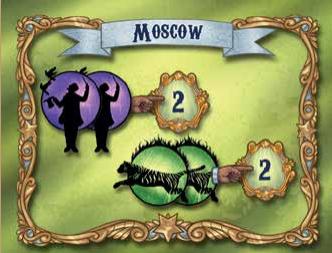
During a game, players visit 3 regions of Europe. This is represented by the Region tiles. Each Region offers a special prestige bonus awarded during each show. By knowing their future destinations, players can plan ahead and invest in performers that will score them more prestige points.
Example: The crowd in Moscow enjoys watching magicians and tamers more than other performer types. During the show the player who is visiting Moscow will score 2 prestige points for every 2 magicians and 2 prestige points for every 2 tamers in their circus.

If any of the resources (cubes) are depleted during the game, players can no longer acquire them until a player returns any back in stock by doing performer flipping to score , or spending them on benefits, personnel and investment cards. If thetokens are depleted during the game, there are no further discounts until a token is returned to stock. If the investment, performer or personnel decks are depleted, shuffle and reuse any cards that were earlier discarded. If there is none left, no more of this kind is available for the rest of the game. Trailers are depleted as well.

 Spend any cube to get 4 coins. |  Spend two coins to get 1 trailer. | Look at the top 3 cards of the investment deck andkeep 1. Put the rest on thebottom of the investment deck. |
 Get a blue or a yellow cube. | Spend any cube to skip a payment of any single salary after the show. | |
 Get any cube and a white cube. | Get any 2 cubes. | Skip a payment of any single salary after the show. |
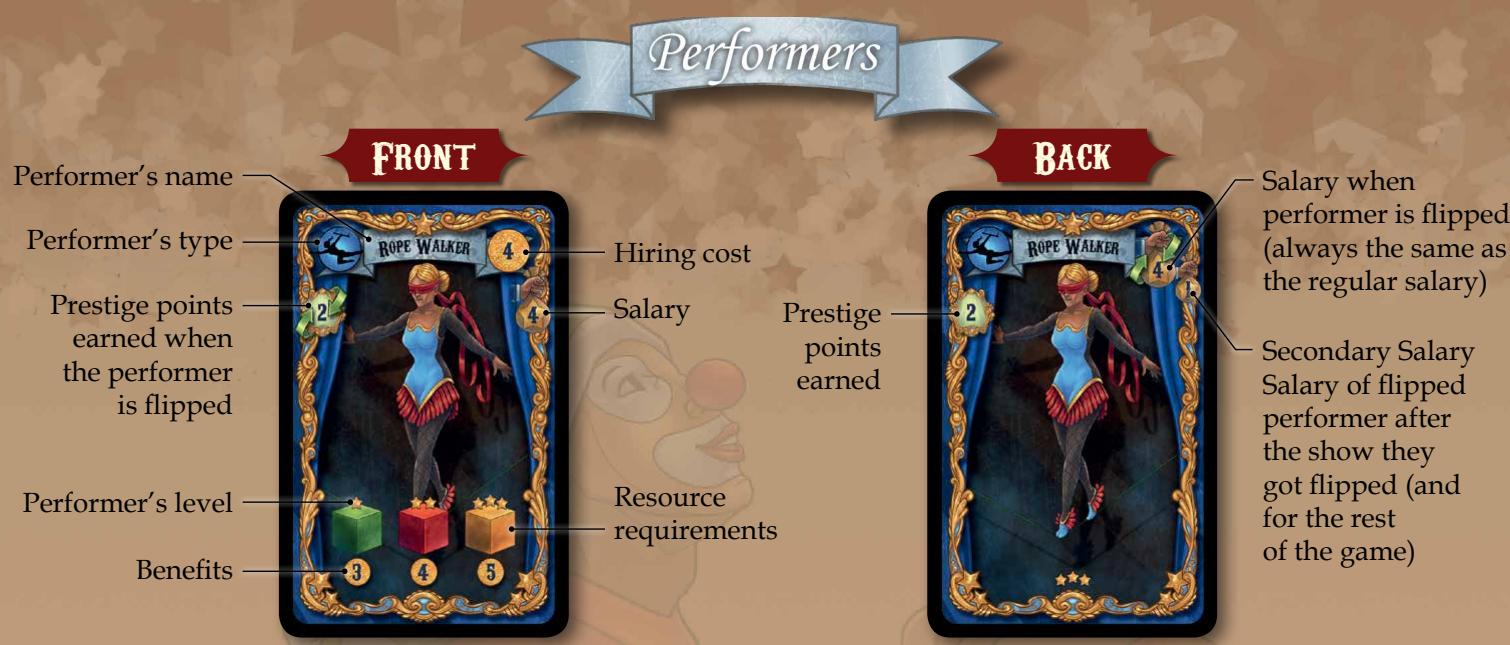
Each performer has specific resource requirements and can achieve 3 levels of performance. In order to achieve a higher level of performance, all resources required by lower levels must be provided. Example: In order for the Rope Walker to do an outstanding () performance, she needs to be provided with one red, one yellow and one white cube in previous distribution phases. In all the following shows, the player can either earn5, or (once per game) flip her and immediately score 2. A player does not have to move cubes on each performer in the level-of-performance order. Example: In preparation turn 4, Jim has a yellow and a white cube in his cube storage area. In the distribution phase he moves these cubes on the Rope Walker even though she doesn't yet have a red cube. In preparation turn 5, Jim acquires a red cube and during distribution phase he moves it on the Rope Walker. In the following show the Rope Walker will do an outstanding performance.
If a show begins, and a performer does not have at least the cube needed for the lowest level of performance () on them, they cannot perform, even if the cubes for higher levels were provided. (See “No Performance" on page 7 for details) As mentioned before, a performer who has achieved an outstanding () level of performance can be flipped to score prestige points. After the show when this is done, the player must pay the performer's regular salary (). In all the following shows, the flipped performer must instead be paid the secondary salary. This means that flipping performers for prestige points earlier in the game, will deprive players from getting benefits several times, but on the other hand, it will help them reduce the salary costs of their circus.
Examples of performers' benefits:
Performer types:

you to look at more than one card before choosing and increase your hand size by 1 (each).
Magicians help you acquire investment

Acrobats give you coins and improve your income.

Bizarre reduce salary costs in your circus by giving you trailers and allowing you to skip salary payments.
Their own salaries and the prestige points they offer are affected by the number of bizarre performers in your circus.

Jugglers give you cubes

which help you provide resources for your other performers.
Tamers allow you to convert cubes into coins.
Personnel
Personnel members assist you in various ways and work exactly like performers regarding hiring and salaries.

Show Organizer: At the end of any turn, you may return the show organizer to the hiring area and become the next starting player. The Show Organizer is again available for hire but you cannot hire him in the following turn. Only other players can.
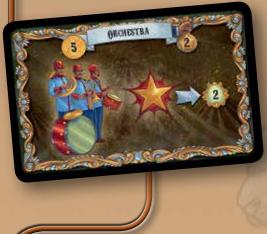
Orchestra: Gain 2 prestige points after each show.
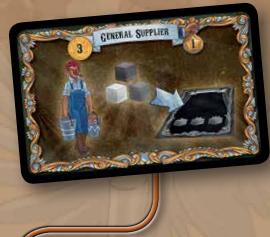
General
Supplier:
During every
distribution
phase, you may move up to 3
cubes (instead of 2) from your cube storage
area, to your
performers.

Popcorn Vendor: Earn 3 coins after each show.
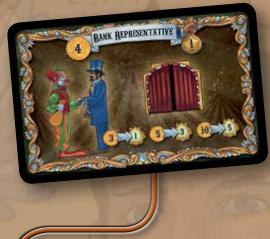
Bank
Representative: At the beginning of each
preparation turn, you may place
any number of
coins on the Bank Representative.
These coins
cannot be used
any more.
When the game ends, score the
prestige points
corresponding
to the amount
of coins you
invested during the game.
(The maximum
prestige points that can be gained is 5. There is no point
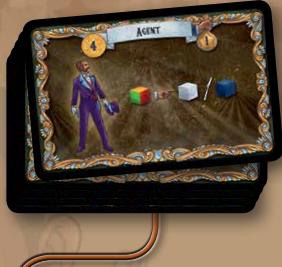
in investing more than 10 coins). Agent:
(5 different).
During each
distribution
phase, you
may perform the shown
conversion
one time.
This means
you may
convert any
cube in to one of the two
cubes offered. Limit:
Regardless
of how many Agents a
player has in their circus,
only one
can be used
during each
distribution
phase. Personal
Assistant:
(5 different).
During each
distribution
phase, you may perform the
shown
conversion
one time. This
means you may convert the
specified cube in to the two cubes offered.
Limit:
Regardless
of how many
Personal
Assistants a
player has in
their circus,
only one can
be used during each distribution phase.

Trailers
Every performer can be given a single trailer ().
Immediately the salary of the performer using a trailer is reduced by 1 coin. Trailers earned by bizarre performers can be given to any other performer. Once a trailer is owned by a performer, it cannot be owned by someone else. Trailers can even reduce a salary cost to 0, but cannot reduce it below 0. When performers are flipped for prestige, they keep their trailer and the salary reduction is also applied to the secondary salary (See Performers on page 9 for details).
DRUM ROLL
Investment
Investment cards help players acquire resources, coins, prestige points and more. Investment cards can be played at any moment unless stated otherwise. Each player has a hand limit of 2 cards which can be increased by hiring magicians. Each magician allows the player to keep one extra card in their hand. If a player reaches their hand limit and receives more cards, they must (after looking at the new card) immediately play any extra cards (including the one they just received) or discard down to their hand limit.
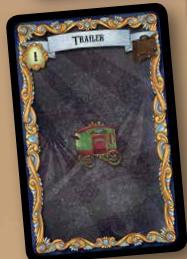
Trailer: You get a trailer. (If not used, this card is worth 1 at the end of the game)
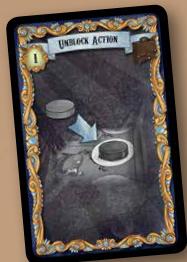
Unblock Action: You may place your action marker on any cube action even if it is blocked by another player or restricted by the game's rules.
(If not used, this card is worth1 at the end of the game)
Time this card can be used (any time if blank) Card action
Fire a Performer: You may fire a performer at any time. You do not have to pay compensation or lose prestige. You may not fire a performer during a show. (If not used, this card is worth 1 at the end of the game).

Cards


Resource Bonus: At the game end, earn for every 3 resources (cubes) left in your cube storage area.
Potential prestige scored by this card

Trailer Bonus: At the game end, earn 1 for each trailer in your circus.
Card name

Indicator of how prestige can be scored from this card (if used or not used)

(One for each performer type) Extended Applause: During the 1st, 2nd or 3rd show, use this card to earn 1 for each performer (of this type) who did an outstanding performance. You also lose for each performer (of this type) who did a poor performance.
Personnel Bonus: At the game end, earn 1 for each personnel member in your circus.


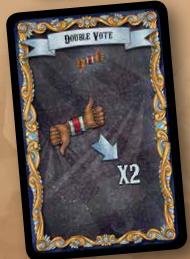
Double Vote: After seeing the result of a vote, you may use this card to make your vote count twice.
Extra Income: You get 4 coins.
(Two for each cube color) Extra Resources: Get any one cube or two cubes of the shown color.

Extra Income: Spend any cube to get 5 coins.
Two
Players
In 2-player games, the following changes must be made:
Regions: Each player takes a random region tile and a 3rd one is placed on the table between the two players.
It will be used as a virtual 3rd player's region so that each player visits 3 different regions during the game.
• Personnel: Deal 3 personnel cards instead of 2.
Performer types: When dealing performers, if two of the same type are dealt, discard the second and deal a new one until the 3 performers in the hiring area are from different performer types.
• Voting: When voting to see if a 6th turn will be played, calculate the result by adding a virtual delay vote to it. In the vote for a 7th turn, perform the voting process normally.
Credits
Designers: Konstantinos Kokkinis Dimitris Drakopoulos
Illustrator:Antonis Papantoniou
Assistant designer: Sandra Biniari
Assistant developer: Anastasios Grigoriadis
Graphic designer: Giota Vorgia
English rules: Konstantinos Kokkinis
Italian rules: Michele Quondam
German rules: Martin Mathes
French rules: Christophe Muller
*Dutch rules: Christophe Mannaert
*Greek rules: Konstantinos Kokkinis
*can be found online at www.artipiagames.com
Acknowledgements
The designers would like to thank the playtesters:
Vangelis Velles, Manos Velivasakis, Alex Kokkalas, Michalis Giannis, Anastasios Grigoriadis, Nikos Chondropoulos, Sotiris Tsantilas, Vangelis Bagiartakis, Dionisis Baltas, Nikos Sakaloglou, Kostas Arkadas, Antonis Papantoniou, Giota Vorgia, Giannis Reppas, Anna Metzelopoulou, Eleni Giannisi, Xristos Kalioras, Dimitris Vasiadis,
Tony Cimino, Konstantinos Stylianopoulos, Nikos Efthimiou, Thanos Bisbikopoulos, Konstantinos Melios, George Psistakis, Zoe Aggelidou, Konstantinos Demertzis, Theodoros Christodoulopoulos, Dimitris Mavroudis, Aggelos Vazaios, Klea Michailidou, Dionisis Tsironis, Olga Mavrofridi, Thanasis Ioannidis, Eleni Drakopoulou, Marianna Kaliora, Stavros Vlahos, Manolis Manolidakis, Kostas Chiotelis, Manos Konstantas, Thiseus Liverios
Konstantinos would like to
dedicate this game to his loving wife Sandra, for her continious support and contribution and to their daughters Irika and Nagia.
We would also like to thank the members of Greek Guild of Boardgamegeek (www.greekguild.gr) for their support.
Dimitris would like to dedicate this game to Chris and Eleni for their creative ideas during the game's development.
Note from the designers: Drum Roll is a product of fiction. Any relation to actual names or characters is purely coincidental. This game is not a historical representation. Actual historical details may vary from this game's contents. We are against any animal abuse and we do not wish to promote it in any way through this game. All life on this world should be treated with respect.
Should you have any comments or questions, please contact us at info@artipiagames.com © 2010. Konstantinos Kokkinis - Dimitris Drakopoulos. © 2013. Artipia Games. All rights reserved.
下载 Markdown原文为社区整理/出版社公开资料,版权归原作者,仅供个人学习查阅。