
Dual Powers: Revolution 1917Dual Powers Revolution 1917
一句话概览
Dual Powers: Revolution 1917 是一款已收录于村了吗规则库的桌游,支持 1–2 人,原名 Dual Powers Revolution 1917。
本页内容:一句话概览 · 游戏概述 · 1. 游戏组件 · 2. 游戏设置 · 3. 游戏流程 / 回合结构 · 4. 卡牌解析 · 5. 行动详解 · 6. 日历特别事件 · 7. 计分阶段详解 · 8. 游戏结束 · 9. 单人变体 · 关键规则与常见问题 · 常见问题
双重权力:革命 1917 规则速览
以下规则速览由本站整理,与官方规则书表述不同,仅供快速上手参考。
游戏概述
1917年3月,沙皇尼古拉斯二世被迫退位,取而代之的是一个保守的临时政府,代表国家的官方权威。反对新政府的是彼得格勒苏维埃,这是一个由社会主义活动家组织的民选工人委员会。在接下来的几个月里,一场争夺权力和影响力的内部斗争将主导这个国家,并引发一场社会革命。在这种双重权力的状态下,富有魅力和强大的领导人会随着公众不满的浪潮而崛起,永远改变俄罗斯政治的进程。
在《双重权力:革命》中,两位玩家各指挥这场斗争的一方力量——一名玩家扮演临时政府(白色),另一名玩家扮演彼得格勒苏维埃(红色)。双方通过政治行动、社会操纵和军事冲突争夺支持;在游戏结束时获得更大支持的玩家将塑造俄罗斯的未来,或者发动或镇压迫在眉睫的内战。
核心机制: 手牌管理、区域控制与强度比较、秘密目标、日历推进、标记的招募/移动/刷新/消耗
1. 游戏组件
| 组件 | 数量/说明 |
|---|---|
| 游戏版图 | 1个(分为6个区域,每区域用不同颜色和图标表示) |
| 规则书 | 1本 |
| 区域板块 | 6个(每个区域一块,与版图颜色匹配) |
| 卡牌合计 | 64张 |
| ├ 指令卡 | 48张 |
| ├ 领袖卡 | 6张(3张红色、3张白色) |
| ├ 历史信息卡 | 8张 |
| └ 玩家帮助卡 | 2张 |
| 领袖标记 | 8个(3个红色领袖、3个白色领袖、2个托洛茨基:1中立、1红色) |
| 派系标记 | 26个(10个红色、10个白色、6个中立) |
| 计分标记 | 1个 |
| 封锁标记 | 1个 |
| 日期标记 | 1个 |
| 月份标记 | 1个 |
| 人民的意愿标记 | 1个 |
| 目的标记 | 3个(编号1、2、3) |
| 对立派系标记(单人变体) | 27个(9个1级、9个2级、9个3级) |
| 难度等级标记(单人变体) | 3个 |
标记的双面说明: 每个派系标记和领袖标记都有两面——活跃面和消耗面。当前状态的强度值用较大的数字表示,其下方较小的数字表示另一面的强度值。对立派系标记在其消耗面有一个"X",这个"X"的值总是等于正在进行游戏的难度级别。
2. 游戏设置
- 决定谁将扮演临时政府(白色),谁将扮演彼得格勒苏维埃(红色)。给每个玩家一张玩家帮助卡。
- 将游戏版图放置在中央,两位玩家分别坐在版图中支持轨的两侧。
- 给每个玩家3张领袖卡、3个领袖标记和10个与其颜色匹配的派系标记。牌拿在手中,领袖标记和派系标记放在他们面前,活跃面朝上,作为他们的供应区。
- 在城市的每个区域随机放置一个中立派系标记,活跃面朝上。
- 将计分标记放在支持轨的中间,并将人民的意愿标记放在游戏版图上红色玩家那边有图标的位置。
- 将月份标记和日期标记放在游戏版图上的日历位置:月份标记放在三月/四月的位置,日期标记放在1的位置。
- 在日历附近,将中立(绿色)托洛茨基标记放在五月/六月上方,红色托洛茨基标记放在八月上方。
- 将3个目的标记放在版图支持轨旁边的3个绿色圆圈上。
- 洗混6个区域板块,并将它们面朝下放在一旁。
- 从区域板块堆顶摸取2块,面朝上放在游戏版图上"动乱"和"封锁"处各1个。
- 将封锁标记放在两个区域之间连接的箭头上,该箭头与"封锁"中的区域板块颜色相对应。
- 洗混48张指令卡,面朝下放置在游戏版图的一旁。
3. 游戏流程 / 回合结构
游戏进行多个回合,每回合由五个阶段组成,顺序如下:
- 摸牌阶段
- 目标阶段
- 行动阶段
- 计分阶段
- 清理阶段
3.1 摸牌阶段
每位玩家从牌堆中摸取5张指令卡加入自己的手牌。第一轮每位玩家手中有8张卡牌(包括设置期间获得的领袖卡);之后的回合中,玩家可能拥有超过8张卡牌,但绝不会少于8张。
注意: 极少数情况下需要摸牌时,将弃牌堆中的牌洗混形成一个新的牌组,然后继续摸牌。
3.2 目标阶段
每位玩家从自己的手中选出一张指令卡,面朝下放在游戏版图上"秘密目标"的位置,不向对手展示。每位玩家可以在回合中的任何时候查看自己的"秘密目标"。
3.3 行动阶段
从具有人民的意愿标记的玩家开始轮流进行(具有人民的意愿标记的红色玩家先开始),直到两位玩家各自进行4个回合。
每位玩家在自己的回合中按顺序完成以下步骤:
- 打出1张卡牌
- 推进日期
- 执行一个行动
- 获得额外行动(如果有资格)
打出1张牌: 当前玩家从手牌中选择任何一张牌(指令卡或领袖卡),面朝上放在自己面前。
推进日期: 将日历上的日期标记推进一定数量的空格,等于刚打出卡牌上的日期数值。如果日期标记前进并超过31,将月份标记向前移动一格,然后日期标记从1的位置继续推进。
如果月份标记推进,人民的意愿标记会立即移动到游戏版图当前激活玩家的一侧。城市中的所有中立派系标记和中立领袖标记现在都在当前激活玩家的控制之下,只要他们在该区域内有一个派系标记或领袖标记。(如果当前玩家已拥有人民的意愿标记,什么也不会发生。)
如果日期标记进入29或30格,则将其移动到31格。如果日期标记位于15格或31格,则当前激活玩家有资格在执行常规行动后获得额外行动。
执行一个行动: 当前玩家执行卡牌上描述的行动。
- 如果打出1张指令卡,玩家可以执行招募行动,或卡牌上显示的其他行动(移动、两次移动或刷新);玩家可以选择指令卡允许的其中一个行动,但不能同时选择这两个行动。
- 如果打出1张领袖卡,玩家可以按任意顺序执行招募领袖行动和卡牌上显示的特殊行动。
3.4 计分阶段
按顺序执行以下步骤:
- 解决动乱区域
- 揭示秘密目标
- 对目标区域进行计分
- 消耗标记
3.5 清理阶段
为准备下一回合,执行以下步骤:
- 从"动乱"槽中弃掉该区域板块,将"封锁"板块移动到游戏版图上"动乱"槽中。
- 从板块堆中拿取最上面的区域板块,面朝上放置在"封锁"槽中。将封锁标记移动到与该区域颜色对应的连接箭头上。
- 从得分区域移除所有目标标记,并将其放回支持轨旁的初始位置。
- 弃掉本轮使用的所有指令卡(包括"秘密目标")和领袖卡。弃掉的指令卡放入弃牌堆,而弃掉的领袖卡将从游戏中移除。
4. 卡牌解析
4.1 指令卡
每一张指令卡都有5个重要元素:
| 元素 | 说明 |
|---|---|
| 日期天数 | 打出此卡时,需要在日历上推进对应的天数 |
| 区域图标 | 表示玩家可以在当前区域招募;或当该卡被选为"秘密目标"时,比较该区域强度值后计算得分 |
| 招募值 | 表示该卡可以招募的强度值——■、■■ 或 ■■■ |
| 行动图标 | 当玩家打出这张卡并且没有选择招募行动时,可选择的三种可能行动之一:移动、两次移动或刷新 |
| 胜利点数 | 表示在回合结束时控制指定区域而获得的点数,仅在此卡被选为"秘密目标"的情况下生效 |
4.2 领袖卡
每一张领袖卡都有四个重要元素:
| 元素 | 说明 |
|---|---|
| 日期天数 | 与指令卡一样,打出此卡时需要在日历上前进对应的天数 |
| 领导力 | 对应领袖标记"活跃"面和"消耗"面的强度数值;较大的数字表示领袖标记活跃面的数值,较小的数字表示消耗面的数值 |
| 招募领袖 | 对应的领袖标记可以使用招募领袖行动,可招募领袖到城市中的任何区域 |
| 领袖特殊行动 | 在打出这张卡时可选择的三种可能行动之一:"发动抗议"、"间谍活动"或"激励人民" |
5. 行动详解
5.1 指令卡行动
- 招募: 当前玩家从自己的供应区中获取1个或多个派系标记,其值■等于或小于所打出卡牌的招募值。招募的派系标记以活跃面朝上放置在卡牌中区域图标所示的区域中。如果玩家的供应区中没有等于或小于卡牌招募值的派系标记,则无法执行招募行动。
- 移动: 当前玩家选择自己控制的任何1个派系标记或领袖标记(活跃的或消耗的),并将其沿着城市中一个无障碍连接的地方移动一个区域。
- 两次移动: 当前玩家选择自己控制的任何1个派系标记或领袖标记(活跃的或消耗的),并将其沿着城市中一个无障碍连接的地方移动一个或两个区域。玩家不能通过这个行动移动两个标记各一个区域。
- 刷新: 当前玩家将自己控制的任何1个派系标记或领袖标记从消耗面翻到活跃面。玩家不能通过此行动将标记从其活跃面翻到消耗面。
若玩家拥有人民的意愿标记,并且在区域内有一个势力派系标记或领袖标记,那么中立派系标记将在该玩家的控制之下(上述移动、两次移动、刷新行动均如此)。
5.2 领袖卡行动
- 招募领袖: 当前玩家从自己的供应区中拿取相应的领袖标记,并以活跃面朝上放置在城市中的任何区域上。
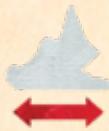
- 发动抗议: 玩家可以立即将封锁标记从当前位置移动到城市中的任何其他连接位置。
- 间谍活动: 玩家立即揭示对手的"秘密目标"卡,将其翻转到正面朝上。
- 激励人民: 玩家可以立即控制人民的意愿,将人民的意愿标记移到游戏板的另一边。城市中的所有中立派系标记和中立领袖标记现在都在该玩家的控制之下,只要他们在区域内有一个势力派系标记或领袖标记。
5.3 额外行动
如果当前激活玩家在自己的回合中率先将日期标记推进到日历中的15或31格,那么他有资格获得一个额外行动,可以从以下4个行动中选择一个:
- 额外招募: 当前玩家招募任何一个值为■的派系标记,放置在城市的任何区域。如果玩家的供应区中没有值为■的派系标记,则无法执行此操作。
- 额外移动: 当前玩家选择自己控制的任何1个派系标记或领袖标记(活跃的或消耗的),并将其沿着城市中一个无障碍连接的地方移动一个区域。
- 额外刷新: 当前玩家将自己控制的任何1个派系标记或领袖标记从消耗面翻转到活跃面。
- 额外摸牌: 当前玩家从牌堆中摸取一张指令卡并将其加入手牌。手牌没有上限。
6. 日历特别事件
日历上有两个特别的事件:
- 托洛茨基流亡归来: 在月份标记移动到五月/六月的格子时发生。立即将中立托洛茨基标记放置在区域板块所指示的"动乱!"区域中。和中立派系标记一样,托洛茨基由持有人民的意愿的玩家控制,只要他们在该区域有一个派系标记或领袖标记。
- 托洛茨基加入布尔什维克: 在月份标记移到八月的格子时发生。如果中立托洛茨基标记还在游戏版图上,立即用红色托洛茨基标记代替,保持其活跃或消耗状态;红色玩家现在控制托洛茨基。如果此事件发生时中立(绿色)托洛茨基标记已经从游戏版图中移除,红色托洛茨基标记不会进入游戏,将其从游戏中移除。
7. 计分阶段详解
7.1 确定强度
为了确定哪个玩家在一个区域内拥有更大的强度,将该区域内每个玩家控制的所有派系标记和领袖标记(活跃和消耗)的强度值相加并进行比较。
拥有人民的意愿标记的玩家控制着该区域的中立派系;只要该玩家在该区域至少有一个派系标记或派系领袖标记,该区域的中立派系和领袖就会贡献他们的力量值。总力量值越高的玩家强度越大。
如果玩家在一个区域内拥有相同的力量值总和,那么在该区域中控制更多标记的玩家被认为拥有更大的强度。如果玩家在该区域也有相同数量的标记,那么具有人民的意愿的玩家被认为具有更大的强度。如果一个区域根本没有标记,则两个玩家都没有强度。
7.2 解决动乱区域
在游戏版图中当前"动乱!"槽中的板块,表明了当前动乱的区域。将编号"1"的目标标记置于动乱区域。比较该区域中哪位玩家拥有更大的强度。在该区域拥有更大强度的玩家可以选择将该区域指定为"附加目标"或采取"额外行动":
- 如果实力更强的玩家选择将动乱区域指定为"附加目标",则根据当月获得额外玩家胜利点数:三月至六月2个胜利点数、七月3个、八月4个、九月5个、十月至十一月7个。
- 如果实力更强的玩家选择了1个"额外行动",他们会立即采取行动,从4个额外行动中选择一个。
7.3 胜利点数
当一位玩家从一个目标中获得分数时,将支持轨上的计分标记移向他的一侧,每个得分移动一格。
7.4 揭示秘密目标
胜利点数较少的玩家首先揭示他的"秘密目标",并将编号"2"的目标标记放在与所揭示牌中显示的区域图标相匹配的区域中。另一位玩家随后揭示他的"秘密目标",并将编号"3"的目标标记放在与所揭示牌中显示的区域图标相匹配的区域中。
如果是平局(计分标记在支持轨中间的绿色格子中)的情况下,没有人民的意愿标记的玩家首先揭示他的"秘密目标"。
7.5 对目标区域进行计分
评估编号"2"的目标标记所在区域,看哪个玩家的强度更大,然后得分。然后评估编号"3"的目标标记所在区域。如果一个区域中有两个目标标记,则分别对每个目标进行计分。
7.6 消耗标记
在每一个有1个或多个目标标记的区域中,将该区域内的所有派系标记和领袖标记从其活跃面翻到消耗面。
如果标记已经是消耗面向上,则从游戏版图中移除。红色和白色派系标记返回各自的供应区,而领袖标记和中立标记则从游戏中移除。
8. 游戏结束
当满足以下任意条件时,游戏立即结束:
- 计分标记到达支持轨的一端。当这种情况发生时,距离得分标记近的玩家获胜。
- 在计分阶段结束时,月份标记位于十月/十一月。当这种情况发生时,距离得分标记近的玩家获胜;如果分数标记正好在支持轨的中间,那么当前拥有人民的意愿标记的玩家获胜。
9. 单人变体
在单人游戏中,玩家面对的不是另一个对手,而是一个自动的"对立派系"。
9.1 设置变更
设置与二人游戏相同,但有以下更改:
- 在决定你想玩哪个阵营后,将另一个阵营的派系标记返回游戏盒。
- 选择一个难度等级(1-6),找到匹配的难度等级标记,面朝上放在你附近。(建议第一次游戏的难度等级为1,多次游戏后尝试更高的难度。)
- 将27个对立派系标记放在游戏版图的一旁。
- 洗混3张未选择的阵营领袖卡,面朝下与相应的领袖标记一起放置在区域板块堆附近。
9.2 摸牌阶段变更
从牌堆中摸出5张指令卡给自己(玩家)和5张指令卡给对手,方法如下:
- 摸4张牌到你的手中。
- 第5张牌面朝下作为你的"秘密目标",不要查看。
- 摸5张牌,将它们面朝下地放在对方那边,不要查看。
注意:对手的"秘密目标"位置将一直保持为空,直到计分阶段。
9.3 目标阶段变更
展示对立派系最上面的领袖卡,并将匹配的领袖标记放置在"动乱"地区。这不算行动;领袖的特殊行动不会触发,也不会推进日期。
把人民的意愿标记放在对立派系那边。这样,对立派系可以在每一回合行动前获得人民的意愿标记。你的"秘密目标"是在摸牌阶段确定的,但你不知道它是哪张。
9.4 行动阶段变更
对手每回合要进行5次行动,而玩家只有4次行动。因此,对手总是第一个行动,而最后一个结束行动。
对立派系回合:
- 轮到对方时,展示对方最上面的指令卡,并根据卡牌上的数值推进日期(如同在二人游戏中那样)。
- 然后在卡牌标示的区域放置一个强度与指令卡显示的招募值——■、■■ 或 ■■■——相匹配的对立派系标记。
对立派系从不移动或刷新任何标记,它只是在游戏版图上添加新的标记。
如果对手将日历上的日期标记推进到15或31的格中,对立派系将采取奖励行动中的招募行动,在"动乱"地区添加1个■的对立派系标记(如果可以)。如果对手把日历上的日期标记推进并超过31格,它就获得了人民的意愿标记(如果它还没有控制权)。
当对手打牌时,将他们面朝上从左到右排列。在计分阶段,卡牌的顺序很重要。
玩家回合变更:
- 有一个新的额外行动可选——"组织":当你采取额外行动时,你可以选择揭示自己的"秘密目标"(而不仅仅是4个常规的额外行动)。
- 在执行间谍行动时,不要揭示对手的"秘密目标",而是要揭示自己的"秘密目标"。
9.5 计分阶段变更
- 解决动乱区域: 像在二人游戏中一样解决动乱区域。如果对立派系在该地区拥有更大的强度,它总是选择将其作为"附加目标"来得分,而不是采取额外行动。
- 揭示秘密目标: 揭示你的"秘密目标"(如果还未揭示)。要确定对手的"秘密目标"区域,需查看对手本回合打出的5张指令卡:把5张牌中相同区域的日数加总,数值最高的区域就是对立派系的"秘密目标"区域;选择对方该区域胜利点数最高的牌作为对方的"秘密目标"。如果两个区域之间存平局,则其中卡牌数最多的区域将成为对手的"秘密目标"区域;如果仍有平局,则卡牌顺位靠后的区域中胜利点数较高的卡牌成为对手的"秘密目标"。
- 对目标区域计分: 同二人游戏。
- 消耗标记: 同二人游戏中的消耗标记步骤。对手的派系标记消耗后,显示的强度为"X"。"X"的数值等于设置游戏时所选择的难度等级(1-6)。
9.6 清理阶段与游戏结束
清理阶段与二人游戏相同。
当满足以下任一条件时,游戏立即结束:
- 计分标记到达支持轨的一端。当这种情况发生时,距离得分标记近的一方获胜。
- 游戏在第三回合计分阶段后结束。当这种情况发生时,得分标记在支持轨一侧的一方获胜;如果计分标记正好在支持轨的中心,那么当前拥有人民的意愿标记的一方获胜。
关键规则与常见问题
易错规则
- 行动阶段两位玩家各进行4个回合,由持有人民的意愿标记的玩家(红色玩家)先开始。
- 日期标记被推进到29或30格时立即移到31格;只有停在15格或31格才使当前玩家获得额外行动资格。
- 额外行动资格由"率先"把日期标记推进到15或31格的玩家获得。
- 月份标记推进时,人民的意愿标记立即转向当前激活玩家一侧;中立标记只有在该玩家于该区域有派系标记或领袖标记时才归其控制。
- 打出指令卡时,"招募"与卡面其他行动二者只能选一;打出领袖卡时,招募领袖和特殊行动可以都执行(按任意顺序)。
- 刷新行动只能把消耗面翻到活跃面,不能反向。
- "两次移动"是用一个标记移动一或两个区域,不能用两个标记各移动一个区域。
- "激励人民"是立即控制人民的意愿并移动标记,与月份推进造成的转移是两回事。
- 计分时两方力量值相同时,先比较区域内控制的标记数量,再比较谁持有人民的意愿;区域内没有标记则两方都没有强度。
- 已经处于消耗面的标记在消耗标记步骤中从版图移除:红/白派系标记回到供应区,领袖标记和中立标记从游戏中移除。
- 清理阶段弃掉的领袖卡从游戏中移除,不进入弃牌堆;弃掉的指令卡进入弃牌堆。
- 单人变体中,对手永远不移动或刷新标记,只添加新标记;对手每回合5次行动,玩家4次。
常见问题
-
Q:谁的"秘密目标"先揭示?
A:胜利点数较少的玩家先揭示;若计分标记在支持轨中间的绿色格子(平局),则由没有人民的意愿标记的玩家先揭示。 -
Q:动乱区域由谁决定结果?
A:由该区域强度更大的玩家选择:把它当作"附加目标"按当月分值得分,或立即采取一个额外行动。 -
Q:一个区域里有两个目标标记怎么办?
A:分别对每个目标进行计分。 -
Q:托洛茨基标记如何进入游戏?
A:月份标记移到五月/六月时放置中立托洛茨基标记于"动乱"区域;移到八月时,若中立托洛茨基仍在版图上,用红色托洛茨基替换(保持其活跃或消耗状态),否则红色托洛茨基不进入游戏,从游戏中移除。 -
Q:封锁标记的位置会变化吗?
A:会。领袖特殊行动"发动抗议"可立即把封锁标记移动到城市中任何其他连接位置;清理阶段它会被重新放到与新"封锁"区域颜色对应的连接箭头上。 -
Q:跳过一个区域连接会被封锁标记阻止吗?
A:会被阻止。移动与两次移动只能沿着城市中一个无障碍连接的地方进行。 -
Q:额外行动有哪些?
A:额外招募(任意区域放1个■派系标记)、额外移动(1个标记移动1个区域)、额外刷新(1个标记由消耗面翻到活跃面)、额外摸牌(摸1张指令卡,手牌无上限)。 -
Q:游戏何时结束?
A:计分标记到达支持轨一端时立即结束;或在计分阶段结束时月份标记位于十月/十一月时结束。由距离得分标记近的玩家获胜,得分标记正好在中间时由当前拥有人民的意愿标记的玩家获胜。
常见问题(FAQ)
以下 1 条问答中 0 条来自站内玩家的真实提问,其余 1 条为本站整理的常见疑问;答复内容保持原样。
Dual Powers: Revolution 1917支持几个人玩?
1–2 人。
去哪查完整规则
想核对具体规则细节、卡牌效果或某个回合的结算方式,可以在村了吗里选中这款游戏后直接提问。
同类桌游
- 卡坦岛德式
- 工业革命:伯明翰德式
- 勃艮第城堡:特别典藏版德式
- 方舟动物园德式
- 卡卡颂抽象
- 瘟疫危机传承:第一季美式
- 阿瑞迪亚:勇踏征途美式
- 重塑宇宙德式
- 幽港迷城美式
- 埃多拉的德鲁伊德式
规则原文(Markdown)
本站收录这款游戏的规则原文 2 个文件,此处内联渲染 2 个,可直接展开阅读或下载。
rules_zh_Dual_Powers_Revolution_1917_5577.md25.7 KB

DUAL 翻译制作: 光羽 POUERS
REVOLUTION 1917
RULEBOOK
DUAL POWERS REVOLUTION 1917
概述
1917年3月,沙皇尼古拉斯二世被迫退位。取而代之的是一个保守的临时政府,代表国家的官方权威。反对新政府的是彼得格勒苏维埃,这是一个由社会主义活动家组织的民选工人委员会。
在接下来的几个月里,一场争夺权力和影响力的内部斗争将主导这个国家,并引发一场社会革命。在这种双重权力的状态下,富有魅力和强大的领导人会随着公众不满的浪潮而崛起,永远改变俄罗斯政治的进程。
目的
在《双重权力:革命》中,每个参与者通过政治行动、社会操纵和军事冲突来指挥这场斗争的一方力量。在游戏结束时获得更大支持的玩家将塑造俄罗斯的未来,或者发动或镇压迫在眉睫的内战。
配件
1个游戏版图
1本规则书
6个区域板块
64 张卡牌
- 48 张指令卡
- 6 张领袖卡 (3 张红色,3 张白色)
- 8 张历史信息卡
- 2 张玩家帮助卡
8个领袖标记
-3个红色领袖
-3个白色领袖
-2个托洛茨基(1中立,1红色)
26个派系标记
-10个红色派系
-10个白色派系
-6个中立派系
1个计分标记
1封锁标记
1日期标记
1月份标记
1人民的意愿标记
3目的标记
游戏版图 / 区域板块
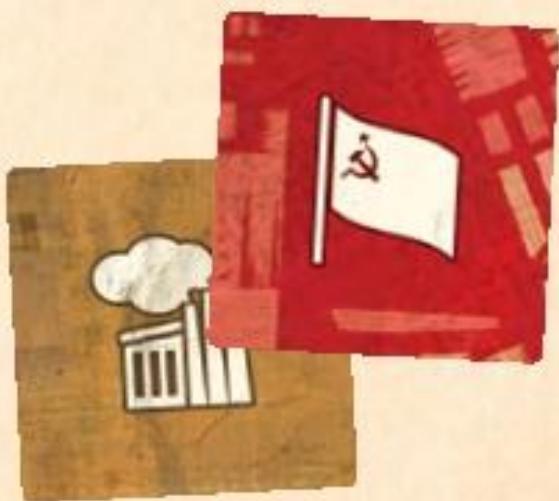
游戏版图分为6个区域,每个区域用不同的颜色和图标表示。还有6个匹配的区域板块:每个区域一块。每回合都会展示当前正在经历“动乱”和被“封锁”的区域。
27对立派系标记(单人变体)
- 9个1级派系
- 9个2级派系
- 9个3级派系
3个难度等级标记(单人变体)
指令卡
每一张指令卡都有5个重要元素:日期天数、区域图标、招募值、行动图标和胜利点数。
-
日期天数: 表示在打出此卡时, 需要在日历上推进对应的天数。
-
区域图标: 表示玩家可以在当前区域招募, 或者当该卡被选为 “秘密目标” 时, 比较该区域强度值后计算得分。
-
招募值: 表示该卡可以招募的强度值—■, ■■ or ■■■。
-
行动图标: 表示当玩家玩打出这张卡, 并且没有选择招募行动时, 玩家可选择的三种可能行动中的一种: 移动、两次移动或刷新。

"What is this dual power? Alongside the Provisional Government, the government at the househouse, another government has a work, to be weak andicient, but undoubtedly a government that actually exists and is growing—the Soviets of Markets' and Soldiers' Departures."
- V.J. Levin, The Dual Power

- 胜利点数: 表示在回合结束时控制指定区域而获得的点数。这只在此卡被选为“秘密目标”的情况下。
领袖卡
每一张领袖卡都有四个重要元素:日期天数、领导力、招募图标和特殊行动图标。

-
日期天数: 与指令卡一样, 打出此卡时需要在日历上前进对应的天数。
-
领导力: 对应的领袖标记 “活跃” 面和 “消耗” 面的强度数值。较大的数字表示领袖标记活跃面的数值,较小的数字表示领袖标记消耗面的数值。
-
招募领袖: 对应的领袖标记可以使用招募领袖行动, 可招募领袖到城市中的任何区域。
4.领袖特殊行动: 在打出这张卡时可选择的三种可能行动中的一种: “发动抗议”、“间谍活动”或“激励人民”。
派系 / 领袖标记
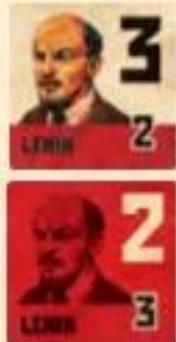
每一个派系标记和领袖标记都有两面:活跃面和消耗面。当前状态的强度值用较大的数字表示。强度值下方较小数字表示另一面的强度值。
对立派系标记
对立派系标记在单人游戏中使用(见第10-12页),用于自动控制对立派系。每一个对立派系标记在其耗尽面有一个“X”。这个“X”的值总是等于正在进行游戏的难度级别。



-
决定谁将扮演临时政府(白色),谁将扮演彼得格勒苏维埃(红色)。给每个玩家一张玩家帮助卡。
-
将游戏版图放置在中央,两位玩家分别坐在版图中支持轨的两侧。
-
给每个玩家3张领袖卡,3个领袖标记,和10个与其颜色匹配的派系标记。牌拿在手中,而领袖标记和派系标记放在他们面前,活跃面朝上,作为他们的供应区。
-
在城市的每个区域随机放置一个中立派系标记,活跃面朝上。
-
将计分标记放在支持轨的中间,并将人民的意愿标记放在游戏版图上红色玩家那边有图标的位置。
-
将月份标记和日期标记放在游戏版图上的日历位置,月份标记放在三月/四月的位置,日期标记放在1的位置。
-
在日历附近,将中立(绿色)托洛茨基标记放在五月/六月上方,红色托洛茨基标记放在八月上方。
-
将3个目的标记放在版图支持轨旁边的3个绿色圆圈上。
-
洗混6个区域板块,并将它们面朝下放在一旁。
-
从区域板块顶,摸取2块。面朝上放在游戏版图上“动乱”和“封锁”处各1个。

-
将封锁标记放在两个区域之间连接的箭头上,该箭头与“封锁”中的区域板块颜色相对应。
-
洗混48张指令卡,面朝下放置在游戏版图的一旁。
游戏顺序
游戏进行多个回合,每回合由五个阶段组成,顺序如下:
-
摸牌阶段
-
目标阶段
-
行动阶段
-
计分阶段
-
清理阶段
1. 摸牌阶段
在这个阶段,每个玩家从牌堆中摸取5张指令卡并将其添加到自己的手牌。这意味着,在第一轮,每个玩家将有八张卡牌在手(包括在设置期间的领袖卡)。在之后的回合中,玩家有可能拥有超过8张卡牌,但绝不会少于8张。
注意:在极少数情况下,当需要摸牌时,将弃牌堆中的牌洗混,形成一个新的牌组,然后继续摸牌。
2. 目标阶段
每位玩家从自己的手中选出一张指令卡,面朝下放在游戏版图上“秘密目标”的位置,而不向对手展示。每位玩家可以在回合中的任何时候查看自己的“秘密目标”。
3. 行动阶段
从具有人民的意愿标记的玩家开始,轮流进行,每次一个,直到两位玩家各自进行4个回合。(具有人民的意愿标记的红色玩家先开始。)
每个玩家在回合中按顺序完成以下步骤:
-
打出1张卡牌
-
推进日期
-
执行一个行动
-
获得额外行动(如果有资格)
打出1张牌·当前玩家从他们的手牌中选择任何一张牌(指令牌或领袖牌),面朝上在他们面前。
推进日期·当前玩家将日历上的日期标记推进一定数量的空格,等于刚打出卡牌上的日期数值。如果这导致日期标记前进并超过31,请将月份标记向前移动一格,然后继续将日期标记从1的位置推进。
如果月份标记推进,人民的意愿标记会立即移动到游戏版图当前激活玩家的一侧。城市中的所有中立派系标记和中立领袖标记现在都在当前激活玩家的控制之下,只要他们在该区域内有一个派系标记或领袖标记。(如果当前玩家已拥有人民的意愿标记,什么也不会发生。)
如果日期标记进入到29或30格中,则将其移动到31格。然后,如果日期标记位于15格或31格,则当前激活玩家有资格在执行常规行动后获得额外行动。

例子A:卡提亚刚打出了一张紫色日期数值为4的指令卡。因此,她将日历上的日期标记推进4个空格,在30格处结束。然后她自动将日期标记推进到31格。这使她有资格获得额外行动,她将在本回合中后续执行额外行动。
日历特别事件
日历上有两个特别的事件:
托洛茨基流亡归来 在月份标记移动到五月/六月的格子时发生。立即将中立托洛茨基标记放置在区域板块所指示的“动乱!”区域中。和中立派系标记一样,托洛茨基是由持有人民的意愿的玩家控制的,只要他们在该区域有一个派系标记或领袖标记。

托洛茨基加入布尔什维克 在月份标记移到八月的格子时发生。如果中立托洛茨基标记还在游戏版图上,立即用红色托洛茨基标记代替,保持其活跃或消耗状态;红色玩家现在控制托洛茨基。如果此事件发生时中立(绿色)托洛茨基标记已经从游戏版图中移除,红色托洛茨基标记不会进入游戏;将其从游戏中移除。

执行一个行动·当前玩家执行卡牌上描述的行动,如果打出1张指令卡,玩家可以执行招募行动或卡牌上显示的其他行动:移动、两次移动或刷新。玩家可以选择指令卡允许的任何一个行动,但不能同时选择这两个行动。如果打出1张领袖卡,玩家可以按照任意顺序执行招募领队行动和卡牌上显示的特殊行动。

指令卡行动
招募: 当前玩家从他们的供应区中获取1个或多个派系标记, 其值 ■ 等于或小于所打出卡牌的招募值。招募的派系标记, 将活跃面朝上放置在卡牌中区域图标所示的区域中。如果玩家的供应区中没有等于或小于卡牌招募值的派系标记, 则无法执行招募行动。
例子B:维克多采取招募行动。他打出的卡牌(绿色4)的招募值为■。他决定从供应区中招募两个■派系标记,他必须把他们放在绿色区域。

移动: 当前玩家选择他们控制的任何1个派系标记或领袖标记(活跃的或消耗的),并将标记沿着城市中一个无障碍连接的地方移动一个区域。如果他有人民的意愿标记,并且在区域内有一个势力派系标记或领袖标记,那么中立派系标记将在玩家的控制之下。
例子C: 卡提亚采取行动。她想把她的克伦斯基领袖标记从绿色区域移到红色区域,但她不能,因为这两个区域之间的连接被封锁标记所阻碍。所以她选择将她的一个派系标记从蓝色区域移动到白色区域。

两次移动:当前玩家选择他控制的任何1个派系标记或领袖标记(活跃的或消耗的),并将标记沿着城市中一个无障碍连接的地方移动一个或两个区域。如果他有人民的意愿标记,并且在区域内有一个势力派系标记或领袖标记,那么中立派系标记将在玩家的控制之下。(玩家不能通过这个行动移动两个标记各一个区域。)

刷新: 当前玩家将他控制的任何1个派系标记或领袖标记从消耗面翻到活跃面。如果他有人民的意愿标记,并且在区域内有一个势力派系标记或领袖标记,那么中立派系标记将在玩家的控制之下。(玩家不能通过此行动将标记从其活跃面翻到消耗面。)

领袖卡行动
招募领袖: 当前玩家从他的供应区中拿取相应的领袖标记,并以活跃面朝上放置在城市中的任何区域上。

领袖特殊行动
发动抗议: 玩家可以立即将封锁标记从当前位置移动到城市中的任何其他连接位置。
间谍活动: 玩家立即揭示对手的"秘密目标"卡,将其翻转到正面朝上。

激励人民: 玩家可以立即控制人们的意愿,将人们的意愿标记移到游戏板的另一边。城市中的所有中立派系标记和中立领袖标记现在都在该玩家的控制之下,只要他们在区域内有一个势力派系标记或领袖标记。
额外行动·如果当前激活玩家在他的回合中率先将日期标记推进到日历中的15或31格,那么他有资格获得一个额外行动,可以从以下4个行动中选择一个:
/ /
- 额外招募: 当前家招募任何一个值为■派系标记, 放置在城市的任何区域。如果玩家的供应区中没有值为■派系标记, 则无法执行此操作。
- 额外移动: 当前玩家选择他们控制的任何1个派系标记或领袖标记(活跃的或消耗的),并将标记沿着城市中一个无障碍连接的地方移动一个区域。如果他有人民的意愿标记,并且在区域内有一个势力派系标记或领袖标记,那么中立派系标记将在玩家的控制之下。
- 额外刷新:当前玩家将他控制的任何1个派系标记或领袖标记从消耗面翻转到活跃面。如果他有人民的意愿标记,并且在区域内有一个势力派系标记或领袖标记,那么中立派系标记将在玩家的控制之下。
- 额外摸牌: 当前玩家从牌堆中摸取一张指令卡并将其添加到手牌。手牌没有上限。
例子D: 维克托有资格获得额外行动,因为他的回合他将日期标记推进到了15格。作为他的常规行动,他在紫色区域招募1个值为■■派系标记(这是他本回合的秘密目标). 之后,维克多采取他的额外行动,将他目前控制的中立派系标记从棕色区域移动到紫色区域。
4. 计分阶段
在此阶段,将按顺序执行以下步骤:
-
解决动乱区域
-
揭示秘密目标
-
对目标区域进行计分
-
消耗标记
确定强度
为了确定哪个玩家在一个区域内拥有更大的强度,将该区域内每个玩家控制的所有派系标记和领袖标记(活跃和消耗)的强度值相加并进行比较。
拥有人民的意愿标记的玩家控制着该区域的中立派系。只要玩家在该区域至少有一个派系标记或派系领袖标记,该区域的中立派系和领袖就会贡献他们的力量值。
总力量值越高的玩家强度越大。
如果玩家在一个区域内拥有相同的力量值总和,那么在该区域中控制更多标记的玩家被认为拥有更大的强度。如果玩家在该区域也有相同数量的标记,那么具有人民的意愿的玩家被认为具有更大的强度。如果一个区域根本没有标记,则两个玩家都没有强度。
例子E: 两个玩家在黄色区域都有控制的派系标记。维克多有三个单位 $(3+1+0)$ ,卡提亚有两个 $(2+2)$ 。两者的力量总和相同。维克托被认为拥有更大的强度,因为他控制着比卡提亚更多的标记。
解决动乱区域·在游戏版图中当前“动乱!”槽中的板块,表明了当前动乱的区域。将编号“1”的目标标记置于动乱区域。比较该区域中玩家谁拥有更大的强度。在该区域拥有更大强度的玩家可以选择将该区域指定为“附加目标”或采取“额外行动”。

- 如果实力更强的玩家选择将动乱区域指定为“附加目标”,则根据当月获得额外玩家胜利点数。
- 三月-六月:2个胜利点数
- 七月3个胜利点数
- 八月:4个胜利点数
- 九月:5个胜利点数

- 十月-十一月:7个胜利点数
- 如果实力更强的玩家选择了1个“额外行动”,他们会立即采取行动,从第7-8页详述的4个额外行动中选择一个。
胜利点数
当一位玩家从一个目标中获得分数时,将支持轨上的记分标记移向他的一侧,每个得分一移一格。
例子F: 布朗地区目前是动乱地区。卡提亚 (1+1+1) 在该地区的实力比维克托 (2+0) 更强。卡提亚选择将布朗区作为一个“附加目标”,并获得3个胜利分,因为现在是7月。她将分数标记向她一侧移动3格。
揭示秘密目标·胜利点数较少的玩家首先揭示他的“秘密目标”,并将编号“2”的目标标记放在与所揭示牌中显示的区域图标相匹配的区域中。另一个玩家随后会揭示他的“秘密目标”,并将编号“3”的目标标记放在与所揭示牌中显示的区域图标相匹配的区域中。
如果是平局(计分标记在支持轨中间的绿色格子中)的情况下,没有人民的意愿标记的玩家首先揭示他的“秘密目标”。
对目标区域进行评分·评估编号“2”的目标标记所在区域,看哪个玩家的强度更大,然后得分。然后评估编号“3”的目标标记所在区域。如果一个区域中有两个目标标记,则分别对每个目标进行评分。
消耗标记·在每一个有1个或多个目标标记的区域中,将该区域内的所有派系标记和领袖标记从其活跃面翻消耗面。
如果标记已经是消耗面向上,则从游戏版图中移除。红色和白色派系标记返回各自的供应区,而领袖标记和中立标记则从游戏中移除。
例子G:对白色区域进行评分。卡提亚在该区域有2个标记(2+1),维克多有1个(3)。卡提亚其中1个标记被翻转到消耗面。维克多的标记和卡提亚剩下标记已经为消耗状态(消耗面),所以从游戏版图上移除。维克多移除的标记是一个派系标记,所以它返回到维克多的供应区中。然而,卡提亚被移除的标记是一个领袖标记,因此它被从游戏中移除。
5. 清理阶段
在这一阶段,为了准备下一回合游戏,进行以下步骤。
- 从“动乱”槽中弃掉该区域板块,将“封锁”板块移动到游戏版图上“动乱”槽中。
- 从板块堆中拿取最上面的区域板块,并将其面朝上放置在“封锁”槽中。将封锁标记移动到与该区域颜色对应的连接箭头上。
- 从得分区域移除所有目标标记,并将其返回到支撑轨旁的初始位置。
- 弃掉所有在本轮使用的指令卡(包括“秘密目标”)和领袖卡。弃掉的指令卡会放入弃牌堆中,而弃掉的领袖卡,将从游戏中移除。
游戏结束
当满足以下任意条件时,游戏立即结束:
-
分数到达支持轨的一端。当这种情况发生时,距离得分标记近的玩家获胜。
-
在计分阶段结束时, 月份标记位于十月/十一月, 当这种情况发生时, 距离得分标记近的玩家获胜。如果分数标记正好在支持轨的中间, 那么当前拥有人民的意愿标记的玩家获胜。
单人变体
在单人游戏中,玩家面对的不是另一个对手,而是一个自动的“对立派系”。
设置
设置与二人游戏相同,但有以下更改:

-
在决定你想玩哪个阵营后,将另一个阵营的派系标记返回游戏盒。
-
选择一个难度等级(1-6)。找到匹配的难度等级标记,并将其面朝上放在你附近。(注意:建议你第一次游戏的难度等级为1,多次游戏后尝试更高的难度。)
-
将27个对立派系标记放在游戏版图的一旁。
-
洗混3张未选择的派系领袖卡,面朝下与相应的领袖标记一起放置在区域板块堆附近。
游戏流程
与二人游戏相同,但有以下更改:
1. 摸牌阶段
在摸牌阶段,从牌堆中摸出5张指令卡给自己(玩家)和5张指令卡给对手,方法如下:
- 摸4张牌到你的手中
- 第5张牌,把它面朝下作为你的“秘密目标”,不要查看。
- 摸5张牌,将它们面朝下地放在对方那边,不要查看。
注意:对手的“秘密目标”位置将一直保持为空,直到计分阶段。
2. 目标阶段
展示对立派系最上面的领袖卡,并将匹配的领袖标记放置在“动乱”地区。这不算行动。领袖的特殊行动不会触发,也不会推进日期。
把人民的意愿标记发放在对立派系那边。这样,对立派系可以在每一回合行动前获得人民的意愿标记。
注意:你的"秘密目标"是在摸牌阶段确定的,但你不知道。
3. 行动阶段
对手每回合要进行5次行动,而你(玩家)只有4次行动。因此,这意味着每回合对手总是第一个行动,而最后一个结束行动。
对立派系回合
-
轮到对方时,展示对方最上面的指令卡,并根据卡片上的数值推进日期(如同在二人游戏中那样)。
-
然后在卡牌标示的区域放置一个强度与指令卡显示—■, ■■ 或 ■■■—的招募值相匹配的对立派系标记。
对立派系从不移动或刷新任何标记;它只是在游戏版图上添加新的标记。
如果对手将日历上的日期标记推进到15或31的格中,对立派系将采取奖励行动中的招募行动,在“动乱”地区添加1个■的对立派系标记(如果可以)。
如果对手把日历上的日期标记推进并超过31格,它就获得了人民的意愿标记(如果它还没有控制权)。
当对手打牌时,将他们面朝上排列,从左到右排列。在计分阶段,卡牌的顺序很重要。
玩家回合
你可以像二人游戏那样进行,但以下情况除外:
有一个新的额外行动可选:组织,当你采取额外行动时你可以选择揭示自己的“秘密目标”(而不仅仅是4个常规的额外行动)。
在执行间谍行动时,不要揭示对手的“秘密目标”,而是要揭示自己的“秘密目标”。
4. 计分阶段
解决动乱区域:解决动乱区域,就像在二人游戏中一样。如果对立派系在该地区拥有更大的强度,它总是选择将其作为“附加目标”来得分,而不是采取额外行动。
揭示秘密目标:揭示你的“秘密目标”(如果还未揭示)。要确定对手的“秘密目标”区域,需查看对手本回合打出的5张指令卡。把5张牌中相同区域的日数加总,数值最高的区域就是对立派系的“秘密目标”区域。选择对方该区域胜利点数最高的牌作为对方的“秘密目标”。

SECRET OBJECTIVE
如果两个区域之间存平局,则其中卡牌数最多的区域将成为对手的“秘密目标”区域。如果仍有平局,则卡牌顺位靠后的区域中胜利点数较高的卡牌成为对手的“秘密目标”区域。
示例:在第一回合游戏中,对手按顺序打出以下五张命令牌:红2、红4、紫4、棕5、紫2。反对派在红色区域的总分是6分,紫色区域也是6分,棕色区域是5分。红色和紫色的总数并列最高。两个区域都有2张牌。紫色4成为对手的秘密目标牌,因为两个区域数值相同,紫色区域顺位靠后,紫色4是紫色卡牌中胜利点数最高的牌。
对目标区域计分:同二人游戏。
消耗标记:同二人游戏中消耗标记步骤。对手的派系标记消耗后,显示的强度为“X”。“X”的数值等于设置游戏时所选择的难度等级(1-6)。
5. 清理阶段
清理阶段与二人游戏相同。
游戏结束
当满足以下任一条件时,游戏立即结束:
-
分数到达支持轨的一端。当这种情况发生时,距离得分标记近的一方获胜。
-
游戏在第三回合计分阶段后结束。当这种情况发生时,得分标记在支持轨一侧的一方获胜。如果计分标记正好在支持轨的中心,那么当前拥有人民的意愿标记的一方获胜。
ACKNOWLEDGMENTS
Designer: Bre My ers
Solitaire Rules: James Kyle & Bre Myers
Developer: Keith Matejka
Graphic Designer: Luis Francisco
Illustrator: Kwanchai Moriya
Editors: Dusn Sch wartz, Steven Dast, and Peter Dast
Special Thanks: Many thanks to all my playtesters, especially Mark Goadrich, James More, James Kyle, Jeph Stahl, Beau Becke, Gr eg Daigle, Chris Young, Nick Bentley, the Roundhouse Gamers, Eric Schlautman, Sco Bog en, and my fellow designers at Protospiel.
This game is dedicated to the memory of Jayson "Patch" Abbott.
© 2018 Thunderworks Games. All Rights Reserved.
For additional information or support,
please visit us at www.thunderworksgames.com.

Dual_Power_Rulebook.md29.4 KB
DUAL POWERS
REVOLUTION 1917
RULEBOOK
DUAL POWERS REVOLUTION 1917
OVERVIEW
In March of 1917, Tsar Nicholas Il was forced to abdicate the throne of Russia. In his place, a conservative Provisional Government formed, representing the official authority of the state. Opposed to the newly formed government stood the Petrograd Soviet, an elected council of workers organized by socialist activists.
Over the following months, an internal struggle for power and influence would dominate the country and spark a social revolution. In this state of dual power, or dvoevlastie, charismatic and powerful leaders would rise with the tide of public dissatisfaction and change the course of Russian politics forever.
OBJECTIVE
In Dual Powers: Revolution 1917, each player directs the forces on one side of this struggle through political action, social maneuvering, and military conflict. The player with greater support at the end of the game will shape Russia's future and either launch or suppress the impending Civil War.
COMPONENTS
1 Game Board
1 Rulebook
26 Unit Tokens
6 Region Tiles
- 10 Red Units
- 10 White Units
27 Opposing Unit Tokens
- 6 Neutral Units
(For Solitaire Variant)
- 9 Level 1 Units
64 Cards
- 9 Level 2 Units
- 48 Command Cards
- 6 Leader Cards (3 Red, 3 White)
1 Score Marker
- 8 Historical Information Cards
- 9 Level 3 Units
- 2 Player Aid Cards
8 Leader Tokens
1 Blockade Marker
- 3 Red Leaders
1 Day Marker
1 Month Marker
1 Will of the People Marker
3 Objective Markers
3 Difficulty Level Tokens (For Solitaire Variant)
- 3 White Leaders
- 2 Trotsky (1 Neutral, 1 Red)
Game BoaRd / ReGion TIles
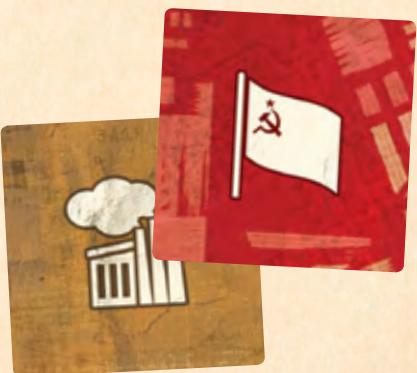
The game board is divided into six regions, each represented by a different color and icon. There are also six matching region tiles: one for each region. From round to round, these region tiles dictate which region is experiencing unrest and which is blockaded.
OBJECTIVE
ComMand CaRDS
Each command card has five important elements: day number, region icon, recruit value, action icon, and victory point value.
-
Day Number: The card's day number indicates how many days to advance the calendar when the card is played.
-
Region Icon: The card's region icon indicates either which region of the city the player may recruit units into when the card is played or which region will be evaluated for scoring when the card is selected as a secret objective.
-
Recruit Value: The card's recruit value indicates the strength value of units that may be recruited when the card is played —■, ■ or .

- Action Icon: The card's action icon represents one of three possible actions that the player may take when this card is played and the recruit action is not chosen: Move, Double Move, or Refresh.
"What is this dual power?Alongside the Provisional Government, the government of the bourgeoisie, another government has arisen, so far weak and incipient, but undoubtedly a government that actually exists and is growingthe Soviets of Workers' and Soldiers' Deputies." – V.I. Lenin, The Dual Power

- Victory Point Value: The card's victory point value is the number of points a player gains for having control of the indicated region at the end of the round. This matters only when the card is selected as a secret objective.
LEADER CARDS
Each leader card has four important elements: day number, leader strength, leader recruit icon, and leader special action icon.

-
Day Number: Like command cards, the card's day number indicates how many days to advance the calendar when the card is played.
-
Leader Strength: The card's leader strength represents the strength of the leader's matching token for both the fresh and exhausted sides. The large number shows the value on the token's fresh side, and the smaller number shows the value on its exhausted side.
-
Leader Recruit Icon: The card's leader recruit icon indicates that the matching leader token can be recruited into any region in the city using the leader recruit action.
-
Leader Special Action Icon: The card's leader special action icon represents one of three possible actions that the player may take when this card is played: Mobilize Protest, Espionage, or Inspire the People.
UNIT / LEADER TOKENS
Each unit and leader token has two sides: the fresh side and the exhausted side. The unit's current strength value is indicated by the larger number. The smaller number below the strength value indicates the strength value on the token's other side.

OpposinG UNIt Tokens
Opposing unit tokens are used in the solitaire variant (see pages 10–12) to track units controlled by the automated opponent. Each opposing unit token has an "X" on its exhausted side. This “X" value is always equal to the difficulty level being played.


-
Decide who will play as the Provisional Government (white), and who will play the Petrograd Soviets (red). Give each player a player aid card.
-
Situate the game board in the center of the play area so that each player is closest to their faction's half of the support track.
-
Give each player the three leader cards, three leader tokens, and 10 unit tokens that match their color. The cards go in their hand, while the leader tokens and unit tokens are placed in front of them, with the fresh side up, as their supply.
-
Place one random neutral unit token in each region of the city, with the fresh side up.
-
Place the score marker on the center space of the support track, and place the will of the people marker on the marked space on the red player's half of the game board.
-
Place the month marker and day marker on the calendar printed on the game board, with the month marker on the March/April space and the day marker on the 1 space.
-
Near the calendar, place the neutral Trotsky token above the May/June space and the red Trotsky token above the August space.
-
Place the three objective markers on the three green circles next to the support track.
-
Shuffle the six region tiles and place them face down in a stack off to the side.
-
Draw the top two region tiles, placing one on the "Unrest!" space and the other on the “Blockade!" space of the game board, both face up.

-
Place the blockade marker on the connection arrow matching the color of the region tile in the “Blockade!" space.
-
Shuffle the deck of 48 command cards and place it face down off to the side of the game board.
GAMEPLAY SEQUENCE
Dual Powers is played over multiple rounds, with each round consisting of five phases performed in order:
-
Draw Phase
-
Objective Phase
-
Action Phase
-
Scoring Phase
-
Cleanup Phase
1. DRAW PHASE
During this phase, each player draws five command cards from the deck and adds them to their hand. This means that, in the first round, each player will have eight cards in hand (including leader cards dealt during setup). In later rounds, it's possible for players to have more than eight cards, but never fewer.
Note: In the rare case that the deck is empty when cards need to be drawn, shuffle the cards in the discard pile to form a new deck, and continue drawing cards as normal.
2. OBJECTIVE PHASE
Each player selects a secret objective by taking a command card from their hand and placing it face down in the space labeled “Secret Objective" on their side of the game board, without showing it to their opponent.
Each player may look at their own secret objective at any time during the round.
3. ACTION PHASE
Beginning with the player who has the will of the people, players take turns in this phase, one at a time, until both players have taken four turns each. (The red player begins the game with the will of the people.)
Each player completes the following steps during their turn, in order:
-
Play a Card
-
Advance the Date
-
Perform an Action
-
Take Bonus Action (if applicable)
PLAY A CAR - The active player chooses any card (command or leader) from their hand and plays it face up in front of them.
AVANCE THE ATE- The active player advances the day marker on the calendar a number of spaces equal to the day number indicated on the card just played. If this causes the day marker to advance past 31, advance the month marker one space and then continue advancing the day marker from the 1 space.
If the month marker advances, the will of the people marker moves immediately to the active player's side of the game board. All neutral unit tokens and neutral leader tokens in the city are now under the active player's control as long as they have a faction unit token or leader token in the region. (If the active player already had the will of the people, nothing happens.)
If the day marker advances to either the 29 or the 30 space, move it to the 31 space. Then, if the day marker is either on the 15 space or the 31 space, the active player is entitled to a bonus action that they will take after performing their regular action.
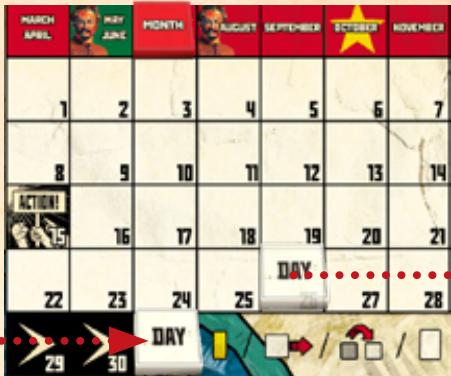
Example A: Katya just played a purple 4 command card. She therefore advances the day marker four spaces on the calendar, ending on the 30 space. She then automatically advances the day marker to the 31 space. This entitles her to a bonus action, which she will take later in the turn.
CALENDAR SPECIAL EVENTS
There are two special events on the calendar:
Trotsky Returns from Exile occurs when the month marker is advanced to the May/June space. Immediately place the neutral Trotsky token in the region indicated by the region tile in the “Unrest!" space. Like the neutral unit tokens, Trotsky is controlled by the player with the will of the people as long as they have a faction unit token or leader token in the region.

Trotsky Joins the Bolsheviks occurs when the month marker is advanced to the August space. If the neutral Trotsky token is still on the game board, immediately replace it with the red Trotsky token, retaining its fresh or exhausted state; the red player now controls Trotsky. If the neutral Trotsky token has already been removed from the game board when this event occurs, the red Trotsky token does not enter play; remove it from the game.

PERF·RM AN ACTIN - The active player performs actions allowed by their played card. If they played a command card, the player may take the Recruit action or the other action indicated on the card: Move, Double Move, or Refresh. The player may choose either action allowed by a command card, but never both. If they played a leader card, the player may take the Leader Recruit action and the special action indicated on the card, in either order.

COMMAND CARD ACTIONS
Recruit: The active player takes one or more unit tokens from their supply whose total ■ value is equal to or less than the recruit value of their played card. The recruited unit token(s) must be placed, fresh side up, in the region indicated by their played card's region icon. If the player does not have units in their supply equal to or less than the card's recruit value, the Recruit action cannot be taken.
Example B: Viktor takes the Recruit action. His played card (green 4) has a recruit value of ■. He decides to recruit two ■ unit tokens from his supply, which he must place in the green region.

Move: The active player selects any one unit token or leader token they control (fresh or exhausted), and moves the token one region along an unobstructed connection in the city. A neutral token is under the player's control if they have the will of the people and have a faction unit token or leader token in the region.
Example C: Katya takes the Move action. She wants to move her Kerensky leader token from the green region to the red region, but she cannot because the connection between those two regions is obstructed by the blockade marker. Instead, she chooses to move one of her unit tokens from the blue region to the white region.

Double Move: The active player selects any one unit token or leader token that they control (fresh or exhausted), and moves the token one or two regions along unobstructed connections in the city. A neutral token is under the player's control if they have the will of the people and have a faction unit token or leader token in the region. (The player cannot move two tokens one region each with this action.)

Refresh: The active player flips any one unit token or leader token that they control from its exhausted side to its fresh side. A neutral token is under the player's control if they have the will of the people and have a faction unit token or leader token in the region. (The player cannot flip a token from its fresh side to its exhausted side with this action.)

LEADER CARD ACTIONS
Leader Recruit: The active player takes the corresponding leader token from their supply and places it in any region, fresh side up.
LEADER SPECIAL ACTIONS
Mobilize Protest: The player may immediately move the blockade marker from its current position to any other connection in the city.
Espionage: The player may immediately reveal their opponent's secret objective by flipping that card face up.

Inspire the People: The player may immediately take control of the will of the people, moving the will of the people marker to their side of the game board. All neutral unit tokens and neutral leader tokens in the city are now under the active player's control as long as they have a faction unit token or leader token in the region.
BONUs ACTIoN5- If the active player is entitled to a bonus action because the day marker was advanced to the 15 or 31 space of the calendar earlier in their turn, they take it now, choosing one of the following four actions:

Bonus Recruit: The active player recruits any one ■unit token, placing it in any region in the city. If the player does not have a unit token in their supply, this action cannot be taken.
Bonus Move: The active player selects any one unit token or leader token that they control (fresh or exhausted) and moves it one region along an unobstructed connection in the city. A neutral token is under the player's control if they have the will of the people and have a faction unit token or leader token in the region.
Bonus Refresh: The active player flips any one unit token or leader token that they control in any region from its exhausted side to its fresh side. A neutral token is under the player's control if they have the will of the people and have a faction unit token or leader token in the region.
Bonus Draw: The active player draws one command card from the deck and adds it to their hand. This increases their hand size by one for the remainder of the game. There is no hand limit.
Example D: Viktor is entitled to a bonus action because he advanced the day marker to exactly the 15 space earlier in his turn. As his regular action, he recruits a ■■ unit token to the purple region (which is his secret objective for this round). After that, Viktor takes his bonus action, moving a neutral unit token, which he currently controls, from the brown region to the purple region.
4. SCORING PHASE
During this phase, the following steps are carried out, in order:
-
Resolve the Region of Unrest
-
Reveal Secret Objectives
-
Score Objective Regions
-
Exhaust Tokens
DETERMINING STRENGTH
To determine which player has the greater strength in a region, total and compare the strength values of all unit and leader tokens (fresh and exhausted) controlled by each player in the region.
The player who has the will of the people controls the neutral tokens in the region. Neutral units and leaders in that region contribute their strength values to the player's strength total as long as the player has at least one faction unit or faction leader in that region.
The player with the higher total has the greater strength.
If players have the same strength total in a region, the player who controls more tokens in the region is considered to have the greater strength. If the players also have an equal number of tokens in the region, the player who has the will of the people is considered to have the greater strength. If a region has no tokens at all, neither player has the greater strength.
Example E: Both players control units in the yellow region. Viktor has three units (3 + 1 + 0) and Katya has two (2 + 2). Both have the same strength total. Viktor is considered to have the greater strength, because he controls more tokens in the region than Katya does.
RESOLVE THE REGION OF UNREST - The region tile in the "Unrest!" space indicates which region of the city is the current region of unrest. Place the “1" objective marker in the region of unrest. Evaluate that region to see which player has the greater strength. The player with greater strength in that region chooses either to assign that region as an additional objective or to take a bonus action.

If the player with greater strength chooses to assign the region of unrest as an additional objective, award the player victory points based on the current month.
• March-June: 2 victory points
• July: 3 victory points
• August: 4 victory points
• September: 5 victory points

• October-November: 7 victory points
If the player with greater strength chooses to take a bonus action instead, they do so immediately, choosing one of the four bonus actions detailed on pages 7-8.
SCORING VICTORY POINTS
When a player scores victory points from an objective, move the score marker toward their side of the support track, one space for each victory point scored.
Example F: The brown region is currently the region of unrest. Katya (1 + 1 + 1) has greater strength in the region than Viktor (2 + 0). Katya chooses to assign the brown region as an additional objective, and scores 3 victory points, since it is July. She moves the score marker three spaces toward her side of the support track.
REVEAL SECRET ·BJECTIVES- The player with fewer victory points reveals their secret objective first, and places the “2" objective marker in the region matching the region icon of the revealed card. The other player then reveals their secret objective and places the “3" objective marker in the region matching the region icon of their revealed card.
In the case of a tie for victory points (when the score marker is on the green space of the support track), the player who does not have the will of the people reveals their secret objective first.
SCORE ·BJECTIVE REGIONS- Evaluate the region with the “2" objective marker to see which player has greater strength, and score the objective. Then score the region with the “3" objective marker. If a region has both objective markers in it, score each objective separately.
EXHAuST T·KEN5- In each region that has one or more objective markers, exhaust all unit tokens and leader tokens in that region by flipping them from their fresh side to their exhausted side.
If a token is already exhausted, it is instead removed from the game board. Red and white unit tokens return to their respective supply, while leader tokens and neutral tokens are removed from the game entirely.
Example G: The white region was just evaluated as an objective region. Katya has two tokens (2 + 1) in the region, and Viktor has one (3). One of Katya's tokens is then flipped to the exhausted side. Viktor's token and Katya's remaining token, which were both already on their exhausted side, are removed from the game board. Viktor's removed token is a unit token, so it returns to Viktor's supply. However, Katya's removed token is a leader token, so it is removed from the game instead.
5. CLEANUP PHASE
In this phase, the following steps are taken in order to prepare for the next game round.
Discard the region tile from the “Unrest!" space on the game board and move the region tile from the “Blockade!" space to the empty “Unrest!" space.
Draw the topmost region tile from the stack and place it face up in the “Blockade!" space. Move the blockade marker to the connection arrow matching the color of that region tile.
Remove all objective markers from scoring regions and return them to their starting positions beside the support track.
Discard all command cards (including secret objectives) and leader cards that were played this round. Discarded command cards are added to the discard pile, while discarded leader cards are removed from the game.
GAME END
The game ends immediately when either of the following conditions is met:
-
The score marker reaches one end of the support track. When this occurs, the player with the score marker on their end of the support track wins.
-
The month marker is on the October or November space at the end of the Scoring Phase. When this occurs, the player with the score marker on their side of the support track wins. If the score marker is exactly in the center of the support track when this occurs, the player who currently has the will of the people wins.
SOLITAIRE VARIANT
In the solitaire variant, instead of playing against another opponent, the player faces off against an automated opponent called “the opposition."

SOLITAIRE SETUP
Set up as you would for the two-player game, with the following changes:


-
After deciding which faction you wish to play, return the unit tokens of the other faction to the game box.
-
Choose a difficulty level to play (1-6). Find the matching difficulty level token and place it face-up near you. (Note: It's recommended to play difficulty level 1 for your first solitaire game, while more advanced players should try higher difficulty levels.)
-
Place the 27 opposing unit tokens off to the side of the game board.
-
Shuffle the three leader cards of the other faction and place them in a face-down stack near the stack of region tiles, along with the corresponding leader tokens.
SOLITAIRE GAMEPLAY SEQUENCE
Gameplay for the solitaire variant is identical to the two-player game except for the following changes:
1. DRAW PHASE
During the Draw Phase, draw from the deck five command cards for you (the player) and five command cards for the opposition, in the following manner:
• Draw four cards into your hand.
• Draw a fifth card and place it face down as your secret objective, without looking at it.
Draw five cards and place them in a face-down stack on the opposition's side of the game board, without looking at them.
Note: The opposition's secret objective space will remain empty until the Scoring Phase.
2. OBJECTIVE PHASE
Reveal the opposition's topmost leader card and place the matching leader token in the region of unrest. This does not count as an action. The leader's special action is not triggered, nor does it advance the calendar.
Place the will of the people marker on the opposition's side of the support track. In this way, the opposition takes control of the will of the people before the Action Phase each round.
Note: Your secret objective is determined in the Draw Phase, but is unknown to you.
3. ACTION PHASE
The opposition will take five turns every round, although you (the player) will only take four. Therefore, this means that the opposition always takes the first and last turn of each round.
OPPOSITION TURN
-
On the opposition's turn, reveal the opposition's topmost command card and advance the calendar according to the day number on the card (as in a two-player game).
-
Then place an opposing unit token with strength matching the recruit value of the revealed command card — ■, ■■ or — in the region indicated by the card.
The opposition never moves or refreshes any of its units; it simply adds new units to the game board.
If the opposition advances the day marker on the calendar to the 15 or 31 space, the opposition takes the Bonus Recruit action, adding a ■ unit token (if possible) to the region of unrest.
If the opposition advances the day marker on the calendar past the 31 space, it takes control of the will of the people (if it doesn't have control already).
As the opposition plays cards, place them in a face-up line, ordered from left to right. The order of the played cards can become important during the Scoring Phase.
PLAYER TURN
You take your turn as you would in a two-player game, with the following exceptions:
There is a new bonus action available to you: Organize — You may choose to reveal your own secret objective when you take a bonus action (instead of taking one of the four regular bonus actions).
When performing the Espionage leader action, instead of revealing the opposition's secret objective, reveal your own secret objective.
4. SCORING PHASE
RESOLVE THE REGION OF UNREST - Resolve the region of unrest as in a two-player game. If the opposition has greater strength in the region, it always chooses to assign it as an objective instead of taking a bonus action.
REVEAL SECRET OBJECTIVES - Reveal your secret objective (if not revealed already). To determine the opposition's secret objective, examine the five command cards played by the opposition this round. Add together the day numbers of the opposition's five cards per region. The region with the highest sum is the opposition's secret objective region. Select the opposition's card with the highest victory point value for that region as the opposition's secret objective.

SECRET OBJECTIVE
If there is a tie between regions for highest sum, the region among them with the most cards becomes the opposition's secret objective region. If there is still a tie, the last played card among the tied regions determines the opposition's secret objective region.
Example H: In the first round of the game, the opposition played the following five command cards in order: red 2, red 4, purple 4, brown 5, and purple 2. The opposition's totals are 6 points in the red region, 6 points in the purple region, and 5 points in the brown region. The totals in red and purple are tied for the highest. Both have two cards in each region. The purple 4 becomes the opposition's secret objective card, as the last card played between the two tied regions was purple, and the purple 4 is the card with the highest victory point value from the purple cards played.
SCORE ·BJECTIVE REGIONS- Scoring objectives is identical to the two-player game.
EXHAUST T·KEN5- Exhaust tokens as in the two-player game. After the opposition's fresh unit tokens are exhausted, their displayed strength will be “X." The value of “X" is equal to the difficulty level (1-6) chosen during setup.
5. CLEANUP PHASE
The Cleanup Phase is identical to the two-player game.
SOLITAIRE GAME END
The game ends immediately when either of the following conditions is met:
-
The score marker reaches one end of the support track. When this occurs, the player with the score marker on their side of the support track wins.
-
The game reaches the end of the Scoring Phase in the third round. When this occurs, the player with the score marker on their side of the support track wins. If the score marker is exactly in the center of the support track when this occurs, the player who currently has the will of the people wins.
ACKNOWLEDGMENTS
Designer: Brett Myers
Solitaire Rules: James Kyle & Brett Myers
Developer: Keith Matejka
Graphic Designer: Luis Francisco
Illustrator: Kwanchai Moriya
Editors: Dustin Schwartz, Steven Dast, and Peter Dast
Special Thanks: Many thanks to all my playtesters, especially Mark Goadrich, James More, James Kyle, Jeph Stahl, Beau Beckett, Greg Daigle, Chris Young, Nick Bentley, the Roundhouse Gamers, Eric Schlautman, Scott Bogen, and my fellow designers at Protospiel.
This game is dedicated to the memory of Jayson “Patch" Abbott.
© 2018 Thunderworks Games. All Rights Reserved. For additional information or support, please visit us at www.thunderworksgames.com.

原文为社区整理/出版社公开资料,版权归原作者,仅供个人学习查阅。