
Duel of Ages IIDuel Of Ages Ii
一句话概览
Duel of Ages II 是一款已收录于村了吗规则库的桌游,支持 2–8 人,原名 Duel Of Ages Ii。
本页内容:一句话概览 · 常见问题
这游戏怎么玩
- 本站已收录这款游戏的规则资料,可以在对话里直接提问规则细节。
常见问题(FAQ)
以下 1 条问答中 0 条来自站内玩家的真实提问,其余 1 条为本站整理的常见疑问;答复内容保持原样。
Duel of Ages II支持几个人玩?
2–8 人。
去哪查完整规则
想核对具体规则细节、卡牌效果或某个回合的结算方式,可以在村了吗里选中这款游戏后直接提问。
同类桌游
- 卡坦岛德式
- 工业革命:伯明翰德式
- 勃艮第城堡:特别典藏版德式
- 方舟动物园德式
- 卡卡颂抽象
- 瘟疫危机传承:第一季美式
- 阿瑞迪亚:勇踏征途美式
- 重塑宇宙德式
- 幽港迷城美式
- 埃多拉的德鲁伊德式
规则原文(Markdown)
本站收录这款游戏的规则原文 1 个文件,此处内联渲染 1 个,可直接展开阅读或下载。
Basic DoA II Rules.md103.8 KB

GAME COMPONENTS







7 Map Platters – Seven large round “buzz saw” map sections. These fit together with the keys like a puzzle.
12 Dome Keys – 6 green (Ancient) and 6 brown (Colonial). Their ages do not matter for the Basic Set.
12 Adventure Keys – Team White and Black Bases, Lith's Lair, Alliance, 4 Standard Labyrinths and 4 Alternate Labyrinths.
48 Character Cards and Markers – Large cards with the portrait and information on one side, the background story on the other. Each card has a corresponding round marker to represent the character on the map.
6 Reference Cards – Large cards providing key info when you are learning the game.
46 Common Treasure Cards – White treasure deck loaded with weapons.
32 Secret Treasure Cards – Black treasure deck light on weapons but containing powerful secrets.
20 Elite Treasure Cards – Gold treasure deck containing superb treasure.
100 Challenge Cards – Used to resolve attacks, challenges, and other game results. While the one deck is used by both teams, a second deck is in the Master Set to allow each team their own deck
72 Guardian Cards – 18 for each of the four ages.
54 Gold Encounter Markers – With a question symbol on the back side. Two markers are blank replacements.
7 Creature Markers — Square markers with gold and blue backgrounds.
28 Team Markers – With Team White on one side, Black on the other.
16 Experience Markers – +1 on one side, Active on the other.
6 Lith Tribute Markers – The greatest treasures of mankind to be offered as tribute to Lith, Queen of the Games.
4 Line of Sight Hexagons – With a blue centering star.
18 Blue Encounter Markers and 16 Henchman Markers – Included in the Basic Set but used with the Master Set.
CREDITS
Game Design
Brett Murrell
Art
K. Andersen
Matthew Attard
Armands Auseklis
Kerem Beyit
Deyer Blaylock
Leon Butchers
Jose R. Castello
Lon Chaney
Dean Chaney
Chris Collingwood
Donna D'Amelio
Jacques-Louis David
Gerald C. Double
FrankT
Andrew Hou
Howard David Johnson
Ronald C. Kapaun
Richard Kitner
Zieben Lin
Thomas Long (Fygomatic)
Damir Martin
Mea
Kurt Miller
Gary Oliverio
Laurie Prindle
Lorraine Purviance
Kevin Radthorne
Mike Robinson
Martin Roes
Douglas Shuler
Margit Elland Schmitt
Robert Sicotte
Wolfgang Sigl
Jakov Smojver
Adam Vehige
Writing
Brett Murrell
Editing
Jeff McCamish
Core Playtest
Curtis Barrett, Tigger Barrett, Keith Carter, Marlee Carter, Matt Clark, John Crane, Jeremy Evarts, Marc Gardner, Joe Hartman, Gary Heller, Steve Kennedy, Matthew Jacobsson, Jeff McCamish, Derek Mencer, James Murrell, Jonathan Murrell, Caleb Ortiz, Joshua Ortiz, Colby Patchin, Jared Patchin, Jack Penick, Chris Reed, Luke Roberts, Zane Roberts, Cody Stump

duelofages.com is the official resource for DoA. Discover a treasure of additional content, strategies, and mods.
- New challenges Extended game play Additional characters Game support – Rules for Alliance key

All game content ©WorIdspanner 2011 All rights reserved.
This rulebook is formatted to teach you the game. The website contains the Rules & Missions PDF, which separates the manual into the core rules and scenarios for easier reference.
INTRO
It is February 30, 2384. Across the Forty Worlds, twenty billion entertainment-seekers engage in the Games. Most hook through v-Space for a few hours of sport. Others spend time with friends at one of the many Reality Realms parks or the Virtuality holo-worlds.
Despite uncountable entertaining options in the Games, there has always been a favorite – Worldspanner. Worldspanner immerses its participants in a thousand different settings, allowing them to take on their favorite persona as a hero or villain of any age, and enjoying delights ranging from masquerade balls to Roman festivals to team contests.
It is your goal to become a professional of the Games – a Challenger...
You are alone in a circular chamber, listening to the chatter of your fellow Psiclone teammates through the commlink in your helmet. You scroll through stats on your helmet display, more out of nervous habit than need. The opponents are old rivals – the Skyhawks, your sixth challenge against them this season.
The 30-second alarm sounds, and you straighten your feedback suit. Now comes the best and worst moment – the discovery of who you are.
The lights dim. Within your helmet the room disappears, replaced by the holovision of a great stage on which you and your teammates are arrayed. Your body is nothing but mist, but it begins to take form like a wraith acquiring flesh. The audience sees the same, and they cheer as they recognize the figures that each of you take.
And now you see yourself whole – a ruggedly handsome Latino in a 20th century American military uniform. The stub of a cigar is clenched in your teeth and your hair is neatly slicked back. You feel a personality template close about your mind, dampening your true self but placing your inner will in control of a new personality. You literally become Private Sanchez, the best sniper in the mix – and one of your favorites.

Several minutes pass as the vast expanse of the challenge arena forms below you. Your team leader strives against the Skyhawk leader to influence the arena's layout, and he adds several hills to best employ your sniping skills – assuming that you can find a weapon. You and your allies hurriedly form plans. Soon the challenge begins as the first of your team materializes into the arena.
Your turn comes. There is a flash and you find yourself in the darkness of an entry dome. You step out, and to your relief you see the ancient hero Beowulf – a friend and ally. He greets you with a huge bearded smile.
“I journey to the Ancient labyrinth,” he says. “Will you follow?"
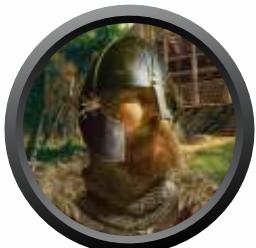
“Lead on, meat," you say, and you both race away. Back in your circular chamber, you run. Force fields form the terrain beneath your feet, and despite your sprints and turns you are kept safely in the middle of the room.
In the arena, the enemy pirate Blackbeard shadows you, but he wisely stays a safe distance from Beowulf. Soon you reach the cave. Miniature dragons flutter about the dark entrance and a greenish glow illuminates the labyrinth's depths. Beowulf steps into the cavern and you follow.

Deep within the cavern, Beowulf raises his hands and shouts, “I offer challenge!” The mists swirl and the cavern transforms into a gleaming white temple atop a lofty mountain. A great sphinx strides from the temple to face Beowulf: “Your fate rests on this riddle," it booms, peering down at Beowulf past its toothy muzzle. “Comforts your sleeping, blesses your reaping, provides fine meat when living or dying. What am I?"
Beowulf's shoulders sag. “A Celtic slave wench?” he answers. The Sphinx glares sternly at the warrior for a moment, and Beowulf disappears in a flash of angry red brilliance to reappear elsewhere in the arena. The Sphinx turns to gaze upon you, and with a sigh you offer the challenge.
But to your surprise, you correctly guess the Sphinx's riddle. The Sphinx fades in defeat, and in your hand appears a small horse figurine. You smile and comm Sir Gawain.
“I have a gift, where are you at?” “Northside,”answers Gawain. “And hemmed in by foes."
“Coming,” you say, and you do manage to reappear northside. As you step out of the dome, you see Gawain sprinting toward you, with a massive bone and metal monster closing on him. For a second you consider activating the horse and escaping. But only for a second.

You toss the figurine to him as he approaches, and he unexpectedly tosses a figurine back.
In the seconds left before the monster reaches you, you realize to your delight what the figurine is. You press the figurine's base and it flashes into virtual reality in your hand — a 19th century musket.
You swing the muzzle around and take aim..
When a team of challengers enters a Duel of Ages contest, they take on the identities of well-known characters from a mix of 360 famous personas known as the Full Degree. These characters are central to Worldspanner, each with a deep pool of history filled with many tales. They are icons, role-models, scoundrels and bogeymen, and they are known universally.
Before beginning your first Trial, grab a character card and spend the next two pages getting familiar with some of the basics...
Ratings are the core of your character. Each rating is a scale from 0 (hopeless) to 9 (best of the best). Ratings are colored merely as a helpful indicator of quality. High ratings are a healthy blue, while poor ratings are a sickly red.
Speed
Land speed. An average human has a Speed of 6.
Health
The amount of punishment you can take before your gallant death. A typical human has Health 4.
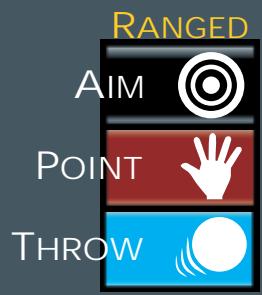
Aim
Steadiness, cool-headedness, concentration and vision quality. Aim is needed to use carefully aimed weapons like rifles.
Point
Hand-eye coordination and fluid, accurate upper body movements. Point is critical with weapons that are not carefully aimed, such as pistols and automatic weapons.
Throw
Throw strength and accuracy. Important for grenades, spears and arm-strength weapons like bows.
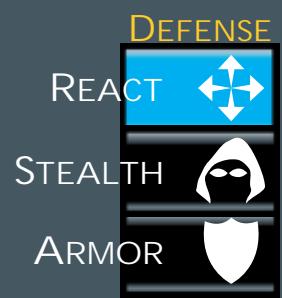
React
Quickness and agility of body movement. React is your defense against Melee attack:

Wind Warrior
Acrobat
Cheerleader
Potbellied plumber
Zombie with torn ACL
Stealth
Hide, sneak, and avoid getting shot. Stealth is your Ranged defense:


Ninja
Elf
Country girl
American tourist
Inebriated Elvis impersonator
Armor
Protection of your clothing or skin:

700 Ibs. of tinfoil Full plate Breastplate Heavy clothing Trendy swimwear


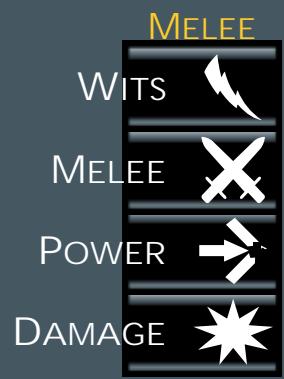


Wits
Cunning, street smarts, cleverness and battle senses:

World-class con man
Pickpocket
Street fighter
Sorority girl
Farm-raised turkey
Melee
Skill at hand-to-hand combat:

Special ops kung fu master
Army Private
Soccer fan
Angry housewife
Spelling bee champion
Power and Damage
Damage caused by natural fists, claws or mandibles. Power is the ability of a weapon to penetrate armor, usually 2-3 for a human fist. Damage is the average damage caused on a hit, and is usually 2.
Strength
Muscle power and the experience to put it to use:

Those guys in the end zone seats
Computer gamer
Ripped pixies
Intellect
Book learning, logic and memory:

Einstein Einstein's accountant brother Einstein during Oktoberfest Einstein the Barbarian Einstein's really smart cat
Honor
How you treat others and hold to selfless standards:

Saintly
Selfless
Give-and-take
Self-serving
Grinchy
Respect
How others regard you:

Rock star!
Reality show contestant
Family man
Loser
Fermenting pond scum



Age and Setting
Characters fall into four ages: Ancient, Colonial, Modern and Future. Within each age are three settings – story universes in which the characters have their being.
CHASMS

An epic fantasy realm where a thousand races share the world with Men.

A land abundantly populated with the faerie people.
EPIC HEROES

The ancient histories and mythologies of old Earth, up to the 1400's A.D.
LANDS WEST

The colorful setting of Western America during the 1800's.
FOLKTALES

Colonial-era folklore and fairy tale set in the 16th-19th century.
HORIZONS

Historical old Earth from the 1400's through World War I.
UNDERGROUND

The hard-bitten realm of lawmen and mobsters during the 20th century.
STRANGE TIMES

The daydream realm of conspiracy theorists and their unexplained phenomena.
AGE OF CRISIS

History and myth during the time of great crisis, between World War Il and the 2060's.
STARMARCH

A fantasy universe set in the mold of hard science fiction.
ALTSPACE

A fantasy universe set in the mold of grand space opera.
FORTY WORLDS

Lords Kings, generals and other leaders
Icons The famous
Adventurers Treasure hunters and thrill-seekers
Defenders Protectors and law-keepers
Villains The dark side
History and mythology from the 2060's to the present.
Circle
From Lords to Outcasts, Exemplars to Villains, the Circle is the social class in which the character is most at home.
Exemplars The pure at heart

Warriors Skilled fighters

Commoners The everymen and everywomen
Outcasts Refugees from normal society
Nature

There is a magical difference between boys, girls and toothy aliens.


Woman

Child


The Portrait
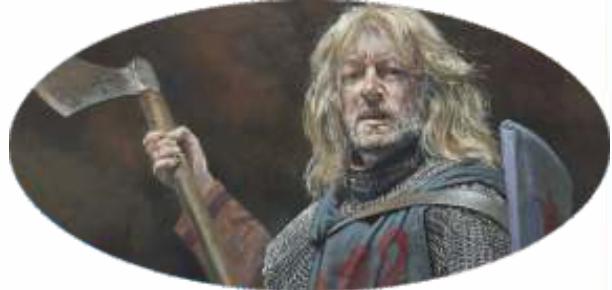
A character's portrait does not reflect the character's equipment. Even though the picture of William Wallace shows him with axe and armor, he actually comes into the challenge with little more than a kilt and an inspiring grimace.
You are ready for the Games
As a new challenger, you must first prove yourself over three training Trials before being allowed access to the Games. Play each Trial until you are comfortable with the rules, then move to the next. Once skilled, you will begin mastery of the Missions.
As you progress through the Trials and Missions, you are learning the rules step by step. Rules learned in earlier Trials are true later, unless they are specifically described as special.
Enter your first Trial on the next page..

"Face Off is your first training exercise, teaching hand-to-hand combat. You must learn to handle yourself in battle."
To Win
Eliminate the enemy team

Team White Stephen Decatur Suva of Orian Venya 8
Teams and Characters
Divide players into two teams. The team with the best hair is Team White. Teammates sit together.
Give the character cards to the teams, dividing them between the players. Find the marker for each character. Markers have a Team Black and a White side.
Team Black Ardin Glynn Jack Hammer Sgt. Gritt Spartacus
There is no difference between your characters and teammate characters. Rules never apply just to the characters that YOU are playing.
Face Off uses only the ratings on the right side of the character card. Ignore all else on the cards, including special abilities. Nol Yes
The Map

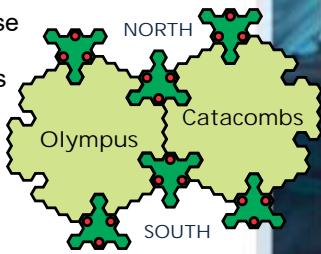
Build the map using the circular platters and the triangular keys like a puzzle. Use the Olympus and Catacombs platters, aligning the name text on the platters as shown (both straight horizontal).
Use the six green Dome keys to lock the platters, placing them as shown. It does not matter which Dome key goes where or how they are aligned.
Common Treasure Deck
The white Common deck contains weapons and other shiny loot. Shuffle it. In Face Off, you do not use Ranged cards. If you draw one, discard it face up and draw again.
The Secret and Elite decks are not used in Face Off.
Any card with one of these three symbols in the upper right is a Ranged card:
Place characters on the map

Team White places their characters in Dome spaces on the three north keys of the map, no more than one per Dome. Black does the same on the south.
Place Encounters on the map

-
Mix the Gold Encounter markers face down.
-
Starting with Team Black, each team alternates placing Encounters face down on the map without looking at them. Encounters cannot be placed in a Dome space. They must be placed at least 4 spaces away from all other Encounters. For the 4-space limit, ignore terrain, but count around the empty notches in the platters.
- Continue until there are no more spaces where an Encounter could be placed.
TRAINING TRIAL 1 – FACE OFF
Game Rounds
Duel of Ages is played in rounds. Each round has a Team White turn, followed by a Team Black turn. The phases below occur each turn. Complete them in the order shown. You must finish one phase before going on to the next.
Team White's turn
Team Black's turn
Free Action phase Move phase Melee phase Adventure phase
Free Action phase Move phase Melee phase Adventure phase
The Free Action Phase
During your Free Action, your team (only) can take special actions like trading cards. You will learn about trading soon.
The Move Phase
During your Move, your team can move any and all of your characters. The other team cannot move.
The map has a grid of hexagonal spaces. Characters move on the map using those spaces. A character's Speed rating is used as “move points." Characters do not need to move full Speed, or even move at all. They cannot save move points for a later turn. 11
Map terrain and movement
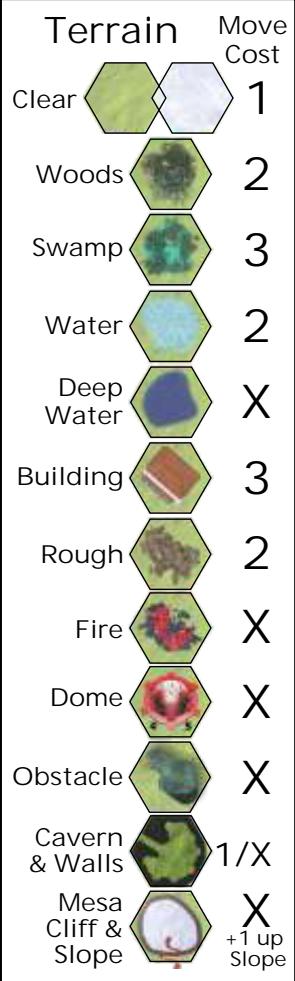
Each space on the map has one and only one terrain type. Each terrain costs a certain number of move points to enter. (You never pay to leave a space.)

Clear – Clear spaces cost 1 point to enter.
Woods and Swamp – Woods costs 2 and Swamp costs 3.
Water and Deep Water – Water costs 2 points to enter. Characters cannot enter Deep Water spaces.
Building – Building spaces cost 3 points to enter.
For buildings that take up multiple spaces, it does not matter if you are moving “inside" that Building from one space to another, it always costs 3 points.
Rough – Rough is rocky terrain costing 2 points.
Fire, Domes and Obstacles – Characters cannot enter Fire, Dome or Obstacle spaces. Obstacles include the snake statue on Catacombs and the Colossus.
Characters MUST leave a Dome space during their Move phase.
TRAINING TRIAL 1 – FACE OFF
Caverns – Any space containing Cavern Wall is a Cavern.
Cavern spaces are always Clear.
Cavern Walls – Caverns are surrounded by black walls. Characters cannot move through cavern walls to the space on the other side unless a passage connects through.
Mesas, Cliffs and Slopes – The snowy white highlands are mesas. Mesas are Clear unless they contain other terrain. Mesas are surrounded by cliffs. Characters cannot cross a cliffside except at Slopes – the winding brown paths. C It costs 1 extra point to move up onto the mesa using a Slope, but no extra to move down it.

Enemies stop movement
If a character moves into a space containing an enemy, he must stop movement.
Always move one space
A character can always move one space during his Move, even if the cost of that one space is more than his Speed. This does not allow impossible movement like into Deep Water or across cliffsides. △
A movement example
These characters each have 6 Speed: W uses 3 points to enter the Building and 3 to enter the Swamp.
X uses 3 points to enter the Building and decides to stop.
Y uses 4 points on the two Water spaces He would like to enter the Building space, but that would cost 7 points.
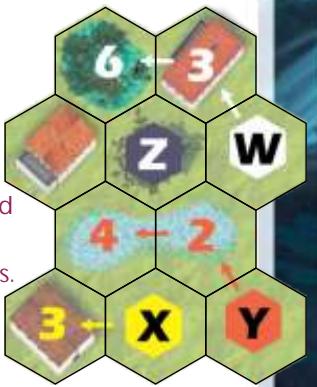
Z decides not to move at all.
The Melee Phase
Melee is hand-to-hand combat. Melee happens only when enemies are in the same space. In each Melee, characters from both teams can attack. Each character can make one melee attack against any one enemy of their choice in the space. Resolve all attacks in one space before moving on.
Wits determines order

Handle melee attacks in order of Wits -- highest Wits attacks first. The current team breaks any tie. For example, on Team Black's turn, they attack first in case of a tie.
This means that a low-Wits character could be killed before being able to attack.
Natural melee attack
Every character can fight hand-to-hand without needing a Melee card. This is called the natural melee attack.
Making a melee attack
-
Choose your target – an enemy in your space.
-
Compare your Melee rating vs. the target's React. Determine which is better, and by how much.

-
Draw a challenge card. If the attacker is better, use the “Attacker is Better” section. If the defender is better, use “Defender is Better.”
-
Look at thecolumn of the card.= Miss, = Hit. Discard the card afterward.
On this card, Melee 7 vs. React 6 would hit, while Melee 6 vs. React 7 would miss.

- If the attack hits, you must now check damage. Compare your Power vs. the target's Armor. Determine which is better, and by how much.

Power VS. Armor

- Draw a second challenge card and look at the column. If this is a number, add or subtract the number from your Damage rating. This might reduce your damage to 0. If the result says “X”, you cause no damage.
Damage

Example: Your Power is 3 and You: Damage is 2. The target has 4 Armor. 3 Power vs. 4 Armor means the Defender is better by 1.

Target:
You draw a challenge card. The Damage column shows "-1". Subtract 1 from your Damage rating, causing 1 damage.


- Subtract the damage from the target's Health. If Health falls to zero, the character is killed.
Max Health/Current Health
Max Health is the amount shown on the character card. Current Health is the amount that the character has at the moment.

Healing increases a character's current Health, but cannot increase it above max Health.
A wounded character suffers no penalties. He fights bravely until killed.
To track Health loss, dice work best. Glass stones are a close second. Dead flies are a distant third.

The Adventure Phase
Meeting an Encounter
An Encounter is a person or group waiting to greet your characters. An Encounter is not a fight. Instead, a character must impress the encounter to receive treasure.
Most Encounters show a rating and a difficulty. For example, the Lumber Camp is 6-rated Strength.
The 'Jacks at the lumber camp respect strength. Weaklings need not apply.
Difficulty
& Rating
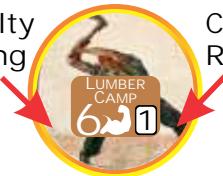
Cards Rewarded
If a character is on a space containing an Encounter, he can challenge it. Reveal the Encounter to all players.
If the character's rating equals or exceeds the Encounter's rating, he impresses the Encounter. He draws as many treasure cards as is shown on the marker. The cards must go to the character that passed the Encounter.
Afterward, remove the Encounter from the map.
For example, if you meet the Lumberjacks above and have 6 or better Strength, you get to draw 1 card.
If the character's rating is less than the Encounter's rating, he fails to impress. Flip the Encounter back face down. If another allied character is in the space, he can try after you.
For Workshop and Black Market, you must instead pay a card to pass the Encounter.
Enemies in your space never prevent you from attempting an adventure in the space. Encounters are always voluntary. You are not required to meet them, nor pay a card for Workshop/Black Market.
Encounter Age Bonus
Each Encounter is a certain Age, as indicated by the box color on the marker. For example, Lumberjacks is a Colonial Encounter with a brown box background.
If an Encounter matches the character's Age, you gain +1 to the rating. For card-paying challenges of the same age, you can choose not to pay a card at all and still pass it, but you draw one less card for your reward.

TRAINING TRIAL 1 – FACE OFF
Treasure
Treasure cards (“cards”) come in three decks – Common, Secret and Elite. Face Off uses only the Common deck.
4 card carry limit
Each character can carry 4 cards. You must immediately discard excess cards. Píace discards face up in a pile.
Strength/Intellect requirement
Look at the Strength and Intellect rating on a card. A character must be as good or better in both Strength and Intellect, or he cannot use that card. He can still carry it.
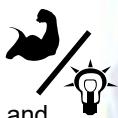
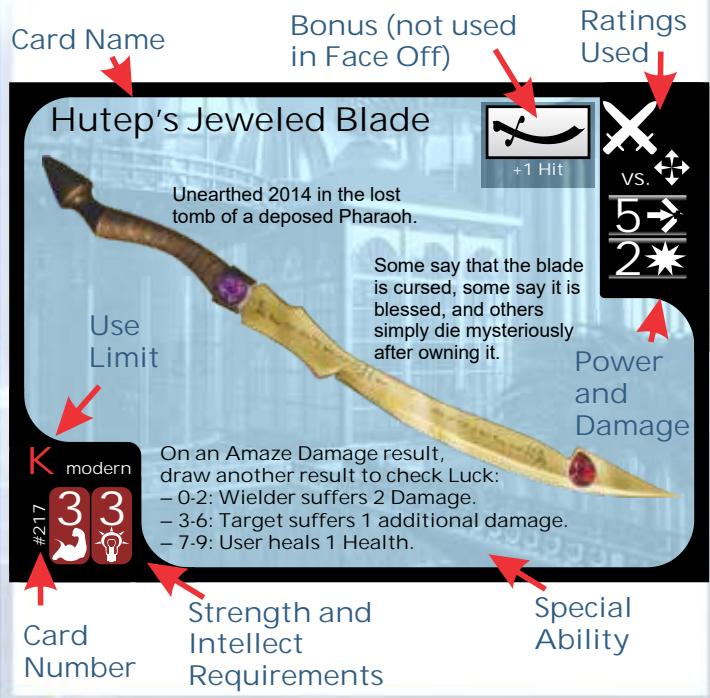
You must have at least 3 Strength and 3 Intellect to use Hutep's Jeweled Blade shown below.
Use limit
Each card has a P, 1, or K in the lower left.
P – The card is permanent, not lost after use. It remains with the character until traded away or lost in some unusual way
1 – This card is usable only once, then discarded.
K – K can be found on most weapons. Such a weapon is lost after it kills or imprisons a character.
Revealing cards
When you draw a new card, keep it face down on or under the owning character's card, unrevealed to the enemy. At some point, a card must be revealed. Once revealed, it cannot be hidden again.
Trading cards
Cards can be traded between characters during their Free Action phase. Characters must be in the same space to trade cards. Cards cannot be traded if an enemy is in the space.
TRAINING TRIAL 1 – FACE OFF
Picking up cards
Characters cannot drop cards voluntarily.
When a character is killed, his cards remain in the space where he was killed.
A character can pick up cards from the ground during Free Action. He cannot pick up cards if an enemy is in the space. He must pick up ALL of the cards. Distribute the cards among any allies in the space, then discard excess or unwanted cards. Unrevealed cards remain unrevealed.
Destroying cards
A character can destroy cards only during his Free Action phase, or whenever he receives new cards.
Card Types
Melee
Melee cards can be used in place of the character's natural melee attack, usually giving a better Power and Damage rating. Reveal a Melee weapon before attacking with it.
Armor
Armor comes in three types – Body, Helm, and Shield. A character can use only one of each type at a time, though he is allowed to carry others.
For Helms and Shields, the Armor bonus is usually shown on the card in the upper right. Helms give a bonus and often an additional +1 Armor against melee attacks, while Shields often give the added +1 against ranged attacks.
Body Armor provides a specific Armor rating. So, if your natural Armor is higher than this, the card does you no good.
Reveal Armor just before an enemy makes a Damage challenge against the owner.
Transports – Mounts and Vehicles
Transports increase Speed or give a set Speed, as shown on the card in the upper right. Using a Transport is voluntary. Reveal it to use it. A character can use only one Transport during a Move. You must use a chosen Transport through your entire Move phase.
Medical
Medical cards heal a character's current Health, usually during Free Action. Reveal the card and apply the healing. Only the owner of the card can be healed.
Gadgets, Packs and Stealth
These cards provide advantages as described on the card.
Reveal them when you first wish to gain those advantages.
Stop! You are now ready to Face Off..
"Adventuring is important, but even a princess must first learn how to defend herself."
If you are new to Duel of Ages, you can skip this lecture. If not, pay attention!

And now, a few words of discouragement from the Chief Weewak:
“Duel of Ages old-timers: You were a problem before, and you'll be the problem now. You must learn to unlearn! Many rules have changed since DoA version 1. Do not assume rules. Here are some key changes that will sneak by your animal synapses:"
Cards (Treasure)
-
Card trading happens during Free Action, not Move.
-
Pets are now the living Creatures, as compared to bots which are the machine Creatures. Hunters are the Creatures that you unleash at a specific enemy.
-
Hunters can move through an enemy without stopping.
-
Sentinels are K weapons. They are destroyed once they kill or imprison an enemy.
-
Body armor gives a set armor value, which might not help you if your armor is already strong.
-
Medical cards are usually used in Free Action.
-
Poison is now a “K” card.
-
A Badge drawn for the Vault is fine, and is taken like any other card.
Fighting
-
You can take up to 4 shots in the Fire phase, though there is a penalty for each extra shot.
-
You also lose a “K” weapon if you imprison an enemy.
-
A double-Amaze attack imprisons even if the enemy is not reduced to half Health or less.
-
There is no -1 penalty/+1 bonus to Hit in the team bases.
-
A shot taken into a space containing multiple targets is no longer determined randomly. Instead, you choose a target. But, if you miss, you must take the attack against an ally (if an ally is in the space).
-
Characters on mesas cannot fire down into any cavern space, and vice versa.
And other stuff
-
Attacking the enemy base is entirely different.
-
The light bulb rating is now called Intellect. The lightning bolt is Wits.
-
There are no more tunnels on the map. Instead, caverns can be found on the maps.
-
Setting up the map is different. Pay attention to the map-building rules.
-
Flight costs 1 point per space, even the ending space.
-
If all Domes of your drawn color are full, you can go to any empty Dome of your choice.

“In Crossfire, you will gather ranged weapons and employ them."
To Win
Crossfire lasts 9 rounds. Team White must eliminate Team Black to win. Team Black must simply survive.
Characters
Give the following characters to the teams:
Character special abilities are still not used!
Team White
Ace Cannon
Boris Andronov
Davy Crockett
Gen. James Gavin
Victoria
York
Team Black Annie Oakley Geronimo Pat Garrett Phillip Redlegs
The Map
Use The Wastes and Lithopolis platters, aligning the name text on the platters as shown.
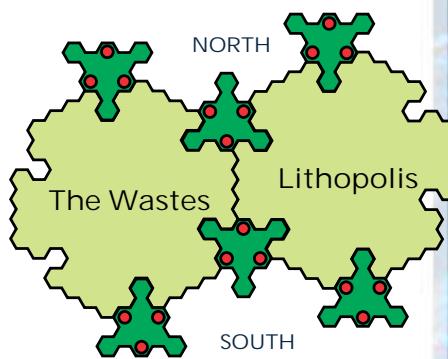
The Common Deck
In Crossfire, do not use Melee weapons. If you draw a Melee card, discard it and draw again.
Setup
Character and Encounter placement is the same as for Trial 1: Face Off.
Game Rounds
Two new phases are added to each turn: Fire and OpFire.
Free Action phase Fire phase Move phase OpFire phase Melee phase Adventure phase
The Fire Phase
During Fire, the current team (only) may shoot. Important! A character that Fires in the Fire phase cannot move in the Move phase.
Ranged Cards
Unlike melee, characters do not naturally have a ranged attack. Ranged weapons are required.
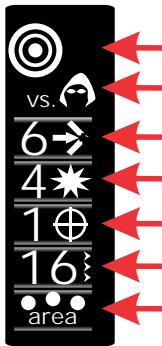
Rating used for Hit Stealth is Hit defense
Power
Damage
OpFire
Range
Target
TRAINING TRIAL 2 – CROSSFIRE
Attacking in the Fire Phase
-
The shooter must have a Ranged weapon. Reveal the weapon. Each shooter can use only one weapon.
-
No enemies can be in the shooter's space, including the target himself.
-
Each shooter can fire at up to 4 targets. Each shot must be at a different target. You must announce how many shots before you conduct the first attack. You do not need to name the specific targets.
A weapon's OpFire rating is ignored in the Fire phase.
- When shooting at more than one enemy, you suffer -2 Hit on ALL shots for each extra shot.
So, if you announce 4 shots, you suffer -6 Hit on ALL FOUR shots.
- The shooter must see the target. See Line of Sight, below.
You cannot check line of sight before announcing the number of shots. If you misjudged lines of sight and cannot take as many shots as you announced, you still suffer the full multi-target penalty above.
-
The target must be in range. To check range, count the number of spaces to the target, including the target's space but not the shooter's.
-
Conduct the ranged attack like a melee attack. Aim, Point or Throw is the attack rating. Stealth is the defense.
For example, Aim is the Hit rating used in this case.

- If you kill your target and you are using a “K” weapon, you lose the weapon and all further intended attacks.
Line of Sight
Some terrain blocks sight completely. Other terrain does not block line of sight, but gives a Stealth bonus to your target.
Often the line of sight is obvious. If not, place sight markers in the shooter's space and the target's space, and draw a line with a paper edge or floss between them. If the line touches any of the terrain images, that terrain affects the shot.
Sight is affected only by the image of the terrain, not its shadow or the entire space.
Ignore terrain in the shooter's space, except Dome and Cavern wall.
This sight is not blocked. It passes between the Building and Dome The Building's shadow and the Dome's numbers have no effect.

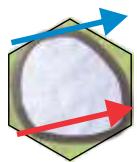
Mesa: Only the white counts
The dark cliffs around Mesa are ignored for line of sight. Only the white terrain counts.
The blue line of sight is not blocked. The red one is.
TRAINING TRIAL 2 – CROSSFIRE
Clear, Water, Deep Water
These do not affect sight. Open Mesa spaces and Cavern spaces are Clear.

Woods, Swamp, Fire
These do not block sight but the target receives a Stealth bonus for each space where the line touches one of these 1 terrain types, including the target space. Woods gives +2 Stealth. Swamp and Fire give +3.

Rough
Rough is too low to affect sight between the target and shooter, but a target in a Rough space gains +2 Stealth.

Building
A shooter can fire into but not past a Building. A target in a Building space gains +3 Stealth.

Dome
No one can see into, out of or past a Dome.

Obstacle Obstacles block sight.
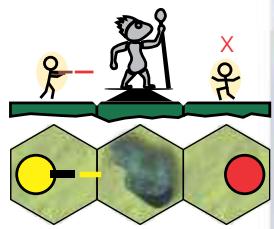
Caverns and Cavern Walls
Wall blocks sight, but Cavern is Clear. Unlike other terrain, include the shooter's space when checking sight.
Not blocked


Blocked

Walls along a space's edge
If the line of sight passes directly along the edge of a space touched by Cavern Wall on either side, sight is blocked.
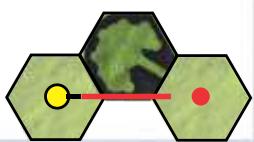
Shooters on Mesas cannot fire down into Cavern, and persons in Cavern cannot fire up to Mesa.
Mesas
Shooters on Mesas have a height advantage. They can see over lower terrain like Woods, Swamp, Fire, Dome and Building, except for the space directly in front of the lower person. This is also true in reverse for the lower character firing up.

In the top example, only the Woods spaces affect the shot. At the bottom, the Dome does not block sight, but the Building does.

Obstacle, Caverns and other Mesa spaces
Obstacles and
Caverns are as tall as Mesas, and block any sight downward from a Mesa. So do other
Mesa spaces.

One Mesa to another
When sighting from one Mesa space to another, all terrain on lower ground is ignored. In the case here, only the Woods affects the shot.

Mesa to Cavern

Firing up at Mesa
When firing up at Mesa, the target gains +2 Stealth because he holds the higher ground.

Additional Line of Sight Notes
See you, see me
Sight is always the same in reverse. If you see me, I see you.
Markers and Adventure spaces
Characters and all other markers placed on the map never affect line of sight. Neither does the text and images of Adventure spaces, which are always Clear.
Gates
(Gates and bases are introduced in the next Trial.) The Gates of Team Bases affect sight like Cavern Walls.
Resolving Line of Sight arguments
In most cases, line of sight is obvious. But sometimes arguments arise. When you disagree, Team White makes the decision. If their decision benefits Team Black, they get to make the decision again the next time. If it benefits themselves, the decision-making crown passes to Team Black.
Be fair about line of sight. Nobody wants to play with nasty cheating scum.
Lobbing Grenades
Grenades can be lobbed up over Domes and Buildings to a space on the other side.
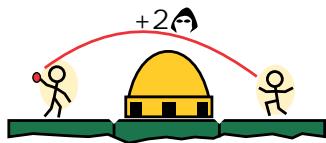
For Grenades, treat Dome and Building spaces as Woods when determining line of sight. You cannot throw a grenade into or out of a Dome (but can in and out of a Building.)
Ranged Attack Example
Annie Oakley attacks Grok with the Accelerator Tube.
Grok is four spaces away, in range of the Tube, but the line of sight touches a Woods and a Swamp, so Grok gains +5 Stealth.

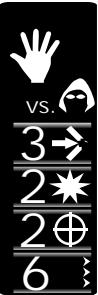
HIT: Comparing Annie's Point rating of 8 to Grok's 2+5 Stealth, the attacker is better by 1.
Challenge card says – a hit!
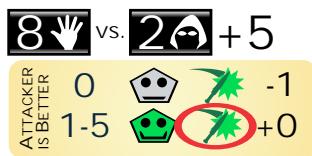
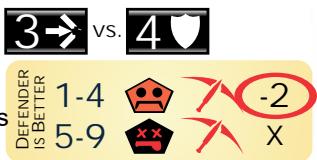
DAMAGE: The Tube's Power is 3, and Grok's Armor is 4, so the defender is better by 1.
The second challenge card shows -2 Damage. Because the Tube's Damage rating is 2, Grok takes no damage. _

The OpFire Phase
During OpFire (short for “opportunity fire”), the non-current team can take shots with ranged weapons at enemies that moved during the Move phase.
So, during Team White's turn, Team Black takes OpFire.
How to OpFire
A character can use only one weapon during OpFire.

A weapon's OpFire rating determines how many shots can be taken with the weapon during OpFire – usually 1 or 2. However, only one shot can be taken against any one target, AND only one shot can be made in any one space.
Enemies in the shooter's space
Remember that during the Fire phase, you could not fire if an enemy is in your space. But during OpFire, this is true only if an enemy begins their Move phase in your space, AND remains there. If he leaves, you are free to fire.
You can never fire at an enemy while he is in your space.
Selecting the target
You can attack a moving target in any space that the target moves into. Watch the enemy movement path during their Move. If you wish, place an unused marker in spaces to remember where an enemy moved.
You cannot attack a target in the space where he began his Move phase. You cannot OpFire at a target that does not use any move points. He's hiding. This includes enemies that fired in the Fire phase.
Making the attack
Name the target, select the space where you intend to take the shot and resolve the attack.
A “K” weapon is lost immediately after killing or imprisoning an enemy.
So, if you have an OpFire 2 weapon and you kill your first target, you cannot take the second shot.
OpFire for other reasons
There can be other actions later in the rules that require the use of move points, such as unleashing a Sentinel.
Since OpFire is allowed against anyone that uses Move points, you can OpFire at an enemy that takes these special actions, even if they do not move out of their space.
“Smart opponents won't be easy targets. Surprise is important. Don't act like you have a weapon. Don't reveal your weapon until you have a good shot."

TRAINING TRIAL 2 – CROSSFIRE
Single and Area Weapons
Ranged weapons are either single or area target.
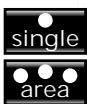
Single target
A single target weapon attacks one target with each shot.
The shooter chooses his target and resolves the attack.
It is possible to accidentally shoot your friends, if you shoot at a target that is in a space containing one of your allies. In this case, if you fail to Hit your target, the enemy chooses an ally in that space. You must attempt the same attack against that enemy.
This does not apply if your target is flying (see later).
This does not occur if the space has other enemies only. It must contain an ally.
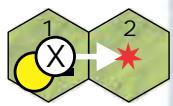
If Mr. Yellow shoots at X and misses, he must make the same attack against his ally P.
Area target

An area target weapon attacks everything in the target space. Make the attack against every enemy and ally in the space.
Important! Unlike other situations, a “K” area weapon is not lost immediately upon killing a target. You must resolve the attack against every target in the space before the weapon is lost. This is still true even if you draw the Weapon Broken challenge card.
During OpFire, choose a moving target and a space that he moved into as your primary target. Every target that is in that space or moved into/through that space during their Move is attacked.
Area weapons cannot target same space
You are not allowed to target the same space with an Area weapon more than once in the same phase.
Example: It is the Fire phase and there are two enemies in a nearby space, X and Y. You have an area weapon. You target X and attack them both. You cannot take a second shot by targeting Z.
OpFire Examples

To demonstrate, Mr. Yellow will be the shooter. X and Z have graciously been volunteered to be targets.
X is moving from 2 to 3. He cannot be targeted in his starting space (2), but can be targeted in 3.

X is safe. He cannot be targeted in his starting space (2), and 3 is not in sight.

X is safe. He cannot be targeted in his starting space (2), and Mr. Yellow cannot fire into his own space.

X is NOT safe. He leaves Mr. Yellow's space, so he cannot prevent the shot in 2.
Either X or Z are safe. Mr. Yellow cannot fire two shots into the same space, so he gets only one shot in 2.
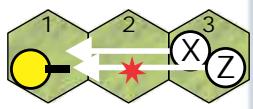
X and Z are NOT safe. X leaves Mr. Yellow's space, so he cannot prevent the shot, and Z does not prevent the shot by moving into Mr. Yellow's space.
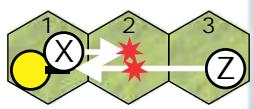
X and Z are safe. X remains in Mr.
Yellow's space, preventing OpFire.

X is safe. He refuses to move.

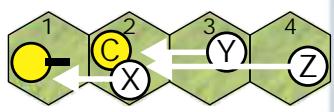
Mr. Yellow has an area weapon. If he fires in 3, he attacks Z only. If he fires in 2, he attacks Y, Z and his ally C.
"Arrright maggots! You wanna win, you gotta FIGHT!" acu Serae.tbis is
“Easy, Sarge, this is just training." "That's right, Whitebread, this is basic training! MOVE, YOU MAGGOTS!"
"Better do as the Sarge says. But don't forget to mosey 'round and greet a few encounters. If you get brawl-happy, you'll find yourself under-equipped. And adventurin' becomes mighty important in the real challenges. You can't win without adventurin'."
"You can't win without FIGHTING, “Alrighty, Sarge. Just remember, folks. Balance your fightin' and your adventurin'carefully.


"The Team Bases are key landmarks in all challenges. In Storming you wil learn to use, defend and assault these bases."
To Win
Storming lasts 10 rounds. At game end, count points. The team scoring the most wins:
– Per enemy base site destroyed at game end: 1
– Per enemy imprisoned at game end: 1
However, if at any moment your team has 6 points more than the opponents (as above), you instantly win.
Characters
| Team White Davy Crockett Devon Regal Minx and Jinx Perindor Victoria William Wallace | Team Black Gen. James Gavin Kit Carson Martians Phillip Redlegs Siennya The Scarlet Vixen |
The Map
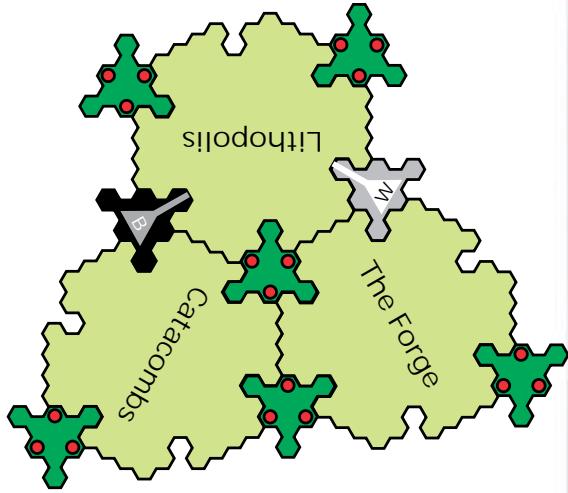
Set up the map as shown. The team bases are on the middle sides, with their openings facing inward as shown. Align the platters based on the text alignment below.
Prepare
-
Shuffle the common deck.
-
All characters begin the game off-map, and come into the game as explained later.
-
Each team draws 2 cards face down and places them in their Vault (lay them near the team base). You can look at your own Vault cards.
-
Encounters are not used in this Trial.

Dismissal and Banishment
Characters are often dismissed or banished, reappearing in a Dome.
Dismissal

Draw a challenge card and place the character in a Dome of the color shown. The Dome cannot already have a character. If there are no empty Domes of that color, place the character in an empty Dome of any color.
If multiple characters are waiting to be dismissed, you must finish dismissing one character before going on to the next.
Banishment

Banishment is the same as dismissal, but the enemy team draws a card and places the character.
Leaving a Dome
During the Move phase, a character that is in a Dome must leave the Dome. Characters can never remain in a Dome.
Adventure Challenges
Success Levels
Unlike Encounters, all other adventures require a challenge card draw, and are rated on five levels of success. When challenging adventures, draw a challenge card and look at thecolumn. The higher the level of success, the better your reward for the adventure.

FOPP – Failure of Painful Proportions.

FAIL – F-A-I-L.

SQUEAK – You manage to squeak by.


PASS – Congratulations, you succeeded.
AMAZE – Wild, jaw-dropping success!
Example: You challenge an Adventure that is rated 5 Wits. You have 7 Wits. You draw a challenge card and look at the Attacker is Better by 2 line. It shows Pass.

About Adventure spaces
You always challenge adventures during your own Adventure phase.
You are never required to challenge an adventure in your space. You can challenge adventures even if an enemy is in your space.
A character could adventure more than once in his Adventure phase, if he happens to be moved to a space containing an adventure. For example, if a character sneaks into the Main Gate of the enemy base (see next page), he can immediately attempt to destroy it.
Stealing Cards
Some rules and events in the game allow stealing cards. When stealing, the character being thieved selects the cards being stolen, not the thief.

TRAINING TRIAL 3 – STORMING
Team Bases
Team Bases are caverns. Each has seven sites – the three Gates, Vortex, HQ, Vault and Prison. During the Adventure phase, you can challenge different adventures at these sites.
Gates
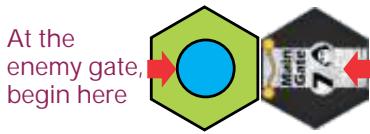
You can walk freely through your own Gates. But, you must challenge enemy Gates to gain entry. To challenge a Gate, move to the space in front of it – not to the Gate space itself.
The Main Gate is a 7 Stealth Adventure challenge. On Squeak or better, you successfully pass through the Gate. Move your character onto the Gate space. On Fail or worse, you do not gain entrance and remain on the outside space.
Move to here on Squeak or better
The High Gate is the same as the Main Gate, but is a Respect challenge. To enter the Low Gate, you must bribe the gate-keeper with one card.
Once inside the enemy base, you can exit any of the Gates freely, without challenging them.
Vortex
The Vortex heals the pure of heart. Only wounded allies of the Vortex can use it. The Vortex is a 5 Honor Adventure:

You heal 4 Health, then are dismissed.
Heal 2 Health, then dismissed.
Heal 1 Health. Dismissed.
Dismissed.
Banished.
Using your Vault
During Free Action, a character on his Vault space can take up to half (rounded up) of the cards out of his Vault. He can also put cards into the Vault before or after taking half. Enemies in the space do NOT prevent you from using the Vault.

Raiding the enemy Vault
A character on the enemy Vault space can attempt to raid it. This is a 5 Wits Adventure:
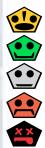
Take 4 random cards, then dismissed.
Take 2 random cards, then dismissed.
Take1 random card. Dismissed.
Dismissed.
Banished.

Interrogating prisoners
During the Adventure phase, a character on their Prison space can interrogate a prisoner that has cards. Challenge their Strength vs the prisoner's Strength:
Steal 4 cards from the prisoner, then you are dismissed.
Steal 2 cards, then you are dismissed.

Steal 1 card, then you are dismissed.
You are dismissed.
You are banished.

Breaking out prisoners
If you are in the enemy Prison space and an ally is in Prison, you can attempt to break him out. This is a 5 Strength Adventure challenge:
You break out two prisoners of your choice, and all three of you are dismissed.

You break out one prisoner of your choice, and both of you are dismissed.

You break out one prisoner of your choice, and both of you are banished.


Dismissed.
Banished.
Destroying enemy sites
If you are on any of the seven enemy base site spaces, you can attempt to destroy that site. This is a challenge against the site, or a 1-card payment in the case of the Low Gate.
So, destroying the HQ is a 5 Intellect challenge.
Site destroyed. Dismissed. Place your team marker on the space.

Dismissed.
Banished.
A destroyed site in your base causes ill effects for your team:
Destroyed Gates – Enemies move freely through destroyed Gates. Destroyed Gates still block sight.
Destroyed Vortex – You cannot use a destroyed Vortex.
Your team cannot gain current or ma
内容过长,此处只内联前一部分;完整内容请下载或到规则页阅读。
下载 Markdown原文为社区整理/出版社公开资料,版权归原作者,仅供个人学习查阅。