
EdoEdo
一句话概览
Edo 是一款已收录于村了吗规则库的桌游,支持 2–4 人,原名 Edo。
本页内容:一句话概览 · 游戏概述 · 1. 游戏组件 · 2. 游戏设置 · 3. 回合结构 · 4. 阶段一:秘密计划行动 · 5. 阶段二:执行计划 · 6. 行动详解 · 7. 阶段三:给付工资及收入 · 8. 阶段四:准备下一轮或判定游戏结束 · 9. 游戏结束与最终计分 · 关键规则与常见问题 · 常见问题
江戶(Edo)规则速览
以下规则速览由本站整理,与官方规则书表述不同,仅供快速上手参考。
游戏概述
在日本 1603 至 1868 年的江户时代,玩家扮演各藩大名,通过在棋盘上的城市里建造房屋、交易站和城堡来扩张势力与经济。最终获得最多胜利点数(VP)的玩家获胜——但前提是必须在江户城至少拥有一栋房屋,否则直接丧失获胜资格。核心流程围绕三张行动卡的选择与排列展开,通过秘密计划阶段决定当轮行动顺序,随后依次执行并配以武士部署、资源生产、交易站贸易与城市收入等环节。
核心机制: 手牌管理、工人放置、逆稀缺资源生产、建造规划、影响点瓜分
1. 游戏组件
| 组件 | 说明 |
|---|---|
| 大版图 | 印有 11 座城市及三个资源区(木頭、石頭、米) |
| 玩家用计划图板 | 每位玩家一块,用于安排当轮行动计划 |
| 行动卡 | 每人 3 张,每张含 4 种行动选择 |
| 特殊行动卡 | 从展示区抽取,每张提供 2 种可选效果 |
| 官员标记(将军) | 用于分配至行动卡以启动行动 |
| 武士模型 | 每位玩家使用自己颜色的单一色块担任武士 |
| 商人模型 | 沿既定轨迹在城市间移动 |
| 商人卡 | 面朝上放置在商人当前位置旁,提供交易选项 |
| 资源代币 | 木頭、石頭、米三种 |
| 金钱 | 每次官员指派至「金」行动时获取 |
| 分数轨标记 | 记录当前胜利点数 |
| 建筑板块 | 房屋、交易站、城堡(部分城市) |
| 利益表 | 每座城市一张,显示多玩家共存时的收入分配 |
2. 游戏设置
2.1 版图布置
- 将大版图置于中央,商人模型放在起始城市位置。
- 商人卡堆叠好洗匀后,翻开最上方一张面朝上放置在商人模型所在处。
- 将分数轨标记置於零格。
2.2 玩家个人设置
每位玩家获得:
- 1 块个人计划图板
- 3 张行动卡作为起始手牌
- 一定数量的起始金钱
- 一组官员标记
- 自己的武士色块
2.3 起始玩家确定
指定一名玩家为起始玩家;其后每轮结束前传递至左手边玩家。
3. 回合结构
每一轮由四个阶段按序进行:
- 秘密计划行动 —— 选择并排列三张行动
- 执行计划 —— 由起始玩家起依次翻开心中的卡片执行
- 给付工资及收入 —— 确认武士去留并结算各城市收入
- 准备下一轮或判定游戏结束 —— 更换商人卡、更新起始玩家、检查终局条件
4. 阶段一:秘密计划行动
所有玩家同时秘密选定本轮的 3 个行动——每个行动必须来自不同的行动卡(每人共 3 张卡,每张选其一)。选定后,玩家自行决定这三项行动的先后顺序,并将对应的行动卡片朝下放入计划图板的插槽中,从左到右排列。
4.1 指派官员
每一项行动在执行时必须至少有一名官员被指派到对应行动卡前;每名官员使该次行动得以启动一次。根据行动卡类型的不同,同一行动在本轮可被重复启动 1 至 4 次不等——每次需额外加派一名官员。若无任何官员被指派到某张行动卡上,该卡在当轮跳过不执行。
4.2 部署武士(边防站)
在行动卡上有「邊防站」这一选项。执行此行动时,玩家将一名官员派遣到版图上已开放的边防站位置,该官员从此变为一名「武士」驻留在棋盘上。此后即可参与需要武士在场的行动(如资源采集、建造等)。
- 每个玩家每次只能使用一个自己颜色的模型作为武士驻留(即同一时间仅有一个武将出现在地图上),但之前已经存在的旧武士可以保留不动。
- 在翻开行动卡之前,玩家可以自由移动棋盘上已有的任意数量武士到相邻或更远的位置——每移动一步花费 1 元。武士可与其他玩家的武士位于同一空间。
5. 阶段二:执行计划
起始玩家翻开自己的第一张行动卡(最左侧那张),然后执行所选择的行动——如果该行动因多次指派官员而需要执行多次,则一口气连续完成全部次数,中途不会被其他玩家打断。随后顺时针轮到下一位玩家,依此类推,直到三位玩家各自的两张行动卡(第一张、第二张、第三张)全部执行完毕。
以下按照行动类型分类详述各项效果。
6. 行动详解
6.1 只需官员的行动
下列行动只需要玩家将官员指派到行动卡上即可执行。
6.1.1 金钱
每指派一名官员到此行动,玩家从银行领取 5 元。
- 可启动 1 至 4 次。
- 玩家可以选择将获得的金钱堆叠起来,以此隐藏实际金额信息。
6.1.2 招募
花 1 单位的米,从银行招募 1 名新的将军官员。从下一轮开始,这名新官员可以被分配到计划图板上的行动卡中启动行动。
- 注意: 这类通过招募获得的纯官员标记不能用来放到版图上充当武士。
- 可启动 1 次(整局游戏限招一名)。
6.1.3 米
每指派一名官员到此行动,玩家从银行领取 1 单位米。
- 可启动 1 至 4 次。
6.1.4 漫遊
每指派一名官员到此行动,玩家可选择执行下方任一子行动之一:
| 子行动 | 效果 |
|---|---|
| 发展 | 花 5 元,从展示区获得 1 张特殊行动卡(补回展示区同等卡张数) |
| 部署武士 | 把官员派往边防站变成武士(见 4.2) |
| 移动武士 | 移动最多 2 个已在棋盘上的自己武士到新的位置(见 4.2) |
6.1.5 发展
每指派一名官员到「發展」行動,執行以下兩種效果之一:
| 选项 | 说明 |
|---|---|
| 特殊行動卡 | 花 5 元從展示區獲取一張特殊行動卡,同時在展示區補一張新卡。特殊行動卡在下輪計劃階段供你參考使用。 |
| 部署武士 | 派官員到邊防站成為武士(同上文)。 |
| 移動武士 | 移動最多 2 個已在棋盤上的自己武士到其他地方(同上文)。 |
特殊行動卡說明: 每張特殊行動卡提供 2 種可行的執行方式,為後續輪次的計畫提供更多選擇。詳細內容參見補充說明。
> 注:原文关于"发展"行动的描述有重叠之处——一种理解是:「發展」作為一種獨立選項,其效果包含獲取特殊行動卡和部署武士兩條路徑,視行爲而定。
6.2 需要官員與武士的行動
以下所有行動均需要:①將至少一名官員指派到對應行動卡;②在版圖上有至少一名己方武士駐留於特定區域。若要多次啟動某項行動,則每額外啟動一次需要額外加派一名官員並確保有對應數量的武士在所需位置。
6.2.1 資源生產(三種資源各有一個行動)
遊戲中共有三種資源:木頭、石頭、米。每种资源对应独立的资源区。
运作原理——逆稀缺效应: 资源区域内的武士总数(不论敌我)越少,玩家获得的资源就越多。每个区域内武士越多,单份产出反而越少。
- 每种资源持有上限:10 个。任何时候都不能超过。
- 获得的资源放在面前公开亮出,供所有玩家查看。
6.2.2 建築行動
玩家在想要建造的城市中必须有自己的武士,并且需要至少一名官员指派到建造行动中。
| 版本 | 每輪可啟動次數 | 條件 |
|---|---|---|
| 簡單版 | 最多 4 次 | 每官啟動 1 次 |
| 困難版 | 最多 2 次 | 城市中每有 1 個武士需指派 2 名官員 |
可建造的建築種類:
| 建築 | 费用 | 立即得分 |
|---|---|---|
| 房屋 | 需支付相應資源及金錢(具體費用參照源圖表格) | 是 |
| 交易站 | 需支付相應資源及金錢 | 是 |
| 城堡 | 需支付相應資源及金錢 | 是 |
建造限制:
- 每座城市最多容纳 10 栋建筑物。
- 新建筑必须沿着箭头方向放置在下一个空位——不可插隊。
- 每座城市只能建造 1 座交易站。例外:江戶城不能建造交易站。
- 城堡建造前提:
- 该城中至少有 2 栋房屋(可以是不同玩家的)。
- 建造者本人在该城中已有 至少 1 栋自己的房屋。
- 如果城中已有 1 座城堡,再建第 2 座需至少 4 栋房屋。
- 城堡建造者不受限于"自己的房屋"——只要满足前两个条件的任何人都能在此城建一座城堡(因为城堡被视为中立设施)。
> 重要提示: 源文中的建筑费用与即时分值以图片中的表格形式呈现,文本未提取到具体数字,故此处无法列出精确造价与得分。
6.2.3 交易行動
商人模型沿预设路线在各城市之间移动。每次打开新商人卡时,商人的位置会发生变更。
启动条件: 每指派一名官员到交易行动,就需要相应数量的武士站在商人当前所在的城市。
先行的商人移动: 在翻开行动卡之前,你可以提前将商人模型移动任意步数——每步花费 1 元。即使你当下并不想利用商人进行交易,也可以主动推动商人前进。
交易效果: 每张商人卡提供两种交易选项:
- 换取 1 个或多个资源;
- 或者换取 1 点分数。
特殊加成:如果商人所在位置恰好也是你拥有交易站的城市,你可以在单次启动的交易行动中同时获得资源和 1 点分数。
交易完成后,你将交换所得的资金和资源放回银行供应区,然后从银行领取相应的资源,并将得分标记推进相应格数。
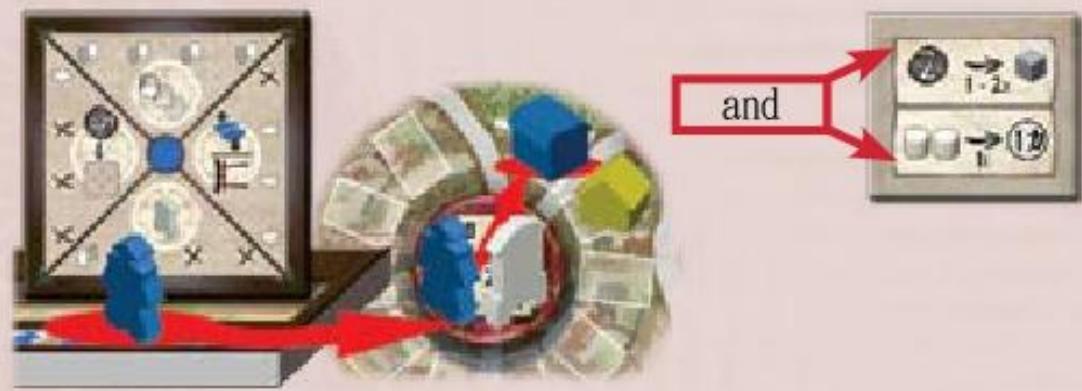
如果你想在同一次交易中执行两次——则需要两名武士分别站在商人所在的位置,并在行动卡上指派两名官员。
> 交易时,玩家随时都不能让任何一种资源的持有量超过上限(10 个)。
> 商人停留在资源区域时不影响资源生产的逆稀缺计算。
7. 阶段三:给付工资及收入
7.1 给付工资(武士留存决策)
由起始玩家开始,每位玩家依次决定自己棋盘上所有武士的去留——每个武士二选一:
- 留在棋盘上 —— 继续驻留在原处(或刚刚移动过的位置)。代价是每名留下的武士须消耗 1 单位米支付给银行。
- 收回成为官员 —— 将该武士变回一名将军官员,放入你的储备中供下一轮使用。
依次轮完所有玩家后进入收入结算。
断粮惩罚: 如果一名玩家没有足够的米来供养棋盘上的武士——他必须将所有在棋盘上的武士立刻撤回收回储备,无需逐一个个支付。
7.2 收入
每座城市中只要有建筑物存在,就能为该城中有建筑的玩家产生收入。
影响点(IP)计算:
| 建筑类型 | 贡献 IP |
|---|---|
| 交易站 | 2 IP |
| 房屋 | 1 IP |
| 城堡 | 0 IP(中立,不参与计分) |
收入分配:
- 若只有一个玩家在城中有任何建筑物 → 该玩家独享整座城市的钱。
- 若有两个或以上玩家在该城有建筑物 → 各玩家的 IP 相加得到总 IP,最高 IP 者获得利益表中最高的那份钱;第二名获得表中次高额度,依此类推。
- 平手处理: 如果两位玩家 IP 相同,比较谁先在该城建了第一个建筑——较早建造者优先获得更高额度的收入。
每座城市独立结算完毕后,进入阶段四。
8. 阶段四:准备下一轮或判定游戏结束
8.1 检查终局条件
本轮结束时检查两个条件,满足任一即触发游戏结束:
- 任意一名玩家已经达到 12 点胜利点数。
- 商人卡库已用完。
8.2 进入下一轮
若均未达到终局条件:
- 将当前使用的商人卡移除,并从商人居中牌库顶部翻出一张新卡面朝上放置到新的空缺位置。
- 起始玩家标记传递给左手边的玩家。
- 所有玩家收回手中的行动卡。
- 所有未用在行动卡上的官员移回个人的官员储备中。
9. 游戏结束与最终计分
一旦触发了终局条件,游戏立即结束,所有玩家开始最终计分:
9.1 获胜资格审查
如果一名玩家没有在江户城建有任何建筑物——该玩家直接被判定失去获胜资格(但仍可以继续完成计分以确认排名)。
9.2 最终得分项目
| 来源 | 计分方式 |
|---|---|
| 棋盘上的武士 | 每 1 名武士 = 1 VP |
| 金钱 | 每 50 元 = 1 VP |
| 已有的建筑得分 | 已在建造时计入分数轨的部分,维持不变 |
9.3 平手打破顺序
- 总资源数:将所有玩家持有的米、木頭、石頭的总量相加——多的获胜。
- 江户城 IP:比较两人在江户城的建筑所带来的 IP 总和——高的获胜。
关键规则与常见问题
易错规则
- 每张行动卡只能选一个行动 —— 三人手中各有 3 张卡,从中各挑 1 项组合成 3 个行动。
- 官员缺额时跳过 —— 如果某张行动卡上没有指派任何官员,整张卡在本轮被忽略。
- 逆稀缺效应 —— 资源区域里的武士(不论敌我)越多,每份产出反而越少。这是 Edo 独特的反直觉机制。
- 武士部署限制 —— 每个玩家每次只能使用一个自己颜色的模型在边防站上当武士。
- 交易站在每城限建一座,江户城禁止建造。
- 城堡的双层门槛 —— 需要城中有 2 栋房屋 + 建造者自己有 1 栋;已有 1 座城堡后再建的门槛升至 4 栋房屋。
- 断粮惩罚一次性全撤 —— 不是付多少留多少,而是米不够就直接清空所有武士。
- 收入平手看谁先建 —— IP 相同时,优先建造者获更高档收入。
- 商人移动不计入任何行动步骤 —— 它是行动卡翻开之前的预备动作,可随时主动推进商人(每步 1 元)。
- 12 VP 或商人卡耗尽任一达成即结束 —— 不需要两个条件都满足。
- 江户城无建筑直接出局 —— 终局时不在江户城建有房屋的玩家丧失获胜资格。
- 资源上限 10 枚/种 —— 任何时候都不得超过,包括通过交易获得的瞬间。
常见问题
-
Q:可以在一个行动卡上对同一行动重复执行吗?
A:可以。只要指派多个官员到同一张卡上的同一个行动,就可以连续执行多次。 -
Q:商人移动到资源区会影响资源产量吗?
A:不会。商人停在资源区对逆稀缺计算公式没有任何影响。 -
Q:如果我想在同一回合既买木头又换分怎么办?
A:取决于商人卡的选项。如果商人卡允许资源+分数同时进行(如你在有交易站的城市且有对应加成),则可以一次完成。否则两种选择通常只取其一。 -
Q:如何获取特殊行动卡?
A:通过「发展」行动花 5 元从展示区抽取。每抽一张,展示区补一张新卡。 -
Q:每轮结束后官员怎么重置?
A:所有未被用在行动卡上的官员回归玩家的个人储备,可用于下一轮重新指派。
常见问题(FAQ)
以下 1 条问答中 0 条来自站内玩家的真实提问,其余 1 条为本站整理的常见疑问;答复内容保持原样。
Edo支持几个人玩?
2–4 人。
去哪查完整规则
想核对具体规则细节、卡牌效果或某个回合的结算方式,可以在村了吗里选中这款游戏后直接提问。
同类桌游
- 卡坦岛德式
- 工业革命:伯明翰德式
- 勃艮第城堡:特别典藏版德式
- 方舟动物园德式
- 卡卡颂抽象
- 瘟疫危机传承:第一季美式
- 阿瑞迪亚:勇踏征途美式
- 重塑宇宙德式
- 幽港迷城美式
- 埃多拉的德鲁伊德式
规则原文(Markdown)
本站收录这款游戏的规则原文 3 个文件,此处内联渲染 3 个,可直接展开阅读或下载。
rules_zh_Edo_2808.md15.7 KB
TOKYO 1603-1868
日本的1603到1868年
天皇的權位衰弱—經過德川宗族的大名嚴峻的統治之下,保障了天皇領地的和平。原本無足輕重的江戶漁村成為了新的政府所在地,並且迅速的崛起成為日本最重要的城市—這個城市就是今日我們所熟知的東京。
為了要在這時候從陰謀中保護他們,德川宗族需要每個大名定居在江戶,同時也花了相當部分的時間發展他們在這個地區的財富。
武士放下武器了,而最棒的他們現在服伺他們的領主如同管事一般。如果他們在亂世對將軍主張的權力沒有質疑的話,一個大名或許會從其他宗族得到更廣泛的影響力...。
遊戲目標
玩家扮演大名的角色,建造房屋、交易站以及城堡來發展江戶城的周遭環境。
遊戲中他們藉由建築和交易並在遊戲結束時從手上的錢和武士來得到分數。
最後計分時最多分數的玩家獲勝—但是他必須至少建有一棟房屋在江戶城。
遊戲流程
遊戲持續進行數輪,每一輪有 4個階段:
階段 1:秘密計畫行動
- 階段 2:執行行動
- 階段 3:給付工資及收入
- 階段 4:準備下一輪或遊戲結束判定
階段 1:秘密計畫行動
每個玩家有 3張行動卡。每張卡有 4種不同的選擇。
a) 選擇 3個行動
所有玩家同時祕密地選擇他們這輪想執行的 3個行動。
玩家只能從每張行動卡中選擇 1項行動。
選擇他們的行動之後,每個玩家決定他們執行這些行動的順序。他們把行動卡放到他們的計畫圖板的插槽中,從左到右依序把選定的行動朝下播放。
b) 指派官員
為了啟動行動一次,玩家必須把1個官員放到他的計畫圖板上的行動卡前。
根據行動卡的種類,每個行動可以藉由佈署適當數量的官員來啟動最多 4次。
注意:如果沒有官員指派到一張行動卡上,該行動會被跳過。
在所有玩家已經結束他們的計畫,前進到階段 2。
階段 2:執行計畫
起始玩家翻開他的第一張行動卡(最左邊的)並且執行該行動卡。如果一個玩家啟動一個行動超過一次。他執行該卡全部的行動無須中斷。然後順時針的下一位玩家執行他們的第一個行動。玩家重複進行這個流程直到中間的第二張行動卡、第三張行動卡都執行完。
行動細節
藉由這些行動,玩家得到資源、建造建築、交易、招募新的官員,並且把他們的武士放到遊戲圖板中。一些行動只需要指派官員到計畫圖板上,然而其他的行動還需要有玩家的武士存在於圖板上的特定區域。每個行動會指示可以啟動多少次藍色玩家翻開他的第一張行動卡,並且執行選定的行動兩次。
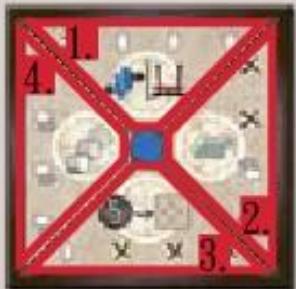
行動卡上可能的 4個行動。
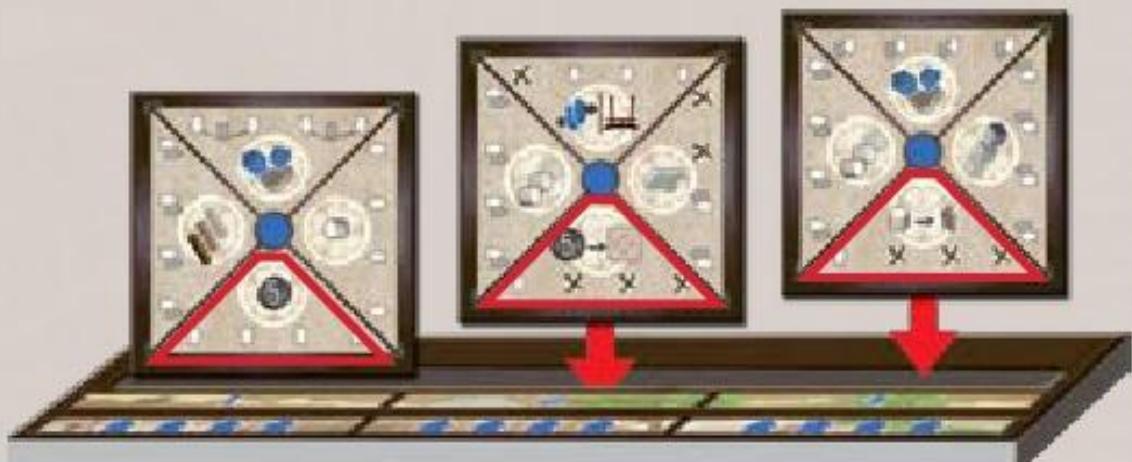
在計畫圖板上,選定的行動朝下放置。他們會從左到右依序執行。
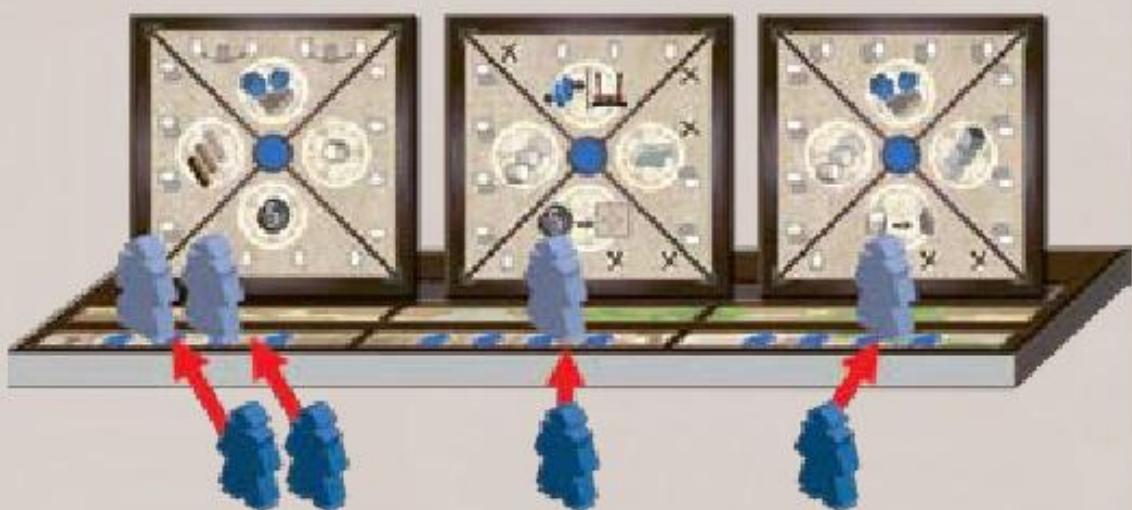
藍色玩家計畫執行第一個行動兩次,並且執行第二、第三張一次。

注意:一個玩家或許會喪失一或更多次行動的啟動。
一個官員佈署到圖板上就變成武士。
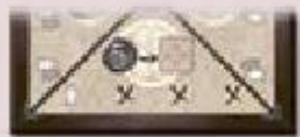

這個行動可以被執行1次。
這個行動可以最多被執行4次。
可以啟動 1-3次,兩種可能的選擇
只需要官員的行動
為了啟動下列的行動,一個玩家只需要指派官員到計畫圖板上的行動卡上。除非有其他指示,每個官員指派到一個行動卡上,啟動該行動一次。
金錢

每個指派到這個行動的官員,玩家從一般供應區拿到 5 元。
可以啟動1-4次
注意:玩家可以堆疊錢幣來隱藏金錢資訊。
招募

可以啟動1次
花 1 米,玩家從一般供應區招募 1 個新的將軍官員。下一輪開始,他可以指派新的官員到他的計畫圖板上。這種官員不能放在圖板上當作武士。
米

每個指派到這個行動的官員,玩家從一般供應區拿到1米。
可以啟動1-4次
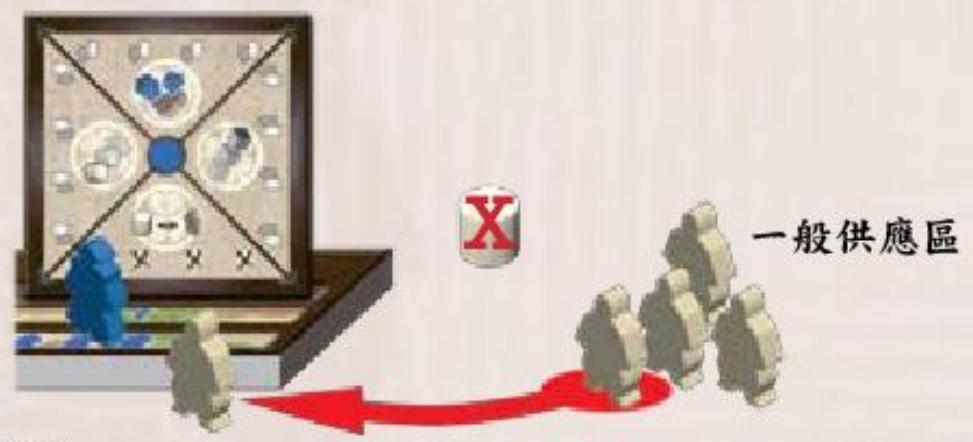
一般供應區
漫遊
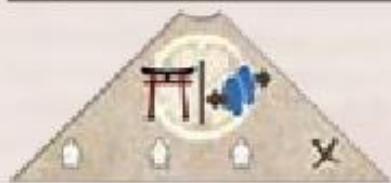
每個指派到這個行動的官員,玩家必須決定他要執行哪個行動。
發展

可以啟動1次
花 5元,玩家獲得 1張新的特殊行動卡。從展示區拿一張新的特殊行動卡就補一張新的在展示區。
把官員派遣到圖板上的邊防站當武士:

重要:玩家只能使用一個他自己顏色的模型當武士。

每張特殊行動卡提供 2種行動的效果,並且給玩家在接下來的計畫階段有更多的選擇。
或者:移動最多 2個他自己在圖板上的武士到新的地方。所有玩家的武士都可以站在同一個地方。

請見補充表上關於特殊行動卡的細節描述。
需要官員和武士的行動

為了要啟動像這樣的行動,玩家必須指派 1個官員到他的計畫圖板上,並且必須有 1個他自己的武士在圖板上的特定區域。
為了要啟動這個行動多次,他必須每有1個官員在計畫圖板上,就要有對應數量的武士在遊戲圖板上來啟動這個行動多次。根據他的武士的區域,他可以在一個或許多地方執行這些行動。
在翻開他的行動卡之前,一個玩家可以移動他遊戲圖板上任何數量的武士。武士可以移動進有其他武士的地方。每移動武士1步,玩家就要花費1元。
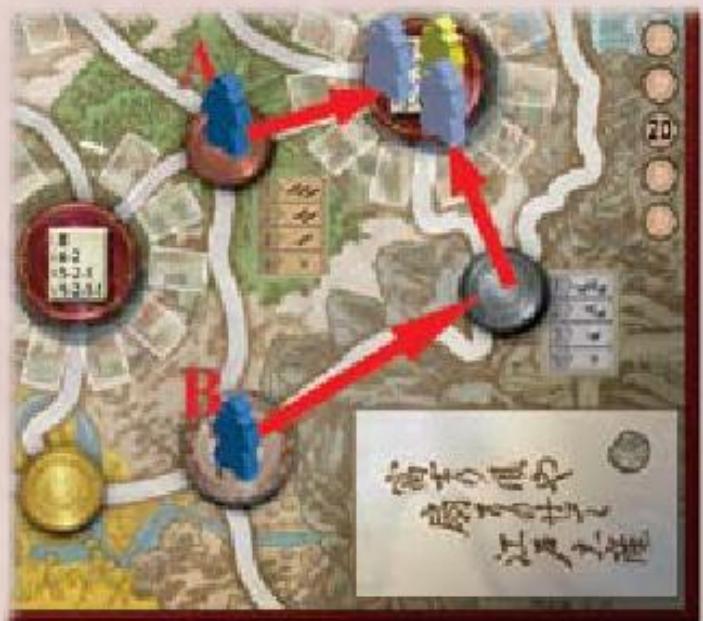
移動武士 A,藍色玩家必須花 1元。
並且花 2元移動武士 B。
資源行動
遊戲圖板上的資源區域:


石頭
木頭
可以啟動1-4次
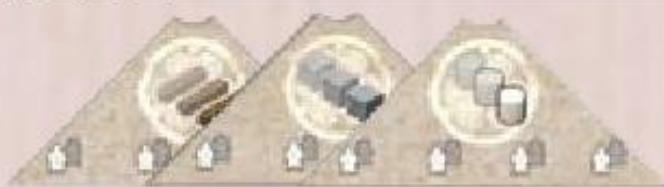
資源的種類有 3種—木頭、石頭以及米;每種資源有對應的行動來生產,遊戲圖板上也有對應的資源區域。
為了啟動這個行動,每有1個官員指派到這個行動,玩家必須有他自己對應數量的的武士在該種類的資源區域。
有越少的武士在一個資源區域,玩家得到的資源就越多,無論這些武士是他的還是別人的。
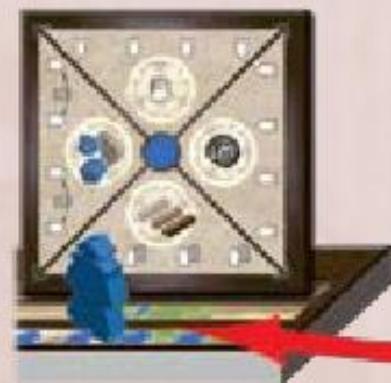
藍色玩家可以啟動這個行動,因為他其中一個武士在遊戲圖板上的木頭資源區。

因為 3個武士(2個藍、1個黃)在木頭資源區,藍色玩家得到 1木頭。

由於兩個武士在木頭資源區,藍色玩家啟動行動兩次,每個武士可以得到2個木頭,共得4個。

在這種情況下,藍色玩家總共得到 5個木頭:3個從區域A獲得(1個藍),以及2個從區域B獲得(1個藍、1個黃)。
玩家把資源放到他們面前讓所有家都看的到。
一個玩家在任何時候,每種資源都不能擁有超過10個。

建築行動
為了啟動這種行動,玩家必須在想建造建築的城市中有他自己的武士,且需要官員指派到計畫圖板上。

可以啟動1-4次
簡單版
這張行動卡能讓玩家執行建築行動最多 4次。
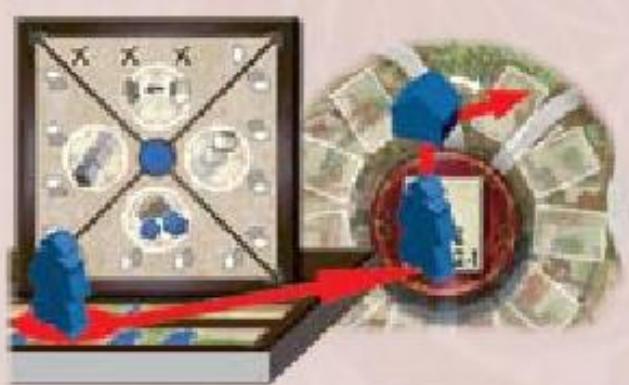
藍色玩家可以建造 1個房屋在這個城市中。

可以啟動1-2次
困難版
這張行動卡能讓玩家執行建造行動最多2次。但是玩家城市中每有1個武士,就必須指派2個官員來執行建造行動

藍色玩家只能建造 1 個房屋在這個城市中。
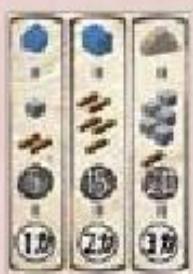
一個玩家可以建造他的房屋、交易站以及共有的城堡。
為了要建造一個建築物,玩家必須花費資源及金錢(見左邊的表格)。當建造時,他馬上得到分數。把花費的資源及金錢放回一般供應區,並且移動分數軌的分數。
建造規則
每座城市可以容納10個建築物。
每個新建築必須順著箭頭方向放到下一個空缺的位置。

每座城市只能建造 1個交易站。
例外:江戶城不能建造交易站。
江戶城的義務建築:
遊戲結束時,玩家必須在江戶城至少建有1棟房屋,來取得贏得遊戲的資格。
交易行動

交易讓玩家可以根據目前的商人卡交換資源及分數。
可以啟動1-2次
為了啟動這個行動,玩家每在他自己計畫圖版上指派一個官員到這個行動卡,就必須有對應數量的武士在商人模型目前的所在位置。
在翻開一張行動卡前,玩家可以移動商人模型任意數量的步數,每移動1步花費1元。即使玩家不想交易,他還是可以移動商人。
每張商人卡提供2種交易選項:
- 得到1或更多資源或者
- 得到1分。
如果商人及玩家的武士在一個有玩家交易站的城市,該玩家可以在單次啟動交易行動就獲得資源並得到1分。
玩家把任何交易後的金錢及資源放回一般供應區。然後他從一般供應區獲得資源,並且移動計分軌的分數。
如果玩家想啟動交易行動 2次,他們必須有 2個武士在商人所在的區域,同時也要有 2個官員指派到這個行動上。
城市裡每有 2棟房屋,一棟城堡可以被建造在城市中。
一個玩家必須在城市中至少有 1 棟他自己的房屋才能建造城堡。


在這個城市中,不論是藍色還是黃色玩家都可以建造一棟城堡,因為已經有兩棟房屋在城市中,而且這兩個家各有一個他們的房屋在這裡。
因為有一棟城堡已經建造在城市中,另一棟城堡不能被建造,除非這個城市至少含有四棟房屋。
注意:當前的商人卡位在商人卡牌堆的旁邊。

注意:交易時,玩家任何時候都不能超過資源數量上限。
注意:商人位在資源區時不會影響資源的產量。
階段 3:給付工資及收入
給付工資
由起始玩家開始,每個玩家必須決定遊戲圖板上武士的去留,不管是留在原來的位置還是把他收回當成官員,下一回合時用在計畫圖板上。如果是留在圖板上,1個武士要花費1米供養。等到起始玩家決定所有他的武士去留,其餘的玩家依順時針輪流決定。
收入
每棟有建築的城市都會帶來收入。如果只有1個玩家在城市中有建築物,他會得到整個城市給予的金錢。如果有2或更多玩家在城市中有建築物,金錢收入就會根據城市的利益表來瓜分。
玩家的交易站值 2點影響點數(IP);每棟房屋值 1 IP。城堡不會提供任何影響點數,它們是中立的。
一個城市中有最多影響點數的玩家得到利益表中最多的收入。其餘的玩家依據他們的排行得到對應的金錢。如果平手,比較早在該城市中有建築物的玩家得到較高的影響點數。
直到所有城市都計算後,前進到階段 4。
階段 4:準備下一輪或遊戲結束判定
檢查是否有玩家已經得到12分或者商人卡是否已經用完。
如果上述兩個條件其中之一都還沒達成...
...準備下一輪遊戲
- 移除遊戲中目前的商人卡,然後把商人卡牌庫上面那張放到右邊新的空缺位置。接著翻開商人卡牌庫上最上面那張(如果需要的話)。
- 起始玩家把起始玩家標記傳給左手邊的玩家。
- 所有玩家把行動卡收回手上,並且把官員放到計畫圖板旁邊。

藍色玩家有3個武士在圖板上。他決定留下2個在原地,1個收回到他的個人供應區。藍色玩家必須花費2米到一般供應區。

注意:一個玩家如果不夠任何數量的米給付,必須移除所有在圖板上的武士。

藍色玩家1 IP = 6元
紅色玩家1 IP = 2元
因為藍色玩家比紅色玩家還要早蓋建築物,他的影響點數較高。

紅色玩家2 IP = 5元
綠色玩家2 IP = 4元
藍色玩家1 IP = 2元
黃色玩家1 IP = 1元
紅色比綠色先蓋,而且藍色比黃色先蓋。
如果上述兩個條件之一達成...
...遊戲結束
玩家加總遊戲的最後計分:
如果一個玩家沒有建築物在江戶城的話,先從遊戲中淘汰不能獲勝。

所有玩家仍然有機會獲勝。所有在圖板上的武士1個1分。每有50元獲得1分的玩家獲勝。
如果平手,有最多資源的玩家獲勝(米、木頭及石頭加總)。如果還是平手,江戶城中有最多影響點數的玩家獲勝。

Edo_Regel_US.md17.1 KB
TOKYO1603-1868
In J from 1603 until 1868, the Emperor's position was weak – and in his place, a Shogun of the Tokugawa clan ruled with a stern hand to ensure peace among the Daimyos. The insignificant fishing village of Edo became the new seat
of government and soon emerged as the most important city in Japan – a city known today as Tokyo.
In order to protect themselves from intrigue during this
time, the Tokugawa clan required each Daimyo to take
up residence in Edo while also spending a considerable portion of their wealth to develop this region. The samurai are disarmed, and the best of them now serve their lords as stewards. If one does not question the Shogun's claim to power during these troubled times, a Daimyo may gain wide influence on other families..
长Object of the game
Assuming the roles of Daimyos, the players build houses, trading posts, and castles to develop Edo and its surroundings.
They gain power points for building and trading during the game, and for money in hand and samurai on the game board at games end.
The player with the most power points after the final scoring wins – provided he has built at least one house in Edo.
Sequence of play
The game lasts several rounds, with each round consisting of 4 phases:
Phase 1: Plan actions in secret a) Select 3 actions b) Assign officials
Phase 2: Perform actions
Phase 3: Collect wages and income
Phase 4: Prepare for the next game round or the end of the game
Phase 1: Plan actions in secret
Each player starts the game with 3 authorization cards. Each card allows 4 different actions, and each card has a different selection of actions.
a) Select 3 actions
Simultaneously and secretly all players select 3 actions that they want to perform during this game round.
Players can select only 1 action on each of their cards.
After having selected their actions, each player decides on the order in which they want to perform these actions. They slide their cards into the slot of their planning board, from left to right and with the selected action pointing downwards.
b) Assign officials
In order to activate an action once, the player must place 1 official on his planning board facing that card. Depending on its type, each action can be activated up to 4 times by deploying the appropriate number of officials to it.
Note: If no official is assigned to a card, that action is skipped.
After all players have concluded their planning, advance to Phase 2.
Phase 2: Perform actions
The starting player reveals his 1st authorization card (the leftmost one) and performs that action. If a player activates an action more than once, he performs all of these actions in a row, without interruption. Then, the other players in clockwise direction take their first actions. The players repeat this procedure for their 2nd authorization card (center), then for their 3rd authorization card (right).
The actions in detail
With their actions, the players gain resources, erect buildings, trade, recruit new officials, and place their samurai on the game board. Some actions require only the assigned official(s) on the planning board, whereas other actions also require the presence of one of the player's samurai on a certain space of the game board. Each action indicates how often it can be activated.

The 4 possible actions on this authorization card.

On the planning board, the selected actions point downwards. They will be performed in order from left to right.
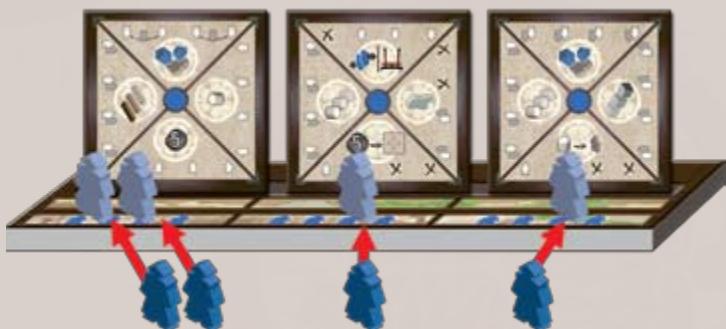
The blue player plans to perform the first action twice and actions 2 and 3 once each.

The blue player reveals his first authorization card and performs the selected action twice.
Note: A player may forfeit one or more activated actions.
An official deployed to the game board turns into a samurai.
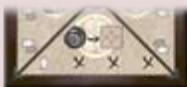

This action can be activated 1x.
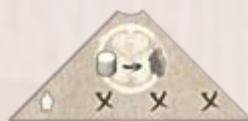
This action can be activated up to 4x.

Actions requiring only officials
To activate the following actions, a player needs only the officials assigned to that card on the player's planning board. Unless noted otherwise, each official assigned to an action activates it once (1x).
Money

Can be activated 1-4x
For each official assigned to this action, the player takes 5 Ryo from the common supply.
Note: Players may keep their money hidden by stacking it.
Recruitment

Can be activated 1-4x
Rice
For each official deployed to this action, the player takes 1 rice from the common supply.
Can be activated 1x

By spending 1 rice, the player recruits 1 new official of the shogun from the common supply.
Starting in the next game round, he may assign this new official to his planning board. This official may not be placed on the game board as a samurai.
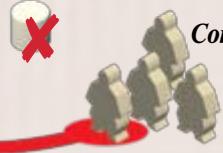
Common supply
Travel

Can be activated 1-3x Two possible actions
For each official assigned to this action, the player must decide which of two actions to take.
Development

Can be activated 1x
By paying 5 Ryo, the player claims 1 new special authorization card from the open display. Reveal a new special authorization card immediately.
Either: Send that official to Edo to serve as a samurai, placing it on one of the border posts on the game board.

Important: A player may use only a figure of his own player color as a samurai.

Or: Move up to 2 of his samurai already on the game board to new locations. Any number of samurai belonging to any number of players may share the same location.
Each special authorization card offers 2 more effective actions and gives the player more options during each subsequent planning phase.


See the supplemental sheet for a detailed description of the special authorization cards.
Actions requiring both officials and samurai

In order to activate such an action, the player must assign 1 official to it on his planning board and must have 1 of his own samurai on a particular space of the game board.
To activate this action more than once, he must have a different samurai on the game board for each official assigned to this action. Depending on the location of his samurai, he can perform these actions in one or in several spaces.
Before revealing his authorization card, a player may move any number of his samurai on the game board. Samurai may move to spaces containing other samurai. The player must pay 1 Ryo to the common supply for each space that he moves a samurai.
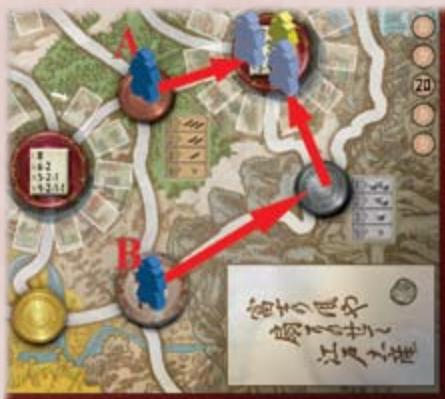

The blue player must pay 1 Řyo to the common supply to move samurai A ...

.. and 2 Ryo to move samurai B.

Can be activated 1-4x
There are 3 types of resources – wood, stone, and rice; each resource type
Resource spaces on the game board: • Wood
Stone
has a corresponding action to produce it, as well as corresponding resource spaces on the game board. To activate this action, the player must have one of his samurai on a corresponding resource space for each official on his planning board assigned to this action.
The blue player can activate this action because one of his samurai is on a wood resource space on the game board.
The fewer samurai that are on a space, whether his own or those of other players, the more resources the player receives.

Because 3 samurai (2x blue, 1x yellow) are on this wood resource space, the blue player receives 1 wood.

With two samurai on this resource space, the blue player can activate this action twice, receiving a total of 4 wood, 2 for each samurai.

In this case, the blue player receives a total of 5 wood: 3 wood from space A (1x blue), and 2 wood from spaċe B (1x blue, 1x yellow).
The players keep their resources in front of them, visible to all players.
A player may never have more than 10 resources of a certain type at any one time.

Building actions
To activate this action, the player must have one of his samurai in the city in which he wants to build for each official on his planning board assigned to this action.
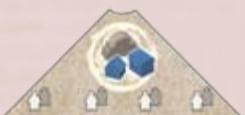
Can be activated 1-4x
Easy
This authorization card allows the player to perform the building action up to 4 times.

The blue player may build 1 house in this city.

Can be activated 1-2x
Difficult
This authorization card allows the player to perform the building action up to 2 times, but the player must assign two officials for each samurai overseeing the construction.

The blue player may build only 1 house in this city.

A player may build his houses, his trading post and the shared fortresses.
In order to erect a building, a player must spend resources and money (see the chart at left). When building, he gains power points immediately. Return the paid resources and money to the common supply, and mark power points on the power points track.
Building rules
Each city can accommodate 10 buildings. Each new building must be placed on the next free building space, in the direction of the arrow.
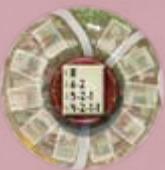
Only 1 trading post may be built in each city.
Exception:
No trading post can be built in Edo.
Obligatory building in Edo
At the end of the game, a player must have built at least 1 house in Edo in order to qualify for winning the game.
Trading actions
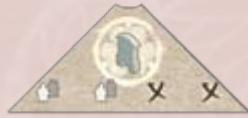
Can be activated 1-2x
Trading allows players to exchange resources and power points based on the current merchant card. To activate this action, the player
must have one of his samurai on the merchant figure's current location for each official on his planning board assigned to this action.
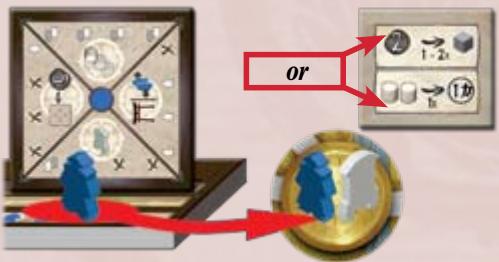
Before revealing an authorization card, a player may move the merchant figure any number of spaces, paying 1 Ryo to the common supply for each space to which the merchant moves. A player may move the merchant even if he does not want to trade with him.
Each merchant card offers 2 trade options:
• Receive 1 or more resources or
• Gain 1 power point.
If the merchant and the player's samurai are in a city containing that player's trading post, the player may receive resources and gain 1 power point with a single trade action.
The player returns any resources or money he expends for the trade to the common supply. He then receives resources from the common supply and marks gained power points on the power points track.
If a player wants to activate the trading action 2x, they must have 2 samurais on the merchant's space as well as 2 officials assigned to this action on their planning board
For every 2 houses in a city, one fortress may be built in that city.
A player may build a fortress in a city only if he owns at least 1 house in that city.

In this city either the blue or the yellow player can build a fortress as twò houses have been built in the city and each player owns one of these houses.

Since one fortress has been built, another fortress cannot be built in this city until it contains at least four houses.
Note: The current merchant card lies in the box next to the merchant card deck.
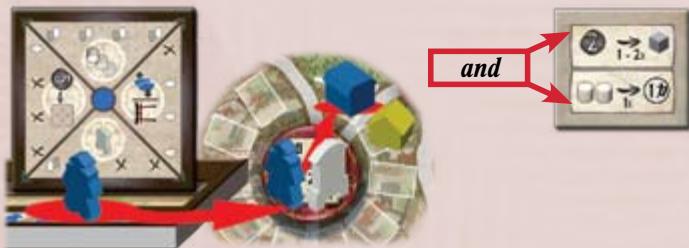
Note: When trading, a player cannot exceed the resource limit at any time.
Note: The merchant's presence on a resource space does not affect the production of that resource.
Phase 3: Collect wages and income
Wages
Beginning with the starting player, each player has to decide for each of his samurai on the game board whether he wants to leave the figure in place or return it to his planning board to be used as an official next round. For each samurai left on the game board, the samurais owner must pay 1 rice to the common supply. After the starting player has decided for all of his samurai, the other players follow in clockwise direction.
Income
Each city with buildings provides income. If only 1 player has built in a city, he earns the entire profit. If 2 or more players have built in a city, the profit is split among them based on their influence in that city.
A player's trading post is worth 2 influence points (IP); each house is worth 1 IP. Fortresses do not provide influence points; they are neutral.
The player controlling the most influence points in a city receives the largest share of the profit. The other players receive money according to their rank, in descending order. In case of a tie, the tied player who built prior to the other tied player(s) has the higher influence.
After all cities have been scored, advance to Phase 4.
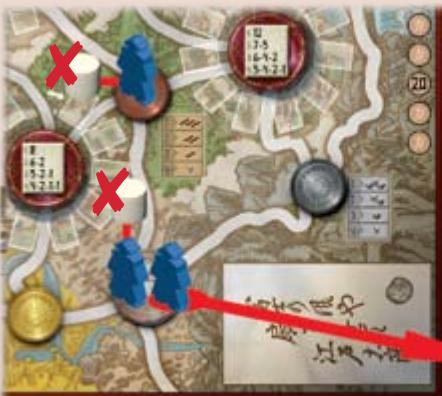
The blue player has 3 samurai on the game board. He decides to leave 2 of them in place and return 1 to his supply. Blue must pay 2 rice to the common supply.

Note: A player not owning any rice must remove all his samurai from the board.
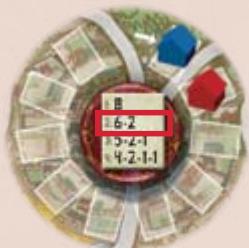
Blue 1 IP= 6 Ryo
Red 1 IP = 2 Ryo
Because Blue built prior to Red, his influence is higher.

Red 2 IP = 5 Ryo
Green 2 IP
= 4 Ryo
Blue 1 IP
= 2 Ryo
Yellow 1 IP
= 1 Ryo
Red built prior to Green, and Blue built prior to Yellow.
Phase 4: Prepare for the next game round or the end of the game
Check whether at least one player has gained 12 power points or more or whether the merchant card deck is exhausted.
If neither of these conditions has been met...
... prepare for the next game round
• Remove the current merchant card from the game, then move the face-up merchant card from the deck to the now empty space. Reveal the top card of the deck (if possible) and leave it on top of the deck.
• The starting player passes the start player marker to his neighbor on the left.
• All players take their authorization cards in hand and place their officials next to their planning board.
If 1 or 2 of these conditions have been met...
.. the game ends
The players conclude the game with the final scoring: If a player has no house built in Edo, he is eliminated
from play and cannot win.

All players still eligible for winning gain 1 power point for each of their samurai on the game board, and 1 power point for each 50 Ryo they own. The player with the most power points wins.
In case of a tie for the most power points, the tied player owning the most combined resources (rice, wood, and stone) wins. If this does not resolve the tie, the tied player with the highest influence in Edo wins.

简繁检索对照.md1.6 KB
114636_113636_edo — 简体/繁体检索对照
本游戏的规则书是繁体中文原文。用户用简体提问时,把关键词按下面这张表转成繁体再去 grep 原文,命中率最高。
回答时用简体或繁体都可以,但引用的原文保持繁体。
简体 → 繁体 对照(按该游戏原文出现频率排序,共 60 字)
| 简体 | 繁体 | 原文出现次数 |
|---|---|---|
| 动 | 動 | 127 |
| 个 | 個 | 103 |
| 这 | 這 | 34 |
| 资 | 資 | 33 |
| 员 | 員 | 30 |
| 图 | 圖 | 29 |
| 游 | 遊 | 28 |
| 启 | 啟 | 28 |
| 区 | 區 | 26 |
| 戏 | 戲 | 26 |
| 计 | 計 | 24 |
| 数 | 數 | 23 |
| 们 | 們 | 21 |
| 张 | 張 | 20 |
| 须 | 須 | 20 |
| 画 | 畫 | 20 |
| 执 | 執 | 20 |
| 蓝 | 藍 | 19 |
| 为 | 為 | 16 |
| 时 | 時 | 16 |
| 筑 | 築 | 16 |
| 阶 | 階 | 16 |
| 应 | 應 | 15 |
| 从 | 從 | 14 |
| 并 | 並 | 13 |
| 种 | 種 | 13 |
| 头 | 頭 | 13 |
| 来 | 來 | 12 |
| 获 | 獲 | 12 |
| 栋 | 棟 | 12 |
| 选 | 選 | 12 |
| 会 | 會 | 11 |
| 钱 | 錢 | 11 |
| 轮 | 輪 | 10 |
| 户 | 戶 | 9 |
| 给 | 給 | 9 |
| 两 | 兩 | 9 |
| 当 | 當 | 8 |
| 响 | 響 | 8 |
| 结 | 結 | 8 |
| 后 | 後 | 8 |
| 择 | 擇 | 8 |
| 还 | 還 | 8 |
| 对 | 對 | 7 |
| 该 | 該 | 7 |
| 开 | 開 | 7 |
| 边 | 邊 | 7 |
| 点 | 點 | 7 |
| 经 | 經 | 6 |
| 胜 | 勝 | 6 |
| 决 | 決 | 6 |
| 费 | 費 | 6 |
| 过 | 過 | 5 |
| 进 | 進 | 5 |
| 准 | 準 | 5 |
| 备 | 備 | 5 |
| 据 | 據 | 5 |
| 黄 | 黃 | 5 |
| 发 | 發 | 4 |
| 没 | 沒 | 4 |
原文为社区整理/出版社公开资料,版权归原作者,仅供个人学习查阅。