
附魔师Enchanters
一句话概览
附魔师 是一款已收录于村了吗规则库的桌游,支持 2–4 人,原名 Enchanters。
本页内容:一句话概览 · 常见问题
这游戏怎么玩
- 本站已收录这款游戏的规则资料,可以在对话里直接提问规则细节。
常见问题(FAQ)
以下 1 条问答中 0 条来自站内玩家的真实提问,其余 1 条为本站整理的常见疑问;答复内容保持原样。
附魔师支持几个人玩?
2–4 人。
去哪查完整规则
想核对具体规则细节、卡牌效果或某个回合的结算方式,可以在村了吗里选中这款游戏后直接提问。
同类桌游
- 卡坦岛德式
- 工业革命:伯明翰德式
- 勃艮第城堡:特别典藏版德式
- 方舟动物园德式
- 卡卡颂抽象
- 瘟疫危机传承:第一季美式
- 阿瑞迪亚:勇踏征途美式
- 重塑宇宙德式
- 幽港迷城美式
- 埃多拉的德鲁伊德式
规则原文(Markdown)
本站收录这款游戏的规则原文 1 个文件,此处内联渲染 1 个,可直接展开阅读或下载。
Enchanters-RuleBook-ang.md20.1 KB
ENCHANTERS
RAFAŁ CYWICKI
RULEBOOK

Game overview
You are the Enchanters - mighty heroes who defend helpless villages with their magic and wits. During the game, each of you will be crafting a powerful Magical Artifact to defeat hordes of attacking Monsters.
The aim of the game is to collect as many Glory Points (è) as possible. Item Cards (), Enchantment Cards (), Monster Cards () and Dragon Cards () will appear on the Journey Track. You must equip yourself with Items () and Enchantments () from the Journey Track in order to fight the Monsters () and the even deadlier Dragons ().
Box content
158 cards in total
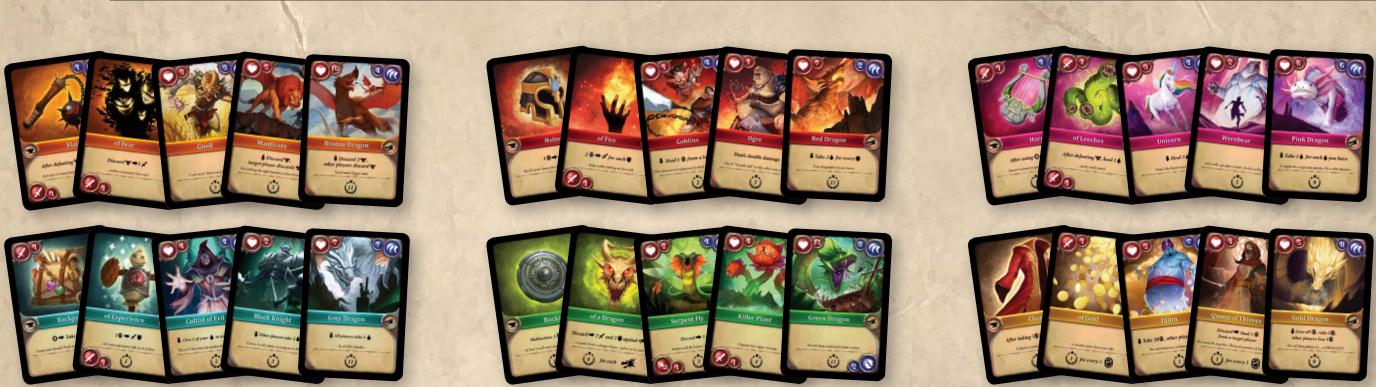
150 Kingdom Cards in 6 decks, each one consisting of 25 cards:
3 Items and 3 Enchantments (2 of each); 6 Minor Monsters, 4 Medium Monsters and 2 Major Monsters; 1 Dragon

33 Wound markers and 40 Crystal tiles
Wound: 25 with -1, 8 with -5; Cristal: 25 with 1, 8 with 3 and 7 with 10
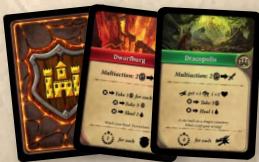
21 Village Tiles
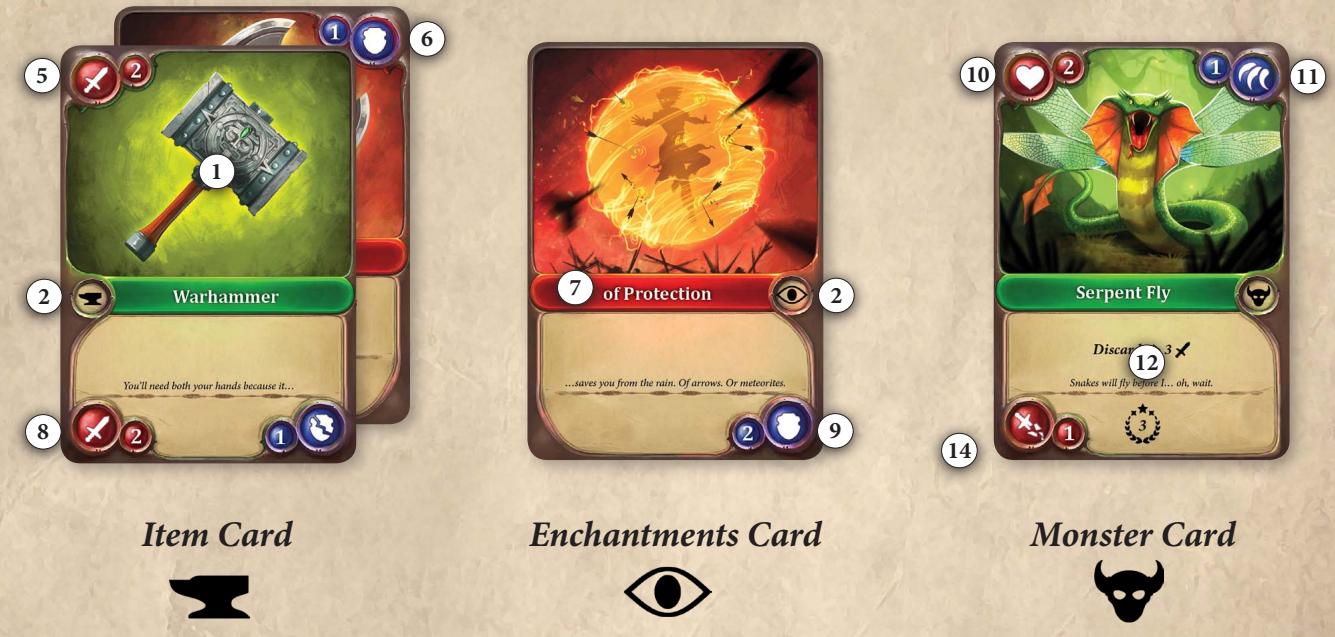
- Illustration; 2. Card type; 3. Village Rules; 4. Additional Glory Points; 5. Attack Points () or Negative Attack Points () (inactive after been covered); 6. Defense Points() or Negative Defense Points() (inactive after been covered); 7. Title of card; 8. Attack Points () or Negative Attack Points () (always active);
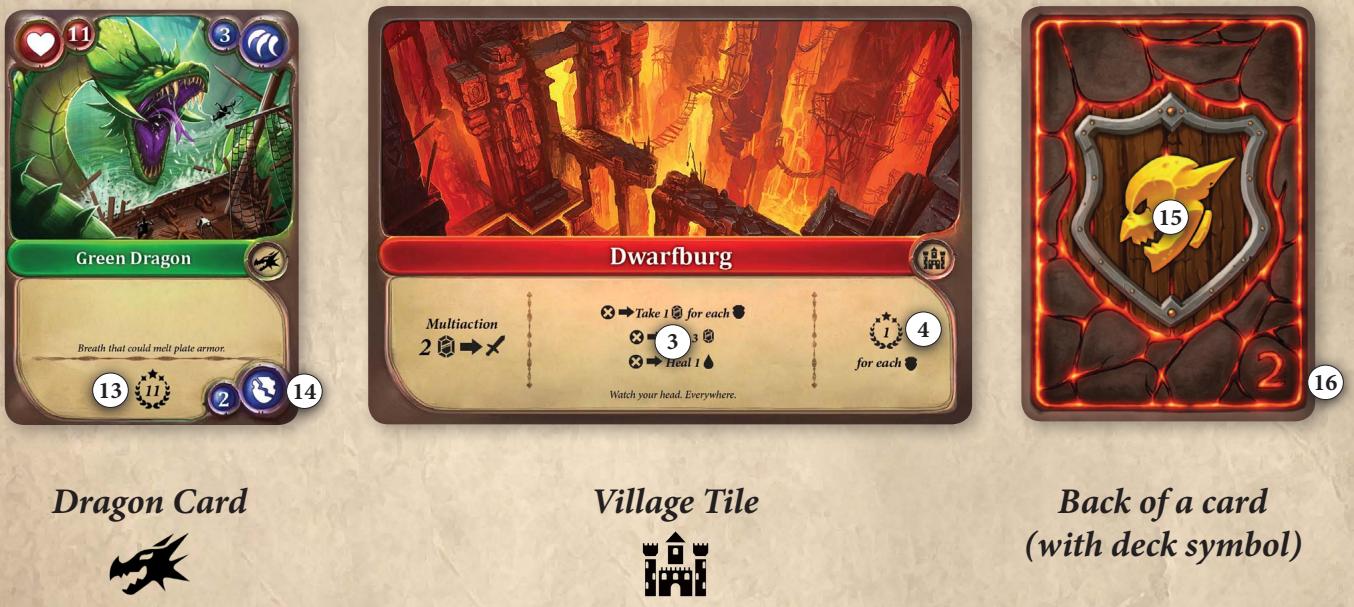
- Defense Points () or Negative Defense Points () (always active); 10. Monster's Health Points (); 11. Monster's Strength (O); 12. Card's Rules; 13. Glory Points (è); 14. Sometimes monster can modify players Defense or Attack Points; 15. Deck symbol; 16. "2" sign (for two player games).
Game setup
Each player takes 5 Crystals (). The remaining Crystals () and Wound ()markers should be placed within reach nearby.
- la aks
3 Each player chooses or randomly takes one Kingdom Deck. The chosen decks are then shuffled together to create the Adventure Deck.
In a two player game, each player chooses 2 decks. From the 4 selected decks, take only the cards marked with a "2" on the back, and shuffle them together to form the Adventure Deck.
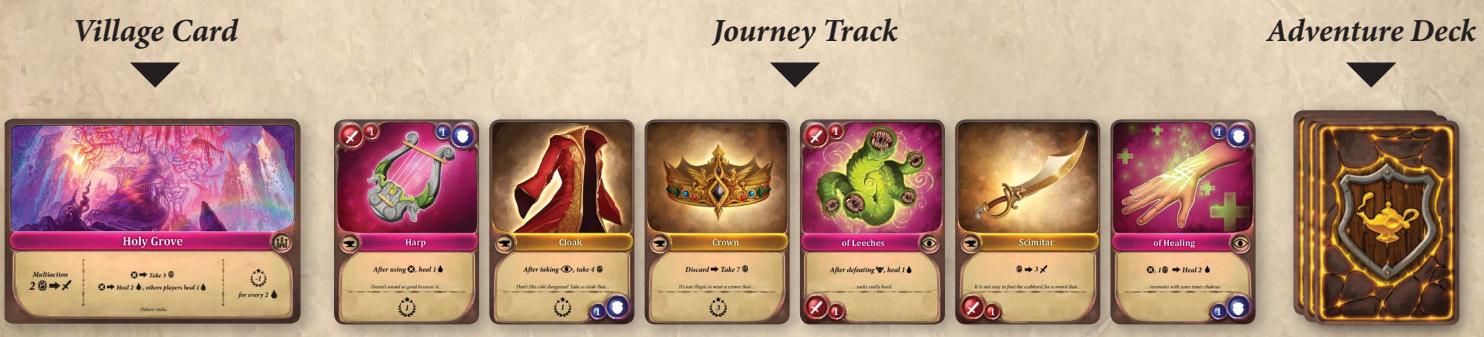
Look at the bottom card of the Adventure Deck. If it is a Monster () or a Dragon (), put it aside. Otherwise add it on the Journey Track. Keep putting Monsters () and Dragons () aside and adding Items () and Enchantments () to the Journey Track until there are 6 cards in the Journey Track. Then put the Monsters () and Dragons () you put aside back on the bottom of the deck.
Randomly choose one of the Village Cards $( \frac { \sqrt { 3 } } { 3 } , \frac { \sqrt { 3 } } { 3 } )$ and place it next to the first card of the Journey Track. $( \frac { \sqrt { 3 } } { 3 } , \frac { \sqrt { 3 } } { 3 } )$ are removed from the game and placed back into the box.
- The player who was most recently underground is the starting player and takes the irst turn.
Your magical artifact
Each player will craft one (and only one) Magical Artifact consisting of Item Cards () and Enchantment Cards ().
Item () and Enchantment () Cards a player takes from the Journey Track are placed in front of her in two separate piles, with Item () Cards on the left and Enchantment () Cards on the right.
The first Item () Card and Enchantment () Card are the "Fist" and "of Enchanting", each Player received during the setup.
Subsequent cards are placed on top of previous ones of the same type so that the lower part (under the horizontal line) of the previous card is always visible.
Defeated Monsters () and Dragons () are placed on the table in the same exact fashion in a third separate pile to the right of the player's Enchantment () Cards .
Covered card
The same rules apply to monsters and dragon cards.
Upper part inactive after covering

Lower part always active


Flow of the game
The game is played in turns. Each turn a player takes one Major Action and as many Minor Actions as he or she wishes, but each of them only once (unless they are described as "Multiaction").
Major Actions are:
Journey - the player takes a card from the Journey Track, paying Crystals () when applicable (see Major Action: Journey below for further explanation). This is basically the only way to obtain Item () and Enchantment () Cards and fight Monsters () and Dragons ().
Rest () - the player uses one of the available () options from the Village Card () or one of her own cards most of the time to heal Wounds () or collect Crystals (). If a player takes the Rest () action, the first card in the Journey Track is discarded at the end of his or her turn.
After each Major Action cards in the Journey Track are slid down to fill any empty spaces. A card is then drawn from the Adventure Deck and added to the last space of the Journey Track.
Some cards have passive effects which trigger upon certain events. For example: "after using ()," "after taking ()" or "when your turn begins." These effects are not considered to be an action and are mandatory.


Actions in general
All actions (except for the Journey) in the game can be described in the following manner:
Cost → Effect
Only after the Cost is paid, does the Effect take place. The cost must be fully paid, while the effect has to be implemented as much as possible.
The actions a player may take are the ones described on the Village () Card and the topmost cards of the player's own Item (), Enchantment (), Monsters ()/Dragons () Card piles.
Each action may only be played only once a turn, unless it's described as "Multiaction". The action's effect stays in play till the end of the player's turn.
Example (Scimitar): “3→”John pays 1 Crystal() and receives a +3 bonus to his attack () this turn.

Example (Normaltown):"Multiaction: 2" Martha may pay 2, 4, 6 or more Crystals () to receive an extra +1, +2, +3 or more Attack Points ( ) this turn. Martha pays 6 Crystals () to get 3 Attack Points ( ), so that she wins a fight with a Dragon Turtle.
Major Action: Rest ()
What Rest actions a player may take depends on the Village () Card and the topmost card of each pile the player has in front of him or her. Rest actions are always marked by asymbol preceding its cost.
should be read as: Take your Major Action as described on the card, then at the end of your turn discard the card on the Journey Track nearest to the Village () Card and reill as usual.
Rest actions are on every Village Card, but can be also found on some Item () or Enchantment () Cards.
Taking a Rest is a standard way of gaining Crystals () and healing Wounds ().

Example (Normaltown): “→3”Jack uses his Major Action to rest () and get 3 Crystals. Then, because he can't do anything else, he finishes his turn, discards the card nearest to the Village () Card, moves the remaining 5 cards on the Journey Track toward the Village () Card, draws a new card and places it after the last card on the Journey Track.

Major Action: Journey
Taking a Journey as your Major Action allows you to get a card from the Journey Track. The player must pay a number of Crystals () equal to the number of cards between his or her chosen card and the Village () Card. Journeys are the only way of getting new cards, whatever type they are: upgrades for the Magical Artifact or Monster trophies.


Example: Ralph wants to get the third card on the Journey Track. To do so, he skips over 2 cards, so he must pay 2 Crystals () to the general supply. Beth then decides to take the first card, so she gets it for free, as she didn't pass any other cards.
If a player has chosen an Item () or an Enchantment (), he or she takes the card and puts it in front of him or her as described in the section "Your Magical Artifact." If the player decides to fight a Monster () or a Dragon (), he or she must defeat it before she taking it. Rules of a fight are described in the section "Combat".
Immediate Effect
Some cards have an Immediate Effect () symbol, meaning the described effect must be implemented right after the chosen card is taken. However, the card is not considered to be a part of the player's Magical Artifact until after the effect is completed.


Combat
If, during a Journey, a player chooses to fight a Monster () or a Dragon (), the Combat will occur in the following order:
The Monster () attacks the player. The player is given a number of Wound () markers equal to the
There is no limit to the number of Wounds () players may receive, but at the end of the game, each Wounds () becomes a negative Glory Point ().
2 The pak the Monster () and put it on top of his or her Monster () Pile.
Sometimes, it may be necessary to buy additional Attack Points () in the Village () or activate Minor Actions on one's own cards to win a Combat with a Monster ().
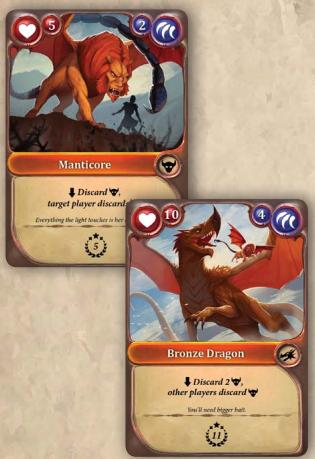
Example: Susan decides to fight a Manticore 2() 5(). She has 3 Attack Points () and 1 Defense Point (). The Monster () attacks first and deals her 1 Wound (). Susan decides to use a Multiaction available in the Village () of Normaltown twice - she pays 4 Crystals () to get a +2 Attack Point (). Susan now has a total of 5 Attack Points (), which is just as much as the Health () of the Manticore. She defeats the Monster () and adds it to her Monster () Pile.
End of the game
The game ends when all cards from both the Adventure Deck and the Journey Track have been taken or discarded. Every player sums all Glory Points $( \xi _ { \mathbf { \lambda } _ { \mathbf { \hat { \lambda } } } } ^ { \star \star _ { \mathbf { \lambda } _ { \mathbf { \hat { \lambda } } } } } )$ from his or her cards: Monsters (), Dragons (), Items () and Enchantments(). Each player must then add or subtract Glory Points () according to the rules below:
• Minus 1 Glory Point $( \xi ^ { \star \star } )$ for each Wound ().
• Additional Glory Points $( \xi _ { \pmb { \lambda } } ^ { \star \star _ { \kappa } } )$ as described on the Village () Card .

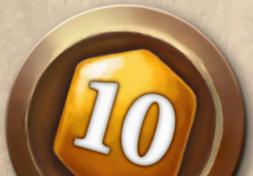


Example: Beth has killed 5 Goblins, 3 Gnolls, 2 Ogres and the Bronze Dragon - that gives her 40 Glory Points (). Unfortunately, she received 9 Wounds () during the game, so after subtracting this number from her score she is left with 31 Glory Points (). The game is being played in Dwarfburg, so Beth gets an additional 1 Glory Point () for every Defense Point () she has. On her cards, she finds 8 Defense Points (), so she adds 8 Glory Points and gets a final score of 39 Glory Points.
Variant: Fast invasion
If you prefer a shorter game, remove 5 cards from the Adventure Deck for every player that wants to participate.
Those cards have to be put in the box (outside the game), not on the discarded cards pile.
Variant: Super-Fast invasion
For an extremely short game, use only cards with "2" on their backs from each Kingdom Deck. Put the rest of the cards in the box (outside the game), not on the discarded cards pile.
Variant: Dragons in the depths
To make sure that Dragons won't come up too early, before you're ready for them, change the standard setup as described below:
Remove Dragon Cards () from the chosen Kingdom Decks.
Take half of the Adventure Deck.
Shuffle the Dragon Cards () into it and put it on bottom of the deck.


Frequently Asked Questions
1
Example: Richard has Necklace on top of his Items Pile (), so during his turn he may remove one of his Monster () Cards to get 7 Crystals (A).
If the text on a card doesn't refer to a particular card (e.g. Top Item), the owner of the targeted cards may choose, which card will be affected.

Example: John took Bolas from the Journey Track and chose Ann to discard one of her Monsters (). Ann has three Monsters (): a Gnoll on the bottom of her pile, a Unicorn in the middle and a Manticore on top, so she chooses to discard the Unicorn, as it's worth the least amount of Glory Points ().
3.
4atied
5eli the fight, leave the Monster's Card () where it was, and discard the first card of the Journey Track, as if a Rest Action $\textcircled{3}$ was taken.
$( { \star } { \star } ) .$ but keep in mind that some effects may only $( \varkappa ^ { \sharp } )$ and vice versa.
$( \ngtr _ { \frac { 3 } { 2 } } )$ icon means negative Attack Points (), and a Broken Shield () icon means negative Defense Points (). Players Attack () and Defense Points () can never go below zero.


Trap:
After taking this card from the Journey Track, the player must give this card to another player. The card is placed on top of the receiving player's Item () Card pile.
Bolas:

After taking this card from the Journey Track, choose a player (yourself included). That player must discard one Monster () Card of her choice from her own Monster () Card pile. The discarded card doesn't have to be the top card of the pile.
Roc:
After defeating this Monster (), but before adding it to your Monster () Pile, choose a player. That player must give you a Monster () of her choice from her own Monster () Pile. Put that Monster () on top of your Monsters Pile (), then put the Roc on top of it.

Manticore:
Manticore: after winning a fight with this Monster (), two things happen:

The player discards one of her own Monsters () from her Monster Pile, before adding the Manticore to the pile. If the Manticore is his or her first Monster (), she doesn't have to discard anything.

The player chooses one of the other players; the target player must discard any one of her Monster () Cards.
Bronze Dragon:
Same as the Manticore rules above. Remember, the Dragon () is not a Monster


Axe:
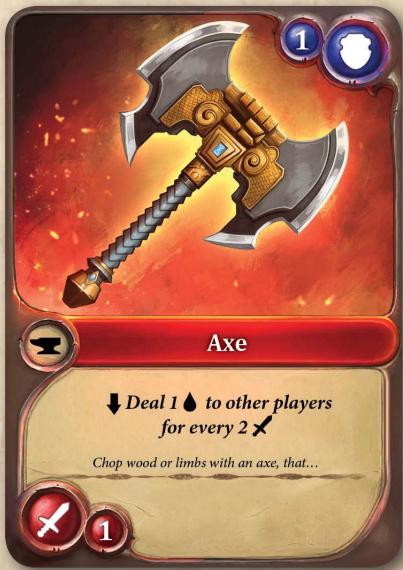
After taking this card, but before adding it to your Items Pile (), every other player is dealt 1 Wound () for every 2 Attack Points () you have. The Axe's 1 Attack Point () does not count towards this total as it is not yet considered a part of your Items Pile ().
Consider raising your Attack Points, before taking an Axe.

Chapel of Soulfire:
Journey to graveyard means that you can treat a top discarded card as a proper journey destination. If it is an item or an enchantment, take it (activate () abilities). If it is a Monster or a Dragon, you must first fight it (the same as if you had taken it from the Journey Track).
Note: the card removed from the Journey Track as part of a Rest action, is placed on the discard pile after the action is resolved.
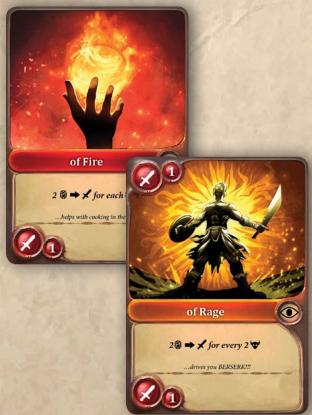
of Fire:
Upon activation, the player receives an Attack Point for every Defense Point he or she has. His or her Defense Points remain at the same value.
of Rage:
Upon activation, the player receives an Attack Point for every two Monsters he has.

Giant:
When a player fights this Monster (), during the "Monster's Attack" phase of the combat, resolve it for each player, one-by-one. Other players may NOT use any actions or effects during this attack (e.g. activate a Helmet). The number of Wounds () dealt may differ between players. The "Player's attack" phase goes by the standard rules.

Pink Dragon:
After winning a fight with this Dragon () count the total number of Wounds () you have. Then take the same number of Wound Markers () from the general supply and add it to the Wounds () you already have.

Ogre:
Double damage means that player receives twice the number of Wounds.
Example: Jack has 3 Defense and decides to take on an Ogre. Normally he would receive 3 Wounds, but since he's fighting an Ogre, he is dealt 6 Wounds instead.
Icon rundown


Monster Card
Dragon Card
Item Card
Enchantment Card
Village Card
Player's Attack
Player's Defence
Monster's Strength
Monster's Health Po
Wound Marker
Cristals, the game's currenc
The Cost — Effect action
Immediate Effect Action
Glory Points
Player's Negative Attack
Player's Negative Defence
The Rest Action


原文为社区整理/出版社公开资料,版权归原作者,仅供个人学习查阅。