
以太梦境Etherfields
一句话概览
以太梦境 是一款已收录于村了吗规则库的桌游,支持 1–4 人,原名 Etherfields。
本页内容:一句话概览 · 常见问题
这游戏怎么玩
- 本站已收录这款游戏的规则资料,可以在对话里直接提问规则细节。
常见问题(FAQ)
以下 1 条问答中 0 条来自站内玩家的真实提问,其余 1 条为本站整理的常见疑问;答复内容保持原样。
以太梦境支持几个人玩?
1–4 人。
去哪查完整规则
想核对具体规则细节、卡牌效果或某个回合的结算方式,可以在村了吗里选中这款游戏后直接提问。
同类桌游
规则原文(Markdown)
本站收录这款游戏的规则原文 1 个文件,此处内联渲染 1 个,可直接展开阅读或下载。
Etherfields_Rulebook_20_280x280mm-PAGES-20.md106.0 KB
ETHERFIELDS
All that we see or seem Is but a dream within a dream. - Edgar Allan Poe
GAME MANUAL2.0

All life is only a set of pictures in the brain, among which there is no difference betwixt those born of real things and those born of inward dreamings, and no cause to value the one above the other. - H. P. Lovecraft
TABLE OF CONTENTS
2 COMPONENTS 3 BEFORE YOU BEGIN 4 OVERVIEW / GAME SETUP STARTING THE CAMPAIGN
6 BASIC RULES DREAM GATE TILES DREAMSCAPE MAP OTHER DREAMSCAPE RULES
8 TURN ORDER DREAMERS & DREAMSCAPE PHASE RESHUFFLE SEALING/UNSEALING DISTRESS & DYING
9 DREAMERS ACTIONS MOVEMENT ACTION GRADUAL ACTIONS
10 ASSAULT/CONTACT ACTIONS BASIC ACTIONS CARD BOOSTING INTENT REROLLS INFLUENCE CARDS
11 PROGRESS INFLUENCE CARDS INFLUENCE MARKET ITEMS
12 DREAMSCAPE PHASE TURN CARDS ENTITY TILE, MOVEMENT, EFFECTS
13 STATE TOKENS MASKS CLOCK WISDOM CARDS AWAKENING
14 DREAMWORLD MAP SLUMBERS AND SLUMBER ENTITY MORPHINGS
15 FATE CARDS DELTA PHASE FLAW CARDS SHOPPING SEASON CARDS
16 SAVING YOUR GAME ADDING A DREAMER VARIANTS 17 FAO/CLARIFICATIONS
18 STRATEGY GUIDE
19 INDEX
20 RULES SUMMARY
CREDITS
GAME DESIGN: Micha OraCz
TESTING AND DEVELOPING (UNTIL DISTURBING SYMPTOMS
APPEAR): Krzysztof Belczyk, Bartłomiej Kalisz, Adrian Krawczyk,
Łukasz Krawiec, Ernest Kiedrowicz, Michał Lach, Jan Truchanowicz
TESTING AND DEVELOPING LEAD: Pawet Samborski
GRAPHIC DESIGN: Adrian Radziun, Andrzej Póltoranos
PAINTED EVERYTHING: Anna Myrcha, Ewa Labak, Michał
Peitsch, Patryk Jędraszek, Jakub Dzikowski, Piotr Orleański, Piotr
Foksowicz, Piotr Kryński, Łukasz Jaskulski, Maciej Łaszkiewicz
"Makilask", Michał Sałata “Fajna Wizja", Mateusz Bielski, Michał
Oracz
CHARACTER DESIGN AND BOX ART: Anna Myrcha BEAUTIFUL 3D FIGURINES: Jędrzej Chomicki, Jakub Ziółkowski, Piotr Gacek, Mateusz Modzelewski, Agnieszka Pogan, Marta Biernacka
BEAUTIFUL 3D FIGURINES LEAD: Adrian Komarski WORLD CONCEPT: Adrian Komarski, Anna Myrcha SToRY: Michał Oracz, Andrzej Betkiewicz GAME VISION AND PROMOTION: Marcin Świerkot PRODUCTION LEAD: Dawid Przybyła, Michał Mattosz RULEB00K 2.0: William Dovan, Michał Lach LAYOUT AND COMPOSITION: Jędrzej Cieślak, Michał Oracz, Patrycja Marzec, Rafał Janiszewski, Maria Pinkowska-Porzycka PROOFREADING AND EDITING: Tyler BrOWn THANK YOU VERY MUCH: Ken Cunningham, Christi Kropf, Jordan Luminais, Tony Nguyen, lan Sutton, Michael French, Joanna Brzezińska, Anna Gajdziszewska, Marta Syc, Kamil Maleszka, Maciej Wanicki, Kostek Weber. Thank you to all people who tested this game during its making. Special thanks to all Kickstarter backers who helped us to make this game a reality.
COMPONENTS So what is all this stuff that you spilled out of the box. DO NOT SHUFFLE ANY DECK UNTIL INSTRUCTED

First Player marker
Belshazar miniature

4 Dreamer miniatures (Gambler, Specialist, Tough Guy, Free Spirit)
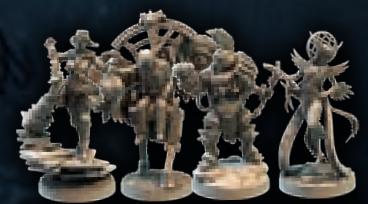
4 Lucid mode Dreamer miniatures They won't be used in the game until you discover how to open the Secret Mode decks during the campaign.

4 Human Shapeshifter miniatures

4 Creature Shapeshifter miniatures
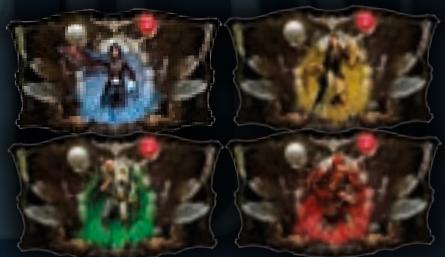
4 Dreamer boards

4 Lucid mode Dreamer boards They won't be used in the game until you discover how to open the Secret Mode decks during the campaign.

14 Masks (and 4 Mask stands)

4 Dreamer INFLUENCE decks (22 cards in each)

4 BASIC ACTIONS cards

5 Starting ITEM cards

4 packed Secret (Lucid) Mode decks (20 cards in each) Do not open them until instructed!
Starting INFLUENCE Market deck (81 cards) Influence cards without numbers or rules on their backs.During the campaign, many new cards from other Influence decks
(i.e. Dreamers Influence decks or Secret Influence cards) will be added to the Influence Market. 280 SECRET tiles
Don't look at them until instructed!
In this game, we use the term "tiles" for oversized 100x100mm cards.

12 TURN cards

Starting FATE deck (10 cards)

Starting FLAW deck (6 cards)

395 SECRET cards Don't look at them until instructed!


17 Dividers They are used to separate decks in the box.

Luck die

16 Ether markers Used to mark acquired Ether – experience gained by the Dreamers. Ether is spent to improve Dreamers, buy new Influence cards, etc. Ether is represented by in rules.

16 Distress markers Used to mark the distress, fear, fatigue, doubts, and wounds of the Dreamers. Distress is represented byin rules.

16 Universal markers Universal markers have many different uses that are defined by cards and rules Universal markers are represented byin rules.

Geis Precious gems that Dreamers may use during specific actions. Their significance expands during the campaign. Shining Gems are represented byin rules.


4 State tokens
Entity Movement die
20 Threat tokens
These are generic tokens that have many different uses defined by cards and rules. They mostly represent dangers or challenges. These tokens have two different sides. Threat tokens are represented by in rules.

4 Dreamer Personal tokens Take these out if the game instructs you to use them.
10 Story tokens If the game doesn't ask you to use a particular Story token, use any of them.


8 Terrain tokens

5 Spirit tokens


6 Block tokens Block tokens are represented by in rules.
12 Morphing tokens

77 Sign tokens Leave these in the box until you discover their meaning and rules on a card!


Hour Counter
Wall / Clock Hand token
6 Blank tokens


Hole token
15 Entity tokens
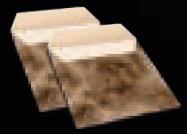

2 Dream Gate tiles envelopes
Wisdom card holders and 2 Dreamworld Map tile holders

Waste Bag When the game asks you to remove a token from the game, put it in the Waste Bag – it won't be used in the game anymore.

Secret Scripts book
STOP! BEFORE YOU BEGIN.
The large quantity of cards, tiles, tokens and other things in the box can be a little intimidating at first. This section will help you sort everything before your first game.
CARDS
1] Put the 4 card packs labelled "Do not open this deck" at one end of the card tray without opening them.
2] Unwrap the remaining card packs but keep them in order!

The vast majority of these are SECRET CARDS and can be identified by the card IDs in the top right corner on their backs. The card IDs start with a Roman Numeral (either I or II) followed by a number and sometimes a letter.
The Roman Numeral explains which campaign the card is from.
The Number places cards into smaller groups (i.e. all cards from a single Dream).
Lastly, each card (or multiple cards of the same type) will have one corresponding letter.
3] Organize these in order (you should find these mostly in the correct order when you unwrap them) and place them in the main long well of the core box. These cards will therefore be arranged like this:
I-01 A, I-01 B, I-01 C, ... I-02 A, I-02 B(x4), ... I-23 A and so on.
Don't panic if some cards seem to be missing – this is deliberate. A full list of of cards can be found at https://www.etherfields-secrets.com/forum/official-faq/list-of-all-secret-cards-and-tiles. The rest of the cards do not have IDs on their card backs. They are starting cards. They can be packed with their corresponding divider (see previous page):
The four
Dreamer Influence Decks.
Place a Basic Action card aid with each deck.
5 Starting Item cards

12 Turn cards
6 Flaw cards
10 Fate cards
81 Starting Influence Market cards
CARDS VS TILES
Unwrap the larger square cards and just like sorting the secret cards above, put them all in the larger storage well in the box. From now on, the larger square cards will be referred to as TILES, while standard sized cards will be called CARDS.
OTHER COMPONENTS
Unpunch all other components and sort them according to the section on the left. Be careful not to discard the blank tokens. The rest of the dividers can be put aside for now (a complete reference for this can be found on page 16).
GAME OVERVIEW
Etherfields is a narrative, cooperative deckbuilding campaign game for 1-4 players (or 5 with the 5th player addon) set in a fantastical world where a series of unique surreal dreamscapes await exploration.
The players take on the role of Dreamers and, throughout the course of the campaign, they discover their forgotten pasts and desperate missions.
Etherfields is an evolving game and as such, some of the rules will not be found within this rulebook – these will be explained as they are introduced gradually.
If this is your first time playing the game, choose a Dreamer character archetype below. Otherwise, go to GAME SETUP.
STARTING THE CAMPAIGN CHOOSING YOUR DREAMER
Each player chooses one of the Dreamers below to play andtakes the Dreamer's corresponding Influence Deck of 22 cards (which they then shuffle) alongside an additional Basic Action card, miniature and Dreamer Board.
Don't worry too much about your choice of Dreamers for now – later on you'll be able to switch them so just go with whichever one appeals to you.

THE GAMBLER is a good choice if you like to play with fate and roll dice. The Gambler often relies on luck, but she can also manipulate it. She likes to deceive others but considers it a game, not something serious. She has a problem with understanding the gravity of the situation, and, when she does, she pretends that there is no problem at all.

THE SPECIALIST is an expert engineer and craftsman. He relies on using Progress cards, which provide constant bonuses during the game and slowly builds a powerful game engine. He chooses peaceful discourses and indepth analysis over fast or brutal solutions. He has gathered more knowledge than the rest of the Dreamers altogether. He is a leader.

THE ToUGH GUY is tenacious and resilient. He prefers simple actions – mostly using brute force. He doesn't like prattling and thinking a problem over and over, but you may rely on him when you're in trouble. He won't hesitate to go as far as sacrificing himself. He may look grim, but he's rather cool and composed, until something unleashes his fury.

THE FREE SPIRIT likes to bend the rules. Even the basic rules of the game! She can't accept any barriers or laws, and she navigates her own path. She identifies with her soul and consciousness, she treats her physical body as something less important. Sometimes, she acts rather childish.
GAME SETUP
"Begin at the beginning," the king said, very gravely, "and go on till you come to the end: then stop."
- Lewis Carroll, Alice in Wonderland If this is the first time you are playing the game, only carry out the highlighted sections of the Game Setup. Otherwise, complete the entire Setup for each subsequent game.
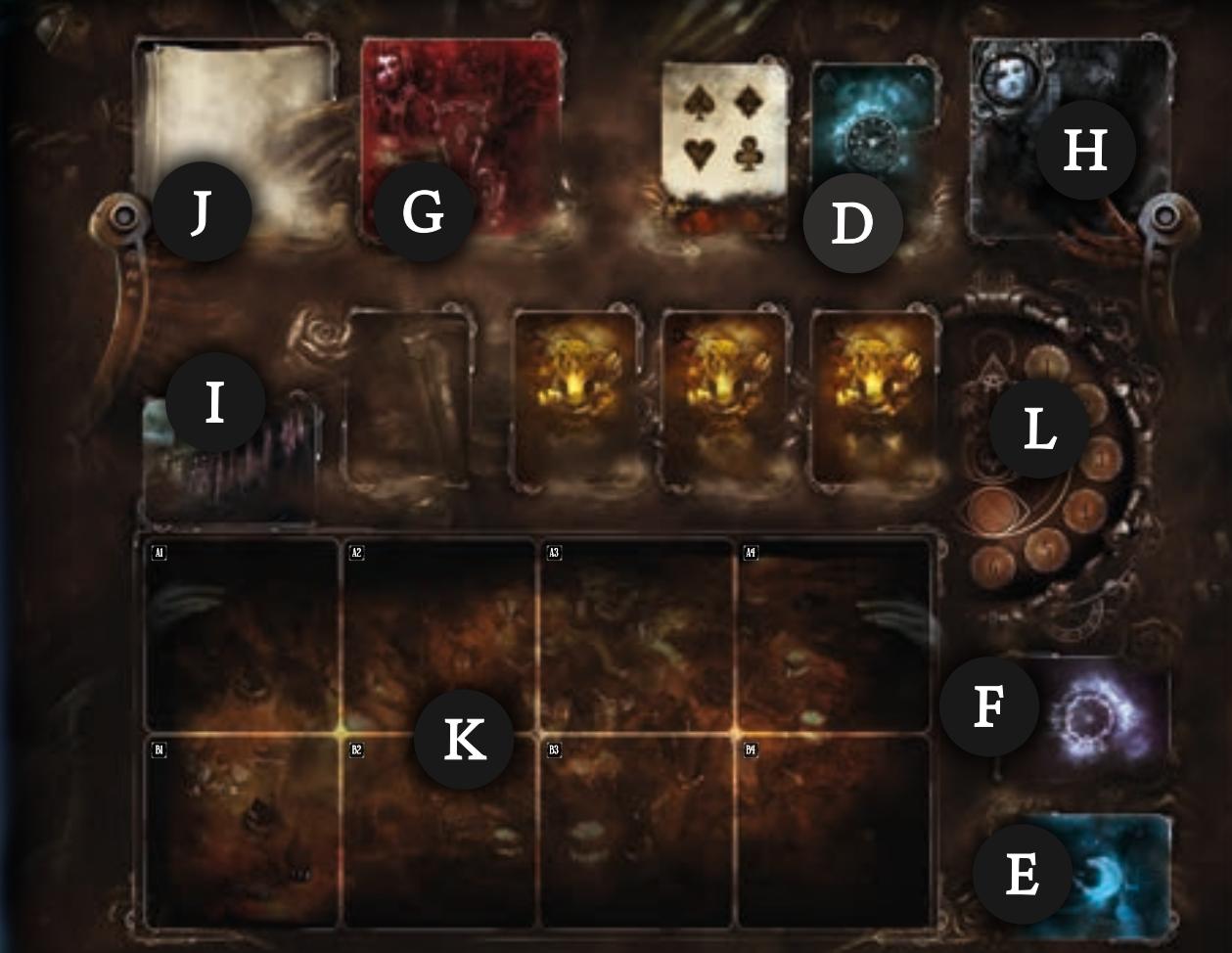
1] Place the game board down. A
2] Storage: Place all of your owner Note cards and Items here B . Note: if starting a campaign, you will not own any of these yet.
3] Dreamscape Board space: Place the 2 Setup Slumber Map tiles here C . If this is your first game, ignore this.
4] Each Dreamer places their chosen Dreamer Board, Influence Cards, Miniature and Basic Action Card in front of them.

DREAMER BOARDS DESCRIPTION
1 - Influence deck (face-down).
2 - Influence Discard pile (face-up).
3 - Gained
4 - Suffered.
5 - Active Progress cards zone.

5] Place the following into their positions:
a)Turn Cards D – Shuffle and place face-down on the Turn Discard slot.
b) Fate Cards E – Shuffle and place face-down on the Fate deck slot.
c) Slumber deck / Entity slot G – Set aside the Delta Phase Tile (green back), shuffle the remaining cards and place them on top of it. This is also a place for Entity tiles.
d)Flaws Cards F – Shuffle and place face-down on the Flaw deck slot.
e) Slumber Map Tiles H – Shuffle and place remaining tiles on the Slumber Map Tiles slot.
f) Season Cards I – Ensure that the top card is the same from your previous game.
g)Take out the Wisdom card holder housing all found Wisdom cards.
h)Dream Gate Tiles – Take out your available Dream Gate Tiles from the special envelop. When starting any Dream they will be placed on J. Do not do it yet!
i) Place all discovered Dreamworld Map Tiles on the Dreamworld Map board K.
6] Place all dice, tokens and markers in separate piles near the board. If they have been unlocked, both universal and personal Sign tokens can be placed out also otherwise leave these in the box.
7] Place the Hour Counter at the corresponding hour of the Clock based on how many Dreamers are playing: 1/2/3/4/5 Dreamers = 5/4/3/2/l Hours L
8] Resolve the Awakening Card starting from Step 4. After the "Placing 2 Starting/Setup Slumber Map tiles” step (the tiles are labelled on the back), place your Dreamers in any of the spaces.
Note: During this resolution, players may change their Dreamer, their Influence deck composition, and which Masks they want to make active.
IF THIS IS YOUR FIRST GAME,
YOU ARE READY TO START THE GAME
FAMILIARIZE YOURSELF WITH THE REST OF THIS PAGE. THEN, TAKE AND RESOLVE TILE 1-01X
(The First Dream Gate tile). To learn how to resolve this card continue to BASIC RULES on the next page)
ELEMENTS IN THE BOX
You can leave the following elements in the box (take them out as needed):
– Influence Market Deck – shuffle before drawing.
– Item Market – shuffle before drawing. If this is your first
game, the Item Market is empty.
– Secret Cards and Tiles – These stay presorted in order. Unused Masks.
Throughout the rest of the rulebook, these highlighted sections are designed to provide a small amount of guidance for the first game you play. The rulebook has been structured with the intention that you dive into the First Dream – the game's tutorial – without necessarily reading the rulebook cover-tocover but referencing it from time to time as you run into new concepts. This portion of the game is designed to slowly introduce you to all the rules.
REVEAL
Whenever the game asks you to reveal a card or tile with a specific code, find it in the Secret deck/tiles (by checking the code on its back) and reveal it. Place it in corresponding slot or nearby game board if it doesn't have a designated slot (which happens mostly in case of Dream specific cards).
If, when asking you to reveal a specific card/tile, the game only gives a letter instead of a full code, it means the revealed card/tile comes from the current Dream instead of the Secret deck/tiles.
There will be many references to "DREAMS" and "SLUMBERS” throughout both the rulebook, cards and tiles and it may initially be easy to confuse the two.
Generally DREAMS are confined larger adventures while SLUMBERS are shorter mini encounters between them.
DREAMS use DREAMSCAPE MAP TILES (found within the unique Secret cards and tiles of the Dream). Your adventure will start in a Dream.
SLUMBERS use SLUMBER (DREAMSCAPE) MAP TILES & the SLUMBER DECK.
Finally, if we zoom further out to a bird's-eye global perspective, our Dreamers – collectively as a group – navigate the DREAMWORLD MAP K in order to gain passage into Dreams, encountering numerous Slumbers along the way. You'll be introduced to Slumbers and the Dreamworld Map later.
SECRET SCRIPTS
Etherfields uses a Book of Secret Scripts to reveal its stories and game events. Whenever you see a reference to "s. ####" turn to the relevant number in the Book of Secret Scripts and read it aloud.
An updated digital version of the Book of Secret Scripts can be found at: https://etherfields-secret-scripts.web.app/.
MULTIPLE CHOICES
When the game instructs you to do something and there are several applicable options (like moving an Entity when you have several possible paths), the Dreamers choose an option as a group. Further, if you do not satisfy the requirements to make a certain choice, you may not choose it. This applies to the whole group if the choice is directed to all the Dreamers.
RULES PRECEDENCE
When a rule on a card, tile or script contradicts the rulebook, the rule on that card, tile or script takes precedence.
PLAYER COUNT ICON ()
indicates the Player Count. It is always equal to the number of players in the game (e.g.: if there are 4 players in the game, this icon means “4”).
“/" SYMBOL
The "/” symbol means "or."
BASIC RULES
FLOW OF THE GAME
Throughout the course of the campaign, players explore a variety of Dreams and their Dreamscapes in order to unravel their purpose and identity. These are longer, unique expanded adventures that feature a variety of environments and storylines. In between these Dreams, they travel across the Dreamworld map and encounter Slumbers – shorter mini-encounters – that expose them to the denizens and creatures that inhabit this world.
DREAM GATE TILES
"Ever have that feeling where you're not sure if you're awake or dreaming?" Neo, The Matrix
THE DREAMSCAPE MAP
THIS TUNNELMUST END SOMEWHERE!
Ignorance, that blind old fool who steers a wayward path, has set the course on which we sail into a night of uncertainty
- Dead Can Dance, In the Wake of Adversity
While in Dreams or Slumbers, the game takes place on the Dreamscape, which consists of Map tiles that represent what the Dreamers experience within the Dream or Slumber. Miniatures are used to represent the Dreamers and the Entities they encounter. Each map tile is divided into 4 spaces. When a map tile is revealed, turn it face-up and align the tile's code with the corresponding code on the game board on the DREAMSCAPE MAP area (upper portion of the game board)
Note that Map tiles or cards do not always occupy a whole Map tile slot. Sometimes a tile may overlap two slots, lying partly on both or a card may be placed at an angle. In such a case, it is important to check the code of the tile is (A1, B2, etc) is aligned with the code on the game board and the grid lines match up.
If this is your first game, the Dream Gate tile has instructed you to reveal only the Setup tile (Tile 1-01 SETUP). Turn it over and place it over the top of the A2 Dreamscape (upper) location on the main board
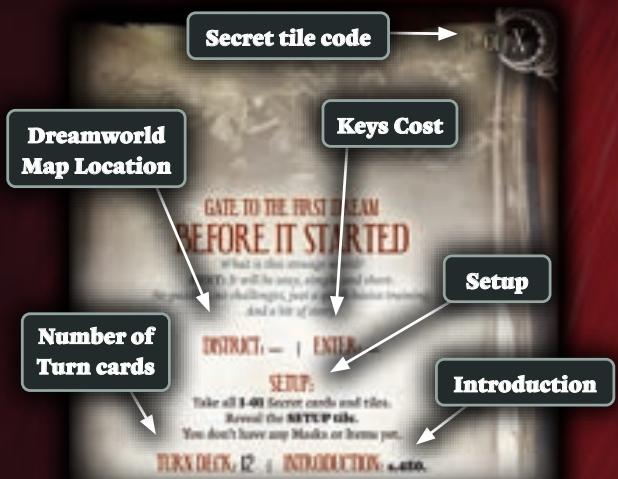
Dream Gates are used to enter Dreams. Usually they will have a specific District on the Dreamworld map where you can enter them (see DREAMWORLD MAP, pg 14) and also a listed key requirement to do so. For the First Dream you can ignore those requirements. Dreams can be stored in between each game session in the envelope provided.
To enter a Dream resolve the following:
– If the Slumber Dreamscape is present, discard it first (i.e.: all Slumber Map tiles, Quirk cards, etc.).
There is no Slumber Map currently so you can ignore this for now.
SETUP: Resolve all the listed steps here prior to beginning the Dream. Generally this will require you to prepare by taking all the appropriate cards out of the box and placing them within reach and also by setting up its starting Dreamscape Map Tiles.
Remember! Never look at the front side of any Secret Card or Tile unless instructed to reveal, peek or gain it.
TURN DECK: Randomly draw the listed number of Turn cards and place them face-up in the Turn deck slot. This determines how much time you have to complete the Dream (see TURN CARDS, pg 12). The rest are discarded face-down to the Turn Discard Pile.
INTRODUCTION: Read this reference within the Secret Scripts booklet for this specific Dream after you have set up the Dream.
Then flip the Dream Gate tile to its other side and place it on the Dream Gate slot. Any special rules are listed here along with the GOAL of the Dream and also the script number to resolve if you run Out of Turns.
- Finally the Dreamers enter the Dreamscape and the first Turn begins...
DREAMER'S ENTRANCE
Dreamers will always enter the Dreamscape on the Dreamer's Entrance ). This icon is placed between 2 spaces. It means that it refers to both of them. Place your miniatures on either of these spaces. Place your dreamers in either of the 2 available spaces on the A2 Tile.
MAP ACTIONS
Map actions are those that can be found on Map tiles. Those with the symbol are single use only. After using the action, block it with a token (see DREAMER ACTIONS, pg 9 for more details about performing actions).
WALLS少IC/JICI
There is also a wall close-by – this is an impassable barrier that you can't move through or measure Range through (see MOVEMENT ACTIONS, pg 11 for more detail).
ENTITY SPAWN
There is no Entity present at the moment so you don't need to worry about this just yet but keep these rules in the back of your mind.
Spawned Entities (see ENTITY, pg 12) always appear in spaces bearing theicon. If several spaces are available, you can choose between them. When spawning several Entities, if there is more than one space available allocate them as evenly as possible.

In the Dreamscape, if there is any space with a TURN SUIT icon, check to see if it corresponds to the current Turn Suit on the current Turn card. If it does, the first Spawned Entity must be placed in that correspondingspace.
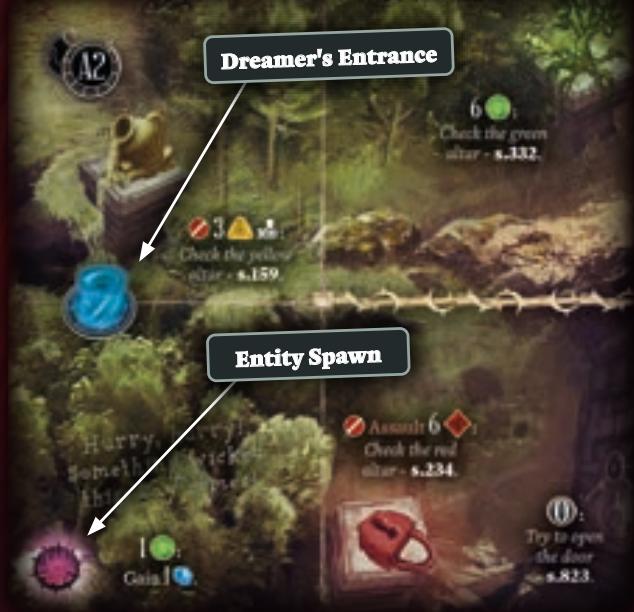
030 Check the yellow
Try to open the door -s.823.
Examples of Map Actions.
OTHER DREAMSCAPE RULES
If this is your first game, you may skip this page for now. Most of this information won't be neccessary to play for now.
OTHER DREAMSCAPE ICONS

SHINING GEM SLOTS – When you're in a space with a , you may spend 1 and place it in that From this moment, the effect described next to that is active. You may use this action without paying additional costs. If you're in a space with an active you may recover that but will also deactivate the effect of the

TRAP – whenever you Move through a space (or end Movement/Relocation on it), you trigger the Trap effect. The Trap effect is described in the Slumber/Dream.
FLYING RULE – effects or actions given in this blue frame are not related to the space in which the frame is located, but concern the whole Dreamscape. If such a frame contains an action, you may perform it regardless of range.
If there is no action inside the Flying Rule but instructions (e.g.: resolving a script) it should be resolved as soon as this Flying Rule is revealed.

DRAWING BONUS – at the start of the Dreamers Phase, if you're in a space with a Drawing Bonus, draw a number of additional Influence cards equal to the number shown on this bonus icon during the Draw step.

Remember that a Drawing Bonus does not modify your Hand Size limit. STAIRS – this icon doesn't have any effect unless another card or rule directly addresses it.
BLOCKED SPACE - Neither Entities nor Dreamers may Move or measure range through a Blocked space. If you want to Move to a space behind a Blocked space (or use an action targeting that space), you must measure the range around it – this may sometimes be impossible.
TERRAIN SYMBOLS AND TERRAIN TOKENS
Terrain Symbols don't have any effect unless another card or rule directly addresses them.
When a Terrain symbol is at the center of a Map tile, all 4 spaces on this tile are considered as having that symbol.
If a Terrain symbol is on the line between 2 spaces of a Map tile, both spaces are considered as having that symbol.
Terrain tokens (placed in a space / 2 spaces / tile) follow the same rules as Terrain symbols.
Whenever there are both and Terrain symbols in the same space at the same time, thesymbol is ignored.
LIMIT OF MINIATURES & ENTITY TOKENS PER SPACE
Each space can hold a maximum of 4 miniatures and/or Entity tokens, after which it is considered full. Dreamers can move through full spaces, but cannot stop on them. Entities entering full spaces (either by Moving or by Spawning) causes Dreamers to be pushed out to any adjacent space chosen by the players. However if the full space contains only 1 Dreamer, that Dreamer cannot be pushed and the Entity ends its Movement within range 1 of the space.
BIG ENTITIES: Big Entities are those whose miniatures or tokens are bigger than normal. They occupy the whole space in which they stand and cannot be pushed out in any way. When a Big Entity enters a space, it pushes all other miniatures and/or Entity tokens in that space to any adjacent spaces chosen by the players and also causes it to end its Movement.
Note: In some Dreams, you will find spaces completely cut off by Walls. The Dreamers may be able to Relocate to these spaces in various ways. If 4 Dreamers occupy such a space, no Entity can spawn or Relocate there.
COMPONENT LIMITATIONS
Whenever you should gain or place a component and there are not enough left in the pool (lack of ormarkers, Keys, tokens, Shapeshifter miniatures, etc.), that component is not gained/placed.
is the only exception to this rule. If a Dreamer should suffer and there are none left in the pool, all Dreamers fail (see Distress and Dying, pg 8).
The number of components of a given type is NOT dependent on the numbers of Dreamers. This rule applies to any component gained from the Secret cards of a Dream (Influence/Item/Note cards, etc.). For instance, if you already found a special Item in a Dream, that Item won't be there anymore if you visit that Dream again (e.g., because you were previously defeated). You do not gain a second copy of that Item.

TURN ORDER
Gameplay within both Dreams and Slumbers is divided into Turns. Each Turn consists of a Dreamers Phase (where the players act simultaneously) followed by a Dreamscape Phase (where the game acts):
DREAMERS PHASE
1) DRAW STEP
Each Dreamer draws 4 Influence cards, not exceeding their Hand Size Limit, which by default is 6 cards*. If you reach your hand limit, you stop drawing and at no time can you have more cards than this limit. If you can draw, you cannot choose to draw fewer cards than required. Before you draw you may discard any number of cards from your hand.
*Some effects and cards may increase this limit.
At any time, if your Influence deck runs out of cards while drawing, reshuffle your Discard pile, creating a new deck, and draw the rest of the required cards. However, this comes at a price (see RESHUFFLE below).
2) CARD AND ACTION STEP
Dreamers move across the Dreamscape, perform actions and play cards (see DREAMERS ACTIONS, pg 9). Dreamers can take their actions simultaneously without worrying about player order* unless a specific situation calls for it. This phase ends when all players agree there is nothing more they wish to do. Then, proceed to the Dreamscape Phase.
*See pg 16 if you would like to play with a structured turn order. You may use the First Player marker ifyou do so.
RESHUFFLE!
At any time you have to draw cards but the deck is empty, after reshuffling your Discard Pile and forming a new Influence Deck – suffer1OR Seal 3 Cards.
To push away the menace of death, you must choose between suffering dangerous Distress or sacrificing cards from your deck by Sealing them. The easiest way to remove Distress and recover these Sealed cards is the special Delta Phase tile, hidden in the Slumber deck (see DELTA PHASE, pg 15).
If the game allows you to reshuffle your Influence deck, even though you still have some cards in it, reshuffle all the remaining cards and the cards in your Discard pile to form a new Influence deck. As this was not triggered by having to draw cards you do NOT have to take the reshuffle penalty.
DREAMSCAPE PHASE
1) ENTITY AND DREAM EVENT STEP
The current Turn card determines which effects of this Dream are resolved and in what order. These effects can be found on the Entity tile(s), Dream Gate tiles or any revealed Secret cards (see TURN CARDS, pg 12).
The Dreamers cannot use any actions or card effects during this phase unless a card allows it specifically or there is a special icon present on it. Occasionally, there are no effects during this step – this is the case for most of the initial part of your First Dream.
2) DISCARD TURN STEP
The current Turn card is discarded at the end of the Turn. All effects with "until the end of this Turn" timing cease to be in effect now. Then if there are cards remaining in the Turn Order deck, a new Turn begins with the Dreamers Phase again. If no cards remain, resolve the "Out of Turns" effect (as described on the Dream Gate/Slumber Tile).
SEALING AND UNSEALING CARDS
"All around me darkness gathers, Fading is the sun that shone,
We must speak of other matters, You can be me when I'm gone."
Neil Gaiman, The Kindly Ones Sealing cards is one of the most common negative effects in the game. It removes a number of cards from your Influence deck until you find a way to Unseal them.
SEAL X CARDS: Reveal X Influence cards from the top of your deck and place them in the Sealed pile. Sealed cards are unavailable until you manage to recover them through an Unseal effect.
UNSEAL X CARDS: Take X cards from the top of your Sealed pile and place them in your Discard pile. They will become available again after you reshuffle your deck.
We suggest to place your Sealed pile below your Dreamer board to mark those cards as unavailable.
Note: Only Influence cards can be Sealed. Other cards in your deck (like Flaw cards) are omitted while Sealing (you just skip the Flaw card and draw another card). After resolving the Seal effect, any drawn Flaw card is placed back on the top of the deck.
Note: Ifyou should Seal cards, but you do not currently have cards in your Influence deck, you do NOT' need to reshuffle NOR Seal your cards.
DISTRESS AND DYING
"For in this sleep of death what dreams may come."
- William Shakespeare
is used to mark distress, fear, fatigue, doubts and wounds suffered by the Dreamers. When obtained, place them next to your Dreamer board.
Dreamers lose when:
– Any Dreamer suffers an 8th dies immediately, and all Dreamers lose.
Whenever a Dreamer should suffer, but there are none left in the pool (there are a total of l6 markers in the game), all Dreamers lose.
When a Dreamer has fewer than 6 cards in total (including cards in their influence deck, hand, and Discard Pile but not Active Progress cards and Sealed cards they immediately die and all Dreamers lose.
If the Dreamers lose, resolve the Death Wisdom card (reveal II-42 I Secret card if it is not revealed yet – there is a reminder on your Basic Action card).
If Dreamers lose in a Dream, they additionally discard the current Dreamscape. and return all cards and tiles of this Dream (except for those already gained by Dreamers or added to the game decks) to the Secrets. Keep the Dream Gate tile of this Dream so that you may still come back to try again.
HAND SIZE LIMIT
You can never have more than 6 cards in hand, at any time. When drawing cards, you only draw until you have 6 cards in hand,
never more.

Some special rules may modify your Hand Size limit.
A bonus that allows you to draw more cards does not increase your Hand Size limit.

DREAMERS ACTIONS
As l easily get inner contact with myself, I notice distress grabbing for my throat. It is time to reach out. To find something that isn't there. You see the signs, they're on the road. The Gathering, Analog Park
While in a Slumber/Dream, each Dreamer may perform various actions. Most of them can be found:
– on the Basic Actions card.
– on the Dreamer's Influence cards.
– on the active Dreamer's Progress cards.
– on the Dreamer's active Mask.
– on the active Items shared by the Team.
More actions may be available in the Dreamscape – on Slumber/Map tiles, Dream Gate tiles, Entity tiles, etc.
The following section describes how to perform actions. The various game elements on which these actions can be found are detailed later in this rulebook.
PERFORMING ACTIONS
When you want to perform an action, you first have to pay its cost (and sometimes meet some additional conditions).
The cost is always indicated at the beginning of each action. Usually, it's an amount of Intent (, , or ).
Intent is a basic resource in the game. It represents how a Dreamer chooses to interact with the world or the manner inwhich they would solve a particular problem. Intent has 3 colors:

– AwARENESs. It's mostly related to conversation, observation, understanding, and technology.

– CuNNING. It's mostly related to movement, cleverness, avoidance, acting, and deception.

– WRATH. It's mostly related to physical effort, fighting, tenacity, or arguing.
To use an action, pay for its cost by discarding a combination of Influence cards from your hand and/or active Items until you reach the required amount of the particular type of Intent. Influence cards are discarded to a personal Influence Discard pile while Items used in this way are discarded into the Item Storage.
The Intent that a discarded Influence/Item card gives is shown in its upper left corner. If a card has multiple Intent colors to choose from, you must choose which one you want to use when discarding it. If you are discarding a card in this way you may not use its printed action ability. Intent is gained immediately when discarding the card and any excess Intent is lost.
Example: A cost has a requirement of either 6or 6. You decide to pay 6 by discarding one card providing 1and 2 , one with 3 and an active item with 2 . The excess 1is lost and cannot be reserved to pay for another action. The1was never gained, since the card was used for the 2


Examples of Intent costs on the Influence / Items cards.
Ale6 Relocate this Eatiry spice.

3 e indicated b

- The cost of this action is always 0 Intent. Using it is free.
- Suffer the shown amount of to pay this cost (gain
More about suffering - see page 8

- The cost of this action is given in . To use this action, you must discard the given amount of
! Map actions can only be carried out if the Dreamer's miniature is in that action's space (unless it is an Assault/ Contact action – see pg 10).
0304
① ry to open the d.
BASIC ACTIONS CARD
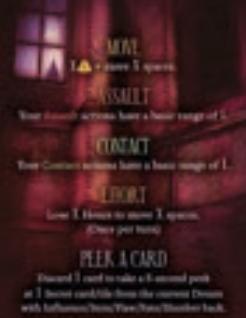
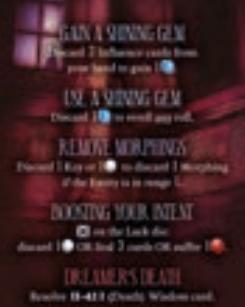
Each Dreamer has their own Basic Actions card that lists the actions discussed before as well as several other ones:
MovE – Spend any number of to Move the same number of spaces.
More about Movement – see Movement on page 11.
EFFORT – Once a turn, lose X hours to move X spaces (see THE CLOCK, pg 13).
PEEK A CARD - Discard 1 card to take a 5-second peek at 1 Secret card/tile from the current Dream with an Influence/ Item/Flaw/Fate or Slumber back.
GAIN A SHINING GEM – Discard 3 Influence cards from your hand to gain a
USE A SHINING GEM - Discard 1 to reroll any roll (of any die, rolled by any player).
REMOVE MoRPHINGs – Discard 1 Key or 1 to discard 1 Morphing (see MORPHINGS, pg 13) from an Entity within range l.
BOOSTING YOUR INTENT – See the description on page 11. This is a reminder of the consequences when you roll (the worst outcome).
DREAMER's DEATH – It's a reminder of what happens when Dreamers exceed their limit. Resolve Secret Card II-42 I (Death) Wisdom Card (see Distress and Dying, pg 8).
INFLUENCE CARDS
I knew who I was this morning, but I've changed a few times since then. Lewis Carroll, Alice in Wonderland
Intent
Ether cost of buying this card
Action/effect cost
Additional requirement
ONE WITH SHADOWS
Action/effect
When you from axy Entity eff Pervent1of tha
Influence cards represent all the abilities and powers in the Dreamers' physical and psychological arsenals. At the start of the campaign, each Dreamer only has access to their 22 starting Influence cards. However, this deck will improve and evolve as they gain new cards by visiting Dreams or buying them from the Influence Market.
Each Dreamer places their deck on the left side of their Dreamer board and they will draw cards from this deck during the game. Played and discarded cards are placed face-up in the Discard pile, on the right side of the Dreamer's Board.
Except for Progress cards (see next section), you may only play Influence cards from your hand either for their Intent or for their action/effect. Unless specified otherwise, you can only play Influence cards during the Dreamers Phase.
The cards bearing the RAPID 4 icon are an exception to this rule. They can be played at any time during your action (even in the middle of another action), other Dreamers rounds or during the Dreamscape Phase (making sure to pay their costs before doing so).
Example: You need to pay 8 for an action. You start paying 4 but do not have enough to finish it. You decide to play "Find the Pattern in the middle of your action – its 4 effect allows you to immediately Seal it and draw 3 additional cards. Luckily two of them have 4and you use those to finish paying for the action.
Some cards will have additional requirements before you can use their Actions/effect (e.g.: being on a space with specific Terrain symbol).
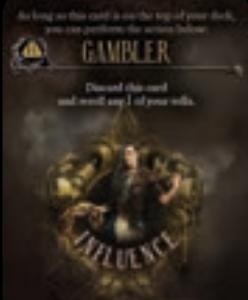

Additionally, each individual starting Influence deck has its own special feature – a character specific action – printed on the back of each card. Dreamers may perform this action when the card is on the top of their deck. As the campaign proceeds, the more cards a Dreamer adds to their deck, the less this action will be available as they gradually lose their original identity.
Gained Influence cards (from Dreams, from the Influence Market) are placed face-up on top of the Dreamer's Discard Pile.

Progress cards are special types of Influence cards that provide persistent abilities to your Dreamers when they are played. They can be used normally for Intent when discarded from your hand but the actions/effects on them cannot be used until they are placed into your Progress Zone (beneath your Dreamer board) by paying the listed cost on the top of the card. From then on, you may use any action or effect on this card. Once played, an active Progress card cannot be discarded to use as Intent.
Each Dreamer may have a maximum of 4 Progress cards in their Progress zone but some Masks (see MASKS, pg 13) and other cards may modify this. If you want to place a new Progress card when you have already reached your limit, you must first discard one of your placed Progress cards (active or flipped) before you can place the new one. You cannot voluntarily discard a placed Progress card otherwise.
FLIPPING PROGRESs CARDs – Being told to flip a progress card causes you to turn it face-down. The card's action can no longer be used until it is unflipped but the card still counts toward your placed Progress cards limit.
Some rules refer toicons - this refers to the number of your active Progress cards of the corresponding color (flipped cards do not count).
Unless otherwise specified Progress cards are not discarded when used. Placed Progress cards remain in your Progress zone until a game effect forces you to discard them (Dreamer's death, Awakening, etc.).
You may have two identical active Progress cards, but most of them will not duplicate their own effect.
INFLUENCE MARKET & BUYING NEW INFLUENCE CARDS
The Influence Market is a pool of unacquired Influence cards available to the Dreamers when they go Shopping on the Dream World map (pg 14). These mechanics will be explained as the game progresses. They can be left in the game box (you should not look at them) and taken out only when required. The Influence Market will change during the campaign with cards being added from Dreams.
When you are instructed to "Buy Influence Cards", each Dreamer may draw the top 3 cards of the Influence Market and buy any number of them with their available , placing them face-up on top of your Discard Pile. Any remaining cards are returned to the bottom of the Market. The cost of each Influence card in the Influence Market is indicated in its upper right corner.
You mainly gainduring Slumbers, as a Loot for victory and also through completing Dreams.
When the game asks you to RETURN a card to the Influence Market, remove this card from your deck and put it at the bottom of the Influence Market – it doesn't matter if this card was from your starting deck, bought from the Influence Market or gained in a Dream.
During the Buying cards step, if you draw a starting card of another Dreamer, you may buy this card – and start using the special action on its back, even though you are not that Dreamer.
At the start of the game the Influence Market consists of all Influence cards with no secret code number on their back.
At the start of the game the Items Market is empty
INFLUENCE DECK CARD LIMITS
20-40
At specific moments of the game (during game setup or Awakening), you'll have the opportunity to add or remove cards from your Influence deck. Be sure to check the number of cards in your deck during this step to ensure you're within the deck limit of 20-40 cards. During this step:
You must have a minimum of 20 cards in your Influence deck (if, for any reason, you have less than 20 cards available, you must add all your available cards to your deck).
– You can have a maximum of 40 cards in your Influence deck. Excess cards are placed back in the box, in the slot dedicated to your Dreamer (with your Divider). These unused cards, cannot be used in the game until the next deckbuilding step.
– During the deckbuilding step, you must add all Flaw cards in your possession to your Influence deck (they do not count toward the 20-40 limit).
Note: If the number of cards in your Influence deck exceeds 40 or drops under 20 during the game, nothing happens. The card limit is only checked during the deckbuilding step.
GRADUAL ACTIONS
Gradual actions are actions that scale with the number of Dreamers and they are marked by a xicon that appears after the basic cost to indicate how many times that cost must be paid to perform it. These may be paid in several steps over several Turns (i.e.: gradually). Each time the basic cost is paid, an Intent Marker can be used to show that it has been paid. Place it near the Action.
Example: There are 3 Dreamers in the game, and you want to perform a gradual action labelled as 3. One Dreamer decides to spend 6 to place 2 Intent markers on this action. On a later turn (or even during the same turn) another Dreamer will only need to pay 3to perform that action.
Note: Some gradual actions have a cost given in two Intent colors. When paying for such an action, you must choose an Intent color and pay the full cost using that color. eg. if there are 4 Dreamers in play, 3x/3 means either 12or 12, not a combination of both.
Return all Intent markers to the pool after the action is performed. Intent markers are limited and if you need one of a specific color but there aren't enough left, you may take an Intent marker from another action.
Any Intent marker placed on an action is considered to be yours, even if it was placed by another Dreamer.
When there are several miniatures of a given type of Entity in play, Intent markers placed on the Entity tile are not assigned to any of the miniatures. They are only assigned (and then discarded) to a specific miniature when the gradual action is actually performed.
Note: the notation “xX" just means a higher action cost, not a gradual action that you may pay in steps. For example, with 3 Dreamers in play x2, means you must pay 6at once.
ASSAULT / CONTACT ACTIONS
Assault6 Relocate this Entity
Contact 3
Move this Degenerate 1
Examples of Assault/Contact actions.
Assault/Contact actions – marked specifically with "Assault" or "Contact" keywords – are used the same way as normal actions with a few exceptions:
Not every action is a Contact action. Not every action is an Assault action.
Unlike map actions which require you to be in the action's space to use, Assault/Contact actions can be performed from the base Assault/Contact range of 1 space away. This can be modified by some Influence or Item cards.
- You can bold the effect of an Assault/Contact action by paying its cost multiple times.
Example: You perform an Assault action with a cost of 3. You can spend 9at once to apply the effect of this action three times.
- If you pay the cost of an action multiple times, you can choose a different target for each effect.
Example: You perform a Contact action with a cost of 3 , and decide to pay 9. There are 2 Entities in range that can be targeted by the action. You can decide to target the first entity twice, and the second Entity once.
LUCK DIE

Many cards and effects require the use of the Luck die to determine a random outcome. The effect of the roll is indicated on these components.
If a result of a roll isn't stated, it means that nothing happens.
A resultis usually severely negative, is just negative or neutral, and,, andare usually positive.
BOOSTING YOUR INTENT
Once per turn, when you spend at least 1 Intent (even if it's less than the required cost) to pay for any action, you may decide afterwards to roll the Luck die to add additional Intent to this action. The various outcomes depend on the following results:
– The action is failed and you don't reclaim discarded Influence cards used to pay for this action. Additionally, discard 1 or suffer1or Seal 3 cards.
– No Intent is added. If this means that the action fails, you don't reclaim discarded Influence cards used to pay for this action.
- add 1/2/3 Intent of the same color.
The Luck die is always used as the last source of adding Intent to the action – after rolling the die, you can't add any more Intent to this action. If you fail to gather the required number of Intent, the used Intent is lost, even though you didn't perform the action.
You may also use the Luck die when performing a Movement action to Move farther. It counts only as 1 Movement. If roll was failed, the Dreamer does not Move at all.
MOVEMENT ACTIONS
Her feet half rested half floated, upon the floor; Earth scarcely held her down, so fast was she becoming a thing of dreams.
A Move action is performed by discarding either Influence cards or Active Item cards with Intent and then moving the Dreamer miniature as many spaces as there were Intent on these. Movement is only ever orthogonal (vertical or horizontal) but never diagonal*.
*Some Influence/Item cards may alter this rule and even provide other bonuses to movement...
RELOCATION – Relocating means moving to another space, ignoring range, Walls, and any other obstacles – much like a "teleportation".
REROLLS

Many effects allow you to reroll a die result (sometimes this only applies to your roll, sometimes to any roll, including other Players' and Entity rolls).
There is no limit to the number of rerolls you can perform, as long as you can meet the conditions and pay all costs given on the card/rule allowing that reroll.
When you reroll the die, only the result of the last roll is applied. Previous results are ignored.
WALLS*KI少ICJICI
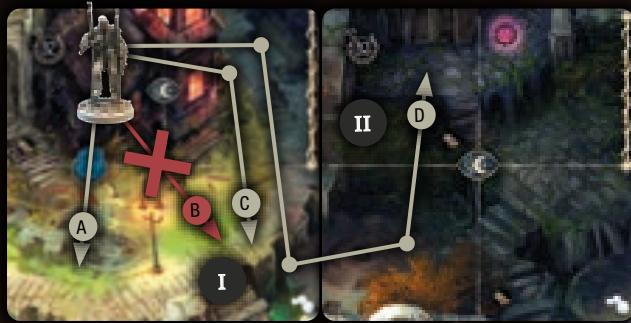
Neither Entities nor Dreamers may Move or measure range through Walls. If you want to Move to a space behind a Wall (or use an action targeting that space), you have to measure the range around it.
Some Walls do not cover the entire edge of their space (they have an opening in their center, or cover just half their space). This means that the Wall on that edge is disabled.
Two adjacent tiles may sometimes display a tiny gap between their Walls, just on their edges. These gaps don't disable the Wall.
A) The Dreamer moves I space.
B) The Dreamer cannot perform this Move because diagonal movement is not allowed.
C) To perform a legal move to space I, the Dreamer must move 2 spaces.
D) To perform a legal move to space II, the Dreamer must move 4 spaces (the Wall prevents them from taking the shorter path).
RANGE
Most actions and effects requiring a target have a specific range. This is the maximum range of this action / effect. Actions and effects can always target spaces that are closer than maximum range.
Range 0 means the same space.
Range 1 means an adjacent space and/or closer spaces.
Range 0
Range 1
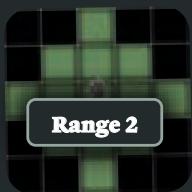

"In any range” or “unlimited range” doesn't mean you may affect spaces behind Walls or Blocked spaces – you still must be able to find a legitimate connection between you and the targeted space. If a rule states “in any space, you may ignore range, Walls and Blocked spaces.
ITEMS
The mystifying oddities that can be found scattered throughout the Dreamworld act as useful aids to help the Dreamers overcome their many challenges.
At any one time there can only be a maximum of 3 ACTIVE ITEMS* which are placed in their designated spaces on the board. Any Dreamer can use these – either by discarding them for their Intent or using them for their effects. Note that not all items are discarded after using their effect unless specifically stated.
*There is a 4th Item Slot on the board that may also be unlocked.
You may have found some STARTING ITEMS during the Initial Dream (3 that you got to keep as ACTIVE ITEMS and the remaining 2 that were sent to your STORAGE). If you didn't find them, these would have made their way to the ITEM MARKET for you to buy later through Shopping Locations on the Dreamworld Map.
All other Item cards owned by the Dreamers are not considered to be active but placed face-down in the Storage slot.
When the game allows you to RESTORE AN ITEM (e.g.: through the effect of an Influence card or Script event), draw one randomly from the STORAGE and place it in an Active Item slot. If there are no slots available, you must discard one of your other active Items or the Item you just drew back into the Storage. Generally DISCARDED ITEMS will go into the STORAGE (however some may go back to the ITEM MARKET which you can obtain again by SHOPPING – see pg 15).

WHY ARE WE DIGGING EMPTY GRAVES? WHO WANTS TO LIVE IN THEM?
DREAMSCAPE PHASE
And if you gaze long enough into an abyss, the abyss will gaze back into you.
- Friedrich Nietzche
ENTITIES are the boogiemen and ethereal beings that wander the dream world. They are represented on the Dreamscape and Slumber maps by their relevant miniature(s) or token(s). They act after the Dreamers have passed in the DREAMSCAPE PHASE and their actions are determined by what is displayed on the Turn Cards and the Entity Tile(s).
Begin the Dreamscape Phase by examining the current face-up Turn Card.
TURN CARDS
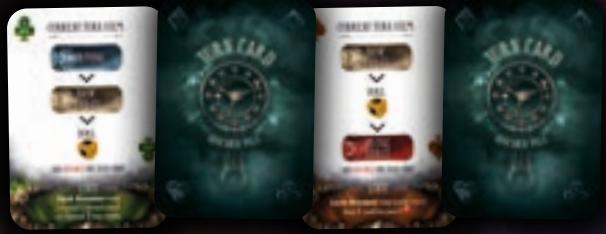
Turn cards serve two functions: both to count the Turns in Slumbers/Dreams and also to indicate how Entities and the ever-changing Dreamscapes of Slumbers and Dreams behave and respond.
COUNTING TURNS
At the beginning of every Slumber/Dream, shuffle the specified number of Turn cards and randomly place them face-up on the Turn deck slot. Turns can be found on the top righthand corner of Slumber Tiles and Dream tiles. Place the remaining Turn cards face-down in the Turn discard pile.
The topmost card – the "current Turn card" – should be the only visible card and, at the end of each Turn (after going through all its effects – see below), this is discarded and a new one revealed for the next Turn. When you run out of Turn cards, the Slumber/Dream ends – resolve the Out ofTurns effects described on the Slumber/Dream Gate tile.

MORPHING EFFECT – Makes the Entity stronger (see MORPHINGS, pg 13).
BASIC EFFECT – A lesser negative effect.
SPECIAL EFFECT – A stronger negative effect.
Turn card effects
ENTITY & DREAM/SLUMBER EFFECTS
At the beginning of the Dreamscape Phase, each step on the current Turn card is resolved from top to bottom. These steps consist of 3 main effects (shown below) and an Entity Movement step
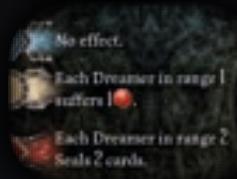
For example, if BASIC EFFECT shows on the TURN CARD, this particular ENTTTY would cause Dreamers within 1 range to suffer1. Likewise SPECIAL EF-FECT would cause Dreamers within 2 range to SEAL 2 cards.
ENTITY TILES
There are two types of Entity Tiles: those that can be found in DREAMS and those found in SLUMBERS. There are minor differences between the two and SLUMBER ENTITY TILES will be covered later under the SLUMBERS section.
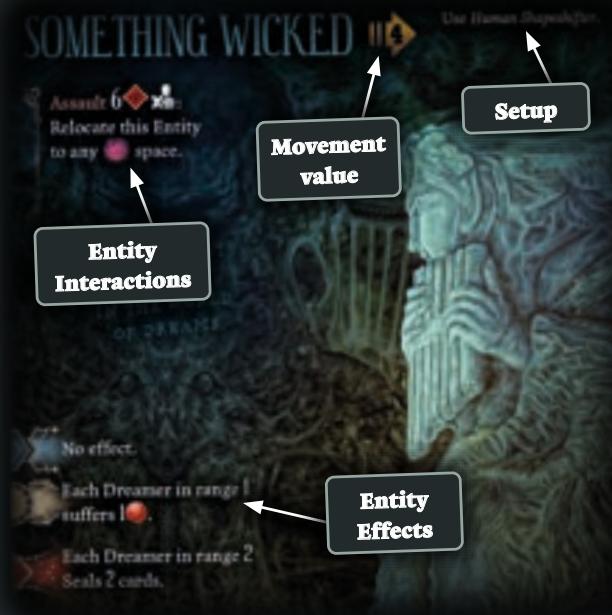
All of these effects are usually found on the ENTITY TILE but can also be found on other Secret cards depending on the Dream/ Slumber.
If a Turn card specifies an effect but there are no game elements where it is featured then skip that effect.
You may find that this is the case for the first half of the First Dream.
When several effects are supposed to happen during the same step, resolve them in any order, but consider that they all happen simultaneously.
If the game instructs you to do something at the end of the Turn, do it after resolving all steps.
OTHER TURN CARD RULES
BLOCKING STEPS / ADDING TURNS
When the game asks you to "Block 1 step of the current Turn card", choose and mark one of the steps with a . This step is skipped when resolving the Turn Card.
When the game asks you to “Add 1 Turn," take the bottom card of the Turn discard pile and place it at the bottom of the Turn deck.
TURN CARD SUITS (,, , ).
Each Turn card bears the symbol of one of the four Turn Suits. They don't ha
内容过长,此处只内联前一部分;完整内容请下载或到规则页阅读。
下载 Markdown原文为社区整理/出版社公开资料,版权归原作者,仅供个人学习查阅。