
Exodus: Proxima CentauriExodus Proxima Centauri
一句话概览
Exodus: Proxima Centauri 是一款已收录于村了吗规则库的桌游,支持 2–6 人,原名 Exodus Proxima Centauri。
本页内容:一句话概览 · 常见问题
这游戏怎么玩
- 本站已收录这款游戏的规则资料,可以在对话里直接提问规则细节。
常见问题(FAQ)
以下 1 条问答中 0 条来自站内玩家的真实提问,其余 1 条为本站整理的常见疑问;答复内容保持原样。
Exodus: Proxima Centauri支持几个人玩?
2–6 人。
去哪查完整规则
想核对具体规则细节、卡牌效果或某个回合的结算方式,可以在村了吗里选中这款游戏后直接提问。
同类桌游
- 卡坦岛德式
- 工业革命:伯明翰德式
- 勃艮第城堡:特别典藏版德式
- 方舟动物园德式
- 卡卡颂抽象
- 瘟疫危机传承:第一季美式
- 阿瑞迪亚:勇踏征途美式
- 重塑宇宙德式
- 幽港迷城美式
- 埃多拉的德鲁伊德式
规则原文(Markdown)
本站收录这款游戏的规则原文 1 个文件,此处内联渲染 1 个,可直接展开阅读或下载。
Exodus_Revised_Rules_Jan2015.md78.5 KB
EXODUS PROXIMACENTAURI
Rules of play
revised edition
There are only few who remember now how the war that burned our homeworld to ashes and made us all exiles had started, and many believe that the events of 2299 are best left forgotten. However, for those who seek to find out, the old archives still hold an incomplete account of the time between the first nuclear warhead falling upon Berlin, and the hasty agreement reached by nine war ravaged factions exactly 83 days later.
Although it is true we had been numerous before the war, the last days of that ultimate conflict saw only a few million people still unaffected by fatal radiation, divided several distinct groups first trying to save what was left of their dying planet, before turning to preparing a hasty escape into the unknown reaches of outer space.
The archives are incomplete, so today we may only make educated guesses as to which of the former Terran nationalities and ethnic groups comprised each of the prime factions that signed a ceasefire on November 3rd, 2299. And although some of the leaders today try to keep traditions of Old Earth alive, nobody knows for sure if they are the ones who should preserve them.
As for the common consensus today, it is believed that three of the prime factions came from the former USA, one from Greater China, one from Latin America, one from the African Union and one from Europe. Nine groups sharing common interests, with eyes that were quickly turned to the stars by a cruel necessity. Nine faction out of which only six would eventually prevail.
Two days were enough for the new leaders of humanity to recognize how dire their situation was. Even without the war raging around them, they were still unable to find stable sources of uncontaminated food or drinking water. And as the nuclear winter was covering the mortally wounded lands with ice and snow, they gathered all ships capable of interstellar travel and still operational to hastily leave their dying homeworld.
And so the Exodus began.
[the story continues on page 11]
Table of Contents
2......[Game Overview]
7........Actions
2......[General Considerations]
7........IV. Fire WMD Stage
2......[Game Components]
8........V. Conquest Stage
3......[Introduction and key concepts]
9......[Victory]
4......[Game setup]
9......[Optional Rules]
5......[Playing the Game]
10....[Frequently asked questions]
5........I. Upkeep Stage
6........II. Council Stage
11....[The story]
6........III. Action Stage
12....[Technologies]
12....[Credits]
[Game Overview]
After a devastating nuclear war, six human factions are seeking shelter in the Centauri system. On the verge of extinction, the humans are saved by a superior civilization, allegedly the Centaurians, and each faction is given a fresh start on a new Planet. Thus, the exodus of humanity seems to have ended on the Planets orbiting the star called Proxima Centauri. When the Centaurians announce their departure, the struggle for power commences once again.
In Exodus: Proxima Centauri, six factions fight for dominance in an epic empire-building game, striving to build a new human empire on the ashes of the Centaurian civilization. Each player will build their own space fleet of customized ships and conquer new Planets, fight the Centaurian Resistance and the other players, negotiate and vote for political decisions, research Centaurian technologies and much more.
[General Considerations]
•A game of Exodus: Proxima Centauri will take around 30 minutes/player once you get to know the rules. For the first game without anyone knowing the rules, expect a game time of about 45 minutes/player.
•The game can be played by 2-6 players. To avoid a very lengthy first game, we recommend you to learn Exodus in a game of 3 or 4 players.
•Whenever a playing card has a rule that contradicts this rule book, the card has priority!
•The concept “in turn order” will be used throughout the rule book. Some Actions in the game will need to be done “in turn order”. This means that all or some of the players will perform a specific Action starting with the one holding the Turn Order card with the lowest number and ending with the player holding the Turn Order card with the highest number. In case an Action must be performed by all the players and the order is not specified, it will be performed in turn order.
•The term “remove” means “return to the owner’s stash” and it is used as such throughout the game. The phrase “remove from the game” means that a specific component may not and will not be used again until the end of the current game.
•The components of the game are limited to the amount found in the box. The damage tokens and the movement tokens are an exception to this rule and are considered to be unlimited. If the tokens provided with the game are not enough, the players may improvise. •Together with the rules of the game, please also read the examples, they will help you understand the concepts of the game.
•If this is the first time you are playing Exodus: Proxima Centauri, it is highly recommended to let the most experienced player go through the rules before the rest and to explain them.
•When you find a concept or rule that seems unclear, please visit www.nskn.net and look for the updated FAQ or ask your question there.
•Experienced players are encouraged to look up on www.nskn.net official variants to make their gaming experience more enjoyable.
[Game Components]
•Hexes


Home Planet Hex
CP Planet Hex

High Council Hex
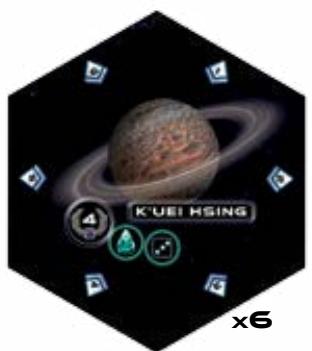
Phasium Planet Hex

Axinium Planet Hex
•Player setup - 6 colors

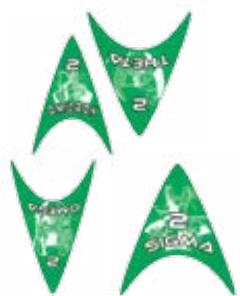

War Cruiser
Second Ship Markers

Battle Carrier


Plastic Space Ships
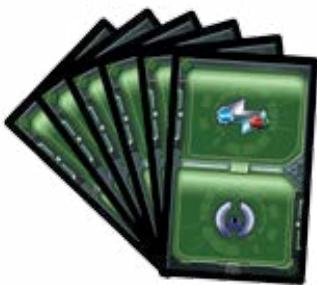
1 set of Action Cards

D6 dice

x30
Population Cubes
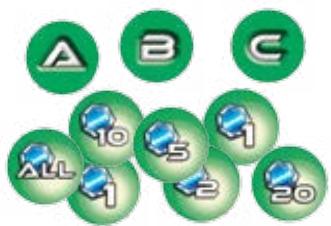
A,B,C Vote Tokens Value Vote Tokens
•Resource Counters, CP tokens and Damage Tokens


Resource Counters (black D6 dice)
CP tokens

Damage Tokens

Movement Tokens
•High Council Board & Player Boards
•Cards

Centaurian Resistance Cards

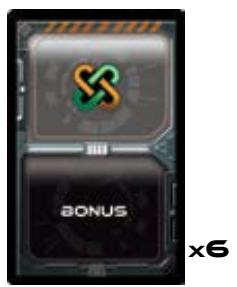
Bonus Action Cards

Political Cards


•Planetary and ship upgrades - Rockets, Drives, Cannons and Shields

•Centaurian Resistance ships


[Introduction and key concepts]
The universe of Exodus: Proxima Centauri is represented by a hex map. Each hex (except the High Council hex) has a Planetary system in the middle. Each Planet harbors resources: Crystallized Platinum (CP), Axinium and Phasium. The amount of resources available at any given moment is represented by a die called the Resource Counter. Most Planets also provide Victory Points for the players that have a majority in Population there at the end of the game.
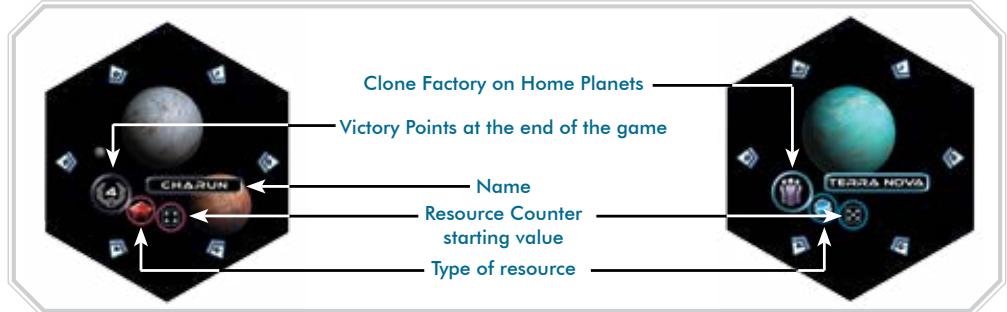
There are three types of resources in the game. "Blue (Crystalized Platinium - CP) acts as a currency in the game. Most actions require CP, including paying tax, building, researching and upgrading. Red (Axinium) is used for building ships. Green (Phasium) is used for purchasing upgrades.
Players keep track of their resources on their Player Board. A player may have at most 10 Axinium and 10 Phasium. CP is not limited, players may exceed the 20 CP depicted on their

Player Boards. The CP in excess of 20 is kept as 20 - CP and 40 - CP tokens.

Your empire is represented by Population and by spaceships. The Population ‘lives’ on Planets and is transported between Planets on ships. The Population is created by cloning and you will receive extra Population cubes every turn, on your Home Planet. Having Population on a Planet allows you to harvest resources from that Planet (regardless of other players having Population on the same Planet). Having majority of Population on a Planet at the end of the game also allows you to score the Victory Points on that Planet.
Spaceships are used for fighting other players’ ships or the Centaurian Resistance, to assert domination over a region of space (hex) and to transport Population. There are four types of ships with each player having a two ships of each type available to build. Every type of ship has a blueprint which allows it to be customized by its owner. The blueprint also shows the cost of building one ship of that kind and the number of VP awarded to the enemy player who destroys this ship.
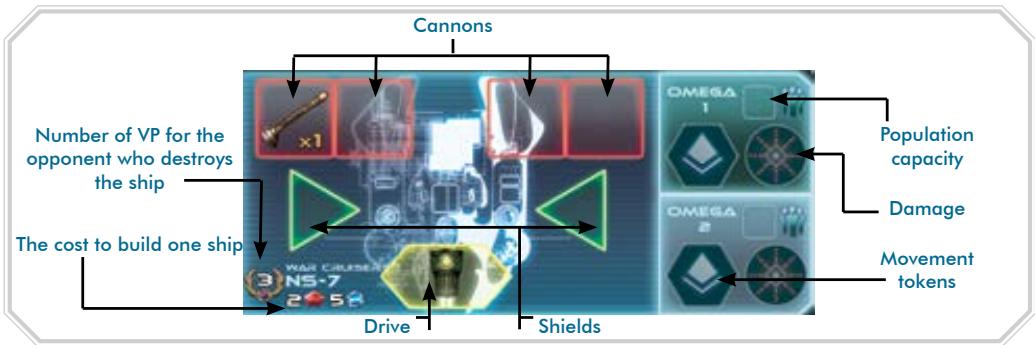
On the ship blueprints there are empty spaces for Upgrades. The following ship parts can be added to the blueprints:
•Drives that allow ships to move a certain number of hexes away •Shields that increase the amount of damage a ship can withstand before being destroyed •Cannons used to attack other ships
There are also Upgrades that are placed on Planets instead of ships. They are called Rockets and they can be fired at other Planets to destroy resources, Population or the Planets altogether.
3 Players
Players get to move their ships in a separate stage of each turn. The movement is simultaneous, simulating a real-time war situation. The movement tokens are used to point the direction(s) of movement for every ship. It only matters where a ships ends its movement, two enemy ships cannot meet half-way (the space is big enough for them not to notice each other at high speed). The edges of every hex are numbered from 1 to 6. To move a ship from a hex to another, its owner will place movement tokens. Once the tokens are revealed, that ship will follow the direction indicated by the number(s) on the movement token(s).

Players may research technologies. Although they do not bring Victory Points directly, technologies are powerful instruments for developing your empire. Each player has a technology tree on their Player Board. All technologies are available throughout the game. These technologies are divided according to their purpose into three groups, Civilian, Transport and Military. They are also divided into Grey, Orange, Black and Tan according to their Centaurian origin. Researching a technology of one color/purpose provides a subsequent discount for all the other technologies of the same color/purpose.

The game features Political decisions that will affect all the players equally throughout the game. Every turn, players will vote for one out of three possible Political decisions and they will choose a bonus Action to speed up the game. The Political decisions are reached through bidding. All auctions in the game are all-pay auctions. The Political decisions types are:
•Laws – they stay permanently on the table unless they are cancelled by a different Political card.
•Resolutions – they stay on the table for exactly one turn, during which their effect is in place
•Executive Decisions – their effect is resolved immediately and then they are removed from the game

2x Resistance Ship I 2x Resistance Ship II 2x Resistance Ship III
Besides the main effect, some Political cards may have a secondary effect, which should be applied immediately after selecting the decision.
The game is “powered” by Actions. Each player has an identical set of six Action cards. The selection of Actions is done simultaneously and each player is able to play the same kind of Action several times every turn.
There are 6 possible Actions:
•Research – learn a new technology and benefit from its advantages immediately.
•Build Ships – puts new ships into the game. Each player has only one ship factory on his Home Planet, so all the new ships will enter the game in that hex.
•Buy Upgrades – purchase and place ship parts on ships or Rockets on Planets, provided that the appropriate tech was researched.
•Banking – gain 4 CP
•Trade – exchange resources using the Common Market
•Mining – replenish up to 4 resources on your Planets
There are ships on the map that do not belong to any player. They are called the Centaurian Resistance and they will fight anyone who stations ships in that hex. To see the strength of the enemy ship, a player will draw a card from the Centaurian Resistance deck that shares a symbol and a color with the ship. That card will determine the fire power and the shielding of the Centaurian ship, the benefit (technology, resources, upgrades) and the amount of VP that will be gained at the end of the game by the player that defeats the Centaurian Resistance ship.
The aim of the game is to accumulate Victory Points (VP) and thus assert your supremacy over the other factions. You can collect Victory Points by winning battles against the other players or against the Centaurian Resistance, by populating Planets, by expanding your fleet of ships and by holding Political titles.
[Game setup]
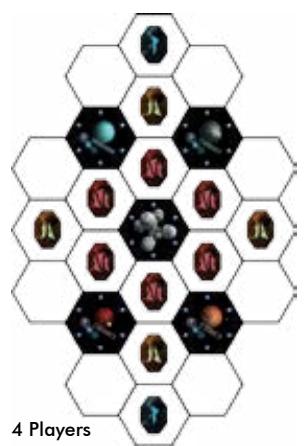
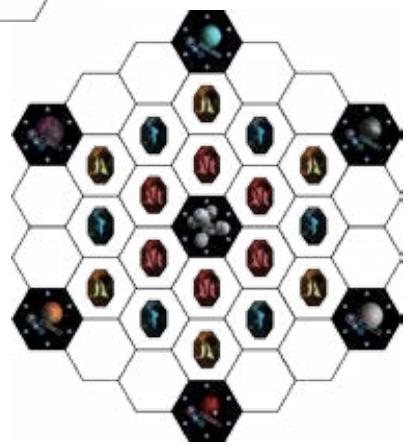
According to the number of players, choose a layout for the map. Place the High Council hex in the middle of the gaming table. Randomly choose any CP, Axinium and Phasium Planets according to the setup and shuffle them together. Place them (all face up) randomly to form the figure indicated in the layout. Finally, place the Home Planet hexes and the Centaurian Resistance ships on the map according to the layout.

1x High Council hex 3x Home Planet hex 7x CP Planet hex 5x Axinium Planet hex 3x Phasium Planet hex
3x Resistance Ship I 3x Resistance Ship II 3x Resistance Ship III

5 Players
1x High Council hex 5x Home Planet hex 12x CP Planet hex 8x Axinium Planet hex 5x Phasium Planet hex
4x Resistance Ship I 5x Resistance Ship II 6x Resistance Ship III
1x High Council hex 4x Home Planet hex 9x CP Planet hex 7x Axinium Planet hex 4x Phasium Planet hex
2x Resistance Ship I 4x Resistance Ship II 6x Resistance Ship III
6 Players
1x High Council hex 6x Home Planet hex 14x CP Planet hex 10x Axinium Planet hex 6x Phasium Planet hex
6x Resistance Ship I 6x Resistance Ship II 6x Resistance Ship III
Place Resource Counters on every Planet on the map. The value on each Resource Counter should be equal to the amount of resources depicted on each Planet.
Each player takes a Player Board then chooses a color, identifies and takes all the components associated with that color: 8 plastic ships, 4 second ship markers, 30 Population cubes, 6 Action Cards, 5 dice and all Voting tokens. Each player should also take one Info card with details about the Actions and about gaining Victory Points. Use the second ship markers to make a distinction between your pairs of ships of the same kind.
Place 3 Population cubes on your Home Planet and 1 Dark Raider and 1 Battle Carrier on the hex containing your Home Planet. Please note that, although they are on the same hex, the Population is on the Planet, while the ships are in the space surrounding the Planet. Place one cube near the VP track. You will use it to mark your VP throughout the game.
Mark your starting resources on the resource tracks of your Player Board: 5 CP (Blue), 1 Axinium (Red) and 0 Phasium (Green). Take one Electromagnetic Shield token and place it on your Battle Carrier blueprint.
Distribute the Turn Order cards for the first turn. Do this either by giving the lowest numbers to the most experienced players (recommended for first games) or at random. Holding the Chancellor, Vice-Chancellor or High Council Senator titles at the beginning of the game gives no advantage.
Place the High Council board on the table face up. Shuffle the Political cards and place them face down next to the High Council board. Separate the Centaurian Resistance cards according to the number on their back (I, II or III), shuffle each deck and place them face down next to the High Council board. Place the Bonus Action cards on the table face up.

The game stretches over 7 turns. Every turn, players go through a sequence of steps as detailed below. Every turn consists of 5 stages:
[Playing the Game]
Place all the Upgrades (Cannons, Shields, Drives, Rockets) on their dedicated spaces on the High Council Board and the Movement tokens, Damage tokens and 20/40 CP tokens on the gaming table.
•Upkeep stage - players receive their income, their Population increases and they may repair their space ships.
•Council stage – players make a Political decision, they decide on the Bonus Action for that turn and the turn order is changed.
•Action stage – players take Actions – researching new technologies, building ships, buying ship and planetary upgrades, mining or trading resources.
•Fire Weapons of Mass Destruction stage – players may fire their Weapons of Mass Destruction.
Place the Turn Counter token on the High Council board turn track on the space marked as 'Turn 1' and remember to move it forward one space each turn.
•Conquest stage (x2) – players move their ships and battle. This stage is played twice.
I. Upkeep Stage
•Reset market - Return all cubes placed on the market to their owners. During the first turn, skip this step, there is nothing to remove.
•Increase Population - Each player places 2 Population cubes from his personal supply on his Home Planet. If a player has researched the Expert Cloning technology, he will place 1 additional Population cube from his supply on his Home Planet. If a player does not have enough Population cubes in their supply they place any they have left. That player will not produce new population until Population cubes are returned to their stock.
•Repair ships – Players who have researched Basic Repairs remove 1 Damage token from each of their ships. Please note that ships do not get repaired automatically.
•Get CP income – Decrease the Resource Counter by one on every undepleted CP Planet where you have Population (regardless of which player has the majority of Population) and add 5 CP to your CP track. Any time a Resource Counter would get to 0, remove it instead. That Planet becomes depleted. If you have researched CP Refinery, you may repeat the process and get 5 extra CP from every CP Planet.
•Get Axinium income and pay tax – Decrease the Resource Counter on every undepleted Axinium Planet where you have Population and add 1 Axinium to your Axinium track. If you have researched Axinium Refinery, you may repeat the process and get 1 extra Axinium from every Axinium Planet. For each Axinium gained during the Upkeep stage you must pay a tax of 1 CP
•Update income and pay tax (in turn order)
•Get Phasium income and pay tax – Decrease the Resource Counter on every undepleted Phasium Planet where you have Population and add 1 Phasium to your Phasium track. If you have researched Phasium Refinery, you may repeat the process and get 1 extra Phasium from every Phasium Planet. For each Phasium gained during the Upkeep stage you must pay a tax of 1 CP
•You decrease the Resource Counter and gain Axinium and Phasium if you pay the CP tax. If you cannot or do not want to pay, do not decrease the Resource Counter and do not gain the resource.

At this point, you are ready to play!

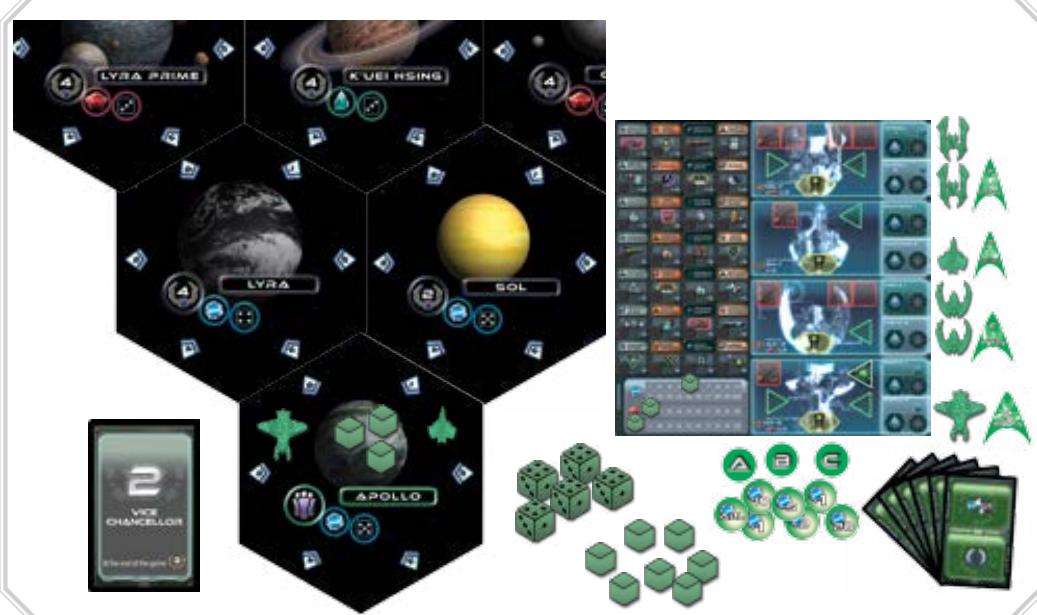
A. The Green player has population on SOL (CP), LYRA (CP), CHARUN (Phasium) and K’UEI HSING (Axinium).The Green player has researched Advanced Phasium Extraction. At the beginning of his turn Green has 7 CP, 3 Axinium and 1 Phasium.
B. Green gains 5 CP from SOL and 5 CP from LYRA and decreases the respective Resource Counters by one.
C. Green then gains 1 Axinium from CHARUN updating also the Resource Counter and pays 1 CP tax.
D. Finally, Green gains 2 Phasium from K’UEI HSING thus decreasing the Resource Counter by two an pays 2 CP tax.
E. At the end of his Upkeep Stage Green has 14 CP, 4 Axinium and 3 Phasium.

•Red: Banking
•Yellow: Trade
•Green: Research
II. Council Stage
Once per cycle, the leaders of the 6 factions face each other under the supervision of the Elder. With hate in their eyes they sit at the giant Council table, stone cold and eager to resume the fight. No one dares to defy the Elder and fail to show up. Not out of respect, but out of fear. The humans are learning Centaurian technologies, they are building Centaurian ships and they mine precious Centaurian resources. Their fear of losing the Elder's favor and the access to things beyond their imagination makes them set the weapons aside and engage in a struggle of politics, negotiation and betrayal. Whichever decision they make, everyone respects them to the letter, leaving unspoken the consequences of doing otherwise.
•Remove from the game any political cards marked as Resolution.
•Political decision
•Reveal the top 3 Political cards (3,4,5,6 players) or 2 Political cards (2 players) and place them near the High Council Board on their designated spaces.
•Bid on the Political cards (see The Bidding Process section on this page) and select the winner. All the ties are broken by the Chancellor.
•As soon as a Political card is selected, put its effects into play, starting with the immediate effect and remove the unselected Political card(s) from the game.
•Bonus Action decision – The Vice-Chancellor selects 2 Bonus Action cards (3 in a twoplayer game) from the 6 available and gives them to the Chancellor. The Chancellor will choose one of them OR none of them. If none is chosen, no Bonus Action will be played this turn. Place the selected Bonus Action card face up on the gaming table and set the rest of the Bonus Action cards aside. They will not be used for the rest of the turn.
•Elections for Chancellor and the order of play
•Using the Value Vote Tokens, bid for the order of play. This is a closed all-pay bid. All ties are broken by the Chancellor. For the whole election process, the Chancellor is not allowed to break any ties in their own favor.
•Redistribute the Turn Order cards accordingly. Attention! The ties are broken by the “old” Chancellor! Only after all the ties are broken, do the new turn order take effect.
•The new Chancellor and Vice-Chancellor are officially appointed.
In a 5-player game (P1, P2, P3, P4, P5), P1 is the Chancellor. Players bid the following amounts P1 – 2, P2 – 3, P3 – 3, P4 – 2, P5 – 0. The Chancellor (P1) will break the tie between P2 and P3 awarding the 1st player (and therefore new Chancellor) to P2. Then P3 will become the 2nd player. The Chancellor will then break the tie between P1 (himself) and P4. He cannot rule in his own favor, so he will decide P5 takes 3rd player and himself, P1, will be the 4th player. The lowest bidder, P5, will be the 5th player.
The Bidding Process
The bidding currency is CP Players have at their disposal all the CP accumulated up to that point in the game. TIP: During the first few turns it is recommended that players spend less than 5 CP during the whole Council Stage.
•Make sure that the 3 Political cards are placed face up on the spaces marked A, B and C and that everyone is aware of the effects of each card.
•This is another closed all-pay auction. Each player will place in his fist Value Vote Tokens representing the amount he wants to bid together with one A/B/C Vote Token. Once everyone has decided, bids cannot be changed anymore and all players must reveal their hands simultaneously. Immediately adjust all CP accordingly.
•Attention! If a player enclosed in his hand more than or less than exactly one A/B/C Vote token, his vote is invalid and will not be considered.
•Sum up the total CP bid on each card, assuming an A/B/C Vote token is equal to 1 CP
•Select the winner. If two or more cards are tied for the highest amount, the Chancellor breaks the tie.

A. Players bid: •P1: A + 3 CP •P2: B + 4 CP •P3: A •P4(Chancellor): C •P5: A + B + 1 CP
B. Players pay the amount they bid. Remove invalid bids – the bid of P5 does not count.
C. Place bids on cards and compute the total for each card: •Card A: 2xA + 3 CP (5) •Card B: 1xB + 4 CP (5) •Card C: 1xC (1)
D. There is a tie between cards A and B. The Chancellor breaks the tie choosing A, which then becomes the political decision for that turn.
III. Action Stage
Each Action card has one Action in its top half and one Reaction in its bottom half. Action cards may not be flipped to exchange the positions of their Action and Reaction.
•Play 1st Action card
•Each player looks at their hand of Action cards and chooses one card to play. That Action card is then played face down in front of that player on the table. The Action that will be resolved is the one written on the top half of the card. TIP: During the first turn, avoid selecting Mining as either Action or Reaction.
•After all the players have placed their Action cards face down in front of them, all the Action cards are revealed (they cannot be replaced anymore).
•In turn order, each player performs the Action (top half of the card) written on his card. TIP: Even though for most Actions it is not necessary to resolve them in a fixed order, the players should pay attention to the Actions of the other players.
•Reaction to 1st Action (1st Reaction)
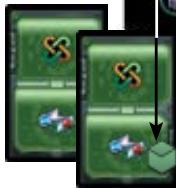
•In turn order, each player may activate and execute (react) the secondary Action (lower half) of one of the Action cards face up on the table. To activate a Reaction, a player must sacrifice 1 or 2 Population cubes from their Home Planet and place them on the specific card with the Reaction they want to perform. Activating your own card requires 1 Population cube, activating any other card requires 2 Population cubes.
•This step is not mandatory! A player may choose not to activate any Reactions. To activate a Reaction, the player must use Population cubes only from his Home Planet.
•Return the used Population cubes to their owner’s stashes (NOT back to the Planets).
•Any player who has researched the Basic Politics technology will take their first Action card back in their hand.
•Play 2nd Action card
•Each player looks at the remaining Action cards in their hand and chooses one card to play. That Action card is then placed face down in front of that player on the table.
•After all the players have placed their Action cards face down in front of them, all the Action cards are revealed and placed on top of the 1st Action card.
•In turn order, each player performs the Action (top part) written on their card.
•Reaction to 2nd Action (2nd Reaction)
•In turn order, each player may react to one of the Action cards face up on the table. The same rules from the 1st Reaction apply.
•[Play 3rd Action card]
•Only the players who have researched the Master Politics technology may participate.
•Those players will repeat the steps from Play 2nd Action card. There is no Reaction to the 3rd Action!

A. Players select their first Action card •Green: Research/ Trade •Yellow: Trade /Build Ships
•Red: Banking / Research
B. Players execute their first Action
•Green: Research
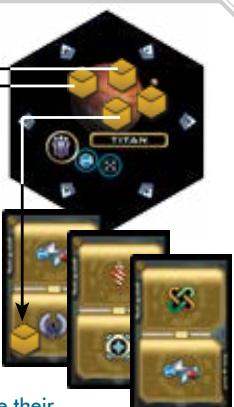
F. Players execute their second Action
C. In turn order, players choose and execute their first Reaction
•Green: Research (Red card) with a cost of 2 Population
•Yellow: Build Ships (Yellow card) with a cost of 1 Population
•Red: no Reaction
D. Green has researched Basic Politics, so they can reuse their first Action card. E. Players select their second Action card: •Green: Research / Trade (again) •Yellow: Mining / Buy Upgrades •Red: Build Ships / Mining

•Yellow: Mining
•Red: Build Ships
G. In turn order, players choose and execute their second Reaction
•Green: Trade (Green card) with a cost of 1 Population
•Yellow: Mining (Red card) with a cost of 2 Population
•Red: no Reaction
H. Yellow has researched Master Politics, so they can play their third Action •Yellow: Research
I. The chosen bonus action is Research, so everybody performs Research in turn order (Green, Yellow and Red).
•Play Bonus Action
•In turn order, all the players perform the Action written on the Bonus Action card chosen during the Council Stage.
•If the bonus Action is MOVE, then all players will perform one additional Conquest Stage this turn after the two ‘normal’ Conquest Stages.
•There is no Reaction to the Bonus Action!
Actions
•Research
•With a Research Action you may learn exactly one Technology (for a detailed list of technologies, see the Technologies section on the last page).
•Place a Population cube from your stash (not your Home Planet) on a technology of your choice and pay its associated cost in CP to the bank.
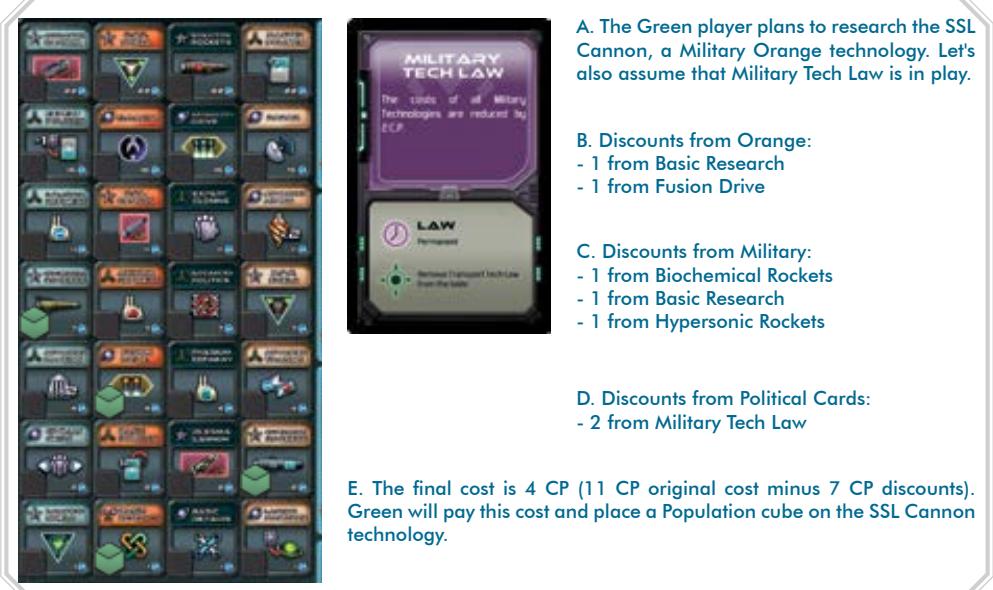
•Each technology receives a ‘discount’ of 1 CP for every other technology of the same color a player has already researched and for every other technology of the same type (Military, Civilian, Transport) a player has already researched. These discounts are cumulative! Additional discounts or restrictions from Political cards may also apply. TIP: The cost of researching a technology can be reduced to a minimum of 0 CP.
•Technologies cannot be un-researched. The advantages of any technology are applied immediately. The Population cubes used to mark researched technologies will never return to a player’s available pool.
•Banking
•Gain 4 CP If you have researched Advanced Banking, gain 8 CP instead.
•Build Ships
•An Action to build ships allows a player to pay the costs and place any number of ships in the hex where their Home Planet is. The cost for each ship is written on its blueprint.
•Those ships can be activated in the very next Conquest Stage (same turn). Bonuses, discounts or restrictions from Political cards also apply!
•Buy Upgrades
•Using Buy Upgrades allows a player to purchase any number of upgrades from the common supply. The ship parts (Cannons, Shields, Drives) modify the blueprints of the ships. As soon as a new upgrade is placed on a ship, all ships of that type behave according to the new blueprint. Rockets are placed on Planets where they can be fired from in the next stage of the turn. Each planet can house up to 2 WMD.
•A necessary precondition to buying an upgrade is to have researched the technology allowing you to have that specific upgrade (for example, you may buy a Fusion Drive only after you have researched the Fusion Drive technology).
•Every upgrade has a cost. A player must pay the costs of all the upgrades they are buying.
•All upgrades must be placed immediately on a ship’s blueprints or on a Planet, any unused upgrades are returned to the bank.
•Players may rearrange upgrades between ship blueprints any time except during a battle.
•Bonuses, discounts or restrictions from Political cards also apply.
•Mining
•Add a total of 4 resources (8 if you have researched Advanced Mining) to Planets where you have Population (up to the maximum that is written on the Planet) by adjusting the Resource Counters. Resources can be distributed in any way among Planets, respecting the maximum written on each Planet. While using this Action you may add a resource counter to a depleted planet (one that provides resource but currently has no resource counter on its surface).
•Trade
•A Trade Action allows a player to exchange resources, either selling Axinium/Phasium for CP or buying Axinium/Phasium with CP
•To perform a Trade Action, place one cube from your supply (not from your Planet) on the left most free area on the market. You may perform up to 4 exchanges. One exchange allows selling 1 Axinium/Phasium for CP OR buying 1 Axinium/Phasium with CP
•If you have researched Advanced Trading, you may buy, sell, or both buy and sell. Perform the desired exchange(s) with the bank. Use the exchange rates written in red for buying and selling.
•If you have not researched Advanced Trading, you may either buy or sell, but not both.
Perform the desired exchange(s) with the bank. Use the exchange rates written in white.
•Both the buying and selling areas of one space on the market are blocked for all the players (including the original player) after a player has used any of them. The number of areas in the market is equal to the number of players. If there are no available areas, no trade may be performed.

IV. Fire WMD Stage
All Rockets are classified as Weapons of Mass Destruction (WMD). The WMD can be placed by players on Planets where they have a majority in Population cubes. A WMD on a Planet may be fired only by the player who has a majority on that Planet. A WMD placed by one player may become "property" of another player if that player gains Population majority on the planet with that WMD. WMD are used solely against Planets, with the exception of Home Planets which possess a unique defense system against all WMD.
A WMD may target a Planet up to a maximum distance of 6 hexes. Whenever counting the distance, do not count the palanet of the WMD's origin.
To fire the weapons of mass destruction, do the following:
•Assigning targets – In reversed turn order, players may assign one target Planet for each WMD. One or more Rockets may be assigned to the same target Planet. Each WMD fires once per turn (and will be ready to use again on a subsequent turn). You can mark the used WMD by flipping their tokens to the grey side.
•Distance check – for each WMD roll a die. If you have research the Radar technology, add 1 to the die roll. If the modified die roll is greater than the distance from the originating hex to the target hex, the WMD hits its target.
•Damage roll – If a WMD passes the distance check, roll the necessary number of dice for each single rocket. 5 and 6 represent hits.
• Hypersonic Rockets: roll 5 dice, destroy one resource per hit.
• Biomchemica Rockets: roll 3 dice, destroy 1 population per hit (you may not ignore any hits, even if it means removing Population cubes belonging to a player you did not want to target)
• Graviton: roll 2 dice, a single hit destroys the planet, all of its resource and Population. Return Population cubes to the owners and flip the planet hex face down. Any ships in the hex are unaffected.
•Attention! All WMDs are fired at the same time. Even if a Planet containing a WMD is the target of a successful attack by a Graviton Rocket, the WMD will still be allowed to be fired before the hex is flipped.

A. The Green player controls a Graviton Rocket on LYRA and 2 Biochemical Rockets on SOL. The Red player controls a Hypersonic Rocket on K’UEI HSING.
B. Players assign targets to their Rockets as shown by the arrows. We assume all distance checks are successful.
C. Green rolls for the first Biochemical Rocket (1,5,6) and the second Biochemical Rocket (1,1,5). With 3 hits Green must destroy 3 Population on LYRA PRIME, 2 red and one green - their own.
D. Green rolls for the Graviton Rocket (2,6) and has 1 hit. K’UEI HSING is destroyed, but not before Red has a chance to fire the WMD housed on that planet.
E. Red rolls for the Hypersonic Rocket (1,2,4,6,6) and has 2 hits. The Resource Counter on CHARUN is decreased by two.
F. Flip K’UEI HSING hex, destroyed by the Graviton Rocket. Remove all Population, the Resource Counter and the Hypersonic Rocket. Any space ships in that hex are not affected.
V. Conquest Stage
Every turn, the players play two separate, consecutive Conquest stages. If the selected Bonus Action was MOVE, then a third separate Conquest stage is played that turn.
During the Conquest stage, players get to move their ships and their Population. They will expand their empires and fight to gain Victory Points.
•Mount Population (OPTIONAL) – Players may put Population from Planets onto ships with transport capacity in the same hex. The number of Population cubes on a ship may not exceed that ship’s transport capacity. At this point, players who researched Civilian Ships may move Population cubes between the Planets where they already have Population.
•Place movement tokens on ships:
•Every ship can move up to 3 hexes away, according to the drive mounted on that ship. •Each movement token is either blank or it has a direction number written on it. Blank means no movement, any direction number forces the ship to move in that direction.
•Players may place one, two or three movement tokens (from the common pile) on the blueprint of each ship, face down. The number of tokens is at most equal to the drive capacity equipping that type of ship. If no tokens are placed, that ship will not move.
•Move all ships – Reveal and execute the movement tokens on all ships, from top to bottom. The order in which the ships move is not relevant. Once the tokens assigned to a ship are executed, return them to their stash.
•Uncloaking (OPTIONAL) – Cloaked ships decide whether to uncloak or not. Once uncloaked, there is no going back, those ships will enter combat. All ships belonging to the same player in each hex must uncloak or remain cloaked together. Players who have researched Radar may force any ships to uncloak. Those ships become visible to everyone.
•Resolve conflicts – Conflicts appear when ships belonging to two or more players are in the same hex (ships sharing hex briefly during movement do not fight each other). All ships in the same hex will battle until there are ships belonging to only one player left in that hex. Battles are structured in combat rounds. Each combat round consists of:
•Roll a number of dice equal to the total number of damage symbols on all the cannons of all your ships in that hex (e.g. an Antimatter Cannon has 5 damage symbols). All 5 & 6 are hits, any other number is a miss. All ships fire at the same time! For every hit, assign
1 damage to (put a damage token on) a ship belonging to another player (if more than
2 players are in a hex, the damage assignment is done in reversed turn order).
•Remove all ships with damage exceeding their total shield power.
•Fight the Centaurian Resistance – After only one player has ships left in each hex, in those hexes where there are Centaurian Resistance ships another battle takes place:
•Identify the type of Centaurian Resistance ship and reveal the top card of the corresponding deck. That card will reveal the fire power and strength of the Centaurian Resistance ship. The Centaurian ship will be controlled by the player to the left of the attacking player.
•Battle that ship, respecting the rules for player vs. player combat above.
•In the case of victory, keep the battle card. You may discard it any time (outside a Conquest stage) to gain a bonus or you may keep it until the end of the game to gain Victory Points.
•In the case of defeat, remove immediately all damage from the Resistance ship and place the Centaurian Resistance card at the bottom of its deck.
•Deploy Population (OPTIONAL)
•One or more of the Population cubes on ships may be deployed on the Planet in the same hexes as the ship carrying them. The deployment may occur regardless of the presence of Population belonging to other players.
•Population cubes can be deployed off cloaked ships without any additional constraints and without uncloaking. The general rules for deployment still apply.
A. The Green player has researched Cloaking tech, no one has researched Radar. Blue’s first War Cruiser hosts 1 Population cube. B. All players assign movement tokens to their ships. Blue decides to group their two ships and move them together. Blue must assign only 1 set of tokens (see Additional Rules for the Conquest Stage).

C. All movement tokens are revealed and executed (see arrows):
All ships (Red, Green and Blue) share the same hex at the end of the move (the Lyra Prime hex).
D. Green chooses not to uncloak. Since no one has the Radar technology, Green ships will remain cloaked until the end of turn.
E. Combat (player vs. player) round 1: •Red rolls 4 dice, Blue rolls 12 dice •Red rolls: 1,1,5,6, a total of 2 hits all assigned to the Blue War Cruiser with Population. •Blue rolls 1,2,2,2,3,3,4,4,4,4,5,6, a total of 2 hits. Both of the 2 hits are assigned to the Red Fighter.
•Red rolls: 2,5,5,5 a total of 3 hits all assigned to the damaged Blue War Cruiser. With a total of 5 damage, it is destroyed together with the Population cube.
•Blue rolls 1,1,2,3,3,3,4,5,5,5,6,6, a total of 5 hits, all assigned to the Red Fighter which is thus destroyed.
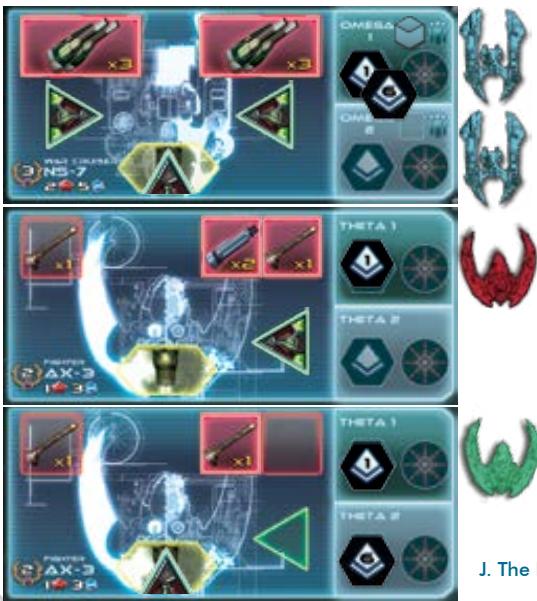
G. The Blue player is awarded 2 VP for destroying the Red Fighter in a combat he won. Now the Blue player engages the Centaurian Resistance.
H. Combat (Blue player vs. Resistance) round 1: •Blue has one War Cruiser left and therefore rolls 6 dice, while the Resistance (controlled by the White player) rolls 3 dice
•Blue rolls 2,3,4,4,5,6, deals 2 damage to the Resistance Ship

•The Resistance rolls 1,1,2 failing to deal any damage
I. Combat (Blue player vs. Resistance) round 2: •Blue rolls 6 dice, the Resistance rolls 3 dice •Blue rolls 1,2,2,3,4,5 deals 1 damage to the Resistance Ship which is defeated •The Resistance rolls 3,4,6, dealing 1 damage to the Blue War Cruiser
J. The Blue player keeps the Centaurian Resistance card.
•For each Population cube that needs to descend on a Planet with Moons (any Planet not 'alone' in its hex), roll a die to check deployment success. A roll of 4-6 is a success, that Population cube may be deployed. Any other roll prevents the respective Population cube to be deployed, therefore it must remain on the ship.
•Population can descend without restrictions on any 'single' Planet (that includes all Home Planets).
•The Landing Maneuver technology allows players to skip the die roll and always deploy successfully.
Additional rules for the Conquest Stage
Players may choose not to use movement tokens for moving some or all of their ships. If they do so, they must move all their ships for which they do not wish to use tokens before any movement tokens are revealed. Any other rules of moving ships still apply.
If the ships belonging to 2 or more players all with Cloaking technology and without Radar end up in the same hex, they are not allowed to uncloak and engage in combat. As long as the ships belonging to at least one player become visible, either due to the lack of Cloaking or due to discovery by Radar, then all the players still cloaked have the option to uncloak.
The winner of the combat (player vs. player) is the only one awarded points for destroying enemy ships. That player will get points for all the ships destroyed in that combat (except their own), regardless of who dealt the damage. Mark those points on the Victory Points track on the common board.
Before the last Conquest stage of the last turn of the game, all players gain the Radar technology and there are no cloaked ships anymore.
[Victory]
The aim of the game is to accumulate Victory Points to assert supremacy over the other factions. At the end of the game, the player with the most Victory Points wins the game.
Use the VP track on the common board to keep track of VP throughout the game and to count VP in the end. In the case of a final tie, the turn order is the tie breaker.
Players accumulate Victory Points by:
•Having the majority of Population cubes on Planets (at the end of the game):
•The player with the most Population cubes on a Planet gets all the Victory Points.
•In the case of a tie, all the players tied for the most Population share the VPs. If 2 players have 2 Population cubes each on a 4-VP Planet and the 3rd player has only one Population cube, the first two players get 2 VP each.
•Space domination (at the end of the game):
•Each player gets 2 VP for each hex with at least one ship belonging to that player.
•The player who has ships in the High Council hex receives 5 additional VP.
•Centaurian Resistance cards (at the end of the game):
•All the Centaurian Resistance cards come with a number of VP. The players that did not discard them for the immediate bonus should add these VP.
•Fighting (throughout the game):
•The winner of every player vs. player fight (the player that has ships left in a hex at the end of a battle) is awarded VP for every enemy ship destroyed in that battle (regardless of who dealt the damage). The number of VP for each type of ship is marked on the blueprint.
•Political titles (at the end of the game):
•The holder of the Chancellor title gets 5 VP, the holder of the Vice-Chancellor gets 3 VP and the holder of the High Council Senator gets 1 VP.
Count the grand total of Victory Points and don't forget to congratulate the winner!
[Optional Rules]
Long Game
•For those who want to spend more time and get the full experience of Exodus: Proxima Centauri, we recommend the Long Game setup of the map.
•Play over 9 turns!
•Only 2 CP as starting resources at the beginning of the game.
•Basic Research technology may not be researched.
Combat Intensive Game
•We recommend this only for experienced players.
•Follow the Minimal Setup to encourage battles.
•Play over 5 turns only!
•Take 10 CP as starting resources at the beginning of the game.
•Each player starts with exactly 3 technologies of their choice, with a total research cost of 20 CP or less. Basic Research may not be obtained this way.
•Each player starts with one extra Battle Carrier.
Short / Simplified Game
•This setup is for those in a rush, who would like to finish the game in 120 minutes with a set of 4-6 players, using simplified rules:
•Do not use movement tokens during the Conquest Stage. Execute the movement in reversed turn order (from number 6 to number 1).
•Skip paying tax. Always play 3 Actions per turn and do not play Reactions! Bonuses from Political cards and Bonus Action still apply.
•Decide on a time limit or a number of turns. When you reach the time limit, call the last turn.
Variants for Banking and Mining
•When performing a Banking Action gain 3 CP or roll a die and gain that much CP If you decide to roll a die, you must keep the result. With Advanced Banking, you may gain 7 CP, roll a die and add 3 and gain that much CP or roll two dice and gain that much CP •When performing a Mining Action you may add a total of 3 resources on Planets where you have Population or roll a die and add that many resources. If you decide to roll a die, you must keep the result. With Advanced Mining, you may choose to add 7 resources, roll a die and add 3 to the result and add that many resources or roll two dice and add that many resources.
2 Players Long Game Setup

1x High Council hex 2x Home Planet hex 6x CP Planet hex 4x Axinium Planet hex 2x Phasium Planet hex
4x Resistance Ship I 2x Resistance Ship II 2x Resistance Ship III
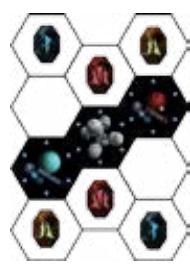
2 Players Minimal Setup
1x High Council hex 2x Home Planet hex 4x CP Planet hex 2x Axinium Planet hex 2x Phasium Planet hex
2 Resistance Ship I 2x Resistance Ship II 2x Resistance Ship III
3 Players Long Game Setup

1x High Council hex 3x Home Planet hex 9x CP Planet hex 6x Axinium Planet hex 3x Phasium Planet hex
6x Resistance Ship I 3x Resistance Ship II 3x Resistance Ship III

3 Players Minimal Setup
1x High Council hex 3x Home Planet hex 5x CP Planet hex 4x Axinium Planet hex 3x Phasium Planet hex
3 Resistance Ship I 3x Resistance Ship II 3x Resistance Ship III

4 Players Long Game Setup
1x High Council hex 4x Home Planet hex 11x CP Planet hex 8x Axinium Planet hex 5x Phasium Planet hex
2x Resistance Ship I 4x Resistance Ship II 6x Resistance Ship III

4 Players Minimal Setup
1x High Council hex 4x Home Planet hex 7x CP Planet hex 6x Axinium Planet hex 3x Phasium Planet hex
4 Resistance Ship I
4x Resistance Ship II
4x Resistance Ship III

5 Players Long Game Setup
1x High Council hex 5x Home Planet hex 14x CP Planet hex 10x Axinium Planet hex 6x Phasium Planet hex
4x Resistance Ship I 5x Resistance Ship II 6x Resistance Ship III
6 Players Long Game Setup
1x High Council hex
6x Home Planet hex
18x CP Planet hex
12x Axinium Planet hex
6x Phasium Planet hex
6x Resistance Ship I
6x Resistance Ship II
6x Resistance Ship III
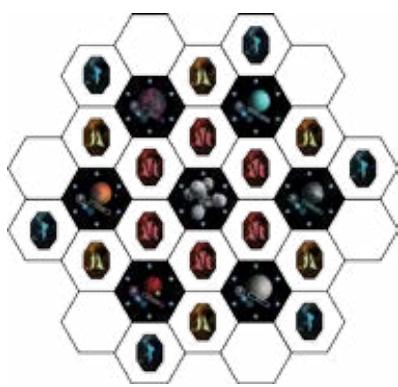
6 Players Minimal Setup
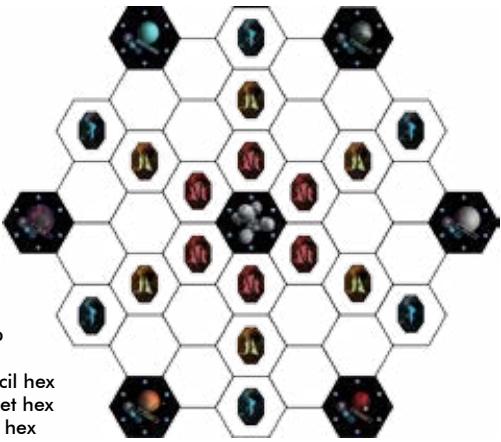
1x High Council hex 6x Home Planet hex 10x CP Planet hex 9x Axinium Planet hex 5x Phasium Planet hex
6x Resistance Ship I 6x Resistance Ship II 6x Resistance Ship III
[Frequently asked questions]
Resources & Population
Q: Do I pay tax for the resources I had before together with the new ones? A: No, it is a tax per income, not per fortune. You pay tax for what you get ‘fresh’ that turn.
Q: My stash of Population cubes ran out. They are all out on Planets. What do I do next? A: This stock is limited. Your clone factory can only produce a limited number without significant genetic degeneration. You will just have to better manage your Population.
Q: What happens if I am attacked and all my ships and my Population are destroyed? A: Every turn, the clone factory on your Home Planet produces two Population cubes. That can be a fresh start for you.
Q: Can Population belonging to two or more players coexist on the same planet? A: Yes! They’re not happy about it, but they can.
Q: So, in this case, who gets resources first? Does it matter how much Population we have there? A: The resources are taken in turn order. The amount of Population counts only for getting VP at the end of the game.
Q: There is no Axinium Planet near me and I cannot get enough Axinium to build all the ships that I want. What do I do?
A: Use Trade. For greater efficiency, research Advanced Trading, this way your trade rates will also improve.
Politics and turn order
Q: When distributing Turn Order cards before the first turn, which ones should we use? A: In a N-player game, used the cards with numbers 1 to N. For example, in a 4-player game use the cards 1,2,3 and 4.
Actions
Q: Can multiple players select the same Action card for their Reaction? A: Every Reaction may only be activated once, so it is available only to the first player that puts Population on it. Remember that Reactions are activated in Turn Order.
Q: I researched Expert Politics and I am reacting on my own card, so I don’t have to spend any population to activate it. How do I mark it spent?
A: Simply flip the card on the other side.
Q: Do players have to use the Bonus Action? A: No, the use of the Bonus Action (or any Action) is in fact not mandatory.
Research and Technologies
Q: How do I get to play more Actions per turn? A: Research Master Politics, it provides the third Action.
Q: Can I un-research or lose a technology that I’ve already researched? A: No.
Q: I keep rolling the ‘wrong’ dice when I need to deploy my Population. What else can I do? A: Research Landing Maneuver, you won’t have to rollany dice at all when deplying Population.
Q: Does Basic Politics work between the 2nd and 3rd Action (Master Politics researched)? A: No, Basic Politics only allows you to take your Action card back before playing your second Action.
Q: Which technologies provide a discount for Basic Research? A: Any other technology.
Q: If two or more players have researched Civilian Ships, they are both free to move population between planets during the Conquest stages. Who does it first?
A: This is done in reversed turn order.
Trade
Q: Can I use the market if I do not have any cubes left? A: No.
Q: Does Advanced Trading allow a player to buy and sell with a single exchange? A: Advanced trading allows you to buy and to sell. However, one exchange is either buying OR selling.
Q: I used Trade as my first Action and I plan to use it again as a Reaction and then as a Bonus Action. Do I need to block a place on the market each time?
A: Yes, every time a Trade Action is performed, one space one the market is blocked, regardless if that player has already performed another Trade Action.
Upgrades
Q: There are no more upgrades of the kind that I want. What can I do? A: Try to research a different technology that is still available which provides a similar upgrade.
Q: I have many ships but they’re easily defeated in combat. What’s the problem? A: Try to put better ship upgrades on their blueprints.
Q: If I move shields away from the blueprints of ships with damage so that the damage accumulated exceeds the total value of the shields, do I have to destroy those ships? A: Yes, as soon as the damage on a ship exceeds the amount the shields can carry, the ship is destroyed immediately. In such a case nobody is awarded VP for destroying those ships.
Building Ships
Q: There are enemy ships orbiting my Home planet. Can I still build ships? A: Yes.
Q: So, what happens then? Do we fight immediately?
A: You do not fight immediately. During the Conquest stage, everyone gets to move their ships before battle. If the enemy ships are too powerful, you have the option to run away with your ships. You get to mount population, place movement tokens and execute them before the actual battle takes place.
Q: In the last turn, the selected bonus Action was MOVE. How many Conquest Stages do we perform and when does everyone get the Radar tech?
A: You will go one by one through three Conquest Stages. The Radar is awarded to everyone before the third Conquest Stage.
Centaurian Resistance
Q: I am in the middle of a combat and I have in my hand a Centaurian Resistance card that gives me a better shield. Can I use it to upgrade my shield? A: No, these cards can be used only outside the Conquest stage. You will be able to use it next turn.
Q: I am the ‘guy on the left’ controlling the Centaurian Resistance and I am not sure what is the best way to distribute the damage of the Resistance ship. What do I do? A: Target ships with Population if you can deal enough damage to take them down. Then, go for the most expensive ship or for many weak ships. If you’re still in doubt, just hit something, it will be fun.
Ship Movement and Battle
Q: Can I retreat from a battle? A: No. Pick your battles carefully.
Q: Can I move my ships through spaces containing non friendly ships? For example I have a ship with Fusion Drive and I move through a hex containing non-friendly ships to get to a tile with no other ships. Would this work?
A: Yes, it is possible.
Q: Before the last Conquest Stage of the last turn does a player automatically get the Radar even if he has no more cubes to place on his technology tree? A: Radar is awarded to all players and there is no need to mark it on the player board.
Q: At the end of the player-vs-player combat, no players have ships left in the hex. Who gets the VP for the destroyed ships?
N: No one. It is a rare case but it can happen. If no one survived the battle, no one gets the glory.
[The story]
The Last Genocide
The first estimations turned out to be far too optimistic. Some of the vessels deemed flight worthy during the first trials turned out to be too damaged to survive prolonged spaceflight, with a few being unable to escape the planet without further damage. Upon this discovery, another deal was quickly struck, one that decided by the leaders of the six factions that had arrived first to Baikonur Cosmodrome, a location in Old Earth Kazakhstan were the whole fleet was gathered for pre
内容过长,此处只内联前一部分;完整内容请下载或到规则页阅读。
下载 Markdown原文为社区整理/出版社公开资料,版权归原作者,仅供个人学习查阅。