
熔炉战争Forge War
一句话概览
熔炉战争 是一款已收录于村了吗规则库的桌游,支持 1–4 人,原名 Forge War。
本页内容:一句话概览 · 常见问题
这游戏怎么玩
- 本站已收录这款游戏的规则资料,可以在对话里直接提问规则细节。
常见问题(FAQ)
以下 1 条问答中 0 条来自站内玩家的真实提问,其余 1 条为本站整理的常见疑问;答复内容保持原样。
熔炉战争支持几个人玩?
1–4 人。
去哪查完整规则
想核对具体规则细节、卡牌效果或某个回合的结算方式,可以在村了吗里选中这款游戏后直接提问。
同类桌游
- 卡坦岛德式
- 工业革命:伯明翰德式
- 勃艮第城堡:特别典藏版德式
- 方舟动物园德式
- 卡卡颂抽象
- 瘟疫危机传承:第一季美式
- 阿瑞迪亚:勇踏征途美式
- 重塑宇宙德式
- 幽港迷城美式
- 埃多拉的德鲁伊德式
规则原文(Markdown)
本站收录这款游戏的规则原文 1 个文件,此处内联渲染 1 个,可直接展开阅读或下载。
Forge War Rule Book - 2nd Printing.md78.6 KB
FORGE WAR
RULE BOOK
he wild lands are growing restless. The king has called upon all able-bodied men to push back the creeping edges of the map. As the leader of a fledgling adventurer's guild, you are tasked with gathering resources, forging weapons and slaying epic monsters of the wilderness to earn riches and gain prestige from the king.
Players will spend rounds gathering metals and precious gems from the mines, which they will then use with designs purchased at the market to forge powerful weapons. These weapons will be wielded by a player's personal pool of adventurers to complete quests, which earn prestige, as well as more money and resources players can invest back into their expanding guild.
There are 2 main modes of play: the normal game, which consists of 7 rounds; and the epic game, which consists of 3 stages with 6 rounds each. Each round consists of 3 phases: mine, market and quest. The game accommodates 1-4 players.
COMPONENTS
Game component amounts are not meant to limit gameplay. If you run out of something, use a suitable replacement.
37 double-sided interlocking mine pieces
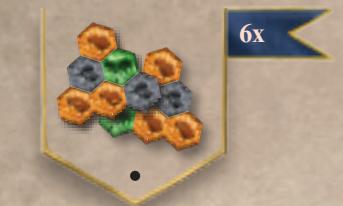
Stage I central hex grids (1 dot on center mine)

Stage I hex borders (1 dot on center mine)
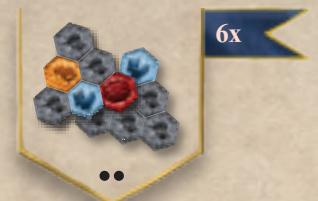
Stage II central hex grids (2 dots on center mine)
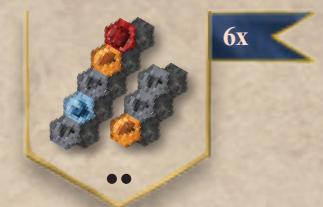
Stage II hex borders (2 dots on center mine)

Stage III central hex grids (3 dots on center mine)
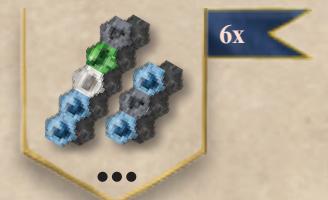
Stage III hex borders (3 dots on center mine)

1 central hex tile
180 resources

Copper ingots (orange)

Iron ingots (black)

Mithril ingots (blue)

Game board
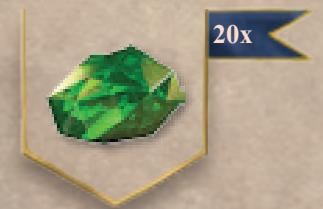
Emeralds (green)

Rubies (red)

Diamonds (white)

Rule book

White quest tracker cubes

Player mats (2-sided, normal / epic game)

Adventurer tiles

Champion title & level tokens

PLAYER ELEMENTS (see page 6)
a1 player mat of their color, correct side up (see page 17).
b1 of each of the 2 starting weapon designs
3 adventurer tiles with level 1 tokens (4 adventurer tiles in epic game)
dEpic game only: A set of 20 champion title tokens
e3 overseer meeples of their color, set to the side
f10 worker pickaxes of their color, set to the side
g5 disk markers of their color, set to the side
2 PLACE DISK MARKERS (see page 6)
kPlayers place 1 disk marker of their color on the 0 spot of the prestige track.
Randomly determine turn order and place 1 disk marker of each player color in the corresponding spot of the turn order track.
mPlace 2 others on the merchant to keep track of buys and sells (see page 17).
3 PLACE ROUND TRACKER (see page 6)
nPlace the round tracker on stage 1, round 1 of the round track.

BONUS TILES (OPTIONAL) (see page 6)
Epic game only: Shuffle the 15 bonus tiles and randomly place 1 tile face-up on top of rounds 4 and 5 of stage 1, place 2 tiles face-up covering rounds 1 and 2 and rounds 4 and 5 of stage 2 and do the same for stage 3. Note that bonus tiles are optional and should only be used by experienced players and only in the epic game. In addition, if bonus tiles are being used, players should start with 1 fewer adventurer (3 total).
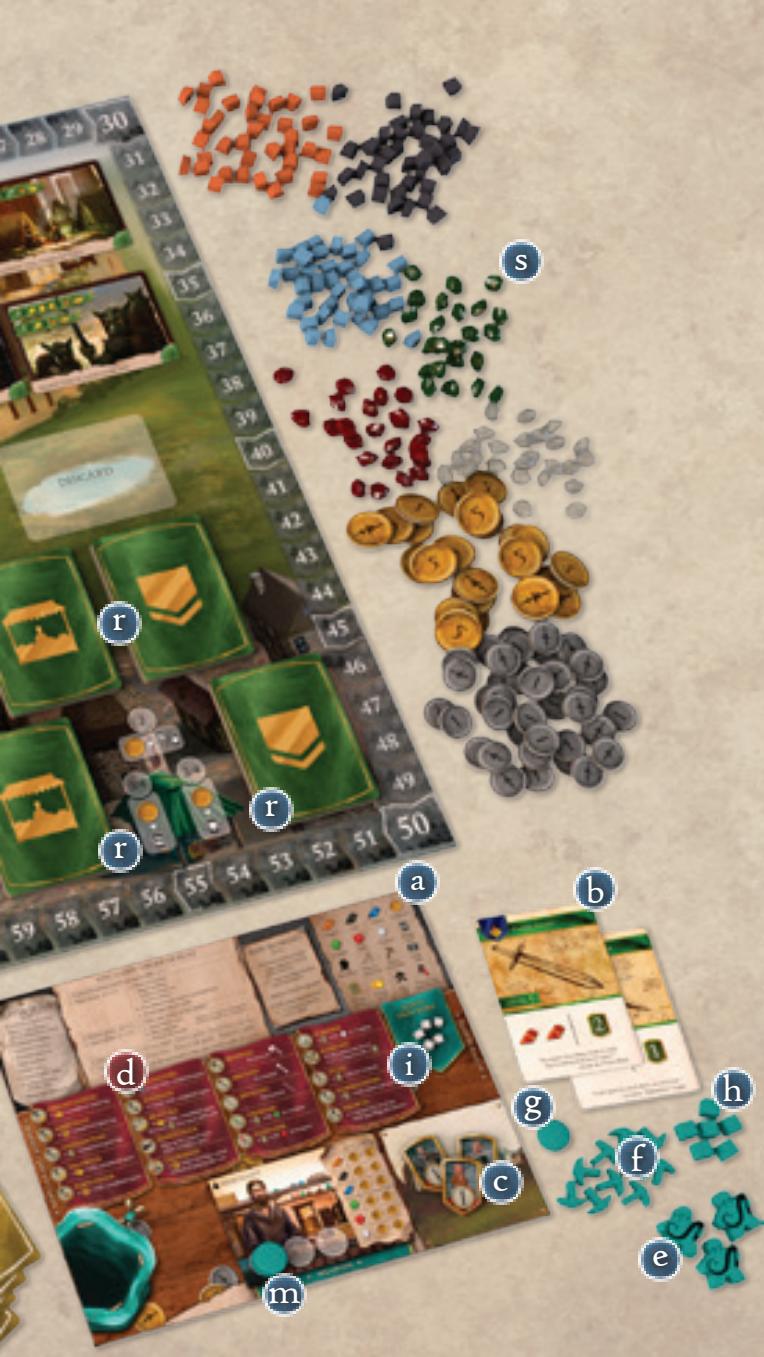
PREPARE THE QUEST DECK (see page 7)
In separate decks, shuffle the 18 green stage 1 quests and the 9 purple stage 1 endgame quests. Place both decks on the quest draw space with the green deck on top.
Epic game only: Do not remove the quests from the green deck. Instead of including the purple stage 1 endgame quests, include the grey stage 2, red stage 3 and purple stage 3 endgame quests shuffled separately and stacked in the topto-bottom order of green, grey, red and purple.
FILL THE QUEST OFFER (see page 7)
Draw 8 stage 1 quest cards from the deck, placing the first 5 in the top row of the quest offer and the next 3 in the bottom row.
STOCK THE MARKET (see page 7)
Separate and shuffle the green weapon, bonus and single-use market cards, then place the decks into their corresponding spots and reveal the top card in each stack (see page 9). Place the 4 public starting weapon designs below the board.
STOCK THE SUPPLY (see page 8)
S Place all the resources separated by color, as well as the extra adventurer tiles, level markers and coin tokens next to the board.
BUILD THE MINE (see page 8)
Randomly pick a side of each of the 6 stage 1 central hex grids and assemble them together with the single central hex to form a hexagonal array with a side length of 4 hexes. Then, based on number of players, surround this assembly with a ring of 6 stage 1 hex borders alternating in length so that they lock together.
10STARTING WEALTH (see page 8)
All players select 2 of their 4 starting wealth cards and collect the bonuses on those 2 cards.
11PLACE OVERSEERS (see page 8)
In turn order, take turns placing 1 overseer on any available unoccupied hex of the mine until all 3 overseers of each player are placed.
NORMAL GAME
Setup and mechanics will be described for playing the normal game.
Extra mechanics for the epic game will be clearly marked as such with this red background.
SETUP

Players should collect the following:
• 1 of each of the 2 starting weapon designs

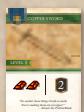
• 3 adventurer tiles with level 1 tokens
(4 adventurer tiles in epic game)




• Epic game only: A set of 20 champion title tokens

• 3 overseers of their color

• 10 worker pickaxes of their color

• 5 disk markers of their color

• 6 claim cubes of their color

• 5 white quest tracker cubes

• 4 randomized stage 1 starting wealth cards

• 1 player mat of their color, correct side up.

2 Players should place 1 disk marker of their color on the 0 spot of the prestige track.
Randomly determine turn order and place one disk marker of each player color in the descending numbered spots of the turn order track.

3Place the round tracker on stage 1, round 1 of the round track.
Epic game only (optional): Shuffle the 15 bonus tiles and randomly place 1 tile face-up on top of rounds 4 and 5 of stage 1, place 2 tiles face-up covering rounds 1 and 2 and rounds 4 and 5 of stage 2 and do the same for stage 3. Note that bonus tiles are optional and should only be used by experienced players and only in the epic game. In addition, if bonus tiles are being used, players should start with 1 fewer adventurer (3 total).

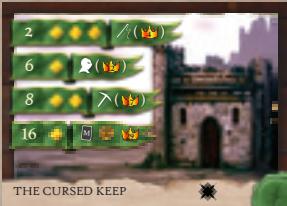
Take the 20 green stage 1 quest cards and remove the 2 quests marked with a(“Investigate the Kidnappings"and “The Cursed Keep"). Find the 9 purple stage 1 endgame quest cards (denoted by the Roman numeral I on the front and back). Shuffle both of these decks separately and then place both decks on the quest draw space with the green deck on top.

Epic game only: Do not remove the quests from the green deck. Instead of including the purple stage 1 endgame quests, include the grey stage 2, red stage 3 and purple stage 3 endgame quests (denoted by the Roman numeral III on the front and back) shuffled separately and stacked top-to-bottom in the order of green, grey, red and purple.
Draw 8 stage 1 quest cards off the top of the deck, placing the first 5 in top row of the quest offer and the next 3 in bottom row face-up.
3 9 10 12 12 13 14 15 16 17 15 19 20 21 22 23 24 25 26 27 28 29 30
QUEST DRAW DECK

Find the green stage 1 market cards and separate them by type (denoted on back) and shuffle each stack. Place the weapon deckaon the weapon space. Separate the bonus deckbinto 2 equal stacks (6 cards each) and place them on the 2 bonus spaces, then do the same for the single-use cardsC. Reveal the top card of each of these 5 stacks. In addition, place the 4 public starting weapon designs (copper spear, copper mace, copper axe and iron sword) in a row below the market section of the game boardd.
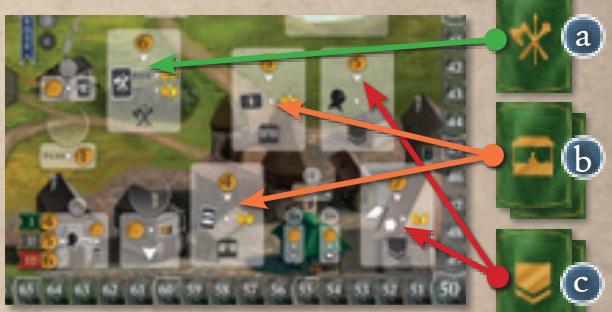

The cards have different backs to ease organization and sorting. The backs are color-coded for each stage of the game and have icons identifying the card use.
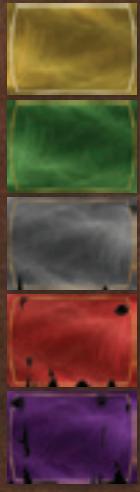
Starting Cards
Stage I cards
Stage II cards
Stage III cards
Endgame cards

QUEST CARDS


STARTING WEALTH CARDS


Stage 1

Fast-Forward (see page 28)
MARKET CARDS

Weapon

Bonus

Single-Use
8 Place ll resources separated by color, as well as the extra adventurer tiles, level markers and coin tokens next to the board. This is the supply.
Randomly choose a side of each of the 6 stage 1 central hex grids and assemble them together with the single central hex to form a hexagonal array with a side length of 4 hexes. Then surround this assembly with a ring of 6 stage 1 hex borders alternating in length so that they cover the corresponding spaces on the board. In a 4-player game, these border tiles should all be resource-side up. With 3 players, 3 contiguous border tiles (2 long and 1 short) should all be flipped to resource-side down. In a 2-player game, all border tiles should be flipped to resource-side down. The stage in which a mine tile belongs can be determined by the number of dots located on the tiles (see page 10).
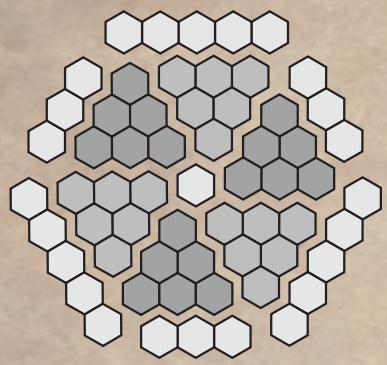
4 PLAYERS
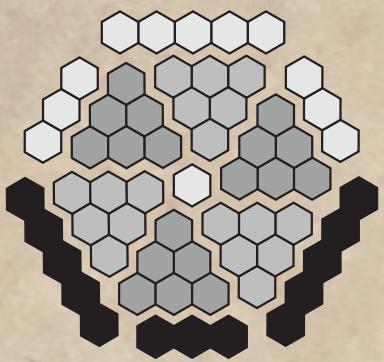
3PLAYERS

2 PLAYERS
At this point, all players should select 2 of their 4 starting wealth cards and collect the bonuses on those 2 tiles. Players place all resources, tokens and adventurers in front of them. This is their pool.
Possible wealth:

Coins

Copper, iron and emerald resources

Level 1 adventurer

Level up 1 adventurer v page 19)

Place a claim token on the specified public design
While 2 level-up bonuses can be used on a single adventurer, the maximum starting level for an adventurer is 3.
In turn order, players take turns placing one of their overseers on any available unoccupied hex of the mine until all 3 overseers of each player are placed.
ICONS
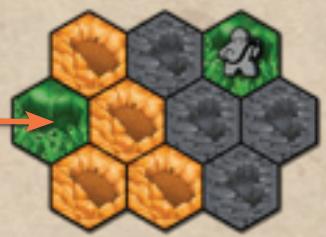

Copper

Emerald

Gold Coin

Adventurer

Mace

Market Card

Overseer movement

Iron

Ruby


Weapon power
Gold coin cost for the normal game

Spear
Quest Card

Worker movement

Mithril

Diamond

Prestige

Level adventurer up

Axe

Remove from game after use

Quest
ORDER OF PLAY
1Players will start a round by replenishing the market cards and quest offer (see page 9).
2They will then move overseers in the mine to collect resources (see page 10).
3Next they will rearrange turn order based on their worker counts in the mine (see page 11).
4 Then players will head to the market to perform 1 market action then discard any unpurchased market cards (see pages 14–15).
5Lastly they will enter the castle to accept quests from the king and manage their existing quests (see pages 21–22).
* Players can also interact with the merchant (see page 17) and their own market stalls (see page 13) at any time during a round.
6At the end of the round, players will remove quests from the quest offer (see page 24).

the new round (see page 26).
START OF ROUND
REPLENISH MARKET CARDS
Reveal the top card of each of the 5 market decks by turning them face-up. If a public weapon design is drawn from the weapon deck (iron spear, iron mace, iron axe or iron greatsword - denoted with a in the upper left of the card), place it below the board with the public weapon designs and reveal a new weapon card (repeating the same process if another public weapon design is drawn). If it is the 1st round of the game or a new stage, this happens before choosing starting wealth cards or placing overseers.
There are mithril public weapon designs that will be revealed during stage 2 of the epic game.
REPLENISH QUEST OFFER (not done in the first round)
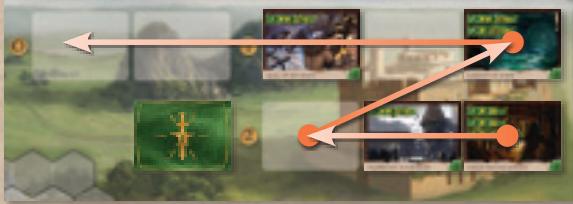
Move all cards in the quest offer as far forward as possible, leaving no open positions between them (pushing cards in the bottom row into empty top row spots).
Then deal a quest card from the quest draw deck to each empty position at the back of the offer. If the quest deck of a single color is depleted, continue dealing cards from the next color.

MINE PHASE
In turn order, every player may move a single overseer of their color in the mine once, with the purpose of collecting resources by generating workers. After each player has made a movement in the mine, the first player in the turn order may make a second overseer movement, however doing so will lock them into last place in the newly determined turn order (see page 11). The following restrictions apply to overseer movement:
Overseers can move in straight lines across the grid through any number of empty hexes.
Overseers can only end their movement on an unoccupied resource hex.
Overseers can move through any number of adjacent workers in a straight line (regardless of color) after moving through any number of empty hexes, but must then end their movement on the next unoccupied hex.
Overseers cannot move through other overseers regardless of color.

After the movement of an overseer, workers (colored wooden pickaxes) are generated based on the following:
• The hex on which the overseer started its movement generates a worker of the same color as the overseer.
• Any workers the overseer moved through that were colored differently than the overseer change to the color of the overseer.
Any workers the overseer moved through that were the same color as the overseer are overworked and defect to another player. The worker changes its color to the color of the player who has the fewest number of workers in the mine, not counting the active player. In case of a tie, the worker changes to the color of the tied player who is earlier in the current turn order. These changes are determined individually in the order in which the workers were passed over by the overseer.
After the overseer movement is resolved, all workers generated or passed over by the overseer generate a single resource of the same type as the hex they occupy and give it to the player of their color. Note: Workers only provide resources to a player when they are generated or passed over by an overseer. They do not generate resources every round.
It is not mandatory to take an overseer movement each round. A player may choose to pass and do nothing instead.


MINE PHASE: STRIKES
After resources are produced, check the mine for any connected groups of 5 or more workers of the same color. These groups of same-colored workers go on strike and are removed from the board. Players must check for strikes after any changes are made to the mine (i.e. overseer movements or worker movements).
MINE PHASE: EXAMPLE
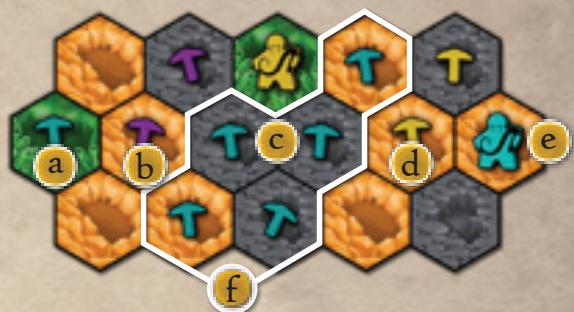
For teal's overseer movement, he moves his overseer to the right, moving through 4 workers (2 teal and 2 yellow).
• First, he generates a worker on the space the overseer leaves a
He then moves through his own workerb. Out of his opponents, purple has the fewest workers on the board (1 to yellow's 3), so that teal worker becomes purple.
The overseer then moves through 2 yellow workers and turns them tealC
He now moves through another teal workerd, but now there are 2 purple workers (1+1) and 1 yellow worker (3-2), so the last teal worker becomes yellow.
• He then must end his move on the next unoccupied space

Teal gets 2 iron and 1 emerald for this move. Yellow and purple both get a copper. Lastly, the 2 yellow workers that became tealCnow form a group of 5 teal workers with the teal workers above and below themf, which is enough for a strike, so these 5 workers are removed g.


MINE PHASE: REARRANGE TURN ORDER
At the end of each mine phase, turn order is rearranged based on the number of workers in the mine. Tally the number of workers each player currently owns in the mine. Whoever has the fewest workers is now first player, the player with the next fewest is second and so on. If there is a tie, the order for those tied relative to each other becomes the reverse of what it was previously. Exception: If the first player in the mine phase took their second overseer movement, they are automatically locked into last place in the order determination and are not considered when determining the other players' order.
Example: In the 3-player example above, the turn order started as purple, yellow, teal, and so teal is the last to move. Purple declines to take an extra move, so a new turn order is now determined. Teal has the fewest workers (1), so they are moved to 1st in the order. Purple and yellow are tied with 2 workers each, so their order switches relative to each other from what it was previously, so the new order becomes teal, yellow, purple. Purple could have used the advantage of the second overseer movement, as they would have been last either way.


MARKET PHASE
In this phase, players can take a single action in the market section of the board that will give them some advantage in the game.
MARKET CARDS
There are 3 types of market cards available for purchase during the market phase:
Weapon design cards
2 Market bonus cards
3 Single-use cards
0

②

3
The following information may be found on the cards:
· Name a
· Adventurer level requirement b
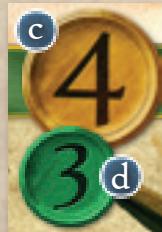
The price in gold for which they can be purchasedC Exception: When playing the normal game, use the number in the green circle (d, if any) as the purchase price.
A prestige value for owning or claiming the carde Single-use cards do no grant any prestige, but they have a visual reminderfto immediately use their effect and then remove them from the game instead of discarding them.

GREEN STINGER


"When you've got this beauty under your cloak, the unwary assassin quickly becomes the assassinated.' – Nicholas, Carpenter of Pain


There are 2 types of weapon designs: public weapon designs1, which are denoted with a on the cardg, and unique weapon designs2, which have full color art and are worth more prestigeethan public weapon designs.
Weapon designs are not weapons themselves, but allow the player to forge that weapon by spending resources. Once a player buys a unique weapon design card, they place it below their mat and it stays there for the rest of the game. In the case of public weapon designs, buying the card is represented by placing a colored claim cubehon the card. Once a player owns a weapon design, they can forge as many of that weapon as they are able. The necessary resources required to forge the weaponiare listed on the left side of the card, and the power of the weaponjand weapon type (k, if any) are listed on the right side.
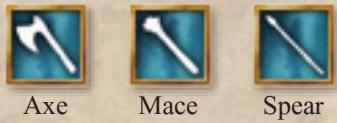
Weapon types consist of: axe ( ); spear ( ); and mace ( ). If a weapon symbol consists of multiple types, the weapon counts as each type shown.
Players equip forged weapons to adventurers and then apply them together to quests (see page 19). An adventurer can only equip a single weapon at a time and must meet the level requirement of the weapon1.
• A player can only have a single claim cube on any single public weapon design.


"Best steer clear of the business end unless you consider lockjaw to be an enjoyable experience. – Andrew the Green Knight
MARKET BONUS CARDS


There are 2 types of market bonus cards: market stalls3, which allow players to exchange different types of resources, and market savvy cards4, which give players some permanent benefit in the market.

Purchased market bonus cards go to the left of a player's mat and remain there for the remainder of the game, providing a permanent bonus.

Market stalls allow the player who owns them to exchange the number of one type of resource shown for the number of the other type of resource shown once each round. Exception: Trader's Savvy can allow a player to use a market stall multiple times in a round (see page 14). This exchange can go either way. For instance, card3shows 1 ruby on the leftmand 2 iron on the rightn. This means that once each round (including the round it was purchased), the player who owns the card can exchange 1 ruby for 2 iron or 2 iron for 1 ruby with the supply. This action can be performed at any time during a round, even after receiving quest rewards (see page 23) or resolving bonus tiles (see page 26), or during another player's turn. Once a player uses a specific market stall in a round, they can rotate the stall card to the side as a reminder that they cannot use it again until next round. A player can only own a single copy of any given market stall variant.


You may buy 1 extra resource from the merchant each round.

Market savvy: there are 4 types of savvy cards:
1Buyer's Savvy increases the number of resources the player can buy from the merchant each round by 1 (see page 17).
2Seller's Savvy increases the amount of gold the player gains from selling a resource to the merchant by 1 (see page 17).
3Trader's Savvy allows the player to use one of their market stalls 1 extra time each round.
4Adventurer's Savvy allows a player taking the Road market action (see page 15) to move the tracker cube on the selected quest up an additional step.
Unlike market stalls, players can own multiple copies of each market savvy cards.


SINGLE-USE CARDS
Singe-use cards5give the player who purchases them bonus resources or other benefits that are taken immediately.
When the card is purchased and the benefit is received, the card is then removed from the game instead of being placed on the player's mat. The symbol in the bottom right corner of the cardfis a reminder of this. Do not discard the purchased card into the market discard deck (see page 15). If the card gave the purchaser an overseer or worker movement, players must check for strikes after the movement is made (see page 11).


MARKET ACTIONS
In the market phase, starting with the first player in turn order, each player may take a single action in the market by placing one of their colored disks on an action space. A player must be able to perform the action to claim its corresponding action space. There are 2 types of action spaces
Closed circles: only 1 player can place a disk on this space each round. When a player places a disk here, it blocks later players.
• Open circles: any number of players can place their disk on these spaces.
A player can take one of the following actions:
1Blacksmith (closed): Purchase the face-up unique weapon design a
Bazaar (closed): Purchase a single face-up bonusbor single-useccard. In the 2-player game, there is only one space that gives access to all 4 cards. In a 3- or 4-player game, there are 2 spaces – one for the 2 bonus cards and one for the 2 single-use cards.
Barracks (closed): Perform one or both of the following actions: hire a new level 1 adventurer for 4 golddand level up one of the adventurers in your supplyeby paying gold coins equal to the current level of the adventurer (leveling from 1 to 2 costs 1 gold, leveling from 2 to 3 costs 2 gold and so on). If both purchases are made, the adventurer leveled up cannot be the one just purchased.
In the epic game, the cost of hiring an adventurer is dependent on the current stage. The cost is 4 gold in stage 1, 5 gold in stage 2 and 6 gold in stage 3.
4Clerk (open): Claim one of the public weapon designs displayed below the board f by placing a colored claim cube on the card. When a player claims a card, they must pay the price listed on the card to the supply, plus pay 1 gold to each player who already has a claim cube on the design.
Road (open): Rush a single quest by moving its quest tracker cube up 1 step (see page 18). This action costs nothing. If this movement would move the quest tracker cube to a new leg and thus completes the current leg, the physical rewards for the completed leg are received at this time (see page 23). The Road action cannot be used to complete a quest. Note that the Adventurer's Savvy card allows a player to move the quest forward an additional step for each of these cards they possess. For instance, if a player has 2 Adventurer's Savvy cards, they can take the road action space to rush a single quest forward 3 steps. Combined with the single step that quests progress on their own each round, this would result in the quest progressing 4 steps total in a single round.
6 It is not mandatory to take an action each round. A player may choose to pass, in which case they receive 1 gold from the bank.
Once all players have taken a single action or passed, the market phase is over and any unpurchased face-up cards still in the market are moved to the7market discard pile. All player disks played on the board are also returned to the players.

During turn 7 of the normal game, there will be no market cards left to purchase. The market phase still proceeds as usual except that players can now use their disk marker on the blacksmith1and bazaar2action spaces to purchase endgame bonus prestige by paying the cost noted on the space. Once the disk marker is placed, the purchase is signified by placing a colored claim cube on the empty card space. These bonuses are tallied at the end of the game:
gThe blacksmith bonus awards a player 2 prestige for each unique weapon design they own and 1 prestige for each public weapon design they have claimed. Prestige is not awarded for the starting copper dagger and copper sword designs.
hThe top left bazaar bonus awards a player 1 prestige for each quest they have fully completed.
iThe top right bazaar bonus awards a player 1 prestige for each adventurer they have employed.
jThe bottom left bazaar bonus awards a player 2 prestige for each market bonus card they own.
kThe bottom right bazaar bonus awards a player 1 prestige for each leftover resource in their supply. Resources scored in this way are not sold to the merchant to gain extra prestige from gold coins (see page 25).
These special actions are not available in the epic game.

THE MERCHANT
At any time during a round, players may interact with the merchant (even after receiving quest rewards (see page 23), resolving bonus tiles (see page 26), or during another player's turn), which allows them to perform the following actions once each round:
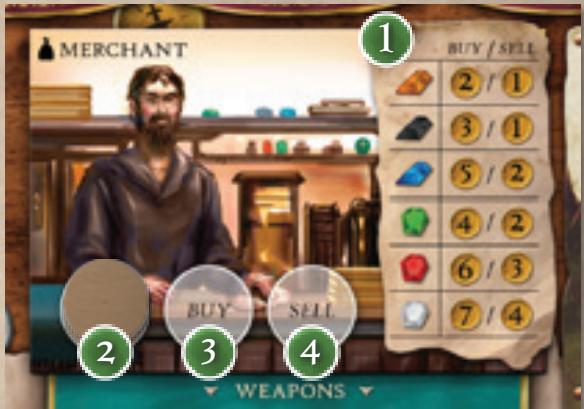
Players may buy a single resource from the supply for the gold price listed in the buy column of the price chart1. This is indicated by moving a disk tracker from the reserve2to the buy circle3. Each Buyer's Savvy card allows a player to buy an additional resource from the merchant each round.
Players may sell a single resource to the supply for the gold price listed in the sell column of the price chart1. This is indicated by moving a disk tracker from the reserve2to the sell circle4 Each Seller's Savvy card increases the gold value of the sold resource by 1 gold.
At the end of each turn players return their disk trackers back to the reserve2to indicate that they may use the buy and sell actions again in the next round.
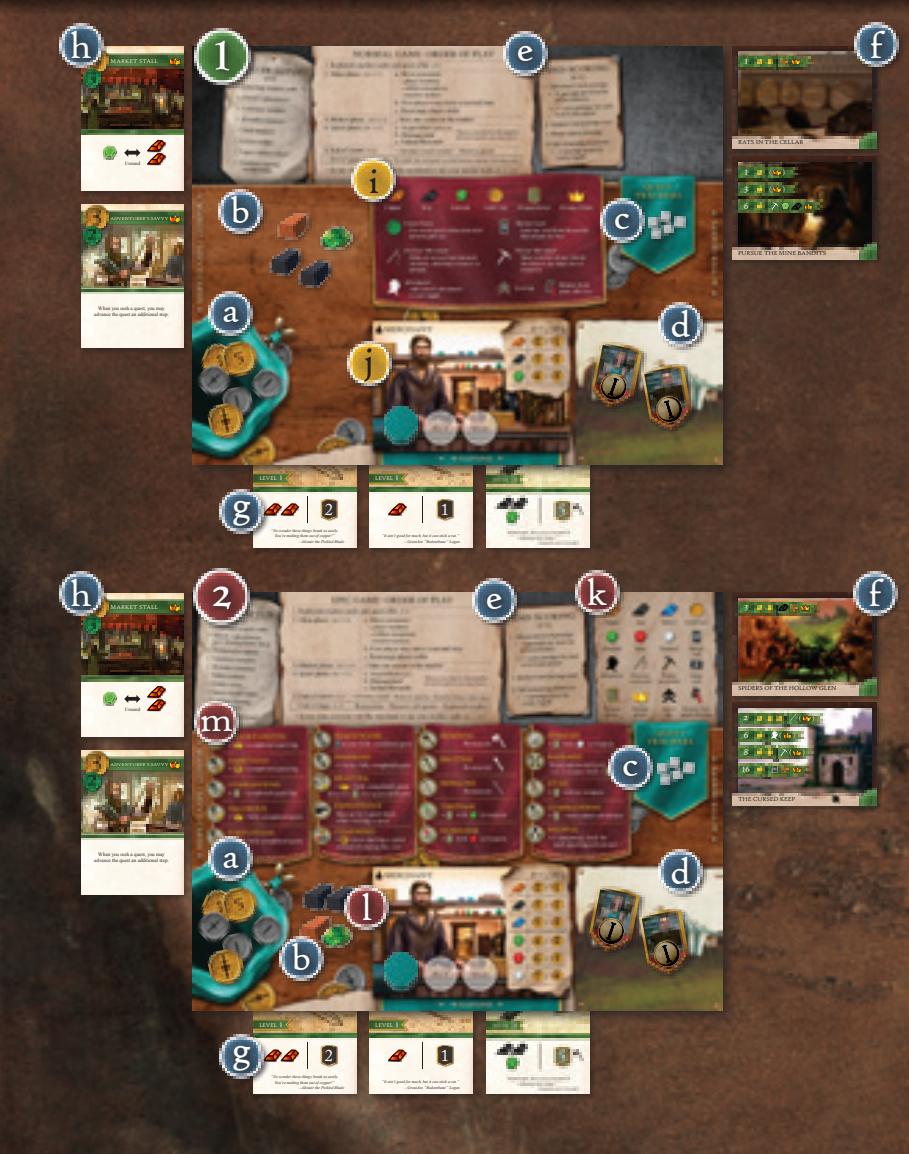
The player mat has 2 sides, a normal game side 1and an epic game side 2.
On each mat there is space to keep coins a, resources b, quest tracker cubes C and adventurers d. The mat also contains a game summary e
Around each mat there is space to lay out quest cards f, weapon design cards g and market bonus cardsh
The normal game mat has a detailed icon guide and a merchant chart containing resources that appear in the normal game .
The epic game mat has an icon guide k, a merchant chart containing resources that appear in the epic game1and a champion title reference m.

QUEST PHASE
In this phase, players will go through 3 successive actions: quest acquisition, quest management and quest rewards.
QUEST CARDS
A quest card consists of a title1and a series of banners to represent the progression of the quest.
2 A single gold diamond on the card represents a quest step. When a player acquires a quest (see page 21), they place a quest tracker cube a on the first of these diamonds (upper left). A player will advance all their active quests a single step during the quest rewards action (see page 23), moving the quest tracker cube left-to-right, top-to-bottom.
A single row of steps represents a quest leg. The difficulty and required weapon types of a leg are listed to the left of the leg's steps and the rewards for completing the leg are listed to the right.
The number in front of a quest leg is the difficulty of the leg. A player must meet or exceed the difficulty of the quest's current leg during the quest management action (see page 22), or the quest will fail.
Some quest legs also contain a symbol beside the difficulty. This is the required weapon type for the leg. If the player does not have at least 1 weapon of that type equipped to an adventurer applied to the quest, the difficulty of the leg is increased by 3. If the symbol includes multiple weapon types, the difficulty is increased by 3 for each weapon type not matched.
Axe Mace
Spear

Axe & Mace

Axe & Spear

Mace & Spear
Axe, Mace & Spear
Any rewards given for completing a quest leg are listed in the area to the right of the last step diamond. These rewards are received during the quest rewards action when the quest tracker cube moves off the current leg (see page 23).

Adventurer tiles represent the hired adventurers you have at your disposal to send out on quests. There are many different variations in the adventurer tile art. This difference is purely aesthetic and a player can select art according to their preference.

Adventurer levels are denoted by a marker placed into the slot at the bottom of the tile a Every adventurer a player acquires, either through single-use market card purchases, barracks purchases, quest rewards or starting wealth cards, always starts at level 1. Adventurers can gain levels by completing the final leg of a quest (see page 23), through the purchase of the Training single-use market card, using the barracks action space or claiming specific starting wealth cards. When an adventurer levels up, remove the current level marker and replace it with the next higher level marker. The maximum level an adventurer can have is 4.
"No wonder these things break so easily. You're making them out of copper!" -Alistair the Pickled Blade
Players apply adventurers to a quest during the quest management action (see page 22) by forging a weapon for them and then placing the adventurer tile to the right of the active quest. A weapon is forged and then equipped by an adventurer by transferring the necessary resources from a player's pool onto the adventurer tile. For instance, if a player were forging a copper sword, they would place 2 copper from their pool onto the adventurer tileb

Once a weapon is forged it cannot be transferred to another adventurer or converted back into raw resources. If there is confusion about which weapon type an adventurer has equipped when a player has multiple weapon designs that require the same resources, the weapon type tokens can be placed on the adventurer to denote their equipped weapon type(s).
Adventurers can only equip weapons of equal or lower level than their own level. Weapon levels are denoted on the weapon design cards.
• Level 1 adventurers can only equip swords and daggers.
• Level 2 adventurers can equip any public or starting weapon (sword, dagger, axe, mace or spear).
• Level 3 and 4 adventurers are the only adventurers that can equip unique weapons purchased from the blacksmith.
Other rules for applying adventurers to quests:
• Adventurers have no inherent power. An adventurer must be equipped with a weapon to be applied to a quest.
• Adventurers can only equip 1 weapon at a time (shields count as weapons).
A player can change the weapon of an adventurer applied to a quest, but any resources used to forge the adventurer's initial weapon are lost and returned to the supply.
Adventurers can be removed from one quest to be applied to another quest, but the adventurer will lose any weapon they were equipped with (resources returned to the supply) and must be given a new weapon.
CHAMPIONS
In the epic game, when an adventurer advances from level 3 to level 4, they become a champion and gain a champion title. Remove the normal level marker from the adventurer tile and insert a champion title marker of the player's choice. Titles offer various perks to the player when the player uses that champion for a quest. There are 20 titles, and each player can only have 1 champion with each title. Extra weapon power from champion titles can be denoted by adding weapon power tokens to the champion.

TITLES

Opportunistic: The player immediately receives an additional 2 prestige every time they complete a leg of the quest this champion is applied to.

Ambitious: The player immediately receives an additional 1 gold every time they complete a leg of the quest this champion is applied to.

Unrelenting: The player immediately adds 1 additional weapon power to this champion's equipped weapon every time they complete a leg of the quest this champion is applied to. Note: This advantage is applied to his weapon, so when he loses that weapon – because it is switched or he is moved to another quest – the attack power bonus is lost, as well.

Valorous: The player receives an additional 4 prestige when the champion fully completes a quest. Full completion of a quest requires that the champion is applied to the quest from the 1st step to the last. Players can use “Started Quest" tokens to remember this.

Fortuitous: The player receives an additional 3 gold when the champion fully completes a quest (see above).

Scavenging: The player can purchase a market card from the market discard pile for its listed price when this champion fully completes a quest (see above).

Inspiring: The player can level up one of the other adventurers applied to this quest an additional time when this champion fully completes a quest (see above)

Bravura: The player receives an additional prestige for every point of weapon power applied to the quest in excess of the difficulty of the final quest leg when this champion fully completes a quest (see above).

Expeditious: When a player acquires a quest and applies this champion to it in the same round, the quest can be started on the 2nd or 3rd step instead of the first. Any physical rewards or champion/weapon bonus are not received for any leg of the quest that was skipped in this manner. In addition, if the quest is failed on the round it is taken, no prestige are awarded. This champion's ability can only be used a subsequent time once the quest on which it was last used is completed or failed.

Charming: When a player starts a quest and applies this champion to it in the same round, the player receives 1 gold from the supply instead of paying the acquisition cost (see page 21). This champion's ability can only be used a subsequent time once the quest on which it was last used is completed or failed.


Rending: This champion adds an axe () weapon type to any weapon he equips.


Brutish: This champion adds a mace () weapon type to any weapon he equips.
Impaling: This champion adds a spear () weapon type to any weapon he equips.

Viridian: When this champion equips a weapon that includes an emerald resource, add 2 additional weapon power to the weapon.

Sanguine: When this champion equips a weapon that includes a ruby resource, add 2 additional weapon power to the weapon.

Purified: When this champion equips a weapon that includes a diamond resource, add 3 additional weapon power to the weapon.

Barbaric: This champion can equip an additional level 1 or 2 weapon (resulting in 2 equipped weapons). The 2nd weapon equipped also gains 1 additional weapon power.
Stoic: This champion can be applied to a quest without equipping a weapon. In this case, the champion is considered to have a weapon of power 2.

Commanding: When this champion is applied to a quest, 1 additional weapon power is added to his weapon for each other adventurer currently applied to the quest.

Helpful: Any adventurer applied to the same quest as this champion is consider to be 1 level higher for the purpose of equipping weapons while they are both applied to the quest.
QUEST ACTIONS
QUEST ACQUISITION
During quest acquisition, in turn order, players have the opportunity to pay gold to acquire a single new quest, putting it to the right of their mat and placing a quest tracker cube on the 1st step of the quest. The acquisition cost of the quest is dependent on what section of the quest offer it is in – either 0 gold (1st 2 quests), 1 gold (next 3 quests) or 2 gold (next 3 quests). Once a quest is acquired, it becomes active, and remains so until it is completed or failed.
It is not mandatory to acquire a quest each round. Players can pass on acquiring new quests and simply manage any active quests they are currently undertaking (if any).
Quest acquisition occurs in turn order, but once a player acquires a quest or passes, they can continue with the other actions of the quest phase independent of the other players. This also means that the next player does not need to wait for the previous player to complete their entire quest phase before taking their own turn, but instead can immediately start quest acquisition once the previous player is done with it.

QUEST MANAGEMENT
As soon as an individual player is finished with quest acquisition, they can begin quest management. It is during quest management that players must match the difficulty of the current step (the step denoted by the quest tracker cube) of all their active quests with equipped adventurer weapons. If the difficulty of a quest leg is not matched or exceeded by the end of quest management, the quest is failed (see below).
In order to match the difficulty of the quest leg, adventurers applied to the quest must be equipped with weapons whose total power is equal to or greater than the difficulty. If the quest leg has a required weapon type, that must be matched by at least one of the weapons equipped by the adventurers as well or the quest difficulty is increased by 3. Adventurers can be applied to any active quest the player has, not just the quest the player acquired that round, and an adventurer applied to a quest remains on the quest with his equipped weapon until the player removes him or the quest is failed or completed.
QUEST FAILURE
If a quest leg's difficulty is not matched by the end of quest management, that quest is failed, and the following happens:
• All forged weapons equipped by adventurers on the quest are lost, and the resources are returned to the supply.
•Adventurers on the quest are returned to the player's pool (without receiving any levels, see page 24).
The quest is discarded. Any physical rewards from previously completed legs are kept, and the player receives a number of prestige equal to the prestige value listed in parentheses from the last successfully completed quest leg (if any). Exception: If a quest has been rushed by the Road action (see page 15) on the same round it is failed, a player would only receive prestige based on where their quest tracker cube was before rushing the quest.
If a quest is failed on the same round it was acquired, the player loses 3 prestige for severely disappointing the king.
Quest Actions Example:
The teal player acquired“Trouble in the Weird Woods" 3 rounds ago. At the beginning of the quest, he applied a level 1 adventurer on the quest with an iron sword a(signified by 2 iron from his pool)bto match the 1st leg's difficulty of 3. Three rounds later, the quest has progressed to the final step, which has a difficulty of 8 and an axe () requirementc. During quest management teal applies another level 1 adventurer with an iron sword and a level 2 adventurer with a copper axe on the questd, since he owns both of these weapon designs and the necessary resources. This satisfies the quest difficulty (3+3+2=8) and the required weapon type.
Once all quest management is complete, players can begin the quest rewards action. After all quests are checked for failure, all quests are advanced 1 step.
If the quest tracker cube is on the last step of a quest leg before advancing, the quest tracker cube is advanced by moving down to the 1st step of the next leg. Doing so completes the quest leg and the player receives the rewards listed at the end of the completed quest leg (if any).
If the quest tracker cube is on the last step of the last quest leg before advancing, then the quest is completed during advancement (see page 24). At this time the player collects rewards for fully completing the quests, including the prestige value listed at the end of the quest.
• Otherwise, the quest tracker cube is advanced by moving to the next step of the current quest leg.
Note: All quest rewards are received after all quest management is finished, such that a player cannot use the rewards from one quest to immediately help manage another quest in the same round, and they cannot use adventurers to complete a leg on one quest and then move those adventurers to satisfy the requirements of another quest.
Finishing a quest leg during this action only activates quest rewards. Players won't have to worry about managing the new difficulty until next round.
Quest rewards fall into 2 categories: physical rewards and prestige.
PHYSICAL REWARDS
Copper (), iron (), mithril (), emerald (), ruby () and diamond () resources – the player receives these resources from the supply in the amount indicated.
• Gold tokens () – the player receives these tokens from the supply in the amount indicated.
Adventurers () – the player takes an adventurer tile from the supply and put it in their adventurer pool. Adventurers always start at level 1.
Overseer movement () – the player may immediately move an overseer of their color, obeying the normal mine phase rules for doing so and distributing workers and resources as usual for a mine phase movement. Check for strikes after this movement.
Worker movement (λ) – the player may immediately pick up a worker of any color in the mine and remove it from the board or place it on any empty mine hex, keeping the same color of the worker. The player receives no resources for this movement. Check for strikes after this movement.
Market cards (M) – the player can look through the market discard pile and acquire a single card at no cost. Note: The player cannot take from the previously purchased single-use market cards which have been removed from the game.
Normally, after quest acquisition, all players can simultaneously manage their quests and collect rewards to save time. However, if 2 or more players receive an overseer movement, worker movement or market card reward on the same round, those rewards are resolved in the current turn order.
PRESTIGE
When a player completes a quest leg that is not the final quest leg, they do not gain the prestige value listed in parentheses. This prestige value is only received when failing a quest (see page 22) as a consolation for not receiving the full prestige value of the quest. The only time a player receives a prestige reward for completing a quest leg (barring champion or weapon bonuses) is when they complete the final leg of a quest. The prestige value listed in the final quest leg is the full prestige value of the quest. If, by receiving prestige, a player makes a full journey around the score track, they should claim a “100 prestige" token (or flip a “100 prestige" token to the 200 side) and continue moving around the track.
When a player completes the final leg of a quest, the entire quest is considered complete and a number of things happen:
• Players receive the full prestige value for the quest, as well as any other listed physical quest rewards for the last leg.
Adventurers that were present for the completion of the quest have an opportunity to level up. Each adventurer can only gain 1 level per completed quest, and a player can distribute a number of levels to their adventurers equal to the number of legs (rows) of the quest.
Adventurers on the quest are returned to a player's pool to be used in subsequent rounds. All weapons they had equipped, however, are lost, and all resources are returned to the supply.
• Any champions on the quest with a “started quest" tokengains their specific reward for fully completing a quest (if any).
•The completed quest is tucked under the player mat, and the quest tracker cube is returned to the player mat.
END OF ROUND
Once all players have finished collecting quest rewards, move the round marker up a single step to begin the next round. In addition, quests should be removed from the front-most quest slots on the board based on the following:
a 4-player game: the lst slot is removed.
b 3-player game: the 1st 2 slots are removed.


C2-player game: the 1st 3 slots are removed.
If these slots are already empty, no extra quests are removed to compensate.

In addition, at the end of the 6th round in the normal game, remove all green stage 1 quests from the quest offer, leaving only the purple endgame quests.

In the epic game, at the end of the 5th round of the 3rd stage, remove all red stage 3 quests from the quest offer, leaving only purple endgame quests.
If an optional bonus tile occupies the next space on the round track, it is resolved before moving to the new round (see page 26).
END OF GAME
The normal game ends after the 7th round.The epic game ends after the 6th round of 3rd stage.
If any player still has active quests after the last round of the game, these quests are immediately failed and prestige is awarded as described in the quest failure section (see page 22).
Once all prestige from quests have been awarded, players also receive extra prestige based on the following:
+1 prestige per level for each of the player's adventurers, plus an extra prestige for each level 4 adventurer (making them worth 5 prestige instead of 4).
The sum of the prestige values of every market card owned by the player (this includes unique weapon designs, market bonus cards and claimed public weapon designs.)
•Any bonus prestige from blacksmith or bazaar bonus spaces claimed on the 7th round of the normal game (see page 16).
Players sell all their leftover resources to the merchant (not considering any Seller's Savvy bonuses) and afterwards receive 1 prestige for every 4 gold they have. The player who claimed the bottom right bazaar bonus (prestige for remaining resources) may not sell their resources in this step, however, since they were already scored.
The player with the most prestige at the end of the game is the winner. If there is a tie, the player who is earlier in the current turn order is the winner.
END OF STAGE
The epic game spans over 3 stages of 6 rounds each. At the end of the 6th and 12th rounds the stage changes, and these actions need to be taken at the start of the following round:
Remove all workers and overseers from the mine, then replace the hex grid assembly with hex tiles from the new stage and assemble them as described on page 8.
Remove any quest cards in the quest offer still remaining from the
内容过长,此处只内联前一部分;完整内容请下载或到规则页阅读。
下载 Markdown原文为社区整理/出版社公开资料,版权归原作者,仅供个人学习查阅。