
塔罗牌French Tarot
一句话概览
塔罗牌 是一款已收录于村了吗规则库的桌游,支持 2–8 人,原名 French Tarot。
本页内容:一句话概览 · 常见问题
这游戏怎么玩
- 本站已收录这款游戏的规则资料,可以在对话里直接提问规则细节。
常见问题(FAQ)
以下 1 条问答中 0 条来自站内玩家的真实提问,其余 1 条为本站整理的常见疑问;答复内容保持原样。
塔罗牌支持几个人玩?
2–8 人。
去哪查完整规则
想核对具体规则细节、卡牌效果或某个回合的结算方式,可以在村了吗里选中这款游戏后直接提问。
同类桌游
- 卡坦岛德式
- 工业革命:伯明翰德式
- 勃艮第城堡:特别典藏版德式
- 方舟动物园德式
- 卡卡颂抽象
- 瘟疫危机传承:第一季美式
- 阿瑞迪亚:勇踏征途美式
- 重塑宇宙德式
- 幽港迷城美式
- 埃多拉的德鲁伊德式
规则原文(Markdown)
本站收录这款游戏的规则原文 2 个文件,此处内联渲染 2 个,可直接展开阅读或下载。
rules_en_french-tarot_4505.md23.9 KB
来源类型:纯文本规则(非 PDF 源,早期抓取/转换产物)
说明:原文未改动,仅调整存放位置与文件名;非 PDF 扫描件,无对应原书 PDF
French Tarot Rulebook | RulesPalRulesPalChatRulebookFrench TarotFrench Tarot Rulebook Table of Contents Table of Contents Warning
The Cards
The Principle of the Game
The Deal
Holding Your Cards
The Bidding
The Dog and the Discard
The Slam
The Handful (10, 13, or 15 Trumps)
The Petit at the End
Playing the Cards
Scoring
Scoring in Casual Play
Ranking in Casual Play
Casual Team Tournament
Game Etiquette
The Referee
Three-Player Game
Five-Player Game
Warning
The single rule set established by the F.F.T. has become standard across France, both for official championships and for friendly games, which suffer fewer disputes as a result.
The Cards
The Tarot deck is composed of 78 cards.
4 suits: Spades, Hearts, Diamonds, Clubs. Each suit is composed of 14 cards. In decreasing order of strength and value: the King, the Queen, the Knight, and the Jack constitute the Honors (or the "dressed" cards),
the 10, the 9, the 8, the 7, the 6, the 5, the 4, the 3, the 2, the Ace.
Twenty-one cards bear a number: these are the Trumps (or Tarots), which outrank the suits. The number indicates the strength of each Trump, from the strongest, the 21, to the weakest, the 1 (called the Petit).
Finally, the Excuse, a card marked with a star and depicting a mandolin player, is a kind of "joker" that excuses the player from following suit or playing Trump.
The 21, the Petit, and the Excuse are the 3 Oudlers (or the 3 Bouts). The entire strategy of Tarot is organized around these 3 cards.
Value of each card:
Cards are counted two by two to make tallying easier:
The Principle of the Game
Tarot is played by four players.
Tarot is both an individual game and a team game. Over the course of the game, one of the players, called the bidder (or declarer), is opposed to the three others, the defenders, who form a team (the Defense). But this partnership lasts only for the duration of one Deal — it may form differently for the next deal.
After looking at their hand, a player may commit to reaching a certain number of points by playing alone against their three associated opponents.
How many points must the bidder alone achieve to win their contract? This depends solely on the number of Oudlers they hold in their tricks (or plis) at the end of the deal.
Points to achieve:
This table reveals the considerable importance of the Oudlers. The 21 and the Excuse can never change sides. But beware — the Excuse must not be played on the last trick except in the case of a Slam, otherwise it changes sides. The Petit, on the other hand, is vulnerable: the declarer may lose it... or capture it from their opponents in the famous HUNT FOR THE PETIT.
The Deal
Before the first deal, the deck is spread out face down, and each player draws a card at random. The lowest card designates the Dealer. In case of a tie between the two lowest cards, the order of priority between suits is observed: Spades, Hearts, Diamonds, Clubs — the Ace of Clubs is therefore the lowest card. Trumps take priority, but the Excuse does not count: in that case, a new card must be drawn.
The deck must be shuffled by the player seated opposite the dealer.
Then the dealer's left-hand neighbor must cut the deck in two, taking or leaving at least 3 cards, and must square the pile back together themselves.
The dealer deals the cards three at a time, counterclockwise. During the deal, the dealer also builds up, card by card, a stack of 6 cards called the Dog (Chien). It is forbidden to place the first or the last card of the deck into the Dog. Each player thus receives 18 cards.
Once the deal is complete, the dealer must show the other players that they have indeed put 6 cards into the Dog.
Players may not touch the cards or pick up their hand until the deal is entirely finished (the referee may apply a penalty to a player who touches or picks up their cards before the deal is complete).
Any fault committed during the deal requires a new deal by the same dealer, who then loses the right to take part in the bidding on that deal. In the event of a fault by the dealer (a misdeal), each player returns their hand without looking at it — this avoids regrets and bad feeling.
Players deal in turn, following the direction of play.
Holding Your Cards
Once the cards are dealt, each player looks at their hand.
Each player must hold their cards above the table so they remain visible, until the last card is played.
A player holding a "bare Petit" (it is their only Trump and they do not have the Excuse) must announce it, spread their hand face up, and cancel the deal before the bidding begins. The dealer's right-hand neighbor then deals again.
The Bidding
It is not essential to sort your cards before the end of the bidding, but for a beginner a well-sorted hand allows for a more precise evaluation.
The player seated to the dealer's right speaks first. If they say "I pass," the turn to speak passes to their right-hand neighbor, and so on, up to the dealer.
If all four players pass, the dealer's right-hand neighbor deals again.
A player may open a bid if they judge that their hand allows them to play alone against the three others. They then say "Petite" ("I take"), "Garde" ("I guard"), "Garde Sans le Chien" ("Guard without the Dog"), or "Garde Contre le Chien" ("Guard against the Dog"). The other players, seated to their right, may then cover this first bid with a higher bid. Each player may speak only once.
The bids, in increasing order, are:
PETITE (Prise): with an average hand that offers only about a 50% chance of success, and which often relies on the hope of finding a very good Dog.
GARDE (Guard): may be an overbid after an opponent's Petite. But it is, most often, the opening bid, when the bidder judges their chances of success to be far greater than their risk of failure.
GARDE SANS LE CHIEN (Guard without the Dog): with a very strong hand, the bidder judges that they can fulfill their contract without incorporating the Dog into their hand, and therefore without making a Discard. However, the points in the Dog are still counted for them at the end of the deal, and constitute a certain safety reserve. Naturally, no player may look at the Dog until the deal has been played.
GARDE CONTRE LE CHIEN (Guard against the Dog): with an exceptional hand, the bidder commits to fulfilling their contract without the help of the Dog, whose points will instead be counted with those of the Defense.
For an over-contract (Guard Without and/or Guard Against), the player must always call the referee.
The Dog and the Discard
On a Petite or a Garde, once the bidding is finished, only the dealer hands the Dog to the bidder, who then turns over the 6 cards of the Dog so that everyone can see them. The bidder incorporates them into their hand, then "discards" (their Discard) 6 cards, which remain secret for the whole game and will be counted together with the bidder's tricks.
Neither a King nor a Bout may be discarded. Trumps may only be discarded if it proves unavoidable, and must be shown to the Defense.
Once the bidder has finished their Discard, they must show the other players that they have indeed placed 6 cards in the Discard. They then say "Jeu" ("Play").
Once the bidder has said "Jeu" and the number of cards in the Discard conforms to the rules, or the first card has been played, the Discard may no longer be modified or examined.
A bidder may therefore correct their Discard if it does not contain 6 cards, as long as no card has yet been played, even if they have already said "Jeu."
On a Garde Sans le Chien or a Garde Contre le Chien, the cards of the Dog remain face down. On a Garde Sans le Chien, they are placed in front of the bidder and will be counted with their tricks. On a Garde Contre le Chien, they are given face down to the defender seated opposite the bidder, and will be counted with the tricks of the Defense.
The Slam
Achieving the SLAM (Chelem) means winning every trick. You may play for years without ever achieving, or suffering, this extremely rare feat. When a player announces a SLAM, they must always call the referee.
The Slam is announced after the contract is declared; points are counted according to the contract bid, and an additional bonus (or penalty) rewards the success (or failure) of the Slam:
Slam announced and achieved: additional bonus of 400 points.
Slam not announced but achieved: additional bonus of 200 points.
Slam announced but not achieved: 200 points are deducted from the total.
If the Slam is announced, the lead for the first trick rightfully passes to the player who announced it, regardless of who the dealer is.
If the Slam succeeds, the announcer must win every trick, and if they hold the Excuse, they must play it last; as a result, the Petit will be considered "at the End" if it is led on the second-to-last trick.
Paradoxically, it can happen that the Defense inflicts a Slam on the declarer. In that case, each defender receives, in addition to their normal score, a bonus of 200 points.
The Handful (10, 13, or 15 Trumps)
A player holding a Handful (Poignée) may, if they wish, announce it and present it — the Trumps sorted in decreasing order, complete, and all at once — just before playing their first card. The Excuse may replace a missing Trump, but presenting the Excuse within the Handful implies that the announcer has no other Trump.
The Handful must actually comprise TEN, THIRTEEN, or FIFTEEN Trumps. When a player holds ELEVEN, TWELVE, FOURTEEN, or SIXTEEN Trumps, they must hide one or more of their choice. When the bidder holds 4 Kings and 15 Trumps, the discarded Trump must be shown again along with the triple Handful, which is then counted.
A simple Handful (10 Trumps) earns a bonus of 20 points.
A double Handful (13 Trumps) earns a bonus of 30 points.
A triple Handful (15 Trumps) earns a bonus of 40 points.
These bonuses keep the same value regardless of the contract. The bonus goes to the side that wins the deal.
Examples:
The bidding side presents a double Handful. If they win, each defender pays, in addition to the normal score, a bonus of 30. If they lose, it is the bidder who pays this bonus to each defender, in addition to the normal score.
A defender presents ten Trumps. If the bidding side wins, each defender pays them a bonus of 20. If the bidding side loses, each defender receives a bonus of 20.
The Petit at the End
If the Petit is part of the last trick, it is said to be "at the End" (au Bout). The side that wins the last trick, provided that trick contains the Petit, benefits from a bonus of 10 points, multiplied according to the contract, regardless of the outcome of the deal.
Examples:
The bidder makes a Garde Sans le Chien. A defender captures the Petit at the End from them. The bidding side pays a bonus of 10 × 4 = 40 to each defender. If, despite losing the Petit, the bidding side still wins their contract, the bonus is then deducted from their winnings.
The bidder makes a Petite. A defender wins the last trick with the Petit. The bidding side pays a bonus of 10 to each defender. If the bidding side still wins the deal, the bonus is deducted from their winnings.
Playing the Cards
The declarer, having finished their Discard, says "Jeu."
The LEAD (the first card played) is made by the player seated to the dealer's right. Then each player plays in turn, moving counterclockwise.
The player who won the previous trick leads the next one. And so on. Play then proceeds according to the following rules:
In Trumps, a player is obliged to overtake the strongest Trump already played, even if it belongs to a teammate. A player who does not hold a Trump higher than the highest one already played may play any Trump of their choice, generally the lowest. This is called "pissing" (pisser).
In suit, a player is obliged to follow the suit led, but is not obliged to overtake.
A player is obliged to trump (that is, to play a Trump) if they hold no card of the suit led. If the previous player has also trumped, the player is obliged to overtrump (trump with a higher Trump) or undertrump ("piss") if they cannot overtrump.
A player discards (plays a card of their choice) if they hold neither a card of the suit led nor any Trump.
If the first card of a trick is the Excuse, it is the next card played that determines the suit led.
The Excuse does not allow its player to win a trick (except in the case of a Slam), but it remains the property of the side that holds it. Whoever played it recovers the Excuse and incorporates it into the pile of tricks they have already won. In its place, they take a card of no value (a low card in suit or Trump) from that pile and give it to the side that won the trick, to replace the Excuse. If that player's side has not yet won any tricks, they set the Excuse aside visibly and will hand over a card to the other side as soon as they get the chance.
If the bidding side achieves a Slam without holding the Excuse, that card, played normally, remains the property of the Defense and counts for 4 points.
As long as a trick has not been gathered up, any player may look again at the previous trick.
A player must never play out of turn, nor even draw a card from their hand before their turn has come.
Tricks that have been won must be gathered by the side that won the trick (by the player seated opposite the bidder, for the Defense's tricks).
Scoring
At the end of the deal, the points contained in the bidder's tricks are counted on one side, and those in the Defense's tricks on the other.
To win their contract, the bidder must achieve a minimum number of points, which depends on the number of Bouts they hold in their tricks at the end of the deal (in the case of a Garde Sans le Chien, any Bout in the Dog belongs to the bidder). If the number of points is exactly met, the contract is "made exactly"; if the number of points is higher, the extra points count as points won; if the number of points is lower, the contract is "set" (chuté), and the number of missing points corresponds to points lost.
Since every contract is arbitrarily worth 25 points, 25 points are added to the number of points won or lost.
This new total is then multiplied by a coefficient depending on the contract bid:
On a PETITE, this total is unchanged.
On a GARDE, this total is multiplied by TWO.
On a GARDE SANS, this total is multiplied by FOUR.
On a GARDE CONTRE, this total is multiplied by SIX.
Finally, any bonuses for a Handful, a Petit at the End, or a Slam are added.
Scoring in Casual Play
In a casual (non-duplicate) tournament with 4 players, each Defender scores the same number of points: negative if the bidder wins, positive if the bidder is set. The bidder scores three times this total: positive if they won, negative if they were set. The total of the four scores (the bidder's and each of the three Defenders') is therefore always equal to 0.
Scoring examples:
The bidder attempts a Garde, presents a Handful of 10 Trumps. They win the Petit at the End and achieve 49 points while holding two Bouts. They therefore go from 49 − 41 = 8. 25 (contract) + 8 = 33, multiplied by 2 (Garde) = 66
Handful = 20
Petit at the End: 10 × 2 = 20
The point total is 66 + 20 + 20 = +106. Each Defender scores −106 and the bidder scores 106 × 3 = +318.
The bidder wins a Garde Sans by 4 points, but the Petit is captured at the End by the Defense. (25 + 4) × 4 (Garde Sans) = 116
40 must be subtracted for the Petit at the End
The point total is 116 − 40 = +76. Each Defender scores −76 and the bidder +76 × 3 = +228.
The bidder is set on a Petite by 7 after presenting a Handful of 10 Trumps, but while winning the Petit at the End. 25 + 7 + 20 (Handful) − 10 (Petit at the End) = 42.
Each Defender scores +42. The bidder scores −42 × 3 = −126.
The bidder wins a Garde by 11, and the Defense presented a Handful. (25 + 11) × 2 (Garde) = 72, plus 20 for the Handful (paid by the Defense). The point total is +92. The bidder scores +276 and each Defender −92.
On a Garde, the bidder announces and achieves the Slam, shows a Handful of 10 Trumps, and wins the Petit at the End. The Defense keeps the Excuse it held. With 2 Bouts, the bidder achieves 87 points. They win by 87 − 41 = 46. (46 + 25) × 2 (Garde) + 20 (Handful) + 20 (Petit at the End) + 400 (Slam announced) = 582. Each Defender scores −582. The bidder scores +582 × 3 = +1746.
The player seated North is responsible for correctly filling in the scoresheet (table number, seat number, players' names and starting seats) and entering the scores. All 4 players are responsible for the scoresheet: each player must confirm that their own running total is correct, and that the sum of the four players' scores equals zero. Once the scoresheet is filled in, it is signed off by all 4 players and handed to the referee.
Ranking in Casual Play
At the end of the tournament, each player obtains a total score by adding up the points obtained on each deal, or by adding up the running totals obtained at each seat.
The referee then draws up the tournament ranking by ordering the players by decreasing number of points.
Casual Team Tournament
It is possible to hold a casual tournament by teams of 2 or 4 players. In this case, players on the same team do not play against each other during the tournament. Their scores are added together to obtain the team's total. Ranking is done by ordering the teams by decreasing number of points.
Game Etiquette
Every player should always maintain a courteous attitude toward their partners and opponents. They should carefully avoid any remark or action that might irritate or bother another player or spoil the enjoyment of the game. Unjustified hesitation, kamikaze bids, mannerisms, signs of approval or disapproval, and discourteous comments are all out of place at a Tarot table. Moderation of tone and remarks is a guarantee of a tournament's smooth running.
The Referee
The referee must ensure the smooth running of the tournament and compliance with the official rules (and, where applicable, the competition rules). To do so, they rely on the arbitration code established by the F.F.T., which sets out the measures and sanctions to apply in the event of an irregularity, fault, or incident of play.
As soon as any irregularity, fault, or incident of play of any kind is discovered, play must stop and the referee must be called immediately (even if the fault was committed several tricks earlier and only discovered later).
This applies to faults of play (a false Discard, playing out of turn, an exposed card, a revoke, etc.) as well as to any anomaly (unjustified hesitation, a player's mannerisms, an incorrect number of cards, cards misplaced back in the board for duplicate play, etc.).
Players are strictly forbidden from settling an incident of play among themselves or agreeing on a solution informally. Failing to call the referee at the moment a fault is discovered forfeits, ipso facto, any later dispute, and constitutes a serious fault in itself.
Calling the referee does not necessarily mean a sanction will follow — the referee is also there to assist players in difficulty, explain cases covered by the arbitration code, answer players' questions, and so on.
Three-Player Game
Foreword: Some casual tournaments, where the number of players is not a multiple of 4, may include tables of 3 players.
The three-player game is permitted and sanctioned by the F.F.T.
The rules are almost the same as for four players. The contracts are identical.
However, the cards are dealt 4 at a time (the Dog is still made up of 6 cards). Each player thus receives 24 cards.
The simple Handful is made up of 13 Trumps, the double Handful of 15 Trumps, and the triple Handful of 18 Trumps.
When tallying, points must be counted to the nearest half point. If the point total is not a whole number, the half point always goes to the winning side, after the side holding the Excuse has handed over a card as normal:
If the bidder achieves 40½ points with 2 Bouts, the half point goes to the Defense. They therefore achieve 40 points and are set on their contract by ONE point.
If the bidder achieves 41½ points with 2 Bouts, the half point goes to them. They therefore achieve 42 points and make their contract by ONE point.
For scoring, the calculation of points allotted to the defenders is the same as with four players. However, the bidder's points are multiplied by 2. The total of the three scores (the bidder's and each of the two Defenders') is therefore always equal to 0.
IN THE THREE-PLAYER GAME, THE BIDDER MUST HOLD A LOT OF POINTS.
Five-Player Game
Foreword: Some small casual tournaments, where the number of players is not a multiple of 4, may include tables of 5 players.
In this case, one of the players (the "dead" player, or mort) deals to the 4 others and takes no part in that particular deal. The dead player does not count in the scoring for that deal. Each player is "dead" in turn, following the direction of play, and deals for as long as no one takes.
Five-player tournaments cannot be officially sanctioned. An FFT rule set nonetheless exists for them.
The rules differ slightly from the four-player game.
The cards are dealt 3 at a time, and the Dog is made up of 3 cards. Each player thus receives 15 cards.
The contracts are identical.
Before turning over the Dog, the bidder calls a King of their choice. When the bidder holds all 4 Kings, they may call a Queen (or even a Knight, if they hold 4 Kings and 4 Queens, or a Jack, if they hold 4 complete "marriages"). If the bidder holds an exceptional hand, they may call themselves, by calling a King that is part of their own hand.
If the called card is in the Dog, or if the bidder has called themselves, then the bidder plays alone against the four other players (defenders). Otherwise, the holder of the called card becomes their partner (associate), and the game is played 2 (the bidder and the partner) against 3.
The lead may not be made in the suit of the card called by the bidder, unless that lead is made with the called card itself.
The bidder's partner must not reveal that they belong to the attacking side until they play the called King, even if their manner of play leaves the opponents with few illusions: they may give points, or the Petit, to the bidder.
The simple Handful is made up of 8 Trumps, the double Handful of 10 Trumps, and the triple Handful of 13 Trumps.
When tallying, points must be counted to the nearest half point. If the point total is not a whole number, the half point always goes to the winning side, after the side holding the Excuse has handed over a card as normal:
If the bidder achieves 40½ points with 2 Bouts, the half point goes to the Defense. They therefore achieve 40 points and are set on their contract by ONE point.
If the bidder achieves 41½ points with 2 Bouts, the half point goes to them. They therefore achieve 42 points and make their contract by ONE point.
For scoring, the calculation of points allotted to the defenders is the same as with four players. Points are awarded, plus or minus depending on success or failure, proportionally between the two attackers (2/3 for the bidder, 1/3 for the partner). In the case where the bidder played 1 against 4 (that is, called themselves), they collect the full total of points, plus or minus, according to their success or failure. The total of the five scores (the bidder's, the partner's, and each of the three Defenders') is therefore always equal to 0.
IN THE FIVE-PLAYER GAME, THE BIDDER MUST HOLD A LOT OF TRUMPS. UNBALANCED DISTRIBUTIONS PROMISE TRUMPING AND OVERTRUMPING IN DEFENSE.
下载 MarkdownOttocentoRulesV1.md7.8 KB

'Ottocento'
Tarocco Bolognese ('Tarocchino')


Rank of Cards:

'Carte Lunghi' (Long Cards)
 | 'Bastoni | Re, Regina, Cavallo, Fante,10, 9, 8, 7, 6, Asso |
| Coppe' | 'Denari | Re, Regina, Cavallo, Fante,Asso, 6, 7, 8, 9, 10 |
Angelo, Mondo, Sole, Luna, 16, 15, 14, 13, 12, 11, 10, 9, 8, 7, 6, 5, Moors (Mori or Moretti), Bégato
Setup Game Play:
-
The dealer (il Scartatore') shufflesand gives the cards to the player to the left to cut. Cards are then dealt out in packets of five, starting with the player on dealer's right; two cards are left on the table. Dealer makes any declarations, scores them immediately, then picks up the additional two cards and discard down to fifteen, keeping the two discarded cards as tricks won.
-
During the first trick, before playing their card to the table, players may declare combinations of cards which have special scores (see scoring). Combinations are declared by placing all the relevant cards face up on the table and are scored immediately.
-
Starting with the player right of ‘il Scartatore', play any card to lead the trick. Other players must follow suit if they can. If they have no cards of the suit led then they must play a trump, although Ottocento does not require you to beat a previous trump.
-
The trick is won by the highest card of the suit led, unless it contains a trump in which case the highest trump wins. If the highest trumps are two or more Moors, the last Moor played wins the trick. The player who won the trick takes the four cards on the table into their ‘won tricks' pile and, leads to the next one.
-
After the last trick is played, each team's scores are calculated. Individual player-won tricks don't matter in Ottocento; both players combine their trick piles into one in order to calculate score. The winner of the last trick played gets 6 points.
NOTE: Dealer is not allowed to discard 4.5- point cards (Tarocchi and Re), but may discard any other trumps (this differs from the custom in many other Tarot games).
Il Matto: The ‘Mattó may be played to any trick regardless of whether or not the player has any cards in the suit led. If the other side wins the trick then the side that played it gives them a o.5- point 'worthless’ card in exchange, and keeps ‘il matto'. If the Matto is led with then the second player may play any card and this determines the lead suit.


In Ottocento, there are three signals that are legal to give your partner, but only when leading to a trick...

'Busso' Strike the table with your fist: "Please play your highest card. If you win, play the same suit."
'Volo' Toss the card onto the table: “This is my last card in this suit" (or last trump if leading a trump).
'Striscio' Slide the card across the table: "I have at least one more card in the suit that I am leading" (or numbered trumps if leading a trump).
Declarations/Card Combinations (Criccone' & Sequences):
ricche: 3 or 4 of a kind of the higher-value cards. No wild cards are used when counting crcche'.

Card Types: Any 3 All 4 (Double)
| 'Tarocchi | 18 | 36 |
| Re | 17 | 34 |
| Regina | 14 | 28 |
| Cavallo | 13 | 26 |
| Fante | 12 | 24 |

‘Tarocchi: The special cricche called ‘Tarrochí” is made up of the two highest ‘Trionfi (Trumps) and the Bégato, and ‘il Mattó’ cards. This is the most valuable combination of cards in the game, aside from the sequences, which have the possibility of scoring higher.
Criccone! D
Sequences:
Three or more cards in one of the four sets (below). 1o points for at least three cards, and then 5 points for each additional card in the set. Wild cards can be used but break the sequence if used back-to-back.
Contatori’: The Bégato and ‘il Mattó cards, as well as being part of the Tarocchí cricche are also Wild Cards! You can use these for any and all sequences, and in multiple sequences, either to replace one of the cards or simply add to the end and extend the sequence.

'Grande' Trump Sequence (Angelo, Mondo, ec..:
The sequences below must start with the indicated card, and must contain at least one other genuine card in the sequence (alongside any contatori). So, in all sequences, there naturally must be at least two genuine cards!

Suit Sequence (Re, Regina, Carvallo,Fante, Asso):
"Grande fino ai calzettini”! (A “Grande down to the socks!") Because the Trump sequence could include a lot of cards, due to the size of the suit, it could potentially extend far enough to include the Moor cards; or even right down to the Bégato!

Asso Sequence (No start card! ):

Moor Sequence (No start card! ):
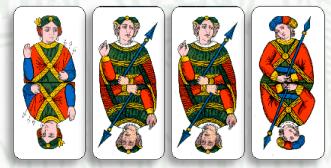
Card Scoring: Similar to other Tarot games, cards are counted together in pairs (usually pairing a .5 card with a higher value). The total number of points in the pack is 87. Don't forget the winner of the last trick played also gets 6 extra points.
Card Type:
| Tarocchi (Angelo, Mondo,Bégato, il Matto') | 4.5 |
| Re | 4.5 |
| Regina | 3.5 |
| Cavallo | 2.5 |
| Fante | 1.5 |
| ‘Scartini (Pip Cards)& ‘Trionfi (Trumps) | .5 |
- Work out your team Cricche (double this score for Criccone!)
2.Use cards collected and Contatori to create Sequences. NOTE: You also double Sequences scoring if you have three or more
-
Award last trick for 6 points.
-
Total up your team card points by pairing 'worthless' cards with others.
-
What is your Grand Total? You carry this through to the next round...
"Ottocento!"
First team to 8oo points wins!
For more info also visit https://www.tarocchinobolognese.it/ Bar Lunette, Via Gaspare Nadi, 6, 40139 Bologna BO, Italy

原文为社区整理/出版社公开资料,版权归原作者,仅供个人学习查阅。