
请上车:纽约与伦敦Get On Board New York London
一句话概览
请上车:纽约与伦敦 是一款已收录于村了吗规则库的桌游,支持 2–5 人,原名 Get On Board New York London。
本页内容:一句话概览 · 常见问题
这游戏怎么玩
- 本站已收录这款游戏的规则资料,可以在对话里直接提问规则细节。
常见问题(FAQ)
以下 1 条问答中 0 条来自站内玩家的真实提问,其余 1 条为本站整理的常见疑问;答复内容保持原样。
请上车:纽约与伦敦支持几个人玩?
2–5 人。
去哪查完整规则
想核对具体规则细节、卡牌效果或某个回合的结算方式,可以在村了吗里选中这款游戏后直接提问。
同类桌游
- 卡坦岛德式
- 工业革命:伯明翰德式
- 勃艮第城堡:特别典藏版德式
- 方舟动物园德式
- 卡卡颂抽象
- 瘟疫危机传承:第一季美式
- 阿瑞迪亚:勇踏征途美式
- 重塑宇宙德式
- 幽港迷城美式
- 埃多拉的德鲁伊德式
规则原文(Markdown)
本站收录这款游戏的规则原文 1 个文件,此处内联渲染 1 个,可直接展开阅读或下载。
GOB_London-NewYork_Rulebook_EN_Light.md20.9 KB

GETOBOARD 中 TM 吕吕吕 吕吕吕吕吕 0000 000000 RULEBOOK 吕 口 0000
BUS LINE# 01
Ah, here's the bus! Hurry, grab a seat and get out of the rain!
Just like every trip, you're fascinated by all the other passengers on board: tourists, professionals, students...
They're all traveling together, though they each have different destinations. This bus line is truly special... but will it be able to transport everyone safe and sound?


CONTENTS
double-sided board 1 London side 1 New York side
50 double-sided player sheets
Route markers Departure pawns Pencils
Bus Ticket cards Common Objective cards
Personal Objective cards 5 London cards 5 New York cards
Inspector pawn
You have 12 rounds to build the best bus line in town. Each round, reveal a new card that shows all players the route shape they must complete. Take the passengers where they want to go, avoid traffic, and gain as many victory points as possible!
GAME ELEMENTS AND SETUP

Choose a player color and put all the corresponding pieces in front of you: 32 Route markers and 1 Departure pawn.
Route markers are placed on the map to plot out your bus line.

Take a player sheet and a pencil. Make sure the top part of everyone's sheets are different (the rest of the sheet should be the same).
Your player sheet will track who has boarded your bus along your route and which Places you stopped at, all of which give you victory points.

Place the board in the middle of the table.
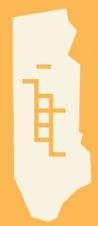
For a 2- or 3-player game, use the New York side.
For a 4- or 5-player game, use the London side.


The board shows a map of the city made up of different roads. Each intersection has one of these Passengers ], one of these Places (■ ], or a Green Light. Certain Places also have a name with a colored background: these are called “Sightseeing Spots." On one side of the board, there are 2 numbered spaces for Common Objective cards to be displayed faceup. There are 2 other spaces for the Bus Ticket deck and discard. The New York map also shows some black roads that constantly have traffic jams.
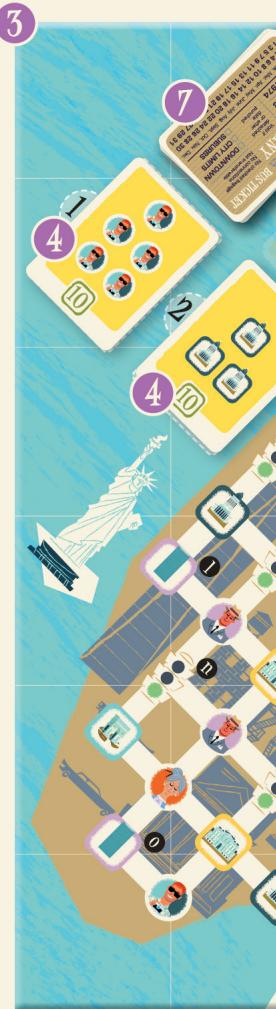

Shuffle the 6 Common Objective cards and randomly place 1, yellow side up, on each of the 2 spaces on the board. Put the unused cards back in the box.
Common Objective cards show players the number of Passengers they must pick up or the Places they must stop at to gain victory points.


5 Sut 1 to each player, face down. Leave the remaining card(s] in the box. You can also choose to leave these cards face-up for a more competitive game.

Personal Objective cards require you to connect 3 specific intersections with your bus line to gain victory points. These points are shown in the black circles. Red circles are only used to highlight landmarks on the map.

Shuffle all 12 Bus Ticket cards if you are playing on the London side or only cards 1 through 6 if playing on the New York side, then deal 2 to each player, facedown. Look at the 2 cards you received and place 1 facedown in front of you. Once everyone has a card in front of them, reveal them: place your Departure pawn on the Traffic Light in the intersection whose number is shown on the Bus Ticket you chose.

This pawn shows the point of departure for your bus line.
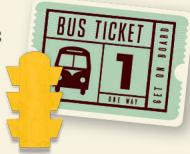

Take all 12 Bus Ticket cards back and shuffle them to make a facedown deck in the dedicated space on the board.
Bus Ticket cards have a number and a color. The number is only used during setup, to show different points of departure. The color is used during gameplay.

The oldest player is the first Inspector and places the Inspector pawn in front of them.

The Inspector pawn shows the turn order. The Inspector will always go first followed by the other players going clockwise. This pawn will pass to the next player each round.


GAMEPLAY OVERVIEW
A game of Get on Board plays over 12 rounds. Each round has 4 phases:
① NEW BUS TICKET

② PLOT ROUTE
③ CHECK COMMON OBJECTIVES
④CHANGE INSPECTOR

②PLOT ROUTE
Starting with the Inspector and taking turns clockwise, follow these two steps:
PLACE ROUTE MARKERS
BOARD BUS
① NEW BUS TICKET
The Inspector reveals the top card of the Bus Ticket deck and places it faceup on top of the discard space.
Each player now crosses off one of the two boxes of the matching color at the top of their player sheet. This box shows the shape of the route they will plot during ② PLOT ROUTE, and also shows which routes are left for the remaining rounds.
Continue to ② PLOT ROUTE.

PLACE ROUTE MARKERS
On the board, create the shape of the route required by the Bus Ticket revealed this round.
To create the shape, you must obey these restrictions:
• Each player can only place one marker per road, but multiple players can place their markers on the same road.
• Your route must begin where your route ended the previous round. For the first round, begin plotting your route starting from your Departure pawn.
• You can only place the number of markers shown on your player sheet.
• Markers placed this round can only have as many turns as are shown on your player sheet. Only the number of turns matters, not their direction. You can always choose which way each turn goes (left or right].
The beginning of the current round's route may form a turn when connected to the end of the previous round's route. Regardless, this turn does not count as one of the turns required for the current round's route.
• You can never double back on the same road.

DIFFERENT ROUTE SHAPES
STRAIGHT LINE
You must place exactly 1, 2, or 3 markers as shown. If you place 2 or 3, they must be placed in a straight line.
1 TURN
You must place exactly 2 markers that make a 90' turn.
2 TURNS
You must place exactly 3 markers that make two 90' turns. These turns can be in the same direction (to make a U) or in opposite directions (to make an S].
If your player sheet shows two different shapes separated by a slash, choose one of them to plot this round.



ExAMPLE: You must place 3 markers with 2 turns this round. You decide to plot them as shown below. The turn made next to the final marker from the previous round and the first marker of the current round does not count as either of your 2 turns.

TRAFFIC JAMS
AVOID TRAFFIC JAMS AS MUCH AS POSSIBLE!
Every time your route goes through a road with one of more other markers, you must cross off as many Buses in your Traffic Jam section (bottom-left of your player sheet] as the number of markers already placed on that road. Cross them off in order, starting from the top-left.
These represent traffic jams along your route and will negatively affect your final victory points.
NEW YORK
CERTAIN ROADS ARE ALWAYS JAMMED!
Every time your route goes through a traffic zone, meaning a black road, cross off 1 extra Bus in the Traffic Jam section of your player sheet.
ExAMPLE: You finish your turn at a Green Light, so you get to place 1 extra marker!


ExAMPLE: You place 1 marker on a traffic zone that already has markers from 2 other players. Therefore you cross off 3 Buses on your player sheet (1 for the traffic zone and 2 for the other markers].

GREEN LIGHTS
SPEED UP YOUR ETA WITHGREEN LIGHTS!
8
If your route for the current round ends at an intersection with a Green Light, place an additional marker to extend your route following the normal rules (in any direction]. If the new marker causes you to end at another Green Light, place another marker. Green Lights under Departure pawns are treated as normal Green Lights.
If you run out of markers, use a a suitable substitute and continue playing.
ExAMPLE: Your route would take you to an intersection you have already passed through. You decide to add a turn to your route by crossing off a space in the Turn Zone of your player sheet. You successfully avoid this intersection and therefore elimination.
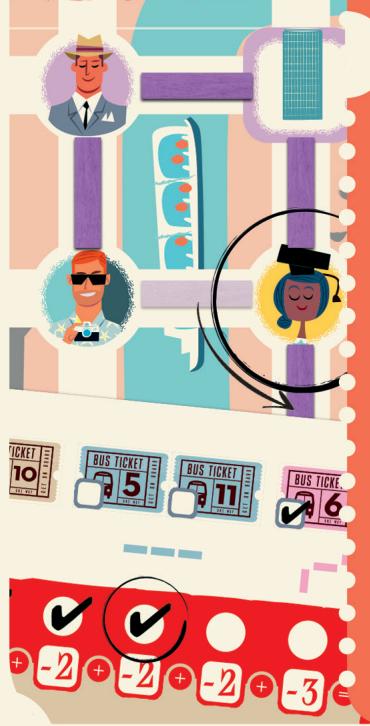
DETOURS NOT ALLOWED
A BUS LINE THAT DOUBLES BACK ONITSELF IS NOT EFFICIENT!
If your route reaches the same intersection for the second time, immediately end your turn. You are eliminated from the game and do not score any victory points at the end of the game. Leave your markers on the board.
STRAIGHT LINESAND TURNS
If the current round's shape does not allow you to place the required amount of route markers or isn't optimal for your strategy, you may increase or decrease the number of required turns.
To do this, you must cross off the left-most space in your Turn Zone (red background, upper-right on your player sheet]. For each space that you cross off, you can change a turn into a straight line or a straight line into a turn. This does not change the total number of markers you must place. This number cannot be adjusted.
You can cross off a maximum of 5 spaces in this Zone. If you have crossed off all the spaces and the required shape is impossible for you to complete because your route would go off the map (but not because you would reach the same intersection for the 2nd time), treat the shape as if it were a straight line using a single marker.
ExAMPLE: Your route reaches an intersection you already passed through. You are eliminated.


Once you have placed all your markers, continue to the BOARD BUS step.

EMBARQUEMENT
For each Passenger or Place you reach with your markers during the PLOT ROUTE step this round, apply the following effects, described on pages 8, 9, and 10.
Certain intersections have 2 Characters. If you reach one of these intersections, apply the effects of both Characters.

1 Immediately cross off the top availablespace on your player sheet. If all the corresponding spaces are already crossed off, nothing happens.


Immediately cross off one of the corresponding spaces on your player sheet. If all these spaces are already crossed off, nothing happens. Careful! The 3in the bottom row can only be crossed off with thebonus, which offers internships to certain Students. Example: You reach a, so you cross off 1space

BUSLINE#01



Immediately cross off the or space that is furthest left in the top row without a Parked Bus [with no number in the rightmost space). If all the spaces of that row are already crossed off or if all rows have Parked Buses, nothing happens.

• Look at the last [if you reached a or
(if you reached aor you crossed off in the top row without a Parked Bus [with no number in the rightmost space]
Then check the points shown at the bottom of the same column. Write that number of victory points in the rightmost space of this row to show that it has a Parked Bus.
also provide a Bonus Passenger, depending on the symbol at the bottom of the corresponding column, when you park their Bus. Cross off the Passenger shown following their normal rules. If you cross off 1this way, cross off one of the spaces in the 3rd row: they are interns and can only be crossed off through these bonuses.
•Then scribble out anyorspaces in that row that weren't crossed off before the Bus parked. The next time you cross off one of these types of spaces, use the next row.
• If you hadn't crossed off anyorin your top row before the Bus parked, nothing happens.

Cross off one of the 3 spaces that match that building type.
Write a 9 in the rightmost space of this row.
Then scribble out the last to show that the Bus parked.

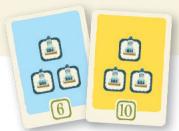

Two Common Objective cards require you to stop at 3or3 If one of these Objectives is in play, track your progress by crossing off a space each time you visit the corresponding Place, regardless of whether there are Tourists on your bus. This zone has no other use than reminding you where you've been.

On each map, there are four Places [one of each type] that represent Sightseeing Spots, which are worth visiting. They each have a large name with stars and a colored background.
As soon as you reach one of these Places, write the number of Passengers of the matching color that you have already crossed off in the starred space.
There are two spaces for Tourists: light blue for the Sightseeing Spot and dark blue for the Sightseeing Spot. The space with thesymbol is only used during final scoring (see page 12].

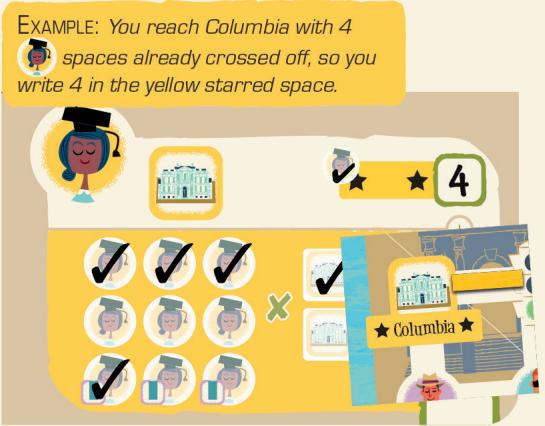
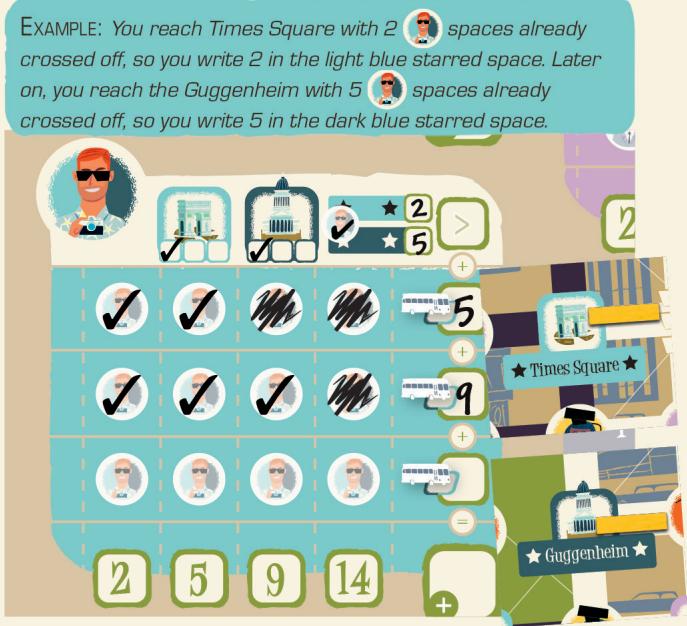
Once you have finished plotting your route for the current round and have crossed off all the corresponding spaces on your player sheet, continue to ③ Check Common Objectives.
Check Common Objectives
Check if you have completed any Common Objectives this round, respecting the following conditions:
Each Objective can be completed by multiple players, but only once per player.
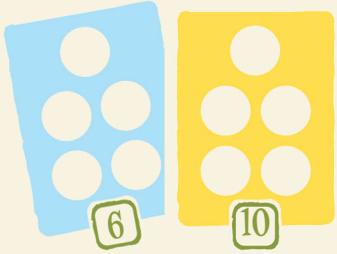
If one or more players complete a yellow Objective in the same round, they write 10 VP in the bonus zone of their player sheet. Then flip the Objective card over to its blue side.
If one or more players complete a blue Objective, they write 6 VP in the bonus zone of their player sheet. The Objective card stays on its blue side.
Then continue to ④ Change Inspector.

CHANGE INSPECTOR

If you just finished the 12th round (and the Bus Ticket deck is empty), continue to the End of the Game.
Otherwise, pass the Inspector pawn clockwise to the next player and begin another round.
CREDITS
Designer: Saashi

Saashi & Saashi
Illustrator: Monsieur Z

Follow us on
Project Manager: Xavier Taverne
Graphic Designer: Vincent Mougenot
Rules Editor: Xavier Taverne
Translator: Danni Loe

Proofreader: William Niebling


Count your final score by following these steps:

Add up your total negative points from crossed off spaces in your Turn Zone.

Add up your points from each crossed off space.


Multiply the number of crossed off spaces by the number of crossed off spaces. Then add these points to any victory points you gained from the yellow Sightseeing Spot.
For the


zones, follow these steps:
the values in the 2 Sightseeing Spot spaces. Gain points equal to the higher of the 2 values. Write it in the space to the right with thesymbol.
Parked Buses gain the points you noted during the game.
Buses that did not park (meaning rows without points in the rightmost space] gain half the points [rounded down] that they would have gained if you immediately reached a orfor or aU for

Add up the points from the 4 spaces in the rightmost column.
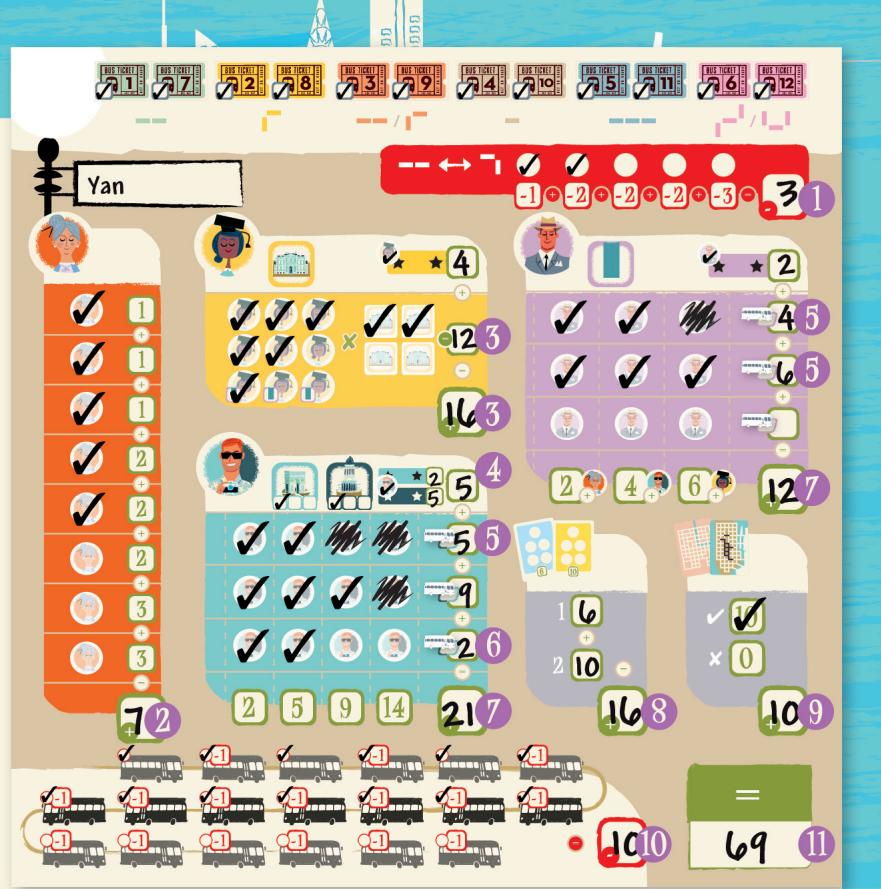

Add up the points from any Common Objectives you completed during the game.
Check your Personal Objective: if you connected all 3 intersections shown in the black circles [in any order], gain 10 points. Otherwise, do not gain any points.

1Add up your total negative points from Traffic Jams.
In the bottom-right of your player sheet, write the total victory points from all 8 subtotal sections [the spaces with a + or in the bottom-left]. That's your final score!
The player with the highest score wins the game. If players are tied for first, they share the victory!
下载 Markdown原文为社区整理/出版社公开资料,版权归原作者,仅供个人学习查阅。