
伦敦公会Guilds Of London
一句话概览
伦敦公会 是一款已收录于村了吗规则库的桌游,支持 1–4 人,原名 Guilds Of London。
本页内容:一句话概览 · 游戏概述 · 1. 游戏组件 · 2. 游戏设置 · 3. 游戏流程 · 4. 回合详解 · 5. 板块结算 · 6. 发展阶段 · 7. 最终计分 · 关键规则与常见问题 · 常见问题
伦敦公会 规则速览
以下规则速览由本站整理,与官方规则书表述不同,仅供快速上手参考。
游戏概述
在17世纪的伦敦,玩家扮演市民贵族,通过派遣会员加入各商会建立势力根基,争夺商会主管职位,并可将影响力延伸至海外殖民地。每轮按分数降序行动,结算时通过谈判与投票决定商会归属。最终获得最多胜利点的玩家将成为伦敦市长。
核心机制: 手牌管理、板块放置、区域控制、谈判博弈、顺位轮换
1. 游戏组件
| 组件 | 数量/说明 |
|---|---|
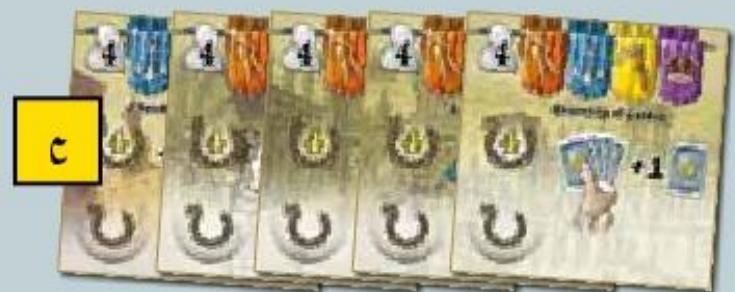
| 商会板块 | 40块(方形,面朝上带有盾徽与分数标识) |
| 殖民地板块 | 1块(乌尔斯特与弗吉尼亚双面) |
| 市政厅板块 | 2块灰色方形板块,拼成中央区域 |
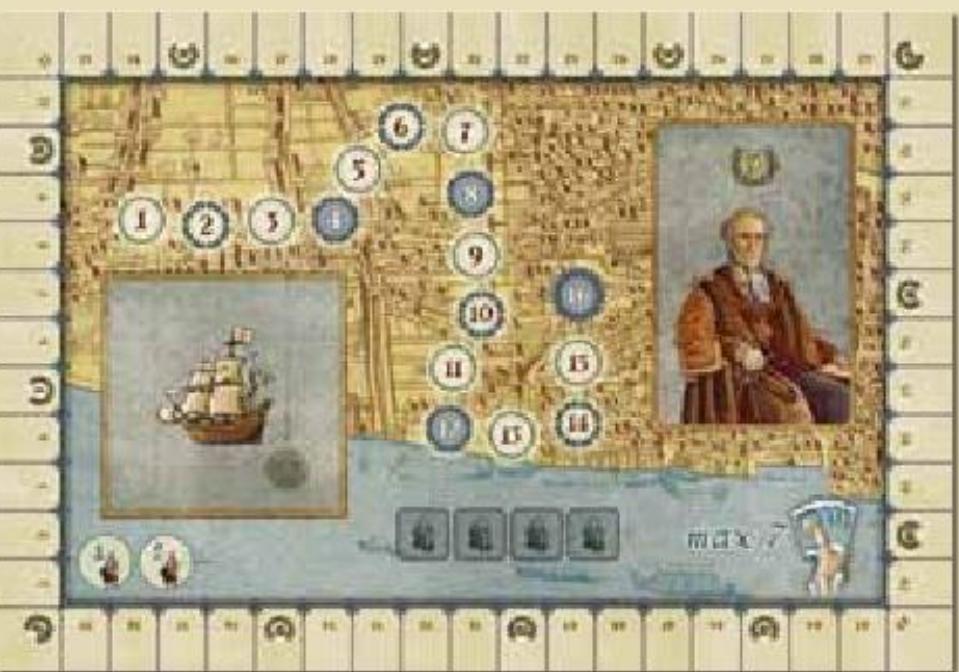
| 计分板 | 1块(双面:含轮次轨、回合顺位区) |
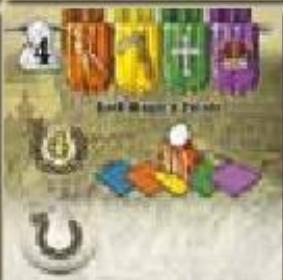
| 特殊建筑板块 | 5块(方形,含4种不同类别标志) |
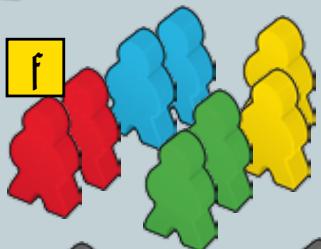
| 会员棋子 | 64枚(红/蓝/黄/绿各16枚) |
| 中立会员棋子 | 8枚(黑色) |
| 官吏棋子 | 1枚(灰色) |
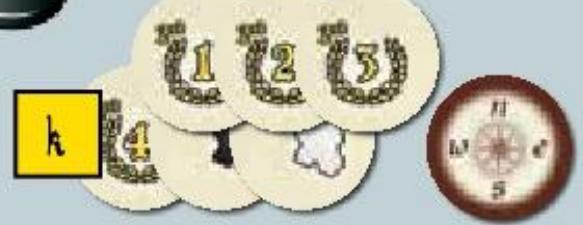
| 亚军奖励标记 | 30枚 + 1枚罗盘标记 |
| 玩家指示物 | 8枚(红/蓝/黄/绿各2枚,用于标顺位和计分) |
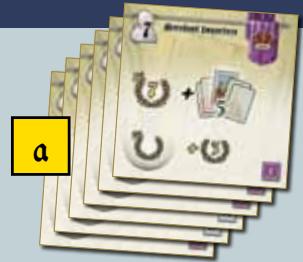
| 行动卡 | 105张(背面为硬币标志) |
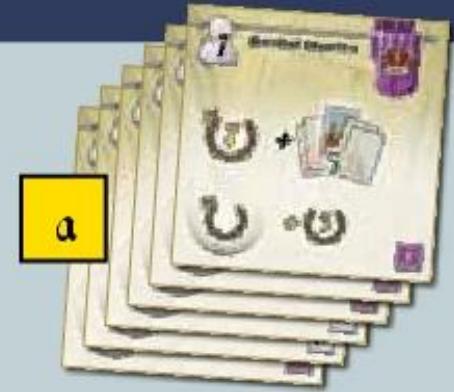
| 市长奖励卡 | 21张(背面为市长图案) |
| 轮次指示物 | 1枚(黑色) |
2. 游戏设置
2.1 板块布置
- 将2块市政厅板块拼好,置于游戏区中央。将罗盘标记放在市政厅上对应空格,指向北方。
- 将圣劳伦斯犹太教堂板块起始面朝上放在市政厅右侧。
- 将40块商会板块与4块特殊建筑板块(排除第5块)洗混。随机抽1张放市政厅左侧,4张放上方,4张放下方,组成一个 4×3 的矩形。每张板块起始面朝上。剩余板块堆在一旁备用。
- 洗混亚军奖励标记,随机抽取10枚,除市政厅外每张板块上各放1枚。
- 将官吏棋子放在右下角商会编号最小的板块上。
- 将计分板放在游戏区旁。
- 选择殖民地板块的任意一面,放在计分板上绘有帆船的空格中。
2.2 玩家个人设置
每位玩家获得:
- 1枚玩家指示物,放在计分板左下角标有序号的圆圈中(从1号到玩家人数)
- 1枚同色玩家指示物放在自己手边,标记使用颜色
- 6张行动卡(从洗匀的行动卡牌堆抽取)
- 3张市长奖励卡(从洗匀的市长奖励卡牌堆抽取),其余市长奖励卡洗匀后放在计分板对应区域作为牌堆
秘密选择其中1张市长奖励卡保留,退回另外2张。退回的和剩余的市长奖励卡重新洗混,组成市长奖励卡牌堆。
- 在市政厅板块上放置4枚己方会员棋子
- 剩余会员棋子放在计分板旁作为供应堆
2.3 其他设置
- 将轮次指示物放在轮次轨第1格
- 将中性会员棋子(黑色)放在轮次轨下方空格,数量等于玩家人数的2倍。如有剩余则放回盒中。
2.4 2人游戏调整
- 只使用1块市政厅板块(反面)
- 将4块特殊建筑板块围绕市政厅摆放,不使用"歌革与玛各"板块
- 随机抽取20块商会板块,组成 5×5 的游戏区域
- 在每个商会板块和特殊建筑板块上都放1枚亚军奖励标记
- 使用计分板2人游戏的一面
3. 游戏流程
游戏进行固定轮次:
- 4人游戏: 12轮
- 3人游戏: 15轮
- 2人游戏: 16轮
每轮分为三个阶段:
| 阶段 | 内容 |
|---|---|
| 开始阶段 | 轮次指示物前进1格(第一轮除外);按分数降序排列行动顺序 |
| 执行阶段 | 每名玩家依次进行1个回合(打出任意数量的行动卡) |
| 结束阶段 | 结算所有板块 → 检查是否进入发展阶段 → 如否则进入下一轮 |
3.1 行动顺序
按分数从高到低的顺序行动。起始玩家为分数最高的玩家。若分数相同,按计分板上玩家指示物从上到下的顺序排列。每个执行阶段内顺位不变。
得分时将自己玩家指示物前进相应格数。若目标格已有他人指示物,将自己的叠在最上面。顺位由上到下排列。
4. 回合详解
玩家可按照任意顺序打出任意数量的行动卡,但必须结算完前一张后才能打出下一张。打出的卡牌正面朝上摆放在面前供查询。回合结束时将所有打出的卡牌弃入弃牌堆,并从行动卡牌堆补充新卡。
4.1 雇佣会员
打出任意一张行动卡,从供应堆放置1枚己方会员棋子到市政厅板块上。
4.2 移动会员
打出一张行动卡,将1枚己方会员棋子从市政厅、某商会板块或特殊建筑板块,移动到另一块面朝上的商会或特殊建筑板块。
限制: 打出的行动卡的类别标志必须与目的地板块的类别标志之一匹配。
例外: 打出镰刀标志卡时,可以将会员移动到任何面朝上的镰刀类别板块。
4.3 使用卡牌特殊能力
打出1张行动卡并声明要发动的能力,然后支付卡牌上标示的特殊能力费用。大部分费用需弃掉指定数量的行动卡。若没有足够的手牌可以弃除,则不能发动该能力。
卡牌背面的硬币标志表示任何行动卡均可用于支付费用。
4.4 摸取行动卡
- 本回合未打出任何行动卡:摸4张
- 本回合打出过行动卡:摸2张
- 某些行动卡可能额外增加摸牌数量
最后一轮不摸牌。 结算板块获得的手牌不受上限限制,仅在执行阶段结束时检查上限。
4.5 手牌上限
默认手牌上限为 7张。如果玩家是大学(University of London)的主管,手牌上限增至 8张。市长奖励卡不计入手牌上限。结算板块获得的手牌不会立即触发弃牌,仅在下一次执行阶段结束时检查。
5. 板块结算
所有玩家执行完回合后,进入板块结算阶段。
结算频率:
- 3-4人游戏:每轮结算
- 2人游戏:每两轮结算一次(计分板上月桂叶标记提示该轮结算)
结算顺序: 从上到下,每行从左到右。顺序非常重要——前面的结算会影响后面的结果。
5.1 结算条件
当板块上的棋子总数(含己方会员棋子和官吏棋子)≥ 结算阈值时,该板块本轮参与结算。
5.2 步骤一:谈判
按当前游戏顺位,每名玩家可以用自己的中立会员棋子替换板块上相等数量的任意玩家的会员棋子。被替换的棋子返回市政厅。也可以选择不替换而让过。
5.3 步骤二:投票
板块上己方会员棋子数量最多的玩家获胜。
平局处理: 水平或竖直相邻的同色主管会给持主管者增加1票。票数多者获胜。如仍平局,则该板块本轮不予结算。
如果谈判后板块上没有玩家棋子,同样不予结算。
投票结束后将所有中立会员棋子放回供应堆。
5.4 步骤三:奖励
- 胜者获得结算奖励(按从左到右顺序逐一获得)和胜者奖励。可以选择只执行部分奖励。
- 亚军(第二名)获得亚军奖励标记及该板块上的额外亚军奖励。如第二名出现平局或无人第二名,则无人获得亚军奖励。
- 将所有棋子从板块上移开。
- 板块翻面(背面朝上)。
- 投票获胜者放置1枚自己的玩家棋子在板块上——这是主管,代表控制此商会。
- 将官吏棋子移到面朝上的、优先度数字最小的商会板块上。
注意: 结算过程中移动的棋子可能导致后续原本不需要结算的板块变为需要结算。
5.5 结算奖励类型
| 效果 | 描述 |
|---|---|
| 部署会员 | 从市政厅等位置移动1名你的会员或主管到任意其他商会或特殊建筑 |
| 抽取市长卡 | 从市长卡堆摸指定数量,选1张保留,其余放回底部 |
| 补充会员 | 从供应堆拿指定数量己方棋子放到市政厅。不足则拿全部 |
| 殖民扩展 | 从市政厅/商会/特殊建筑拿1枚己方棋子放到殖民地板块 |
| 抽取行动卡 | 从行动卡堆摸指定数量。结算后手牌可超过上限 |
6. 发展阶段
当轮次指示物停在灰色格子时,进入发展阶段。包含以下四步:
6.1 结算殖民地板块
殖民地板块结算分三步:谈判、投票、奖励。
投票: 殖民地板块上会员棋子数量最多的玩家获胜。
奖励分配(弗吉尼亚):
- 第一名:获得斜线左方奖励
- 第二名:获得斜线右方奖励
- 并列第一:并列者各得斜线右方奖励
- 并列第二:并列者无任何奖励
奖励分配(乌尔斯特):
- 棋子最多的玩家获得3张市长奖励卡,选1张保留,弃掉2张。
获得奖励后,需将殖民地板块上一定数量的己方棋子交回储备。如无足够棋子,则交回全部。
6.2 检视游戏结束条件
满足任一条件即结束:
- 轮次指示物到达游戏结束格
- 2人游戏中所有板块已被结算
6.3 加入新板块(仅3-4人游戏)
除最后一轮的发展阶段外,每轮添加新板块:
- 3人游戏:添加5块
- 4人游戏:添加6块
从罗盘标记指向的方向依次放置:第3轮向北、第6轮向东、第9轮向南、第12轮(仅3人)向西。新板块顺时针依次摆放不留空隙。每块新板块随机放1枚亚军奖励标记。
6.4 移动官吏棋子
将官吏棋子移动到面朝上优先度数字最小的商会板块上。
7. 最终计分
游戏结束后依次计算:
- 移除所有未结算板块上的棋子
- 所有玩家公开展示自己的市长奖励卡,结算奖励得分
- 主管相邻加分: 每有一对水平或竖直相邻的主管得1分(例如2×2的主管方块组合可得4分)
- 最高分者获胜。
平局处理:
- 首先比较市长奖励卡数量,多者胜
- 仍平局则所有平局者分享胜利
关键规则与常见问题
易错规则
- 行动顺序按分数降序排列:分数高先动。得分时指示物前进,重叠时叠于上方,顺序由上到下决定
- 每次结算后重新排定顺位:结算板块谈判时也按分数高低顺序进行
- 每回合可打出任意数量卡:只需在前一张结算完毕后才能出下一张
- 谈判阶段可用黑子换任何人的棋子:被换回市政厅;也可让过
- 投票只看棋子数量:相邻同色主管只影响平局情况
- 主管只在获胜后放置:结算完成后才放,之前的移动不算控制权变更
- 2人游戏每两轮结算一次:计分板月桂叶标记提示该轮结算
- 2人游戏最后一块板块结算后直接进最终计分:不再多轮
- 军官永远放在优先度最低的可见商会:每轮发展阶段都会重新放置
- 殖民地奖励只给前两名:并列第一共享右方奖励,并列第二什么都得不到
- 手牌上限仅在执行阶段结束时检查:结算阶段超限不补牌
- 最后一名玩家出牌后摸牌:最后一轮结束时不摸牌
- ** council 优先级为1-12的商会在最终计分时可能影响结果**:具体以市长奖励卡为准
常见问题
- Q:谈判阶段的黑子能换多少?
A:任意数量——可以用1个黑子换1个对方的,也可以用多个换多个。
- Q:如果协商后没人了怎么办?
A:该板块本轮不予结算,跳过。
- Q:官员棋子什么时候移动?
A:每次板块结算后,官员移到优先度最低的面朝上商会。此外每个发展阶段的最后也会重新安置。
- Q:殖民地可以同时有两个玩家在吗?
A:是的,就像普通商会一样,双方都可能派出棋子。投票决定谁赢。
- Q:主管能像普通会员一样被黑子替换吗?
A:是的,谈判阶段主管也被视为板块上的棋子,可以被对方的黑子替换。
- Q:结算时可以部分领取奖励吗?
A:可以。如果有多项奖励,按从左到右的顺序依次获得,可以选择不执行后续的奖励。
- Q:市长奖励卡可以在什么时候展示?
A:只有在最终计分时才公开。在游戏过程中始终对其他玩家保密。
- Q:永久效果有哪些?
A:歌革与玛各和伦敦大学两个特殊板块的效果是永久的,不会因为板块翻面而消失。详见提示卡。
常见问题(FAQ)
以下 1 条问答中 0 条来自站内玩家的真实提问,其余 1 条为本站整理的常见疑问;答复内容保持原样。
伦敦公会支持几个人玩?
1–4 人。
去哪查完整规则
想核对具体规则细节、卡牌效果或某个回合的结算方式,可以在村了吗里选中这款游戏后直接提问。
同类桌游
- 卡坦岛德式
- 工业革命:伯明翰德式
- 勃艮第城堡:特别典藏版德式
- 方舟动物园德式
- 卡卡颂抽象
- 瘟疫危机传承:第一季美式
- 阿瑞迪亚:勇踏征途美式
- 重塑宇宙德式
- 幽港迷城美式
- 埃多拉的德鲁伊德式
规则原文(Markdown)
本站收录这款游戏的规则原文 2 个文件,此处内联渲染 2 个,可直接展开阅读或下载。
rules_zh_伦敦公会_1365.md29.3 KB
伦敦商会
欢迎来到伦敦商会
伦敦是英格兰在中世纪晚期与现代早期最大,最具影响也最为富有的城市。商会在伦敦市民的生活中扮演了重要角色,控制着贸易、生产与商业的方方面面。商会的会员们都是富裕的市民,他们在社区中占有重要的位置,掌控着巨大的公民力量。商会的首席代表会成为伦敦的市长,其他的主要代表担任议员。其余商会会员是中产阶级的重要力量。商会通过贸易控制城市,每家商会都有自己的会议厅和独有的盾徽。每天商会的代表们都会聚集在市政厅讨论重大问题。
游戏配件



40张商会板块(方形板块)
1张殖民地板块(乌尔斯特和维吉尼亚)


2张市政厅板块(灰色方形板块)
1张双面计分板

5张特殊建筑板块(方形板块)
64枚会员棋子(红蓝黄绿各16枚)


8枚玩家指示物(红蓝黄绿各2枚)
m

8枚中立会员棋子(黑色棋子)

1枚轮次指示物(黑色)


1枚官吏棋子(灰色)

30枚亚军奖励标记和1枚罗盘标记

105张行动卡(牌背是硬币)

m
21张市长奖励卡(牌背是市长)
一本规则书和一张提示卡
-
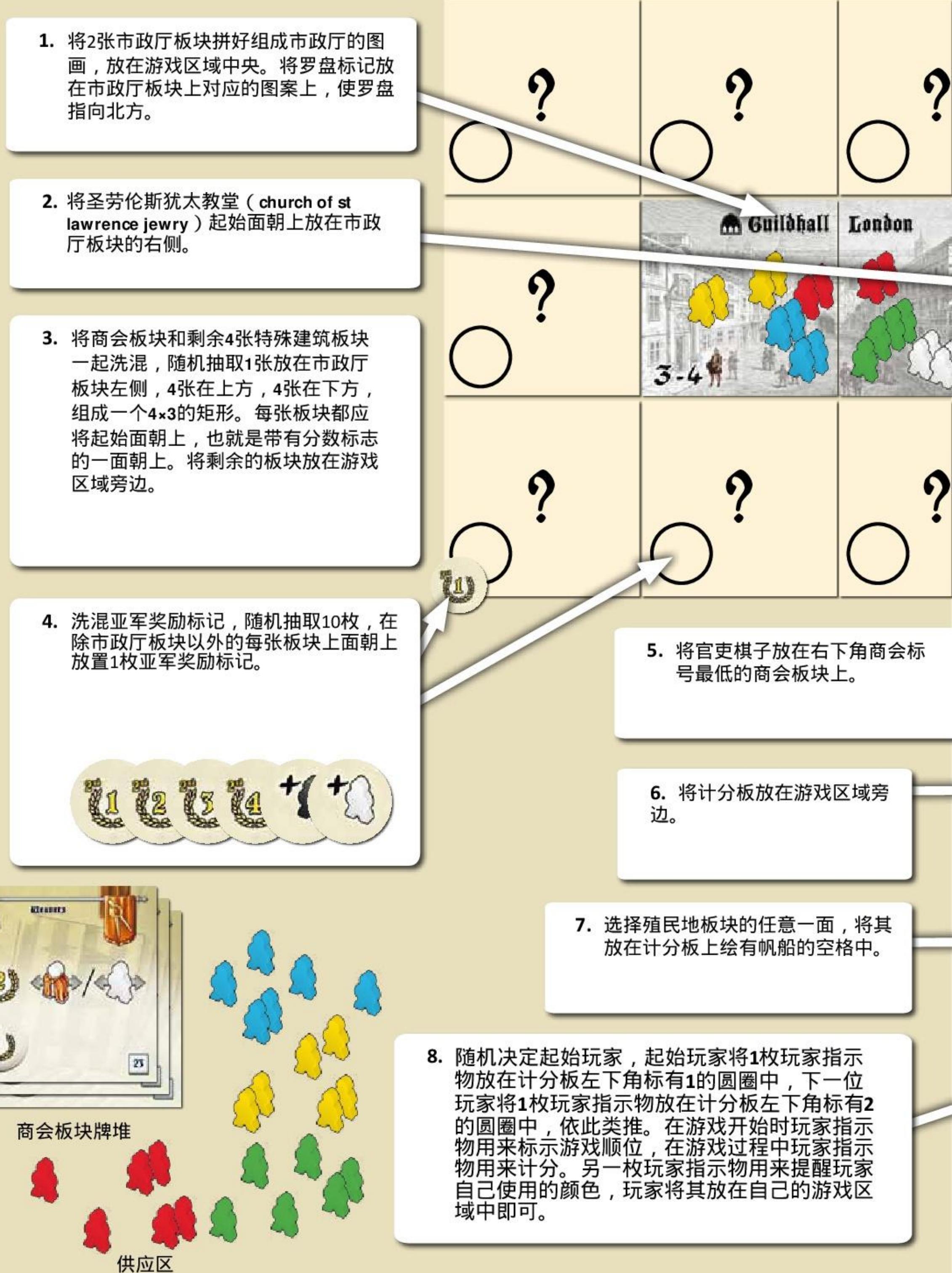
将2张市政厅板块拼好组成市政厅的图画,放在游戏区域中央。将罗盘标记放在市政厅板块上对应的图案上,使罗盘指向北方。
-
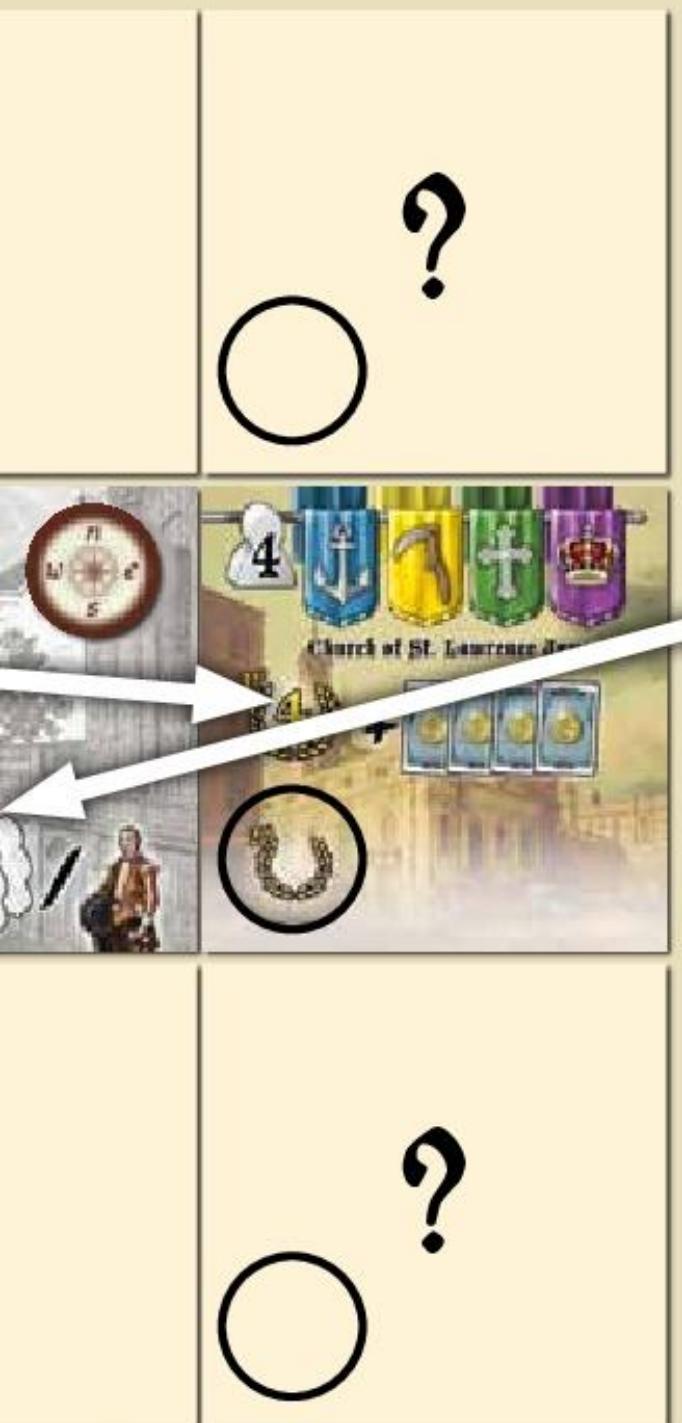
将圣劳伦斯犹太教堂(church of st lawrence jewry)起始面朝上放在市政厅板块的右侧。
-
将商会板块和剩余4张特殊建筑板块一起洗混,随机抽取1张放在市政厅板块左侧,4张在上方,4张在下方,组成一个4×3的矩形。每张板块都应将起始面朝上,也就是带有分数标志的一面朝上。将剩余的板块放在游戏区域旁边。
-
洗混亚军奖励标记,随机抽取10枚,在除市政厅板块以外的每张板块上面朝上放置1枚亚军奖励标记。
-
将官吏棋子放在右下角商会标号最低的商会板块上。
-
将计分板放在游戏区域旁边。
-
选择殖民地板块的任意一面,将其放在计分板上绘有帆船的空格中。
-
随机决定起始玩家,起始玩家将1枚玩家指示物放在计分板左下角标有1的圆圈中,下一位玩家将1枚玩家指示物放在计分板左下角标有2的圆圈中,依此类推。在游戏开始时玩家指示物用来标示游戏顺位,在游戏过程中玩家指示物用来计分。另一枚玩家指示物用来提醒玩家自己使用的颜色,玩家将其放在自己的游戏区域中即可。
-
洗混市长奖励卡并发给每名玩家3张,在看过自己的6张行动卡和3张市长奖励卡后,每名玩家秘密选择1张市长奖励卡并退回另外2张市长奖励卡。在游戏过程中,玩家的市长奖励卡始终对其他玩家保密。将退回和剩余的市长奖励卡重新洗混,放在计分板上的对应区域组成市长奖励卡牌堆。
-
每名玩家在市政厅板块上放置4枚会员棋子,剩余会员棋子放在计分板旁组成供应堆。
-
将数量等于玩家人数2倍的中立会员棋子放在轮次轨下方的空格中,如果有剩余的中立会员棋子,将其放回游戏盒中。


每名玩家
- 将轮次指示物放在轮次轨中的第1格。
市长奖励卡


- 洗混行动卡并发给每名玩家6张行动卡。其余行动卡组成行动卡牌堆,放在计分板旁边。
游戏概览
在《伦敦商会》游戏中,玩家将自己的会员派往新建立的商会中建立自己的权力基础,并且使会员成为商会的主管。玩家还可以将自己的影响扩展到海外的乌尔斯特或维吉尼亚殖民地。玩家控制的每家商会都会带给玩家胜利分以及可以利用的额外行动,这样玩家可以控制城市的发展方向。游戏结束时拥有最高分数的玩家会成为伦敦市长,在这座绝伦的城市的历史上占据自己的一席之地。
板块详解
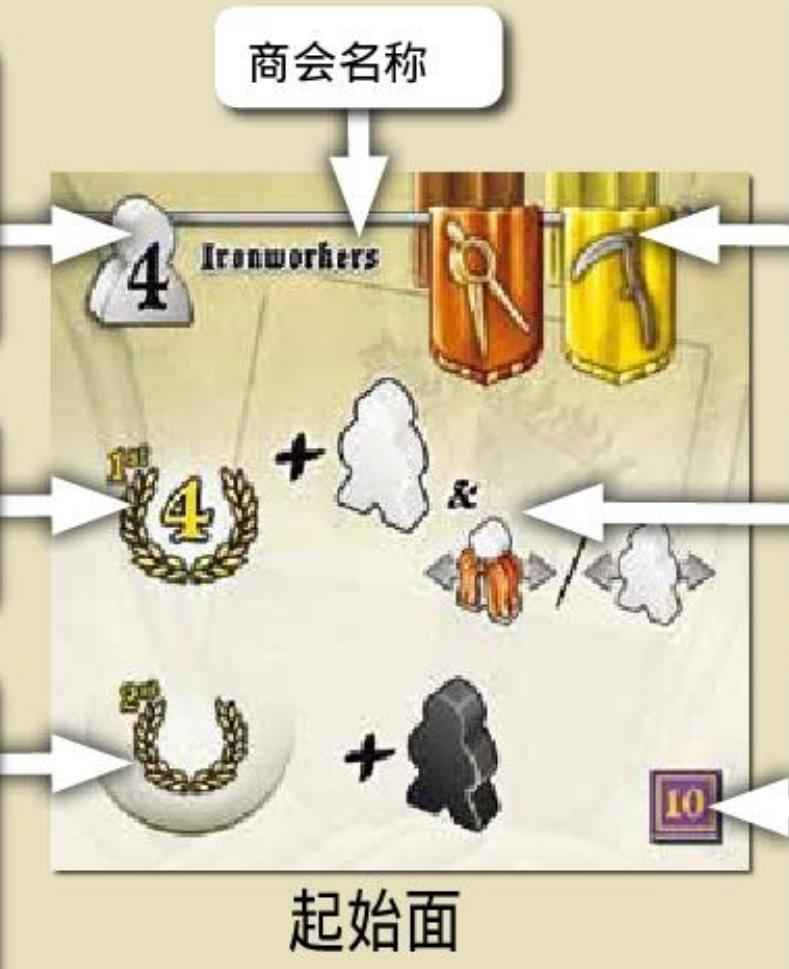
结算阈值:结算这张板块所需的棋子下限,包括玩家的会员棋子和官吏棋子。
胜者奖励:结算这张板块时胜者获得的奖励。
亚军奖励:在胜者获取奖励后,亚军将获得亚军奖励标记以及板块上标示的其他亚军奖励。
商会类别:对游戏结束计分和一些行动卡有影响。

盾徽:商会的盾徽
商会名称

完成面
商会类别:玩家的行动卡上必须有其中一个(只需一个)对应的标志才能将会员移动到这家商会上。特殊建筑板块上有4个不同标志。
结算奖励:胜者立即获得结算奖励。
商会优先度:数字越小,代表这家商会越高级。商会优先度用来决定在发展阶段结束时官吏棋子的放置位置。特殊建筑板块没有商会优先度。同时商会优先度为1-12的商会会对游戏结束计分产生一些影响。
商会优先度:对游戏结束计分有影响(仅限优先度为1-12的商会)
行动卡详解
卡牌数量:表示这张卡在牌堆中共有几张
卡牌编号:每张卡牌的编号不同
特殊能力费用:玩家使用卡牌特殊能力的费用,通常通过弃掉行动卡来支付。

行动卡的背面有一个硬币标志,代表每张卡都可以被用来支付特殊能力的费用。
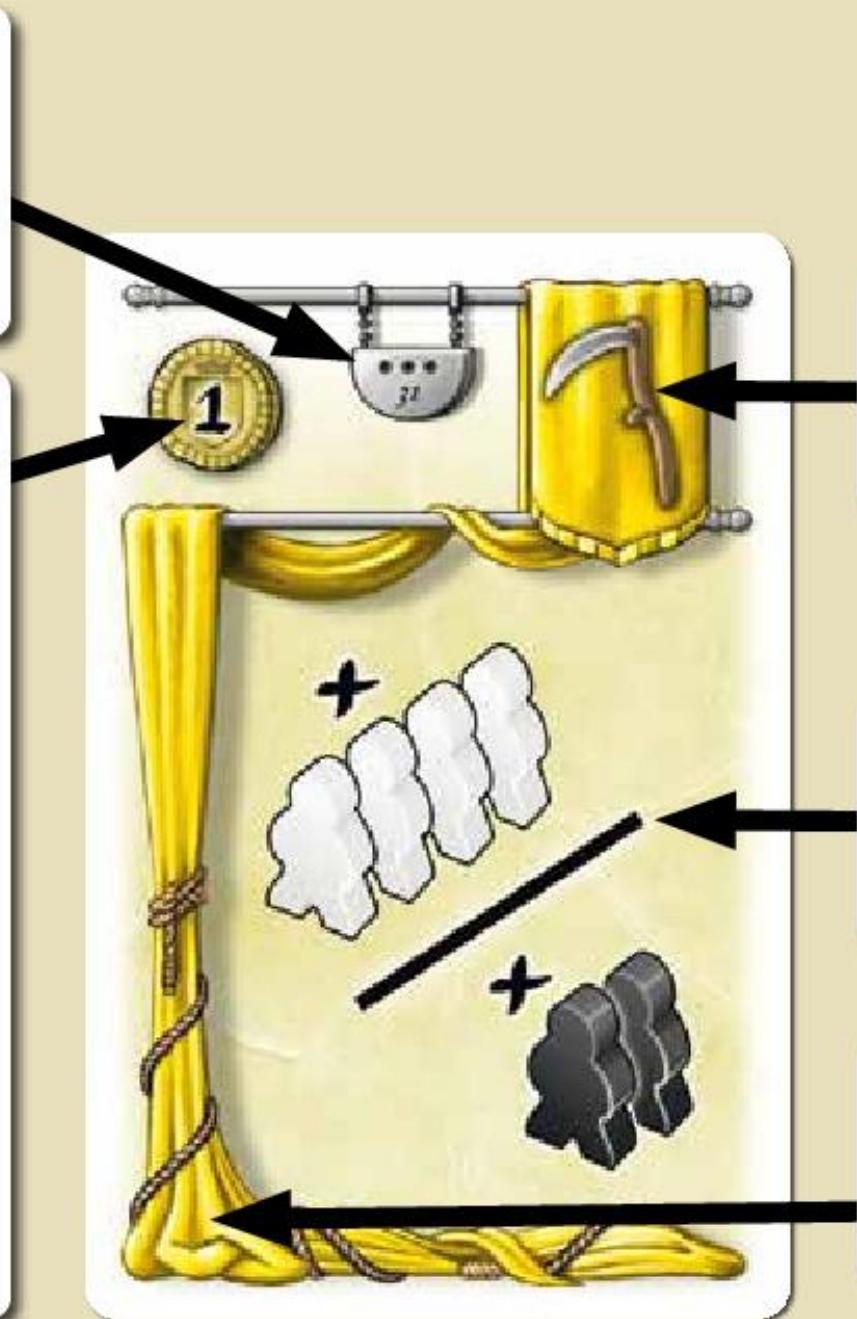
商会类别:当移动会员棋子时,这个标志必须与对应商会的类别中的一个标志对应。
特殊能力:玩家支付特殊能力费用后可以发动的特殊能力。
卡牌颜色:与卡牌类别对应:红色圆规,蓝色锚,黄色镰刀,绿色十字架,紫色王冠。
游戏流程
根据玩家人数,伦敦商会游戏会进行一定的轮次:
2人游戏——16轮
3人游戏——15轮
4人游戏——12轮
每轮每名玩家执行一个回合,然后所有玩家检视并结算商会和特殊建筑。在几轮之后(2人游戏4轮,3-4人游戏3轮)会进行一个发展阶段,这时会结算殖民地板块。在3-4人游戏中这时还会在游戏区域加入更多的板块。游戏流程总结如下,之后会有每一步的详细描述:
开始阶段
- 将轮次指示物前进1格(第一轮略过这一步)
执行阶段
- 按照得分降序,每名玩家执行一个回合
结束阶段
3.结算板块
-
如果轮次指示物在一个灰色的格子中时,进入发展阶段,否则开始下一轮游戏。
-
结算殖民地板块
-
如果这是最后一轮,进入最终计分。否则加入更多板块(仅在3-4人游戏执行)并进入下一轮游戏。
最终计分
7.获得市长奖励卡的加分
8.获得相邻主管的加分
分数最高的玩家获得胜利,如果出现平局,拥有市长奖励卡更多的玩家获胜,如果仍然平局,那么所有平局玩家分享胜利。
获得分数
当你获得分数的时候,将你的玩家指示物前进对应的格数。如果玩家指示物最终到达的位置已经有了其他玩家的指示物,那么将你的玩家指示物盖在最上面。分数相同的玩家将按照玩家指示物从上到下的顺序执行行动,因此你获得了更靠前的顺位。
开始阶段
前进轮次指示物
在每轮开始时,将轮次轨上的轮次指示物前进一格(第一轮略过这一步)

决定玩家顺位
游戏的顺位按照分数降序来决定。也就是说起始玩家是分数最高的玩家。如果有多名玩家的分数相同,那么按照玩家指示物从上到下的顺序排定顺位。在执行阶段过程中,玩家的游戏顺位不会发生改变。
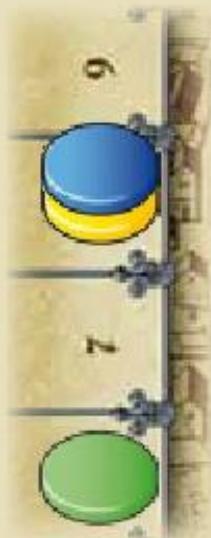
蓝色是起始玩家,之后是黄色玩家,最后轮到绿色玩家。
执行阶段
按照顺位每名玩家依次进行一个回合。
在玩家的回合中玩家可以按照任意顺序打出任意数量的行动卡,但玩家必须结算完前一张行动卡后才能打出下一张行动卡。
玩家打出的行动卡可以执行三个行动之一:雇佣会员,移动会员或者使用卡牌的特殊能力。雇佣或移动会员是免费的,但使用卡牌的特殊能力需要支付卡牌左上角所标示的费用。
当玩家打出卡牌时,将打出的卡牌放在玩家面前,直到玩家的回合结束。这样玩家可以随时查询之前打出的行动卡是否对本回合之后的行动产生影响。当玩家不打算继续出牌时,玩家将面前的所有行动卡弃至弃牌堆,并从行动卡牌堆中摸取新的行动卡。摸取的行动卡数量由玩家本轮打出的行动卡数量决定。
当所有玩家都执行了一个回合以后,游戏进入结束阶段。
A) 雇佣会员
玩家从手中打出任意一张行动卡,将一枚自己颜色的会员棋子从供应堆拿到市政厅板块上。无论在游戏规则中的任何地方提到“雇佣会员”,玩家都应按照上述规则移动会员棋子。
B) 移动会员

玩家从手中打出一张行动卡,将一枚自己颜色的会员棋子从市政厅、商会或特殊建筑板块上移动到另一块面朝上的商会或特殊建筑上。玩家打出的行动卡的商会类别必须与目的地板块的商会类别之一相同。
无论在游戏规则中的任何地方提到“移动会员”,玩家都应按照上述规则移动会员棋子。

打出一张镰刀卡可以将一名会员棋子从市政厅、商会板块或特殊建筑板块移动到一块面朝上的镰刀板块。
C) 使用卡牌的特殊能力
除了用行动卡雇佣或移动会员棋子以外,玩家还可以发动行动卡的特殊能力。玩家打出卡牌并声明要发动的特殊能力,然后支付行动卡左上角的费用。大部分费用要求玩家从手牌中弃掉一些行动卡,一些费用需要玩家将会员棋子归还到供应堆。玩家将弃掉的行动卡弃入弃牌堆,如果玩家没有足够的行动卡来弃除,那么玩家就不能发动卡牌的特殊能力。
一旦玩家支付了行动卡的费用,玩家就可以执行行动卡上的特殊能力。行动卡上的标志说明在单独的提示卡上。
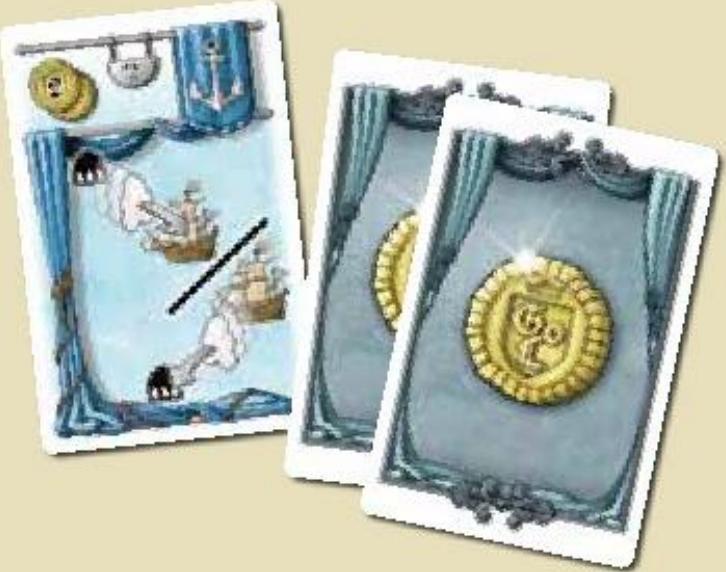
为了使用这张行动卡的特殊能力,玩家必须从手牌中弃除另外两张行动卡。
摸取行动卡
如果玩家本轮没有打出行动卡,那么玩家摸取4张行动卡,否则玩家摸取2张行动卡。注意玩家打出的某些行动卡可能会使玩家额外摸取行动卡。
大部分具有摸牌能力的行动卡在玩家回合结束时发动,少数行动卡的摸牌能力在打出后立即生效。玩家可以根据卡牌上的标志区分不同的能力。
大部分的卡牌和板块能力都会立即生效,一些能力会持续一段时间:例如“本回合当你移动会员时...”,所有持续生效的能力都会在玩家回合结束时停止生效,除了歌革和玛各(Gog & Magog)和伦敦大学(University of London)这两个特殊板块,这两个特殊板块的效果是永久效果(详见提示卡)。
在游戏最后一轮,玩家在回合结束时不再摸取行动卡,但玩家可以在结算板块时获得行动卡。
弃除行动卡
玩家的手牌上限是7张(如果玩家是伦敦大学的主管,那么玩家的手牌上限增加为8)。如果玩家在回合结束摸牌之后超过了手牌上限,那么玩家必须将手牌弃至上限。市长奖励卡不计入手牌上限。
如果玩家在之后的结算阶段获得了更多手牌,玩家无需弃牌,手牌上限仅在每轮执行阶段结束时生效
常见符号
市政厅
每次
回合结束

供应堆
你的会员棋子


雇佣会员


你的主管棋子
移动会员
如果本轮执行过这一行动

从X张市长奖励卡中选择一张
结束阶段
当所有玩家结束了自己的回合之后,将进行板块的结算。在结算每个板块的谈判阶段时,都会重新排定游戏顺位。与之前相同,仍然按照当时的分数从高到低的顺序排定游戏顺位。如果出现平分,那么按照玩家指示物从上到下的顺序排定顺位。
结算板块
在3-4人游戏中,每轮结束都会进行板块的结算;在2人游戏中,每两轮进行一次板块结算。
在2人游戏玩家板上,我们用月桂树叶标志来表示本轮应当进行板块的结算。
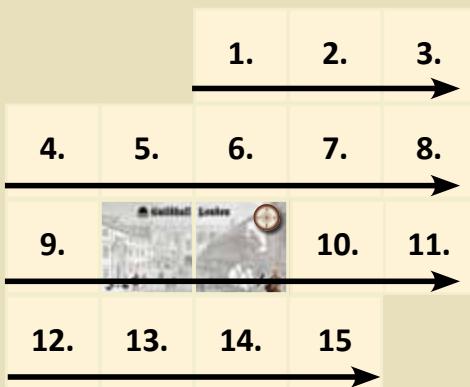
板块的结算顺序是从上到下,每一行从左到右。结算顺序十分重要,因为前面结算的板块可能会影响到之后的板块结算结果。
如果一块板块上的棋子数(包括会员棋子和官吏棋子)大于等于板块左上角的结算阈值,那么这个板块将在本轮被结算。结算板块将按照谈判——投票——奖励三步依次进行。

步骤1:谈判
按照当前的游戏顺位,每名玩家可以选择用任意数量的自己的中立会员棋子替换当前板块上相等数量的任意玩家的会员棋子。被替换的会员棋子将返回市政厅板块。如果玩家不愿这样做,玩家可以选择让过。当所有玩家都进行了依次替换或让过行动后,进入步骤2:投票。
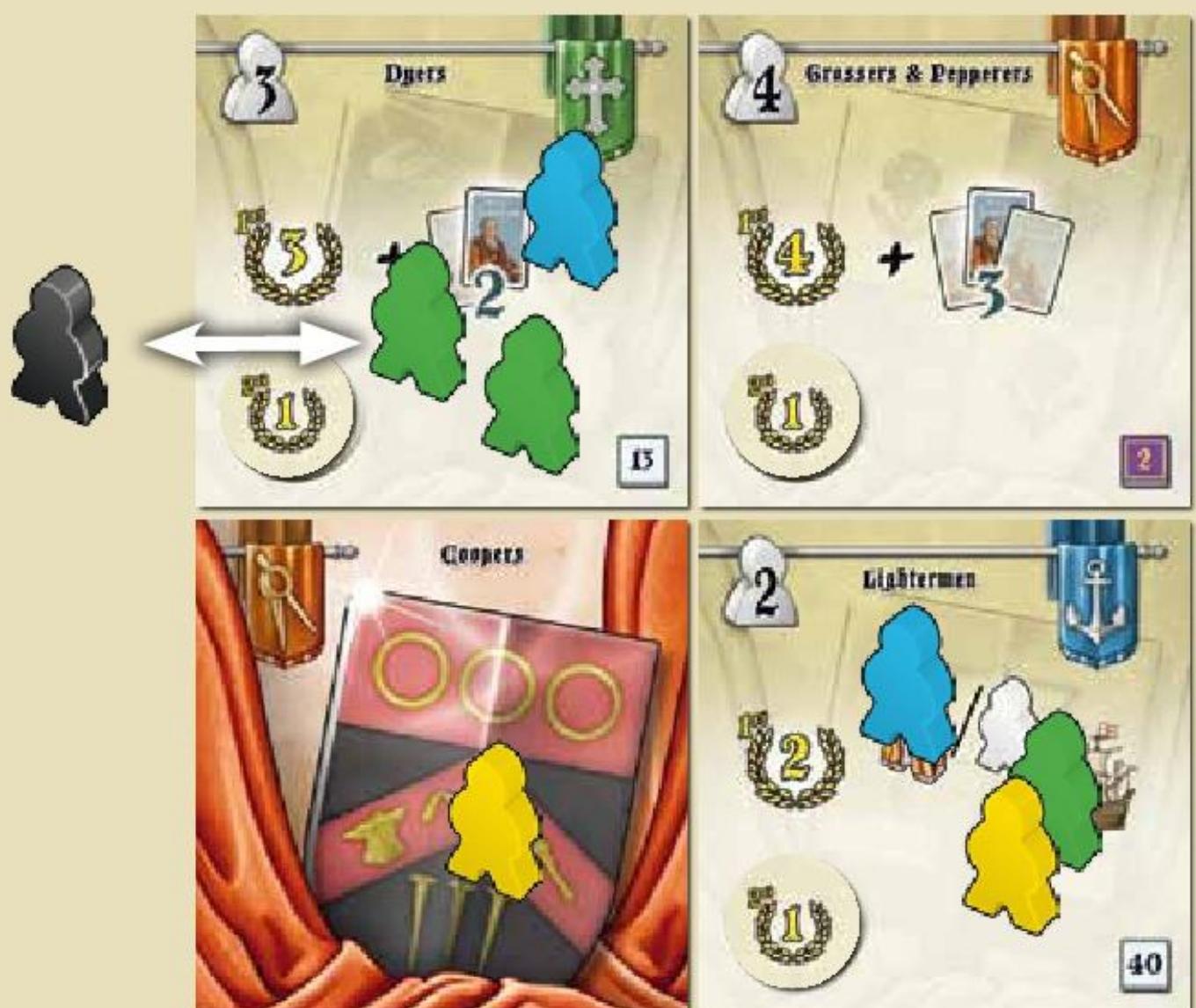
在Dyers商会,蓝色玩家用他的一个黑色棋子替换了一个绿色玩家的棋子。这样蓝色和绿色玩家在该商会打成1-1平。如果绿色玩家也有黑色棋子,这时他可以用黑色棋子替换一个蓝色棋子,这样绿色玩家就可以1-0获胜。
步骤2:投票
在当前板块上会员棋子数量最多的玩家获得投票胜利。在第8页的例子中,如果不进行谈判,绿色玩家会赢得Dyers商会的投票。如果出现平局,那么水平或竖直相邻的商会板块上的每个同色主管会给玩家增加1票,此时票数较多的玩家获得投票胜利。如果仍然出现平局,那么这个板块在本轮将不再进行结算。
在第8页的例子中,替代绿色的黑色棋子导致Dyers商会上出现了1-1的平局,无人获得投票胜利。然而在Lightermen商会中,尽管棋子数量是1-1-1,但相邻的黄色主管使黄色玩家获得投票胜利。
如果在谈判阶段后,没有玩家棋子在板块上,那么这个板块在本轮也不会继续结算。
然后将所有中立玩家棋子放回供应堆。
步骤3:奖励
当一个板块完成结算后,
-
投票获胜的玩家获得胜者奖励和结算奖励
-
玩家可以选择执行全部的胜者奖励,也可以选择只执行一部分。奖励立即生效。如果有多项奖励,按照从左到右的顺序依次获得。
-
投票中获得第二名的玩家获得亚军奖励并拿取亚军奖励标记。一些商会对亚军还有额外奖励。
-
如果投票中第二名出现平局或者没有第二名玩家,那么无人获得第二名奖励。
-
将所有棋子从板块上移开,然后将板块翻面。投票获胜的玩家如果可能就必须放置一枚自己的玩家棋子在板块上,这个玩家棋子被称为这个商会的主管,它表示玩家控制了这个商会。其他玩家棋子被放回市政厅板块。如果有官吏棋子,将官吏棋子放在面朝上的优先度数字最小的板块上。
在结算板块时移动的棋子可能会导致其他原本不需要结算的板块在之后变成需要结算的板块。
如果当前结算的板块是当前游戏中最后一个未被结算的板块,那么立即将轮次指示物移动到轮次轨上下一个灰色圆圈中进行发展阶段。在2人游戏中,如果当前结算的板块是最后一个未被结算的板块,那么再结算一次殖民地板块,然后立即进入最终计分。

从市政厅、任意商会板块或特殊建筑板块移动一名你的会员或主管棋子到任意一块其他的商会或特殊建筑板块上。如果你愿意的话,你可以移动刚刚结算板块上的棋子。
从市长奖励卡牌堆摸取对应数量的市长奖励卡,选择一张面朝下保留在你的游戏区域中,将其余市长奖励卡按照任意顺序放回市长奖励卡牌堆的底部。
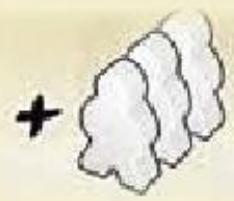
从供应堆拿取对应数量的你的会员棋子,将其放到市政厅板块上。如果供应堆没有足够的棋子,那么拿取供应堆所有的你的棋子。

从市政厅、任意商会或特殊建筑板块上拿取一枚你的会员或主管棋子,将其移动到殖民地板块上。如果你愿意的话,你可以移动刚刚结算板块上的棋子。
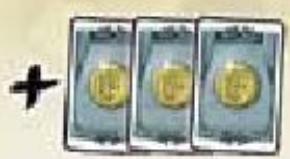
从行动卡牌堆摸取对应数量的行动卡。在结算板块后你的手牌可以超过上限。玩家只需在执行阶段结束时检查手牌是否超过上限。
发展阶段
在轮次轨上的灰色格子所代表的轮次结束时,游戏会进入一个发展阶段。发展阶段分为下面4步:
结算殖民地板块
检视游戏结束条件
■ 加入新的板块(仅在3-4人游戏中进行)
移动官吏棋子
结算殖民地板块
步骤1:谈判
按照当前的游戏顺位,每名玩家可以选择用任意数量的自己的中立会员棋子替换当前板块上相等数量的任意玩家的会员棋子。被替换的会员棋子将返回市政厅板块。如果玩家不愿这样做,玩家可以选择让过。当所有玩家都进行了依次替换或让过行动后,进入步骤2:投票。
步骤2:投票
殖民地板块上会员棋子数量最多的玩家获得投票胜利

步骤3:奖励
会员棋子数量最多的玩家获得板块上斜线左面的奖励,次多的玩家获得斜面右面的奖励,其余玩家不获得奖励。如果只有一名玩家在板块上有棋子,那么这名玩家只获得斜线左面的奖励。如果出现并列第一名,并列的玩家都获得斜线右面的奖励,其余玩家不获得奖励。如果出现并列第二名,那么并列玩家不获得任何奖励。
在乌尔斯特(Ulster)棋子最多的玩家获得3张市长奖励卡,选择1张保留并弃掉另外两张。
获得奖励的玩家需要将殖民地板块上的一些自己的会员棋子交回储备区。需要交回的数量被标示在殖民地板块上。如果玩家没有那么多会员棋子,那么玩家必须退回殖民地板块上自己的全部会员棋子。
检视游戏结束条件
游戏结束的条件有两个:轮次指示物到达了游戏结束的那一格或者在2人游戏中所有板块都被结算。
游戏结束的轮次取决于游戏人数:
2人游戏——16轮
3人游戏——15轮
4人游戏——12轮
如果游戏结束,进行最终计分,否则添加新的板块并移动官吏棋子。

3-4人游戏计分板
加入新的板块(仅在3-4人游戏中执行)
在除最后一轮的发展阶段以外的每个发展阶段中,玩家都要随机摸取一定数量的板块并将其加入游戏区域中。
在3人游戏中,加入5张板块
在4人游戏中,加入6张板块
从拥有罗盘标记的市政厅板块出发,按照以下指示放置新的板块:
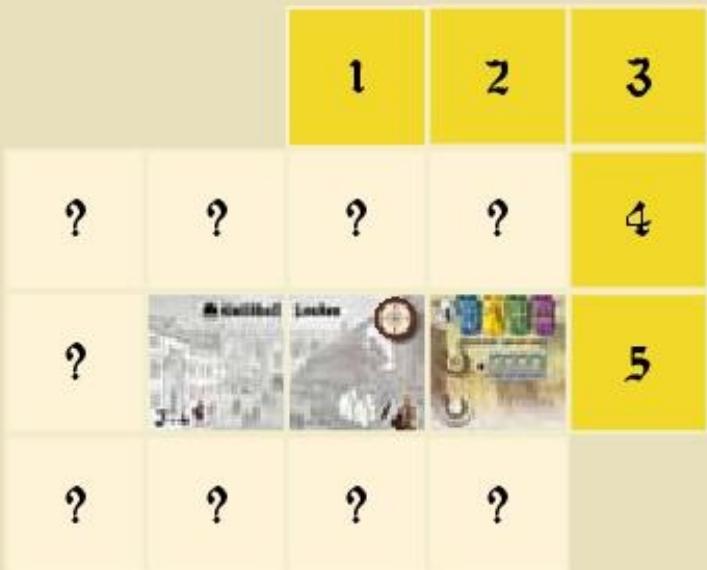
第三轮新放置的板块从最北面开始放置。
在第3轮,从市政厅向北,将第一块新板块放在最北边板块的上方
在第6轮,从市政厅向东,将第一块新板块放在最东边板块的右侧
在第9轮,从市政厅向南,将第一块新板块放在最南边板块的下方
在第12轮(仅限3人游戏),从市政厅向西,将第一块新板块放在最西边板块的左侧。
-
将其余新板块按照顺时针的方向依次放置,不要留下空格。
-
在每个新放置的板块上随机放一枚亚军奖励标记。
玩家也可以选择将罗盘标记指向真正的北方,而不是游戏区域中所谓的北方。
移动官吏棋子
将官吏棋子移动到面朝上优先度数字最小的商会板块上。
最终计分
移除所有未结算板块上的棋子,然后所有玩家展示自己的市长奖励卡并结算奖励得分。
重要:玩家可以使用同一个板块结算多张市长奖励卡的奖励得分。
玩家每有一对水平或竖直相邻的主管就得1分,例如一个2*2的板块会使玩家获得4分。
拥有最高分数的玩家获得胜利,如果出现平局,那么市长奖励卡更多的玩家获胜。如果仍然平局,那么平局玩家分享胜利。
Credits
Game Design: Anthony Boydell
Game Development: Jon Challis, Jimmy Chung, Alan Paull, Richard Clyne, Iain Shirley, Carl & Elizabeth, Paul Allwood, Hanno Girke, Klemens Franz
Play testers: Si from Into the Gamescape, Ben & Becky Bateson, Sebastian Bleasdale, Karen Boydell, David Brain, Richard Breese, Nicolas Guibert, James Lee-Hynes, Ray Fong, W. Eric Martin, Charlie Paull, Peter Piggott, Steve Walker, Steve Wright, Rob Fisher, Phil Pettifer, Claire Baker, Ian Vincent, Paul Grogan, Surya (who's pure Eurosnoot and proud of it) & Myriam (!), Richard 'Rahdo' Ham, Neil Yates, David Studley, David Minken, Doug Garrett, Garry Rice, Jimmy Hensel and Chris Dickinson. Apologies, again, to DAAAN.


www.PlayTMG.com
Need replacement parts?
Email: parts@playtmg.com
2人游戏
伦敦商会游戏的2人规则有少许改变:
游戏设置阶段:
■ 只使用一块市政厅板块(反面)
将4块特殊建筑板块放在市政厅板块的四周,在2人游戏中不使用歌革和玛各(Gog & Magog)
随机抽取20张商会板块,组成一个5*5的游戏区域。
随机在每个商会板块和特殊建筑板块上放一枚亚军奖励标记。
使用计分板2人游戏的一面
游戏过程中:
在发展阶段跳过放置新板块一步。
概览
游戏流程
开始阶段
移动轮次标记
2人游戏——16轮
3人游戏——15轮
4人游戏——12轮
执行阶段
每名玩家按照分数降序依次进行一个回合
可选行动:
■ 雇佣会员
■ 移动会员
■ 发动特殊能力
摸取4张或2张卡牌(根据是否打出卡牌)
结束阶段
结算板块
如果轮次指示物在一个灰色的格子中时,进入发展阶段,否则开始下一轮游戏。
发展阶段
结算殖民地板块
如果这是最后一轮,进入最终计分。否则加入更多板块(仅在3-4人游戏执行)并进入下一轮游戏。
最终计分
获得市长奖励卡的加分
获得相邻大师的加分
分数最高的玩家获得胜利
| ? | ? | ? | ? | |
| ? | ? |  | ? | |
| ? |  |  | ||
| ? | ? |  | ? | |
| ? | ? | ? | ? | |
The real Guilds of London



All through the design and development life of Guilds of London, I used the names and the Armorial Bearings of forty of the most important guilds. When the final production process began, I contacted each and every one of those guilds to make sure that it would be okay to use them in the game. Only three said “yes”, so I had to re-imagine thirty seven guild names and shields! I would like to take this opportunity to express my sincere gratitude to Worshipful Company of Paviors, The Worshipful Society of Apothecaries and The Honourable Company of Master Mariners for their permission - the shields you see are their own and I am extremely proud to have them in Guilds of London.
Tony Boydell, Summer 2015
下载 MarkdownGOL_TMG_rulebook_V3.md34.2 KB
Welcome to Guilds of London
London: The biggest, most important and richest city in England in the late medieval and early modern periods. The guilds played a major role in the lives of London’s citizens, controlling the way in which trade, manufacturing and business were conducted in the City. The members of the guilds , the liverymen, were rich men, who were appointed to the most influential positions in the community and wielded immense civic power. The chief representative of the guilds became the Lord Mayor of London, and the leading delegates of the guilds became its aldermen. Other members of the guilds were the burghers of London. The guilds ran the City and controlled its commerce. Each guild had its own hall and its own coat of arms. Representatives of the guilds met at the Guildhall to discuss the great issues of the day.
Components




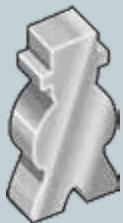
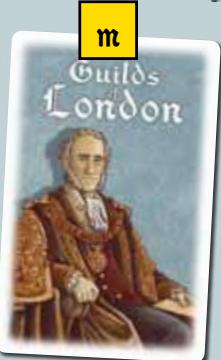


40 guild tiles (square tiles)

2 Guildhall tiles (square grey tiles)
5 special building tiles
(square tiles: Church of St Lawrence Jewry, Gog & Magog,
Company Hall, Lord Mayor’s Parade, University of London)


1 plantation tile (Ulster Plantation; Virginia Plantation)

1 double-sided scoreboard (2 players; 3-4 players)
64 liveryman pawns
(16 pawns in each player colour, green, red, blue, yellow)

8 player markers (2 discs in each player colour)

8 neutral liveryman pawns (black pawns)

1 round marker (black disc)

1 beadle piece (silver pawn)

30 2nd place reward tokens and
1 compass rose token (cardboard chits)

105 action cards (with a coin on the back)

21 mayoral reward cards (with the Lord Mayor on the back)
1 rulebook and 1 reference sheet
-
Put the 2 Guildhall tiles next to each other in the centre of the playing area to form a picture of the Guildhall. Put the compass rose token on the matching icon on the Guild Hall, pointing North.
-
Put the Church of St Lawrence Jewry special building tile to the right of the Guildhall with its starting side up (with victory point symbol showing).
-
Put the remaining 4 special building tiles and all the guild tiles together, mix them thoroughly and pile them in a few stacks. Then, taking each tile randomly from the stacks, put 1 tile to the left of the Guildhall, 4 tiles in a row above the Guildhall row, and 4 below it. Each tile should have its starting side up (with victory point symbol showing). Put the stacks next to the playing area.
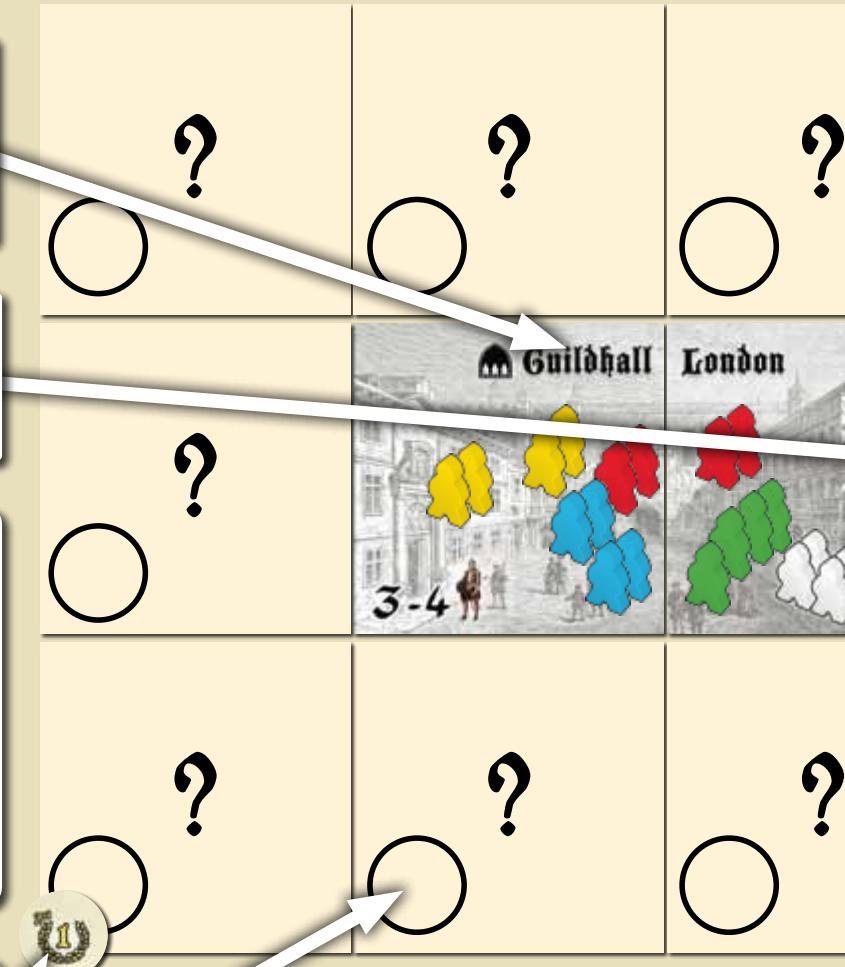
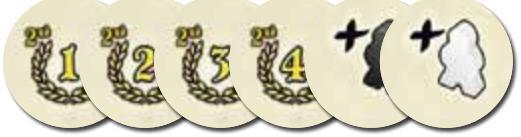
- Mix the 2nd place reward tokens face down thoroughly. Then place a randomly drawn 2nd place reward token face up (with its reward showing) on each of the 10 guild and special building tiles, skipping the Guildhall tiles.

-
Place the beadle piece onto the guild tile with the lowest guild number (the number is at the botom right corner of each tile).
-
Put the scoreboard conveniently next to the tiles, leaving some space for the playing area to expand.
-
Choose one of the sides of the plantation tile and place it onto the scoreboard in the space with the ship with the chosen side showing.
-
Determine a player order at random. Place 1 of the starting player’s markers (discs) in the 1st player space at the botom left of the scoreboard, the next player in the 2nd space and so on. These spaces are used at the start of the game to show the initial turn order. The marker is used to record victory points scored. The other player marker shows the colour that player is using – keep it in that player’s playing area.

-
Shufle the mayoral reward cards and deal 3 face down to each player. After looking at their hand of 6 action cards and their 3 mayoral reward cards, each player chooses 1 mayoral reward card, in secret, to keep, and returns the other 2 to the mayoral reward cards pack. Keep the chosen mayoral reward card secret from the other players till the end of the game. Once all players have returned their discarded mayoral reward cards, shufle the mayoral reward cards again and place them face down in the indicated space on the scoreboard to form the mayoral reward deck.
-
Each player places 4 liveryman pawns of their colour onto the Guildhall. Put all remaining liveryman pawns into a general supply near the score board.
-
Put two neutral (black) liveryman pawns on the squares on the gameboard for each player in the game; 4, 6 or 8 pawns for 2, 3 or 4 players. Put any remaining neutral liveryman pawns back into the box. They won’t be needed.

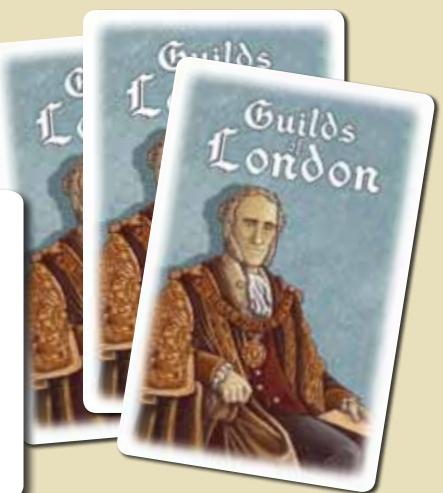
mayoral reward cards
- Place the round marker in the 1 space of the round track.
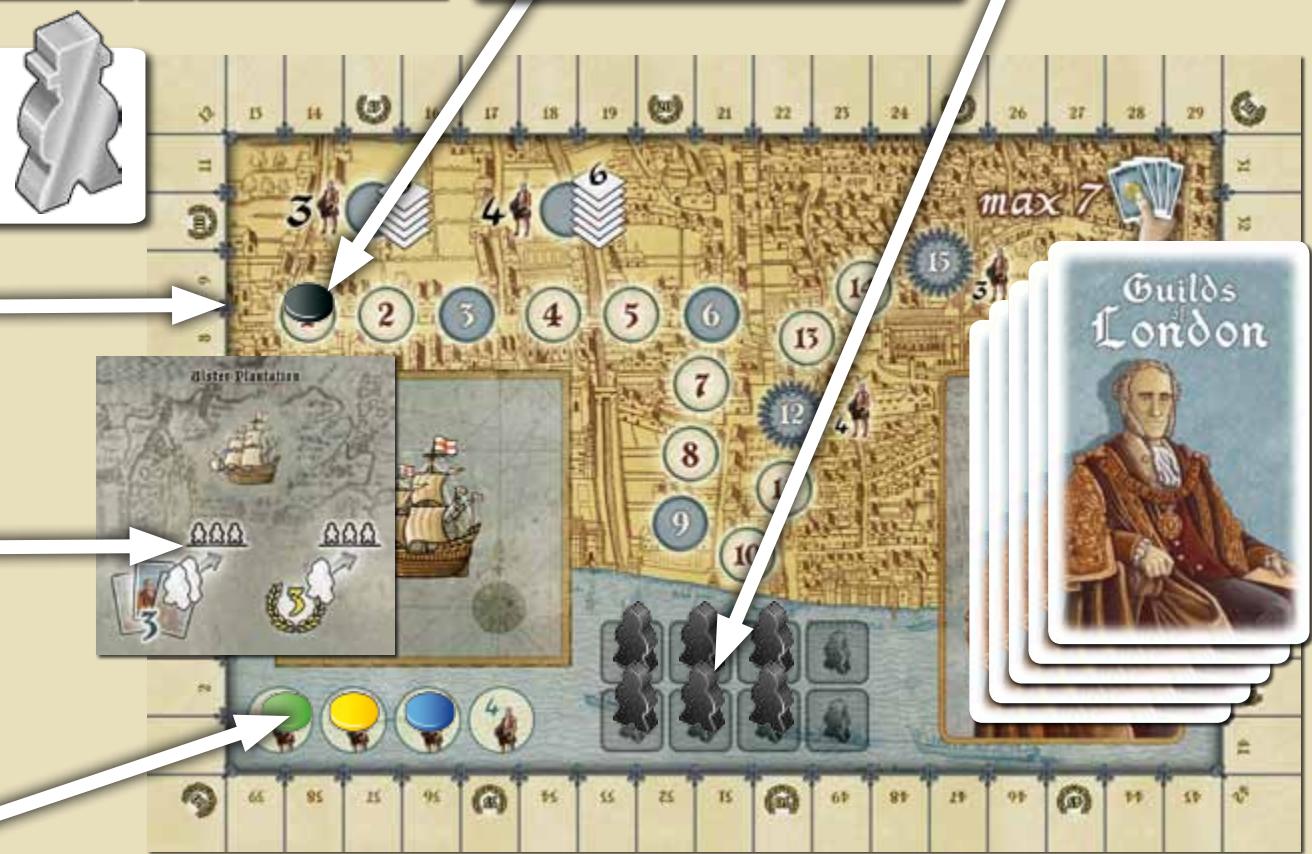

- Shufle the action cards and deal 6 face down to each player. Put the undealt action cards face down next to the playing area to form the action deck. Leave a space next to the action deck for a discard pile.
Overview of Guilds of London
In Guilds of London, you will place your liverymen in newly-forming guilds, building your power base so they can achieve the status of master. You will also have the opportunity to spread your power overseas to the lucrative Ulster or Virginia plantations. Control of each guild will provide victory points and additional actions that you can exploit, so you can control the future development of the City. The player with the most points at the end of the game will become the Lord Mayor of London and take their place in the history of this fabulous City!

What’s what on the tiles
Majority: The minimum number of pieces, including players’ liveryman pawns and the beadle piece, needed on the tile to resolve it.
1st place reward: When the tile resolves, the winner takes this reward.
2nd place reward: After the winner has taken the 1st place reward, the 2nd placed player takes the 2nd place reward token and any further 2nd place reward shown on the tile.

Guild suit(s): For end of game scoring and some action card abilities.
Armorial bearing: The heraldic sign of the guild.
Completed side
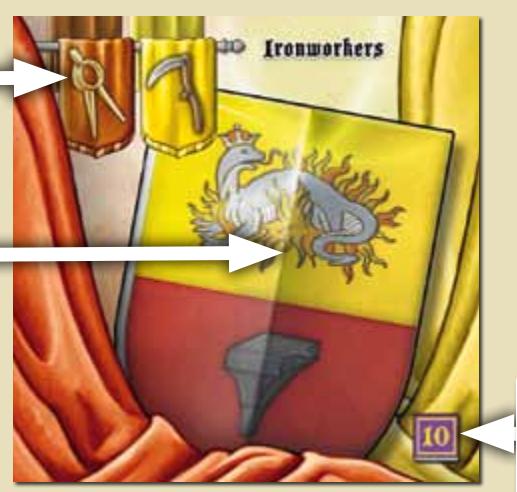
Guild suit(s): The symbol needed on an action card to move a liveryman pawn onto this tile. With multiple symbols any one will do. Special building tiles have four of the five symbols.
Resolution bonus: The winner of this guild gets this bonus immediately.
Guild precedence: The lower this number, the more senior the guild. This is used to determine where the beadle piece is placed at the end of each Growth phase. Special building tiles don’t have a precedence number. The guilds numbered between 1 and 12 are significant for some game-end scoring.
Guild precedence: For end of game scoring (guilds numbered 1 through 12 only)
What’s what on the action cards
Card quantity: Shows how many copies of this card are in the action deck.
Card identifier: Unique to the card
Special ability cost: What you must pay, usually by discarding action cards from hand, if you want to use the card’s special ability.
Action cards have a coin on the back, indicating that each card can be used to pay for a special ability cost.
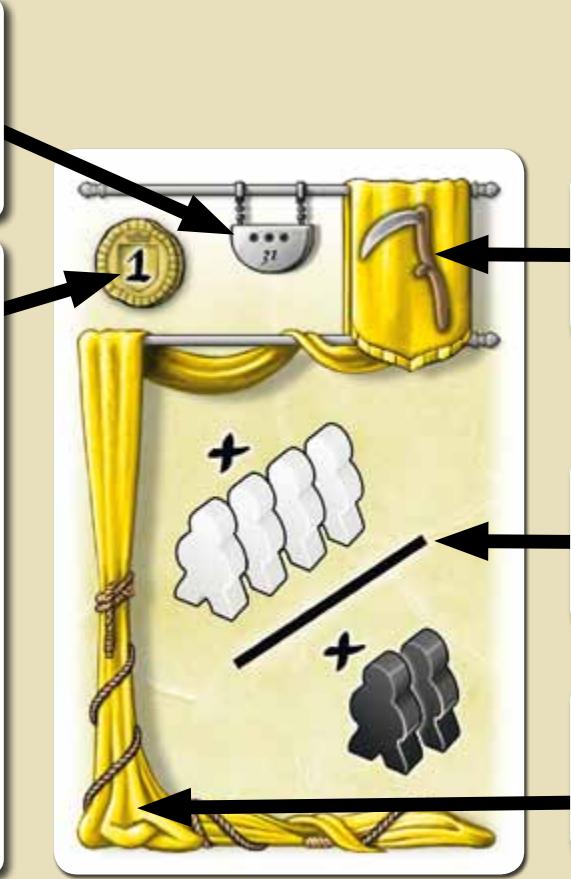
Guild suit: When moving a liveryman pawn to a tile, this symbol must match one of the symbols on the tile.
Special ability: An iconised description of what the card does, if you pay the special ability cost.
Card colour: Also designates the suit - compasses are red; anchors are blue; crosses are green; scythes are yellow; crowns are purple.
Sequence of Play
Guilds of London has a number of rounds dependent on the number of players:
2 players – 16 rounds
3 players – 15 rounds
4 players – 12 rounds
In a single round each player will take one turn, then guild and special building tiles are checked and may resolve. After a number of rounds (four in a 2 player game, three in a 3-4 player game) there is a Growth phase, during which the plantation tile is resolved and, in a 3-4 player game, more tiles are added to the playing area. The sequence of play is summarised here, and then each part is explained in detail below.
Start new round
- Advance the round marker on the round track (skip this in round 1).
Player turns
- Each player takes one turn in descending order of victory points.
End of round phase
-
Resolve tiles.
-
If the round marker is on a grey space carry out a Growth phase, otherwise start the next round.
Growth phase
-
Resolve the plantation tile.
-
If this is the last round, go to final scoring.
Otherwise add more tiles (3-4 players only) and continue with the next round.
Final scoring
-
Score the bonuses on mayoral reward cards.
-
Score points for adjacent masters.
The player with the most victory points is the winner. If there is a tie for first place, the tied player with the most mayoral reward cards is the winner. If there is still a tie, all tied players win.
Scoring victory points
Whenever you score victory points, add them to your current total, and move your marker on the scoring track to show your new score. If your marker ends up on a space with another player’s marker, place your marker on top. For turn order purposes, your marker is ahead of the other player’s marker, so you would take your turn before that player.
Start new round
Advance the round marker (skip on Round 1)
At the start of a new round, move the round marker one space forward on the round track.

Determine player turn order
Players take their turns in descending order of victory point totals. The first player is the one with the most victory points, the second is the next highest, and so on. If more than one player has the same total, the player with the marker on or closer to the top of the stack of markers takes his or her turn before players with markers lower down the stack. This order does not change during player turns, even if players score points during their turn. Turn order may change as points are scored during the resolution of tiles (including the plantation tile), after all players have had their turn.
Blue is first player, yellow second and the green player is last.

Player turns
In player turn order each player takes one turn per round.
On your turn you may play any number of action cards, zero or more, from your hand. You can play them in any order, but you must finish playing one card before playing the next one.
You can play an action card for one of three diferent kinds of action: hiring a liveryman, moving a liveryman or using the card’s special ability. Hiring or moving a liveryman doesn’t have a cost, but using a card’s special ability requires you to pay the cost shown in the top left corner of the card.
When you play a card, place it face up in front of you. Keep the cards you have played in front of you until you have finished your turn, so that you can refer to any abilities that will afect your play during the turn. When you no longer wish to play any more cards, put the played cards in the discard pile and draw new ones from the action deck. The number of cards you draw depends on the cards you played during your turn.
After each player has taken one turn, move on to resolving tiles.
A) Hire a liveryman

Play any action card from your hand and place one liveryman pawn of your colour from general supply onto the Guildhall.
Whenever the term ‘hire a liveryman’ is used in the game, it refers to placing one of your liveryman pawns in this way.
B) Move a liveryman

Play any action card from your hand and move one liveryman or master pawn of your colour from the Guildhall or from any guild or special building tile to any other face up guild or special building tile that matches the suit of the played card. To move to the tiles with more than one symbol, play an action card with any of the suits on the card.
Whenever the term ‘move a liveryman’ is used in the game, it refers to moving a liveryman or master pawn in this way.
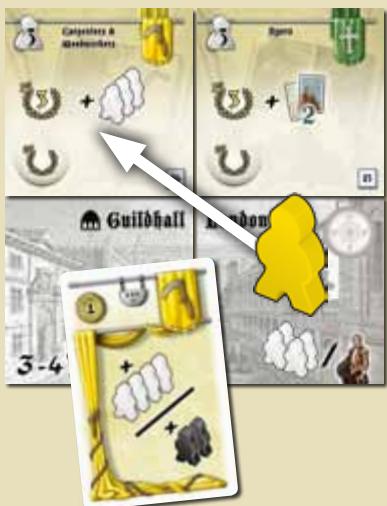
For example play a Scythe card to move a liveryman pawn from the Guildhall or from any guild or special building tile to a Scythe face up tile.
C) Use a special ability
Players can use the special ability described on an action card, instead of using the card to hire or move a single pawn. Play the card and announce its ability, then pay any cost indicated in the top left corner of the card. Most costs require you to discard action cards from your hand, a few require you to remove pawns and put them back into general supply. Put any discarded action cards in the discard pile. If you cannot pay the cost, then you cannot play the card for its special ability.
Once you have paid the cost, which in some cases may be nothing, carry out the ability stated on the played card. Action card icons are described in the separate reference sheet.

To use the special ability of this action card, the player has to discard 2 other action cards from hand.
Draw action cards
If you have played no cards this turn, draw 4 cards from the action deck at the end of your turn. Otherwise draw 2 cards from the action deck, modified by any special abilities you have paid for during your turn.
Most action card abilities that involve drawing extra cards happen at the end of your turn after you have finished playing cards. Some card drawing abilities resolve immediately when the card is played. These diferences are explained through the card icons.
Most abilities that you play, from cards or tiles, have efects that happen immediately. Some card efects have a duration: for example “Whenever you move a liveryman pawn this turn…”. All efects that have a continuous efect will stop at the end of your turn, with the exception of the Gog & Magog and University of London special building tiles; these two cards have permanent efects (see icon descriptions in the separate reference sheet).
In the final round of the game, you do not draw action cards at the end of your turn. You may still gain action cards as a reward for a resolving tile.
Discard cards
The maximum hand size is seven action cards (increased to eight if you are the master of the University of London special building tile). If you have more than this limit in your hand at the end of your turn after you have drawn new action cards, you must choose and discard down to the limit. Mayoral reward cards do not count against your hand limit.
If you gain further action cards during tile resolution, vou do not need to check your hand size until the end of your next turn!

End of round phase
Tiles are resolved after all players have had a turn. At the start of each negotiation stage when resolving individual tiles and the plantation tile, player turn order is in descending order of victory point totals at that moment. As before, if more than one player has the same total, the player with the marker on or closer to the top of the stack of markers takes his or her negotiation turn before players with markers lower down the stack.
Resolve tiles
Resolving tiles happens at the end of every round in 3-4 player games. For 2 player games resolving tiles happens at the end of every two rounds; these rounds are shown with a laurel leaf edge on the track on the 2 player board.
Tiles are resolved in order from the top left of the playing area to the botom right, from left to right on each successive row downwards. The order is important, because resolution of one tile might afect the later resolution of another tile.
Each face up tile with a total number of pieces on it equal to, or exceeding, its majority value (in the top left corner of the tile) must be resolved. Pieces counting towards the majority value include player liveryman pawns and the beadle piece.
For each tile in turn that resolves, carry out the following ‘negotiation’, ‘voting’ and ‘rewards’ stages, completing all three stages for one tile before moving on to the next.
Stage 1: Negotiation
In current turn order, each player may choose to replace 0, 1 or more coloured (player) liveryman pawns on the currently resolving tile with the same number of neutral liveryman pawns from their personal stock or pass. Replaced liveryman pawns are returned to the Guildhall. When all players have had a single chance to do this, continue to the voting stage.
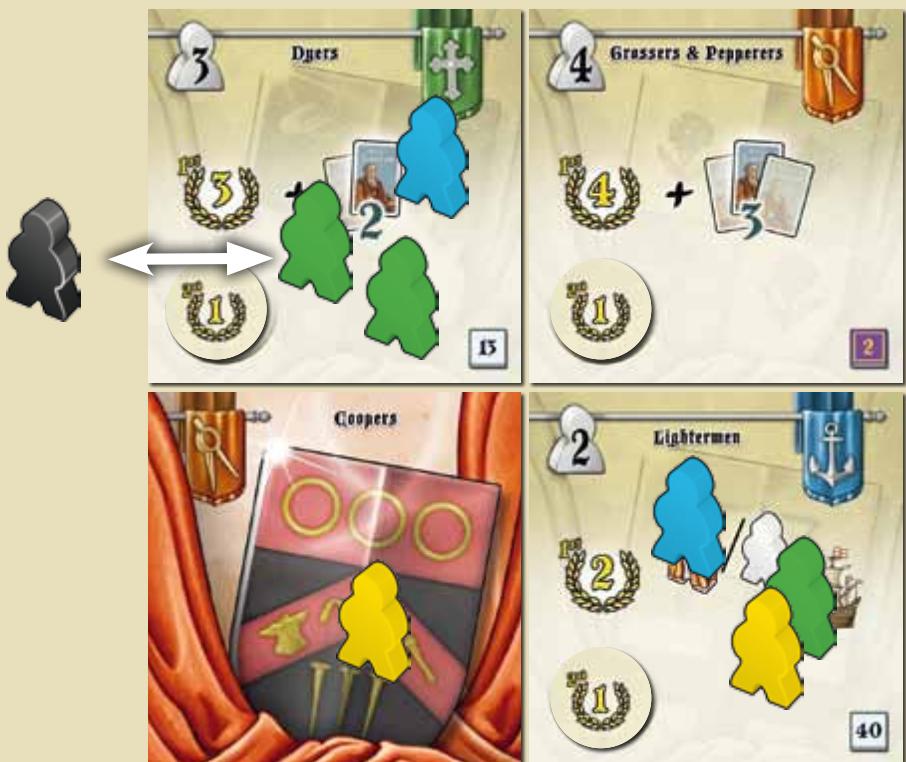
In this example for the Dyers, the blue player swaps out a green pawn for one of her black pawns. There is now a 1-1 tie between green and purple for winning the guild. If green had any black pawns, that player might wish to swap out a blue one at this point to put them in the lead again (1-0).
Stage 2: Voting
Count the number of liveryman pawns in each player’s colour on the currently resolving tile. You win the vote if you have more liveryman pawns of your colour on the tile than any other player.
In the example at the foot of page 8, with no Negotiation (swapping of pawns), the Green player would win the Dyers guild. If there is a tie for first place, each tied player adds 1 to their total for each orthogonally adjacent tile with their master pawn on it. The totals are then checked again and the winner determined. If there is still a tie, then the tile does not resolve this round, and all pieces remain on the tile.
In the example at the foot of page 8, the swapped black-for-green pawn would leave a 1-1 tie with no adjacent tie-breaker so the Dyers guild would remain unresolved. The Lightermen’s guild would be won by yellow, because although the guild is tied (1-1-1), yellow has won an adjacent guild and wins on the tie-break.
If there are no player liveryman pawns on the tile after negotiation, the tile will not resolve this round.
Return all the neutral liveryman pawns on the tile to general supply.
Stage 3: Rewards
When a tile has resolved, carry out the following steps in this order:
-
The winner of the tile scores the 1st place reward and the resolution bonus.
-
The winner may choose to carry out all or part of the 1st place abilities on the tile. The abilities are resolved immediately. If a tile awards multiple abilities, resolve them in order from left to right.
-
The player with the second highest number of liveryman pawns on the resolving tile gains the $2 ^ { \mathsf { n d } }$ place reward. Keep the token in your playing area. Some guilds have an additional $2 ^ { \mathsf { n d } }$ place bonus, for example dual-symbol guilds give a neutral liveryman pawn, the Merchant Importers give an extra 3 victory points.
-
In the event of a tie for $2 ^ { \mathsf { n d } }$ place, or if there is no second player on the tile, no-one gains anything for 2nd place.
-
Remove all pieces from the tile, and flip the resolved tile face down.
The winner, if possible, must place one of their liveryman pawns that had been on that tile onto the face down tile. This piece is now referred to as a ‘master’. It indicates that that player controls the tile.
Place all other liveryman pawns that were on the tile onto the Guildhall.
If the beadle piece was on the tile, move it to the lowest numbered face up guild in play (see below).
Moving pieces during resolution of a tile may cause other tiles to resolve later in the round.
If the current resolving tile is the last unresolved one in play, then immediately move the round marker to the next grey circle on the round track and continue with the Growth phase. In a 2 player game, if the current resolving tile is the last unresolved one in play, then resolve the plantation tile once more, and end the game immediately with final scoring, even if this is not otherwise the last round on the track.
The final round at the end of the game is shown by the symbols for the number of players on the track.
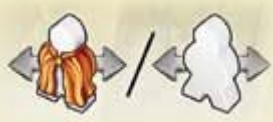 | Move 1 of your liveryman or master pawns from any guild, special building tile or the Guildhall to any other face up guild or special building tile. You may move a liveryman pawn from the currently resolving tile, if desired. |
 | Draw the stated number of cards from the top of the mayoral reward deck. Choose 1 and put the remaining cards at the bottom of the mayoral reward deck in any order. For example draw 2 keep 1, draw 3 keep 1 (this example). Keep the chosen mayoral reward card face down in your play area. |
 | Take the stated number of your pawns from general supply and put them onto the Guildhall. If there are not enough of your pawns in general supply, then take as many as you can. |
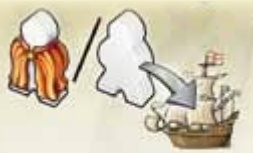 | Take 1 of your liveryman or master pawns from any guild or special building tile or the Guildhall and put it on the plantation tile. You may use a liveryman pawn from the currently resolving tile, if desired. |
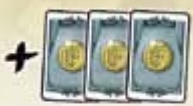 | Draw the stated number of cards from the action deck into your hand. It is possible to end up with more cards in hand than the normal hand limit after resolving tiles. Extra cards are not discarded, as hand size is only checked at the end of a player's turn, not at the end of a round. |
Growth phase
At the end of rounds with a grey space on the round track, there will be a Growth phase. Carry out the following activities:
Resolve the plantation tile.
Add new tiles (3-4 players only).
Move the beadle piece.
Check for end of game.
Resolve the plantation tile
Stage 1: Negotiation
In turn order, each player may replace 0, 1 or more coloured (player) liveryman pawns on the plantation tile with the same number of neutral liveryman pawns from their personal stock or pass. Replaced liveryman pawns are returned to the Guildhall. When all players have had a single turn to do this, return all the neutral liveryman pawns on the tile to general supply and continue to the voting stage.
Stage 2: Voting
Count the number of liveryman pawns in each player’s colour on the currently resolving tile. You win the vote if you have more liveryman pawns of your colour on the tile than any other player.

Stage 3: Rewards
After the negotiation the player with the most liveryman pawns on the plantation tile gains the reward on the left side of the slash (/) on the tile. The player with the second most scores the reward on the right side. Other players receive nothing. If only one player has pawns on the plantation tile, that player gains the left side reward only. If there is a tie for 1st place, the tied players all gain the right-side reward and other players get nothing. Players tied for 2nd place get nothing.
The player with the most liveryman pawns on Ulster takes 3 mayoral reward cards, chooses 1 to keep, then puts the others on the botom of the mayoral reward deck in any order.
Players who gain rewards are required to return a number of livermen pawns from the plantation tile to general supply, as shown next to the reward on the tile; if they do not have enough then they must return as many as they are able. Otherwise, liveryman pawns remain on the plantation tile.
Check for end of game
The game ends if the round marker has reached the end of its track or, in the 2 player game, if all tiles have been resolved. The length of the track depends on the number of players:
2 players – 16 rounds
3 players – 15 rounds
4 players – 12 rounds
If the game is ending, calculate final scores. Otherwise, continue with adding new tiles from the stacks, then move the beadle piece and start the next round.

scoreboard 3 & 4 player
SURPRISED
Add new tiles (3-4 players only)
During each Growth phase (skip in the last one of the game) take more tiles randomly from the stacks and put them round the tiles already in the playing area.
In the 3 player game, take 5 new tiles.
In the 4 player game, take 6 new tiles.
Put these tiles around the tiles already in the playing area as follows:
- Spot the Guildhall tile with the compass rose token on it.
More tiles are added in a direction linked to the round number:

Newly added tiles starting in the North in Round 3.
Round 3: go ‘North’ from the Guildhall tile and place the first new tile above the tile furthest North.
Round 6: go ‘East’ from the Guildhall tile and place the first new tile to the right of the tile furthest East.
Round 9: go ‘South’ from the Guildhall tile and place the first new tile below the tile furthest South.
Round 12 (3 players only): go ‘West’ from the Guildhall and place the first new tile to the left of the tile furthest West.
-
Then lay out the remaining tiles in a clockwise direction, following the edges of the existing tiles (leaving no gaps).
-
Add a randomly drawn 2nd place reward token to each new tile.
Why not rotate the compass rose token so it points to redr North instead, rather thar just the North of the playing area!

Move the beadle
Find the face up guild tile with the lowest guild number on it and move the beadle piece onto it.
Final scoring
Remove all pawns and chits from unresolved tiles. Then in turn order players reveal all their mayoral reward cards and add the bonuses to their current score.
Important Note: You are allowed to use the guilds you control on multiple scoring cards, for example a guild with two symbols can be used to score either or both symbols across multiple bonuses!
Additionally, each player scores 1 victory point for each pair of orthogonally adjacent tiles in which they have a master pawn. For example, 4 adjacent tiles in a square will score 4 additional victory points.
The winner is the player with the highest total of victory points. If there is a tie for first place, the tied player with the most mayoral reward cards is the winner. If there is still a tie, all tied players win.
Credits
Game Design: Anthony Boydell
Game Development: Jon Challis, Jimmy Chung, Alan Paull, Richard Clyne, Iain Shirley, Carl & Elizabeth, Paul Allwood, Hanno Girke, Klemens Franz
Play testers: Si from Into the Gamescape, Ben & Becky Bateson, Sebastian Bleasdale, Karen Boydell, David Brain, Richard Breese, Nicolas Guibert, James Lee-Hynes, Ray Fong, W. Eric Martin, Charlie Paull, Peter Piggot, Steve Walker, Steve Wright, Rob Fisher, Phil Petifer, Claire Baker, Ian Vincent, Paul Grogan, Surya (who’s pure Eurosnoot and proud of it) & Myriam (!), Richard ‘Rahdo’ Ham, Neil Yates, David Studley, David Minken, Doug Garret, Garry Rice, Jimmy Hensel and Chris Dickinson. Apologies, again, to DAAAN.

www.PlayTMG.com
Need replacement parts?
Email: parts@playtmg.com
The 2-Player Game
When playing Guilds of London with only 2 players use the following changes:
During Setup:
Use the single Guildhall tile (reverse side).
Place four special building tiles around the Guildhall tile; do not use Gog/Magog in the 2 player game.
Create a 5 x 5 grid with 20 randomly-selected guild tiles (see picture).
Put 2nd place tokens, chosen at random, on each guild and special building tile.
Use the 2 player side of the score board
During play:
Skip the new tiles in the Growth Phase.

| ? | ? | ? | ? |
| ? | ? |  | ? |
| ? |  | Guilbhall London |  |
| ? | ? |  | ? |
| ? | ? | ? | ? |
Overview
Sequence of Play
Start new round
Advance the round marker.
2 players – 16 rounds
3 players – 15 rounds
4 players – 12 rounds
Player turns
Each player takes one turn in descending order of victory points. Actions:
Hire a Liveryman.
Move a Liveryman.
Use a special ability.
Draw 4 or 2 cards (modified by cards played).
End of round phase
Resolve tiles.
If the round track is on a grey space or all tiles now resolved, Growth happens, otherwise start next round.
Growth phase
Resolve the plantation tile.
If this is the last round, go to final scoring. Otherwise add more tiles (3-4 players only) and continue with the next round.
Final scoring
Score the mayoral reward cards.
Score points for adjacent masters.
The players with the most VP is the winner.
The real Guilds of London


All through the design and development life of Guilds of London, I used the names and the Armorial Bearings of forty of the most important guilds. When the final production process began, I contacted each and every one of those guilds to make sure that it would be okay to use them in the game. Only three said “yes”, so I had to re-imagine thirty seven guild names and shields! I would like to take this opportunity to express my sincere gratitude to Worshipful Company of Paviors, The Worshipful Society of Apothecaries and The Honourable Company of Master Mariners for their permission - the shields you see are their own and I am extremely proud to have them in Guilds of London.
Tony Boydell, Summer 2015
下载 Markdown原文为社区整理/出版社公开资料,版权归原作者,仅供个人学习查阅。