
HeatHeat
一句话概览
Heat 是一款已收录于村了吗规则库的桌游,支持 3–5 人,原名 Heat。
本页内容:一句话概览 · 常见问题
这游戏怎么玩
- 本站已收录这款游戏的规则资料,可以在对话里直接提问规则细节。
常见问题(FAQ)
以下 1 条问答来自站内玩家的真实提问,答复由本站依据规则资料作答;答复内容保持原样,仅对提问做了去口语化的轻微整理。
heat 吃了尾流之后过了弯道是不是要弯道检测?
结论:要,但前提是你在那一回合确实越过了弯道线;而且尾流本身不会抬高你的速度值。
具体拆解:
1. 触发条件
弯道检测只在一个情况下进行:本回合中你越过了弯道线(Corner Line)。只要发生了这种情况,就要做检测——不管你越过弯道线是靠正常移动、Boost 还是尾流。反过来,如果你吃了尾流但并没有跨过任何弯道线,那就不做弯道检测。
2. 尾流对速度的影响
规则里明确写了:尾流不会增加你用于弯道检测的速度值。也就是说,尾流让你多走的 2 格,不会被算进速度里。相比之下,Boost 是明确会提高速度值的。
3. 弯道检测怎么算
速度值 = 你 Play Area 里所有卡牌数值之和,如果你使用了 Adrenaline 加成则再 +1。
- 速度值 ≤ 该弯道限速:什么都不发生。
- 速度值 > 限速:按超出的差值支付 Heat。
- Heat 不够付:冲出赛道(Spin out),车退回到导致冲出那条弯道线之前的第一个可用格,并按档位抓取额外的 Stress 卡、档位杆回到 1 档。
4. 一回合多个弯道
如果你同一回合穿过了多个弯道,每个弯道要分别结算,从你先越过的第一条弯道线开始。
所以典型流程是:吃尾流多走 2 格 → 如果这 2 格让你越过了弯道线,就照常做第 7 步弯道检测,但检测时用的速度里不包含尾流带来的那 2 格。
本内容仅供参考,如有冲突以说明书和身边大佬为准。
去哪查完整规则
想核对具体规则细节、卡牌效果或某个回合的结算方式,可以在村了吗里选中这款游戏后直接提问。
同类桌游
- 卡坦岛德式
- 工业革命:伯明翰德式
- 勃艮第城堡:特别典藏版德式
- 方舟动物园德式
- 卡卡颂抽象
- 瘟疫危机传承:第一季美式
- 阿瑞迪亚:勇踏征途美式
- 重塑宇宙德式
- 幽港迷城美式
- 埃多拉的德鲁伊德式
规则原文(Markdown)
本站收录这款游戏的规则原文 2 个文件,此处内联渲染 2 个,可直接展开阅读或下载。
rules_en_heat_157815.md13.8 KB
来源类型:纯文本规则(非 PDF 源,早期抓取/转换产物)
说明:原文未改动,仅调整存放位置与文件名;非 PDF 扫描件,无对应原书 PDF
Heat: Pedal to the Metal Rulebook | RulesPalRulesPalChatRulebookHeat: Pedal to the MetalHeat Rulebook Table of Contents Table of Contents Components
Object of the Game
Setting up the game
Playing a round 1. Shift Gears
-
Play Cards
-
Reveal & Move Stress Cards
-
Adrenaline
-
React Cooldown
Boost
-
Slipstream
-
Check Corner Spin out
-
Discard
-
Replenish Hand Running out of cards
TODO + Symbol
HEAT Cards Paying Heat
Shifting up/down 2 positions
Cluttered Hand
Starting Upgrade Cards
How to Win
Components
Here are the components you will need to play your first few games. You can leave the rest in the box for now. They will be described in the other booklet.
Rules booklet
2 double-sided game boards with 4 different race tracks (USA, France, Great Britain and Italy)
6 player mats in player colors
6 Gear pawns in player colors
6 race cars in player colors
72 Basic cards (12 per player) They are identified by the TODO symbol
18 Starting Upgrade cards (3 per player)
37 Stress cards
48 Heat cards
Object of the Game
In “Heat: Pedal to the Metal™” everyone races a car around the track for a given number of laps to determine the best driver. At the start of each round you can shift gears, which dictates how many cards you play that round. You control your car’s speed by adding the value of these cards to move that many spaces on the race track, jockeying for position.
If you’re playing this racing game, you love speed so you’ll be playing your high-value cards early and often. However, racing requires skill as you maneuver around the track, so be careful not to exceed the suggested speed of each corner or your car will start to overheat; push too hard and you risk spinning out. Manage your speed and take care of your engine if you want a shot at the podium!
Setting up the game
Place the game board in the middle of the table (for your first game use the USA track, and consider only racing 1 lap as a learning experience instead of the regular 2 laps as printed on the board).
Each player chooses a color and takes the car, player mat, Gear pawn and 12 Basic cards in their color. Each player also takes the 3 Starting Upgrade cards in their color.
Check the game board to discover how many Heat and Stress cards each player must add to their car (typically it will be 6 Heat and 3 Stress cards so that example is used below).
Place your player mat in front of you . Shuffle your 12 Basic cards, 3 Starting Upgrade cards and 3 Stress cards together and place this draw deck facedown on your player mat’s left spot . Place the 6 Heat cards faceup on the Engine spot in the middle of the player mat and your Gear pawn in first gear.
Place the remaining Stress cards faceup close to the board as a reserve .
Randomly place all participating race cars on the starting grid to determine player order for the first round. Place them one at a time, filling the spots in ascending order.
Draw 7 cards from your draw deck into your hand. These are the cards available to you in the first round of the game. You are ready to begin!
If you are an experienced driver and playing with rookies, consider removing 1 or 2 Heat from your own car to level the playing field.
Playing a round
“Heat: Pedal to the Metal™” is played over several rounds. Each round all players ALWAYS complete 4 steps:
adjust their gear,
play cards,
move their car,
draw back up to seven cards.
These mandatory steps are highlighted thanks to the following icon TODO. The remaining steps (4-8) are all situational and only sometimes apply to your turn.
All players complete steps 1 and 2 at the same time (do them in order, but without waiting for each other). Then, starting with the frontmost car, closest to the Race Line, complete steps 3 through 9. Once a car has completed step 9 and ended their turn, proceed back through the positions completing one car’s turn at a time. Repeat this sequence until all cars have finished the race (check the number of laps on the board for the track you are using).
1. Shift Gears
First, check which gear your car is in, and decide if you want to leave it there or shift it one gear up or down from that position.
Note: You can choose to shift your gear up/down two positions, but doing so will require that you pay one Heat, which you can read more about on p. 7: Heat Cards.
2. Play Cards
Your current gear determines exactly how many cards you play from your hand. 1st gear means you must play 1 card, 2nd gear is 2 cards, and so on. In this step you can play all types of cards except for Heat cards. Keep the 1-4 played cards facedown in your own Play Area.
3. Reveal & Move
Reveal the cards in your Play Area, then add all values together to determine your Speed. Values from Upgrade and Stress cards (see below) contribute to that total Speed. Move your car forward by exactly that many Spaces on the track. Always put your car on the Spot closest to the Race Line if available.
Cars never prevent you from passing through them, even when it looks like the race track is blocked. However, if you would end your move in a Space where there are cars on all Spots, then you are blocked and must put your car in the first Space with a free Spot behind the cars that blocked you (as close to the Race Line as possible).
If there are 2 cars next to each other, the car closest to the Race Line is considered ahead for all purposes.
Stress Cards
All players start with three Stress cards shuffled into their draw deck, and you will eventually draw these into your hand. Stress cards represent lapses of concentration as you race around the track.
You will have to play Stress cards to get them out of your hand. Doing so introduces randomness to your Speed (see TODO symbol on the right).
4. Adrenaline
Only applies if you are the last car to move this round (or two last cars in a race with 5 cars or more).
Adrenaline helps the last player each round. It is not really a step of its own, but gives that player extra symbols they may use in the next step (React). They may move 1 extra Space while adding 1 to their Speed value and/or gain 1 extra Cooldown.
Note: Adrenaline cannot be saved for future rounds.
5. React
In this step you get to activate symbols you have access to in ANY order you want. In the core game you have access to symbols from your current gear (Boost and/or Cooldown) and Adrenaline if last. Each symbol is activated and completed individually.
Cooldown
Cooldown is an important aspect of the game because it allows you to take a Heat card from your hand and put it back in your Engine (so you can use the Heat card again). The number in the Cooldown symbol indicates how many Heat you can move in this way. You gain access to Cooldown in a few ways but the most common is from driving in 1st gear (Cooldown 3) and 2nd gear (Cooldown 1).
Boost
Regardless of which gear you are in you may pay 1 Heat (see p. 7) to boost once per turn. Boosting gives you a TODO symbol (see p. 5) as reminded on the player mats. Move your car accordingly, you may still be blocked.
Note: TODO symbols always increase your Speed value for the purpose of the Check Corner step.
6. Slipstream
Only applies if you are next to or behind another car at this point.
Slipstreaming is optional if you land next to another car, or in a Space behind a car or cars. If you choose to Slipstream, you move 2 Spaces forward. You can only Slipstream once per turn and if all the Spots in the final Space are occupied, place your car in the first Space with a free Spot behind the blocking cars.
Note: Slipstreaming does NOT increase your Speed value for the purpose of the Check Corner step.
7. Check Corner
Only applies if you crossed a Corner Line this round.
If at any point this turn you crossed a Corner Line, you must now check if your total Speed for the round exceeds the Speed Limit of that corner (Speed = Sum of the values of all the cards in your Play Area, +1 if you used the Adrenaline Bonus).
If your total Speed for the round is equal to or lower than the Speed Limit, nothing happens.
Otherwise, you pay Heat equal to the difference between your total Speed and the Speed Limit (p. 7: Heat Cards).
Note: If you drive through several corners on the same turn, you must pay for each of them separately, starting with the first Corner Line you crossed.
Spin out
If you do not have enough Heat to pay for your excess Speed, you pay all the Heat you have and immediately spin out:
Move the car back to the first available Space before the Corner Line that caused the spin out.
Take 1 extra Stress card into your hand if you are in 1st/2nd gear, or 2 extra Stress cards if you are in 3rd/4th gear.
Move your Gear pawn to 1st gear.
8. Discard
You may discard cards from your hand if you do not want to save them for future rounds. Do so by placing them face up into your discard pile. However, nobody can browse through the discard piles (including their own); only the top card is public knowledge.
Note: You can never choose to discard Stress or Heat cards (even the Upgrade ones).
9. Replenish Hand
Take all cards from your Play Area and put them onto your discard pile.
Draw back up to 7 cards, then the next player can proceed with steps 3-9.
Running out of cards
At any point, if you must draw, flip, or discard cards and there are no cards left in your draw deck, immediately shuffle your discard pile and place it face down as your new draw deck. Then draw, flip, or discard the cards you were missing.
If this happens during your turn (before this final redrawing step), do not shuffle the cards in your Play Area back in the deck, as they have not been discarded yet.
TODO + Symbol
For each symbol played you will add an unknown value between 1 and 4 to your Speed. This is done by flipping the top card of your draw deck:
If it is a Basic card (TODO), add it to your Play Area.
Otherwise, immediately put it in the discard pile and keep flipping until you find a Basic card (TODO).
For each played Stress card, cards are flipped from the top of the active player’s deck and discarded until a Basic card (TODO) shows up. This card is then put in the Play Area, on top of the Stress card it replaces.
In this example, the active player discards 2 Heat cards, a Stress card and a Starting Upgrade card and ends up with a Speed of 8. They immediately move their car forward that many spaces.
HEAT Cards
As you race around the track you should use Heat to drive faster on straights and in corners. As a consequence, Heat cards will move from your Engine to your discard pile. Later on they will be shuffled into your draw deck and reach your hand. The only way to get Heat cards out of your hand and back into the Engine is to cool down, typically by shifting to lower gears. This cycle means the same Heat card could be used several times during a race, depending on how fast you use it, draw it and cool it down again.
Heat cards can never be discarded or played from your hand. They effectively reduce your hand size by filling it up with useless cards.
Paying Heat
Every time you are asked to pay 1 Heat, you must take 1 Heat card from your Engine and move it to your discard pile. If you do not have a Heat card available, you cannot choose to Boost. If you went through a corner exceeding the Speed Limit and do not have enough Heat to pay, you spin out (see p. 6).
Shifting up/down 2 positions
If you want to move your Gear pawn an extra step up or down (e.g. between gears 1&3 or 2&4) during step 1: Shift Gears, you have to pay 1 Heat immediately. As everyone shifts gears at the same time, just announce you are doing it, pay the Heat and move your Gear pawn accordingly.
Cluttered Hand
In rare circumstances you can get stuck with so many Heat cards in your hand that you don’t have enough playable cards for the gear you’re in. If this happens, use as many playable cards as possible and cover the difference with Heat cards.
In this case, your car does not move this turn. Instead, when you reveal your played cards, immediately move your Gear pawn to 1st gear, place the cards that are in your Play Area in your Discard pile, and skip straight to step 9 (Replenish Hand).
Starting Upgrade Cards
In your first few games, all the players will have the same 3 Upgrade cards (identified by the chevron pattern) in their decks. You will remove these cards from the decks when you use the Garage mode described in the Advanced Rules Booklet.
Two of those cards (0 and 5) have the same look and feel as Basic cards. They are used mostly in the same way. The only difference is that they are discarded when flipped for resolving the effect of a TODO symbol.
The 3rd one is simply an extra Heat Card and works in the exact same way as the 6 regular ones except that it starts the game shuffled into the deck instead of in the Engine.
How to Win
You win the race (and the game) by being the first player to cross the finish line after the number of laps indicated on the board. If two or more cars finish in the same round, the winner is the player whose car is furthest ahead (the spot closest to the Race Line is the tiebreaker if two cars end up side by side).
Slipstreaming can never be used to cross the finish line nor after having crossed the finish line.
Disregard any Speed Limits in corners after the finish line, simply move as far as you can.
At the end of the round, remove all the cars that crossed the finish line from the track and place them in order on the Hall of Fame Space on the board. Continue playing until all cars make it to the finish (give Adrenaline to the last car or last two cars based on the number of cars that started the race, not the remaining cars in play).
下载 MarkdownHeatRules_PnP.md5.9 KB
Components
32 Cards (p. 2-6)
15 Heat Tokens
Money: 20 x \$1, 20 x \$5, 10 x \$25
Heat Board (p. 6)
Cubes work well for Heat tokens, and poker chips or the like for money. All the cards have a common back.
The Pitch
We are here to steal things. There will be three Heists, each consisting of four Stages. Before each Heist begins, we will be Drafting a Plan. Since we are civilized criminals, we’ll execute each Stage of our Heists simultaneously. Our efforts will of course draw attention from the authorities, which will bring down Heat upon us. At the end of the game, we’ll have to pay off that Heat, lest we find ourselves in real trouble.
Setup
Fill the entire Heat board with tokens, one on each slot. Then go through the deck and remove any cards that don’t have an icon at their bottom right matching the number of players (For example, when playing with 3, remove any cards that only have ‘4’ and ‘5’). Shuffle the cards and begin!
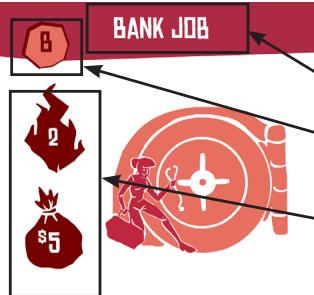
Phase:When during a Stage the card will be executed.
Icons: A simple version of what the card does.
2 Heat. If no one else played a Bank Job this Stage, \$5. Otherwise, \$0.
Text: A detailed version of the card’s effects.
Players: Which player counts this card is used with.
Drafting a plan
Before each Heist, you will draft to build your hand of cards. Deal two cards to each player to start their hand. Then, repeat three times:
1) Each player simultaneously takes one card from their hand and passes it to the player on their left*.
2) Each player draws a card from the deck, taking both it and the card they were passed into their hand.
At the end of the draft, each player will have a five card hand for the Heist.
*-Before the second heist, pass to the right, and for the third, to the left again.
The Heist
A Heist consists of four Stages during which each player will choose a card to use. The cards you choose will become your Record for the Heist, laid out in a line in front of you from oldest to newest, left to right. The right-most (newest) card in your Record is always the card you are currently using.
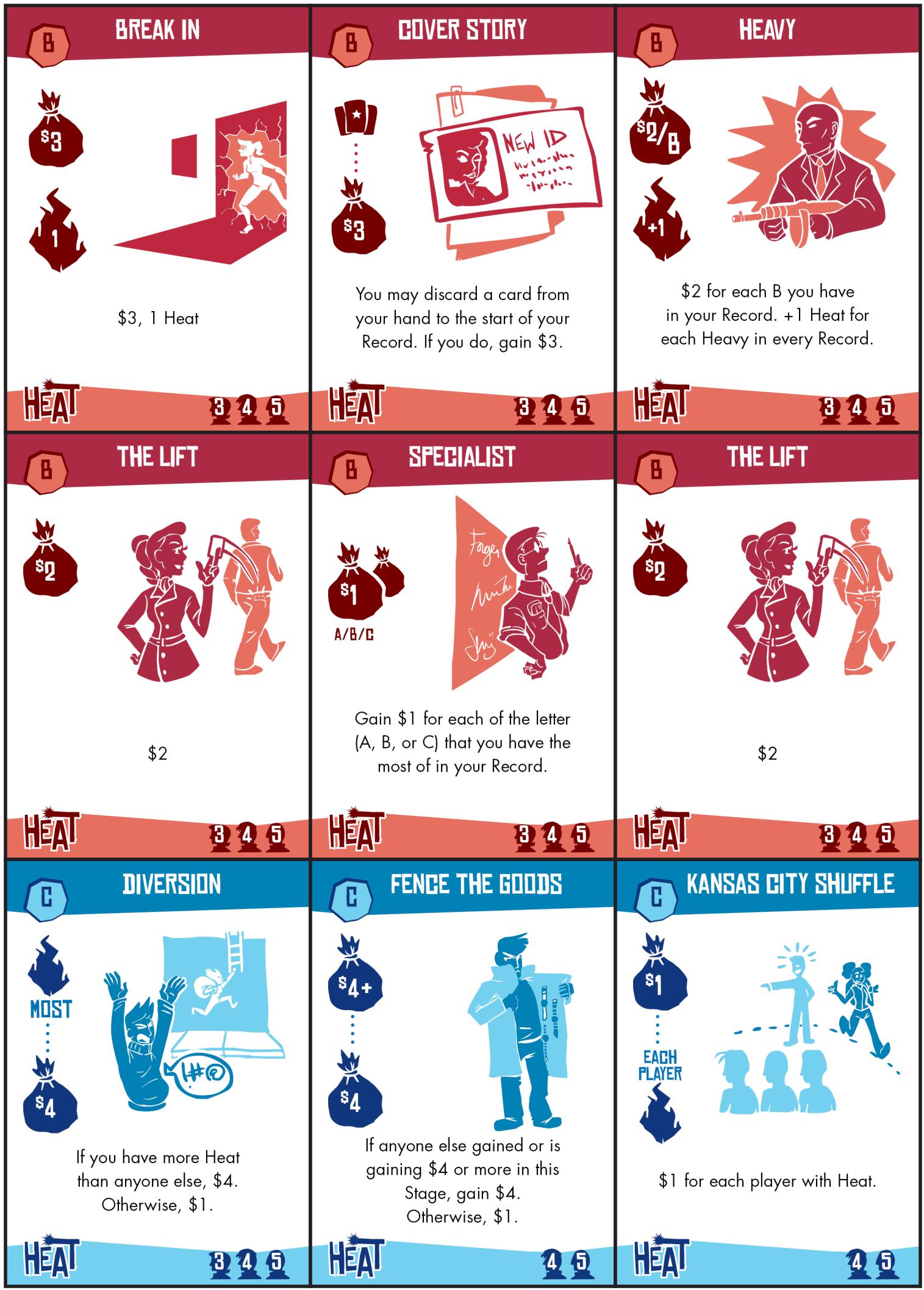
To start a Stage, each player secretly chooses and then simultaneously reveals a card to add to their Record. First, all A effects are resolved, then B, then C. After the fourth Stage of a Heist, all the cards are shuffled back into the deck for a new Draft.
If a Stage would require more cards or Heat than is available, see Out of Heat/Cards/Money on the next page.
TALKING A GOOD GAME
As you become more familiar with the cards, it is not only allowed but encouraged to talk about your plans. It is not only encouraged but nearly required to lie about them. You don’t want to both be robbing the bank at the same time, do you?
Gaining and returning Heat
Heat tokens represent the presence and attention of the police. When a card instructs you to take Heat, remove a Heat token from the board in the slot covering the least negative number and place it in front of yourself. When returning Heat, place it in the most negative spot available. It never matters which space a Heat token came from -- all Heat tokens are worth the same at any moment.
Out of heat / cards / money
If Phase B of a Stage would require more heat than is available, all players return 1 Heat before the Stage, then all players that did so also lose \$3. This is repeated until enough Heat is available.
If there aren’t enough cards for all players to draw during a phase, all players with actions that require card draws skip them.
Money is not limited. If you run out, use a substitute.
Heat Value
Each Heat token you have will cost you money at the end of the game. The value of each is represented by the worst completely empty row on the Heat board. Heat cost will fluctuate as the game goes on. The more attention players draw as a group, the worse the cost will become. On the example board below, the Heat value is -\$3.

GAME END
The game ends after three Heists. Now players must pay up for their Heat tokens, returning money for each equal to the current value. For example, if a player had three Heat tokens given the example board to the right, they would return \$9. The player with the most money leftover wins! In a tie, the player with the least Heat wins. If still tied, victory is shared.
FAQ AND OTHER NOTES
-Some cards are multiphase, such as Interrogation.
These cards are used during all listed phases.
-The ‘start’ of your record is the left side, the ‘end’ of your record is the right side.
-Remember that once played, a card is immediately part of your Record. So Heavy, Specialist, etc count themselves when activating.
-It is possible through unlikely circumstances to have a B phase where more than 15 Heat would be gained. In this case the game ends immediately, all players are arrested, and your game will be confiscated. Way to go.
-Timely play: If one player is taking too long, it is permissible to discuss amongst the other players how to divvy up their assets were ‘an accident’ to happen on their next Heist.
Special Thanks
Chris Cieslik, John Cooper, Jacob Davenport, Josh Drobina, Nate Lawrence, Kristin Matherly, and the rest of the folks from Pepperland for primary playtesting.
Chris Dupuis, Peter Lee, and Rodney Thompson for Lords of Waterdeep: Scoundrels of Skullport’s corruption track.
Seiji Kanai for Love Letter.
John Rogers for Crime World and its research for help with some of the terminology.



原文为社区整理/出版社公开资料,版权归原作者,仅供个人学习查阅。