
HistoriaHistoria
一句话概览
Historia 是一款已收录于村了吗规则库的桌游,支持 1–6 人,原名 Historia。
本页内容:一句话概览 · 游戏概述 · 1. 游戏组件 · 2. 游戏设置 · 3. 游戏流程 · 4. 行动详解 · 5. 回合结束 · 6. 游戏结束 · 关键规则与常见问题 · 常见问题
Historia(历史) 规则速览
以下规则速览由本站整理,与官方规则书表述不同,仅供快速上手参考。
游戏概述
在 12000 年的人类历史长河中,玩家扮演一个文明的统治者,从旧石器时代起步,历经农业、航海、核能,一路迈向未来时代。市民研发科技、探索领地、与他国交易或发动战争,建设伟大奇观以脱颖而出。最终,对人类历史影响力最大的文明获胜。
核心机制: 同时出牌的手牌管理 · 发展矩阵追踪科技与军事成长 · 已用方块池资源管理 · 革命节拍驱动回合推进
1. 游戏组件
| 组件 | 说明 |
|---|---|
| 游戏版图 | 含地图(14 个领土)、环状时间轴、胜利点数轨道、回合顺序轨道、发展矩阵、政府奖励表、已用方块池 |
| 行动卡 | 开拓、扩张、贸易、劫掠、艺术、军事、科研、革命、旅游、战争 |
| 导师卡 | 各文明专属技能卡 |
| 奇观卡 | 分三个纪元卡组 |
| 领导卡 | 分三个时代卡组 |
| 玩家方块 | 各颜色一套 |
| 各类标记 | 文明标记、领土指示物、回合标记、纪元标记、胜利点数标记、发展矩阵标记、回合顺序标记 |
2. 游戏设置
-
放置版图。 将游戏版图置于桌面中央。
-
放置时间标记。 一个回合标记放在环状时间轴的"开始"位置,另一个纪元标记放在内圈第一纪元的起始格上。
-
准备奇观卡。 按奇观卡背面的纪元标记分成三叠,分别洗匀。从第一纪元卡堆中抽出"玩家人数 + 2"张,面朝上放置,构成奇观区域。
-
选择颜色和方块。 每位玩家选择一种颜色,领取该颜色的方块:其中 1 个放入已用方块池,3 个置于自己面前,剩余的全部放入供应区。
-
准备行动卡。 每位玩家获得 10 张同色行动卡,将"战争"和"旅游"两张暂时搁置——这两张将在游戏中期逐步获得——其余 8 张即为起始手牌。
-
选择文明与导师卡。 每位玩家随机(或自选)一个文明,领取对应文明的 5 张导师卡。导师卡洗匀面朝下放置,翻出顶面 1 张加入手牌。
-
确定回合顺序。 随机决定首轮先后顺序,将回合顺序标记放到轨道对应位置。
-
放置个人标记。 每位玩家将胜利点数标记放至胜利点数轨道的 0 点,发展矩阵标记放至矩阵左下角。
-
放置领土指示物。 随机将领土指示物分配到地图的 14 个领土上。
-
发放领导卡。 领导卡按背面标记分三叠。首轮最后行动的玩家从第一时代卡组中抽出与玩家人数等量的卡,检视后挑留 1 张,其余按逆时针传递给下一位;重复此流程直至每人获得 1 张领导卡,全部面朝上放置。
-
放置首枚方块。 按回合顺序正向,每位玩家从己方面前的方块中取 1 个,放置到地图上一个空领土。领土指示物保留不变。放置时获得该领土指示物的分数。
> 提示:首次游玩时,建议把自己的方块放在与其他玩家已占领土相邻的空位上。
3. 游戏流程
3.1 纪元与回合
游戏分为 3 个纪元,每个纪元包含 4 个回合,总计 12 个回合。每完成 4 个回合(即环状时间轴跑完一圈),纪元标记顺移至下一纪元,回合标记回到第一部分的起始格。第三纪元第四回合结束后,游戏结束。
3.2 行动回合结构
- 同时选择: 每位玩家从手牌中选出若干行动卡和/或导师卡,面朝下放在面前。
- 同时亮牌: 所有玩家同时翻开展示所选卡牌。
- 结算: 按回合顺序依次执行各玩家卡牌上的效果。
- 新行动回合: 若无人打出革命,回到步骤 1 开始新的行动轮。
- 革命触发回合结束: 一旦有人打出革命卡,本行动轮为最后一个,随后进入回合结束阶段。
3.3 出牌数量限制
每回合能打出的行动卡 + 导师卡总数取决于文明科技等级:
| 科技等级 | 可打出手牌数 | 对应科技 |
|---|---|---|
| 1–4 | 1 张 | 起始状态 |
| 5–12 | 2 张 | 轮子 |
| 13+ | 3 张 | 医药 |
3.4 行动卡执行通则
所有行动卡均需遵守以下规则:
- 每回合至少打出 1 张卡,即便无法执行。
- 卡一旦展示不可撤回。
- 若行动需要花费方块,玩家必须拥有足够方块;方块使用后放入已用方块池。
- 按回合顺序结算各玩家效果;同一玩家的同一张卡若有多个效果,须按卡牌标注的顺序依次结算。
- 每张卡通常同时具备基本效果和增益效果——后者费用更高但效果更强。
- 若行动所需的先决条件未满足,则本次行动无效。
- 结算完毕的行动卡面朝上放入弃牌堆顶部(露出行动图标);导师卡结算后直接移出游戏,不入弃牌堆。
4. 行动详解
4.1 军事
发展文明的军事实力。花费 1 个方块,将发展矩阵标记垂直向上移动 1 格。
增益效果(需金属工艺科技): 花费 3 个方块,向上移动 2 格。
- 若发展矩阵已达最上方(军事实力 = 16 级),无法再向上移动,此行动无效。但若已处于 16 级,此后每次军事增长改为获得 2 点胜利点数。
- 因军事等级提升获得的额外奖励(如政府奖励),可在本次行动回合的后续行动中立即使用。
4.2 科研
发展文明的技术水平。花费 1 个方块,将发展矩阵标记水平向右移动 1 格。
增益效果(需科学科技): 花费 3 个方块,向右移动 2 格。
- 若发展矩阵已达最右端(科技实力 = 16 级·未来科技),无法再向右移动,此行动无效。但若已处于 16 级,此后每次科技增长改为获得 2 点胜利点数。
- 因科技等级提升获得的额外奖励,可在本次行动回合的后续行动中立即使用。
> 发展矩阵上限为 16 × 16。
4.3 艺术
建设奇观。花费 1 个方块,从奇观区域取走 1 张奇观卡置于面前。
增益效果(需书写科技): 花费 3 个方块,获得 2 张奇观卡。
- 刚获取的奇观不能在本轮立即激活,可在下一个行动轮中使用。
- 激活奇观后将其由竖置翻为横置,表示已使用。
- 奇观区域不会即时补充,须在时间轴标明的时机刷新。
4.4 开拓
补充可用方块储备。从已用方块池和/或自己占据的领土上,取回 2 个属于自己的方块,放回面前。
增益效果(需印刷术科技): 花费 1 点胜利点数,取回 4 个方块。
- 若已用方块池内少于可取回的数量,依然执行行动,取走池中所剩全部方块。
- 若通过收回自己领土上的方块而放弃某块领土,则失去该领土上指示物的分数。
4.5 扩张
将文明扩展到新的领土。把 1 个自己的方块放置到与自己已有领土相邻的一个空领土上,并立刻获得该领土上指示物的分数。
增益效果(需车轮科技): 先取回 1 个自己的方块,再执行上述扩张动作。
- 获得航海科技后,可以向地图上任何领土扩张(不再受相邻限制)。
- 北美洲与俄罗斯不相邻;中美洲与南美洲在巴拿马运河处相连;大洋洲与东南亚共享一条领土边界。
4.6 贸易
与一个比自己科技等级更高的相邻文明进行贸易。(共享同一领土视为相邻。)执行贸易的玩家获得 1 点科技等级,被贸易方获得 2 点胜利点数。
增益效果(需航海科技): 被贸易方仅获得 1 点胜利点数。
- 获得航海科技后,可与任何文明贸易,不再要求对方科技等级更高。
4.7 劫掠
对自己军事实力低于自己的相邻文明实施劫掠。(共享同一领土亦视为相邻。)
基本效果: 从已用方块池取回 1 个自己的方块,并获得 1 点胜利点数。
增益效果(需火药科技): 取回 2 个自己的方块,并获得 2 点胜利点数。
- 如果没有相邻文明的军事实力低于自己,劫掠无效。
- 即使未能取回任何方块,胜利点数照常获得。
4.8 战争
对与自己共享同一领土的文明宣战。必须在拥有农业科技后方可使用。
- 军事实力较高者获胜,获得 2 点胜利点数。
- 败者将该领土上属于自己的方块移回已用方块池。
增益效果(需核能科技): 胜者获得 4 点胜利点数。
- 战争卡一旦打出不可撤销,即便找不到合法目标亦然。
- 若双方军事等级相同,战争不产生任何效果。
- 没有人会因此失去地图上的最后一个方块;即使在该领土上战败,方块保留,胜方照样获得分数。
- 若同一领土上共存两个以上敌对方块,发动方须指定攻击对象。
4.9 旅游业
仅在科技等级达 12 级(工业) 后方可启用。
基本效果: 每拥有 4 张奇观,获得 1 点胜利点数(向下取整)。
增益效果(需互联网科技): 每拥有 3 张奇观,获得 1 点胜利点数(向下取整)。
4.10 革命
标志本次行动轮的终结。仅当弃牌堆中至少有 3 张行动卡时可执行。革命必须是本行动轮的最后一个动作。
执行革命的玩家:拿回最后一张打出的卡(通常为革命),并从弃牌堆中选择 1 张放回手牌。
5. 回合结束
当至少一名玩家打出革命后,环状时间轴回合标记移至下一格,进入回合结束阶段。时间轴上的图标在此刻触发,分两类依次执行:
- 灰色区域(个人玩家行动) 先执行。其中"增加一个方块"必定最先执行,其余可任意排序。
- 棕色区域(全局调整) 后执行。其中"调整回合顺序"必定最先执行。
5.1 增加一个方块
每位玩家从供应区取 1 个方块,放入已用方块池。
5.2 回复卡牌
每位玩家将弃牌堆底端的 2 张卡牌放回手牌。
5.3 回复奇观
每位玩家将已使用的奇观由横置翻回竖置,重新可用。
5.4 回复方块
从已用方块池中取回方块,数量等于本文明独自占有的领地数。
5.5 政府奖励
根据发展矩阵所处区域(军事/科技的不同区间代表不同政府形态)获得对应奖励。
5.6 调整回合顺序
按当前胜利点数重新排列下回合行动顺序:VP 最少者先动,次少者第二,依此类推。若两人 VP 相等,上回合先手者改为后手。
5.7 重置奇观
移除仍在奇观区域的旧卡,从当前纪元卡组中新补 7 张(2–3 人游戏补 5 张)。
5.8 重置领导卡
由本轮首个玩家从领导卡堆中抽取与玩家人数等量的卡,轮流挑选后传递,直至每人获得 1 张,面朝上放置。
5.9 领导卡奖励结算
若领导卡上的任一条件已满足,获得对应胜利点数。两名条件全满足时,只计分值更高的一项。无论是否获得分数,领导卡在结算完毕后移出游戏。
5.10 领土奖励
在每个纪元结算时,每位玩家获得其独自占有的领土上所有领土指示物的分数。指示物保留在版图上。
6. 游戏结束
第三纪元第四回合的回合结束后,游戏立即结束。
6.1 最终计分
- 计算所有翻转奇观、已激活领导卡及领土指示物带来的胜利点数。
- 胜利点数最高者获胜。
- 若多人并列最高 VP,总和最庞大科技等级与军事等级之和者胜出。
关键规则与常见问题
易错规则
- 革命的执行前提: 弃牌堆中必须至少有 3 张行动卡,否则不能打出革命。
- 革命必须是最后一个动作: 不能在革命之后继续执行其他行动。
- 革命后拿回卡牌: 拿回最后一张打出的卡 + 从弃牌堆选 1 张回手。
- 同时出牌不可撤回: 一旦亮牌,即便条件不满足导致行动无效,卡也不得收回。
- 发展矩阵上限 16: 已满级后继续投资军事或科研,改为获得 2 VP/次,而非数值增长。
- 军事/科技增强效果的连锁: 因等级提升获得的游戏内奖励(如政府奖励),可在本行动回合的后续行动中立即使用。
- 战争的不可替代性: 战争卡一旦打出不可撤销,即使无合法对手或双方军力持平,卡片依然消耗。
- 无人会丢失最后一个方块: 即使末位领土上战败,方块不退出版图,但胜方照样获得 VP。
- 旅游业触发门槛: 科技必须达到 12 级(工业)后方可打出旅游行动。
- 领导卡双条件只计一项: 两项全满足时取高分项,不复叠加。
- 导师卡结算后移出游戏: 不入弃牌堆,不同于普通行动卡。
- 探险(开拓)的方块来源: 可从已用方块池和己方占领领土两处取回。
常见问题
- Q:发展矩阵是什么?
A:追踪每个玩家科技(水平方向)与军事(垂直方向)等级的棋盘区域,上限为 16 × 16。
- Q:相邻怎么判断?
A:共享白色边界的领土互为相邻;共享同一领土的文明也视为彼此相邻。北美洲与俄罗斯不相邻。
- Q:贸易必须对方科技更高吗?
A:基础规则是的。获得航海科技后,取消此限制,可与任何文明贸易。
- Q:劫掠条件不满足怎么办?
A:若没有相邻文明的军事实力低于自己,劫掠行动整体无效。但即便未能取回方块,VP 仍可正常获取。
- Q:战争可以主动对无共享领土的文明发动吗?
A:不可以。战争仅限与自己共享同一领土的对手。
- Q:刚建的奇观能马上激活吗?
A:不能。本轮获取的奇观只能从下一个行动轮起激活。
- Q:如果发展矩阵已满还执行军事/科研会怎样?
A:不再提升等级,改为每次获得 2 点胜利点数。
- Q:革命时弃牌堆只有 2 张卡能执行吗?
A:不能。至少需要 3 张才能执行革命。
- Q:领导卡什么时候结算?
A:回合结束阶段在重置领导卡后结算,满足条件即得 VP,然后移出游戏。
常见问题(FAQ)
以下 1 条问答中 0 条来自站内玩家的真实提问,其余 1 条为本站整理的常见疑问;答复内容保持原样。
Historia支持几个人玩?
1–6 人。
去哪查完整规则
想核对具体规则细节、卡牌效果或某个回合的结算方式,可以在村了吗里选中这款游戏后直接提问。
同类桌游
- 卡坦岛德式
- 工业革命:伯明翰德式
- 勃艮第城堡:特别典藏版德式
- 方舟动物园德式
- 卡卡颂抽象
- 瘟疫危机传承:第一季美式
- 阿瑞迪亚:勇踏征途美式
- 重塑宇宙德式
- 幽港迷城美式
- 埃多拉的德鲁伊德式
规则原文(Markdown)
本站收录这款游戏的规则原文 2 个文件,此处内联渲染 2 个,可直接展开阅读或下载。
rules_zh_Historia_1550.md16.4 KB
HISTORIA
Historia 将为玩家重现过去 12000 年的历史,从文明的曙光,经历农业、航海、核能等等,最后进入到未来时代。
在 Historia 里面,每位玩家控制一个文明从旧石器时代开始发展,目的是让这个文明发展壮大。市民们研发新的科技,在这个星球上探索,或许和先进相邻文明交易以学习先进理念,或许开拓新的领地以为未来获得更强大的力量。当然,你也可以发展你的军事实力并且相互发动战争。
另外,建设伟大奇观会让你的文明走在别的文明前面,而且游戏末期会激活旅游业。在游戏中,领导和国家顾问会协助你进行游戏。
胜利者将会是在人类历史上有最大影响力的那一位。
游戏版图
游戏版图划分为几个区域。
地图:划分为 14 个领土。如果两个领土之间有一条白色的边界代表着他们是相邻的。
环状时间轴: 用来表示时间的流逝。外圈划分为 4 个部分, 每一个部分代表了一个回合。内圈代表着游戏的 3 个纪元。
胜利点数轨道:用来表示玩家的胜利点数。每当一个文明获得胜利点数,在轨道上移动他们的胜利点数标记。
回合顺序轨道:用来标记每个回合每位玩家的先后顺序。
发展矩阵:这个矩阵在垂直方向上代表了每个文明的军事实力,在水平方向上代表了科技等级。
政府奖励:表明不同的政府构成会获得不同的奖励。
已用方块池:两个相同的区域用于放置玩家已经使用过的方块,在池里面的方块不能用来执行行动。
起始设定
-
放置游戏版图在桌子上。
-
把游戏时间标记放置在环状时间轴上: 一个放置在回合开始位置上, 另外一个放置在内圈纪元轨的第一纪元上。
-
按照奇观卡背面的标记, 将奇观卡分成 3 叠, 洗混每一叠, 放置在游戏版图的一边。从第一纪元奇观卡上抽出玩家人数+2 张, 面朝上放置在桌子上, 构成奇观区域。
-
每位玩家选择一种颜色,然后拿取你选择颜色的小方块 4 个,将其中一个放置在已用方
块池,另外 3 个放置在自己面前。剩下的方块放置在供应区里面。
-
每位玩家获得 10 张他选择的颜色的行动卡,并且把战争和旅游放置在一边,这两张卡将会在游戏过程进行中获得,剩下 8 张卡组成每位玩家的手牌。
-
随机地给予每位玩家一个文明,并且获得该文明的 5 张导师卡。每位玩家洗混他们的导师卡并且面朝下放置在他们面前,然后抽取最顶上的那张卡放入自己的手牌中。当然,每位玩家可以自己选择文明。
-
随机地决定每位玩家的回合顺序,然后将回合顺序标记放置在回合顺序轨道上。
-
每位玩家放置他们的胜利点数标记在胜利点数轨道的 0 点上,放置他们的发展矩阵标记在发展矩阵的左下角。
-
随机地放置领土指示物到地图的每个领土上。
-
按照领导卡背面的标记,将领导卡分成 3 叠。回合顺序标记末位的玩家从第一时代领导卡中抽取出等同于玩家数量的领导卡。然后该玩家可以查看这些领导卡,并且从中选择一张,然后将剩余的领导卡按照回合顺序的反向传递个下一位玩家。重复上一句的步骤直到每位玩家都获得他们的领导卡。然后每位玩家将他的领导卡面朝上放置在他们面前。
-
按照回合顺序的正向,每位玩家从可用的 3 个方块里面,拿出一个放置到地图的空闲领土上。领土指示物仍然保留在地图上。获得领土指示物对应的分数。(实体版无前面这句话)。第一次玩这个游戏的玩家,建议将自己的方块放置在与其他玩家方块占据领土所相邻的领土上。
游戏构成
这个游戏被划分为 3 个纪元,每个纪元又划分为 4 个回合,也就是整个游戏有 12 个回合。每个回合结束的时候,在环状时间轴上的回合标记会按顺时针方向移动到下一个回合上,并且每个玩家执行回合结束的行动。(查看“回合结束”)
经历了 4 个回合后,环状时间轴跑完,将纪元标记移动到下一个纪元,然后将回合标记放置到环状时间轴的第一部分上。
在过完第三纪元的最后一个回合,游戏结束。
胜利条件
获得最多胜利点数的玩家获胜,如果有多人有最多胜利点数,那么谁有最多的科技和军事实力的总和获胜。
游戏回合
每个游戏可以由一系列的行动回合组成,行动回合由玩家打出的行动卡来决定。在每个行动回合,玩家们从手上选择行动卡和/或导师卡打出,并且执行卡牌上面的行动。
行动卡
为了去执行行动,每位玩家同时从手牌里选择一些行动卡和/或导师卡,并将它们面朝下放在自己面前。
每个行动回合里面,每位玩家能够打出的行动卡和/或导师卡的数量,基于每位玩家文明的科技等级。在游戏开始时,每位玩家每个行动回合只能打出 1 张行动卡和/或导师卡。当一位玩家的科技等级达到 5,即学习了轮子科技,他可以在一个行动回合中同时打出 2 张行动卡和/或导师卡。当他的科技等级达到 13,即学习了医药科技,他可以在一个行动回合中同时打出 3 张行动卡和/或导师卡。
当所有玩家都选择了它们的行动卡和/或导师卡,他们同时展示各自的行动卡。
每一张行动卡的执行都必须符合以下规则:
1、每个行动回合至少有 1 张行动卡和/或导师卡,即使这张行动卡不能被执行。
2、一旦行动卡展示出来,这张卡牌就不能被撤回,即使这张行动卡不能被执行。
3、如果某些行动卡需要花费方块来执行,玩家必须有足够数量的方块用来支付这张行动卡的费用。一旦方块使用了,就将它们放置到游戏版图上的医用方块池。
4、按照回合顺序来每位玩家依次结算行动卡和/或导师卡的效果。
5、在每个玩家的行动回合中, 他可以决定他的行动卡和/或导师卡结算顺序。如果一张行动卡和/或导师卡有好几个效益, 它必须按照卡牌上面的顺序一次结算他的效果。
6、某些行动卡和/或导师卡同时有基本效果和增益效果。增益效果通常要花费更多,但是效果更强。
7、某些行动需要执行条件。如果执行条件没有达成,该次行动就没有效果。
当一张行动卡结算完效益,它被面朝上地放置在每位玩家的弃牌队列最上面(每张弃牌都该露出它的行动图标以便玩家查看)。导师卡在结算完效益则将会移除出游戏,而不是放置进弃牌队列。
当所有玩家结算完所有行动卡的效益,一个新的行动回合开始。这个步骤将会重复知道某位或者更多的玩家执行革命行动。
行动描述
军事:发展文明的军事实力。玩家需要花费 1 个方块来获得 1 点军事实力等级:将放置在发展矩阵上的发展矩阵标记在垂直方向上向上移动 1 格,然后将花费的方块放置进已用方块池。
增益效果(需要金属工艺科技)允许一位玩家花费 3 个方块来获得 2 点军事实力等级。
1、如果文明因为发展矩阵标记无法向上移动而无法增加军事实力等级,那么这次行动将没有效果。但是,如果发展矩阵标记已经在发展矩阵的最上面(即军事实力已经达到16级),那么每次军事实力等级的增长将会替换为获得2点胜利点数。
2、如果因为军事实力等级的增长而获得额外奖励,那么这个奖励可以在这次行动回合的下次行动上使用。
科研:发现新的科学技术。玩家需要花费 1 个方块来获得 1 点科技实力等级:将放置在发展矩阵上的发展矩阵标记在水平方向上向右移动 1 格,然后将花费的方块放置进已用方块池。增益效果(需要科学科技)允许一位玩家花费 3 个方块来获得 2 点科技实力等级。
提醒:
1、如果文明因为发展矩阵标记无法向右移动而无法增加科技实力等级,那么这次行动将没有效果。但是,如果发展矩阵标记已经在发展矩阵的最右边(即科技实力已经达到 16 级-未来科技),那么每次科技实力等级的增长将会替换为获得 2 点胜利点数。
2、如果因为科技实力等级的增长而获得额外奖励,那么这个奖励可以在这次行动回合的下次行动上使用。
艺术: 建设奇观。玩家需要花费 1 个方块从奇观区域获得 1 张奇观卡: 奇观卡将放置在该玩家的面前, 然后将花费的方块放置进已用方块池。
增益效果(需要书写科技)允许一位玩家花费3个方块来获得2张奇观。
提醒:
1、奇观可以在执行行动的任何时候激活以获得它们的奖励,刚获得的奇观不能立刻激活,但是可以在同一个行动轮的下个行动中使用。激活一个奇观之后,需要将奇观从竖置状态变成横置状态,表明这个奇观已经激活过了。
2、在奇观区域的奇观卡并不会立刻补充。在环状时间轴上标明了奇观区域在何时补充。
开拓:补充你的人口。玩家可以在已用方块池和/或领土上取回 2 个属于自己的方块,放置到自己面前。如果一位玩家通过移除自己的方块来放弃一块领土,那么他会失去该领土的领土指示物上的胜利点数。(综合 1.22 版和实体版来看,实体版应去掉此句话)。
增益效果(需要印刷术科技)允许一位玩家花费 1 个胜利点数来取回 4 个方块。
提醒:
1、如果执行开拓时, 已用方块池里面的方块少于该玩家能够取回的方块, 那么这次开拓还是会被执行, 然后该玩家取回他所有的方块。
扩张: 在地图上扩张你的文明。玩家将一个自己的方块放置进一个与他已经拥有的领土相邻的领土上。
增益效果(需要车轮科技)允许一位玩家先取回一个方块,在执行上面的动作。
1、当你的文明获得航海科技时,你可以扩张到任何领土上。
2、马上获得新扩张领土的分数。(1.22版有此句, 实体版没有此条件)。
3、北美洲和俄罗斯病没有相邻。中美洲和南美洲相邻,在巴拿马运河。大洋洲和东南亚相邻因为他们共享一条领土边界。
贸易:一个文明与一个相邻且拥有比它自己更高科技实力等级的文明进行贸易。哪位玩家执行贸易,哪位就获得 1 点科技实力等级;而被进行贸易的玩家则会获得 2 点胜利点数。
增益效果(需要航海科技)被贸易的玩家仅仅获得1点胜利点数。
提醒:
1、当你的文明获得航海科技,你可以与任何文明进行贸易。
2、如果你的文明和别的文明共享一个领土,你们两个相互认定为相邻的。
劫掠: 劫掠你的邻居。你的文明决定对一个相邻于你的并且军事实力比你低的文明执行一次劫掠。与你在同一个领土上的另外的文明也可以认定为相邻于你,并且可以被劫掠。
劫掠者可以在已用方块池取回 1 个属于自己的方块并且获得 1 点胜利点数。
增益效果(需要火药科技)劫掠者可以在已用方块池取回 2 个属于自己的方块并且获得 2
点胜利点数。
提醒:
1、如果没有一个相邻文明有比你低的军事实力等级,劫掠将没有效益。
2、即使玩家并没有取回任何方块,胜利点数仍然可以获得。
战争:对一个与你有相同领土的文明声明一场战争。战争必须需要文明获得农业科技之后才能使用。
拥有较高军事实力等级的文明获得战争的胜利并且获得 2 点胜利点数。而失败的文明将该领土上属于他的方块移除出地图,并放置到已用方块池中。
增益效果(需要核能科技)战争胜利者获得4点胜利点数。
提醒:
1、一旦战争卡被打出,即使玩家无法获胜,或者没有一个文明可以被攻击,这场战争还是发生了。
2、如果战争的双方拥有一致的军事实力等级,这场战争没有任何效果。
3、每位玩家都不可能失去地图上面最后一个方块。即使玩家在最后一个领土上打输了战争,他也不会失去这块领土上的方块,而胜利一方还是会获得胜利点数。
4、如果在同一块领土上同时有两个文明以上的方块时,发动战争的一方需要决定去攻击哪一方。
旅游业: 吸引游戏来参观你的奇观。当你的文明科技实力等级至少达到 12 级, 即工业, 才能获得旅游业。
打出旅游业的玩家每 4 个奇观获得 1 点胜利点数(向下取整)。
增益效果(需要互联网科技)打出旅游业的玩家每3个奇观获得1点胜利点数(向下取整)。
革命: 标示着这是这个回合的最后一个行动轮。当玩家的弃牌队列中, 没有至少 3 张行动卡, 革命行动 (或者一张包含革命行动的导师卡) 是不能被执行的。革命行动必须是这个行动回合的最后一个动作。
打出革命行动的玩家将会拿回最后一张他打出的卡牌(通常是革命),并且在弃牌队列中选择一张拿回到手上。
在行动轮结束时, 至少有一位玩家打出了革命, 那么环状时间轴上的回合标记将移动到下一个部分, 并且开始回合结束程序。
回合结束
在回合结束阶段,每一个在环状时间轴上用图标表明的行动都将会执行。每个玩家各自执行在灰色区域的图标。而在棕色区域的图标的行动将会影响到游戏的其他部分。
灰色区域的图标行动将会在棕色区域的图标行动之前。
在灰色区域的图标中,增加一个方块的行动一定会在所有行动之前执行,然而除了这个行动之外的所有行动可以以任意顺序执行。
在棕色区域的图标中,调整游戏回合顺序的行动一定会在所有行动之前。
增加一个方块: 每位玩家从供应区里面取得一个方块, 并将它放置在游戏版图上的已用方块池。
回复卡牌:每位玩家将弃牌队列里面最底下的两张卡牌放回到自己的手牌中。
回复奇观: 每位玩家将他们使用的奇观变成可以使用的状态, 即从横置的状态变为竖置的状态。
回复方块: 玩家从已用方块池中取回方块, 数量等同于你的文明占有了多少块领地。(1.22版为独自占有, 实体版无此限制)
政府奖励: 每位玩家基于他的政府构成状态获得不同的奖励 (发展矩阵的不同区域代表了不同的政府构成状态)。
调整游戏回合顺序:基于每位玩家获得的胜利点数的多少,重新调整游戏回合顺序。当前最少胜利点数的玩家将会成为下个回合中第一位玩家,倒数第二少胜利点数的玩家将会成为下个回合中第二顺位的玩家,以此类推。然而当两位玩家有相同的胜利点数,上个回合的先手玩家将会成为下个回合的后手玩家。
重置奇观: 仍然在奇观区域的奇观移除出游戏, 然后从当前纪元奇观牌堆中添加七个行的奇观。当进行二人或者三人游戏时, 只添加五个新的奇观。
领导卡奖励:领导卡将指引你的文明的发展方向。每位领导将有两个条件。如果玩家达成其中一个条件,则获得该条件给予的胜利点数。(如果玩家都达成两个条件,玩家只会得到最高的胜利点数。)—实体版无这句话。
无论是否获得胜利点数,领导卡在结算完成后移除出游戏。
重置领导卡: 指派新的领导。游戏回合顺序第一的玩家抽取等同于玩家数量的领导卡。然后,选择其中一张, 将剩余的领导卡传递给下一顺位的玩家。重复这个步骤直到所有玩家都获得他的领导卡。
领导卡面朝上地放置在每位玩家面前,将会在下次执行领导卡奖励时结算。
领土奖励: 在每个纪元结算的时候, 每位玩家都可以获得他们独自占领的领土上面领土指示物的胜利点数。领土指示物仍然保留在游戏版图上。
下载 Markdownrules1.19.md40.9 KB
HISTORIA
Recreate the last 12,000 years of history. From the dawn of Civilization, through agriculture and navigation, nuclear energy and then into the future!
In Historia, each player controls a Civilization starting in the late stone age. The aim is to develop that Civilization from the rst sparks of fire to the development of the Singularity. Civilizations discover new technology and expand over the planet. Trade with more developed neighbors to learn new innovations or exploit the land to gain more power for future actions. Develop your military and wage wars with each other.
Building great Wonders allows a Civilization to stand above the others, and in the late game attract tourists. Leaders and national advisors help guide you through the game.
The winner will be the player having the most impact on the history of mankind.
CREDITS
Designer: Marco Pranzo
Illustrations: Miguel Coimbra and Marina Fischetti
Development: Michele Quondam
English Rulebook: Paul Grogan
Special thanks to Game designer friends in Roma (Virginio Flaminia Carlo Claudia), Verme Jena group (Giacomo Luca Alessandro Vittorio RiccardoPaolo), and various friends that are still talking to me even after having tested Historia (Mauro Sonia Stefano Francesca Alessandro Marco Flaminia Alessio Marco Adolfo Eleni) and many others.
Special thanks to all our sponsors: Paul Grogan, Giandomenico Martorelli, Gabriele Ausiello, Davide Favargiotti, Arnaldo Maggiora Vergano, Michele Stucchi,and many others too numerous to mention. Paul Grogan, Giandomenico Martorelli, Gabriele Ausiello, Davide Favargiotti, Arnaldo Maggiora Vergano,Michele Stucchi, and many others too numerous to mention.
Paul Grogan, Giandomenico Martorelli, GabrieleAusiello, Davide Favargiotti, Arnaldo Maggiora Vergano, Michele Stucchi, and many others too numerous to mention.
Paul Grogan, Giandomenico Martorelli, Gabriele Ausiello, Davide Favargiotti, Arnaldo Maggiora Vergano, Michele Stucchi, and many others too numerous to mention.
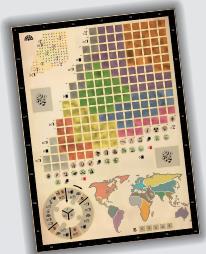
X54 POWER CUBES

X6
DEVELOPMENT
MARKERS
X18 LEADER CARDS
X1 GAMEBOARD
X45 WONDER CARDS


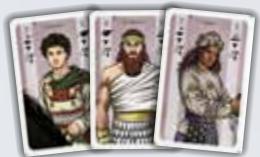
X60 ACTION CARDS
X16 TERRYTORY TILES


X2 TIME MARKERS
X12 POINT/TURN MARKERS
x30 ADVISOR CARDS

X7 CIVBOT CARDS


X6 PLAYER REFERENCE SHEETS
GAMEBOARD
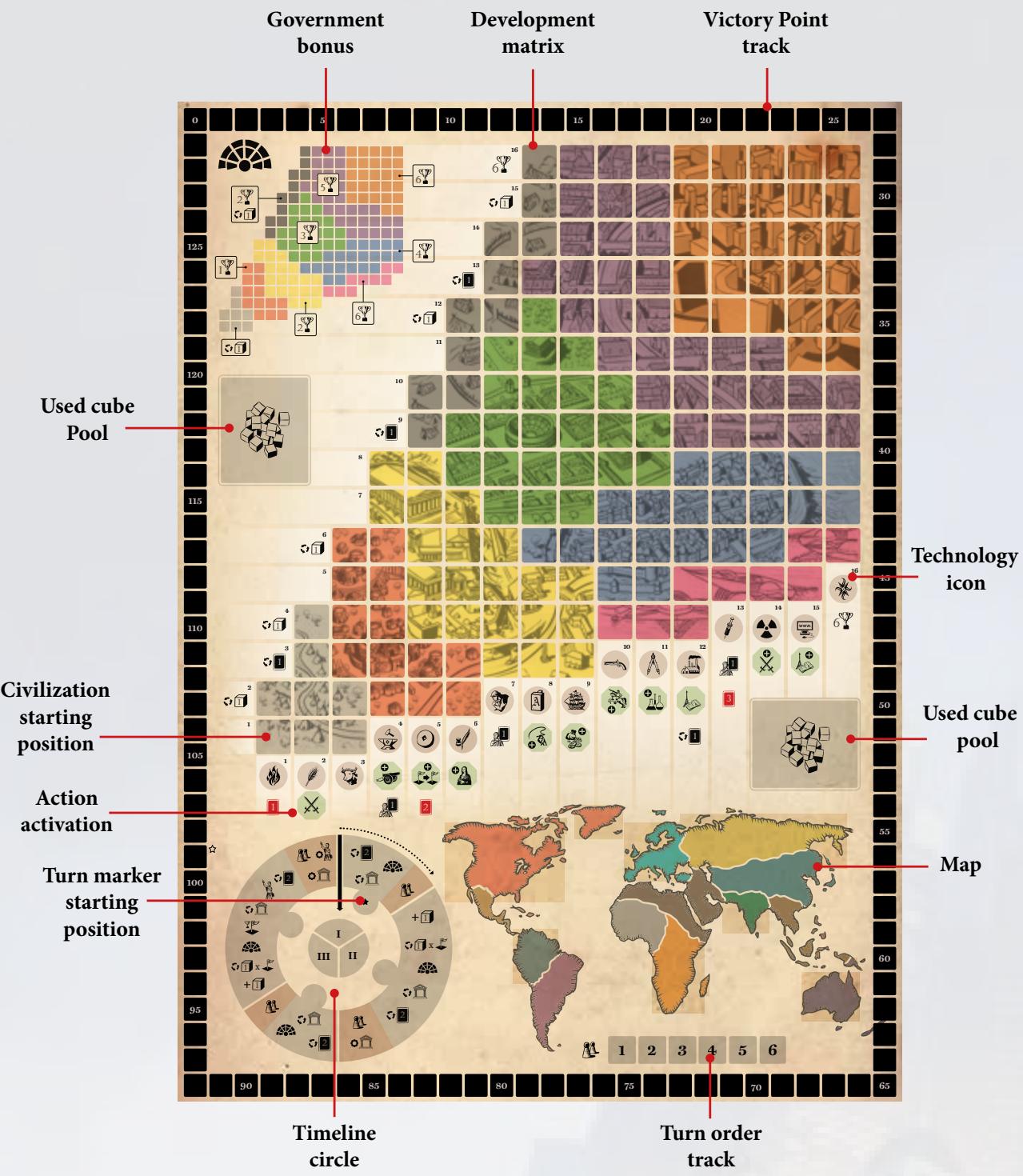
The gameboard is divided into several parts:
Map: Divided into territories. A white border between two territories indicates they are adjacent.
Timeline Circle: Used to represent the passing of time. The outer circle is divided into 4 sections, each of which represent a game turn. The inner circle tracks the three Eras of the game.
Victory point track: Used to track the players Victory Points (VP). When a Civilization gains VP, move their VP marker on the track.
Turn order track: Used to keep track of the turn order of the players.
Development Matrix: 'This represents the Military Level of each Civilization (on the vertical) and the Technological Level (on the horizontal).
Government bonus: Indicates the bonus associated with each form of Government.
Used cube pool. Two equivalent spaces which contain the Used cubes of all players. Cubes in these pools are not available for performing actions.
SETUP
-
Place the gameboard on the table.
-
Put the timeline markers on the timeline circle: one on the Turn marker starting position, and the other on the central Era track on Era I.
-
Separate the Wonder cards into 3 decks (one for each Era – see backs of cards). Shuffle each deck and put them next to the gameboard. Draw 7 cards from the first Era deck and place them face up on the table forming the Wonder row. When playing in 2 or 3 players draw 5 wonders instead of 7.
-
Each player chooses a color and takes 4 Power cubes of the chosen color, placing 1 of them in one of the Used cube pools on the board and keeping the other 3 in front of him. Remaining cubes are placed in a general supply.
-
Each player takes the 10 Action cards of his color and sets aside the War and Tourism cards (these cards are obtained later in the game). The 8 Action cards remaining form a players hand.
-
Randomly assign each player a Civilization and give them the corresponding 5 Advisor cards. Each player shuffles his own deck of Advisors and
THE GAME STRUCTURE
The game is divided into 3 Eras. Each Era is divided in to 4 Turns for a total of 12 Turns in a full game.
At the end of each Turn, the Turn marker on the Timeline Circle is moved clockwise to the next section and each player resolves the actions indicated (see "Turn End”, paragraph 4).
After 4 Turns, when the Timeline circle has been completed, the Era marker is moved to the next Era and the Turn marker is placed on the first segment. After the last turnof the third Era, the game ends.
VICTORY CONDITIONS
Thewinner is the player with the most Victory Points at the end of the game. In case of tie the winner will be the player having the higher sum of technology and military levels.
THE TURN
Each Turn is composed of a variable number of Action rounds, depending on the number of Action cards played. In each Action round, players choose and perform Actions by playing Action and/or Advisor cards from their hand.
ACTION CARDS
To perform actions, each player simultaneously chooses a number of Action and/or Advisor cards places it face down on the table in front of them, drawing the top card into their hand. You may allow players to choose their Civilization instead.
-
Randomly determine the turn order for each player and mark this on the Turn order track.
-
Each player puts a VP marker on space 0 of the VP track and a Matrix marker in the bottom-left corner of the Development matrix.
-
Place a random territory token face up on each territory of the map.
-
Separate the Leader cards into three decks (one for each Era – see the back of the card). The last player in Turn order draws a number of Leader cards from the first Era deck equal to the number of players, looks at them and chooses one, passing the remaining cards to the next player in reverse Turn order. This procedure is repeated until all players have a Leader Card. Leader cards are then placed face up in front of each player.
-
Following the Turn order, each player puts one Power cube (from their remaining 3) on an empty territory of the map and scores the VP on the token. The territory token remains on the map.
The number of cards played in an Action round depends on the Technology Level of the Civilization. The starting number of available actions is 1. If a player is at Technology level 5 (the Wheel), he can play up to 2 cards. If a player is at Technology level 13 (Medicine), he can play up to 3 cards.
When all players have chosen their cards, they are revealed simultaneously.
The playing of a card must follow theserules:
At least 1 Action/Advisor card has to be played in each round, even if it cannot be resolved. Example: Carlo can play 2 action cards per round. He can however, decide to play only one.Bea can only play one card, and has to play one Action / Advisor card each round.
Once a card is revealed, it cannot be withdrawn, even if the action cannot be performed.
Some Actions cost Power cubes which the player must have available in front of him to perform the Action. When Power cubes are used, they are moved to one of the Used cube Pools on the board.
In Turn order, players resolve all of their played Action cards.
On a player'sturn, he decides the order of resolution of his action cards. If a card has more than one effect, the card will specify the order of resolution. Example: Advanced Expansion recovers 1 Power cube frst,and then places a Power cube to a territory on the map.
Some Action cards have both a Basic action and an Advanced action. Advanced actions usually cost more, but are more powerful.
Some actions have a requirement. If the requirement is not met, the action has no effect.
Requirement
for the
Advanced
Action

Action Icon
Basic Action Advanced Action
Example: In order to perform Advanced Raid Action a Civilization needs to have reached at least Technology level 10 (Gunpowder).
After an Action card is resolved, it is placed face up in the Discard queue of the player (cards should be placed so that the action icons are visible). Advisors are removed from the game after their effect has been resolved instead of going to the Discard queue.
Discard Queue
The most recent card played (with the red line) is placed on top of the other cards as shown.
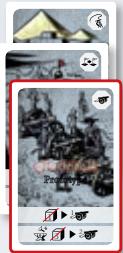
When all cards of all players have been resolved, a new Action round begins. This process is repeated until one or more players play the Revolution Action.
ACTION DESCRIPTION

Military: Develop the Military strength of the Civilization. The player uses 1 Power cube to gain 1 Military Level: move the marker on the development matrix one space upwards and put the cube in a Used cube pool.
The advanced action (requires Metal Working) allows a player to use 3 Power cubes to gain 2 Military Levels.
If the Civilization cannot increase itsMilitary level due to there being no space to move to, the action has no effect. However, if the marker is already at the top of the Development Matrix (Level 16), each level increase gives 2 VP instead.
• A bonus granted by the new Military Level (see page 9) is gained immediately and can be used in the next action during the same Action round.

The Blue player cannot increase his Military.
He must improve his Technology first.

Technology: Discover new technologies. The player uses 1 Power cube to gain 1 Technology Level. To do this, move the marker on the development matrix one space to the right and put the cube in a Used cube pool. The advanced action (requires Science) allows a player to use 3 Power cubes to add 2 Technology Levels.
If the Civilization cannot increase its Technology level due to there being no space to move to, the action has no effect. However, if the marker is already at the far right of the Development Matrix (Level 16 - Singularity), every further Technology level increase gives 2 VP instead.
A bonus granted by the new Technology Level (see page 9) is gained immediately and can be used during the same Action round.
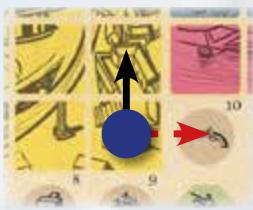
The Blue player cannot increase his Technology. He must improve his Military first.

Art:Build Wonders. The player uses 1 Power cube to take 1 Wonder card from the Wonder Row. The Wonder is placed in his player's area and the Power cube is put in a Used cube pool.
The advanced action (Requires Writing) allows a player to use 3 Power cubes in order to take 2 Wonders.
Wonders may be activated to produce their bonus anytime the player is taking an action, starting from the next action (even if this is during the same Action round).
The cards in the Wonder row on the table are not replenished. The Wonder row is only refilled as specified in the Timeline circle (Page8).

Exploit: Exploit your population. The player recovers up to 2 Power cubes of his own color fromthe Used cube pools on the board
and/or the map. If a player abandons a territory by
removing his cube,then the player losesVP equal
to the VP value of the territory token (while power
cubes, if any, are not lost).
The advanced action (requires Printing Press) allows a player to spend 1 VP to recover 4 Power cubes.
The exploit action can be performed even if the Used pool contains fewer cubes than the player will recover. Simply recover all the player's cubes.

Expansion: Expand the Civilization on the map. The player puts 1 Power cube onto the map into a territory adjacent to one of their y occupied territories.
The advanced action (requires the Wheel) allows a player to recover 1 Power cube from the Used pool before putting a cube on the map.
Civilizations which have Navigation Technology can expand into any Territory.
If a Civilization expands into an empty territory, it gains the Territory Bonus of the Territory Token.
America and Russia are not adjacent. Central America and South America are adjacent across the Panama strait. Oceania and Indochina are adjacent since they share a border.

Trade: The Civilization trades with an adjacent Civilization that has a higher Technology Level. The player who used Trade Technology Level.
In the basic action, the adjacent Civilization who the trade is done with, gains 2 VP. In the advanced action (requires Navigation),they gain 1 VPinstead.
Civilizations which have Navigation Technology can trade with any Civilization.
Civilizations which share a territory are considered adjacent.

Raid: Raids your neighbors. The Civilization launches a raid on an adjacent Civilization that has a lower Military Level. Note that a Civilization in thesame territory as you is considered adjacent, and may be raided.
Theraider recovers up to 1 Power cube of his own color from a Used cube pool and gains 1 VP. The advanced action (requires Gunpowder) allows a player to recover up to 2 Power cubes and gains2 VP.
If there are no adjacent Civilizations with a lower Military Level, the raid has no effect.
If the player cannot recover all the Power cubes, the VP are still gained.

Example: Bea's Civilization (Blue) is located in Africa. She can raid the Purple Civilization in South America as she has Navigation technology. Bea's Military level is higher than the other Civilization, so she recovers 1 Power cube and gains 1 VP.

War: Declare war on a Civilization sharing the same territory. 'The War action card is only available if the Civilization's Technology level ast 2 (Agriculture).
The Civilization with the higher Military Level wins the war and gains 2 VP. The loser removes his Power cube from the contended territory of the Map and puts it in a Used cube pool.
In an Advanced War (requires Nuclear energy), the winner gains 4 VP.
Once a War Action card has been played, the war has to be carried out even if the player cannot win or no Civilization can be attacked.
In case of the same Military level on both sides, the war has no effect.
A player cannot lose their last cube on the map: If a player loses a war with their last cube on the map, their opponentstill gains VP, but the cube is not removed.
If more than two Civilizations have a Power cube on the same territory, the attacker decides who is going to be attacked.

Example: Bea (blue) and Carlo (red) share the same territory. Carlo has Military level 8, Bea's Military level is 7. Bea plays an Advanced Military action, while Carlo a War action. In Turn order, Bea precedes Carlo, so the Advanced Military action of Bea is resolved first and Bea reaches Military level 9. When Carlo's war is resolved, assuming that Carlo does not share any other territory, he loses the war and the territory and Bea gains 2 VP.

Tourism: Attract tourists to visit your Wonders. The Tourism action card is only available if the Civilization technology level is 12 (Industry).
The player gains 1 VP for each four Wonders (rounded down).
Advanced Tourism (Requires Internet) allows a player to gain 1 VP for each three Wonders (rounded down).

Revolution: Marks the last Action round of the current Turn. The Revolution action (or an Advisor with the Revolution effect)
cannot be played if the player's Discard queue contains less than 3 action cards at the beginning of the action phase. The Revolution action has to be played as the last action of the Action round.
A player who played a Revolution action takes back the last (most recent) card from the card queue [ (usually the revolution action itself) and one card of his choice.
Example: Carlo's discard queue contains 2 cards. He can play 3 action cards per round. However, he cannot play a Revolution action since his discard queue at the beginning of the action phase only contains 2 cards.
At the end of an Action round where 1 or more Revolution cards have been played, the Turn marker is moved to the next section on the Timeline Circle and Turn End procedure starts.
TURN EXAMPLE
The game starts with 3 players. Ada's Civilization is in Middle-East, Bea in China and Yuri in North America. 'The initial turn order is Ada, Bea and Yuri.

The players simultaneously play an Action Card. Ada plays Technology, Bea plays Military and Yuri plays Expansion. Actions are resolved in Turn order.
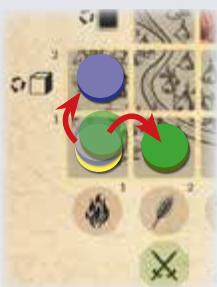
Ada uses 1 Power cube and gains 1 technology level. Bea uses 1 Power cube and gains 1 military level. She then moves one cube from the Used cube pool back in front of her (The bonus associated with attaining level 2 military).
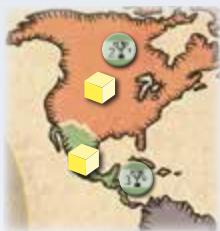
Yuri moves one Power cube on to themap expanding his Civilization into Central America. He gains 3VP as the territory is empty (VP equalto the value of the Territory Token).
The next Action round begins. Ada plays Expansion, Bea plays Raid, and Yuri plays Technology.
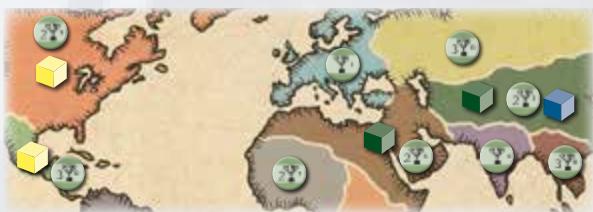
Ada expands her Civilization into China. She does not gain any VP from the territory token since there is already a Civilization there. Bea performs a raid on Ada (who has a lower Military level) and gains 1 VP and recovers 1 Power cube.

Yuri develops Agriculture by paying 1 Power cube.
At the end of the second action round, Ada has no cubes in front of her and 2 in the Used cube pool, Bea has 3 cubes and none on the Used cube pool, while Yuri has no cubes and 2 in the Used cube pool.
The third Action round starts. Both Ada and Yuri play Exploit and they recover 2 cubes each.

Bea plays a Trade action with Ada and discovers agriculture, Ada gains 2VP.
In the fourth Action round, Ada plays Art, Bea plays technology and Yuri plays Revolution.
Ada uses 1 Power cube and chooses a Wonder from the Wonder row. The Wonder is placed in front of her.
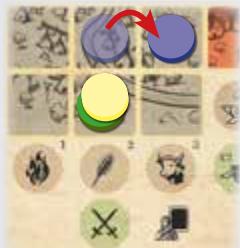
Bea uses 1 Power cube and discovers Animals. She then takes the top Advisor card from her pile of national advisors (a bonus for reaching this technology level).
Yuri performs the revolution and takes back the newest card from his Discard queue (Revolution) and another card of his choice.
The first turn is over.

The Turn End actions are performed: All players recover 2 cards, take Government bonusesand then recover Wonders
Turn order is updated The Turn marker is then moved to the next turn
At the beginning of the second turn, the Discard queue of Ada contains Exploit and Art, Bea has Trade and Technology in her Discard queue, while the Discard queue of Yuri is empty.
TURN END
At the end of each Turn, each action specified by an icon on the corresponding segment of the Timeline Circle will be performed. Icons in the larger gray zone indicate actions that each player performs themselves. The icons in the smaller brown zone indicate the actions which affect other aspects of the game.
All icons in the gray zone are resolved before any icons in the brown zone.
In the gray zone, the Add Power cube’ action must be resolved first, whilst the other actions can be done in any order.
In the brown zone, the Turn order' action must be resolved first.
Add Power cube: Each player adds 1 Power cube of his color from the general supply to the Used cube Pool on the board.

Recover cards: Each player takes back the first (oldest) 2 cards from his queue.

Recover Wonders: Each player may re-activate (turn back straight) all of his Wonder cards.

Recover Power cubes: Each player recovers from the Used cube pool, a number of Power cubes equal
to the number of territories that his Civilization occupies.

Government bonus: Each player gains the bonus corresponding to the form of government of his Civilization(shown by its position on the DevelopmentMatrix).
| Government Type | Government Bonus |
| Clan | Recover 1 Power Cube |
| Nomadic | Gain 1 VP |
| City state | Gain 2 VP |
| Empire | Gain 3 VP |
| Mercantilism | Gain 4 VP |
| Enlightenment | Gain 5 VP |
| Consumerism | Gain 6 VP |
| Utopian | Gain 6 VP |
| Barbarians | Recover 1 Power Cubeand Gain 2 VP |

Turn order: A new Turn order is determined. The player with the lowest VP is the new first player, and other players
follow in Turn order in increasing VP. The player with the highest VP being the last player. In case of a tie, precedence is given to the player who played later in the previous turn.
Example: The turn order is Carlo, Bea and Ada. At the end of the turn Ada has 26 VP, Bea and Carlo 23 VP. The new turn order is Bea, Carlo and Ada. Bea precedes Carlo since she was after Carlo on the previous turn.

Reset Wonders: 'The Wonder cards remaining in the Wonder Row are discarded and 7 new Wonder cards are
drawn and displayed. When playing in 2 or 3 players draw and display 5 wonders instead of 7. New Wonder cards come from the deck corresponding to the Era of the next turn.
Example: in the 2nd turn of the game, reset Wonders with cards from Era 1. In the 4th turn of the game (the end of Era 1), use cards from Era 2 and the remaining unused wonders of Era 1 are discarded.

Leader bonus: Leaders shape the development of Civilizations. Each leader card has two conditions. If a Civilization meets either of the conditions, the player
gains the VP shown on the card for that condition. If both conditions are met, the player only scores the one with the highest VP.
Whether any VP are gained or not, each Leader card is then removed from the game.
Example: At the end of the Second Era, Lorenzo il Magnifico grants 3 VP if the Civilization has reached Technology level 9 (Navigation), or 6 VP if the Civilization has 6 Wonders or more. If both of these conditions are met, only 6 VP are gained.

Reset Leader: New leaders are assigned. The first player (in the new Turn order) draws a number of Leader cards equal to the number of players, chooses one of them
and passes the remaining cards to the next player in Turn order. This is repeated until all players have a Leader Card.
The Leader cards are placed face up in front of a player and scoredin the next Leader bonus stage.

Territory bonus: At the end of each Era and for each territory, each Civilization scores the VP specified on the Territory token if it is the only Civilization in that territory. The
territory tokenstays on the board.
GAME COMPONENTS
BOARD
MAP
The territories on the map are used to represent the expansion of each Civilization.
A Civilization is considered adjacent to another if they share a territory, or if they are on two adjacent territories. If a Civilization has developed the Navigation technology, all territories are considered adjacent. However, only Civilizations with Navigation have this privilege.
Example: Civilization A is in North America and has Navigation. It is adjacent to Civilization B in Africa. Civilization B does not have Navigation, so it is not adjacent to Civilization A.
Each territory has a number associated with it (printed on the territory token). This number is used to drive the expansion of the Civbots (see “Civbots”).
DEVELOPMENT MATRIX
The development matrix is used to represent both the technology (on the horizontal)and military (on the vertical) achievements of aCivilization.
Technology Level: This represents the technological development of the Civilization. Each technology level also has a symbol denoting what that level gives.
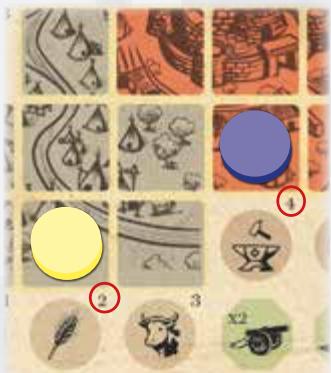
The Blue Civilization has a Technology level of 4. This means that Fire Agriculture , Animal Handling and Metal Working have been discovered. The Yellow Civilization has only discovered Fire and Agriculture.
Military Level: 'This represents the military development of a Civilization.

The Yellow Civilization has Military level 4
The Green Civilizationhas Military level 2.
Government type: Each cell of the development matrix is colored which represents the type of government that Civilization has. This government type grants a bonus at the end of the Turn.
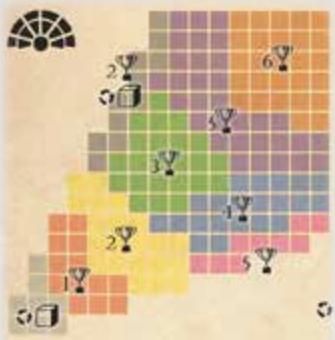
The Government bonus is shown in the upper-left corner of the game board.
Example: A player in the green zone of the Development Matrix at the end of the Turn gains 3 VP.
DEVELOPMENT MATRIX BONUSES When a new military or technology level is developed, the Civilization may gain a bonus. The bonuses that can be gained are as follows:
Recover a Power cube or an Action card. Respectively move 1 Power cube from the Used cube Pool to your player area or take back into your hand the first card (oldest) of your Discard queue.

The Yellow player takes back the oldest card from his Discard queue.
The Blue Civilization recovers a Power cube from the Used cube Pool on the board.
Provides a new Action card or Advanced Action. Some technology levels give either a new Action card (Level 2 – War, and Level 12 – Industry) or the ability to use an advanced version of an Action card. When given a new Action card, the card is added directly to the player's hand and it can be used from the next Action round.

The Yellow player can play the War Action card, while the Blue player can also play the advanced version of the Military Action card.
New National Advisor. Upon reaching Technology level 3 (Animals), level 7 (Philosophy) and level 13 (Medicine) draw a new Advisor card from your Advisors deck.

The Yellow player can draw a new Advisor card from his Advisor deck.
Number of actions. When reaching Technology level 5 (Wheel), and level 13 (Medicine) the Civilization gains an additional action. From the next Action round, the player can now play two or three cards in each round.
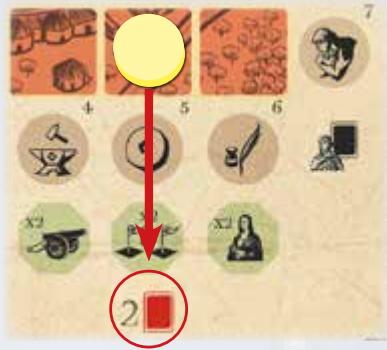
The Yellow player can make 2 Actions per round.
Victory Points. Some Technological advancements grant Victory Points when discovered.
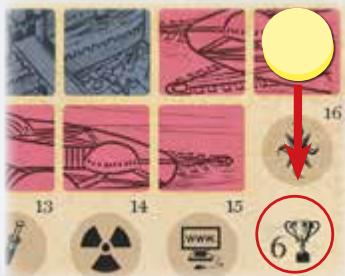
The Yellow player gains 6 VP when discovering the Singularity (Technology Level 16).
POWER CUBES
Each cube represents the Power of a Civilization in terms of manpower, richness, and resources. Cubes in front of a player represent power that are available to be spent on performing various actions. Cubes in the Used cube Pool represent power that will be used again once it has been recovered back to a player's personal supply.
ACTION CARDS
Actions cards are used to perform actions during the
Leader name
game. Each card shows either one or two possible action effects: Basic and Advanced. If there is only one action effect, it is considered a Basic action.
When a card is being resolved, the player may choose to perform either the Basic or Advanced action, but must have the required Technology level to do so.
Requirement
for the
Advanced
Action

Basic Action Advanced Action
Example: In order to perform the Advanced Tourism Action, a Civilization needs to have reached at least the technology level 15 (the Internet).
ADVISOR CARDS
National Advisors are additional bonus actions specific to each Civilization. Each player starts with 1 Advisor card in his hand and the rest face-down in an Advisors deck.
When some technologies (Animals, Philosophy and Medicine) are developed, the player adds 1 Advisor card to his hand by drawing it from his deck. When an advisor card is used, it is permanently discarded.
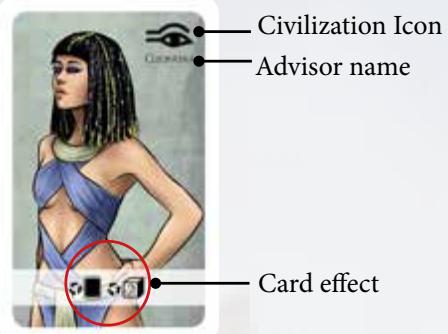
Example: Egypt's advisor Cleopatra allows the recovery of the oldestcard fromthe players Discard queue, and also recovers2 Power cubes.
LEADER CARDS
Each Leader card represents a possible leader for your Civilization. Leaders guide the Civilization by shaping objectives andgranting VP if some conditions will be
met at the end of an Era.
The Era in which the Leader is used is shown on the back of the card.
Leader cards are scored at the end of an Era, and a player gains VP if one of the requirements is satisfied. If both requirements are satisfied, the Civilization scores only the higher value.
If neither requirement is met, the Leader card is discarded with no effect.

Example: The Leader card Caesar provides 5 VP if the Civilization has reached a Military Level of 5, or 2 VP if the Civilization has 2 or more Wonder cards. If the Civilization has both of these, it scores 5 VP only.
WONDER CARDS
Wonders are built using the Art action and grant a bonus if a condition is met.
Once built, a Wondercan be activated by rotating the card 90 degrees. A Wonder card that is rotated cannot be activatedagain until rotated back. There is no limit to the number of Wonders a player can have.
A player can activate as many wonder cards as he wants during his actions. Some wonders can be activated ifan action card is used even if not successfully resolved. Some Wonders can only be activated if the player has a majority in something; in caseof tie, the Wonder cannot be activated.
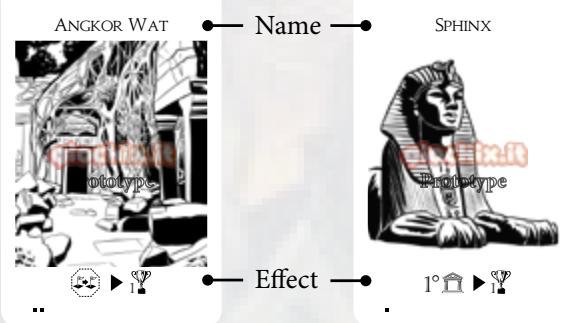
Example: the Sphinx requires majority in the number of Wonders, and it allows the player to gain 1VP. Angkor Wat requires the useof an Expansion action togain 1 VP.
TERRITORY TOKENS
A territory token gives a VP bonus to the Civilization which first explores the territory (Exploration bonus) and also to a Civilization if it is the sole occupier at the End of an Era.

Territory tokens also have a unique number on them. This is the territory number (used with Civbots)
Exploration bonus: The bonus is gained when a Civilization expands into the territory if is was empty. This bonus is also awarded during the initial Setup of the game.
End of Era bonus: The bonus is granted at the end of each Era if the Civilization is the only one with a cube on the territory.
CIVBOTS
The Civbots are Civilizations automatically guided by the game. Civbots are used when playing the Solo game and may optionally also be used when playing with fewer than 6 players.
Civbot behavior is driven by the Civbot cards; each card specifies one or more actions that will be performed by the Civbot on that turn.
Possible actions are: Gaining a
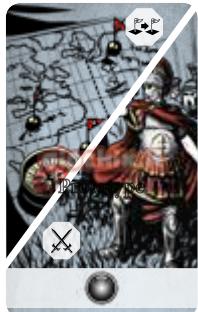
Technology and/orMilitary level, building a Wonder, scoring, expanding on the map and waging wars.
SETUP
The starting number of Civbots is 6 minus the number of players, although you may play with less. Example: In a 2 player game, up to 4 Civbots are added.
Put a Matrix marker of all Civbots on the Development Matrix in the normal starting position (Military and Technology level of1).
Each Civbot starts with one Power cube on the map. Place them in empty territories, starting with the highestterritory number.
Example: Let assume that the highest territory tokens are 16, 14 and 13. In a 3 player game, the 2 Civbots will start in territories 16 and14. If territory 14 is occupied,the Civbot will start in territories 16 and 13.
Place the VP marker for each Civbot on the VP track. They score VP for the territory they occupy at the start. For each Civbot, the players choose a difficulty level (Chieftan, Noble, or King) and place the turn order marker on the difficulty level card to indicate this.
CIVBOT TURN
Civbots play at the end of each turn, before any end of turn actions. Civbots act in order of difficulty level, highest first. If two Civbots have the same difficulty level, use the order of the cubes on the Civbot card from left to right. The actions are resolved as Civbot cards are drawn.
Draw a number of Civbot cards according to the difficulty (Chieftan – 3, Noble – 4, King – 5).
With the Technology action, the Civbot gains one Technology level. If the new level grants a bonus, the Civbot does not get this bonus.
With the Military action, the Civbot gains one Military level. If the new level grants a bonus, the Civbot does not get this bonus.
The Art action is performed by taking a random Wonder card from the Wonder row and removing it from the game. If no Wonder is available the action is not performed.
Wars are waged only if the Civbot can win them. War is declared against the weakest possible Civilization (human or Civbot). If more than one war could be declared, the Civbot attacks the human player with the lowest Military. If no human player can be attacked, war is performed against the weakest Civbot.
If more than one territory of the same enemy can be attacked, the Civbot attacks the territory having the highest number. The Civbot gains 2VP (or 4VP if it has developed nuclear energy).

Example: Bea (Blue) and Yuri (Yellow) are playing with 1 Civbot (Green). Military levels are: Bea 2, Yuri 3, Civbot 5. The Civbot performs a War action. Bea has a lower Military than Yuri, but does not share a territory with the Civbot so Yuri is attacked. Of the two territories which Yuri shares with the Civbot, Russia is attacked as it has a higher territory number.
Expansions are performed to an adjacent empty territory with the highest number. This scores the Civbot the VP according to the territory token. If there are no empty adjacent territories, the Civbot expands into the adjacent territory with the highest territory number.
The usual rules for Navigation affect Civbot expansion. If the Civbot has no available Power cubes, the expansion is not performed.
The Scoring action gains the Civbot 1 VP.
Civbots gain VP whenever a player trades with them.
When all cards of a Civbot have been resolved, all the Civbot cards are shuffled together and the same process is followed for all other Civbots.
At the end of each turn, a Civbot scores VP for its Government and territory bonus, as per the rules for human players.
The last territory of a Civbot can be attacked and destroyed.
SOLO GAME
Solo games are played against 5 Civbots. The aim of the game is to survive and score the most VP.
Do not use the Leader cards.
Remove any Wonders from the game that give a bonus when the player has a sole majority (ones with1ºin the activation cost).
The presence of Civbots is not taken into account when considering the majority condition on some of the Wonders.
Example: Bea has the Ishtar Gate and military level 6 while Ada and Carlo have military level 5. A Civbot has military level 7. Bea can still activate the Wonder and gain VP.
You can lose your last cube on the map as the result of a war with a Civbot. If this happens, you are eliminated and lose the game.
At the end of the third Era the game ends, the player wins if he has more VP than the civbots.
PROMO EXPANSIONS
These expansions has been made for game launch. If still available, should be possible to find them in some shops.
CIVILIZATION GOALS
Civilization Goals represent important achievements of the Civilizations and are placed on the Development Matrix.
The first Civilization moving his Matrix marker onto or over a Civilization Goals token on the Development Matrix immediately gains the bonus shown on the token and the token is removed from the game.
During the setup of the game after step 9, put all Civilization Goals tokens face down on the table, mix them up and then each player in Turn order takes one of them, turns it face up, and places it face up on any
space of the Development Matrix that is not adjacent (even diagonally) to another Civilization Goals token or to a Matrix marker. Continue doing this until 6 tokens have been placed and return unused tokens to the box.
Note that in a 4-5 player game, players earlier in Turn order will place more tokens.
If a Civbot reaches a Civilization Goals token, it scores any VP indicated and the token is removed from the game.
THE WAYS OF COMMAND
The Command token can be used to override a selected action during the game. Each Command token has two command symbolsamong Military, Technology, Wonders, VP, Territories. These symbols are used to determine the activation of the Command token.
Each player takes the Command token during the setup. When resolving an action card the player can declare the use of the Command token.
The player then copies and resolve the effects of one of the action card played by another player. While the action cardwith the Command token goes normally in the discard queue and its effects are not used.
The Command token is removed from the game after the use.
• Advisors cards cannot be copied.
The Command token cannot be used if the player is the last in one of the two symbols. In case of tie the Command token cannot be activated.
Example: The Roman civilization cannot activate the Command token if has less territories or has a lower military level than the other civilizations.
giocHix.it
All rights reserved (2014) Inmedia Srl, Roma, Italy www.giochix.it, info@giochix.it
下载 Markdown原文为社区整理/出版社公开资料,版权归原作者,仅供个人学习查阅。