
瘟疫危机:伊比利Iberia
一句话概览
瘟疫危机:伊比利 是一款已收录于村了吗规则库的桌游,支持 2–5 人,原名 Iberia。
本页内容:一句话概览 · 游戏概述 · 1. 游戏组件 · 2. 游戏设置 · 3. 游戏流程 · 4. 行动详解 · 5. 抽牌阶段 · 6. 感染阶段 · 7. 事件卡 · 8. 胜负条件 · 9. 挑战模式 · 10. 角色能力 · 关键规则与常见问题 · 常见问题
瘟疫危机:伊比利(Pandemic Iberia)规则速览
以下规则速览由本站整理,与官方规则书表述不同,仅供快速上手参考。
游戏概述
19世纪中叶,伊比利亚半岛疫病肆虐。玩家作为第二次皇家慈善远征队的成员,踏上探寻疾病起源的使命——研究全部四种疾病即获胜,但爆发过多、疾病方块耗尽或玩家牌堆耗尽均会导致失败。每位玩家拥有独特角色能力,协作对抗疫情。
核心机制: 合作游戏、手牌管理、行动点分配、疫情传播与爆发链、净水防御、铁路建设、角色特殊能力
1. 游戏组件
| 组件 | 数量 |
|---|---|
| 棋盘 | 1块 |
| 角色卡(Role cards) | 7张 |
| 棋子(Pawns) | 7个 |
| 医院(Hospitals) | 4个 |
| 疾病方块(Disease cubes) | 96个(4色各24个) |
| 玩家卡(Player cards) | 69张(城市卡48张、事件卡15张、流行病卡6张) |
| 感染卡(Infection cards) | 48张 |
| 研究标记(Research markers) | 4个 |
| 爆发标记(Outbreaks marker) | 1个 |
| 感染率标记(Infection rate marker) | 1个 |
| 参考卡(Reference cards) | 5张 |
| 净化标记(Purification tokens) | 14个 |
| 铁路标记(Railroad tokens) | 20个 |
| 疾病卡(Disease cards,历史疾病挑战用) | 4张 |
| 参考卡(患者涌入挑战用) | 1张 |
| 预防标记(Prevention token,护士用) | 1个 |
2. 游戏设置
2.1 摆放棋盘与配件
- 将棋盘放在所有玩家触手可及处
- 将4个医院、20个铁路标记、14个净化标记放在棋盘旁
- 疾病方块按颜色分为4堆作为供应堆
2.2 放置爆发标记与研究标记
- 爆发标记放在爆发轨道的"0"位置
- 4个研究标记放在对应疾病研究指示器旁
2.3 放置感染率标记并感染9座城市
- 感染率标记放在感染率轨道最左侧的"2"位置
- 洗匀感染牌,翻开3张:每座城市放3个对应颜色的疾病方块
- 再翻开3张:每座城市放2个对应颜色的疾病方块
- 再翻开3张:每座城市放1个对应颜色的疾病方块
- 共放置18个疾病方块,颜色与城市匹配
- 这9张牌面朝上放在感染弃牌堆,其余感染牌组成感染牌堆
2.4 分发角色卡、棋子与参考卡
- 每位玩家获得1张参考卡
- 洗匀角色卡,每位玩家面朝前发1张并配对应棋子
- 未使用的角色卡和棋子移出游戏
2.5 准备事件卡与发手牌
- 从玩家牌堆中取出流行病卡,暂放一旁
- 洗匀所有事件卡,随机搁置指定数量的事件卡(根据玩家人数,具体数量因源文件未确认而省略)
- 搁置的事件卡混入城市卡,其余事件卡放回盒中
- 洗匀玩家牌堆(城市卡+事件卡),按玩家人数发手牌(具体数量因源文件未确认而省略)
- 每位玩家选择手牌中某城市卡上的城市放置棋子;若无城市卡,可放任意城市
- 玩家卡面朝上放在面前
2.6 准备玩家牌堆
- 按难度选择流行病卡数量:入门4张、标准5张、英雄6张
- 移除未使用的流行病卡
- 将剩余玩家牌分成与流行病卡数量相等的若干堆(尽量均等)
- 每堆洗入1张流行病卡,面朝下
- 将各堆叠放形成玩家牌堆(较小的堆放底部)
2.7 确定起始玩家
- 手中持有建城年代最早的城市卡的玩家先行动
3. 游戏流程
每回合分3个步骤,按顺序执行:
- 执行4个行动
- 抽取2张玩家卡
- 感染城市
当前玩家完成后,左手边玩家开始回合。玩家之间可以自由讨论,但当前行动玩家做最终决定。事件卡可在任何时候打出(不算行动)。
4. 行动详解
每回合最多执行4个行动,可任意组合,可重复执行同一行动。某些角色能力会改变行动方式。需弃牌的行动,弃牌均放入玩家弃牌堆。
4.1 马车/船移动(Move by Carriage/Boat)
沿棕色线(实线或虚线)移动到相邻城市。无任何消耗。
4.2 火车移动(Move by Train)
沿连续的铁路标记链移动到可达城市。无任何消耗。
4.3 船运移动(Move by Ship)
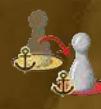
弃1张与目的地城市颜色匹配的城市卡,在两座港口城市之间移动。
4.4 建造铁路(Build Railroad)
在当前城市连出的线路上放置1个铁路标记。
- 不能在虚线上放置
- 安道尔城、帕尔马·德·马略卡、直布罗陀的连出虚线不可放置铁路标记(但可通过马车/船移动沿虚线通行)
- 若供应堆中无剩余铁路标记,不可执行此行动
4.5 建造医院(Build Hospital)
弃1张与当前城市匹配的城市卡,在该城市建造1个医院。
- 医院颜色必须与城市颜色匹配
- 从棋盘旁取对应颜色的医院
- 若该颜色医院已在棋盘上,将其从原位置移至当前城市
4.6 治疗疾病(Treat Disease)
从当前城市移除1个疾病方块,放回供应堆。
- 与普通《瘟疫危机》不同,即使疾病已被研究,每次仍只移除1个方块
- 疾病永远不会被治愈或根除
4.7 分享知识(Share Knowledge)
两种方式之一:
- 赠送: 将与当前城市匹配的城市卡交给同在该城市的另一名玩家
- 获取: 从同在该城市的另一名玩家手中取走与当前城市匹配的城市卡
双方必须都同意。若获得卡牌的玩家手牌超过7张,必须立即弃牌或打出事件卡。
4.8 研究疾病(Research a Disease)
在有医院的城市中,弃掉5张与该医院颜色匹配的城市卡,将该颜色的研究标记移至已研究位置。
- 疾病被研究后,方块仍留在场上,流行病和感染时仍可放置新方块
- 已研究疾病的同色卡可用于在任意相邻地区执行净水行动
- 研究不等于治愈或根除
4.9 净化水源(Purify Water)
向1个相邻地区放入2个净化标记,两种方式之一:
- 弃1张与相邻地区中某城市颜色匹配的城市卡
- 弃1张与已研究疾病颜色匹配的城市卡(可在任意相邻地区使用)
净化标记效果: 每个净化标记阻止1个疾病方块被放入该标记所在地区的相邻城市。
区域定义: 区域是棋盘上棕色线围成的区域。巴塞罗那、塔拉戈纳、巴伦西亚、帕尔马·德·马略卡之间的海域也是一个区域。每个区域可容纳任意数量的净化标记。
- 若供应堆中无剩余净化标记,不可执行此行动
5. 抽牌阶段
从玩家牌堆顶抽取2张牌。若抽牌时牌堆不足2张,游戏结束,团队失败。
5.1 流行病卡(Epidemic)
若抽到流行病卡,立即按顺序执行以下步骤:
- 升级(Increase): 感染率标记在感染率轨道上前进1格
- 感染(Infect): 从感染牌堆底部抽1张牌,在对应城市放3个同色方块。若该城市已有同色方块,只补至3个,然后触发一次爆发。每个相邻净化标记可代替放置1个方块。此牌放入感染弃牌堆
- 加剧(Intensify): 将感染弃牌堆的牌洗匀,放在感染牌堆顶上
- 若同时抽到2张流行病卡,先完整执行一次三个步骤,再执行一次
- 流行病卡结算后移出游戏,不补抽替换牌
5.2 手牌上限
手牌上限为7张。超过7张时,弃牌或打出事件卡直到手牌为7张。此限制在任何时候都适用,包括从其他玩家获得卡牌后。
6. 感染阶段
翻开放当前感染率数量的感染牌(感染率标记下方的数字),逐张感染对应城市:
- 在城市放1个对应颜色的疾病方块
- 若该城市所在区域相邻区域有净化标记,移除1个相邻区域的净化标记(放回供应堆)代替放置方块(多个相邻区域有标记时,当前玩家决定移除哪个)
- 若城市已有3个同色方块,不放第4个,改为在该城市触发一次爆发
- 感染牌放入感染弃牌堆
6.1 爆发(Outbreaks)
- 爆发标记前进1格
- 在该城市每个相邻城市放1个同色方块(或移除1个净化标记代替)
- 若某相邻城市已有3个同色方块,不放第4个,改为在当前爆发结算完成后触发链式爆发
6.2 链式爆发(Chain Reaction Outbreaks)
- 爆发标记前进1格
- 放置方块同上
- 但不会向已在本次感染卡结算中爆发过的城市放置方块
爆发可导致同一城市上出现多种颜色的方块,每种颜色最多3个。
7. 事件卡
- 任何玩家可在回合中打出事件卡,打出不算行动
- 可在任何时间打出,但在抽牌与结算之间不可
- 同时抽到2张流行病卡时,可在第一张结算后打出事件卡
- 打出后放入玩家弃牌堆
8. 胜负条件
胜利
全部4种疾病被研究后立即获胜,不论场上疾病方块数量。
失败(三种情况)
- 爆发标记到达爆发轨道末端(共8格)
- 需要放置疾病方块时供应堆中该颜色方块不足
- 玩家无法在行动后抽取2张玩家卡
9. 挑战模式
9.1 患者涌入挑战(Influx of Patients)
模拟19世纪伊比利亚新建医院涌入患者的场景。
设置变更:
- 将患者涌入参考卡叠放在棋盘的游戏流程区域
- 供应堆中仅6个净化标记可用
- 剩余8个净化标记分成4堆(每堆2个),每堆上放1个医院
回合新顺序:
1. 执行4个行动
2. 移动患者(每色1个)
3. 抽2张玩家卡
4. 感染城市
建造医院的额外效果:
- 将该医院下方的2个净化标记放入供应堆
- 移除该城市中与医院同色的疾病方块(放回供应堆)
移动患者:
- 每个医院方向移动1个最近的同色疾病方块向医院移动1步
- 计算距离时按线路段数计算,忽略铁路标记
- 多个等距患者可任选
- 患者沿最快路线移动(可利用铁路),多条等速路线可任选
- 移动不受净化标记或护士预防标记影响
- 若移动导致医院城市有4个同色方块,触发溢出
溢出(Overrun Hospitals):
- 医院城市出现4个或更多同色方块时触发
- 将该城市中所有该色方块移至相邻城市(玩家决定分配方向)
- 可能引发链式爆发,按正常规则处理
- 移动完成后在爆发轨道上标记1次爆发
- 若爆发发生在有医院的城市,放入第4个方块(不放第5或第6个),然后按溢出规则处理
9.2 历史疾病挑战(Historical Diseases)
面对行为各异的强大疾病。洗匀4张疾病卡,随机抽取1至4张使用(越多越难)。放置在棋盘旁。
| 颜色 | 疾病 | 特殊规则 |
|---|---|---|
| 黑色 | 疟疾(Malaria) | 感染时,若某城市原本无黑色方块,改为放入2个黑色方块 |
| 蓝色 | 霍乱(Cholera) | 蓝色爆发时,除在1连接距离的城市各放1个蓝色方块外,还在2连接距离且无任何方块的城市各放1个蓝色方块 |
| 红色 | 斑疹伤寒(Typhus) | 若某城市有超过1个红色方块,治疗该城市需花费2个行动才能移除1个红色方块 |
| 黄色 | 黄热病(Yellow Fever) | 在港口城市放入黄色方块时,还必须在所有相邻港口城市各放入1个黄色方块 |
10. 角色能力
农学家(Agronomist)
- 花费1个行动,在相邻地区放置1个净化标记
- 执行净水行动时,可额外在该地区多放1个净化标记
政治家(Politician)
- 花费1个行动,可将城市卡交给任意城市中的另一名玩家(自己必须在与该卡匹配的城市)
- 花费1个行动,可将手中1张城市卡与玩家弃牌堆中的1张城市卡交换(自己必须在与其中任一卡匹配的城市)
铁路工人(Railwayman)
- 建造铁路时,可一次性放置2个连续铁路标记(从当前城市起算)
- 乘火车移动时,可携带同城市的1名乘客(棋子)同行
护士(Nurse)
- 拥有1个预防标记,设置时放在自己城市相邻的1个区域中
- 预防标记所在区域相邻的城市不能被感染(不能放入疾病方块)
- 预防标记始终跟随护士移动:任何时候护士的棋子被移动,立即将预防标记放在棋子相邻的区域
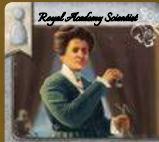
皇家科学院科学家(Royal Academy Scientist)
- 执行净水行动时,可使用任意颜色的城市卡
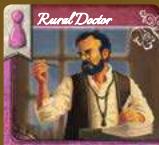
乡村医生(Rural Doctor)
- 执行治疗疾病行动时,移除当前城市的1个方块后,还额外从当前城市或相邻区域中的另一座城市移除1个方块
水手(Sailor)
- 乘船移动时不消耗城市卡
- 乘船移动时可携带同城市的1名乘客(棋子)同行
关键规则与常见问题
易错规则
- 疾病只研究不治愈: 研究疾病后方块仍在场上,新方块仍可放置,每次治疗仍只移除1个方块
- 医院可移动: 建造医院时,若该颜色医院已在场上,将其移至新位置而非另外新增
- 净化标记代替放置: 感染阶段和流行病感染步骤中,相邻区域的净化标记可代替放置方块
- 爆发不向已爆发城市放置: 链式爆发中,不会向本次感染卡结算中已爆发过的城市放方块
- 虚线限制: 安道尔城、帕尔马·德·马略卡、直布罗陀的虚线不可放铁路标记,但可沿虚线移动
- 事件卡打出时机: 不可在抽牌与结算之间打出,但可在两张流行病卡的第一张结算后打出
- 手牌上限7张: 在任何时候适用,包括从其他玩家获得卡牌后
- 同时抽到2张流行病卡: 完整执行一次三个步骤后再执行一次,不补抽替换牌
- 护士预防标记随移动更新: 任何人移动护士棋子时都要立即重新放置预防标记
- 分享知识双方必须同意
常见问题
-
Q:疾病被研究后还能放新方块吗?
A:能。研究不等于治愈,流行病和感染仍可放置新方块。 -
Q:治疗疾病在研究后能一次移除更多方块吗?
A:不能。与普通《瘟疫危机》不同,本作每次治疗始终只移除1个方块。 -
Q:净化标记放几个?
A:每次执行净水行动放入2个净化标记(农学家可额外多放1个)。 -
Q:已研究疾病的卡有什么用?
A:可用于在任意相邻地区执行净水行动(不限于卡上城市所在区域)。 -
Q:铁路上移动消耗卡牌吗?
A:不消耗。火车移动沿铁路标记链免费移动。 -
Q:建造医院时如果该颜色医院已在场上怎么办?
A:将其从原位置移至当前城市,不会增加医院数量。 -
Q:同时抽到2张流行病卡怎么办?
A:完整执行第一张的升级→感染→加剧三步,再执行第二张的三步。 -
Q:护士预防标记能阻止流行病感染步骤吗?
A:能。预防标记所在区域相邻的城市不能被放入疾病方块。 -
Q:患者涌入挑战中移动患者受净化标记影响吗?
A:不受。移动患者时无视净化标记和护士预防标记。
常见问题(FAQ)
以下 1 条问答中 0 条来自站内玩家的真实提问,其余 1 条为本站整理的常见疑问;答复内容保持原样。
瘟疫危机:伊比利支持几个人玩?
2–5 人。
去哪查完整规则
想核对具体规则细节、卡牌效果或某个回合的结算方式,可以在村了吗里选中这款游戏后直接提问。
同类桌游
规则原文(Markdown)
本站收录这款游戏的规则原文 1 个文件,此处内联渲染 1 个,可直接展开阅读或下载。
18-pandemic-iberia-rulebook.md40.5 KB
PANDEMIC
IBERIA
A cooperative game for 2–5 players, ages 8 and up. 45 minutes.
It's the mid-19th century and as members of The Second Royal Philanthropic Expedition,
you are embarking on your mission to discover the origins of diseases that are devastating the countryside of the Iberian Peninsula. Will you succeed in your mission? Can you research all four diseases in time to save humanity?
OVERVIEW
Pandemic Iberia is a cooperative game. The players all win or lose together.
The goal is to research all 4 diseases. The players lose if:
• 8 outbreaks occur (a massive panic occurs),
• not enough disease cubes are left when needed (a disease spreads too much), or
• not enough player cards are left when needed (your team runs out of time).
Each player has a specific role with special abilities to improve the team's chances.
CONTENTS


7 Pawns
7 Role cards
4 Hospitals

SETUP
96 Disease cubes (24 in 4 colors)

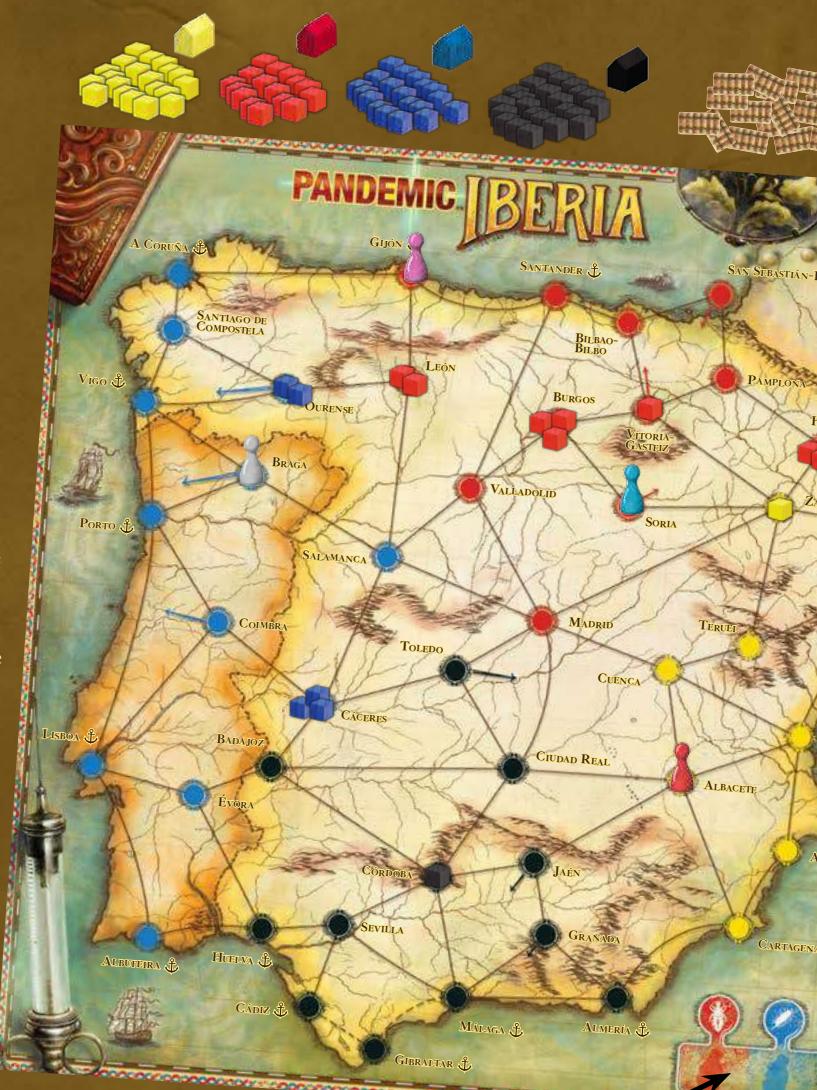
SET OUT THE BOARD AND PIECES
Place the board within easy reach of all players. Put the 4 hospitals, 20 railroad tokens, and 14 purification tokens nearby. Separate the cubes by color intò 4 supply piles.

PLACE OUTBREAKS AND RESEARCHMARKERS Place the outbreaks marker on the “0" space of the Outbreaks Track. Place the 4 reseārch markers near the Researched Disease Indicators.

PLACE INFECTION RATE MARKER AND INFECT 9 CITIES
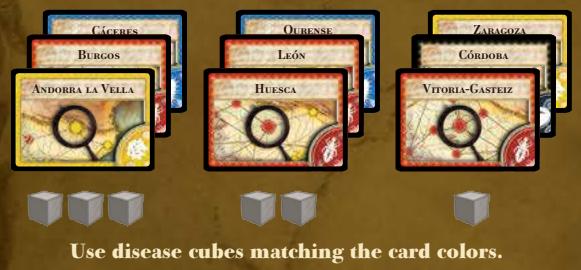
Place the infection rate marker on the left-most “2” space of the Infection Rate Track. Shuffle the Infection cards. • Reveal 3 of them. Put 3 disease cubes of the matching color on each of these cities.
• Reveal 3 more cards: put 2 disease cubes on each of these cities.
• Reveal 3 more cards: put 1 disease cube on each of these cities. (You will place a total of 18 disease cubes, each matching the color of the city.)
Place these 9 cards face up on the Infection Discard Pile.
The other Infection cards form the Infection Deck.

GIVE EACH PLAYER A ROLE CARD. A PAWN, AND A REFERENCE CARD

Give each player a reference card. Shuffle the Role cards and deal 1 face up in front of each player along with the matching pawn. Remove the remaining Role cards and pawns from the game.
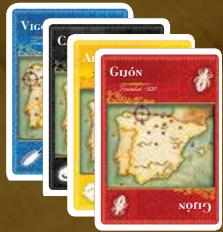
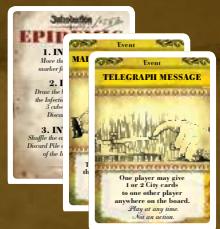
69 Player cards (48 City cards, 15 Event cards, 6 Epidemic cards)
5454
4 Research markers

1 Outbreaks marker

48 Infection cards

1 Infection rate marker
MOVE BY CARRIAGE / BOAT
Muse to a city cn ud by a liae.
MOVE BY SHIP
Moso herwren tuo pert cities hy diwanding a City eard matching the color of your
destination.
Me t ay riy reachahle hy etuus rail. BUILD RAILRDAD
Pat I railroad saken on a liae connected to your sity. (Nat posibde on dashed liars)
TREAT DISEASE
Remsse 1 disrase cobe frsm your curreat ciy.
8
5 Reference cards

14 Purification tokens

20 Railroad tokens
Infection Deck
Infection Discard

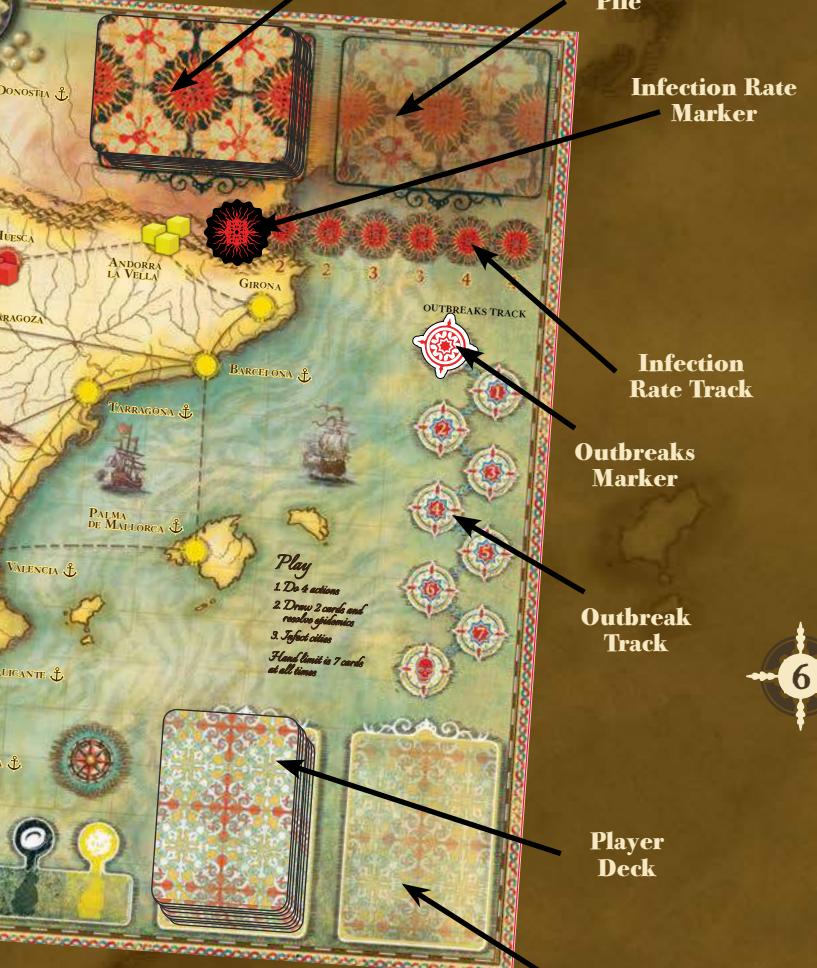
BEGIN PLAY
Player Discard Pile
Stack
The players look at the City cards they have in their hand. The player who has the Cty card with the earliest founding date goes first.
Note: The City cards include their approximate founding dates. (Note that humans settled these locations thousands of years ago, before the cities were named.)
Shuffle
If there is more than I red cube in a city,
三
4 Disease cards (for use with the Historical Diseases challenge)
Play 1. Do 4 acbions 3. Drew 2 cards and d. Iefact oitis Hand limit is 7 cards
1 Order of Play
Reference card
(for use with the Influx
of Patients challenge)
1 Prevention token
1 Board
PREPARE THE EVENTS AND GIVE CARDS TO EACH PLAYER
Take the Epidemic cards out of the Player Deck and set them aside until Step 6.
Shuffle all the Event cards and randomly set aside the number of Event cards shown in the table below.
Add these Event cards to the City cards and return the remaining Event cards to the box without looking at them.
Shuffle the Player cards (City and Event cards). Deal cards to the plåyers to form their starting hands. Give cards according to the number of players:
# of players
Events in Deck Starting Hand
2-player game
3-player game
4-player game
5-player game
Each player looks at the City cards in their hand and selects one of the cities pictured on their cards to place their pawn. If a player đoesn't have a City card (for example if all of their cards are Event cards), they may start their pawn in any city on the board. Players keep their cards face up on the table.
PREPARE THE PLAYER DECK
Set the game's difficulty level, by using either 4, 5, or 6 Epidemic cards, for an Introductory, Standard, or Heroic game. Remove any unused Epidemic cards from the game.
Divide the remaining Player cards into face down piles, as equal in size as you can, so that the number of piles matches the number of Epidemic cards you are using. Shuffle 1 Epidemic card into each pile, face down. Stack these piles to form the Player Deck, placing smaller piles on the bottom.
EPIDEMIC
1. INCREASE
2.INFECT
3. INTENSIFY
EPIDEMIC
1. INCREASE
2. INFECT
3. INTENSIFY
IDEMIC 1. INCREASE 2. INFECT LINIENSIY
IDEMIC 1. INCREASE 2. INFECT 3. INTENSIFY
PLAY
Each player turn is divided into 3 steps:
• Do 4 actions.
• Draw 2 Player cards.
•Infect cities
After a player is done infecting cities, the player on their left goes next. Players should freely give each other advice. However, the player whose turn it is decides what to do. Your hand can hold City and Event cards. City cards are used in some actions and Event cards can be played at any time.
ACTIONS
You may do up to 4 actions each turn.
Select any combination of the actions listed below. You may do the same action several times, each time counting as 1 action. Your role's special abilities may change how an action is done. Some actions involve discarding à card from your hand; all these discards go to the Player Discard Pile.
MOVEMENT ACTIONS

MOVE BY CARRIAGE / BOAT Move to a city connected by a brown line (solid or dashed) to the one you are in.
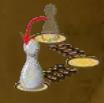
MOVE BY TRAIN
Move to a city connected by a continuous chain of railroad tokens. MOVE BY SHIP
Move between two port cities by discarding a City card matching the color of your
destination.
OTHER ACTIONS
BUILD RAILROAD Put a railroad token on a line coming out of your current city. (Not possible on dashed lines.)

Railway tokens cannot be placed on the dashed lines coming out of Andorra la Vella, Palma de Mallorca, or Gibraltar. Players may Move by Carriage/Boat along those dashed lines, however. If there aren't any railroad tokens remaining in the supply, players cannot do this action.

BUILD A HOSPITAL
Discard the City card that matches your current city to build a hospital there. The hospital you build must match the color of your city. Take it from the pile next to the board. If the hospital of that color is already on the board, move it from its current location to your city.

TREAT DISEASE
Remove 1 disease cube from the city you are in, placing it in the cube supply next to the board.

Note: unlike regular Pandemic, in Pandemic Iberia, you only remove 1 disease cube from the board, even after a dišease has been researched. (Diseases are never čured or eradicated in Pandemic Iberia.)
SHARE KNOWLEDGE You can do this action in two ways:
• give the City card that matches the city you are in to another player, or
• take the City card that matches the city you are in from another player.
The other player must also be in the city with you. Both of you need to agree to do this.
Example: If you have the Córdoba City card and are with another player in Córdoba, you can give the Córdoba card to that player. Or, if another player has the Córdoba card and you both are in Córdoba, then you can take it from that player. In either case, you both must agree before handing the card over.
If the player who gets the card now has more than 7 cards, that player must immediately discard a card or play an Event card (see Évent Cards on page 7).
RESEARCH A DISEASE While at a city with a hospital, discard 5 City cards matching the color of the hospital from your hand to research the disease of that color. Move the disease’s research marker on the board to indicate that it has been successfully researched.
Note: Unlike regular Pandemic, you never discover the cures for diseases in Pandemic Iberia. Instead, you research how to help prevent their spread.
When a disease is researched, its cubes remain on the board and new cubes can still be placed during epidemics or infections (see Epidemics and Infections on page 6). However, cards matching the color of the researched disease may now be used to Purify Water in any adjacent region, and you are closer to winning the game.
PURIFY WATER You can do this action two different ways to add 2 purification tokens into an adjacent region:
• discard a City card matching the color of a city in an adjacent region to put the 2 tokens into that region, or
• discard a City card matching the color of a researched disease to put the 2 tokens in any one adjacent region.
Each purification token prevents the addition of onè disease cube into a city adjacent to the region that contains it (see Epidemics, Infections, and Outbreaks on pages 6-7). Îf there aren't any purification tokens remaining in the supply, players cannot do this action.
Regions are the areas of the board enclosed by the brown lines. For example, the area enclosed by the lines between Huesca, Andorra la Vella, Girona, Barcelona, and Zaragoza is a region. Each region may contain any number of purification tokens.
Note that the sea area enclosed between Barcelona, Tarragona, Valencia, and Palma de Mallorca is also a region.
Example 1: While in Barcelona, Sonsoles plays a yellow card to add 2 purification tokens to the region to the north of her city. She could alternatively play a red card to add 2 tokens there (since there is a red city – Huesca – in that region as well).

Example 2: The black disease has been researched. While in Zaragoza, Donna could use a black card to add 2 purification tokens to any one of the six regions adjacent to her.


Play Example: On her turn, Sonsoles does 4 actions: (1) Move by Carriage to Huesca (from Andorra la Vella), (2) Move y Train to Madrid, (3) Treat Disease in Madrid, removing a red disease cube there, and (4) Treat Disease in Madrid again, removing a second red disease cube. Sonsoles has finished the Actions step of her turn.
Play Example: Later in the game, the yellow disease has been researched.
3 cubes remain on the board in Málaga where Sonsoles begins her turn.
Sonsoles (1) discards the yellow Valencia card to add 2 purification tokens to tħe region northeast of Málaga. (Šince yellow has been researched, she can now use yellow cards to do the Purify Water action in any adjacent regioñ.)
Donna (the white pawn, currently in Vigo) tells Sonsoles that she has the León card – which would be the last card she’d need to research the red disease.
Sonsoles (2) plays the blue Lisboa card to Move by Ship to Vigo.
She then (3) Moves by Train to León. Since she’s the Railwaymán, she takes Donna with her to León.
Sonsoles then (4) does the Share Knowledge action and asks Donna for the León card. Donna gives it to her. Sonsoles now has 5 red cards.
Sonsoles has finished the Actions step of her turn. She plans to move up to Gijón on her next turn šo she can do the Research a Disease action, since Peter (the green pawn) has already built the red hospital there.


DRAW CARDS
After doing 4 actions, draw the top 2 cards together from the Player Deck.

If, as you are about to draw, there are fewer than 2 cards left in the Player Deck, the game ends and your team has lost! (Do not reshuffle the discards to form a new deck.)
EPIDEMIC CARDS
If your draws include any Epidemic cards, immediately do the following steps in order:
-
Increase: Move the infection rate marker forward
1 space on the Infection Rate Track. -
Infect: Draw the bottom card from the Infection Deck. Put 3 disease cubes of that color on the named city. If the city already has cubes of this color, do not add 3 cubes to it. Instead, add just enough cubes so that it has 3 cubes of this color and then an outbreak of this disease occurs in the city (see Outbreaks below). Each purification token prevents the addition of 1 cube. Discard this card to the Infection Discard Pile.

If you cannot place the number of cubes actually needed on the board, because there are not enough cubes of the needed color left in the supply, the game ends and your team has lost! This can occur during an epidemic, an outbreak, or infections (see Outbreaks and Infections below).
- Intensify: Reshuffle just the cards in the Infection Discard Pile and place them on top of the Infection Deck.
When doing these steps, remember to draw from the bottom of the Infection Deck and to then reshuffle only the Infection Discard Pile, placing it on top of the existing Înfection Deck.
It is rare but possible to draw 2 Epidemic cards at once. In this case, do all three steps above once and then again.
In this case the second epidemic's Infection card will be the only card to "reshuffle," ending on top of the Infection Deck. An outbreak will then occur in this city during Infections (see Infections below), unless an Event card is played to prevent this (see Event Cards on page 7).
After resolving any Epidemic cards, remove them from the game. Do not draw rêplacement cards for them.
HAND LIMIT
If you ever have more than 7 cards in hand (after first resolving any Epidemic cards you may have drawn), discard cards or play Évent cards until you have 7 cards in hand (see Even't Cards on page 7).
Play Example (cont.): Sonsoles draws 2 cards. Neither is an Epidemic card and Sonsoles respects the 7-card hand limit, so Sonsoles continues her turn.


INFECTIONS
Flip over as many Infection cards from the top of the Infection Deck as the current infection rate. This number is below the space of the Infection Rate Track that has the infection rate marker. Flip these cards over one at a time, infecting the city named on each card.
To infect a city, place 1 disease cube matching its color onto the city. If there is a purification token in a region adjacent to the city, however, remove 1 purification token from an adjacent region (returning it to the supply) instead of placing a cue. (If there is more than one adjacent region with a purification token, the current player decides which token to remove.)
If the city already has 3 cubes of this color, do not place a 4th cube. Instead, an outbreak of this disease occurs in the city (see Outbreaks below). Discard this card to the Infection Discard Pile.

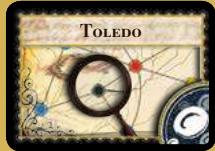


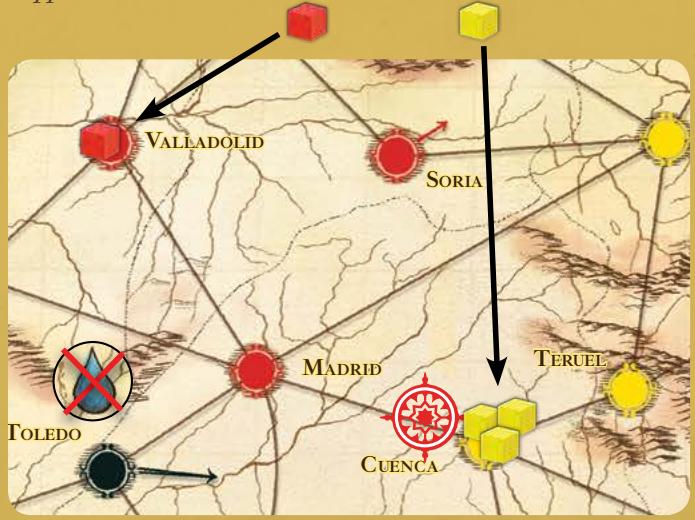
Play Example (cont.): Sonsoles ends her turn by infecting cities. The current infection rate is 3, so Sonsoles flips over the top 3 Infection cařds: Toledo, Valladolid, and Cuenca.
There is a purification token in a region adjacent to Toledo, so Sonsoles takes one of those off the board and discards the Toledo card.
Valladolid has a red cube on it, so Sonsoles adds a second red cube there and discards the Valladolid card.
The yellow disease has been researched but there are no purification tokens next to Cuenca, so Sonsoles must infect Cuënca. Since 3 yellow cubes are already in Cuenca, Sonsoles does not put a 4th cube there. Instead a yellow disease outbreak happens in Cuenca.
OUTBREAKS
When a disease outbreak occurs, move the outbreaks marker forward 1 space on the Outbreaks Track. Then, place 1 cube of the disease color on every city connected to the city (or remove a purification token if any). If any of them already has 3 cubes of the disease color, do not place a 4th cube in those cities. Instead, in each of them, a chain reaction outbreak occurs after the current outbreak is done.
When a chain reaction outbreak occurs, first move the outbreaks marker forward 1 space. Then, place cubes as above, except do not add a cube to cities that have already had an outbreak (or a chain reaction outbreak) as part of resolving the current Infection card.
As a result of outbreaks, a city may have disease cubes of multiple colors on it; up to 3 cubes of each color.
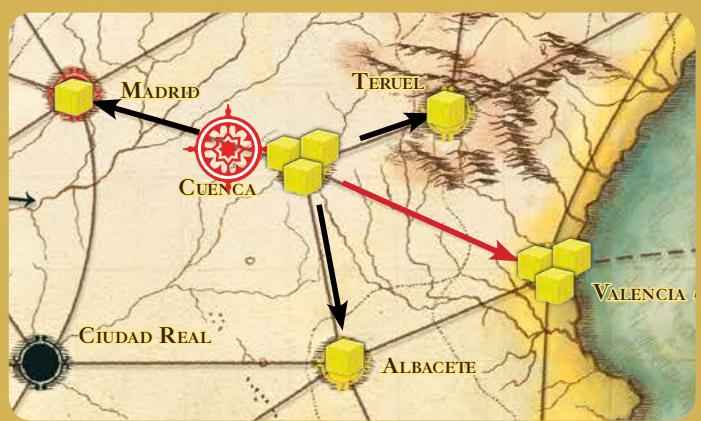
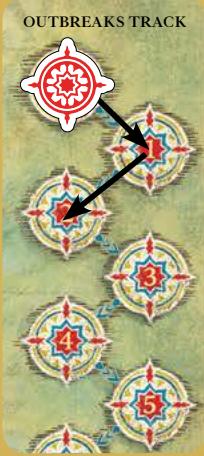
Play example (cont): A yellow disease outbreak happens iñ Cuenca. Soñsoles moves the outbreaks marker forward 1 space and places 1 yellow cube on every city connected tō Cuenca: Madrid, Teruel, Albacete, and Valencia.
Valencia already has 3 yellow cubes so Sonsoles does not place ā 4th cube there, instead a chain reaction outbreak occurs in Valencia.
Sonsoles moves the outbreaks marker forward 1 more space. She places 1 yellow cube on every city connected to Valencia – Tarragona, Alicante, Albacete, and Palma de Mallorca – but not Cuenca as Cuenca has already had an outbreak while resolving this Infection card.
Then, Sonsoles discards the Cuenca card.

TURN END
After infecting cities and discarding Infection cards, your turn is over. The player on your let begins a turn.
EVENT CARDS
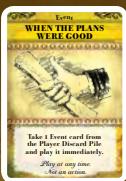
During a turn, any player may play Event cards. Playing an Event card is not an action. The player who plays an Event card decides how it is used.
Event cards can be played at any time, except in between drawing and resolving a card.
When 2 Epidemic cards are drawn together, events can be played after resolving the first epidemic.
Example: If, during infections, the first Infection card drawn causes an outbreak, you may not play the Travel Day and Night Event card to move the Nurse (añd her prevention token) to prevent this. After this outbreak happens, however, you may use the Travel Day and Night card to move the Nurse (to possibly protect other cities with her prevention token) before flipping over the next Infection card.
After playing an Event card, discard it to the Player Discard Pile.
PLAYER CARDS
Place your cards face up in front of you, for all players to see. Only Player cards count towards your hand limit. Your Role and your Reference cards are not part of your hand. Players may freely examine either discard pile at any time.
GAME END
The players win as soon all 4 diseases have been researched.
Once all diseases have been researched, the game ends and players win immediately, no matter how many cubes are on the board.
There are 3 ways for the game to end and the players to lose:
• if the outbreaks marker reaches the last space of the Outbreaks Track,
• if you are unable to place the number of disease cubes actually needed on the board, or
• if a player cannot draw 2 Player cards after doing their actions.
INFLUX OF PATIENTS CHALLENGE
This challenge simulates the rush of patients into the new, fledgling hospitals in the 19th Century Iberian Peninsula. In this period, hospitals were built for the treatment of specific diseases, and people tried to reach these cities in order to receive it.
SETUP
Use the setup rules for the base game with the following changes:
• Add the Influx of Patients Challenge reference card over the Play section of the board. This shows the new order of play, and will help you remember to take the new “Move patients" step each turn.
Play 1. Do 4 aclione 7ourds
• Only 6 purification tokens are available in the supply for use at the beginning of the game. Divide the remaining 8 purification tokens into 4 stacks of 2 tokens, placing a hospital on each stack.
PLAY
BUILDING HOSPITALS
Building a hospital now has additional benefits. Whenever you buid a hospital, after placing the hospital onto the board, do the following:
• Put the 2 purification tokens that were underneath the hospital into the supply. They are now available for use.
• Remove the disease cubes (matching the color of the hospital, if any) from the city where you buit the hospital and return them into the supply.
The downside to building hospitals, however, is that players must now move one disease cube (referred to as a “patient” from now on) toward each hospital each turn. This means that the hospitals can quickly become overrun with patients.
Move patients after doing actions, but before drawing Player cards, according to this new order of play:
- Do 4 actions
- Move patients (1 per color)
- Draw 2 Player cards
- Draw Infection cards
MOVING PATIENTS
During step 2, for each hospital, move the closest patient (i.e., disease cube) matching the color of the hospital 1 step toward it.
When counting distance to determine the closest patient, count line segments but ignore the railroad tokens. If there are 2 or more patients the same distance away, you may choose the patient to move from the closest patients.
When moving, patients will move the fastest way they can – which means they will take use railroads if it's the fastest means to reach the hospital. If there are 2 or more routes that take the same amount of time, you may choose the route the patient takes from the fastest routes. Moving
patients are not affected by purification tokens or the Nurse’s prevention token.
If moving a patient causes a city with a hospital to have 4 disease cubes of the same color, it is overrun. See Overrun Hospitals below.
If an outbreak happens in a city containing a hospital (by an Infection or Épidemic card) place the 4th disease cube into the city (a 5th or 6th cube of the same color are never placed), then follow the rules for Overrun Hospitals.
OVERRUN HOSPITALS
If a city with a hospital ever has 4 or more patients of the same color in it, the hospital is overrun and everyone flees the city. Instead of doing a normal outbreak when this happens, move every patient of that color in the city into adjacent cities. Players may decide which cities the cubes are moved to.
In some cases this may result in one or more outbreaks. When this happens, resolve the outbreaks normally. After moving cubes out of the city with the overrun hospital, mark an outbreak on the Outbreaks track.
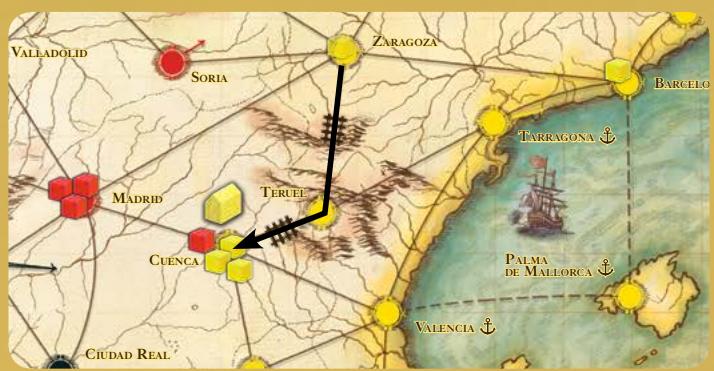
Play example: During the Move patients” step, Donna moves 1 patient (a yellow disease cube) ¯in Zaragoza toward the yellow hospital in Cuenca. She can’t mové the yellow cube in Barcelona since it’s further away. Since Zaragoza is connected to Cuenca by rail, Donna moves the patient directly to Cuenca. The city now has 4 cubes of a singlê color and is õverrun!
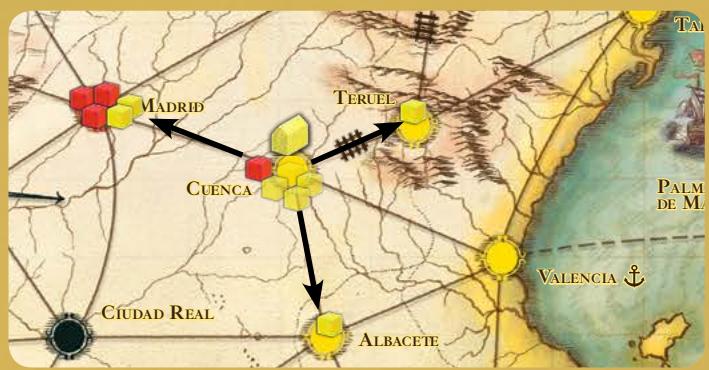
Donna takes all of the disease cubes in Cuenca and moves them into adjacent cities. She moves 2 yellow cubes into Madrid, 1 yellow cube into Turel, and 1 yellow cube into Albecete. (Šhe decides not to move one into Valencia.) She then moves the outbreak marker down by 1.
HISTORICAL DISEASES CHALLENGE
BACKGROUND
In this challenge you must fight as an experienced team against even more powerful diseases. Each disease will now appear with a different, terrible behavior: more dangerous outbreaks, more rapid infection, harder to treat... City life was not so easy in the 19th Century!
SETUP
Although many diseases devastated the world during 19th Century, only four of these dangerous enemies appear in this game. Àt the time, humanity began to learn how the diseases originated, how to fight them, and how to prevent them. And although these diseases have now been eliminated from much of the developed world, millions of people continue to suffer from them.
Shuffle the Disease cards and randomly select one, two, three, or four of them to play with. The more you select, the harder your game will be. (You might want to start with just one and gradually add more in future games as you get better at the game.) Place the cards you've randomly selected to the side of the board and the others back into the box.
PLAY
Play as usual, but note the special effects of the historical diseases that are now in play:

Huelva gets 2 black cubes wħen infected since it was free of black cubes.
When blue outbreaks, in addition to placing a blue cube in each city 1 connection away, place a blue cube in each city that is 2 connections away if there are no cubes in it.
The Vibrio cholerar bacteria arrived to Porto, in the northuest, in 8. Later it arrieed phrough the port of Vigo, firt in and later in 83, In mecuire apidemics, around 20 perent o the poalation was iaeted with a totul of more than 650,000 dead.
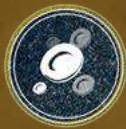
BLACK - MALARIA When infecting with black, whenever you would put 1 black cube into a city that has no black cubes in it, add 2 black cubes instead.

BLUE - CHOLERA When blue outbreaks, in addition to placing a blue cube in each city 1 connection away, place a blue cube in each city that is 2 connections away if there are no cubes (of any color) in it.
HARDER TO TREAT IN LARGER POPULATIONS If there is more than 1 red cube in a city, you must spend 2 actions to remove a red cube from it
Rickettsia bucteria was propaguted by liee, mites, fleas, or ticks, usuully in big and disasters or in cities destroyed by war.
It takes 2 actions to do the Treat Disease action to remove the first red disease cube from Madrid (since there are 2 or more cubes there) and 1 action to Treat the remaining cube.
RED - TYPHUS
If there is more than 1 red cube in a city, you must spend 2 actions to remove a red cube from it.

2 actions
Vellow Fever IARES R When a yellow cube is placed in a port city, you must place a yellow cube in all adjacent port cities as well.

1 action
The rirus was propagated by the mouquito Aedes aegypłi and oftea affected sea or river port cities. Outhreak were lcated ia Mediterrunan and soathern cities and were particulurly serious at the bagiaing of the ntury.
YELLOW – YELLOW FEVER When a yellow cube is placed in a port city, you must place yellow a cube in all adjacent port cities às well.
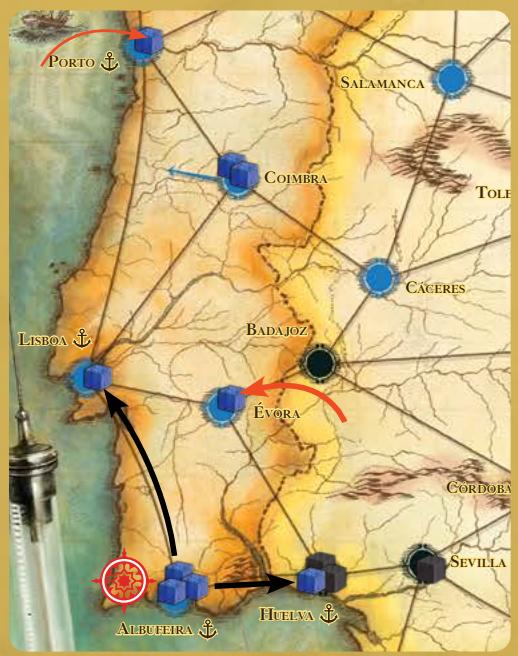
Albufeira outbreaks.
One cube is added to Lisboa and Huelva (as usual).
Then, an additional blue cube is added to Porto and Évora.
No cube is added to Coimbra or Sevilla since there are already cubes in those cities.
Valencia and Cartagena both get a yellow cube when Alicante is infected since they are both adjacent port cities.

HISTORICAL INFORMATIONS
EVENTS

GOOD SEASON
Epidemics and new disease outbreaks have decimated populations over the course of human history. Many terrible diseases have been controlled or even eradicated from some regions thanks to advances in science.

OVERSEAS MIGRATION In the last decade of the 19th century, Spain controlled some overseas territories: Islas Canarias, Ceuta, Melilla, Cuba, Puerto Rico, Filipinas, Guinea and Sahara Español, amongst others. Portugal had territories in Açores, Madeira, Africā (Cabo Verde, Guiné- Bissau, Angola, Moçambique), Índia Portuguesa (Goa, Damão), Macao, and Timor-Leste, amongst others. In the Peninsula, there was also a third but small country named Andorra, and a British colony, the City of Gibraltar.

GOVERNMENT
MOBILIZATION
The Royal Philanthropic Expedition was led by Doctor Francisco Javier de Balmis, a deputy surgeon, 3 nurses, 2 first-aid practitioners, 2 assistants, a rectoress, and 22 orphan boys.
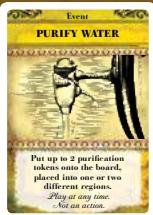
PURIFY WATER Asepsis—having clean food, water, and medical instruments—was one of the most important discoveries for fighting diseases and a powerful tool against infections.
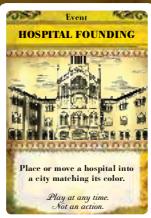
HOSPITAL FOUNDING There were specialized hospitals for every kind of illness. Sick people would move to a city for its hospital, although their capacity for curing them was very limited.

RING RAILROADS
In 1855, the General Law of Railroads
(Ley General de Caminos de Hierro) was the first plan to build a national train network, using à characteristically wider railroad than the rest of the European countries. In Portugal, the main railroad network was built from 1856 to 1890.
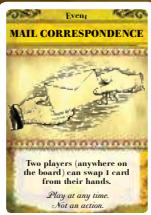
MAIL CORRESPONDENCE The postal mail business is as old as the Roman age. The first Spanish stamps were launched on January 1, 1850. In Portugal, stamps were approved two years later and started to be used in 1853.

SCIENCE TRIUMPH Humanity started to win against diseases thanks to many scientific and medical discoveries, mainly asepsis and the microbiologic origin o infectious diseases.

NEW RAILS
The first railroad and train travel in the Iberian Peninsula was from Barcelona to Mataro, inaugurated on October 28, 1848 (The first one in Spain was in Cuba in 1837). The first Portuguese railroad, from Lisboa to Carregado, was inaugurated on October 28, 1856.

SECOND CHANCE Different diseases struck cities one after another, or at the same time. As modern medicine advanced, so did life expectancy.

ONE MORE DAY
Researchers and scientists dedicated
many efforts to fight against diseases. The main scientific institutions were
universities and royal academic centers. When the first plans for public education started, around 90% of the adult
population was illiterate.

SHIPS ARRIVE Until the end of the 19th century, ships and boats were the fastest long-distance transports and the main way to move resources.
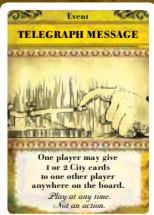
TELEGRAPH MESSAGE The first telegraph message in Spain, from Madrid to Irún, was a speech Queen Isabel II gave to inaugurate a new congress period on November 8, 1854. The public service of telegrams started on February 25, 1855. In 1855, a submarine line connected Lisboa to Açores Islands. Portuguese public service of telegrams started in 1857.

TRAVEL DAY AND NIGHT The main way of transport, before the train age, was carriages and coaches.

WHEN THE PLANS WEREGOOD
The Royal Philanthropic Expedition was a medical mission from 1803 to 1806. Its objective was to bring a smallpox vaccine to the overseas Spanish lands, carried inside the blood of 22 orphan boys. It was the first healthcare expedition in World history.
DISEASES
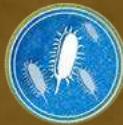
The Vibrio cholerae bacteria arrived to Porto, in the northwest, in 1832. Later it arrived through the port of Vigo, first in 1833 and later in 1853. In successive epidemics, around 20 percent of the population was infected, with a total of more than 650,000 dead.

TYPHUS
Rickettsia bacteria was propagated by lice, mites, fleas, or ticks, usually in big and dirty cities. It arose even more after
natural disasters or in cities destroyed by war.
MALARIA
The north of the Peninsula was free of this disease. Around 1880, humanity learned that it is caused by a Plasmodium protist and transmitted by female Anopheles mosquitoes. Malaria still kills millions of people in the world today.

YELLOW FEVER
The virus was propagated by the mosquito Aedes aegypti and often affected sea or river port cities. Outbreaks were located in Mediterranean and southern cities and were particularly serious at the beginning of the 19th century.
FINE POINTS AND REMINDERS
• If a disease has been researched, you still only remove 1 cube when you do the Treat Disease action.
• You may use cards matching the color of a researched disease to do the Purify Water action in an adjacent region.
• You do not draw a replacement card after drawing an Epidemic card.
• On your turn, you may take a card from another player, if you are both in the city that matches the taken card.
• Your hand limit applies at all times, including after you receive a card from another player.

ROLES
Each player has a role with special abilities to improve your team's chances.

AGRONOMIST
• Spend an action to place a purification tôken into an adjacênt region.
• As an action, place 1 purification token
into an adjacent region ou do the Purify Water action, onal purification
• When doing the Purify Water action, you may place 1 additional purification token into the region.

• As an action, give a City card to another plņer in any city. You must be in the city matching the passed eard. • As an action, swap a Gity card in your hand with a City card in the Player Discard File. You must be in a city matching one of the swapped cards
POLITICIAN
• Spend an action to give a City card to another player in any City. You must be in the city matching the card that is passed.
• Spend an action to swap a City card in your hand with a City card in the discard pile. You must be in a city matching one of the cards that is swapped.

• When you do the Purify Water action, spend any City card, regardle pick up the next 3 cards layer Deck. Rearrange them and put them back on top of
RAILWAYMAN
NURSE
• No discase cubes may be added in cities adjacent to your prevention token
• Your role comes with a prevention token. Put your prevention token into a region adjacent to your city during setup. Cities adjacent to your prevention token cannot be infected.
• Once per turn, when you do the Build Railroad action, you may place two consecutive railroad tokens starting from your current city.
• Your prevention token always travels with you. Whenever you (or anyone else) moves your pawn for any reason, immediately put your prevention token into a region adjacent to your pawn.
• When you Move by Train, you make take one passenger (a pawn in your city) with you.
ROYAL ACADEMY SCIENTIST
• When you do the Purify Water action, you måy play any City card, regardless of color.
• Spend an action to pick up the next 3 Player cards. Rearrange them as you like, then place them back on top of the Player Dečk.
RURAL DOCTOR
When you do the Treat Disease action, remove one cube from your city, and one additional cube from your city or from a different city in an adjacent region.

SAILOR
• When you do the Move by Ship action,
do not spend a card.
• When you do the Move by Ship action
you may take one pawn in your city with you
• When you Move by Ship, do not spend a card.
• When you Move by Ship you may take one passenger (a pawn in your city) with you.
CREDITS
Game design: Jesús Torres Castro and Matt Leacock Artwork: Atha Kanaani and Chris Quilliams Graphic Design: Philippe Guérin and Karla Ron Rules layout: Marie-Elaine Bérubé Editing: Jean-François Gagné Special thanks to Beth Heile and John Knoerzer Special thanks to everybody at Jugamos Tod @s
Playtesters: Colleen and Donna Leacock, David P., Enrique B., María B., Rafael N., Javi A., Pili M., Luis O., Ana M., Carlos M., Joaquín O., Sandra M., José Luis A., Marta M., Adrián J., Diego G., Silvia M., David A., Juan Carlos J., Emilio M., Elena Z. Rafa M., Álvaro L., JuanFran L., Elena M., Nacho E., Isaac A., Alberto M., Antonio V., Rafa S., Juan L., Maqui N., Jokin G., Sara S., Antonio R., Patricia, Dirk, Barbara, Raúl & Sonso.
© 2016 F2Z Entertainment Inc. 31 rue de la Coopérative Rigaud QC JOP 1PO Canada
下载 Markdown原文为社区整理/出版社公开资料,版权归原作者,仅供个人学习查阅。