
百分直觉Illusion
一句话概览
百分直觉 是一款已收录于村了吗规则库的桌游,支持 2–5 人,原名 Illusion。
本页内容:一句话概览 · 常见问题
这游戏怎么玩
- 本站已收录这款游戏的规则资料,可以在对话里直接提问规则细节。
常见问题(FAQ)
以下 1 条问答中 0 条来自站内玩家的真实提问,其余 1 条为本站整理的常见疑问;答复内容保持原样。
百分直觉支持几个人玩?
2–5 人。
去哪查完整规则
想核对具体规则细节、卡牌效果或某个回合的结算方式,可以在村了吗里选中这款游戏后直接提问。
同类桌游
- 卡坦岛德式
- 工业革命:伯明翰德式
- 勃艮第城堡:特别典藏版德式
- 方舟动物园德式
- 卡卡颂抽象
- 瘟疫危机传承:第一季美式
- 阿瑞迪亚:勇踏征途美式
- 重塑宇宙德式
- 幽港迷城美式
- 埃多拉的德鲁伊德式
规则原文(Markdown)
本站收录这款游戏的规则原文 1 个文件,此处内联渲染 1 个,可直接展开阅读或下载。
Illusion_PandaS_rule.md6.6 KB

W o l f g a n g W a r s c h Warsch
Can you trust your eyes?

Players: 2-4
Age: 8 +
Duration: app. 20 min.
Contents
12 arrow cards

98 color cards
3 each in yellow, red, green and blue
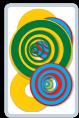
front
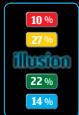
back
The information on the back of each color card indicates what percentage of the card is represented by each color. Note: The percentage values relate to the printable white area on the card (the grey border is not included).
Game concept
In each round, an arrow determines which color is being played. Following the direction of the arrow, a row of cards is formed in which the proportion of the designated color on each card must get progressively higher following the direction of the arrow (equal values are also correct).

The green proportion must become progressively higher from card to card, following the direction of the arrow. Immediately next to the arrow, just a small amount of green can be seen. On the following card, there is already significantly more. On the third card, quite a lot of green is apparent and all the way over on the right, there is a huge amount. All correct so far!
As each player takes their turn, they must decide either to query the validity of the entire row so far or they must take an additional color card from the deck and insert it (hopefully correctly) into the row.
Preparing the game
The 12 arrow cards are shuffled and placed face down on the edge of the table. The top arrow card is turned over and placed face up in the center of the table. The 98 color cards are also shuffled and are placed with the color side facing up in a deck on the edge of the table, alongside the stack of arrow cards. The top color card is taken from the deck and placed face up next to the arrow in the center of the table. Warning: The back of the color card (percentage information) must not be seen.

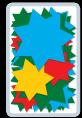
The top arrow card (red) is turned over and placed in the center of the table. The top color card from the deck is placed alongside.
Course of the game
Lots are drawn to decide who should start. The relevant player takes the top card from the color card deck and must place it alongside the color card which is already there, either to the right or to the left (in front), following the direction of the arrow. Very important: It is crucial to prevent the back of the card with the percentage information being seen.

Tim takes the topmost color card from the deck and places it to the left of the card which is already there. By doing this, Tim suggests that the proportion of red increases from left to right.
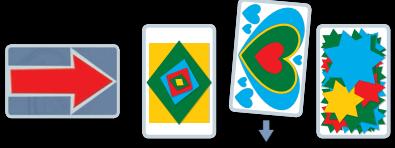
Now it is the turn of the next player in a clockwise direction. They must decide whether they believe the order to be correct for the entire row so far, or whether they would like to question the validity of the entire row.
k If the player believes that the entire row is correct, they take the top color card from the deck and insert it into the existing row: all the way to the left, or all the way to the right, or between two cards. After the new card has been inserted, the cards can be realigned so they lie neatly in sequence. Note: It is not permitted to retrospectively swap any cards which were played earlier.
Sarah takes the next color card from the deck and places it between the cards which have already been played.
Now it is the turn of the next player in a clockwise direction, and they must decide for themselves whether they believe that the order is correct for the entire row so far, or whether they would like to question the validity of the entire row. Provided no-one questions the sequence, play continues in a clockwise direction, as described, with the row growing by one card after each player’s turn.
mll
Lucas and Emma take their turns one after the other, and each of them inserts a color card into the row.
k If it comes to a player’s turn and they do not believe in the validity of the entire row, they must say loudly and clearly “I don’t believe it”. When this happens, all the cards played so far are turned over and the percentage values are inspected to work out whether or not the sequence was correct. The row is deemed to be correct, if the percentage values get progressively higher from left to right following the direction of the colour arrow. Note: If two immediately adjacent cards have identical percentage values, this is considered to be correct.

4%
%28
illusion
%27
%6
9 % %6 illusion %26 %32

21 %
%3
illusion
%15
%37
Tim does not believe Emma that the entire row is correct and he declares his suspicion. All five cards are turned over. And indeed, after 16% comes a lower value (11%) - that is an error.
k If the player queries correctly, i.e. there was at least one error in the row (regardless of who actually committed this error!), the questioning player receives the arrow card as a reward. Tim queried the row correctly and receives the red arrow card as his reward.
k If the player makes an incorrect query (i.e. the entire row was correct), then the arrow card is awarded to the player who put down the final color card immediately before the questioning player.
Ongoing course of play + end of the game
All the color cards are removed from the center of the table and are no longer required. Now the next round is played. The game is prepared and the next round played exactly as described above. The new round begins with the player who previously received the arrow card. Further rounds are played in the manner described until someone obtains 3 arrow cards - that player is the winner. Of course, you could also play 12 rounds. Then the winner is the player with the most arrow cards.
下载 Markdown原文为社区整理/出版社公开资料,版权归原作者,仅供个人学习查阅。