
印何阗Imhotep
一句话概览
印何阗 是一款已收录于村了吗规则库的桌游,支持 2–4 人,原名 Imhotep。
本页内容:一句话概览 · 游戏概述 · 1. 游戏组件 · 2. 游戏设置 · 3. 游戏流程 · 4. 五种地点详解 · 5. 船型一览 · 6. 规则变体 · 7. 市场卡总览 · 8. 关键规则与常见问题 · 常见问题
印何阗 规则速览
以下规则速览由本站整理,与官方规则书表述不同,仅供快速上手参考。
游戏概述
印何阗(Imhotep)是埃及最早的知名建筑师,被视作人类历史上第一位通才。你扮演这位建筑师,负责建造塞加拉的左塞尔金字塔——但你不是唯一在建的人,对手同样在争夺珍稀石材,一场竞争激烈的建造大战就此展开。
核心机制: 工人放置、骰子变量(船型)、手牌管理、资源转换
1. 游戏组件
| 组件 | 数量/说明 |
|---|---|
| 石头 | 120 枚(黑、白、褐、灰各 30 枚) |
| 地点图板 | 5 块(每块正反面分别为 A/B 面) |
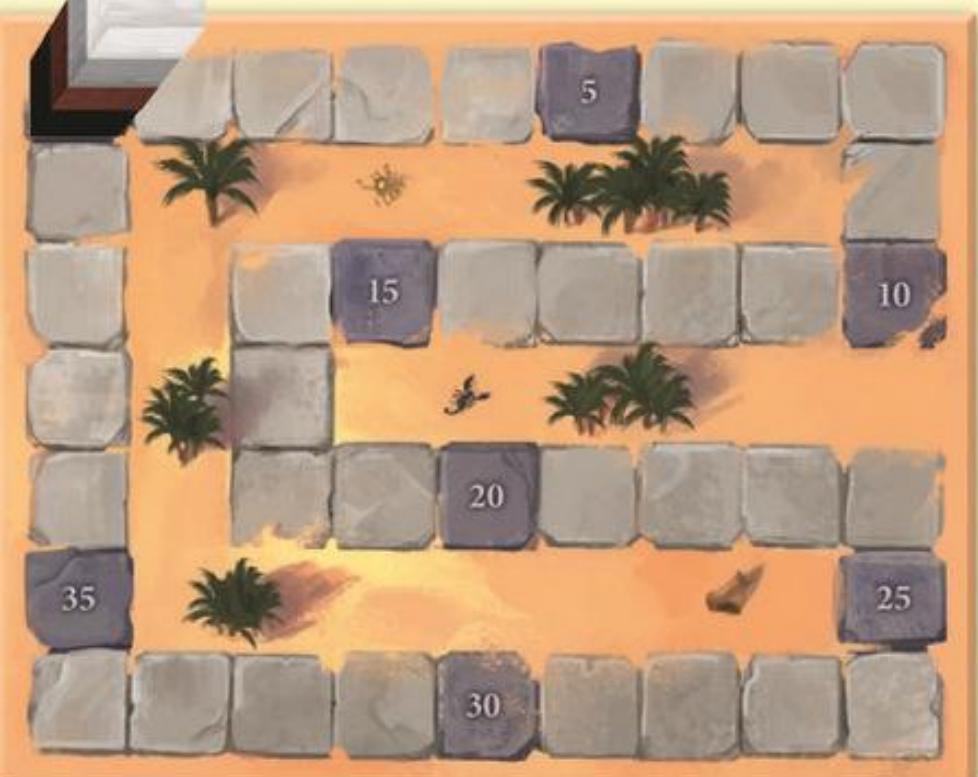
| 计分轨道 | 1 块(含 0~40 刻度) |
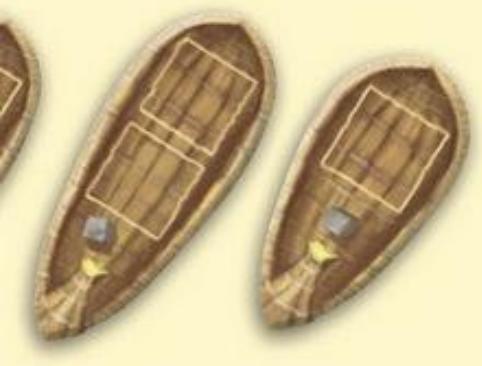
| 船板块 | 8 块(容量分别为:4 格×2、3 格×3、2 格×2、1 格×1) |
| 供应面板 | 4 块(每色 1 块,对应 4 种玩家颜色) |
| 轮数卡 | 21 张(7 张 2 人用、7 张 3 人用、7 张 4 人用;底部有对应人数图标) |
| 市场卡 | 34 张 |
| 矿场 | 所有未使用的石头集中存放的区域 |
2. 游戏设置
2.1 版图设置
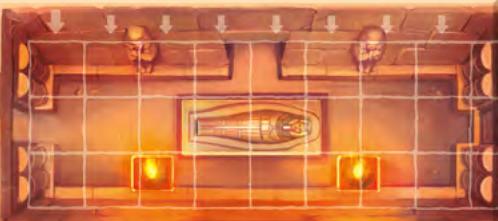
- 将 5 块地点图板置于场中央,A 面朝上(首次游戏使用 A 面)。
- 计分轨道放在地点图板右侧。
- 8 块船板块叠放在地点图板上方。
- 将卡片分为两堆:21 张轮数卡为轮数卡堆,34 张市场卡为市场卡堆。
- 洗匀市场卡堆,置于"A 市场"图板的右侧。
2.2 轮数卡设置
- 根据玩家人数选取对应人数的 7 张轮数卡:
- 2 人游戏: 底部带 2 个人头图标的 7 张
- 3 人游戏: 底部带 3 个人头图标的 7 张
- 4 人游戏: 底部带 4 个人头图标的 7 张
- 从选定的 7 张中随机移除 1 张(因游戏仅进行 6 轮),剩余 6 张洗匀后正面朝下码放为轮数牌库。多余卡牌放回盒中。
- 轮数牌库摆放在船板块旁。
2.3 玩家设置
- 每位玩家选择一种颜色(黑、白、褐或灰),取对应颜色的供应面板。
- 所有石头放入地点图板右侧作为矿场。
- 少于 4 人时,未使用的供应面板和对应颜色的石头放回盒中。
- 每位玩家将 1 枚己色石头放在计分轨道「0 / 40」起始位。
2.4 起始玩家与初始资源
- 决定起始玩家。
- 依次从矿场拿取石头放到自己的供应面板上:
- 起始玩家:2 枚
- 顺时针下一位:3 枚
- 再下一位:4 枚
- 最后一位(仅 4 人局):5 枚
- 供应面板最多容纳 5 枚石头。
3. 游戏流程
游戏共进行 6 轮。每轮由翻卡阶段和多个回合构成。每轮开始时由当前起始玩家率先行动,轮到你时执行一种行动;四轮船只全部发出后该轮结束。上一轮打出最后一艘船的玩家,其左手边玩家成为下一轮的起始玩家。
3.1 每轮开始
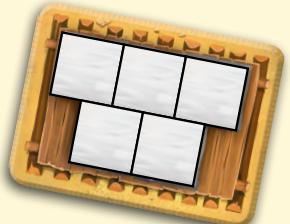
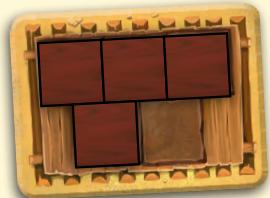
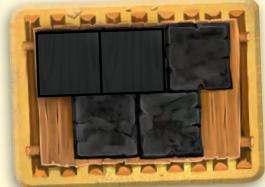
- 翻出船: 翻开轮数牌库顶部的轮数卡,根据卡面指示取出对应数量的船板块(如 1 艘 4 格船 + 1 艘 3 格船 + 2 艘 2 格船),将它们并排摆在地点图板左侧。本轮仅开放这 4 艘船。
- 发市场卡: 从市场卡堆顶部翻开 4 张市场卡,置于市场区。若牌堆耗尽,则洗牌重组成新牌堆。
- 自此进入回合阶段,玩家依次行动。
3.2 回合行动
轮到你的回合时,从以下 4 种行动中任选 1 种执行:
行动 A —— 获取石头
从矿场拿取 3 枚石头放到你的供应面板上。
- 供应面板上限 5 枚。若当前已有 4 枚,本行动只得 1 枚;若仅有 3 枚可放,则可拿满至 5 枚而非全拿。
- 若矿场已无石头,不能执行此行动。
行动 B —— 装载石头入船
从你的供应面板取 1 枚石头,放置到任意一艘尚未发出的船的空槽位中。
- 只有本轮摆放的 4 艘船可用,已发出或未摆出的船不可操作。
- 每次只能装 1 枚石头。
行动 C —— 派船前往地点
将一艘船上尚未发出的船驶往一个地点,船上石头就地卸入该地点结算。必须同时满足两个条件:
- 达到最低载量: 船头显示的灰色石头图标为该船的最小载客量,船上已有石头数须 ≥ 该值才能发出。
- 目的地未被占用: 该地点在本轮尚未有其他船抵达——即每轮同一地点最多停靠 1 艘船。
石头卸下顺序:从船头方向的前方石头起依次放置(忽略空槽位)。
- 市场和金字塔立即结算。
- 神庙在本轮结束时统一结算。
- 墓穴和方尖碑仅在游戏结束时结算。
> 提示:即使某船为空,只要满足最低载量和目的地开放的两大条件,依然可以派遣它出发。
行动 D —— 打出蓝色市场卡
如果你持有蓝色市场卡,可在你的回合内使用一张,替代上述行动 B 或 C 的效果(不能替代行动 A)。蓝色市场卡不是额外行动——它是行动 B 或 C 的增强版。使用后将卡片置入弃牌堆。每回合限用 1 张蓝色市场卡。
> 见第 8 节「市场卡说明」。
3.3 每轮结束
当 4 艘船全部发出后,本轮结束:
- 结算神庙——从上方俯瞰,每一格最顶层可见的石头为持有人计 1 分(被上层覆盖的石头不记分)。
- 将本轮发出的 4 艘船收回船板块供应区。
- 将市场上剩余的 4 张市场卡清空,置入弃牌堆。
- 下一轮开始(见 3.1)。
3.4 最终计分
6 轮结束后,游戏结束。计分顺序:
- 墓穴计分(逐组相连石头计分)。
- 方尖碑计分(按高度排名计分)。
- 市场「装饰套装」卡计分——每个地点每累计 3 枚石头(含他人),你得 1 分。
- 市场「雕像」卡计分——按持有数量查表得分。
- 未使用的蓝色市场卡每张值 1 分。
总分最高者获胜。平局时比较各方供应面板上剩余石头数量,剩余多者胜出;若仍平局,共享胜利。
4. 五种地点详解
4.1 市场
每运送 1 枚石头到市场,持有该石头者即可从市场卡堆顶抽取 1 张市场卡(红色卡除外)。
- 抽到的卡立即置于面前。
- 红色卡须立即使用其效果,然后置入弃牌堆。
- 蓝色卡在手牌中保留,于后续回合的行动 D 中使用。
- 紫色「雕像」卡和绿色「装饰套装」卡留待游戏结束时计分。
- 卸货后,所有运抵市场的石头放回矿场。
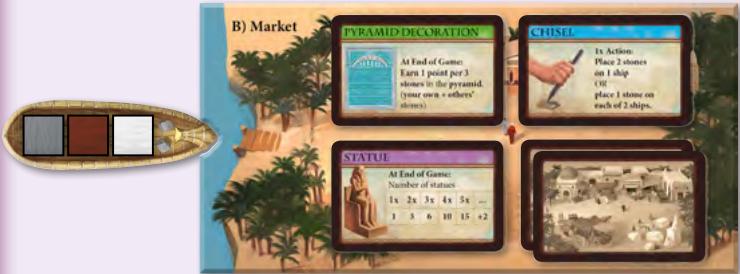
B 面区别: 每轮开始此时,在市场区固定放置 2 张正面朝下的卡。运石到此地时,你可同时查看 2 张,挑选其中 1 张收入手中,另 1 张置入弃牌堆。
4.2 金字塔
每枚放入金字塔的石头立即给持有人计 1 分,石头依序放置到下一个开放格子中。
A 面规则:
- 放置顺序:先填满左列从上到下,再填中间列从上到下,最后填右列。
- 金字塔分为 3 层:
- 第 1 层: 共 9 格。每个格子内的分值不等。
- 第 2 层: 共 4 格,分数更高。
- 第 3 层: 仅 1 格,分数最高。
- 金字塔建成(三层全部填满)后,之后任何运抵的石头像右侧延伸区域放置,每枚计 1 分。
B 面区别: 场上存在 3 座独立的小金字塔。你自由决定将石头放入哪一座。某些格子内含特殊奖励(抽 1 张市场卡、从矿场获取 3 枚石头入供应面板、或将 1 枚石头装入任意船的剩余空槽)。完成全部 3 座金字塔后,后续运至此地的石头均计 1 分。
4.3 神庙
将石头依次放入神庙的下一个开放位置——从左侧开始、下层优先、逐层推进。每层的格子数为:
- 2 人局: 每层 4 格
- 3 / 4 人局: 每层 5 格
没有高度限制,可无限叠加。
结算时机: 每轮结束时统一结算。
从上方俯瞰,每个最顶层可见的格子中的 1 枚石头给持有人计 1 分。被上层覆盖的石头不产生分数。
> 示例:一轮结束时若神庙共有 7 枚石头——底层 5 枚已被覆盖,第 2 层前 2 格各有 1 枚,则仅有第 2 层的 2 枚可见,分别计分。
B 面区别: 每格带有不同奖励标识,可见石头可选择以下一项:
- 获得 1 分,或者从矿场拿取 2 枚石头放入供应面板。
- 获得 2 分。
- 从牌库抽 1 张市场卡。
4.4 墓穴
将石头依序放置——自左列顶端起逐列向下填充,向右依次延伸。墓地右侧格数为无限,可向外拓展。
结算时机: 游戏结束时计分。
同色石头在同一列中连续排列(对角线不算连接)形成一组,按组内石头数量计分:
| 连续石头数 | 1 | 2 | 3 | 4 | 5 | 6+ |
|---|---|---|---|---|---|---|
| 分值 | 1 | 3 | 6 | 10 | 15 | +2/枚 |
超过 5 枚后,每多 1 枚追加 2 分。
- 每条列中,每组同色连续石头的全部组别都会独立计分,并非只取最大的一组。
B 面区别: 以横行为单位分别计分。每行的最高分规则为:在该行拥有最多石头的玩家得第一名分数(8 分),其次得第二名分数(4 分),以此类推。同行并列者平分名次分数(去掉小数后的整数)。要在某行参与计分,该行至少得有 1 枚自己的石头。同色石头在同列中不得相邻。
4.5 方尖碑
每位玩家为自己颜色的方格堆叠石头,每人建自己的「方尖碑」。
结算时机: 游戏结束时计分。
前提:方尖碑板上至少有 1 枚你的石头才可参与计分。
2 人计分: 最高 10 分,次高 1 分。
3 人计分: 最高 12 分,次高 6 分,第三 1 分。
4 人计分: 最高 15 分,次高 10 分,第三 5 分,第四 1 分。
并列处理:并列玩家合并所占名次的分数总和后除以人数,取整数(去掉小数部分)。
> 示例:四人局,黑白方尖碑均为 3 枚,白色为 4 枚,褐色为 0。白色得 15 分(第一名)。黑白并列第 2~3 名,合并分数 (10+5)/2=7.5 → 各得 7 分。褐色无石头,不得分。
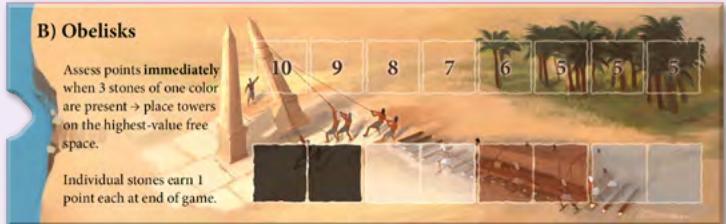
B 面区别: 每集齐 3 枚同色石头,即刻计分并移走——这 3 枚叠为一叠,放到当前分数值最高且未占用的方格处,玩家立刻获得该格分数。此后继续积累:每再过 3 枚再触发一次。例如:3 枚时得 3 分,6 枚时累计得 3+6=9 分,9 枚时累计得 3+6+9=18 分……(第 N 组得 3N 分。)
5. 船型一览
| 船型 | 容量 | 最低载量 | 本轮出现次数 |
|---|---|---|---|
| 大型船 | 4 格 | 4 枚 | 每轮 1 艘 |
| 中型船 | 3 格 | 3 枚 | 每轮 1 艘 |
| 中小型船 | 2 格 | 2 枚 | 每轮 2 艘 |
| 小型船 | 1 格 | 1 枚 | 视轮数卡而定 |
每轮由轮数卡指定哪些船型上桌。每轮 4 艘船对应 5 个地点中的 4 个——必有一个地点本轮无船可达。
6. 规则变体
6.1 B 面地点
每块地点图板均有正反两面。建议首轮只用 A 面熟悉规则,后续可切换 B 面,或自由混合搭配使用。
6.2 法老王的愤怒(进阶难度)
若你想增加挑战性,可加入此惩罚规则:
在游戏结束时,检查以下四个地点——金字塔、神庙、墓穴、方尖碑:
- 任一地点若没有任何一枚石头来自你(即从未向该地点发送过任何船只),则该玩家扣 5 分。
- 注意:市场不计入此惩罚检查范围。
7. 市场卡总览
共计 34 张,分布如下:
即时效果卡(红色)——共 6 张
| 卡牌 | 数量 | 效果 |
|---|---|---|
| 入口卡 | 2 张 | 立刻从矿场拿 1 枚石头放到指定地点,置入弃牌堆 |
| 石棺卡 | 2 张 | 同上 |
| 铺路石板卡 | 2 张 | 同上 |
装饰套装卡(绿色)——共 8 张
| 卡牌 | 数量 | 效果 |
|---|---|---|
| 金字塔装饰卡 | 2 张 | 游戏结束时,金字塔中每 3 枚石头(含他人)计 1 分 |
| 神庙装饰卡 | 2 张 | 同上,统计神庙 |
| 墓穴装饰卡 | 2 张 | 同上,统计墓穴 |
| 方尖碑装饰卡 | 2 张 | 同上,统计方尖碑 |
雕像卡(紫色)——共 10 张
拥有越多越好。游戏结束时按持有数量计分:
| 持有数量 | 1 | 2 | 3 | 4 | 5 | 6 | 7+ |
|---|---|---|---|---|---|---|---|
| 分值 | 2 | 4 | 6 | 8 | 10 | 12 | +2/张 |
蓝色市场卡(行动增强)——共 10 张
每张可在后续回合使用一次,取代行动 B 或 C。若最终未使用,游戏结束时每张值 1 分。
| 卡牌名称 | 数量 | 效果 |
|---|---|---|
| 杠杆卡 | 2 张 | 执行行动 C(派船)。可自行决定船上石头的卸货顺序。 |
| 锤子卡 | 2 张 | 执行行动 A+C 的组合:先从矿场拿 3 枚石头入供应面板,再从供应面板取 1 枚放入任意一艘未发出的船上。 |
| 远航卡 | 3 张 | 执行行动 B+C 的组合:将 1 枚石头装入 1 艘船,随即派出这艘船前往一个地点(须满足两个发船条件)。 |
| 凿子卡 | 3 张 | 执行行动 B:将 2 枚石头装入同一艘船,或分别装入两艘不同的船(每艘各 1 枚)。 |
8. 关键规则与常见问题
易错规则
- 每轮仅开放 4 艘船,故每轮有 1 个地点不可达。 策略上需取舍。
- 每次行动仅能执行 1 种。 蓝色市场卡是对行动 B/C 的增强,不能拿来代替行动 A。
- 供应面板上限 5 枚。 不够放 3 枚时,能拿多少拿多少。
- 每轮同一地点只停靠 1 艘船。 先到先得,后出牌的玩家若选择同一地点则不可行。
- 运到市场的石头返回矿场。 不要误以为留在市场结算。
- 金字塔得分看格子标记的分值,非固定等值。 务必看清每个格子标了几分。
- 墓穴 B 面禁止同列同色相邻。 违反此规则可能影响计分。
- 方尖碑必须有石头才可参与终局计分。 一片空白则一分不得。
- 方尖碑并列分数去掉小数取整。 如 (10+5)÷2=7.5→7 分,而非四舍五入。
- 市场卡「装饰套装」统计所有石头。 不只是你自己的,他人的也算在内。
常见问题
- Q:神庙何时计分?
A:每轮结束时统一结算,非即时计分。可见的是每一列最顶层的石头。
- Q:金字塔的放置顺序是什么?
A:A 面从左列顶端开始逐列向下填充,填满左列→中列→右列。三层依次为 9、4、1 格。
- Q:船为空也可以派出去吗?
A:可以。只要满足最低载量和目的地未占用两项条件即可。但空船无法得分,不建议浪费。
- Q:如果我的供应面板已满 5 枚,还能执行获取石头行动吗?
A:不能。供应面板已达上限,无法再多拿石头。
- Q:蓝色市场卡可以累积多张一起用吗?
A:可以。每张蓝色卡在手牌中保留,可在各自回合分别使用。未使用的在终局每张计 1 分。
- Q:方尖碑 B 面 3 枚一组的计分是累加的吗?
A:是的。第 1 组(3 枚)得 3 分,第 2 组(6 枚总计)再得 6 分,第 3 组(9 枚总计)再得 9 分,以此类推。
- Q:「法老王的愤怒」变体会惩罚市场的石头收集吗?
A:不会。惩罚仅针对金字塔、神庙、墓穴、方尖碑四个地点,市场不在其列。
常见问题(FAQ)
以下 1 条问答中 0 条来自站内玩家的真实提问,其余 1 条为本站整理的常见疑问;答复内容保持原样。
印何阗支持几个人玩?
2–4 人。
去哪查完整规则
想核对具体规则细节、卡牌效果或某个回合的结算方式,可以在村了吗里选中这款游戏后直接提问。
同类桌游
- 卡坦岛德式
- 工业革命:伯明翰德式
- 勃艮第城堡:特别典藏版德式
- 方舟动物园德式
- 卡卡颂抽象
- 瘟疫危机传承:第一季美式
- 阿瑞迪亚:勇踏征途美式
- 重塑宇宙德式
- 幽港迷城美式
- 埃多拉的德鲁伊德式
规则原文(Markdown)
本站收录这款游戏的规则原文 3 个文件,此处内联渲染 3 个,可直接展开阅读或下载。
rules_zh_印何阗_1268.md28.8 KB
PHIL WALKER-HARDING
IMHOTEP
BAUMEISTER ÄGYPTENS
FÜR 2–4 SPIELER AB 10 JAHREN
印何闐
埃及建築師
中文規則書 翻譯/排版:小柴
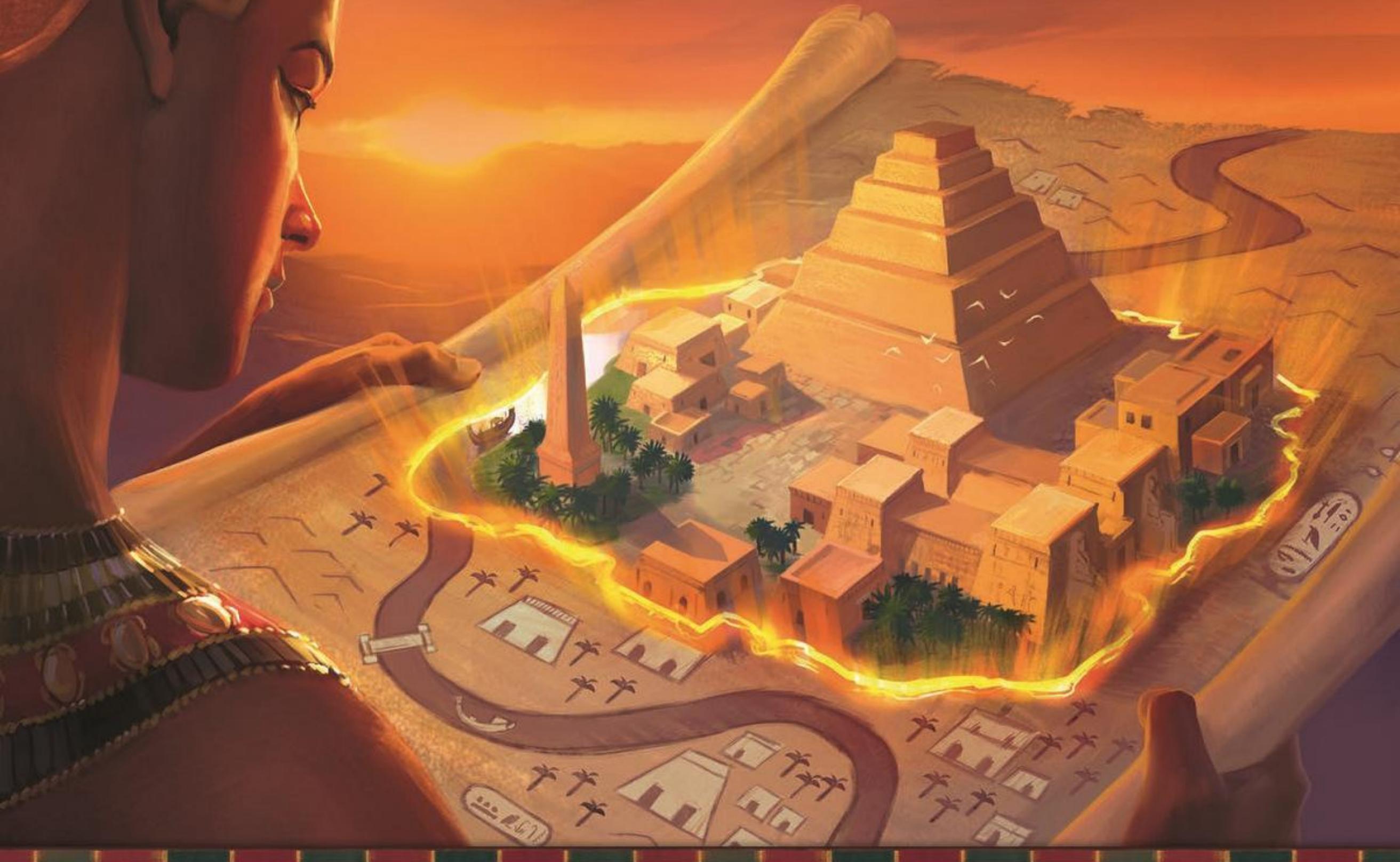
遊戲背景
印何闔是埃及最早也最知名的建築師,他被視爲是人類歷史上第一個通才之一。所以他被任命爲負責建造埃及最早的金字塔建築,也就是位於賽加拉的左塞爾金字塔。你能像印何闔一樣,創造出永垂不朽的金字塔嗎?
為了建造金字塔,你必須用船把來自各地的石頭運送過來。但是你決定不要獨自運送載著石頭的船。你的對手有不同的計畫,並且想要阻止你成功,珍貴石頭的爭奪戰一觸即發。只有正確的戰術以及一點好運才能取勝。
1 Punkt pro Stein, der von oben sichtbar ist
遊戲目標
每個玩家扮演一位埃及建築師。在6輪的遊戲中,你嘗試從五個不同的地方運送石頭並建造金字塔以獲得最多的分數。輪到你的回合時,你選擇以下四種行動的其中一種執行:
·獲得新的石頭
· 把 1 個石頭放在一艘船上
· 把 1 艘船開往一個地點
· 打出 1 張藍色的市場卡
把石頭運到不同的地點可以獲得許多分數:有的給予很多分數、有的很少,有些會立即給分,有些則在一輪結束或遊戲結束後給分。6輪後,最高分的玩家獲勝。
遊戲配件
120個石頭(4種玩家顏色各30個:黑色、白色、褐色,以及灰色)
5個地點圖板
1個計分圖板
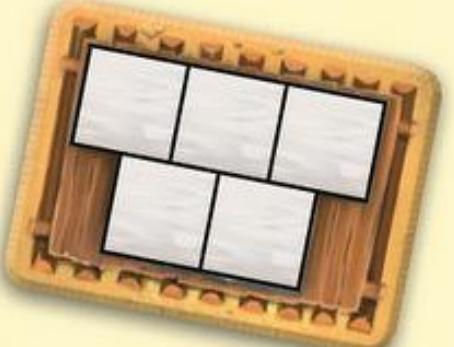
8個船板塊
4 個供應板塊(4 種玩家顏色各 1 個:黑色、白色、褐色,以及灰色)
21 輪數卡
34張市場卡
地點圖板
船板塊



供應板塊

輪數卡


市場卡

礦場
(所有玩家的石頭)
計分圖板
(你可以獲得超過40分。如果你超過40分,把你的石頭繼續往前移動,請記得你已經繞了一圈。)
起始玩家
(供應板塊上有2個石頭)
遊戲設置
- 把 5 個地點圖板放到場中央,如圖所示。所有的地點圖板都有 A 面和 B 面。你們的第一場遊戲我們建議用 A 面進行遊戲,之後的遊戲可以使用 B 面。
所以第一場遊戲先把地點圖板以A面朝上放置。
· 把計分圖板放到地點圖板的右側。
· 把 8 個船板塊放到地點圖板上方。
· 把卡片分成一個 21 張輪數卡的牌庫以及一個 34 張市場卡的牌庫。
· 洗混 3 4 張市場卡的牌庫並把它放到「A市場」的右側。
· 2人、3人以及4人遊戲各有7張輪數卡。
卡片底部有2個人頭的7張輪數卡用於2人遊戲。
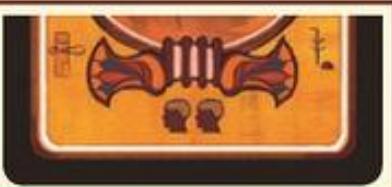
卡片底部有3個人頭的7張輪數卡用於3人遊戲。
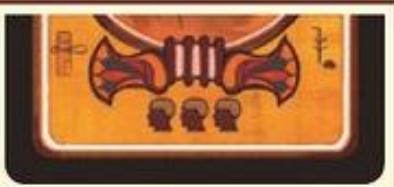
卡片底部有 4 個人頭的 7 張輪數卡用於 4 人遊戲。

使用對應玩家人數的7張輪數卡。剩餘的14張輪數卡遊戲中不會用到,把它們放回遊戲盒中。
因爲遊戲只進行6輪,所以現在必須隨機移除其中1張輪數卡,然後把這張輪數卡也放回遊戲盒中。
洗混剩餘的6張輪數卡,並把它們組成正面朝下的牌庫並放到8個船板塊旁。
· 每個玩家挑選一種顏色(黑色、白色、褐色,或是灰色)並且拿取對應顏色的供應板塊。
· 所有的石頭放到地點圖板右側組成礦場。
· 如果遊戲人數少於 4 人,把沒有用到的供應板塊以及石頭放回遊戲盒中。
·每個玩家把他所屬顏色的1個石頭放到計分圖板上「0/40」那一格。
· 決定一個起始玩家,起始玩家從礦場拿取2個石頭,並把它們放到他的供應圖板上。起始玩家左手邊的玩家拿取3個石頭並放到他的供應圖板上,第三位玩家拿取4個石頭,而第四位玩家拿取5個石頭,依此類推。
遊戲進行
遊戲進行6輪。
一輪流程
每輪按照以下流程進行:
· 每輪一開始翻開最上面的輪數卡,該張卡上顯示這一輪開放哪4個船板塊。把這些船板塊放到地點圖板左側。船上會有不等數量的空間可以放置石頭:
4個石頭兩艘、3個石頭三艘、2個石頭兩艘,以及1個石頭一艘。
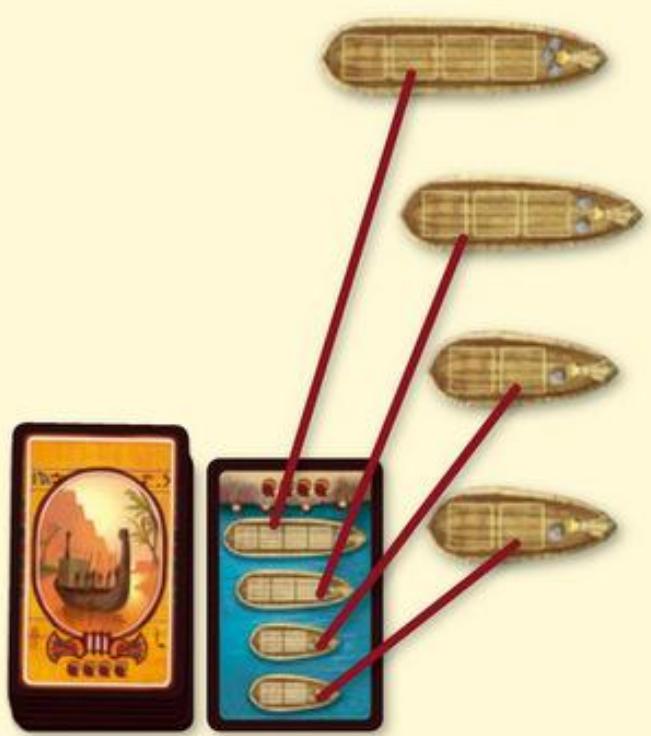


範例:你翻開這一輪的輪數卡,你拿取一艘「4格船」、一艘「3格船」,以及兩艘「2格船」,並且把它們放到地點圖板左側。
· 接著,從牌庫翻開 4 張市場卡,並把它們放到市場圖板上。
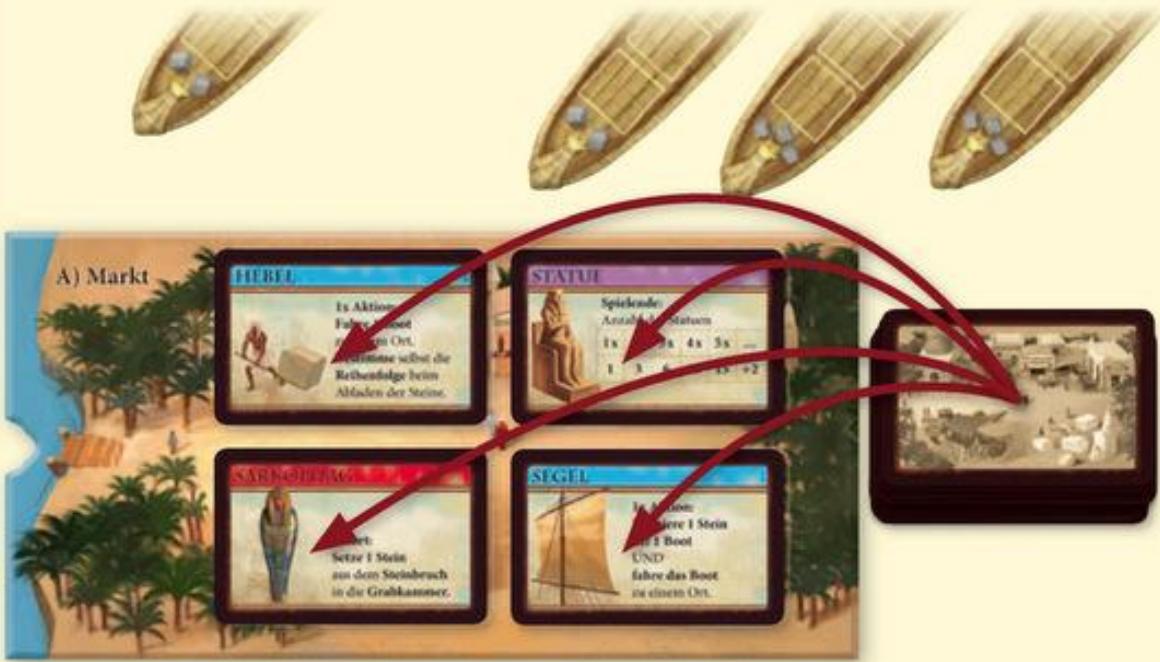
如果牌庫耗盡,洗混棄牌堆並組成一個新牌庫。
· 接著,從起始玩家開始,每個玩家輪流進行回合。
每回合按照以下步驟進行:
回合流程
輪到玩家的回合時,玩家必須從4種行動中選擇一種執行:
獲得新的石頭
從礦場拿取 3 個石頭,並把它們放到你的供應板塊上。

註記:你的供應板塊最多只能放置5個石頭!如果你的供應板塊只能再放2個石頭,你選擇這個行動的話只能再從礦場拿2個石頭。
如果礦場裡沒有石頭,則你不能再拿取石頭。
或者
把 1 個石頭放在一艘船上
從你的供應板塊拿取 1 個石頭,並且把它放到一艘還沒開往一個地點的船的任一個空格中。

或者
把 1 艘船開往一個地點
你把 1 艘船開往一個地點,這裡必須注意 2 種情況:
1) 船上必須至少已經裝有最低數量的石頭。船頭顯示的灰色石頭符號代表這艘船最低的裝載
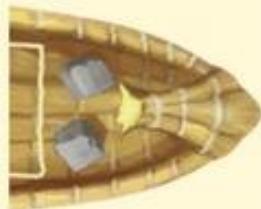
數量。每艘船的最低裝載數量不同。
2) 前往的地點必須還是開放的狀態,因此,這必須是這一輪還沒有船開往的地點。
接著,船上的石頭(根據顏色)依序從放在最前面的石頭開始,卸載到地點上。忽略船上的空格。
5個地點適用不同的規則,當玩家把自己的石頭放在那裡時會各自受該地點的效果影響。
A市場以及A金字塔會立刻結算。A神廟每輪結束時結算。A墓穴以及A方尖碑只會在遊戲結束結算。
每個地點的詳細規則請查看規則書第7頁及第8頁「A面地點註記」的說明。
重要:即使你沒有石頭在該艘船上,你還是可以挑選該艘船並開往一個地點,只要第4頁提到的兩個條件有滿足即可。
如果一個地點有船開往,則一輪結束時停在這個地點的船現在會清空。現在你了解到,一輪的一個地點不能超過一艘船停靠。每輪一個地點最多只會停靠一艘船。

範例:放了4個石頭的船開往金字塔。從放在最前面的石頭開始,現在把石頭放在金字塔。每放一個石頭,玩家會立刻獲得對應格子中的分數。
或者
打出 1 張藍色的市場卡
如果你有這樣的卡片,你可以打出並使用卡片的功能,接著把打出的卡片放到棄牌堆。
你每回合只能打出1張藍色市場卡。

玩家輪流進行回合,並且在回合時恰好執行一個行動。每輪你們會進行多個回合,只有在所有的4艘船都開往不同的地點後,這一輪才結束。
重要:因爲每輪只開放4艘船,每輪5個地點中的其中一個不會有船開往!
一輪結束
如果所有的4艘船都開往地點,這一輪結束。現在神廟開始結算。從最上面俯視每個可見的石頭會得到1分,所以被遮住的石頭不會帶來任何分數。

範例:一輪結束時,神廟進行結算。灰色玩家獲得2分(2個最上面可見的石頭)。白色玩家、褐色玩家,以及黑色玩家獲得1分(從最上面俯視可見的石頭)。
· 把這 4 艘船放回船供應區。
· 市場圖板上剩餘的市場卡都清掉,並把它們放到棄牌堆。
下一輪開始。
從輪數卡牌庫翻開下一張輪數卡,找到卡片上顯示的4艘船,並把它們放到地點圖板左側。從市場卡牌庫翻開4張新的市場卡,並把它們放到市場圖板上。
接著,上一輪開第4艘船的玩家的左手邊玩家,開始他的回合,並執行4種行動的其中一種。
遊戲結束
6輪進行完,遊戲結束,接著進行最終計分。
最終計分
首先計算墓穴裡的石頭分數。詳細的計分方式請查看第7頁「A墓穴」的說明。
接著,計算方尖碑的分數。詳細的計分方式請查看第8頁「A方尖碑」的說明。
市場卡「裝飾品」以及「雕像」根據卡片上的敘述計分。詳細的計分方式請查看第12頁的說明。每張沒有使用的藍色市場卡值1分。
加總分數後,最高分的玩家獲勝。如果平手,平手的玩家中,供應板塊上剩餘較多石頭的玩家獲勝。如果還是平手,平手的玩家共享勝利。
銘謝
設計師:

Phil Walker-Harding liebt es seit seiner Kindheit, Brettspiele zu spielen und zu entwickeln. Besonders mag er Spiele, die Menschen unterschiedlichen Alters und Typs zusammenbringen.
Phil interessiert sich außerdem für Theologie, klassische Hollywood-Filme
und die Mythen des Alten Ägyptens. Er lebt zusammen mit seiner Frau Meredith in Sydney, Australien.
„Imhotep“ hat 2010 als Prototyp den 2. Platz beim Premio Archimede Autoren-Wettbewerb gewonnen – damals unter dem Titel „Builders of Egypt“.
premio
RCHIMEDE
dedicato ad Alex Randolph

插畫:Miguel Coimbra
圖像設計 : Michaela Kienle
編輯:Ralph Querfurth
中文規則書翻譯/排版:小柴
Phil Walker-Harding und KOSMOS danken allen Test-spielern und Regellesern.
Ein besonderer Dank geht an Meredith Walker-Harding, Leo Colovini, Chris Morphew, Nick Barnett, Kerryn und Andrew Young, Josh und Naomi Pryde, Marion Engelke, Wolfgang Lüdtke, Maria Fischer-Witzmann, Arnd Fischer, Thomas Wessels und Markus Potthast.
© 2016 Franckh-Kosmos Verlags-GmbH & Co. KG
Pfizerstr. 5–7
D-70184 Stuttgart
Tel.: +49 711 2191-0
Fax: +49 711 2191-199
info@kosmos.de
kosmos.de
Alle Rechte vorbehalten.
MADE IN GERMANY
Art.-Nr.: 692384
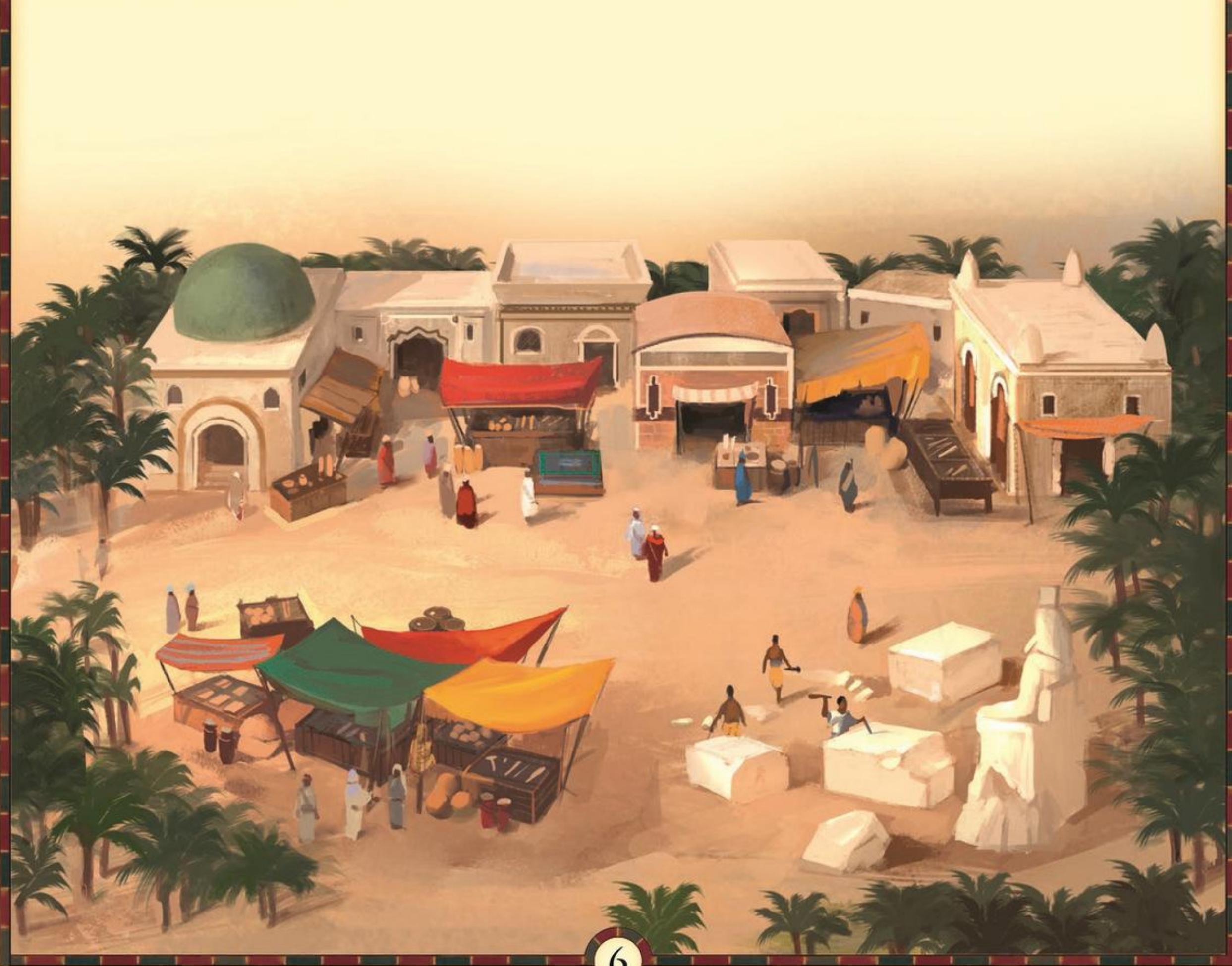
A 面地點的說明
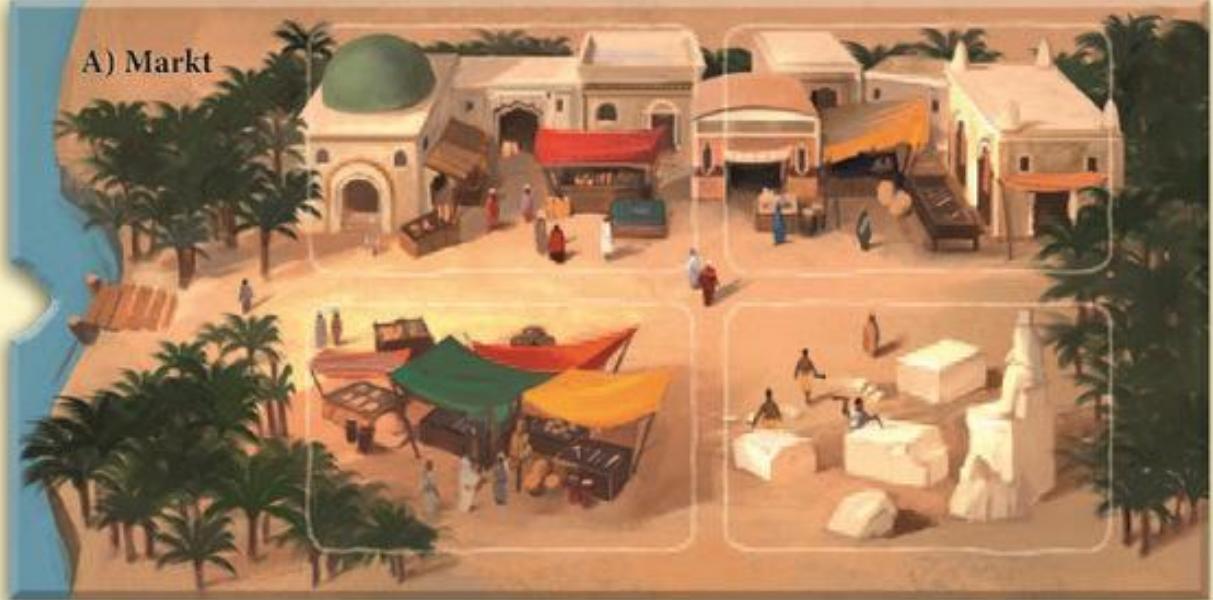
A) 市場
每運送一個石頭到這裡,持有該石頭的玩家必須立刻從這裡拿取1張市場卡。有關每張市場
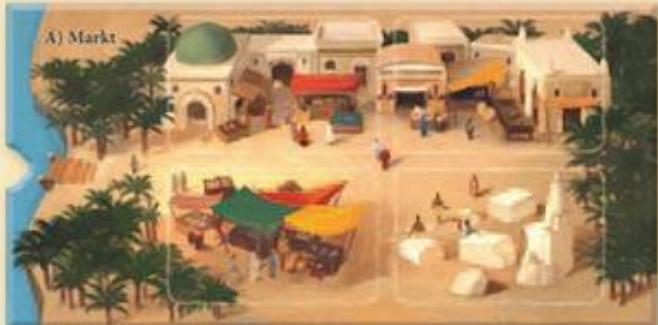
卡的說明,可以在這本規則書的第12頁找到。
重要:運送到這裡的石頭放回礦場。
把獲得的卡片放到你的面前。
如果你拿的是紅色卡片,你必須立刻使用它,然後把它放到棄牌堆。藍色卡片你只能在遊戲中你的回合使用一次,你必須在之後的回合中花費一個行動使用它。紫色「雕像」卡以及綠色「裝飾品」卡會讓你在遊戲結束時獲得分數。

範例:這艘4格的船開往市場。白色玩家先拿取一張卡片,他挑選了「航行」。下一個褐色玩家挑選了「雕像」卡。接著灰色完家挑選了「槓桿」卡。接著把船上所有的石頭放回礦場。
A) 金字塔
每個把石頭放在這裡的玩家立刻獲得分數,你把石頭放到下一個開放的格

子中。擺放石頭時,從最左邊那一欄的最上方的格子開始放置,直到放滿該欄。然後再次從中間那欄最上方的格子開始放置。
如果第1層(3×3個石頭)已經放滿了,繼續建造第2層。第2層一樣從左邊第一欄最上方的格子開始放置,不過第2層只能放置2×2個石頭。如果第2層放滿,第3層只能放1個石頭。
每個放在第1層的石頭所獲得的分數等同於格子中顯示的數值。第2層以及第3層的分數顯示在圖板右側。
如果金字塔完成建造,之後任何運送到這裡的石頭可以獲得1分。這些石頭會放在金字塔圖板的右側。
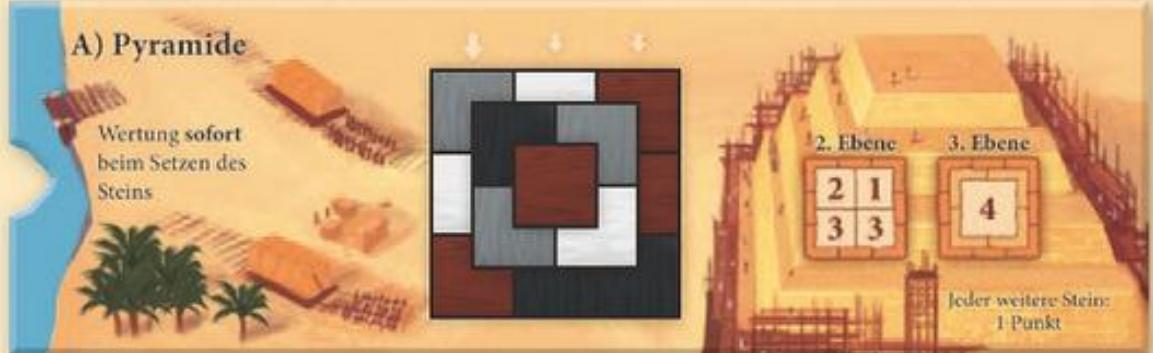
範例:一個完成的金字塔(3層)看起來如上圖。
A) 神廟
一輪結束時,從上方俯瞰,每個放在
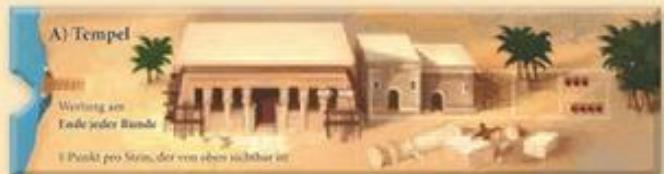
這裡可見的石頭會讓持有該石頭的玩家獲得1分。你把石頭放到神廟中下一個開放的區域。放置石頭時,從左邊的區域先開始放置。一層放滿後才放下一層。如果進行3人或4人遊戲,則神廟裡所有的5個格子都開放建造。2人遊戲時,只有4個格子開放建造。
如果第1層滿了,第2層會再次從左邊開始建造。放在下層的石頭因此被遮住,依此類推。
這裡沒有高度限制。

範例:這艘3格的船開往神廟。第一個褐色石頭放在最底層的最後一個空格。第二個褐色石頭放在第2層的第一格。白色石頭放在2層的第二格。
A) 墓穴
遊戲結束時,每個放在這裡的石頭,會讓持有的玩家獲

得分數。擺放石頭時,從最左邊那一欄的最上方的格子開始放置,直到放滿該欄。然後再次從第二欄最上方的格子開始放置,依此類推。
墓穴的右邊格子是無限的,因此即使圖板上的格子已經放滿,有需要的話可以往右延伸欄位。遊戲結束時,分數計算如下:一種顏色的石頭相連(對角線不算)會帶來分數,根據該種顏色的石頭數量而定。
| 相連的石頭: | 1x | 2x | 3x | 4x | 5x | ... |
| 分數: | 1 | 3 | 6 | 10 | 15 | +2 |
只要超過 5 個相連的石頭,每個超過的石頭會帶來 2 分。
重要:每組相連的石頭都會為玩家帶來分數,不會只算相連最大的那一組!
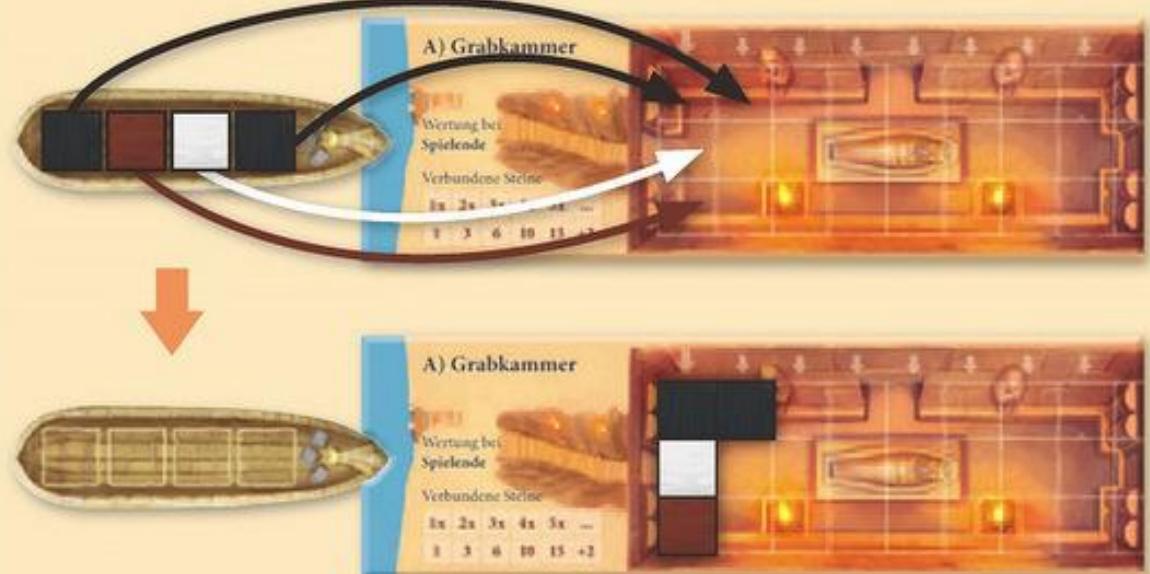
範例:這艘4格的船開往墓穴。石頭會按照順序卸載並開始從墓穴的左欄接續放置。

範例:一場4人遊戲的墓穴最終看起來如上圖所示。白色玩家因為有2個相連的石頭獲得3分。黑色玩家因為只有1個石頭獲得1分。褐色玩家有3個相連的石頭獲得6分,加上另一組1個石頭獲得1分,總共7分。灰色玩家因為有6個相連的石頭,獲得 $15+2=17$ 分。
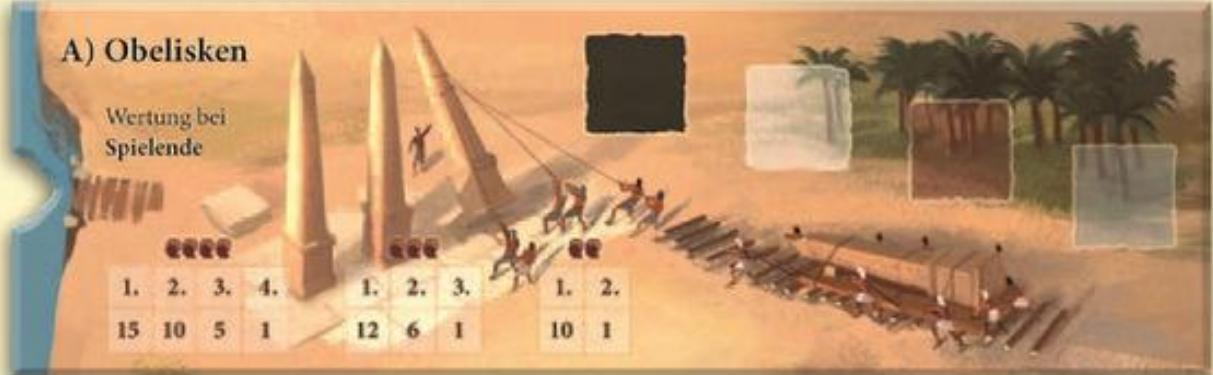
A) 方尖碑
運送到這裡的石頭,
遊戲結束時會給予分數。每個你運

送到這裡的石頭會放在屬於你顏色的格子裡。所以你的石頭會在這裡疊成一疊,每個玩家會建造屬於自己的「方尖碑」。遊戲結束時玩家會獲得分數,疊最高的玩家理所當然獲得最多分數。
2人遊戲計分:
方尖碑最高的玩家獲得 10 分。
第二高的玩家獲得 1 分。
3人遊戲計分:
方尖碑最高的玩家獲得12分。
第二高的玩家獲得6分。
第三高的玩家獲得1分。
4人遊戲計分:
方尖碑最高的玩家獲得15分。
第二高的玩家獲得10分。
第三高的玩家獲得5分。
第四高的玩家獲得1分。
重要:
- 你在方尖碑圖板至少要有 1 個石頭才會參與計分。
· 如果平手,則把平手名次的分數加總,並除以這麼多的玩家人數。每個玩家獲得去掉小數點的整數分數。

範例:這艘3格的船開往方尖碑。石頭會疊放在對應顏色的格子裡。
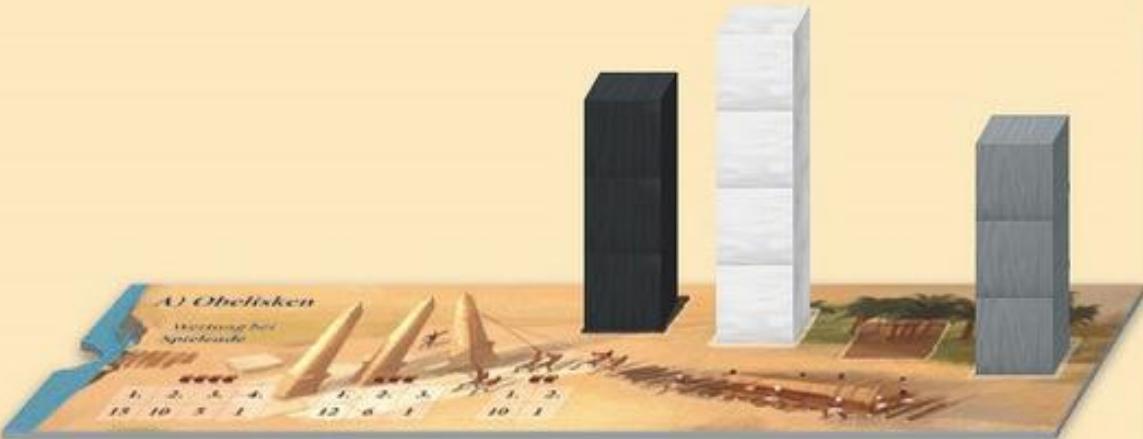
範例:4人遊戲時,黑色玩家的方尖碑最終有3個石頭高。白色玩家的方尖碑有4個石頭高。褐色玩家沒有石頭,而灰色玩家有3個石頭,因此白色玩家可以獲得15分。黑色玩家和灰色玩家平分第2名及第3名的分數,相加除以2後為7.5分((10+5)/2=7.5),去掉小數點後,黑色玩家和灰色玩家各得7分。褐色玩家不會獲得任何分數,因為方尖碑圖板上沒有他的石頭。
變體:B面地點
每個地點圖板都有A面和B面。第一次進行遊戲只用A面。之後的遊戲可以嘗試B面的地點。你們也可以A面和B面混著玩,試試不同的組合。
B) 市場

B 面運作的方式與 A 面相似,不過有以下的調整:
每輪一開始,右下角的卡片區域會放置2張正面朝下的卡片。把一個石頭運往這裡,你可以查看2張卡片,然後挑選1張保留,另一張放到棄牌堆。

B) 金字塔

B 面運作的方式與 A 面相似,不過有以下的調整:
每個運往金字塔的石頭,持有該石頭的玩家可以決定要把石頭放在3個金字塔的哪一個。有些金字塔的格子中會帶來特殊獎勵。
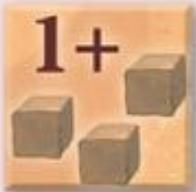
你獲得 1 分並從市場牌庫頂抽一張卡片。
你獲得1分並立刻從礦場拿3個石頭,然後把它們放到你的供應板塊上。

你獲得 1 分並立刻把你供應板塊上的 1 個石頭放到任何一艘船的空格上,只要該艘船還有開放的空格即可。
每個金字塔都從左上角的格子開始放置石頭。每個金字塔第二層的石頭都值4分。如果三個金字塔都完成建造,每個之後運送到金字塔的石頭都值1分,這些石頭會放在金字塔圖板的右側。
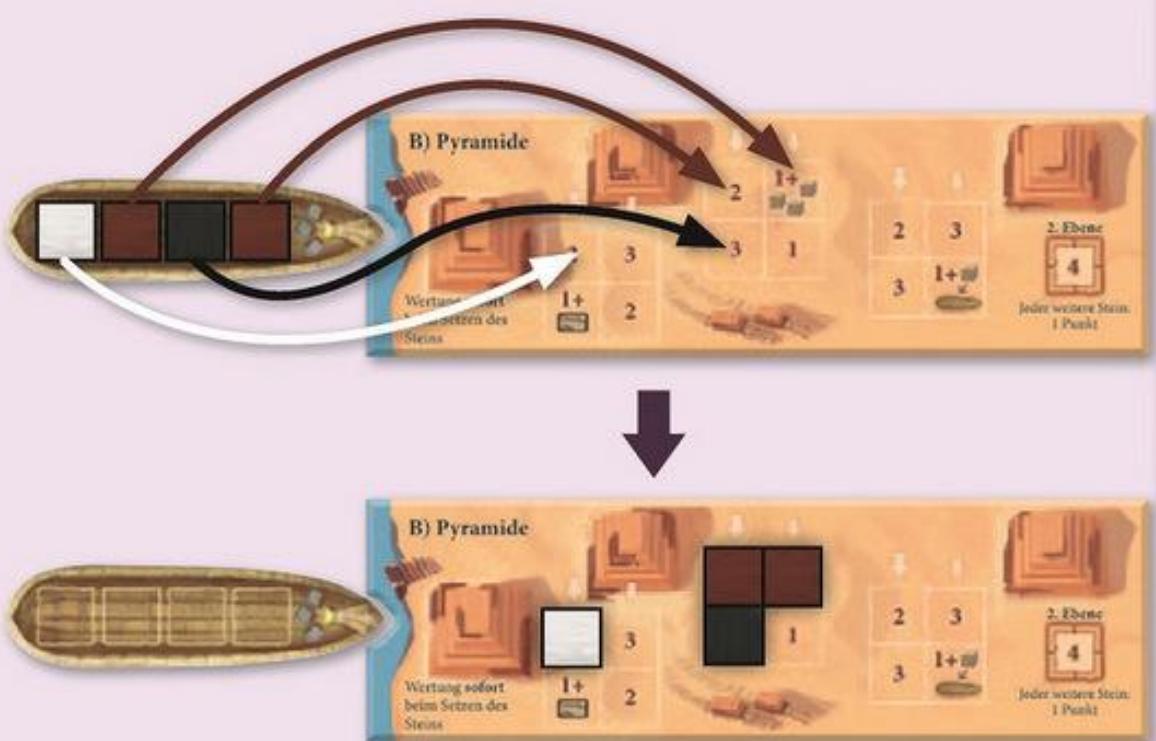
範例:這艘4格的船開往金字塔。褐色玩家把他的第一個石頭放到中間金字塔的第1格,接著黑色玩家把他的石頭放到中間金字塔的第2格。然後褐色玩家把他的第二個石頭放到中間金字塔的第3格。最後白色玩家把他的白色石頭放到左邊金字塔的第1格。
B) 寺廟
B 面運作的方式與 A 面相似,不過有以下的調整:

每輪結束時,每個從上方俯瞰的可見石頭會各別獲得不同的獎勵,獎勵根據石頭放在神廟的哪一格而定。

你獲得 1 分,或者你可以從立刻從礦場拿取 2 個石頭,並把它們放到你的供應板塊。
你獲得2分。
你從牌庫抽1張市場卡。

範例:神廟在一輪結束時結算。灰色玩家可以決定想要1分還是從礦場拿取2個石頭。褐色玩家獲得2分。白色玩家可以決定想要1分還是從礦場拿取2個石頭。此外,白色玩家可以從牌庫抽1張卡片。黑色玩家可以決定想要1分還是從礦場拿取2個石頭。
B ) 墓穴

B 面運作的方式與 A 面相似,不過有以下的調整:
遊戲結束時,墓穴的3橫列計分,每一列最多石頭的玩家得到第一名的分數,第二多的獲得第二名的分數,依此類推。每一列會各別結算。
重要:
· 為了在一列中計分,你在該橫列至少必須要放有1個石頭。
· 同種顏色的石頭同一直欄不能相鄰。
· 如果一列裡有玩家平手,則平手的玩家一起平分分數。每個玩家獲得去掉小數點的整數分數。

範例:墓穴在遊戲結束時計分。

最上列白色玩家有3個石頭,他的石頭數量最多。為此,他獲得8分。褐色玩家以及灰色玩家因為各放1個石頭,平分第2名及第3名的分數,他們各獲得(4+2)/2=3分。

中間列黑色玩家有3個石頭,他的石頭數量最多。為此,他獲得8分。白色玩家有1個石頭,列為第2名,他獲得4分。褐色玩家與灰色玩家沒有石頭放在中間列,所以不獲得任何分數。

最下列灰色玩家有4個石頭,他的石頭數量最多。為此,他獲得8分。其他玩家沒有石頭放在最下列,所以不獲得任何分數。
B) 方尖碑
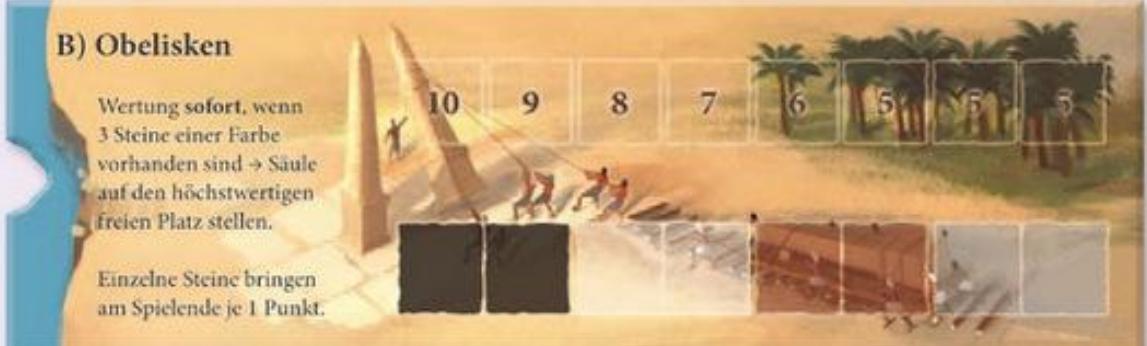
B 面運作的方式與 A 面相似,不過有以下的調整:
每個運送到這裡的石頭會放在對應顏色的格子中
當這裡累積一種顏色的3個石頭,這些石頭會立刻計分。這3個石頭會疊成一疊,並放到分數最高且開放的分數格。
玩家立刻獲得該分數格的分數。

範例:這艘3格的船開往方尖碑。黑色玩家把他的石頭放在圖板上的黑色空格中。白色玩家把他的石頭放到另外兩個白色石頭上。現在這3個白色石頭組成方尖碑,這些石頭會疊成一疊,放到下一個開放的分數格中(分數為9)。白色玩家獲得9分。接著,灰色玩家把他的石頭放到圖板上的灰色空格中。
規則變體:法老王的憤怒
如果你想進行「更難」的遊戲,請試試以下變體:
如果你沒有參與建造所有的四個地點,你會受到處罰。
任何一個這四個地點:「金字塔」、「神廟」、「墓穴」,以及「方尖碑」沒有都至少運送1個石頭的玩家,遊戲結束時會扣5分。

市場卡說明
這裡你會找到所有市場卡的內容以及功能的詳細說明。當特定市場卡進場時再查閱即可。
「Eingang」、「Sarkophag」、「Gepflasterter Pfad」(每種各2張)

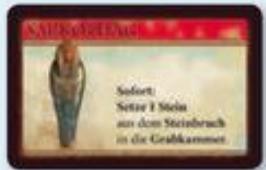

如果你拿到這種市場卡,你立刻從礦場拿取1個石頭並放到對應的地點,接著把這張卡片放到棄牌堆。
「Pyramiden-Verzierung」、
「Tempel-Verzierung」、「Grabkammer-Verzierung」、「Obelisken-Verzierung」(每種各2張)

如果你拿到這種市場卡,它會放在你面前直到遊戲結束。
遊戲結束時,對應地點中每3個石頭(你自己的+其他玩家的)你獲得1分。


範例:遊戲結束時,墓穴裡有13個石頭。因為「Grabkammer-Verzierung」卡,所以玩家會獲得4分。
「雕像」
(10張)

如果你拿到這種市場卡,它會放在你面前直到遊戲結束。
遊戲結束時,根據你擁有的「雕像」卡數量,你會獲得對應的分數。
Anzahl der Statuen


範例:遊戲結束時,玩家有3張「雕像」卡,因此他可以獲得6分。
藍色市場卡
每回合你可以使用1張藍色市場卡。藍色市場卡不是額外的行動,而是以下行動的加強版:「獲得新的石頭」、「在1艘船上放1個石頭」,或「把1艘船開往個1個地點」。藍色市場卡總共有4種:
「槓桿」
(2 張)

如果你拿到這種市場卡,它會放在你面前直到你使用它。
之後的回合,你可以執行1個以下的行動:把1艘船開往1個地點。你可以自己決定石頭卸載的順序。當然開船的兩個條件還是要滿足。接著把這張卡片放到棄牌堆。如果你沒有使用這張卡片,遊戲結束時還會獲得1分。
「槌子」(2張)

如果你拿到這種市場卡,它會放在你面前直到你使用它。
之後的回合,你可以執行1個以下的行動:從礦場拿3個石頭,並把它們放到你的供應板塊上。接著從你的供應板塊上拿取1個石頭並放到1艘船上。接著把這張卡片放到棄牌堆。如果你沒有使用這張卡片,遊戲結束時還會獲得1分。
「航行」
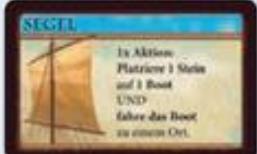
(3 張)
如果你拿到這種市場卡,它會放在你面前直到你使用它。
之後的回合,你可以執行1個以下的行動:把1個石頭放到1艘船上,然後把這艘船開往1個地點。當然開船的兩個條件還是要滿足。接著把這張卡片放到棄牌堆。如果你沒有使用這張卡片,遊戲結束時還會獲得1分。
「鑿子」(3張)

如果你拿到這種市場卡,它會放在你面前直到你使用它。
之後的回合,你可以執行1個以下的行動:把2個石頭放到1艘船上,或者2艘船上各放1個石頭。接著把這張卡片放到棄牌堆。如果你沒有使用這張卡片,遊戲結束時還會獲得1分。
方尖碑
金字塔
地点
大古墓
概览
大神庙
建筑
趁火打劫
接二连三
行动

行动
方尖碑
a. 黑白金字塔单独计,
金字塔
计分
大古墓
a. 未使用的行动板块每个1VP
剩余物
b. 停留在港口的工人每个1VP
下载 Markdown692384_imhotep_manualsmall.md32.8 KB
GAME STORY
Imhotep was the first and most famous master builder of ancient Egypt. He is considered one of the earliest polymaths in the history of humanity. For example, he is said to have been responsible for building the very first pyramid in Egypt — the Pyramid of Djoser in Saqqara. Can you match his accomplishments in creating monuments for the ages? You will need ships to transport blocks of stone to various building sites. But you will not be the only one making decisions about where to send the ships and their cargoes. Your opponents will have their own plans and will try to prevent your success. A fierce competition will unfold over the most valuable stone shipments. It will take clever tactics and a little luck to achieve success.
GAME OBJECTIVE
Each player assumes the role of an Egyptian master builder. You will have 6 rounds to transport your stones to the various sites and to erect monuments in such a way that you earn the most points. Whenever your turn comes up, you will select one of the following 4 action options:
• Get new stones
• Place 1 stone on the ship
• Sail 1 ship to a site
• Play 1 blue market card
Delivering the stones gets you various points in various ways — sometimes more points, sometimes fewer; sometimes right away, sometimes at the end of a round, and sometimes at the end of the game. Whoever has the most points after 6 rounds is the winner.
GAME MATERIALS
120 Wooden blocks (called “stones") (30 in each of the 4 game colors: black, white, brown, and gray)
5 Site boards
1 Scoring track board
8 Ship tokens
4 Supply sled tokens (1 in each of the 4 game colors: black, white, brown, and gray)
21 Round cards
34 Market cards
Site boards





Round cards


Market cards

Stone quarry (with all players’ stones)

Scoring track board
(You can earn more than 40 points. In this case, just keep moving your stone block around the board and remember that you have circled the board once already.)

Starting player (2 stones on his or her supply token)
GAME PREPARATION
Place the 5 site boards in the center of the table as shown in the illustration. All site boards have an A side and a B side. In your first few games, use the A side. You can use the B sides in later games as a variant to the standard game play. So be sure that the A sides of the boards are showing in your first game.
Place the scoring track board to the right of the site boards. Use this to keep track of all players' points.
• Have the 8 ship tokens ready above the boards.
• Separate the 21 round cards from the 34 market cards.
• Shuffle the 34 market cards and place them face down as a draw pile to the right of the “A) Market" board.
• There are 7 round cards for two, three, and four players.
Use the 7 round cards with 2 heads on them in a two-person game.

Use the 7 round cards with 3 heads on them in a three-person game.
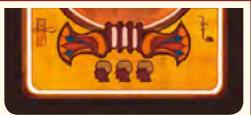
Use the 7 round cards with 4 heads on them in a four-person game.
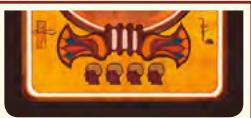
Pull out the 7 round cards corresponding to your number of players. You will not need the other 14 round cards. Place them back in the box. Since you will only be playing for 6 rounds, you must now pick one of your 7 round cards at random and place it back in the box as well. Shuffle the remaining 6 round cards and place them face down in a single stack next to the 8 ship tokens.
• Each player chooses a color (black, white, brown, or gray) and gets a supply sled token in that color.
• With fewer than 4 players, the unused supply sled token(s) and stones of the unused color(s) go back in the box.
• All of the stones go in a pile to the right of the site boards, forming the stone quarry.
• Each player places 1 stone in his or her color on the “0/40” space of the scoring track.
Decide who will be the player to start. The starting player gets 2 stones in his or her color from the stone quarry and places them on his or her supply sled token. The second player (who is the player to the left of the starting player) gets 3 stones for his or her supply sled token, the third player (the player to the left of the second player) gets 4 stones, and the fourth player gets 5 stones, each in their color.
COURSE OF PLAY
The game is played over 6 rounds.
COURSE OF A ROUND
Each round proceeds as follows:
At the start of the round, turn over the top round card. It will indicate which 4 ship tokens are available in this round. Arrange these tokens spaced not too closely together to the left of the site boards. There are ships with various amounts of space for stones:
Two boats have space for 4 stones, three have space for 3 stones, two have space for 2 stones, and one boat has space for 1 stone.

Example: If you have turned over the round card shown above, take one four-stone ship, one three-stone ship, and two two-stone ships, and arrange them spaced not too closely together to the left of the site boards.
Then turn over the top four market cards from the draw pile and place them face up on the market board.
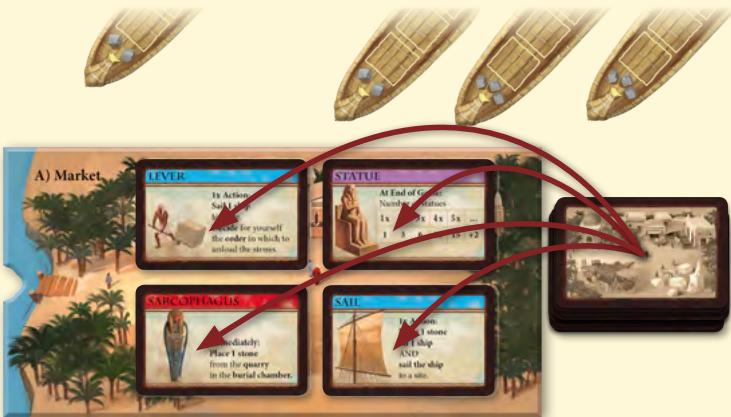
If the draw pile is empty, shuffle the discard pile and create a new draw pile.
• Then all the players take their actions in turns, beginning with the starting player.
Each turn goes as follows:
TURN
The player whose turn it is must carry out exactly one of the following 4 actions:
Get new stones
Take 3 stones of your color from the stone quarry and place them on your supply sled token.
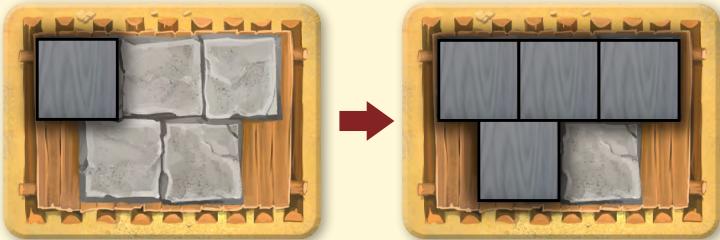
Note: Your supply sled token has enough space for a maximum of 5 stones!
For example, if you only have space for 2 stones and you choose this action, you can only take 2 stones from the quarry.
If you have no more stones in the quarry, you cannot take any more stones.
OR
Take 1 stone from your supply sled token and place it on any empty space on a ship that has not yet sailed to a site.

OR
Sail 1 ship to a site
Slide 1 ship to a site board.
You must observe 2 conditions, however:
1) The ship must already be loaded with at least the minimum required number of stones. The gray stone symbols at the bow
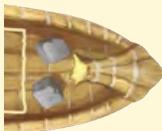
of the ship indicate the minimum number for that ship.
This number varies from ship to ship.
2) The site to which the ship is sailing must still have an open dock. In other words, no other ship can have sailed to it in this round.
The ship's stones are then unloaded by their owner (indicated by color) in order from front to back and delivered to the site — beginning with the stone placed closest to the front. Ignore any empty spaces on the ship.
At each of the 5 sites, there are different rules for what the stone's owner will receive for each stone delivered, and when they will receive it. The market and the pyramid are assessed immediately. The temple is assessed at the end of each round. The burial chamber and the obelisks are not assessed until the end of the game. Read the exact rules for each site under the Explanations of the A sides of the sites" heading on pages 7 and 8 of this manual.
Important: You are also permitted to sail a ship when you do not have a stone of your own on it. The only requirement is that both of the above conditions must be met. After a site has been sailed to, the now-empty ship remains at the site's mooring area until the end of the round. This way, you can see that no more ships can sail to that site during that same round. No more than one ship can sail to any given site per round.

Example: This four-stone ship was sailed to the pyramid. Beginning with the stone closest to the front, all the stones are now placed on the pyramid. The pyramid yields points immediately for each stone delivered, in accordance with the number value indicated on the space.
OR
Play 1 blue market card
If you have one of these cards, you can play it and make use of its benefit.
The played card is then placed on the discard pile.
You can only play 1 blue market card per turn.

Each player takes action in turns and always performs exactly one action per turn.
Each player's turn will come up several times per round. The round does not end until all 4 ships have been sailed to the various sites.
Important: Since there are only 4 ships available per round, there will always be 1 of the 5 site boards that will not be sailed to in each round!
END OF ROUND
When all 4 ships have been sailed to the sites, the round ends immediately.
Now the temple is assessed. Each stone visible from above yields 1 point. In other words, stones covered by other stones no longer yield any points.

Example: The temple is assessed at the end of the round. Here, the gray player gets 2 points (for 2 stones visible from above). The white, brown, and black players get 1 point each (each for 1 stone visible from above).
PREPARE FOR THE NEXT ROUND
• Return the 4 ships to the pile of other ships.
• Gather up any market cards still remaining on the market board and place them on the discard pile.
• All stones already placed on site boards and supply sled tokens stay in place.
The next round begins.
Turn over the next round card from the pile, get the 4 ships indicated on the card, and place them to the left of the site boards.
Turn over 4 new market cards from the pile and place them on the market board.
The starting player for the new round is the player to the left of the player who sailed the fourth ship in the previous round.
END OF GAME
The game ends after 6 rounds.
Then the final point assessment, or scoring, takes place.
Final point assessment (scoring)
Start by assessing the stones in the burial chamber. The point assessment is explained on page 7 under the “A) Burial chamber" heading.
Then it is time to assess the obelisks. Their point assessment is explained on page 8 under the “A) Obelisks" heading.
The decoration and statue market cards yield points in accordance with what is printed on them. The point assessment of the cards is explained on page 12. Unused blue market cards yield an additional value of 1 point each.
The player with the most points is the winner. In case of a tie: The player with the greater number of stones on his or her supply sled token is the winner. If this is also a tie, the tied players share first place.
PUBLISHER'S INFORMATION
Author:

Since childhood, Phil Walker-Harding has loved playing and inventing board games. He particularly likes games that bring together people of different ages and personality types.
Phil is also interested in theology, classic Hollywood films, and the myths of
ancient Egypt. He lives with his wife Meredith in Sydney, Australia.
The prototype edition of “Imhotep," under the name “Builders of Egypt," won second place in the Premio Archimede board game designers' competition in 2010.


Illustration: Miguel Coimbra
Graphics: Michaela Kienle
Editor, Original German Edition: Ralph Querfurth
English Translation: David Gamon English Text Editing: Ted McGuire
Phil Walker-Harding and KOSMOS thank all the test players and rule reviewers.
Special thanks go to Meredith Walker-Harding, Leo Colovini, Chris Morphew, Nick Barnett, Kerryn and Andrew Young, Josh and Naomi Pryde, Marion Engelke, Maria Fischer-Witzmann, Arnd Fischer, Thomas Wessels and Markus Potthast.
© 2016 Franckh-Kosmos Verlags-GmbH & Co. KG
Pfizerstr. 5-7, D-70184 Stuttgart, Germany.
Phone: +49 711 2191-0; Web: kosmos.de
© 2016 Thames & Kosmos, LLC, Providence, RI, USA
Thames & Kosmos® is a registered trademark of Thames & Kosmos, LLC. All rights reserved.
Distributed in North America by Thames & Kosmos, LLC. Providence, RI 02903 Phone: 800-587-2872; Web: thamesandkosmos.com
Distributed in United Kingdom by Thames & Kosmos UK, LP. Goudhurst, Kent TN17 2QZ Phone: 01580 212000; Web: thamesandkosmos.co.uk
Printed in Germany / Imprimé en Allemagne

EXPLANATIONS OF THE A SIDES OF THE SITES
A) Market
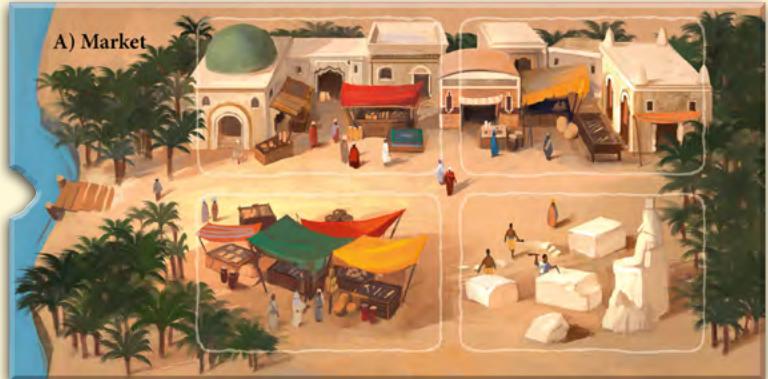
For each stone delivered here, the owner of the stone can immediately take any 1 face-up market card.

Explanations of the various market cards can be found on page 12 of this manual.
Important: The delivered stones must be returned to the quarry after taking the card.
Drawn cards must be placed face up in front of you. The red cards must be played immediately. These are then placed in the discard pile.
The blue market cards can be played exactly once as an action in a later turn of the player who draws it. The purple statue cards and the green decoration cards will earn you points at the end of the game.

Example: This four-stone ship was sailed to the market. The white player can first take a card and she selects the sail card. Then the brown player chooses the statue card. Then the gray player chooses the lever card. By the end, all of the stones that were on the ship are returned to the quarry.
A) Pyramid
For each stone delivered here, the owner of the stone earns points immediately. Place the

stone on the next free space in the pyramid. Stones are placed column by column. Placement of the stones begins at the top left until the column is full. Continue to the center column, starting again at the top.
When the first level (3x3 stones) is full, continue building in the second level, as shown in the illustration.
In the second level, start once again at the top left. The second level only includes 2x2 stones, however.
When the second level is full, continue building in the third level, which only consists of one single stone.
Each stone that you place yields the number of points indicated on the space. The values of the spaces in the second and third levels are indicated on the right side of the board.
Once the pyramid is completely built, each additional stone delivered to the pyramid yields 1 point. Place these stones at the right edge of the pyramid board.

Example: The illustration above shows how a completed pyramid (consisting of 3 levels) can look at the end.
A) Temple
For each stone delivered here, the owner of the stone
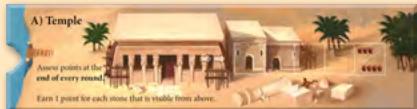
earns points at the end of the round if the stone is visible from above.
Place the stone on the next free space in the temple. Placement of the stones begins from the left, until the first level is full. With 3 and 4 players, all 5 spaces of the temple are covered. With 2 players, just the first 4 spaces are covered.
When the first level is full, continue to the second level, beginning again from the left. The stones on the first level are covered over in the process, and so on with additional levels. There is no height limit.
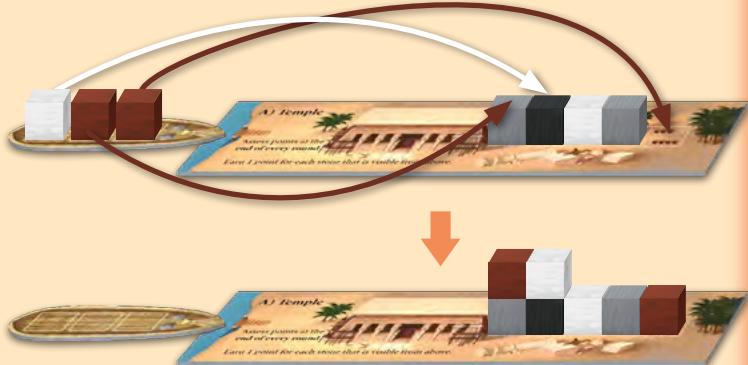
Example: This three-stone ship was sailed to the temple. The first brown stone goes on the last free space on the lowest level. The second brown stone goes on the first space on the second level. The white stone goes on the second space on the second level.
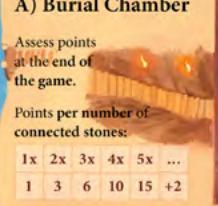
A) Burial Chamber
For each stone delivered here, the owner of the stone earns points at the

end of the game. Stones are placed column by column. Placement of the stones begins at the top left until the column is full. Then continue to the next column, starting again from the top, and so on.
The burial chamber is unrestricted in the rightward direction. In other words, there can be as many columns as you like, even if you have to go to the end of the board. At the end of the game, points are earned as follows: Each area consisting of one stone or more than one connected stones of a single color yields a certain number of points depending on the number of stones. Connected stones must be touching along at least one side. Stones touching only diagonally at corners are not connected.
| Number of stones:Points: | 1x | 2x | 3x | 4x | 5x | |
| 1 | 3 | 6 | 10 | 15 | +2 |
In areas with more than 5 connected stones, each additional connected stone yields an additional 2 points. Important: Each player can get points for more than one “field” of connected stones. So don't just add up points for the largest field for one player!

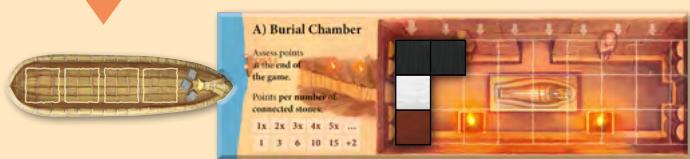
Example: This four-stone ship was sailed to the burial chamber. The stones are unloaded in order and placed on the burial chamber column by column starting from the top left.
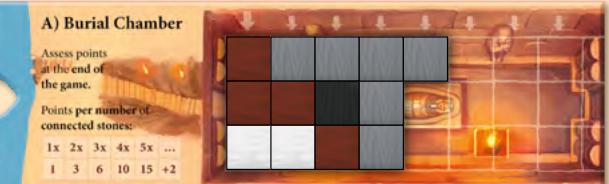
Example: In a game with four players, the burial chamber could look as shown in the illustration above. The white player gets 3 points for her field consisting of 2 stones. Black gets 1 point for his 1-stone field. Brown gets 6 points for her field of 3 stones and 1 point for her 1-stone field. Gray gets 15 + 2 = 17 points for his field consisting of 6 stones.
A) Obelisks
For the stones delivered here, the players earn points at the end of the game. Place each
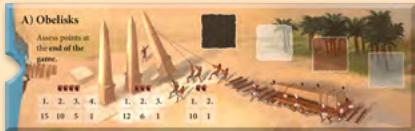
stone delivered here on the space matching your color. In that way, you will create a stacked tower of your stones. Each player will be building his or her own obelisk. Add up the points at the end of the game — with the tallest obelisk getting the most points, of course.
The following point assessment applies to a two-person game:
The player with the tallest obelisk gets 10 points.
The person with the second-tallest obelisk gets 1 point.
The following point assessment applies to a three-person game:
The player with the tallest obelisk gets 12 points.
The player with the second-tallest obelisk gets 6 points.
The player with the third-tallest obelisk gets 1 point.
The following point assessment applies to a four-person game:
The player with the tallest obelisk gets 15 points.
The player with the second-tallest obelisk gets 10 points.
The player with the third-tallest obelisk gets 5 points.
The player with the fourth-tallest obelisk gets 1 point.
Important:
• You must have delivered at least 1 stone to the obelisks to participate in this point assessment.
• In case of a tie, divide the total points among the number of players who tied. Every player involved in the tie shares in the divided-up point total rounded down to the nearest whole number.
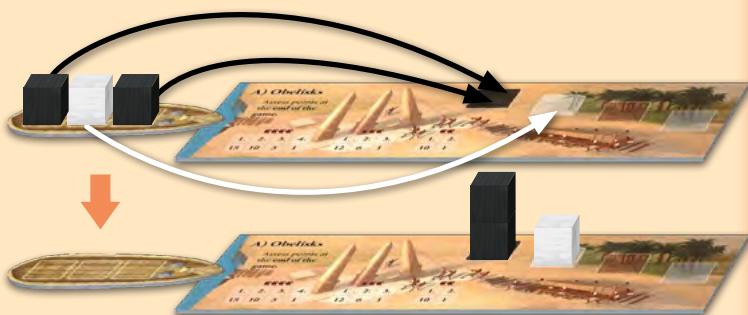
Example: This three-stone ship was sailed to the obelisks. The stones are placed on the correspondingly-colored spaces and stacked into towers.

Example: In a four-person game, the black player ends up with an obelisk that is 3 stones tall. The white player has a 4-stone tower. The brown player has no stones at all. The gray player has 3 stones. That means that the white player gets 15 points. The black and gray players share second and third places. They both get (10 + 5) / 2 = 7.5 points, which when rounded down yields 7 points for each player. Brown gets no points, because he did not deliver any stones at all to the obelisks.
VARIANT: THE B SIDES OF THE SITES
All site boards have an A side and a B side. You should always start playing with just the A sides. Later on, you can try the B sides.
You can also play with a mix of A and B sides. Why not try various combinations?
B) Market
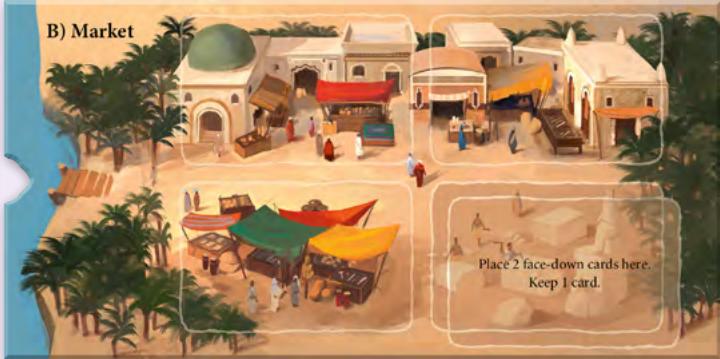
The B side works just like the A side, except for the following difference:
At the start of the round, place 2 cards face down on the card space at bottom right (instead of 1 face-up card). For a stone delivered to the market, you can pick up both cards and look at them. Then, select 1 card to keep. Place the other card on the discard pile.
B) Pyramids

The B side works just like the A side, except for the following differences:
For a stone delivered to the pyramids, the owner of the stone gets to decide which of the 3 pyramids the stone is to be delivered to.
Some of the pyramids yield special bonuses:

You get 1 point and can take the top market card from the draw pile.

You get 1 point and can immediately take 3 stones from the quarry and place them on the supply sled token.

You get 1 point and can place 1 stone from your supply sled token on any empty space of a ship that has not yet sailed to a site.
Each pyramid is started from the top left. Stones are placed column by column.
Each stone in the second level of a pyramid is worth 4 points. Once the pyramids are completed, each additional stone delivered to the pyramids yields 1 point. Place these stones at the right edge of the pyramid board.

Example: This 4-stone ship was sailed to the pyramids. The brown player places her first stone on the first space of the middle pyramid. Then, the black player places his stone on the second space of the middle pyramid. Then, the brown player places her second stone on the third space of the middle pyramid. Finally, the white player places his stone on the first space of the left pyramid.
B) Temple

The B side works just like the A side, except for the following difference:
At the end of each round, there are various bonuses for each stone visible from above — depending on the temple space on which the stone is placed:

You get 1 point or, if you prefer, you can take 2 stones from the quarry and place them on your supply sled token.
You get 2 points.
You get the top market card from the draw pile.
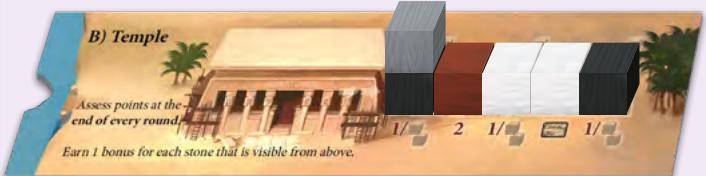
Example: The point assessment for the temple is performed at the end of the round. The gray player can decide whether to take 1 point or 2 stones from the quarry. The brown player gets 2 points. The white player gets to decide whether to take 1 point or 2 stones from the quarry. In addition, the white player gets to take the top market card from the draw pile. The black player gets to decide whether to take 1 point or 2 stones from the quarry.
B) Burial Chamber
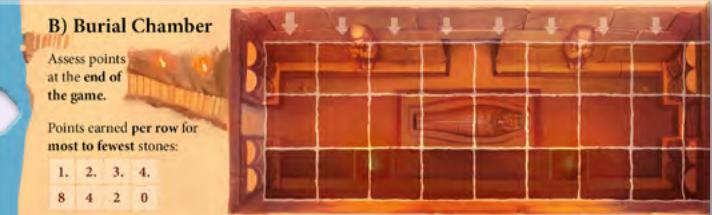
The B side works just like the A side, except for the following differences:
At the end of the game, the players earn points for having the greatest number of stones in the 3 rows of the burial chamber.
Each row is assessed individually.
Important:
• You must have at least 1 stone in a row in order to be involved in the point assessment for that row.
• The stones of any one color do not have to be adjacent.
• In case of a tie, add up the placement points and divide them among the number of tied players. Every player involved in the tie shares in the divided-up point total rounded down to the nearest whole number.

Example: The burial chamber point assessment is performed at the end of the game.

In the top row, the white player has the greatest number of stones (3). For that, she gets 8 points. With 1 stone each, the brown and gray players share second and third places. For that, they each get (4 + 2) / 2 = 3 points.

In the middle row, the black player has the greatest number of stones (3), and gets 8 points. White is in second place with 1 stone, and gets 4 points. Brown and gray have no stones in this row, so they get no points.

In the bottom row, gray has the greatest number (4), and gets 8 points. None of the other players are in the row, so they get no points.
B) Obelisks
The B side works just like the A side, except for the following differences:
Each stone delivered here is first placed on a space with the corresponding color.
When the third stone of any given color is delivered, these stones immediately have their value assessed. The 3 stones are stacked in a single tower on the free space with the highest point value. The owner of the stones immediately receives these points.
Individual stones that do not make it into an obelisk earn 1 point each at the end of the game.

Example: This 3-stone ship was sailed to the obelisks. The black player places his stone on one of the empty spaces on the board. The white player adds her stone to the other two white stones. Since there are now 3 white stones at the obelisks, these stones are stacked into a tower on the next free space (with a point value of 9). The white player immediately gets 9 points. Then, gray places his stone on one of the board’s empty gray spaces.

AT A GLANCE: EXPLANATIONS OF THE MARKET CARDS
In this section, you will find an overview of all of the market cards and a more detailed description of the way they work. Wait to read these explanations until a given market card comes into play.
Entrance, Sarcophagus, and Paved Path (2 of each)

When you get a market card like this, immediately place 1 of your stones from the quarry on the corresponding site. The stone is placed on the next available space, following the normal rules of building on that site. The card is then placed on the discard pile.
Pyramid Decoration, Temple Decoration, Burial Chamber Decoration, and Obelisk Decoration (2 of each)

When you get a market card like this, it remains face up in front of you until the end of the game. At the end of the game, you earn 1 point for every 3 stones (your own stones plus others’ stones added together) found at the corresponding site.


Example: In the burial chamber, there are 13 stones at the end of the game. That means that there would be 4 points granted for the burial chamber decoration card.
Statue (10x)

When you get a market card like this, it remains face up in front of you until the end of the game. At the end of the game,
you count up the number of statue cards you have and receive points in accordance with the following table. Additional cards past 5 are worth 2 points each.


Example: One player has 3 statue cards at the end of the game. For those, she gets 6 points.
Blue Market Cards
You can only use exactly 1 blue market card per turn. The use of a blue market card is not in addition to, but instead of, the use of one of the three other action possibilities: “Get new stones," “Place 1 stone on a ship," or “Sail 1 ship to a site." There are four different types of blue market cards:
Lever (2)
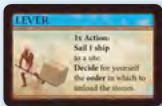
When you get this market card, it remains face up in front of you until you use it. In a later turn, you can perform the following e time:
action a single time:
Sail 1 ship to a site. Decide for yourself what sequence to follow when unloading the stones.
As always, of course, both conditions for sailing a ship must have been met. After play, the card is placed on the discard pile. If you have not used the card by the end of the game, you will get 1 point for it.
Hammer (2x)

When you get the market card, it remains face up in front of you until you use it. In a later turn, you can perform the following
action a single time:
Take 3 stones from the quarry and place them on your supply sled token. Then, place 1 stone from your supply sled token on 1 ship.
After play, the card is placed on the discard pile. If you have not used the card by the end of the game, you will get 1 point for it.
Sail (3x)

When you get this market card, it remains face up in front of you until you use it. In a later turn, you can perform the following
action a single time:
Place 1 stone on 1 ship and sail this ship to a site. As always, of course, both conditions for sailing a ship must have been met.
After play, the card is placed on the discard pile. If you have not used the card by the end of the game, you will get 1 point for it.
Chisel (3x)

When you get this market card, it remains face up in front of you until you use it. In a later turn, you can perform the following
action a single time:
Place 2 stones on 1 ship or 1 stone on each of 2 ships. After play, the card is placed on the discard pile. If you have not used the card by the end of the game, you will get 1 point for it.
下载 Markdown简繁检索对照.md1.6 KB
192862_191862_imhotep — 简体/繁体检索对照
本游戏的规则书是繁体中文原文。用户用简体提问时,把关键词按下面这张表转成繁体再去 grep 原文,命中率最高。
回答时用简体或繁体都可以,但引用的原文保持繁体。
简体 → 繁体 对照(按该游戏原文出现频率排序,共 59 字)
| 简体 | 繁体 | 原文出现次数 |
|---|---|---|
| 头 | 頭 | 153 |
| 个 | 個 | 149 |
| 数 | 數 | 72 |
| 获 | 獲 | 65 |
| 这 | 這 | 61 |
| 游 | 遊 | 60 |
| 戏 | 戲 | 60 |
| 场 | 場 | 60 |
| 开 | 開 | 55 |
| 会 | 會 | 55 |
| 轮 | 輪 | 51 |
| 张 | 張 | 50 |
| 点 | 點 | 47 |
| 结 | 結 | 41 |
| 从 | 從 | 38 |
| 图 | 圖 | 34 |
| 时 | 時 | 32 |
| 并 | 並 | 30 |
| 计 | 計 | 26 |
| 后 | 後 | 26 |
| 应 | 應 | 26 |
| 种 | 種 | 24 |
| 里 | 裡 | 24 |
| 块 | 塊 | 21 |
| 运 | 運 | 20 |
| 层 | 層 | 19 |
| 们 | 們 | 17 |
| 进 | 進 | 17 |
| 没 | 沒 | 17 |
| 范 | 範 | 16 |
| 为 | 為 | 15 |
| 矿 | 礦 | 15 |
| 还 | 還 | 15 |
| 则 | 則 | 13 |
| 动 | 動 | 13 |
| 颜 | 顏 | 13 |
| 该 | 該 | 13 |
| 过 | 過 | 12 |
| 库 | 庫 | 12 |
| 庙 | 廟 | 12 |
| 须 | 須 | 11 |
| 对 | 對 | 10 |
| 弃 | 棄 | 10 |
| 满 | 滿 | 10 |
| 栏 | 欄 | 10 |
| 来 | 來 | 9 |
| 选 | 選 | 9 |
| 蓝 | 藍 | 9 |
| 侧 | 側 | 9 |
| 边 | 邊 | 9 |
| 说 | 說 | 9 |
| 于 | 於 | 8 |
| 执 | 執 | 8 |
| 组 | 組 | 8 |
| 连 | 連 | 8 |
| 叠 | 疊 | 8 |
| 与 | 與 | 8 |
| 规 | 規 | 7 |
| 决 | 決 | 7 |
原文为社区整理/出版社公开资料,版权归原作者,仅供个人学习查阅。